Sample Category Title
XAU/USD Outlook: Gold Eases Further on Stronger Dollar
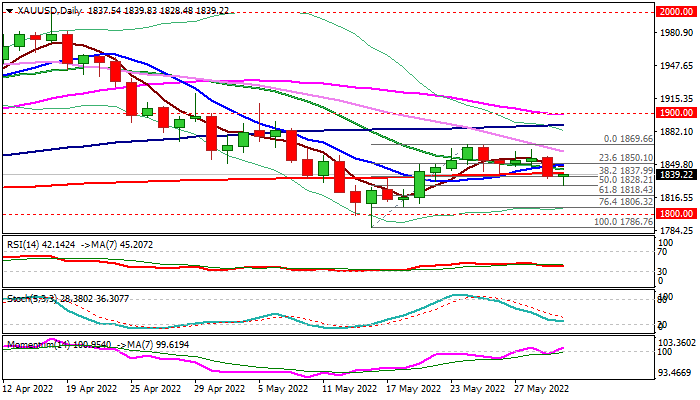
Spot gold remains firmly in red for the second straight day and falls to two-week low on Wednesday, in extension to Tuesday’s 1% drop, pressured by stronger dollar on expectations global inflation concerns could prompt central banks for more aggressive steps in tightening monetary policies.
Markets bet for 0.5% rate rise from the Fed in coming two policy meetings, although the longer-term outlook remains unclear, while inflation in the EU reached new record high, increasing pressure on the ECB to end its ultra-loose policy.
Tuesday’s close below 200DMA brought moving averages into bearish setup on daily chart, with completion of failure swing pattern and retracement of 50% of $1786/$1869 upleg, adding to negative signals, though partially offset by still positive momentum.
Near-term bias is expected to remain with bears while the price action holds below 200DMA ($1840), but bears need further negative signal on close below $1828 (cracked Fibo 50%) to reinforce negative stance. Conversely, bears would lose traction on return and close above 200DMA.
Res: 1840; 1844; 1850; 1862.
Sup: 1828; 1818; 1806; 1800.
EUR/AUD Mid-Day Outlook
Daily Pivots: (S1) 1.4889; (P) 1.4941; (R1) 1.5006; More...
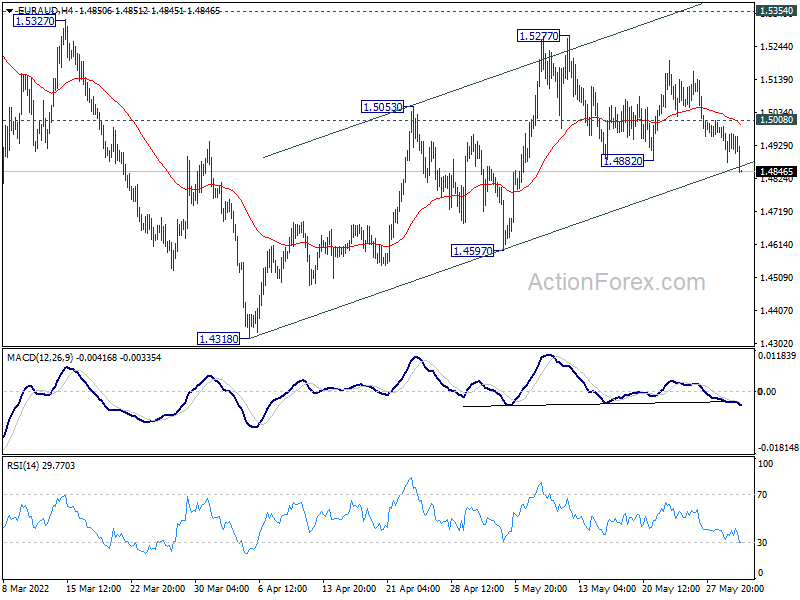
EUR/AUD's fall from 1.5277 resumed by breaking through 1.4882 temporary low, and intraday bias is back on the downside. Corrective rebound from 1.4138 should have completed at 1.5277, ahead of 1.5354 resistance. Break of 1.4597 support will bring retest of 1.4318 low. On the upside, above 1.5008 minor resistance will mix up the outlook and turn intraday bias neutral first.
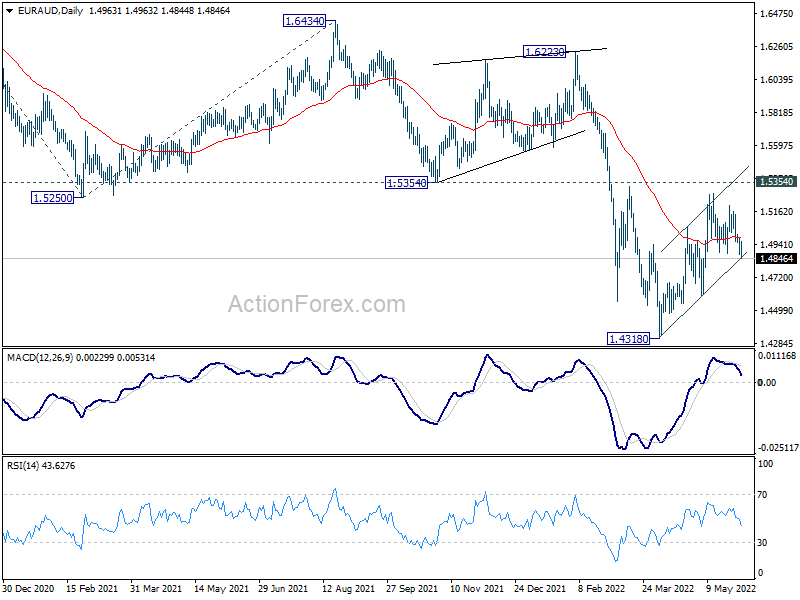
In the bigger picture, as long as 1.5354 support turned resistance holds, larger down trend from 1.9799 (2020 high) is still expected to continue. On resumption, next target is 61.8% projection of 1.9799 to 1.5250 from 1.6434 at 1.3623, which is close to 1.3624 long term support (2017 low). However, firm break of 1.5354 will indicate medium term bottoming and bring stronger rally back to 1.6434 key resistance.
EUR/USD Mid-Day Outlook
Daily Pivots: (S1) 1.0681; (P) 1.0732 (R1) 1.0786; More...
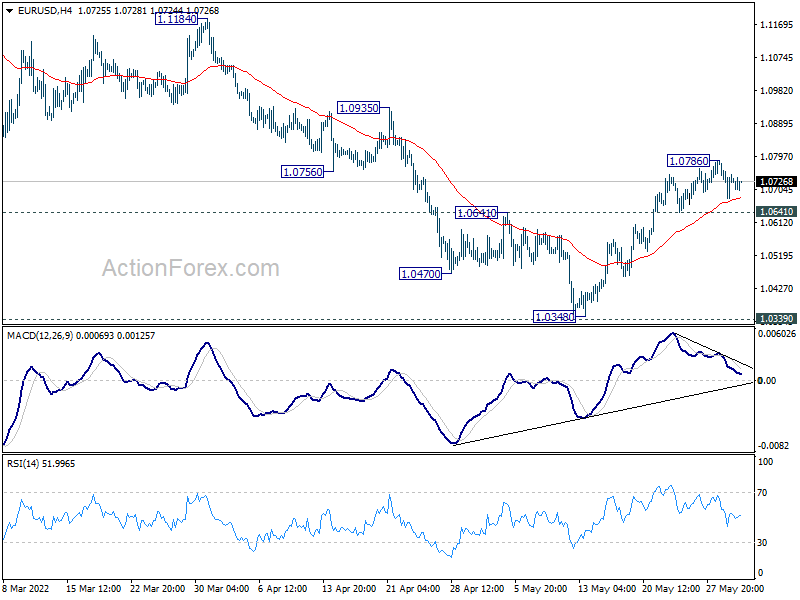
Intraday bias in EUR/USD stays neutral at this point. On the upside, break of 1.0786, and sustained trading above 55 day EMA (now at 1.0757) will target 1.0935 resistance next. On the downside, however, break of 1.641 minor support will indicate rejection by 55 day EMA, and turn bias back to the downside for retesting 1.0348 low instead.
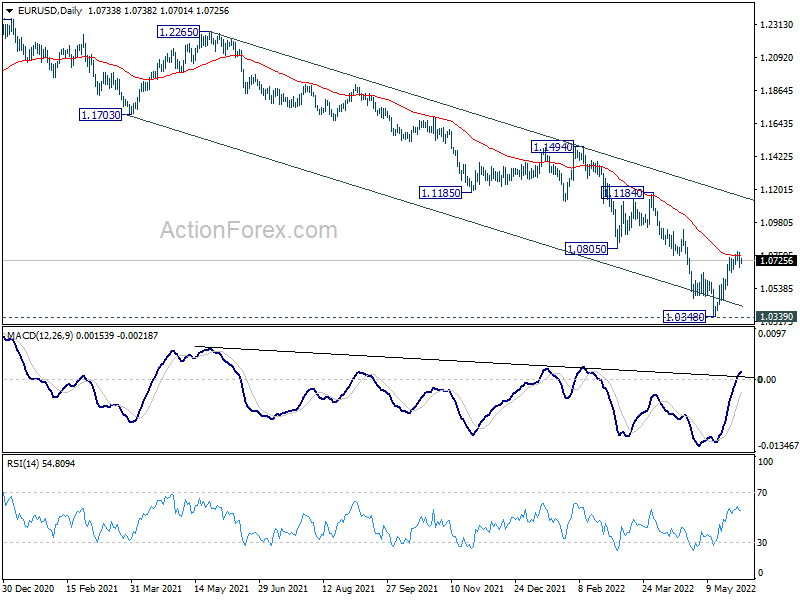
In the bigger picture, focus stays on 1.0339 long term support (2017 low). Decisive break there will resume whole down trend from 1.6039 (2008 high). Next target is 61.8% projection of 1.3993 to 1.0339 from 1.2348 at 1.0090. However, firm break of 1.0805 support turned resistance will delay this bearish case and bring medium term corrective rebound first.
GBP/USD Mid-Day Outlook
Daily Pivots: (S1) 1.2557; (P) 1.2606; (R1) 1.2652; More...
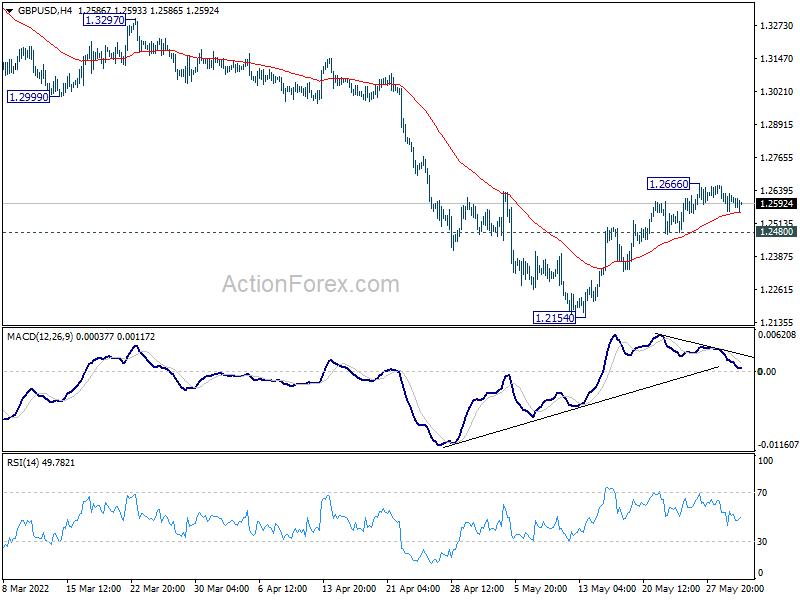
Intraday bias in GBP/USD stays neutral at this point. On the upside, above 1.2666 will resume the rebound from 1.2154. Sustained of 55 day EMA (now at 1.2741) will target 1.2999 support turned resistance. On the downside, though, break of 1.2480 minor support will turn bias back to the downside for retesting 1.2154 low instead.
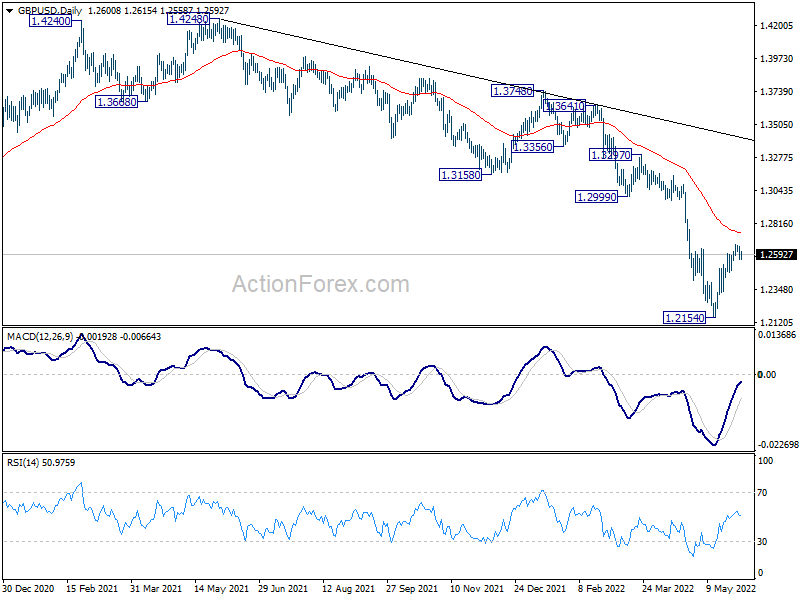
In the bigger picture, fall from 1.4248 (2018 high) could be a leg inside the pattern from 1.1409 (2020 low), or resuming the longer term down trend. Deeper decline is expected as long as 1.2999 support turned resistance holds. On resumption, next target is 1.1409 low.
USD/CHF Mid-Day Outlook
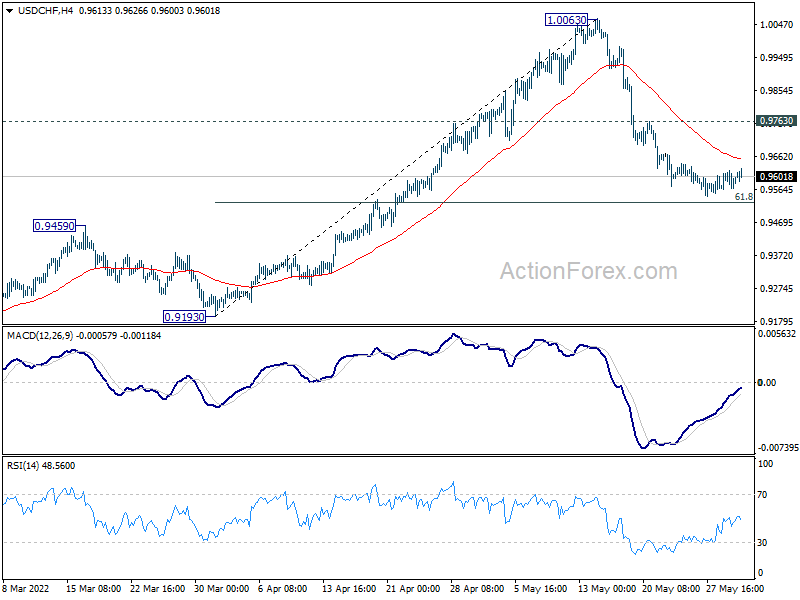
Daily Pivots: (S1) 0.9569; (P) 0.9595; (R1) 0.9625; More...
Outlook is USD/CHF is unchanged. Strong support is still expected at 61.8% retracement of 0.9193 to 1.0063 at 0.9525 to complete the pull back from 1.0063. On the upside, above 0.9763 minor resistance will turn bias back to the upside for retesting 1.0063 high. However, sustained break of 0.9525 will bring deeper decline to 0.9193 support.
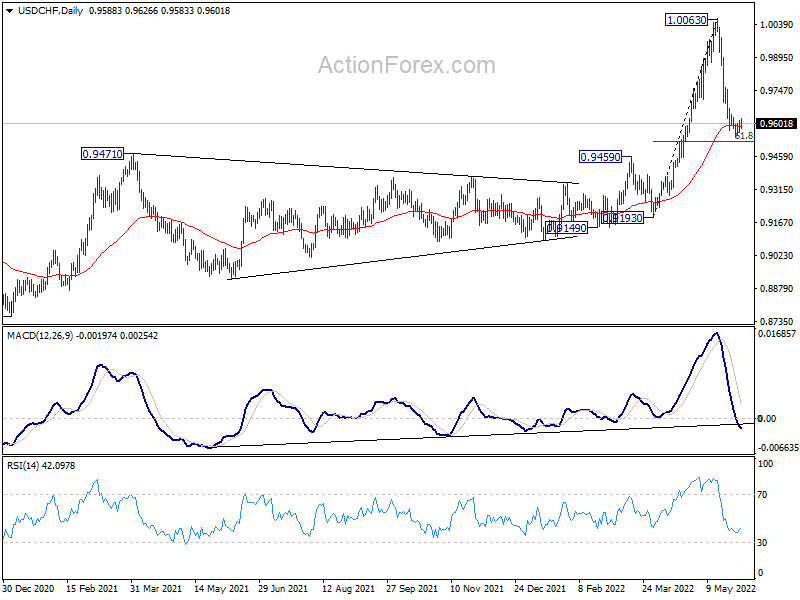
In the bigger picture, down trend from 1.0342 (2016 high) should have completed with three waves down to 0.8756 (2021 low) already. Rise from 0.8756 is likely a medium term up trend of its own. Next target is 1.0237/0342 resistance zone. This will remain the favored case as long as 0.9471 resistance turned support holds. However, sustained break of 0.9471 will extend long term range trading with another falling leg.
USD/JPY Mid-Day Outlook
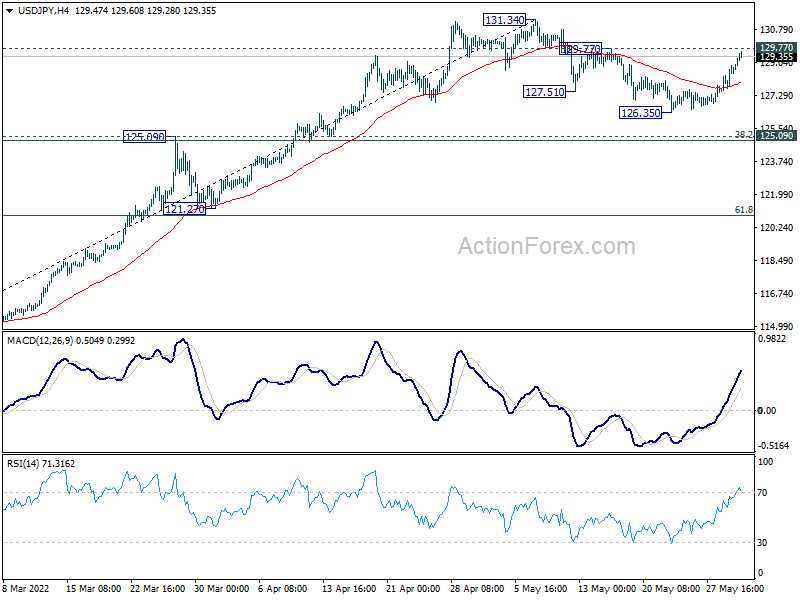
Daily Pivots: (S1) 127.04; (P) 127.43; (R1) 128.00; More...
Focus remains on 129.77 resistance in USD/JPY. Break there should confirm that pull back from 131.34 has completed at 126.35. Larger up trend should be resuming. Further break of 131.34 high will confirm this bullish case. Meanwhile, even if the correction from 131.34 is to extend, downside should be contained by 125.09 cluster support (38.2% retracement of 114.40 to 131.34 at 124.86) to bring rebound.
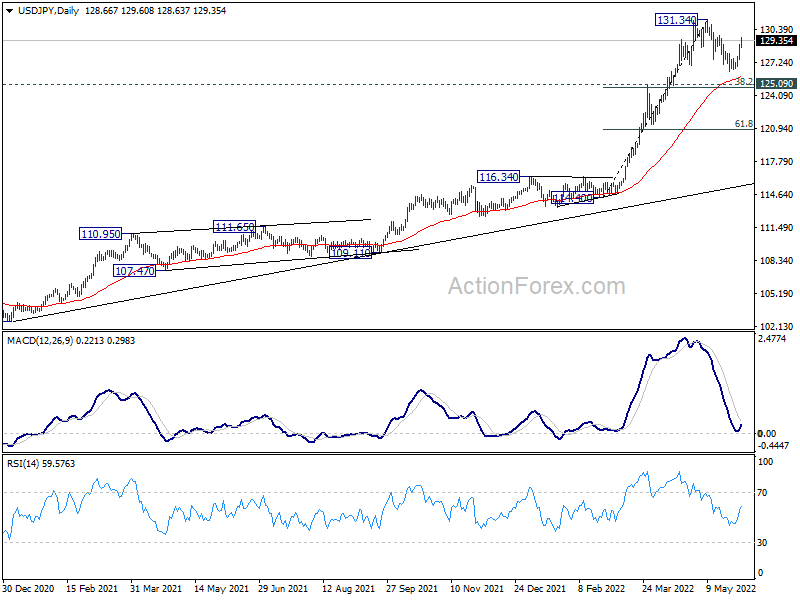
In the bigger picture, current rally is seen as part of the long term up trend form 75.56 (2011 low). Sustained trading above 61.8% projection of 75.56 (2011 low) to 125.85 (2015 high) from 98.97 at 130.04 will pave the way to 100% projection at 149.26, which is close to 147.68 (1998 high). For now, this will remain the favored case as long as 121.27 support holds.
USD/CAD Mid-Day Outlook
Daily Pivots: (S1) 1.2624; (P) 1.2656; (R1) 1.2682; More...
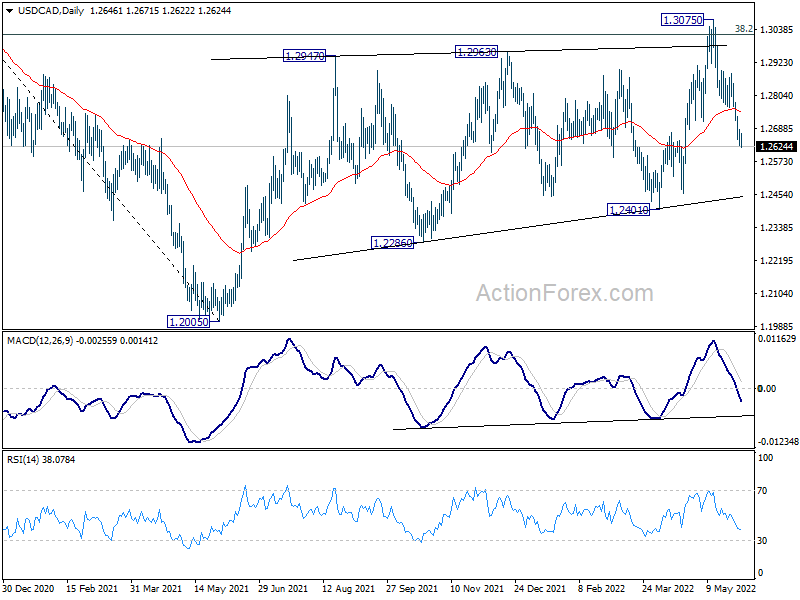
Intraday bias in USD/CAD remains on the downside. Decline from 1.3075 is in progress for 1.2401 support. . Firm break there will argue that whole rebound from 1.2005 has completed. Deeper fall would then be seen to retest this low. On the upside, above 1.2763 minor resistance will mix up the near term outlook and turn intraday bias neutral first.
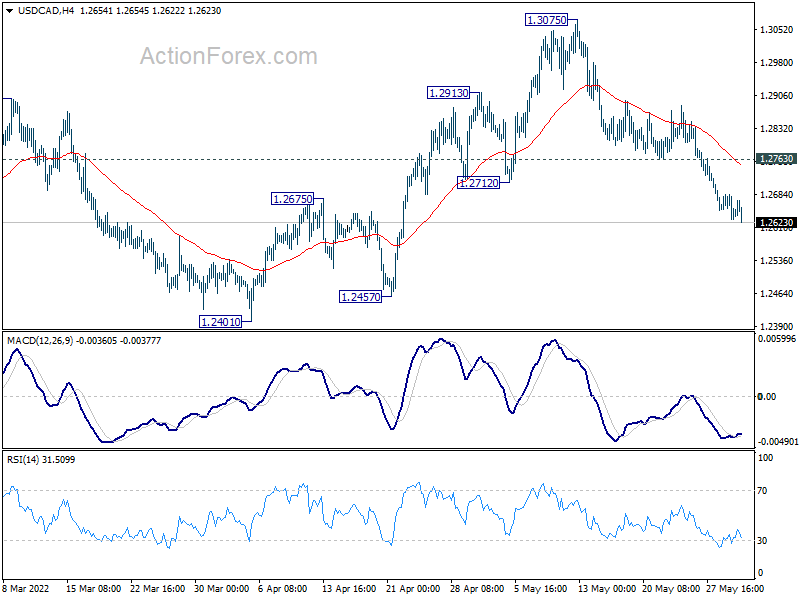
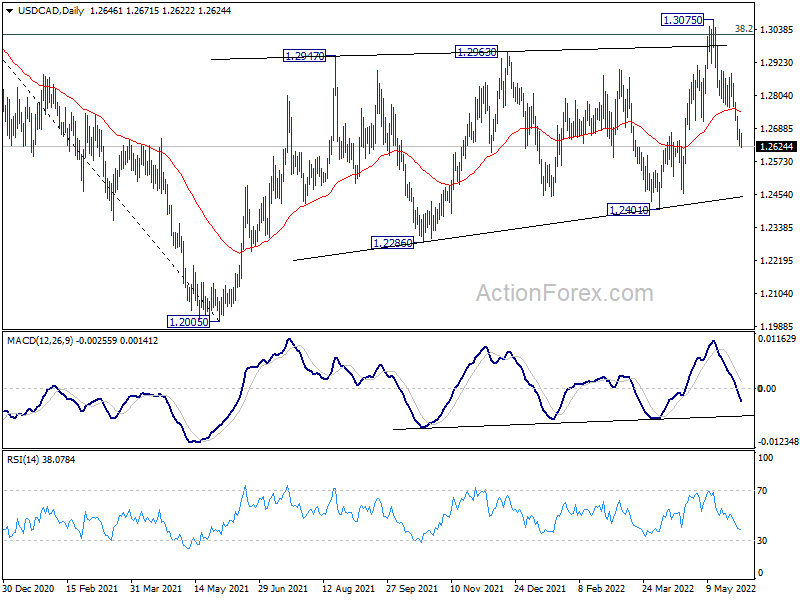
In the bigger picture, focus stays on 38.2% retracement of 1.4667 (2020 high) to 1.2005 (2021 low) at 1.3022. Sustained break there should confirm that the down trend from 1.4667 has completed after defending 1.2061 long term cluster support. Further rise would then be seen towards 61.8% retracement at 1.3650. However, rejection by 1.3022 will maintain medium term bearishness. Break of 1.2005 will resume the down trend from 1.4667 and that carries larger bearish implications too.
Yen Accelerating Down, Aussie Rising With Loonie
Australian Dollar is leading commodity currencies higher again, on the back of positive market sentiment. The Aussie is additionally support by better than expected GDP data, which affirms the case for more RBA rate hike. Canadian Dollar is also firm, awaiting BoC's hawkish rate hike. Yen is the worst performing one, following the rally in treasury yields. European majors are also weak, but by a distant to Yen. Dollar is mixed in the middle and would probably need some very strong non-farm payroll data to revive its strengthen.
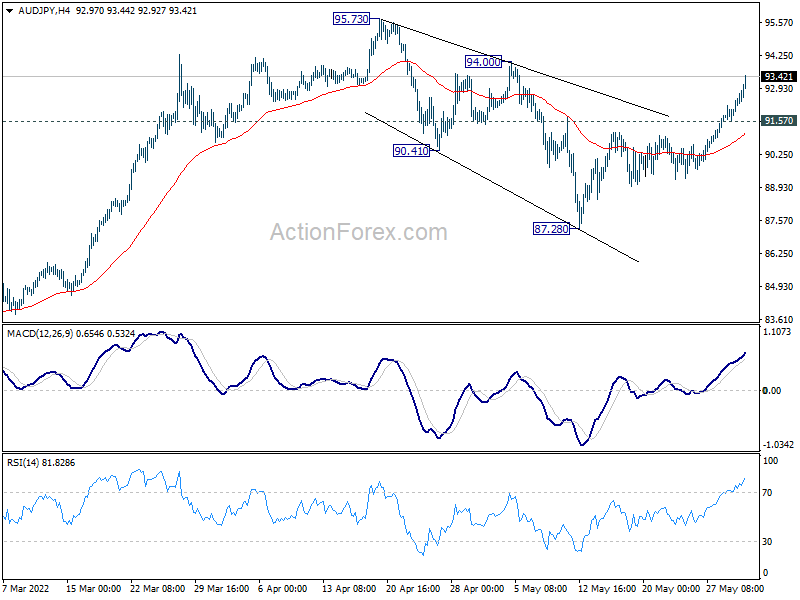
Technically, AUD/JPY's upside acceleration, as seen in 4 hour MACD, affirms the case that it's resuming medium term up trend. Further rally is expected as long as 91.57 minor support holds. Break of 94.00 will add more weight to this case and target 95.73 high and above. At the same time, focus will be on when CAD/JPY would break through 102.93 high to confirm up trend resumption.
In Europe, at the time of writing, FTSE is down -0.11%. DAX is up 0.35%. CAC is up 0.16%. Germany 10-year yield is up 0.0221 at 1.145. Earlier in Asia, Nikkei rose 0.65%. Hong Kong HSI dropped -0.56%. China Shanghai SSE dropped -0.13%. Singapore Strait Times rose 0.36%. Japan 10-year JGB yield dropped -0.0039 to 0.236.
Eurozone unemployment rate unchanged at 6.8%, EU at 6.2%
Eurozone unemployment rate was unchanged at 6.8% in April, above expectation of 6.7%. EU unemployment rate was also unchanged at 6.2%.
Eurostat estimates that 13.264m men and women in the EU, of whom 11.181m in the Eurozone, were unemployed in April 2022. Compared with April 2021, unemployment decreased by 2.543m in the EU and by 2.175m in the Eurozone.
Eurozone PMI manufacturing finalized at 54.6, 18-month low
Eurozone PMI Manufacturing was finalized at 54.6 in May, down from April's 55.5. That's the lowest level in 18 months. Looking at some member states, the Netherlands dropped to 18-month low at 57.8. Austria dropped to 16-month low at 56.6. Ireland dropped to 15-month low at 56.4. France dropped to 7-month low at 54.6. Greece dropped to 14-month low at 53.8. Italy dropped to 18-month low at 51.9. Nevertheless, Germany rose to 2-month high at 54.8.
Chris Williamson, Chief Business Economist at S&P Global Market Intelligence said: "Euro area manufacturers continue to struggle against the headwinds of supply shortages, elevated inflationary pressures and weakening demand amid rising uncertainty about the economic outlook. However, the manufacturing sector's deteriorating health has also been exacerbated by demand shifting to services, as consumers boost their spending on activities such as tourism and recreation.
UK PMI manufacturing finalized at 54.6, companies face a barrage of headwinds
UK PMI Manufacturing was finalized at 54.6 in May, down from April's 55.8. S&P Global said output grew at seven-month low. Consumer goods sector was hit by weaker consumer demand. Input cost and output price inflation remained elevated.
Rob Dobson, Director at S&P Global Market Intelligence, said: "The rate of expansion in UK manufacturing output eased to a seven-month low in May as companies face a barrage of headwinds. Factories are reporting a slowdown in domestic demand, falling exports, shortages of inputs and staff, rising cost pressures and heightened concern about the outlook given geopolitical uncertainties. The consumer goods sector was especially hard hit, as household demand slumped in response to the ongoing cost of living crisis.
"With both input costs and selling prices rising at rates close to April's peaks, the surveys suggest that there is no sign of the inflationary surge abating any time soon. Manufacturers continue to report issues getting the right materials, at the right time for the right price, and energy prices remain a major concern."
BoJ Wakatabe: Necessary to persistently continue with monetary easing
BoJ Deputy Governor Masazumi Wakatabe said in a speech, "since rises in energy and food prices are mainly caused by cost-push factors from abroad, it is desirable to respond to them through measures other than monetary policy."
"Possible options include fiscal policy and energy policy to reduce Japan's dependence on petroleum and natural gas," he added.
For monetary policy, "it is necessary to persistently continue with monetary easing and thereby continue to steadily support the virtuous cycle in the economy and maintain an environment in which wages rise," he said.
"In addition, if downside risks to the economy materialize, the Bank should not rule out taking the necessary additional easing measures without hesitation."
Released from Japan, PMI manufacturing was finalized at 53.3 in May, down from April'2 53.5. S&P Global noted softer expansions in production and incoming new business. Supply chain disruption encouraged firms to bolster safety stocks. Input prices rose at fourth-fastest pace in survey history.
Capital spending rose 3.0% in Q1, below expectation of 3.7%.
China Caixin PMI manufacturing rose to 48.1, still in contraction
China Caixin PMI Manufacturing rose from 46.0 to 48.1 in May, below expectation of 49.4. Caixin said output and new orders both declined at slower rates. Suppliers' delivery times continued to lengthen markedly. Output charges fell, despite further rise in costs.
Wang Zhe, Senior Economist at Caixin Insight Group said: "The negative effects from the latest wave of domestic outbreaks may surpass those of 2020. It's necessary for policymakers to pay attention to employment and logistics. Removing obstacles in supply and industrial chains and promoting resumption of work and production will help to stabilize market entities and protect the labor market. Also, the government should not only offer support to the supply side, but also put subsidies for people whose income has been affected by the epidemic on the agenda."
Australia GDP grew 0.8% qoq in Q1, price deflator highest since 1988
Australia GDP grew 0.8% qoq in Q1, above expectation of 0.6% qoq. GDP also grew 3.3% through the year. Nominal GDP rose 3.7%. The GDP implicit price deflator increased 2.9%, the fastest rate since March quarter 1988.
The terms of trade rose 5.9%, with export (+9.6%) and import prices (+3.5%) both up strongly. Strong demand for Australia's mining and agricultural commodities amidst supply constraints in other producing nations contributed to the rise in export prices.
The domestic final demand implicit price deflator rose 1.4%. This was the strongest growth since the introduction of the Goods and Services Tax, reflecting high levels of demand and increased input costs.
Also from Australia, AiG performance of manufacturing index dropped sharply from 58.5 to 52.4 in may.
USD/CAD Mid-Day Outlook
Daily Pivots: (S1) 1.2624; (P) 1.2656; (R1) 1.2682; More...
Intraday bias in USD/CAD remains on the downside. Decline from 1.3075 is in progress for 1.2401 support. . Firm break there will argue that whole rebound from 1.2005 has completed. Deeper fall would then be seen to retest this low. On the upside, above 1.2763 minor resistance will mix up the near term outlook and turn intraday bias neutral first.
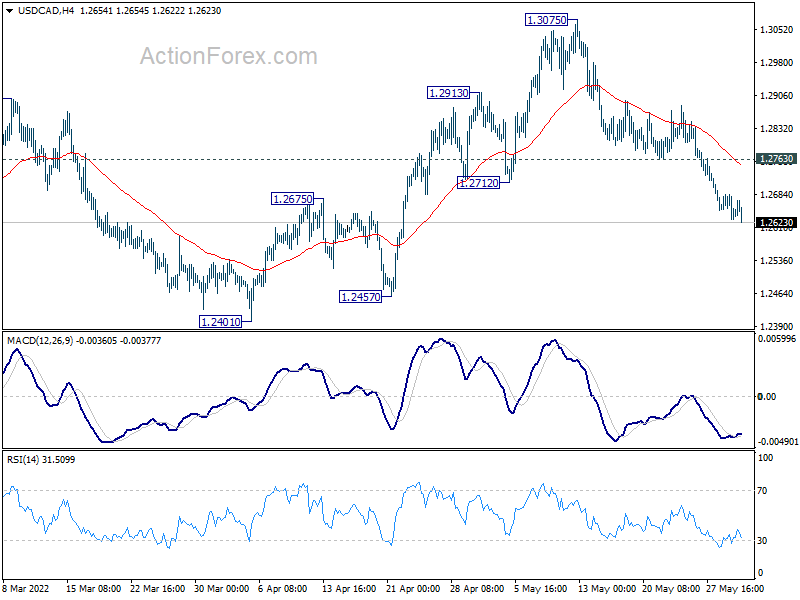
In the bigger picture, focus stays on 38.2% retracement of 1.4667 (2020 high) to 1.2005 (2021 low) at 1.3022. Sustained break there should confirm that the down trend from 1.4667 has completed after defending 1.2061 long term cluster support. Further rise would then be seen towards 61.8% retracement at 1.3650. However, rejection by 1.3022 will maintain medium term bearishness. Break of 1.2005 will resume the down trend from 1.4667 and that carries larger bearish implications too.
Economic Indicators Update
| GMT | Ccy | Events | Actual | Forecast | Previous | Revised |
|---|---|---|---|---|---|---|
| 22:30 | AUD | AiG Performance of Mfg Index May | 52.4 | 58.5 | ||
| 23:01 | GBP | BRC Shop Price Index Y/Y Apr | 2.80% | 2.70% | ||
| 23:50 | JPY | Capital Spending Q1 | 3.00% | 3.70% | 4.30% | |
| 00:30 | JPY | Manufacturing PMI May F | 53.3 | 53.2 | 53.2 | |
| 01:30 | AUD | GDP Q/Q Q1 | 0.80% | 0.60% | 3.40% | |
| 01:45 | CNY | Caixin Manufacturing PMI May | 48.1 | 49.4 | 46 | |
| 06:00 | EUR | Germany Retail Sales M/M Apr | -5.40% | -0.50% | -0.10% | |
| 07:30 | CHF | SVME PMI May | 60 | 61.5 | 62.5 | |
| 07:45 | EUR | Italy Manufacturing PMI May | 51.9 | 53.6 | 54.5 | |
| 07:50 | EUR | France Manufacturing PMI May F | 54.6 | 54.5 | 54.5 | |
| 07:55 | EUR | Germany Manufacturing PMI May F | 54.8 | 54.7 | 54.7 | |
| 08:00 | EUR | Eurozone Manufacturing PMI May F | 54.6 | 54.4 | 54.4 | |
| 08:30 | GBP | Manufacturing PMI May F | 54.6 | 54.6 | 54.6 | |
| 09:00 | EUR | Eurozone Unemployment Rate Apr | 6.80% | 6.70% | 6.80% | |
| 13:30 | CAD | Manufacturing PMI May | 56.2 | |||
| 13:45 | USD | Manufacturing PMI May F | 57.5 | |||
| 14:00 | CAD | BoC Interest Rate Decision | 1.50% | 1.00% | ||
| 14:00 | USD | ISM Manufacturing PMI May | 54.5 | 55.4 | ||
| 14:00 | USD | ISM Manufacturing Prices Paid May | 80.1 | 84.6 | ||
| 14:00 | USD | ISM Manufacturing Employment Index May | 50.9 | |||
| 14:00 | USD | Construction Spending M/M Apr | 0.50% | 0.10% | ||
| 18:00 | USD | Fed's Beige Book |
AUD/USD: Keep Your Eyes Peeled on 0.72664
AUD/USD has had a pretty good run since mid-May. The pair has climbed from a low of 0.68290 on 12 May 2022, breezing past the 2 May swing low of 0.70300 along the way, to reach a high of 0.72039 on 31 May 2022. Retracements on the way up, if any, have been too shallow for words. The Aussie has clearly been benefiting from what has been a more relatively risk positive environment over the prior two weeks.
But the Aussie’s recent shine stretched beyond global risk appetite. Early positive assessments of Australia’s economy were proven correct with Wednesday’s release of Q1 GDP, which showed the economy expanded by a better-than-expected 33.3% y/y. In turn, that will help underpin further interest rate rises from the RBA. A widening in the gap between Australian and US short-dated yields have certainly supportive for AUD/USD.
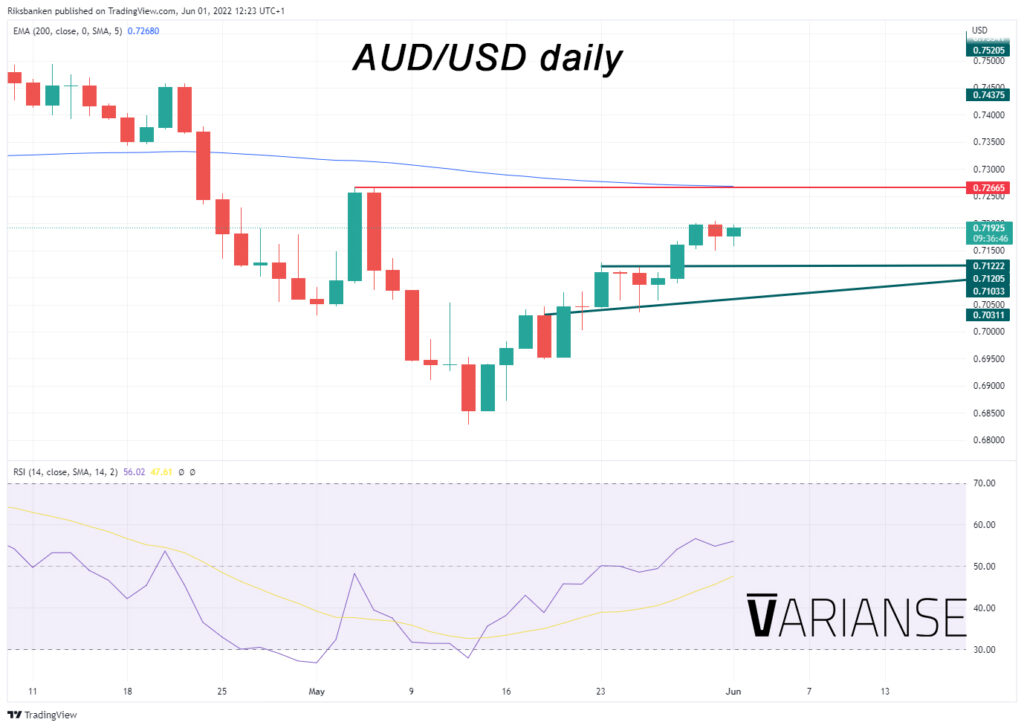
Still, AUD/USD is pushing up toward some seriously basic, but important technical levels. First, there is the last 5 May corrective swing high of 0.72664 from the current downtrend. From a market structure perspective, price would need to pierce this level and establish a new lower high before AUD/USD shift trends. Then, just above, buyers will need to contend with the daily 200 exponential moving average, which stood at 0.72680 at the time of writing.
Buyers should not discount those levels as potential areas of key resistance as price moves higher. Should prices retrace, 0.7122-0.70638, may provide decent levels to re-buy. Meanwhile, a steeper drop may point to more range-bound conditions before a potential continuation of the recent downtrend.
USD/JPY Outlook: Strong Recovery Pressures Psychological 130 Barrier
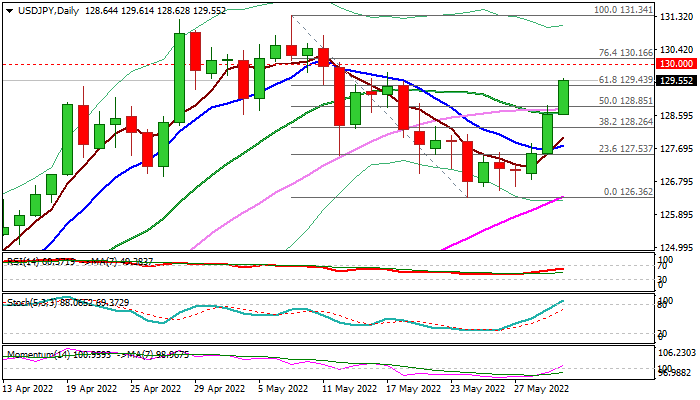
The USDJPY extends strong rise into third straight day, lifted by stronger dollar, divergence in monetary policies as Fed remains hawkish while BoJ maintains ultra-low rates and Japanese importers buying dollar.
Fresh advance cracked pivotal Fibo level at 129.43 (61.8% of 131.34/126.36), generating strong signal of a higher low forming at 126.36 (correction low of May 24) and possible end of corrective phase from 131.34 (May 9 peak, the highest since 2002).
Close above 129.43 Fibo level will confirm signal as bulls pressure psychological 130 barrier, break of which would add to strong bullish stance and open way for full retracement of 131.34/126.36 pullback.
Improved daily techs (10/20/30DMA’s turned to bullish configuration and ascending 14-d momentum broke into positive territory) support the action, also underpinned by rising and thickening daily cloud.
Caution on overbought daily stochastic which suggests that bulls may face headwinds at pivotal 130.00/16 zone (psychological / Fibo 76.4% of 131.34/126.36), but near-term bias is expected to remain bullish while broken 20DMA (128.67), now acting as solid support, holds.
Res: 129.61; 130.00; 130.16; 130.80.
Sup: 128.85; 128.67; 128.36; 127.77.