Sample Category Title
Dollar Profited from Marginal Equity Risk-Off and Rising Yields
Markets
Core bonds were back on offer at the final trading day of the month. US Treasuries underperformed German Bunds on a combination of hawkish Fed speech (Waller), better-than-expected economic data (Chicago PMI, Conference Board consumer confidence) and a general catch-up move after reopening from a long weekend. US yields added 8.1 bps to 10.9 bps with the belly underperforming the wings. Yields in Europe/Germany rose within a range of 5 and 7 bps across the curve, inspired by yet another record EMU inflation print (headline 8.1%, core 3.8% with strong monthly dynamics) for May. Action on bond markets set the tone for equities too. Europe and the US inched 1.36% and about 0.5% lower respectively. Oil prices surged initially by a little less than 3% following Europe’s ban on Russian imports, serving as a common factor pushing up yields further. But a WSJ article triggered a sharp intraday reversal of >4%. The report was about OPEC mulling to exempt Russia from its oil-production targets since the country hasn’t met its quota for several months now. If that were to happen, it could pave the way for the likes of Saudi Arabia and the UAE to pump up significantly more crude. The cartel has its monthly meeting tomorrow. The dollar profited from the marginal equity risk-off and rising yields. Some end-of-month rebalancing after the recent string of USD losses may have been at play too. EUR/USD erased the Monday gains to finish at 1.073. USD/JPY confirmed the bottoming out process with a sharp jump to 128.67. EUR/GBP had no clue what side to pick. The pair closed unchanged in the low 0.85 area.Stock markets in Asian dealings trade mixed. China underperforms after the private manufacturing PMI (48.1) rose less than the official readings had suggested a few days earlier. US bond yields extend their rise though on a more gradual basis. The 10y yield adds 2.5 bps, moving further away from important support at 2.72%. The dollar starts the new month on solid footing. EUR/USD inches further south towards the 1.07 big figure. We think current moves on bond and FX markets set the tone for the rest of the day. On the economic data front, the US kicks off an interesting remainder of the week with the manufacturing ISM (seen easing to 54.5) and JOLTS job openings today, followed by the ADP jobs report tomorrow and culminating on Friday with the official payrolls and the services ISM. The Fed’s monetary policy cycle starts tonight with the release of the Beige Book. Speeches by Lagarde, Lane and Knot all take place right before the quiet period ahead of the June 9 policy meeting begins. It is worth monitoring nevertheless.
News Headlines
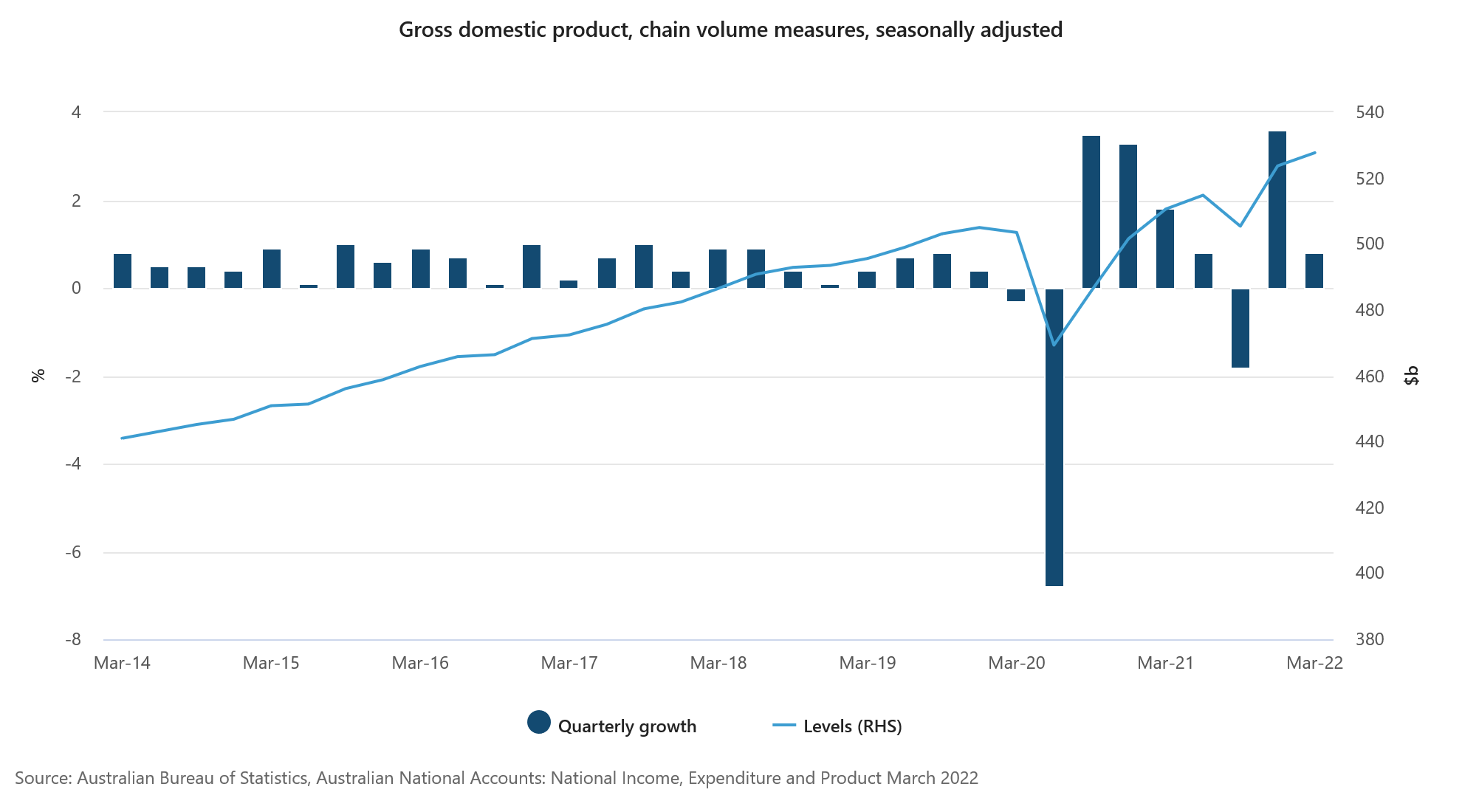
The Australian economy performed well in the first quarter, growing by a bigger-than-expected 0.8% Q/Q and 3.3% Y/Y (was 3.6% Q/Q and 4.4% Y/Y in Q4 last year). Domestic demand was strong, with consumption adding 0.8ppts. Government expenditure also supported growth. The domestic performance was partially eroded by a negative contribution from net exports. The GDP price deflator printed at 2.9% Q/Q, the fastest pace since 1988. The combination of solid domestic demand and rising price pressures supports the case for the RBA to continue its hiking cycle after it raised its policy rate for the first time from 0.1% to 0.35% at the May meeting. Markets discount another 25 bps rate hike at the June 7 meeting. The 3-y Australian government bond yield jumps 8.5 bps this morning. The Aussie dollar is losing marginally (0.7165), but this is mainly due to overall USD strength.
May is Over, But Worries are Here to Stay
May is finally over, but inflation worries, the war, and high energy prices welcome the new month with us.
Yesterday’s meeting between Joe Biden and Jerome Powell reminded investors that inflation is the policymakers’ primary concern, and both Biden and Powell will do anything in their power to fight soaring inflation.
But if only Powell could do something effective! The rising consumer prices are mostly due to the rising energy costs – which are out of Powell’s direct reach.
Oil: The good and the bad
The good news is that the kneejerk reaction in crude oil to European ban of Russian oil imports remained capped near the $120 mark. US crude couldn’t find buyers above the $120 psychological mark, and the latest rally got investors to hurriedly take profit, as a sign that above this level the concerns about the negative impact on demand takes over - despite the news that Shanghai is free after two-month lockdown.
The bad news is, Russia started cutting off the gas of more European countries as a response to the European ban on its oil exports, pointing that they refused to pay the Russian gas in rubles. Gazprom stopped providing oil to Netherlands and Denmark, and dropped a small contract to Germany as well, according to Bloomberg news. The latter pushed the European gas futures up by about 2.5% yesterday, but the fact that we are entering the summer months, where the need for heating will be much less, is temporarily good news. I say ‘temporarily’ because losing the Russian energy, watching OPEC do nothing to increase production, and China reopening will likely throw a floor under any selloff in oil prices, and should keep the downside potential limited. The major support to the actual rally is the 50-DMA level, a touch below the $107 per barrel.
Futures point at positive start to June
US futures hint at a positive start to the month, but the gains are vulnerable to inflation fears, geopolitical tensions, and the positive pressure in energy prices.
In the FX, we see the US dollar rebound with higher US yields. The dollar index rebounded back above the 102 mark this morning, but the upside potential will likely remain limited from here, as 1. the hawkish Federal Reserve (Fed) expectations are fully priced in, the US 10-year breakeven inflation rate fell to 2.6% from 3% earlier this year, meaning that investors have more confidence in Fed’s ability to tame inflation without getting more aggressive on actual policy, and 2. other central banks are also tightening… or thinking about tightening (yes, I am looking at you, Christine!)
Today, the Bank of Canada(BoC) will likely raise its overnight rate by 50bps to 1.50%. The dollar-CAD slipped below its 200-DMA this week, and has potential to extend losses to at least toward the 1.2550 without even damaging the medium-term positive trend. Tighter BoC, high energy prices and improved balance of payments suggest a stronger Loonie in the medium run.
Fed Starts QT and ECB Slows QE
Market movers today
Today focus will be on a range of PMI data released throughout the day. Manufacturing PMIs will be released for Sweden and Norway in the morning, followed by the revised final figures for the Euro Area. In the afternoon, US ISM Manufacturing PMI is expected to decline following the weak Flash Markit reading last week. We will also get the US ADP private sector employment report for May, as well as the US Job Openings and Labor Turnover Survey (JOLTS) for April.
Bank of Canada will have a monetary policy meeting and we expect a 50bp hike, which is fully priced in by the markets. We will also have several central bank speakers on the wires, including ECB's Lagarde and Lane as well as Fed's Williams and Bullard.
Today, ECB will scale back its net APP purchases to EUR20bn for June, and Fed will commence its QT phase. ECB and the EU are set to publish assessments of Croatia's bid to join the euro next year.
The 60 second overview
Euro area inflation for May surprised on the upside, even of the revised expectations after the country releases on Monday. Euro area headline came in at 8.1% vs. 7.5% in April, while core printed at 3.8% from 3.5% prev. The seasonally adjusted monthly change was still around 0.5%, and no peak in sight, and given the recent dynamics we see core inflation peaking after summer. Yesterday's print naturally puts ECB under tough pressure, raising the market speculation of a 50bp rate hike coming in July. After the report, Kazimir said that he backed a 25bp hike in July but was open to discuss 50bp. The drivers of the euro area inflation came from energy as it rose 39.2% yoy while the food rose 7.5%.
Oil: Oil prices surged through the day to USD120bbl (WTI), until media reported that OPC members are looking into the possibility of exempting Russia's contribution, which all things equal opens the possibility for more oil to come to the market. Tomorrow, the OPEC countries will meet. Oil markets reacted strongly and dropped to USD115bbl.
Chinese Caixin Manufacturing PMI followed suit to the official PMI released a day earlier with a small uptick, but still remains in the sub-50 territory at 48.1
Biden and Powell met yesterday where Biden highlighted the objective to address inflation and ensuring its independence. Yellen also admitted that she underestimated the inflation risks and pressure already last year, but is aware of the repercussions now.
FI: The record European (core and headline) inflation print for May sent European rates on a bear steepening path as mounting pressure for ECB to hike 50bp in July increased. Bunds touched 1.12% which is the highest since 2014 (with the exception of a brief 2-day period in early May). Notably Italian spreads jumped on the inflation report, despite a solid Italian auction. US yields jumped 10bp, as a catch up to Monday's sell-off in EGBs.
FX: Persistently high oil prices could tempt some OPEC+ members to push for higher production. Our case for a temporary boost to NOK got more support yesterday with Norges Bank announcing a drop in the daily fiscal NOK sales. Risks are tilted towards further TRY weakness.
Credit: Yesterday, credit markets reversed to a risk-off tone after a few constructive sessions. The uncertainty was fuelled by accelerated and record-high Euro-zone inflation numbers in May that exceed the consensus estimate. ITraxx Main widened by 3.1bp to close at 87.5bp, while Xover widened 16.9bp to close at 437.4bp.
Asia Gets No Shanghai Surprise
Asian markets are trading with a negative tone today, with the ending of virus restrictions in Shanghai today having little to no positive impact. Mostly that is due to the flip-flop of the day in US markets, which reopened overnight. New York decided overnight to be nervous about Fed tightening once again, having dismissed it last week. Tomorrow, they may decide it's not a problem once again, who knows.
Either way, the Fed’s Waller’s hawkish remarks on Monday and the start of quantitative tightening this week by the Fed prompted Wall Street to close slightly lower after US yields rose, after a few sessions of sideways trading. That also saw some modest US Dollar strength while gold moved lower in another session of unconvincing price action
With Wall Street setting a negative tone for Asia, Manufacturing PMIs from across the region did nothing to lift the tone. China’s Caixin Manufacturing PMI rose slightly from April, the May number climbing to 48.1. Partial reopenings in China have seen the official and Caixin PMIs rebound slightly this week, but not enough to push them into expansionary territory once again.
Notably, May Manufacturing PMIs from Australia, Malaysia, Taiwan, Thailand, and the Philippines all fell from April. Although mostly expansionary, one cannot but conclude that China’s slowdown is finally permeating regional economies. The only exception was Vietnam, long a China alternative. Manufacturing PMI rose to 54.7 from 51.9 previously. So a combination of soft PMIs and a negative Wall Street session are dampening Asian sentiment today.
Much has been made of the ending of Shanghai virus restrictions today, with many seeming to think it offers an instant panacea to an Asian slowdown. Unfortunately, I must add a word of caution here. China’s covid zero strategy has not suddenly gone away, the opposite in fact. And as other countries with covid zero strategies have found out, the country needs to get lucky 100% of the time, the virus only needs to get lucky only once. Any returning outbreaks in Beijing or Shanghai or Shenzhen etc, will put China back to square one.
One potential piece of good news for markets comes from OPEC+, who never cease to amaze me with their ability to surprise us sometimes. Late in New York, a story started circulating that OPEC might exempt Russia from the production quota agreement at the OPEC+ meeting tomorrow. That slack being taken up by other producers, although realistically, that means Saudi Arabia and the UAE. The potential for higher output making up for lost Russian oil saw crude prices fall by 5.0% overnight. All eyes will be on the OPEC+ meeting tomorrow for confirmation.
Looking ahead, Asia’s data calendar is now dead with German Unemployment and UK Nationwide House Prices holding the most interest for markets this afternoon. Overnight, French GDP contracted QoQ for Q1, with inflation rising. Italian GDP narrowly avoided a Q1 contraction, but inflation also rose. It highlights the difficult position the ECB finds itself in as stagflation, exacerbated by the Ukraine conflict, makes its presence felt in Europe. There are no good choices for a central bank in this situation, and although the ECB will probably ramp rates up to errrr… zero per cent, the increasingly dark economic picture is likely to limit EUR/USD gains. One piece of good news though would be if the OPEC Russia exemption story is correct.
Tonight, the US releases May ISM Manufacturing PMI and the JOLTs Job Openings for April. Manufacturing PMI should retreat slightly from April’s 55.4 but remains expansionary. And unless the JOLTs data tumbles massively and prints under 11.0 million jobs (11.4 exp), neither number if likely to move markets. The move higher by US yields, should it continue this evening, is going to have far more impact. Otherwise, US markets, and by default, global markets, will still indulge in schizophrenic swings in market sentiment as the FOMO dip-buyers become increasingly frantic in their attempts to pick a cyclical low in equity markets.
Asian are mostly lower
Weakening Manufacturing PMI data from across the Asia-Pacific, combined with a low close on Wall Street, sees most of Asia trading in the red today, ignoring the bounce in US index futures this morning. Overnight, a rise in US yields saw the S&P 500 finish 0.63% lower, the Nasdaq lost 0.41%, with the Dow Jones easing by 0.57%. In Asia, US futures have rebounded on thin volumes, S&P 500 and Nasdaq futures rising by 0.30%, while Dow Jones futures have unwound overnight losses, rising 0.60% and suggesting month-end flows played their part in the overnight retracement.
With most of Asia in the red, one exception is Japan where the Nikkei 225 has risen by 0.65% today. The rise in US yields overnight inspired a bout of Yen weakness, which notionally, will improve exporter performance. In a similar vein, the Kospi is also 0.60% higher, although the Shanghai reopening may be playing a greater part in that rally.
In China, the contractionary Caixin Manufacturing PMI has drowned out any Shanghai reopening peace dividend, the Shanghai Composite and CSI 300 are both down 0.10%, while Hong Kong is 0.20% lower. Regional markets are also lower, although Singapore has managed to rise by 0.50% today. Elsewhere, Taipei is down by 0.55%, Kuala Lumpur is down 0.80%, Bangkok is 0.20% lower, and Manila has fallen by 0.60%. Jakarta is closed for a holiday. In Australia, the All Ordinaries has eased 0.10%, while the ASX 200 has risen by 0.10%.
A nondescript Asian session will not provide much lead for European markets, which headed lower overnight on stagflationary data and as Russia cut of natural gas supplies to Denmark, the Netherlands, and a small importer in Germany over rouble payments. Today, however, Europe should get a boost from the OPEC Russia production quota exemption story.
US markets, as ever, remain a turkey shoot. Today they might be nervous about US inflation and Fed tightening, or they may not.
Higher US yields lift US Dollar
Currency markets continued to trade in a choppy, but ultimately consolidative range overnight and this morning. Higher US yields overnight allowed the US Dollar to be ascendant, the dollar index rising 0.48% to 101.78, having probed above 102.00 intraday. The dollar index has added 0.14% to 101.93 this morning. It remains in a broad range between support/resistance at 101.00 and 102.50.
EUR/USD fell on a stronger US Dollar and weak data overnight, finishing 0.44% lower at 1.0730. It has eased another 0.13% to 1.0718 in Asia, having dipped below 1.0700 intraday overnight. EUR/USD is struggling to find the momentum to challenge resistance at 1.0800 and 1.0830. The job will become harder if US yields continue climbing, although lower oil prices would be supportive. Support is at 1.0680 and 1.0640
GBP/USD eased by 0.42% to 1.2605 overnight, taking out support at 1.2600 intraday. It has fallen to 1.2595 this morning and has traced out a decent top at 1.2670 for now. The fragile economic situation in the UK likely means we have seen the best of the Sterling rally for now, especially if the US Dollar has bottomed. Support is now at 1.2540 followed by 1.2500.
The overnight price action on USD/JPY highlighted unequivocally that the US/Japan rate differential is the primary driver of USD/JPY price action. Rising US yields overnight provoked an immediate response in USD/JPY, which rallied sharply by 0.85% to 128.70, rising another 0.40% to 129.20 in today’s session. USD/JPY is now well clear of its previous descending trendline resistance at 127.30, and if US yields rise in New York later today, it may well test 130.00.
AUD/USD and NZD/USD both eased slightly overnight, with NZD/USD disproportionately impacted as economic slowdown fears ratchet higher. NZD/USD has lost around 1.0% in the last 24 hours to 0.6490 today. Having traced out a series of tops at 0.6560, support lies at 0.6450. AUD/USD is only modestly lower today, implying a fair amount of AUD/NZD buying is going through the market. It continues to consolidate in a 0.7150 to 0.7200 range.
Nothing much is happening in the USD/Asia space today. Firmer US yields, and thus, a firmer US Dollar, saw Asia currencies reverse most of the previous day’s gains, with the Malaysian Ringgit, once again, a notable underperformer, as was the Thai Bhat yesterday after weak data. With the PBOC setting neutral USD/CNY fixes over the last few sessions, the consolidation of USD/Asia looks set to continue. Weak PMI figures from across the region have seen further weakness today, but it will be the direction of the US bond market that will ultimately dictate whether the Asian currency sell-off is set to resume, or not.
OPEC+ rumours sink crude prices
The announcement of the partial EU ban on Russian crude imports was a mild tailwind yesterday, but by and large, looked to have been already priced into markets. What did surprise markets was a Wall Street Journal article suggesting that OPEC might exempt Russia from the production quota agreement at tomorrow’s OPEC+ meeting. Although its impact on WTI was minimal in context, Brent crude, the internationally traded benchmark, plummeted by 4.50% to close at $116.10 a barrel, while WTI only finished 2.0% lower at $115.25.
The internal politics of OPEC+ makes the Game of Thrones look like a teddy bears picnic, and there are a couple of ways one could interpret the WSJ story. Firstly, it is an eminently sensible move by OPEC given that a sanctioned Russia has no hope of meeting its production commitments anyway, better to let the rest of the group make up the deficit and earn brownie points with the rest of the world. Or, OPEC has become upset with Russia for selling crude oil at massive discounts to India, China and others, undermining OPEC members' market share. The other variable, if the story is correct, is did Russia agree to it, or was it imposed by OPEC on the plus in OPEC+?
All will be revealed tomorrow at OPEC+’s meeting I suppose. Realistically, only Saudi Arabia, the UAE, and perhaps Iraq, can rapidly increase production, as the rest of the group can’t meet their present quotas, let alone larger redistributed ones. If Russia has agreed to this course of action, it would weigh on oil prices, rebalancing supply, and demand but not enough to send Brent crude back through $100.00 a barrel. If this outcome was imposed on Russia, which disagreed with it, that implies a major fracture in OPEC+ unity. That would be a much more bearish development for oil prices. My belief is that Russia has agreed to this course, or the story is incorrect. Any other outcome appears to mean OPEC shoots itself in the foot.
Either way Brent crude is now eight dollars lower than yesterday’s $124.00 a barrel high, having slipped by 0.30% in Asia through support at $116.00 to $115.90. Failure of $115.00 could see a capitulation to $112.00. WTI tested $120.00 a barrel overnight, before falling five dollars to $115.25. The $120.00 region is a clear resistance level now and failure of $113.00 could see WTI tumble towards $108.00 a barrel.
The next 36 hours in oil markets are looking rather tasty from a volatility point of view, despite already seeing huge overnight session ranges. The OPEC+ meeting, based on the WSJ article, has now transformed from the monthly business-as-usual event, to a potential structural turning point for oil markets.
Gold is in trouble
As I warned yesterday, the real test of gold’s resilience would be if it held firm in the face of US Dollar strength and rising US yields again. On both counts, it failed overnight, as just that situation sent gold 1.0% lower to $1837.50 an ounce. In Asia, gold has eased again as the US Dollar moves higher, falling 0.22% to $1833.50 an ounce. Gold’s inability to weather the most modest US Dollar strength bodes ill and reinforces my fear that its recovery from $1780.00 has been built on sandy foundations.
Gold now has resistance at $1840.00, previous support and the 200-day moving average. (DMA) That is followed by $1860.00 and $1870.00 an ounce. If US Dollar strength persists, and US yields continue rising, gold is increasingly at risk a retest of $1800.00 and then $1780.00 an ounce. Failure of $1780.00 signals a deeper, and possibly disorderly fall to $1700.00 an ounce.
USD/CAD Daily Outlook
Daily Pivots: (S1) 1.2624; (P) 1.2656; (R1) 1.2682; More...
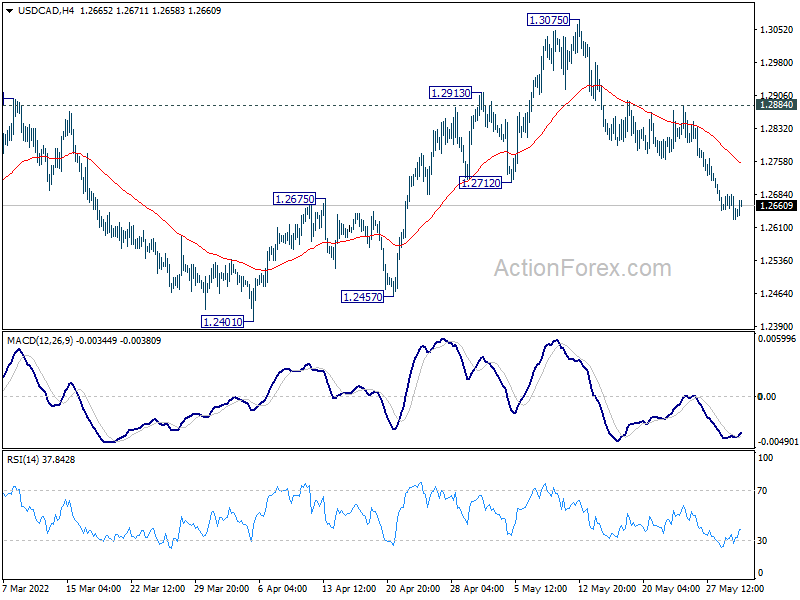
USD/CAD's fall from 1.3075 is still in progress and intraday bias stays on the downside for 1.2401 support. Firm break there will argue that whole rebound from 1.2005 has completed. Deeper fall would then be seen to retest this low. On the upside, though, above 1.2884 minor resistance will revive near term bullishness and turn bias back to the upside for 1.3075 high.
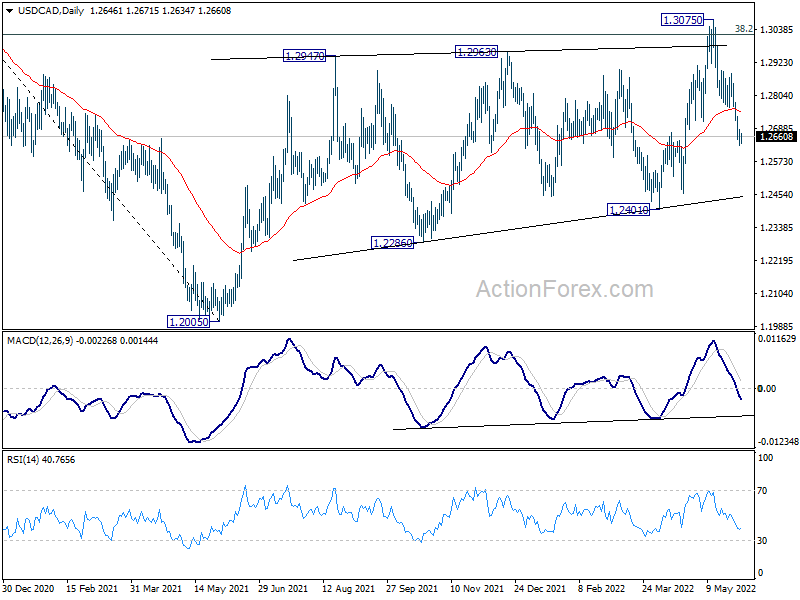
In the bigger picture, focus stays on 38.2% retracement of 1.4667 (2020 high) to 1.2005 (2021 low) at 1.3022. Sustained break there should confirm that the down trend from 1.4667 has completed after defending 1.2061 long term cluster support. Further rise would then be seen towards 61.8% retracement at 1.3650. However, rejection by 1.3022 will maintain medium term bearishness. Break of 1.2005 will resume the down trend from 1.4667 and that carries larger bearish implications too.
USD/JPY Rises Strong as Yield Rebounds, CAD Firm ahead of BoC
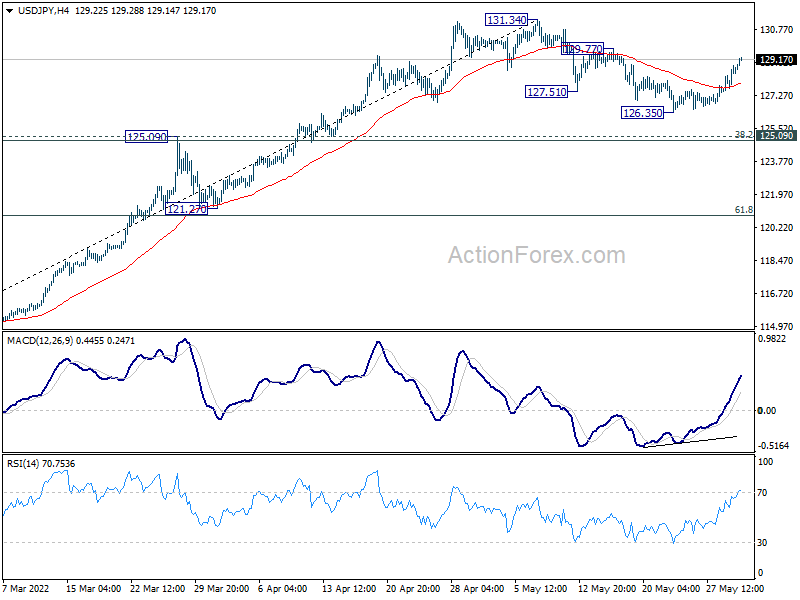
Strong rally in USD/JPY is the main focus in Asian session today, following the strong rebound in benchmark US treasury yields. Yen is also staying as the weakest one. But for now, Canadian Dollar and Australian Dollar are both stronger than the greenback. The Loonie's rally slowed some what as WTI crude oil was rejected by 120 handle. But there is still upside prospect as hawkish BoC rate hike is awaited.
Technically, EUR/JPY's break of 138.33 resistance and GBP/JPY's break of 161.83 resistance both indicate more upside for retesting recent highs at 139.99 and 168.40 respectively. A focus will also be on 129.77 resistance in USD/JPY. Firm break there will affirm the case of broad based up trend resumptions in Yen pairs.
In Asia, Nikkei closed up 0.65%. Hong Kong HSI is down -0.83%. China Shanghai SSE is down -0.35%. Singapore Strait Times is up 0.38%. Japan 10-year JGB yield is down -0.0042 at 0.236. Overnight, DOW dropped -0.67%. S&P 500 dropped -0.63%. NASDAQ dropped -0.41%. 10-year yield rose 0.101 to 2.743.
Fed Bostic: There could be significant reduction in inflation this year
Atlanta Fed President Raphael Bostic said yesterday that a pause in tightening in September might be a good idea, because market responses had been "far stronger than what we've historically seen." "I want to make sure I truly understand the pace of change that's associated with our policy response," Bostic said.
By September, some of the uncertainty over the economy could be resolved. Bostic expected that could lead to a "pretty significant reduction in inflation."
Yet, he's "fully comfortable" to raise interest rates above neutral if inflation doesn't come down. "The goal is to get inflation down. We've got to really tackle it in an intentional, persistent way," he said. "I want to be open to both possibilities."
BoJ Wakatabe: Necessary to persistently continue with monetary easing
BoJ Deputy Governor Masazumi Wakatabe said in a speech, "since rises in energy and food prices are mainly caused by cost-push factors from abroad, it is desirable to respond to them through measures other than monetary policy."
"Possible options include fiscal policy and energy policy to reduce Japan's dependence on petroleum and natural gas," he added.
For monetary policy, "it is necessary to persistently continue with monetary easing and thereby continue to steadily support the virtuous cycle in the economy and maintain an environment in which wages rise," he said.
"In addition, if downside risks to the economy materialize, the Bank should not rule out taking the necessary additional easing measures without hesitation."
Released from Japan, PMI manufacturing was finalized at 53.3 in May, down from April'2 53.5. S&P Global noted softer expansions in production and incoming new business. Supply chain disruption encouraged firms to bolster safety stocks. Input prices rose at fourth-fastest pace in survey history.
Capital spending rose 3.0% in Q1, below expectation of 3.7%.
China Caixin PMI manufacturing rose to 48.1, still in contraction
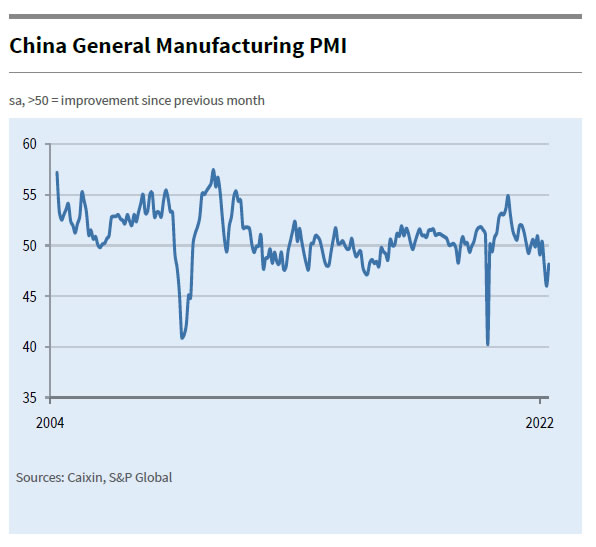
China Caixin PMI Manufacturing rose from 46.0 to 48.1 in May, below expectation of 49.4. Caixin said output and new orders both declined at slower rates. Suppliers' delivery times continued to lengthen markedly. Output charges fell, despite further rise in costs.
Wang Zhe, Senior Economist at Caixin Insight Group said: "The negative effects from the latest wave of domestic outbreaks may surpass those of 2020. It's necessary for policymakers to pay attention to employment and logistics. Removing obstacles in supply and industrial chains and promoting resumption of work and production will help to stabilize market entities and protect the labor market. Also, the government should not only offer support to the supply side, but also put subsidies for people whose income has been affected by the epidemic on the agenda."
Australia GDP grew 0.8% qoq in Q1, price deflator highest since 1988
Australia GDP grew 0.8% qoq in Q1, above expectation of 0.6% qoq. GDP also grew 3.3% through the year. Nominal GDP rose 3.7%. The GDP implicit price deflator increased 2.9%, the fastest rate since March quarter 1988.
The terms of trade rose 5.9%, with export (+9.6%) and import prices (+3.5%) both up strongly. Strong demand for Australia's mining and agricultural commodities amidst supply constraints in other producing nations contributed to the rise in export prices.
The domestic final demand implicit price deflator rose 1.4%. This was the strongest growth since the introduction of the Goods and Services Tax, reflecting high levels of demand and increased input costs.
Also from Australia, AiG performance of manufacturing index dropped sharply from 58.5 to 52.4 in may.
CAD/JPY ready for up trend resumption as BoC hike awaited
BoC is widely expected to raise the Overnight Rate by another 50bps to 1.50% today. Governor Tiff Macklem had recently noted that interest rates may need to go above the neutral range, estimated to be between 2% and 3%. Thus BoC should indicate that more tightening is still on the way. But Macklem would probably wait at least until July's monetary policy report before talking about how high rates would top.
Some previews on BoC:
- BoC Policy Meeting: Stick to the Guidance for Now
- Forward Guidance: Bank of Canada to Hike Rates Again as Economy Runs Hot
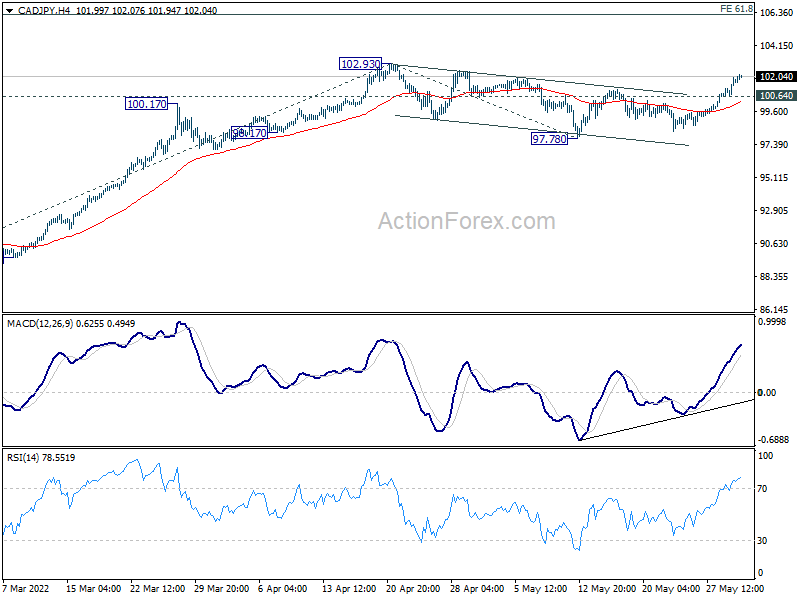
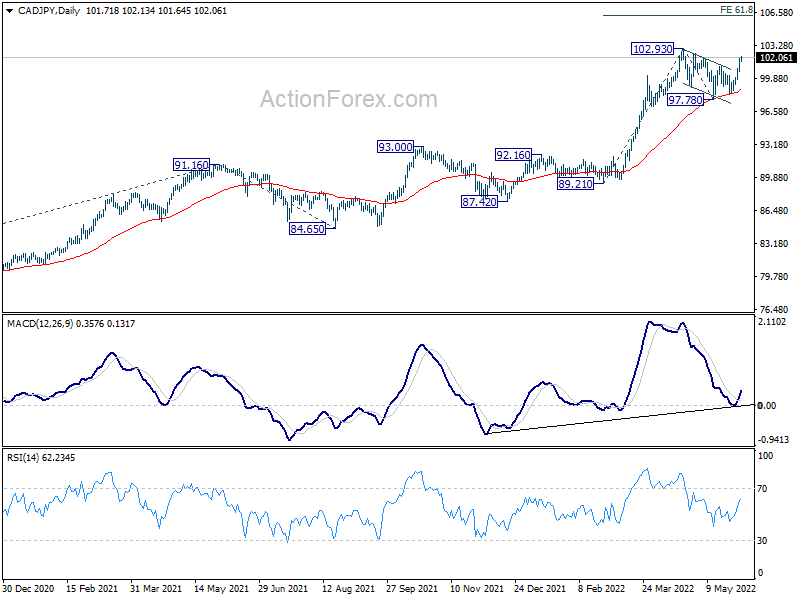
CAD/JPY's strong rally this week suggests that correction from 102.93 has completed at 97.78 already, after drawing support from 55 day EMA. Further rise is now expected as long as 100.64 minor support holds. Firm break of 102.93 will resume larger up trend and target 61.8% projection of 89.21 to 102.93 from 97.78 at 106.25.
Looking ahead
Swiss PMI, Eurozone PMI manufacturing final and unemployment rate, UK PMI manufacturing final will be released in European session.
Later in the day, BoC rate hike is the main focus. US will release ISM manufacturing and Fed's Beige Book report.
USD/CAD Daily Outlook
Daily Pivots: (S1) 1.2624; (P) 1.2656; (R1) 1.2682; More...
USD/CAD's fall from 1.3075 is still in progress and intraday bias stays on the downside for 1.2401 support. Firm break there will argue that whole rebound from 1.2005 has completed. Deeper fall would then be seen to retest this low. On the upside, though, above 1.2884 minor resistance will revive near term bullishness and turn bias back to the upside for 1.3075 high.
In the bigger picture, focus stays on 38.2% retracement of 1.4667 (2020 high) to 1.2005 (2021 low) at 1.3022. Sustained break there should confirm that the down trend from 1.4667 has completed after defending 1.2061 long term cluster support. Further rise would then be seen towards 61.8% retracement at 1.3650. However, rejection by 1.3022 will maintain medium term bearishness. Break of 1.2005 will resume the down trend from 1.4667 and that carries larger bearish implications too.
Economic Indicators Update
| GMT | Ccy | Events | Actual | Forecast | Previous | Revised |
|---|---|---|---|---|---|---|
| 22:30 | AUD | AiG Performance of Mfg Index May | 52.4 | 58.5 | ||
| 23:01 | GBP | BRC Shop Price Index Y/Y Apr | 2.80% | 2.70% | ||
| 23:50 | JPY | Capital Spending Q1 | 3.00% | 3.70% | 4.30% | |
| 00:30 | JPY | Manufacturing PMI May F | 53.3 | 53.2 | 53.2 | |
| 01:30 | AUD | GDP Q/Q Q1 | 0.80% | 0.60% | 3.40% | |
| 01:45 | CNY | Caixin Manufacturing PMI May | 48.1 | 49.4 | 46 | |
| 06:00 | EUR | Germany Retail Sales M/M Apr | -5.40% | -0.50% | -0.10% | |
| 07:30 | CHF | SVME PMI May | 61.5 | 62.5 | ||
| 07:45 | EUR | Italy Manufacturing PMI May | 53.6 | 54.5 | ||
| 07:50 | EUR | France Manufacturing PMI May F | 54.5 | 54.5 | ||
| 07:55 | EUR | Germany Manufacturing PMI May F | 54.7 | 54.7 | ||
| 08:00 | EUR | Eurozone Manufacturing PMI May F | 54.4 | 54.4 | ||
| 08:30 | GBP | Manufacturing PMI May F | 54.6 | 54.6 | ||
| 09:00 | EUR | Eurozone Unemployment Rate Apr | 6.70% | 6.80% | ||
| 13:30 | CAD | Manufacturing PMI May | 56.2 | |||
| 13:45 | USD | Manufacturing PMI May F | 57.5 | |||
| 14:00 | CAD | BoC Interest Rate Decision | 1.50% | 1.00% | ||
| 14:00 | USD | ISM Manufacturing PMI May | 54.5 | 55.4 | ||
| 14:00 | USD | ISM Manufacturing Prices Paid May | 80.1 | 84.6 | ||
| 14:00 | USD | ISM Manufacturing Employment Index May | 50.9 | |||
| 14:00 | USD | Construction Spending M/M Apr | 0.50% | 0.10% | ||
| 18:00 | USD | Fed's Beige Book |
CAD/JPY ready for up trend resumption as BoC hike awaited
BoC is widely expected to raise the Overnight Rate by another 50bps to 1.50% today. Governor Tiff Macklem had recently noted that interest rates may need to go above the neutral range, estimated to be between 2% and 3%. Thus BoC should indicate that more tightening is still on the way. But Macklem would probably wait at least until July's monetary policy report before talking about how high rates would top.
Some previews on BoC:
- BoC Policy Meeting: Stick to the Guidance for Now
- Forward Guidance: Bank of Canada to Hike Rates Again as Economy Runs Hot
CAD/JPY's strong rally this week suggests that correction from 102.93 has completed at 97.78 already, after drawing support from 55 day EMA. Further rise is now expected as long as 100.64 minor support holds. Firm break of 102.93 will resume larger up trend and target 61.8% projection of 89.21 to 102.93 from 97.78 at 106.25.
China Caixin PMI manufacturing rose to 48.1, still in contraction
China Caixin PMI Manufacturing rose from 46.0 to 48.1 in May, below expectation of 49.4. Caixin said output and new orders both declined at slower rates. Suppliers' delivery times continued to lengthen markedly. Output charges fell, despite further rise in costs.
Wang Zhe, Senior Economist at Caixin Insight Group said: "The negative effects from the latest wave of domestic outbreaks may surpass those of 2020. It's necessary for policymakers to pay attention to employment and logistics. Removing obstacles in supply and industrial chains and promoting resumption of work and production will help to stabilize market entities and protect the labor market. Also, the government should not only offer support to the supply side, but also put subsidies for people whose income has been affected by the epidemic on the agenda."
Japan PMI finalized at 53.3 in May, in-line with 2.90% increase in industrial production in 2022
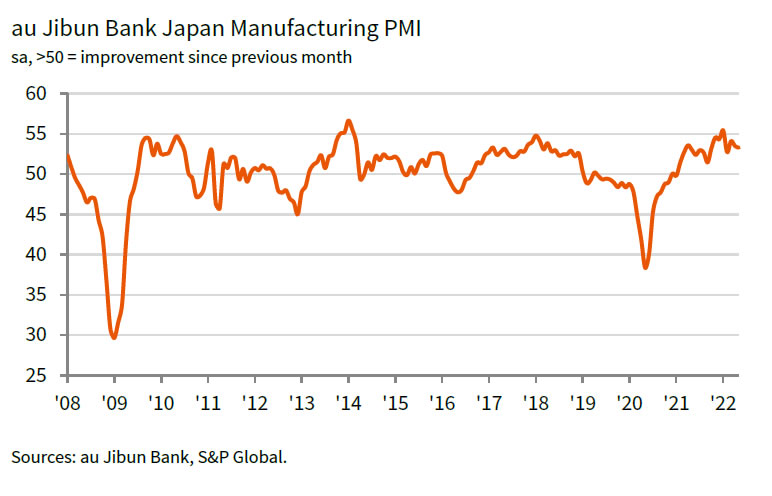
Japan PMI manufacturing was finalized at 53.3 in May, down from April'2 53.5. S&P Global noted softer expansions in production and incoming new business. Supply chain disruption encouraged firms to bolster safety stocks. Input prices rose at fourth-fastest pace in survey history.
Usamah Bhatti, Economist at S&P Global Market Intelligence, said:
"Both output and new orders rose at softer rates, with the latter rising at the weakest pace for eight months amid sustained supply chain disruption and raw material price hikes...
"Disruptions were exacerbated by renewed lockdown restrictions across China, and contributed to a further sharp lengthening of suppliers' delivery times. The deterioration in vendor performance was the joint-quickest since last October and robust overall....
"Material shortages and logistical issues were also partly behind a sustained surge in costs. Average input prices rose at a substantial rate that was the fourth-highest on record....
"Confidence regarding the year-ahead outlook strengthened however, underpinned by hopes that an end to the pandemic and Russia-Ukraine conflict would induce a broad recovery in demand and supply chains. This is in line with an estimated 2.9% increase in industrial production in 2022."
Australia GDP grew 0.8% qoq in Q1, price deflator highest since 1988
Australia GDP grew 0.8% qoq in Q1, above expectation of 0.6% qoq. GDP also grew 3.3% through the year. Nominal GDP rose 3.7%. The GDP implicit price deflator increased 2.9%, the fastest rate since March quarter 1988.
The terms of trade rose 5.9%, with export (+9.6%) and import prices (+3.5%) both up strongly. Strong demand for Australia's mining and agricultural commodities amidst supply constraints in other producing nations contributed to the rise in export prices.
The domestic final demand implicit price deflator rose 1.4%. This was the strongest growth since the introduction of the Goods and Services Tax, reflecting high levels of demand and increased input costs.