Sample Category Title
EUR/USD Mid-Day Outlook
Daily Pivots: (S1) 1.0742; (P) 1.0764 (R1) 1.0803; More...
Intraday bias in EUR/USD is turned neutral with current retreat. On the upside, break of 1.0786, and sustained trading above 55 day EMA (now at 1.0758) will target 1.0935 resistance next. On the downside, however, break of 1.641 minor support will indicate rejection by 55 day EMA, and turn bias back to the downside for retesting 1.0348 low instead.
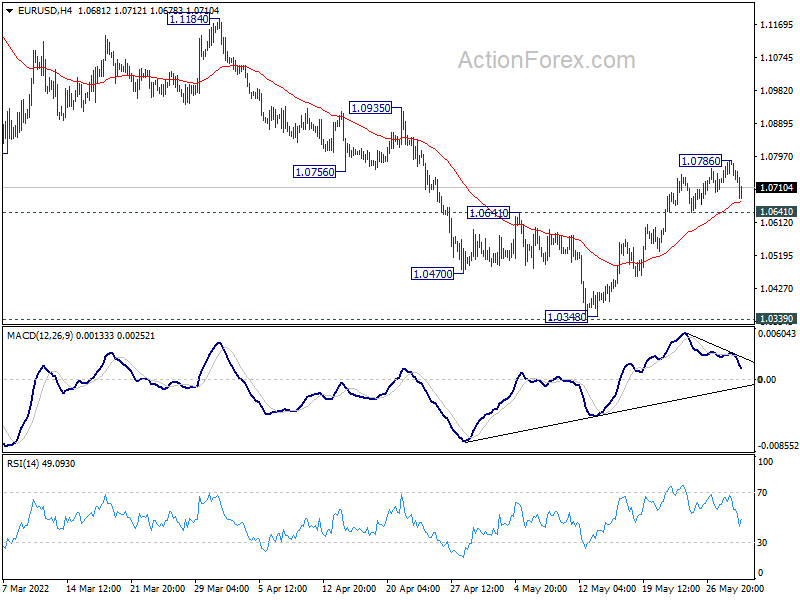
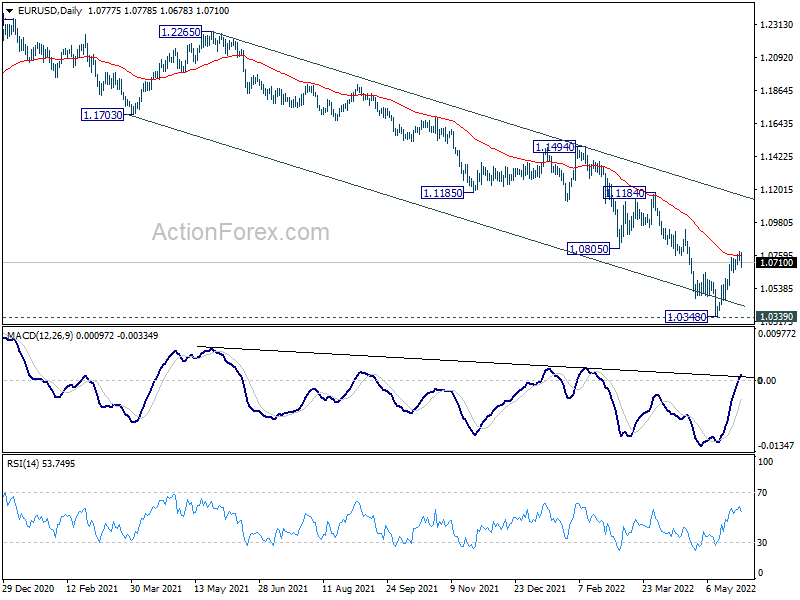
In the bigger picture, focus stays on 1.0339 long term support (2017 low). Decisive break there will resume whole down trend from 1.6039 (2008 high). Next target is 61.8% projection of 1.3993 to 1.0339 from 1.2348 at 1.0090. However, firm break of 1.0805 support turned resistance will delay this bearish case and bring medium term corrective rebound first.
Euro Dips Despite Record Inflation, Dollar Recovering
Euro is trading broadly lower today even though inflation high another record high. The common currency and European indexes are somewhat weighed down by EU's decision to ban two-thirds of Russian oil imports immediately. Dollar is rebounding following some risk aversion, together with Swiss Franc. But Canadian Dollar remains firm as supported by surging oil prices. Australian Dollar is also firm, but Yen and Sterling are weak.
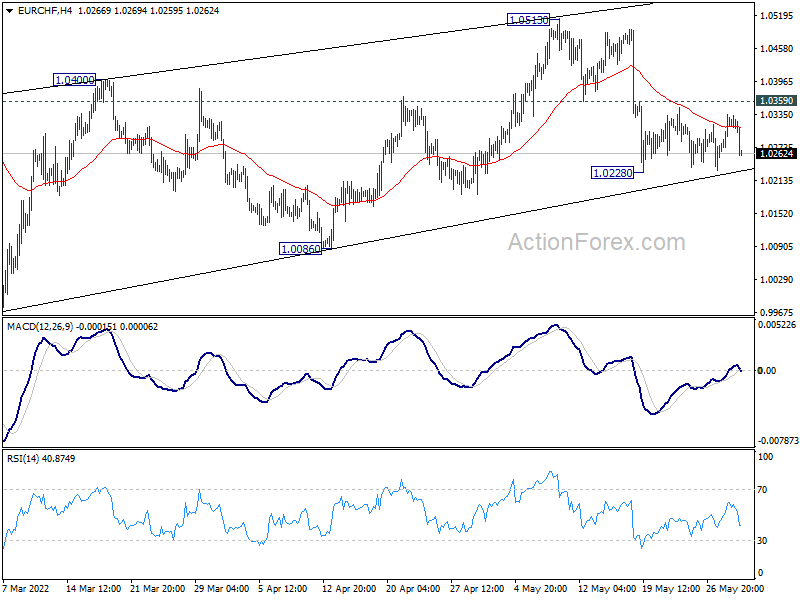
Technically, a focus is now on whether EUR/CHF would finally resume the fall from 1.0513. Break of 1.0228 temporary low would also affirm the case that corrective rebound from 0.9970 has completed with three waves up to 1.0513. If that happens, Euro could be dragged further lower elsewhere, in particular against Canadian and Australian Dollars.
In Europe, at the time of writing, FTSE is up 0.24%. DAX is down -1.20%. CAC is down -1.38%. Germany 10-year yield is up 0.066 at 1.122. Earlier in Asia, Nikkei dropped -0.33%. Hong Kong HSI rose 1.38%. China Shanghai SSE rose 1.19%. Singapore Strait Times dropped -0.20%. Japan 10-year JGB yield rose 0.0063 to 0.240.
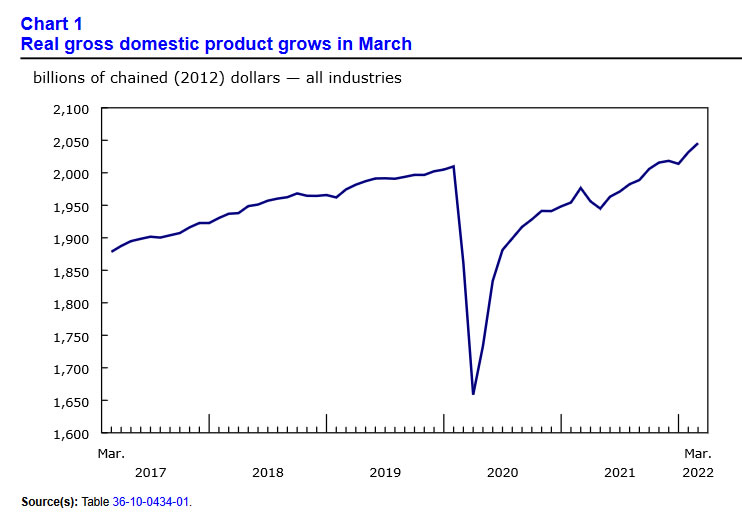
Canada GDP grew 0.7% mom in Mar, to grow 0.2% in Apr
Canada GDP grew 0.7% mom in March, above expectation of 0.5% mom. Services producing sectors rose 0.6% while goods-producing sectors rose 0.9%. 14 of 20 industrial sectors expanded. For Q1, GDP grew 0.8% qoq.
Advanced information indicates that real GDP grew another 0.2% mom in April. Output was up in the mining, quarrying and oil and gas, transportation and warehousing and wholesale trade sectors.
ECB Villeroy: Latest inflation figures confirm necessity of gradual but resolute monetary normalization
ECB Governing Council member Francois Villeroy de Galhau said today, "the latest inflation figures for May, in France and in the other countries, confirm the rise that we expected, and the necessity of a gradual but resolute monetary normalization."
Still, he emphasized that rates "that have been exceptionally accommodative for borrowers since 2015 will remain favorable and very supportive for the entire economy compared to historical norms."
"Clarity is needed: the increase in rates in an orderly and well-managed way will be favorable for the financial sector," Villeroy said. "It should support the profitability of French banks by increasing net activity margins."
ECB de Cos to eliminate policy accommodation in very gradual manner
ECB Governing Council member Pablo Hernandez de Cos said he expects the end of net asset purchases at the beginning of July, followed by a first rate hike. Then there will be "another one in September, (to get us) out of the negative territory. What next would be decided "according to the circumstances."
"What we can do is to eliminate progressively in a very gradual manner, all the accommodation of our monetary policy (...) we will be deciding some steps in the following weeks, and this will be enough," de Cos said.
Another governing council member Ignazio Visco emphasized, "given the uncertainty of the economic outlook, the rates will have to be raised gradually."
Eurozone CPI hits new record 8.1% yoy in May
Eurozone CPI accelerated further from 7.4% yoy to 8.1% yoy in May, another record and above expectation of 7.7% yoy. CPI core also rose from 3.5% yoy to 3.8% yoy, above expectation of 3.5% yoy.
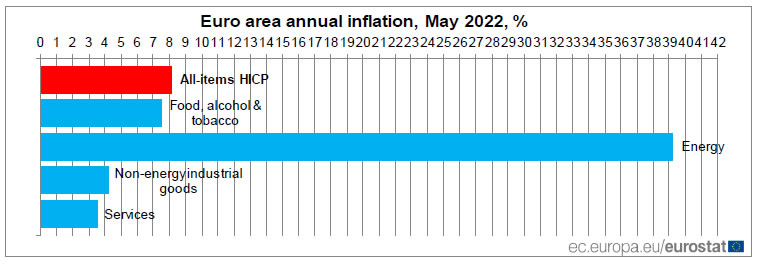
Looking at the main components, energy is expected to have the highest annual rate in May (39.2%, compared with 37.5% in April), followed by food, alcohol & tobacco (7.5%, compared with 6.3% in April), non-energy industrial goods (4.2%, compared with 3.8% in April) and services (3.5%, compared with 3.3% in April).
France GDP dropped -0.2% in Q1, consumer spending dropped -0.4% in Apr
France GDP contracted -0.2% qoq in Q1, revised down from 0.0% qoq. The contraction was linked to weakness of household consumption (-1.5%). General government's consumption expenditure rose 0.2%. Total gross fixed capital formation rose 0.6%. Exports rose 1.2% with net foreign trade up 0.2%.
Also from France, consumer spending dropped -0.4% mom in April, below expectation of 0.4% rise.
Swiss GDP grew 0.5% qoq in Q1, above expectations
Swiss GDP grew 0.5% qoq in Q1, above expectation of 0.3% qoq. Recovery was driven largely by the industrial sector, with manufacturing up 1.7%. This was accompanied by 1.4% rise in goods exports. But overall trade dropped -0.1%. Public health measures had significantly less impact on the economy, and accommodation and food services was the only sector to see a noticeable decline (−2.2%). In other areas of private consumption (+0.4%), there were signs of some normalization.
Also released, trade surplus widened to CHF 4.13B in April versus expectation of CHF 3.50B. Retail sales dropped sharply by -6.0% yoy, versus expectation of -1.4% yoy.
Japan industrial production dropped -1.3% mom in Apr, expected to return to growth in May
Japan industrial production dropped -1.3% mom in April, much worse than expectation of -0.2% mom. It's also the first decline in three months. The seasonally adjusted production index for the manufacturing and mining sectors stood at 95.2 against 100 for the base year of 2015.
Manufacturers surveyed by the Ministry of Economy, Trade and Industry expected output to return to growth in May, gaining 4.8%, followed by a 8.9% rise in June.
Also from Japan, unemployment rate dropped from 2.6% to 2.5% in April, lowest in two years. Retail sales rose 2.9% yoy, above expectation of 2.6% yoy. Housing starts rose 2.2% yoy in April versus expectation of 3.0% yoy. Consumer confidence rose from 33 to 34.1 in May, above expectation of 33.9.
China PMI manufacturing rose to 49.6 in May, services rose to 47.8
The official China PMI manufacturing rose from 47.4 to 49.6 in May, matched expectations. PMI Services rose from 41.9 to 47.8, above expectation of 45.2. PMI Composite also rose from 42.7 to 48.4.
"This showed manufacturing production and demand have recovered to varying degrees, but the recovery momentum needs to be strengthened," said Zhao Qinghe, senior statistician at the NBS.
EUR/USD Mid-Day Outlook
Daily Pivots: (S1) 1.0742; (P) 1.0764 (R1) 1.0803; More...
Intraday bias in EUR/USD is turned neutral with current retreat. On the upside, break of 1.0786, and sustained trading above 55 day EMA (now at 1.0758) will target 1.0935 resistance next. On the downside, however, break of 1.641 minor support will indicate rejection by 55 day EMA, and turn bias back to the downside for retesting 1.0348 low instead.
In the bigger picture, focus stays on 1.0339 long term support (2017 low). Decisive break there will resume whole down trend from 1.6039 (2008 high). Next target is 61.8% projection of 1.3993 to 1.0339 from 1.2348 at 1.0090. However, firm break of 1.0805 support turned resistance will delay this bearish case and bring medium term corrective rebound first.
Economic Indicators Update
| GMT | Ccy | Events | Actual | Forecast | Previous | Revised |
|---|---|---|---|---|---|---|
| 22:45 | NZD | Building Permits M/M Apr | -8.50% | 5.80% | 6.20% | |
| 23:30 | JPY | Unemployment Rate Apr | 2.50% | 2.60% | 2.60% | |
| 23:50 | JPY | Industrial Production M/M Apr P | -1.30% | -0.20% | 0.30% | |
| 23:50 | JPY | Retail Trade Y/Y Apr | 2.90% | 2.60% | 0.90% | |
| 01:00 | NZD | ANZ Business Confidence May | -55.6 | -42 | ||
| 01:30 | AUD | Building Permits M/M Apr | -2.40% | 2.00% | -18.50% | -19.20% |
| 01:30 | AUD | Private Sector Credit M/M Apr | 0.80% | 0.50% | 0.40% | 0.60% |
| 01:30 | AUD | Current Account Balance (AUD) Q1 | 7.5B | 13.4B | 12.7B | 13.2B |
| 01:30 | CNY | Manufacturing PMI May | 49.6 | 49.6 | 47.4 | |
| 01:30 | CNY | Non-Manufacturing PMI May | 47.8 | 45.2 | 41.9 | |
| 05:00 | JPY | Housing Starts Y/Y Apr | 2.20% | 3.00% | 6.00% | |
| 05:00 | JPY | Consumer Confidence Index May | 34.1 | 33.9 | 33 | |
| 06:00 | CHF | Trade Balance (CHF) Apr | 4.13B | 3.50B | 2.99B | |
| 06:30 | CHF | Real Retail Sales Y/Y Apr | -6.00% | -1.40% | -6.60% | |
| 06:45 | EUR | France Consumer Spending M/M Apr | -0.40% | 0.40% | -1.30% | |
| 06:45 | EUR | France GDP Q/Q Q1 | -0.20% | 0.00% | 0.00% | |
| 07:00 | CHF | GDP Q/Q Q1 | 0.50% | 0.30% | 0.30% | |
| 07:55 | EUR | Germany Unemployment Change May | -4K | -16K | -13K | |
| 07:55 | EUR | Germany Unemployment Rate May | 5.00% | 5.00% | 5.00% | |
| 08:30 | GBP | M4 Money Supply M/M Apr | 0.00% | 0.20% | 0.10% | |
| 08:30 | GBP | Mortgage Approvals (GBP) Apr | 66K | 72K | 71K | |
| 09:00 | EUR | Eurozone CPI Y/Y May P | 8.10% | 7.70% | 7.50% | |
| 09:00 | EUR | Eurozone CPI Core Y/Y May P | 3.80% | 3.50% | 3.50% | |
| 12:30 | CAD | GDP M/M Mar | 0.70% | 0.50% | 1.10% | |
| 13:00 | USD | S&P/CS Composite-20 HPI Y/Y Mar | 21.20% | 20.80% | 20.20% | 20.30% |
| 13:00 | USD | Housing Price Index M/M Mar | 1.50% | 1.80% | 2.10% | 1.90% |
| 13:45 | USD | Chicago PMI May | 55.8 | 56.4 | ||
| 14:00 | USD | Consumer Confidence May | 103.9 | 107.3 |
Canada GDP grew 0.7% mom in Mar, to grow 0.2% in Apr
Canada GDP grew 0.7% mom in March, above expectation of 0.5% mom. Services producing sectors rose 0.6% while goods-producing sectors rose 0.9%. 14 of 20 industrial sectors expanded. For Q1, GDP grew 0.8% qoq.
Advanced information indicates that real GDP grew another 0.2% mom in April. Output was up in the mining, quarrying and oil and gas, transportation and warehousing and wholesale trade sectors.
ECB de Cos to eliminate policy accommodation in very gradual manner
ECB Governing Council member Pablo Hernandez de Cos said he expects the end of net asset purchases at the beginning of July, followed by a first rate hike. Then there will be "another one in September, (to get us) out of the negative territory. What next would be decided "according to the circumstances."
"What we can do is to eliminate progressively in a very gradual manner, all the accommodation of our monetary policy (...) we will be deciding some steps in the following weeks, and this will be enough," de Cos said.
Another governing council member Ignazio Visco emphasized, "given the uncertainty of the economic outlook, the rates will have to be raised gradually."
Canadian Dollar eyes GDP, BoC Meeting
After a 3-day rally, the Canadian dollar has reversed directions on Tuesday and edged lower. Canada releases GDP for March later in the day.
Canada’s GDP climbed in February by 1.1% MoM, the highest monthly growth rate since March 2021. The March reading is expected to fall to 0.5%. This would mark a 10th straight monthly expansion. On an annualized basis, GDP is forecast to come in at 5.4%, down from 6.7% prior. Canada has been easing Covid restrictions, which has boosted the services sector, and manufacturing and construction are also accelerating. Unless the GDP drastically underperforms, I don’t anticipate any pressure on the Canadian dollar today.
BoC set to hike by 50-bps
The focus on GDP won’t be lengthy, as attention will shift to the Bank of Canada rate decision on Wednesday. The BoC is widely expected to raise the benchmark rate by 50-bps, which would move the rate to 1.5%. This would be a second straight 50-bps hike, as the BoC has signalled that it will aggressively tighten policy in order to curb soaring inflation. CPI has ballooned to 6.8%, its highest level in 30 years, and if inflation continues to accelerate, a massive 75-bps increase cannot be ruled out.
The BoC is clearly feeling the pressure as inflation is yet to ease, and could continue delivering 50-bps salvos. The neutral range for interest rates is around 3 per cent, and the big question is will we see inflation peak before rates are that high, or will the Bank have to raise rates above the neutral range in order to wrestle down inflation, which would take a toll on economic growth. In the meantime, it’s clear that interest rates will continue to rise at the same time that the Federal Reserve is also raising rates. That means the Canadian dollar should not lose ground due to Fed tightening.
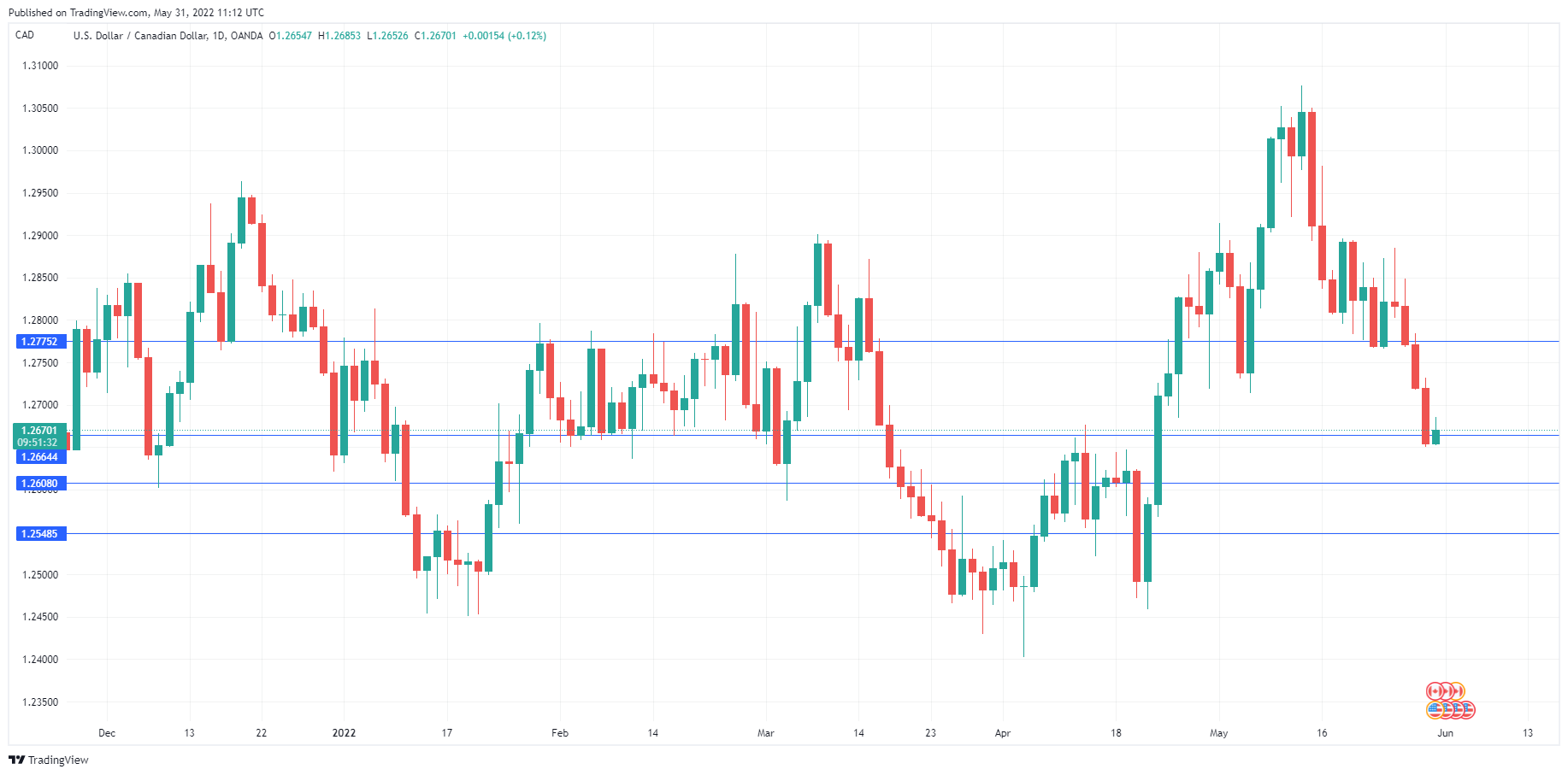
USD/CAD Technical
- There is support at 1.2608 and 1.2548
- USD/CAD is testing resistance at 1.2664. Above, there is resistance at 1.2775
Brent Storms $120, But Rally May be Nearing the End
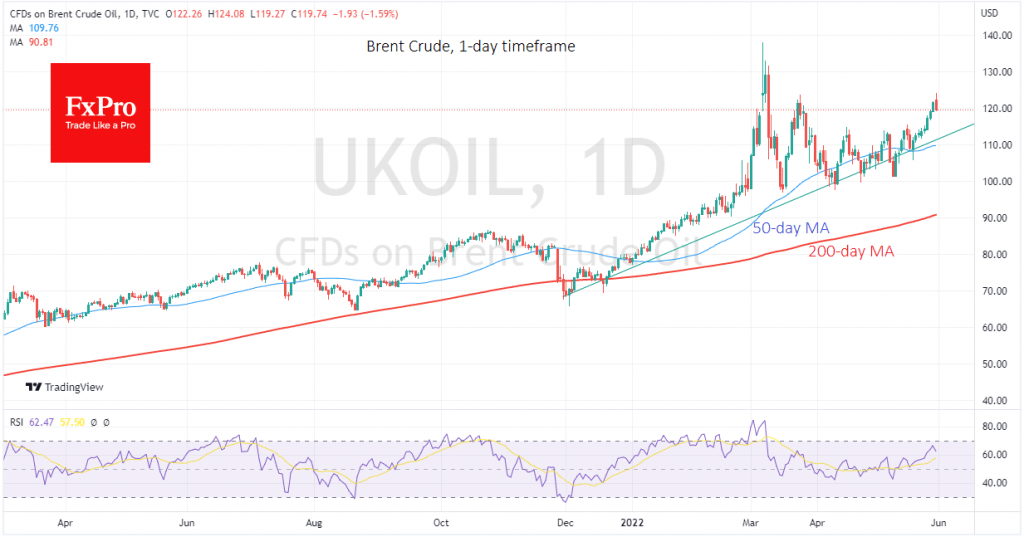
Brent spot prices were approaching $120 earlier today on news that the EU managed to agree on an immediate embargo on 2/3 of oil imports from Russia. We saw Oil trading above current levels for just a couple of days in March.
Over the last four days, as discussions on the ban on oil imports have continued, its price has risen by more than 7%, and much of the news may already have been priced in.
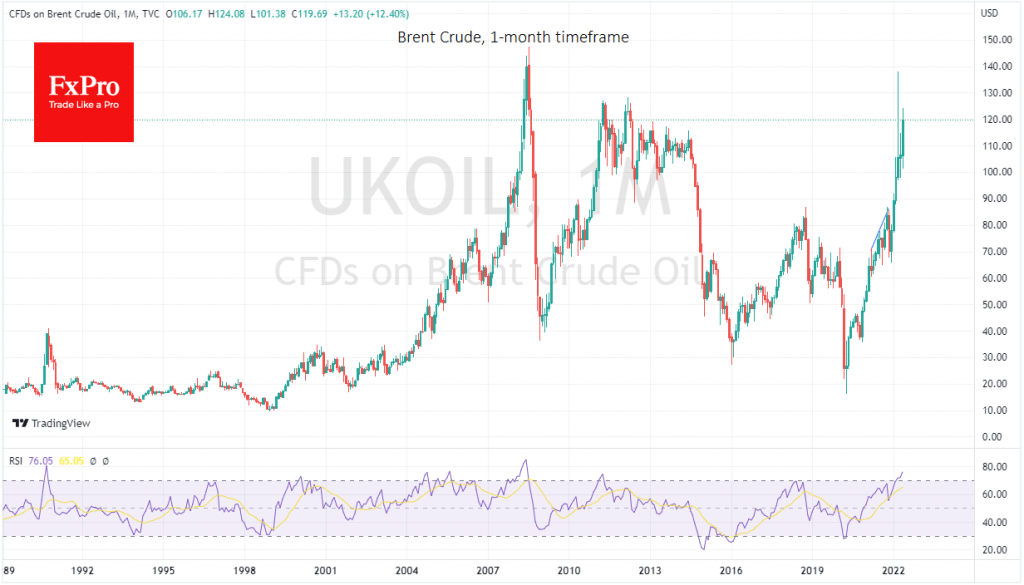
Current levels are at a considerable distance from the highs of 2008 at $146 and below the peaks of 2011 and 2012 when they briefly went above $126. However, from a historical perspective, prices are close to unsustainably high levels.
Already, high energy costs are causing a decline in retail consumption in Europe and the US, the world’s wealthiest regions. No doubt developing countries are experiencing an even more significant slowdown in their economies because of prevailing high fuel prices.
Oil is susceptible to fluctuations in supply and demand, so a shift in the balance of supply and demand by a couple of per cent sometimes triggers movements of tens of per cent, as happened more than once in the past decade. The high cost of fuel is already causing a reduction in consumption, which, combined with higher quotas in OPEC+, will shift the balance towards the buyers in the coming months.
From current levels, we would venture to guess that oil has minimal short-term upside potential to bounce back from the news emotionally. A prolonged lull could follow, with movement in the $100-120/bbl range until the end of the year, during which time demand and supply will adjust to the new reality.
The longer-term prospects remain an open question. The chances are now roughly equal that the oil market at levels near $120 remains at the foot of an extended multi-year rally or is ready to repeat the collapse of 2014 or 2008.
Brent Oil Rises to Two-Month High, On Track for the Sixth Straight Month of Hains
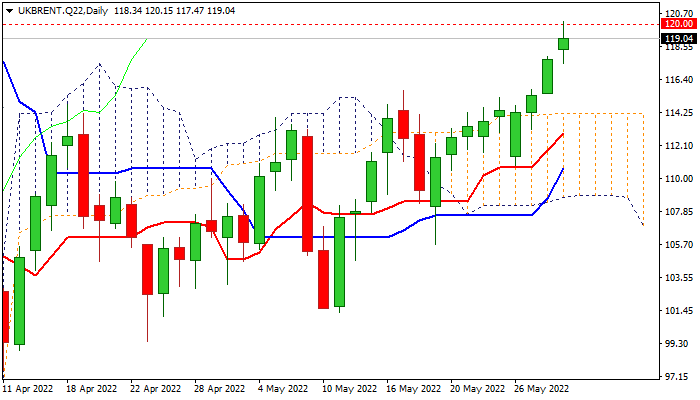
Brent oil rose to new two-month high on Tuesday and probed through psychological $120 level, as bull-run extends into the ninth straight day and the contract is about to end the sixth consecutive month in green.
Easing of Covid restrictions in China and start of summer driving season underpin the prices, with agreement of EU leaders to cut 90% of oil imports from Russia by the end of 2022, with exemption of Hungary that marks the toughest sanction on Russia so far, additionally lifting the oil prices.
Although the fundamentals remain supportive for oil price, technical studies on daily chart show loss of bullish momentum, suggesting that bulls face strong headwinds at $120 barrier and may consolidate before resuming.
With overall picture being firmly bullish, dips are expected to provide better buying opportunities, with broken 50% retracement of $138.22/$96.92 at 117.57, offering initial and solid supports and guarding the top of thickening daily Ichimoku cloud at $114.22, which should limit extended dips.
Firm break of $120 pivot would expose targets at 122.44 (Fibo 61.8%) and $123.72 (Mar 24 peak).
Res: 120.00; 120.15; 120.87; 122.44.
Sup: 117.57; 116.20; 115.47; 114.22.
NZD Falls as Business Confidence Swoons
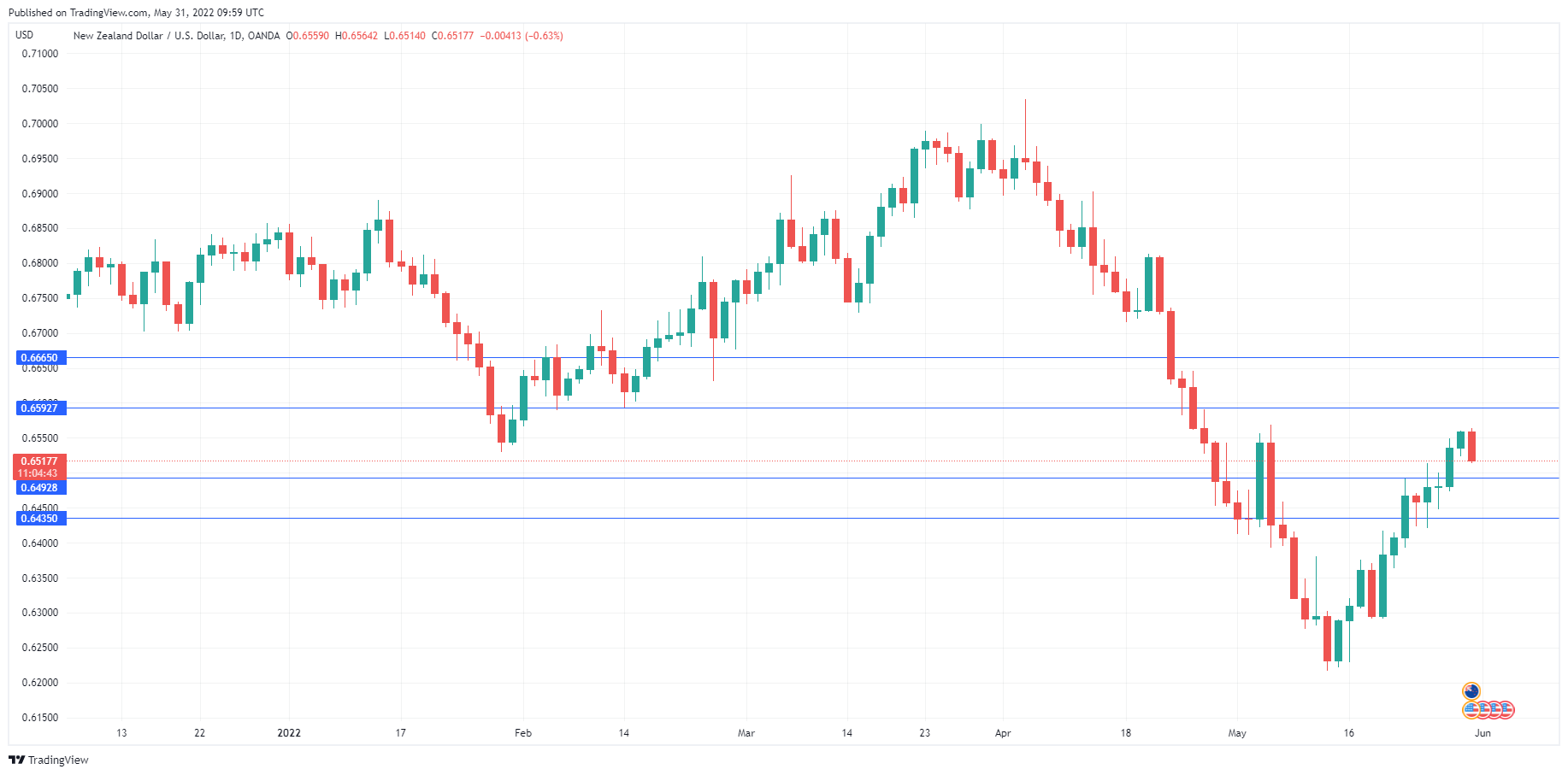
The New Zealand dollar rally has fizzled out on Tuesday. In the European session, NZD/USD is trading at 0.6517, down 0.63% on the day.
Business Confidence slides
New Zealand’s business sector remains deeply pessimistic about the economy. ANZ Business Confidence has been mired in negative territory for close to a year and the May reading fell to -55.6, down sharply from -42.0 in April. This means that more than half of New Zealand businesses expect economic conditions to worsen during the next 12 months.
There weren’t any surprises in the ANZ survey, with businesses noting that their two biggest problems are inflation and cost pressures. Inflation continues to be broad-based, and inflation expectations remain intense. One-year inflation expectations rose to 6.2%, much higher than the RBNZ’s inflation target of 1%-3%. The RBNZ is very concerned about inflation expectations, which can manifest into actual inflation. Governor Orr said last week that it was crucial that inflation expectations remain “anchored” and that a situation where higher inflation expectations become persistent had to be avoided “at all costs”.
The RBNZ finds itself in the middle of its aggressive rate-tightening cycle. The Bank raised the cash rate to 2.0% last week, up from 1.50%. Governor Orr has stated that he is looking to raise rates to 4% by mid-2023, which means that investors can expect plenty of tightening, which could mean additional 50-bps hikes. The RBNZ’s chief economist, Paul Conway, has acknowledged that a soft landing amidst aggressive rate hikes is “difficult to engineer” but said the economy was strong enough to handle a downturn due to the strong labour market. Conway added that 75-bps hikes were not being considered by the central bank.
NZD/USD Technical
- 0.6492 is under pressure in support. Below, there is support at 0.6435
- There is resistance at 0.6593 and 0.6650
EURJPY Battles to Upkeep Bullish Bias
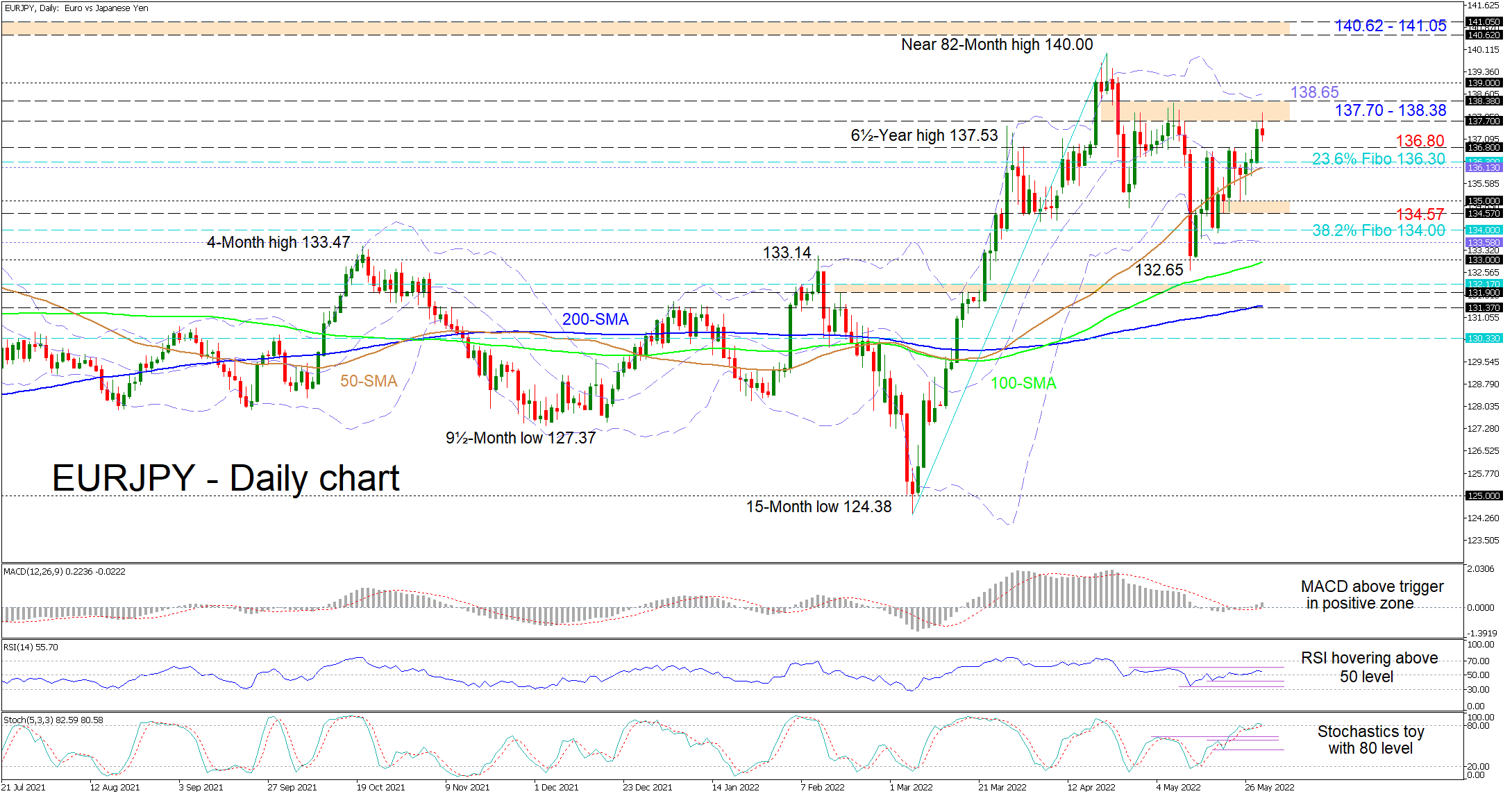
EURJPY’s recent positive legs from the 135.00 handle are now struggling to overcome the early May highs, which are being reinforced by the upper Bollinger band overhead. Despite the waning in positive forces, the advancing simple moving averages (SMAs) are backing the bullish structure.
The short-term oscillators are suggesting buyers are in control but are reflecting the latest weakness in upside momentum around the 137.70-138.38 resistance section. The MACD is slightly north of the zero threshold and is holding above its red trigger line, indicating positive forces have yet to fully subside. Meanwhile, the minor dip in the RSI in the bullish region, and the shaky positive charge of the stochastic lines around the 80 overbought barrier, both imply that sellers may retake the reins.
In the positive scenario, immediate heavy resistance is emanating from the 137.70-138.38 region, which currently includes the May highs and is being reinforced by the upper Bollinger band at 138.65. If buying pressures increase and pilot the price beyond the adjacent upper Bollinger band at 138.65, the 139.00 hurdle could impede additional gains from revisiting the more than 6½-year peak of 140.00. Should the 140.00 border fail to calm buying interest, the 140.62-141.05 resistance band that extends back to the June 2015 rally peaks could then draw traders’ focus.
Otherwise, if the 137.70-138.38 barricade manages to mute upside pressures, support could arise from the 136.80 inside swing high ahead of the 136.30 mark, which is the 23.6% Fibonacci retracement of the up leg from 124.38 until 140.00. Should selling interest overwhelm, the converged mid-Bollinger band and the rising 50-day SMA at 136.13 may then be overrun with the bears targeting the zone of support between the 135.00 barrier and the 134.57 low. Sinking further, the space from the 38.2% Fibo of 134.00 until the lower Bollinger band at 133.58 could try to halt further deterioration in the pair towards the 100-day SMA at 133.00 and the 132.65 trough.
Summarizing, EURJPY is exhibiting a bullish bearing above the SMAs and the 134.57-135.00 boundary. A climb north of the upper Bollinger band could bolster buyers’ confidence, while a dive extending below the 38.2% Fibo may trigger worries about returning negative tendencies.
Eurozone CPI hits new record 8.1% yoy in May
Eurozone CPI accelerated further from 7.4% yoy to 8.1% yoy in May, another record and above expectation of 7.7% yoy. CPI core also rose from 3.5% yoy to 3.8% yoy, above expectation of 3.5% yoy.
Looking at the main components, energy is expected to have the highest annual rate in May (39.2%, compared with 37.5% in April), followed by food, alcohol & tobacco (7.5%, compared with 6.3% in April), non-energy industrial goods (4.2%, compared with 3.8% in April) and services (3.5%, compared with 3.3% in April).