Sample Category Title
GBP/USD: Pound Eases on Weak Data, Firmer Dollar
Cable holds in red on Tuesday, as dollar rose on month-end demand, while weaker than expected UK mortgage approvals data added to negative near-term tone.
Traders also worry that soaring inflation may significantly hurt consumer demand that would further pressure pound.
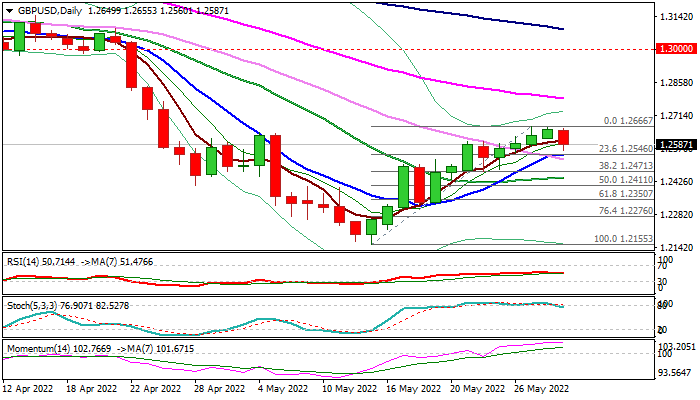
Daily momentum indicators turn south and stochastic emerges from overbought territory, generating initial negative signal which would be boosted by close below 10DMA (1.2544), while extension below Fibo 38.2% of 1.2155/1.2666 recovery leg (1.2471) would increase risk of deeper drop and possible end of correction.
Res: 1.2666; 1.2700; 1.2726; 1.2772.
Sup: 1.2544; 1.2500; 1.2471; 1.2446.
US consumer confidence dropped to 106.4, inflation remains top of mind for consumers
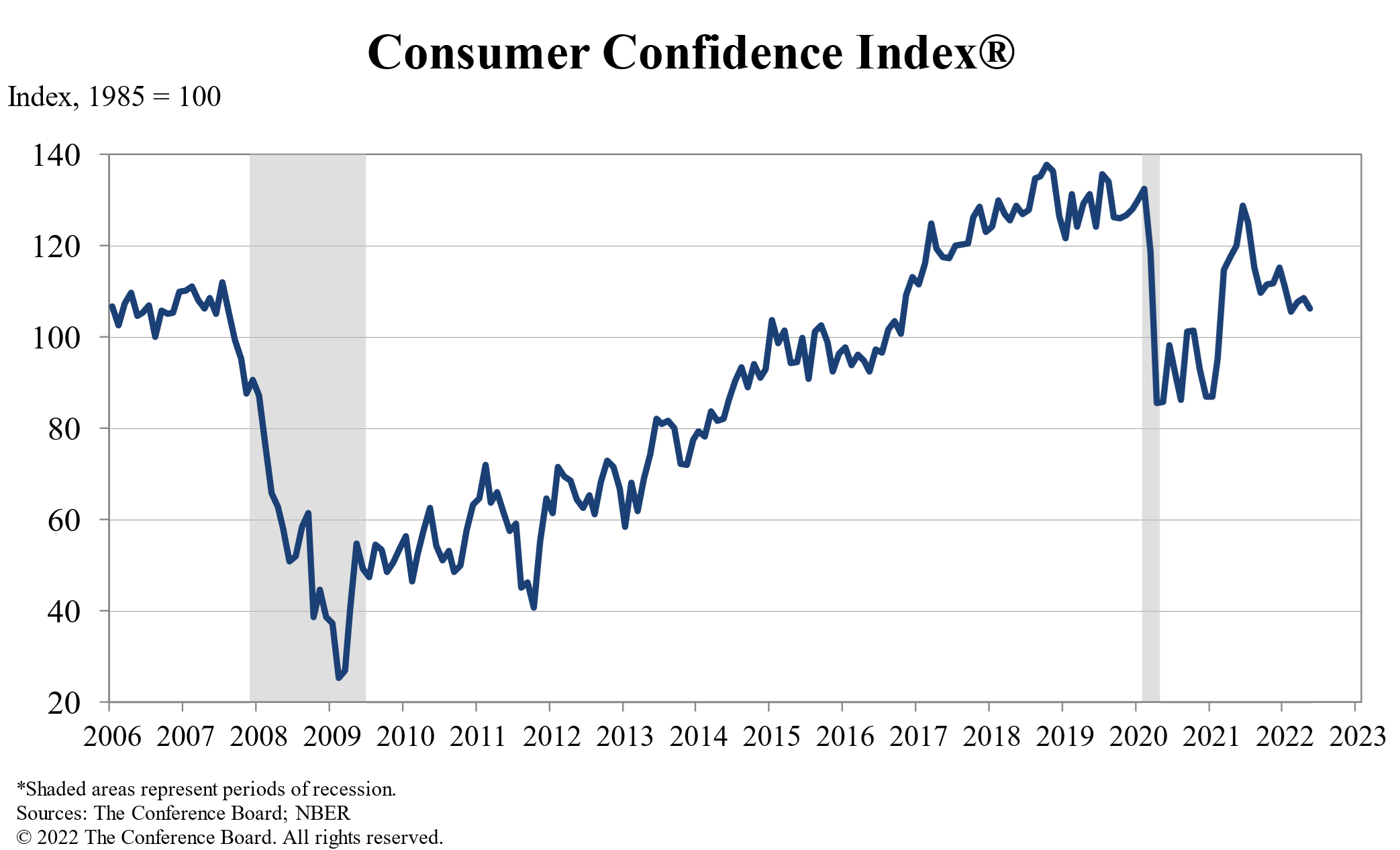
US Conference Board Consumer Confidence dropped slightly from 108.6 to 106.4 in May, above expectation of 107.3. Present Situation Index dropped from 152.9 to 149.6. Expectations Index dropped from 79.0 to 77.5.
"Consumer confidence dipped slightly in May, after rising modestly in April," said Lynn Franco, Senior Director of Economic Indicators at The Conference Board. "The decline in the Present Situation Index was driven solely by a perceived softening in labor market conditions. By contrast, views of current business conditions—which tend to move ahead of trends in jobs—improved. Overall, the Present Situation Index remains at strong levels, suggesting growth did not contract further in Q2. That said, with the Expectations Index weakening further, consumers also do not foresee the economy picking up steam in the months ahead. They do expect labor market conditions to remain relatively strong, which should continue to support confidence in the short run."
"Meanwhile, purchasing intentions for cars, homes, major appliances, and more all cooled—likely a reflection of rising interest rates and consumers pivoting from big-ticket items to spending on services. Vacation plans have also softened due to rising prices. Indeed, inflation remains top of mind for consumers, with their inflation expectations in May virtually unchanged from April's elevated levels. Looking ahead, expect surging prices and additional interest rate hikes to pose continued downside risks to consumer spending this year."
Sunset Market Commentary
Markets
US investors returned to trading desks following the long weekend (Memorial Day Holiday). US Treasuries started weak, catching up with yesterday’s Bund losses while also paying attention to hawkish comments by Fed Waller (+50 bps at each and every meeting this year) and a WSJ op-ed by US President Biden. The latter worked out a three-pillar plan to combat inflation which he’ll exceptionally discuss with FOMC governor Powell and US Treasury Secretary, and former Fed president, Yellen. Biden clearly states that the first line of defense and prime responsibility to control inflation lays at the Fed. Fighting inflation is the top economic challenge right now with the Fed and government ready to pay an economic price if necessary. A final element contributing to the weakness in core bonds is Brent crude’s rise to $124/b, the highest level since 2012 apart from a brief spell early March. The Chinese economic reopening (demand-side) and European oil embargo against Russia (supply-side) are at play. From a technical point of view, the US 10-yr yield extensively tested 2.71% support (Apr 2027 low and neckline potential double top formation) last week. A break lower didn’t occur, adding to the weakness in Treasuries. US investors aren’t afraid that this week’s key eco releases might start showing some signs of weakness. US yields add 6.8 bps (2-yr) to 9.9 bps (10-yr) compared with Friday’s close with the belly of the curve underperforming the wings. German Bunds caught a very brief bid at the start of the European session, but rapidly went back into sell-off mode. German yields rise by 2.7 bps (30-yr) to 7.2 bps (5-yr). The feared EMU inflation acceleration occurred in May with prices rising by 0.8% M/M (from 0.6% M/M in April and vs 0.6% consensus) to 8.1% Y/Y (EMU record vs 7.8% consensus). Underlying core inflation increased from 3.5% Y/Y to 3.8% Y/Y. Available details/subcategories nearly all set EMU highs: from services inflation (3.5% Y/Y from 3.3% Y/Y) over food, alcohol and tobacco (7.5% Y/Y from 6.3% Y/Y) to non-energy industrial goods (4.2% Y/Y from 3.8% Y/Y). The inflation print once more highlights the necessity for the ECB to start normalization policy quickly and to not look back once the process effectively starts. Italian (+6 bps), Portuguese (+3 bps) and Spanish (+3 bps) 10-yr yield spreads vs Germany widen today. The pace of the bond sell-off is again impacting risk sentiment. Main European bourses lose over 1% at the moment. Risk sentiment, the US Treasury underperformance and failure to take out first resistance at EUR/USD 1.0758/1.0806 all contributed to today’s return action lower in the currency pair. EUR/USD is changing hands just below 1.07 for the moment. EUR/GBP remains steady in the low 0.85-area.
News Headlines
The Canadian economy expanded by 3.1% q/q annualized in Q1 vs 5.2% expected. Still-solid growth was supported by strong private consumption, business investment and an inventory build-up. A steep drop in exports, in part due to Covid- and maintenance-driven production disruptions in the vast oil sector, was only partially compensated by faltering imports. Today’s reading is in line with the Bank of Canada’s April forecast (2.8% q/q ann.). The BoC is thus set to raise rates by 50 bps again to 1.5% tomorrow. Market expectations are for another such move in July with speculation building for September too. The loonie loses against a superior USD today. USD/CAD rises to 1.268.
The Hungarian central bank raised policy rates by 50 bps to 5.90% today. In the policy statement, the MNB said strong growth at the beginning of 2022 will probably slow in coming quarters due to subdued external demand. Inflation, already at 9.5% (10.3% even in the core), is expected to increase in coming months. This warrants further tightening. But there is a slight change in the wording with the MNB no longer speaking about “increased” fundamental inflation risks. It has also assigned itself with the “key task to set an optimal interest rate level that ensures the sustainable achievement of the inflation target”, suggesting more moderate tightening may be appropriate to find that level. The Hungarian forint loses marginally to EUR/HUF 395 though losses were already there going into the policy decision. Hungarian swap yields add 5-7 bps across the curve.
Canada’s GDP Grows Less than Expected in the First Quarter
The Canadian economy expanded by 0.8% quarter/quarter (q/q) in Q1 2022 (3.1% annualized), with final domestic demand up 1.2% (q/q). Furthermore, the flash estimate for April showed a deceleration to 0.2% month/month (m/m).
Spending by households increased by 0.8% q/q. Statistics Canada noted that this was the "third consecutive quarterly increase, as outlays on most goods and services expanded, even with limited capacity restrictions throughout Canada on in-person shopping and services." Durable goods led the way, up 2.6% q/q, while spending on services rose by a more modest 0.7% q/q.
Residential investment rose again, up 4.3% q/q, with renovations spurring the gain. Investment in non-residential structures and machinery and equipment rose 2.9% q/q and 0.9% q/q, respectively. The release noted that "investment in engineering structures rose 3.5%, as spending on the Kitimat LNG project in British Columbia and oil and gas activity increased."
Terms-of-trade rose 4.2%, as higher export prices (up 7.1% q/q) "were again heavily influenced by the rising price of crude oil." Export prices rose strongly in other areas also, including "lumber (+25.0%), electricity (+24.8%) and refined petroleum products (+21.2%), reflecting continued price pressures due to supply constraints."
Key Implications
GDP missed the mark, with expectations heading into the release looking for +5% growth (q/q annualized). This was largely due to weaker household consumption, with service spending failing to pick-up as expected given the reopening that was underway. Layering on the weak flash estimate for April, it is clear that Canada's economic momentum is slowing. Though this was expected given rising inflation and high interest rates, the deceleration is occurring much quicker that previously thought.
We don't think this will change the Bank of Canada's thinking at its meeting tomorrow. We expect the Bank to hike by another 50 basis points, followed by another 50 in July. Bond markets aren't reassessing either, with the 10-year Canada yield up another 10 basis points this morning.
A Respite for Dollar Bulls or a Trend Reversal? We Will Find OutToday
In the US debt market, 10-year Treasury yields have exceeded 2.8% after floundering around 2.7% last week. This small move for bonds is having severe consequences for almost all markets.
The dollar index is almost in sync with long-term bond yields pulling away from its 50-day moving average, coinciding with a 50% correction from the rally from late March to mid-May.
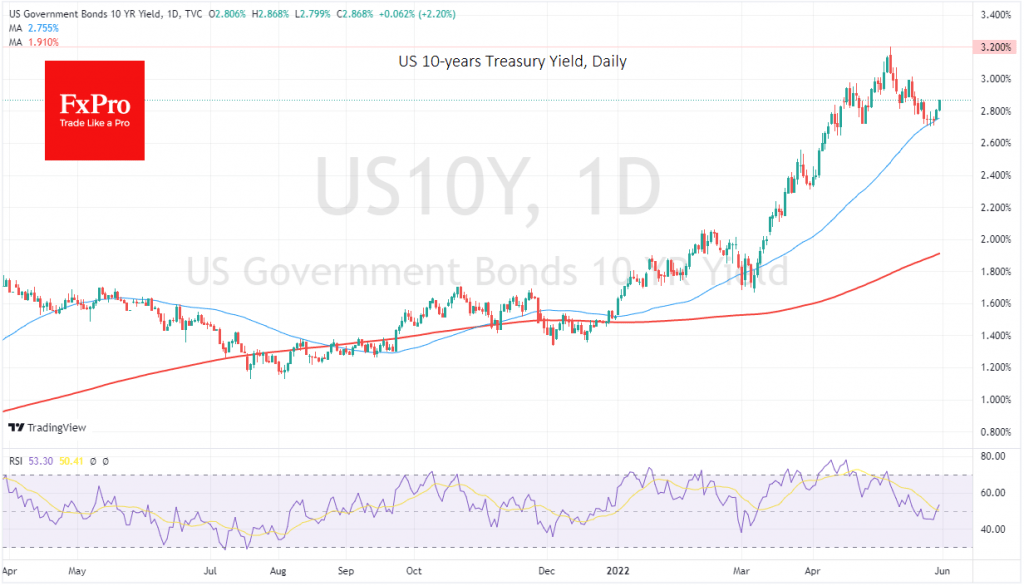
EURUSD and USDJPY are moving today towards the prevailing trends of recent weeks. As in the case of the 10-yr yields and DXY, the dollar bulls went back into play after touching the 50-day averages for these instruments.
US equity index futures are losing traction, with the S&P500 pulling back from levels above 4200 to 4140.
Interestingly, pressure increased in oil, despite a potentially positive backdrop.
The market dynamics on Monday and Tuesday morning may not be indicative as they do not include liquidity from the US. Investors and traders should therefore pay increased attention to Tuesday’s close of trading.
We may well have an answer today as to whether the recent dollar weakening was a bullish respite or the beginning of a downswing.
GBPUSD Pulls Lower after Nearing 2020 Barrier
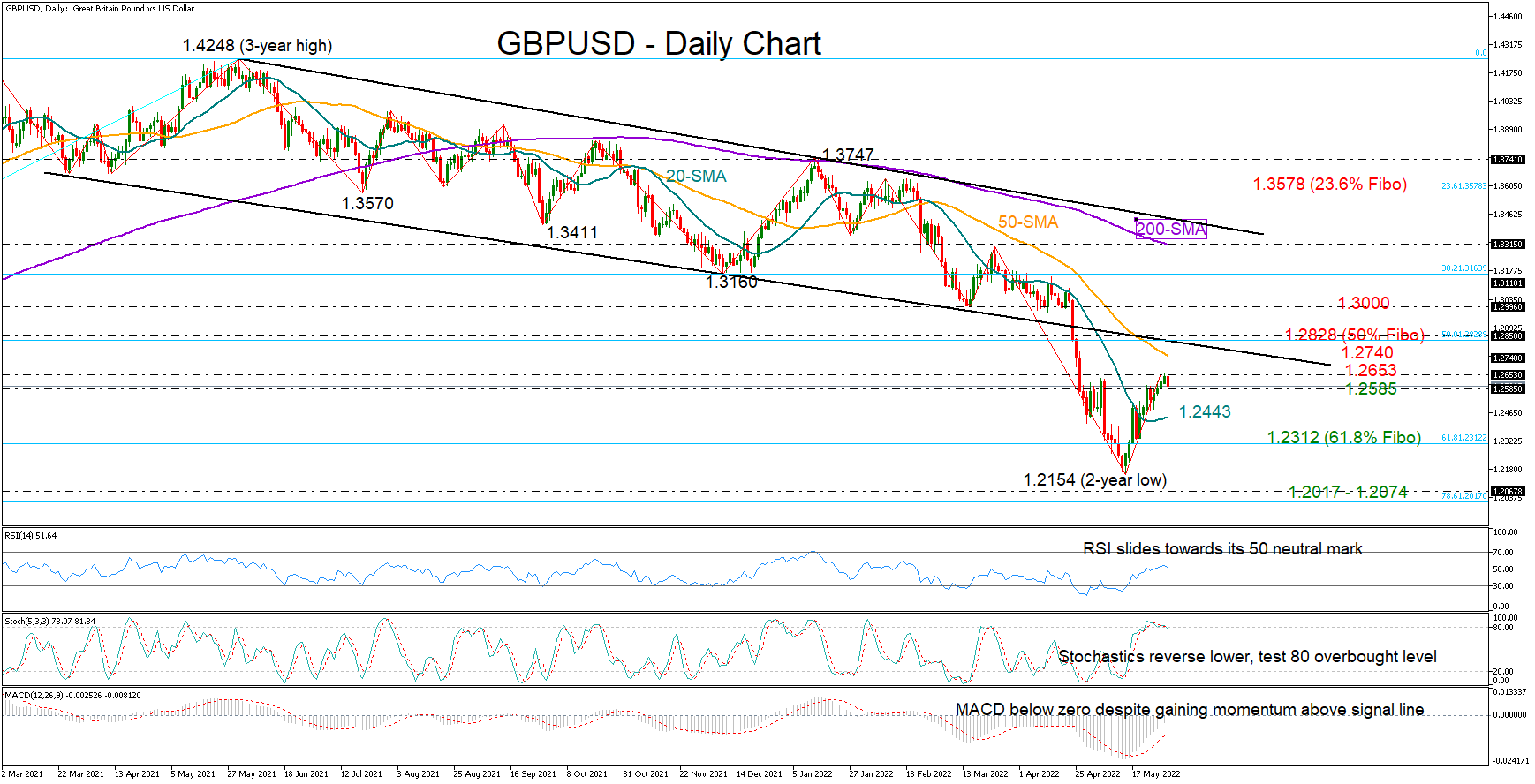
GBPUSD is marking a negative day after its four-day gradual bull run met resistance near the 1.2653 zone, which is marginally below the low from September 2020.
The short-term bias is viewed as neutral as the RSI is diminishing towards its 50 neutral mark after barely peeking above it, while the MACD has yet to enter the positive territory despite increasing its distance well above its red signal line. The Stochastics are losing steam, but they haven’t exited the overbought territory yet.
The 1.2580 constraining area, which is currently in action, could postpone any bearish cycles. If not, the price may tumble towards the 20-day simple moving average (SMA) at 1.2443, while deeper sellers may seek a drop below the 61.8% Fibonacci retracement of the 2020 rally at 1.2312 in order to gain access to the two-year low of 1.2154.
On the upside, a clear close above 1.2653 could prompt an extension towards the 50-day SMA at 1.2740. Notably, the bottom line of the broken bearish channel is within breathing distance and near the 50% Fibonacci of 1.2828. Hence, a successful advance above the latter might be a prerequisite for an advance straight to 1.3000.
In the big picture, the bearish outlook is well preserved and that may not change unless the price accelerates beyond 1.3300.
In short, GBPUSD is not out of the woods despite its recent advance off a two-year low. A close above 1.2653 or below 1.2580 will probably raise volatility in the market accordingly.
EUR/USD: Recovery Runs Out of Steam as Downbeat EU Inflation Data Darkens Economic Growth Outlook
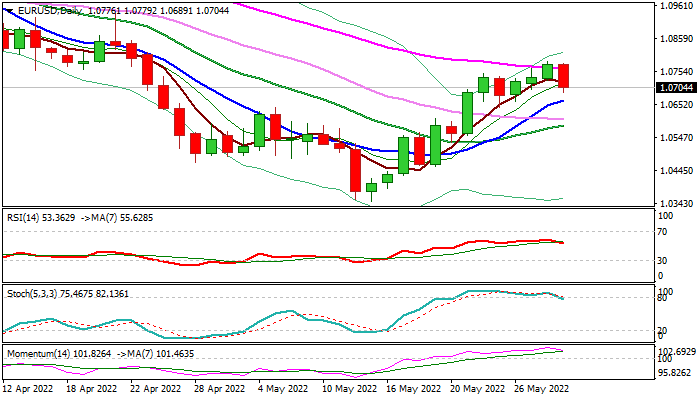
The Euro eases on Tuesday, deflated by firmer dollar and disappointing data, as the inflation in the European Union hit new record high in May and oil prices continue to rise, weakening bloc’s growth outlook.
Two-week recovery rally from new five-year low at 1.0349, failed to clear important barrier at 1.0767 (50% retracement of 1.1184/1.0349 / falling 55DMA), with subsequent weakness generating initial signal of recovery stall.
The pullback was signaled by overbought daily stochastic which also made a bearish divergence, with fading bullish momentum adding to negative signal, as recovery was weighed by falling and thickening daily Ichimoku cloud.
However, fresh weakness needs more evidence to signal pullback, with close below 10DMA (1.0665) to generate initial negative signal, which will require confirmation on extension through pivots at 1.0619 (Fibo 38.2% of 1.0349/1.0786) and 1.0586 (20DMA).
Res: 1.0767; 1.0786; 1.0800; 1.0865
Sup: 1.0683; 1.0665; 1.0619; 1.0586
USD/JPY Mid-Day Outlook
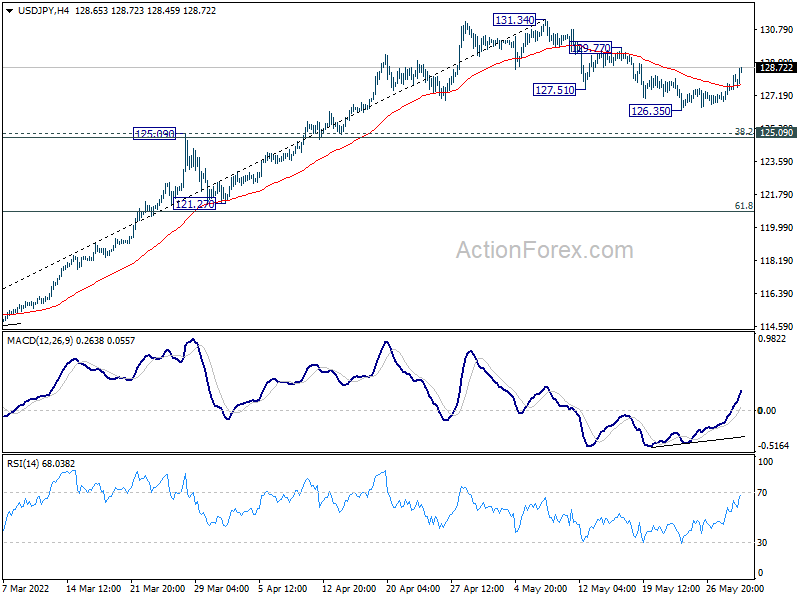
Daily Pivots: (S1) 127.04; (P) 127.43; (R1) 128.00; More...
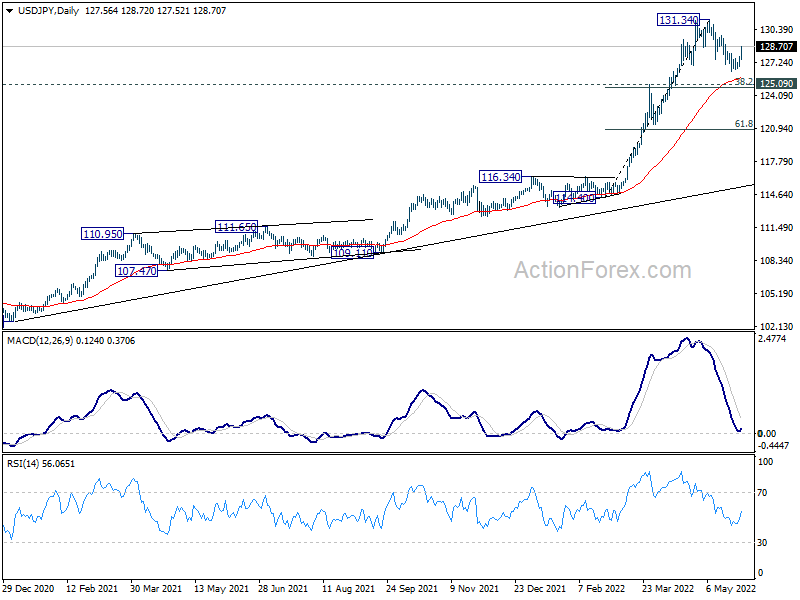
Intraday bias in USD/JPY stays neutral for the moment. On the upside, break of 129.77 minor resistance will suggest that correction from 131.34 is finished. Intraday bias will back on the upside for retesting 131.34 high. On the downside, break of 126.35 will extend the correction. But downside should be contained by 125.09 cluster support (38.2% retracement of 114.40 to 131.34 at 124.86) to bring rebound.
In the bigger picture, current rally is seen as part of the long term up trend form 75.56 (2011 low). Sustained trading above 61.8% projection of 75.56 (2011 low) to 125.85 (2015 high) from 98.97 at 130.04 will pave the way to 100% projection at 149.26, which is close to 147.68 (1998 high). For now, this will remain the favored case as long as 121.27 support holds.
USD/CHF Mid-Day Outlook
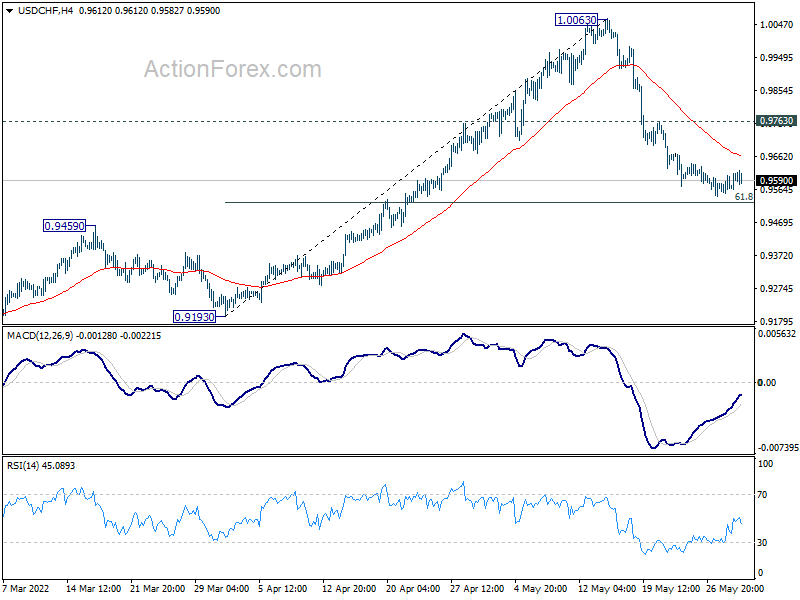
Daily Pivots: (S1) 0.9549; (P) 0.9577; (R1) 0.9601; More...
No change in USD/CHF's outlook. Strong support is still expected at 61.8% retracement of 0.9193 to 1.0063 at 0.9525 to complete the pull back from 1.0063. On the upside, above 0.9763 minor resistance will turn bias back to the upside for retesting 1.0063 high. However, sustained break of 0.9525 will bring deeper decline to 0.9193 support.
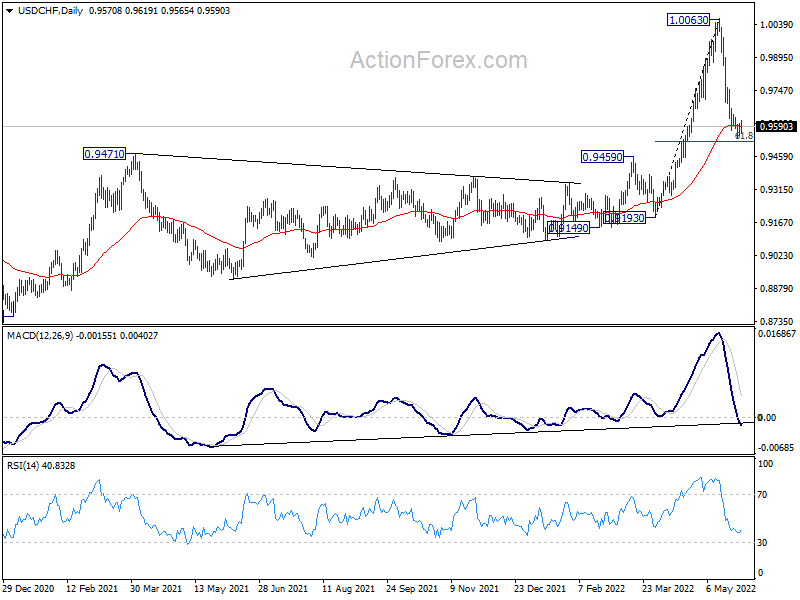
In the bigger picture, down trend from 1.0342 (2016 high) should have completed with three waves down to 0.8756 (2021 low) already. Rise from 0.8756 is likely a medium term up trend of its own. Next target is 1.0237/0342 resistance zone. This will remain the favored case as long as 0.9471 resistance turned support holds. However, sustained break of 0.9471 will extend long term range trading with another falling leg.
GBP/USD Mid-Day Outlook
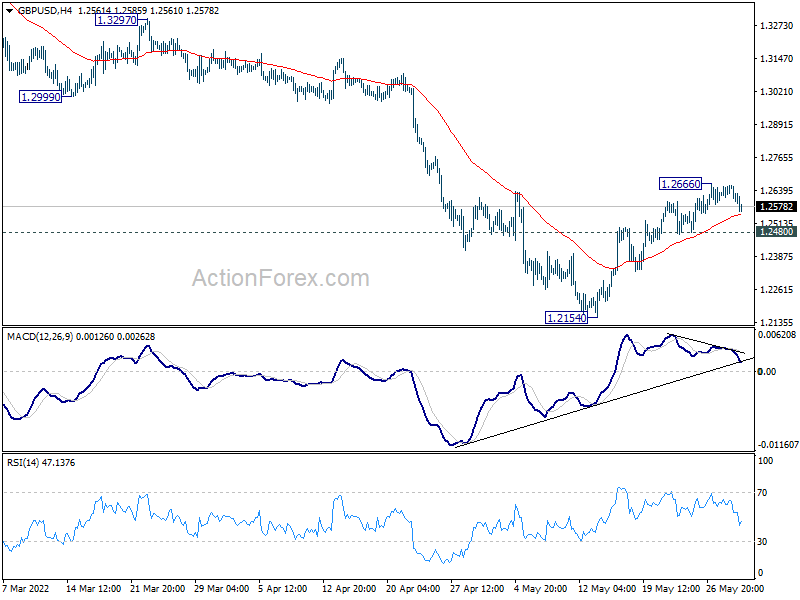
Daily Pivots: (S1) 1.2625; (P) 1.2643; (R1) 1.2670; More...
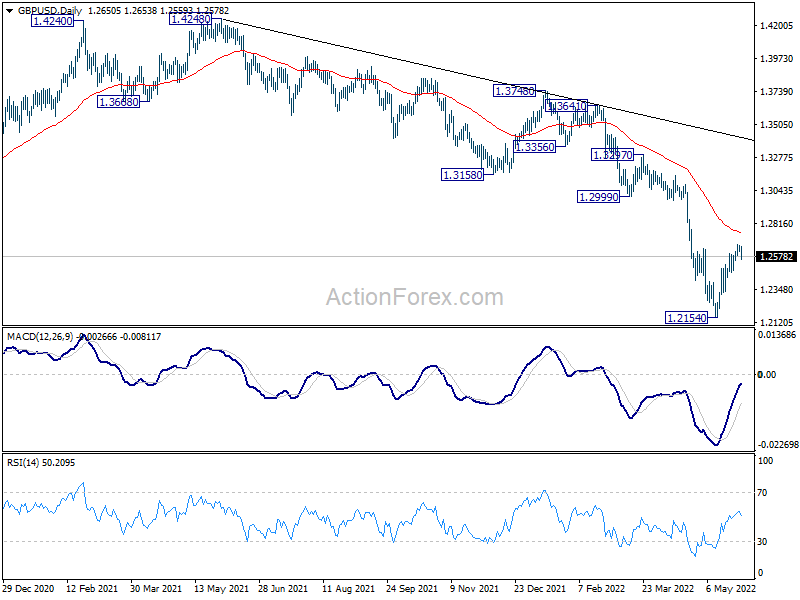
Intraday bias in GBP/USD is turned neutral with current retreat. On the upside, above 1.2666 will resume the rebound from 1.2154. On the downside, sustained of 55 day EMA (now at 1.2752) will target 1.2999 support turned resistance. On the downside, though, break of 1.2480 minor support will turn bias back to the downside for retesting 1.2154 low instead.
In the bigger picture, fall from 1.4248 (2018 high) could be a leg inside the pattern from 1.1409 (2020 low), or resuming the longer term down trend. Deeper decline is expected as long as 1.2999 support turned resistance holds. On resumption, next target is 1.1409 low.