Sample Category Title
EURGBP Wave Analysis
- EURGBP reversed from resistance level 0.8590
- Likely to fall to support level 0.8450
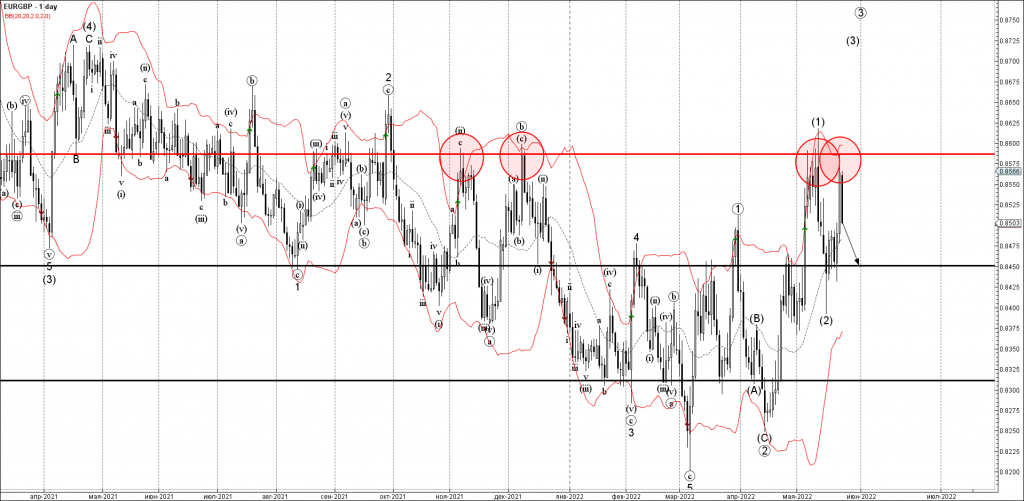
EURGBP currency pair recently reversed down from the key resistance level 0.8590 (which has been reversing the price from last November) strengthened by the upper daily Bollinger Band.
The downward reversal from the resistance level 0.8590 is currently forming the daily reversal pattern Bearish Engulfing.
Given the strength of the resistance level 0.8590, EURGBP can be expected to fall further toward the next support level 0.8450.
Fed Reiterates its Commitment to Bringing Inflation Back to Target
The minutes from the May 3-4, 2022 Federal Open Market Committee (FOMC) meeting showed that the Fed is fully committed to curtailing inflation.
On the progression of the economy, the Committee members noted that "although overall economic activity had edged down in the first quarter, household spending and business fixed investment had remained strong. Job gains had been robust in recent months, and the unemployment rate had declined substantially. Inflation remained elevated, reflecting continued supply and demand imbalances, higher energy prices, and broader price pressures"
On the current acceleration in prices, the Committee stated that "inflation continued to run well above the Committee’s longer-run goal and that inflation pressures were evident in a broad array of goods and services." Additionally, committee members acknowledged the fact that surging inflation is eroding household real income and impeding businesses' future investment decisions.
On the expected pace of policy tightening, they stated that "50 basis point increases in the target range would likely be appropriate at the next couple of meetings." Moreover, committee members stated that they should move monetary policy towards a neutral position.
Key Implications
The minutes revealed that inflation remains of paramount importance for the Fed, with consumer prices in April having surged to 8.3% from year-ago levels. The Russia-Ukraine conflict and recent COVID lockdowns in China, only add to the upside risk. Additionally, the labor market has continued to strengthen, with employment approaching pre-pandemic levels and the unemployment rate sitting at 3.6%, just 0.1 percentage points above its February 2020 level. We expect the Fed to continue to act aggressively until inflation is comfortably trending towards its 2% target.
On June 1st, the Fed will begin reducing the size of its balance sheet, which will work in tandem with interest rate increases to further tighten monetary conditions. This has undoubtedly played through to both government yields and mortgage rates, which have increased markedly since the beginning of the year. The UST 10-year yield, while down from its 2022 peak, has increased by 124 basis points while the 30-year conventional mortgage rate has added 214 basis points.
Eco Data 5/26/22
[php_everywhere instance="1"]
Bitcoin Hovers Near $30,000 as Sentiment for Risky Assets Deteriorates
Bitcoin has delivered its eighth consecutive weekly loss for the first time in history, currently trading in a tight range around the $30,000 psychological mark, which is more than 50% down from its all-time peak. The sustained downtrend could be attributed to a barrage of emerging headwinds such as the negative macroeconomic environment for risky assets, inflation and growth concerns, alongside idiosyncratic risks stemming from within the crypto industry. Heading further into 2022, Bitcoin and the broader crypto market seem to be lacking the necessary catalysts that could drive upside growth, but cryptocurrencies have managed to recover from all their previous downfalls. Is this time any different?
Further decline or imminent reversal?
In recent months, investors appear to be moving away from cryptocurrencies and risky assets in general in the face of persistently high inflation and recession fears. Any signs that inflationary pressures are not waning would force central banks to slam the brakes harder on the economies, infusing further downside pressures into the crypto space. Moreover, the collapse of Terra and Luna has increased uncertainty, while a new systemic failure might act as the final blow to investors’ interest in the unregulated cryptocurrency sphere.
On the other hand, a recent report by the United States Federal Reserve Board revealed that most US crypto investors trade them for profit-gaining purposes, neglecting their use as an alternative payment method. Essentially, the current situation in crypto markets could endorse a buy the dip strategy, which could be further bolstered by speculators joining in to push the market higher and exploit the bull run. Furthermore, crypto funds, institutional investors and asset management firms are now having a significantly higher stake in cryptocurrencies than retail traders, with most of them having stepped in the market at higher levels. Thus, it is clear that they would do anything in their power to avoid a long-lasting crypto winter.
Congress to introduce the first regulatory framework
There are growing threats of a regulatory crackdown hanging over crypto markets since the collapse of two major altcoins earlier this month. In response to the increasing calls for regulatory action, US policymakers are expected to put forward a bill that will categorize cryptocurrencies as either securities or commodities and announce which public agency will be responsible for their oversight. In addition, the proposed legislation will include provisions covering consumer protection from fraud and taxation issues. Undoubtedly, the passage of a clear and strict regulatory framework for crypto assets will be a sigh of relief for investors, reducing uncertainty and motivating adoption.
Bitcoin rangebound unable to find fresh trading impetus
Bitcoin price has been trading within a tight range during the past week, with the decline in volatility probably hinting that investors are scrutinizing the current complex market conditions to decide its future price direction.
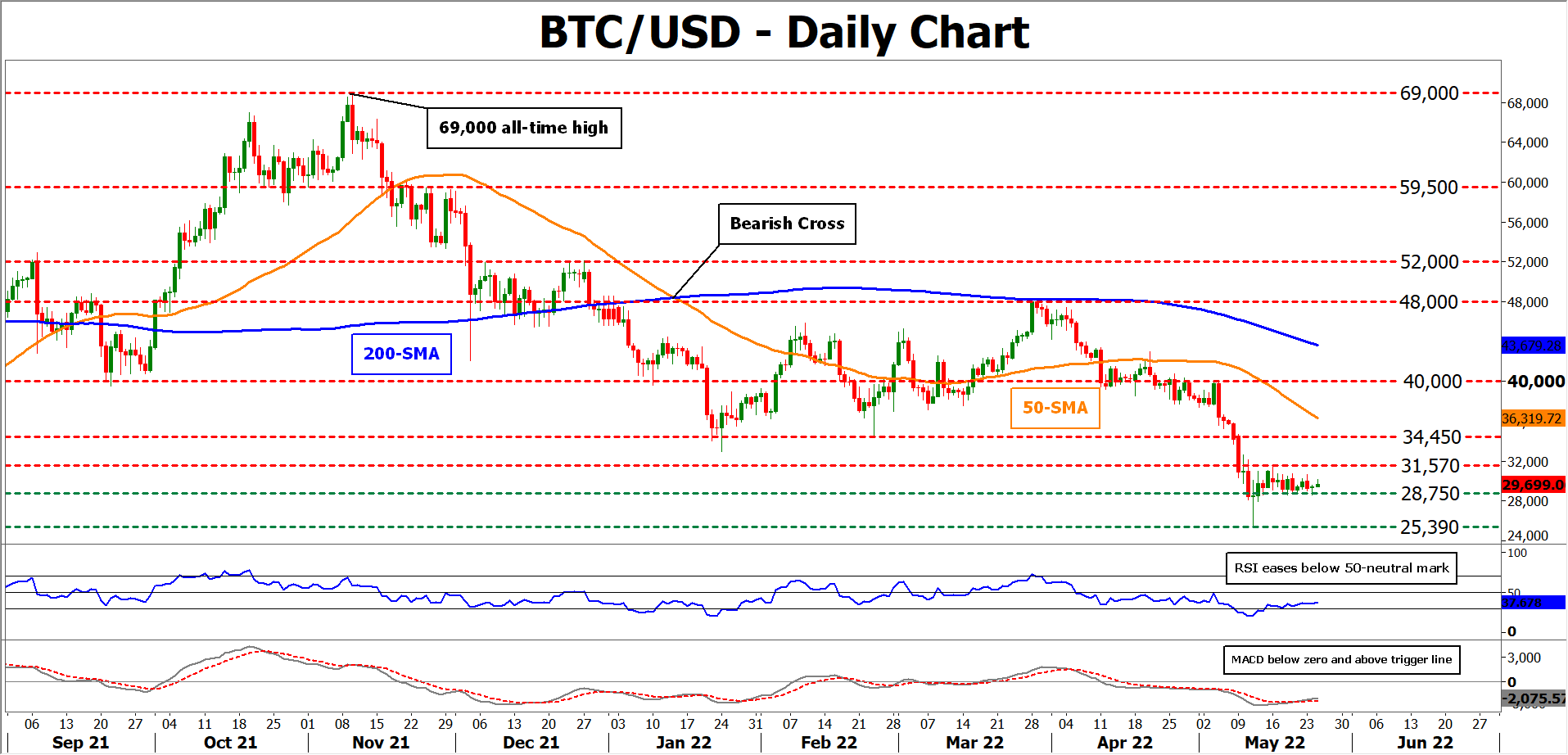
Should major central banks tone down their hawkish rhetoric and try to perform ‘softer’ landings, the bulls could initially target $31,570, which is the upper boundary of Bitcoin’s recent sideways move. Piercing through this barrier, the $34,500 hurdle could prove to be the next resistance point.
On the flipside, signals of a faster tightening cycle may send the price to test the recent low of $28,750 before the spotlight turns to the 2022 low of $25,390.
Awaiting FOMC Minutes
Stock markets are a little flat on Wednesday as investors await minutes from the May FOMC meeting.
I'm not sure what exactly investors are holding out for. A lot has changed in the markets over the last few weeks and we've had a lot of Fed commentary in that time that is arguably more relevant than almost anything we can take from the minutes.
That said, this is nothing new and investors are always wary of what could happen. Especially when market conditions are as volatile and uncertain as they are. There is no shortage of anxiety in the markets and the minutes could potentially feed into that.
We've seen interest rate expectations pare back a little in recent weeks as economic fears have become more prominent. The central bank still expects to avoid a recession, which may be referenced in the minutes, but investors are becoming less confident as the cost of living squeezes household budgets.
ECB seemingly united on July and September hikes
We've heard from numerous ECB policymakers today and it's clear that they are united in their desire to start raising rates in July and again probably in September. There is some desire to perhaps move faster it seems but broadly speaking, there's clearly widespread agreement.
It still seems quite strange how direct they are being about raising interest rates and when especially when talking about September which is four months away. One thing that's been clear over the last year is how horrible policymakers have been at anticipating things months in advance. I'm not sure what has made them so confident now.
Risks remain tilted to the upside in oil
Oil prices are continuing to consolidate around the upper end of their trading range over the last couple of months. Concerns about Covid cases in Beijing and global growth are continuing to prevent a much larger rally in oil prices as a result of the undersupply in the market, a potential EU ban on Russian imports and the reopening in Shanghai.
We're seeing gains again today of around 1% but these are still relatively small and represent a slowing of momentum in the rally. Risks still remain tilted to the upside, even after the recent moves, but it just may not be as explosive as we've seen at times before.
Gold slips ahead of the FOMC minutes
Gold is making small losses ahead of the Fed minutes as the dollar claws back some of the recent declines. There's clearly some nerves around what the minutes will contain which is why we appear to be seeing a little profit-taking.
The yellow metal is seeing some support around $1,850 after peaking near $1,870 on Tuesday. Assuming the minutes don't contain anything too shocking, we could see it continue to push higher as economic fears push investors back towards safe-havens.
Bitcoin disconnected from broader markets?
Nothing much has changed as far as bitcoin price action is concerned in recent weeks. It continues to be choppy around $30,000 and isn't really picking up any momentum in either direction. It remains a mild concern that there isn't much dip-buying appetite even during periods of improved sentiment in the markets but perhaps we're seeing a bit of a brief disconnect between crypto and the rest of the market.
SNB Jordan: We are moving into an unpleasant situation for monetary policy
SNB Chairman Thomas Jordan said in an interview, "it's a new situation, for the first time since 2008, we are seeing monetary policy moving toward tightening in most currency areas."
"We are moving into an unpleasant situation for monetary policy: inflation is already high globally and is even rising in many countries, while at the same time economic activity is weakening worldwide," he said.
SNB will next meet on June 16. "We will, of course, analyze and take into account the impact of the sharp rise in global inflation on Switzerland," he said.
Sunset Market Commentary
Markets
European stock markets started in good spirits today. They tried to recoup some of yesterday’s loses by opening with a little less than a 1% gain. After some intraday volatility, gains are currently capped to 0.5%. WS opens mixed. Meanwhile, more ECB governors, including from the dovish side (eg. Panetta), argue in favor for ending negative policy rates, be it in gradual (read: 25 bps) manner. Even chief economist Lane said “it’s appropriate to normalize”. Dutch governor Knot in two separate speeches said he fully supported Lagarde’s blog post setting out at least two consecutive 25 bps rate hikes earlier this week only to nuance that a bit later by adding that 50 bps rate hikes are not off the table. Vice-governor de Guindos tied bigger rate increases to the (inflation) outlook. The debate in any case remains open and next Tuesday’s EMU inflation numbers will provide crucial input. In the (long) run-up to it, German bunds extend yesterday’s gains. Yields ease 2.6-4.5 bps across the curve. US Treasuries underperform slightly. Changes vary from +0.1 bp (2y) to -2.5 bps (5y). The 10y yield (-0.7 bps) is extensively testing the 2.72% support level. Yields extended their intraday decline after lower-than-expected durable goods data for April. All measures for orders came in below consensus and saw their March figures revised downwards. The latter was also the case for actual capital good shipments (a proxy for investment), putting a dampener on the consensus beat for April (rose by 0.8% m/m vs 0.5% expected). UK Gilt yields stabilize after yesterday’s uppercut.
Turning to FX markets, the euro felt some selling pressures. Perhaps interest rate differentials at the short end of the curve did their part. Either way, EUR/USD lost the 1.07 one day after recovering it. It does, although barely, manage to keep north of the 1.0642 support level. The dollar in general is in better shape too after a rough few days. The trade-weighted index rebounded from 101.77 to 102.36. The Swiss franc is the runner-up for today, strengthening more than half a percent against the euro. EUR/CHF slips sub 1.03 to 1.025 after SNB president Jordan said he’s closely watching rising inflation rates. It’s the second verbal (rate) warning in one week. The Japanese yen finishes the top three. It still loses against the USD (USD/JPY 127.19) but appreciates vs the euro (EUR/JPY 135.55) and all other G10 peers. Sterling recouped a nice chunk of the PMI driven losses yesterday. EUR/GBP eases from 0.857 to 0.852.News Headlines
Polish eco data today showed a mixed picture. Consumer confidence weakened in May from -37.2 to -38.4, holding close the low levels reached in March after the Russian invasion in Ukraine. Consumers turned more pessimistic on current personal finances and the economic situation. A similar picture was also visible in the expectations for the next 12 months with in particular the outlook on the economic situation but also on unemployment deteriorating. The latter is not (yet) confirmed by hard data published today. The unemployment rate declined further from 5.4% in March to 5.2% in April. The number of unemployed people is now lower by 2.7% M/M and 16.6% Y/Y. The zloty recently was a relative outperformer in the region as the NBP for maintains its anti-inflation stance. However, the psychological barrier of EUR/PLN 3.60 proves a strong hurdle for the zloty. EUR/PLN again trades near 4.615.
The Hungarian forint again underperforms the region with EUR/HUF trading at around 388.75, putting the MNB in a difficult position. The move is at least partially inspired by PM Orban announcing a state of emergency in the country with new measures under the new regime expected soon. On monetary policy, MPC vice governor Virag recently indicated that the MNB wants to slow the pace of rate hikes to 50 bps from 100 bps. This probably means that it will take longer to close the gap between the base rate (currently 5.4%) and the one week deposit rate (currently 6.45%). The MNB probably also prefers to adjust one week deposit rates only once a month. Given recent forint developments there is little room for the MNB to slow the pace of hikes of the weekly deposit rate from the current 30 bps p/m, on the contrary.
Euro Rally Hits a Wall
Euro falls sharply
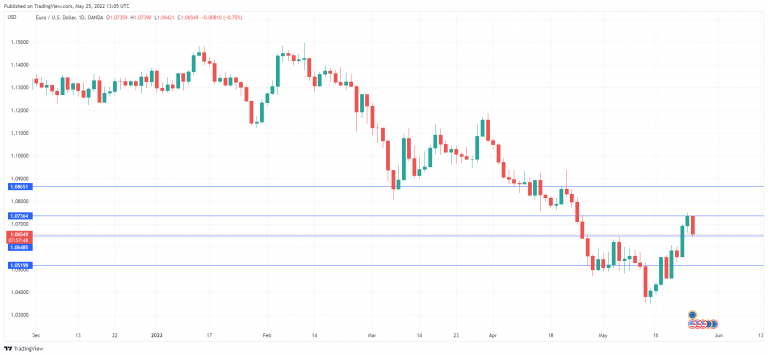
The euro has reversed directions on Wednesday and is sharply lower. In the European session, EUR/USD is trading at 1.0663, down 0.67% on the day. The euro was up 1.29% on Monday and extended its gains on Tuesday, hitting a 4-week high, after ECB President Lagarde announced that the ECB would raise interest rates in July.
On the data front, there weren’t any surprises out of Germany. GDP in Q1 rose by 0.2% QoQ, as expected. Compared to Q4 of 2019, the quarter prior to the Covid-19 pandemic, growth was 0.9% smaller, which means that the economy is yet to fully recover from the Covid crisis. The war in Ukraine and Covid-19 have resulted in supply chain disruptions and accelerating inflation, which has hampered economic growth.
German confidence remains in deep-freeze
German GfK Consumer Sentiment came in at -26.0 in May, a slight improvement from the April reading of -26.6, which marked a record low. Not surprisingly, consumers put the blame for their deep pessimism on two key factors – the conflict in Ukraine and spiralling inflation. The GfK survey also found that consumer spending has weakened, as high costs for food and energy have reduced spending on non-essential items.
The ECB Financial Stability Review, published twice a year, echoed what German consumers are saying. The report bluntly stated that financial stability conditions have deteriorated in the eurozone, as the post-Covid recovery has been tested by higher inflation and Russia’s invasion of Ukraine. The report noted that the economic outlook for the eurozone had weakened, with inflation and supply disruptions representing significant headwinds for the eurozone economy.
Given this challenging economic landscape, the euro will be hard-pressed to keep pace with the US dollar.
EUR/USD Technical
- There is resistance at 1.0736 and 1.0865
- EUR/USD is testing support at 1.0648. The next support line is at 1.0519
USD/JPY Mid-Day Outlook
Daily Pivots: (S1) 126.13; (P) 127.10; (R1) 127.85; More...
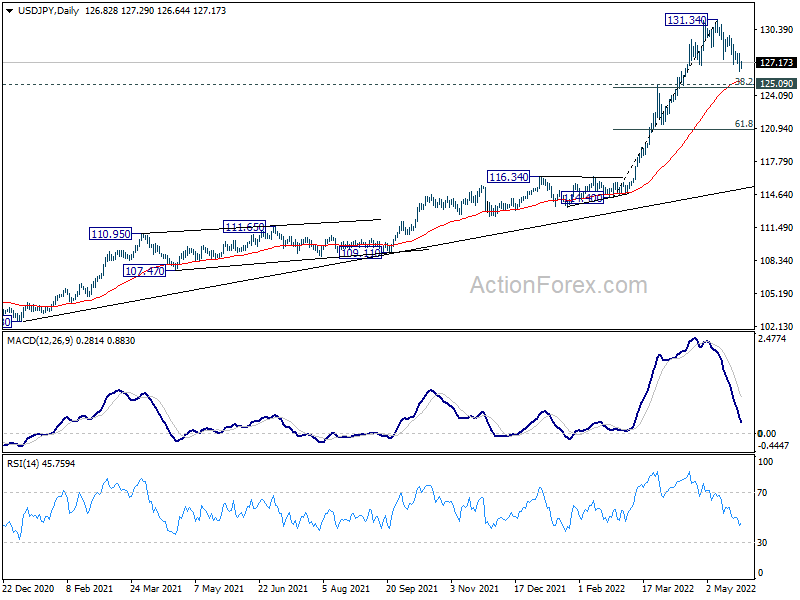
No change in USD/JPY's outlook as correction from 131.34 is in progress. Deeper decline could be seen. But downside should be contained by 125.09 cluster support (38.2% retracement of 114.40 to 131.34 at 124.86) to bring rebound. On the upside, break of 129.77 minor resistance will suggest that the correction is finished and bring retest of 131.34.
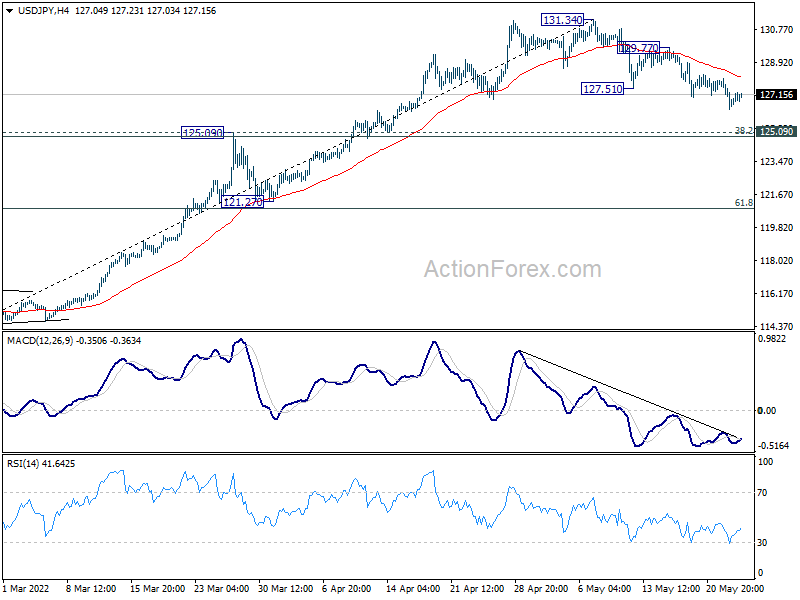
In the bigger picture, current rally is seen as part of the long term up trend form 75.56 (2011 low). Sustained trading above 61.8% projection of 75.56 (2011 low) to 125.85 (2015 high) from 98.97 at 130.04 will pave the way to 100% projection at 149.26, which is close to 147.68 (1998 high). For now, this will remain the favored case as long as 121.27 support holds.
USD/CHF Mid-Day Outlook
Daily Pivots: (S1) 0.9563; (P) 0.9617; (R1) 0.9659; More...
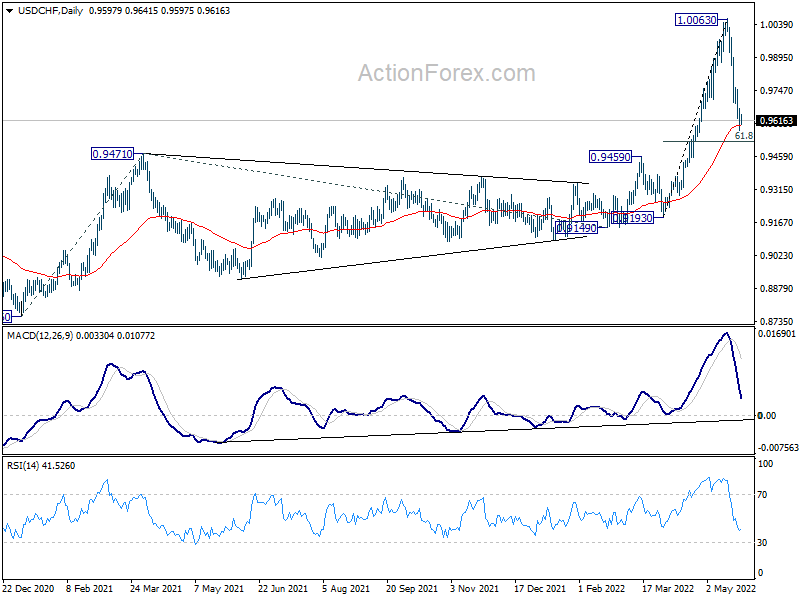
Further fall could still be seen in USD/CHF despite loss of downside moment. But downside should be contained by 61.8% retracement of 0.9193 to 1.0063 at 0.9525 to bring rebound. On the upside, above 0.9763 minor resistance will turn bias back to the upside for recovery. However, sustained break of 0.9525 will bring deeper decline to 0.9459 support.
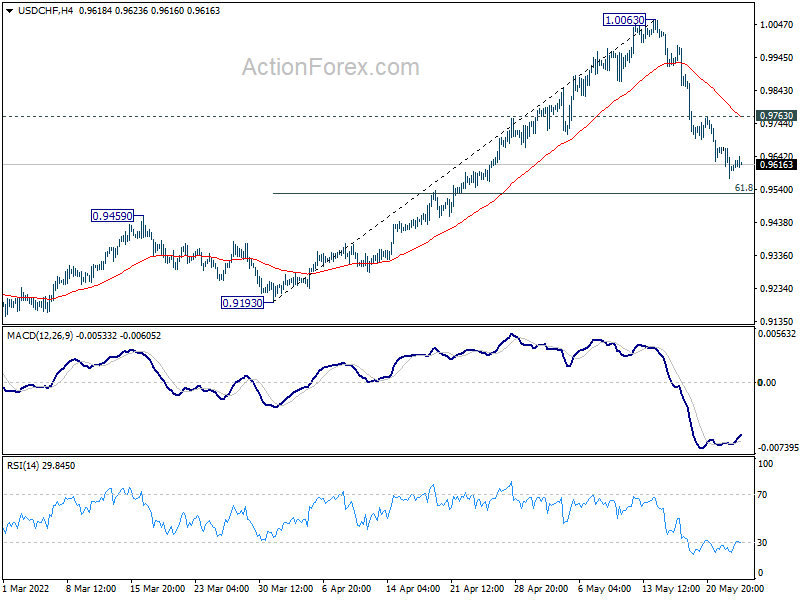
In the bigger picture, down trend from 1.0342 (2016 high) should have completed with three waves down to 0.8756 (2021 low) already. Rise from 0.8756 is likely a medium term up trend of its own. Next target is 161.8% projection of 0.8756 to 0.9471 from 0.9149 at 1.0306, which is close to 1.0342 (2016 high). This will remain the favored case as long as 0.9459 resistance turned support holds.