

Sample Category Title
Swiss Franc Still Firm in Ranging Markets, Dollar Weak
Trading in the currency market is rather quiet today, with major pairs and crosses stuck inside yesterday's range. Other markets are also treading water with European indexes and US futures slightly up. Benchmark treasury yields are mixed. Gold is retreating slightly while oil prices are also range bound. As for the week, Dollar remains the worst performing one, followed by Canadian and Aussie. Swiss Franc is the strongest, followed by Euro and Kiwi.
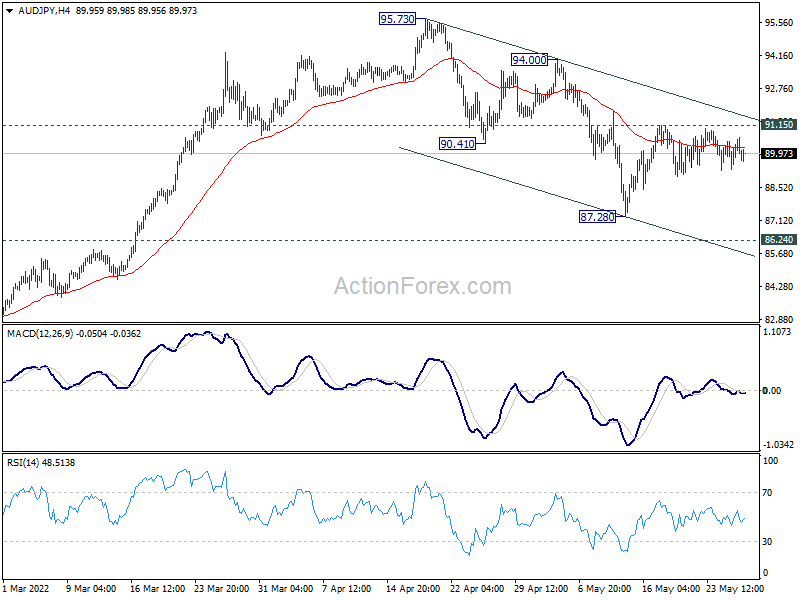
Technically, US stocks have been very resilient this week, but there is no clear turn around in the near term trend yet. If overall sentiment does improve further, it's likely that AUD/JPY would finally break through 91.15 resistance to resume the rebound from 87.28 low. Such development, if happens, would also firm the case that correction from 95.73 is finished, and bring retest of this high. In that case, stock markets should be staging a strong rebound too, or something is wrong underneath.
In Europe, at the time of writing, FTSE is up 0.12%. DAX is up 0.84%. CAC is up 0.78%. Germany 10-year yield is up 0.010 at 0.964. Earlier in Asia, Nikkei dropped -0.27%. Hong Kong HSI dropped -0.27%. China Shanghai SSE rose 0.50%. Singapore Strait Times rose 0.93%. Japan 10-year JGB yield rose 0.0232 to 0.235.
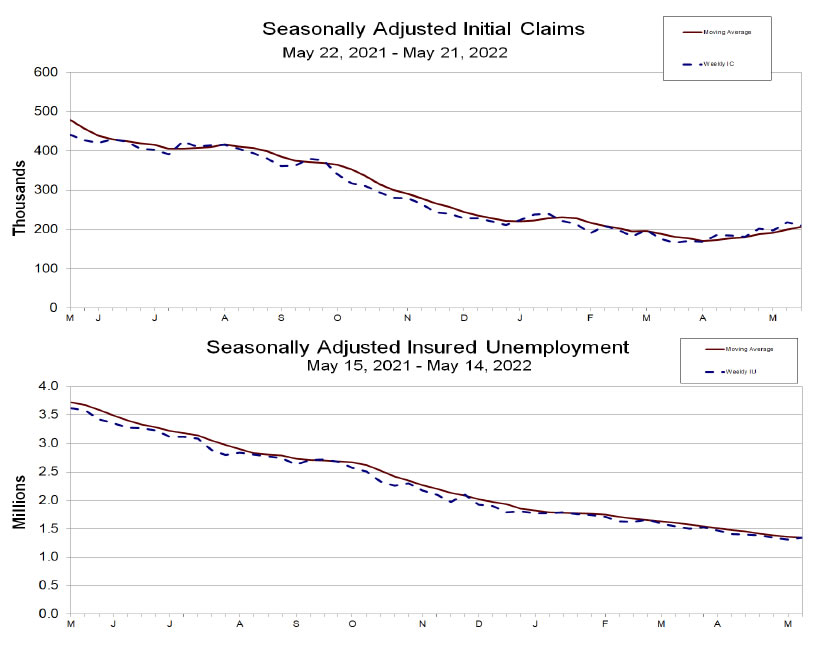
US initial jobless claims dropped to 210k continuing claims down to 1.348m
US initial jobless claims dropped -8k to 210k in the week ending May 21, matched expectations. Four-week moving average of initial claims rose 7k to 207k.
Continuing claims rose 31k to 1346k in the week ending May 14. Four-week moving average of continuing claims dropped -14k to 1348k, lowest since January 17, 1970 when it was 1340k.
Also released, Q1 GDP was revised down from -1.4% annualized to -1.5%. GDP price index was revised up from 8% to 8.1%.
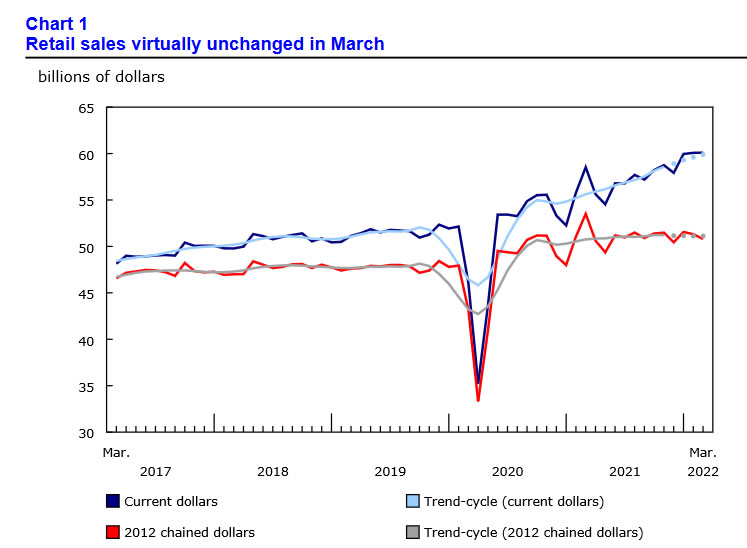
Canada retail sales flat in Mar, auto and parts contracted sharply
Canada retail sales was flat mom in March, worse than expectation of 1.5% mom rise. Sales were up in 10 of 11 subsectors, led by gasoline (up 7.4%). However, sales at motor vehicle and parts dealers (-6.4%) erased the gains observed in the remaining subsectors.
For Q1 as a whole, sales were up 3.0%, largest quarterly rise since Q3 of 2020. Preliminary data indicates sales rose 0.8% mom in April.
BoJ Kuroda: Exit from easy monetary policy won't be easy
BoJ Governor Haruhiko Kuroda reiterated to the parliament today that ultra-loose monetary policy must be maintained for now. Consumer inflation is still expected to slow next year and beyond, after spiking above 2% target this year, only because of surging energy prices.
Nevertheless, Kuroda also noted when the right time comes, BoJ will plan an exit from easy policy. "The key would be how to raise interest rates and scale back the BOJ's expanded balance sheet," he said. "The BOJ can combine various means and ensure markets remain stable in executing a smooth exit from easy policy. I must add, however, that it won't be easy," he said.
Regarding exchange rate depreciation, Kuroda said Fed's rate hike may not necessarily weaken the Yen, if they also shoot down stock prices.
Prime Minister Fumio Kishida said in the same parliament session, "sharp yen moves are undesirable. While a weak yen benefits exports and firms with overseas assets, it hurts households and some businesses via higher costs."
RBNZ Orr: Single biggest risk is embedded inflation expectation
RBNZ Governor Adrian Orr told a parliamentary committee today, "the single biggest risk to this nation at the moment is enabling current high CPI inflation to become embedded in future ongoing inflation expectation."
Orr said that a recession is not projected for New Zealand, even though he cannot rule it out. Challenges to growth were coming through significant downgrades to global growth, particularly China.
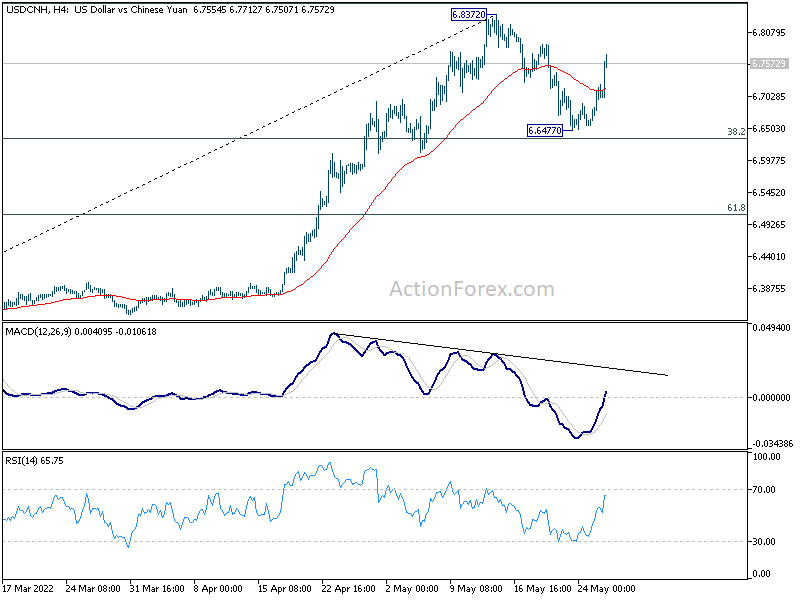
USD/CNH finished pull back, heading back to 6.83
Yuan's decline today suggests that the near term recovery is already completed and there's risk of more downside. The selloff came after Chinese Premier Li Keqiang held a rare high-profile meeting yesterday on measures to support the economy. That's is seen as a sign that the government is in deep worry about the impact of the extend tough pandemic lockdowns in many majors city, including Shanghai.
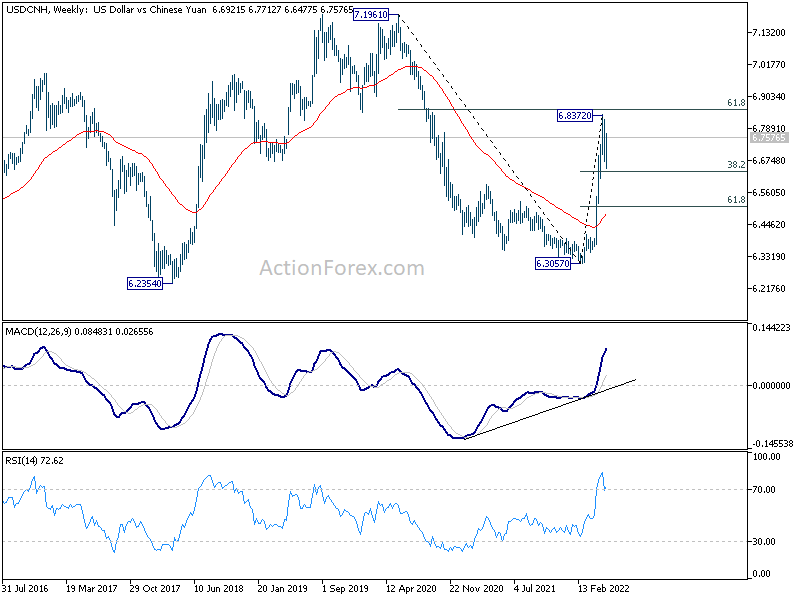
USD/CNH's pull back from 6.8372 has likely completed at 0.6477, just ahead of 38.2% retracement of 6.3057 to 6.8372 at 6.6342. Strong rebound should be seen to 6.8372 and possibly above. The key resistance, however, still lies 61.8% retracement of 7.1961 to 6.3057 at 6.8560. USD/CNH could still be rejection by this fibonacci level at the second attempt.
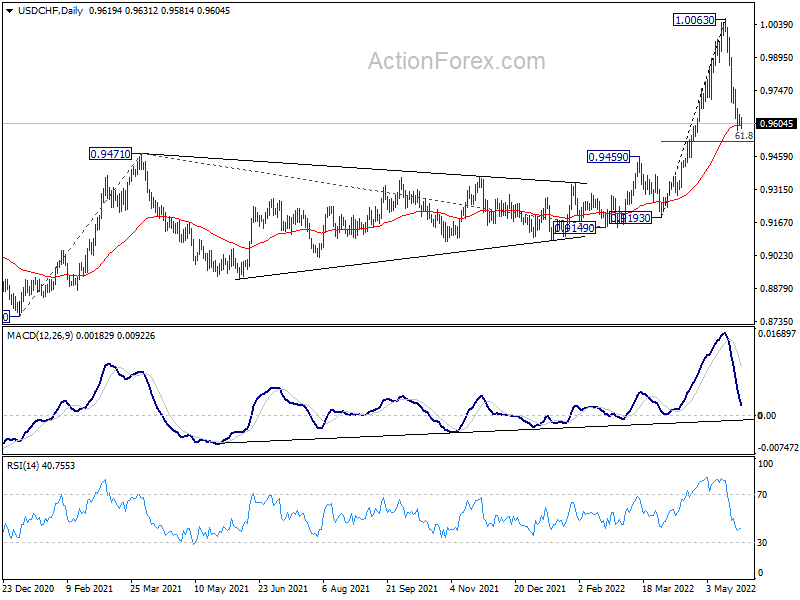
USD/CHF Mid-Day Outlook
Daily Pivots: (S1) 0.9599; (P) 0.9621; (R1) 0.9645; More...
USD/CHF's downside momentum is diminishing as in 4 hour MACD. While further decline cannot be ruled out, downside should be contained by 61.8% retracement of 0.9193 to 1.0063 at 0.9525 to bring rebound. On the upside, above 0.9763 minor resistance will turn bias back to the upside for recovery. However, sustained break of 0.9525 will bring deeper decline to 0.9459 support.
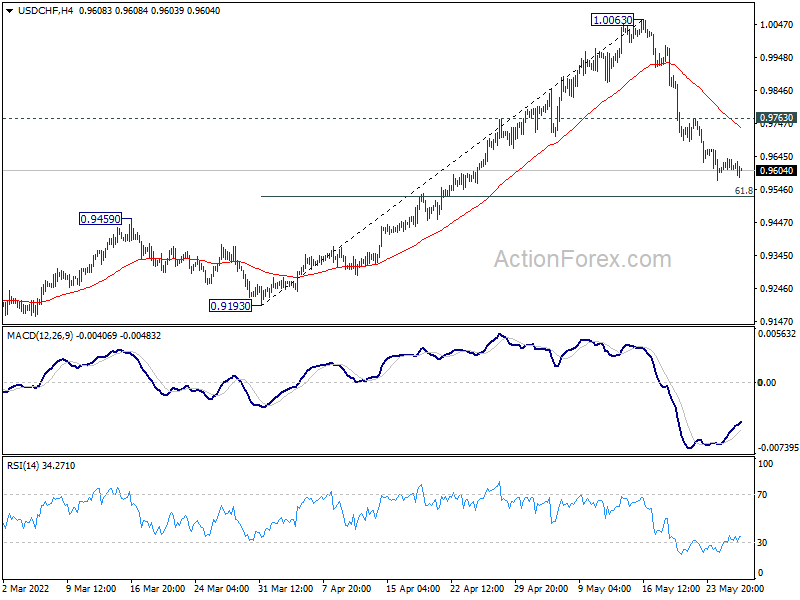
In the bigger picture, down trend from 1.0342 (2016 high) should have completed with three waves down to 0.8756 (2021 low) already. Rise from 0.8756 is likely a medium term up trend of its own. Next target is 161.8% projection of 0.8756 to 0.9471 from 0.9149 at 1.0306, which is close to 1.0342 (2016 high). This will remain the favored case as long as 0.9459 resistance turned support holds.
Economic Indicators Update
| GMT | Ccy | Events | Actual | Forecast | Previous | Revised |
|---|---|---|---|---|---|---|
| 23:50 | JPY | Corporate Service Price Index Y/Y Apr | 1.70% | 0.90% | 1.30% | |
| 01:30 | AUD | Private Capital Expenditure Q1 | -0.30% | 1.50% | 1.10% | 2.30% |
| 12:30 | CAD | Retail Sales M/M Mar | 0.00% | 1.50% | 0.10% | |
| 12:30 | CAD | Retail Sales ex Autos M/M Mar | 2.40% | 2.20% | 2.10% | |
| 12:30 | USD | Initial Jobless Claims (May 20) | 210K | 210K | 218K | |
| 12:30 | USD | GDP Annualized Q1 P | -1.50% | -1.30% | -1.40% | |
| 12:30 | USD | GDP Price Index Q1 P | 8.10% | 8.00% | 8.00% | |
| 14:00 | USD | Pending Home Sales M/M Apr | -1.70% | -1.20% | ||
| 14:30 | USD | Natural Gas Storage | 83B | 89B |
US initial jobless claims dropped to 210k continuing claims down to 1.348m
US initial jobless claims dropped -8k to 210k in the week ending May 21, matched expectations. Four-week moving average of initial claims rose 7k to 207k.
Continuing claims rose 31k to 1346k in the week ending May 14. Four-week moving average of continuing claims dropped -14k to 1348k, lowest since January 17, 1970 when it was 1340k.
Canada retail sales flat in Mar, auto and parts contracted sharply
Canada retail sales was flat mom in March, worse than expectation of 1.5% mom rise. Sales were up in 10 of 11 subsectors, led by gasoline (up 7.4%). However, sales at motor vehicle and parts dealers (-6.4%) erased the gains observed in the remaining subsectors.
For Q1 as a whole, sales were up 3.0%, largest quarterly rise since Q3 of 2020. Preliminary data indicates sales rose 0.8% mom in April.
Yuan Could Fall Below 7.10 per Dollar in the Next Two Months
The yuan has been losing 1.6% in the past two days amid fears of an economic slowdown. This is a solid move compared to how unexpected the bad news was. In our opinion, the appreciation of the last two days should be seen as a continuation of the trend that started at the beginning of April.
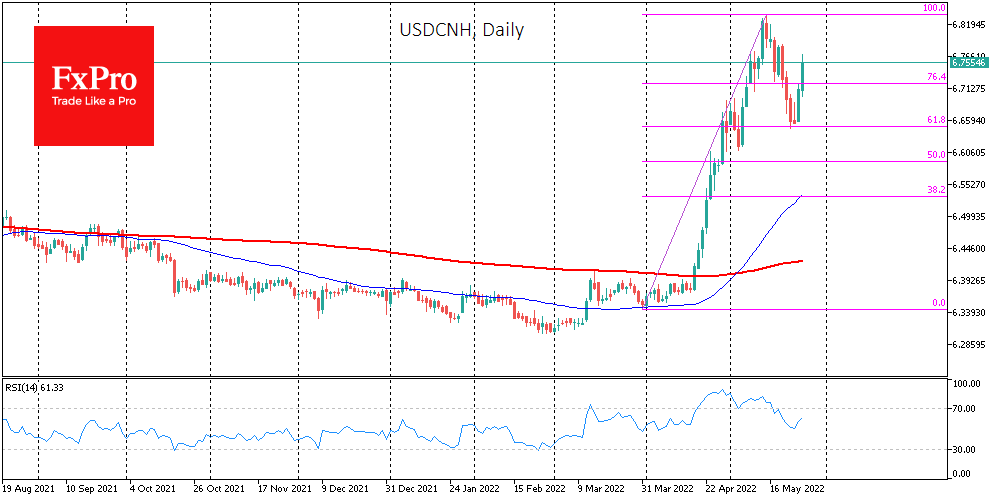
At that time, the renminbi definitively went against the current and succumbed to the Dollar’s general appreciation, and this weakening accelerated sharply at the end of April. The renminbi recovered some losses from May 12th to 24th, but it was just a recharge for yuan bears.
The depth of the retreat in the USDCNH coincided with a classic Fibonacci retracement of 61.8% of the initial move.
China’s slowdown leads to a loosening of monetary policy, and Xi Jinping’s worrying comments set up markets that could see more economic measures in the coming days or weeks. This is especially important for the Chinese leader as 2022 is an election year, and the authorities will therefore try to create as favourable a macroeconomic backdrop as possible.
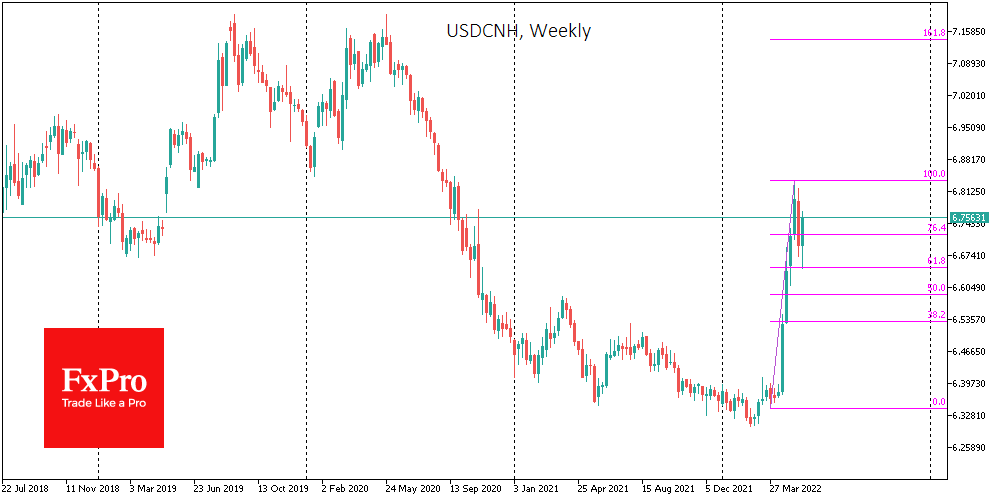
A weaker CNY could give the Chinese economy a helping hand to boost exports. In addition, the fact that monetary policy in China and the US is heading in opposite directions leads to a weaker renminbi.
According to the technical analysis, the USDCNH could now target levels around 7.15 – the highs for 2019 and 2020 – where the 161.8% level of the move mentioned above also passes and where the renminbi could reach mid-July.
EURCHF Bearish Flag Pattern Points to More Downside
The US dollar rose during the American session as the market reacted to the latest minutes by the Federal Reserve. The minutes provided more color about the state of the bank’s officials as they try to lower the runaway inflation. Most officials agreed that the bank needs to do more in terms of lowering liquidity in the market. As a result, in addition to the 50 basis points rate hike they implemented, they signaled that more tightening was necessary. As such, the consensus is that the bank will hike interest rates by 0.50% in the upcoming two meetings and then start quantitative tightening.
The price of crude oil went sideways even after the US published the latest inventory data. According to the Energy Information Administration (EIA), the country’s oil inventories had a drawdown of over 1.01 million barrels. This was a smaller drawdown than the previous week’s 3.39 million barrels. The report showed that oil inventories at Cushing declined by more than 1 million barrels while weekly distillates stocks rose to 1.65 million barrels. Oil is also reacting to expectations that the global economy may be entering a period of recession or stagflation. For example, data from the US revealed that durable goods orders declined in April.
There are several important events scheduled today. In Turkey, the central bank is expected to deliver its decision. The expectation is that the bank will leave interest rates unchanged and signal more caution. In Mexico, the statistics agency will publish the latest retail sales numbers. Economists believe that the country’s sales rose by 2.7% in April. Meanwhile, in the United States, the government will release the pending home sales data. On Tuesday, data showed that new home sales declined by 16% in April. Other key data to watch will be the US GDP numbers.
EURUSD
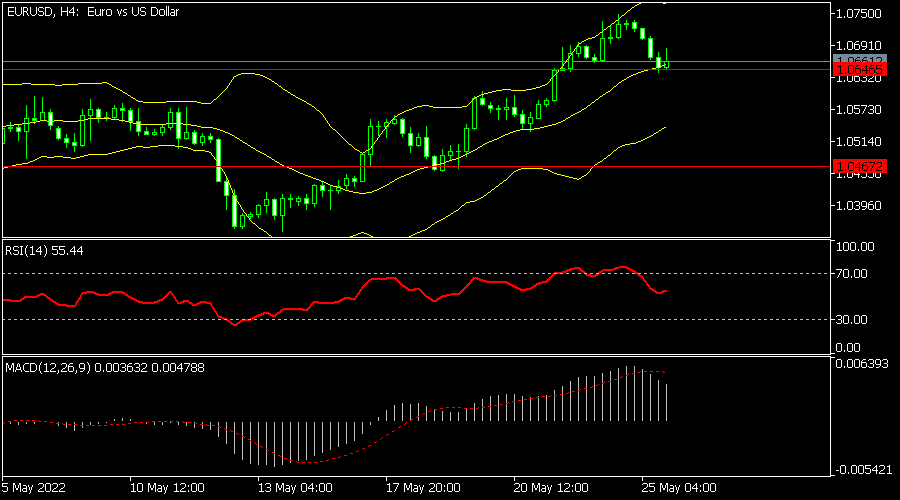
The EURUSD pair retreated to a low of 1.0645, which was the lowest point since Monday. This was a notable level since it was the highest point on May 4. The price is also along the middle line of the Bollinger Bands while the Relative Strength Index (RSI) has moved below the overbought level. The MACD remains above the neutral point. Therefore, the pair will likely resume the bullish trend since it has formed a break and retest pattern.
XNGUSD
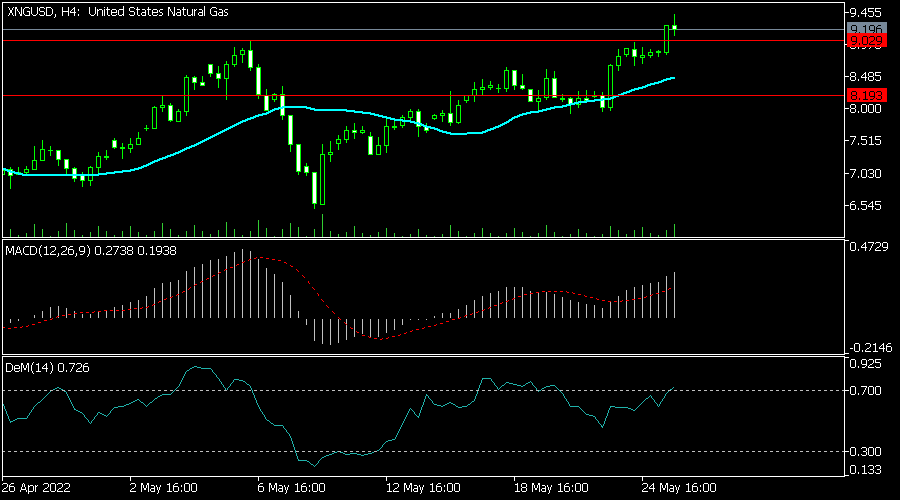
The XNGUSD pair has maintained its bullish trend as demand for natural gas rose. The pair moved above the important resistance level at 9.02, which was the highest level on May 6. The pair moved above the 25-day moving average while the MACD and the DeMarker indicators continued rising. Therefore, the pair will likely keep rising, with the next key resistance level at 9.45.
EURCHF
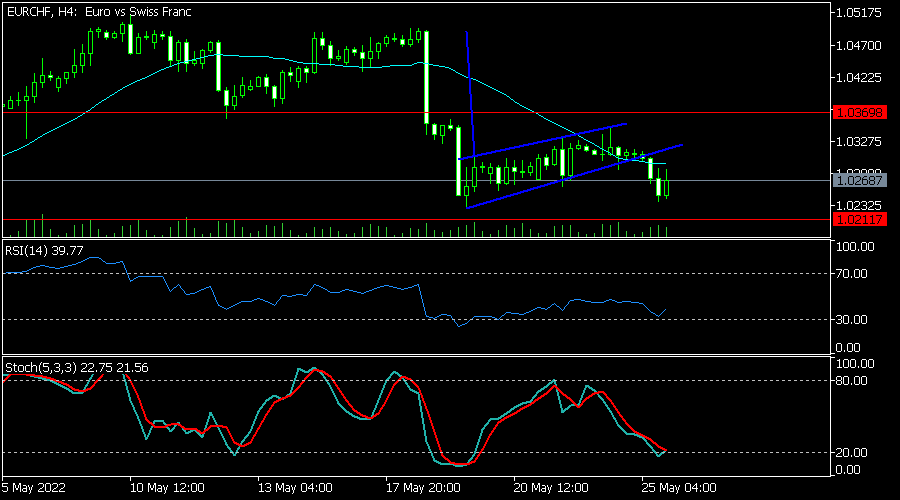
The EURCHF pair has been in a strong bearish trend for the past few days. The pair formed a bearish flag pattern that is shown in blue. This pattern is usually a bearish sign. The pair has moved below the 25-day and 50-day moving averages while the Relative Strength Index (RSI) has moved close to the overbought level. The pair will likely keep falling, with the next key support being at 1.0211.
Bitcoin is Stable, But Ether’s Performance Reflects the Pressure
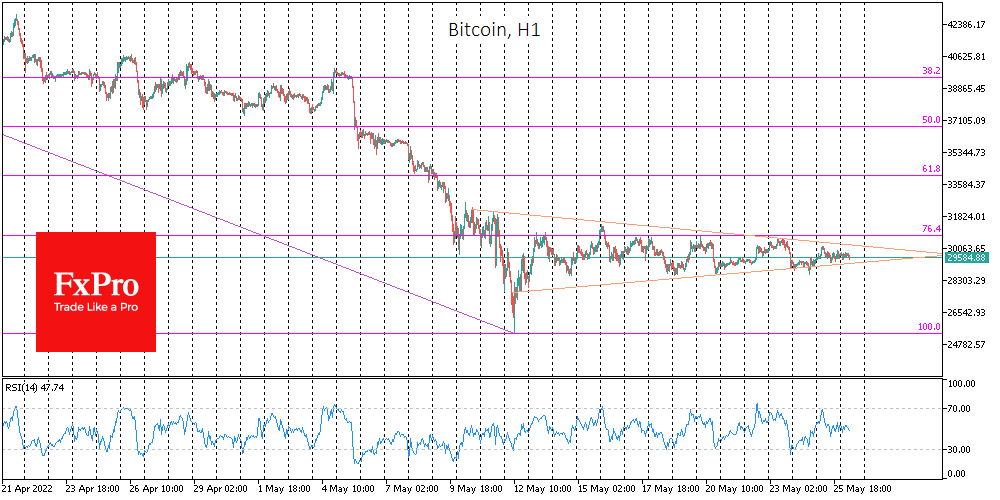
Bitcoin ignored the positive dynamics of US stock indices on Wednesday, further reducing the amplitude of its fluctuations. The first cryptocurrency has been moving in a $29.5-30.0K range since the start of active trading in New York. We caution that this reduction in volatility risks turning into an explosion in the near term, potentially setting off momentum for a few days or weeks.
A formal break of consolidation would be considered a consolidation beyond the previous local extremes, which are located at $30.2K and $29.3K. Going beyond those limits in a sharp move promises to trigger a wave of liquidation of positions that the bulls and bears have brought closer to the current price due to low volatility and bored speculators in recent days.
Outside of Bitcoin, the situation is more worrying. The total capitalisation of the crypto market, according to CoinMarketCap, has fallen 1.6% in the last 24 hours to $1.25 trillion. Bitcoin’s dominance index is 0.4 points to 45.1%.
Ethereum lost 3%, dropping to 1915, the lower end of a steady trading range for the past two weeks. The daily candlestick chart clearly shows a sequence of increasingly lower local highs. This dynamic is a sure sign of a sustained sell-off in crypto, temporarily covered by Bitcoin’s stability.
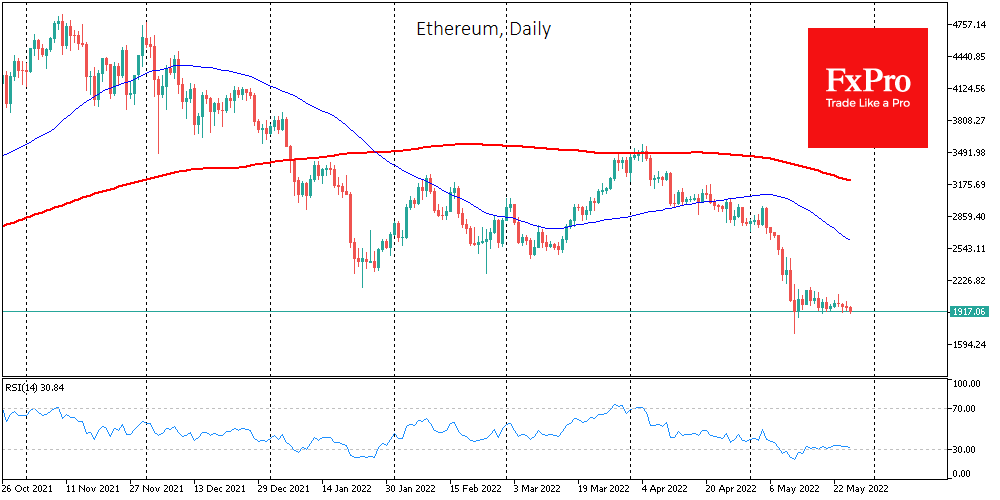
Bitcoin’s stability against such an external backdrop may be nothing more than a temporary consolidation of capital in the most liquid cryptocurrency and is supported by improved sentiment in stocks.
The cryptocurrency Fear and Greed Index was up 1 point to 12 by Thursday and remains in “extreme fear”.
Ripple lawyer Stuart Alderoty criticised the stance of US Securities and Exchange Commission Chairman Gary Gensler and the SEC’s desire to seize administrative control of the cryptocurrency market.
Stellar will provide its technology to the Central Bank of Brazil to develop the digital currency.
EUR/GBP Outlook: Bearish Engulfing Weighs and Keeps the Downside Vulnerable
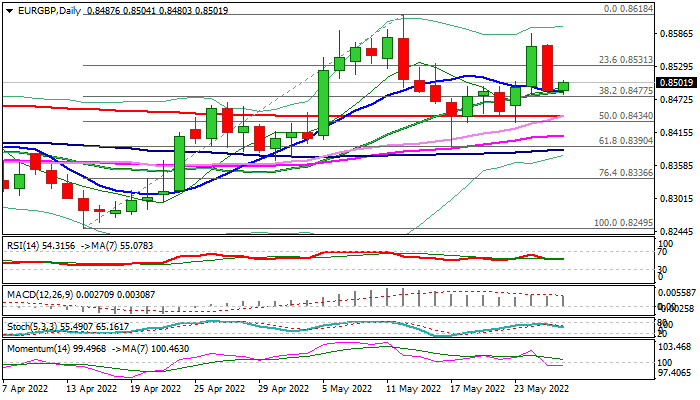
The cross is consolidating above important supports at 0.8486/77 (converged 10/20DMA’s / Fibo 38.2% of 0.8249/0.8618) following Wednesday’s sharp drop (0.9%).
Bearish engulfing pattern formed on Wednesday, along with large bearish daily candle, weigh on near-term action, with rising bearish momentum on daily chart, adding to negative signals and keeping the downside vulnerable.
Clear break of 0.8486/77 pivots would spark fresh acceleration lower and risk test of next key level at 0.8443 (200DMA), loss of which would further weaken near0term structure and allow for deeper drop.
Key support lays at 0.8392 (May 17 higher low)and break here would complete failure swing pattern on daily chart and signal reversal.
Conversely, return above 0.85 handle would ease immediate downside risk, but lift above 0.8589 (Tuesday’s peak) is needed to bring bulls fully in play for renewed attempt towards 2022 high at 0.8618 (May 12).
Res: 0.8500; 0.8531; 0.8567; 0.8586.
Sup: 0.8486; 0.8477; 0.8443; 0.8432.
EUR/USD Outlook: Bullish Near-Term Bias above Daily Kijun-Sen
The Euro is trading within tight range around 1.07 handle in Europe on Thursday but remains constructive despite easing risk mode in Asia.
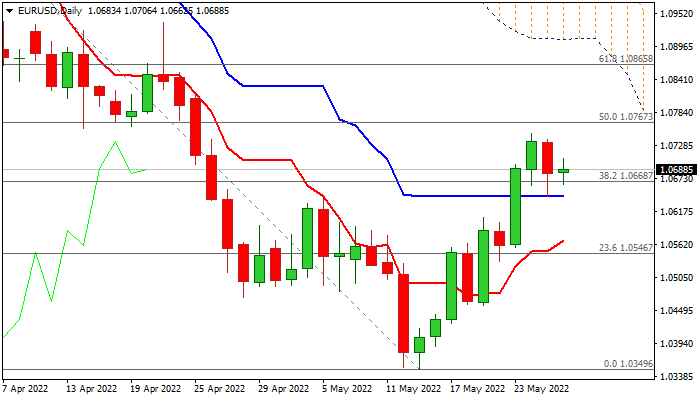
The action stays above broken Fibo barrier at 1.0668 (38.2% of 1.1184/1.0349) and daily Kijun-sen (1.0643) which turned to solid supports and maintain near-term bullish bias.
Daily MA’s (5/10/20) are in bullish setup and formed a multiple bull-crosses that support the action, along with rising bullish momentum.
Bulls eye pivotal barriers at 1.0774/87 (55DMA / Fibo 38.2% of 1.1494/1.0349) to generate fresh positive signals on potential break.
Caution on drop below daily Kijun-sen, while return below daily Tenkan-sen (1.0568) would neutralize near-term bulls.
Repeated hawkish signals from ECB President Lagarde about moving rates from the negative territory and possible further rate hikes in coming months, underpin the action, although the
ECB still lacks unity in this idea.
With no releases from the EU scheduled in the morning, trader await US economic indicators, with Q1 GDP, weekly jobless claims and pending home sales, being in focus today.
Res: 1.0748; 1.0767; 1.0787; 1.0800.
Sup: 1.0668; 1.0643; 1.0607; 1.0568.
USD/CNH finished pull back, heading back to 6.83
Yuan's decline today suggests that the near term recovery is already completed and there's risk of more downside. The selloff came after Chinese Premier Li Keqiang held a rare high-profile meeting yesterday on measures to support the economy. That's is seen as a sign that the government is in deep worry about the impact of the extend tough pandemic lockdowns in many majors city, including Shanghai.
USD/CNH's pull back from 6.8372 has likely completed at 0.6477, just ahead of 38.2% retracement of 6.3057 to 6.8372 at 6.6342. Strong rebound should be seen to 6.8372 and possibly above. The key resistance, however, still lies 61.8% retracement of 7.1961 to 6.3057 at 6.8560. USD/CNH could still be rejection by this fibonacci level at the second attempt.
BoJ Kuroda: Exit from easy monetary policy won’t be easy
BoJ Governor Haruhiko Kuroda reiterated to the parliament today that ultra-loose monetary policy must be maintained for now. Consumer inflation is still expected to slow next year and beyond, after spiking above 2% target this year, only because of surging energy prices.
Nevertheless, Kuroda also noted when the right time comes, BoJ will plan an exit from easy policy. "The key would be how to raise interest rates and scale back the BOJ's expanded balance sheet," he said. "The BOJ can combine various means and ensure markets remain stable in executing a smooth exit from easy policy. I must add, however, that it won't be easy," he said.
Regarding exchange rate depreciation, Kuroda said Fed's rate hike may not necessarily weaken the Yen, if they also shoot down stock prices.
Prime Minister Fumio Kishida said in the same parliament session, "sharp yen moves are undesirable. While a weak yen benefits exports and firms with overseas assets, it hurts households and some businesses via higher costs."