

Sample Category Title
Bitcoin Will Fall Until the Bulls Capitulate
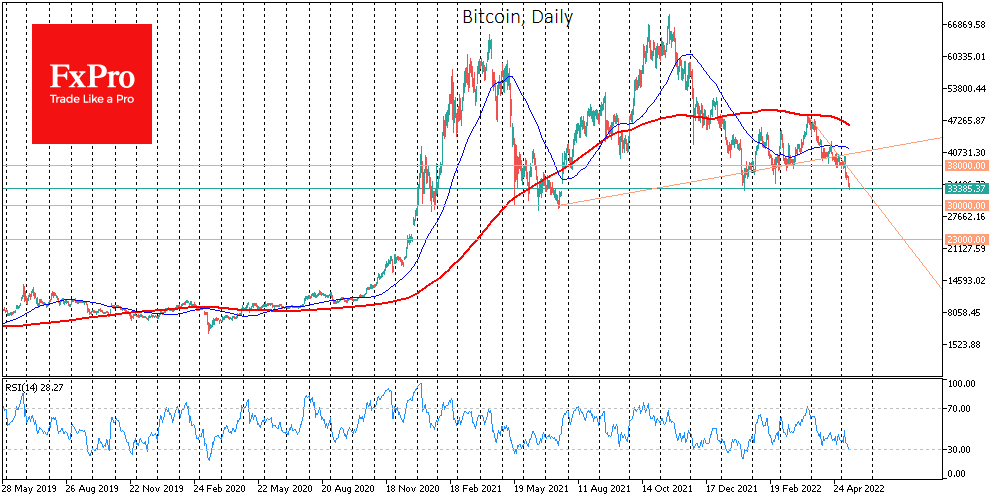
Bitcoin is trading near $33.5K on Monday morning, declining for the fifth consecutive day. Over the past 24 hours, losses are 2.3%, and are approaching 14% over the past seven days. Ether loses 3.5% in 24 hours and 14.3% for the week, settling near $2450. Altcoins from the top ten are down between 0.8% (XRP) and 4.3% (Cardano).
Total crypto market capitalisation, according to CoinMarketCap, is down 2.3% overnight to $1.54 trillion. More worryingly, volumes are rising along with falling prices. This situation points to an increasingly rapid exit from cryptocurrencies, even though the process takes place without sharp dips. We see an orderly exit – a sure sign that downward sentiment may prevail.
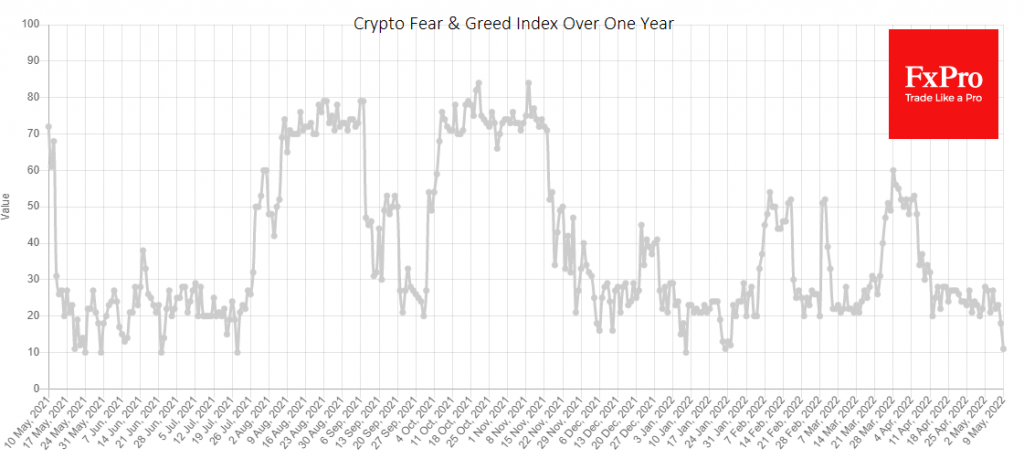
The optimists, however, have something to hang on to. The Cryptocurrency Fear and Greed Index has collapsed to 11. Over the past year, the index has been at the current or lower level six times, and on each occasion, we have seen either consolidation or the start of a rally and a rebound.
In March 2020, when the index similarly reached single digits, we saw an influx of long-term buyers.
The current extreme fear may attract buyers who have been waiting for extreme oversold conditions to buy cryptocurrencies long term.
However, we note that the amplitude of crypto market fluctuations does not resemble either a capitulation of enthusiasts or a wave of stop orders triggering. Typically, a trend reversal is preceded by a sharp increase in momentum with the eventual resignation of those who stood against the trend.
In our case with Bitcoin, this could translate into a sharp acceleration of the sell-off after falling below $30K, all the way to the $23K or even the $20K area. It is only from this level that major long-term buyers can be expected to emerge.
Nasdaq 100 and Dow Jones Struggling as Earnings Growth Slows
Global stocks are still on edge as worries about the Federal Reserve continued. Futures tied to the DAX and Nasdaq 100 continued dropping in early trading. The sell-off accelerated when the Fed decided to reduce liquidity in the market by hiking interest rates and starting a quantitative tightening policy. As a result, stocks declined as investors avoided betting against the Fed. At the same time, the earnings season has pointed to margin contraction considering that earnings have declined. According to FactSet, earnings growth was at 9.1%, which is the lowest level since Q4 of 2020.
The price of crude oil rose slightly as investors reacted to the latest meeting by OPEC+ leaders. The members, as expected, decided to continue hiking production gradually even as demand kept rising. They will now continue adding about 432k barrels of oil per day. The announcement came as the European Union continued deliberating on blocking Russian oil. The process stalled when Hungary decided to veto it saying that the move would deprive the economy of the vital resource.
The economic calendar will not have any major events today. Therefore, investors will focus on the ongoing earnings season. The companies that will publish today include Tyson Food, Palantir Technologies, Lordstown Motors, Maxar Technologies, and Vroom among others. Raphael Bostic, a Fed official will speak and share his opinion about the economy. Earlier on, the Chinese statistics agency said that its exports declined slightly because of recent lockdowns.
XBRUSD
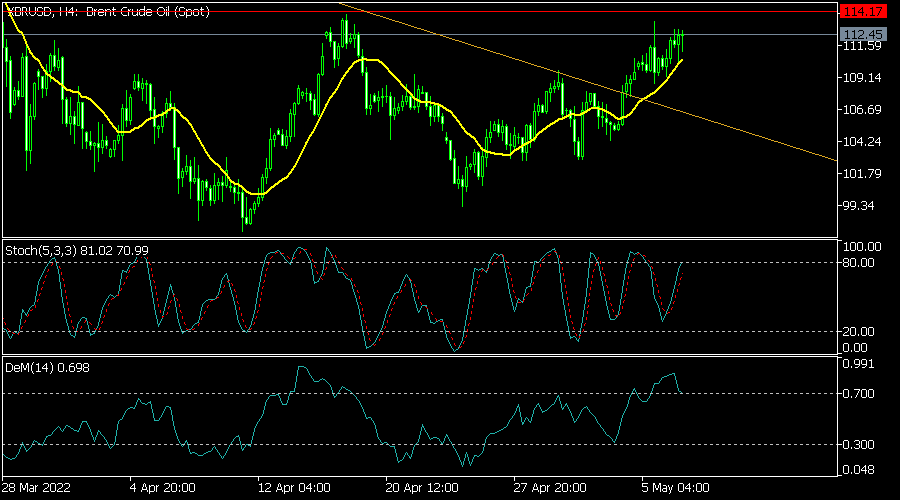
The XBRUSD pair continued surging as demand continued rising. It rose to a high of 112.45, which was the highest level since April 20th. On the four-hour chart, the pair is approaching the important resistance level at 114.17. It has also moved slightly above the descending trendline shown in orange. The uptrend is also being supported by the 25-day and 50-day moving averages while the Stochastic Oscillator and the DeMarker indicator have risen. Therefore, the pair will likely keep rising as bulls target the key resistance at 114.17.
EURUSD
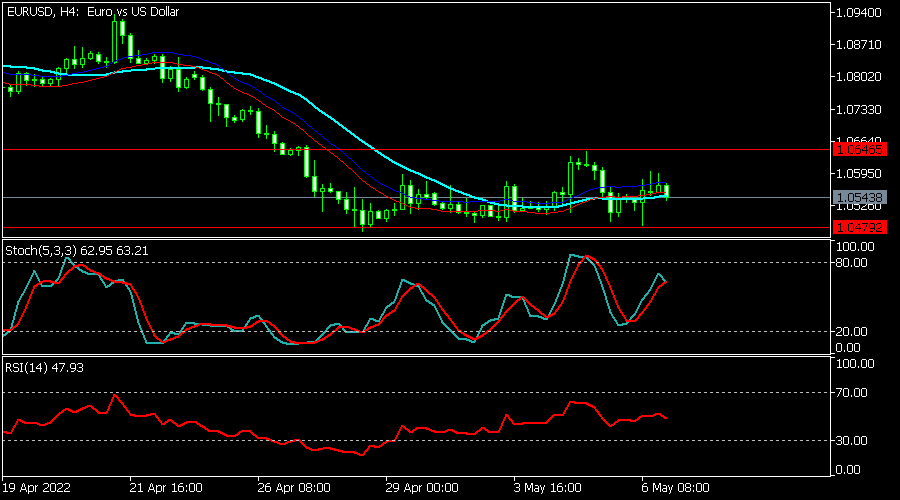
The EURUSD pair moved sideways as investors reacted to the recent American non-farm payrolls data. It is trading at 1.0545, which is slightly above last week’s low of 1.0480. It is at the same level as the envelopes indicator while the Relative Strength Index and the Stochastic Oscillator have moved to the neutral level. The pair will remain at this range since there is no major data from the US and EU.
USDCAD
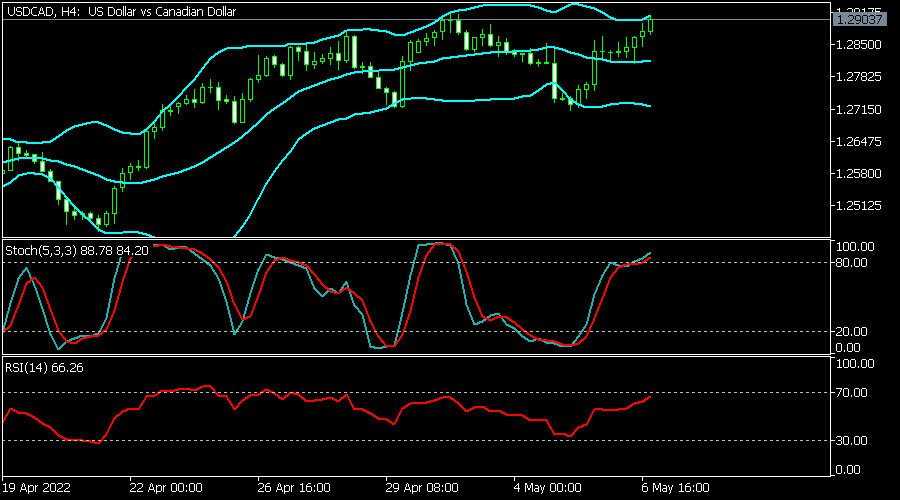
The USDCAD pair held steady after the latest jobs data from the US and Canada. It is trading at 1.2900, which was the highest level since May 4. It moved above the upper side of the Bollinger Bands. Also, the pair has moved above the 25-day and 50-day moving averages while the Relative Strength Index has moved close to the overbought level. The pair will likely keep rising as bulls target the resistance at 1.2950.
Yuan selloff accelerates as China tightens up Shanghai lockdown again
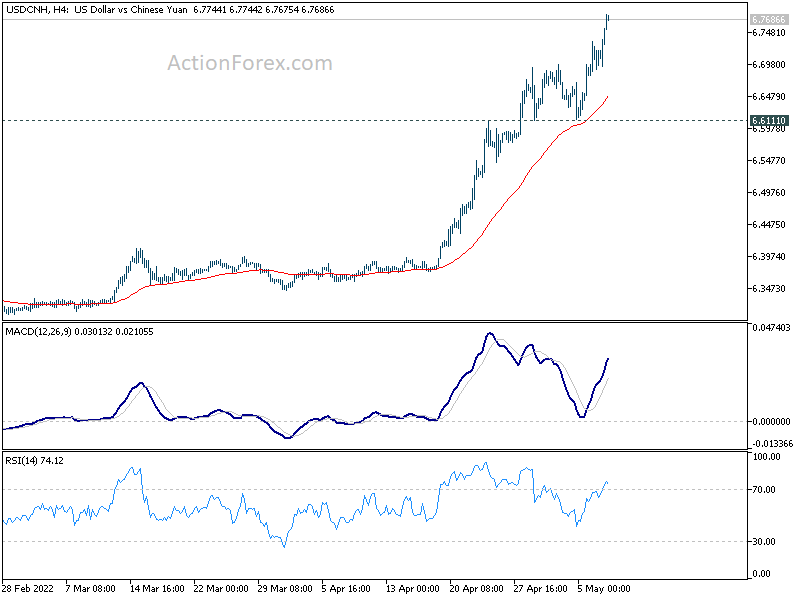
The selloff in Chinese Yuan accelerates again today as the Chinese government tightened up city-wide lockdown in Shanghai again. The decision came after President Xi Jinping's pledge last week to double down on the "battle" against the coronavirus.
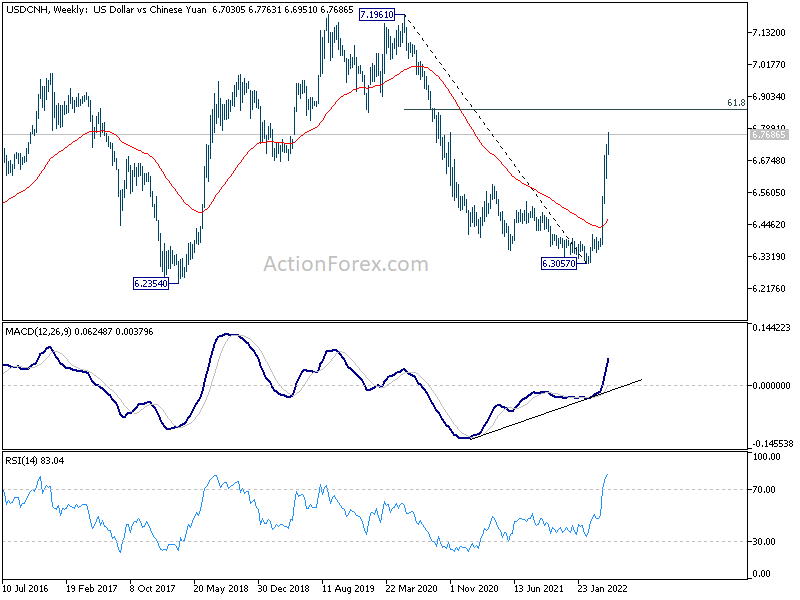
USD/CNH (offshore Yuan) hits as high as 6.7763 so far today, highest level since late 2020. Technically, Current rise is at least in the same degree as the down trend from 7.1961 (2020 high). Further rise is expected as long as 6.6111 support holds. Next target is 61.8% retracement of 7.1961 to 6.3057 at 6.8560.
Also, released from China earlier today, exports rose 3.9% yoy in April, above expectation of 3.2% yoy. Imports dropped -2.0% yoy, versus expectation of -3.0% yoy. Trade surplus widened from USD 47.4B to USD 51.1B, basically in-line with expectations.
Gold Shows No Intention of Altering Bearish Phase
Gold started Monday’s session on the wrong foot of what it could turn into its fourth consecutive week of declines.
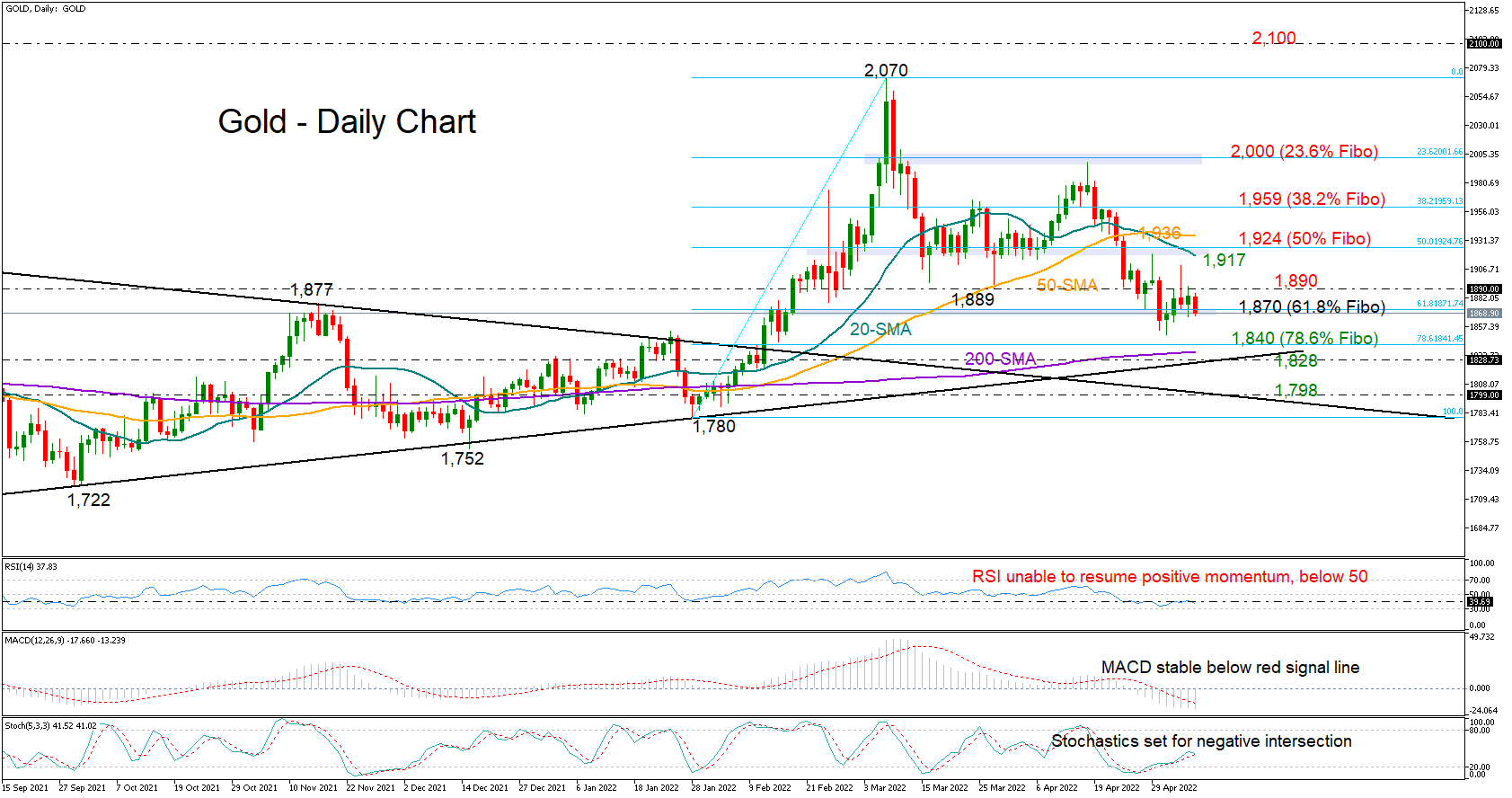
The 1,870 area is currently buffering selling tendencies, but the momentum indicators are still feeding scepticism. The RSI is struggling to exit the bearish area, while the MACD remains comfortably below its red signal line despite stabilizing lately. Discouragingly, the Stochastics are looking for a negative intersection following the bounce off the oversold region.
Adding to the dim signals is the bearish crossover between the 20- and 50-day simple moving averages (SMAs), which lends more credence to the downleg from 2,070.
In the event the price slides below 1,870, confirming a broad neutral outlook, it could initially seek shelter within the 1,840 – 1,825 zone, which encapsulates the 200-day SMA and the long-term supportive trendline from March 2020. This is also where the 78.6% Fibonacci retracement of the 1,780 – 2,070 upleg is placed. Failure to pivot here could see a sharp extension towards the broken resistance trendline drawn from the 2020 record high of 2,079. If that floor cracks as well, the bears will head for the 2022 low of 1,780.
The way higher is also looking rocky. The 1,890 ceiling is currently a primary concern. A successful close above that bar is expected to prompt additional bullish movements, bringing the 20-day SMA and the 50% Fibonacci of 1,924 next into scope. If buying appetite grows beyond the 50-day SMA too, the way would clear for the 38.2% Fibonacci of 1,959, though only a sustainable increase above 2,000 would breathe life back to gold’s 2022 paused uptrend.
In brief, gold’s short-term technical picture is still grim. A close below 1,870 would further endorse the bearish mode in the market, though only a significant decline below the long-term ascending trendline would violate the pandemic-led positive pattern in the market.
GER 40 Struggles for Support
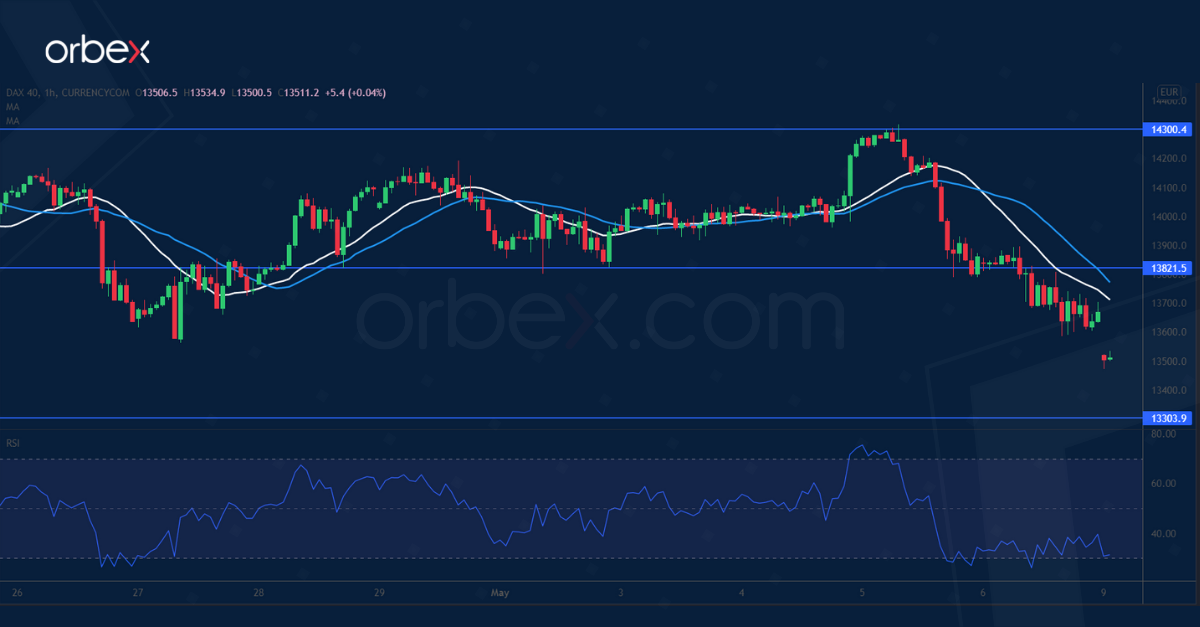
The Dax 40 tumbles as risk appetite subsides amid global policy tightening. The index has met stiff selling pressure at the origin of the late April sell-off at 14300. A drop below the psychological level of 14000 prompted buyers to bail out, invalidating the latest rebound in the process. A bearish MA cross is another sign that an imminent sell-off could be building up. A deeper correction below 13570 would send the price action to 13300. 13820 is a fresh resistance in case of a rebound.
USD/CAD Bounces Higher
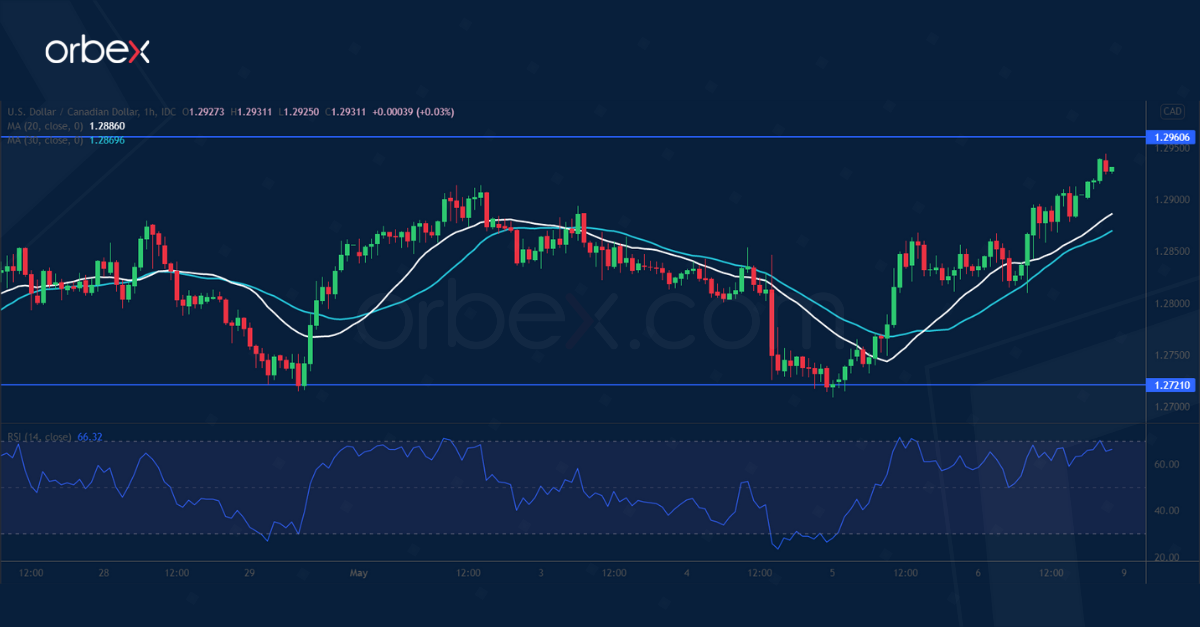
The Canadian dollar softens as April’s labour market performance fell short of expectations. A combination of a break above March’s high (1.2900) and a bullish MA cross on the daily chart confirms the market’s upbeat mood. The latest retracement found support in the major demand zone over 1.2720. A break above 1.2840 may have flushed remaining selling interests out. Last December’s high at 1.2960 is the last hurdle and its breach could open the door for an extended rally above 1.3100.
EUR/USD Consolidates
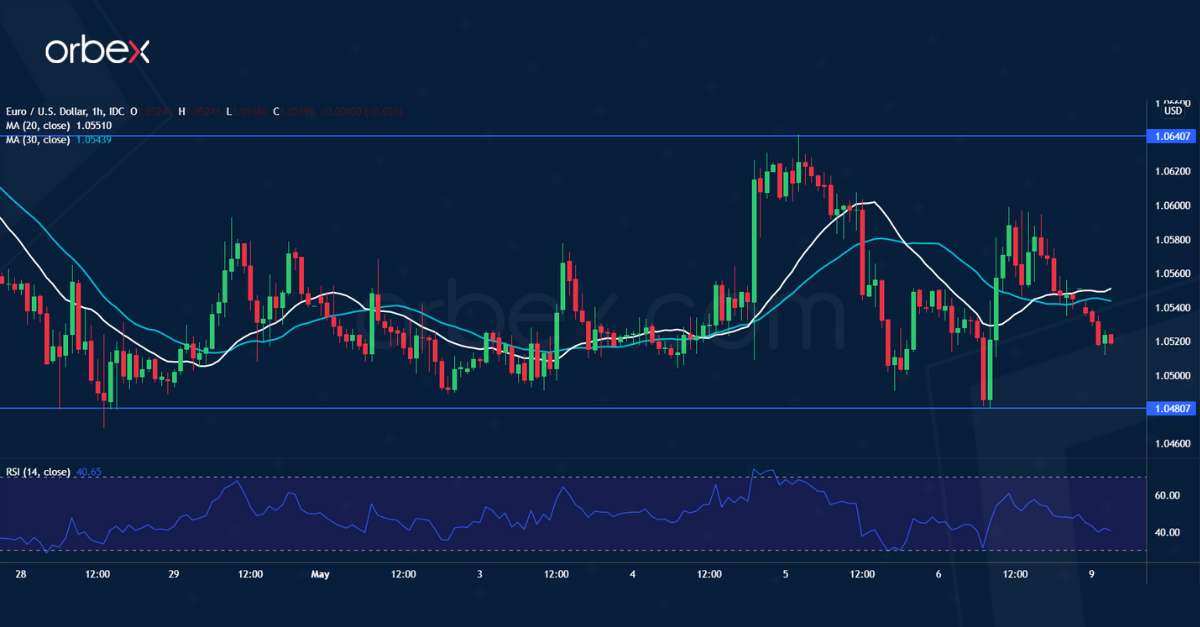
The US dollar climbed after better-than-expected NFP in April. The euro is licking its wounds after it broke March 2020’s lows near 1.0640. The price is seeking support above March 2017’s lows (1.0500). The previous rebound came to a halt at the support-turned-resistance at 1.0640. A bullish breakout could drive the bears into giving up their chips, reducing the pressure and potentially paving the way for a rally towards 1.0810. A fall below the current consolidation range (1.0480) would send the single currency to 1.0400.
Eurozone Sentix investor confidence dropped to -22.6, war only knows victims
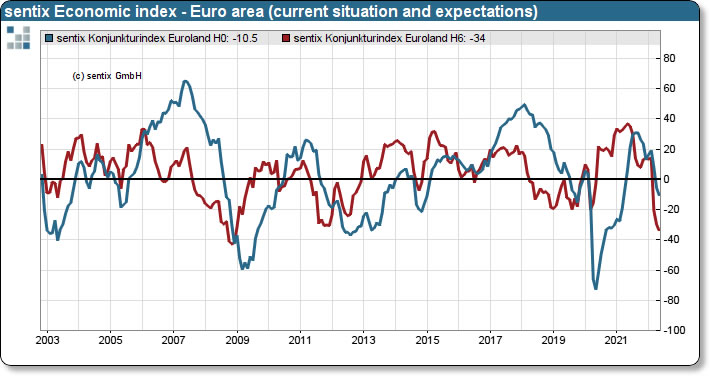
Eurozone Sentix Investor Confidence dropped from -18.0 to -22.6 in May, worse than expectation of -20.8. The's the third decline in a row, and the lowest reading since June 2020. Current Situation index dropped from -5.5 to -10.5, worst since March 2021. Expectations index dropped from -29.8 to -34.0, worst since December 2008.
Germany Sentix Investor Confidence dropped from -17.1 to -20.5, lowest since May 2020. Current Situation index dropped from -4.8 to -7.3, lowest since March 2021. Expectations index dropped from -28.8 to -32.8, all-time low.
Sentix said: "War only knows victims. The traces of the Ukraine conflict are also becoming increasingly visible in the economy. The sanctions against Russia are having an effect, on enemies and friends alike. Last month, the "first mover" economic index clearly pointed the way towards recession. At the beginning of May, the downturn deepened further. Europe is hit particularly hard. The overall Eurozone index drops to -22.6 points. And for Germany we report an all-time low in economic expectations. In other words: it's coming thick and fast."
Daily Technical Analysis
EUR/USD
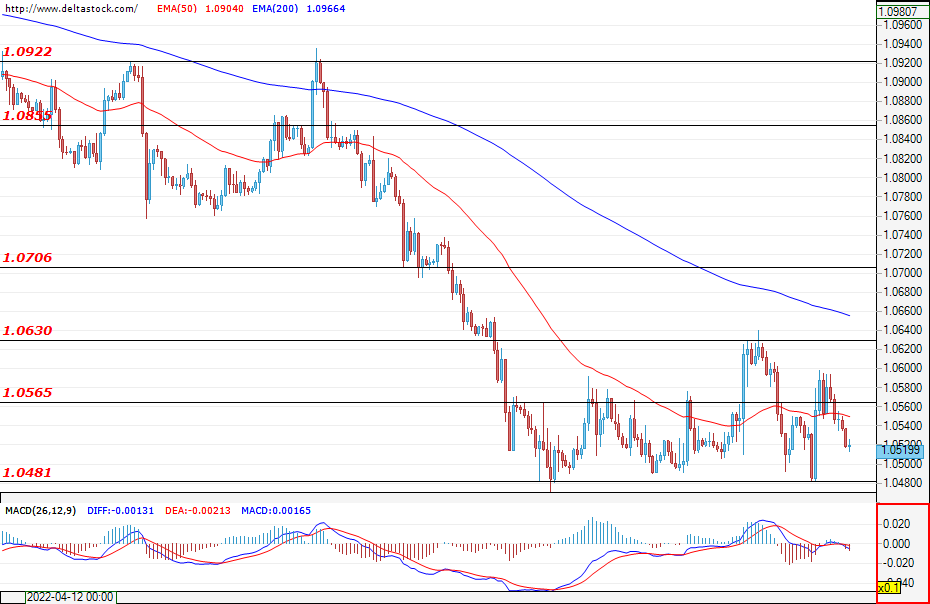
During the last week, the single European currency was trading around the key level at 1.0565, but the week ended with a breach of 1.0565 – a level that already plays the role of the first important resistance. Today, the bears confirmed the breach of this level and are rapidly attacking the support level at 1.0480, a breach of which would draw a more bearish picture. However, if the bulls manage to tip the scales in their favour, then they would have to once more breach the key resistance level at 1.0565, with the next important zone being the level at 1.0630.
USD/JPY
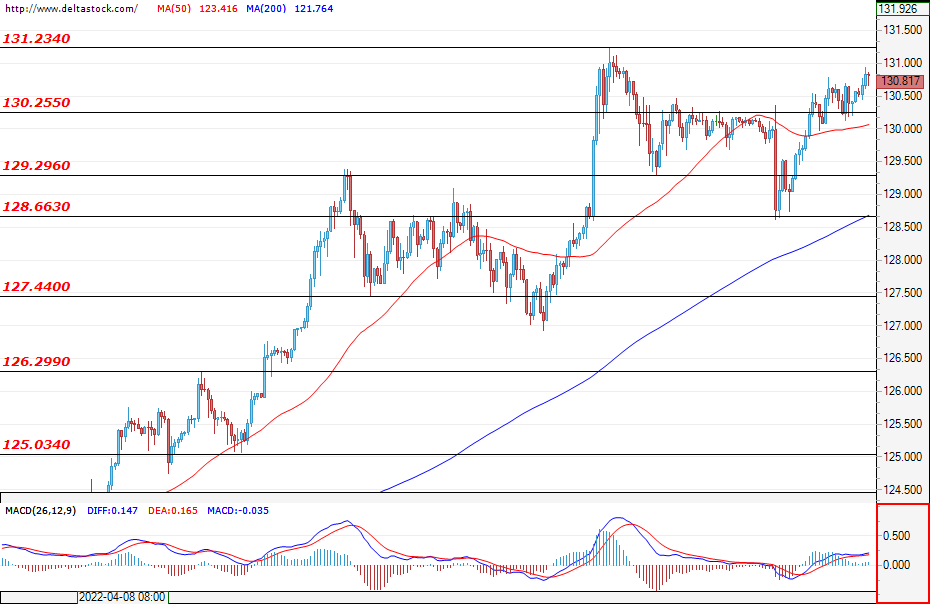
The breach of the support at 129.30 and the subsequent unsuccessful attempts at breaching the next support zone at 128.66 represented the week for the Ninja. The bears’ attempt to reverse the upward trend of the greenback against the yen ended with the unsuccessful breach of the support at 128.66. Following their failure, the upward trend continued in full swing. At the time of writing the analysis, the bulls are aiming to breach the resistance at 131.23. If they are successful in their attack, then the most likely scenario would be for a move towards the resistance at 133.00.
EUGERMANY40
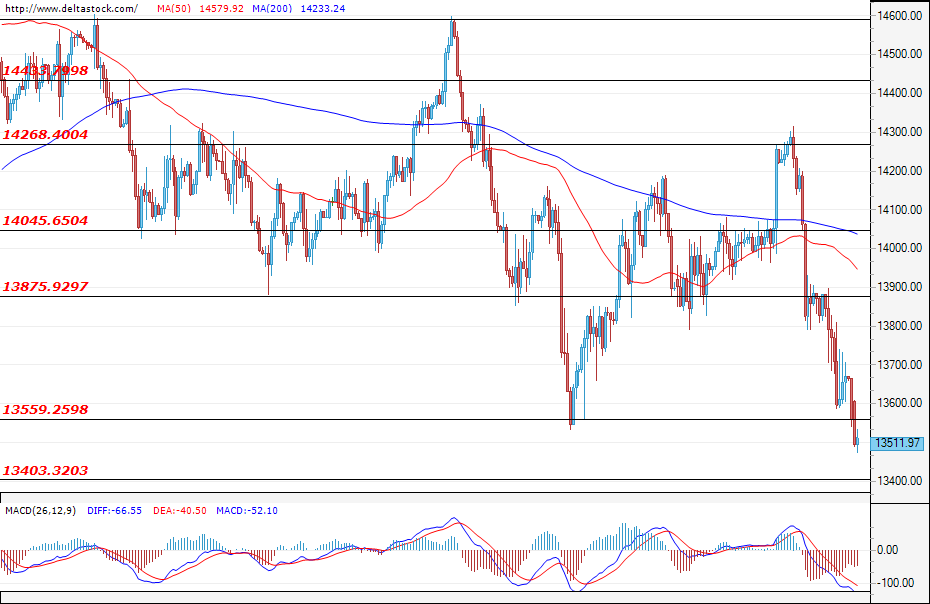
The bears continued to dominate the European markets, as over the past week, they managed to deepen the sell-off and cause a decline of almost 600 points in the German index. Today, with the opening of the markets, they managed to overcome the support level at 13559, and at the time of writing, the next goal for the bears would be to try and breach the level at 13400, with a corrective move towards 13560 shaping up to be a highly likely scenario.
US30
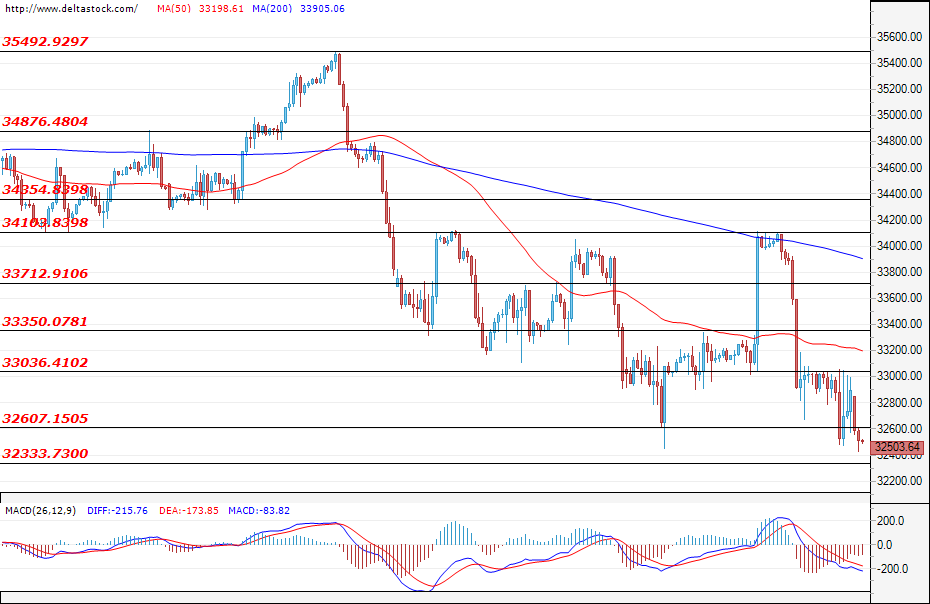
The U.S. blue-chip stock index began its trading session with a decline below 32607 and the bears now have the opportunity to gain even more ground if they manage to breach the next support level at 32333. The reason for this is that, despite the seemingly strong U.S. economy, the housing market is flashing warning signs as the treasury yields surge. Due to last week's extreme volatility, the odds of a corrective upward move are rather high and the bulls could meet resistance at 33000. This week, important economic news that could affect the U.S. index, is the data on the main consumer price index for the U.S. (Wednesday; 12:30 GMT), as well as the data on the U.S. producer price index (Thursday; 12:30 GMT).
Asian-Pacific Equity Scoreboard All Red This Morning
Markets
Last week ended with another joint sell-off in stocks and bonds after solid April payrolls. The report provided the Fed with all the arguments to continue its recently beefed up tightening pace, even as monthly wage growth disappointed marginally. Wall Street shed up to 1.4% (Nasdaq). US bond yields added 2.8 (2y) to 10.6 bps (30y) in a steepening move. European swap yields rose 6.2 bps (2y) to more than 10 bps at the long end. A series of ECB governors (Holzmann on Thursday, Villeroy and Vasle on Friday) flagged the possibility of a rate hike already in June and helped to launch the move. Germany’s 10y yield in particular was eyepopping. An 8.8 bps surge hurled the closely watched reference beyond 1.06% resistance (2015 top) and made it already test the next target at 1.13%. Friday’s yield rise came mainly on the account of real yields, both in the US and the euro zone. Peripheral spreads rose marginally with Greece (+4 bps) underperforming. EUR/USD left intraday lows sub 1.05 behind after the ECB comments. The pair eventually didn’t make it much further compared to opening levels though (1.055). A strong trade-weighted dollar closed near cycle highs at 103.66. Sterling licked wounds inflicted by the openly divided Bank of England. EUR/GBP extended its break above the 0.8512 resistance to 0.855 – the highest since early December.The Asian-Pacific equity scoreboard is all red this morning. Without much other news to trade on, investors have no option but to focus on high inflation, rapid monetary tightening and soaring growth prospects. Losses range between 1 and 4%. Core bonds tried but failed to capitalize on the risk-off. The dollar starts in pole position in FX markets, the Chinese yuan slips on lockdown-impacted trade data (see below). The British pound looks little affected by the historic victory by the Northern Irish Sinn Féin nationalists.Economic data won’t guide markets much today. It does get interesting later this week with US CPI on Wednesday, UK GDP numbers on Thursday and an avalanche of central bank speeches, including from ECB president Lagarde, starting from tomorrow on. For today, there’s quite some nervousness about Russian president Putin’s speech during the May 9 Victory Parade. Risk-off may hold a tight grip, keeping the likes of the euro and sterling in the defensive. EUR/USD 1.05 remains a heavy gravitational force. EUR/GBP very recently swapped a month’s long downward trend channel for a narrow upward sloping one. EUR/GBP 0.8595 is next short-term resistance. Last Friday underscored the bearish momentum in core bonds. We don’t question the trend. The US 10y is testing final intermediate resistance ahead of the 2018 top (3.26%).
News Headlines
Chinese lockdowns hampered production and supply/shipments while slowing demand, affecting the country’s exports and imports. Exports in April slowed from 14.7% Y/Y to 3.9% Y/Y. Import growth came to a stand-still (0.0%) after a marginal decline in March. This resulted in a further rise of the Chinese trade surplus from $47.38 to $ 51.12 bln. The trade data confirm the growth risks for the Chinese economy. Chinese Prime Minister Li warned on the grave and complicated employment situation in both cities and, despite the lockdowns, instructed official institutions to giving priority stabilize employment, illustrating the ongoing difficult balancing act in the Covid strategy. The yuan this morning weakens further with USD/CNY jumping north of 6.71.