Sample Category Title
GBP/USD Mid-Day Outlook
Daily Pivots: (S1) 1.2285; (P) 1.2332; (R1) 1.2389; More...
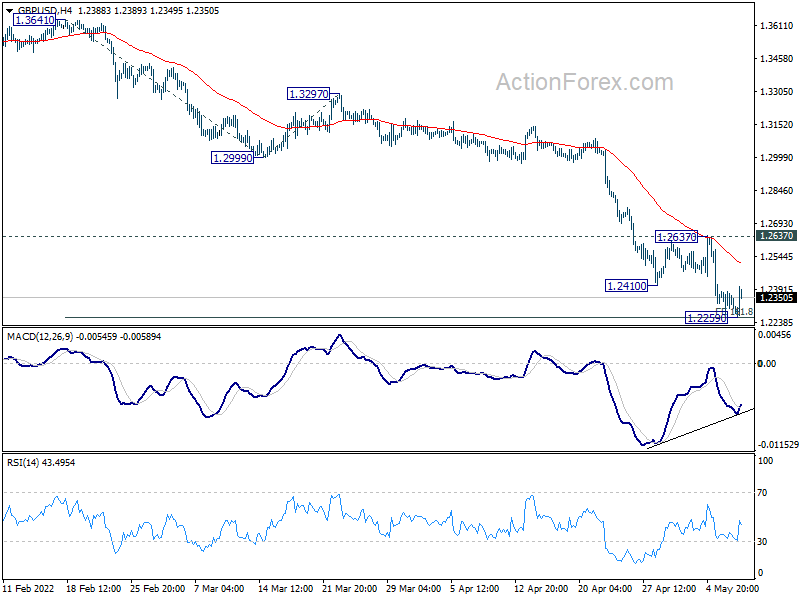
GBP/USD recovers slightly after hitting forming a temporary low at 1.2259, just ahead of 161.8% projection of 1.3641 to 1.2999 from 1.3297 at 1.2258. Intraday bias is turned neural for consolidations first. But upside of recovery should be limited by 1.2637 resistance to bring fall resumption. Firm break of 1.2258 will extend recent down trend to 200% projection at 1.2013 next.
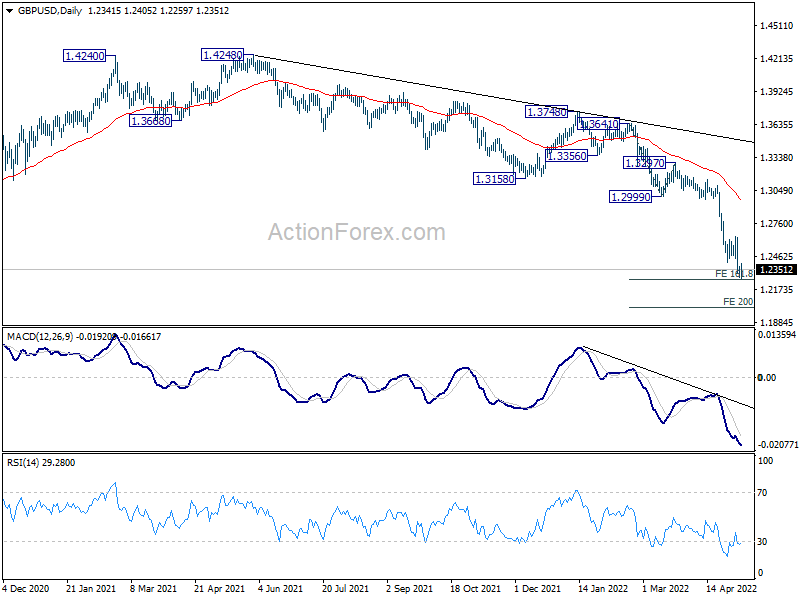
In the bigger picture, based on current momentum, fall from 1.4248 (2018 high) at least at the same degree as the rise form 1.1409 (2020 low). That is, fall from 1.4248 could be a leg inside the pattern from 1.1409, or resuming the longer term down trend. In either case, deeper decline is expected as long as 1.2999 support turned resistance holds. Next target is 1.1409 low.
EUR/USD Mid-Day Outlook
Daily Pivots: (S1) 1.0487; (P) 1.0543 (R1) 1.0603; More...
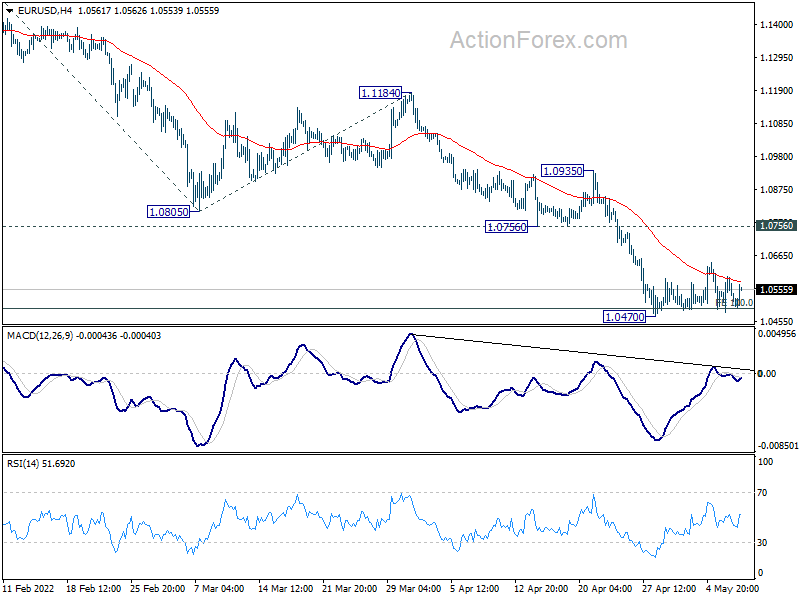
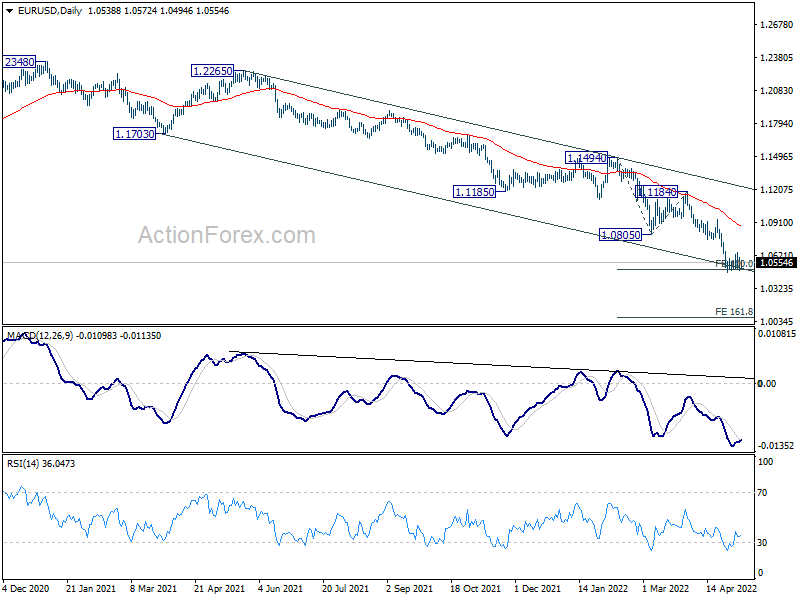
EUR/USD recovers mildly today as consolidation from 1.0470 extends. Intraday bias remains neutral for the moment. In case of another recovery, upside should be limited by 1.0756 support turned resistance to bring fall resumption. On the downside, firm break of 1.0470 will resume larger down trend to 161.8% projection of 1.1494 to 1.0805 from 1.1184 at 1.0069.
In the bigger picture, the decline from 1.2348 (2021 high) is expected to continue as long as 1.1185 support turned resistance holds. The break of 1.0635 (2020 low) now raises the chance that it's resuming long term down trend from 1.6039 (2008 high). Retest of 1.0339 (2017 low) low should be seen next. Decisive break there will confirm this bearish case.
Risk Aversion Still Dominates But Dollar Lost Momentum, Euro Recovers
Risk aversion is the theme of the day, with major European indexes trading in red, while US futures are also diving. Australian Dollar is leading other commodity currencies lower. While Dollar is firm, it's losing some momentum entering into US session. In particular, the greenback is retreating after failing to break through a near term resistance against Euro again. Sterling is currently the stronger one, followed by Euro, will help from buying against Swiss Franc too.
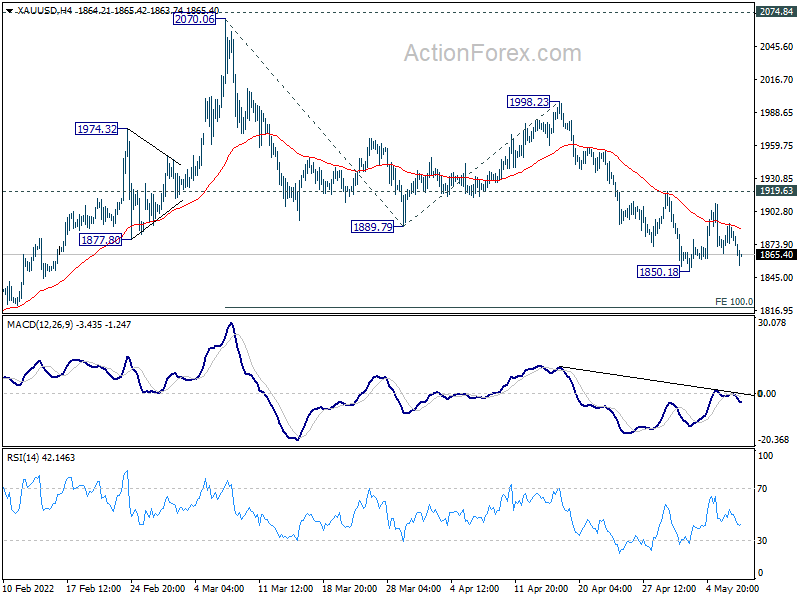
Technically, Gold dips notably today but it's still hold on above 1850.18 temporary low. For now, near term outlook in Gold stays bearish with 1919.63 resistance intact. Deeper decline is expected, sooner or later, through 1850.18. Next target is 100% projection of 2070.06 to 1889.79 from 1998.23 at 1817.96. Break of this projection level could prompt downside acceleration. Attention will be on how Gold' next move correlate to FX pairs too.
In Europe, at the time of writing, FTSE is down -1.76%. DAX is down -1.37%. CAC is down -1.68%. Germany 10-year yield is up 0.010 at 1.145. Earlier in Asia, Nikkei dropped -2.53%. China Shanghai SSE rose 0.09%. Singapore Strait Times dropped -0.51%. Japan 10-year yield rose 0.0054 to 0.251.
Fed Bostic: No need to be moving more aggressively than 50bps
Atlanta Fed President Raphael Bostic told Bloomberg today that last week's 50bps rate hike was "already a pretty aggressive move". He added, "I don't think we need to be moving even more aggressively."
"I think we can stay at this pace and this cadence and really see how the markets evolve ... We are going to move a couple times, maybe two, maybe three times, see how the economy responds, see if inflation continues to move closer to our 2% target, then we can take a pause and see how things are going," he said.
Fed Kashkari: Virtually all of that news is in the wrong direction
Minneapolis Fed President Neel Kashkari said in a CNBC interview, "I'm confident we are going to get inflation back down to our 2% target, but I am not yet confident on how much of that burden we're gonna have to carry versus getting help from the supply side."
He added that "virtually all of that news is in the wrong direction," pointing to Ukraine war and lockdowns in China.
He also emphasized that Fed is focused on its dual mandate, price stability and full employment. If data comes in different from expectations, Fed will change its policy approach.
Eurozone Sentix investor confidence dropped to -22.6, war only knows victims
Eurozone Sentix Investor Confidence dropped from -18.0 to -22.6 in May, worse than expectation of -20.8. The's the third decline in a row, and the lowest reading since June 2020. Current Situation index dropped from -5.5 to -10.5, worst since March 2021. Expectations index dropped from -29.8 to -34.0, worst since December 2008.
Germany Sentix Investor Confidence dropped from -17.1 to -20.5, lowest since May 2020. Current Situation index dropped from -4.8 to -7.3, lowest since March 2021. Expectations index dropped from -28.8 to -32.8, all-time low.
Sentix said: "War only knows victims. The traces of the Ukraine conflict are also becoming increasingly visible in the economy. The sanctions against Russia are having an effect, on enemies and friends alike. Last month, the "first mover" economic index clearly pointed the way towards recession. At the beginning of May, the downturn deepened further. Europe is hit particularly hard. The overall Eurozone index drops to -22.6 points. And for Germany we report an all-time low in economic expectations. In other words: it's coming thick and fast."
Yuan selloff accelerates as China tightens up Shanghai lockdown again
The selloff in Chinese Yuan accelerates again today as the Chinese government tightened up city-wide lockdown in Shanghai again. The decision came after President Xi Jinping's pledge last week to double down on the "battle" against the coronavirus.
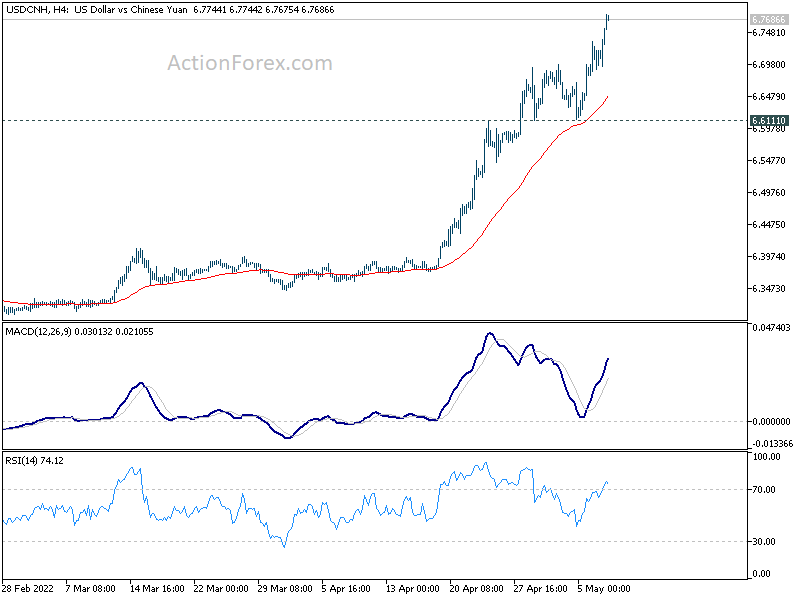
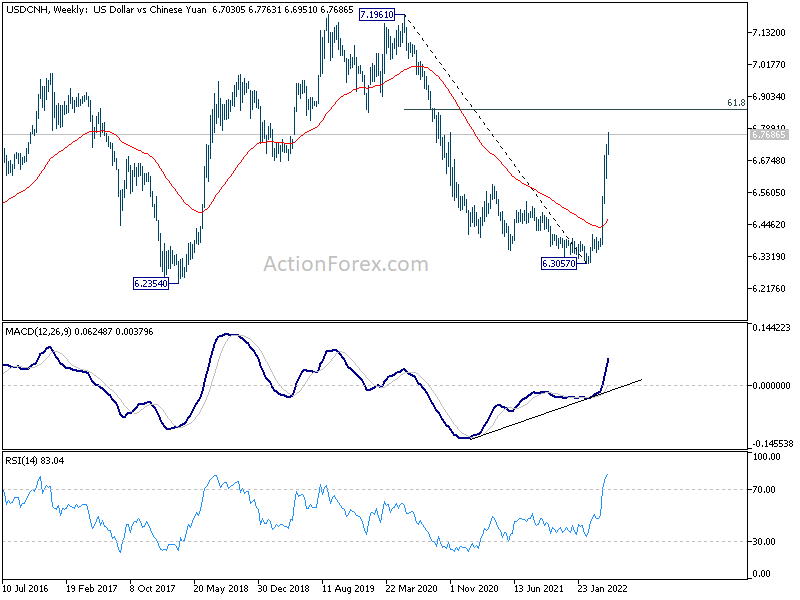
USD/CNH (offshore Yuan) hits as high as 6.7763 so far today, highest level since late 2020. Technically, Current rise is at least in the same degree as the down trend from 7.1961 (2020 high). Further rise is expected as long as 6.6111 support holds. Next target is 61.8% retracement of 7.1961 to 6.3057 at 6.8560.
Also, released from China earlier today, exports rose 3.9% yoy in April, above expectation of 3.2% yoy. Imports dropped -2.0% yoy, versus expectation of -3.0% yoy. Trade surplus widened from USD 47.4B to USD 51.1B, basically in-line with expectations.
EUR/USD Mid-Day Outlook
Daily Pivots: (S1) 1.0487; (P) 1.0543 (R1) 1.0603; More...
EUR/USD recovers mildly today as consolidation from 1.0470 extends. Intraday bias remains neutral for the moment. In case of another recovery, upside should be limited by 1.0756 support turned resistance to bring fall resumption. On the downside, firm break of 1.0470 will resume larger down trend to 161.8% projection of 1.1494 to 1.0805 from 1.1184 at 1.0069.
In the bigger picture, the decline from 1.2348 (2021 high) is expected to continue as long as 1.1185 support turned resistance holds. The break of 1.0635 (2020 low) now raises the chance that it's resuming long term down trend from 1.6039 (2008 high). Retest of 1.0339 (2017 low) low should be seen next. Decisive break there will confirm this bearish case.
Economic Indicators Update
| GMT | Ccy | Events | Actual | Forecast | Previous | Revised |
|---|---|---|---|---|---|---|
| 23:30 | JPY | Labor Cash Earnings Y/Y Mar | 1.20% | 0.90% | 1.20% | |
| 23:50 | JPY | BoJ Monetary Policy Meeting Minutes | ||||
| 02:00 | CNY | Trade Balance (USD) Apr | 51.1B | 51.2B | 47.4B | |
| 02:00 | CNY | Exports (USD) Y/Y Apr | 3.90% | 3.20% | 14.70% | |
| 02:00 | CNY | Imports (USD) Y/Y Apr | -2.00% | -3.00% | -0.10% | |
| 02:00 | CNY | Trade Balance (CNY) Apr | 325.1B | 340B | 301B | |
| 02:00 | CNY | Exports (CNY) Y/Y Apr | 1.90% | 16.40% | 12.90% | |
| 02:00 | CNY | Imports (CNY) Y/Y Apr | -2.00% | -2.90% | -1.70% | |
| 06:45 | EUR | France Trade Balance (EUR) Mar | -12.4B | -11.2B | -10.3B | -10.4B |
| 08:30 | EUR | Eurozone Sentix Investor Confidence May | -22.6 | -20.8 | -18 | |
| 12:30 | CAD | Building Permits M/M Mar | -9.30% | 3.40% | 21.00% | |
| 14:00 | USD | Wholesale Inventories Mar F | 2.30% | 2.30% |
Fed Bostic: No need to be moving more aggressively than 50bps
Atlanta Fed President Raphael Bostic told Bloomberg today that last week's 50bps rate hike was "already a pretty aggressive move". He added, "I don't think we need to be moving even more aggressively."
"I think we can stay at this pace and this cadence and really see how the markets evolve ... We are going to move a couple times, maybe two, maybe three times, see how the economy responds, see if inflation continues to move closer to our 2% target, then we can take a pause and see how things are going," he said.
Fed Kashkari: Virtually all of that news is in the wrong direction
Minneapolis Fed President Neel Kashkari said in a CNBC interview, "I'm confident we are going to get inflation back down to our 2% target, but I am not yet confident on how much of that burden we're gonna have to carry versus getting help from the supply side."
He added that "virtually all of that news is in the wrong direction," pointing to Ukraine war and lockdowns in China.
He also emphasized that Fed is focused on its dual mandate, price stability and full employment. If data comes in different from expectations, Fed will change its policy approach.
Euro Steady after G-7 Pledge Oil Ban
G-7 commits to ban Russian oil
The euro has started the week quietly, although there have important developments in the West’s sanction battle with Russia. On Sunday, G-7 leaders pledged to phase out or ban the import of Russian oil.
As the war in Ukraine continues, the West has ratcheted up its sanctions against Moscow. Some European countries, such as heavy-weight Germany, have been reluctant to embrace an outright ban on Russian oil, since 25% of Germany’s oil comes from Russia. The war has taken a toll on the eurozone economy, and there are concerns that a complete ban on Russian oil would tip Germany into a recession. The G-7 commitment to “phase out” Russian oil is a compromise that will allow eurozone nations to find alternative sources as they cut back on Russian oil imports.
Despite the slowdown in eurozone growth, inflation in the bloc isn’t showing any signs of easing. In April, CPI remained at a record 7.5% YoY, edging up from 7.4% in March. The combination of rising prices and weaker economic growth has raised fears of stagnation and increased uncertainty about the economic outlook. This has taken a toll on the euro, which has plunged around 14% since June 1st.
The dovish ECB has been slow to respond to the new landscape in Europe, although there are more calls within the ECB to raise rates at least up to zero. On Monday, ECB Governing Council member Olli Rehn, who is head of the Finnish central bank, weighed in and urged the ECB to start raising rates in July. ECB President Lagarde cannot afford to continue ignoring soaring inflation and the ECB will have to hike rates in the coming months.
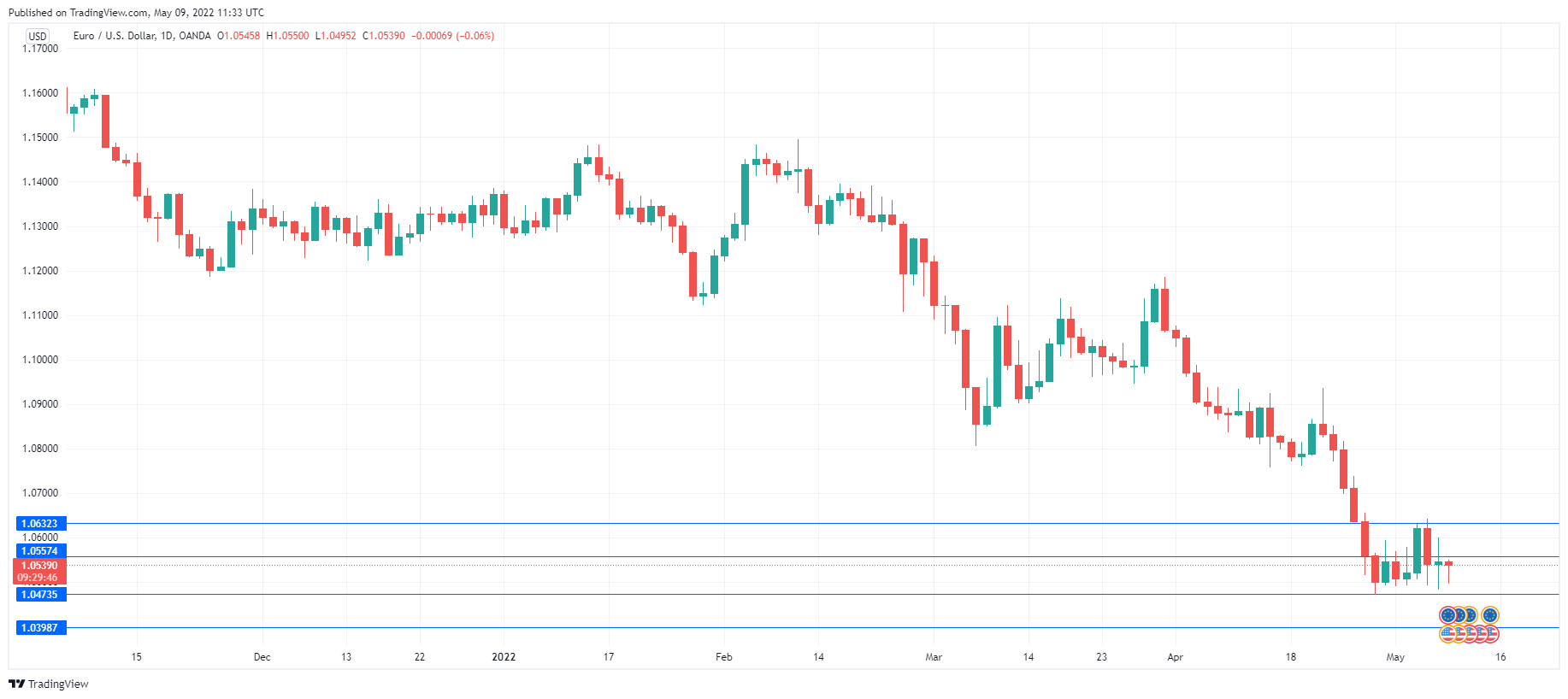
EUR/USD Technical
- There is weak resistance at 1.0557. Above, there is resistance at 1.0632
- 1.0473 is providing support, followed by 1.0398
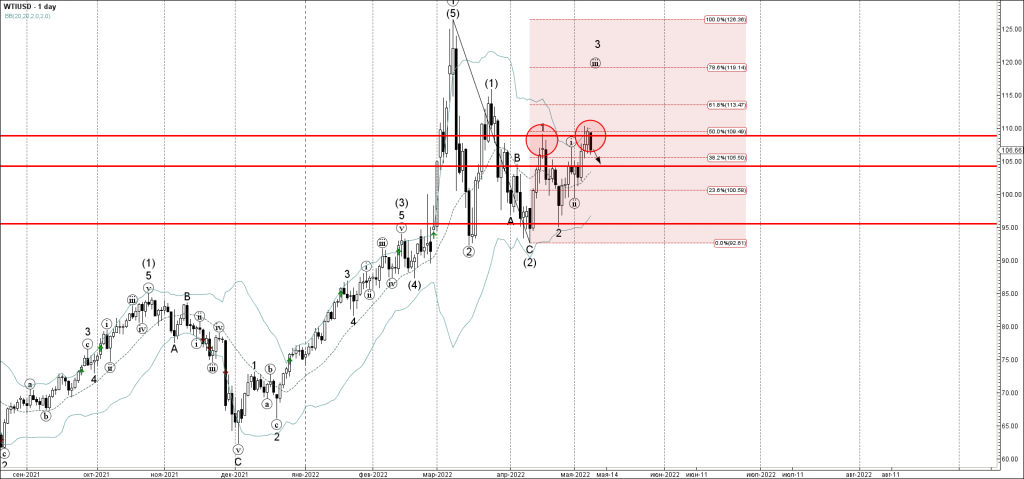
WTI Crude Oil Wave Analysis
- WTI crude oil reversed from resistance zone
- Likely to fall to support level 105.00
WTI crude oil recently reversed down from the resistance zone lying between the key resistance level 108.80 (top of the previous impulse wave 1) and the upper daily Bollinger Band.
The downward reversal from this resistance zone stopped the earlier impulse waves (iii) and 3 of the medium-term impulse wave (3) from the start of April.
WTI crude oil can be expected to correct down further toward the next support level 105.00.
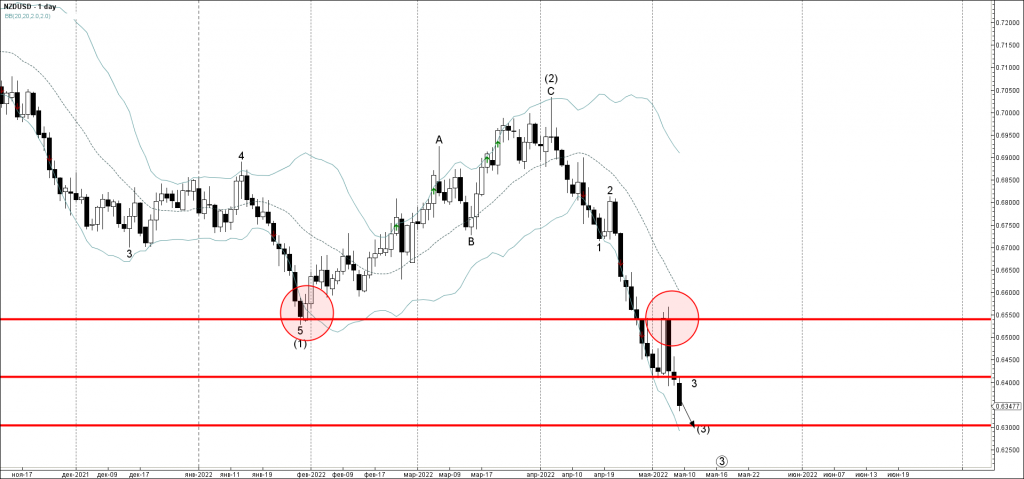
NZDUSD Wave Analysis
- NZDUSD broke key support level 0.6410
- Likely to fall to support level 0.6300
NZDUSD currency pair under the bearish pressure after the price broke the key support level 0.6410 (which reversed the price sharply at the start of this month).
The breakout of the support level 0.6410 accelerated the active impulse waves 3 and (3).
Given the clear daily downtrend – NZDUSD currency pair can be expected to fall further toward the next support level 0.6300 (target price for the completion of the active wave (3)).
Canadian Dollar Extends Losses
The US dollar continues to post gains and is in positive territory at the start of the week. USD/CAD is trading at 1.2934 in the European session, up 0.20% on the day.
Canada unemployment drops
Canada’s April employment report on Friday was steady but not spectacular. The economy added a modest 15.3 thousand jobs, lower than the estimate and well below the March release of 72.5 thousand. The labour market may well have reached its limit, after all the strong gains we’ve seen during the Covid recovery. The number of job vacancies remains high and the unemployment rate fell from 5.3% to 5.2%, both of which reflect a robust labour market and a shrinking labour pool.
The tightening job market is putting further pressure on the Bank of Canada to raise rates at a faster pace than expected. The benchmark rate is currently at an even 1.00%, after the 0.50% hike in April. Governor Macklem has hinted that he could deliver more 0.50% hikes and we could see rates rise to 2% by the end of Q2. Macklem has signalled the rate-hike cycle could be very aggressive, saying that he will lift rates above 3% if necessary, in order to beat back spiralling inflation.
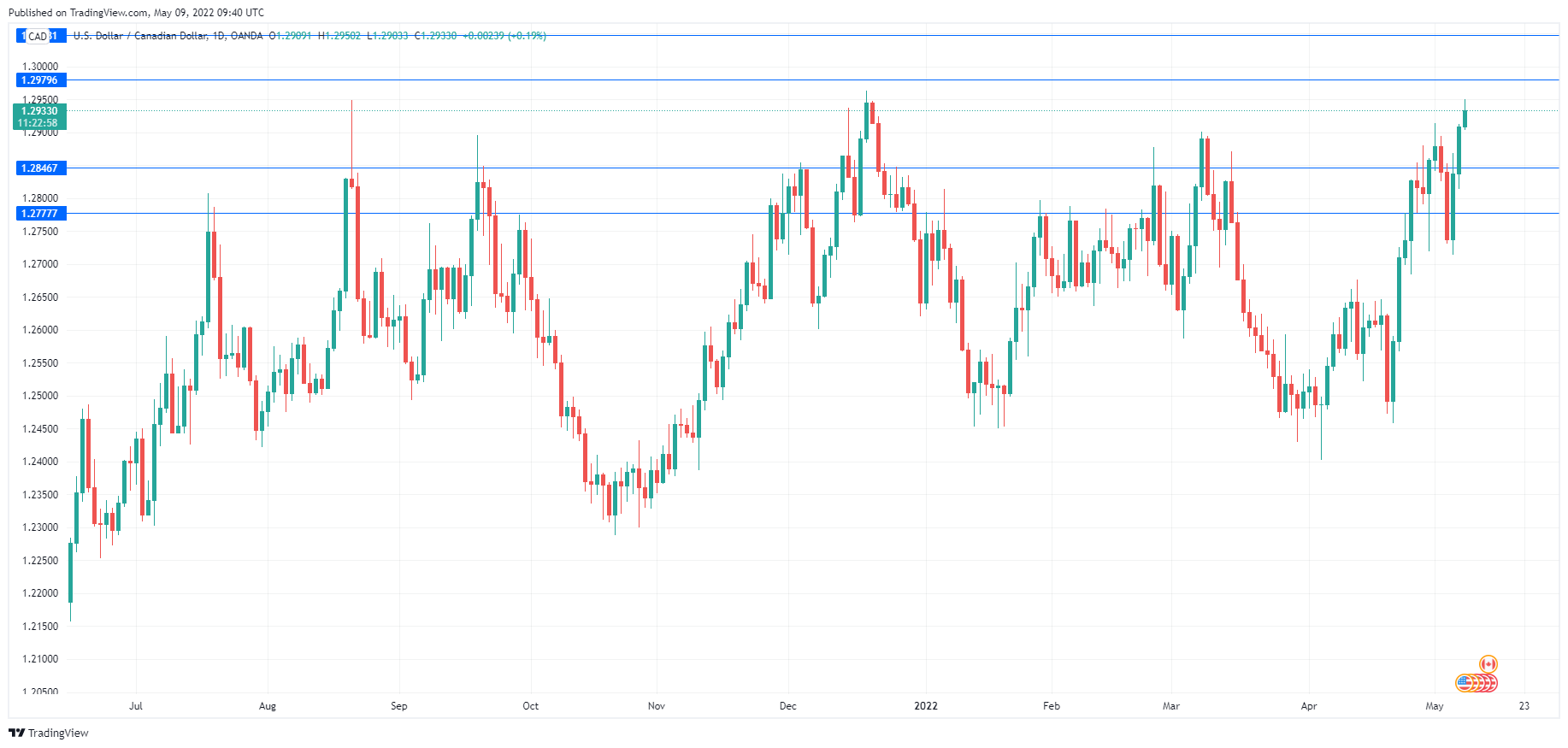
The Canadian dollar remains under pressure, with USD/CAD setting its sights on the symbolic 1.30 line. The Fed is also showing its hawkishness, having just delivered its own oversize 0.50% hike last week. This move was priced in by the markets, but the rate hike and the expectations of more on the way have provided plenty of wind for the sails of the US dollar. USD/CAD hit 1.2950 earlier today, its highest level since December 21st 2020. For USD/CAD, risk is tilted to the upside, and I expect the pair to put further pressure on the 1.30 line.
USD/CAD Technical
- There is support at 1.2846 and 1.2777
- Resistance at 1.2979 is protecting the 1.30 level. Above, there is support at 1.3048
EURUSD Buyers Struggle to Make Advances
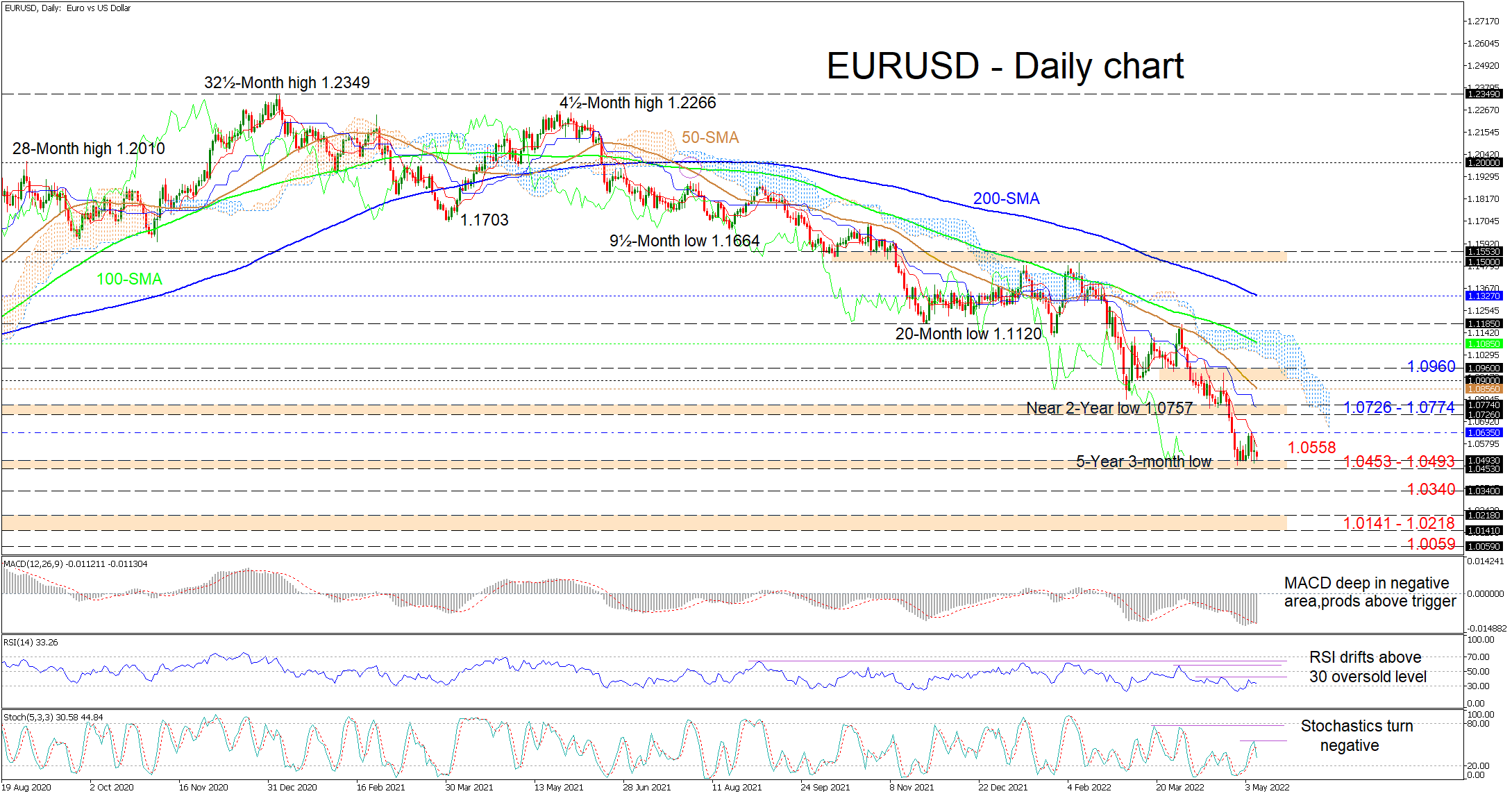
EURUSD is tiptoeing around more than five-year low levels and the pair’s efforts to improve seem to be to no avail, leaving no fingerprint of clear gains as the bearish bias overwhelms. That said, the falling simple moving averages (SMAs) are endorsing the downward trajectory in the pair.
Currently, the downward sloping Ichimoku lines are indicating that the sellers are active, while the short-term oscillators are now transmitting mixed messages in directional impetus. The MACD is reflecting easing in negative momentum as the stochastic oscillator is promoting additional descending moves in the pair. Meanwhile, the RSI is hovering in the bearish region, above the 30 oversold mark.
In the negative scenario, the 1.0453-1.0493 support band may try to delay for a while longer the revival of the broader descent in the pair. However, if selling pressures intensify, the price may meet the January 2017 trough of 1.0340 before aiming for the 1.0141-1.0218 support section that extends all the way back to mid-July 2002. Should the heavy pair sink past this barrier too, the bears could then attack the December 2002 low of 1.0059 opening the door for the parity mark.
Otherwise, if buyers create positive traction off the 1.0453-1.0493 multi-year low boundary, upside friction could commence from the falling red Tenkan-sen line at 1.0558 ahead of the March 2020 trough (previous support-now-resistance) of 1.0635. Slightly higher, the 1.0726-1.0774 resistance band could then test buying power, a barrier referring to the April until mid-May 2020 period of lows. Creeping further up, the bulls may encounter the approaching 50-day SMA at 1.0856 ahead of the 1.0900-1.0960 resistance border.
Summarizing, EURUSD is sustaining a sturdy bearish bearing beneath the SMAs and the 1.1185 high. A break below the 1.0453-1.0493 support may nudge positive developments further into the horizon. Yet, for optimism to return in the pair, the price would need to step over the 1.0900-1.0960 obstacle and the Ichimoku cloud.