

Sample Category Title
US Employment Growth Remains Strong in April
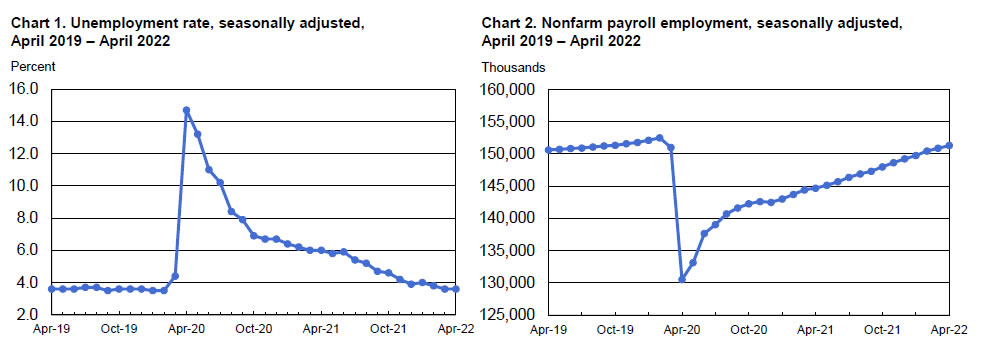
The U.S. economy added 428k jobs in April, coming in well above the consensus forecast of 380k. As of April, total payroll employment remains 0.8% below February 2020 levels. Downward revisions subtracted 39k jobs from the two prior months.
Employment gains were widespread, with leisure and hospitality (78k) seeing the biggest gains on the month – though employment in this sector still remains 8.5% below pre-pandemic levels. Education & health care (59k), transportation & warehousing (52k), retail & wholesale trade (51k), professional & business services (41k), and financial activities (35k) all had strong gains on the month. Hiring in goods producing (66k) industries was largely concentrated in manufacturing (55k). Government (22k) hiring was also strong in April.
The unemployment rate held steady at 3.6%, as both the labor force (-363k) and number of people employed (-353k) fell by roughly the same amount. As a result, the participation rate declined by 0.2 percentage points to 62.2%.
Average hourly earnings rose 0.3% month-on-month (m/m), which was up 5.5% on a year-on-year – though it slowed slightly from the 5.6% y/y recorded in March.
Key Implications
The pace of hiring remained robust in April, exactly matching March's strong tally. At this point, the biggest factor preventing an even stronger pace of hiring stems from the lack of labor supply. This was perhaps the most disappointing element of April's employment report, as the pool of available workers unexpectedly declined.
Cutting the labor force data by age offers some insight into the labor supply issues. To date, the 25-34 age cohort has been one of the slowest to recover and still remains 1.8% (560k) below pre-pandemic levels, with losses equally split between males and females. This is likely due to the fact that this age group would include many young parents who are still struggling to find childcare. The other cohort to have lagged considerably is the 55+, as the pandemic has likely knocked many of these workers into an early retirement. Lingering health and safety concerns may also be playing some role in why this cohort has been slower to recover.
While growth in hourly earnings remains strong, the average American is still struggling to see their wage keep pace with inflation. This has led many to seek full-time employment – resulting in the number of those that are part-time for economic reasons to have recently fallen to levels not seen since the early-2000s.
This morning's report should help assuage some of the recent fears that the economy is slowing. With the labor market still running hot and inflation at multi-decade highs, we expect the Fed to continue to move aggressively on raising rates over the coming months.
Canada’s Labour Market Takes a Breather in April
The Canadian labour market gained 15k positions in April, with full-time employment down -31k and part-time employment up 47k.
The unemployment rate dropped by 0.1 percentage points, to 5.2%. The participation rate was little changed at 65.3%.
By industry, Statistics Canada noted that "employment was virtually unchanged in both the goods-producing and services-producing sectors in April," but highlighted gains in professional, scientific and technical services, as well as public administration. On the negative side, losses were noted in retail trade and construction.
On a geographic basis, the report noted employment gains in New Brunswick (+6.7k), Nova Scotia (+5.9k), Newfoundland and Labrador (+2.5k), and Alberta (+16k). Conversely, there was a decline in employment in Quebec (-27k) and effectively flat employment in Ontario.
Lastly, total hours worked declined 1.9% month-on-month and wages were up 3.3% year-on-year.
Key Implications
Given that more than 400 thousand jobs were gained over the previous two months, labour market momentum was poised to slow. This should be expected. With the unemployment rate at 5.2%, the economy is at full employment. This means it will be harder and harder to produce the kind of outsized job gains witnessed in recent months.
Going forward, we are looking for more modest job gains, which should keep the unemployment rate in the low 5% range. The drop in hours worked should bounce back, given that about 9% of workers were absent due to illness (the impact of the sixth covid wave). With the job market remaining very tight, wages should also accelerate. Overall, the key for the economy is to hold on to the job gains achieved so far. More modest employment reports are a tribute to the Canadian economy's recent success.
USD/JPY: Firm Break of 130 Zone to Add to Bullish Outlook for Retest of 20-Year High
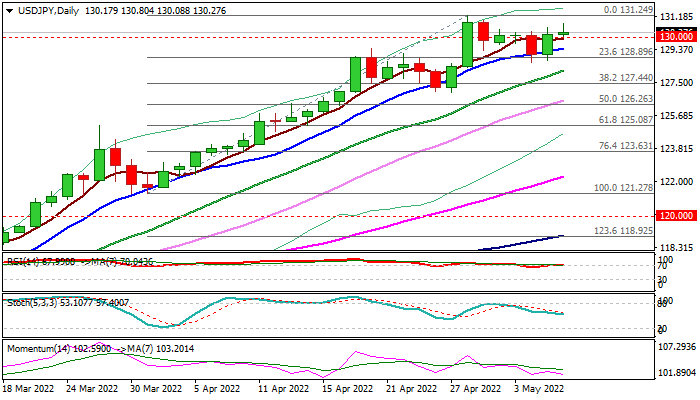
The USDJPY returned to bullish mode, after shallow pullback from new 20-year high found firm ground at 129 zone, contained by rising 10DMA and Fibo 23.6% of 121.27/131.24 upleg.
Bulls are establishing above 130 level, but need weekly close above here to confirm bullish signal, after last week’s spike to 131.24 was short-lived and failed to register close above 130.
Thursday’s rebound left a double-bottom and formed bullish engulfing pattern that underpins near-term action and adds to positive signals.
However, traders remain cautious despite the dollar regained traction, awaiting fresh signals from the US labor report, while daily studies show weakening bullish momentum, which warns bulls may lose steam on renewed probe through 120 pivot.
Near-term action is expected to keep bullish bias above rising 10DMA (129.42) with sustained break above 130.00 and 130.65 (Fibo 76.4% of 147.68/75.55) to open way for retest of new peak at 131.24 and unmask 2002 peak at 135.16.
Res: 130.47; 130.65; 130.80; 131.24
Sup: 130.00; 129.42; 128.89; 128.62
USD/JPY Mid-Day Outlook
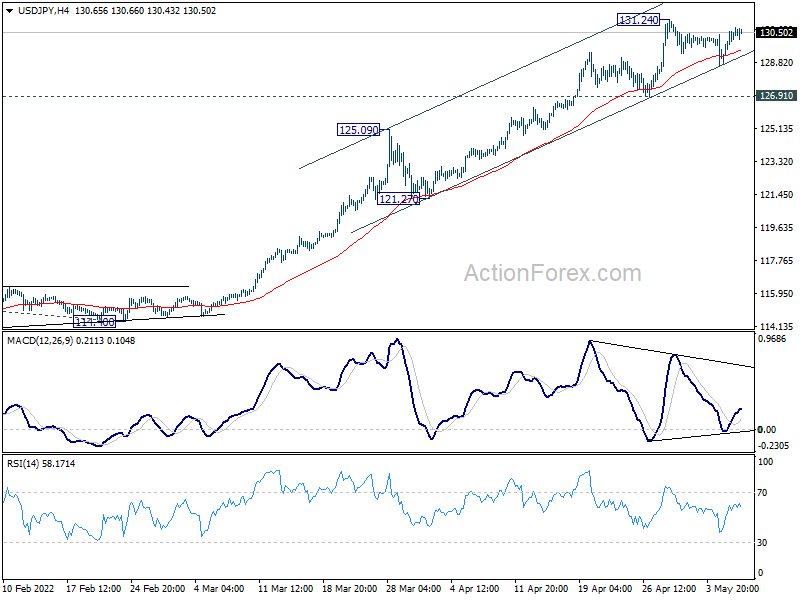
Daily Pivots: (S1) 129.79; (P) 130.04; (R1) 130.38; More...
Intraday bias in USD/JPY remains neutral at this point. Also, near term outlook stays bullish with 126.91 support intact and further rally is expected. On the upside, break of 131.24 will resume recent up trend to 261.8% projection of 109.11 to 116.34 from 114.40 at 133.26. However, considering bearish divergence condition in 4 hour MACD, break of 126.91 will confirm short term topping and turn bias back to the downside for 121.27/125.09 support zone.
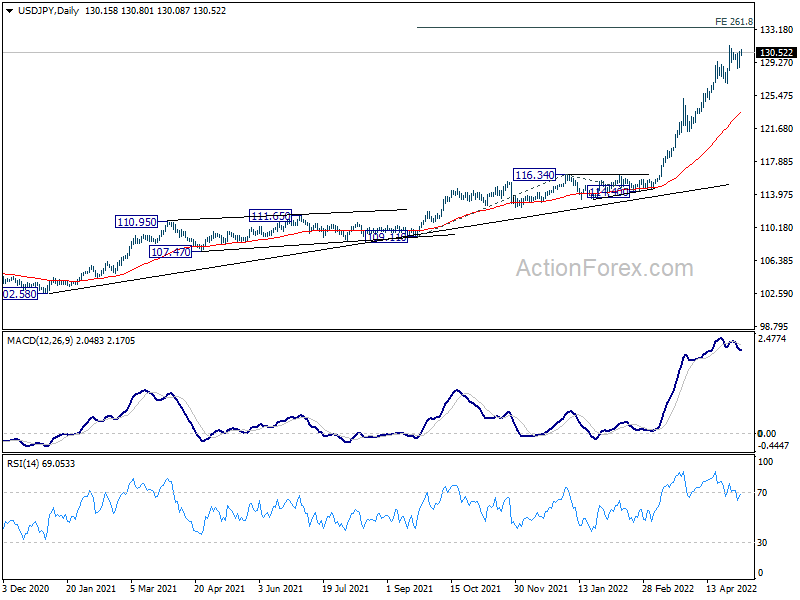
In the bigger picture, current rally is seen as part of the long term up trend form 75.56 (2011 low). Sustained trading above 61.8% projection of 75.56 (2011 low) to 125.85 (2015 high) from 98.97 at 130.04 will pave the way to 100% projection at 149.26, which is close to 147.68 (1998 high). For now, this will remain the favored case as long as 121.27 support holds.
USD/CHF Mid-Day Outlook
Daily Pivots: (S1) 0.9743; (P) 0.9817; (R1) 0.9923; More....
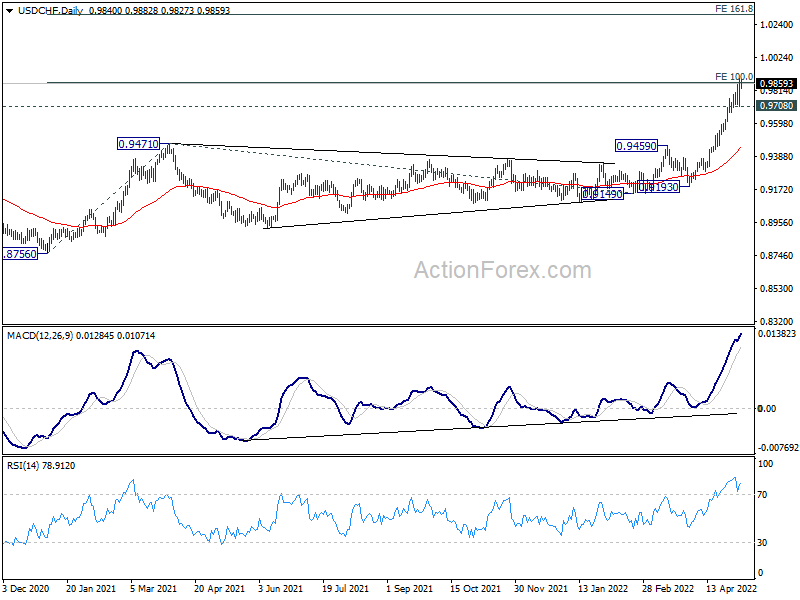
Intraday bias in USD/CHF remains on the upside at this point. Sustained trading above 0.9864 will pave the way to next target at 1.0342 high. For now, outlook will remain bullish as long as 0.9708 support holds, in case of retreat.
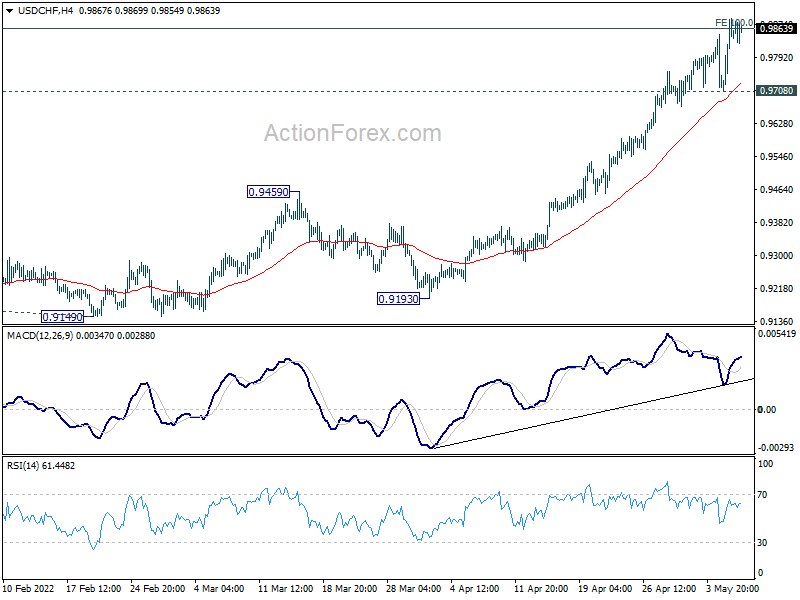
In the bigger picture, down trend from 1.0342 (2016 high) should have completed with three waves down to 0.8756 (2021 low) already. Rise from 0.8756 is likely a medium term up trend of its own. Next target is 100% projection of 0.8756 to 0.9471 from 0.9149 at 0.9864. Sustained break there will pave the way back to 1.0342 high. This will now remain the favored case as long as 0.9459 resistance turned support holds.
GBP/USD Mid-Day Outlook
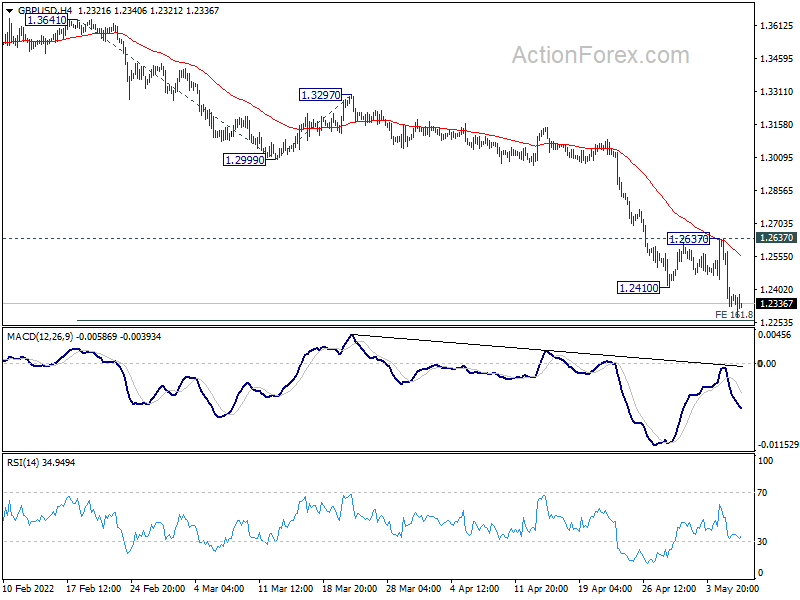
Daily Pivots: (S1) 1.2242; (P) 1.2439; (R1) 1.2552; More...
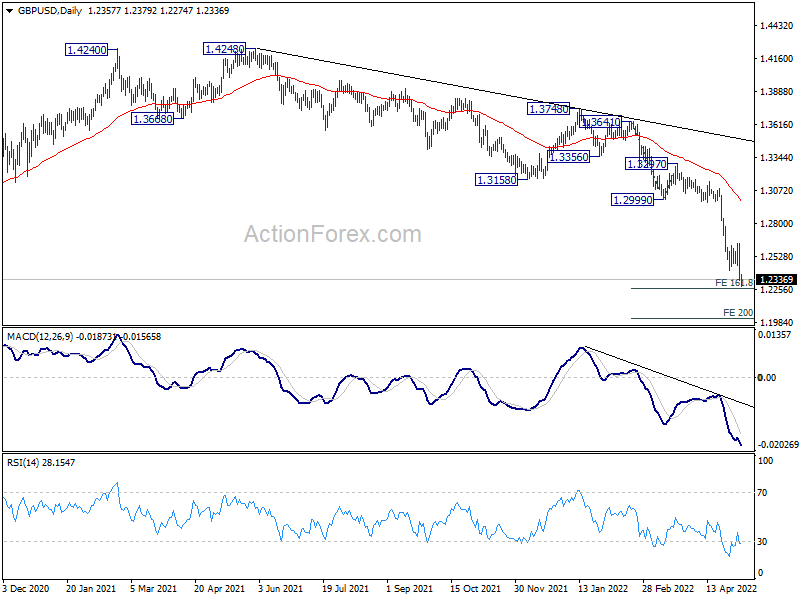
Intraday bias in GBP/USD stays on the downside at this point. Firm break of 161.8% projection of 1.3641 to 1.2999 from 1.3297 at 1.2258 will target 200% projection at 1.2013 next. On the upside, break of 1.2637 resistance is needed to indicate short term bottoming. Otherwise, outlook will remain bearish in case of recovery.
In the bigger picture, rise from 1.1409 (2020 low) has completed at 1.4248, ahead of 1.4376 long term resistance (2018 high). Based on current momentum, fall from 1.4248 is probably the start of a long term down trend. The break of 61.8% retracement of 2.1161 to 1.1409 at 1.2493 is affirming this bearish case too. For now, deeper decline would be seen as long as 1.3158 support turned resistance holds. Next target is 1.1409 low.
EUR/USD Mid-Day Outlook
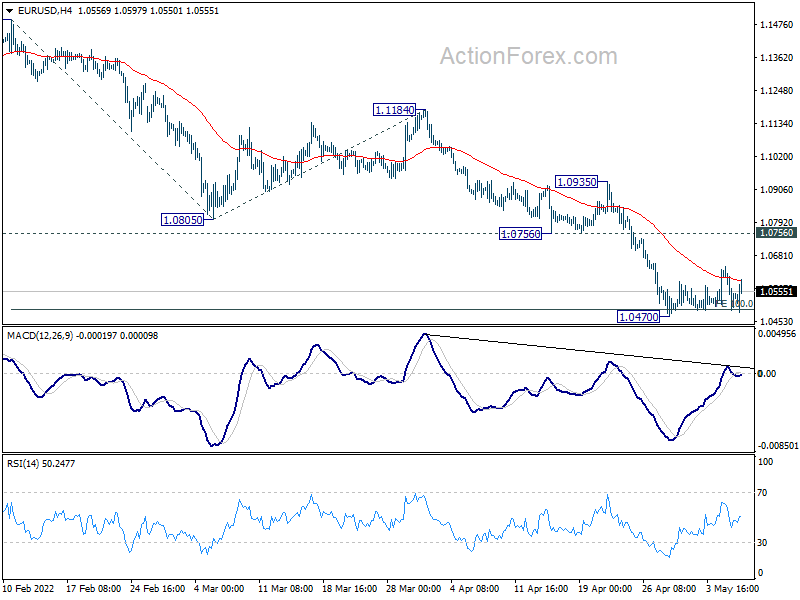
Daily Pivots: (S1) 1.0474; (P) 1.0558 (R1) 1.0623; More...
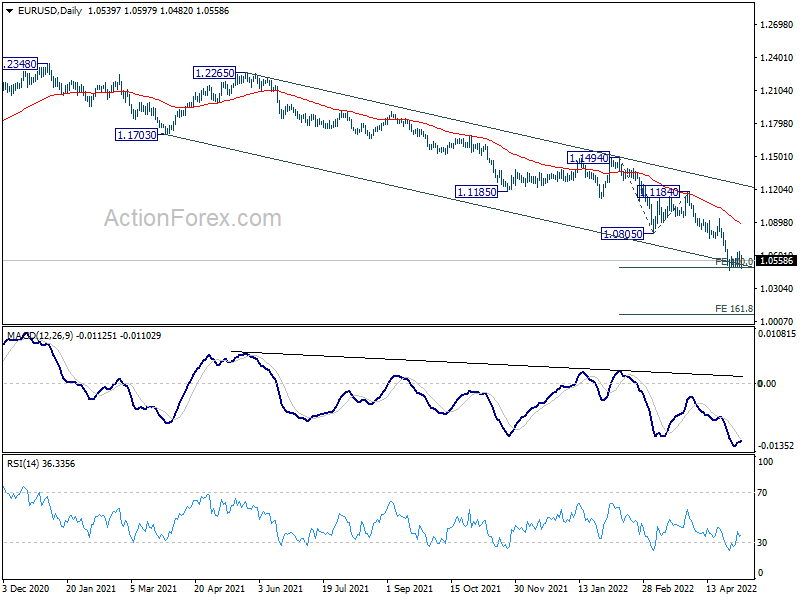
EUR/USD recovers ahead of 1.0470 support and intraday bias remains neutral at this point. Still, outlook stays bearish with 1.0756 support turned resistance intact. On the downside, break of 1.0470 will resume larger down trend. Next target will be 161.8% projection of 1.1494 to 1.0805 from 1.1184 at 1.0069.
In the bigger picture, the decline from 1.2348 (2021 high) is expected to continue as long as 1.1185 support turned resistance holds. The break of 1.0635 (2020 low) now raises the chance that it's resuming long term down trend from 1.6039 (2008 high). Retest of 1.0339 (2017 low) low should be seen next. Decisive break there will confirm this bearish case.
Euro Talked Up By ECB Hawks, Dollar Shrugs NFP
Dollar turns slightly softer in early US session even though non-farm payroll report came in slightly better than expected. Yen is also weak on rising benchmark global yields. On the other hand, Euro jumps broadly as supported by hawkish comments from ECB officials. As for the week, Aussie and Euro are now the strongest ones while Sterling and Swissy are the weakest.
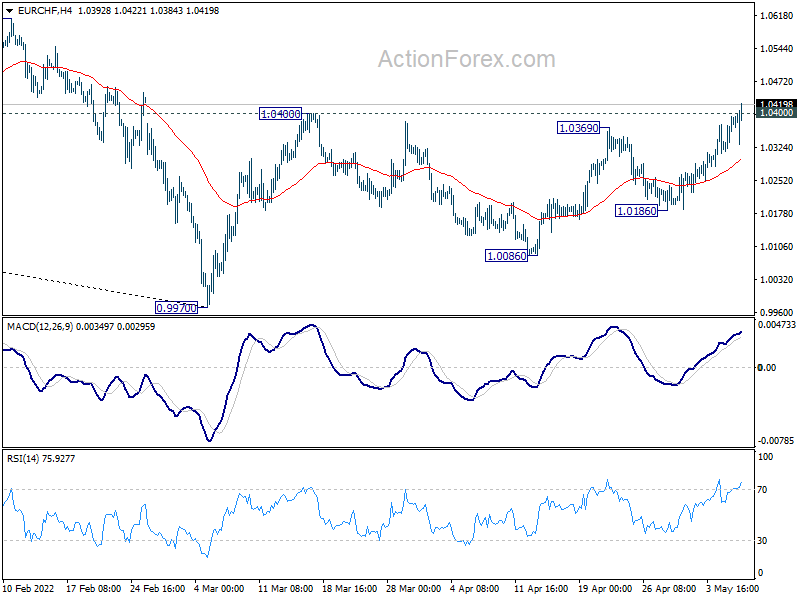
Technically, EUR/CHF finally breaks through 1.0400 resistance today, after brief set back. Rebound from 0.9970 is resuming for 1.0610 structural resistance next. The development could help lift Euro against others. In particular, EUR/GBP is on track to 0.8697 medium term fibonacci level.
In Europe, at the time of writing, FTSE is down -0.77%. DAX is down -0.92%. CAC is down -0.99%. Germany 10-year yield is up 0.038 at 1.086. Earlier in Asia, Nikkei rose 0.69%. Hong Kong HSI dropped -3.81%. China Shanghai SSE dropped -2.16%. Singapore Strait Times dropped -1.55%. Japan 10-year JGB yield rose 0.0153 to 0.230.
US non-farm payroll rose 428k in Apr, unemployment rate unchanged at 3.6%
US non-farm payroll employment rose 428k in April, slightly above expectation of 400k. Total employment was still down by -1.2m, or -0.8%, from its pre-pandemic levels.
Unemployment rate was unchanged at 3.6%, matched expectations. Number of unemployed persons was essentially unchanged at 5.9m. The numbers compared to prepandemic levels of 3.5% and 5.7m respectively. Labor force participation rate dropped -0.2% to 62.2%.
Average hourly earnings rose 0.3% mom, below expectation of 0.4% mom.
ECB Rehn: We should move relatively quickly to zero
ECB Governing Council member Olli Rehn said today, "We are almost in between a rock and a hard place so that on one hand we have to ensure that the recovery will continue. On the other hand, we have to prevent higher inflation expectations being entrenched and being reflected in the labor market."
"In other words, we have to avoid second-round effects. Therefore, in my view, we should move relatively quickly to zero and continue our gradual process of normalization of monetary policy as we have done," he continued.
"Of course, all this on the condition that Russia's war in Ukraine will not substantially escalate and intensify which could derail all the forecasts and the economic recovery."
ECB Villeroy: Reasonable to have positive rates by year end
ECB Governing Council member Francois Villeroy de Galhau said, "the three conditions of our forward guidance on interest rates are, according to my personal judgment, fulfilled. Barring unforeseen new shocks, I would think it reasonable to have entered positive territory by the end of this year."
But he's vague on the timing of the first hike, as "while I wouldn't preclude the next few Governing Council meetings, I would rather set a marker a bit further down the road." He added the ECB's push to normalize policy "will be guided by an active use of optionality and gradualism."
On asset purchases, Villeroy said "seen from today the case for continuing to press the accelerator and adding further net purchases after June is not obvious."
BoE Pill: We face risks on both sides of the economic outlook
BoE Chief Economist Huw Pill told CNBC today that "we face risks on both sides of the economic outlook." Inflation is going up to 10% because of energy and international goods prices. At the same time, there was a risk of recession.
"It's a tricky balance to seek in current difficult circumstances. And the arguments around where rates should be set in order to achieve that balance are quite finely balanced in themselves," Pill added.
Asked about what would cause the BOE to pause tightening, Pill said MPC would want to see more evidence inflation expectations and wage and price setting and momentum in economy more consistent with target. He added, "if we don't see that we will need to act further."
UK PMI construction dropped to 58.2, moving towards a more subdued recovery phase
UK PMI Construction dropped from 59.1 to 58.2 in April, above expectation of 58.0. S&P Global said new work had the weakest rise since December 2021. Total construction output expanded at slower pace. Growth projections eased to lowest since September 2020.
Tim Moore, Economics Director at S&P Global said: "The construction sector is moving towards a more subdued recovery phase as sharply rising energy and raw material costs hit client budgets. House building saw the greatest loss of momentum in April, with the latest expansion in activity the weakest since September 2021. Commercial and civil engineering work were the most resilient segments, supported by COVID-19 recovery spending and major infrastructure projects respectively."
RBA SoMP: 2022 GDP forecasts downgraded to 4.5%, CPI raised to 6%
In the Statement on Monetary Policy, RBA reiterated that a further lift in interest rates is required over the period ahead. Also, the Board will continue to closely monitor the incoming information and evolving balance of risks as it assesses the timing and extent of future interest rate increases
In the new economic projections:
- 2022 GDP growth forecast was downgraded from 5.50% to 4.50%.
- 2023 GDP growth was upgraded from 2.50% to 2.75%.
- 2022 year-end headline CPI forecast was raised form 3.25% to 6%.
- 2023 year-end CPI headline forecast was raised from 2.75% to 3.25%.
- 2022 year-end trimmed mean CPI was raised from 2.75% to 4.75%.
- 2023 year-end trimmed mean CPI was raised from 2.75% to 3.25%.
- 2022 year-end unemployment rate was unchanged at 3.75%.
- 2023 year-end unemployment rate was us lower from 3.75% to 3.50%.
Also from Australia, AiG Performance of Services Index rose from 56.2 to 57.8 in April.
EUR/USD Mid-Day Outlook
Daily Pivots: (S1) 1.0474; (P) 1.0558 (R1) 1.0623; More...
EUR/USD recovers ahead of 1.0470 support and intraday bias remains neutral at this point. Still, outlook stays bearish with 1.0756 support turned resistance intact. On the downside, break of 1.0470 will resume larger down trend. Next target will be 161.8% projection of 1.1494 to 1.0805 from 1.1184 at 1.0069.
In the bigger picture, the decline from 1.2348 (2021 high) is expected to continue as long as 1.1185 support turned resistance holds. The break of 1.0635 (2020 low) now raises the chance that it's resuming long term down trend from 1.6039 (2008 high). Retest of 1.0339 (2017 low) low should be seen next. Decisive break there will confirm this bearish case.
Economic Indicators Update
| GMT | Ccy | Events | Actual | Forecast | Previous | Revised |
|---|---|---|---|---|---|---|
| 22:30 | AUD | AiG Performance of Services Index Apr | 57.8 | 56.2 | ||
| 23:30 | JPY | Tokyo CPI Core Y/Y Apr | 1.90% | 1.80% | 0.80% | |
| 23:50 | JPY | Monetary Base Y/Y Apr | 6.60% | 8.20% | 7.90% | |
| 01:30 | AUD | RBA Monetary Policy Statement | ||||
| 05:45 | CHF | Unemployment Rate Apr | 2.20% | 2.20% | 2.20% | |
| 06:00 | EUR | Germany Industrial Production M/M Mar | -3.90% | -1.30% | 0.20% | |
| 07:00 | CHF | Foreign Currency Reserves (CHF) Apr | 926B | 911B | ||
| 08:00 | EUR | Italy Retail Sales M/M Mar | -0.50% | 0.50% | 0.70% | |
| 08:30 | GBP | Construction PMI Apr | 58.2 | 58 | 59.1 | |
| 12:30 | USD | Nonfarm Payrolls Apr | 428K | 400K | 431K | 428K |
| 12:30 | USD | Unemployment Rate Apr | 3.60% | 3.60% | 3.60% | |
| 12:30 | USD | Average Hourly Earnings M/M Apr | 0.30% | 0.40% | 0.40% | 0.50% |
| 12:30 | CAD | Net Change in Employment Apr | 15.3K | 39.5K | 72.5K | |
| 12:30 | CAD | Unemployment Rate Apr | 5.20% | 5.20% | 5.30% | |
| 14:00 | CAD | Ivey PMI Apr | 70 | 74.2 |
US non-farm payroll rose 428k in Apr, unemployment rate unchanged at 3.6%
US non-farm payroll employment rose 428k in April, slightly above expectation of 400k. Total employment was still down by -1.2m, or -0.8%, from its pre-pandemic levels.
Unemployment rate was unchanged at 3.6%, matched expectations. Number of unemployed persons was essentially unchanged at 5.9m. The numbers compared to prepandemic levels of 3.5% and 5.7m respectively. Labor force participation rate dropped -0.2% to 62.2%.
Average hourly earnings rose 0.3% mom, below expectation of 0.4% mom.
ECB Rehn: We should move relatively quickly to zero
ECB Governing Council member Olli Rehn said today, "We are almost in between a rock and a hard place so that on one hand we have to ensure that the recovery will continue. On the other hand, we have to prevent higher inflation expectations being entrenched and being reflected in the labor market."
"In other words, we have to avoid second-round effects. Therefore, in my view, we should move relatively quickly to zero and continue our gradual process of normalization of monetary policy as we have done," he continued.
"Of course, all this on the condition that Russia's war in Ukraine will not substantially escalate and intensify which could derail all the forecasts and the economic recovery."