

Sample Category Title
Pound Takes a Tumble after BoE Hike
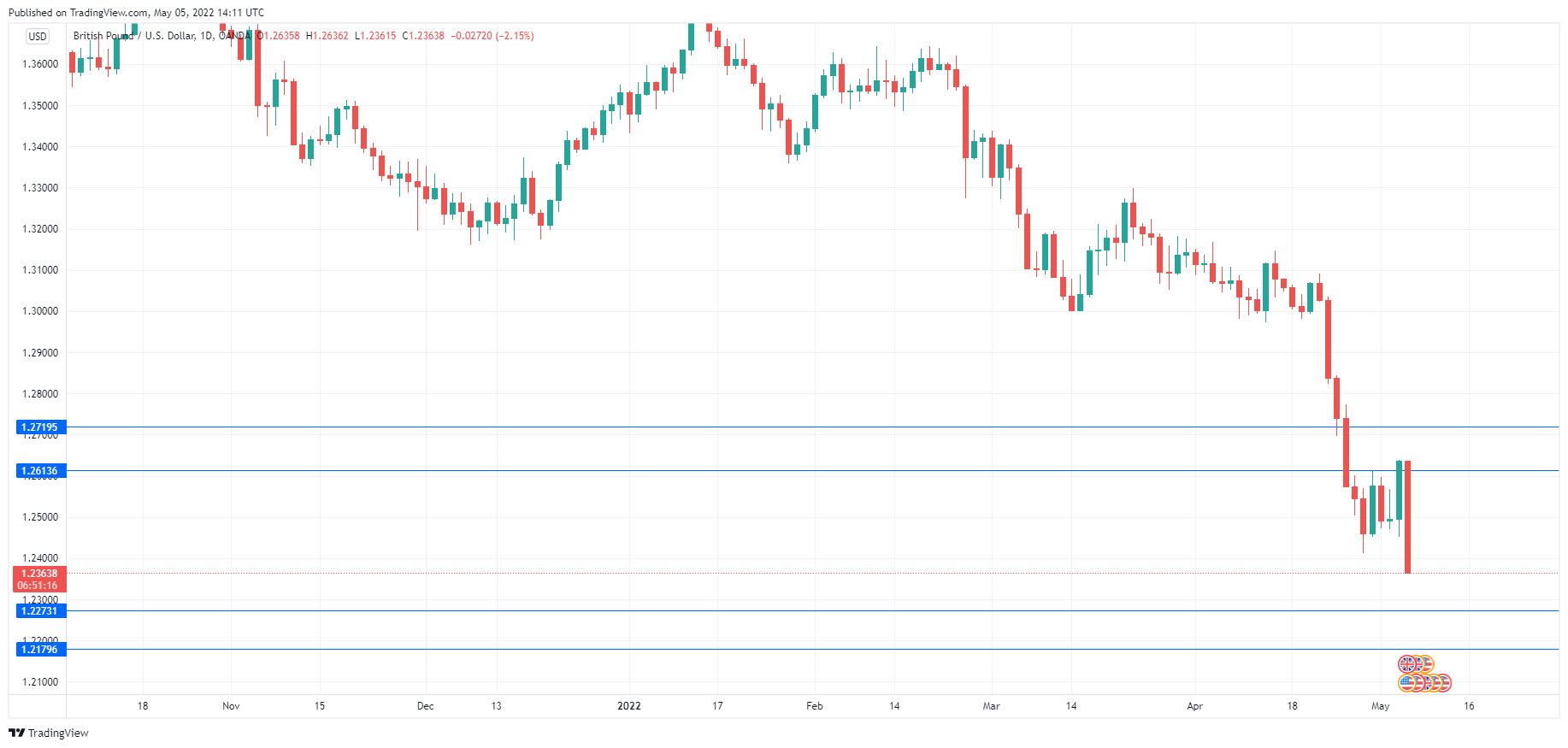
The British pound is fading badly on Thursday. GBP/USD has dropped a staggering 2.15% today and has fallen below the 1.24 line for the first time since July 2020. After the BoE decision, market focus has shifted to the elections in Northern Ireland later today. A Sinn Fein victory could weigh on the wobbly pound.
BoE hike fails to impress markets
The BoE raised interest rates for a fourth straight time since December, bringing the Official Bank Rate to 1.00%, its highest since 2009. Yet the market reception to the BoE move was decidedly chilly, as the pound has plunged almost 2% today.
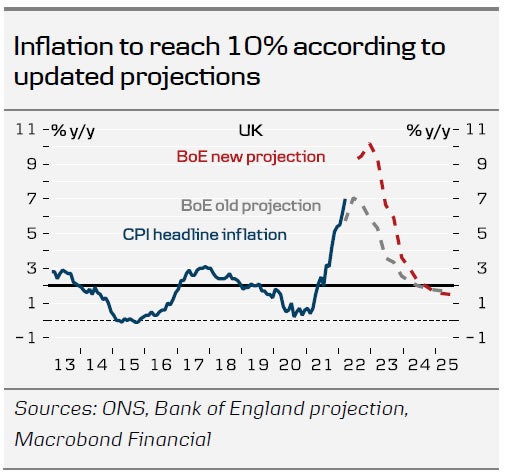
Why the sour reaction from the markets? The 0.25% was a modest move and it’s questionable if it will have much impact on soaring inflation. In March, CPI rose to 7.0%, up from 6.2%, and the BoE has warned that inflation could surpass 10%. The modest rate hike passed by a vote of 6-3, surprising the markets which had expected an 8-1 vote. Two MPC members called for a 0.50% hike, which reveals a sharp split within the MPC. Governor Bailey admitted after the meeting that an uncertain economic outlook had led to a range of views in the MPC, and such a statement can hardly be expected to instill confidence amongst investors.
The BoE cannot be blamed for not being aggressive – it is well into its rate-hike cycle and the policy summary noted that “some degree of further tightening in monetary policy may still be appropriate in the coming months”. In addition, the BoE dropped the word “modest” to describe upcoming rate hikes. Yet the markets appeared to focus on the split vote and the warning from the BoE that the country could face a sharp economic downturn, and the thumbs-down response has sent the pound sharply lower.
As expected, the Federal Reserve raised rates at its meeting by a half-point, the largest increase in 20 years. The Fed signalled that it will deliver additional half-point hikes in June and July, with Fed Chair Powell stating that the FOMC was not “actively considering” a 0.75% increase.
The Fed is also implementing quantitative tightening with a reduction in the balance sheet. Starting in June, the Fed will sell USD 45 billion/mth in assets, which will rise to USD 95 billion/mth in September. In sharp contrast to the BoE’s hike, the financial markets reacted positively, as investors believe that the Fed’s rate hikes can curb inflation while ensuring a soft landing for the economy and avoiding a recession.
GBP/USD Technical
- GBP/USD faces resistance at 1.2612 and 1.2719
- There is support at 1.2272 and 1.2179
Sunset Market Commentary
Markets
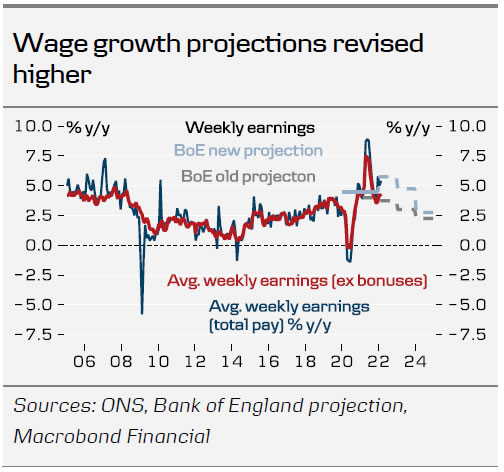
The Bank of England raised its policy rate for a fourth consecutive time by 25 bps, from 0.75% to 1%, the highest level since February 2009. Governor Bailey and co ordered internal staff to present a strategy to actively sell bonds from its QE-portfolio by the August meeting. In the past, they vowed to put this process in motion once policy rates hit 1%. Internal division within the Bank of England is extremely high. Three out of nine governors voted in favour of a 50 bps rate hike because the further deteriorating inflation outlook. The BoE in its new Monetary Policy Report puts the inflation peak now at slightly over 10% in Q4 (because of another increase of 40% in the UK energy price cap in October) compared with around 7.25% in the February report. Based on the market implied policy rate path (2.5% policy rate peak by mid-2023), inflation will fall to just above the 2% target by end 2023 and to 1.3% end 2024 as external factors fade. Pay growth is set to accelerate to 5.75% (!) this year before falling afterwards. Two other, dovish, officials dissented against the central bank’s guidance on additional rate moves resulting in an official line that “most members judged that some degree of further tightening in monetary policy might still be appropriate in coming months.” They represent the camp fearful of the growth outlook. The BoE predicts a 1.5% decline in real disposable income for households this year, which is the 2nd largest fall since 1964 despite supportive fiscal measures. Under current forecasts, a technical recession will be narrowly avoided, but GDP is set to shrink by 1% Q/Q in Q4 2022. Annual growth numbers for 2023 and 2024 are a miserable -0.25% and +0.25%. The poor economic outlook prompted money market investors to scale back rate hike expectations especially given the high internal division. The UK yield curve bull steepened with yields losing 17.4 bps (2-yr) to 5.1 bps (30-yr). The Dec2022 3-month GBP SONIA future now trades at 2.09% compared with 2.39% ahead of the meeting. German Bunds see some spillover effects as markets fear a similar dilemma down the road for the ECB. ECB Chief Economist Lane today also refrained from calling the July meeting a live one to finally start a European tightening cycle. The German yield curve shifts in similar fashion with yields losing 5.5 bps (2-yr) to flat (10-yr). US Treasuries underperform. US yields rise by up to 7 bps with the 10-yr yield testing 3%. Yesterday’s “correction” following the FOMC meeting proved to be short-lived. Sterling gets a beating with EUR/GBP taking out the YTD high at 0.8512. The pair currently changes hands around 0.8540. Cable sinks below 1.24 to the weakest level since July 2020. The dollar is again better bid with EUR/USD trading at 1.0560 from an open above 1.06.
News Headlines
As flagged at the March meeting, the Norges Bank left its policy rate unchanged at 0.75%. However, based on the Committee’s current assessment the policy rate will most likely be raised in June as planned. The NB still considers policy as expansionary while the upswing in the Norwegian economy continued and as the unemployment is lower than projected. Regarding the balance of risks, the MPC is concerned with the risk of accelerating price and wage inflation. If there are prospects of persistently high inflation, the policy rate may be raised more quickly than indicated by the policy rate forecast in the March Report. The krone gradually weakened after announcement. EUR/NOK rebounded from the 9.80 area to currently trade near 9.86.
The Czech national bank surprised markets again. After slowing the pace of rate hikes to 50 bps at the end of March meeting, the CNB today again accelerated its anti-inflation campaign by raising the policy rate from 5.0% to 5.75%. Most market analysts only expected a 50 bps hike. Comments of late from CNB governors provided mixed signals, but several members flagged a more modest or even a finetuning approach. The Czech koruna hardly gained any ground despite the bigger than expected rate hike. EUR/CZK trades little changed near 24.60.
Bank of England Review: Another Rate Hike But Mixed Signals
In line with expectations, the Bank of England (BoE) hiked the Bank Rate by another 25bp to 1.00%. As expected, attention was on forward guidance and not the rate hike itself. As we had expected, the BoE kept the softer forward guidance in place by stating "some degree of further tightening in monetary policy may still be appropriate in the coming months" (our emphasis). In our view, the Bank of England is definitely sending some mixed signals and the committee is very divided on what is the appropriate path going forward. On the one hand, three policymakers voted in favour of a larger 50bp rate hike due to high underlying inflation pressure. On the other hand, two policymakers voted against the "may still be appropriate" forward guidance because balance of risk is "more evenly balanced" according to them. Seemingly, they are more concerned about the economic outlook. Notably, the Bank of England now projects negative growth in 2023 based on market pricing, which is most likely weighing on some policymakers' assessment.
Overall, in our view, it seems fair to conclude that forward guidance is mixed but mostly to the dovish side, at least compared to market pricing. Additionally, it also means that it is more difficult to say what the Bank of England will do from here because of the internal disagreements. Markets reacted accordingly with EUR/GBP moving up one figure from 0.841 to 0.852 (GBP/USD below 1.24) and 2yr gilt yields went briefly below 1.40% (from nearly 1.63% yesterday) but are stabilising around 1.42% at the time of writing. Markets are now pricing in an additional total of 117bp rate hikes this year.
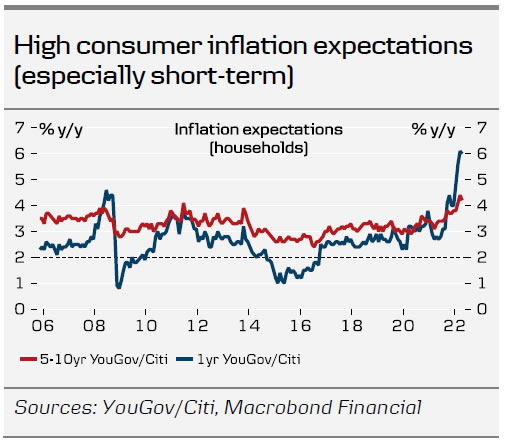
We change our Bank of England call now expecting three additional 25bp rate hikes (June, August and November vs. 25bp in August and November previously) recognising that the Bank of England is probably not ready to slow the rate hike pace just yet. We still see risks skewed towards more rate hikes, as risk is that inflation continues to surprise to the upside.
We are more dovish than markets, as the Bank of England puts more weight on the economic outlook than what markets believe in. We expect EUR/GBP to remain range-bounded around 0.84. On the one hand, a re-pricing of Bank of England (and perhaps a more hawkish ECB) is likely to weigh on GBP but on the other hand GBP usually appreciated vs EUR in an environment where USD performs.
Against our expectation, the Bank of England did not outline a plan for active QT (selling gilts directly to markets) in connection with today's meeting. Instead, the Bank of England said that they are working on a plan, which will be presented in connection with the August meeting, so they can "make a decision at a subsequent meeting". Hence we now expect active gilts selling to start in Q1 23. This is another reason why the BoE may slow the pace of rate hikes (or even pause for a number of meetings).
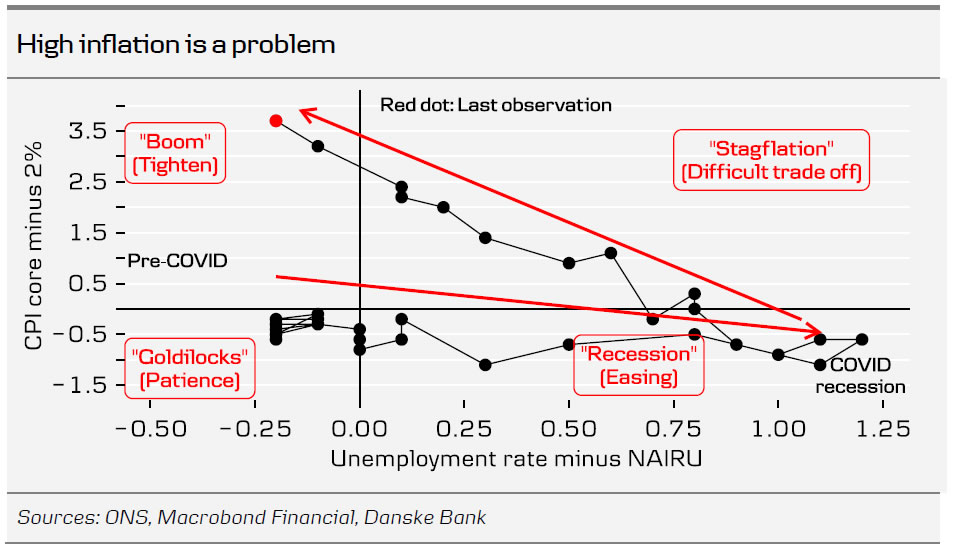
Our Bank of England call summarised
As expected, the Bank of England hiked the Bank Rate to 1.00% in connection with the May meeting. The Bank of England was, however, sending mixed signals with some members arguing for a larger rate hike while others thought it would be appropriate to remove the forward guidance on possible future rate hikes.
We have changed our Bank of England call now expecting three additional 25bp rate hike this year (June, August and November vs. 25bp in August and November previously). This is still less aggressive than current market pricing of an additional total of 117bp rate hikes this year.
We now expect the Bank of England to start active QT (selling gilts directly to markets) in Q1 23.
BTCUSD Seems Unable to Escape from Tight Range
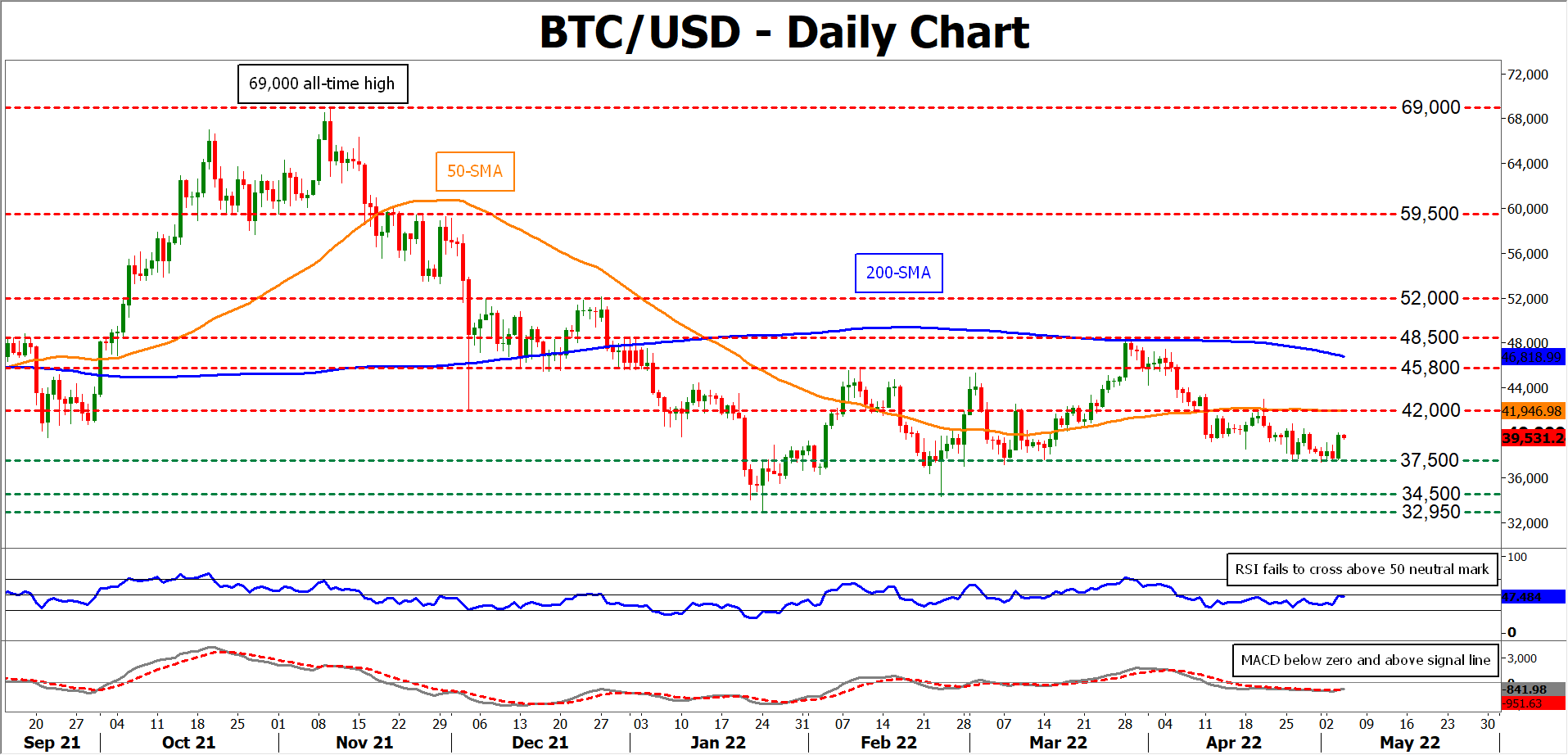
BTCUSD (Bitcoin) has been declining in the short-term after its advance paused at the 48,350 region. Nevertheless, the largest cryptocurrency by market capitalization has been trading sideways in the past few sessions, with its technical picture providing mixed signals.
The short-term oscillators suggest a cautiously positive near-term bias. Specifically, the MACD histogram has jumped above its red signal line but remains in the negative region, while the RSI's ascent failed to cross beyond the 50-neutral mark.
Should positive momentum intensify, the price could edge higher towards the 50-day simple moving average (SMA), currently at 42,000. A successful break above this region would turn the attention to the 45,800 barrier before the 2022 peak of 48,350 appears on the radar. Higher, the bulls might aim for the December resistance zone of 52,000.
Alternatively, if negative pressure arises the critical support region of 37,500 could be the initial point of support. Diving beneath this region, the February low of 34,500 may arrest any further declines. Failing to halt there, the price might descend towards the 2022 low of 32,950.
Overall, BTCUSD has been rangebound in the last two weeks, appearing unable to adopt a clear direction. Therefore, a break above the 42,000 region could ignite further buying interest, while a dive beneath 37,500 would signal the resumption of the cryptocurrency's short-term downtrend.
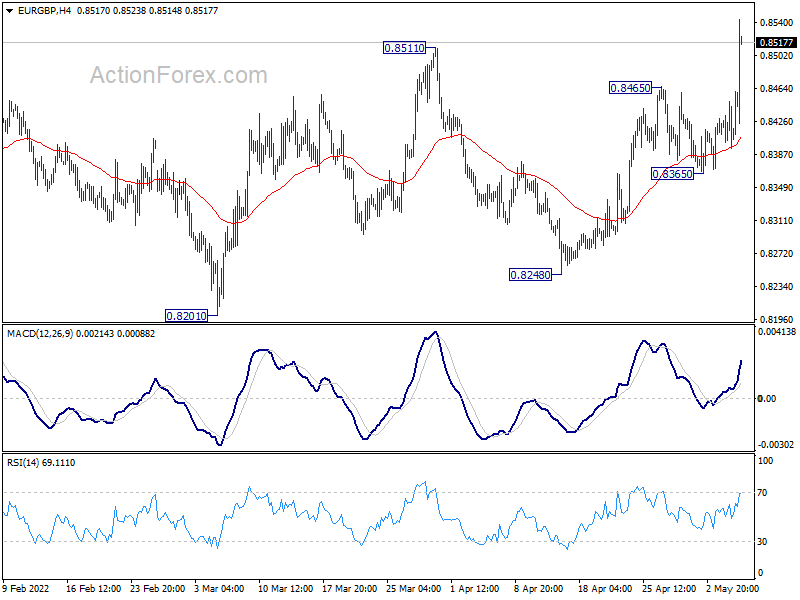
EUR/GBP Mid-Day Outlook
Daily Pivots: (S1) 0.8386; (P) 0.8418; (R1) 0.8440; More...
EUR/GBP's rally resumes and hits as high as 0.8544 so far. The break of 0.8511 resistance reaffirm that 0.8201 is a medium term bottom. Intraday bias is back on the upside for 0.8697 medium term fibonacci level next. For now, outlook will stay cautiously bullish as long as 0.8365 support holds, in case of retreat.
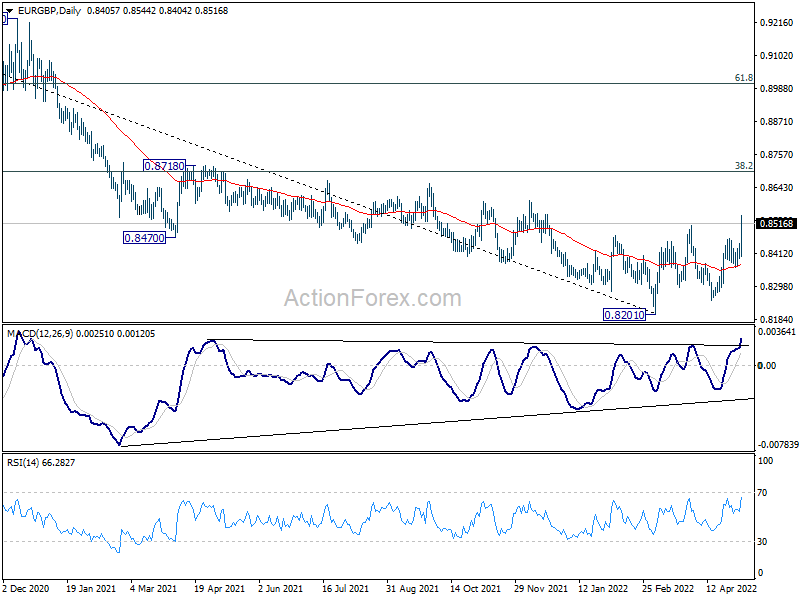
In the bigger picture, a medium term bottom could be in place at 0.8201, on bullish convergence condition in daily and weekly MACD. Rise from there could either be a correction to the down trend from 0.9499 (2020 high), or a medium term up trend itself. In either case, further rise should be seen to 38.2% retracement of 0.9499 to 0.8201 at 0.8697. Sustained break there will target 61.8% retracement at 0.9003.
USD/JPY Mid-Day Outlook
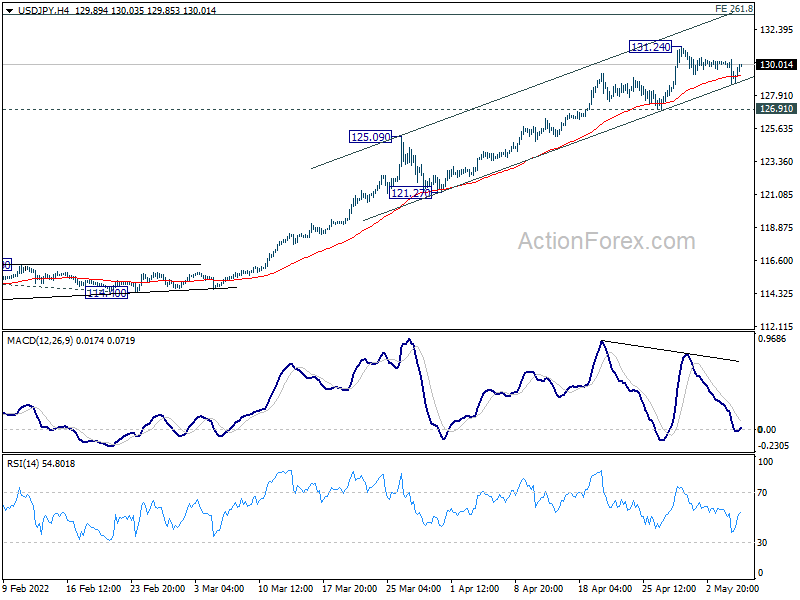
Daily Pivots: (S1) 129.79; (P) 130.04; (R1) 130.38; More...
Intraday bias in USD/JPY remains neutral as consolidation from 131.24 might extend further. Near term outlook stays bullish with 126.91 support intact and further rally is expected. On the upside, break of 131.24 will resume recent up trend to 261.8% projection of 109.11 to 116.34 from 114.40 at 133.26. However, considering bearish divergence condition in 4 hour MACD, break of 126.91 will confirm short term topping and turn bias back to the downside for 121.27/125.09 support zone.
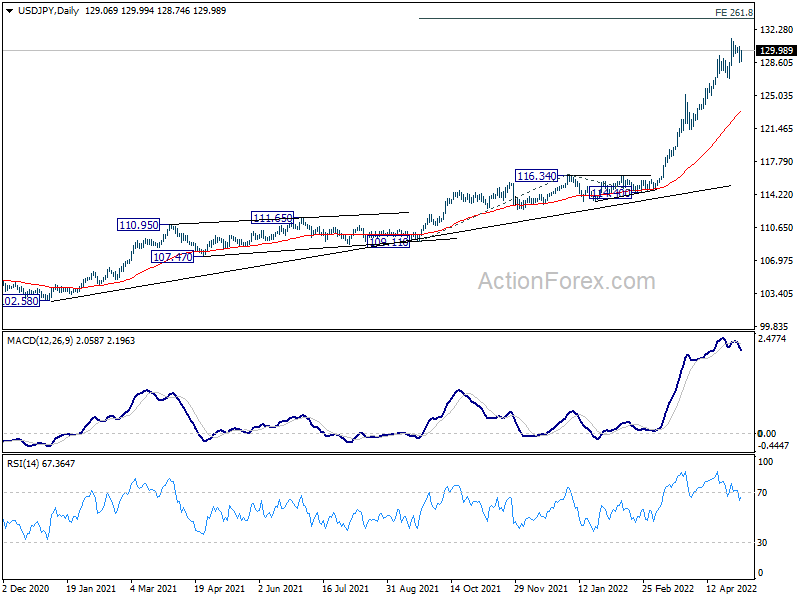
In the bigger picture, current rally is seen as part of the long term up trend form 75.56 (2011 low). Sustained trading above 61.8% projection of 75.56 (2011 low) to 125.85 (2015 high) from 98.97 at 130.04 will pave the way to 100% projection at 149.26, which is close to 147.68 (1998 high). For now, this will remain the favored case as long as 121.27 support holds.
USD/CHF Mid-Day Outlook
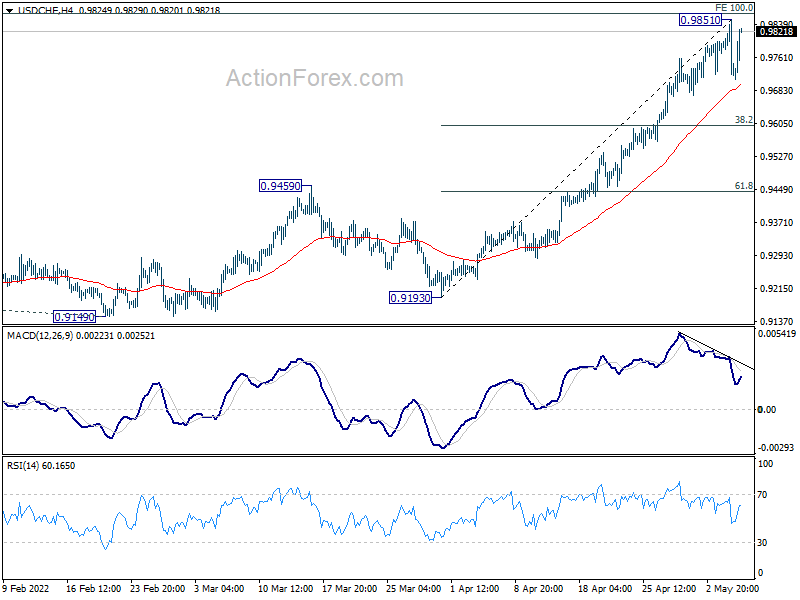
Daily Pivots: (S1) 0.9675; (P) 0.9763; (R1) 0.9808; More....
Intraday bias in USD/CHF remains neutral for consolidation below 0.9851. In case of another fall, downside should be contained by 38.2% retracement of 0.9193 to 0.9851 at 0.9600. On the upside, firm break of 0.9851 will bring up trend resumption.
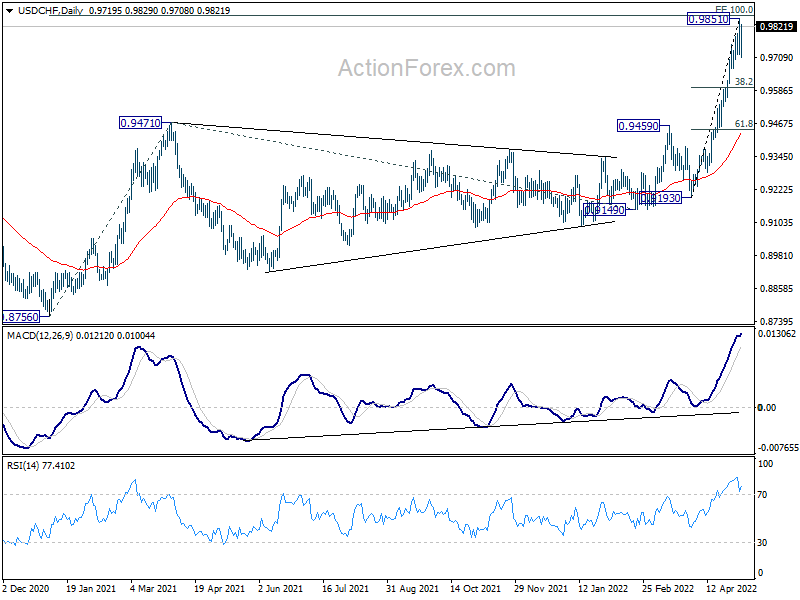
In the bigger picture, down trend from 1.0342 (2016 high) should have completed with three waves down to 0.8756 (2021 low) already. Rise from 0.8756 is likely a medium term up trend of its own. Next target is 100% projection of 0.8756 to 0.9471 from 0.9149 at 0.9864. Sustained break there will pave the way back to 1.0342 high. This will now remain the favored case as long as 0.9459 resistance turned support holds.
EUR/USD Mid-Day Outlook
Daily Pivots: (S1) 1.0544; (P) 1.0587 (R1) 1.0669; More...
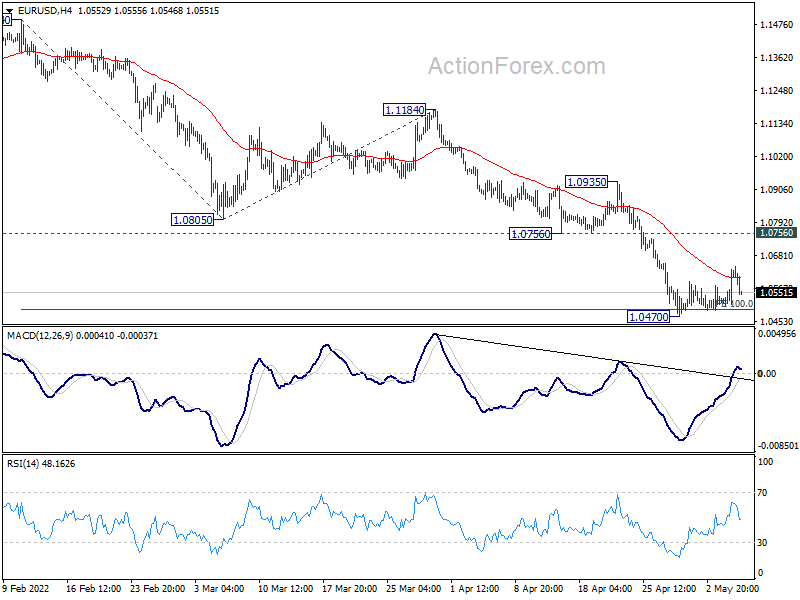
EUR/USD is still bounded in consolidation from 1.0470 and intraday bias remains neutral. Another recovery could still be seen. But upside should be limited by 1.0756 support turned resistance to bring fall resumption. Break of 1.0470 will resume larger down trend and target 161.8% projection of 1.1494 to 1.0805 from 1.1184 at 1.0069.
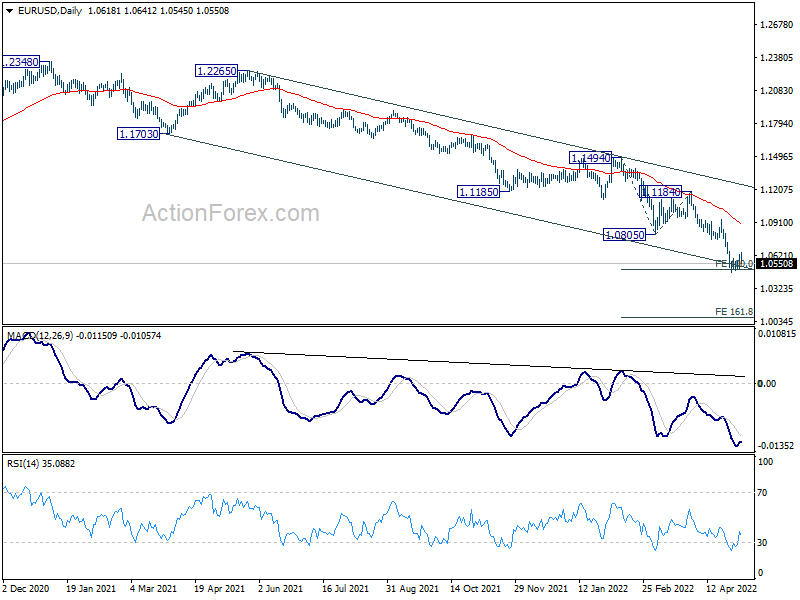
In the bigger picture, the decline from 1.2348 (2021 high) is expected to continue as long as 1.1185 support turned resistance holds. The break of 1.0635 (2020 low) now raises the chance that it's resuming long term down trend from 1.6039 (2008 high). Retest of 1.0339 (2017 low) low should be seen next. Decisive break there will confirm this bearish case.
GBP/USD Mid-Day Outlook
Daily Pivots: (S1) 1.2513; (P) 1.2575; (R1) 1.2699; More...
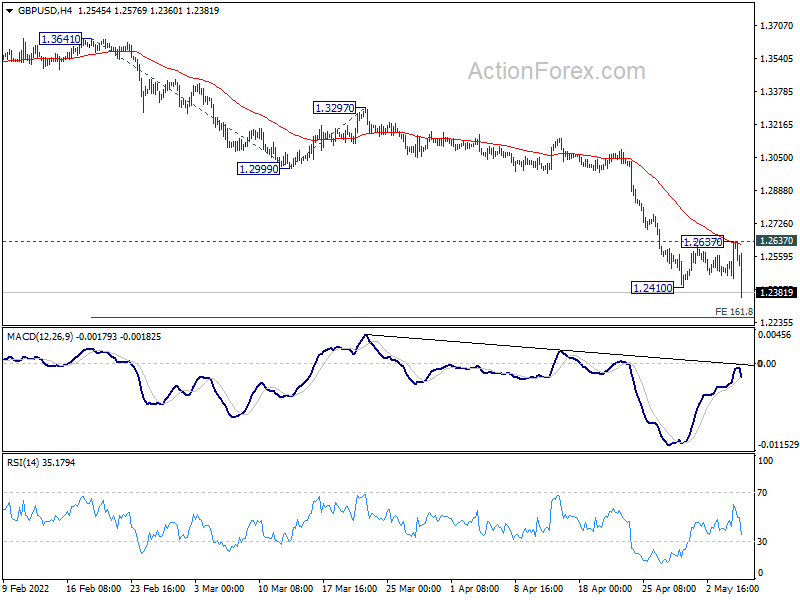
GBP/USD's down trend resumes by breaking through 1.2410 support. Intraday bias is back on the downside for 161.8% projection of 1.3641 to 1.2999 from 1.3297 at 1.2258. Break will target 200% projection at 1.2013 next. On the upside, break of 1.2637 resistance is needed to indicate short term bottoming. Otherwise, outlook will remain bearish in case of recovery.
In the bigger picture, rise from 1.1409 (2020 low) has completed at 1.4248, ahead of 1.4376 long term resistance (2018 high). Based on current momentum, fall from 1.4248 is probably the start of a long term down trend. The break of 61.8% retracement of 2.1161 to 1.1409 at 1.2493 is affirming this bearish case too. For now, deeper decline would be seen as long as 1.3158 support turned resistance holds. Next target is 1.1409 low.

Sterling Collapses after Dovish BoE Hike, Dollar Regains Ground
Sterling drops sharply today even after BoE raised interest rate as expected. The trigger was the warning that of recession as high inflation hurts real incomes of household and profits of businesses. Aussie and Kiwi are also trading lower as yesterday's risk-on rally fades. Dollar, on the other hand, is regaining some of the post FOMC losses. As for the week, though, Sterling is the worst so far, followed by Franc. Aussie is still the strongest, followed by Loonie.
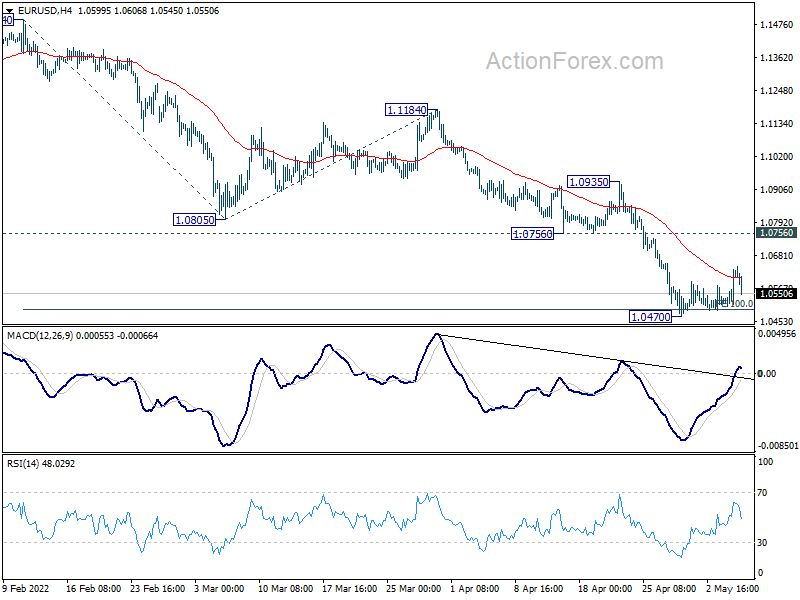
Technically, the development in Sterling is rather bad, with GBP/USD breaking through 1.2410 support to resume medium term down trend. EUR/GBP's strong break of 0.8511 resistance reaffirms that it's in medium term rebound. A focus now is indeed on whether Euro will also follow. Hence, attention will be back on 1.0470 support in EUR/USD.
In Europe, at the time of writing, FTSE is up 1.58%. DAX is up 1.56%. CAC is up 1.90%. Germany 10-year yield is down -0.0045 at 0.928. Earlier in Asia, Japan was on holiday. Hong Kong HSI dropped -0.36%. China Shanghai SSE rose 0.68%. Singapore Strait Times dropped -0.17%.
US initial jobless claims rose to 176k, continuing claims dropped to 1.384m
US initial jobless claims rose 19k in the week ending April 30, above expectation of 176k. Four-week moving average of initial claims rose 8k to 188k.
Continuing claims dropped -19k to 1384k in the week ending April 23, lowest since January 17, 1970. Four-week moving average of continuing claims dropped -36k to 1417k, lowest since February 21, 1970.
BoE hikes by 25bps, three MPC members wanted 50bps
BoE raises Bank Rate by 25bps to 1.00% as widely expected. The decision was made by 6-3 vote, with three members voted for 50bps hike, including Jonathan Haskel, Catherine Mann and Michael Saunders.
In the accompany statement, BoE reaffirmed its preference that the Bank Rate will be used as the active policy tool in adjusting monetary policy stance. It will "consider" beginning the process of selling the assets purchased., but the decision will depend on economic circumstances. The strategy on offloading the assets will be provided at the August meeting.
BoE also updated the economic projections conditions on a market-implied path for Bank Rate that rises to around 2.50% by mid-2023, before falling to 2.00% at the end of the forecast period. CPI is expected to rise further over the remainder of the year, averaging slightly over 10% at its peak in 2022 Q4, then falls back to 2% target in around two years. GDP is projected to fall in 2022 Q4 and calendar year GDP growth is broadly flat in 2023.
UK PMI services finalized at 58.9, twin headwinds of costs and war
UK PMI Services was finalized at 58.9 in April, down from March's 62.6. S&P Global noted that input cost inflation hit fresh record high. Activity and new business continued to rise, but a reduced rates. Business confidence was lowest in a year-and-a-half. PMI Composite was finalized at 58.2, down from March's 60.9.
Andrew Harker, Economics Director at S&P Global: "The twin headwinds of the cost of living crisis and the war in Ukraine started to bite on the UK service sector during April, as evidenced by a sharp slowdown in new order growth to the lowest in the year so far. Worryingly, companies seem to be expecting impacts to be prolonged, with business confidence dropping to the lowest in a year-and-a-half."
ECB Lane: Gradualism is an important consideration in thinking about normalization
ECB Chief Economist Philip Lane said in a speech, "in thinking about the normalization process, gradualism is an important consideration." There are two basic reasons that make the timeline of completing normalization "intrinsically uncertain".
Firstly, "the feedback loop between various steps in the policy normalisation process and inflation dynamics needs to be incorporated into the monetary policy decision process".
Secondly, "high uncertainty about the economic impact of the war in Ukraine, the energy shock and the post-pandemic recovery suggests that it is unlikely that the economy will quickly settle into a new steady-state equilibrium."
Lane reiterated that the calibration of policies will "will remain data-dependent and reflect our evolving assessment of the outlook".
Released in European session, Germany factory orders dropped -4.7% in March versus expectation of -0.5%. France industrial output dropped -0.5% mom in March versus expectation of 0.0% mom. Swiss CPI came in at 0.4% mom, 2.5% yoy in April, versus expectation of 0.2% mom, 2.5% yoy.
China Caixin PMI services dropped to 36.2 in Apr, PMI composite down to 37.2
China Caixin PMI Services dropped from 42.0 to 36.2 in April, below expectation of 40.9. That's the second straight month of steep decline, and the worst reading since February 2020. Caixin said decline in new business gathered pace but employment fell only slightly. PMI Composite dropped from 43.9 to 37.2, also the worst since the onset of the pandemic.
Wang Zhe, Senior Economist at Caixin Insight Group said: "Overall, in April, local Covid outbreaks continued and activity in the manufacturing and service sectors continued to contract, with services shrinking more. Demand was under pressure, external demand deteriorated, supply shrank, supply chains were disrupted, delivery times were prolonged, backlogs of work grew, workers found it difficult to return to their jobs, inflationary pressures lingered, and market confidence remained below the long-term average."
GBP/USD Mid-Day Outlook
Daily Pivots: (S1) 1.2513; (P) 1.2575; (R1) 1.2699; More...
GBP/USD's down trend resumes by breaking through 1.2410 support. Intraday bias is back on the downside for 161.8% projection of 1.3641 to 1.2999 from 1.3297 at 1.2258. Break will target 200% projection at 1.2013 next. On the upside, break of 1.2637 resistance is needed to indicate short term bottoming. Otherwise, outlook will remain bearish in case of recovery.
In the bigger picture, rise from 1.1409 (2020 low) has completed at 1.4248, ahead of 1.4376 long term resistance (2018 high). Based on current momentum, fall from 1.4248 is probably the start of a long term down trend. The break of 61.8% retracement of 2.1161 to 1.1409 at 1.2493 is affirming this bearish case too. For now, deeper decline would be seen as long as 1.3158 support turned resistance holds. Next target is 1.1409 low.
Economic Indicators Update
| GMT | Ccy | Events | Actual | Forecast | Previous | Revised |
|---|---|---|---|---|---|---|
| 01:30 | AUD | Building Permits M/M Mar | -18.50% | -12.00% | 43.50% | 42.00% |
| 01:30 | AUD | Trade Balance (AUD) Mar | 9.31B | 7.80B | 7.46B | 7.44B |
| 01:45 | CNY | Caixin Services PMI Apr | 36.2 | 40.9 | 42 | |
| 06:00 | EUR | Germany Factory Orders Mar | -4.70% | -0.50% | -2.20% | -0.80% |
| 06:30 | CHF | CPI M/M Apr | 0.40% | 0.20% | 0.60% | |
| 06:30 | CHF | CPI Y/Y Apr | 2.50% | 2.50% | 2.40% | |
| 06:45 | EUR | France Industrial Output M/M Mar | -0.50% | 0.00% | -0.90% | |
| 08:30 | GBP | Services PMI Apr F | 58.9 | 58.3 | 58.3 | |
| 11:00 | GBP | BoE Interest Rate Decision | 1.00% | 1.00% | 0.75% | |
| 11:00 | GBP | MPC Official Bank Rate Votes | 9--0--0 | 8--0--1 | 8--0--1 | |
| 11:30 | USD | Challenger Job Cuts Y/Y Apr | 6.00% | -30.10% | ||
| 12:30 | USD | Initial Jobless Claims (Apr 29) | 200K | 176K | 180K | 181K |
| 12:30 | USD | Nonfarm Productivity Q1 P | -7.50% | -5.10% | 6.60% | |
| 12:30 | USD | Unit Labor Costs Q1 P | 11.60% | 7.40% | 0.90% | |
| 14:30 | USD | Natural Gas Storage | 69B | 40B |