Sample Category Title
Sunset Market Commentary
Markets
This morning Chinese authorities/the PBOC indicated they will continue to support the economy and promote healthy and stable financial markets. This gave some conform after investor worries about a sharp cooling of Chinese growth due to new lockdowns put markets in outright risk-off mode yesterday. Asian equities showed a mixed, still sightly unconvincing picture, despite a solid close on WS. European indices also regain part of yesterday’s setback with the Eurostoxx rebounding about 0.50%. However, Russian foreign minister Lavrov warning on the risk of a nuclear escalation was just another illustration of the still unpredictable nature of the war in Ukraine, while diplomatic efforts continue at the same time. Yesterday, growth fears/the risk-off repositioning coincided with a substantial correction in commodities/setback in inflation expectations, triggering sharply lower core yields. The sell-off in oil and most other commodities slowed. For now however, it wasn’t enough to revive the uptrend in core yields. Especially US Treasuries are extending gains, with yields declining 9/8 bps in the 2/10-year sector. The very long end slightly underperforms (-5 bps). Eco data were not to blame. US durable goods orders (0.8% M/M) suggest ongoing heathy investment dynamics. S&P Corelogic CS 20 city house prices also rose a faster-than-expected 2.39% M/M and 20.20% Y/Y. The Conference Board consumer confidence (107.3) and the Richmond Fed manufacturing (14) came within the margin of consensus error. Later today, the US Treasury will sell $48 bln of 2-y Notes. Bunds followed the rebound in US Treasuries but underperformed with a mild curve flattening (2-y -2 bps; 30-y -3.5 bps). Changes in 10-y intra-EMU yields spreads versus Germany were very limited, with Greece the exception to the rule (10-y +10 bps) as the country announced to have mandated to tap a 2027 bond.
On FX markets, the correction in US yields still hardly hinders a solid USD momentum. The trade-weighted DXY index touched yet another cycle top just below the 102 big figure. At the same time, by default euro weakness is also still in play as investors are eagerly awaiting clarity/hard interest rate support from the ECB. At 1.0675, the corona low (1.0636) is now really within striking distance. Sterling still also fights an uphill battle. Cable dropped below the 1.27 handle (1.2680). EUR/GBP gains a few ticks (0.8420). USD/JPY is the exception to the rule with the yen profiting from a less negative interest rate differential and maybe also from the new economic support package. News Headlines
Japan has unveiled another emergency relief package amounting to 13.2tn yen ($103bn) to soften the blow from rising energy and raw material costs. The plan is made out of four pillars: curbing oil prices, ensuring a stable food supply, providing support for small and medium-sized companies and helping struggling households. Some 6.2tn yen will be direct government spending, such as cash pay-outs to low-income households with children and subsidies to gasoline wholesalers to depress retail prices. The remainder consists of measures including private-sector lending. "We must prevent rising fuel and raw material costs from disrupting a recovery in economic and social activity from the pandemic," PM Kishida justified the fiscal boost at a time many other Western countries are gradually phasing out crisis measures. The yen strengthens today. USD/JPY declines to the low 127 area.
The Hungarian central bank raised its base rate by an expected 100 bps to 5.40%. The interest rate corridor was also lifted with the same amount. The bottom O/N deposit rate now stands at the same 5.40% and the upper limit at 8.40%. The MNB remains very concerned about inflation, which rose to 8.5% in March with core measures even hitting 9.1%. Strong negative supply effects (war, sanctions, commodity prices) will push up inflation in coming months. It won’t reach the 3% target until the first half of 2024. Elevated inflation expectations with the increasing risk of second-round effects make it necessary to continue tightening until the inflation outlook stabilizes around the MNB target and risks become evenly balanced. Hungarian swap yields rise 0.5-10 bps today with the wings of the curve underperforming. The forint fails to profit with today’s decision discounted. EUR/HUF advances to 375.13.
US consumer confidence dropped slightly to 107.3, inflation and war to pose downside risks
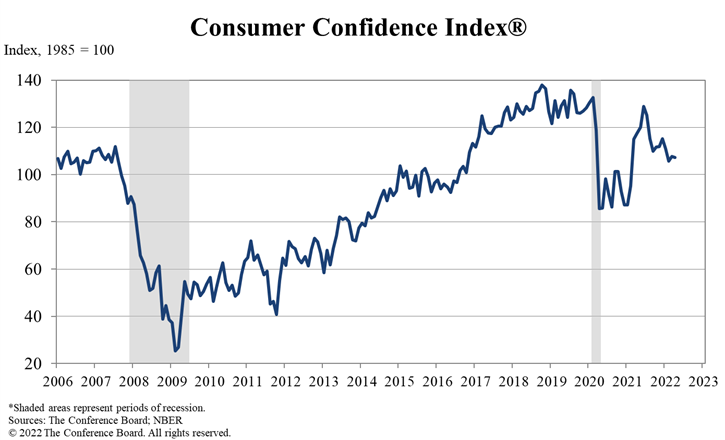
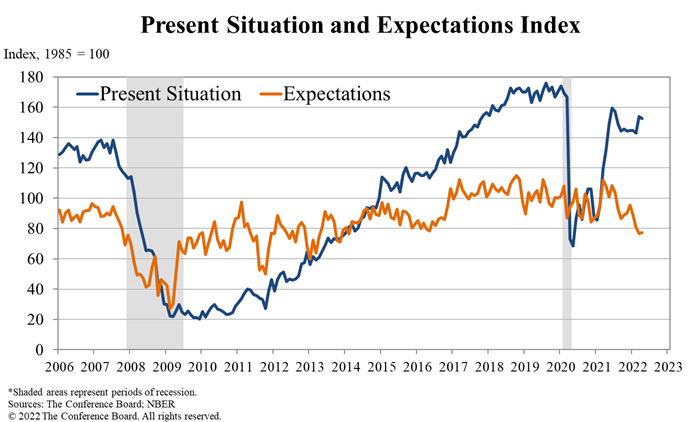
US Conference Board Consumer Confidence Index dropped slightly from 107.6 to 107.3 in April, below expectation of 108.5. Present Situation Index dropped from 153.8 to 152.6. Expectations Index rose from 76.7 to 77.2.
"Consumer confidence fell slightly in April, after a modest increase in March," said Lynn Franco, Senior Director of Economic Indicators at The Conference Board. "The Present Situation Index declined, but remains quite high, suggesting the economy continued to expand in early Q2. Expectations, while still weak, did not deteriorate further amid high prices, especially at the gas pump, and the war in Ukraine. Vacation intentions cooled but intentions to buy big-ticket items like automobiles and many appliances rose somewhat."
"Still, purchasing intentions are down overall from recent levels as interest rates have begun rising. Meanwhile, concerns about inflation retreated from an all-time high in March but remained elevated. Looking ahead, inflation and the war in Ukraine will continue to pose downside risks to confidence and may further curb consumer spending this year."
Bleeding Euro Falls to 2-Year Low
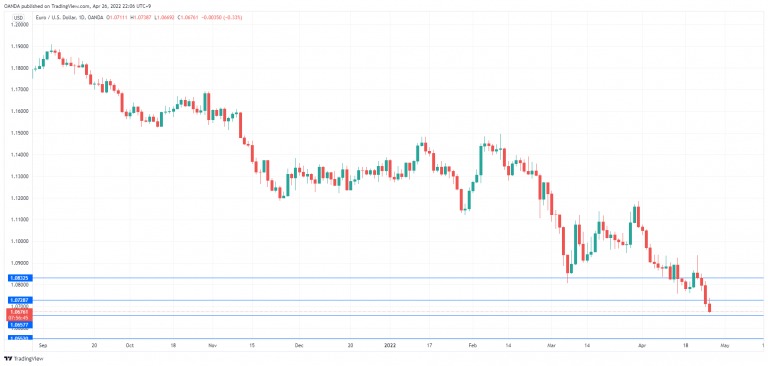
The euro remains on a downswing and has extended its losses for a fourth straight day. EUR/USD has dropped below the 1.07 line for the first time since March 2020.
Euro drenched by April showers
April has been nasty for the euro, which has fallen over 300 points. The Ukraine war and the hawkish Fed have been a toxic mix for the euro, as investors have dumped the currency and flocked to the safe-haven US dollar.
The war between Russia and Ukraine grinds on, and the uncertainty over Russian energy supplies to Europe and sanctions against Russia have dampened sentiment towards the euro. Tight sanctions against Russia, which have led to soaring oil prices, are also having an effect on the growth of eurozone countries. There are calls within Europe to hit Russia even harder by banning Russian energy imports. However, Germany is understandably against such a sweeping move, given that Russia provides Germany with 25% of its oil and 40% of its natural gas, and cutting off these supplies would push Germany into a recession.
Across the pond, Federal Reserve hawkishness is also weighing on the euro. The Fed is in a hurry to roll out further rate hikes in order to contain inflation, and Fed Chair Powell has hinted strongly at a 0.50% increase at the May meeting, with possibly more such increases in the coming months. This widening of the US/Europe rate differential is weighing on the euro, which is on track to break below the 1.06 shortly.
On Sunday, President Emmanuel Macron won a decisive victory over Marie Le Pen of the extreme right, by a score of 58% to 42%. The mood in European markets was one of relief rather than elation, given that Le Pen, a staunch euro-sceptic had her best showing ever. The victory of the pro-business Macron is good news for the markets, but it hasn’t stopped the euro’s slide this week.
EUR/USD Technical
- EUR/USD continues to break through support levels. 1.0657 is under pressure, followed by support at 1.0553
- There is resistance at 1.0728 and 1.0832
USD/JPY Mid-Day Outlook
Daily Pivots: (S1) 127.48; (P) 128.18; (R1) 128.82; More...
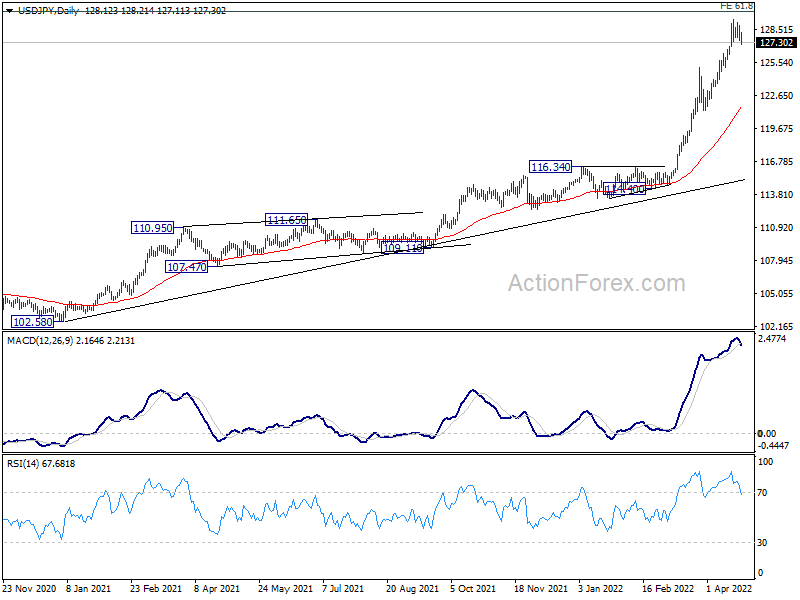
Intraday bias in USD/JPY remains neutral as consolidation from 129.39 is extending. Deeper retreat could be seen but downside should be contained above 125.09 resistance turned support to bring another rally. On the upside, above 129.39 will target 130.04 long term projection level next.
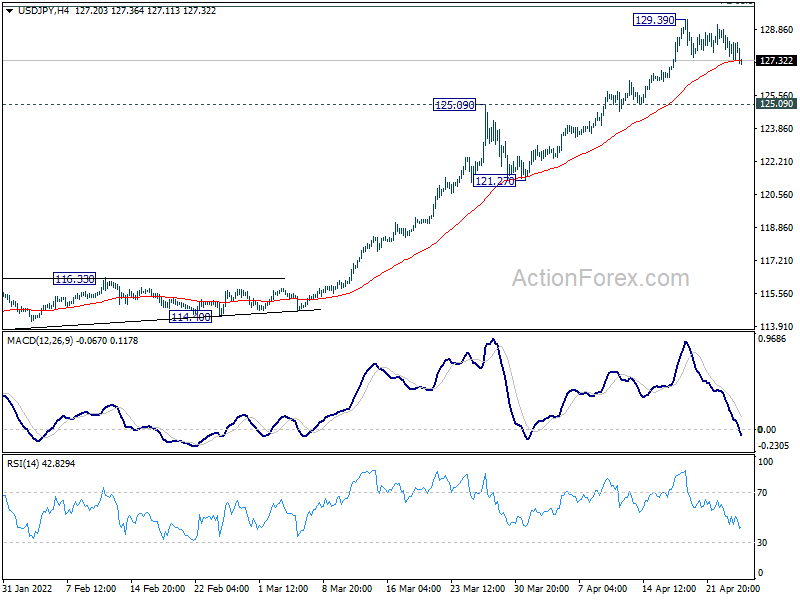
In the bigger picture, the break of 125.85 resistance (2015 high) suggests that whole up trend from 75.56 (2011 low) is resuming. Further rise should be seen to 61.8% projection of 75.56 (2011 low) to 125.85 (2015 high) from 98.97 at 130.04. Sustained break there wave the way to 147.68 (1998 high). For now, this will remain the favored case as long as 121.27 support holds.
USD/CHF Mid-Day Outlook
Daily Pivots: (S1) 0.9564; (P) 0.9580; (R1) 0.9614; More....
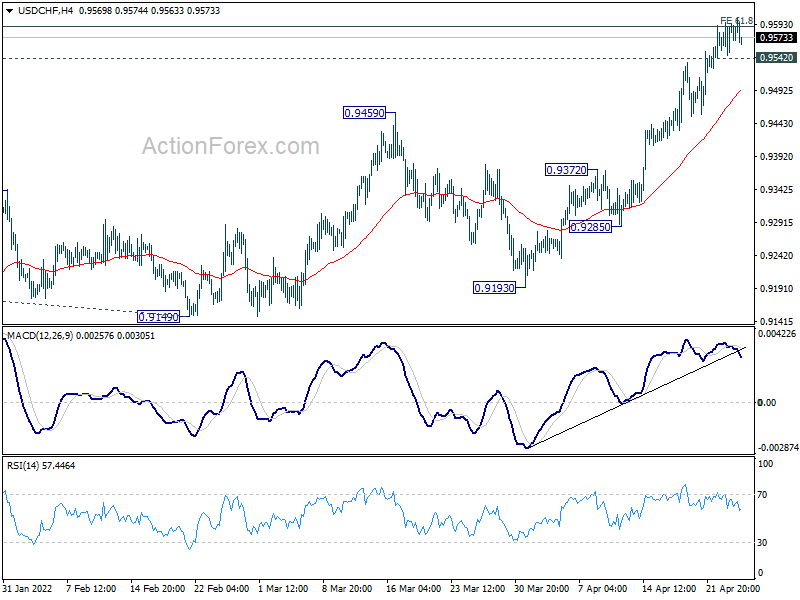
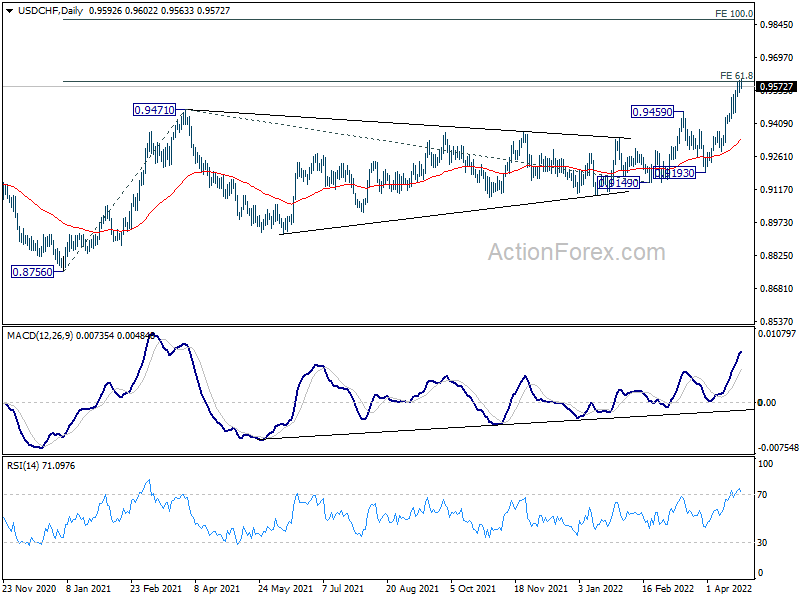
USD/CHF continues to lose upside momentum as seen in 4 hour MACD and intraday bias is turned neutral first. Some consolidations could be seen. But downside should be contained above 0.9372 resistance turned support to bring another rally. On the upside, sustained break of 0.9591 medium term projection level will pave the way to next at 0.9864.
In the bigger picture, down trend from 1.0342 (2016 high) could have completed with three waves down to 0.8756 (2021 low) already. Rise from 0.8756 is likely a medium term up trend of its own. Sustained break of 61.8% projection of 0.8756 to 0.9471 from 0.9149 at 0.9591 will pave the way to 100% projection at 0.9864. This will now remain the favored case as long as 0.9193 support holds.
EUR/USD Mid-Day Outlook
Daily Pivots: (S1) 1.0668; (P) 1.0741 (R1) 1.0786; More...
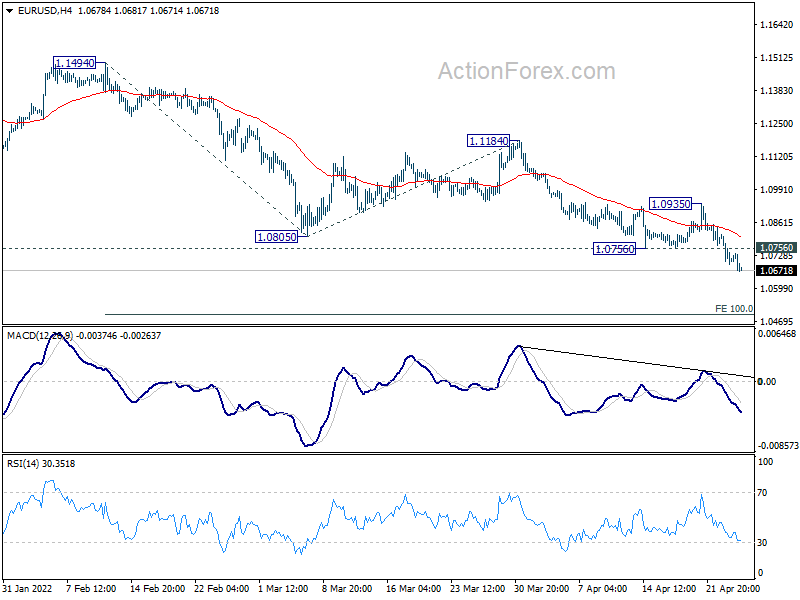
Intraday bias in EUR/USD remains on the downside for 100% projection of 1.1494 to 1.0805 from 1.1184 at 1.0495. Firm break there will pave the way to 161.8% projection at 1.0069. On the upside, above 1.0756 minor resistance will turn intraday bias neutral first. But outlook will stay bearish as long as 1.0935 resistance holds, in case of recovery.
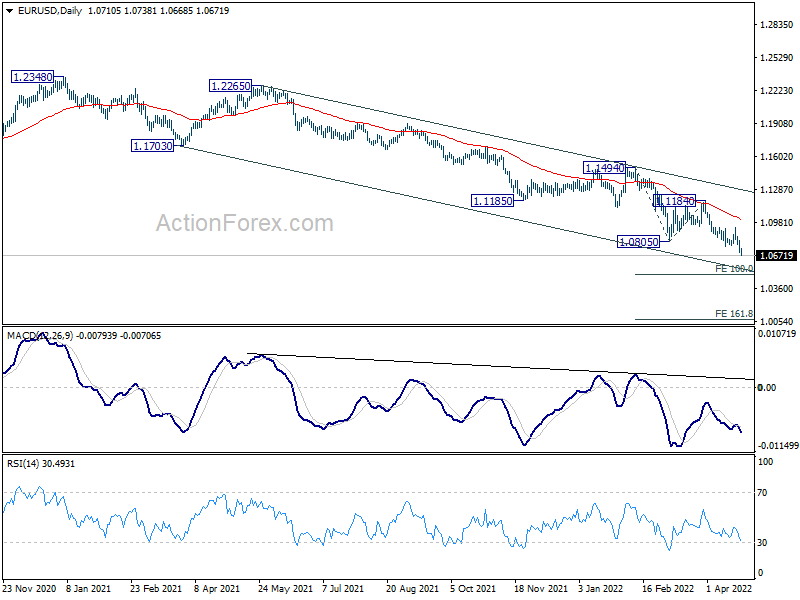
In the bigger picture, the decline from 1.2348 (2021 high) is expected to continue as long as 1.1185 support turned resistance holds. Firm break of 1.0635 (2020 low) will raise the chance of long term down trend resumption and target a retest on 1.0339 (2017 low) next. Nevertheless, break of 1.1185 will maintain medium term neutral outlook, and extending term range trading first.
GBP/USD Mid-Day Outlook
Daily Pivots: (S1) 1.2679; (P) 1.2762; (R1) 1.2826; More...
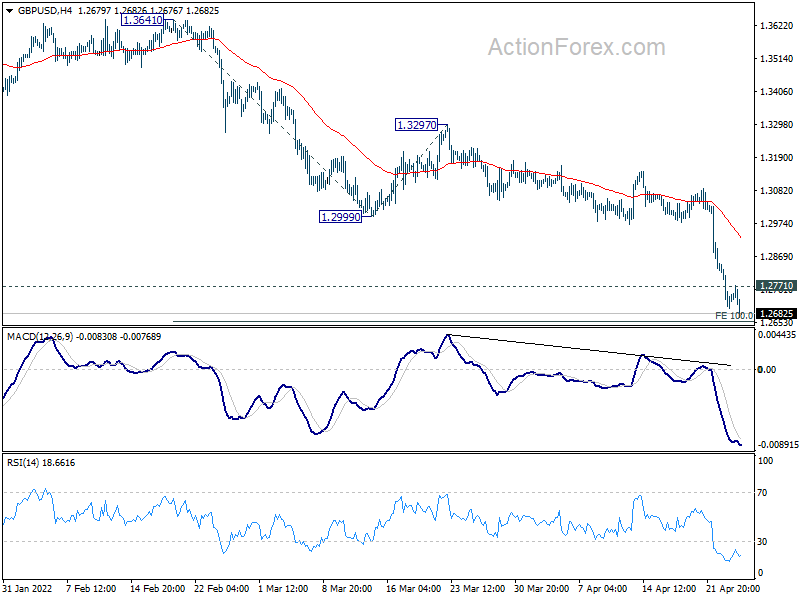
GBP/USD's decline continues today and intraday bias stays on the downside for 100% projection of 1.3641 to 1.2999 from 1.3297 at 1.2655. Sustained break there will target 161.8% projection at 1.2258. On the upside, above 1.2771 minor resistance will turn intraday bias neutral and bring consolidation first, before staging another decline.
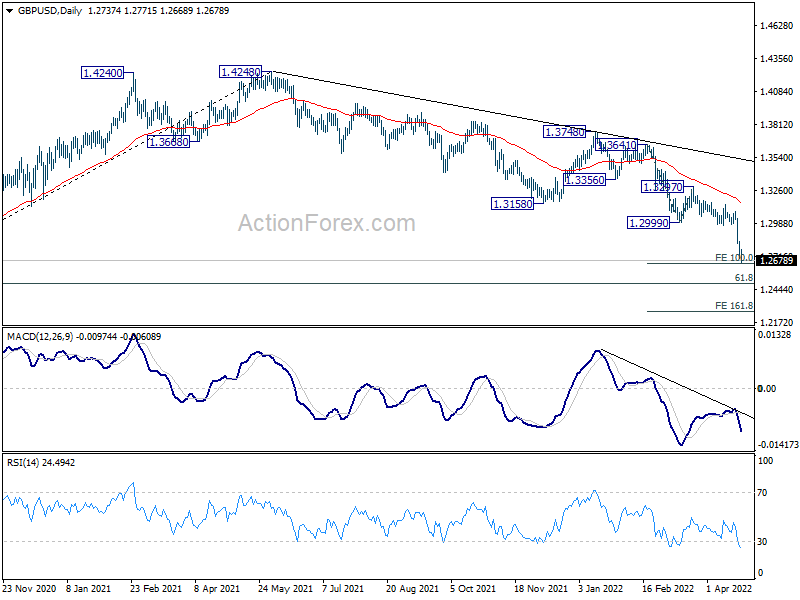
In the bigger picture, rise from 1.1409 (2020 low) has completed at 1.4248, ahead 1.4376 long term resistance (2018 high). Decline from 1.4248 could still be a corrective move, or it could be the start of a long term down trend. In either case, deeper decline would be seen back to 61.8% retracement of 2.1161 to 1.1409 at 1.2493. In any case, break of 1.3158 support turned resistance is needed to be the first sign of medium term bottoming. Otherwise, outlook will stay bearish in case of rebound.
Selling Focus Turns to EUR and GBP; USD, JPY and CHF Firm
Overall risk sentiment is mixed today with mild recovery in European stocks, even though US futures still point to lower open. Major global benchmark treasury yields are turning softer. Dollar, Swiss Franc and Yen are staying as the strongest ones. Selling focus, however, has turned to Sterling in Euro. Commodity currencies turned mixed for now, with recovery seen in Gold and oil price too.
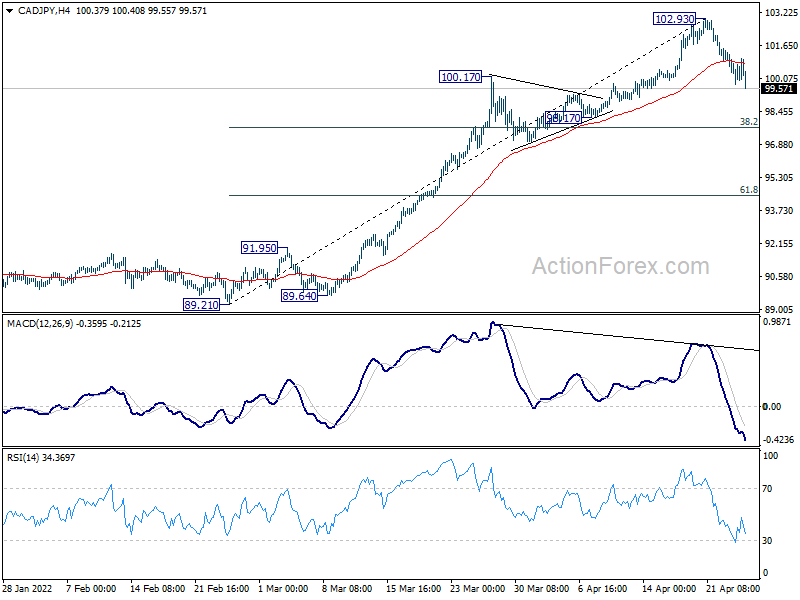
Technically, Yen pairs, except USD/JPY, are generally trading lower today. Even CAD/JPY is accelerating after failing to recover back above 4 hour 55 MEA. Current fall from 102.93 is seen as corrective whole rise from 89.21. Deeper decline should be seen to 38.2% retracement of 89.21 to 102.93 at 97.68. Such development would be reflected in deeper decline in both AUD/JPY and NZD/JPY too.
In Europe, at the time of writing, FTSE is up 0.79%. DAX is up 0.69%. CAC is up 0.88%. Germany 10-year yield is down -0.153 at 0.819. Earlier in Asia, Nikkei rose 0.41%. Hong Kong HSI rose 0.33%. China Shanghai SSE dropped -1.44%. Singapore Strait Times dropped -0.53%. Japan 10-year JGB yield dropped -0.0038 to 0.251.
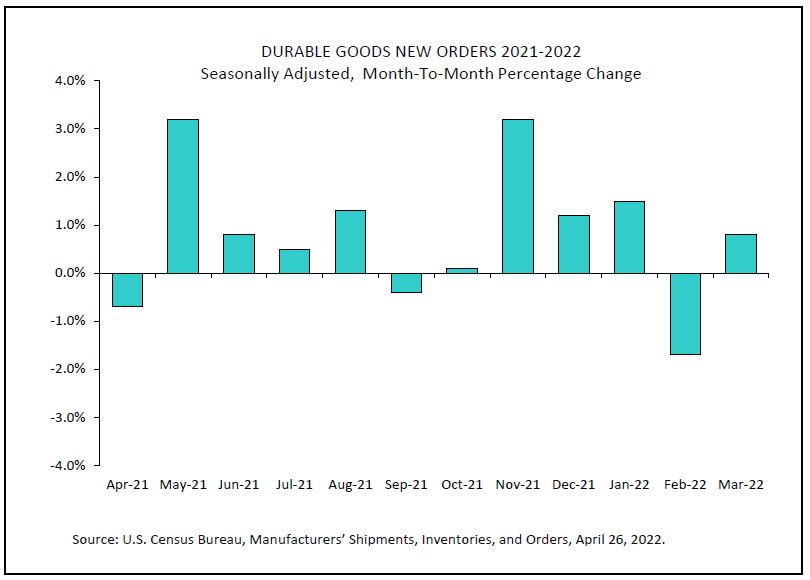
US durable goods orders rose 0.8% mom in Mar, ex-transport orders up 1.1% mom
US durable goods orders rose 0.8% mom to USD 275.0B in March, below expectation of 1.0% mom. Ex-transport orders rose 1.1% mom, above expectation of 0.5% mom. Ex-defense orders rose 1.2% mom. Computers and electronic products, up two of the last three months, led the increase, USD0.7B or 2.6% to USD 26.3B.
ECB Kazaks: Rate hike in July is possible and reasonable
ECB Governing Council member Martins Kazaks said "a rate rise in July is possible and reasonable" and "ending the Asset Purchases Programme in early July is appropriate,"
"Markets are pricing two or three 25 basis point steps by the end of the year. I have no reason to object to this, it's quite a reasonable view to take," he said. "Whether it happens in July or September is not dramatically different, but I think July would be a better option."
Japan unemployment rate dropped to 2.6% in Mar, lowest in 2 years
Japan unemployment rate dropped from 2.7% to 2.6% in March, better than expectation of 2.7%. That;s also the lowest rate since April 2020. Number of workers rose 180k while unemployed dropped -90k. Job-to-applicant ratio rose 0.01 pts to 1.22.
"The drop in unemployment rate indicates signs of recovery" in the labour market, a government official told a media briefing. "But the impact of the pandemic appears to be lingering and requires close attention."
GBP/USD Mid-Day Outlook
Daily Pivots: (S1) 1.2679; (P) 1.2762; (R1) 1.2826; More...
GBP/USD's decline continues today and intraday bias stays on the downside for 100% projection of 1.3641 to 1.2999 from 1.3297 at 1.2655. Sustained break there will target 161.8% projection at 1.2258. On the upside, above 1.2771 minor resistance will turn intraday bias neutral and bring consolidation first, before staging another decline.
In the bigger picture, rise from 1.1409 (2020 low) has completed at 1.4248, ahead 1.4376 long term resistance (2018 high). Decline from 1.4248 could still be a corrective move, or it could be the start of a long term down trend. In either case, deeper decline would be seen back to 61.8% retracement of 2.1161 to 1.1409 at 1.2493. In any case, break of 1.3158 support turned resistance is needed to be the first sign of medium term bottoming. Otherwise, outlook will stay bearish in case of rebound.
Economic Indicators Update
| GMT | Ccy | Events | Actual | Forecast | Previous | Revised |
|---|---|---|---|---|---|---|
| 23:30 | JPY | Unemployment Rate Mar | 2.60% | 2.70% | 2.70% | |
| 06:00 | CHF | Trade Balance (CHF) Mar | 2.99B | 6.23B | 5.95B | 5.88B |
| 06:00 | GBP | Public Sector Net Borrowing (GBP) Mar | 17.3B | 14.2B | 12.3B | 9.9B |
| 12:30 | USD | Durable Goods Orders Mar | 0.80% | 1.00% | -2.10% | |
| 12:30 | USD | Durable Goods Orders ex Transportation Mar | 1.10% | 0.50% | -0.60% | |
| 13:00 | USD | S&P/Case-Shiller Home Price Indices Y/Y Feb | 20.20% | 18.40% | 19.10% | |
| 13:00 | USD | Housing Price Index M/M Feb | 2.10% | 1.40% | 1.60% | |
| 14:00 | USD | Consumer Confidence Apr | 108.5 | 107.2 | ||
| 14:00 | USD | New Home Sales Mar | 774K | 772K |
US durable goods orders rose 0.8% mom in Mar, ex-transport orders up 1.1% mom
US durable goods orders rose 0.8% mom to USD 275.0B in March, below expectation of 1.0% mom. Ex-transport orders rose 1.1% mom, above expectation of 0.5% mom. Ex-defense orders rose 1.2% mom. Computers and electronic products, up two of the last three months, led the increase, USD0.7B or 2.6% to USD 26.3B.
Bank of Canada Hints at Half-Point Hike
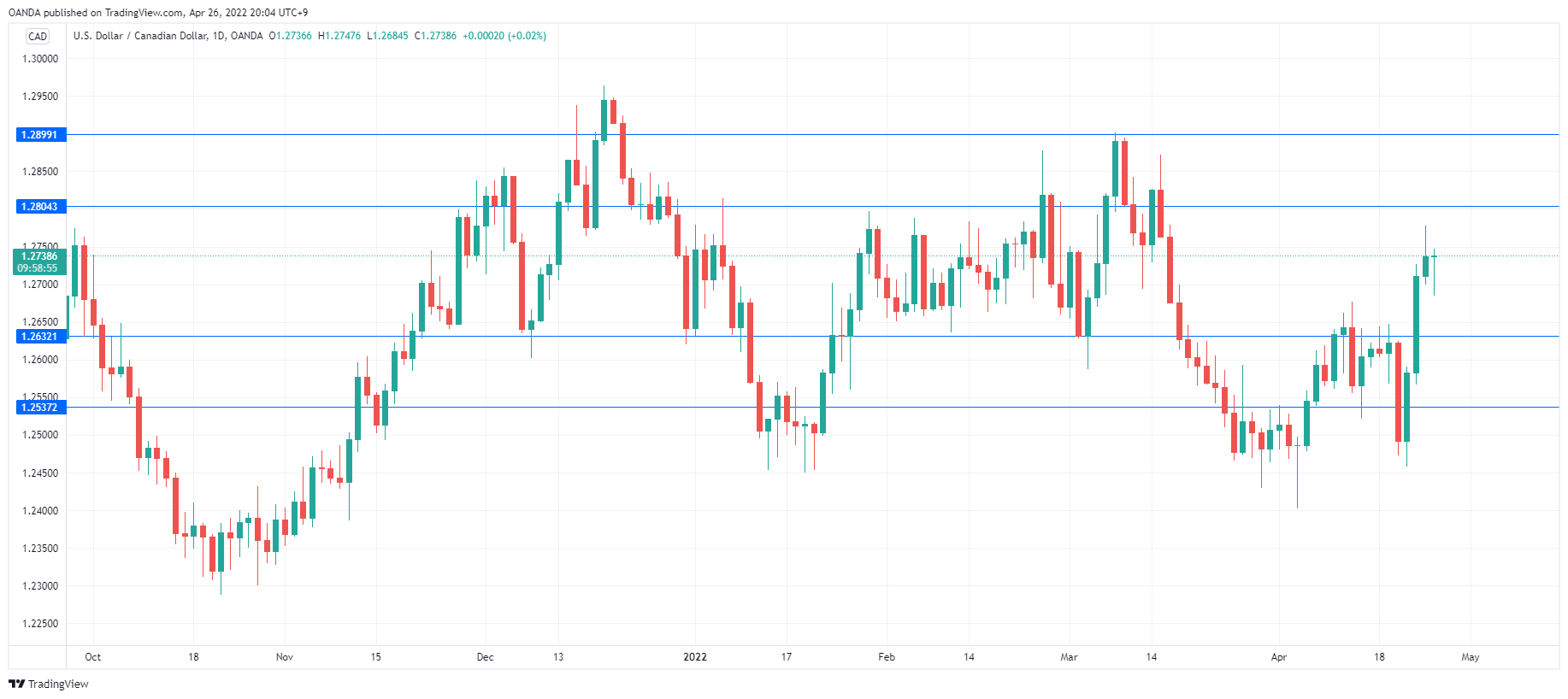
The Canadian dollar has been on a nasty slide, falling around 2% since Thursday. There are no Canadian releases until GDP on Friday, which means that US releases during the week will have a significant impact on the movement of USD/CAD.
Macklem says 0.50% hike on the table
Bank of Canada Governor Tiff Macklem can usually be counted on for using clear and understandable language, which I’m always grateful for, as I vividly recall trying to decipher Alan Greenspan’s Fedspeak years ago. Unlike Greenspan, Macklem wants the markets to actually understand what he’s saying. The BoC delivered a 0.50% hike earlier this month, the largest increase in over 20 years. Macklem remains in hawkish mode and said on Monday that additional 0.50% increases were being considered. The markets expect the BoC to tighten at a fast pace – a 0.50% has been priced in for the June meeting, with a slight possibility of a massive 0.75% hike.
The primary driver for the BoC’s aggressive stance is, of, course, the surge in inflation. The BoC is committed to wrestling inflation down from its highest level in 30 years, with the challenge of raising rates enough to curb inflation without bringing the economy to a screeching halt. The BoC is also keeping an eye on what’s happening down south with the Federal Reserve. With the US also grappling with soaring inflation, the Fed may deliver 0.50% hikes as well, and this will likely propel the US dollar higher. The BoC doesn’t want to see the Canadian dollar get pummelled and with rates set to go as high as 3% by year’s end, the BoC should be able to keep in sync with the Fed, which will help the Canadian currency keep pace with the US dollar. With the BoC aggressively raising rates and oil prices around the 100-dollar mark, the outlook for the Canadian dollar is positive.
USD/CAD Technical
- USD/CAD has support at 1.2632 and 1.2537
- There is resistance at 1.2804 and 1.2899