Sample Category Title
Elliott Wave View: EURJPY Correcting 5 Waves Move
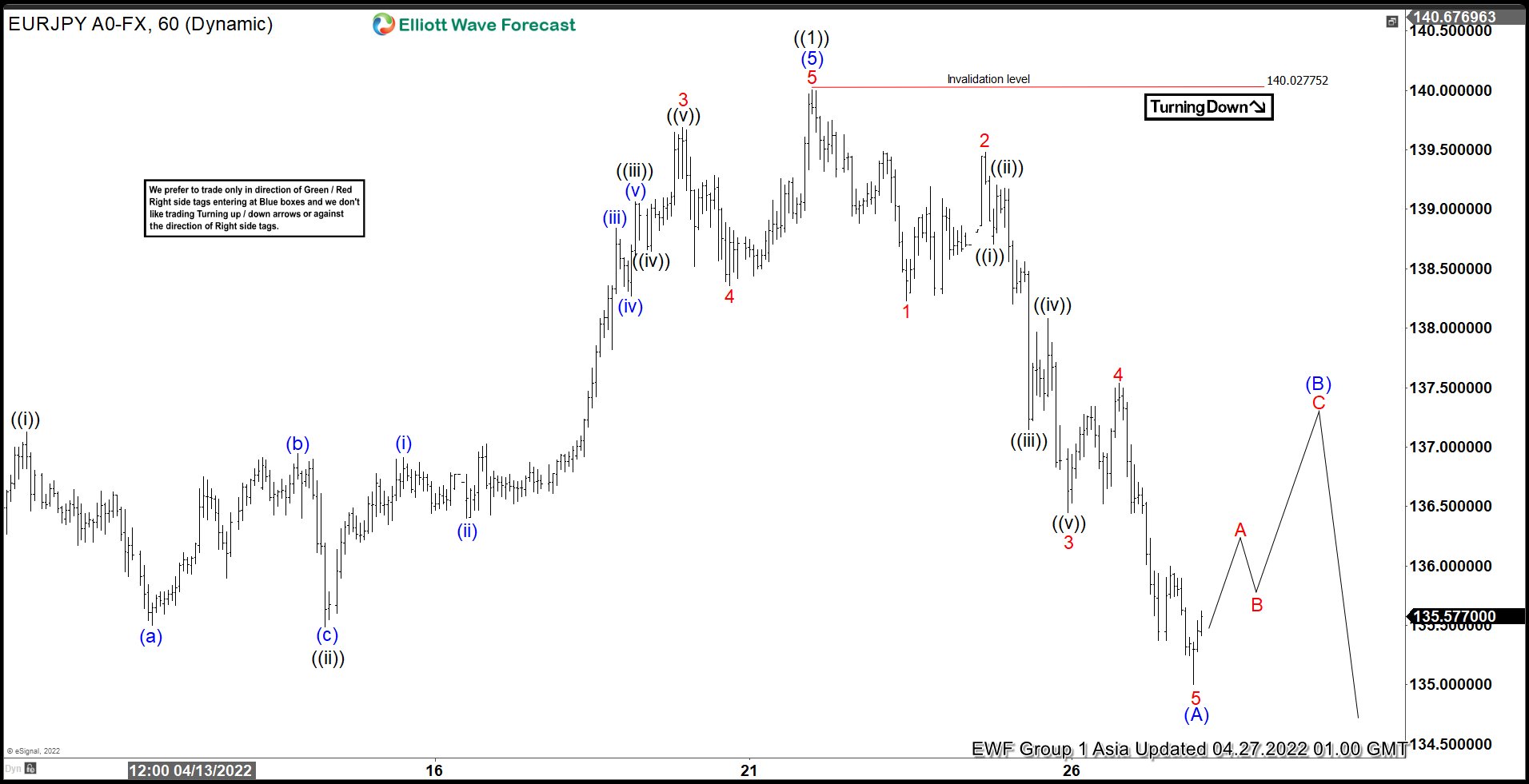
EURJPY shows a bullish sequence from June 2016 low and May 2020 low. Long term, pair should be supported and continue higher. Short term, however, pair has ended the rally from March 7, 2022 low at 140 with wave ((1)). Wave ((2)) pullback is currently in progress to correct the rally from March 7 low before it resumes the rally again. Wave ((2)) is unfolding as a zigzag Elliott Wave structure. Down from wave ((1)), wave 1 ended at 138.23 and rally in wave 2 ended at 139.48. Pair then resumes lower in wave 3 towards 136.45 and rally in wave 4 ended at 137.54. Final leg lower wave 5 ended at 135 which also completed wave (A).
Pair should rally in wave (B) to correct cycle from April 21 before the decline resumes. Internal of wave (B) is proposed to unfold in 3 waves taking the form of zigzag structure before the next leg lower. Expect pair to extend higher to end wave A, then it should pullback in wave B before another leg higher in wave C to complete wave (B). Afterwards, pair should resume lower in wave (C) of ((2)). Near term, as far as April 21 pivot high at 140 remains intact, expect the rally to fail in the sequence of 3, 7, or 11 swing for further downside.
EURJPY 60 Minutes Elliott Wave Chart
Eco Data 4/27/22
[php_everywhere instance="1"]
Bank of Japan to defend yield curve control policy, but what about the yen?
The Bank of Japan concludes a two-day monetary policy meeting on Thursday and even though no changes are anticipated, its language on the exchange rate might prove decisive for the yen. As other central banks race to normalize policy amid the global spiral in inflation, the BoJ has stuck to its ultra-accommodative policy, stepping up its purchases of Japanese Government Bonds (JGBs) over the last month. But this has come at a cost as the yen has plunged to 20-year lows against the US dollar. Will the BoJ make any attempt to sound less dovish this week?
No inflation panic at the BoJ
Although Japan is not yet experiencing the same inflationary pressures as the United States and other countries, there is no question that prices are on the rise. The consumer price index hit 1.2% year-on-year in March – the highest since October 2018. Core CPI that excludes fresh food prices and is targeted by the Bank for its 2% goal rose by a more modest 0.8%.
This partially explains why the BoJ is a lot more relaxed about surging prices than its peers. Not only has inflation yet to reach 2%, but policymakers can afford to let it rise above target for a while after decades of deflation. The other reason is that Governor Haruhiko Kuroda is now the lone central bank chief that still thinks this episode of excessive inflation will be temporary. Only last week Kuroda reinforced his view that inflation in Japan is being driven mainly by the cost-push shock due to supply factors and therefore “lacks sustainability”.
Weak yen: a new headache?
Until there is more evidence that higher inflation is becoming embedded into the economy, Kuroda is unlikely to change his stance. But if that risk alone is not enough to alter policy course at the Bank of Japan, another might. The yen has come under intense selling pressure since early March when the sanctions against Russia sent inflation expectations soaring and the government bond yields of major economies to multi-year highs, except of course for JGB yields.
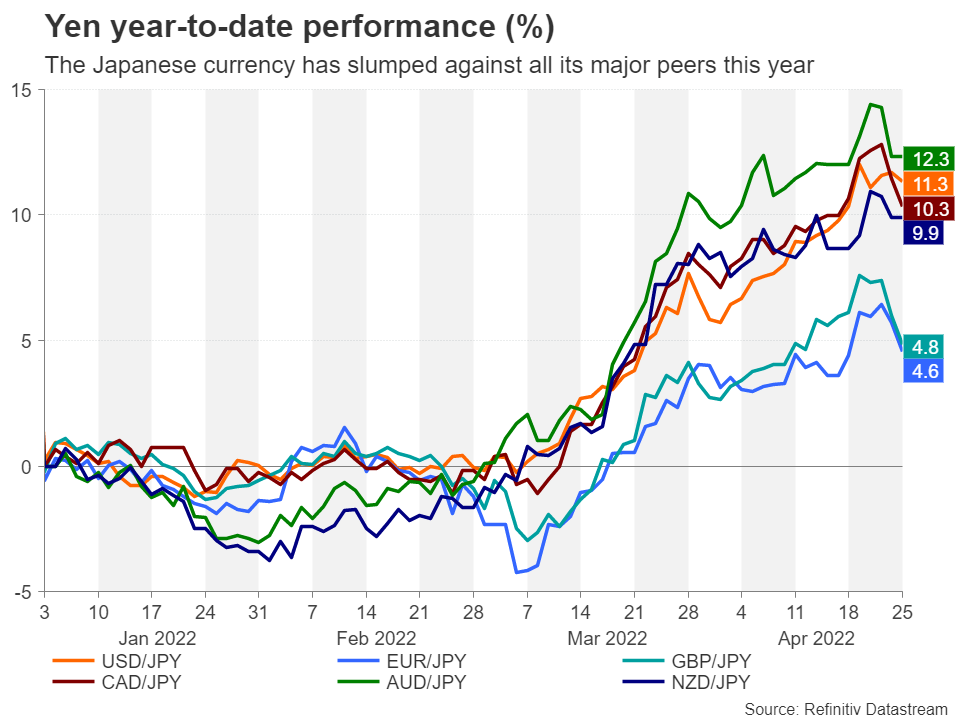
The widening yield differentials, especially with the US, have been an unexpected headache for the BoJ. Kuroda is not particularly mindful of a weaker yen but the Japanese government is, putting him at odds with Finance Minister Shunichi Suzuki who decides on exchange rate policy. Japanese businesses have also been complaining about the slump in the value of the yen. Although exporters tend to benefit from a devalued currency, any benefits from cheaper exports are being negated by the increased cost of imports, which is additionally being exacerbated by the huge jump in energy and raw material prices.
All eyes on the forward guidance
It's possible the BoJ will add something about the yen in its statement, to demonstrate that it is worried about a rapid fall in the currency. But what would send a more convincing signal to the markets that the Bank isn’t prepared to let the yen slide much further is an updated forward guidance that is less dovish.
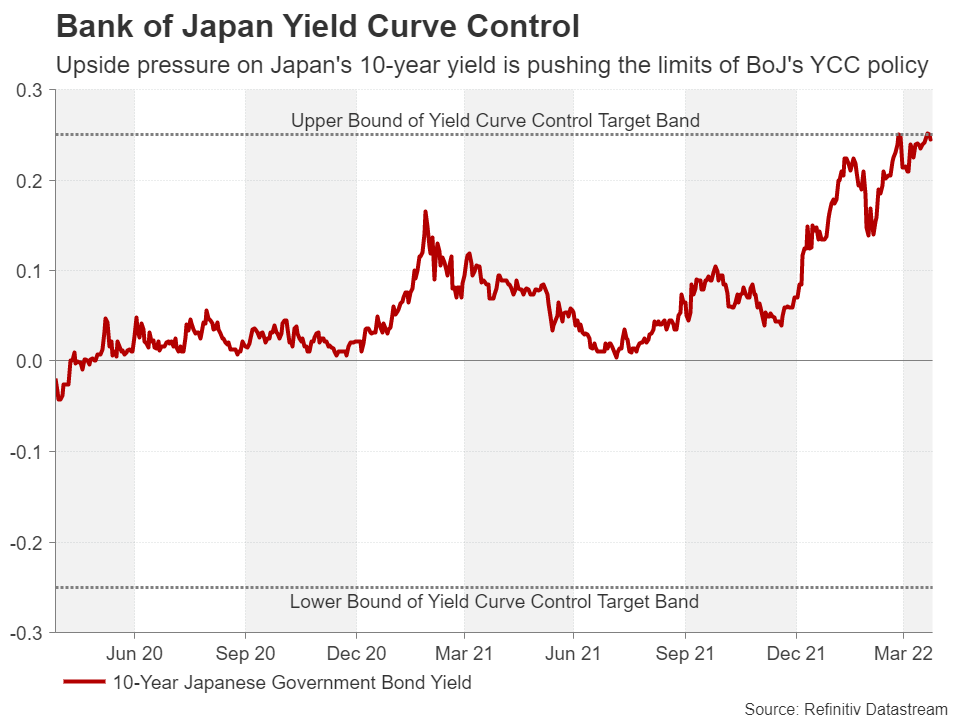
Even if Japan has some way to go before inflation turns into a big problem, it may not be feasible for much longer for the BoJ to pin the 10-year yield near zero per cent. Liquidity in the bond market is drying up fast as the central bank snaps up all the available JGBs. So maintaining its yield curve control policy in its current form may become impossible if yield spreads keep widening in favour of the dollar and other rival currencies.
Yield curve control may be tweaked
The BoJ may hint that it is open to allowing the 10-year yield to fluctuate within a wider range than the current target band of 25 basis points above or below zero. Another option is to switch the target from 10-year JGBs to shorter-dated bonds.
Although such policy tweaks would still leave the BoJ miles away from hiking its benchmark lending rate, which is stuck at -0.1%, they would nevertheless be a significant step towards normalization. Hence, there is scope for the yen to make notable gains on the back of a policy shift.
Yen has steadied, but 130/dollar remains within reach
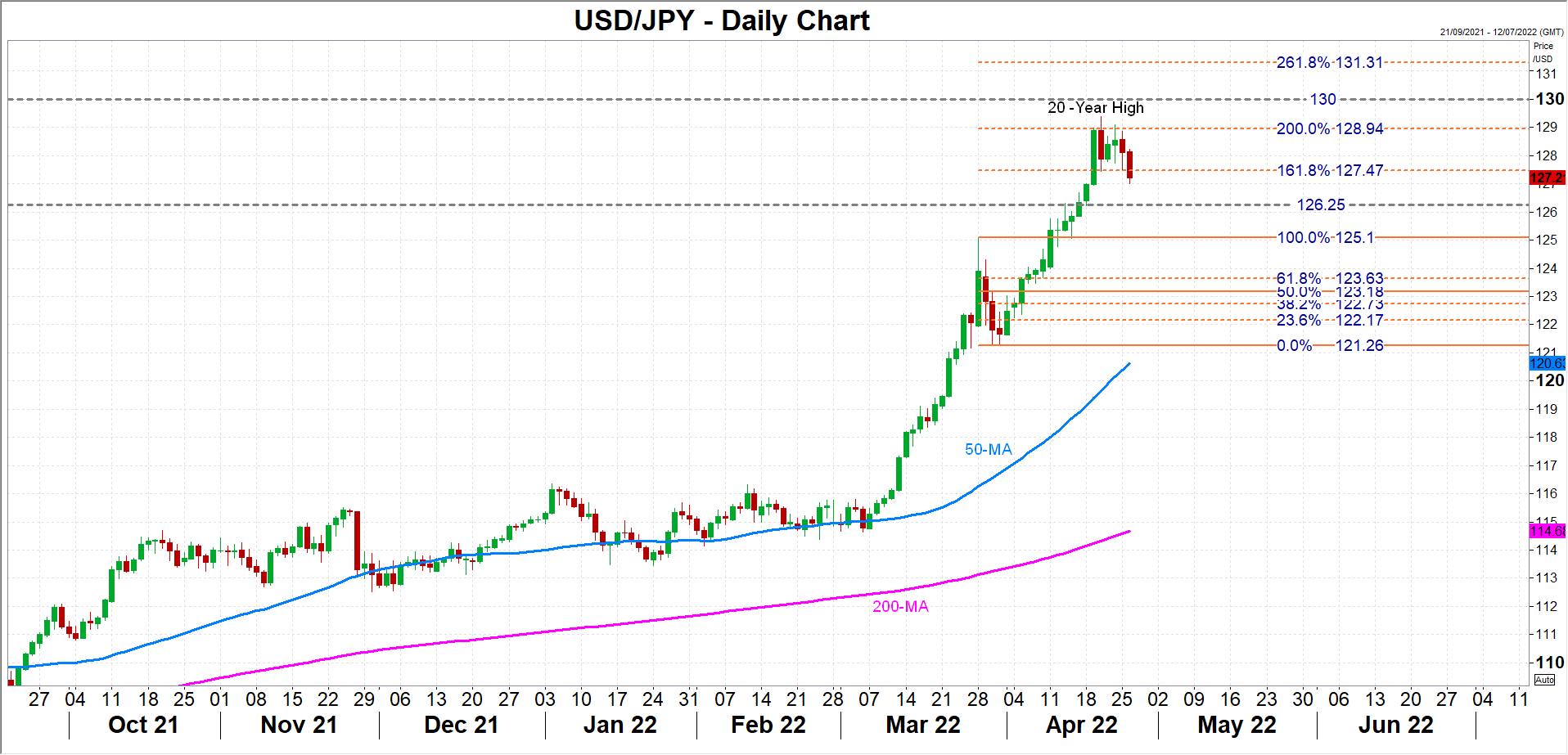
The dollar has eased to just above the 127-yen level, as the Japanese currency has benefited from some safe-haven flows in the last few sessions. Should the pair retreat further, the 126.25 mark is a potential support area, otherwise, the decline could stretch until the March peak of 125.10.
However, if the BoJ decides to wait until its June or July meetings before telegraphing or announcing any policy changes, dollar/yen could resume its rally and aim for the crucial 130 level. The 200% Fibonacci extension of the March downleg just below 129 could obstruct any advances before reaching this point, while above it, the 261.8% Fibonacci of 131.31 would be the next target for yen bears.
Inflation forecast to be revised up
In the absence of any explicit signals, investors will have to search for clues in the BoJ’s latest quarterly outlook report. The Bank is expected to revise up its forecasts for inflation but will probably cut its projection for economic growth for the current fiscal year. However, what will matter more is whether policymakers put greater emphasis on the upside risks to inflation than on the downside dangers to growth as this would be a better indication on the pace of future policy tightening.
Australian Dollar Falls Below 0.72
Aussie steady after nasty slide
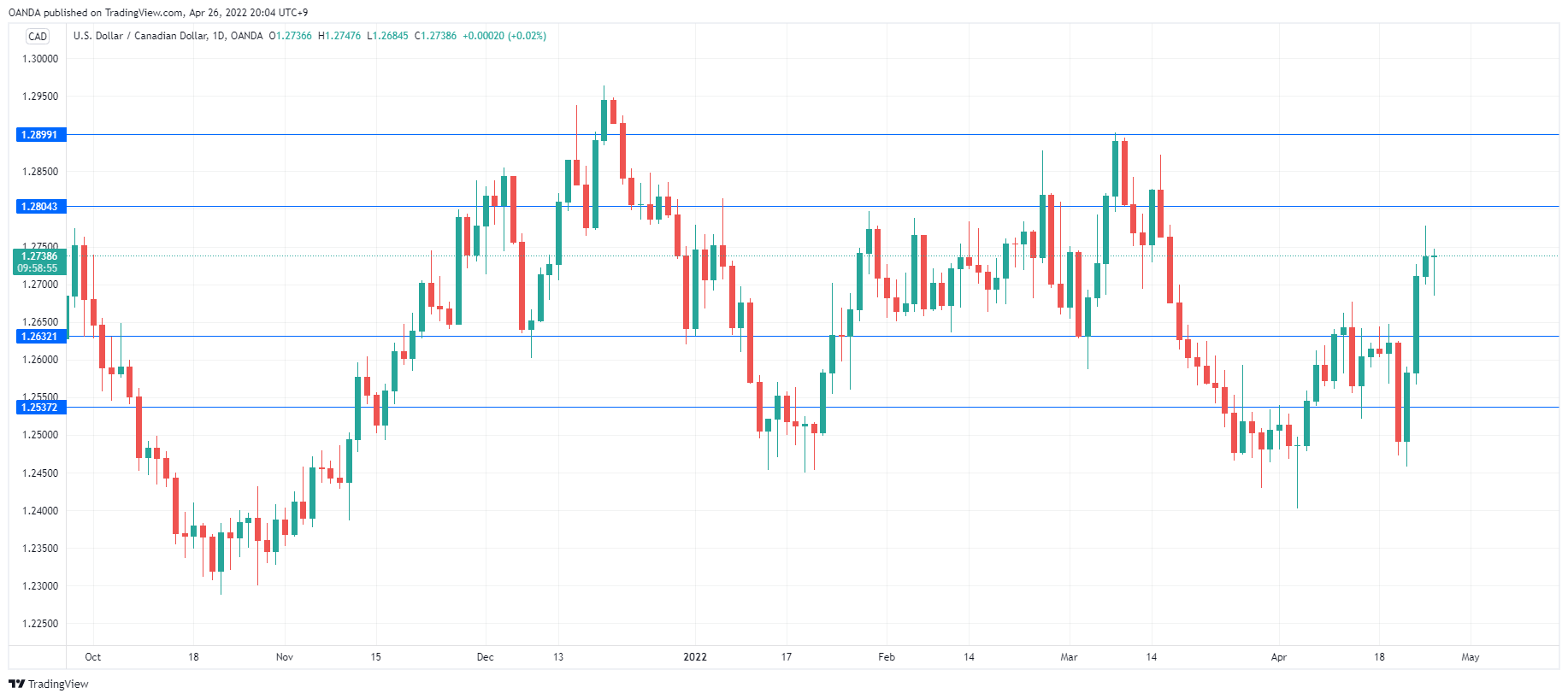
The Australian dollar has stabilized after a sharp downturn, losing over 300 points since Thursday. AUD/USD is trading below the 72 line and is close to a 2-month low.
All eyes are on Australia’s inflation report for March, with CPI expected to accelerate to 4.6% YoY, after a 3.5% gain in February. This would mark the highest rate of inflation since the GFC, as soaring food and fuel prices continue to drive inflation higher. If March CPI comes in as expected, the RBA may well respond with an oversize 0.40% increase at the policy meeting on May 3rd. This means that a strong inflation report should give the Australian dollar a boost.
The central bank, which last raised rates in 2010, would prefer to stay on the sidelines during the current election campaign or raise rates by a very modest 0.15%. The problem is that with inflation showing no signs of easing, policymakers may feel they can’t wait until June to hike rates.
The Federal Reserve, which has already embarked on its rate-hike cycle, has been sending out hawkish messages to the markets. Last week, Fed Chair Powell reiterated that a 0.50% rate increase was on the table, and according to CME’s Fed Watch, there is a 98% likelihood of a 0.50% hike at the May 4th meeting. With the Fed expected to tighten rates to 3% or higher by the end of the year, the rate-hike cycle should boost the US dollar in the coming months.
The Australian dollar, which was trading just shy of the 0.76 in early April, benefited from the surge in commodity prices. Now that commodities, especially iron ore, are falling in price, the Aussie is dropping along for the ride. Concerns over China’s growth are also weighing on the Australian dollar, as China is Australia’s number one trading partner.
AUD/USD Technical
- There is resistance at 0.7253 and 0.7390
- AUD/USD has broken through support at 0.7167. Below there is support at 0.7089
Dollar Index: Dollar Remains Well Supported and Could Extend Higher than Expected
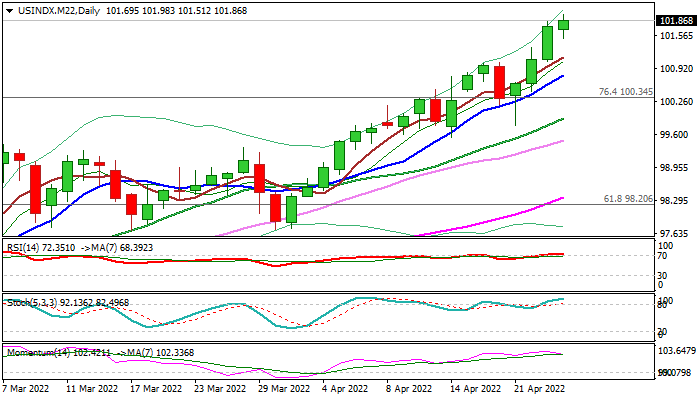
The dollar continues to trend higher and hit new two-year high on Monday, with recent rapid rise being underpinned by safe-haven buying and expectations of more aggressive Fed.
Growing uncertainty over the consequences of the conflict in Ukraine and its possible escalation, prompts traders out of riskier assets into safe-haven dollar, while markets bet on stronger than expected action from the US central bank in tightening monetary policy in attempts to tame raging inflation, as the rhetoric from the US policymakers becomes more hawkish lately.
The dollar index rose over 5% since the war in Ukraine started, with strong acceleration seen in April that marks the biggest monthly advance since May 2010.
Strong uptrend can extend towards March 2017 high at 102.26, the last obstacle en-route to key barriers at 103.80 (peaks of Jan 2017 / Mar 2020), as bulls so far show no signs of fatigue, with fundamentals being dollar’s main driver and remaining strongly supportive.
Overbought studies warn of minor price adjustment which should stay above psychological 100 support and offer better levels to join the uptrend.
Res: 102.00; 102.26; 102.71; 103.00
Sup: 101.51; 101.00; 100.78; 100.34
EURJPY Wave Analysis
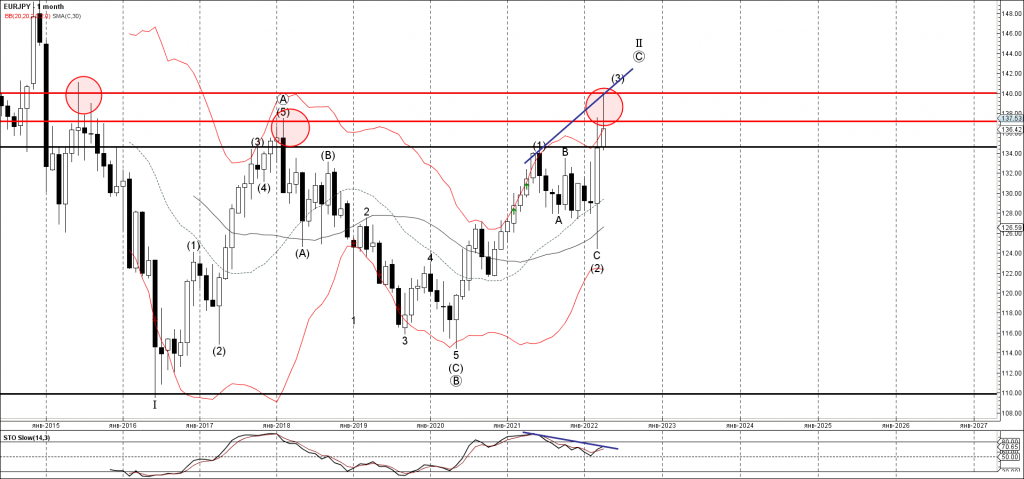
- EURJPY reversed from resistance zone
- Likely to fall to support level 134.00
EURJPY currency pair recently reversed down from the resistance zone located between the 2 long-term resistance levels: 137.20 (yearly high from 2018) and 140.00 (key resistance from 2015).
The downward reversal from this resistance zone stopped the earlier intermediate impulse wave (3).
Given the clear bearish divergence on the monthly Stochastic – EURJPY currency pair can be expected to fall further toward the next support level 134.00.
Natural Gas Wave Analysis
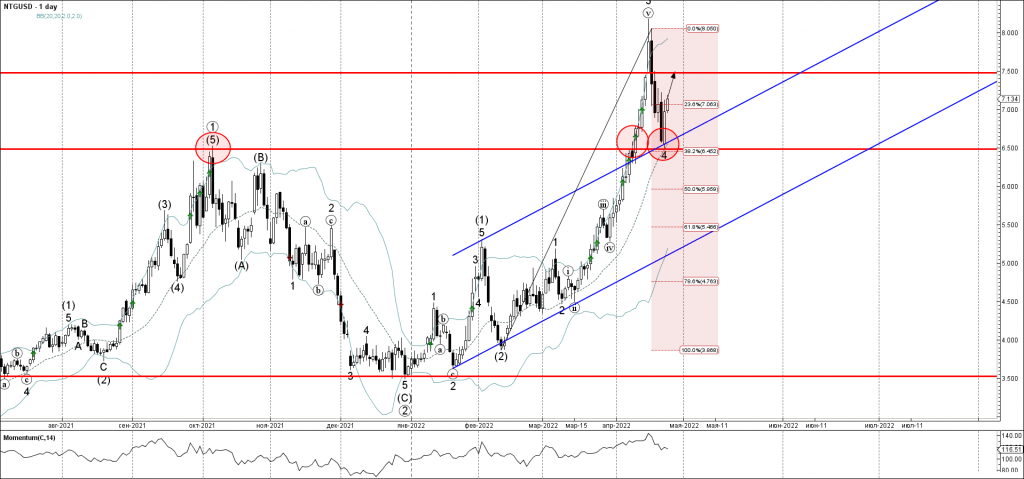
- Natural gas reversed from support zone
- Likely to rise to resistance level 7.50
Natural gas recently reversed up from the powerful support zone located between the pivotal support 6.50 (former multi-month high from October of 2021), 20-day moving average, upper trendline of the daily up channel from January and the 38.2% Fibonacci correction of the upward impulse from February
The upward reversal from this support zone stopped the earlier minor corrective wave 2.
Given the clear daily uptrend – Natural gas can be expected to rise further toward the next resistance level 7.50.
Sunset Market Commentary
Markets
This morning Chinese authorities/the PBOC indicated they will continue to support the economy and promote healthy and stable financial markets. This gave some conform after investor worries about a sharp cooling of Chinese growth due to new lockdowns put markets in outright risk-off mode yesterday. Asian equities showed a mixed, still sightly unconvincing picture, despite a solid close on WS. European indices also regain part of yesterday’s setback with the Eurostoxx rebounding about 0.50%. However, Russian foreign minister Lavrov warning on the risk of a nuclear escalation was just another illustration of the still unpredictable nature of the war in Ukraine, while diplomatic efforts continue at the same time. Yesterday, growth fears/the risk-off repositioning coincided with a substantial correction in commodities/setback in inflation expectations, triggering sharply lower core yields. The sell-off in oil and most other commodities slowed. For now however, it wasn’t enough to revive the uptrend in core yields. Especially US Treasuries are extending gains, with yields declining 9/8 bps in the 2/10-year sector. The very long end slightly underperforms (-5 bps). Eco data were not to blame. US durable goods orders (0.8% M/M) suggest ongoing heathy investment dynamics. S&P Corelogic CS 20 city house prices also rose a faster-than-expected 2.39% M/M and 20.20% Y/Y. The Conference Board consumer confidence (107.3) and the Richmond Fed manufacturing (14) came within the margin of consensus error. Later today, the US Treasury will sell $48 bln of 2-y Notes. Bunds followed the rebound in US Treasuries but underperformed with a mild curve flattening (2-y -2 bps; 30-y -3.5 bps). Changes in 10-y intra-EMU yields spreads versus Germany were very limited, with Greece the exception to the rule (10-y +10 bps) as the country announced to have mandated to tap a 2027 bond.
On FX markets, the correction in US yields still hardly hinders a solid USD momentum. The trade-weighted DXY index touched yet another cycle top just below the 102 big figure. At the same time, by default euro weakness is also still in play as investors are eagerly awaiting clarity/hard interest rate support from the ECB. At 1.0675, the corona low (1.0636) is now really within striking distance. Sterling still also fights an uphill battle. Cable dropped below the 1.27 handle (1.2680). EUR/GBP gains a few ticks (0.8420). USD/JPY is the exception to the rule with the yen profiting from a less negative interest rate differential and maybe also from the new economic support package. News Headlines
Japan has unveiled another emergency relief package amounting to 13.2tn yen ($103bn) to soften the blow from rising energy and raw material costs. The plan is made out of four pillars: curbing oil prices, ensuring a stable food supply, providing support for small and medium-sized companies and helping struggling households. Some 6.2tn yen will be direct government spending, such as cash pay-outs to low-income households with children and subsidies to gasoline wholesalers to depress retail prices. The remainder consists of measures including private-sector lending. "We must prevent rising fuel and raw material costs from disrupting a recovery in economic and social activity from the pandemic," PM Kishida justified the fiscal boost at a time many other Western countries are gradually phasing out crisis measures. The yen strengthens today. USD/JPY declines to the low 127 area.
The Hungarian central bank raised its base rate by an expected 100 bps to 5.40%. The interest rate corridor was also lifted with the same amount. The bottom O/N deposit rate now stands at the same 5.40% and the upper limit at 8.40%. The MNB remains very concerned about inflation, which rose to 8.5% in March with core measures even hitting 9.1%. Strong negative supply effects (war, sanctions, commodity prices) will push up inflation in coming months. It won’t reach the 3% target until the first half of 2024. Elevated inflation expectations with the increasing risk of second-round effects make it necessary to continue tightening until the inflation outlook stabilizes around the MNB target and risks become evenly balanced. Hungarian swap yields rise 0.5-10 bps today with the wings of the curve underperforming. The forint fails to profit with today’s decision discounted. EUR/HUF advances to 375.13.
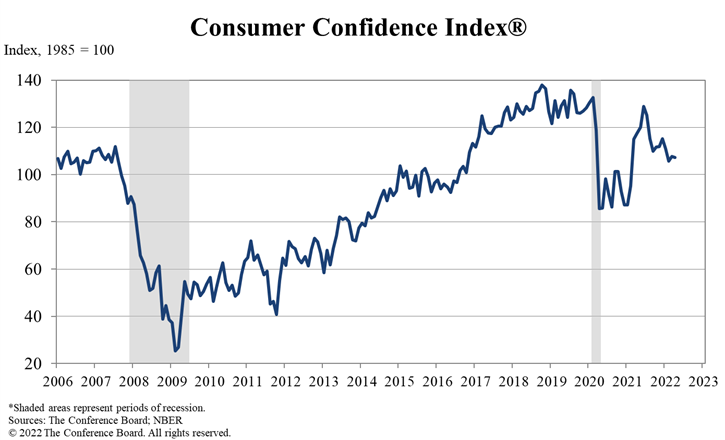
US consumer confidence dropped slightly to 107.3, inflation and war to pose downside risks
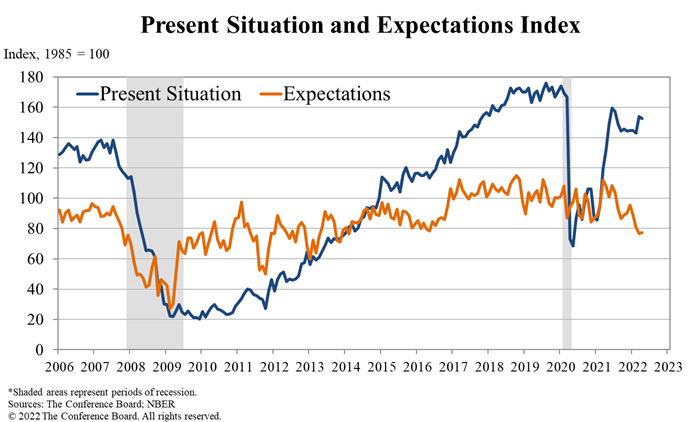
US Conference Board Consumer Confidence Index dropped slightly from 107.6 to 107.3 in April, below expectation of 108.5. Present Situation Index dropped from 153.8 to 152.6. Expectations Index rose from 76.7 to 77.2.
"Consumer confidence fell slightly in April, after a modest increase in March," said Lynn Franco, Senior Director of Economic Indicators at The Conference Board. "The Present Situation Index declined, but remains quite high, suggesting the economy continued to expand in early Q2. Expectations, while still weak, did not deteriorate further amid high prices, especially at the gas pump, and the war in Ukraine. Vacation intentions cooled but intentions to buy big-ticket items like automobiles and many appliances rose somewhat."
"Still, purchasing intentions are down overall from recent levels as interest rates have begun rising. Meanwhile, concerns about inflation retreated from an all-time high in March but remained elevated. Looking ahead, inflation and the war in Ukraine will continue to pose downside risks to confidence and may further curb consumer spending this year."
Bleeding Euro Falls to 2-Year Low
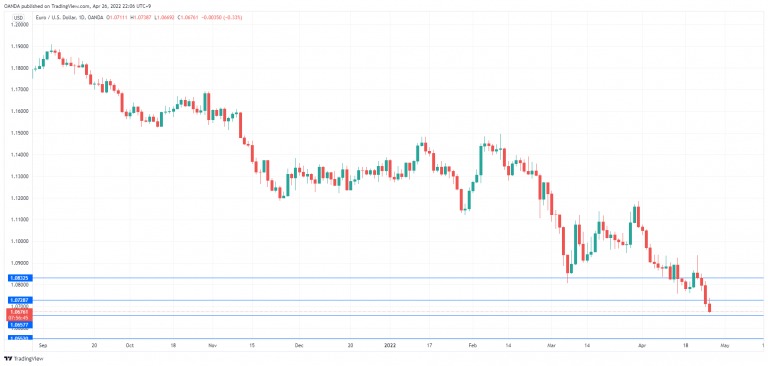
The euro remains on a downswing and has extended its losses for a fourth straight day. EUR/USD has dropped below the 1.07 line for the first time since March 2020.
Euro drenched by April showers
April has been nasty for the euro, which has fallen over 300 points. The Ukraine war and the hawkish Fed have been a toxic mix for the euro, as investors have dumped the currency and flocked to the safe-haven US dollar.
The war between Russia and Ukraine grinds on, and the uncertainty over Russian energy supplies to Europe and sanctions against Russia have dampened sentiment towards the euro. Tight sanctions against Russia, which have led to soaring oil prices, are also having an effect on the growth of eurozone countries. There are calls within Europe to hit Russia even harder by banning Russian energy imports. However, Germany is understandably against such a sweeping move, given that Russia provides Germany with 25% of its oil and 40% of its natural gas, and cutting off these supplies would push Germany into a recession.
Across the pond, Federal Reserve hawkishness is also weighing on the euro. The Fed is in a hurry to roll out further rate hikes in order to contain inflation, and Fed Chair Powell has hinted strongly at a 0.50% increase at the May meeting, with possibly more such increases in the coming months. This widening of the US/Europe rate differential is weighing on the euro, which is on track to break below the 1.06 shortly.
On Sunday, President Emmanuel Macron won a decisive victory over Marie Le Pen of the extreme right, by a score of 58% to 42%. The mood in European markets was one of relief rather than elation, given that Le Pen, a staunch euro-sceptic had her best showing ever. The victory of the pro-business Macron is good news for the markets, but it hasn’t stopped the euro’s slide this week.
EUR/USD Technical
- EUR/USD continues to break through support levels. 1.0657 is under pressure, followed by support at 1.0553
- There is resistance at 1.0728 and 1.0832