Sample Category Title
US: Growth in the Services Sector Accelerates in March
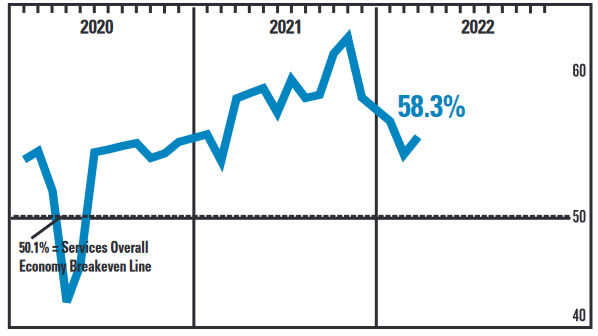
The ISM services index rose 1.8 percentage points (ppts) to 58.3 in March (from 56.5 reported in February). This was just a notch lower than 58.4 expected by the median consensus estimate.
Demand sub-indexes showed signs of recovery from February's slump. The business activity sub-index was up only marginally by 0.4 ppts to 55.5 from 55.1, while new orders moved back up to 60s, growing by 4.0 ppts to 60.1 from 56.1 reported in February.
The new exports index continued to recover from the contractionary territory for second month in a row, reaching 61.0 (+8.0 ppts). In contrast, the imports index moved back into contraction for the first time in six months losing 6.7 ppts with a reading of 45.0 in March.
Inventories were up by 0.9 points to 51.7, but inventory sentiment returned to contraction, dropping by 15.1 ppts to 40.2 suggesting that inventories remain too low for the level of demand.
Supply-side indicators were mixed in March. Delivery times improved with the supplier deliveries sub-index declining by 2.8 ppts to 63.4. The backlog of orders sub-index rose marginally by 0.3 ppts to 64.5.
The employment sub-component moved out of contractionary territory, rising 5.5 ppts from 48.5 in February to 54.0.
The prices paid component continued its ascent, reaching 83.8 from 83.1 in February, just one point shy of the highest reading of 83.9 reported in December. All 18 industries reported an increase in prices paid.
Seventeen industries expanded in March. The only industry reporting a contraction in March is Agriculture, Forestry, Fishing & Hunting.
Key Implications
The services sector showed signs of acceleration in March, shaking off some of the winter weakness caused by Omicron. The acceleration in demand is supported by improving inventories, which should make it easier for firms to support future growth. Furthermore, the recovery in the employment sub-index is encouraging as it may help ease supply-side pressures in a sector that is more labor intensive.
Still, the report is full of contrasts. Supply chain easing is a welcome sign but may not be enough to bring much relief on inflation. Indeed, there are no signs of normalization in prices as the Russia – Ukraine war continues to shock global commodity prices, while the recent lockdown of Shanghai may continue to make sourcing of products even more pricey and difficult. The risk is that rising prices may force companies to take "a cautious approach to planned capital expenditures."
Despite these challenges, we maintain an optimistic view on the sector as it hasn't fully profited from reopening, and should continue to benefit from consumers' directing more of their spending to services.
Sunset Market Commentary
Markets
At first sight, the context for global trading today wasn’t much different from yesterday. Except for a strong US services ISM (58.3 vs 58.5 expected), there were again hardly any data with market moving potential. Geopolitics continued dominating the headlines. What additional sanctions will western countries take in the wake of atrocities being committed as Russian troops left the Kyiv area and what will be the impact of retaliatory action from Russia, especially on EMU growth and inflation? Investors’ assessment to these questions varies from day to day. European equities return yesterday’s gain (-0.75%). US indices again outperform. The fear for new sanctions keeps Brent oil in a $105 p/b to 110 p/b range, but a new forceful break higher doesn’t occur yet. Yesterday, a similar narrative caused US and EMU interest markets to part ways, with the US yield curve bear steepening and Europe bull flattening on growth concerns. Today, the reaction function in different especially in Europe. The US curve again steepens, jumping between 5.5 bps (2-y) and 8 bps, mainly driven by real yields. Except for the US 30-y, yields at all maturities between 2-y and 10-y are only a few basis points away from the cycle peak reached about two weeks ago. The 10-y real yield even touched a new post corona top (-0.38%). German yields today join the steepening trend, rising between 4.0 bps (2-y) and 7.0 bps (10 & 30-y). However, at this side of the Atlantic the move is still supported by inflation expectations setting a cycle peak (10-y inflation swap 2.85%). Possible interpretation: EMU interest rate markets still keep the ECB under pressure not to get further behind the (inflation) curve, even as the crisis in Ukraine is causing additional doubts on growth. EMU swap yields even gain slightly more. Except for Greece, 10-y intra-EMU spreads also continue their widening trend with the likes of Portugal (+4 bpn) or Italy (+5 bp) underperforming.
The brisk move in interest rate markets again had little direction impact on the major FX cross rates. The dollar hardly profits from the ongoing rise in the real yields. USD/JPY (122.85) gains marginally. The trade-weighted DXY (98.9) even lost a few ticks. The euro remains in the defensive. EUR/USD dropped below the ST uptrend line near 1.0975, weakening the short-term picture, even as the absolute loss remain modest. Sterling showed remarkable strength today, gaining against the dollar (Cable 1.315) and the euro. EUR/GBP (currently 0.8335) did break a similar ST uptrend line as was the case for EUR/USD, with the correction low at 0.8296 next reference on the technical charts. The Aussie dollar gained sharply after the RBA dropped the language of being patient at today’s policy meeting. AUD/USD gains more than a full big figure (testing 0.7650). The kiwi dollar moves in sympathy touching the highest level since November last year (NZD/USD 0.7025). In Europe, markets apparently also see room for the Scandinavian currencies to profit for a catch-up move in policy normalization, with the EUR/SEK breaking the 10.30 support (currently 9.265). In Central Europe, the forint again underperforms (EUR/HUF 373.75) on headlines that Europe might trigger the rule of law mechanism against Hungary. News Headlines
The National Bank of Romania (NBR) raised its policy rate as expected by 50 bps from 2.5% to 3%, the highest level since the Summer of 2014 and thus exceeding the pre-Covid level for the first time. It’s the fifth rate hike in a row even as risks to the economic outlook increased because of the Russian war in neighboring country Ukraine. The Romanian near term inflation target deteriorated further with inflation running above 5% Y/Y, compared with a 2.5% +-1% percentage point target. The annual inflation rate is expected to rise somewhat more steeply in coming months (potentially double digits) than anticipated at the February meeting, under the impact of supply-side shocks. The NBR therefore continues to stand ready to use the tools at its disposal to achieve price stability in the medium term. Romanian government bond yields today add 10 bps to 4 bps in a bear flattening move. The Romanian leu is little changed at EUR/RON 4.94. The NBR uses a managed float of its currency, keeping it rather stable against the euro. Since 2014, EUR/RON in a very gradual manner rose from the 4.40 area to current levels.
Brainard: Fed to continue tightening methodically through series of hikes and balance sheet reduction
Fed Governor Lael Brainard said in a speech that FOMC will "continue tightening monetary policy methodically through a series of interest rate increases and by starting to reduce the balance sheet at a rapid pace as soon as our May meeting."
"Given that the recovery has been considerably stronger and faster than in the previous cycle, I expect the balance sheet to shrink considerably more rapidly than in the previous recovery, with significantly larger caps and a much shorter period to phase in the maximum caps compared with 2017–19," she added.
"I expect the combined effect of rate increases and balance sheet reduction to bring the stance of policy to a more neutral position later this year, with the full extent of additional tightening over time dependent on how the outlook for inflation and employment evolves," she said.
US ISM services rose to 58.3, corresponds to 3% annualized real GDP growth
US ISM Services PMI rose from 56.5 to 58.3 in March, above expectation of 57.7. Looking at some details, business activity/production rose from 55.1 to 55.5. New orders rose from 56.1 to 60.1. Employment rose notably from 48.5 to 54.0. Prices rose 0.7 to 83.8.
ISM said: "The past relationship between the Services PMI and the overall economy indicates that the Services PMI for March (58.3 percent) corresponds to a 3-percent increase in real gross domestic product (GDP) on an annualized basis."
Gold’s Balance With Upside Risks
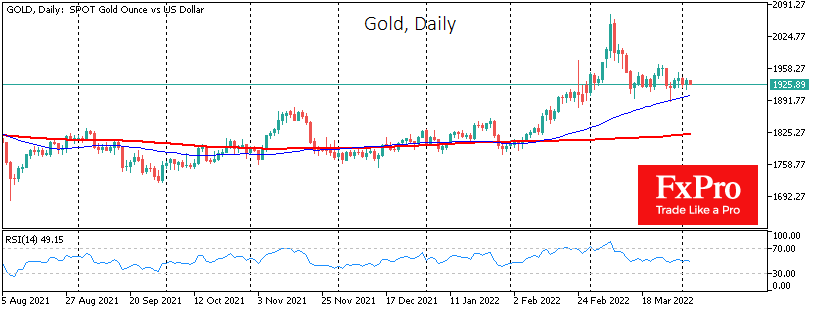
Gold has found a balance, stabilising at around $1930. The pullback in gold from the highs reached on the 8th of March was in unison with the rebound in stock indices, i.e., reflecting capital flow from the safe harbour into equities.
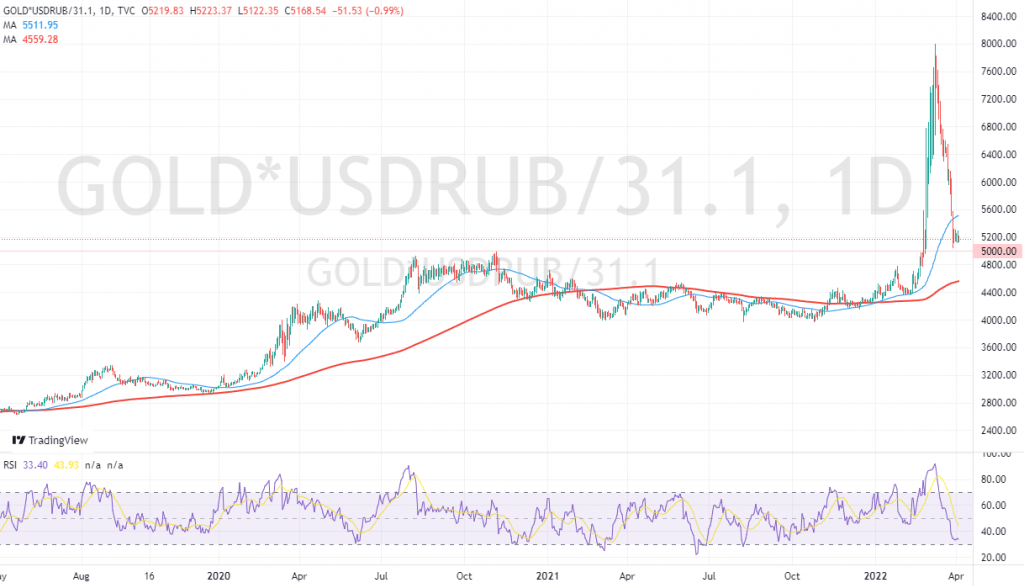
The ongoing sanctions prevent the equity market from rising further. Still, there is also another buyer of gold – namely the Bank of Russia, which is committed to buying gold at 5,000 RUB per gram. The gold pullback and the rouble rise have reduced the initial discount from 20% to 3%, which we have seen over the last six trading sessions.
Russia is trying to loosen the capital controls very carefully, which is a positive move for the economy but potentially harmful to the rouble. A USDRUB recovery to pre-February 23rd levels does not fit the new reality with a falling domestic economy and diminishing prospects for export earnings.
A return to rouble depreciation would open the way for gold to fall, but until then, it is hardly prudent to bet against it. A sharp easing from the Bank of Russia in the coming days is unlikely to be expected, which could collapse the rouble, as it would further boost inflation. Although the price of gold has been moving around current levels for the last 15 trading days, there are more upside risks.
Aussie Rockets as RBA Hints at Hike
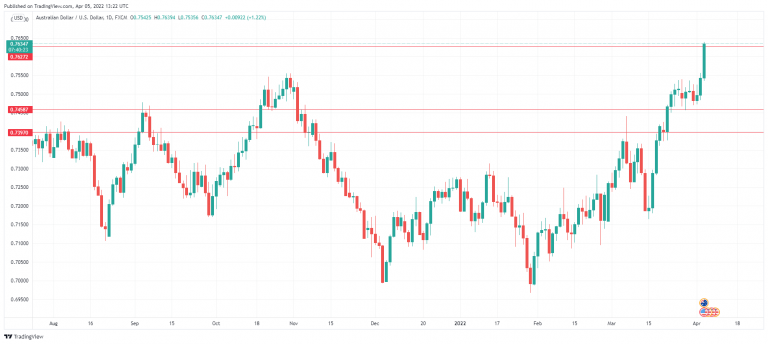
The Australian dollar is turning heads, as AUD/USD has jumped a massive 1.27% today. In the European session, the Australian dollar hit 0.7639, its highest level since June 2021.
RBA says audieu to ‘patience’
If I had to pick a word that encompassed RBA Governor Lowe’s monetary stance, it would be ‘patience’. Lowe has preached patience to the impatient markets for many months, and previous rate statements have stated that the RBA was willing to be “patient” before raising the cash rate. The markets pounced on the slight change in Lowe’s rate statement, noting the absence of the word “patience”.
Lowe has until now tried to dampen expectations of a rate hike, although the markets have held to the belief that a series of rate hikes are coming. The Governor has previously insisted that wage growth would have to rise above 3% before the Bank was convinced that high inflation was sustainable. The rate statement noted that wages were rising in “some areas”, and that wages were expected to rise.
Lowe has retreated from his previous position and now appears amenable to raise rates as long as inflation and wage growth are moving higher. The apparent hawkish pivot, or at least “less dovish” stance from the RBA has sent the Aussie soaring almost 200 points today.
As for the timing of a rate hike, a move at the next meeting in May is unlikely, as a federal election is likely to be called in May and the RBA would prefer to avoid making any major moves during an election campaign. This points to the June meeting as the most likely date for a rate hike. The markets have priced in an 84% chance of a 0.25% hike in June, and close to a 50% likelihood of a 0.50% hike, with up to seven more increases before the end of the year.
AUD/USD Technical
- AUD/USD has broken above resistance at 0.7627. Above, there is resistance at 0.7771
- 0.7458 is the first line of support. Below, there is support at 0.7397
USD/JPY Mid-Day Outlook
Daily Pivots: (S1) 122.38; (P) 122.66; (R1) 123.06; More...
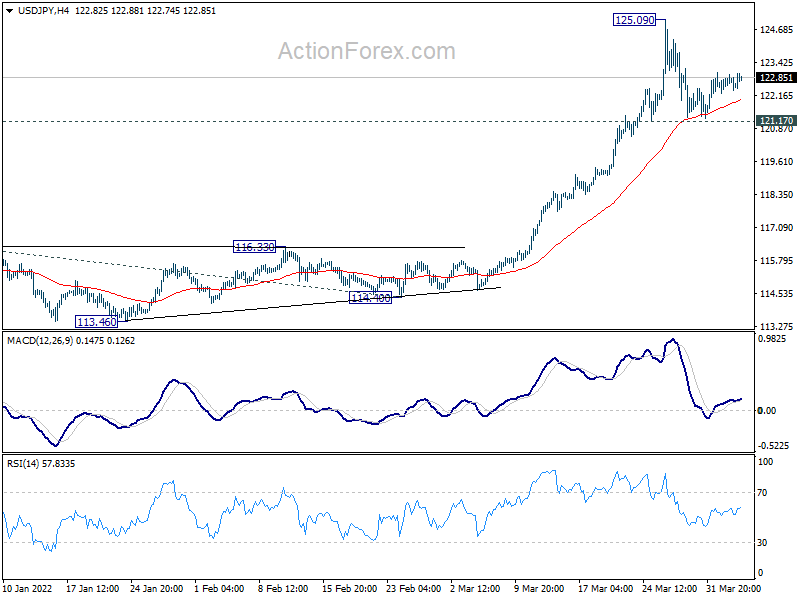
Intraday bias in USD/JPY remains neutral and consolidation from 125.09 could extend. Outlook stays bullish with 121.17 support intact and further rise is expected. On the upside, break of 125.09 will target 161.8% projection of 109.11 to 116.34 from 114.40 at 126.09, which is close to 125.85 long term resistance. However, break of 121.17 will turn bias back to the downside for deeper pull back.
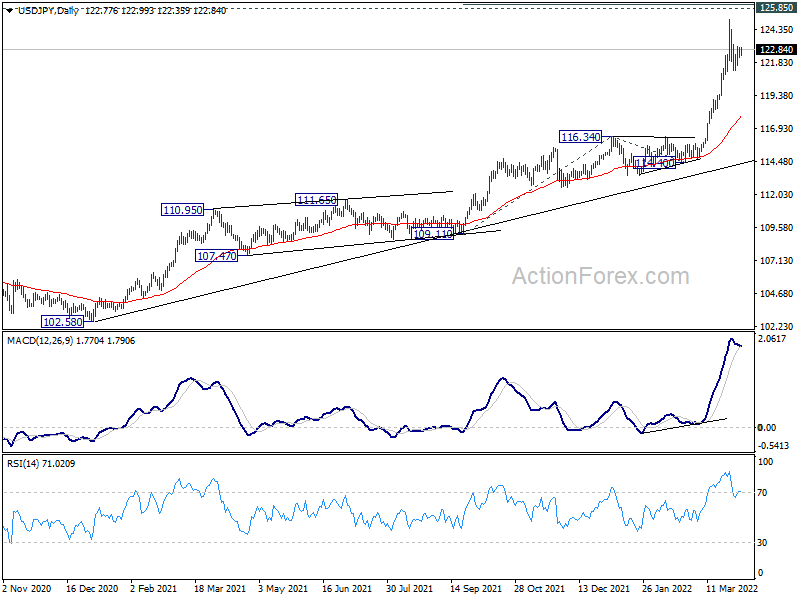
In the bigger picture, up trend from 98.97 (2016 low) in in progress for retesting 125.85 (2015 high). Sustained break there will confirm long term up trend resumption. Next target will be 61.8% projection of 75.56 (2011 low) to 125.85 (2015 high) from 98.97 at 130.04. This will now remain the favored case as long as 116.34 resistance turned support holds.
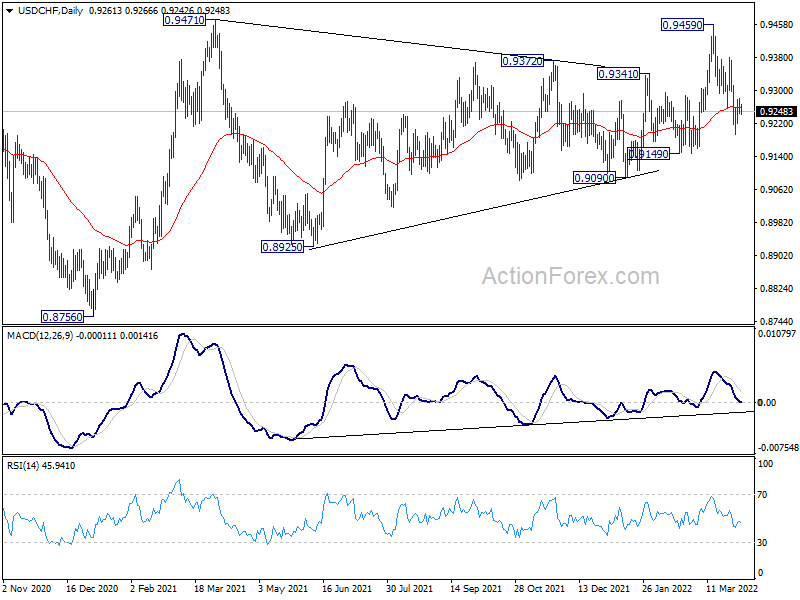
USD/CHF Mid-Day Outlook
Daily Pivots: (S1) 0.9246; (P) 0.9264; (R1) 0.9282; More....
Intraday bias in USD/CHF remains neutral as consolidation form 0.9193 is extending. Further decline is expected with 0.9380 resistance intact. On the downside, below 0.9193 will resume the decline from 0.9459 to 0.9149 support. Firm break there will turn near term outlook bearish for 0.9090 support and below. On the upside, above 0.9380 resistance will flip bias back to the upside for 0.9459 resistance instead.
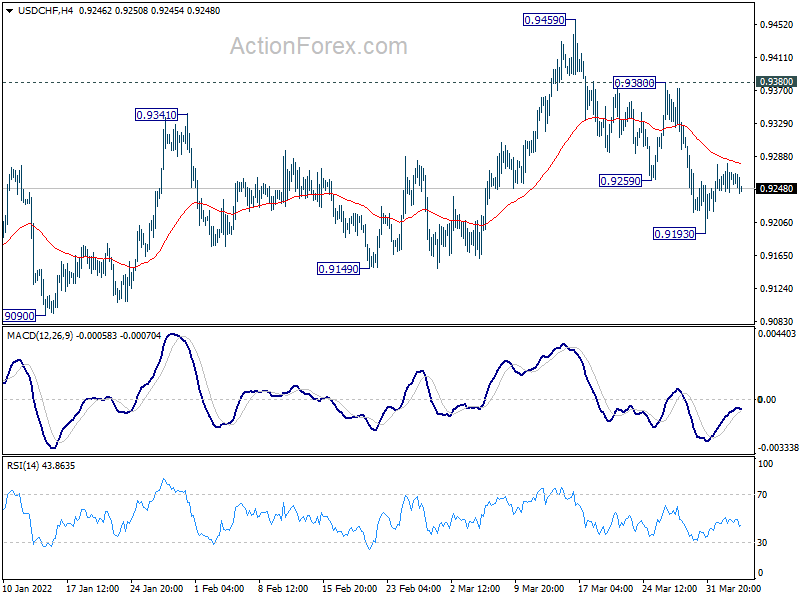
In the bigger picture, medium term outlook will be neutral at best as long as 0.9471 resistance holds. Larger down trend could still extend through 0.8756 (2021 low). However, firm break of 0.9471 will argue that whole down trend form 1.0342 (2016 high), has completed with waves down to 0.8756. A medium term up trend should be set up to target 1.0237/0342 resistance zone.
GBP/USD Daily Outlook
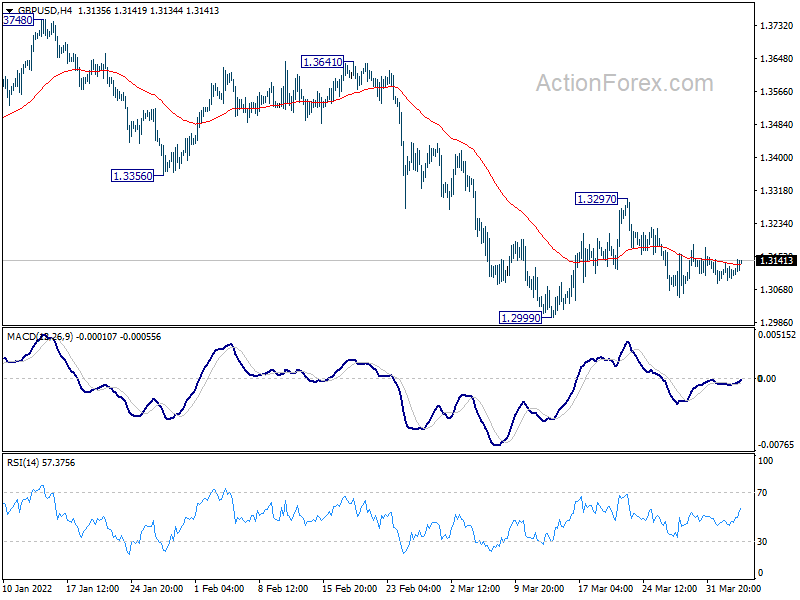
Daily Pivots: (S1) 1.3093; (P) 1.3115; (R1) 1.3137; More...
Intraday bias in GBP/USD remains neutral as consolidation from 1.2999 is extending. Further decline is mildly in favor with 1.3297 resistance intact. On the downside, firm break of 1.2999 will resume larger down trend from 1.4248. However, firm break of 1.3297 will turn bias back to the upside for stronger rebound.
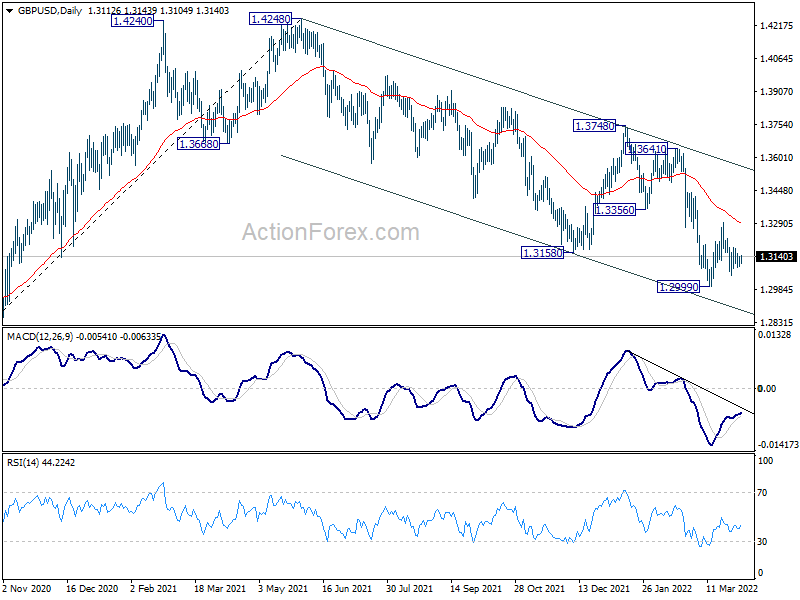
In the bigger picture, current development suggests that the up trend from 1.1409 (2020 low) has completed at 1.4248. Decline from 1.4248 could still be a corrective move, or it could be the start of a long term down trend. In either case, deeper decline would be seen back to 61.8% retracement of 2.1161 to 1.1409 at 1.2493. In any case, break of 1.3748 resistance is needed to indicate medium term bottoming, or outlook will stay bearish.
EUR/USD Mid-Day Outlook
Daily Pivots: (S1) 1.0937; (P) 1.0996 (R1) 1.1031; More...
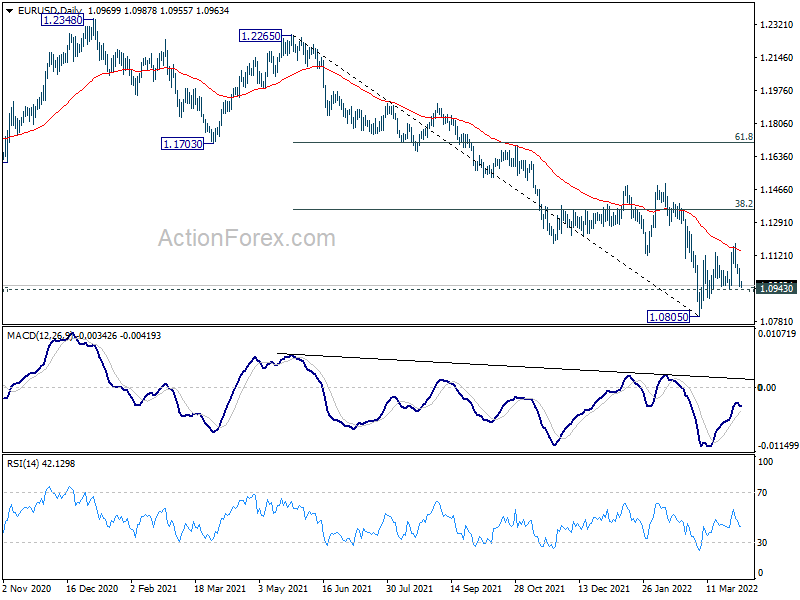
Intraday bias in EUR/USD remains neutral for the moment. Break of 1.0943 support will argue that rebound from 1.0805 has completed at 1.1184. Intraday bias will be back on the downside for retesting 1.0805 low. Further break of 1.0805 will resume larger down trend from 1.2348. On the upside, above 1.1053 minor resistance will revive near term bullishness, and turn bias back to the upside for 1.1184 resistance and above.
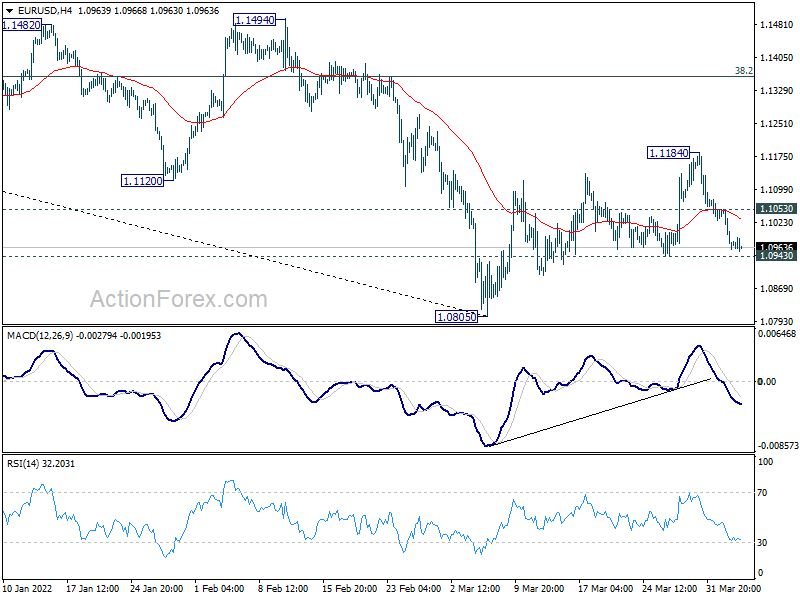
In the bigger picture, the decline from 1.2348 (2021 high) is expected to continue as long as 1.1494 resistance holds. Firm break of 1.0635 (2020 low) will raise the chance of long term down trend resumption and target a retest on 1.0339 (2017 low) next. Nevertheless, break of 1.1494 will maintain medium term neutral outlook, and extending term range trading first.