Sample Category Title
Euro Falls Broadly as EU Announces New Russia Sanctions, Aussie Strongest
Euro is trading broadly lower today, as EU announces the fifth package of sanctions against Russia. As European Commission President Ursula von der Leyen said, "Russia is waging a cruel, ruthless war, also against Ukraine's civilian population." The sanctions include ban of Russia coals, access to EU ports and transaction banks of four key Russian banks. On the other hand, Australian Dollar remains the strongest one, as lifted by the hawkish twist in RBA statement.
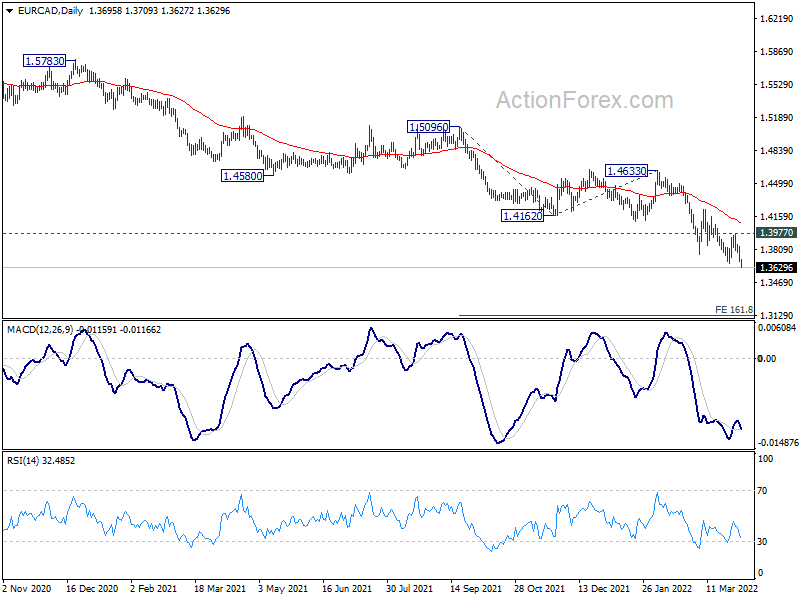
Technically, EUR/CAD's down trend resumed by breaking through 1.3671 low. Outlook will stay bearish as long as 1.3977 resistance holds. Next target is 161.8% projection of 1.5096 to 1.4162 from 1.4633 at 1.3122. At the same time, break of 1.0943 support in EUR/USD, and 0.8294 support in EUR/GBP, will further solidify weakness in Euro.
In Europe, at the time of writing, FTSE is up 0.02%. DAX is down -0.57%. CAC is down -1.49%. Germany 10-year yield is up 0.075 at 0.580. Earlier in Asia, Nikkei rose 0.19%. Hong Kong HSI rose 2.10%. China was on holiday. Singapore Strait Times rose 0.82%. Japan 10-year JGB yield dropped -0.0055 to 0.211.
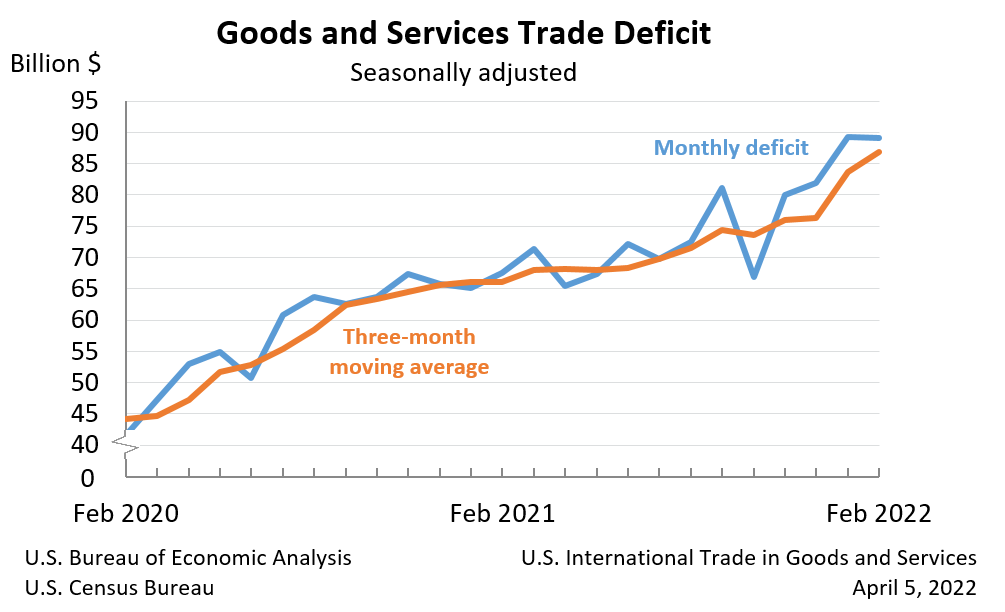
US trade deficit unchanged at US 89.2B in Feb
US exports of goods and services rose 1.8% to USD 228.6B in February. Imports of goods and services rose 1.3% to USD 317.8B. Trade deficit was relatively unchanged at USD 89.2B, larger than expectation of USD 88.5B.
Trade deficit with Mexico dropped USD 2.7B to USD 9.8B. Deficit with Japan dropped USD 2B to USD 5.1B. Deficit with China rose USD 7.9B to USD 41.2B.
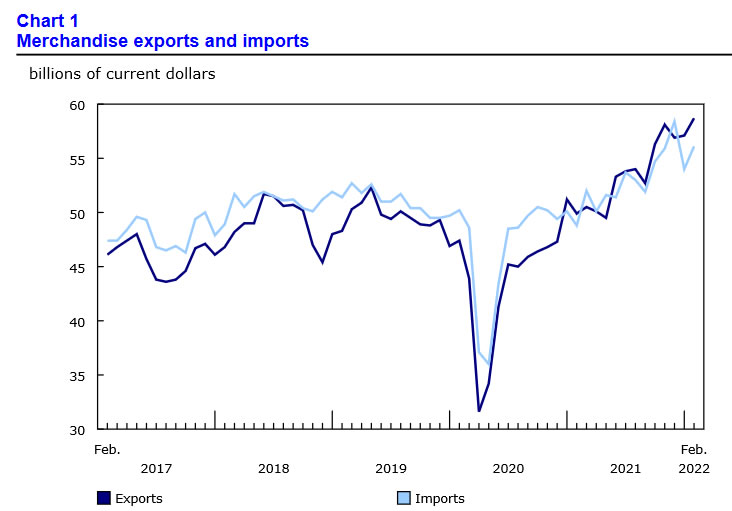
Canada trade surplus narrowed to CAD 2.7B in Feb
Canada imports rose 3.9% to CAD 56.1B in February. Gains were observed in 9 of 11 import product sections. Exports rose 2.8% to CAD 58.7B, with increases in 8 of 11 products sections. Trade surplus narrowed from CAD 3.1B to CAD 2.7B, smaller than expectation of CAD 2.9B.
UK PMI services finalized at 62.6, second strongest since 1997
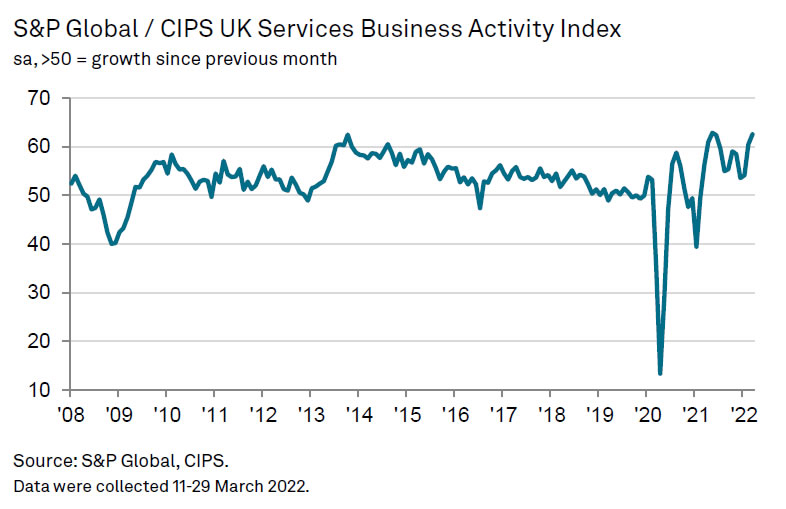
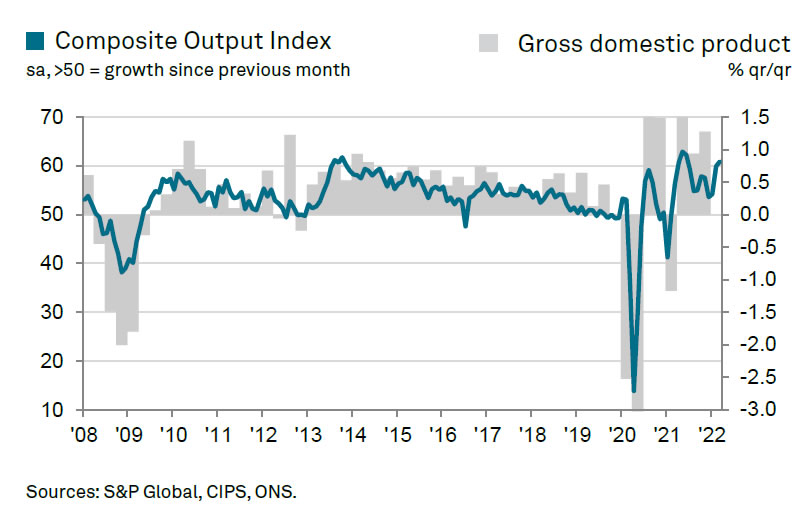
UK PMI Services was finalized at 62.6 in March, up from February's 60.5. Rate of expansion was the second strongest since May 1997, exceeded only by the post-lockdown recovery in May 2021. PMI composite was finalized at 60.9, up from prior months 59.9, fastest expansion since June 2021.
Tim Moore, Economics Director at S&P Global: "UK economic growth continued to surge higher in March after an Omicron-induced slowdown at the turn of the year... However, the near-term growth outlook weakened in March, with optimism dropping to its lowest since October 2020 as the war in Ukraine and global inflation concerns took a considerable toll on business sentiment.
"Service providers experienced the second-fastest rise in business expenses since this index began in 1996, driven by higher wages, energy bills and fuel prices. Soaring costs meant that output charges were increased to the greatest extent for more than 25 years in March. Many survey respondents commented that the full extent of the recent spike in their operating costs had yet to be passed on to customers."
Eurozone PMI composite finalized at 54.9, greater risk of economy stalling or contracting
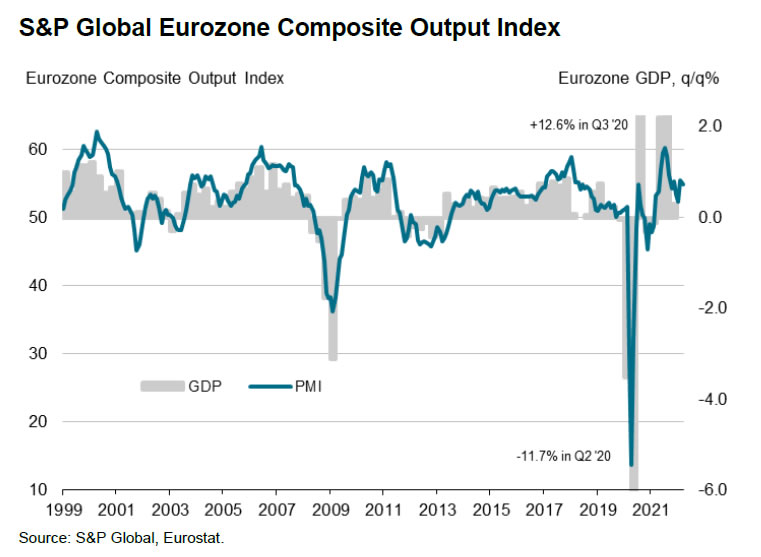
Eurozone PMI Services was finalized at 55.6 in March, up from February 55.5, hitting a 4-month high. However, PMI Composite was finalized at 54.9, down from prior month's 55.5.
Looking at some member states, Ireland PMI composite rose to 5-month high at 61.0. France rose to 8-month high at 56.3. But Germany dropped to 55.1. Spain dropped to 53.1. Italy dropped to 52.1. PMI composite of Germany, Spain and Italy were all at 2-month low.
Chris Williamson, Chief Business Economist at S&P Global said: "The further reopening of the eurozone economy amid the fading Omicron wave has provided a welcome tailwind to business activity in March... However, the resilience of the economy will be tested in the coming months by headwinds which include a further spike in energy costs and other commodity prices due to Russia's invasion of Ukraine, as well as worsening supply chain issues arising from the war and a marked deterioration in business optimism regarding prospects for the year ahead...
"The outlook for growth has therefore deteriorated at a time when the inflation outlook has worsened. A recession is by no means assured, as the extent to which the economy could suffer in the coming months will depend on the duration of the war and any changes to both fiscal and monetary policy. It certainly seems likely however that the solid expansion seen in March will prove hard to sustain and there is clearly a greater risk of the economy stalling or contracting during the second quarter."
RBA stands pat, drop the patient stance
RBA keeps cash rate unchanged at 0.10% today as widely expected. The central bank dropped the line that "the Board is prepared to be patient as it monitors how the various factors affecting inflation in Australia evolve." It's seen as a sign that RBA is preparing the markets for an earlier rate hike.
In the forward guidance, RBA said "the Board has wanted to see actual evidence that inflation is sustainably within the 2 to 3 per cent target range before it increases interest rates.". While inflation has picked up and further increase is expected, "growth in labour costs has been below rates that are likely to be consistent with inflation being sustainably at target."
RBA concluded, "over coming months, important additional evidence will be available to the Board on both inflation and the evolution of labour costs. The Board will assess this and other incoming information as its sets policy to support full employment in Australia and inflation outcomes consistent with the target."
BoJ Kuroda: Recent Yen moves somewhat rapid
BoJ Governor Haruhiko Kuroda told the parliament today that recent moves in Yen exchange way have been "somewhat rapid". He added, "it's extremely important for currency rates to move stably reflecting economic and financial fundamentals."
"We will patiently maintain powerful monetary easing to support an economy still in the midst of recovering from the COVID-19 pandemic's impact," he reiterated.
"If long-term interest rates rise rapidly, we are ready to deploy such market operations," Kuroda said, referring to the intervention to cap 10-year JGB yield at 0.25%.
EUR/USD Mid-Day Outlook
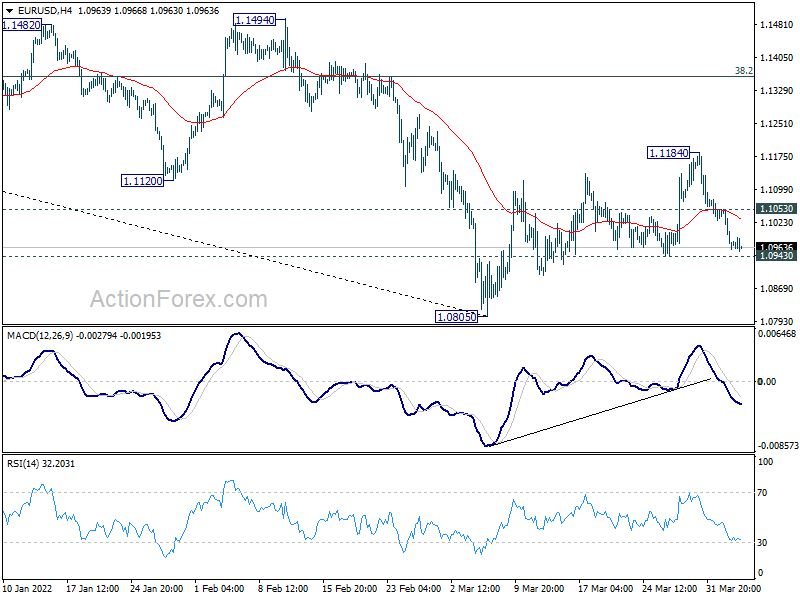
Daily Pivots: (S1) 1.0937; (P) 1.0996 (R1) 1.1031; More...
Intraday bias in EUR/USD remains neutral for the moment. Break of 1.0943 support will argue that rebound from 1.0805 has completed at 1.1184. Intraday bias will be back on the downside for retesting 1.0805 low. Further break of 1.0805 will resume larger down trend from 1.2348. On the upside, above 1.1053 minor resistance will revive near term bullishness, and turn bias back to the upside for 1.1184 resistance and above.
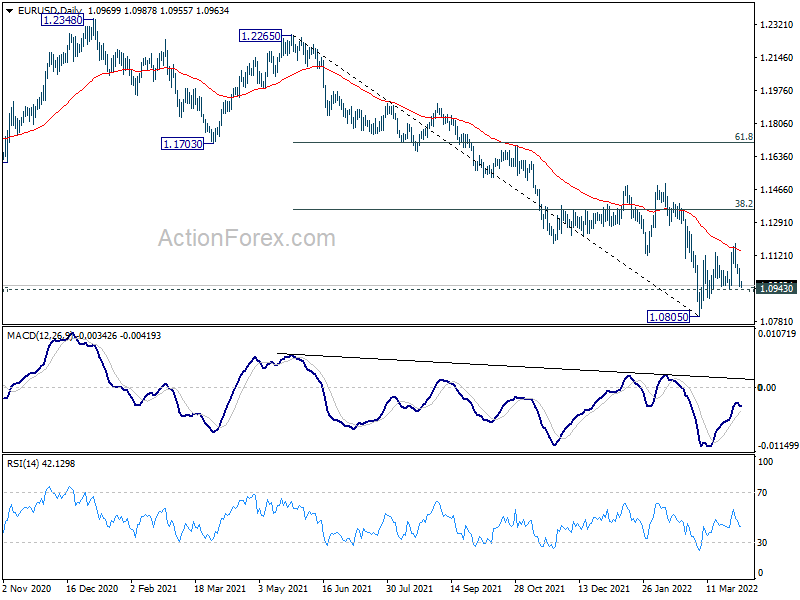
In the bigger picture, the decline from 1.2348 (2021 high) is expected to continue as long as 1.1494 resistance holds. Firm break of 1.0635 (2020 low) will raise the chance of long term down trend resumption and target a retest on 1.0339 (2017 low) next. Nevertheless, break of 1.1494 will maintain medium term neutral outlook, and extending term range trading first.
Economic Indicators Update
| GMT | Ccy | Events | Actual | Forecast | Previous | Revised |
|---|---|---|---|---|---|---|
| 22:30 | AUD | AiG Performance of Construction Index Mar | 56.5 | 53.4 | ||
| 23:30 | JPY | Labor Cash Earnings Y/Y Feb | 1.20% | 0.60% | 0.90% | 1.10% |
| 23:30 | JPY | Overall Household Spending Y/Y Feb | 1.10% | 2.70% | 6.90% | |
| 04:30 | AUD | RBA Interest Rate Decision | 0.10% | 0.10% | 0.10% | |
| 06:45 | EUR | France Industrial Output M/M Feb | -0.90% | -0.50% | 1.60% | 1.80% |
| 07:45 | EUR | Italy Services PMI Mar | 52.1 | 51.5 | 52.8 | |
| 07:50 | EUR | France Services PMI Mar F | 57.4 | 57.4 | 57.4 | |
| 07:55 | EUR | Germany Services PMI Mar F | 56.1 | 55 | 55 | |
| 08:00 | EUR | Eurozone Services PMI Mar F | 55.6 | 54.8 | 54.8 | |
| 08:30 | GBP | Services PMI Mar F | 62.6 | 61 | 61 | |
| 12:30 | CAD | Trade Balance (CAD) Feb | 2.7B | 2.9B | 2.6B | 3.1B |
| 12:30 | USD | Trade Balance (USD) Feb | -89.2B | -88.5B | -89.7B | -89.2B |
| 13:45 | USD | Services PMI Mar F | 58.9 | 58.9 | ||
| 14:00 | USD | ISM Services PMI Mar | 57.7 | 56.5 |
US trade deficit unchanged at US 89.2B in Feb
US exports of goods and services rose 1.8% to USD 228.6B in February. Imports of goods and services rose 1.3% to USD 317.8B. Trade deficit was relatively unchanged at USD 89.2B, larger than expectation of USD 88.5B.
Trade deficit with Mexico dropped USD 2.7B to USD 9.8B. Deficit with Japan dropped USD 2B to USD 5.1B. Deficit with China rose USD 7.9B to USD 41.2B.
Canada trade surplus narrowed to CAD 2.7B in Feb
Canada imports rose 3.9% to CAD 56.1B in February. Gains were observed in 9 of 11 import product sections. Exports rose 2.8% to CAD 58.7B, with increases in 8 of 11 products sections. Trade surplus narrowed from CAD 3.1B to CAD 2.7B, smaller than expectation of CAD 2.9B.
Bitcoin Sets Up for Optimism
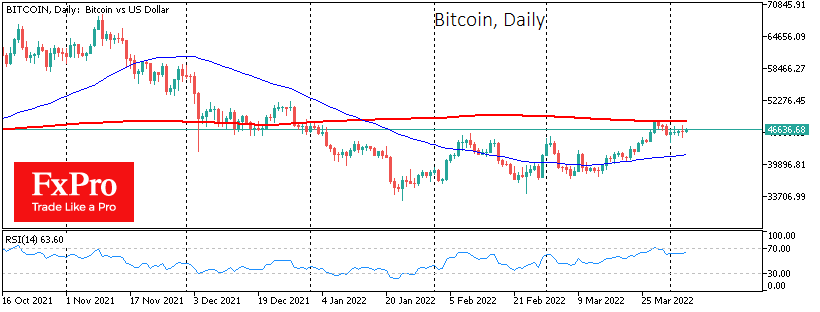
BTC was down 0.2% on Monday, ending the day near $46,300. Since the start of Tuesday, the first cryptocurrency has strengthened by 1% to $46.7K. Over the past 24 hours, Ethereum has gained 0.6%, as other leading altcoins from the top ten showed mixed dynamics: from a decline of 2.2% (Solana) to a rise of 4.8% (Dogecoin).
According to CoinMarketCap, the total capitalization of the crypto market increased by 0.7% over the day to $2.17 trillion. The Bitcoin Dominance Index rose 0.3% to 41%.
Cryptocurrency index of fear and greed added another 1 point by Tuesday, to 53, remaining in neutral territory.
Bitcoin corrected down on Monday, updating three-day lows just above $45,000. By the end of the day, BTC was able to win back almost the entire decline against the backdrop of positive dynamics in US stock indices.
According to CoinShares, institutional investors invested $180 million in crypto funds last week. Europeans again showed the most activity, while American investors remained on the sidelines.
Long-term investors in cryptocurrencies continue to accumulate bitcoin, the IntoTheBlock report notes. Without significant news in the cryptocurrency sector, bitcoin is again working as an indicator of global demand for risky assets. Its positive dynamics on Tuesday morning is a positive signal for stocks at the start of the day. However, it will be possible to speak with confidence about the local victory of the bulls only after BTCUSD fixes above the 200-day moving average, which is now passing near 48300.
Meanwhile, investment bank JPMorgan warned investors of an imminent slowdown in the growth of the cryptocurrency market, as indicated by the decrease in the share of stablecoins in the total market capitalization of cryptocurrencies.
The metaverse market will reach $13 trillion by 2030, according to Citibank. At the same time, the user base of the metaverses will grow to 5 billion people in the coming years. According to an NBC News survey, 21% of Americans have already used cryptocurrencies for various purposes.
EURJPY’s Uptrend Active Despite Retreat from 6½-Year High
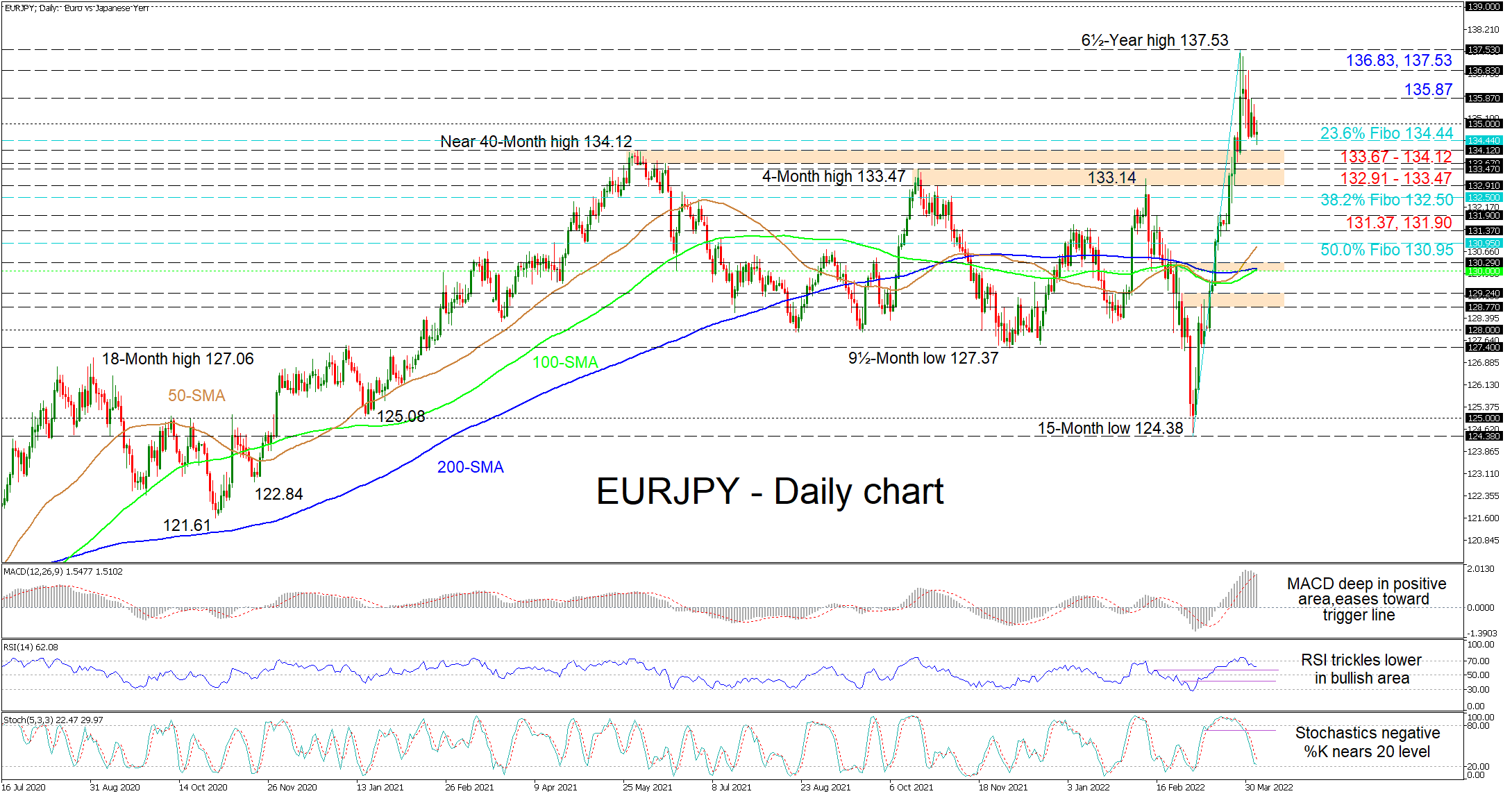
EURJPY is consolidating around the 135.00 handle after its recent pullback and has found its feet around the 134.44 level, which is the 23.6% Fibonacci retracement of the one-month rally from 124.38 until the 6½-year high of 137.53, the latter being a high that marginally breached the February 2018 peak of 137.49. Currently, the climbing 50- and 100-day simple moving averages (SMAs) do not reveal significant concerns in positive pressures, thus continuing to endorse the bullish trend.
The short-term oscillators indicate the latest surge in negative momentum but have yet to confirm that sellers are in command. The MACD, is far north of the zero mark and although easing towards its red trigger line, it is presently holding above it. The RSI is weakening ever so slightly in the bullish region, while the negatively charged stochastic oscillator promotes negative price action. However, traders need to be aware that the stochastic %K line is slowing ahead of the 20 oversold level, showing that buyers are pushing back.
If buyers create positive traction off the 23.6% Fibo of 134.44 and steer the price above the 135.00 hurdle, upside constraints could begin to emerge at the 135.87 barrier. Gaining additional buoyancy, the pair may then tackle the 136.83 high before confronting the multi-year peak of 137.53. If buying interest endures, the revival of the uptrend could cheer buyers to target the 139.00 border.
That said, more profound negative pressures would need to unfold to overwhelm the congested obstacles, which are defending the positive structure. An initial dip below the immediate 23.6% Fibo of 134.44 is faced with two critical support regions. Firstly the 133.67-134.12 area formed by the June 2021 highs followed by the 132.91-133.47 region moulded by the October 2021 highs. In the event sellers triumph, they may then meet the 38.2% Fibo of 132.50 prior to a support section between the 131.90 and 131.37 barriers. Maintaining command, the bears may seek out the 50.0% Fibo of 130.95.
Summarizing, EURJPY is sustaining a bullish bias above the near 40-month high of 134.12 and if the 23.6% Fibo acts as a foothold, this could reinforce confidence in the pair. Yet, if the price sinks below the 132.91-133.47 support obstacle, this could nurture negative tendencies in the pair.
UK PMI services finalized at 62.6, second strongest since 1997
UK PMI Services was finalized at 62.6 in March, up from February's 60.5. Rate of expansion was the second strongest since May 1997, exceeded only by the post-lockdown recovery in May 2021. PMI composite was finalized at 60.9, up from prior months 59.9, fastest expansion since June 2021.
Tim Moore, Economics Director at S&P Global: "UK economic growth continued to surge higher in March after an Omicron-induced slowdown at the turn of the year... However, the near-term growth outlook weakened in March, with optimism dropping to its lowest since October 2020 as the war in Ukraine and global inflation concerns took a considerable toll on business sentiment.
"Service providers experienced the second-fastest rise in business expenses since this index began in 1996, driven by higher wages, energy bills and fuel prices. Soaring costs meant that output charges were increased to the greatest extent for more than 25 years in March. Many survey respondents commented that the full extent of the recent spike in their operating costs had yet to be passed on to customers."
Eurozone PMI composite finalized at 54.9, greater risk of economy stalling or contracting
Eurozone PMI Services was finalized at 55.6 in March, up from February 55.5, hitting a 4-month high. However, PMI Composite was finalized at 54.9, down from prior month's 55.5.
Looking at some member states, Ireland PMI composite rose to 5-month high at 61.0. France rose to 8-month high at 56.3. But Germany dropped to 55.1. Spain dropped to 53.1. Italy dropped to 52.1. PMI composite of Germany, Spain and Italy were all at 2-month low.
Chris Williamson, Chief Business Economist at S&P Global said: "The further reopening of the eurozone economy amid the fading Omicron wave has provided a welcome tailwind to business activity in March... However, the resilience of the economy will be tested in the coming months by headwinds which include a further spike in energy costs and other commodity prices due to Russia's invasion of Ukraine, as well as worsening supply chain issues arising from the war and a marked deterioration in business optimism regarding prospects for the year ahead...
"The outlook for growth has therefore deteriorated at a time when the inflation outlook has worsened. A recession is by no means assured, as the extent to which the economy could suffer in the coming months will depend on the duration of the war and any changes to both fiscal and monetary policy. It certainly seems likely however that the solid expansion seen in March will prove hard to sustain and there is clearly a greater risk of the economy stalling or contracting during the second quarter."
GBPUSD Challenges the 20-Day SMA above 1.3100; Outlook Still Bearish
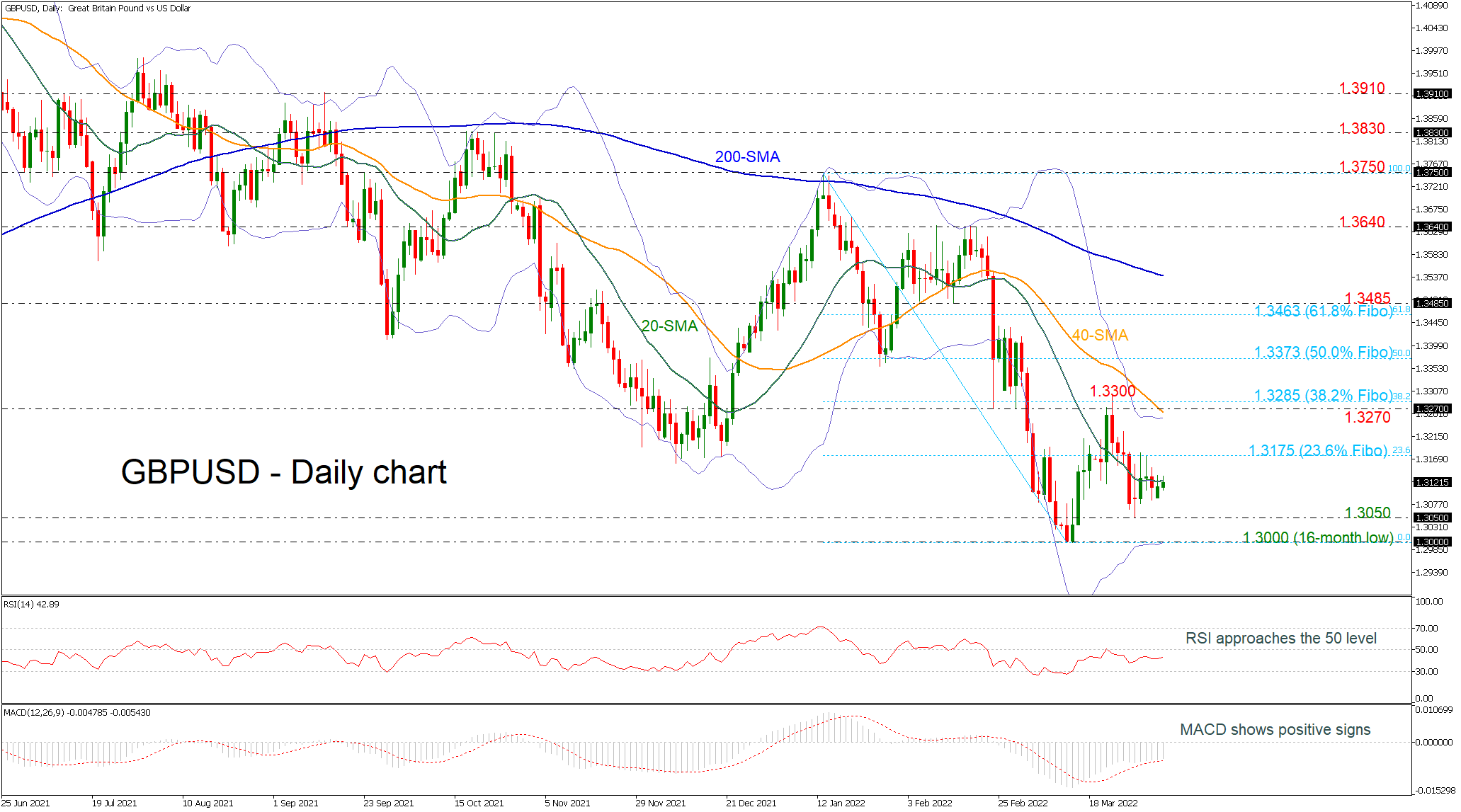
GBPUSD is developing near the 20-day simple moving average (SMA) and below the significant barrier of the 23.6% Fibonacci retracement level of the down leg from 1.3750 to 1.3000 at 1.3175. Over the last month, the price is looking neutral as it failed to post a lower low or a jump above the previous high near 1.3300.
The momentum indicators in the daily chart though are currently supporting that positive momentum is likely to strengthen in the short-term. Specifically, the RSI is picking up speed above 50 and the MACD continues to move above its red signal line in the negative region.
Should the price decisively close above the roof of the 23.6% Fibonacci of 1.3175, bulls could extend an upward move towards the crucial area of the 1.3270 resistance, which holds near the upper Bollinger band and the 40-day SMA. Slightly higher, the 38.2% Fibonacci of 1.3285 may halt the bullish movements ahead of the previous high of 1.3300. Further advances above this level, could then target the area around the 50.0% Fibonacci of 1.3373.
On the other hand, a decline could meet the 1.3050 support, which the market was unable to break through from the end of March. Even lower, the price could retest the 16-month low of 1.3000, which overlaps with the lower Bollinger band, before more bearish movement shifts the focus to the 1.2850 barrier, taken from the low in November 2020.
Summarizing, GBPUSD has been in a declining mode since May 2021 and only a surge above the 200-day SMA around 1.3540 may switch the bearish outlook to bullish.
RBA Board Abandons “Patient” Approach to Policy at April Board Meeting
The Reserve Bank Board has abandoned its patient approach to policy and given itself sufficient flexibility to raise rates as early as June. This decision will depend on the data over the next two months. To raise rates in June it will need to adopt a specific tightening bias at the May meeting.
The Reserve Bank Board decided to keep the cash rate target at 10 basis points and the interest rate on Exchange Settlement balances at zero per cent.
The Governor has significantly changed his language in the Statement to allow flexibility to start raising rates based on data “over coming months”. By definition, that could be as early as June, which would be two months earlier than our current call that the tightening cycle will begin in August.
In the conclusions to statements of recent meetings the Governor has concluded that “It is likely to be some time yet before growth in labour costs is at a rate consistent with inflation being sustainably at target. The Board is prepared to be patient as it monitors how the various factors affecting inflation in Australia evolve.”
In today’s Statement the Governor notes, “Over coming months, important additional evidence will be available to the Board on both inflation and the evolution of labour costs. The Board will assess this and other incoming information as it sets policy to support full employment in Australia and inflation outcomes consistent with the target.”
Note also, however, that it still remains cautious about the evolution of wages, “growth in labour costs has been below rates that are likely to be consistent with inflation being sustainably at target.”
In his Statement last month after the March meeting, he did refer to “labour costs” but in the Minutes of the March meeting the Board referred to the need for “aggregate wages growth to be consistent with inflation being sustainably at target.”
This is important because “aggregate” wages refers to the Wage Price Index, whereas labour costs can be a much broader measure covering business surveys; the RBA’s own liaison; and other “lead indicators” such as job vacancies; the unemployment rate and award wage decisions.
The arithmetic is that the annual growth in the Wage Price Index that prints on May 18 is likely to print 2.5% (0.8% for the quarter), well below the 3% target that the Governor has set in the past although the annualised six month pace is likely to be around 3%. (The annual rate is being held down by the 0.4% which printed in the June quarter last year. That will drop out for the June quarter reading but will continue to hold down the annual March reading.)
The Governor confirms the consistent view that the pick-up in wages growth is expected to be “only gradual”, although there is uncertainty about the behaviour of labour costs at historically low levels of unemployment.
The Inflation print on April 27 is forecast by Westpac to print 4.6% annual headline, up from 3.5%, and underlying annual 3.1% up from 2.6%.
Given the extreme impact of fuel prices on the headline print the underlying print will attract most attention from the RBA.
With the Statement referring to “over coming months” it seems clear that the Board is not signalling a likely move at the May meeting in the aftermath of the March quarter CPI.
However, it could move to a tightening bias at the May meeting dependent on the inflation print on April 27 and conditions in the labour market in May.
With the March quarter WPI; two prints on the unemployment rate; and business and liaison survey the Board has now sufficiently changed its language to satisfy the market which has been demanding a June rate hike for some time.
Even though the election in May posed some complications for monetary policy it appears from this change in rhetoric that the Board is prepared to accept that a specific debate about an immediate rate hike following the election on May 14 or 21 can be contemplated, emphasising the independence of the Reserve Bank.
Conclusion
We have been surprised with this very significant change of heart from the Board since the March meeting. The only important piece of new domestic data over the month has been the fall in the unemployment rate to 4% although developments in global markets have, as indicated by the market, been consistent with a much more aggressive RBA.
However there has been a major change in the rhetoric and the Board has now increased its flexibility to start raising rates as early as June, two months earlier than our current call which remains August.
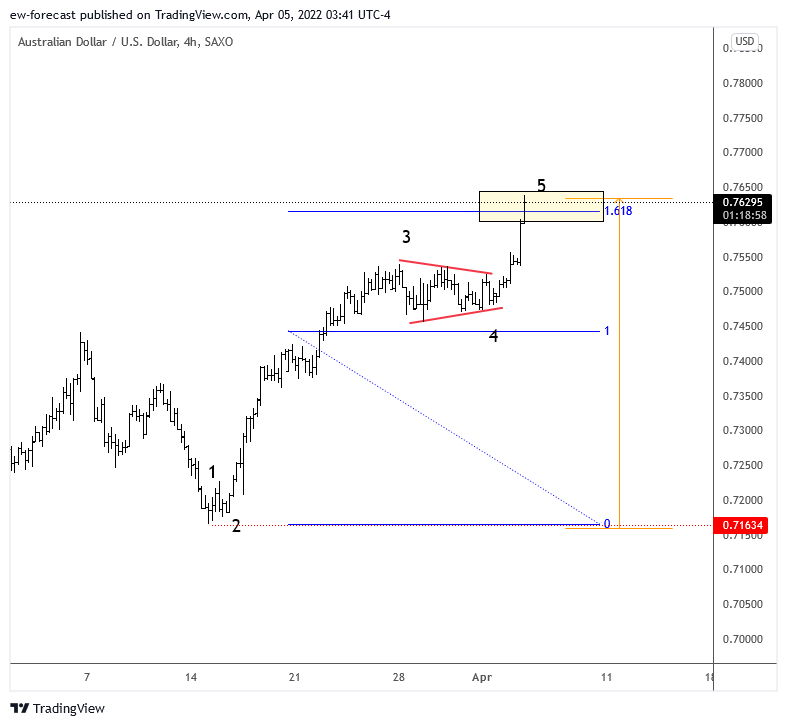
AUD/USD: RBA Catalyst for Broken Triangle
AUD is one of the strongest across the board after recent RBA comments, who want to see more indications that wage growth has significantly picked before moving to tighten policy. So, the potential date for the first hike is in June, as May meeting is scheduled around two weeks before the wage data is released in Australia. Aussie is coming nicely out of a triangle as expected, but we know that this is now most likely a final leg within a higher degree trend, so be aware of a limited upside in a fifth wave. But for now, there is room for recovery close to 0.77, while the market is above 0.7550; price back below that level will signal an important shift of an intraday trend.