Sample Category Title
Caution Prevails as Geopolitical Risks Continue
A sense of caution has taken hold of financial markets as investors evaluate the prospects of more sanctions on Russia for the alleged destruction in Bucha, a town on the outskirts of Ukraine’s capital.
Asian shares wobbled on Tuesday morning due to the rising geopolitical risks, while oil benchmarks jumped over 1% on supply-side fears. European and U.S futures fluctuated, pointing to a mixed open despite Wall Street closing higher overnight. In the currency space, the dollar gained for the third straight session yesterday as investors sprinted to safety. But interestingly, trading activity in gold was like watching paint dry.
With geopolitics at the forefront of investors’ minds, the next few days could be rough and rocky for global markets. The devastation in Bucha has prompted not only the European Union but also world leaders to discuss new sanctions on Russia. As ongoing geopolitical risks fuel uncertainty and trigger volatility, this could sap risk sentiment, extending further support to safe-haven assets.
The Reserve Bank of Australia (RBA) left interest rates unchanged at 0.1% at its overnight meeting. However, the central bank signaled a growing willingness to raise interest rates soon, by dropping the phrase “the board is prepared to be patient”. The RBA’s hawkish tilt sent the aussie to its highest level in nine months, above 0.76.
FOMC minutes and Fed speeches in focus
This could be a big week for the dollar due to the FOMC meeting minutes as well as scheduled speeches from Fed officials.
The minutes of the FOMC March policy meeting are expected to offer investors fresh insight into how officials view monetary policy, after raising interest rates for the first time since 2018. Market players will also comb through the minutes for details on the plans for balance sheet reduction which could start as soon as May.
Should the minutes strike a hawkish tone with policymakers discussing the possibility of a 50-basis point rate hike in May, this could boost the dollar. Expect the greenback to be influenced by numerous policymakers scheduled to speak this week as well, including Fed Governor Lael Brainard and Philadelphia Fed President Patrick Harker among others.
Commodity spotlight – Oil
Oil benchmarks appreciated over 1% on Tuesday morning as bulls drew strength from supply-side fears due to the Russia-Ukraine conflict. With the European Union working on new sanctions that may target Russia’s oil industry, crude prices could edge up in the near term.
However, last week’s announcement by President Biden to release a mammoth 180 million from the country's strategic petroleum reserves (SPR) between May and October is taming oil bulls. The idea of the SPR plugging the gaping hole in the absence of Russian oil could cap upside gains in the global commodity. In addition, China’s most populous city Shanghai is under lockdown and given how China is the world’s largest crude consumer, this development may further weigh on prices.
Brent is trading around $109.15 as of writing. A move to the upside could open a path back towards $114.50. If prices slip below $108, then a decline towards $104 could be on the cards.
Oil Rebounds on Escalating Geopolitical Tensions
Twitter jumped 27% in a single move on the news that Elon Musk took a 9.2% stake in the company. The jump in Twitter shares gave an energy boost to the US equities, especially to the technology stocks. Nasdaq jumped 1.90%, while the S&P500 gained 0.80% and Dow Jones added a slim 0.30%.
But news regarding the war and oil prices were less encouraging.
Potential sanction on Russian energy boosts oil prices
EU leaders will reportedly meet tomorrow, and the additional sanctions could include more action on Russian oligarchs, more exports restrictions, an eventual port ban on Russian ships, and a potential ban on Russian energy exports.
If leaving the Russians without Big Macs, Starbucks coffees, or Nike shoes hasn’t been effective in discouraging Putin from ending the war in Ukraine, banning the Russian energy imports should make a difference, yet it would also mean a severe energy crunch in Europe, and a big hit to economic growth.
But, not everyone is scared. Lithuania has become the first European country to announce a total ban on Russian gas imports, and the possibility of other nations joining Lithuania in banning Russian oil and gas gives a boost to oil bulls.
US crude quickly bounced above the $100 mark yesterday on escalating tensions in Ukraine while many questioned the US ability to bring a million barrels of oil per day into the market for six months, pointing at the ‘sour’ crude quality that refineries may not want to buy, and the logistical constraints. As a result, the news of US strategic release and pandemic couldn’t pull the price of a barrel sustainably below the $100pb mark, strengthening support at this level.
Gold, support by geopolitical escalation, pressured by rising yields
Gold remains under the pressure of rising US yields. The yellow metal is bid above the $1900 mark as the war uncertainties keep the safe haven demand tight. Medium-term risks remain tilted to the downside as even a risk selloff may not easily benefit to gold, if the selloff is due to rising US yields.
Yet, renewed geopolitical tensions boost appetite in gold, and the fact that the West prepares to announce new sanctions against Russia on horrifying images of attacks against civilians should throw a floor under a selloff below the $1900 in the short run.
Macro
US factory orders fell for the first time in ten months on supply constraints, the PMI data will give a hint on the European activity levels amid war in Ukraine, and the Reserve Bank of Australia (RBA) kept its policy rate unchanged at the historical low of 0.10% for the sixteenth consecutive month.
Yet, the Australian policymakers dropped the ‘patient’ pledge in their accompanying statement, meaning that if inflation rises fast - and it probably will, the RBA could start raising rates in the next couple months, as well.
The Aussie rebounded more than 9% against the US dollar since the beginning of February, as iron ore prices jumped due to the Ukraine war. The RSI indicator hints at overbought market conditions as the currency may have gained too fast in a too short period of time. A short-term correction could therefore be healthy at the current levels. But the medium-term outlook remains positive for the Aussie, as long as commodity prices remain supported by geopolitical threat to the supply.
Daily Technical Analysis
EUR/USD
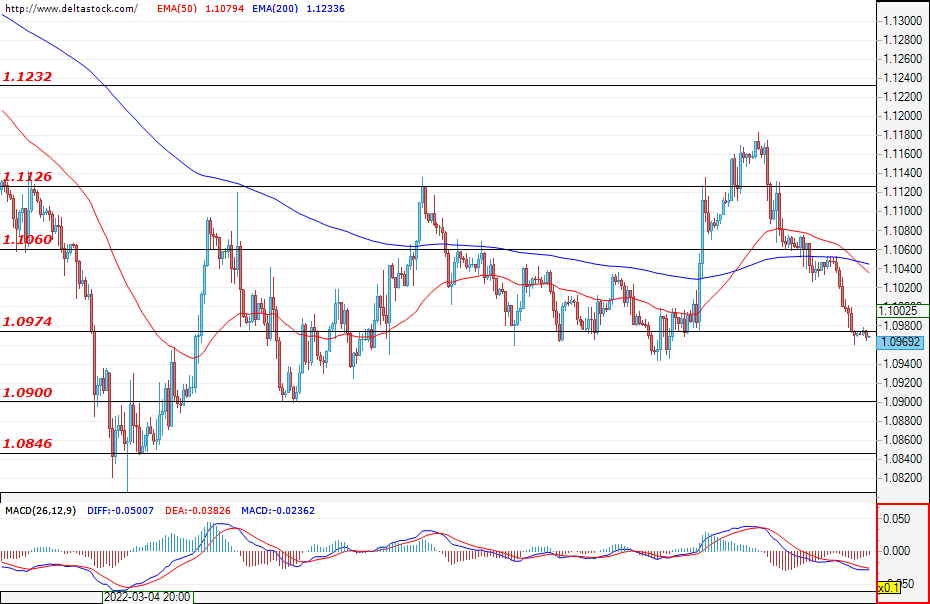
For the single European currency, the week began with some losses against the dollar. After the market opened, the bulls did not even try to test the resistance at 1.1060 and relinquished control of the market to the bears. They turned the exchange rate of the currency pair to a support at 1.0974. Although they are currently facing some difficulties with this level, the downward movement is probably not over. A likely scenario is a direction of the course to the second support at 1.0900. Even if this does not happen, we can talk about a possible return of the bulls, but only after overcoming the resistance at 1.1060.
USD/JPY
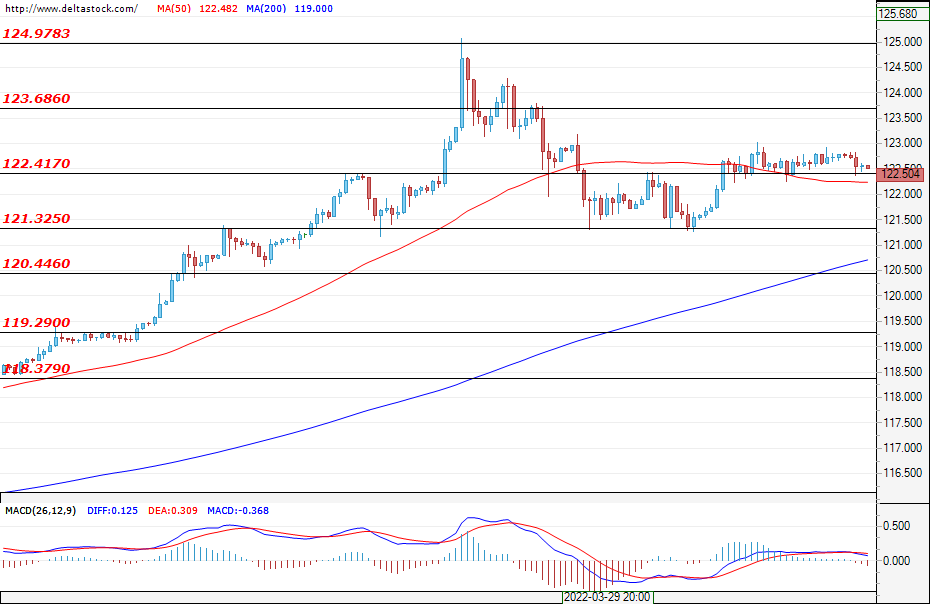
The corrective phase from the level of 125.08 to 121.32 managed to slow down the strong trend of the currency pair and the consolidating movement above the support at 122.41 continues. If the bulls do not try to test the resistance at 123.68, it is very likely that we will witness a longer period of a range between the levels 122.41 and 121.32.
GBP/USD
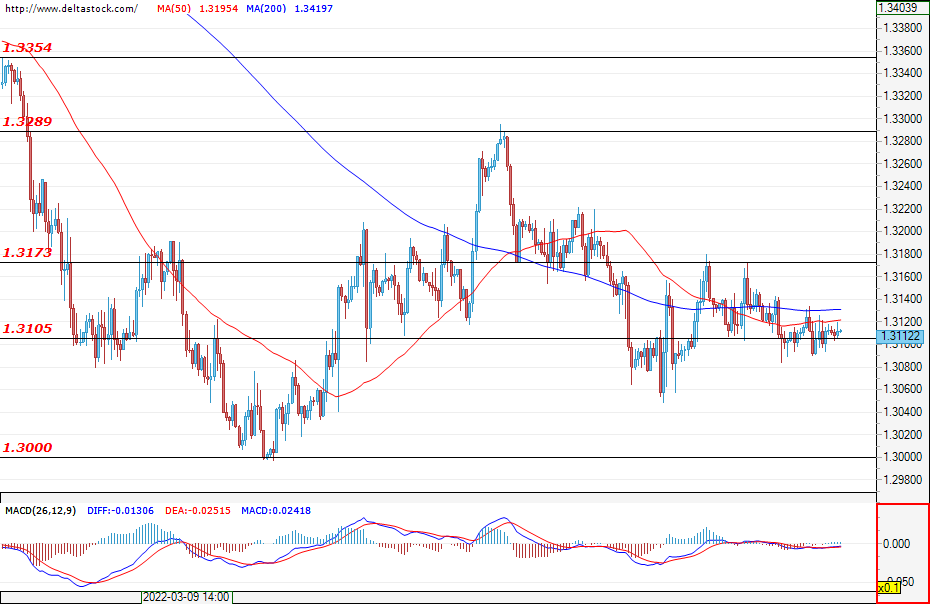
Trading in the past session was calm and the price of the currency pair has so far managed to consolidate above the support at 1.3105. It is likely that we will observe a range movement and a reversal of the course back to the resistance at 1.3173. A signal that the bulls could return to the market for a longer period of time would be the overcoming of the resistance at 1.3289. If this does not happen, the important supports that would make it difficult for the bears, are at 1.3105 and 1.3000.
EUGERMANY40
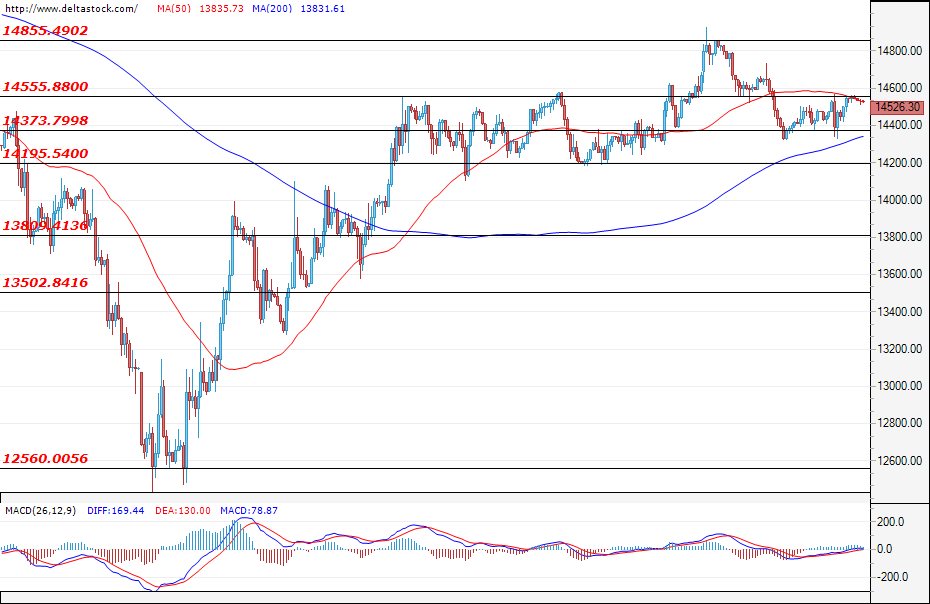
The German index successfully held above support at 14373. However, this consolidation may be temporary, given the precarious situation in Ukraine. If the bulls fail to break the resistance at 14550, the bears may once again prevail. If this happens and they overcome the support at 14195, we will witness new sales to the next major level at 13809.
US30
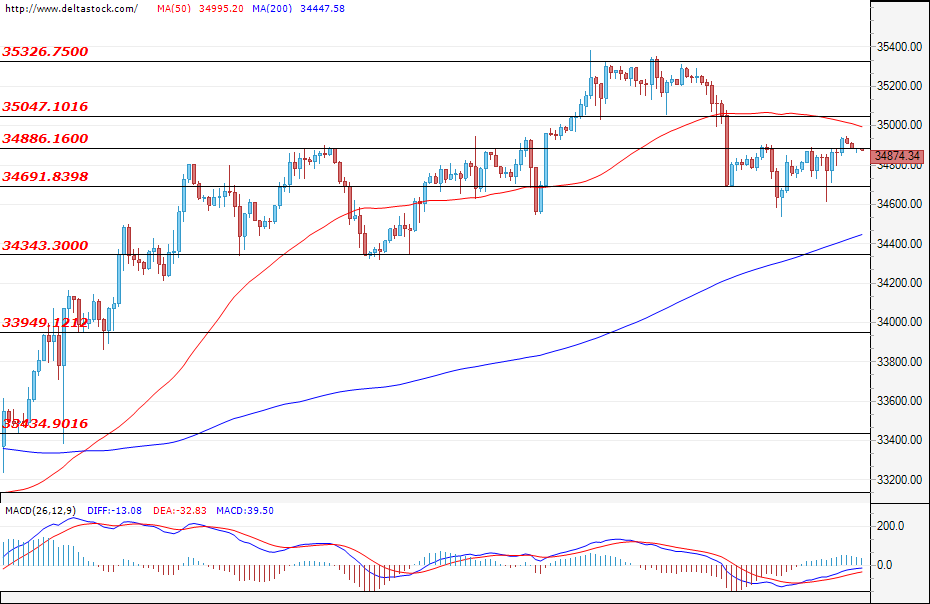
The last session was calm for the U.S. blue chip index as the US30 managed to stop its fall and turned to the important resistance at 34886. For now, it manages to stop the bulls. If the price turns to the support level at 34360 and it is overcome, it is possible that the bears will return to the market.
Natural Gas Gains Momentum as Uncertainties Rise
US stocks rose on Monday even as investors remained concerned about the Federal Reserve and the fact that the American economy was slowing. The Dow Jones rose by 53 points while the tech-heavy Nasdaq 100 index rose by over 232 points. The Fed is expected to maintain a hawkish tone after recent positive jobs numbers from the US. On Friday, data showed that the American unemployment rate dropped to 3.6% while wages rose by more than 5%. But on Monday, data revealed that the country’s factory orders declined by 0.5% in February after rising by 1.5% in January. New orders for non-defense capital investments fell by 0.2% as supply chain challenges rose.
The price of natural gas hovered near its highest level this year while oil moved sideways after Emmanuel Macron called for a complete ban of Russian oil and coal. He attributed the statement to signs that the Russian military had committed war crimes in Ukraine. Still, he did not call for a ban of Russian gas, which is an important part of the European economy. Russian gas accounts for about 80% of all Austrian gas imports and 40% in Germany. Still, investors are pricing in a sharp decline in Russian gas in Europe since the EU has said that it will not pay in Rubles. Russia supplies about 70% of thermal coal to Europe.
The biggest event on Wednesday was the interest rate decision by the Reserve Bank of Australia (RBA). As was widely expected, the bank left interest rates unchanged at 0.10%. It then hinted that it would start hiking interest rates in the coming months. Meanwhile, Japan released relatively weak household spending and cash earnings data. The upcoming numbers that will move specific currencies, will be Canada’s exports and imports and the latest services and composite PMIs from most countries. The American Petroleum Institute will release the latest oil inventories data.
EURUSD
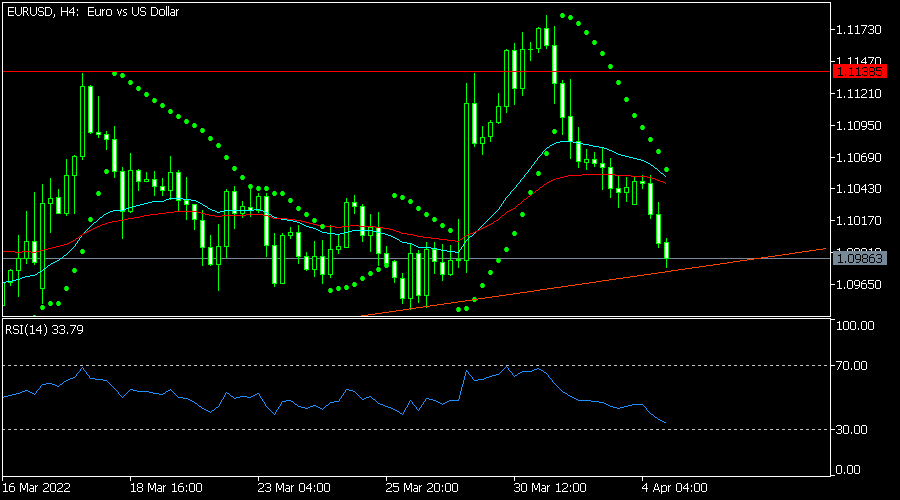
The EURUSD pair declined to a key support level at 1.0985, which was the lowest level since March 29 this year. The pair managed to test the important support that is shown in red. It also dropped below the 25-day moving average while the Relative Strength Index moved slightly above the oversold level. The price is also below the dots of the parabolic SAR indicator. Therefore, the pair will likely keep falling today. The alternative is where it resumes the bullish trend as bulls target the upper side of the channel.
USDCAD
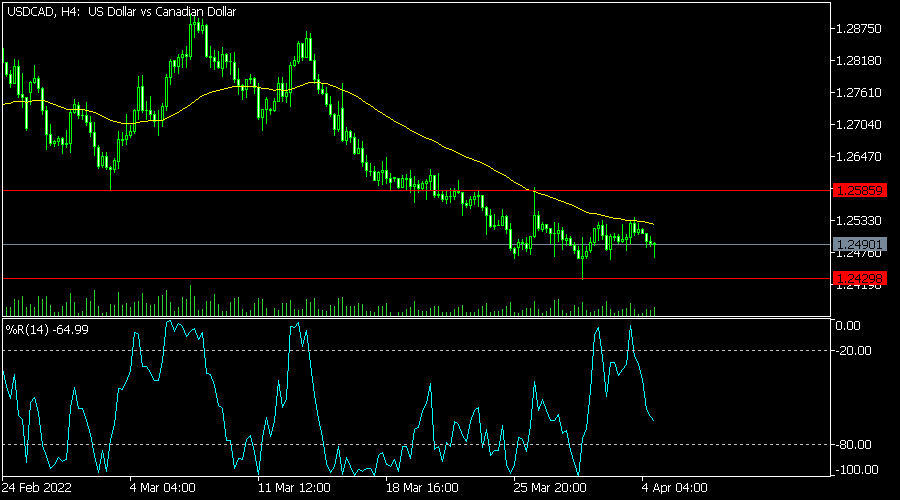
The USDCAD pair was little changed on Tuesday morning. It is trading at 1.2492, where it has been in the past few days. The pair has moved below the 25-day moving average and the important support at 1.2585, which was the lowest level on March 3. The Williams %R has also moved below the overbought level. Therefore, the pair will likely keep falling as bears target the next support at 1.2430, the lowest level in March.
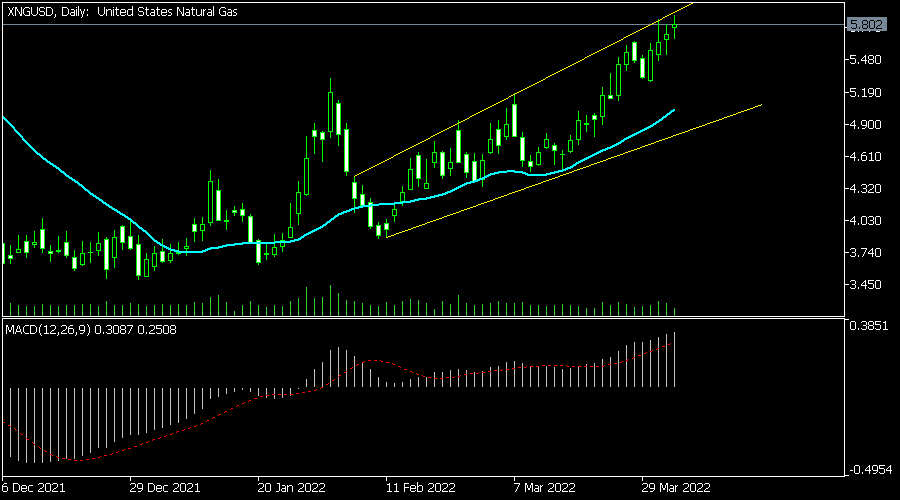
XNGUSD
The XNGUSD pair rose to a high of 5.89, which was the highest level since November 2. On the daily chart, the pair is along the upper side of the ascending channel. It has also moved above the short and long-term moving averages while the MACD has continued rising. Therefore, the path of the least resistance for the pair is to the upside.
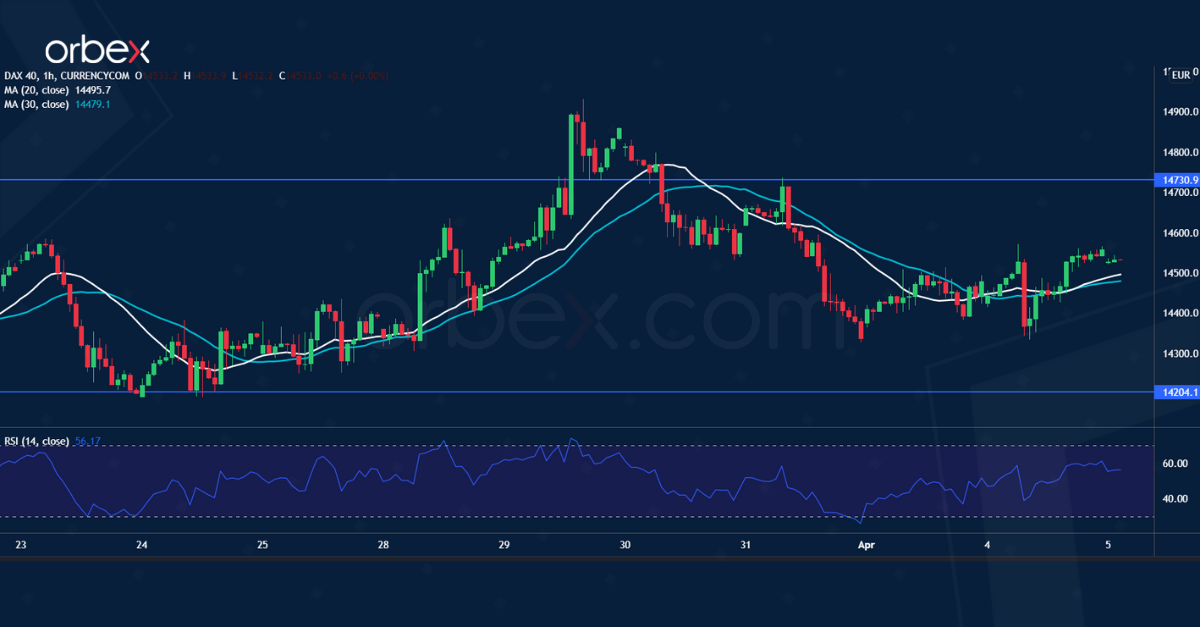
DAX 40 Takes a Breather
The Dax 40 goes sideways as the EU considers a new set of sanctions. A bullish MA cross on the daily chart suggests an acceleration in the rebound as a sign of improved sentiment.
The index is hovering above the lower end (14200) of the previous consolidation. This level coincides with the 20 and 30-day moving averages, making it an area of interest.
A close above 14730 could extend the rally to the origin of the February liquidation at 15200. This is an important resistance before the uptrend could resume in the medium-term.
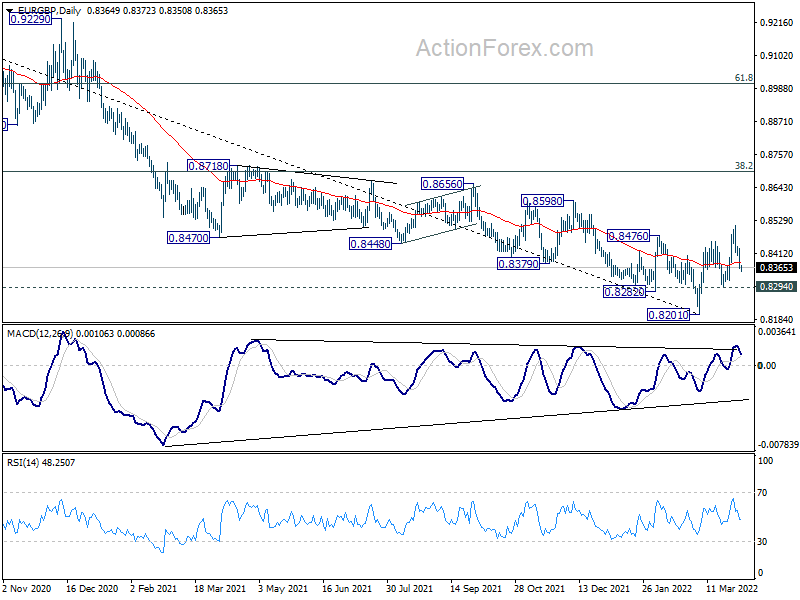
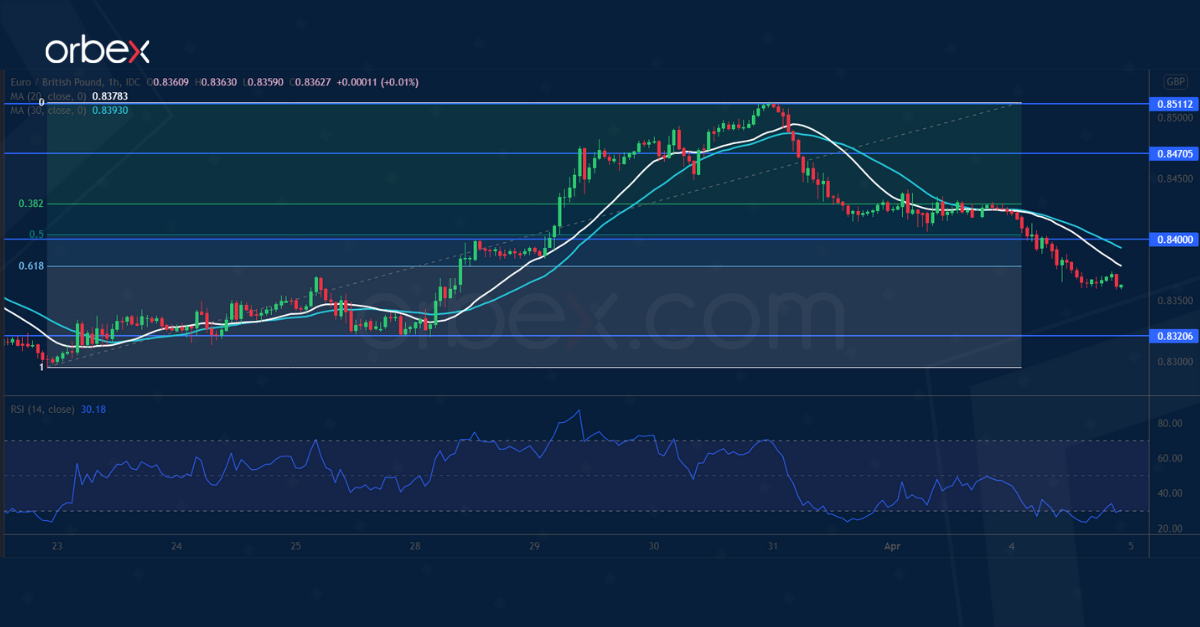
EUR/GBP Struggles for Support
The euro fell as worries over Europe’s energy supply grew. The current pullback could be an opportunity for the bulls to stake in but they will need to push past 0.8400 to regain control.
The 61.8% (0.8380) Fibonacci retracement level has failed to foster buyers’ interest. The RSI’s double dip into the oversold area may attract some bids.
The demand zone between the daily support (0.8300) and 0.8320 is a critical floor to keep the rebound valid. That said, its breach could trigger a sell-off towards 0.8200.
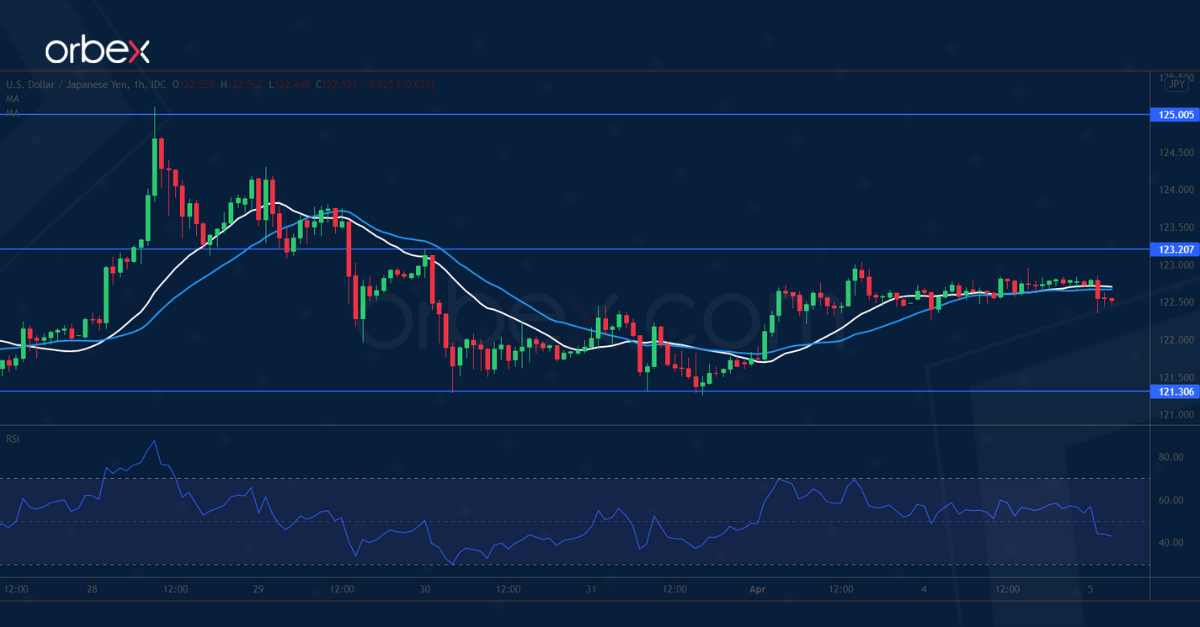
USD/JPY Consolidates Gains
The US dollar gains on the prospect of more sanctions on Russia. On the daily chart, the RSI’s overbought condition led to profit-takings as the bulls became reluctant to outbid each other.
Nonetheless, the direction remains upward, and a pause is necessary for the market to take a breather. The current pullback has found support over 121.30.
A bounce above 123.20 may signal a bullish continuation and extend the price back to 125.00. On the downside, a breakout could cause a correction to 119.40 near the 30-day moving average.
GBP/JPY Daily Outlook
Daily Pivots: (S1) 160.43; (P) 160.87; (R1) 161.46; More...
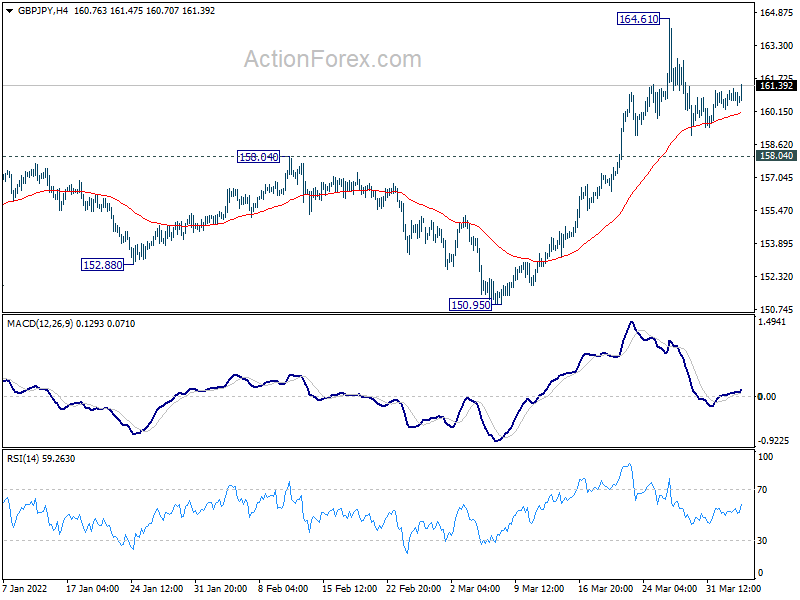
GBP/JPY is staying in consolidation from 164.61 and intraday bias remains neutral first. Outlook remains bullish with 158.04 resistance turned support intact, and further rally is expected. On the upside, break of 164.61 will resume larger up trend to long term fibonacci level at 167.93. However, firm break of 158.19 will turn bias to the downside and bring deeper pull back.
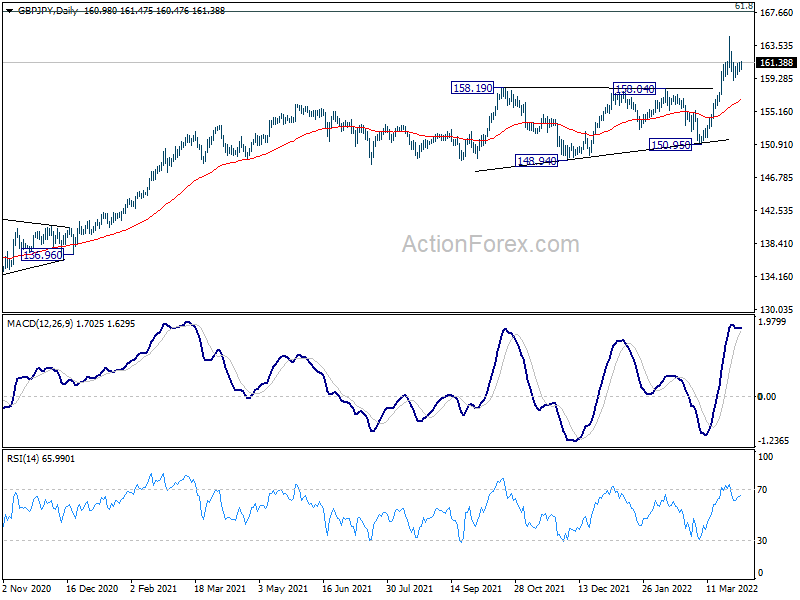
In the bigger picture, up trend from 123.94 (2020 low) is still in progress, and notable support from 55 week EMA affirms medium term bullishness. Next target is 61.8% retracement of 195.86 (2015 high) to 122.75 (2016 low) at 167.93. Sustained break there will be a long term bullish signal. This will now remain the favored case as long as 150.95 support holds.
EUR/JPY Daily Outlook
Daily Pivots: (S1) 134.29; (P) 134.99; (R1) 135.40; More....
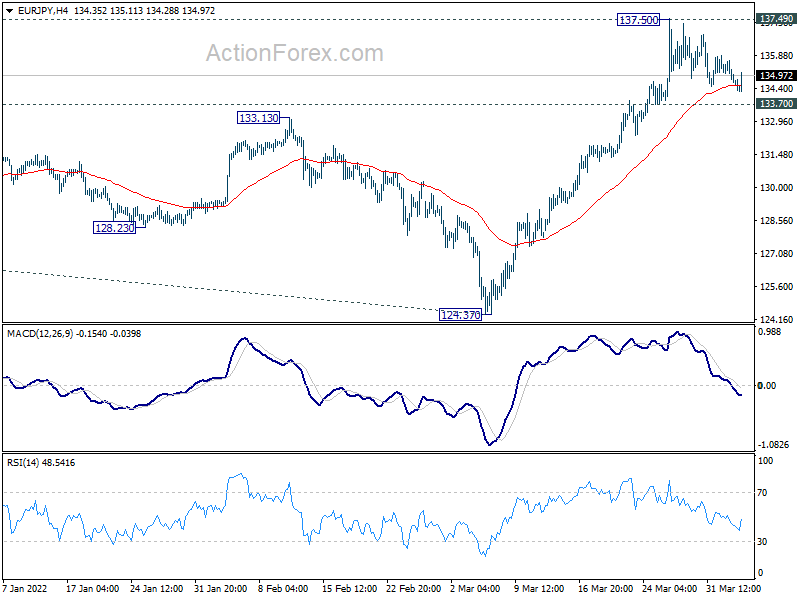
Intraday bias in EUR/JPY stays neutral at this point, as consolidation from 137.49 is still extending. With 133.70 minor support intact, further rally is expected. On the upside, sustained break of 137.49 resistance will resume larger up trend for 144.06 projection level next. However, firm break of 133.70 will indicate short term topping, and turn bias back to the downside for deeper pull back.
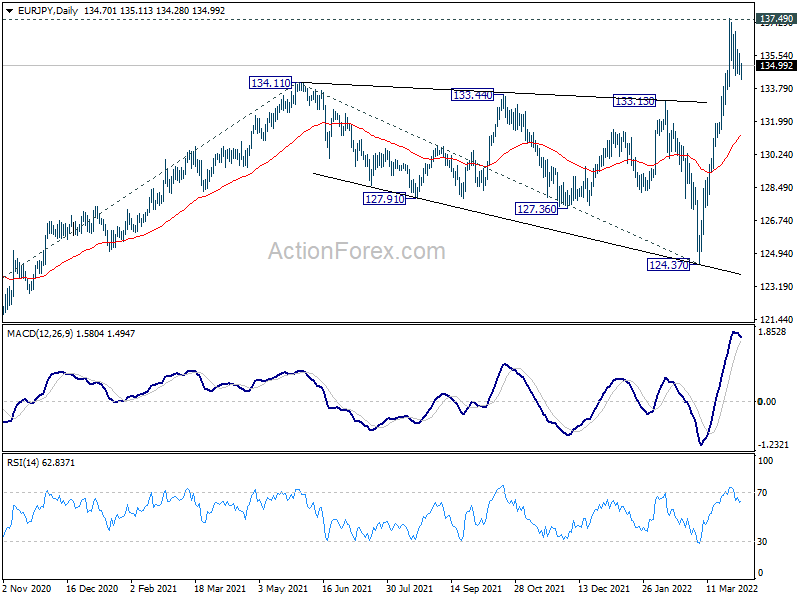
In the bigger picture, up trend from 114.42 (2020 low) is in progress. Sustained break of 137.49 (2018 high) will resume larger pattern from 109.30 (2016 low). Next target will be 100% projection of 114.42 to 134.11 from 124.37 at 144.06. In any case, outlook will now remain bullish as long as 124.37 support holds, in case of deep pull back.
EUR/GBP Daily Outlook
Daily Pivots: (S1) 0.8342; (P) 0.8386; (R1) 0.8411; More...
Intraday bias in EUR/GBP stays neutral for the moment. With 0.8294 support intact, further rise is still in favor. . On the upside, break of 0.8511 will target 0.8697 medium term fibonacci level next. However, break of 0.8294 will dampen this bullish view and bring retest of 0.8201 low.
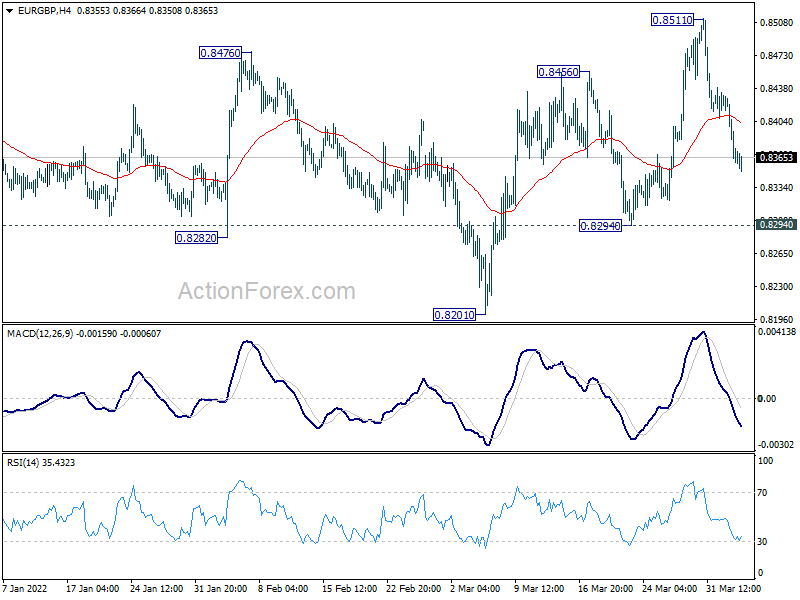
In the bigger picture, a medium term bottom should be in place at 0.8201, on bullish convergence condition in daily and weekly MACD. Rise from there could either be a correction to the down trend from 0.9499 (2020 high), or a medium term up trend itself. In either case, further rise should be seen to 38.2% retracement of 0.9499 to 0.8201 at 0.8697. Sustained break there will target 61.8% retracement at 0.9003. This will remain the favored case as long as 0.8294 support holds.