Sample Category Title
Eco Data 4/5/22
[php_everywhere instance="1"]
BoE Cunliffe: We will need carefully to judge the risks on both sides
BoE Deputy Governor Jon Cunliffe said said in a speech that the UK economy entered 2022 "still affected by two major impacts of the path out of Covid – very high imported inflation, and a very tight labour market with strong pay growth."
"While I recognise the risk of second-round effects and that further tightening of monetary policy might be necessary, I am not at present convinced that we will inevitably have to lean heavily and constantly against an embedding of an inflationary psychology as we progress through this challenging period and as the impact of higher commodity prices on real household incomes depresses activity."
"Rather, we will need carefully to judge the risks on both sides, weighing the evidence on the evolution of domestic prices, wages, activity and employment as it emerges. The MPC's next forecast will be the first opportunity since the invasion to do that," he added.
ECB Vasle preaches getting out of negative rate by turn of the year
ECB Governing Council member Bostjan Vasle said the most important thing for him is to start the process of ending asset purchases "note very late in the year", and "have the opportunity to be out of negative territory by the turn of the year."
"We're still expecting quite strong positive growth rates, and if that scenario materializes I don't see any reasons why we wouldn't continue with policy normalization after the turn of the year and go above zero with interest rates," he said.
That's "one element affecting my understanding of not only inflation, but especially inflation pressures which are in the pipeline at the moment," Vasle said. "It also gives me additional insight into what's happening in the labor market and how these expectations regarding wages will be formed in future months and quarters."
"My expectation is that in a quarter or two we'll see the peak of inflation and then a gradual easing by the end of the year," he said. "The last inflation reading was indeed very high, but in the context of the conflict and the rising prices across various energy segments, it was something which wasn't so unexpected."
Yen Takes a Pause after Busy Week
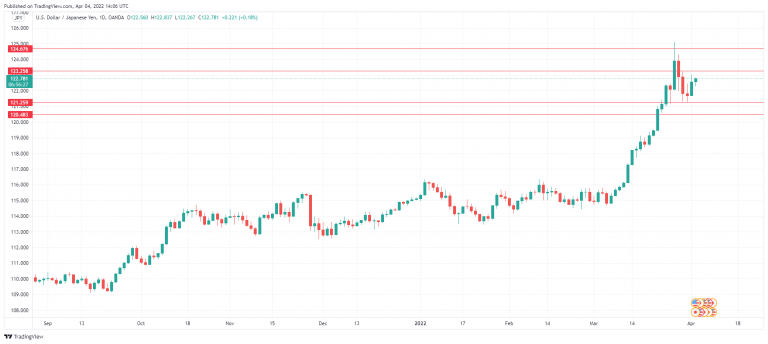
The Japanese yen has started the week with slight gains, as USD/JPY is trading at 122.75 in the North American session.
It was a rollercoaster week for the yen, which showed strong volatility throughout the week. USD/JPY posted considerable gains on Friday, as the US/Japan rate differential widened on Friday and pushed the yen briefly above the 123 line. The Japanese currency received a temporary boost after the BoJ made an unusual move and intervened to protect its yield curve and keep 10-year JGBs below 0.25%. The central bank made unlimited purchases of the 10-year bonds for four straight days last week, in a determined move to maintain its ultra-loose monetary policy. This has become more challenging for the BoJ, as many major central banks, including the Fed and the BoE are tightening policy.
The yen’s sharp movement last week was also attributable to financial year-end repatriation flows. This gave the yen a boost early in the week, but the currency weakened as the repatriation flows reversed directions, away from the yen.
The BoJ’s intervention got the job done and pushed 10-year JGBs below 0.25%, but this could prove to be of temporary relief only for the yen. BoJ Governor Kuroda remains in support of a weak yen and if the Fed decides to bring in the heavy artillery in the form of 1/2 point rate hikes, the yen will likely resume its downswing.
The week ended with US nonfarm payrolls for March, which posted a respectable gain of 431 thousand. This was lower than the consensus of 490 thousand, but investors didn’t seem to mind, as the US dollar rose. The robust labor market and strong US economy mean that 50-basis point rate hikes are real possibilities at the May, June and July Fed meetings, which is providing support for the US dollar.
USD/JPY Technical
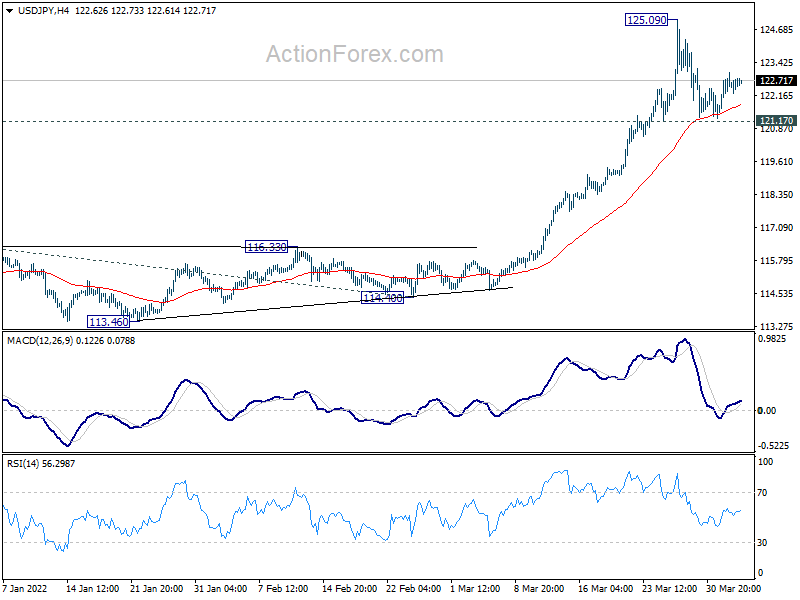
- USD/JPY has support at 121.21 and 120.48
- There is resistance at 123.25 and 124.67
Sunset Market Commentary
Markets
(European) markets took a hesitant start to the new trading week. Today’s eco calendar was thin and data with market moving potential will also be scarce for the remainder of the week. So, the market focus again turned to the war in Ukraine. Images/reports on atrocities during the weekend committed in cities near Kyiv, reinforced calls across Europe to take more decisive economic sanctions against Russia. EMU equities opened with modest losses, but a cautious bid gradually brought European indices back to unchanged levels.US indices also open little changed. Brent Oil gained modestly to $107/b, but the damage could have been bigger. European natural gas hardly reacted. Maybe it helped to prevent a more pronounced risk-off. US and European interest rate markets are reacting in a slightly different way after recent anticipation on central bank policy normalization. The US curve shows a (corrective) steepening. The 2-y eases 1.5 bps but at 2.44% is holding within reach of last week’s cycle peak. The 30-y gains 2.25 bps, after trading higher intraday. EMU bond investors fear a further escalation in mutual economic sanctions between European and Russia, annex potential negative fall-out on growth, and turn a bit more cautious on the recent sharp rise in EMU yields. This feeling was perfectly illustrated by EU Sentix investor confidence tumbling from -7.0 to -18.0. The expectations component (-29.8) even dropped to the lowest level since end 2011. German yields are declining between 3 bps (2-y) and 6 bps (10-y). EMU swap yields show a similar pattern, but the decline is less outspoken. Interestingly, after a period of remarkable resilience despite the (economic) uncertainty due to the conflict in Ukraine, intra EMU spreads are widening for the second session in a row. 10-y spreads of Spain, Portugal, but also France are widening up to 2-3 bps. Greece is the exception (-2 bps).
Persistent geopolitical uncertainty at the borders of the EU, a pause in the ECB normalization bets and wider intra-EMU spreads are eroding last week’s positive euro momentum. The EUR/USD picture hasn’t deteriorated in a profound way yet, but is showing cracks. A sustained break below the 1.10/0975 area (psychological and short-term uptrend line) would turn the focus again to the downside with 1.0951 (62 % retracement March rebound) a next reference. Other cross rates confirm that today’s EUR/USD decline is mainly euro weakness. USD/JPY gains only modestly (122.7). EUR/JPY (133.9), EUR/CHF (1.0180) and EUR/GBP falling back to 0.8385 (from 0.8435/30 this morning) all confirm a bleak euro performance. The forint (EUR/HUF 369.50) underperforms regional peers (CZK, zloty) after PM Orban maintained a comfortable two-thirds majority in yesterday’s parliamentary election, suggesting more political confrontations with the EU.
News Headlines
Turkish inflation last month accelerated to a mindboggling 61.14% y/y, up from 54.44% in February. Energy inflation climbed to 102.9% despite tax cuts. Food prices soared 70.3%. Core inflation jumped from 44.05% to 48.39%, revealing price pressures stretch way beyond energy and food. Such high numbers imply Turkish real policy rates at -47.1% are the world’s lowest. This compares to -8% or -7.4% for Europe or the US respectively. Producer price inflation remained in the triple digits, quickening from 105.01% to 114.97%. The Turkish lira trades stoic today. If anything, the currency even gains against the likes of the euro (EUR/TRY 16.16). Year-to-date, the lira is down more than 6% vs the common currency. Moves were remarkably orderly though, even amidst the Russian invasion.
Saudi Arabia, the world’s biggest oil exporter, raised oil prices for all clients in every region. The move follows soaring international prices in the wake of the Russian invasion (eg. Brent oil settled well above $100/b). It increased prices for its Arab Light crude for next month’s shipments to $9.35 p/b above the benchmark for Asia in particular. That’s up $4.4 from April, which was already a record. Global energy prices remain on the rise today as well. Europe is working on a new round of sanctions following alleged Russian atrocities near Kyiv. Pressure is building to target oil and coal imports. Brent adds 2.6% to $107 p/b.
Crude Oil Already Considered Negative News
On Monday 4 April, the Brent price is “in the black”; the asset is trading at $105.40.
This sharp decline in oil prices was caused by US President Joe Biden’s decision to “unleash” the country’s reserve oil tanks and sell 1 million barrels every day. In total, 180 million barrels are expected to be sold from May to October. Moreover, the International Energy Agency agreed to unleash its oil reserves but no particular volumes have been announced yet.
This measure is expected to be a temporary solution and won’t help to solve the supply shortage issue.
Geopolitics is slowly becoming normal. The conflict between Saudi Arabia and Houthis from Yemen is dying down as the parties agreed to cease fire. It’s good news for oil deliveries.
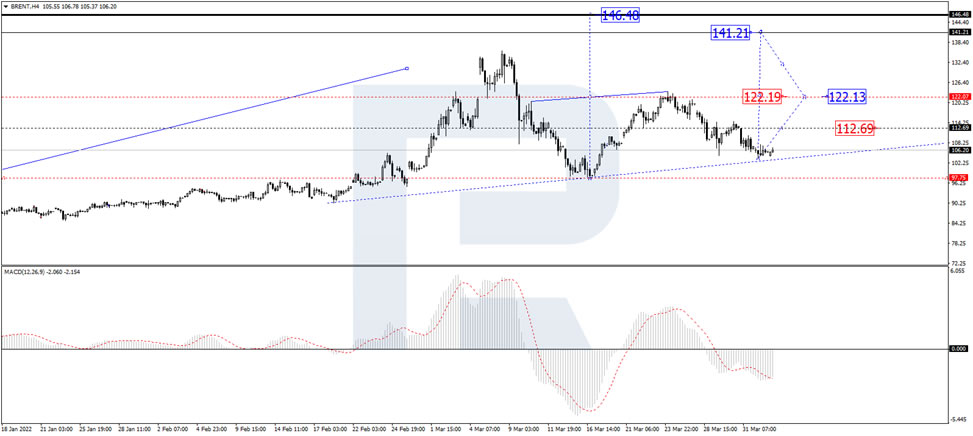
In the H4 chart, having completed the correctional structure at 113.66, Brent is consolidating around his level. If later the asset breaks this range to the upside, the market may resume growing to break 112.69 and then continue trading upwards with the first target at 122.20. After that, the instrument may correct to return to 112.70 and then resume trading upwards with the short-term target at 141.20. From the technical point of view, this scenario is confirmed by MACD Oscillator: its signal line is moving below 0 outside the histogram area, which means that it may grow to break the above-mentioned level and then continue moving towards new highs.
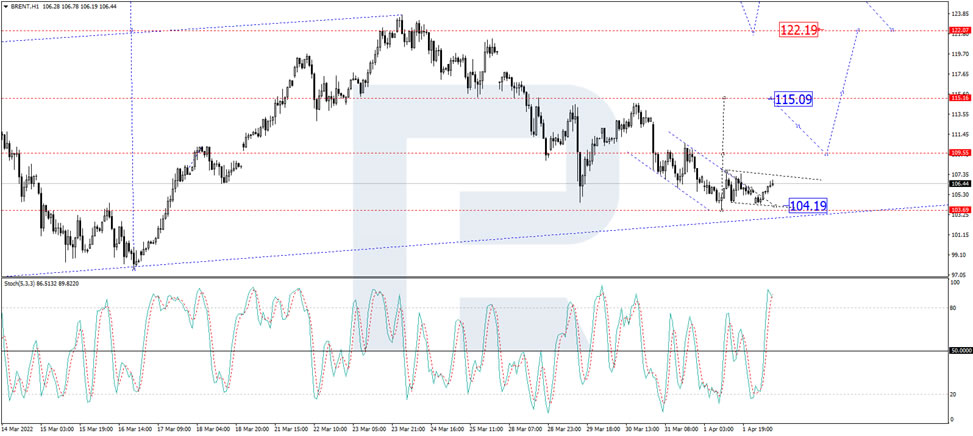
As we can see in the H1 chart, after finishing the correction and forming the first ascending impulse at 107.69, Brent is correcting downwards and may soon reach 104.20. Later, the market may start another growth to break 109.55 and then continue trading within the uptrend with the first target at 115.10. From the technical point of view, this idea is confirmed by the Stochastic Oscillator: its signal line is moving above 80 and may soon resume falling towards 50. After that, the line is expected to rebound from 50 to the upside and grow to return to 80.
Caution ahead of More Talks
European stocks are treading water on Monday and Wall Street is eyeing a similar open amid another cautious start to the week.
Virtual talks are set to resume as Europe prepares fresh sanctions against Russia following the release of disturbing images over the weekend. Pressure is ramping up on Brussels to enforce a total ban on Russian energy imports in order to enforce real damage and punishment against the Kremlin for the invasion. Of course, it's easier for some to make such demands than others.
We will likely continue to see resistance from Germany and a select few others as they're simply far more reliant on Russian imports of oil, gas and coal. Forecasts for the impact of an embargo vary but it would almost certainly tip the country into recession.
But few disagree that harsher measures are needed as Putin has clearly not been deterred despite the economic hardship he's about to drag his country through. Some of the cracks have been papered over in the near term, as we've seen with the rouble recovery and discounted exports to friendlier nations but this won't be enough to protect them in the event of a blanket ban.
We're left hoping that talks continue to make progress towards a ceasefire and exit of Russian troops but if the process so far is anything to go by, that may not happen soon. While progress has been positive for risk assets so far, they remain vulnerable to setbacks in talks which continue to take place against the backdrop of ongoing attacks.
Oil steadies as IEA prepares details of reserve release
Oil prices have pulled back considerably since peaking last month in the early days of the invasion. Declines over the last couple of weeks have been aided by lockdowns in China and a massive SPR release by the IEA, the details of which should become known early this week.
The US has already made its contribution known which will go some way to easing the tightness in the market and supply shock from Russia where sanctions are biting. This is only a temporary solution but offers a buffer over the next six months as producers ramp up production, including OPEC+ which has until now refused to accelerate its efforts in any significant way.
Oil prices remain high but they're certainly at more sustainable and less economically threatening levels. WTI slipped below $100 and could remain there depending on the full details of the IEA release and the length of Chinese lockdowns but the war in Ukraine remains a significant upside risk.
Gold holding up as recession signals flash
Gold is holding up fairly well in the face of multiple super-sized rate hikes being priced into the markets and risk appetite remaining fairly strong. The inflation risk is seemingly providing plenty of support which is why we're seeing so many rate hikes being priced into the markets, along with the downside economic risks that continue to mount.
One thing that has come with these super-sized hikes is recession risks, as evident by the inversions we're now seeing on the US yield curve. The 2-10 inversion is now clear for all to see and has previously been a fairly reliable recession indicator. Of course, it doesn't offer any kind of specific timeline and there are doubts about its reliability in an enormous Fed balance sheet world. The economic data may also provide some comfort.
But gold is holding firm and is actually up marginally on the day. It appears to have consolidated just above $1,900 over the last few weeks with brief dips below being quickly bought into. Equally, it's not making any real headway to the upside, making it quite a choppy market at the moment that offers little in the way of directional clues.
Bitcoin grinding higher
Speaking of choppy, bitcoin has been just that over the last week or so since breaking through a key resistance level. It's recovered over the last few days after finding some support around $44,000 but continues to struggle to find much momentum as it approaches last week's peak. It could still build on that breakout but it may be more of a grind than we've seen in the past, given the current environment.
USD/JPY Daily Outlook
Daily Pivots: (S1) 121.80; (P) 122.42; (R1) 123.16; More...
Intraday bias in USD/JPY remains neutral and outlook is unchanged. With 121.17 support intact, further rally is in favor. On the upside, break of 125.09 will target 161.8% projection of 109.11 to 116.34 from 114.40 at 126.09, which is close to 125.85 long term resistance. However, break of 121.17 will indicate short term topping, and bring deeper pull back.
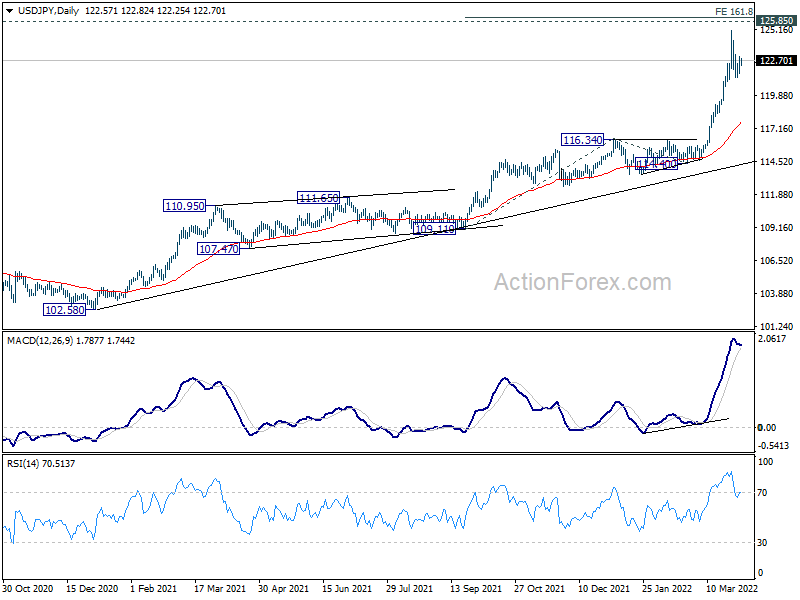
In the bigger picture, up trend from 98.97 (2016 low) in in progress for retesting 125.85 (2015 high). Sustained break there will confirm long term up trend resumption. Next target will be 61.8% projection of 75.56 (2011 low) to 125.85 (2015 high) from 98.97 at 130.04. This will now remain the favored case as long as 116.34 resistance turned support holds.
USD/CHF Mid-Day Outlook
Daily Pivots: (S1) 0.9218; (P) 0.9249; (R1) 0.9285; More....
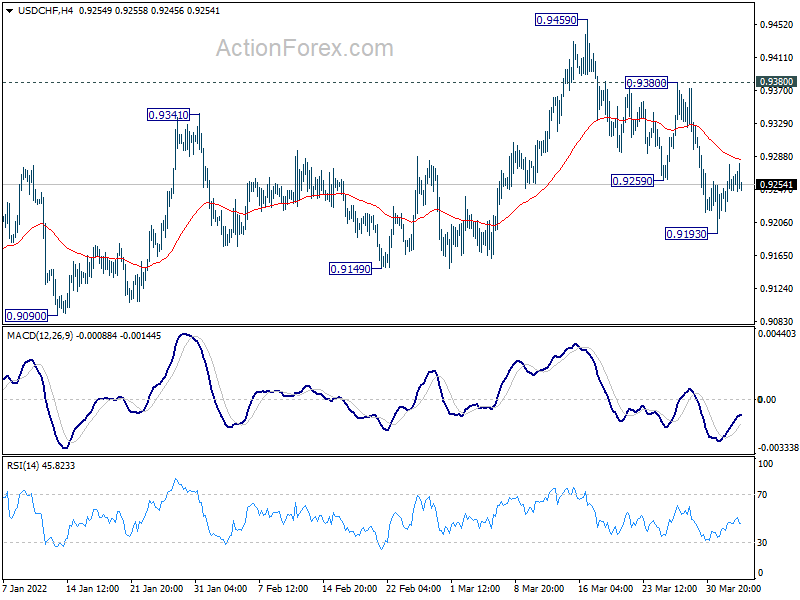
Intraday bias in USD/CHF remains neutral at this point. Further decline is expected with 0.9380 resistance intact. On the downside, below 0.9193 will resume the decline from 0.9459 to 0.9149 support. Firm break there will turn near term outlook bearish for 0.9090 support and below. On the upside, above 0.9380 resistance will flip bias back to the upside for 0.9459 resistance instead.
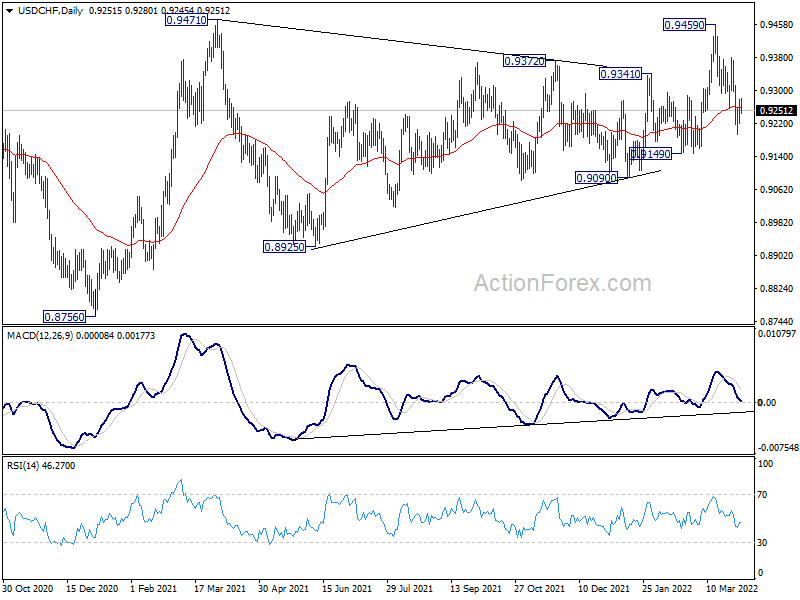
In the bigger picture, medium term outlook will be neutral at best as long as 0.9471 resistance holds. Larger down trend could still extend through 0.8756 (2021 low). However, firm break of 0.9471 will argue that whole down trend form 1.0342 (2016 high), has completed with waves down to 0.8756. A medium term up trend should be set up to target 1.0237/0342 resistance zone.
GBP/USD Mid-Day Outlook
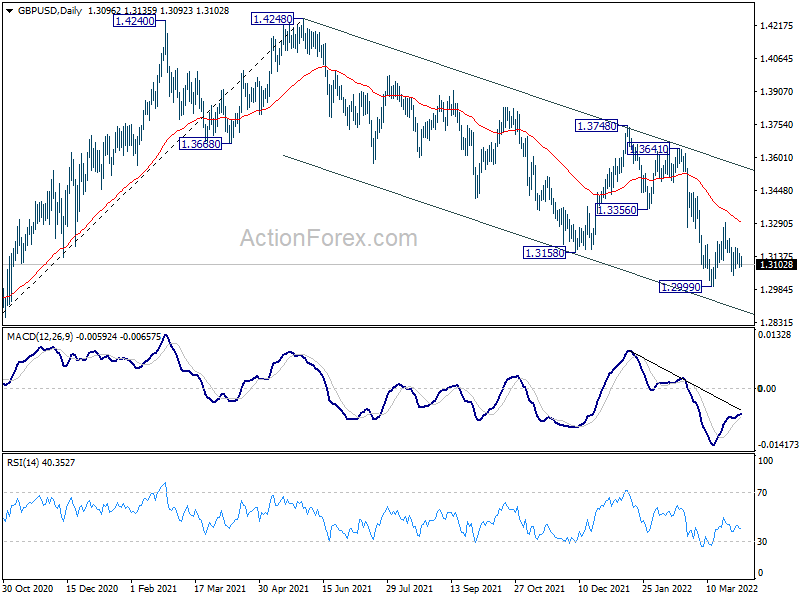
Daily Pivots: (S1) 1.3085; (P) 1.3118; (R1) 1.3150; More...
Intraday bias in GBP/USD remains neutral as sideway trading continues. Further decline is mildly in favor with 1.3297 resistance intact. On the downside, firm break of 1.2999 will resume larger down trend from 1.4248. However, firm break of 1.3297 will turn bias back to the upside for stronger rebound.
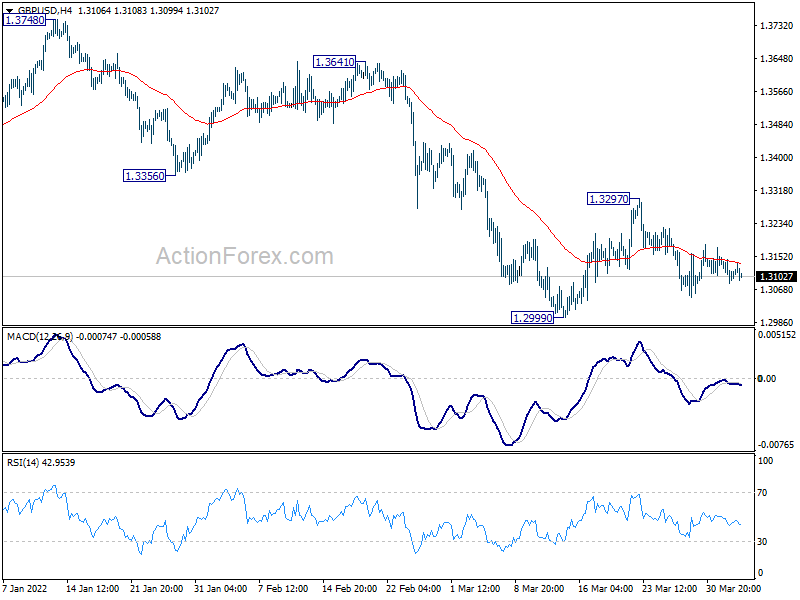
In the bigger picture, current development suggests that the up trend from 1.1409 (2020 low) has completed at 1.4248. Decline from 1.4248 could still be a corrective move, or it could be the start of a long term down trend. In either case, deeper decline would be seen back to 61.8% retracement of 2.1161 to 1.1409 at 1.2493. In any case, break of 1.3748 resistance is needed to indicate medium term bottoming, or outlook will stay bearish.