

Sample Category Title
EUR/GBP Daily Outlook
Daily Pivots: (S1) 0.8649; (P) 0.8681; (R1) 0.8705; More…
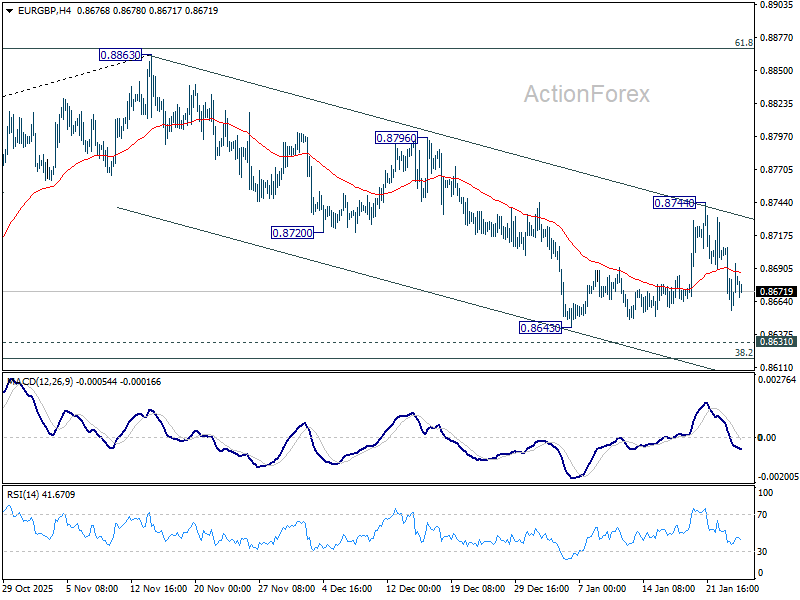
Intraday bias in EUR/GBP stays on the downside and deeper fall should be seen to 0.8631 cluster support (38.2% retracement of 0.8221 to 0.8663 at 0.8618). Decisive break there will carry larger bearish implications and pave the way to 61.8% retracement at 0.8466. Risk will now stay on the downside as long as 0.8744 resistance holds, in case of recovery.
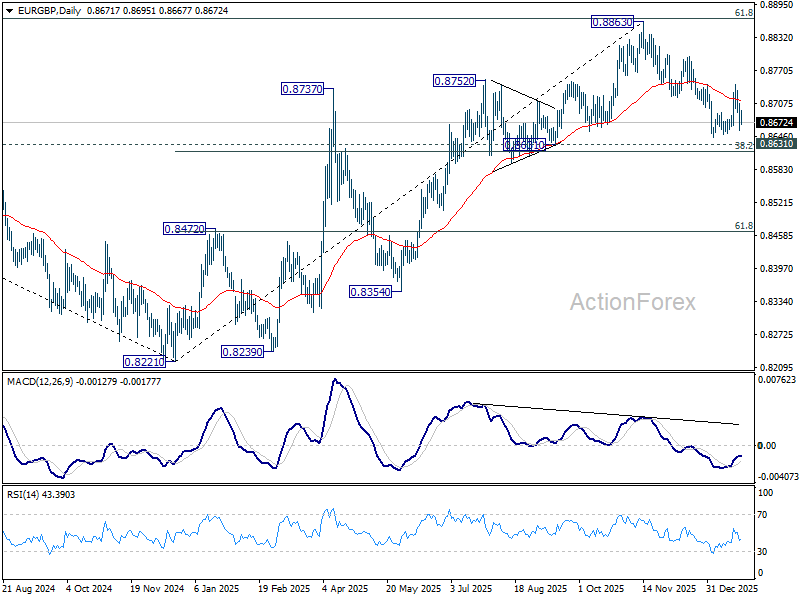
In the bigger picture, rise from 0.8221 medium term bottom (2024 low) is seen as a corrective move. Upside should be limited by 61.8% retracement of 0.9267 to 0.8221 at 0.8867. Sustained trading below 55 W EMA (now at 0.8625) should confirm that this corrective bounce has completed. In this case, deeper fall would be seen back to 0.8201/21 key support zone. However, decisive break of 0.8867 will suggest that EUR/GBP is already reversing whole decline from 0.9267 (2022 high). That should pave the way back to 0.9267.
EUR/AUD Daily Outlook
Daily Pivots: (S1) 1.7102; (P) 1.7154; (R1) 1.7209; More...
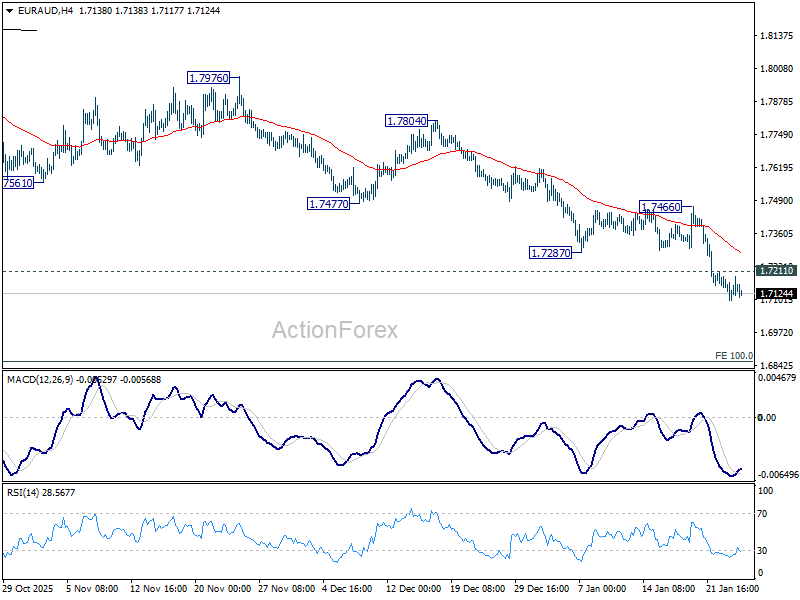
Intraday bias in EUR/AUD remains on the downside for the moment. Current fall is seen as the third leg of the pattern from 1.8554. Deeper decline should continue to 100% projection of 1.8554 to 1.7245 from 1.8160 at 1.6851. On the upside, above 1.7211 support turned resistance will turn intraday bias neutral first, and bring consolidations, before staging another decline.
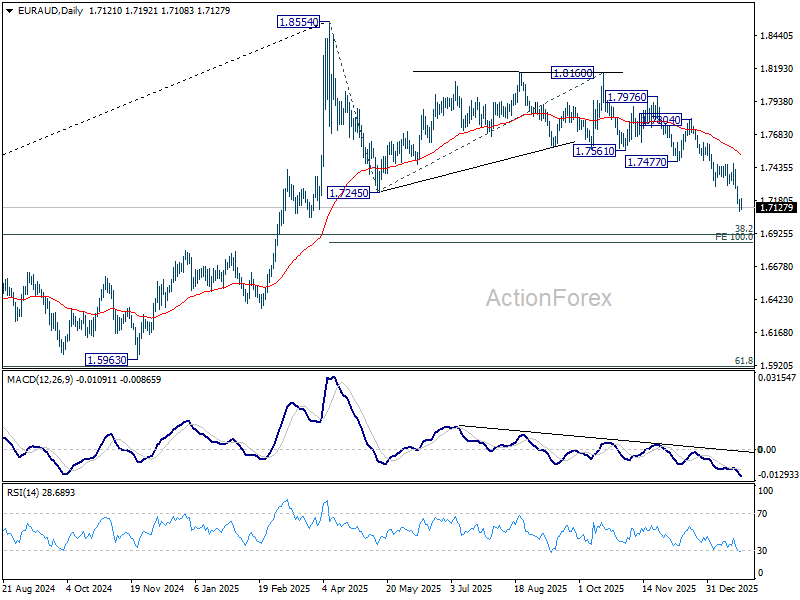
In the bigger picture, the break of 55 W EMA (now at 1.7464) argues that fall from 1.8554 medium term top is correcting whole up trend from 1.4281 (2022 low). Deeper decline is in favor to 38.2% retracement of 1.4281 to 1.8554 at 1.6922, and possibly below. Risk will stay on the downside as long as 55 D EMA (now at 1.7537) holds, in case of strong rebound.
EUR/CHF Daily Outlook
Daily Pivots: (S1) 0.9202; (P) 0.9246; (R1) 0.9276; More....
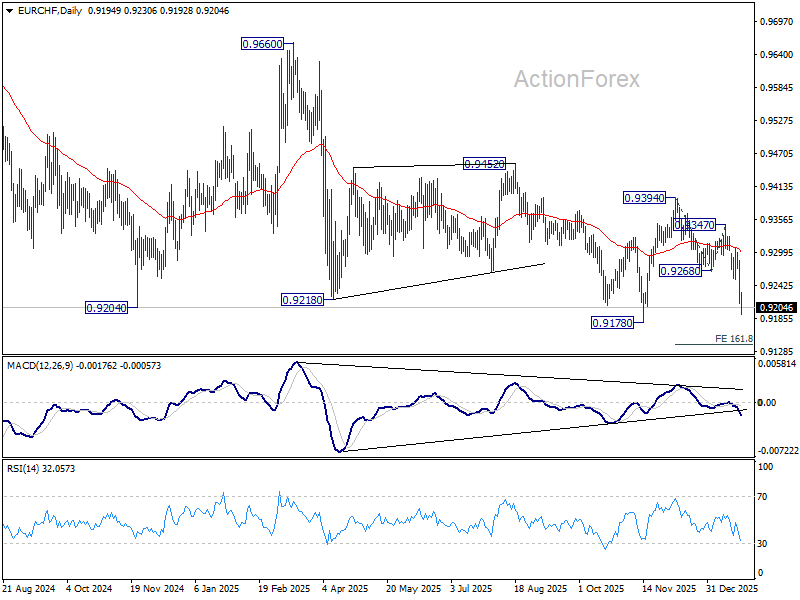
Intraday bias in EUR/CHF stays on the downside for retesting 0.9178 low. Firm break there will resume larger down trend. On the upside, above 0.9253 support turned resistance will turn intraday bias neutral and bring consolidations, before staging another decline.
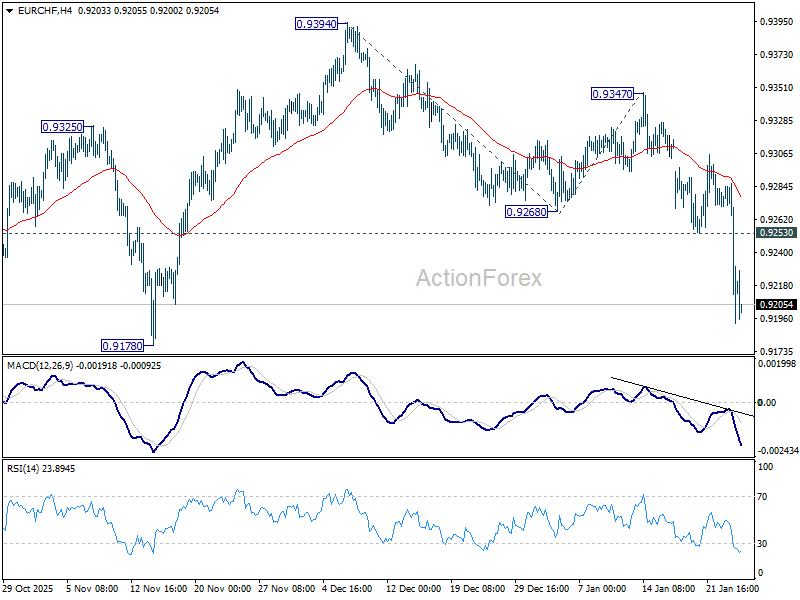
In the bigger picture, another rejection by 55 W EMA (now at 0.9350) keeps outlook bearish. Downtrend from 1.2004 (2018 high) is still in progress. Firm break of 0.9178 will target 61.8% projection of 1.1149 to 0.9407 from 0.9928 0.8851. Outlook will stay bearish as long as 0.9394 resistance holds, in case of recovery.
AUD/USD Daily Report
Daily Pivots: (S1) 0.6853; (P) 0.6876; (R1) 0.6918; More...
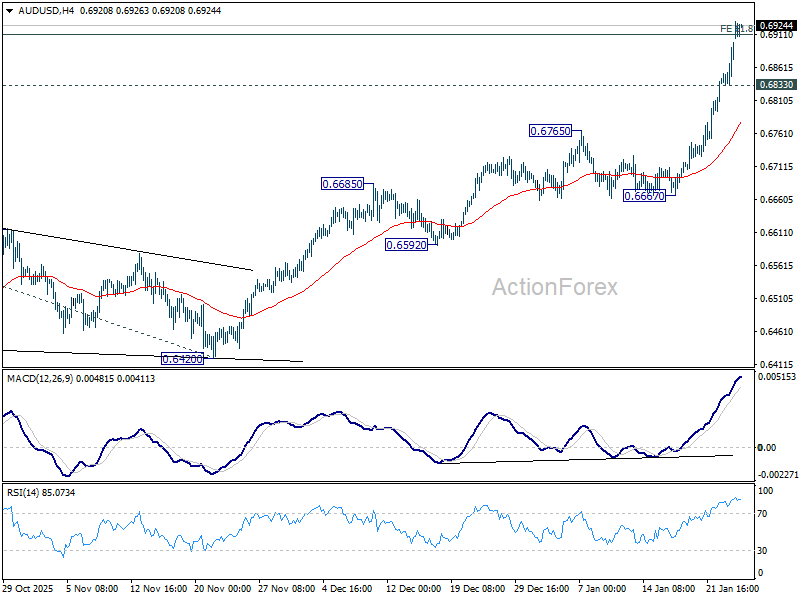
AUD/USD's rally continues today and intraday bias stays on the upside, sustained trading above 61.8% projection of 0.5913 to 0.6706 from 0.6420 at 0.6910 will pave the way to 100% projection at 0.7213. On the downside, below 0.6833 minor support will turn intraday bias neutral and bring consolidations first. But downside of retreat should be contained well above 0.6667 support to bring another rally.
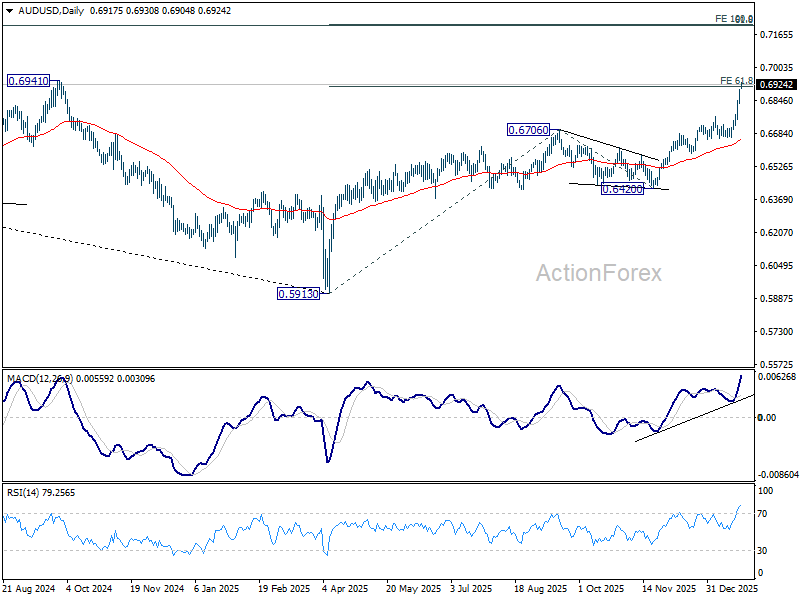
In the bigger picture, current development argues that rise from 0.5913 (2024 low) is reversing whole down trend from 0.8006 (2021 high). Further rally should be seen to 61.8% retracement of 0.8006 to 0.5913 at 0.7206. This will remain the favored case as long as 0.6420 support holds, even in case of deep pullback.
USD/CAD Daily Outlook
Daily Pivots: (S1) 1.3663; (P) 1.3732; (R1) 1.3769; More...
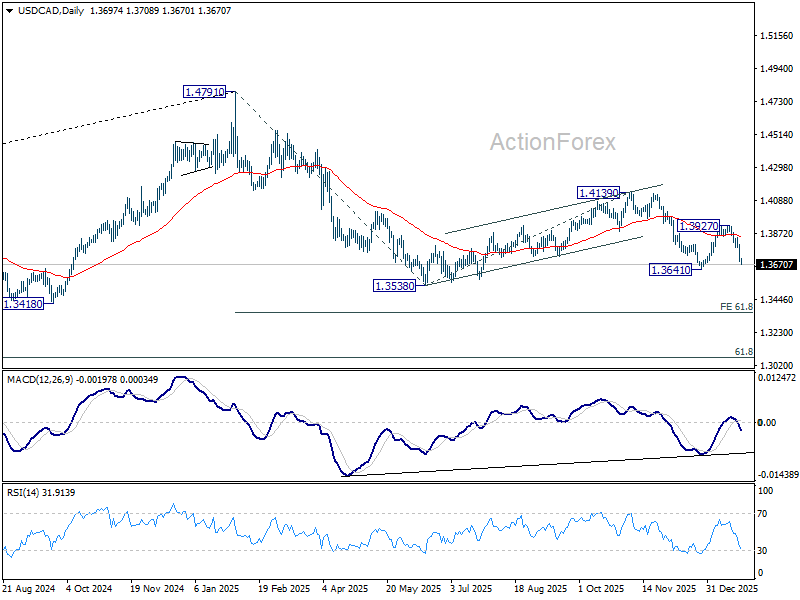
Intraday bias in USD/CAD remains on the downside for 1.3641 support. Firm break there will resume the decline from 1.4139 and target a retest on 1.3538 low. On the upside, above 1.3724 minor resistance will turn intraday bias neutral and bring consolidations first.
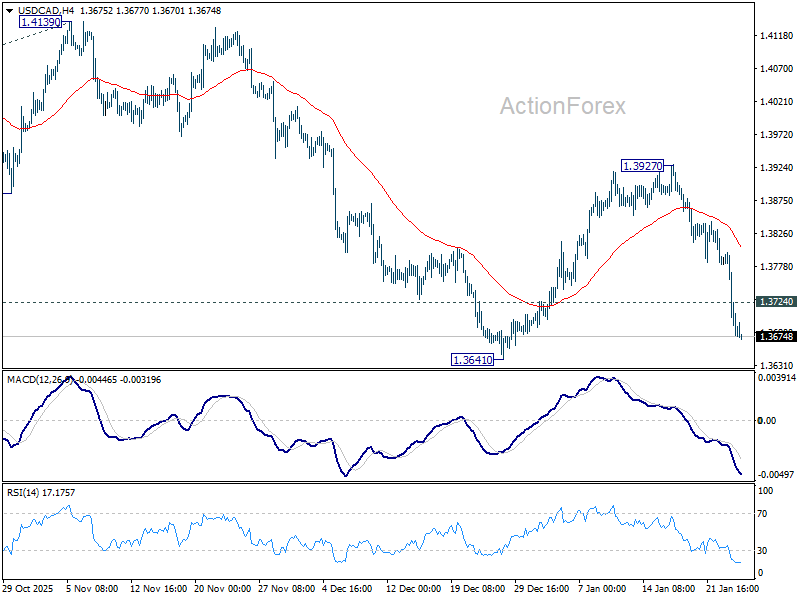
In the bigger picture, price actions from 1.4791 are seen as a corrective pattern to the whole up trend from 1.2005 (2021 low). Deeper fall could be seen as the pattern extends, and break of 1.3538 will target 61.8% retracement of 1.2005 to 1.4791 at 1.3069. For now, medium term outlook will be neutral until there are signs that the correction has completed.
EUR/USD Daily Outlook
Daily Pivots: (S1) 1.1760; (P) 1.1797; (R1) 1.1866; More….
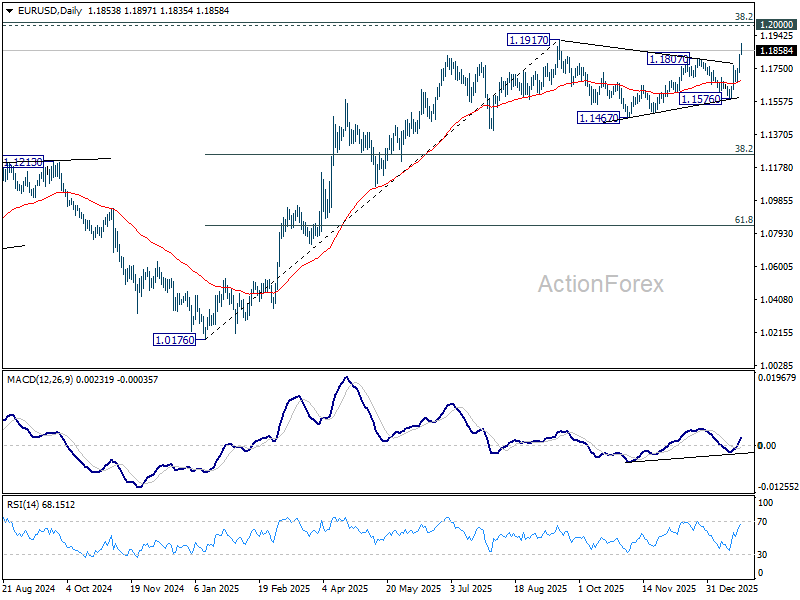
Intraday bias in EUR/USD stays on the upside for retesting 1.1917 key resistance. Firm break there will resume larger up trend. On the downside, below 1.1812 minor support will mix up the outlook and turn intraday bias neutral again.
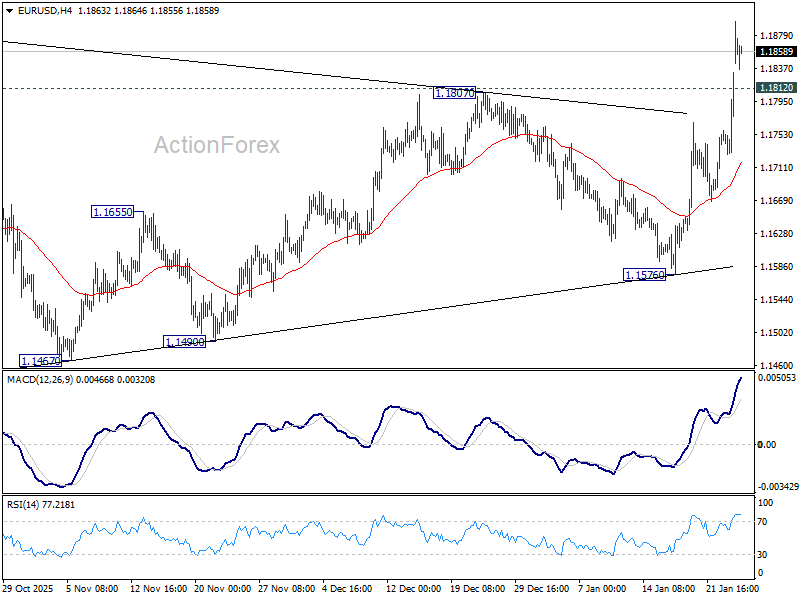
In the bigger picture, as long as 55 W EMA (now at 1.1443) holds, up trend from 0.9534 (2022 low) is still in favor to continue. Decisive break of 1.2 key psychological level will carry larger bullish implication. However, sustained trading below 55 W EMA will argue that rise from 0.9534 has completed as a three wave corrective bounce, and keep long term outlook bearish.
GBP/USD Daily Outlook
Daily Pivots: (S1) 1.3534; (P) 1.3590; (R1) 1.3698; More...
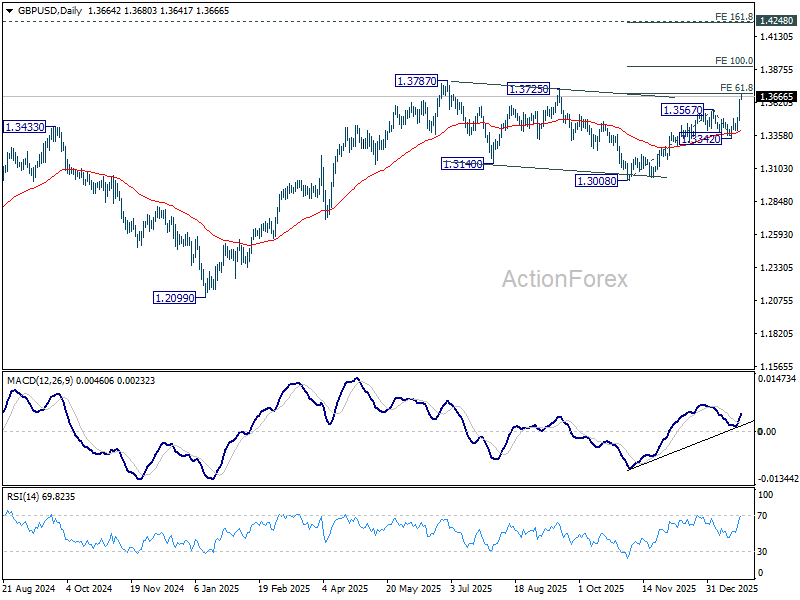
GBP/USD's rally continues today and intraday bias stays on the upside at this point. Firm break of 61.8% projection of 1.3008 to 1.3567 from 1.3342 at 1.3687 should prompt upside acceleration through 1.3787 high to 100% projection at 1.3901. On the downside, below 1.3591 minor support will turn intraday bias neutral. But retreat should be contained well above 1.3342 support to bring another rally.
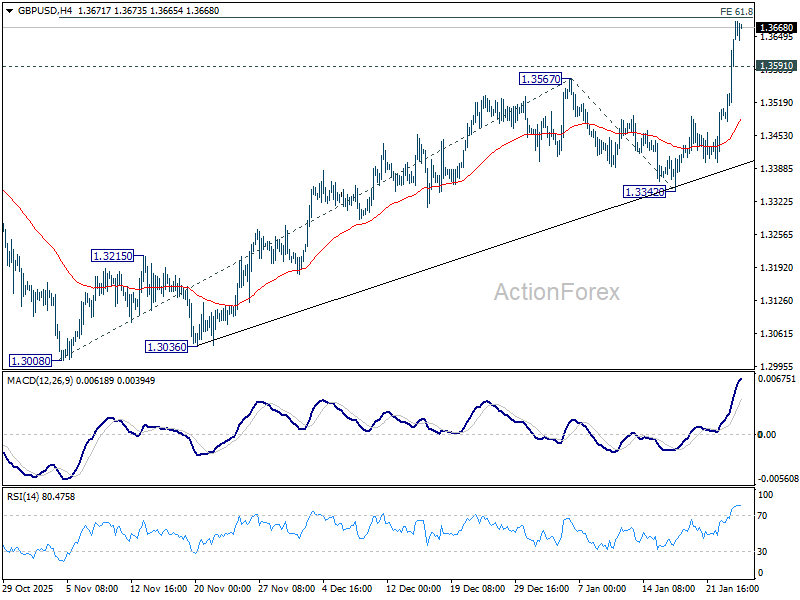
In the bigger picture, price actions from 1.3787 (2025 high) are seen as a correction to the larger up trend from 1.3051 (2022 low). That might have completed at 1.3008 already. Firm break of 1.3787 will confirm up trend resumption. Next target is 1.4284 key resistance (2021 high). This will remain the favored case as long as 1.3008 support holds.
USD/CHF Daily Outlook
Daily Pivots: (S1) 0.7754; (P) 0.7836; (R1) 0.7884; More….
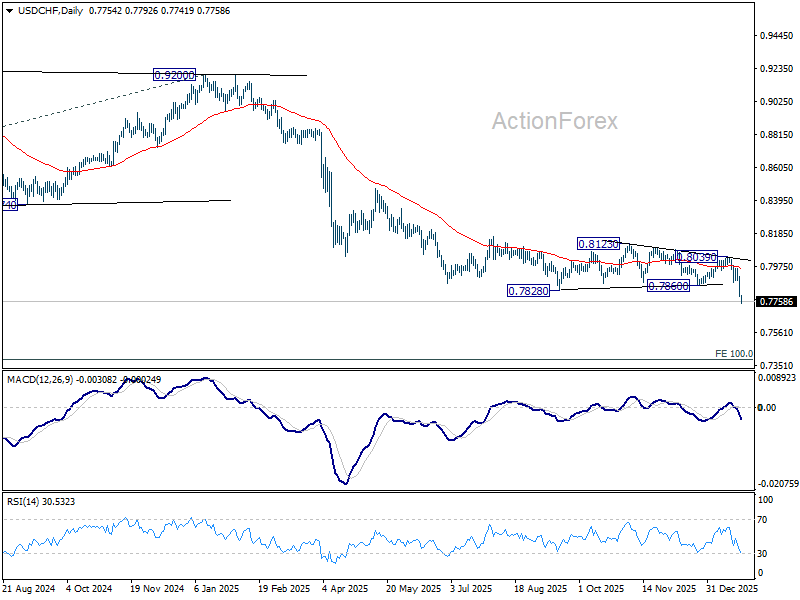
Intraday bias in USD/CHF stays on the downside. Current fall is part of the larger down trend and should target 0.7382 projection level. On the upside, above 0.7828 minor resistance will turn intraday bias neutral first. But recovery should be limited well below 0.8039 resistance to bring another fall.
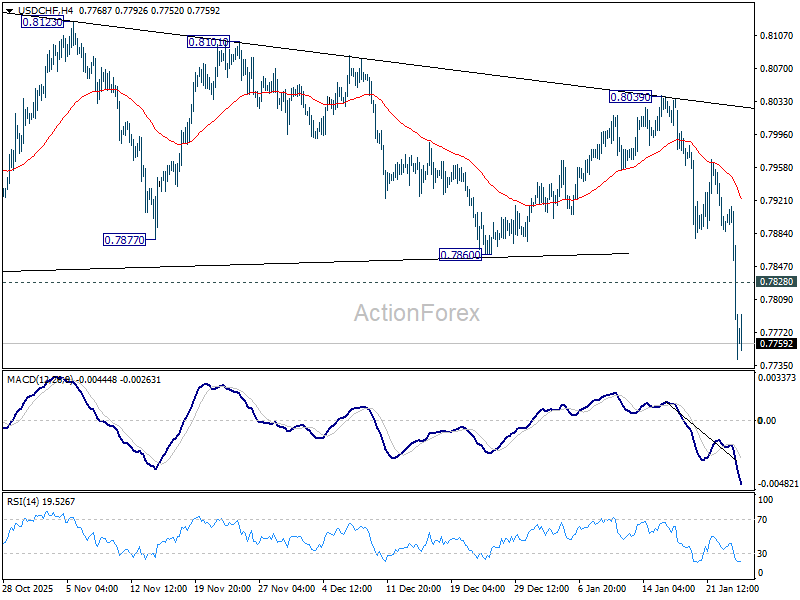
In the bigger picture, larger down trend from 1.0342 (2017 high) is still in progress and resuming. Next target is 100% projection of 1.0146 (2022 high) to 0.8332 from 0.9200 at 0.7382. In any case, outlook will stay bearish as long as 55 W EMA (now at 038199) holds.
German Ifo stalls at 87.6, as weak momentum carries into new year
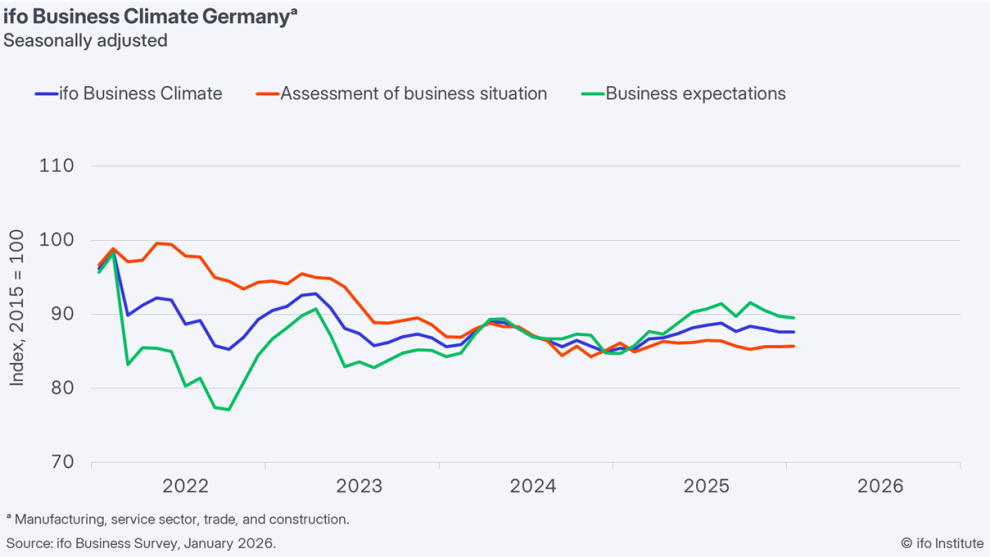
Germany’s Ifo Institute Business Climate Index was unchanged at 87.6 in January, undershooting expectations for a modest improvement to 88.3. The stagnant headline reading reinforces the view that Germany’s economy is entering the new year without meaningful traction.
Beneath the surface, the details were mixed. Current Assessment Index edged slightly higher from 85.6 to 85.7, suggesting conditions have stabilized but remain weak. In contrast, Expectations Index slipped from 89.7 to 89.5, indicating that confidence about the months ahead has softened rather than improved.
Sector performance highlighted the uneven picture. Manufacturing showed a notable improvement, rising from -14.6 to -12.2, while trade and construction also edged higher to -21.1 and -14.2 respectively. Services, however, deteriorated from -2.1 to -2.6. Ifo summed up the survey bluntly, saying the German economy is "starting the new year with little momentum".
Gold Surges Above 5,000 USD: Safe-Haven Demand Explodes
Gold has broken through the historic 5,000 USD per troy ounce mark, rising above 5,075 USD for the first time. The metal continues its record rally as investors aggressively shift into defensive assets amid escalating trade and geopolitical uncertainty.
The main catalyst was renewed rhetoric from US President Donald Trump. Over the weekend, he stated that Washington would seek sovereignty over parts of Greenland where US military bases are located. These comments reignited market anxiety, coming just days after a temporary easing of tariff threats against several European countries.
Further pressure on global markets followed Trump’s warning to Canada. He stated that all Canadian exports to the US could face 100% tariffs if Ottawa finalises a trade agreement with China. The statement came a week after Canadian Prime Minister Mark Carney announced a preliminary deal with Beijing, which involves a mutual reduction in tariffs.
Geopolitical risks also remain elevated. Ukraine and Russia held another round of US-mediated talks without reaching an agreement, although both sides signalled readiness to continue negotiations next weekend.
As a result, rising geopolitical tensions and aggressive trade threats have sharply increased capital inflows into gold, further strengthening its role as the primary global safe-haven asset.
Technical Analysis
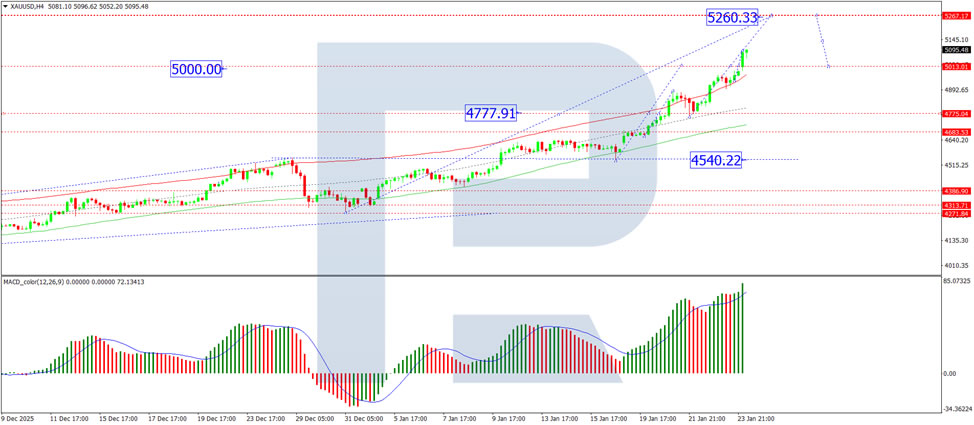
On the H4 XAUUSD chart, gold has confidently broken above 5,000 and is now developing a strong bullish wave towards the 5,215 level. After reaching this area, a corrective pullback towards 5,000 is possible. The MACD confirms strong upside momentum, with the signal line at highs and pointing firmly upwards.
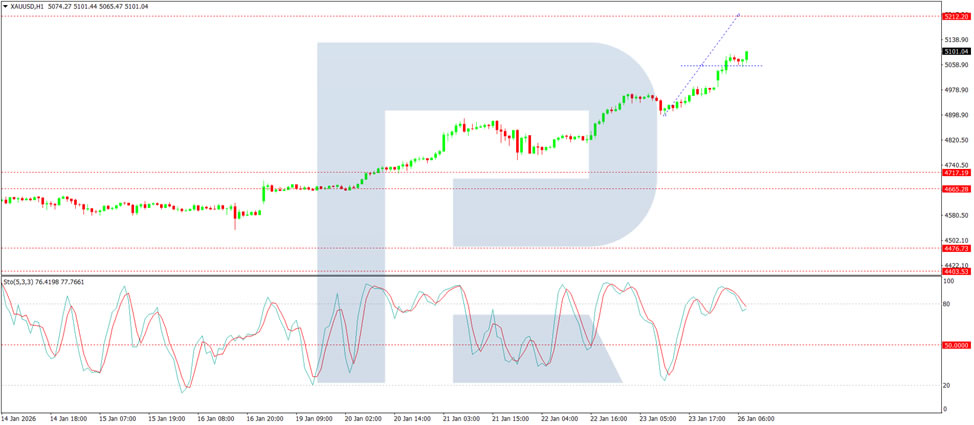
On the H1 chart, the price has broken and consolidated above the 5,050 level, which is acting as support. The trend is expected to extend towards 5,200. The Stochastic oscillator supports this bullish scenario, with the signal line above 50 and continuing to rise.
Conclusion
Gold has entered a new historical phase above 5,000 USD, driven by escalating geopolitical risks and aggressive US trade rhetoric. As long as uncertainty around global politics and trade persists, gold is likely to remain strongly supported, with further upside potential despite the risk of short-term technical corrections.