

Sample Category Title
Gold Bears are Back in Play: Elliott Wave Analysis
US Dollar Index, DXY still eyeing for more upside, out of a triangle while SP500 is approaching resistance. Risk-off will be a catalyst for more dollar strength, even vs. some comm. currencies. The question is what can cause risk-off? Well, it can be a disappointment for Ukraine-Russia talk that just started in Turkey.
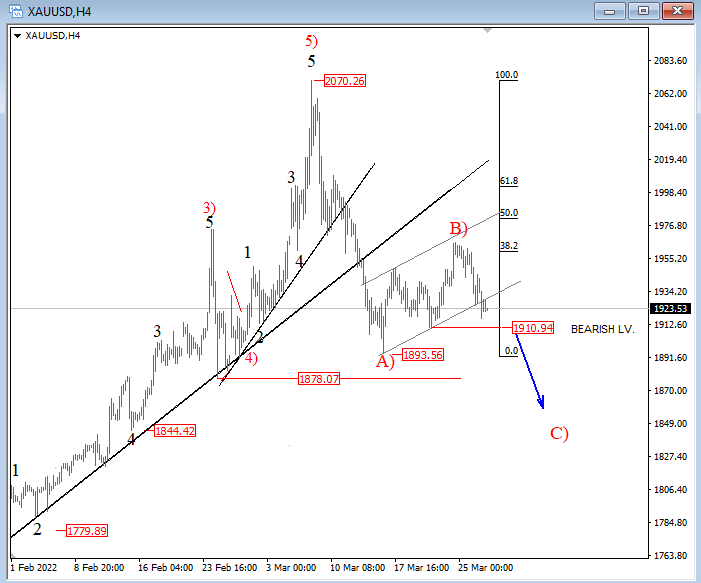
Gold is coming down after three up, so bears are back in play and they could extend even lower this week, below 1895 as the corrective rally should be fully retracted.
Gold 4h Elliott Wave analysis
Market Mood Lifted By Renewed Peace Talks Hopes
A sense of positivity returned to financial markets as the prospects of more ceasefire talks between Russia and Ukraine soothed investor jitters.
Asian shares opened higher on Tuesday morning, tracking the positive overnight cues from Wall Street as market players cast aside fears of rising interest rates to focus on geopolitical developments. European pushed higher this morning amid the improving market mood, with the risk-on sentiment potentially keeping US equity bulls in the driving seat later this afternoon.
In the currency arena, the yen hijacked our attention by weakening to levels not seen in seven years as the Bank of Japan intervened in bond markets to cap yields. Oil prices tumbled as China lockdowns prompted demand worries, while gold stood little chance against an appreciating dollar and rising Treasury yields. The widely watched US 10-year Treasury yield hit 2.5% yesterday.
On the geopolitical front, Ukraine’s president has said he is willing to discuss becoming a neutral country as part of a peace deal with Russia. Should a ceasefire agreement become reality, this could boost global sentiment further and revive investor confidence, sending equity markets higher.
Japanese Yen melts as BoJ intervenes
The yen is struggling to nurse the deep wounds inflicted by yesterday’s painful selloff. It weakened to a seven-year low against the dollar after the Bank of Japan (BoJ) offered to buy an unlimited amount of 10-year Japanese Government Bonds after yields rose to a fresh six-year high of 0.255%.
One would think that the extreme levels of uncertainty and geopolitical risks would send investors rushing towards the yen. However, the currency has weakened against every G10 currency since 24 February, when Russia began its invasion of Ukraine.
It is becoming clear that the yen’s weakness is a product of central bank divergence among other themes. While the Fed is willing to raise interest rates aggressively to tame rising inflation, the BoJ continues to stick with its dovish policy settings. If it carries on intervening to prevent yields from rising beyond the 0.25% policy target while other major market yields continue to rise, this could result in further yen weakness.
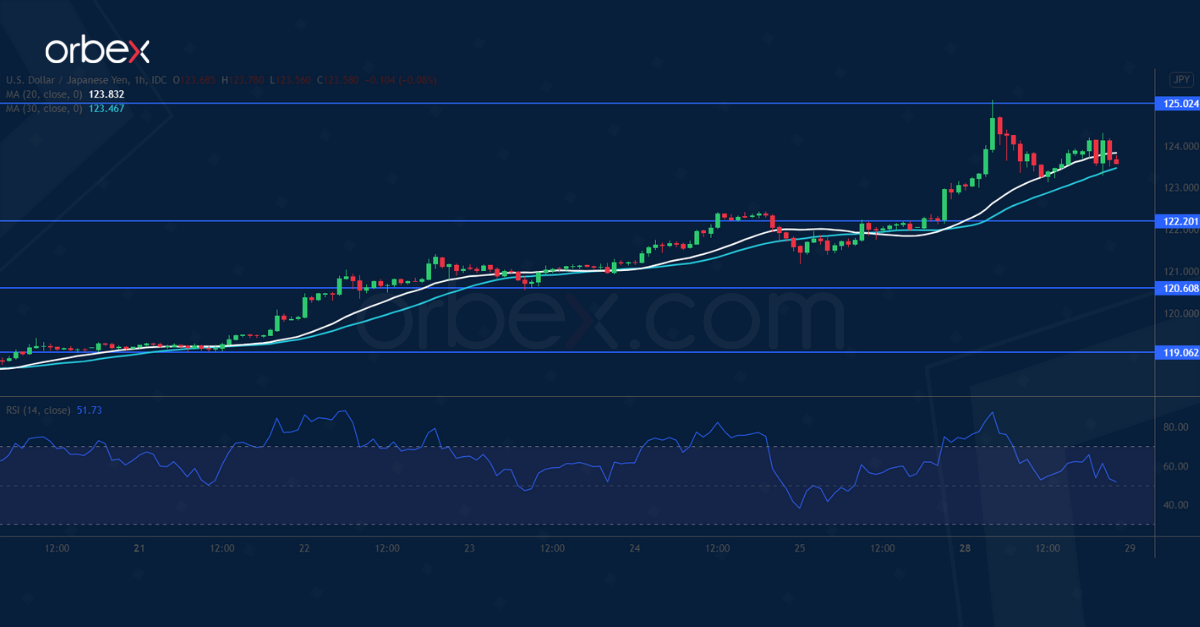
Looking at the technical picture, USD/JPY is heavily bullish on the daily charts. A strong close above 125.00 could open the door to the 2015 high around 125.85. Should 125.00 prove to be reliable resistance, prices could decline back towards 122.50 before experiencing some consolidation.
Oil prices shaky ahead of OPEC+ meeting
Oil benchmarks were shaky this morning after falling in the previous session amid fears over weaker fuel demand in China. WTI Crude and Brent have shed over 7% since the start of this week.
The world’s second-largest economy has announced its biggest city-wide lockdown since the Covid outbreak started more than two years ago. Given how China is the world’s largest crude consumer, this development continues to weigh on oil markets.
There could also be more volatility ahead with the OPEC+ meeting on Thursday. The cartel will determine output production beginning in May with markets expecting the group to stick with its pre-planned production quota hike of 400,000 barrels per day. Expect oil to remain sensitive to any news revolving around the China lockdown and Ukraine developments.
Gold breakdown on the horizon?
This could be a rough week for gold as renewed peace talks rekindle risk appetite. An appreciating dollar and rising Treasury yields are likely to rub salt into the wound, sending the precious metal on a slippery decline. On top of this, the US jobs report on Friday could compound gold’s woes if the numbers exceed market expectations.
Looking at the technical picture, prices have the potential to sink lower if a solid breakdown below the $1910 support is achieved. This could open the door towards $1900 and $1875. Should $1910 prove to be reliable support, prices may rebound back towards $1965 and $2000, respectively.
American Equities Mixed as Bond Yields Flash Warning Signs
American equities were relatively mixed on Monday as investors watched the performance of the bond market and the war in Ukraine. On Monday, the yield curve inverted for the first time since 2016 as the yields of shorter-term bonds outperformed the longer-term ones. The 10-year yield retreated to 2.45% while the 30-year yield was about 2.50%. The performance of these bonds is a sign that the market is now pricing in a recession as the Fed embraces a more hawkish sentiment. Officials have warned that they could be forced to implement several 50 basis point rate hikes in upcoming meetings. Some of the top movers in Wall Street were firms like AMC, Gamestop, Coinbase, and Tesla.
The US dollar index rose slightly as investors waited for the upcoming consumer confidence data. Economists expect that data by Conference Board will show that the country’s confidence declined slightly in March as inflation concerns remain. They see the confidence number falling from 111 in February to 107 in February. Last week, a similar number by Michigan University showed that confidence declined to the lowest level in about a decade. The Bureau of Labor Statistics will also publish the latest job openings numbers.
Cryptocurrency prices continued doing well in the overnight session even as the yield curve inverted. Analysts expect that Russia and other countries will start to embrace Bitcoin as a means of exchange or store of value. For one, western countries like the US have deployed their currencies as a form of economic warfare. Also, there is optimism that some countries will embrace more user-friendly regulations this year. Bitcoin prices rose to over $48,000 while the total market cap of all digital currencies rose to over $2 trillion.
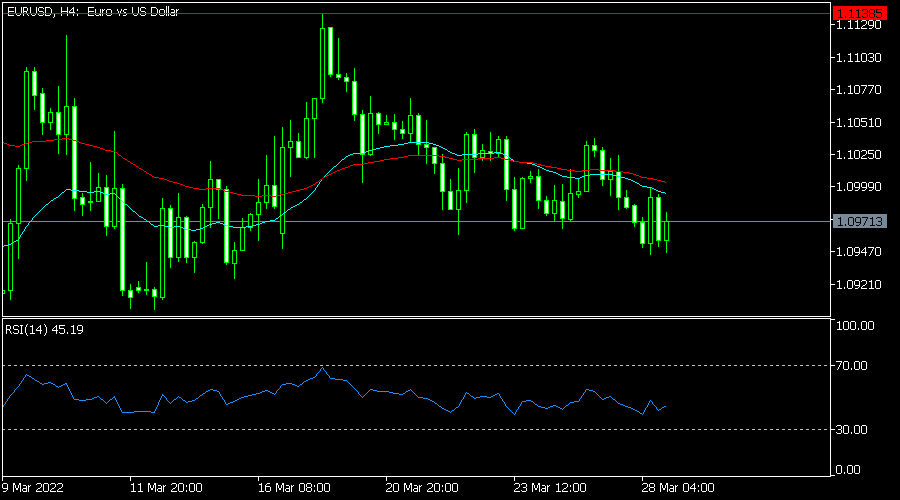
EURUSD
The EURUSD pair remained in a consolidation mode as investors watched the performance of the American bond market. It is trading at 1.0970, where it has been in the past few days. This price is along the 23.6% Fibonacci retracement level. It has also moved slightly below the 25-day and 50-day moving averages while the Relative Strength Index (RSI) has moved to the neutral level. Therefore, the pair will likely remain in this range today.
GBPUSD
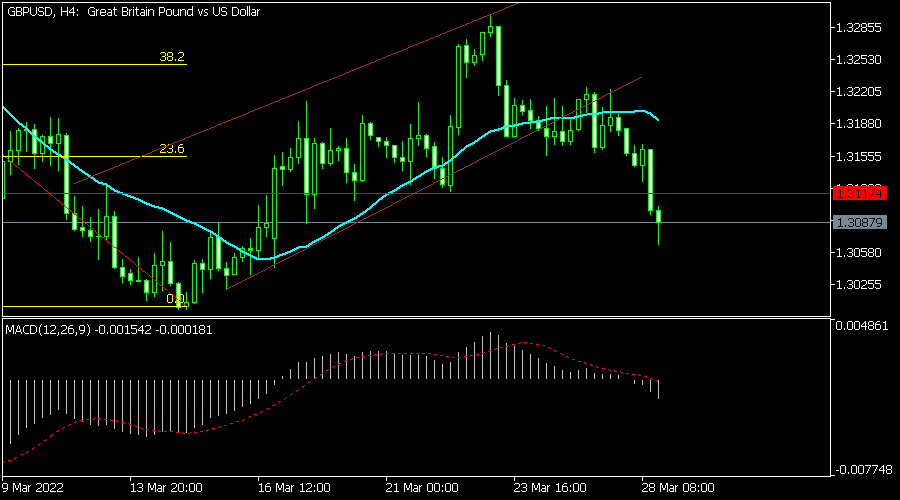
The GBPUSD pair has been in a strong bearish trend in the past few days. It is trading at 1.3087, which is close to the lowest level since March 17. It has moved below the ascending channel shown in brown and the 25-day moving average. Further, the pair has moved below the important support level at 1.3117 while oscillators are pointing downwards. Therefore, the pair will likely have a bearish breakout in the coming days.
XNGUSD
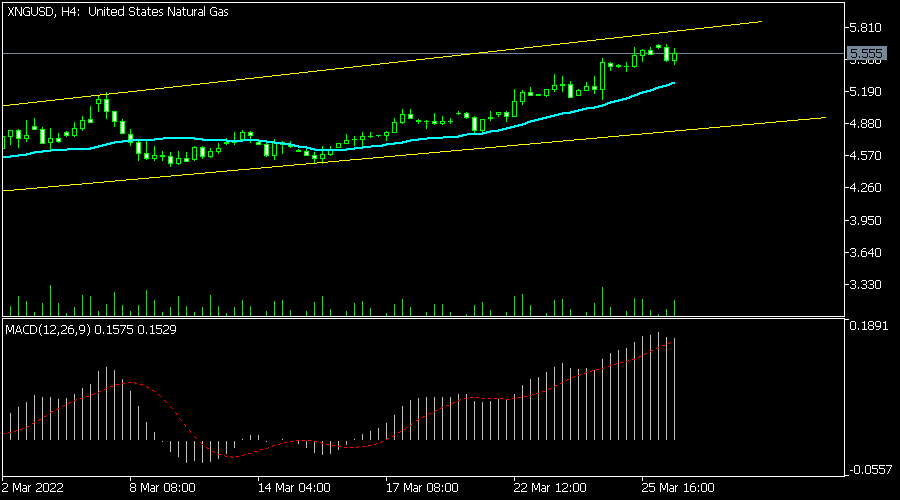
The XNGUSD pair has been in a bullish trend because of the ongoing crisis in Russia. There are expectations that Russia will limit the flow of natural gas to some European countries, which will lead to shortages. It is slightly below the upper side of the ascending channel and is also slightly above the 25-day moving average. Therefore, the pair will likely maintain its bullish trend.
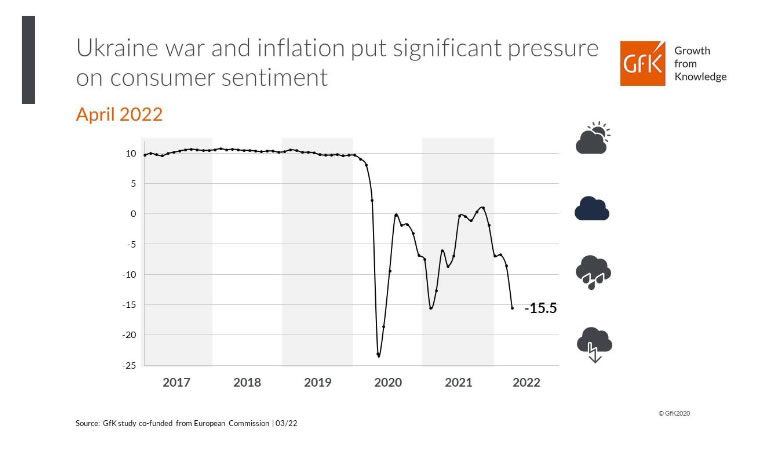
Germany Gfk consumer sentiment dropped to -15.5, hopes vanished into thin air
Germany Gfk consumer sentiment for April dropped sharply from -8.5 to -15.5. In March, economic expectations dived from 24.1 to -8.9, lowest since May 2020 during the first lockdown at -10.4. Income expectations tumbled from 3.9 to -22.1, hitting the lowest value since 2009, which was at -22.9. Propensity to buy dropped slightly from 1.4 to -2.1.
"In February hopes were still high that consumer sentiment would recover significantly with the foreseeable easing of pandemic-related restrictions. However, the start of the war in Ukraine caused these hopes to vanish into thin air. Rising uncertainty and sanctions against Russia have caused energy prices in particular to skyrocket, putting a noticeable strain on general consumer sentiment," explains Rolf Bürkl, GfK consumer expert.
None of the G10 Peers Did Worse than the JPY
Markets
The violence to which bonds sold off in Asian dealings yesterday eased a bit in European and US trading hours. The Japanese 10y yield stayed marginally above the 0% + 25 bps upper limit for most of the day still, even as the BoJ offered unlimited bond buying twice. Front end yields in the US jumped almost 14 bps at some point before paring gains as the session evolved to about 6 bps (2y, 3y). Bidding metrics of the dual ST bond auction eased. The $50bn 2y auction tailed while both the 2y and the $51bn 5y were awarded the biggest yield since early 2019. Yields further down the curve finished the day up to 4.5 bps lower. There was similar flattening in Germany with changes ranging from +1.8 bps (2y) to -1.9 bps (30y).
In FX space, commodity currencies including the NOK and kiwi dollar were under pressure as the broad commodity rally went in reverse for the day (e.g. Brent oil down 7%). None of the G10 peers did worse than the JPY though. USD/JPY surged to an intraday high of more than 125. The pair closed at 123.86 eventually, still the highest since end 2015. DXY (trade-weighted dollar) tested the YtD highs but was unable to force a break higher. The USD also ruled over the euro for a large part of the day. But the common currency straightened up and capped EUR/USD losses to just below 1.10. EUR/GBP jumped from 0.833 to near 0.84. BoE governor Bailey explained the softened rates guidance against the backdrop of increased uncertainty. Hiking bets were marginally pared back. UK yields dropped as much as 10 bps at the long end.
A new round of ceasefire talks between Ukrainian and Russian negotiators starts today in Turkey. An FT report yesterday suggesting Russia is dropping some demands helped shape sentiment in late US dealings and may also explain the fairly optimistic equity mood this morning. Core bonds are being shed relentlessly. US short term yields rise more than 6 bps. FX markets trade quiet. The Japanese yen strengthens slightly to USD/JPY 123.55. Japanese Minister of Finance Suzuki received orders from PM Kishida to come up with measures to cushion the impact of high energy prices which are being amplified by the slumping yen.The economic calendar only gets moderately interesting today. US Conference Board consumer confidence is expected to fall to the lowest since February last year (107). The indicator is strongly influenced by the currently excellent shape of the labour market. However, war- and inflation-driven uncertainty will probably have affected the March reading more. We don’t expect it to materially affect reigning market trends though. Markets have fully embraced the idea of the Fed frontloading policy action, supporting both yields and the USD. While they also expect the ECB to fall in line (four 25 bps hikes discounted by Q1 2023), uncertainty about the war is keeping the euro at bay. This may remain the case for the time being.
News Headlines
US president Biden yesterday proposed a $5.79 trillion budget plan to Congress for the fiscal year that will start on October 1. The final approval is with Congress lawmakers. The proposal seeks a record in military spending of $813 bln in 2023. At the same time, in a effort to rein in the budget deficit, the proposal aims to raise taxes for the wealthiest individuals and companies. According to the White House, the budget deficit would decline to 5.8% of GDP this year and remain below 5.0% the next decade. The budget sees the debt held by the public declining to 101.8% at the end of 2023. However, debt is still expected to rise further over the following years to reach 106.7% of GDP by 2032.The ECB and the National Bank of Poland agreed to set up a new swap line that will stay in place till 15 January 2023. Under the new swap line, the NBP will be able to borrow up to €10 bln from the ECB in exchange for zloty. The ECB also extends existing temporary repo lines with non-euro central banks to the same date. Euro liquidity lines address possible liquidity needs in non-euro area countries given uncertainty from Russian invasion of Ukraine and regional spill-over risk. Those liquidity lines were scheduled to expire end of March 2022 as they were originally aimed at addressing possible euro liquidity caused by dysfunctions due to the coronavirus (COVID-19) pandemic.
Daily Technical Analysis
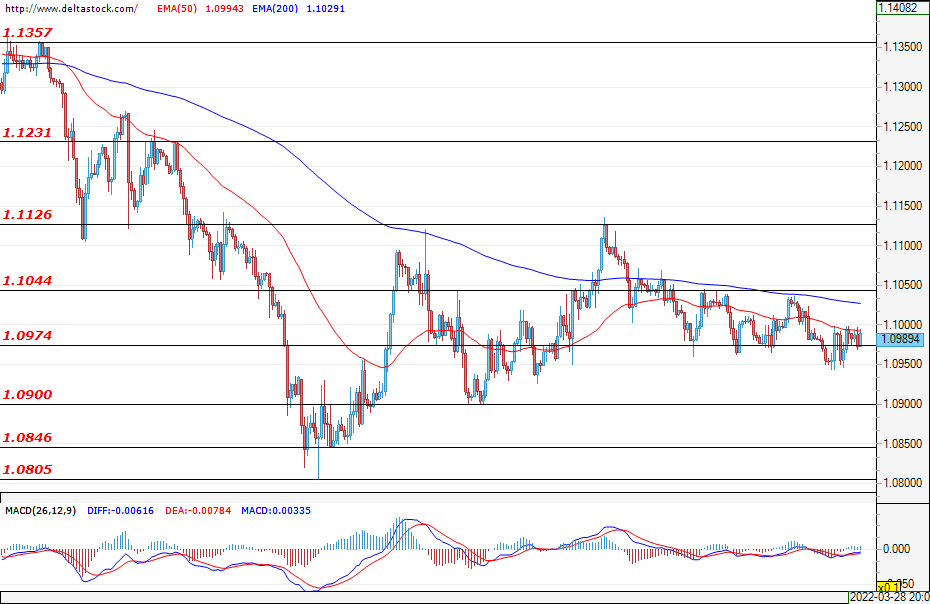
EUR/USD
At the time of writing, the currency pair is consolidating just above the support level at 1.0974 after several unsuccessful attempts to breach that level. Currently, the most likely scenario for the currency pair is for it to maintain the range movement in the narrow channel of 1.0974 – 1.1044, but in the event of bullish predominance, the first significant resistance would be the level at 1.1126. There is no economic news planned for today that could affect the market.
USD/JPY
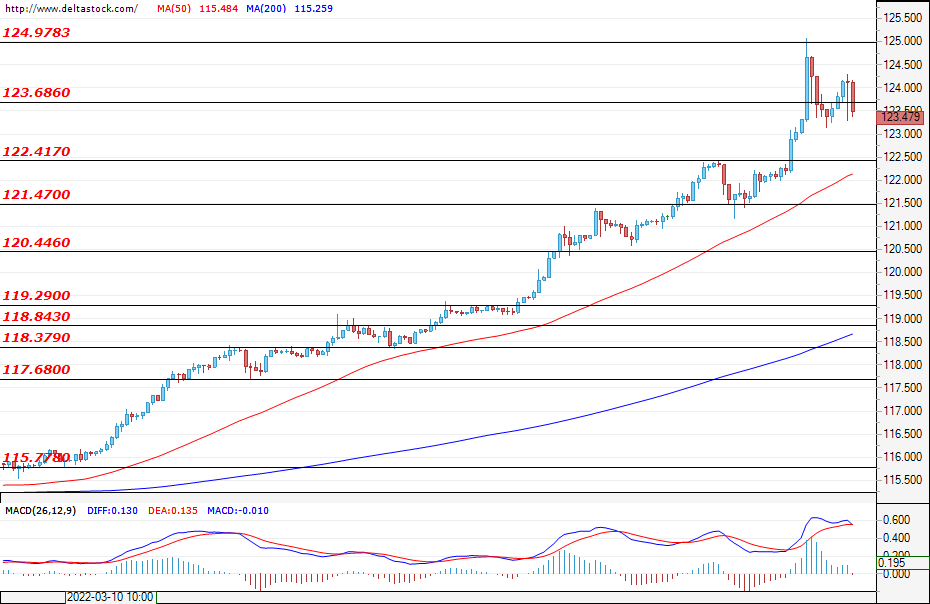
At the local high from yesterday's trading session, one U.S. dollar was trading for 125 Japanese yen – a level last reached in 2015. The subsequent depreciation does not put an end to the upward movement at the moment, with the more likely scenario being a corrective move in order to find better market entry levels. According to the higher time frames, the level at 125.00 is also the main resistance for the currency pair. The first significant support is the area at around 122.00.
GBP/USD
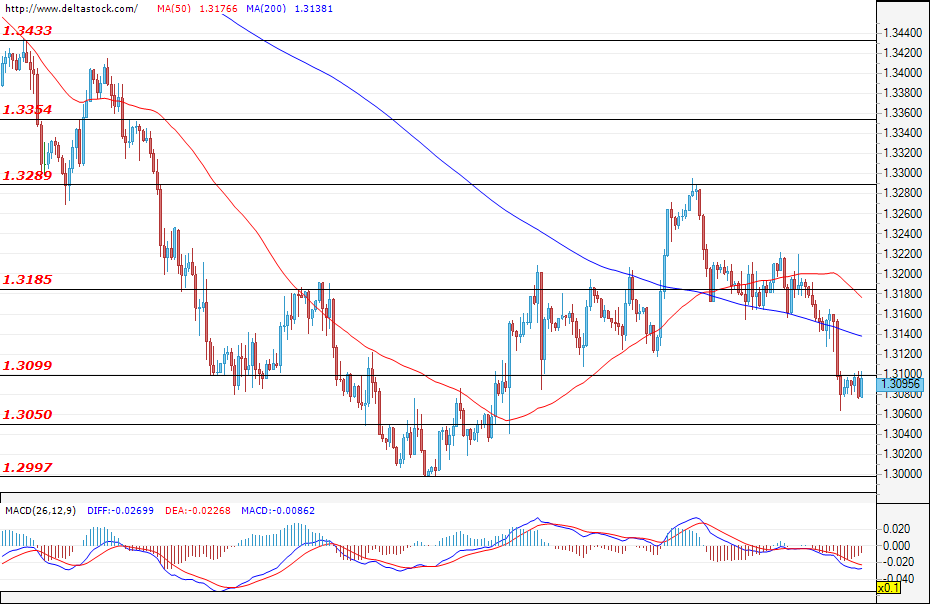
The support zone at 1.3100 was overcome during yesterday's session, but at the time of writing the analysis, we are seeing a consolidation just below the mentioned level, which currently plays the role of first resistance. This could put an end to the downward move and a successful breach of the resistance could pave the way for an upward move and an attack towards the next resistance at 1.3185.
EUGERMANY40
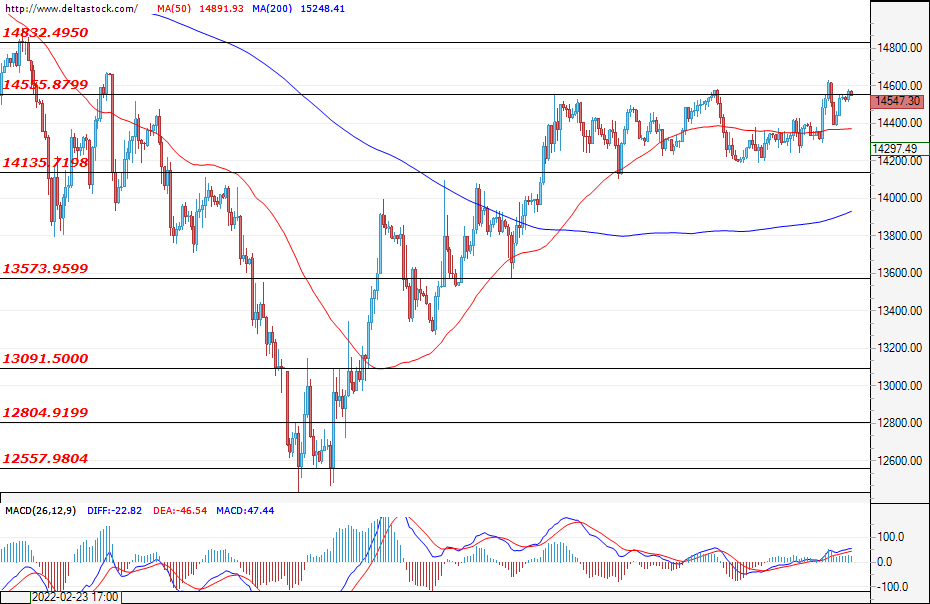
At the time of writing, the German index is still trading in the range of 14135 – 14555. However, it is possible to see a breach in the upper boundary at 14555, if the positive sentiment persists. On the other hand, if the bulls fail to gain the necessary momentum to secure a breach of this level, then this could initiate a downward movement, leading to a depreciation towards the support area at 14135.
US30
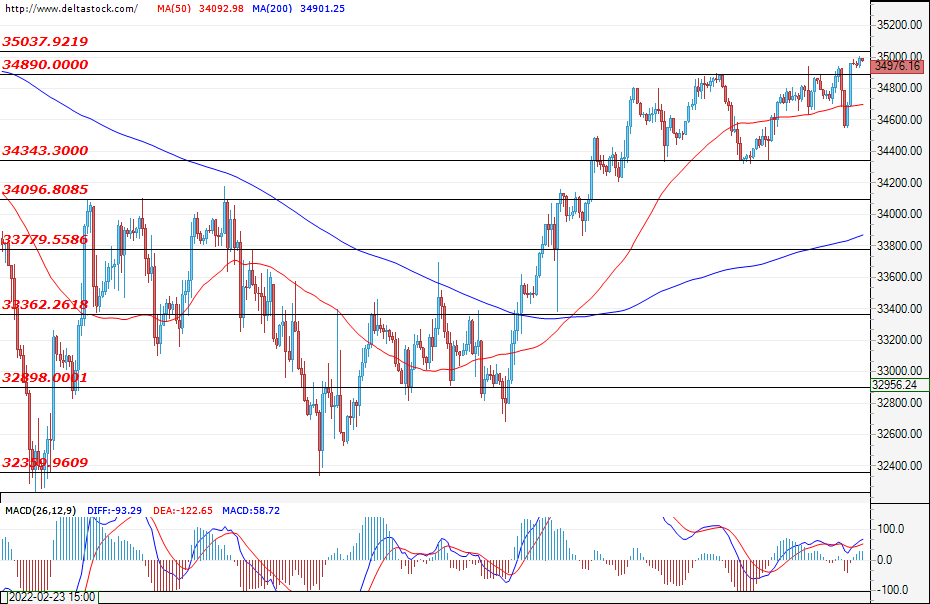
The U.S. blue-chip stock index continues its recovery, as at the time of writing, the trading activity is sitting just below the 35000 resistance area. Sentiments remain positive, but the resistance is fundamental and the bears may narrow the appreciation around this level. A hesitation on behalf of the buyers could give the bears the necessary incentive to establish themselves on the market and lead the price back towards the range move, and then towards the first significant resistance zone at 34343.
US 100 to Test Major Resistance
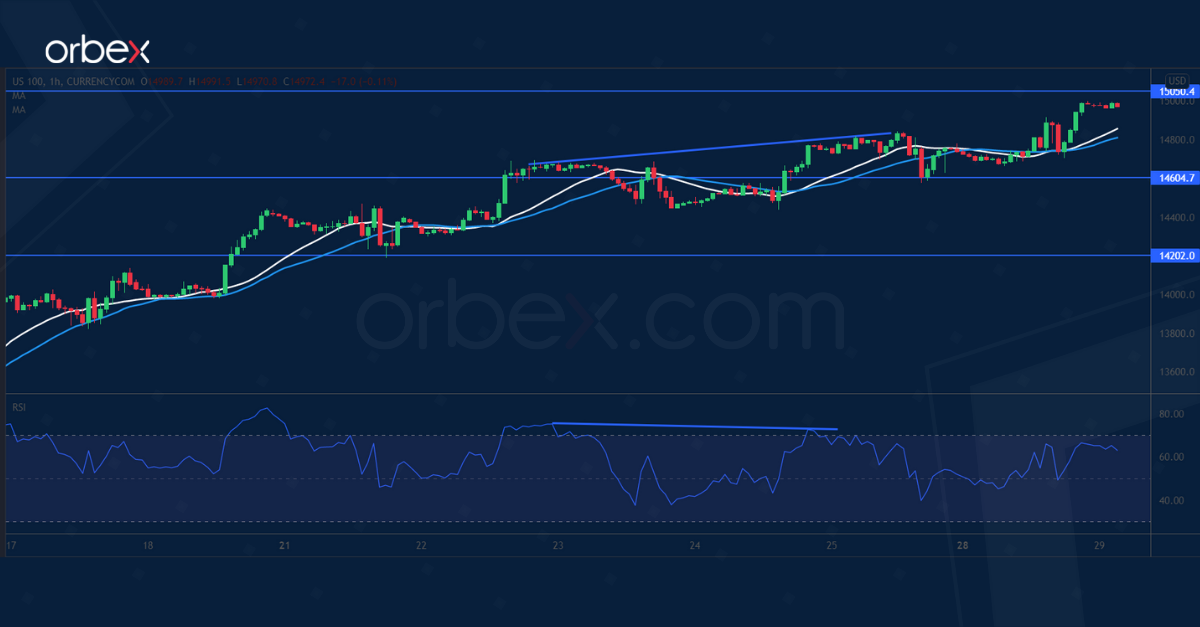
Growth stocks rose amid a sell-off in the bond market. Short-term sentiment remains bullish after a series of higher lows which indicates sustained buying interest.
The Nasdaq 100 is heading to the daily resistance at 15050. A bearish RSI divergence suggests a deceleration in the rally, foreshadowing a potential retracement.
14600 is the support and its breach may trigger a sell-off towards 14200 which sits at the base of the recent breakout. A close above the said hurdle may put the index back on track in the weeks to come.
AUD/USD Hits Major Resistance
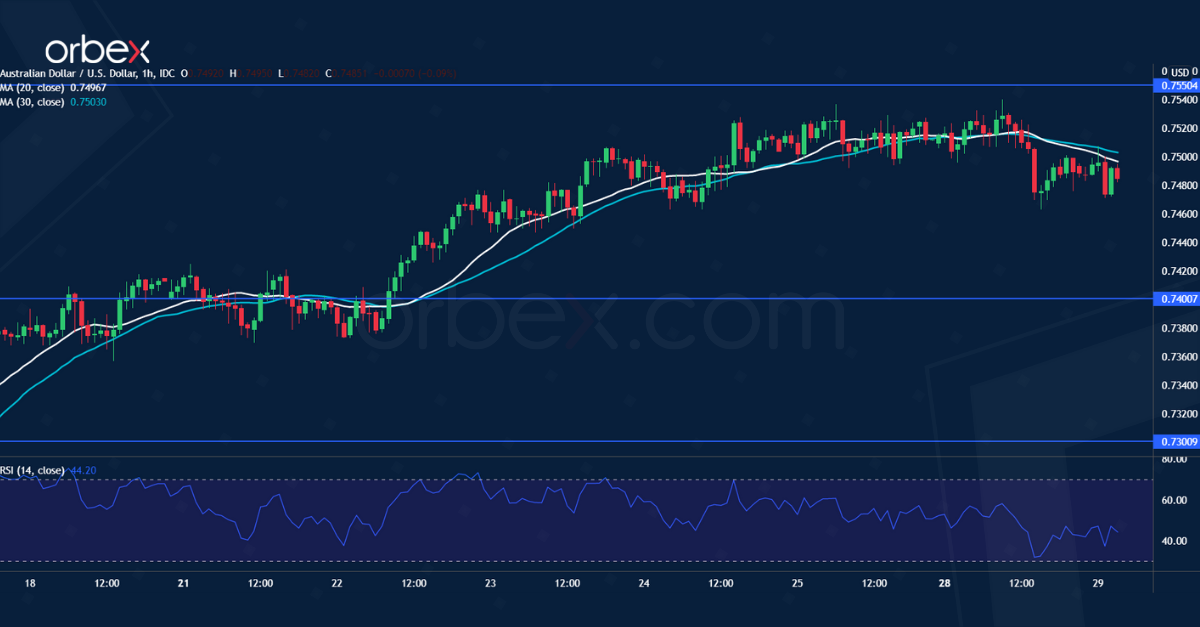
The Australian dollar stalls as caution prevails ahead of major economic data. The rally slowed down at last October’s peak at 0.7550.
A combination of profit-taking and fresh selling weighs on the Aussie. The bulls may see a pullback as an opportunity to accumulate in hope of a new round of rally.
0.7400 from the latest bullish breakout would be key support should this happen. On the upside, an extended rally could propel the pair to last June’s highs around 0.7770 and pave the way for a reversal in the medium-term.
USD/JPY Seeks Support
The Japanese yen recouped some losses after a drop in February’s unemployment rate. The pair surged to August 2015’s high and the psychological level of 125.00.
An overwhelmingly overbought RSI may cause a pullback if short-term buyers start to unwind their bets. As the market mood stays upbeat, trend followers could be waiting to jump in at a discount.
122.20 is the closest level if the greenback needs to gather support. A break above the current resistance would propel the pair to new highs above 127.00.
Oil Pullback Gives Relief
US equities kicked off the week with gains; the Big Tech led gains, as oil stocks slumped following an almost 10% slump in crude oil prices.
Shanghai lockdown combined with the rising Covid cases in China boosted worries that the fresh health crisis could extend and further weigh on Chinese oil demand – but the temporary fall in Chinese demand should do little to the demand-supply dynamics in the medium-term, which remains in favour of bullish market conditions.
Many oil traders predict that the price of a barrel could reach $200 by the end of the year. Goldman Sachs warns that the barrel of crude at $200 would send the economy into recession as it would ‘produce an income shock similar in magnitude to those that precipitated the 1974 and 1979 recessions.’
But we are not there yet. The barrel of US crude is still capped below the $130 level, and the global demand is expected to reach a record in the second half of the year. The actual fall will likely remain short-lived, and limited above the critical 50-DMA support, which stands just a touch below the psychological $100 mark. Many oil traders see the price pullbacks as interesting opportunities to strengthen their long positions.
Big tech leads rally
Nasdaq led gains on Monday. The tech-heavy index gained 1.30%, while the S&P500 progressed 0.70% and the Dow followed with a 0.27% advance. As such Nasdaq recovered more than half of losses it made since the November selloff, when the Federal Reserve (Fed) hinted at steeper rate hikes and quantitative tightening. The index is preparing to step above the 15000 mark for the first time since before the Ukrainian war, and to test the 200-DMA, near 15120 level.
The Big Tech is, of course, pulling the index higher, as big tech companies, along with other big cap stocks, are now perceived as safe haven investments when bonds tumble on expectation of a steeper monetary policy normalization.
The Bank of America even warns that the global debt weighted by world GDP is on course for its worst year since 1949. So, it’s not a surprise that Joe Biden wants deficit reduction that would be financed by the biggest tax increase in history in dollar terms.