Sample Category Title
Gold Sank Below $1900 on ‘Constructive’ Russia-Ukraine Talks
The price of a troy ounce of gold fell to $1890, its lowest level since late February, on reports of significant progress in negotiations between Russia and Ukraine.
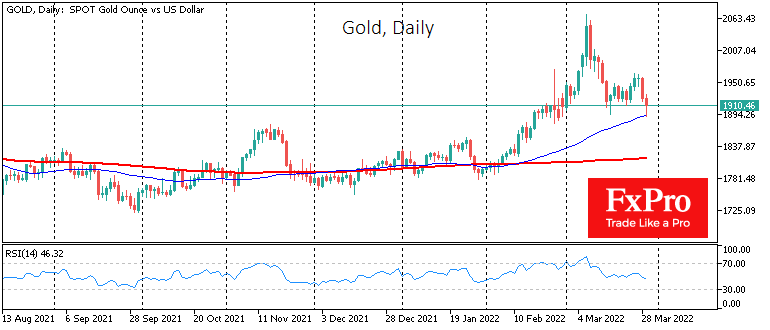
Gold retreated 8.5% from the 8th of March peak, returning to the 50-day moving average line. A consolidation below current levels at the end of the day or, better still, the month would be an important market signal to break the wild trend of the last two months.
From the tech analysis side, a consolidation below this mark would trigger a realisation “Head & Shoulders” scenario with an implied drop towards $1730, with probable significant support at the 200-day moving average (currently at $1820). However, in addition to the geopolitical driver, there remains an inflationary driver in gold.
Investors are buying gold given the significant difference between the inflation rate and the yields in the debt markets. This is an important reason for medium-term gold purchases, which could provide buyers with interest even if there is further military de-escalation.
Eco Data 3/30/22
[php_everywhere instance="1"]
Sunset Market Commentary
Markets
High-level talks in Turkey between Ukraine and Russia finally seem to slowly moving in the direction of agreeing on a cease-fire. The FT reported on it first and it was later confirmed by Ukrainian negotiator Podolyak. Russian negotiator Medinsky talked about a potential Putin-Zelenskiy meeting. Russia would also sharply cut military operations near Kyiv and Chernihiv. European stock markets surged by over 3%. The EuroStoxx50 returned above 4000 for the first time since February and is testing the December/January lows which previously served as support around 4027. The stock market comeback is perfectly logical in the narrative that there is even the slightest possibility that the Russia would pull back its troops. However, the risk rally is slightly at odds with what happens on bond markets. European bond markets were in full sell-off mode until oil prices crashed. The faster the war ends, the smaller the economic fallout, the stronger the incentive by the European central bank to tackle inflation. German yields add 3.3 bps (30-yr) to 8.4 bps (4-yr) today in a bear flattening move. Intraday moves have been larger, but markets turned after Brent crude fell $10/b from $115/b to $105/b. It complicates the above-mentioned normalization puzzle by relieving some (future) inflation pressure. The German 2-yr yield turned positive again at one stage for the first time since August 2014. The German 10-yr yield set a new recovery top around 0.73%. The EU 10y swap rate came within 5 bps of the 2015 high at 1.37%. 10-yr yield spreads vs Germany in this context narrow up to 4 bps for Italy which seems also somewhat strange. The expected ECB policy rate peak is gradually rising from 1.25% to 1.50% by the end of 2023. US Treasuries outperform today with yields sliding up to 4.5 bps at the belly of the curve. The single currency is relieved with EUR/USD bouncing from sub 1.10 to test first resistance at 1.1121. A break higher puts 1.1483/1.1495 back on the radar. The Swiss franc gets battered with EUR/CHF approaching 1.04 while the Japanese yen finally catches a break. The diving oil price trumps the positive risk climate. USD/JPY slides from 124 towards 122.50. Central-European FX is flying high. EUR/HUF returns below the pre-war highs around 370. EUR/PLN does the same below 4.70. The Czech currency already outperformed recently, gaining less from 24.60 to 24.40. Apart from energy prices, other commodities ranging from metals over food to gold (see graph), cede ground as well. News Headlines
Payscale, a US company that analyzes compensation data, in its new annual report found that 92% of organizations plan to raise wages this year. That’s up from 85% last year and way more than the 67% in Covid year 2020 and comes as more than 75% of them experienced labour shortages last year. The amount of pay increases is also higher. 44% foresee more than 3%, that’s 13 ppt more firms than the average of the last six years. 15% of organizations expect a pay raise in the bucket 4-5% compared to 8-10% in the years 2016-2021. It is nevertheless insufficient to counter spiraling inflation which amounted to 7.9% in February. Official payrolls data for March later this week will offer another glimpse at the current state of the US labour market.
Australia’s Treasurer Frydenberg revealed the new budget for the fiscal year starting July 1st. It includes a series of measures, many of them designed to alleviate rising costs of living such as a temporary 50% cut to fuel excise, a one-off A$250 payment and another one-off A$420 tax offset for low- and idle income earners. According to Frydenberg, the strong economy (as well as rising commodity/iron ore prices) allows for such additional spending while simultaneously cutting the deficit back from a peak of 6.5% of GDP in 2020-21 to 3.5% in 2021-22 and 3.4% in 2022-23. It is the final budget ahead of the May 2022 federal elections. PM Morrison center-right government has been sliding in opinion polls. The Liberal Party lost power in the state of South Australia in what was viewed as a shock election earlier this month.
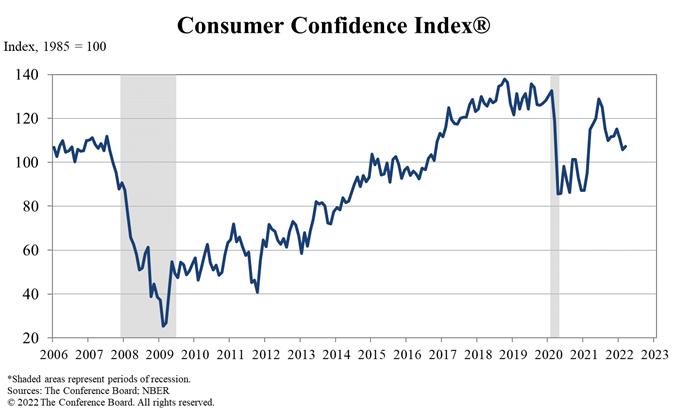
US consumer confidence rose to 107.2, supported by strong employment growth
US Conference Board Consumer Confidence index rose from 105.7 to 107.2 in February, below expectation of 107.9. Present Situation Index rose from 143.0 to 153.0. Expectations Index, however, dropped from 80.8 to 76.6.
"Consumer confidence was up slightly in March after declines in February and January," said Lynn Franco, Senior Director of Economic Indicators at The Conference Board. "The Present Situation Index rose substantially, suggesting economic growth continued into late Q1. Expectations, on the other hand, weakened further with consumers citing rising prices, especially at the gas pump, and the war in Ukraine as factors. Meanwhile, purchasing intentions for big-ticket items like automobiles have softened somewhat over the past few months as expectations for interest rates have risen."
"Nevertheless, consumer confidence continues to be supported by strong employment growth and thus has been holding up remarkably well despite geopolitical uncertainties and expectations for inflation over the next 12 months reaching 7.9 percent—an all-time high. However, these headwinds are expected to persist in the short term and may potentially dampen confidence as well as cool spending further in the months ahead."
JP 225 Index’s Bullish Bearing Shows No Weakness
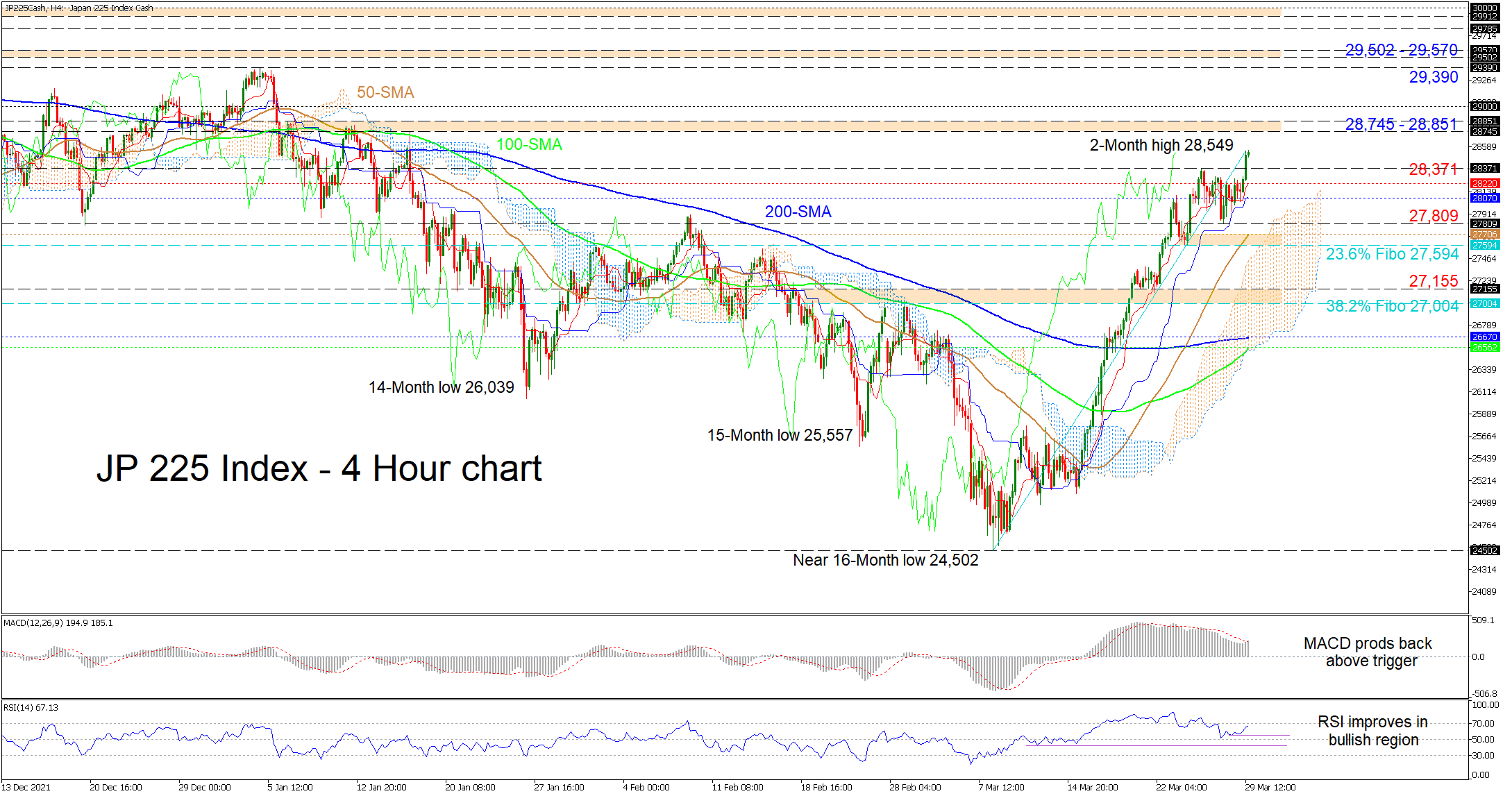
The Japan 225 index (Cash) has recorded a two-month peak of 28,549, resuscitating the uptrend from the 24,502 low, after breaching the recent 28,371 high. The soaring 50-period simple moving average (SMA) is endorsing the more than two-week rally, and the nearing of a bullish crossover of the 200-period SMA by the ascending 100-period SMA could further boost advances in the index.
Currently, the hiking Ichimoku lines indicate sturdy positive forces, while the short-term oscillators are mirroring an increase in bullish momentum. The MACD, some distance north of the zero threshold, has pierced back above its red trigger line, while the improving RSI is nearing the 70 overbought level.
In the positive scenario, an area of highs over the January 6 until 18 period being between 28,745 and 28,851 could provide the first barricade for additional progress in the index. Overcoming this barrier may bolster upside momentum, possibly overrunning the 29,000 handle and encouraging buyers to target the January 5 high of 29,390 before challenging the 29,502-29,570 resistance band.
If positive momentum starts to fade, initial support could come from the 28,371 level ahead of the Ichimoku lines at 28,220 and 28,070. If a deeper retreat unfolds, the price may then test the 27,809 low prior to weighing on the Ichimoku cloud and the 27,594-27,706 support border, the former being the 23.6% Fibonacci retracement of the up leg from 24,502 until 28,549.
Summarizing, the Nikkei is sustaining a strong bullish bearing above the SMAs and the 27,809 trough. A break above the 28,745-28,851 obstacle could boost upside impetus, while a retracement below the 27,004 level may spark worries about intensifying negative tendencies.
Euro Surges on Ukraine Talks
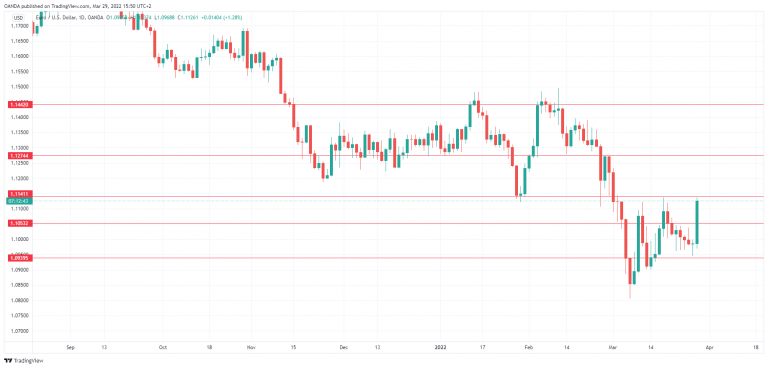
It’s been a dramatic afternoon, as EUR/USD has rocketed in the North American session, gaining 1.16%. The pair is currently trading just above the 1.11 level.
Euro flies as peace talks show progress
The euro has been showing limited movement for a week, which led me to caption Monday’s post as, “Euro looking for direction”. Twenty-four hours later, my heading looks outdated, as the euro has leaped upwards and posted massive gains of 120 points, breaking past 1.10 and then the 1.11 level.
The driver behind this impressive and unexpected jump was news that Russia had softened its position at the negotiating table. In talks held in Turkey today, Russia said that it was scaling down its forces in northern Ukraine and held out the possibility of direct talks between Russian President Putin and Ukrainian President Zalensky, once the sides had prepared a draft peace treaty.
As anyone who is following the war can attest to, anything coming out of Moscow has to be taken with more than a grain of salt. There has been speculation that Russia is using the peace talks as a cover to reorganize its forces, after being held to a stalemate by the outnumbered and outgunned Ukrainian army. Moscow may have decided to focus its efforts in the eastern part of Ukraine and consolidate its grip on areas it has already conquered. President Zalensky has reiterated that Ukraine will not compromise on any of its territory, so there are still large gaps between the sides.
Still, the markets jumped on positive news out of Ukraine, and European equity markets have climbed around 2% today. After starting the day in quiet mode, the euro has sparkled and jumped over 1 per cent. The massive move illustrates that to a very large extent, the euro’s movement is being dictated by developments in Ukraine, and what goes up can quickly come down, if the apparent progress in the peace talks turns out to be another dead end and the crisis worsens.
EUR/USD Technical
- EUR/USD has support at 1.1053 and 1.0940
- There is resistance at 1.1274, followed by 1.1441
EUR/GBP Mid-Day Outlook
Daily Pivots: (S1) 0.8341; (P) 0.8371; (R1) 0.8419; More...
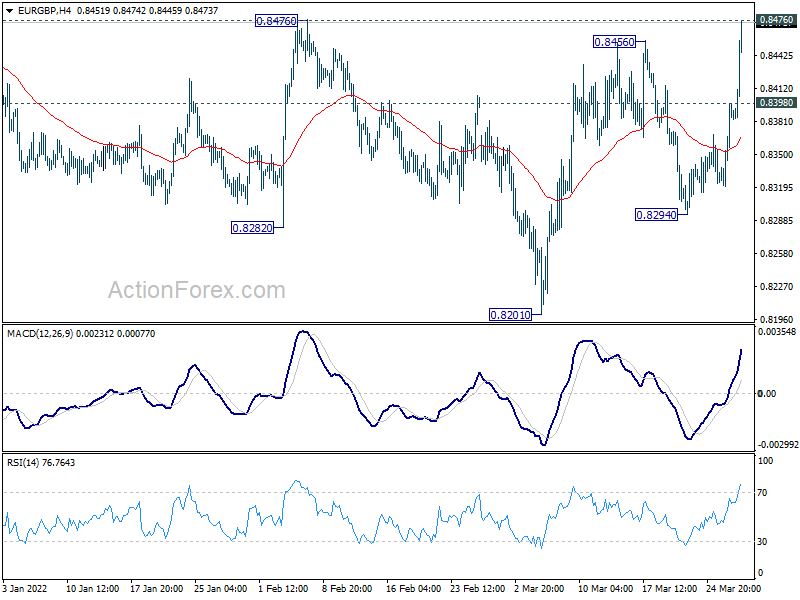
EUR/GBP's rise from 0.8201 resumed by breaking through 0.8456 and intraday bias is back on the upside. Sustained break of 0.8476 resistance will indicate medium term bottom at 0.8201. Near term outlook will be turn bullish for 0.8697 fibonacci level next. . On the downside, below 0.8398 minor support will turn intraday bias neutral again first.
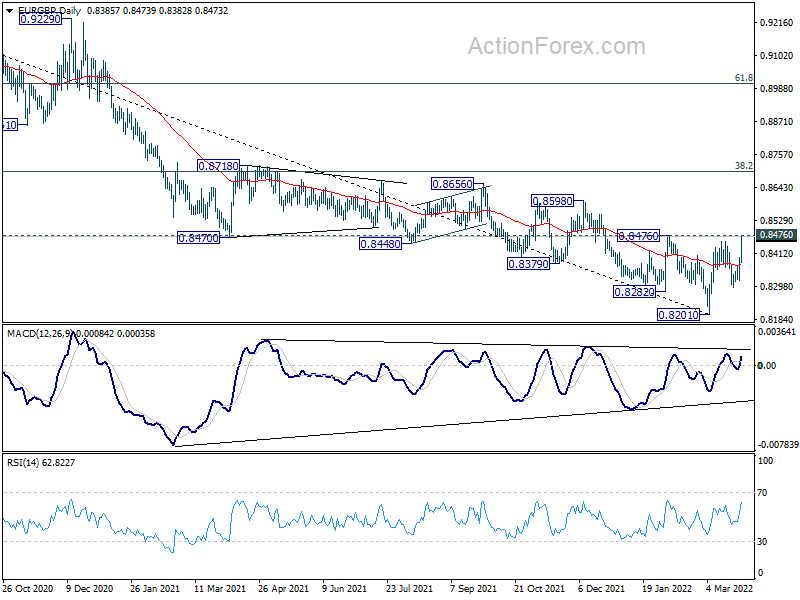
In the bigger picture, the down trend from 0.9499 is expected to continue as long as 0.8476 resistance holds. Sustained trading below 0.8276 support will argue that the whole up trend from 0.6935 (2015 low) has reversed. Deeper fall should be seen to 61.8% retracement of 0.6935 to 0.9499 at 0.7917 next. However, firm break of 0.8476 will indicate medium term bottoming at least, on bullish convergence condition in daily and weekly MACD. Stronger rally would be seen back to 38.2% retracement of 0.9499 to 0.8201 at 0.8697.
EUR/AUD Daily Outlook
Daily Pivots: (S1) 1.4567; (P) 1.4632; (R1) 1.4729; More...
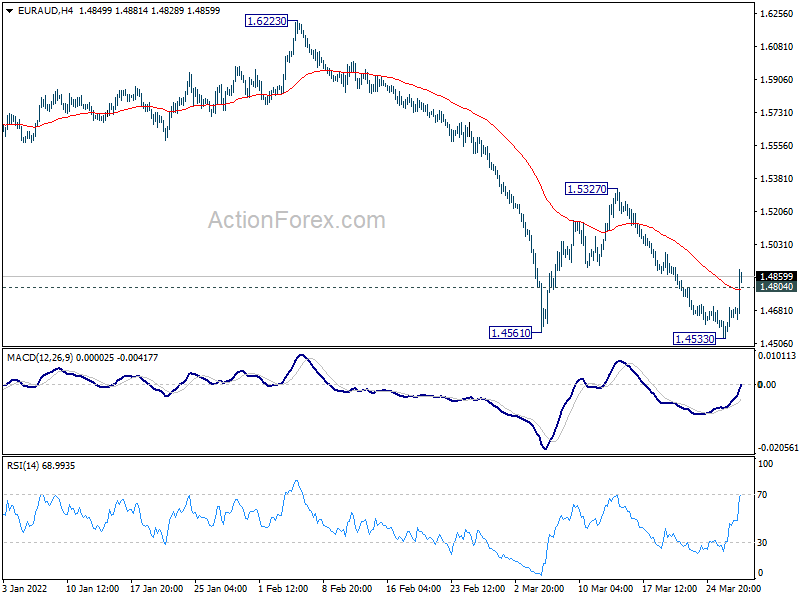
EUR/AUD's break of 1.4804 minor resistance argues that fall from 1.5327 is completed at 1.4533 already. Intraday bias is back on the upside for 1.5327 resistance. For now, such rise is seen as the third leg of the corrective pattern from 1.4561. As long as 1.5327 resistance holds, larger down trend is still expected to continue through 1.4533 at a later stage.
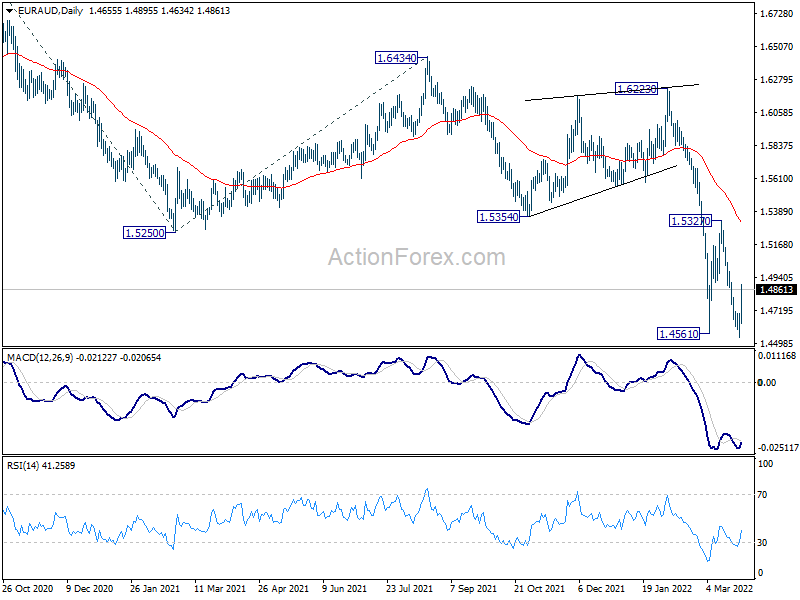
In the bigger picture, fall from 1.9799 is seen as a long term impulsive move. Next target is 61.8% projection of 1.9799 to 1.5250 from 1.6434 at 1.3623, which is close to 1.3624 long term support (2017 low). Some support could be seen there to bring interim rebound. But overall, break of 1.5354 support turned resistance is needed to be the first sign of medium term bottoming. Otherwise, outlook will stay bearish in case of recovery.
Gold dives through 1900 on breakthroughs in Russia/Ukraine negotiations
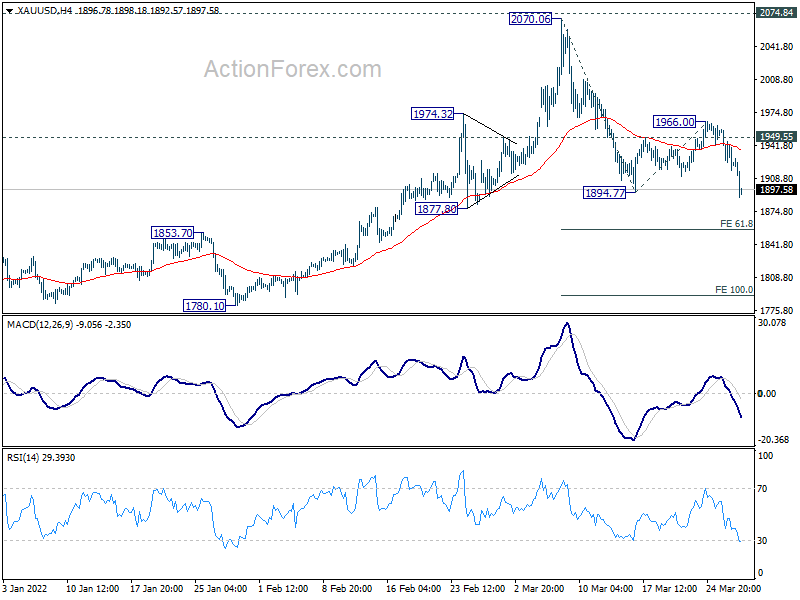
Gold dives sharply on some progress in the negotiation between Russia and Ukraine. It's report that Ukrainian negotiators proposed a status under which it would not join alliances or host bases of foreign troops. Russia also promised to drastically scale down its military operations around Kyiv and the northern Ukrainian city of Chernihiv.
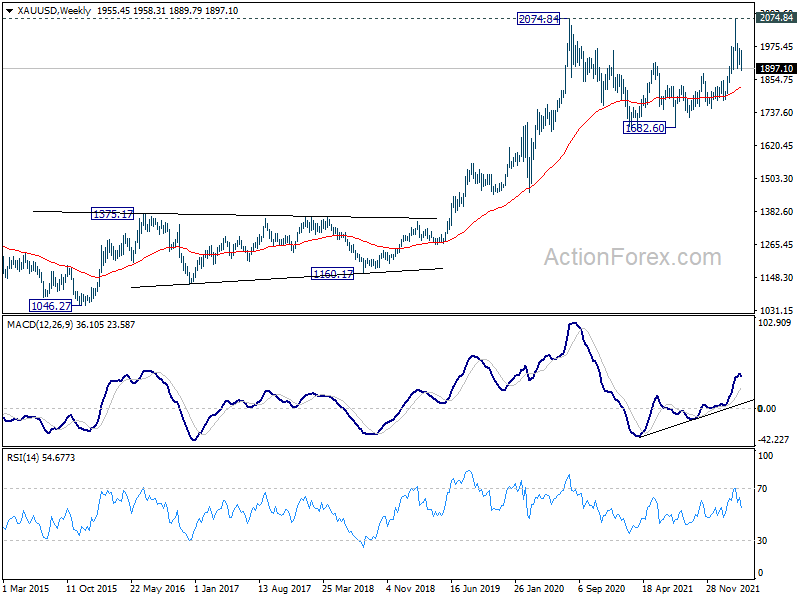
Gold's break of 1894.77 support indicate resumption of the fall from 2070.06. Deeper decline should be seen to 61.8% projection of 2070.06 to 1894.77 from 1966.00 at 1857.67, and then 100% projection of 1790.71. Also, such fall is seen as the third leg of the correction pattern from 2074.84, and could head to 1682.60 support before completion.
WTI crude oil completed rebound, heading back towards 93.98 support
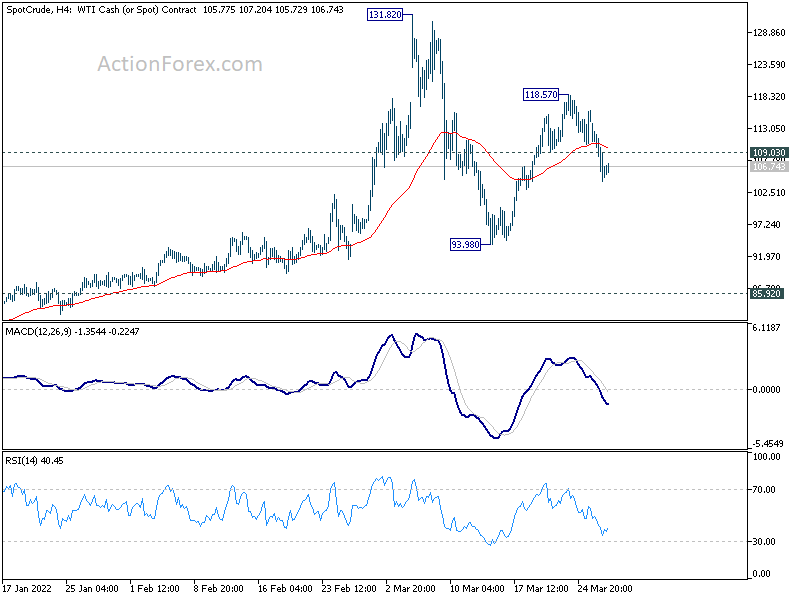
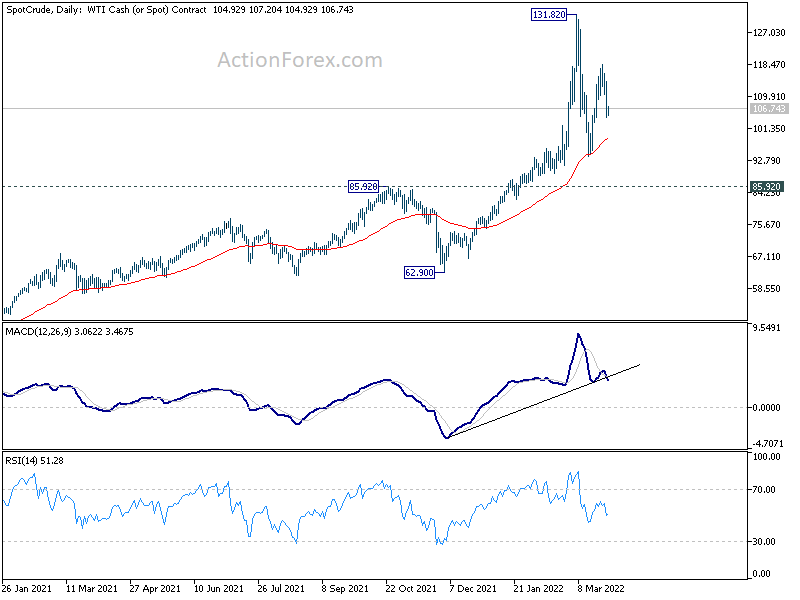
WTI crude oil's break of 109.03 support earlier this week argues that rebound from 93.98 has completed at 118.57 already. Fall from there is seen as the third leg of the corrective pattern from 131.82. Deeper decline would be seen back to 93.98, and possibly below. But still, firm break of 85.92 resistance turned support is needed to indicate trend reversal. Otherwise, medium term outlook is just neutral for range trading.