

Sample Category Title
Gold Updated Its Highs
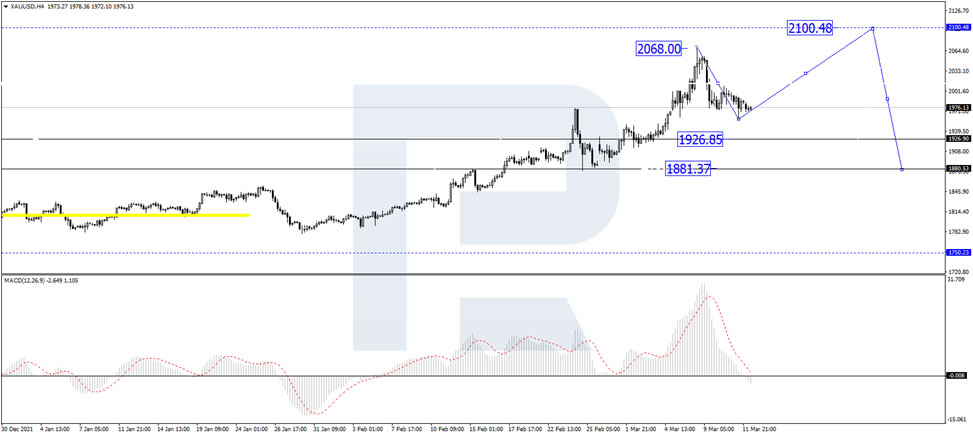
In March, Gold updated its high at $2,078.80 and then started a correction. Early in a new week March week, the precious metal is trading at $1,977.
Gold is an excellent tool for investors to protect them from the consequences of increasing inflation, which is expected to continue rising for a while longer. It means that the fundamental support factor for Gold will remain in effect. The US inflation is at its 40-year high and there are barely any reasons for the indicator to go down.
The current decline in Gold is probably the result of profit-taking. Gold enthusiasts do not consider the strong USD factor, as they are supported by stable demand for the precious metal.
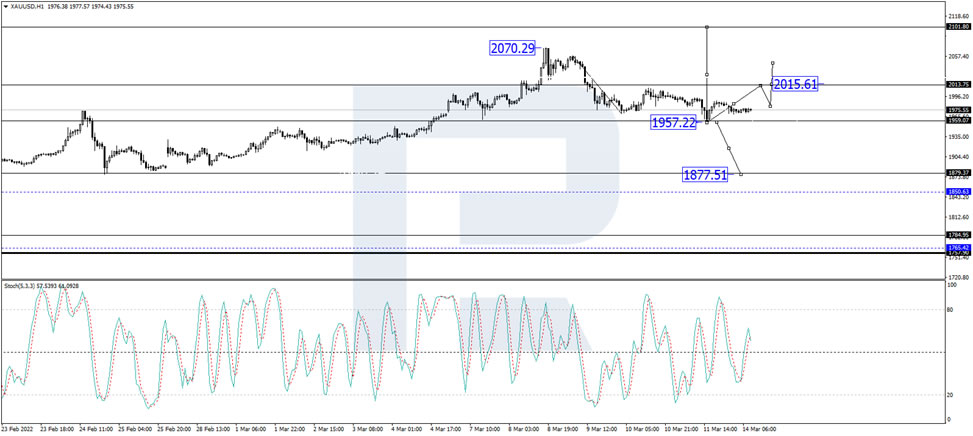
As we can see in the H4 chart, after completing the descending wave at 1958.50 along with the ascending impulse towards 1987.90, XAU/USD is forming a new consolidation range between these two levels. Possibly, the metal may break the range to the upside and grow with the first target at 2015.60. Later, the market may start a new decline to reach 1980.00. On the other hand, if the price breaks the above-mentioned range to the downside, the asset may resume trading downwards towards 1877.50. From the technical point of view, this scenario is confirmed by the Stochastic Oscillator: after breaking 50 to the upside, its signal line is expected to grow towards 80. Otherwise, the indicator may resume falling to reach 20.
In the H1 chart, Gold has finished the correctional wave at 1958.50; right now, it is consolidating near the lows. Possibly, the metal may form one more ascending wave towards 2015.00 and then start another correction to reach 1982.00, thus forming a new consolidation range between these two levels. If the price breaks this range to the upside, the market may resume growing towards 2100.00 or even reach 2200.00; if to the downside – correct down to 1850.00. From the technical point of view, this scenario is confirmed by MACD Oscillator: its signal is falling to break 0 and may later continue moving downwards to reach new lows. However, if the line rebound from 0, it may grow towards new highs.
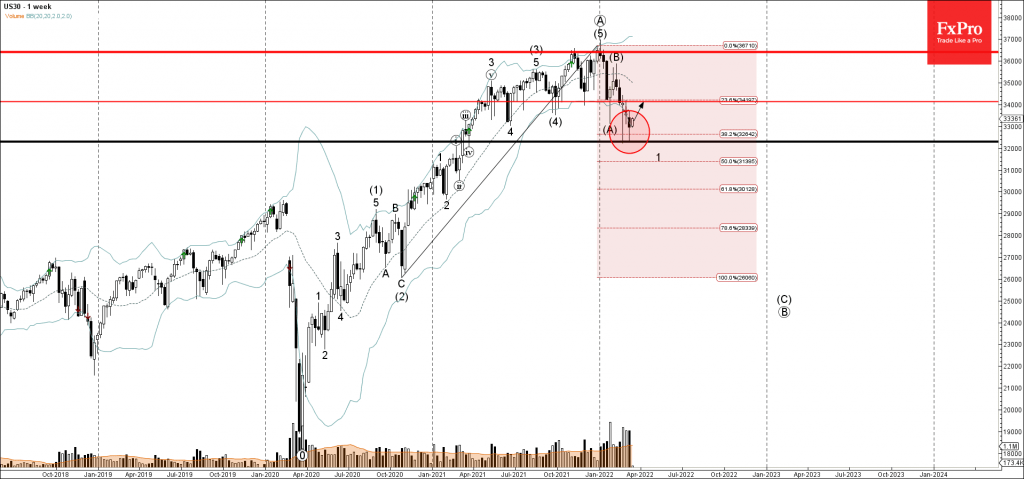
Dow Jones Wave Analysis
- Dow Jones reversed from support zone
- Likely to rise to resistance level 34000.00
Dow Jones recently reversed up from the support zone located between the support level 32310.00 (which has been steadily reversing the index from the start of 2021) and the lower weekly Bollinger Band.
This support zone was further strengthened by the 38.2% Fibonacci correction of the sharp upward impulse from October.
Given the clear weekly uptrend – Dow Jones can be expected to rise further toward the next resistance level 34000.00 (former strong support from last year).
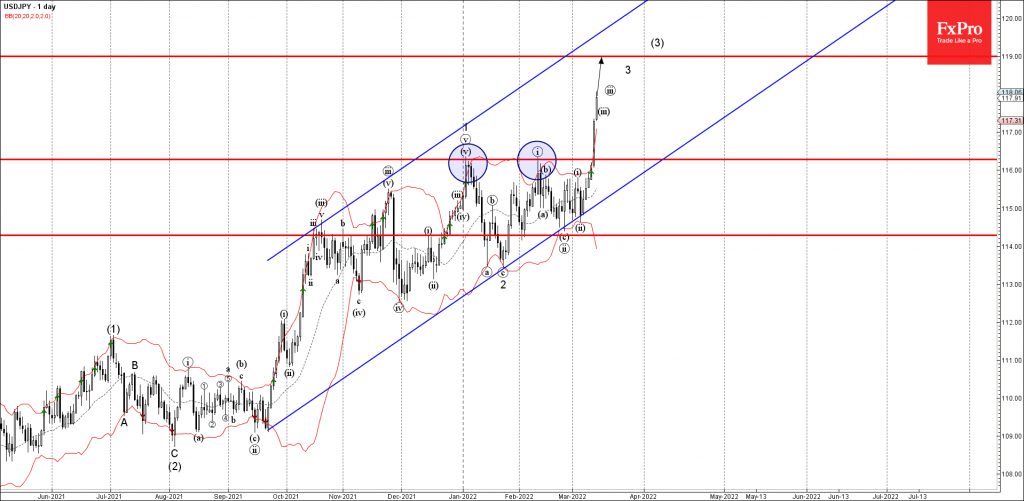
USDJPY Wave Analysis
- USDJPY broke resistance level 116.30
- Likely to rise to resistance level 119.00
USDJPY continues to rise strongly after the earlier breakout of the key resistance level 116.30 (previous monthly high from January and February).
The breakout of the resistance level 116.30 accelerated the active impulse waves (iii), 3 and (3).
Given the clear daily uptrend and powerful yen outflows – USDJPY can be expected to rise further toward the next resistance level 119.00 (target for the completion of the active impulse wave 3).
EURCHF Recovers from Multi-Year Low Just Under the 1.00 Mark
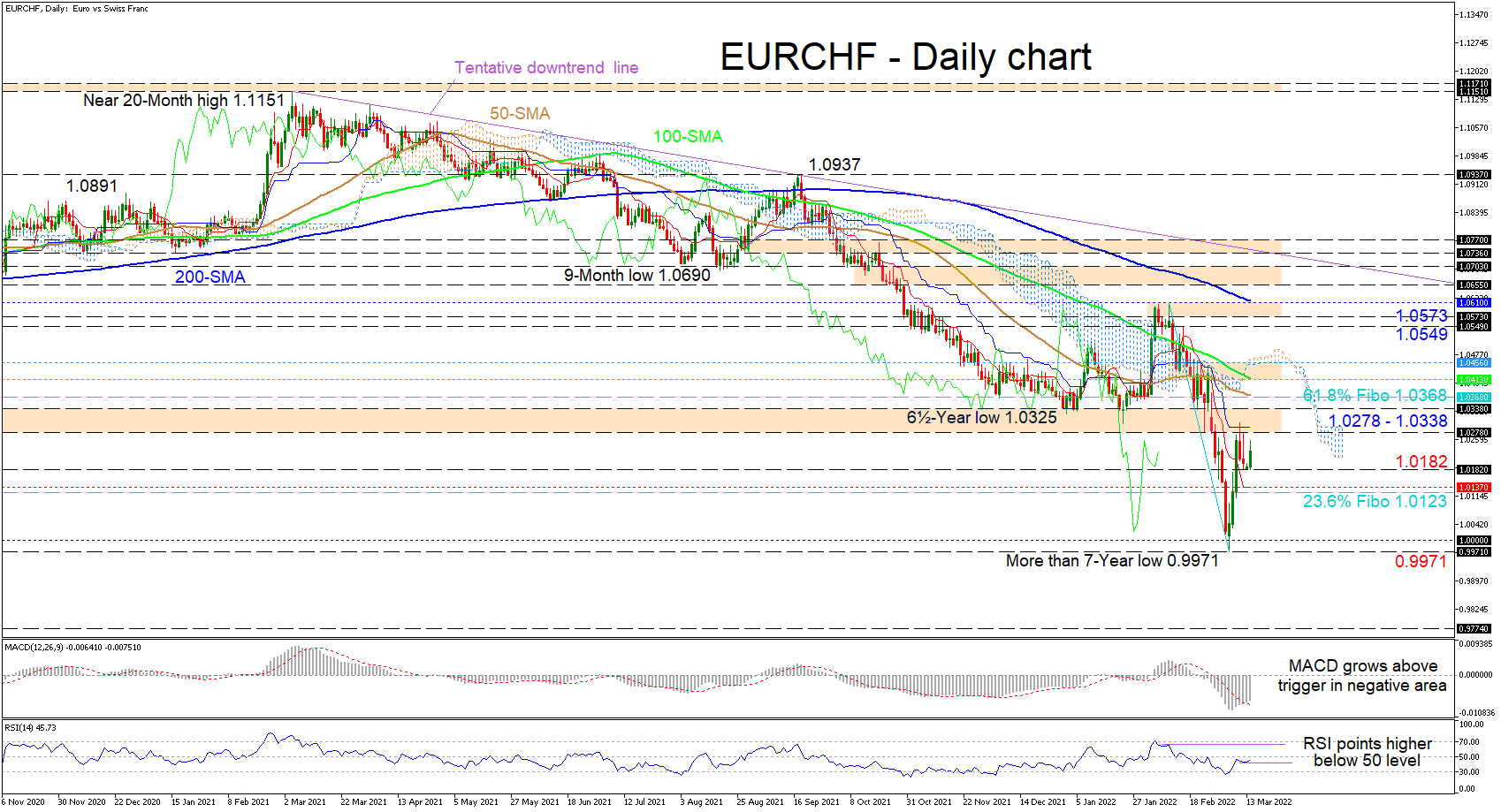
EURCHF has established a foothold around 1.0182 and above the 1.0123 level, which is the 23.6% Fibonacci retracement of the down wave from 1.0610 until a more than 7-year low of 0.9971, signalling that buyers are starting to reap some rewards from the recent bounce in the pair. Despite the fresh progress in the pair, the descending simple moving averages (SMAs) are backing the one-year decline from the 1.1151 high.
The Ichimoku lines are indicating a significant dry up in negative pressures but have yet to confirm that buyers have gained the upper hand. That said, the short-term oscillators are reflecting the increase in bullish momentum. The MACD, far beneath zero, is improving over its red signal line, while the RSI is pointing higher, marginally underneath the 50 neutral threshold.
The road higher in the pair looks to be a difficult one with congested obstacles ahead, possibly starting with the initial 1.0278-1.0338 boundary (previous support-now-resistance), which stretches back to May 2015. Slightly overhead is the 61.8% Fibo of 1.0368 that may impede buyers from challenging the 1.0413-1.0456 resistance zone, the former being the 100-day SMA and the latter the Ichimoku cloud’s lower surface. Optimism in the pair could return if the price oversteps the cloud, which may then turn the focus to the 1.0549 barrier and the neighbouring 1.0573-1.0610 resistance band.
Alternatively, if positive forces start to fade, support could begin at the 1.0182 low prior to sellers confronting the red-Tenkan-sen line at 1.0137, coupled with the 23.6% Fibo at 1.0123. Should the price dive back beneath the 23.6% Fibo, the critical support base between the 1.0000 round mark and the more than 7-year trough of 0.9971 could draw serious attention.
Summarizing, EURCHF is sustaining a broader bearish trend below the SMAs and the 1.0610 high. If buyers fail to push north of the 1.0278-1.0338 boundary, this could add credence to the negative outlook.
USD/JPY Outlook: Bulls Further Tighten Grip after Last Week’s 2%Advance, ahead of Fed
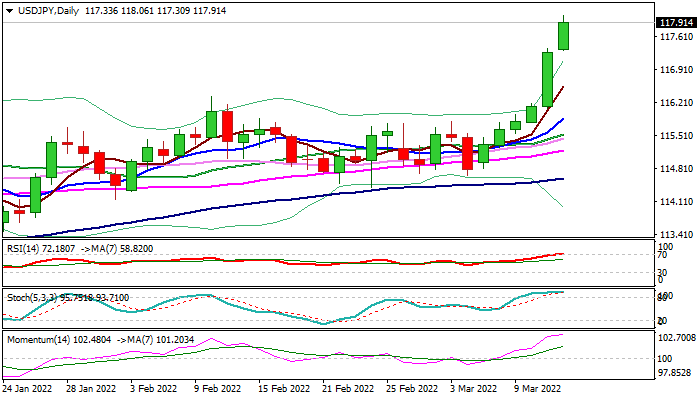
The USDJPY extends its steep ascend on Monday, following nearly 1% rise on Friday, the biggest daily advance since November 2020.
Fresh acceleration (0.5% up until early US session on Monday) cracked 118.00 barrier, opening way for test of Dec 2016 peak (118.66) and unmasking pivotal Fibo barrier at 119.50 (76.4% retracement of 125.84/98.99 fall).
The dollar remains well supported by uncertainty over the war in Ukraine that keeps investors in the safety, with expectations for Fed rate hike on Wednesday, adding to positive sentiment, while divergence between the Fed and BoJ, as Japan’s central bank is likely to stay on hold for some time, prompting stronger selling of yen.
Overbought daily studies is the only signal that may slow bulls, however a massive weekly candle (the pair was up 2% last week) continues to underpin, with shallow dips to offer better buying opportunities under the current circumstances. Traders focus on Fed’s decision, with 0.25% hike widely expected and all attention will be on Fed’s short-term plans – the pace of raising rates and projections for this year and 2023/24, in attempts to tame raging inflation, which rose to the highest in forty years.
Only more dovish-than-expected stance from the FOMC, would negatively impact strong bulls.
Res: 118.06; 118.66; 119.00; 119.50.
Sup: 117.53; 117.07; 116.66; 116.33.
Ruble Adds 10% as Russia Assures It Won’t Default
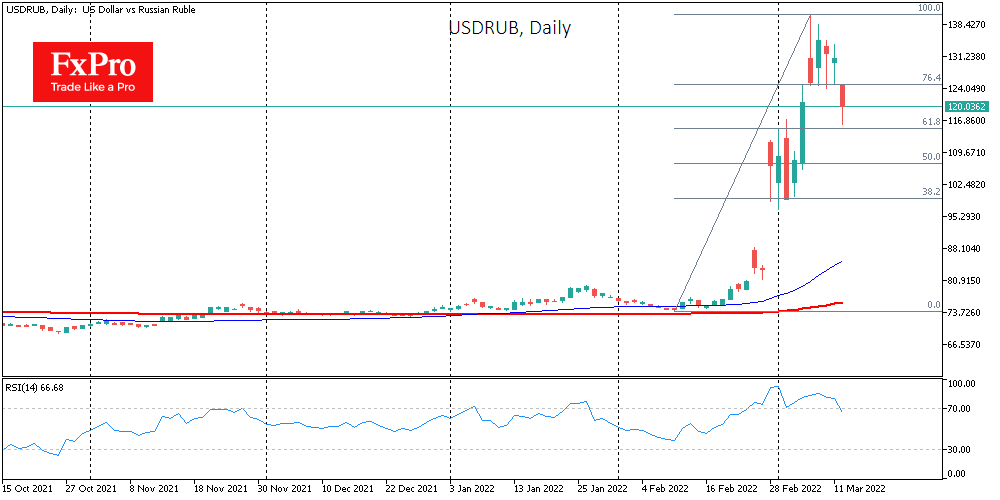
The Russian ruble is strengthening significantly, by 10%, to 118.8 on forex at the start of the new week. The growth momentum comes with signals from the presidents of Russia and Ukraine that negotiations are moving forward. In addition, the Russian Finance Ministry made it clear over the weekend that it does not intend to waive coupon payments on foreign currency bonds unilaterally. It would make payments for its part but that they might not technically pass, in which case payments would be made in rubles.
In addition, the central bank has eased its currency export restrictions somewhat.
As is often the case in emerging markets, relaxations and declarations of commitment strengthen the confidence in the financial system. As a result, we see a convergence of the USD exchange rates quoted on the Moscow Exchange and international forex.
However, the latest movements do not mean that the ruble has already passed its low point, as markets are still constantly reassessing the reality under new sanctions.
A technical view of USDRUB’s recent moves suggests that the pair could settle into a correction near 115 rubles after jumping from 74 in early February to 140 at one point last Tuesday. If we do not see a cardinal shift towards de-escalation in the coming days, the pressure on the Russian currency could return, albeit not with the same strength.
Sunset Market Comentary
Markets:
New Chinese lockdowns sent main Chinese stock markets more than 3% lower, but didn’t translate in a general risk-off setting in Europe. The empty eco calendar did provide little guidance neither. Main European equity indices gain over 1% with commodity prices correcting further off peak levels. Main US indices trade flat (Nasdaq) to 1% higher (Dow) in the opening US trading hour. Ukraine and Russia plan more talks aiming to achieve a cease-fire even as fighting continues. Core bonds remain in sell-off mode with focus now turning to Wednesday’s FOMC meeting. US inflation expectations are flirting around 3% and ask for a strong signal by the Fed. Apart from an inaugural 25 bps rate hike, markets will well be interested in the peak policy rate projection in the updated dot plot and in policy plans with regard to the balance sheet run-off. US yields add 6.9 bps (2-yr) to 10.3 bps (10-yr) today with the belly of the curve underperforming the wings. The US 2-yr yield rises above 1.8% to the highest level since July 2019. The US 5-yr yield passes the 2%-threshold for the first time since May 2019. The same goes for the US 10-yr yield at 2.1% which approaches 62% retracement (resistance) of the 2018-2020 decline at 2.13%. The US 30-yr yield is closing in on the 2021 top of 2.51%. The German yield curve bear steepens today with yields adding 6.8 bps (2-yr) to 12 bps (20-yr). The German 10-yr yield reaches a new recovery high at 0.35%, the highest level since November 2018. European inflation expectations remain on the rise as well despite last week’s signal by the ECB (too little and especially too late?!). Peripheral yield spreads vs Germany remain broadly stable. The single currency slightly takes the upper hand against both the dollar and sterling in the current risk environment, even if the Bank of England is also set deliver (a third consecutive) policy rate hike on Thursday. EUR/USD changes hands around 1.0960 from an open at 1.09. EUR/GBP trades at 0.84 from 0.8370. The Japanese yen remains the stand-out loser with USD/JPY briefly trading above the 118 big figure for the first time since early 2017. It prompted soft verbal interventions from the Japanese government, but these didn’t impress markets. In a broader context, Central European currencies are staging an impressive comeback today. Their geographical proximity to the Russian invasion put a bull’s eye on their backs. Regional central bankers did damage controls via FX interventions and more regular rate hikes. The conflict amplifies an already huge inflation problem. Czech governor Rusnok today for example said that he expects inflation to peak around 13%-14% in May. Any way. EUR/CZK today dives back below the 25 big figure for the first time since end February. EUR/HUF dives from 383 to 373. A return sub 370 would give the MNB some breathing space in its weekly deposit rate tightening cycle. EUR/PLN fell from 4.8 to 4.7. News Headlines:
Swedish inflation unexpectedly jumped in February. The target measure or the Riksbank (CPIF, with a fixed interest rate) rose 0.9% on a monthly basis to reach 4.5% Y/Y (from 3.9% in January), the fastest pace of price increases since December 1993. The core CPIF index excluding energy prices also accelerated by 1.0% M/M to rise 3.4% Y/Y, all well above the 2.0% target of the Swedish central bank. The February release and the risk of persistent high levels in the wake of the crisis in Ukraine are questioning the monetary policy guidance of the Swedish Riksbank. At the February policy meeting, the central bank still indicated that it only expected the repo rate to be raised in the second half of 2024. The recent change in the ECB’s policy roadmap and a weak Swedish krona are additional reasons for the Riksbank to change its view on policy. The next policy decision is scheduled for April 28. The krona strengthened after the release from EUR/SEK 10.635 this morning to near 10.50. Swedish money markets now discount a 0.75% policy rate by the end of the year, compared to 0.40% ahead of the inflation numbers.
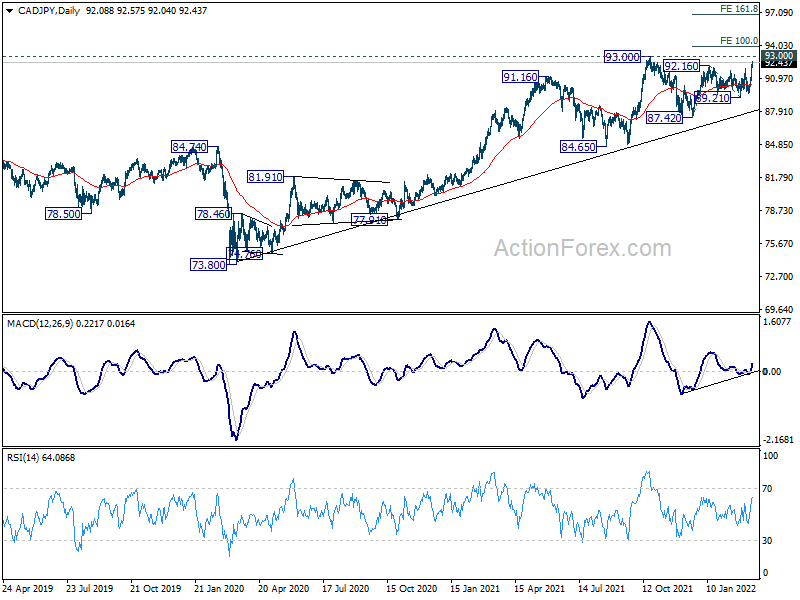
CAD/JPY eyes 93 resistance as Yen weakness persists
Selloff in Yen continues today, lifted by global benchmark treasury yields. US 10-year yields resumes the medium term up trend and breaches 2.1 handle. Germany 10-year yield is up at above 0.35, breaking above February's high. UK 10-year gilt yeas is also above 1.59, and should make a similar upside breakout soon.
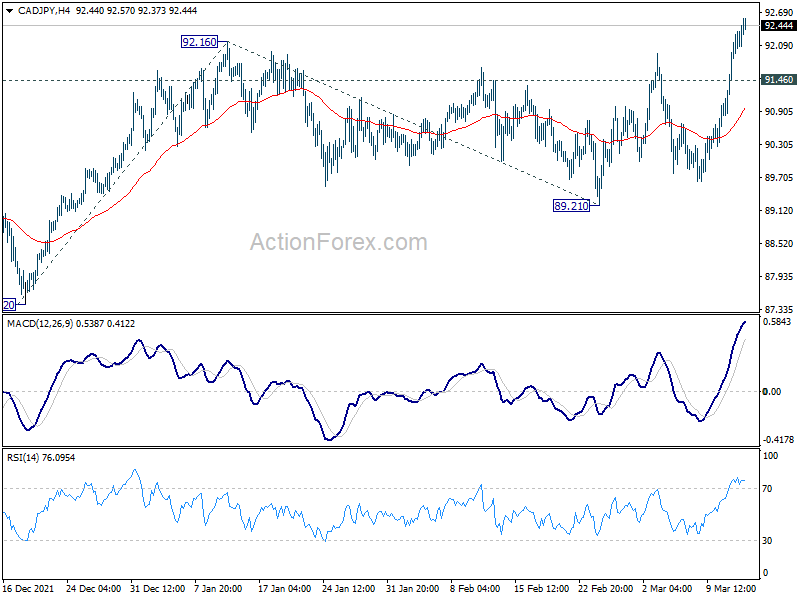
CAD/JPY is benefiting from Yen's weakness. With 92.16 resistance taken out, CAD/JPY is resuming the rise from 87.42. Immediate focus is now on 93.00 high, Firm break there will resume larger up trend from 73.80. Next near term target is 61.8% projection of 87.42 to 92.16 from 89.21 at 93.95. Decisive break there could prompt upside acceleration to 161.8% projection at 96.83. Nevertheless, break of 91.46 minor support will delay the bullish case and bring pull back first.
Australian Dollar Slips to 2-Week Low
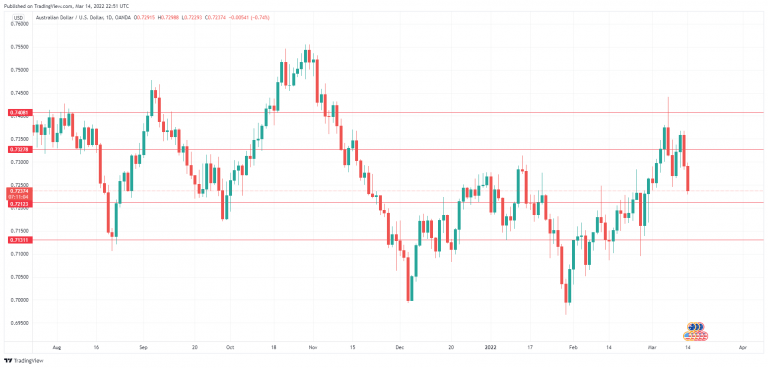
The Australian dollar continues to lose ground. After falling 0.91% on Friday, AUD/USD is down 0.68% on Monday and is trading at 0.7238. Earlier in the day, the Australian dollar dropped to 0.7222, its lowest level since February 28th.
Aussie hampered by risk aversion
It was a tough week for the Australian dollar, which lost more than 1%, and the currency is down considerably on Monday. Risk appetite remains weak and the markets have been volatile as the Ukraine war continues. There have been some hints of slight progress in the negotiations but the Russians continue to pound Ukrainian targets, both military and civilian. If a ceasefire is agreed to, it would boost risk sentiment and the Aussie would likely recover some of its recent losses.
The Australian dollar is risk-sensitive, but nonetheless had an impressive run of five straight winning weeks until last week. The primary driver for this upswing was been the massive surge in commodity prices. Australia exports a range of commodities which has boosted the export sector as well as the Australian dollar. However, risk apprehension remains high and if the Ukraine crisis deteriorates, such as a clash between NATO and Russian forces, the Aussie could get hit hard.
The US dollar recorded broad gains on Friday, as investors preferred to avoid risk over the weekend. On Friday, the dollar index rose 0.60% to 99.12. The index has dipped to 98.93, in the middle of the range of 98.50 – 99.50. A break above 99.50 will would provide room for the US dollar to rise, while a fall below 98.50 would cloud the bullish outlook for the greenback.
Investors are awaiting the RBA minutes from the March meeting, which will be released on Tuesday. Any clues as to future rate hikes could have a strong impact on the Australian dollar. The RBA maintained the cash rate at that meeting, but rising inflation and a strong economic recovery are putting pressure on the RBA to raise rates, which could press the trigger as early as June.
AUD/USD Technical
- AUD/USD is putting pressure on support at 0.7212. Below, there is support at 0.7131
- There is resistance at 0.7408 and 0.7523
Markets Hope for Peace Talks; US Stock Futures Mixed
Risk mode on as Ukraine-Russia start fourth round of discussions
While there is no clarity on what the positive assessments emerged from the latest Russian-Ukraine high-level talks are, markets continued to behave like the fourth-round of talks would result in another positive outcome today even if Russia's attacks expanded closer to the Polish borders, and the war conditions remain largely unchanged.
Another reason for the current risk-on tendencies is perhaps the fact that investors have started to adjust to the new normality, making less aggressive selling decisions, as central banks are willing to move forward with their policy tightening plans with scope to balance the sanction-led inflationary spikes.
The safe-haven global bond markets faced another downturn, with short-term and longer-term bond yields unlocking fresh highs.
The monetary reserve metal gold followed suit, extending last week’s decline to $1,954/ounce before bouncing slightly up, while palladium was a bigger victim, slumping by around 10% on the day.
In other commodities, WTI crude oil futures also slipped on hopes of a ceasefire in Ukraine, stretching the decline from a 14-year high of $130.50 to $102.47/barrel. Efforts to revive the 2015 Iranian nuclear deal, which is expected to allow more oil supply from Iran, could face fresh complications after the Iranian missile attack on Iraq on Sunday. On top of that, the US has recently expressed thoughts to strike a separate accord without Russia if Moscow refuses to meet demands for exemptions from Ukrainian-related sanctions.
Stocks claim soft gains
In stock markets, gains in financial and industrial shares overshadowed losses in the energy sector, boosting the pan-European STOXX 600 moderately up. Likewise, the British FTSE 100 was gradually recouping its previous losses despite the sharp sell-off in basic material shares. Meanwhile in the US, Wall Street is set for a mixed open, with futures tracking the Dow Jones and S&P 500 trading in the green zone and against a soft decline in the Nasdaq 100.
In business highlights, the German carmaker Volkswagen saw its stock surging after doubling its operating profit.
Dollar/yen extends rally; European currencies moderately up
Turning to the FX space, the soft recovery in European currencies and particularly the strength in the euro, which will be eagerly watched in the coming months as the ECB is preparing to join the tightening club in the second half of the year, pressed the dollar index marginally lower. Yet, thanks to the falling yen, dollar/yen managed to grow in the green territory, crawling above the crucial 117.50 key resistance region to touch the 118.00 psychological level ahead of the FOMC policy announcement on Wednesday.
Powell has clearly stated that the Fed will raise its interest rate by a quarter-percent this week, but it would be interesting to see how policymakers will plot their rate hike projections amid the sanctions war. The Bank of England is largely expected to follow the Fed’s footsteps the next day, raising its rate to 0.75% on Thursday according to futures markets, though UK employment readings could cause some volatility earlier on Tuesday at 07:00 GMT as pound/dollar is pushing for some recovery after almost touching the 1.3000 level.
Investors will also be looking for any hawkish remarks when the RBA releases the minutes of its March meeting at 00:30 GMT on Tuesday. Despite the risk-on mode in markets, aussie/dollar could not achieve buying traction, changing hands lower at 0.7240 to be the worst performing pair among its major peers. Perhaps rising infections and new lockdowns in Chinese provinces kept sentiment downbeat, as China is a key buyer of Australian commodity exports.