Sample Category Title
USDJPY Faces Downside Risks; Bullish Outlook Maintained
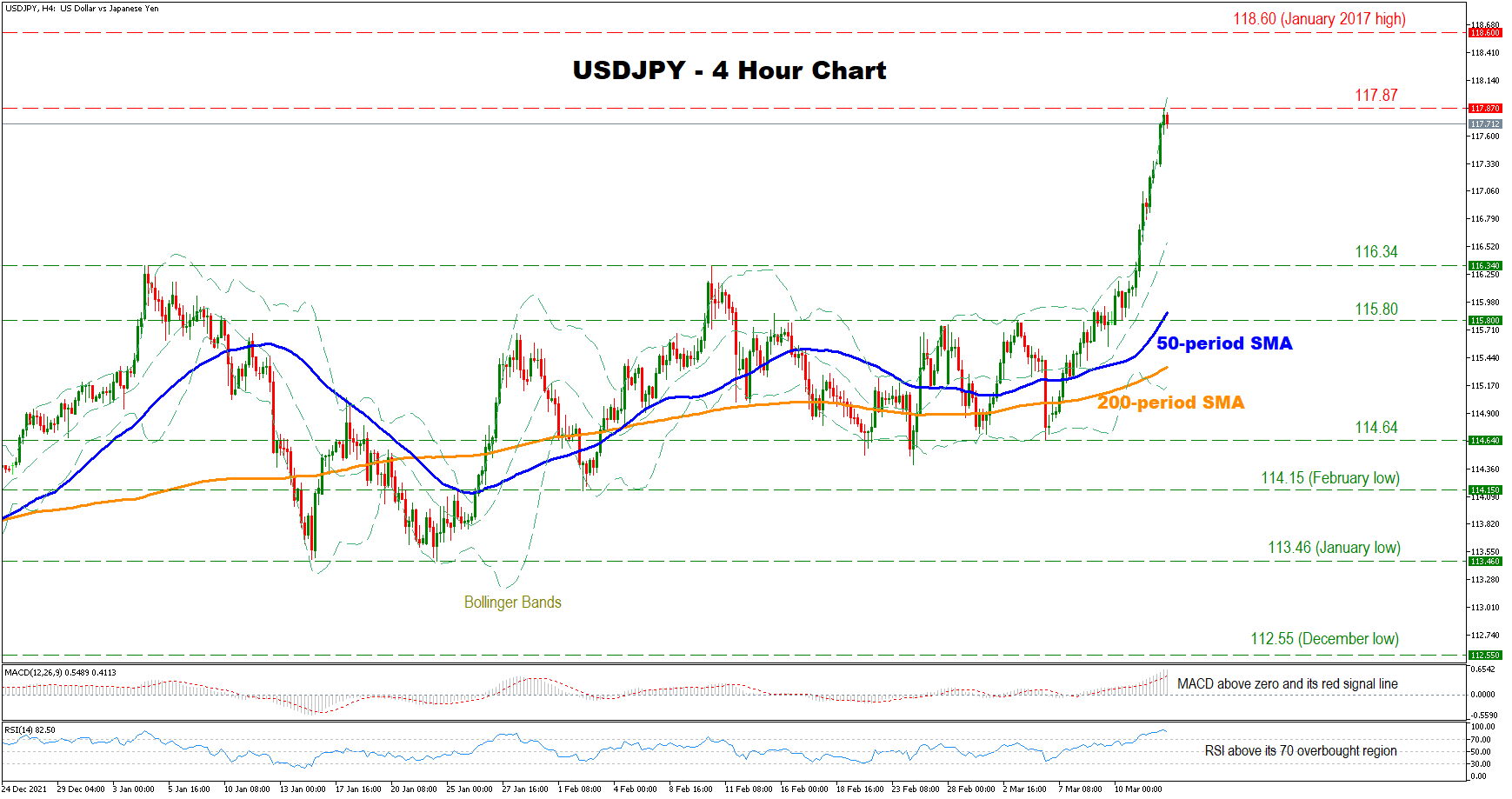
USDJPY came back swinging from its early-March low, reaching multi-year highs as positive momentum mounts. Moreover, the pair is currently trading way above its 50- and 200-period simple moving averages (SMAs), reinforcing its overall bullish outlook.
Short-term momentum oscillators reflect a mixed picture as the RSI is found above its 70 overbought region, signalling that an imminent pullback is not out of the equation. However, the MACD is found above zero and its red signal line, which could indicate that the positive momentum in the price might be gaining further traction.
The bulls seem to be firmly holding control over the last few sessions. Should they manage to push the price above the 114.87 hurdle, positive momentum could strengthen, opening the door towards the January 2017 high at 118.60. Crossing above the latter could then pave the way towards the 120.00 psychological mark.
On the flip side, if negative forces resurface, immediate support might be found at the 116.34 level, before sellers eye the region which includes the 50-period SMA and the 115.80 barrier. Crossing below this area could turn the fortunes around for the pair, sending the price to test its 200-period SMA currently at 115.35.
In brief, the overall outlook for the pair is bullish despite trading close to its upper Bollinger Band, which raises the immediate risk to the downside. For sentiment to change, sellers would need to drive the price below the 50-period SMA currently at 115.88.
US Dollar Index Outlook: Dollar Remains Firm on Geopolitical Tensions
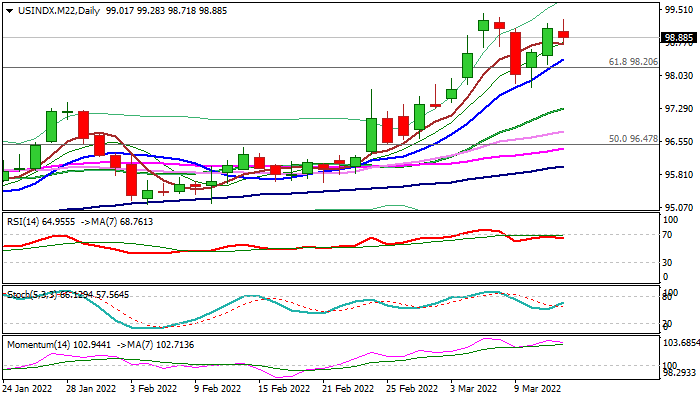
The dollar index edged lower in European session on Monday, after hitting a session high (99.28) in Asian and still holding positive sentiment, despite reviving risk sentiment on fresh optimism over Russia – Ukraine ceasefire talks.
The index is trading near new highest in almost two years (99.41) being lifted by strong risk aversion caused by growing uncertainty over the war in Ukraine and potential consequences on the global economy.
The dollar is expected to remain strongly supported by geopolitical factor, unless the conflict de-escalates significantly, with strong expectations that the US federal Reserve will raise interest rates for the first time after pandemic, in their policy meeting this week.
Economists do not expect war tensions to derail the central bank widely expected 0.25% hike this month, as soaring inflation maintains pressure on the policymakers to start tightening and fight strong price pressures.
Bullish technical studies on all larger timeframes are supportive for further advance, with dips to ideally stay above solid supports at 98.38/20 (rising 10DMA / broken Fibo 61.8% of larger 103.80/89.15 fall) and keep bulls in play for retest of 2022 high (99.41) and attack at psychological 100 barrier, violation of which would expose 100.34 (Fibo 76.4%).
Caution on loss of 98.20 handle that would soften near-term tone and risk attack at 97.76 (Mar 10 trough) break of which would complete a failure swing pattern on daily chart and generate initial signal of reversal.
Res: 99.28; 99.41; 100.00; 100.34.
Sup: 98.71; 98.38; 98.20; 97.76.
Are Conditions Perfect for Gold’s Uptrend?
Before we answer the questing in the headline, it is important to remember that the circumstances were not ideal for gold during 2021. Yes, the uncertainty was there due to the ongoing waves of the pandemic. Also, inflation was starting to boil, despite repeated efforts of central banks to calm it. However, the US dollar was the winner, not gold. The greenback has bounced back after the US Dollar index recorded its lowest level in December. The real yields were trapped within the 0.50% range over the year after having already seen repeated declines for two years.
Apart from inflationary pressures, all other factors were serving as tailwinds to gold after reaching $2000 in August 2020. But inflation along with the slowing global economy are the factors that make gold shining brighter.
How has gold reacted to the Russian-Ukrainian war?
Gold prices rose in recent weeks, as investors turned to safe-haven assets amid rising tensions between Russia and Ukraine. In addition, gold provides a place to hide from out-of-control inflation, and there is no sign that it is going to calm down anytime soon.
The latest CPI data also confirms that the US inflation is still very hot after rising 7.9% year on year. Geopolitical tensions and strong inflation numbers have encouraged some traders to bet on higher gold prices over the next few weeks. Therefore, 2022 gave gold a gift to rise above $2000 for the first time since December 2020.
What are the reasons that support gold prices?
With gold seen as a hedge against inflation, prices still have room to go up. The uncertainty has pushed investors to buy gold. What are the factors that will help gold rise?
- The possibility of disruptions in global supply chains of raw materials since Russia is one of the largest producers of these materials, along with Ukraine.
- Recent inflation data suggests that price pressures are unlikely to calm any time soon.
- The already fragile global economy has taken another hit, and it is hard to imagine a scenario in which continued tensions with Russia do not have real economic impacts.
- Expectations that gold will outperform even after the war ends because of post-war effects.
- The expected decline in global oil and gas supplies due to the sanctions imposed on Russia, resulting in higher oil prices.
- Fed will hike rates, no joke here. But any indication that they will raise it four times this year instead of six as markets have priced in, would be positive news for gold.
- The world will dive into recession as inflation continues to soar, prices for commodities and raw materials are rising, and economies are slowing. Gold will be the preferred asset.
Where will gold prices go?
Gold's recent rally is just the beginning of a bigger move in the long term, even if the sentiment among Wall Street and traders weakens in the near term. After the precious metal rose above $2000, this may be a sign that it needs to calm down a bit. There is no doubt that gold is in an uptrend, but some consolidation is needed. Everything that happens around gold supports its long-term rally.
In the end, the war between Russia and Ukraine caused major movements in commodities. Since the invasion on the 24th of February, the prices of oil, gold, uranium and even soft commodities such as wheat have skyrocketed. Although a diplomatic solution to this conflict is likely, the war will have a genuine effect on the markets for years to come.
Steve Wozniak Believes BTC Will Reach $100K
Bitcoin has decreased over the past week by 0.9%, ending it at around $38,700. Yesterday, the decline continued, bringing the price to 38500. Ethereum lost 0.7% in 24 hours and added 1.5% in a week. Other leading altcoins from the top ten show mixed dynamics over 24 hours: from a decline of 3.8% (XRP) to a rise of 3.3% (Terra).
According to CoinMarketCap, the total capitalization of the crypto market decreased by 14% in 24 hours, to $1.72 trillion. The Bitcoin Dominance Index fell 0.1% to 42.4%. The Cryptocurrency fear and greed index added 2 points in a day to 23 and remains in “extreme fear” condition.
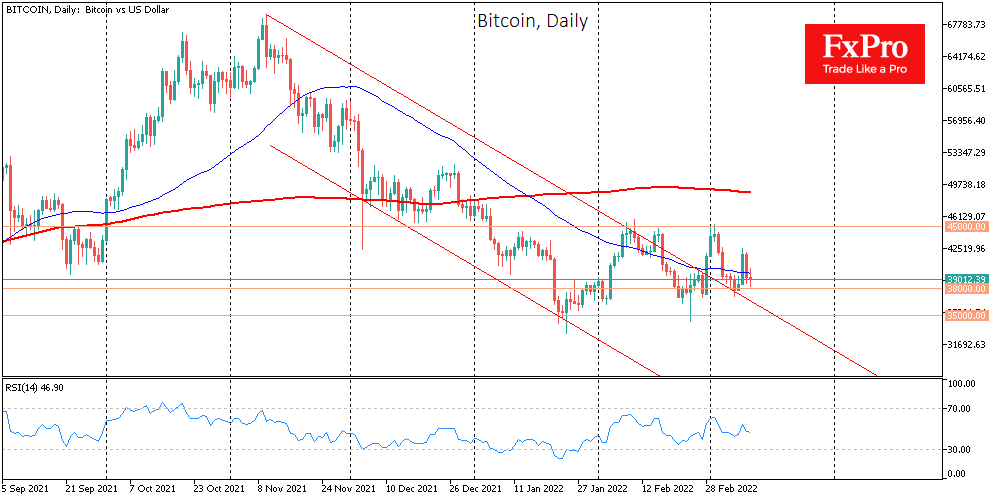
In the first half of the past week, the first cryptocurrency tried to strengthen, testing five-day highs near $42,600. Later, BTC lost all gains, again being thrown back to support near $38,000. Pressure on all risky assets continues to be exerted due to the situation in Ukraine.
One of the Apple founders, Steve Wozniak, said that bitcoin would reach $100,000, which will be facilitated by the general interest in cryptocurrency. At the same time, he has a negative attitude towards altcoins and non-fungible tokens (NFTs).
The US Securities and Exchange Commission (SEC) has again rejected applications from the NYSE Arca and Cboe BZX Exchanges to create spot bitcoin ETFs due to non-compliance with US exchange law.
El Salvador has announced that it will postpone the issuance of bonds in bitcoins in connection with the events in Eastern Europe. The received funds were planned to be used for the construction of the “Bitcoin City”.
Visiting the UAE, Russians massively sell cryptocurrency for billions of dollars. Earlier, FBI Director Christopher Wray emphasized that the United States has vast experience in tracking cryptocurrencies, and Russia will not be able to use them to circumvent sanctions.
Swiss SECO cuts 2022 growth forecast, direct impact of Ukraine conflict on Switzerland limited
Swiss SECO export growth lowered 2022 GDP growth forecast from 3.0% to 2.8%. It said, "higher inflation and the Ukraine conflict are slowing the pace of recovery." It added, "the war in Ukraine poses major risks for the global economy." For 2023, growth projection is kept unchanged at 2.0%.
Recent appreciation of the Swiss Franc is " helping to contain price pressures within Switzerland, but higher inflation rates are still to be expected on the domestic front." 2022 inflation forecasts was raised sharply from 1.1% to 1.9, then slowed to 0.7% in 2023. .
SECO said: "The direct impact of the Ukraine conflict on Switzerland is likely to be limited, given the relatively low level of economic ties with Russia and Ukraine. Nonetheless, significant indirect effects are to be expected. World prices of key exports from Russia and Ukraine – energy resources as well as certain food staples and industrial metals – have soared. Global inflationary pressures will therefore remain high for now. "
No Reason to Exit the Better Safe than Sorry Thinking
Markets
Markets were mostly chewing on the ECB’s message during Friday’s European trading session. Behind doors stories emerged suggesting a broadly 15-10 split in favour of the more hawkish ECB flank. Especially the significant rise in market-based inflation expectations since the early February meeting supposedly tilted the balance. The EU 10y inflation swap for example surged from near 2% to a peak of 2.8%. European yields remained in the lift with the EU 2y swap rate setting a new multiyear high above 0.25% and the 10y benchmark testing the psychologic 1% mark. Trading dynamics changed over US trading hours when risk sentiment turned risk-off again, providing a bid especially for longer dated bonds. The EMU swap curve flattened with daily changes ranging between +2.9 bps (3-yr) and -2.2 bps (30-yr). German Bunds outperformed with the curve bull flattening (yields dropping 2.1 bps to 3.4 bps). US Treasuries underperformed in the run-up to this week’s FOMC meeting with daily changes from +5.2 bps (2-yr) to -1.3 bps (30-yr). EUR/USD during the US session tanked from an intraday high around 1.1040 to a close just north of 1.09. Key US stock market benchmarks lost over 2% for the Nasdaq compared with positive closing levels in Europe.
Asian bourses trade mixed this morning with China significantly underperforming after the country placed the southern city of Shenzhen (technology hub) into lockdown for at least a weak. The dollar’s strength is again most outspoken in the USD/JPY combination. The pair on Friday broke above 116.35 resistance and this morning closes in on the 118 big figure for the first time since end 2016. Next resistance stands at 118.66 (2016 top). Reuters already reports that the Japanese government stresses the importance of the a stable currency and that it is eying the impact of a significantly softer yen on the economy.
In a broader context, there’s little to add on the situation in Ukraine. From a market perspective, this implies no reason to exit the better safe than sorry thinking. The eco calendar is empty today with market focus on this week’s monetary policy meetings in the US and in the UK. Markets no longer contemplate a 50 bps Fed rate lift-off and discount a 25 bps move. Indications on the (speed of the) balance sheet run-off, the terminal rate and the number of follow-up rate hikes to tackle decade-high US inflation will be key further out. In any case, we think that (global) policy normalization continues to serve as strong counterweight against potential upticks in risk aversion. This suggests a persistent fragile stock market environment and more weakness for core bonds. The jury in FX space remains out. The ECB in theory solidified the floor below EUR/USD medium term, but in a short term perspective the dollar could hold the upper hand. Support stands at 1.0806 (2022 low) and 1.0636 (2020 low).
News Headlines
In an interview on Sunday, Russian Finance Minister Siluanov said his country lost access to around $300bn of its total $640bn gold and FX reserves due to sanctions imposed by Western countries. In this context, the Minister said that Russia will continue to fulfil its debt obligations. However he indicated that the country will pay roubles to its debt holders, rather than in USD or other currencies until the state reserves are made free again. Russia also looks for support from China as the West is putting pressure on China to limit access to reserves in yuan. Today, the US National Security adviser Jake Sullivan will meet in Rome with a top diplomat of the Chinese Polit bureau.
Corona infections continue to impact life and economic activity in China. Chinese authorities have imposed a lockdown on the City of Shenzhen, home to a about 17.5 mln people. The region is an important Tech hub. So the lockdown may cause additional supply issues. Covid cases in the country are also rising again in several other cities, including Shanghai. The impact on activity raises the chances that the PBOC will ease policy further in the near future. End last week, February credit data in China slowed more than expected.
European Indices, Except FTSE 100, Start the Week on Strong Gains as Oil Falls
European indices kicked off the week on a positive note, and the US futures recover losses after a red Friday, yet the news from Ukraine are worrying and the risk appetite is certainly not strong. The FTSE100 remains on the backfoot as the cheaper oil and commodity prices weigh on the miner-heavy British blue-chip index. Rio Tinto shed more than 200 points this morning, as Anglo American and Glencore cost 145 and 30pts respectively.
US crude is down 3.45% despite the escalating tensions in Ukraine, and the negative pressure in oil prices is in play since the failure to break above the $130pb mark following the US and the UK’s announcement of a ban on Russian oil last week - a price action suggesting that last week’s highs factored in a major part of the bad news before they were announced. We may see a further easing, and the $95/100pb area should be closely monitored.
I still believe that the risks remain tilted to the upside, as the sanctions on Russian oil, the constraint supply from OPEC countries which are partly not willing to increase production and investment in fossil fuel that will be abandoned as soon as possible, and the news that the nuclear negotiations with Iran were suspended due to ‘external factors, as tweeted by the EU foreign policy chief Josep Borell. So, the Iranian oil is not what’s pressuring the oil prices lower this morning. But, one of the biggest arguments for the oil bears at this point is the fact that the energy prices went so high that it will slow down the economic growth, by lower demand, and by an eventually more restrictive monetary policy.
Speaking of central bank policy, the Federal Reserve (Fed) is given close to 100% chance of raising the interest rate by 25bp this week, and there will probably be no surprise as the Fed is really not willing to rock the boat at this point. There is however a risk that we hear a hawkish statement given that the pressure on inflation won’t be easing anytime soon. The US dollar is preparing to test the 100 mark, while the S&P500 is now headed to a death cross formation on its daily chart.
The Bank of England (BoE) is also seen rising the bank rate, while the Bank of Japan and the Central Bank of Turkey are expected to maintain the status quo.
Elsewhere, the surge in nickel prices jeopardize the optimism that rising fuel prices would quicken the electric transition. Tesla shares closed the week below the $800 mark, and the downside risks prevail.
US Dollar Index Rises as Wall Street Meltdown Accelerates
American equity futures declined on Monday morning as the crisis in Ukraine escalated during the weekend. Vladimir Putin’s military continued shelling many Ukrainian cities as it continued facing fierce opposition from Ukrainian soldiers. As a result, investors are worried about the impact of this crisis on companies' growth and margins as the cost of doing business escalates. For example, the prices of key commodities like oil, wheat, palladium, and nickel has risen sharply in the past few days. Some of the top companies to watch this week will be software-related, which will publish their earnings. They include SentinelOne, GitLab, SmartSheet, and PagerDuty.
The price of crude oil and natural gas remained at elevated levels on Monday morning as the crisis in Ukraine escalated. On Sunday, the Russian military attacked a Ukrainian military base close to Poland. That attack came shortly after Russian officials warned the US against equipment shipments to Ukraine. Therefore, analysts warn that Russia will continue its assault in the country this week. With OPEC members like Saudi Arabia not cooperating, there is a likelihood that demand for oil will outstrip supplies and push energy prices higher.
The economic calendar will be significantly muted today, with no major data expected. The only important event will be a meeting of EU members, who will deliberate on the crisis in Ukraine. Another key report will be from Switzerland, where a panel of economists will provide a forecast of the country’s recovery. At the same time, investors will be looking at the upcoming interest rate decision by the Federal Reserve. Most analysts expect that the Fed will deliver a hawkish statement considering that the country’s inflation is surging.
EURUSD
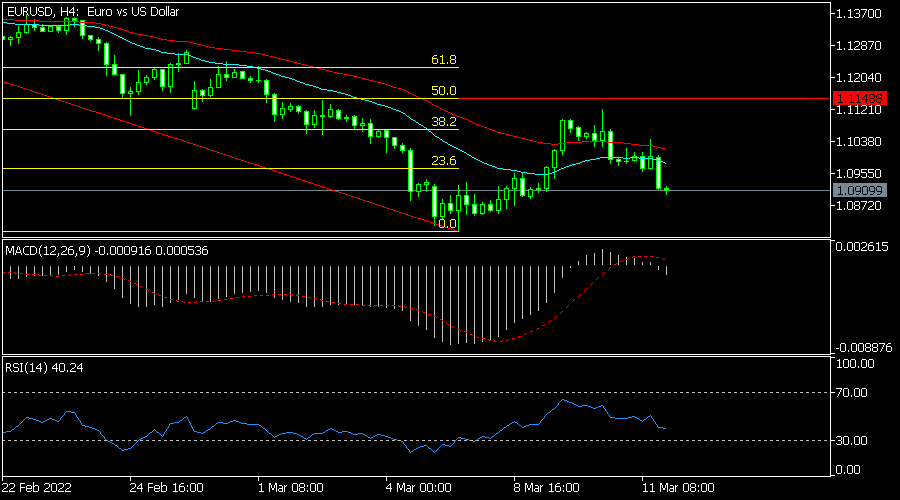
The EURUSD pair continued its bearish trend on Monday morning as demand for the US dollar rose. It is trading at 1.0900, which is lower than last week’s high of 1.1116. On the four-hour chart, the pair has managed to move below the 23.6% Fibonacci retracement level. It has also crashed below the 25-day and 50-day moving averages. At the same time, the Relative Strength Index and the MACD are pointing lower. Therefore, the pair will likely continue falling as bears target the next key support at 1.0800.
USDCHF
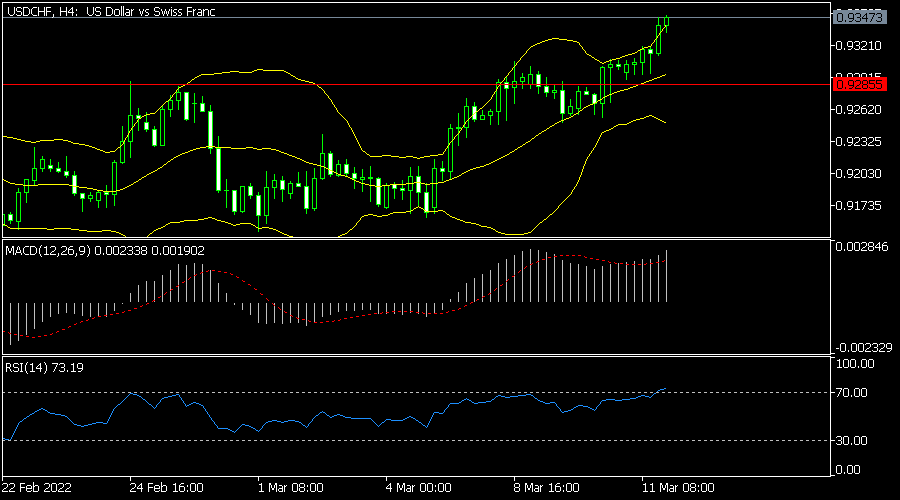
The USDCHF pair has been in a strong bullish trend in the past few days. And on Friday, the pair surged to a multi-month high of 0.9347 as demand for the greenback rose. On the four-hour chart, the pair is along the upper side of the Bollinger Bands. It has also moved above the 25-day and 50-day moving averages. The Relative Strength Index and the MACD have pointed upwards. Therefore, the pair will likely keep rising as bulls target the next resistance at 0.9500.
USDJPY
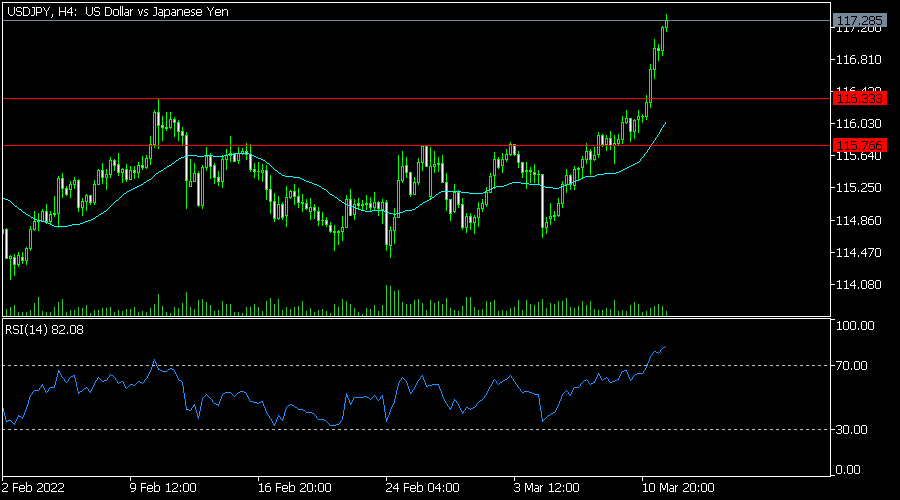
The USDJPY also jumped sharply as dollar demand rose. It rose to 117.28, which was significantly higher than this month’s low of 114.70. On the four-hour chart, the pair has moved above the key resistance level at 116.33, which was the highest level this week. It has moved above the 25-day and 50-day moving averages. Therefore, the pair will likely keep rising this week.
Shenzhen Lockdown Muddies Economic Waters
Monday’s these days usually present a confusing picture to investors, and this one is no different. Reuters is reporting that both Ukraine and Russia appear to be making progress towards substantive negotiations. That gave some parts of Asia an excuse to tentatively buy equities this morning and has seen oil fall, with the chance of bottom-fishing the Ukraine war just too tempting.
Offsetting that was Russian missile strikes in Western Ukraine over the weekend that were very close to the Polish border, and reports from American officials that Russia was asking China for military aid, since denied by Chinese officials. If true, it would be a serious sign that all is not well in the Russian industrial-military complex and could explain the shift by the Russians outlined in the Reuters reporting above. China, for its part, will need to tread carefully, with the US and Europe being its largest export customers. Political doctrines or not, money talks and China is facing economic challenges of its own it may not want to exacerbate for the sake of Putin.
China itself has announced a complete lockdown of 17.5 million people in its coastal city Shenzhen, a major tech-hub and port city to fight rising Covid-19 cases. Adjacent Hong Kong announced that 300,000 people were in isolation or quarantine as its Covid nightmare continues. Foxconn, a major Apple supplier, has already announced factory suspensions in Shenzhen and if the port also has to close, we can throw more supply chain disruptions into the global mix. Oil’s fall this morning may also be partly due to expectations that China’s domestic consumption could temporarily fall due to Covid lockdowns.
With that in mind, oil’s fall today is even more surprising after Iranian missiles rained down on a target in Iraq. Allegedly in retaliation for an Israeli attack in Syria earlier this week on suspected Republican Guards leaders there, but also perhaps linked to frustrations about the stalled nuclear agreement. Last-minute Russian demands threaten to scuttle the entire thing, making the fall in oil prices today even more surprising.
US Consumer Confidence data was weaker than expected on Friday, suggesting that the stagflationary wave sweeping the world from the Ukraine conflict is having an immediate impact. That won’t be the last we hear on that front with cost-of-living increases rising sharply around the world, provoking disgruntlement amongst consumers. Asian currencies are under pressure today and going forward, those pressures will be amplified as Asia’s central banks will be reluctant to hike with the Fed.
Fed likely to implement 1/4 point hike
As if things couldn’t get more complicated, the US Federal Reserve’s FOMC announces its latest interest rate decision this week. A 0.25% rate hike is locked and loaded, and despite the noise, I believe that the Fed is still cautious and 0.50% is off the table. What might not be, though, is a faster path of rate hikes to normalise monetary policy. The US yield curve continues to flatten and if the FOMC is hawkish, could shift higher in entirety and flatten and head towards inversion, signalling potentially, a future recession.
Stagflation is a nasty beast, and there are no painless options for central banks when it happens. Do nothing and your currency is likely to fall, exacerbating imported inflation. Hike rates and support the currency, but slow or stop growth. Each central bank will have to choose its own path, but my reading thus far will be that Europe and Asia will hold rates fast, China will attempt a targeted easing, while the US and the Commonwealth countries, including Australia, will hike. That will be good for the US dollar, bad for the euro and Asian FX, while to say the environment for equities anywhere will be challenging in 2022, is an understatement.
The FOMC will clearly be the economic data highlight of the week, even as the short-term financial markets continue to chase their tails on Ukraine developments. But China will also announce its one-year medium-term lending facility rate (MLF) sometime this week, which could feature a cut. It releases Retail Sales and Industrial Production tomorrow. Indonesia and Taiwan’s central banks announce policy decisions after the FOMC on Thursday. China and India release trade balances tomorrow, with Singapore releasing Non-Oil Exports. Finally, Australia releases unemployment data on Thursday as well, with strong jobs gains perhaps the last piece of the puzzle needed by the RBA to drop its ultra-dovish stance. The RBA Governor said last week that preparing for higher interest rates would be a sensible precaution. Tuesday and Thursday will be peak-data days for Asia this week.
Finally, the Bank of England announces its latest policy decision on Thursday, followed by the Bank of Japan on Friday. The Bank of Japan will hold its nerve, but the Bank of England will almost certainly follow the FOMC and hike by 0.25%.
Geopolitics will continue to dominate the market and the list of headlines from around the world today made me not even want to get out of bed. One thing I am sure of is that the algo and retail fast-money gnomes of the financial markets are going to buy risk heavily at the first concrete signs of Ukraine-Russia settlement progress. That is likely to be a sucker’s rally, though, because behind the scenes, the stagflationary wave sweeping the world, and the new cold war, are quietly eroding the foundations of the global recovery. The pain will be felt unevenly, and I’d hate to be a politician fighting an election this year, although resource-heavy countries should fare better than most. You could almost construct a case for getting bullish Latin America again on that basis. Almost…
As I have stated ad nauseam, volatility will be the winner in H1 2022, not market direction. Although I expect more last stands from the “buy-everything” HODL gnomes. Alas, after 14 years of central banks creating inequality in the world, all good things must come to an end. Given the risk profile of this week, a sensible investor with a longer-term view, and without a need to get spanked by Mistress Whip-Saw, might choose to watch the fun and games from the sidelines.
Gold Price Entered a Short-Term-Bearish Zone Below $2.020
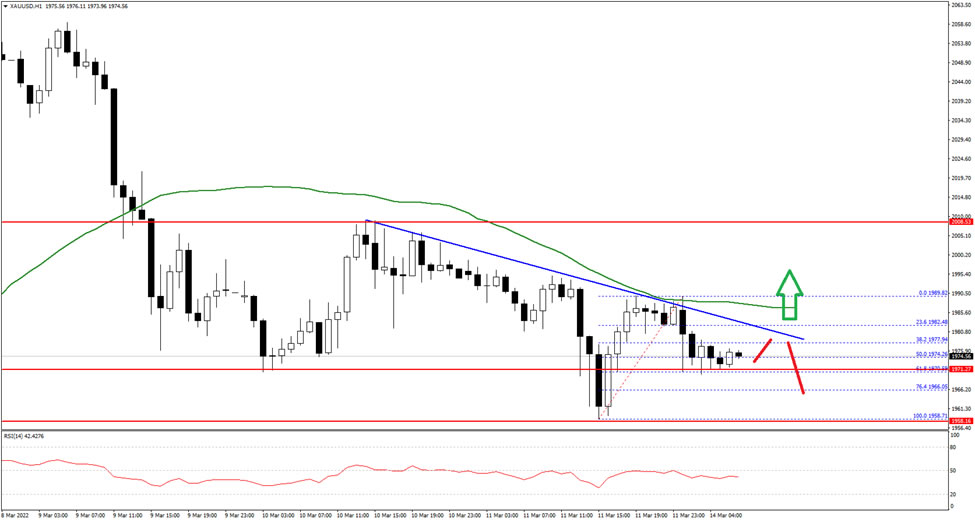
Gold price started a downside correction from well above $2,050 against the US Dollar. The price broke the $2,020 support level to enter a short-term bearish zone.
The price even declined below $2,000 and the 50 hourly simple moving average. It traded as low as $1,958 and is currently consolidating losses. On the upside, the price is facing resistance near the $1,980 level.
The next main resistance could be near the $2,000 level, above which the price could start another steady increase. In the stated case, it could rise towards $2,050 on FXOpens.
If not, there could be a fresh decline below $1,970. The next major support is near the $1,960 level, below which the bears might gain strength. In the stated case, the price could even decline below the $1,950 support level in the near term.