Sample Category Title
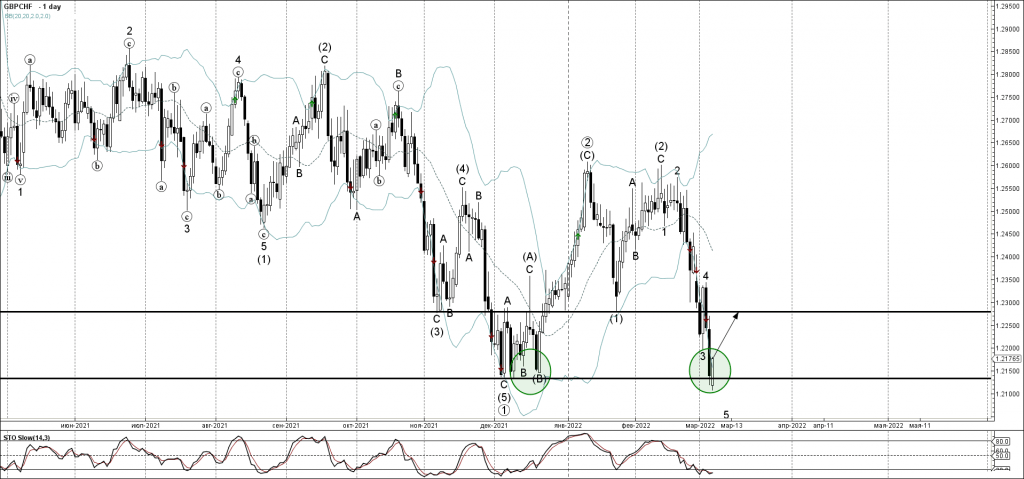
GBPCHF Wave Analysis
- GBPCHF reversed from support area
- Likely to rise to resistance level 1.2280
GBPCHF currency pair recently reversed up from the support area located between the multi-month support level 1.2135 (previous monthly low from October) and the lower daily Bollinger Band.
The upward reversal from this support area stopped the previous impulse waves 5 and (3).
Given the oversold reading on the daily Stochastic indicator, strong swiss franc outflows- GBPCHF can be expected to rise further toward the next resistance level 1.2280 (former monthly low from January).
XAU/USD outlook: Gold Rises above $2000 as Escalating Crisis Boosts Safe-Haven Demand
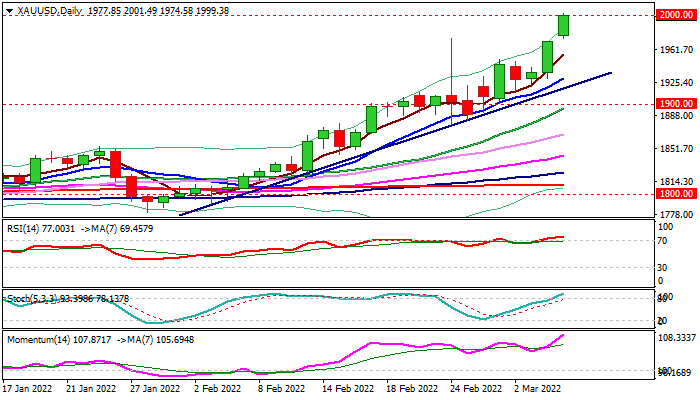
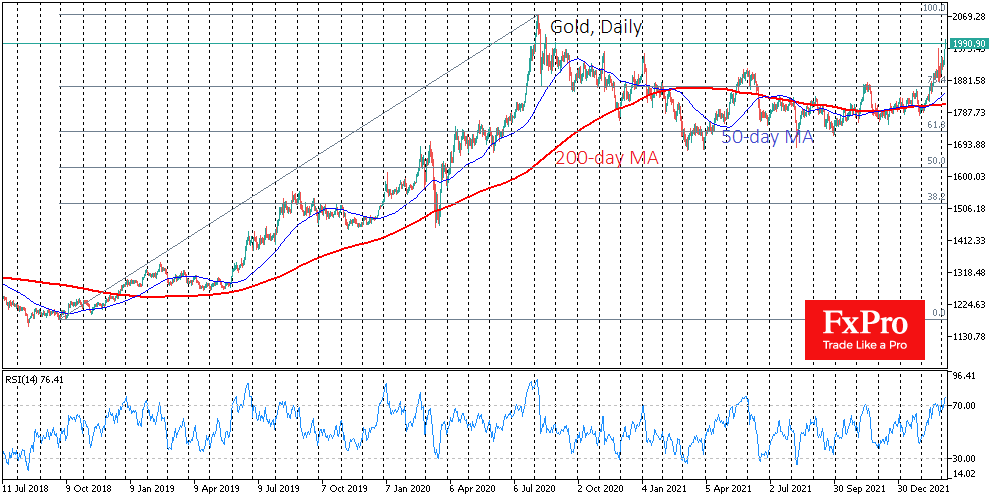
Spot gold hit $2000 per ounce this morning, for the first time since August 2020, as uncertainty about global economy in light of the consequences of the Russia-Ukraine war and Western sanctions on Russia, as talks about including Russian energy products into the package of restrictions, strongly increased global uncertainty and boosted safe-haven demand.
The yellow metal advanced 2.6% last week, as crisis deepened, but advanced 1.2% only in early Monday’s trading after starting the week with gap higher, signaling that the latest acceleration could extend much higher. Close above $2000 is needed to confirm strong bullish bias and expose targets at $2015/$2049 (Aug/Sep 2020 peaks) which guard a record high at $2074, posted in Oct 2020.
Further escalation of the crisis could inflate gold price above these levels and unmask next targets at $2100 (round-figure) and $2168 (Fibo 123.6% projection of the rally from $1676 (Mar 2021 low).
Solid supports lay at $1980/74 (broken Fibo 76.4% of $2074/$1676 / Feb 24 spike high), followed by daily Tenkan-sen ($1940) and trendline support at $1925.
Res: 2015; 2049; 2074; 2100.
Sup: 1980; 1974; 1950; 1940.
DAX Falls to Multi-Month Low as Risk Aversion Accelerates on Speculations
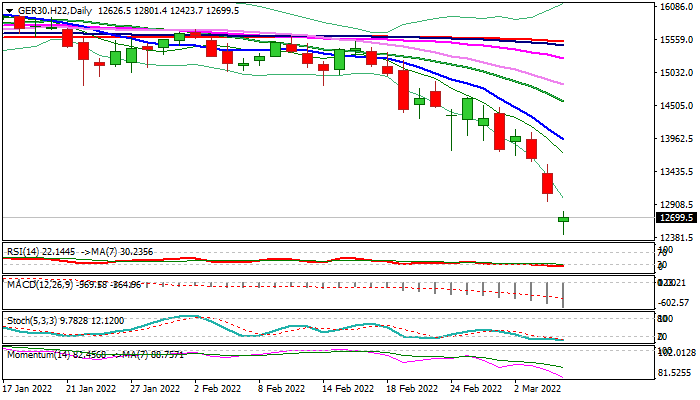
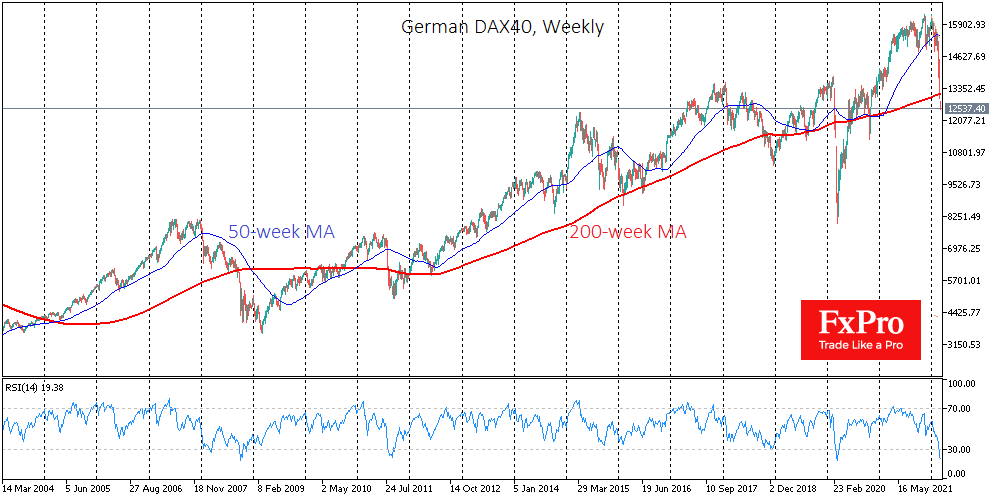
Dax index opened with gap-lower on Monday and broke below 13000 marks to hit 1650, the lowest since November 2020, driven by fresh wave of risk aversion.
Global markets panicked after the US and Western allies announced plans to impose a ban on importing Russian energy products, which were so far excluded from the wide package of sanctions.
The news sent shockwaves across the markets and raised fears that such measure could strongly hurt bloc’s economy, heavily dependent on Russian energy and significantly slow economic growth, as record inflation could rise further.
The index extends steep fall into third straight week, following nearly 8% drop last week and break of key technical supports at 13668 and 13101 (base of thick weekly cloud / Fibo 38.2% of 7940/1629 rally) that generated strong bearish signal, adding to negative outlook, as global migration from riskier assets into safety accelerates on the latest signals of possible deepening of crisis.
Bears focus initial target at 12116 (50% retracement of 7940/16292) and could extend towards 11314 (Oct 2020 through), with limited upticks on oversold conditions to provide better levels for re-entering bearish market.
Res: 12801; 12959; 13101; 13668.
Sup: 12423; 12116; 12000; 11314.
Capital Fleeing Europe and Markets’ Domino Effect
The armed conflict in Ukraine continues to have a destabilizing effect on the markets. With no visible signs of de-escalation over the weekend, markets opened the week with impressive gaps. They continued to move in the directions that were set back in February.
By the beginning of active trading in Asia, an ounce of gold has reached $2,000, then retreating to $1,990. Above the current values, the precious metal was traded only for a short time in early August. The craving for gold has intensified amid growing signs that the crypto exchanges and platforms are supporting sanctions against Russia, blocking Russian wallets from the sanctions lists (and thousands allegedly associated with them), and prohibiting Russian residents from opening wallets the largest exchanges. All that leaves no choice to investors by directing their capital to gold as the primary haven.
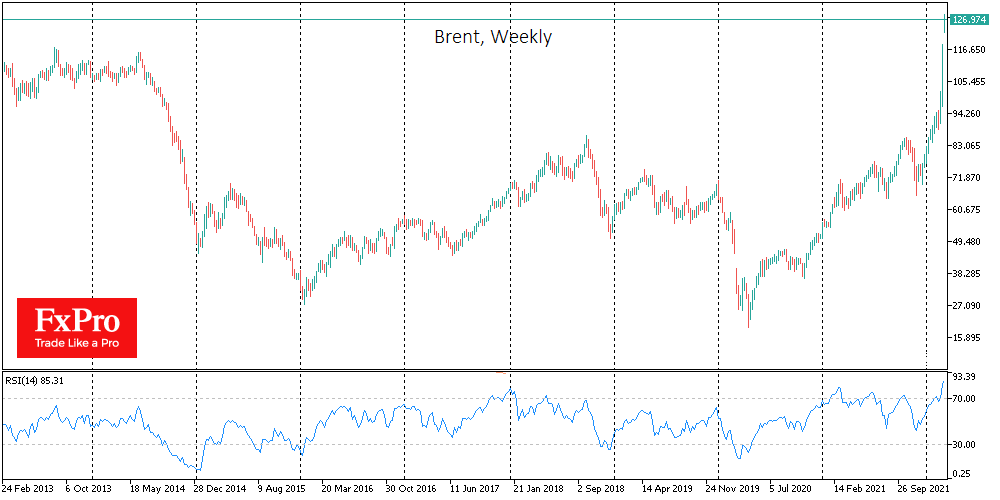
Over the weekend, the US considered a ban on oil imports from Russia. There were hints that the United States could be followed by several countries for which such sanctions would not lead to irreparable consequences for the economy. The prospect of worsening oil supplies in the short term caused a 10% jump in the price of Brent this morning, which reached $129 on the spot market, and WTI – up to $125. The struggle for the energy resources remaining on the market has intensified among traders. Many operators avoid chartering oil from Russia and even Kazakhstan, fearing restrictions on bank transfers and fearing a tightening of the import ban in the coming days.
Futures for wheat and corn again rested against the allowable upper daily limits immediately at the opening of trading. To alleviate the humanitarian catastrophe at home, Ukraine limits the export of certain types of food products from obtaining special licences for meat and sunflower oil to a complete ban on such as buckwheat and sugar.
Risk aversion is also developing in the stock markets. The German DAX shed about 4% on Friday and started trading with another 3.8% on Monday. The main Asian indexes lose about 3-4% as the exit of world business from Russia and the jump in commodities and energy prices make the economic prospects sharply reassessed.
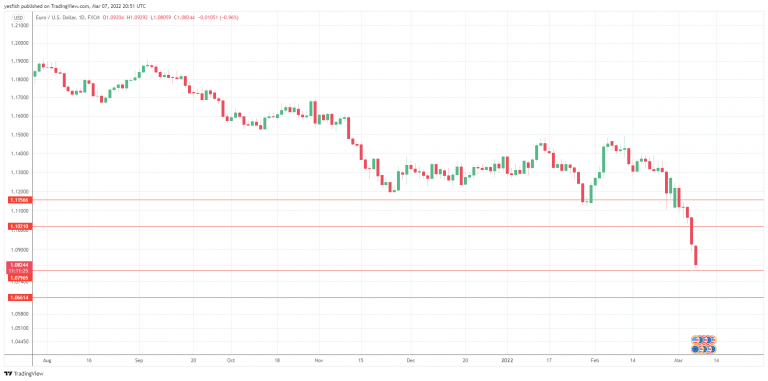
Capital is fleeing Europe, which is also evident in the persistent sell-off of the euro and the British pound. EURUSD is trading below 1.09 to 22-month lows. EUR fell below the parity with CHF at the start of the trading on Monday. GBPUSD is near December minimums at 1.3200. A dip below 1.3160 would set the quote to the lowest levels since the end of 2020.
The market situation now more and more resembles a domino effect. Once in a zone of turbulence, assets can go much further uncontrollably before the situation stabilizes. The experience of the last 20 years shows that only powerful interventions from the government and central banks can stop the domino effect. Now this will also require the political will of the warring parties.
Euro Decline Continues
The euro is coming off a nasty week and has continued its downswing on Monday. EUR/USD fell 3% last week and the pair has dropped 0.9% on Monday, to 1.0830. Earlier, the euro dropped to 1.0821, its lowest level since May 2020.
US dollar gains ground as risk appetite sinks
The US dollar continues to power forward as investors sought risk protection from the safe-haven greenback. The dollar index has risen to 99.23, up 0.59% as it moves steadily toward the symbolic 100 level.
The war in Ukraine rages on, with Russian President Putin saying that he will not stop the fighting until Ukraine surrenders. The West has ratcheted up its sanctions package, and there is now talk in Washington of trying to kick Russia out of the World Trade Organization. Just to add to the toxic mix, oil prices have surged to USD 130 on fears that the US and Europe may block Russian oil transfers.
It’s a messy situation all around, and the euro has become a punching bag for jittery investors, as the eurozone is not all that far from the fighting and much of its oil needs are covered by Russian supplies. Any good news, such as progress towards a cease fire, could help reverse the euro’s nasty skid.
Meanwhile, the US economy continues to hum, with an excellent nonfarm payroll release. The economy created 678 thousand jobs in February, breezing past the consensus of 400 thousand and above the January reading of 481 thousand. Unemployment fell to 3.8%, down from 4.0.%. With workers in short supply, pressure on wages will continue, and the Fed is likely to respond with a cycle of rate hikes, starting in March. The US releases CPI on Thursday, which is projected to hit 8%. A release within expectations will raise pressure on the Fed to align their timeline more closely with market expectations of six rate hikes this year.
EUR/USD Technical
- There is resistance at 1.1256 and 1.1406
- 1.0796 is under strong pressure in support and could be tested during the day. Below, we find support at 1.0661
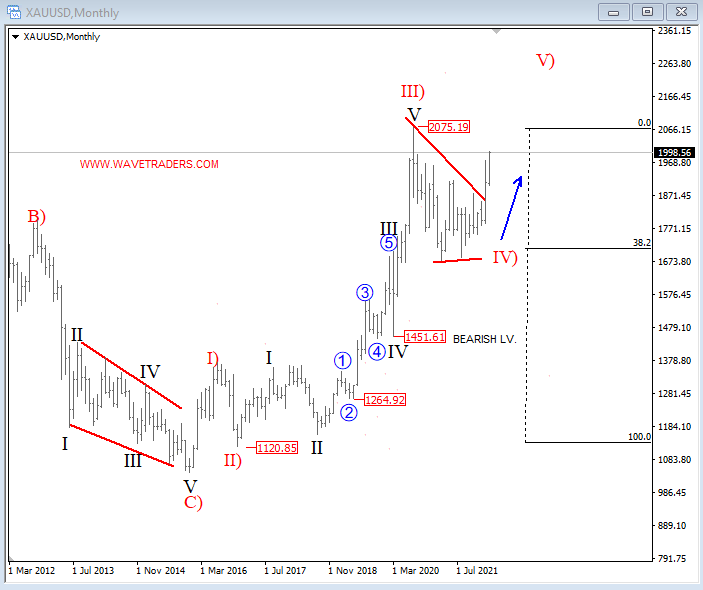
Gold Hunting for New All-time High: Elliott Wave Analysis
The Russia-Ukraine conflict remains the main driver of the risk-off sentiment, with stocks coming sharply down in Europe, while crude oil moves to 2008 levels. Bloomberg reported that the US was looking to ban Russian oil imports, which could lift prices even higher. This should have a strong impact on inflation as well then so FED will have to hurry up with higher rates, but they of course will be careful due to war in Ukraine. Definitely not an easy situation for investors, so we will most likely continue to see run to safety, which is Gold and USD at the moment.
From an Elliott Wave perspective, we see metals coming higher, with gold breaking out of a triangle and hunting new ATH. Some wonder if higher rates can stop gold rise. I think maybe only temporary if FED surprises and hikes well above expectations, and if situation in Ukraine gets better. Ideally, this will be after fifth.
Gold monthly Elliott Wave analysis
Gold Currently Consolidating Gains from $2000
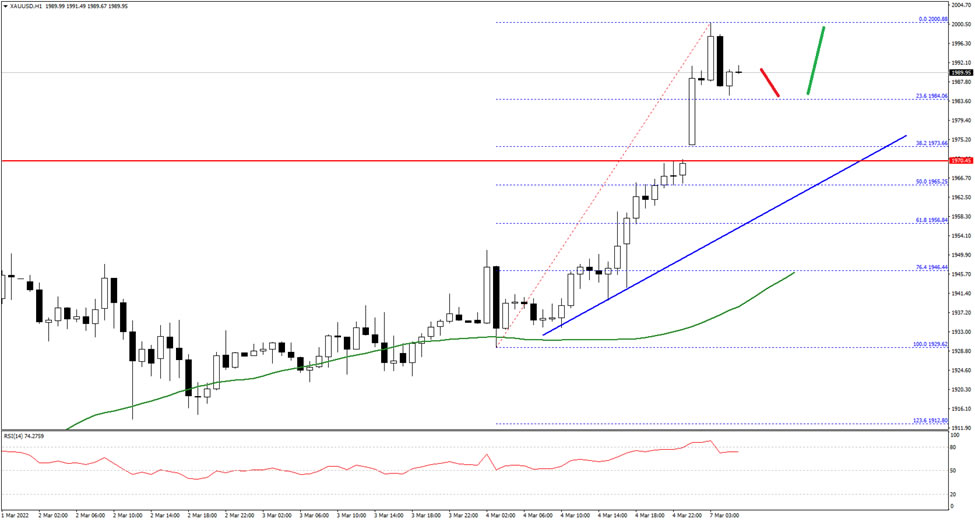
Gold price started a major increase above the $1,950 resistance against the US Dollar. The price broke the $1,980 resistance level to move further into a positive zone.
The rally even extended above $1,995 and the 50 hourly simple moving average. The price tested a major hurdle at $2,000 and currently consolidating gains. An initial support on the downside is near the $1,985 level.
The next major support is near $1,872 and a connecting bullish trend line on the hourly chart, below which the bears might gain strength. In the stated case, the price could start a steady decline towards $1,850 on FXOpen.
On the upside, the price is facing resistance near the $1,995 level. The next main resistance could be near the $2,000 level, above which the price could start another steady increase. In the stated case, it could rise towards $2,050.
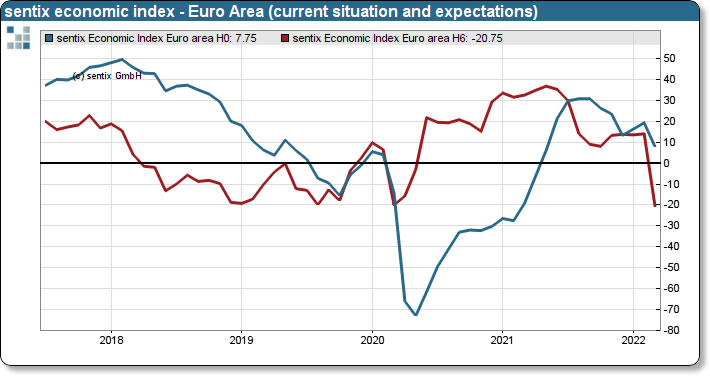
Eurozone Sentix dropped to -7, worst fall in expectations than pandemic
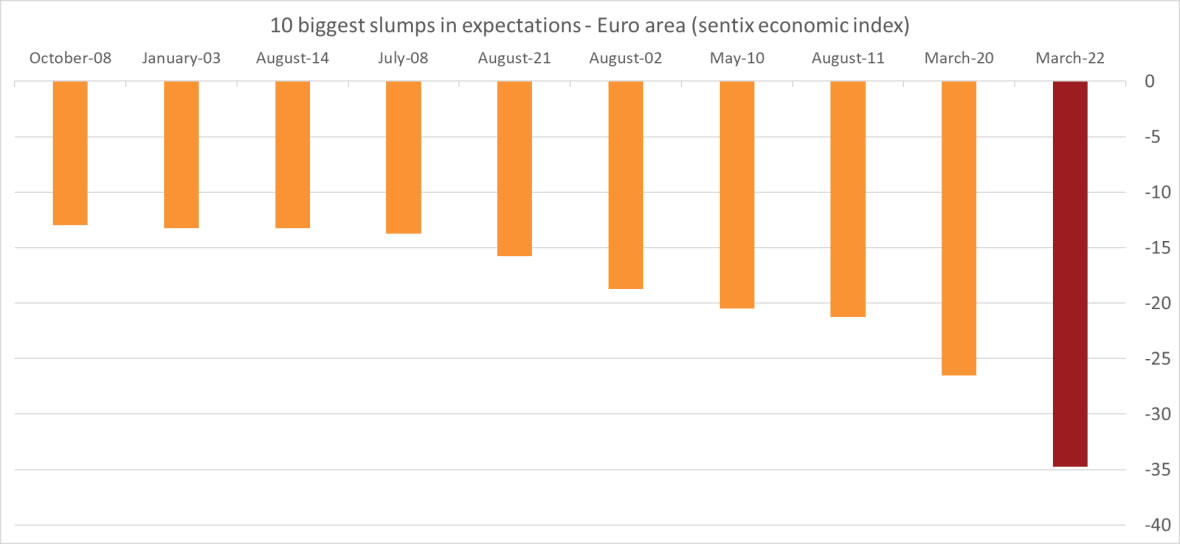
Eurozone Sentix Investor Confidence dropped sharply from 16.6 to -7.0 in March, well below expectation of 5.1. That;s also the lowest level since November 2020. Current Situation index dropped from 19.3 to 7.8, lowest since May 2021. Expectations index dropped from 14.0 to -20.8, lowest since August 2012.
Sentix said: "The first economic indication after the Russian invasion of Ukraine has it all: The economy in Euroland collapses dramatically in the month of March! The assessment of the economic situation decreased by 11.5 points and the expectations decreased by 34.75 points, which is more than ever before in the history of sentix. Even the Corona pandemic or the banking crisis had not led to such a sharp drop in the future outlook!"
Cryptocurrencies Can’t Stay Away from Politics
With a sharp decline over the weekend, Bitcoin wiped out the initial weekly gains, giving bears the upper hand for the third straight week. There were drawdowns to $34K on the low-liquid market on Saturday and Sunday. So the rate of the first cryptocurrency fell to $38K with a 3.8% loss. However, over the past 24 hours, BTC has reached $39,000 while Ethereum has lost 4.5%. Other leading altcoins from the top ten decline from 2% (XRP) to 6.8% (LUNA).
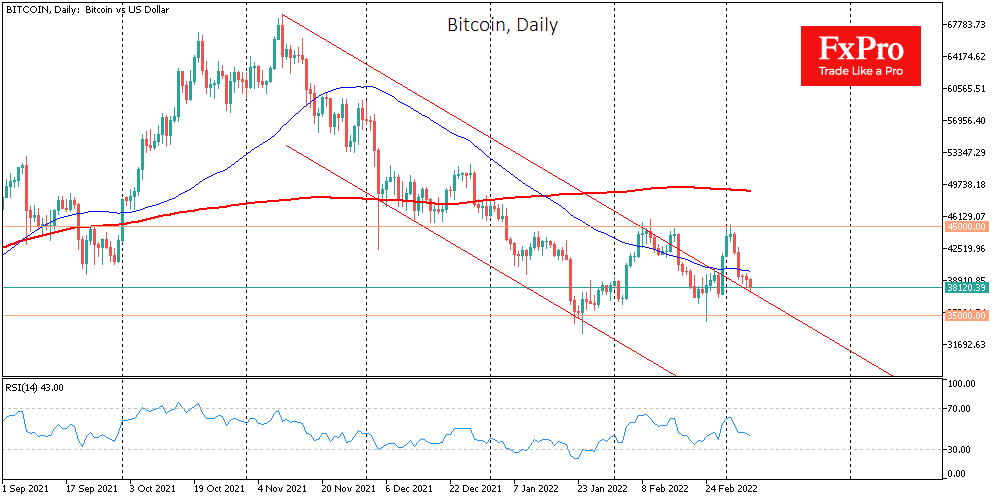
According to CoinMarketCap, the total capitalization of the crypto market decreased by 3.8%, to $1.71 trillion. The bitcoin dominance index sank from 42.9% on Friday to 42.3% due to the sale of bitcoin over the weekend.
The cryptocurrency fear and greed index is at 23 now, remaining in a state of “extreme fear”. Looking back, in the middle of the week, the index had a moment in the neutral position.
The sales were triggered by reports that the BTC.com pool banned the registration of Russian users. Cryptocurrencies do not remain aloof from politics, hardly confirming the role of an alternative to the banking system now, supporting EU and US sanctions against Russia, and showing their initiative. The news appeared that Switzerland would freeze the crypto assets of the Russians who fall under the sanctions.
In the second half of the week, bitcoin lost almost all the growth against the backdrop of a decline in stock indices. Although last week started on a positive wave: BTC added nearly $8,000 (21%) since the previous Monday but couldn’t overcome the strong resistance of mid-February highs at around $45,000 and the 100-day moving average. Speaking about the prospects, pressure on all risky assets will continue to be exerted by the situation around Ukraine, where hostilities have been taking place for two weeks.
Worth mentioning that the world-famous investor and writer Robert Kiyosaki said that the US is “destroying the dollar” and called for investing in gold and bitcoin.
At the same time, the founder of the investment company SkyBridge Capital (Anthony Scaramucci) is confident that bitcoin will reach $100,000 by 2024. Now, he has invested about $1 billion in BTC. Plis, a group of American senators, develops a bill that opens access to the crypto market for institutional investors. And one more piece of news to consider: the city of Lugano in Switzerland has recognized bitcoin and the leading stablecoin Tether (USDT) as legal tender.
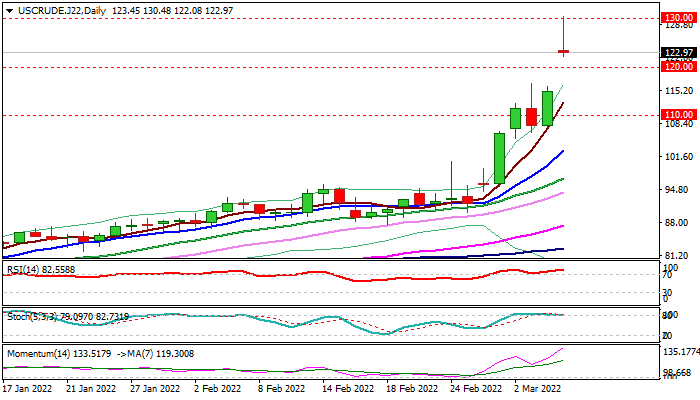
WTI Oil Outlook: Oil Hits $130 per Barrel on Fears that Russian Energy Products
WTI oil opened with wide gap higher on Monday and soared to $130 per barrel, the highest since July 2008.
Threats of further escalation of war in Ukraine continued to inflate energy prices in past few days, while the latest threat comes from growing fears about stronger oil shortage in the market as talks with Iran were delayed due to Western sanctions on Russian products, signaling that Iran oil may not be distributed soon.
Although the Russian energy products were not included in the first package of the sanctions, this options remains on the table and world fears that cuts of most of Russia’s energy exports would be a major shock to global markets.
Such scenario would signal that global markets enter stagflation and major central banks coming under increased pressure to review their plans for the near future and probably keep financial stimulus for some time.
Oil price surged nearly 20% in the wild action last week, marking the record weekly advance, with today’s gap-higher opening and fresh extension higher, suggesting that it may rise much higher.
Close above $130 would reinforce strong bullish stance for possible re-test of record 2008 peak at $147.2 per barrel, as bulls approach target at $131.93 (Fibo 176.4% projection of the rally from $6.52 pandemic low) the last significant obstacle.
Firmly bullish technical studies add to overall outlook, although the energy market is currently driven purely by geopolitics, with shallow dips expected to provide better buying opportunities.
Res: 126.66; 130.48; 131.93; 135.00.
Sup: 122.08; 120.00; 116.00; 112.80.