

Sample Category Title
ECB Lane: Hold-steady approach reinforced if bottlenecks are primarily external in nature
ECB Chief Economist Philip Lane said in a blog post, "in terms of inflation dynamics, the relative price dislocations associated with bottlenecks are intrinsically short-term rather than permanent in nature." Further, "initial increases in relative prices of categories that experienced high demand and/or low supply can be expected to level off or even reverse."
Additionally, "it should be acknowledged that bottlenecks are not the only factor influencing the overall inflation environment, with a comprehensive monetary policy assessment taking into account a wide range of factors."
"Since bottlenecks will eventually be resolved, price pressures should abate and inflation return to its trend without a need for a significant adjustment in monetary policy."
"The logic underpinning a hold-steady approach to monetary policy is reinforced if the bottlenecks are primarily external in nature, caused by global disruptions in supply or a surge in global demand".
ECB de Guindos: Inflation to decline in the course of this year
ECB Vice President Luis de Guindos said in a speech, "inflation is likely to remain elevated for longer than previously expected, but to decline in the course of this year."
"That is the central case, but there are upside risks to that outlook," he added. "Inflation could turn out to be higher if price pressures feed through into higher-than-anticipated wage rises, or if the economy returns to full capacity more quickly than foreseen.
"Some other central banks have either already raised rates or indicated that they will soon do so," he said. "In making comparisons, it's worth remembering that the euro area is at a different stage of the economic cycle, just as it was when the pandemic started. So it's natural that central banks around the globe won't necessarily start raising rates at the same time."
EU downgrades 2022 Eurozone GDP forecasts, upgrades inflation
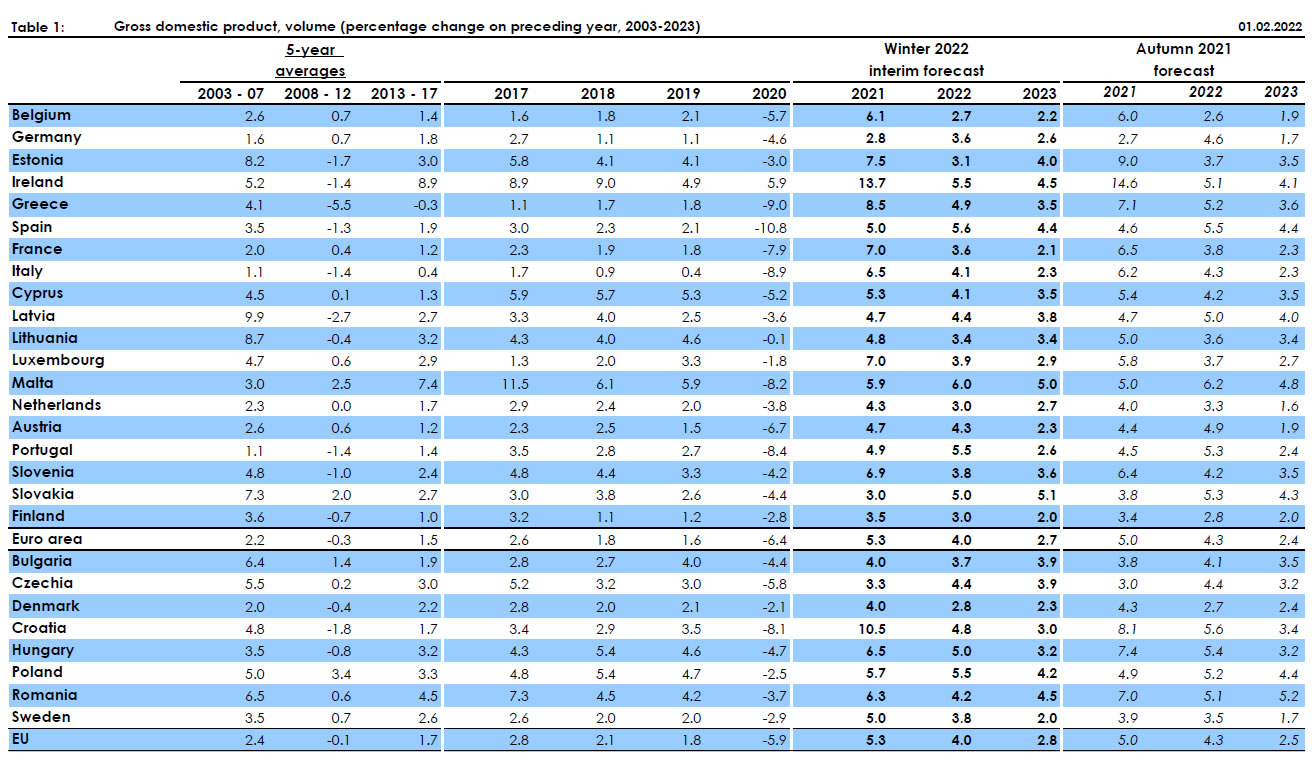
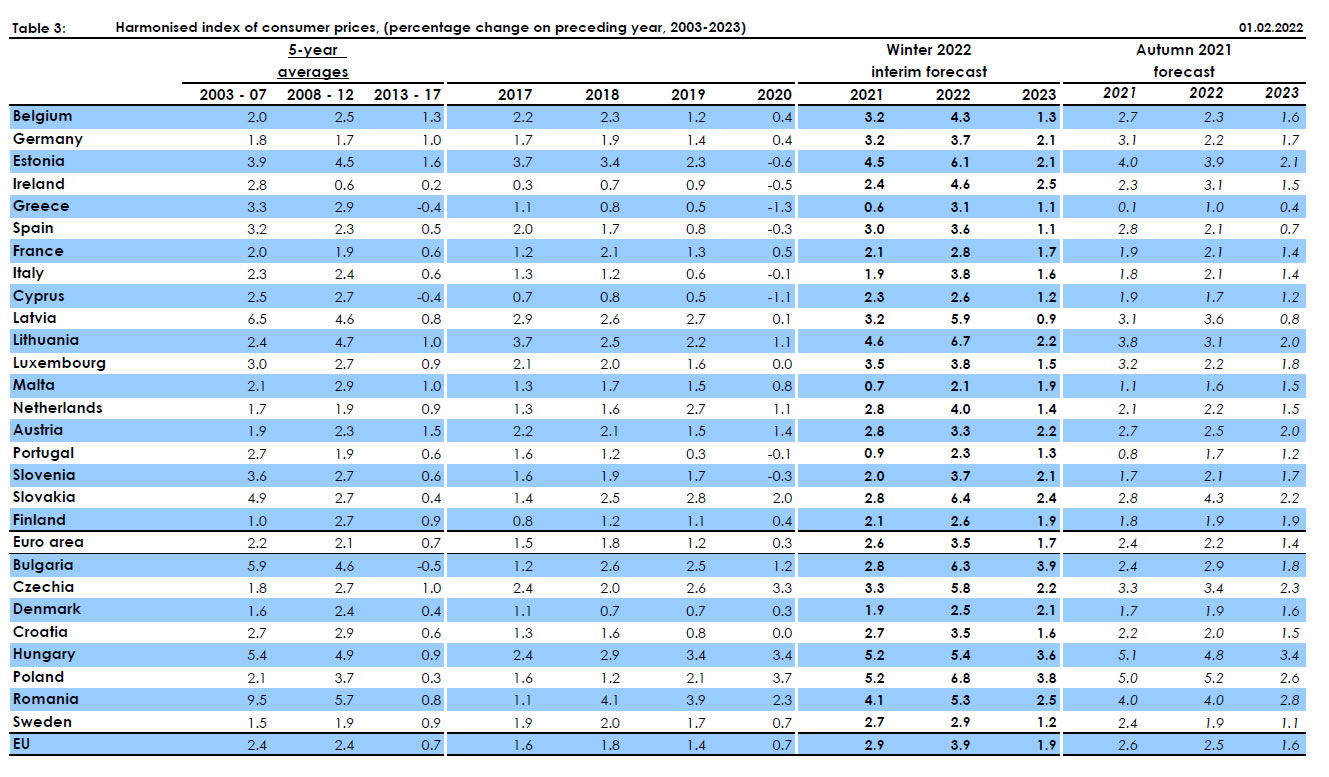
In the Winter 2022 interim forecasts, EU downgrades 2022 Eurozone GDP growth forecasts from 4.3% to 4.0%. Nevertheless, 2023 GDP growth forecast was upgraded from 2.4% to 2.7%. Eurozone 2022 HICP inflation forecast was raised from 2.2% to 3.5%. 2023 HICP inflation forecast was also upgraded from 1.4% to 1.7%.
Valdis Dombrovskis, Executive Vice-President for an Economy that Works for People said: "The EU economy has now regained all the ground it lost during the height of the crisis, thanks to successful vaccination campaigns and coordinated economic policy support. Unemployment has reached a record low. These are major achievements. As the pandemic is still ongoing, our immediate challenge is to keep the recovery well on track. The significant rise in inflation and energy prices, along with supply chain and labour market bottlenecks, are holding back growth. Looking ahead, however, we expect to switch back into high gear later this year as some of these bottlenecks ease. The EU's fundamentals remain strong and will be boosted further as countries start to put their Recovery and Resilience Plans into full effect."
Paolo Gentiloni, Commissioner for Economy said: "Multiple headwinds have chilled Europe's economy this winter: the swift spread of Omicron, a further rise in inflation driven by soaring energy prices and persistent supply-chain disruptions. With these headwinds expected to fade progressively, we project growth to pick up speed again already this spring. Price pressures are likely to remain strong until the summer, after which inflation is projected to decline as growth in energy prices moderates and supply bottlenecks ease. However, uncertainty and risks remain high."
USDCHF Moves Sideways after its Rebound Stalls
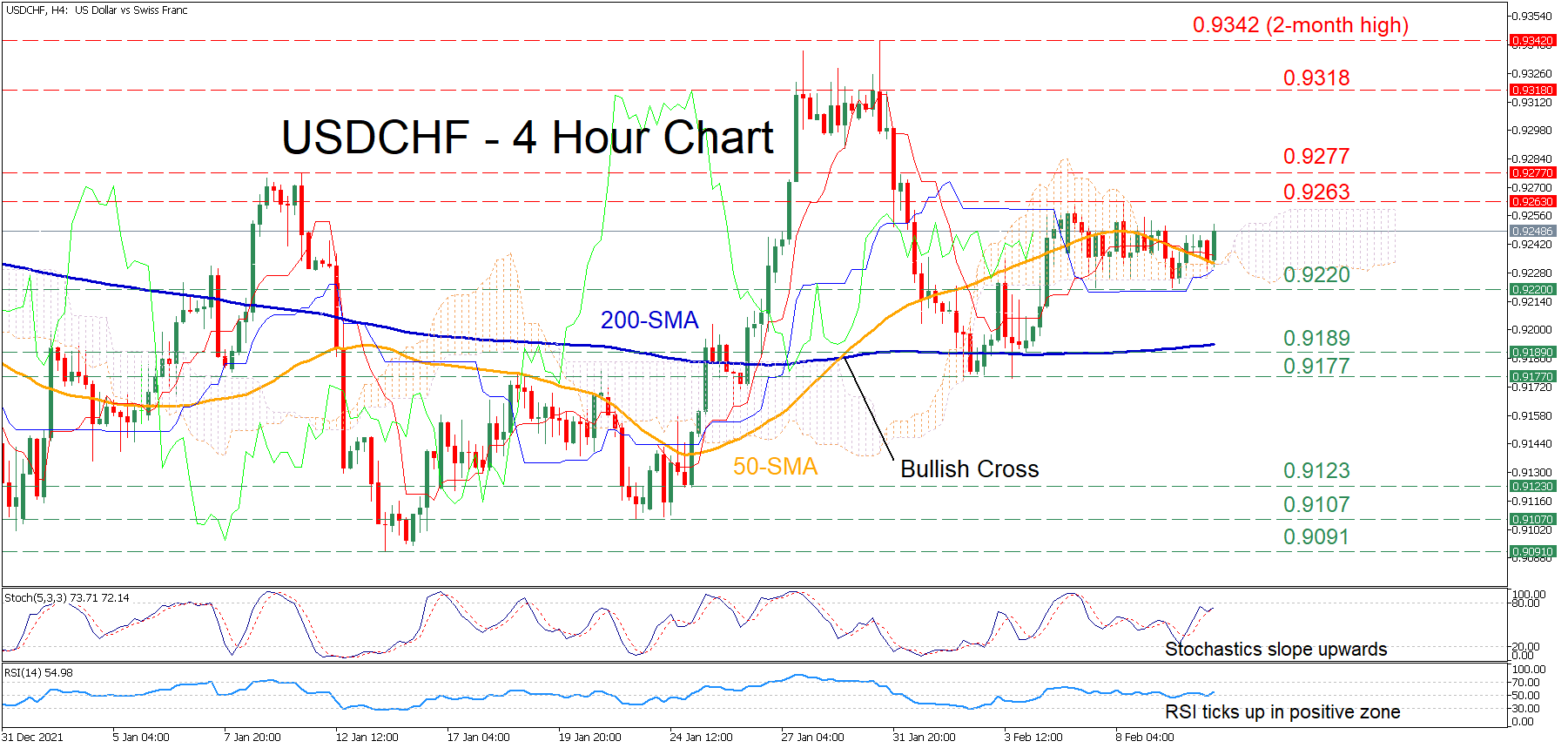
USDCHF has recovered some lost ground after its short-term decline ceased at the 0.9177 region. However, in the last few four-hour sessions, its ongoing rebound seems to be faltering as the price has adopted a more sideways pattern.
The momentum indicators suggest that bullish forces are still prevailing. More specifically, the stochastic oscillator is sloping upwards, while the RSI is ticking up above its 50-neutral mark. Additionally, the price is currently trading above the Ichimoku cloud, confirming the broader bullish near-term picture.
Should the positive momentum intensify further and the price ascends, initial resistance might be encountered at the recent high of 0.9263. Crossing above this level, the spotlight could turn to the 0.9277 barrier. If upside pressure persists, the price could jump towards 0.9318, a level which the price has failed to close above on multiple occasions in the recent past.
On the flipside, if bearish forces manage to regain the upper hand, the price may meet immediate support at the recent low of 0.9220. Diving below this region, the 0.9189 hurdle could appear on the radar. Failing to halt there, the price could dip towards the 0.9177 crucial support point, before the bears aim for the 0.9123 obstacle.
Overall, USDCHF has been moving without a clear direction in the last few sessions, but the short-term oscillators indicate that the directional forces are tilted to the upside. Therefore, a clear break above the 0.9263 ceiling is needed to signal the resumption of its recent rebound, whereas a dive below 0.9177 could endorse the short-term downside trajectory.
Cautiously Higher
European stock markets are continuing cautiously higher on Thursday as we await key inflation data from the US and comments from BoE Governor Andrew Bailey.
Inflation and central banks' response to it remain front and center in investors' minds and while the situation has not improved in recent weeks, there has been a clear upturn in sentiment. Earnings season came at just the right time and while there have been bumps in the road, investors will reflect on it positively and it's certainly helped to lift the mood.
I think we're also seeing investors come to terms with the higher interest rate environment that lies ahead. Of course, there will be a tipping point if markets are forced to price in even more rate hikes but there does now appear to be a level of comfort at the prospect of four or five increases this year from the Fed.
And if that does prove to be over the top in the coming months, it should provide a nice tailwind for stock markets as we move into the middle of the year. Investors will be looking for any sign that price pressures are easing as we near what many believe to be peak inflation over the next couple of months.
Today's CPI from the US is what we've all been waiting for this week. Fed policymakers have continued to stress their flexibility on interest rates this year, with Loretta Mester claiming that each meeting will be in play, as many now assume to be the case. Although one hike each quarter still looks like the most likely outcome.
Of course, that depends on inflation not spiraling out of control, forcing the Fed to be more aggressive. The CPI data is expected to show prices rose 7.3% in January compared to a year ago, almost four times the Fed's target. Another reading above here could spook the markets once more, which may explain the cautious advance we're seeing so far today.
Can Bailey pare back market expectations?
The Bank of England is also on a journey to higher interest rates, although we are seeing some push back against market expectations. Four hikes are heavily priced in this year, including one at each of the next two meetings. Both of these are fully priced in after four dissenters voted for a 50 basis point move this month.
We could get more clarity from BoE Governor Andrew Bailey this morning when he appears at an online event hosted by TheCityUK. The suggestion last week appeared to be that in the near term, we will see rates rising, in line with what markets are saying, but beyond that, the pace of tightening will slow again, which does not align with markets. We may see that message reinforced this morning.
Crude prices remain elevated despite progress on nuclear talks
Oil prices are marginally lower this morning but Brent crude remains above $90 and WTI is only a little shy of it. Prices rose a little on Wednesday after a couple of days of losses following the EIA inventory report, which showed a surprising 4.8 million barrel drawdown.
This came as talks appear to be moving in the right direction between the US and Iran, which could see more than a million barrels re-enter the market. A deal is far from guaranteed though and with the market so tight, crude will likely remain elevated. It has helped take some pressure off but as we saw yesterday, there's still plenty willing to buy into shallow dips.
Gold pause ahead of US inflation data
It's been a good February so far for gold, which has now recorded seven days of gains in the last eight. The rally appears to be running a little low on momentum though, which is perhaps not surprising considering the inflation data that's due today and the fact that it's trading around a key resistance level.
It has managed to force its way above $1,830, but just like yesterday, it's quickly hitting new resistance around $1,835. I think we just need to get this inflation report out of the way, after which gold may generate some fresh momentum, one way or another. It's a little flat on the day so far and may remain so ahead of the CPI release later.
Can Bitcoin smash through $45,500?
Bitcoin is a little lower and continuing to see strong resistance around $45,500 in the middle of the week. What's encouraging is that we're not seeing any real pullback from these levels though which suggests there's plenty of enthusiasm. It would appear there's a growing belief that the worst is behind it and we've all seen before what cryptos can do once they have some momentum behind them. A break of $45,500 would be very bullish, with $52,500 potentially offering the next test.
Oil: Technical Correction But a Bullish Outlook
WTI crude oil has lost around 3% since the start of the week, bouncing back to $88.4 from $91.2 at the beginning of the week. The observed pullback looks like a technical correction to remove local overheating.
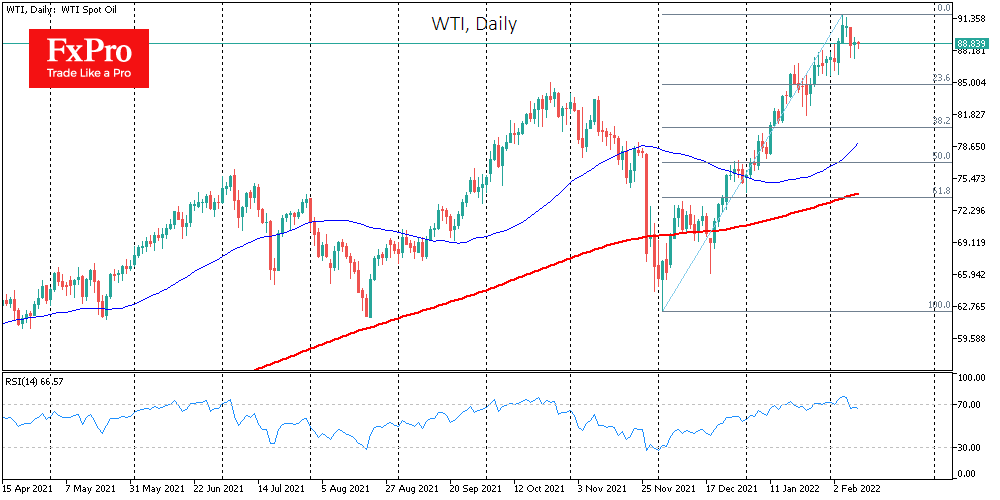
This correction comes against a relatively bullish background. Yesterday’s data marked a new drop in inventories, both commercial and strategic reserves. The Biden administration has said it may accelerate sales from reserves. Perhaps these comments were a formal excuse for profit-taking in the market. However, the start of these sales came with a two-month rally.
The government’s intention to sell off reserves may even have contributed to the rise in prices. The desire to bring prices down is hurting US production ramp-up plans. Aggressive support for alternative energy has made the hydrocarbon industry unattractive to banks.
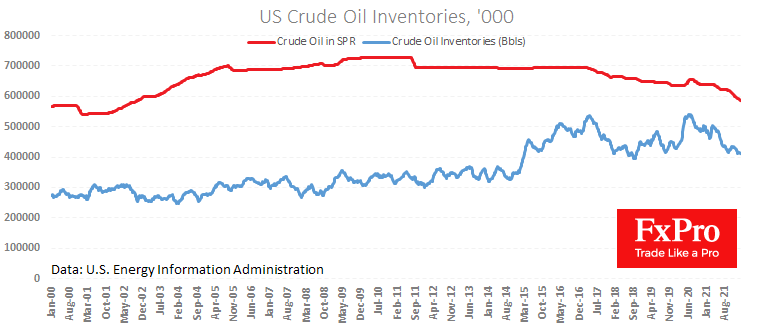
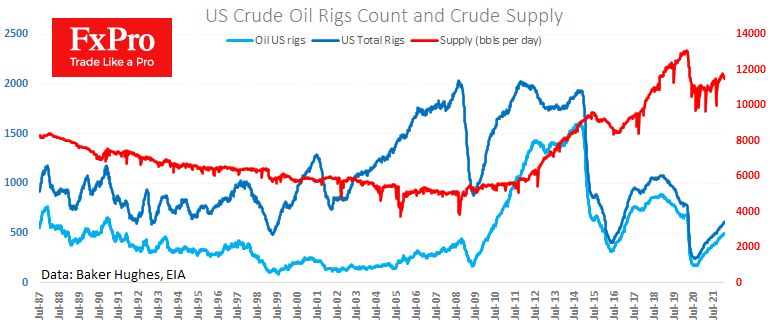
As a result, we are seeing a much slower production recovery than in the recovery periods of the last decade. The number of rigs in operation is rising methodically, but it seems that new wells are only marginally offsetting spent ones.
Also, OPEC has repeatedly suggested that the industry’s severe underinvestment during the pandemic makes it impossible to ramp up production quickly now. Despite a favourable price environment, the cartel has not picked up quotas in recent months.
It is also worth mentioning that countries are not imposing new travel restrictions but are loosening them more and more, supporting energy demand. Also, commodity prices are supported by political pressure on Russia, which threatens gas supplies to Europe and further fuels price increases.
Locally, oil remains vulnerable to a corrective pullback after a more than two-month rally with potential targets at $84.5 for WTI – a 23.6% pullback from the rally and the October peak area. A deeper retracement scenario suggests a pullback to $80.3. For Brent, the near-term target is $86-87, with a deeper retracement to $83.
Stocks Buoyant ahead of US CPI, Dollar Holds Steady
- Wall Street extends climb out of January pit, but futures ease as CPI data awaited
- Dollar edges sideways as traders seek direction from US price growth
- Gold hits two-week high amid uncertainty about inflation and Fed policy
The improved risk tone is holding ahead of the all-important inflation numbers out of the United States later on Thursday. Stocks on Wall Street jumped higher for a second day on Wednesday, erasing the losses from late last week when markets were roiled from surging bond yields.
The rally in yields appears to be cooling and this is aiding the rebound in equities, which are proving to be surprisingly resilient given that nothing has changed since January when it comes to the monetary policy landscape. If anything, the panic should have intensified after the European Central Bank joined its peers in flagging a possible rate rise later this year.
However, investors were likely relieved when the ascent in the 10-year Treasury yield stopped just shy of the 2.0% level. Combined with the growing sentiment that the robust corporate earnings that equity traders have become accustomed to over the past several quarters are not under immediate threat, there is hope yet for the bull market.
The generally upbeat earnings are keeping Wall Street afloat and European earnings have been impressive too. Disney was the latest to report stellar Q4 results yesterday, with its stock soaring even before the earnings announcement that came after the market close.
The S&P 500 closed up 0.9% and the Nasdaq Composite rallied 2%. Their futures were last trading slightly in negative territory, though stocks in Europe and Asia were mostly higher.
The caution could increase in the run up to the inflation prints, which are expected to show America’s consumer price index hitting a fresh 40-year peak of 7.3%.
Gold climbs, dollar flat as all eyes on US CPI
A lot is riding on today’s CPI report as the Fed has become very data dependent and there is huge uncertainty around what path the federal funds rate will follow over the next year or two. Fed officials seem mostly opposed to hiking rates by 50 basis points in March but what happens after that is unclear. If there’s any sign in the numbers that inflation is peaking or is close to, Treasury yields could significantly pull back from their current elevated levels, weighing on the US dollar.
The dollar index is consolidating this week as investors weigh the varying price dynamics in each region. If inflation peaks in the US before other countries, that could dampen the greenback’s outlook in the short- to-medium term.
However, uncertainty about how much central banks will have to tighten has never been greater as the inflation picture is extremely foggy right now. This uncertainty could be what’s been driving gold higher lately as the precious metal is scaling a two-week top today.
The price of bullion appears to be testing familiar resistance in the $1,830/oz region. Whether it’s able to break above that barrier will likely depend on how strong the CPI data is.
Modest gains for euro and pound
The euro has also been stuck in a tight range this week as rate hike calls from the ECB’s more hawkish members have overshadowed President Lagarde’s more tempered tone on policy normalization.
The single currency was last trading around $1.1435. Sterling was firmer despite the Bank of England’s chief economist, Huw Pill, calling for a “steady handed approach” to raising rates.
Higher commodities help aussie and kiwi maintain rebound
The Australian and New Zealand dollars were both extending their February upswing on Thursday, tracking the broader improvement in risk appetite.
Higher commodity prices have been bolstering the aussie and kiwi lately, with copper futures surging in the last two sessions. Oil prices, meanwhile, were steadier, edging slightly higher after finding support from the surprise drawdown in US crude oil inventories in yesterday’s weekly report. However, any upside is likely to be weak as investors are waiting to see whether there’s any prospect of Iranian sanctions being lifted should there be a deal with the West on Tehran’s nuclear program.
EUR/USD Outlook: Euro Regains Traction on Positive Fundamentals
The Euro edges higher in European trading on Thursday, signaling an end of a shallow pullback from new three-month high (1.1483).
Comments from German Ifo Institute that industrial order backlog is the highest in more than 40 years and could strongly boost the economy if persisting supply shortages ease, improved the sentiment and lifted the single currency.
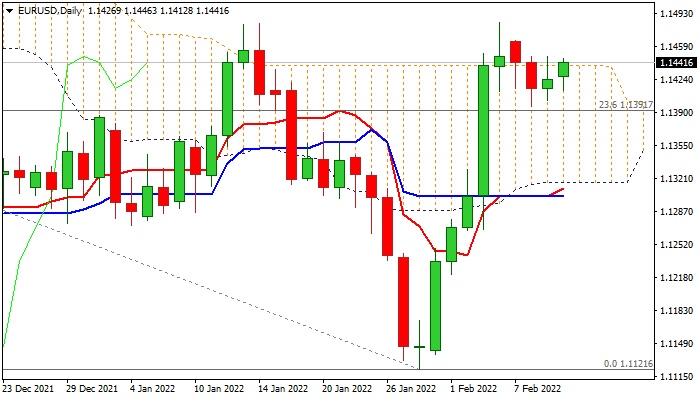
Fresh strength probes again through the top of thick daily cloud (1.1439) with close above here to generate fresh bullish signal for retest of 1.1483 peak and attack at 200WMA (1.1497), violation of which would signal continuation of recovery leg from multi-month low at 1.1121 (Jan 28 low).
Bullish daily studies support the action, but traders focus on key US CPI data, as inflation is expected to rise to a 40-year high at 7.3% in January that would boost expectations for future rate hikes and lift the dollar, putting the Euro in defense.
Initial support lays at 1.1396 (low of shallow pullback), followed by 1.1345 (Fibo 38.2% of 1.1121/1.1483 rally) and pivotal daily cloud base (1.1316).
Res: 1.1447; 1.1483; 1.1497; 1.1558.
Sup: 1.1396; 1.1345; 1.1316; 1.1300.
EURJPY maintains bullish tone sparked by Lagarde
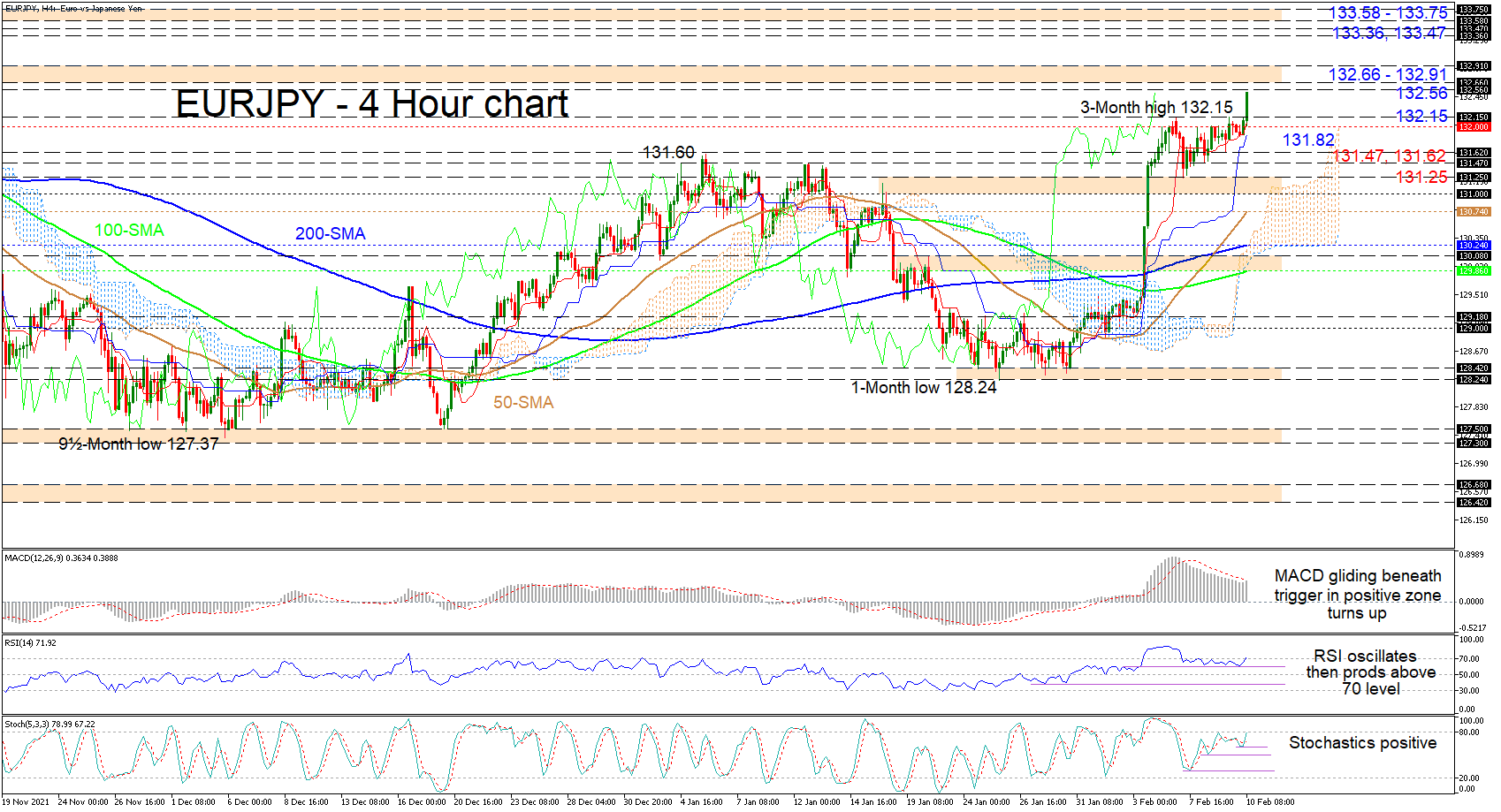
EURJPY has overcome the three-month high of 132.15, recorded after the price soared in response to ECB President Lagarde’s surprise hawkish tone at the last week’s meeting as the governing council reiterated concern about high inflation data. The positive incline in the longer-term 100- and 200-period simple moving averages (SMAs) and the bullish crossover of them by the climbing 50-period SMA, are together endorsing the bullish mood in the pair.
The Ichimoku lines are implying that bullish forces have powered up, while the short-term oscillators are reflecting that the pair has resuscitated its positive drive. The MACD, in the positive zone, has gained an incline back near to its red signal line. The RSI, which was fluctuating a tad underneath the 70 level, is making efforts to overstep the 70 overbought line. Moreover, the stochastic oscillator’s positive charge has amplified, reflecting additional bullish developments.
If the current trajectory persists, prompt resistance could emanate from the 132.56 high, identified at the beginning of November 2021, ahead of the 132.66-132.91 resistance band formed by the peaks from the second part of October 2021. Conquering this barrier may boost confidence in the pair, encouraging the bulls to propel for the four-month peaks of 133.36 and 133.47 from mid-October 2021, before challenging the 133.58-133.75 resistance barricade stretching back to June 2021.
On the other hand, if fresh impetus fades and the price falls back beneath the 132.15 barrier (previous resistance-now-support), the Ichimoku lines at 132.00 and 131.82 could provide preliminary downside friction ahead of the 131.62 and 131.47 congested lows. Not much lower, the 131.00-131.25 support border that overlaps with the Ichimoku cloud’s upper band may prove to be more difficult to dip by. However, if a deeper retracement unfolds, sellers may then meet the 50-period SMA at 130.74 before diving towards the cloud’s surface at 130.24, where the 200-period SMA also currently resides.
Summarizing, EURJPY’s bullish bias is strengthening with the price surging above the 3-month high of 132.15. To begin to dent the bullish bias, sellers would initially have to drive the price below the 131.25 trough. That said, the bullish bias remains intact above the 131.00-131.25 base and the SMAs.
Note, one important thing traders need to keep in mind is today’s important US inflation data. Expectations are that the figures will be elevated, which may see EURJPY take a hit.
EUR/USD: US January CPI is Seminal
If US January CPI disfavours the US dollar, EUR/USD could experience a structural shift higher
EUR/USD holds its ground
EUR/USD is still holding its ground despite increased geopolitical tensions related to the Ukraine and an overnight report from Bloomberg that certain ECB members are losing confidence in their own staff forecasts. Release of US January CPI data today, however, is likely to test the euro’s resolve with economists forecasting a 7.3% print versus 7.0% in December.
Last Thursday’s ECB meeting led EUR/USD and short-term euro area bond yields to rally after the ECB meeting with the former rising to an eventual high of 1.14839. At the meeting, President Christine Lagarde declined to rule out the possibility of an interest rate hike this year. Recent efforts by President Lagarde and other Governing Council members to talk down euro area bond markets have had mixed result.
EUR/USD and vs EUR-USD 2-yr yield spread
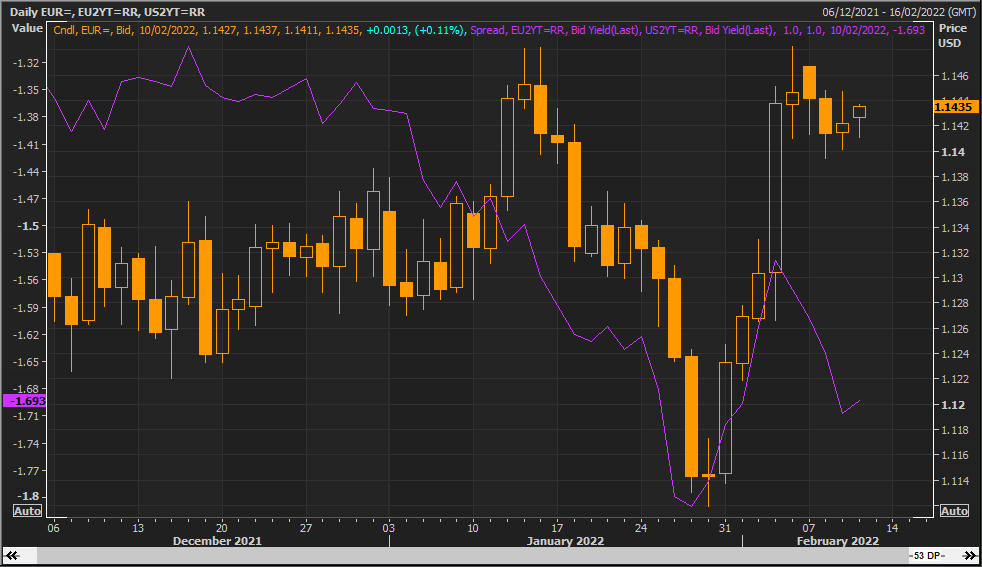
In contrast, Governing Council member Klass Knot on Sunday indicated that interest rate rise could come as early as the fourth quarter of this year. Those comments more closely match what’s being priced by interest rate markets. In summary, the odds of the ECB as whole shifting more hawkish when it meets in March have increased dramatically.
EUR/USD primed for a technical shift
However, the EUR/USD is already facing a seminal moment ahead of US CPI data today. The downtrend in the pair that began in October last year is showing sings of fading. On the 4 February, EUR/USD had already tested, broke, but failed to sustain the last corrective swing high of 1.14827 of the current downtrend.
EURUSD daily chart
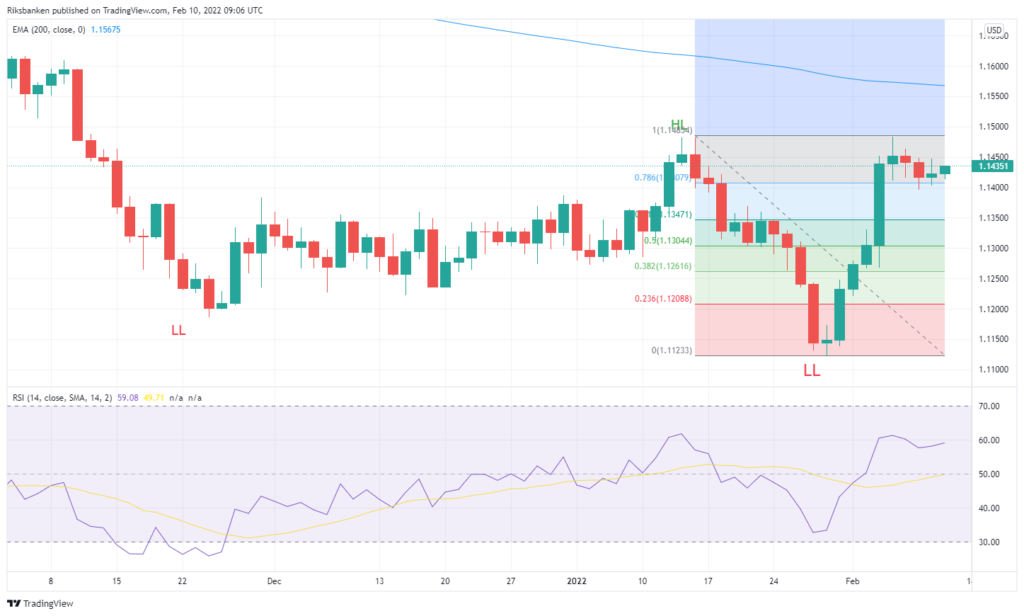
There is nothing to say that the pair couldn’t yet again try and successfully break that level in coming days if today’s CPI print disfavours the US dollar. If EUR/USD were to do so, it would likely mark dramatic shift in the pair’s fortunes. If it fails, the potential for a fall back to the 1.3745 region, which was a previous level of resistance, or even1.13415, the 4 hour 200-exponential moving average, is more than possible.