

Sample Category Title
Eco Data 1/19/22
[php_everywhere instance="1"]
Don’t Expect The Emerging Market FX Rally to Last
Summary
In something of a surprise, the U.S. dollar has weakened over the first few weeks of this year and emerging market currencies have outperformed. A sharp shift in monetary policy stance from the Fed supported the greenback late last year but has done little to help the dollar so far in 2022; however, once the "buy the rumor, sell the fact" dynamics come to an end and markets focus on underlying fundamentals, the U.S. dollar should strengthen going forward. We also expect emerging market currencies to come under the most pressure in 2022-2023 as tighter Fed policy, higher bond yields and local political developments result in weaker currencies across the emerging markets spectrum.
Dollar Down This Year, EM Currencies Leading The Way
The first few weeks of 2022 have surprised us. Just over the past two weeks, financial markets have priced a significantly more hawkish Fed. Instead of two rate hikes this year, market participants, including us, now forecast four hikes. And what seemed unlikely at the start of the year, economists and strategists alike have taken the FOMC's guidance and now forecast the Fed to begin shrinking its balance sheet in the second half of the year. Despite the Fed's latest and sharp shift in its monetary policy stance, the U.S. dollar has depreciated against most foreign currencies. Through the first few weeks of this year, the U.S. dollar index (DXY) is down 0.15%, indicating depreciation against G10 currencies. Dollar weakness has also spread into the emerging markets as currencies across Latin America, Asia and the EMEA (Europe, Middle East, Africa) region have strengthened against the greenback.
We can point to a few likely reasons why the dollar has started 2022 on the back foot, the first being Fed Chair Powell's commentary at his U.S. Senate confirmation hearing. When questioned about the direction of Fed monetary policy, Powell indicated the FOMC will look to raise interest rates in a way where the U.S. and global economic recovery will not be interrupted, a comment somewhat supportive of foreign currency and especially emerging currency sentiment. In addition, U.S. December inflation data was "as expected", a break from several months of upside surprises and a factor that may have reined in the U.S. dollar to some extent. And finally, there may also be capital flows from the U.S. to foreign markets. To that point, by many measures, U.S. equities are currently relatively expensive, while international equities could be more fairly priced. In order to potentially take advantage of more attractive valuations abroad, investors could be shifting capital toward international equities. Major equity index performance year-to-date supports this thesis, as the S&P500 is down 2.5% this year, while major European and emerging market equity indices have positive returns to start the year.
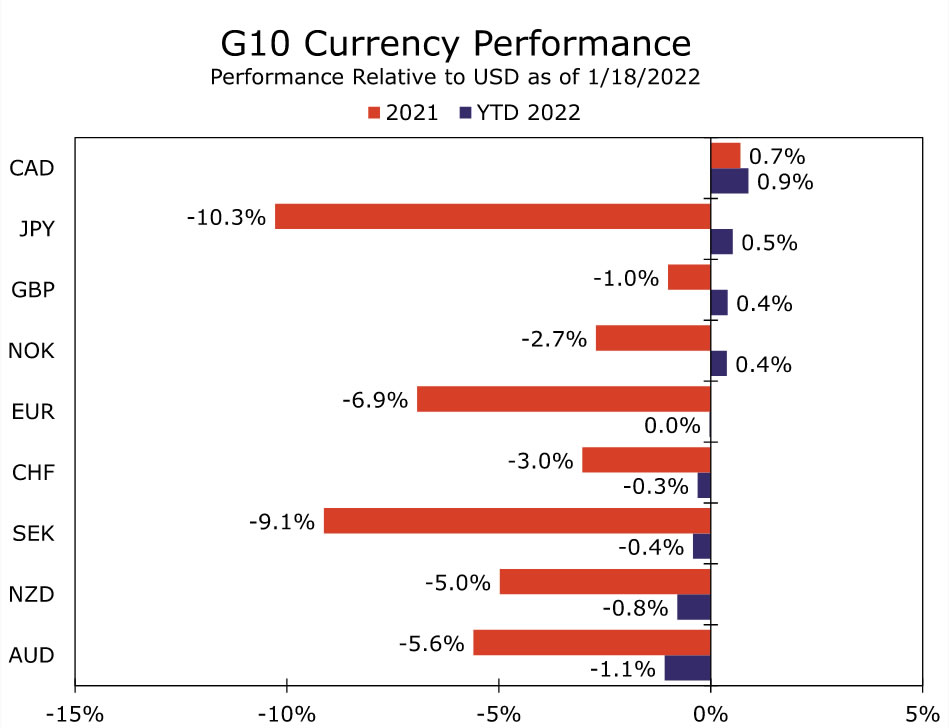
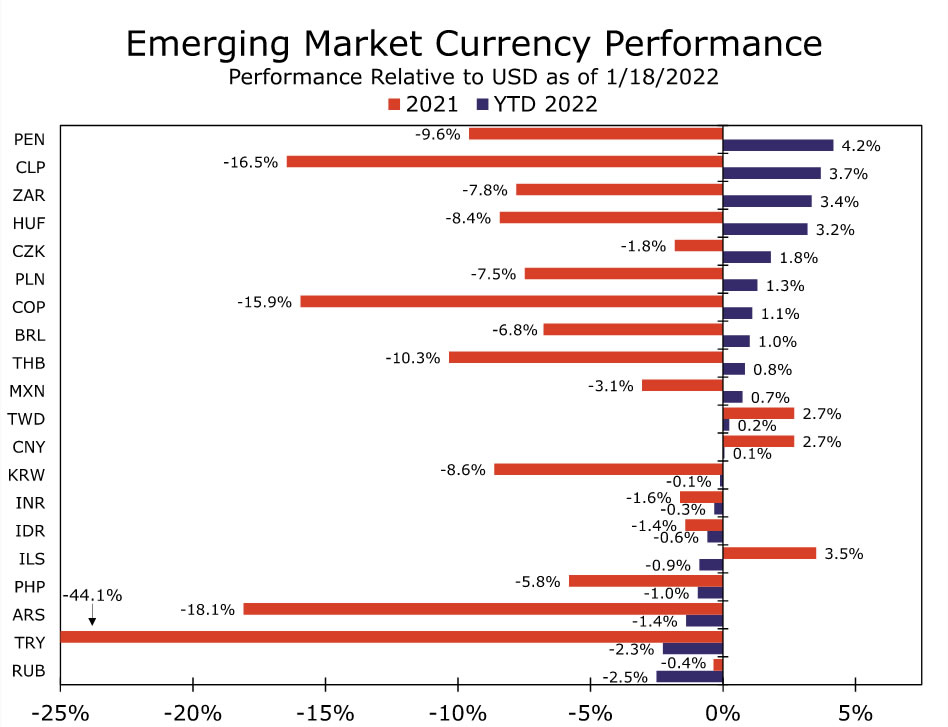
Foreign currency strength has been significant enough where currencies across the G10 and emerging markets have broken through key technical levels. 50-day, 100-day, and in some cases, 200-day moving averages have been breached, suggesting the current trend could continue for the time being. Following a year when foreign currencies largely underperformed, G10 currencies are mixed, but on balance, performing solidly (Figure 1); however, emerging market currencies are outperforming more broadly. With the exception of select outliers where idiosyncratic issues are factors (i.e: Russia, Turkey and Argentina), just about all major emerging market currencies have strengthened this year (Figure 2). To date, the Peruvian sol is the top performing currency, strengthening over 4%, as the central bank maintains a hawkish monetary policy stance amid its commitment to contain elevated inflation and as political risk tied to President Castillo's administration eases. Similar dynamics exist in Chile as inflation remains high and the central bank remains committed to interest rate hikes to bring CPI within target. In addition, the election of Gabriel Boric has yet to yield concerning rhetoric, also supporting the Chilean peso. On down the list, emerging market currencies from the South African rand to the Chinese renminbi have strengthened, despite underlying fundamentals associated with most developing economies still rather fragile.
But, Don't Expect The Rally to Continue
In our view, the dynamics that have supported foreign currencies, in particular emerging market currencies, are unlikely to persist for an extended period, and we maintain our view for a stronger U.S. dollar as 2022 progresses and into 2023. Despite the Fed's guidance on monetary policy doing little to support the dollar early this year, we believe actual changes to policy settings could and should result in capital flows back toward the U.S. dollar. Should the Fed start raising interest rates in March or shortly thereafter, the relative attractiveness of the U.S. dollar could improve, and we believe, can support the greenback going forward. In addition, we believe market participants will eventually begin to focus on underlying fundamentals associated with individual economies. In that sense, the U.S. economy is still a relative outperformer as underlying fundamentals associated with the American economy remain sturdy. Economies across the G10 are still lagging the U.S., while most developing economies have struggled to gather or maintain economic momentum since the start of the pandemic. As the focus shifts back to country-specific fundamentals, we believe investors will again divert capital back towards U.S. dollar denominated assets, which should be supportive of the greenback over time.
We believe the dollar can strengthen against G10 currencies; however, we expect the most pronounced strength to come against the emerging markets. Tighter Fed monetary policy and higher bond yields in the United States have historically weighed on emerging currencies, and we expect these dynamics to play out over the course of this year. In addition to higher bond yields, we expect local political developments in many developing countries to also be a source of currency depreciation in 2022. Latin American politics shifted sharply left last year, and we believe new policy platforms and political ideologies in countries such as Chile and Peru can still weigh on these currencies. In addition, Presidential elections will take place in Brazil and Colombia this year, and we expect left-leaning politicians to gather significant momentum in the lead up to each vote. Political risk tied to each election should also weigh on the Brazilian and Colombian currencies this year. In the EMEA region, unorthodox policy should continue to weigh on the Turkish lira, while a fragile economy and heightened political risk in South Africa should keep the rand on the back foot. In Russia, while the underlying fundamentals of the economy are strong, geopolitical tensions with the U.S. related to Ukraine and other regional issues should keep the ruble under pressure. And finally in Asia, we expect the diverging monetary policy path between the Fed and the PBoC to push the renminbi weaker against the dollar. In addition, geopolitical tensions and PBoC intervention could also place depreciation pressure on the renminbi. As the Chinese currency weakens, we expect other emerging Asian currencies to follow given the influence the path of the renminbi within Asia and for other Asian currencies.
US Bond Yields Had a Roaring Start
Markets
US bond yields had a roaring start coming out of a long weekend during early morning trading hours. We’ve distinguished some general drivers for the aggressive bond selloff. First, there was already some general yield momentum lingering as suggested by German/European markets on Monday, when the US was closed. A Houthi drone strike at the United Arab Emirates prompted oil supply fears. It caused prices to rise to the highest level since 2014, helping push up yields as well. Brent oil currently trades at $87.57 per barrel. Both the short and long end were able to cap some high-profile targets of 1% for the 2Y and 1.77% resistance in the 10Y, allowing for a technical acceleration that send the curve at some point more than 7 bps higher. That US yield vigor largely held up during the European session even as (second tier) data were a mixed bag: the US manufacturing index (see below) declined sharply but the German ZEW (expectations component) crushed estimates. Current gains on the US yield curve range from 4.9 bps (2y) over 5.5 bps (5y) to 3.3 bps (30y) with the bulk driven by real yields. Today’s move brings the spread between the US 30y and 5y to the lowest level since March 2020. The yield surge sours equity mood. Losses add up to 1% in Europe and almost 2% in the US (Nasdaq). German and European yields initially joined US peers but soon met with resistance. For the German 10y this meant another throw to the symbolic 0% ended in tears (-0.1 bp). The short end outperforms with the 2y yield 1.1 bp down. In other bond news, the Kingdom of Belgium successfully launched its first (out of three) syndicated benchmark deal. It sold €5bn of a 2032 at MS-6 compared to MS-5 guidance. Books were above €21bn. Greece intends to launch its first new 10y benchmark of the year, most likely tomorrow. The country is underperforming peers in terms of peripheral yield changes today (+2 bps).
Contrary to what was the case lately, the US dollar is finally starting to profit from the real yield surge. The 10y variant (-0.66%) is closing in on the previous cycle high of -0.60% in a steep move that started since the new year. DXY (trade-weighted dollar) bounces of support from the upward sloping trend line at 95.13 to 95.57. EUR/USD gives up on 1.14 to trade around 1.136, below intermediate support of 1.1386. Risk-off (equity) and rising US bond yields keep USD/JPY in check. Sterling was largely unaffected by a generally solid labour market report. EUR/GBP whipsawed near the short-term equilibrium of 0.835/0.836.
News Headlines
The New York Manufacturing Index unexpectedly declined from 31.9 in December to -0.7 in January. The NY Fed concludes that activity stalled after a period of 18 months of expansion. The new orders index also suggests a slight decline in orders (-5.0 from 27.1). At 1.0 (from 27.1) the shipment index also suggested limited growth. However, indicators related to supply chains (delivery times, inventories unfilled orders) remain at elevated levels. Firms continue to expand employment (16.1) and the average workweek. At respectively 76.7 and 37.1 for prices paid and prices received, pressure remains elevated even as they slowed slightly. Looking forward, the sentiment on activity six months ahead remains more or less stable at a solid 35.1. Future price subindices even are rising further to a record high. Conclusion: NY manufacturing is temporarily dented by omicron, but the outlook remains constructive with few indications that price pressures are easing.
In an interview with DeniKN, Czech central bank head Rusnok was quoted as saying that the CNB plans to raise interest rates further. However, the pace of monetary tightening will probably be slower than at the end of last year. The article indicates that Rusnok expects the interest rate to move above 4% but not beyond 5.0%. He was also quoted that the exchange rate now already reflects a large part of the rate hikes. Despite the rise in core (US) yields, the koruna maintains recent gains trading near EUR/CZK 24.415.
Canadian Housing Starts Ease But Remain Elevated in December
In December, Canadian housing starts fell by 22% m/m from November's extremely elevated level, coming in at 236.1k units. This marked the lowest pace of starts activity since December 2020. However, the six-month moving average remained exceptionally strong at 260.6k units.
In urban markets, declines were registered in both single-detached and multi-family units. Starts of single-detached units fell by 4% m/m to 55.2k units. Meanwhile, multi-family starts dropped by 29% m/m to 157.7k units, almost fully unwinding November's robust gain.
Urban starts were lower in six of 10 Provinces:
- In Ontario, starts plunged from their November level (-59.1k to 66.3k units)
- Starts fell by 10.1k units in the Prairies, leaving their level at 39.5k units. Alberta was the largest drag, followed by Saskatchewan.
- In the Atlantic Region, starts increased (+1.4k to 14.2k units), boosted by Newfoundland and Labrador and Nova Scotia. December also marked the 3rd straight strong month for starts in the Atlantic.
- Starts declined by 14.3k in Quebec to 41.2k units and jumped by 15.2k to 51.0k units in B.C.
Key Implications
Some easing in December's starts data was expected, given the outsized November surge. On a trend basis, the pace of starts remains robust, stimulated by strong demand, low levels of unsold new inventories, and elevated prices.
For the fourth quarter overall, starts dipped by a mere 1%. This introduces an upside risk to our forecast calling for an outsized drop in residential investment in the fourth quarter.
Moving forward, building permit data point to starts remaining well above pre-pandemic levels in the near-term. Looking further ahead, we expect starts to move lower, trending towards levels more in-line with underlying fundamentals. Higher interest rates are likely to take some steam from demand, thus moderating the pace of homebuilding, albeit with a lag.
Stocks Retreat and Dollar Nudges Higher as Yields Spike
Dollar and safe havens shine; loonie amongst the few winners
The US dollar is storming higher today, heavily supported by surging Treasury yields, as markets seem to be pricing in four rate hikes by the Fed in 2022. Moreover, the significant losses observed in risky assets due to rising Treasury yields triggered a broader risk-off sentiment in the markets, adding more fuel to the dollar’s rally. In addition, the soaring risk aversion in today’s session favours safe haven currencies such as the Japanese Yen and the Swiss franc, which are appreciating against a broad range of currencies.
However, the loonie is the stronger currency on the forex spectrum today as it is the only commodity-linked currency that managed to capitalize on the fact that oil is trading near seven-year highs. On the other hand, the aussie and kiwi are inching lower, largely pressured by the prevailing risk-off sentiment.
The euro and British pound are struggling in today’s session without any major headlines behind these weaknesses as their pullback is mainly attributed to the stronger dollar.
US stocks tumble amid surging yields
Wall Street is set to open the week lower as surging Treasury yields seem to be inflicting serious damage on tech stocks and consequently on the Nasdaq. Moreover, weaker-than-expected Q4 earnings reported by most major US banks are dragging the S&P 500 lower as well. More specifically, e-mini futures for the Nasdaq, S&P 500 and Dow Jones are taking a hard hit in pre-market trade, currently losing 1.65%, 1.05% and 0.9% on the day, respectively.
In Europe, most major indexes are in the red today as increasing odds for faster rate hikes by the Fed seem to be affecting investors’ risk appetite.
Oil near 7-year highs; gold holds steady
Oil prices jumped to their highest levels since 2014 today as geopolitical flare-ups in the Mideast Gulf increased fears for renewed supply disruptions amid an already tight supply outlook. Gold is a little softer on the day but it is holding its ground, probably endorsed by the general risk-off sentiment in the markets, although it is being heavily pressured by rising Treasury yields and a stronger dollar.
Bitcoin and the broader cryptocurrency market continue to be a sea of red today as surging Treasury yields are significantly weighing on risky assets.
USD/JPY Mid-Day Outlook
Daily Pivots: (S1) 114.29; (P) 114.47; (R1) 114.79; More...
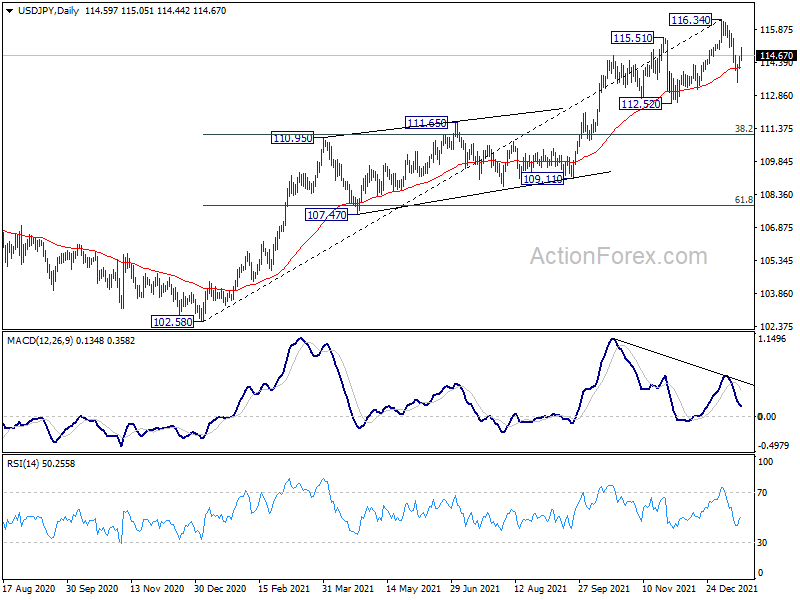
Further rise could be seen in USD/JPY as rebound from 113.47 might extend. But we're not expecting a break of 116.34 for now. Instead, the corrective pattern from there should extend with another falling leg. On the downside, break of 114.30 minor support will turn bias to the downside for 113.47. Break there will target 112.52 structural support.
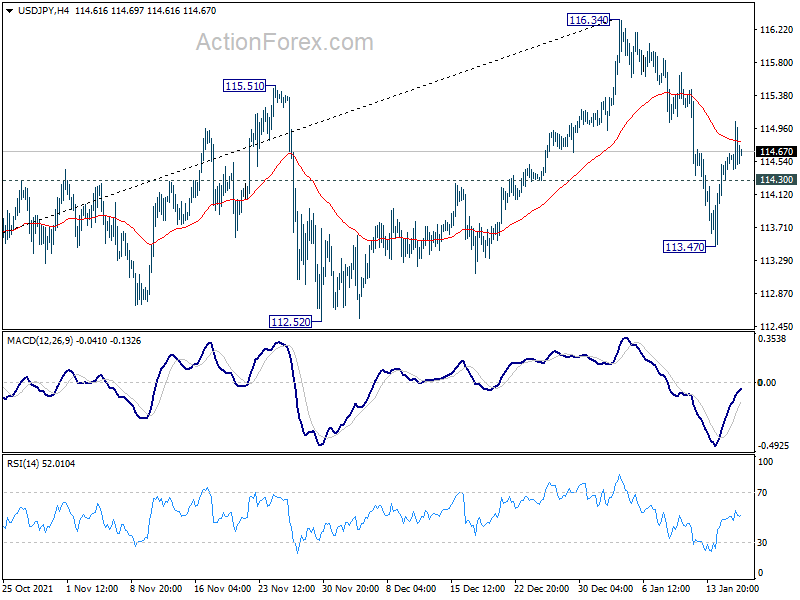
In the bigger picture, no change in the view that rise from 102.58 is the third leg of the up trend from 101.18 (2020 low). Such rally should target a test on 118.65 (2016 high). Sustained break there will pave the way to 120.85 (2015 high) and raise the chance of long term up trend resumption. However, firm break of 112.52 support will dampen this bullish case and we'll assess the outlook based on subsequent price actions later.
USD/CHF Mid-Day Outlook
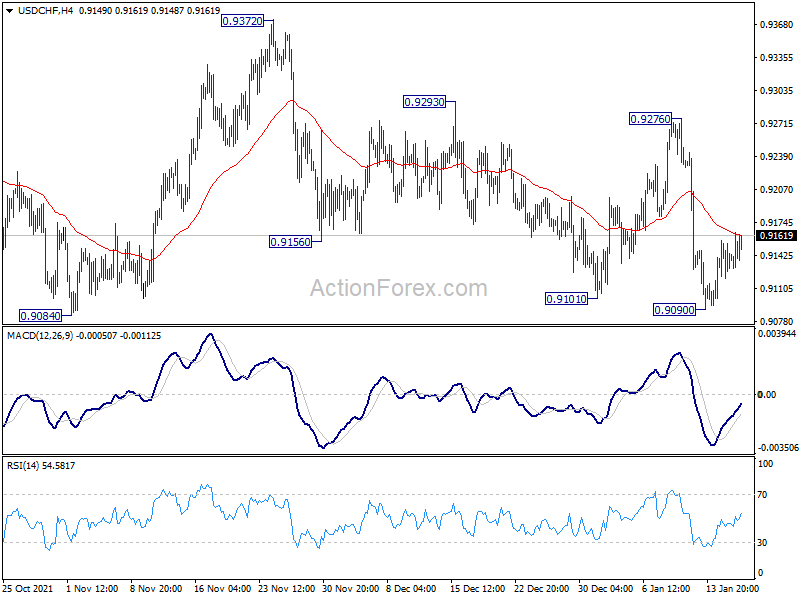
Daily Pivots: (S1) 0.9124; (P) 0.9141; (R1) 0.9161; More....
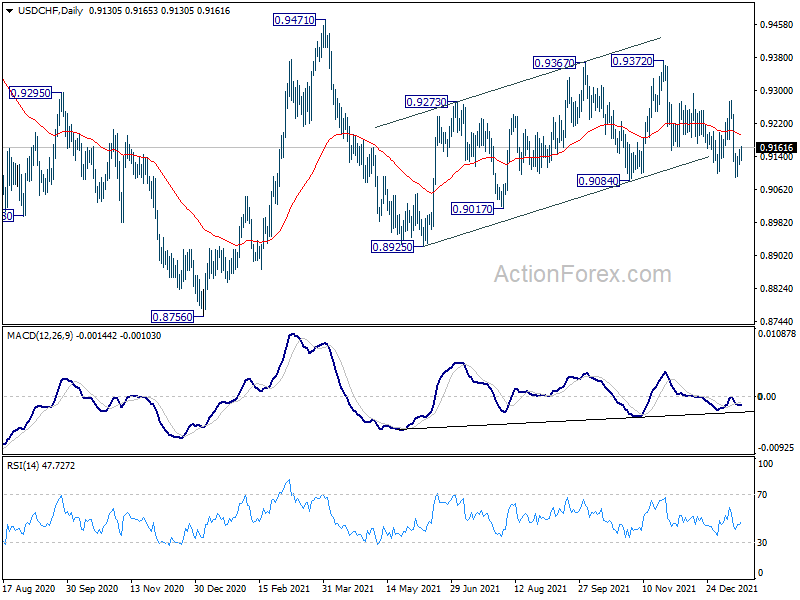
Intraday bias in USD/CHF remains neutral first. On the downside, firm break of 0.9084 support will argue that choppy rise from 0.8925 has completed. Fall from 0.9471 might be ready to resuming. Further decline would be seen back to 0.8925 support first. On the upside, above 0.9276 will target 0.9372 resistance instead.
In the bigger picture, the corrective structure of the rebound from 0.8925 argues that fall from 0.9471 is not complete yet. It could either be the second leg of pattern from 0.8756 (2021 low), or resuming larger down trend from 1.0237 (2018 high). We'd pay attention to the downside momentum and assess the odds later. But for now, medium term outlook will be neutral at best as long as 0.9471 resistance holds.
EUR/USD Mid-Day Outlook
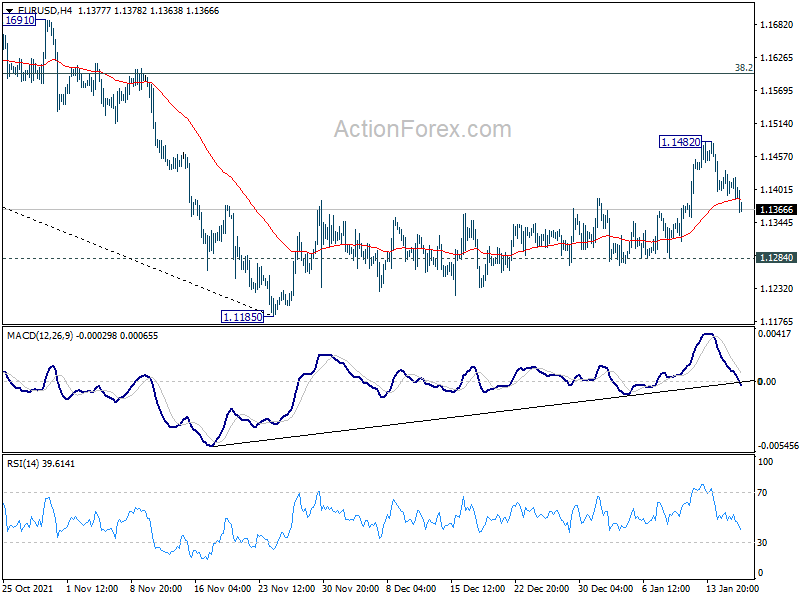
Daily Pivots: (S1) 1.1387; (P) 1.1410; (R1) 1.1429; More...
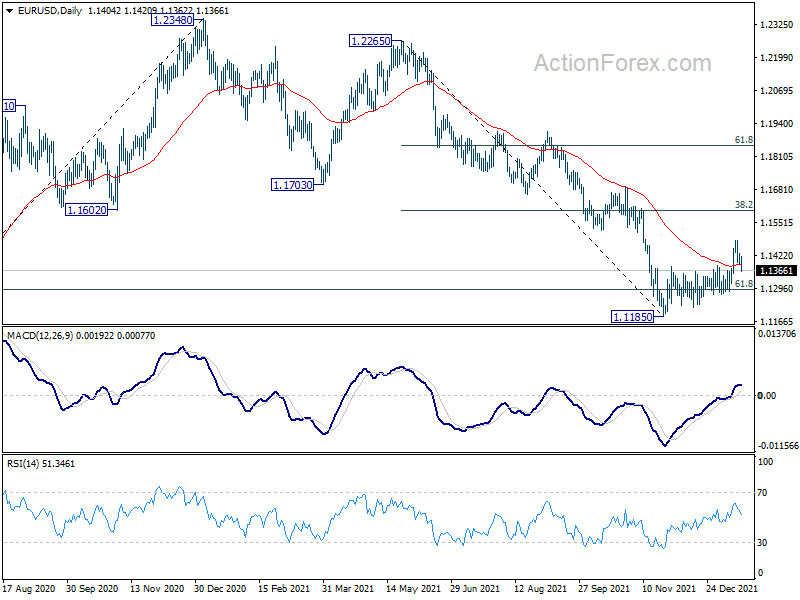
Outlook in EUR/USD is unchanged and intraday bias remains neutral first. Rebound from 1.1185 is seen as a corrective move. Above 1.1482 will extend the rebound but upside should be limited by 38.2% retracement of 1.2265 to 1.1185 at 1.1598. On the downside, below 1.1284 support will bring retest of 1.1185 low. However, sustained break of 1.1598 will argue that the trend is reversing already.
In the bigger picture, there are various ways of interpreting the fall from 1.2348 (2021 high). It could be a correction to rise from 1.0635 (2020 low), the fourth leg of a sideway pattern from 1.0339 (2017 low), or resuming long term down trend. In any case, outlook will now stay bearish as long as 1.1703 support turned resistance holds. Sustained break of 61.8% retracement of 1.0635 to 1.2348 at 1.1289 would pave the way back to 1.0635.
GBP/USD Mid-Day Outlook
Daily Pivots: (S1) 1.3624; (P) 1.3657; (R1) 1.3676; More...
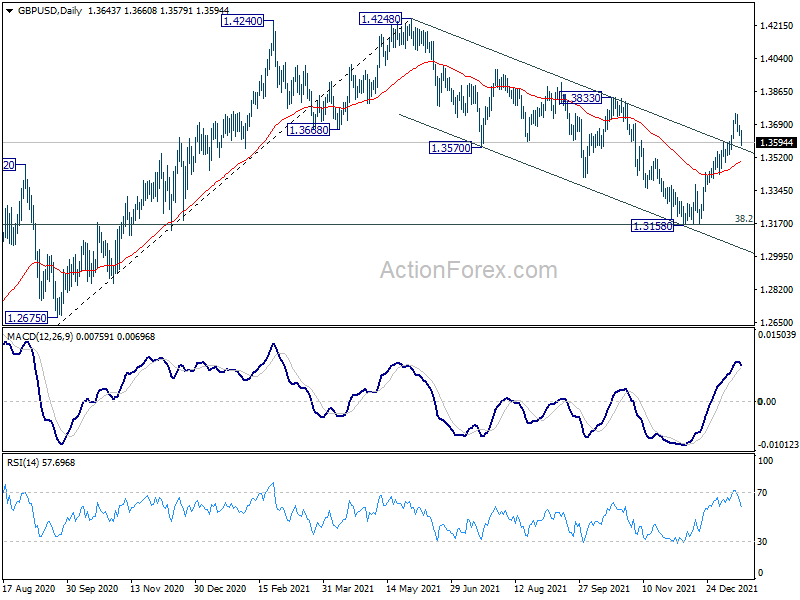
GBP/USD's pull back from 1.3748 extended lower today but stays above 1.3489 support. Outlook is unchanged and intraday bias remains neutral first. Downside of retreat should be contained by 1.3489 support to bring another rally. As noted before, corrective fall from 1.4282 should have completed with three waves down to 1.3158, after hitting 1.3164 medium term fibonacci level. Above 1.3748 will target 1.3833 first. Sustained break of 1.3833 will pave the way back to retest 1.4248 high.
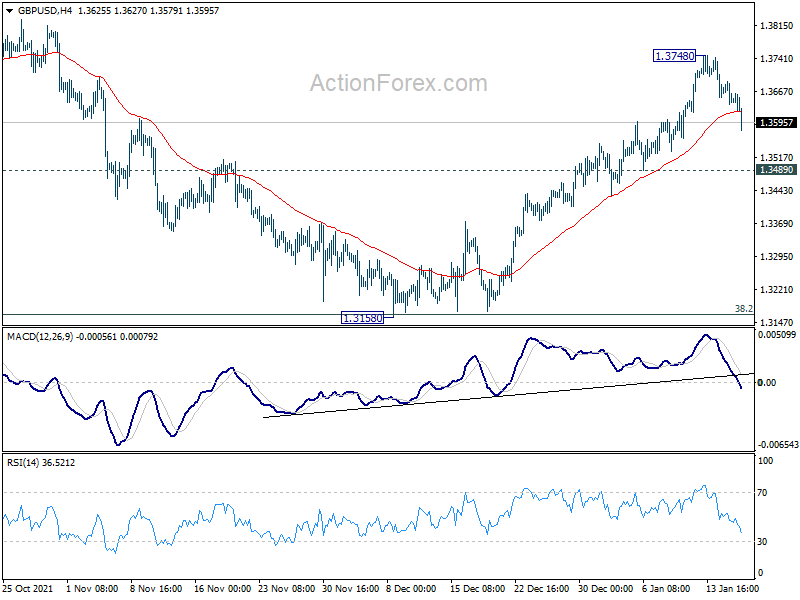
In the bigger picture, strong support was seen from 38.2% retracement of 1.1409 to 1.4248 at 1.3164. The development suggests that up trend from 1.1409 (2020 low) is still in progress. On resumption, next target will be 38.2% retracement of 2.1161 to 1.1409 at 1.5134. Nevertheless sustained break of 1.3164 will argue that whole rise from 1.1409 has completed and bring deeper fall to 61.8% retracement at 1.2493.
Yen Reverses Losses on Risk-off Sentiment, Dollar Supported By Yields
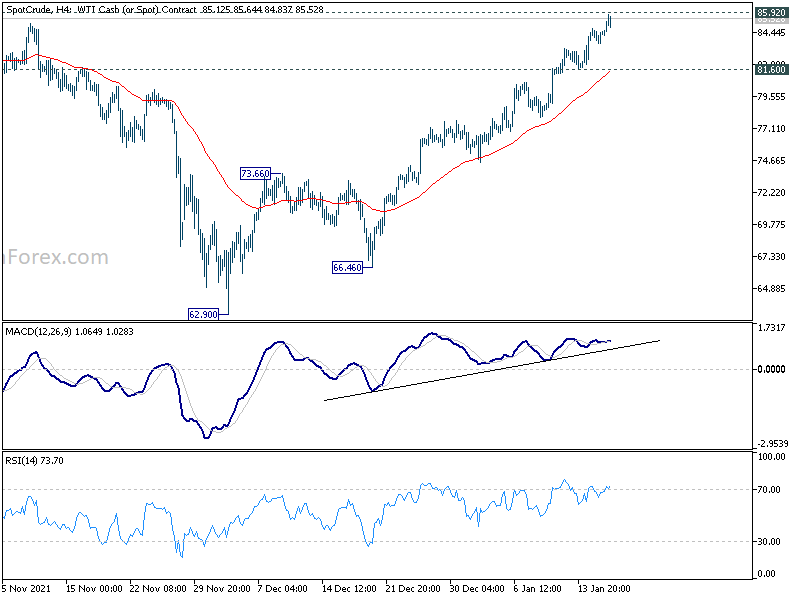
Stocks markets are turning back into risk off mode with US futures pointing to sharply lower open. Yen managed to reverse earlier losses and trading generally higher. Canadian Dollar is also firm as supported by extended rally in oil prices. Dollar is following with some lift by rising treasury yields. On the other hand, Sterling is currently the weakest one, weighed down further by selloff against other Europeans. But Aussie and Kiwi are not to far away.
Technically, we'll pay attention to WTI crude oil today as it's now pressing 85.92 high. We're not expecting a decisive break there. Rejection by this resistance, followed by break of 81.60 support, should trigger near term reversal back towards 73.66 resistance turned support. In this case, we could seen Canadian Dollar reverses too with USD/CAD breaking through 1.2619 resistance. However, strong break of 85.92 will give the Loonie another boost, probably pushing EUR/CAD through 1.4162 low.
In Europe, at the time of writing, FTSE is up 0.50%. DAX is up 0.86%. CAC is up -0.77%. Germany 10-year yield is flat at -0.023. Earlier in Asia, Nikkei dropped -0.27%. Hong Kong HSI dropped -0.43%. China Shanghai SSE rose 0.80%. Singapore Strait Times dropped -0.24%. Japan 10-year JGB yield rose 0.0056 to 0.152.
US Empire state manufacturing dived to -0.7, expectations firm
US Empire State Manufacturing Survey general business conditions index dropped sharply from 31.9 to -0.7 in January. Twenty-two percent of respondents reported that conditions had improved over the month, while 23 percent reported that conditions had worsened. Expectations for the six months ahead ticked down from 36.4 to 35.1.
Looking at some details, new orders dropped from 27.1 to -5.0. Shipments dropped from 27.1 to 1.0. Delivery times dropped slightly from 23.1 to 21.6. Price paid eased from 80.2 to 76.6. Prices received also dropped from 44.6 to 37.1.
Germany ZEW surged to 51.7, economic outlook improved considerably
Germany ZEW Economic Sentiment rose sharply from 29.9 to 51.7 in January, well above expectation of 32.7. Current Situation index deteriorated from -7.4 to -10.2, missed expectation of -7.5.
Eurozone ZEW Economic Sentiment jumped from 26.8 to 49.4, well above expectation of 29.2. Current Situation index dropped -3.9 pts to -6.2.
ZEW President Achim Wambach said: "The economic outlook has improved considerably with the start of the new year. The majority of financial market experts assume that economic growth will pick up in the coming six months. It is likely that the phase of economic weakness from the fourth quarter of 2021 will soon be overcome.
"The main reason for this is the assumption that the incidence of COVID-19 cases will fall significantly by early summer. The more positive economic expectations include the consumer-related and export-oriented sectors and thus a large part of the German economy."
UK payroll rose 184k in Dec, unemployment rate dropped to 4.1% in Nov
UK payrolled employees rose 184k to 29.5m in December. The number was up 409k on pre-pandemic level back in February 2020. All region are now above pre-coronavirus levels.
For September to November period, comparing to the prior quarter, employment rate rose 0.2% to 75.5%. Unemployment rate dropped -0.4% to 4.1%. Economic inactivity rate rose 0.2% to 21.3%.
Average earnings including bonus rose 4.2% 3moy while average earnings excluding bonuses rose 3.8% 3moy.
BoJ stands pat, upgrades 2022, 2023 inflation forecasts
BoJ left monetary policy unchanged. Under the yield curve control, short-term policy interest rate is held unchanged at -0.1%. BoJ will also buy a "necessary amount" of JGB bonds to keep 10-year yield at around 0%.
BoJ maintained the pledge to continue with QQE with yield curve control, "aiming to achieve the price stability target of 2 percent, as long as it is necessary for maintaining that target in a stable manner". It will also continue expanding the monetary base "until the year-on-year rate of increase in the observed consumer price index (CPI, all items less fresh food) exceeds 2 percent and stays above the target in a stable manner."
In the new economic projections, comparing to October forecasts:
- Fiscal 2021 real GDP growth downgraded from 3.4% to 2.8%.
- Fiscal 2022 real GDP growth upgraded from 2.9% to 3.8%
- Fiscal 2023 real GDP growth downgraded from 1.3% to 1.1%.
- Fiscal 2021 core CPI unchanged at 0.0%.
- Fiscal 2022 core CPI upgraded from 0.9% to 1.1%.
- Fiscal 2023 core CPI upgraded from 1.0% to 1.1%.
BoJ Kuroda: We are not debating an interest rate hike
In the post meeting press conference, BoJ Governor Haruhiko Kuroda said, "consumer inflation is likely to stay around 1% through the end of the BoJ's projection period. As such, there is no need to modify the BoJ's monetary easing."
"We are not debating an interest rate hike ... As shown in the report, we're not yet in a situation where inflation is steadily accelerating toward the BoJ's goal. The median forecast of board members is for inflation around 1%. Under such conditions, we are absolutely not thinking about raising rates or modifying our easy monetary policy," he said.
"If achievement of 2% inflation comes into sight, the BoJ's board will likely debate an exit strategy and communicate its intention to markets. That in itself won't be that difficult. The problem is that unfortunately, we haven't see inflation hit 2%. It's premature to debate an exit strategy," he added.
Downbeat New Zealand business confidence, strong inflation pressures
In the The latest NZIER Quarterly Survey of Business Opinion, a net 34.4% of New Zealand businesses expect a deterioration in general economic conditions over the coming months, much worse than prior quarter's 11.1%. Trading activity for the next three months dropped slightly from 8.7 to 8.3.
Regarding inflation, a net 61% reported increased costs in Q4, highest since 2008. A net 65% expect further increase in prices in the next quarter. NZIER said, "these results point to inflation pressures in the New Zealand economy remaining strong over the coming year."
GBP/USD Mid-Day Outlook
Daily Pivots: (S1) 1.3624; (P) 1.3657; (R1) 1.3676; More...
GBP/USD's pull back from 1.3748 extended lower today but stays above 1.3489 support. Outlook is unchanged and intraday bias remains neutral first. Downside of retreat should be contained by 1.3489 support to bring another rally. As noted before, corrective fall from 1.4282 should have completed with three waves down to 1.3158, after hitting 1.3164 medium term fibonacci level. Above 1.3748 will target 1.3833 first. Sustained break of 1.3833 will pave the way back to retest 1.4248 high.
In the bigger picture, strong support was seen from 38.2% retracement of 1.1409 to 1.4248 at 1.3164. The development suggests that up trend from 1.1409 (2020 low) is still in progress. On resumption, next target will be 38.2% retracement of 2.1161 to 1.1409 at 1.5134. Nevertheless sustained break of 1.3164 will argue that whole rise from 1.1409 has completed and bring deeper fall to 61.8% retracement at 1.2493.
Economic Indicators Update
| GMT | Ccy | Events | Actual | Forecast | Previous | Revised |
|---|---|---|---|---|---|---|
| 21:00 | NZD | NZIER Business Confidence Q4 | -28 | -11 | ||
| 03:00 | JPY | BoJ Rate Decision | -0.10% | -0.10% | -0.10% | |
| 04:30 | JPY | Industrial Production M/M Nov F | 7.00% | 7.20% | 7.20% | |
| 07:00 | GBP | ILO Unemployment Rate (3M) Nov | 4.10% | 4.20% | 4.20% | |
| 07:00 | GBP | Average Earnings Including Bonus 3M/Y Nov | 4.20% | 4.20% | 4.90% | |
| 07:00 | GBP | Average Earnings Excluding Bonus 3M/Y Nov | 3.80% | 3.80% | 4.30% | |
| 07:00 | GBP | Claimant Count Change Dec | -43.3K | -38.6K | -49.8K | |
| 07:30 | CHF | Producer and Import Prices M/M Dec | -0.10% | 0.40% | 0.50% | |
| 07:30 | CHF | Producer and Import Prices Y/Y Dec | 5.10% | 5.80% | ||
| 09:00 | EUR | Italy Trade Balance (EUR) Nov | 4.16B | 4.23B | 3.89B | |
| 10:00 | EUR | Germany ZEW Economic Sentiment Jan | 51.7 | 32.7 | 29.9 | |
| 10:00 | EUR | Germany ZEW Current Situation Jan | -10.2 | -7.5 | -7.4 | |
| 10:00 | EUR | Eurozone ZEW Economic Sentiment Jan | 49.4 | 29.2 | 26.8 | |
| 13:15 | CAD | Housing Starts Dec | 236K | 234K | 301K | |
| 13:30 | USD | Empire State Manufacturing Index Jan | -0.7 | 28 | 31.9 | |
| 15:00 | USD | NAHB Housing Market Index Jan | 84 | 84 |