Sample Category Title
GBPUSD Turns South after Reaching 200-Day SMA
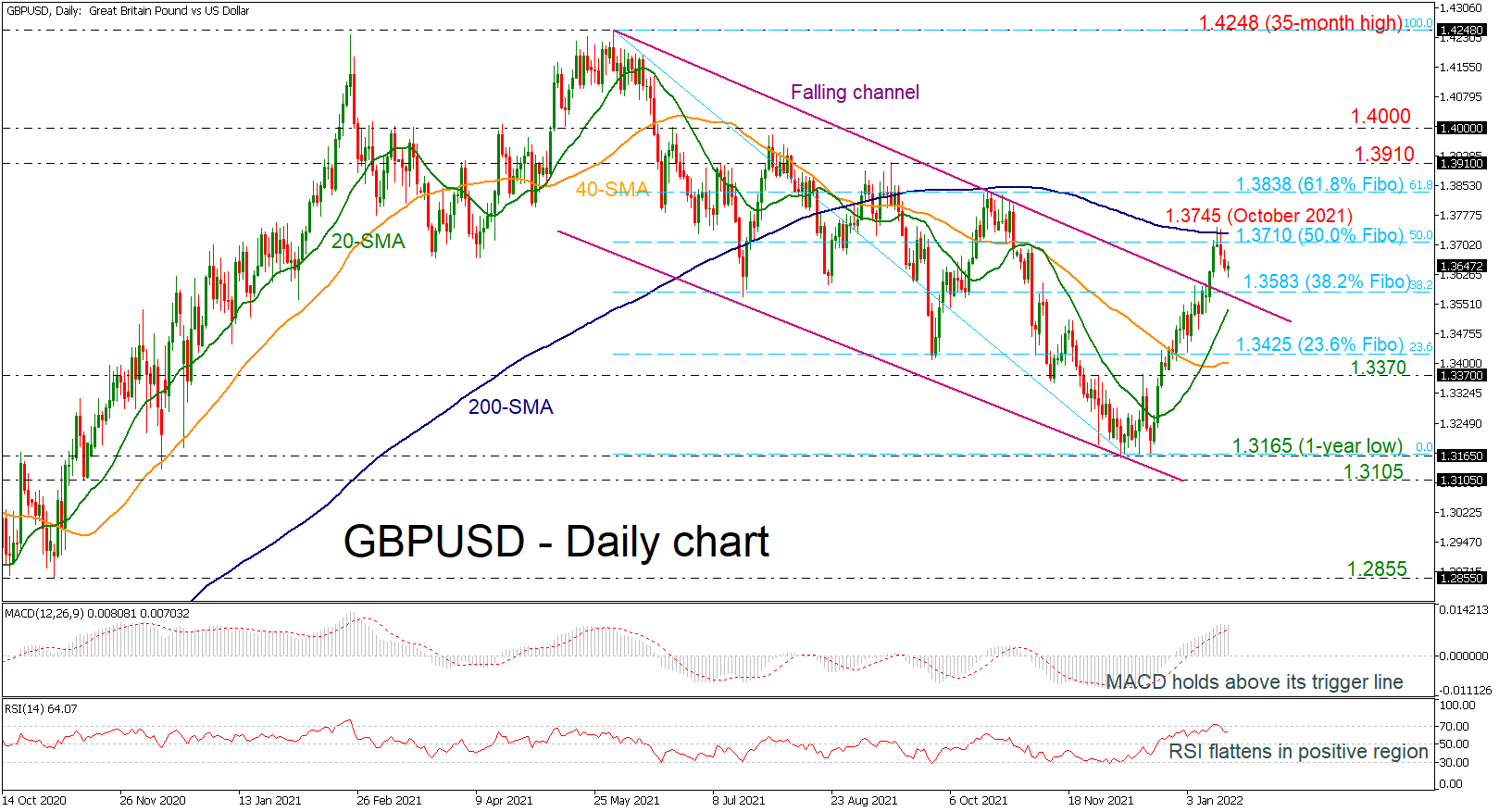
GBPUSD is reversing following the advance to the 1.3745 level, which represents a nearly three-month high. Although the price declined following the touch of the 200-day simple moving average (SMA), it remains above the long-term declining channel. The MACD oscillator is still holding above its trigger line in the positive region with weak momentum, while the RSI is flattening above the neutral threshold of 50.
If the pair continues to fall, immediate support might be found near the 38.2% Fibonacci retracement level of the decline from 1.4248 to 1.3165 at 1.3583, before meeting the 20-day SMA at 1.3535. If selling pressure remains, traders may consider the 23.6% Fibonacci level of 1.3425, which is located above the inside swing high of 1.3370 and the one-year low of 1.3165.
In the alternative scenario, a rally above recent highs could take the currency to the 61.8% Fibonacci level of 1.3838 and then to the 1.3910 barrier. Even higher, the psychological number of 1.4000 may put an end to bullish moves.
All in all, GBPUSD has largely maintained a bullish bias since the bounce from 1.3165, although the recent bearish days may portend a negative correction.
EURJPY Bounces Off 2-Week Low But More Upside is Needed
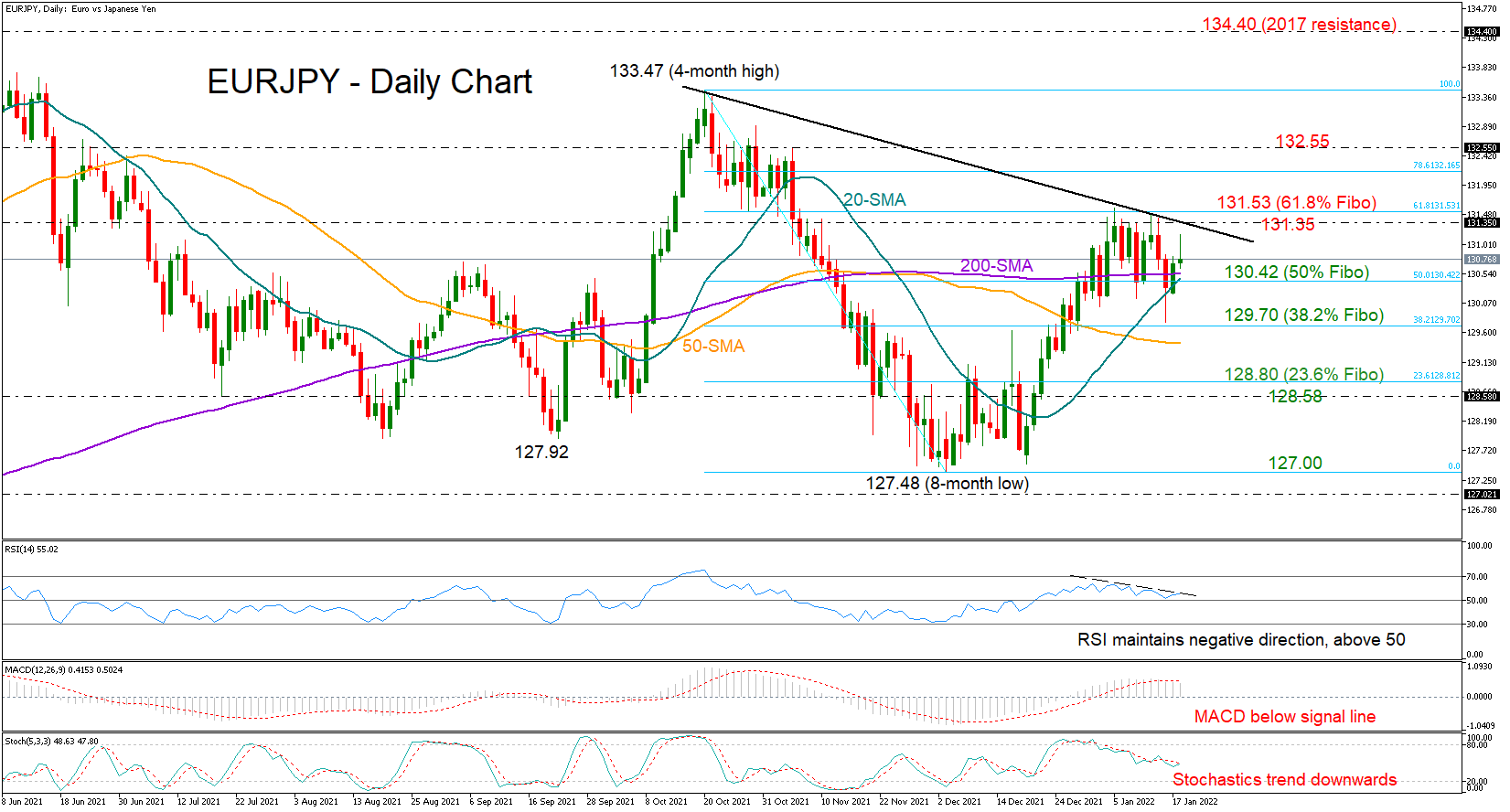
EURJPY has quickly recovered Friday’s drop to a two-week low of 129.77, bouncing back above its simple moving averages (SMAs) and the 50% Fibonacci level of the October-November downfall.
Despite the positive correction, downside risks continue to linger in the background as the RSI and the Stochastics are preserving a downward direction below their December peaks, while the MACD is still hovering below its red signal line.
Negative risks could dwindle if the pair extends its rebound sustainably above the short-term resistance trendline at 131.36, and more importantly, beyond the 61.8% Fibonacci of 131.53. If that turns out to be the case, the price could pick up fresh momentum to meet the 132.00 psychological mark, while higher, the bulls will need to claim the tough 132.55 barrier to access the four-month high of 133.47.
Otherwise, a decisive close below the 20-day SMA and the 50% Fibonacci of 130.42 could generate additional bearish actions towards the 38.2% Fibonacci of 129.70. Deeper and beneath the 50-day SMA, the door would open for the 23.6% Fibonacci of 128.80, a break of which could send the pair straight to the 127.48 bottom.
In summary, EURJPY has not escaped the bearish play despite the latest upturn. For that to happen, the bulls will need to successfully claim the 131.35 – 131.53 restrictive region.
Markets Wary of Oil and Bond Yield Highs, as Focus Shifts to Corporate Earnings
Asian shares were a mixed bag on Tuesday due to the absence of cues from Wall Street following a national holiday in the United States. But European and U.S. equity futures are flashing red amid a jump in Treasury yields, as investors brace for the Federal Reserve to raise interest rates four times this year to tame inflation. Brent crude ventured to its highest level since 2014 due to geopolitical tensions in the Middle East, while gold struggled for direction above $1810. In the currency arena, king dollar pushed higher while the yen weakened this morning after the Bank of Japan concluded a two-day policy meeting with no major changes.
This will certainly be a big week for financial markets as investors juggle the various themes influencing global sentiment. Equity markets will look to company results for some direction as the fourth-quarter earnings season gets into full swing. Reports from the US banks who have so far reported paint a mixed picture with JP Morgan Chase, a financial bellwether, closing down more than six per cent on Friday after the bank said rising costs would curtail profits in 2022 even as it posted record full-year earnings. Heavyweights such as Goldman Sachs and Bank of America, as well as Netflix among many others will be under the spotlight this week.
The burning question on the minds of investors could be what impact rising inflation and the emergence of the Omicron variant will have on final quarter earnings. Should we witness another mixed or disappointing week of results, this could sap more confidence from stock market bulls, especially when considering that the broader S&P500 index is already down over 2% so far this year.
A wild week ahead for the Pound?
The British pound could be injected with volatility this week due to the series of key economic reports and potential political drama at Westminster.
Market expectations already remain elevated over the Bank of England raising interest rates next month, with traders pricing in around an 91% chance of a 25bp rate hike. The argument for higher rates may be reinforced this week if the pending data meets or exceeds forecasts.
On the political front, Prime Minister Boris Johnson remains under pressure to resign over ‘partygate’. Given how it has been reported that as many as 30 letters of no confidence in Boris Johnson have been submitted by Tory MPs, things are bound to get heated. A total of 54 letters of no confidence would have to be submitted to Sir Graham Brady, chairman of the 1922 Committee of backbench MPs, for a vote to be held.
Looking at the technical picture, GBPUSD remains bullish on the daily charts. However, there seems to be resistance around the 200-day Simple Moving Average at 1.3734. A decline towards 1.3600 could be on the cards after such a strong run since the December lows, before bulls snatch back momentum for a push towards 1.3700 and 1.3830.
Commodity spotlight – Oil
Brent crude marched into Tuesday’s session, with prices climbing to fresh seven-year highs as geopolitical tensions bubbled in the Middle East. Iran-backed Yemini fighters claimed to have launched drone strikes on the United Arab Emirates, the third-biggest OPEC producer. Brent is up almost 2% this week and has appreciated close to 13% since the start of 2022. Prices are above $87.70 this morning, with bulls eyeing $88 and $90 as upside targets.
Commodity spotlight - Gold
Gold could be flung into the firing line this week if the dollar regains its mojo and Treasury yields rally. The precious metal has displayed resilience in recent sessions and even took advantage of a softer dollar to push back above $1810.
However, given gold’s zero-yielding nature, the path ahead could be bumpy and perilous for the precious metal as interest rate rises become a reality. Although other factors such as inflation risks and Omicron uncertainty may support gold bugs, the pressure is piling up on gold.
Looking at the technical picture, prices remain within a choppy range. A breakdown below $1810 could open the doors towards $1800, 1786, and $1770. Should $1810 prove to be reliable support, bulls may eye $1831 and $1845.
GER 40 Goes Sideways
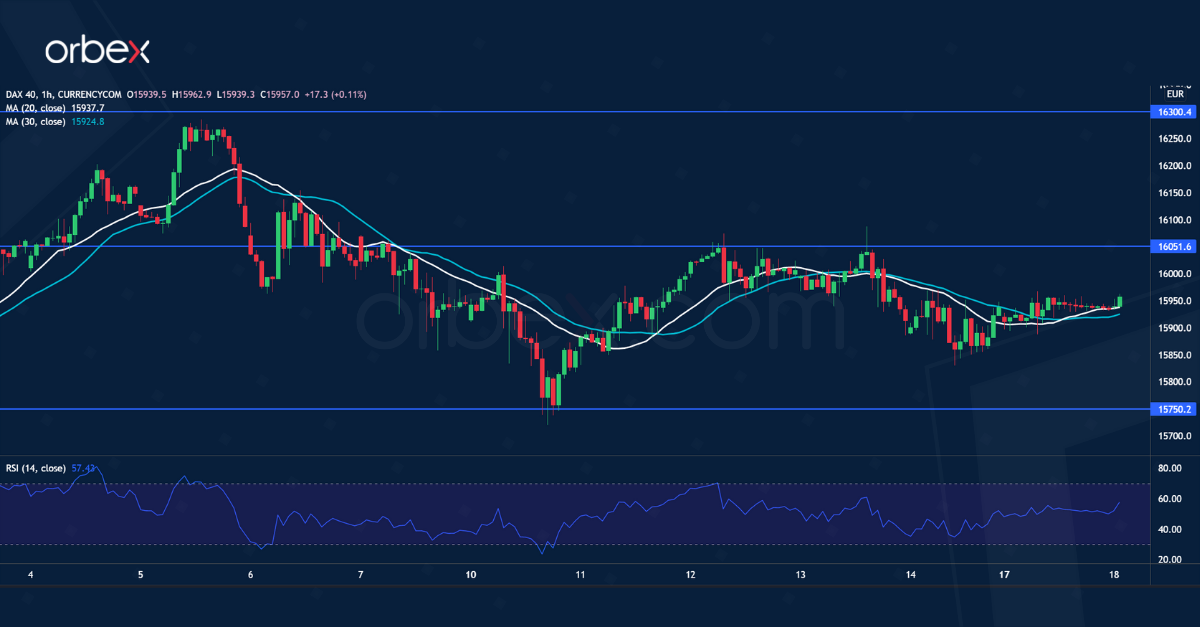
The Dax 40 consolidates as the eurozone’s finance ministers meet. The double top at the all-time high (16300) is a strong resistance to crack.
A break below 15860 has prompted some buyers to exit and reassess the situation. The current consolidation is a sign of market indecision in the short term.
A rise above the psychological level of 16000 has so far struggled to boost buyers’ confidence. This may only happen if the index reclaims 16050. On the downside, a fall below 15750 would send the price to 15500.
EUR/CAD Tests Major Floor
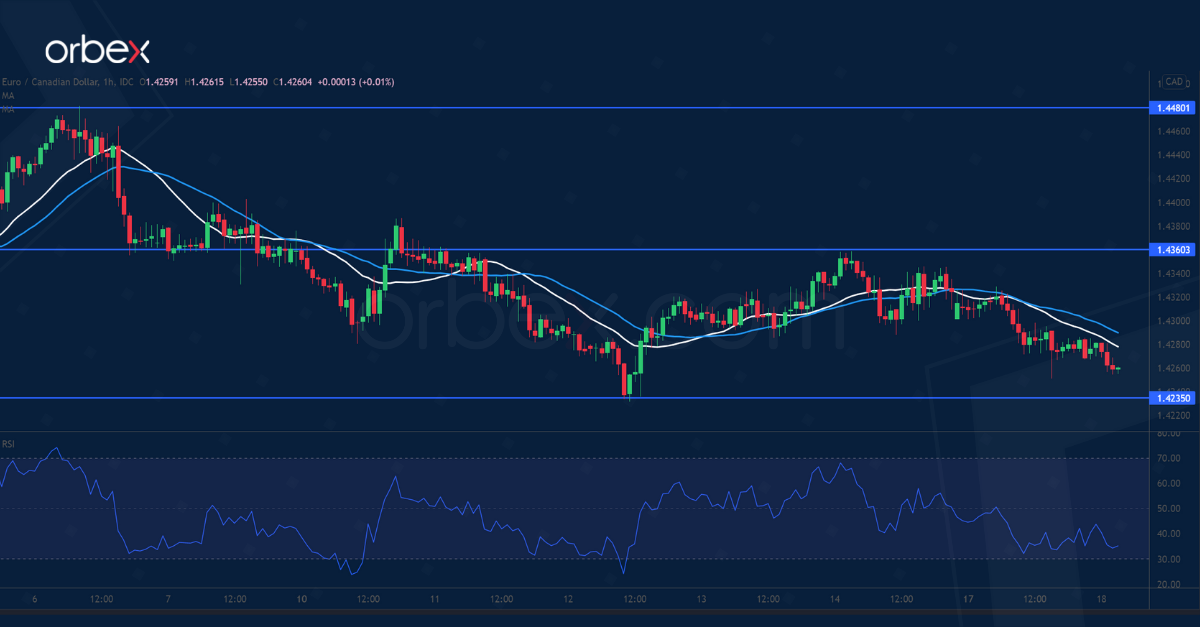
The Canadian dollar inched higher supported by rising oil prices.
The pair has given up all gains from the December rally above the daily resistance at 1.4550. Sentiment is struggling to turn things around.
The RSI’s double bottom in the oversold area attracted some buying interest over the critical support at 1.4235. The bulls will need to push above 1.4360 before they could pull in enough bids for a reversal.
Otherwise, a bearish breakout could trigger a sell-off towards 1.4100.
EUR/USD Seeks Support
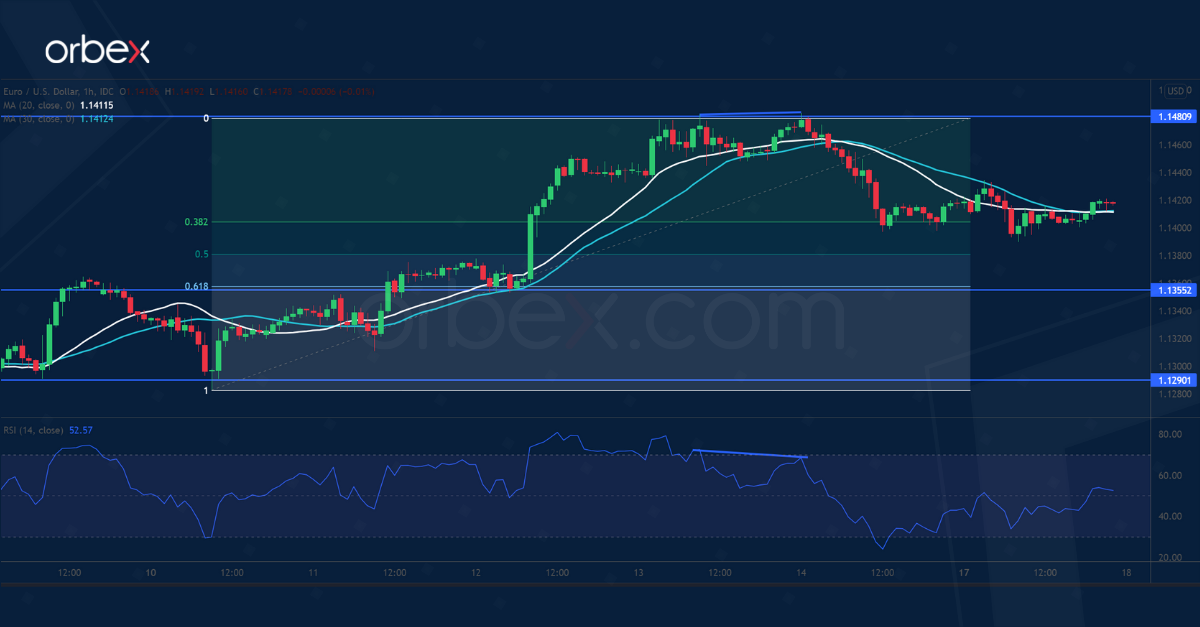
The euro retreated as short-term traders took profit. After a six-week-long consolidation, the euro soared above the supply area at 1.1380 and forced the bears to cover in mass.
As the dust settles, a bearish RSI divergence showed a lack of follow-up momentum. The current pullback is heading towards the origin of the breakout near 1.1355 which coincides with the 61.8% Fibonacci retracement level.
A rebound and then a close above 1.1480 would lead to a bullish reversal towards the daily resistance at 1.1600.
Daily Technical Analysis
EUR/USD
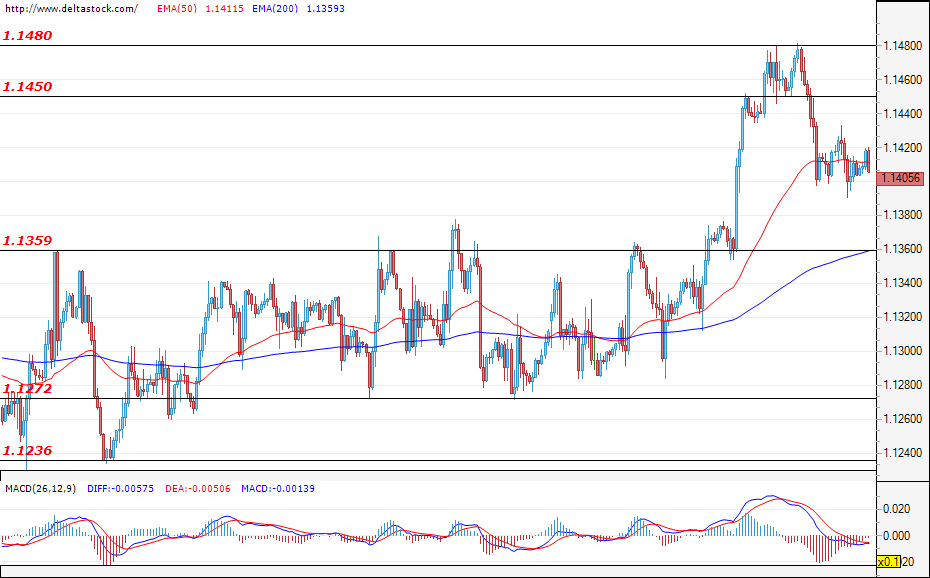
The bears established themselves on the market and, during the last trading session from the previous week, the currency pair underwent a sell-off, which almost completely erased the previously won positions. At the time of writing, the pair is consolidating at around 1.1400. The formation of a range within 1.1360 - 1.1450 is not ruled out due to the lack of significant economic events, except for the announcement of the consumer price index data for the euro area (Thursday; 10:00 GMT), after which the currency pair may head in a more defined direction.
USD/JPY
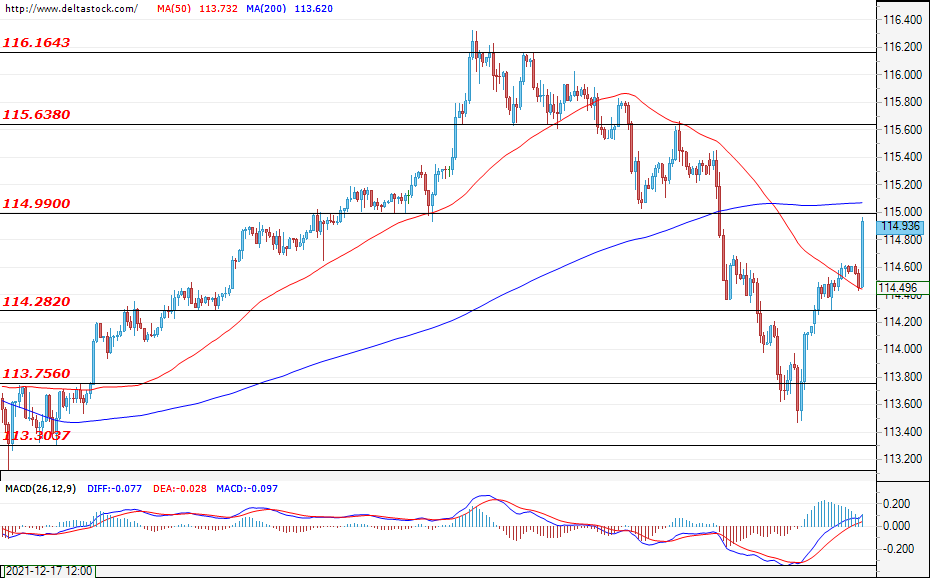
The U.S. dollar continues to appreciate against the Japanese yen and the announcement of the interest rate decision by the central Bank of Japan (today; 02:45 GMT) has certainly helped in that regard. At the time of writing, the currency pair is facing a test of the 115.00 resistance zone. A successful breach of this level could give the bulls the necessary momentum needed for an attack on the next significant level at 115.63. On the other hand, if the bears manage to limit the appreciation below the current resistance, then it is quite possible that we will witness a consolidation below 115.00. A formation of a short-term range between 114.30 - 115.00 is also not excluded.
GBP/USD
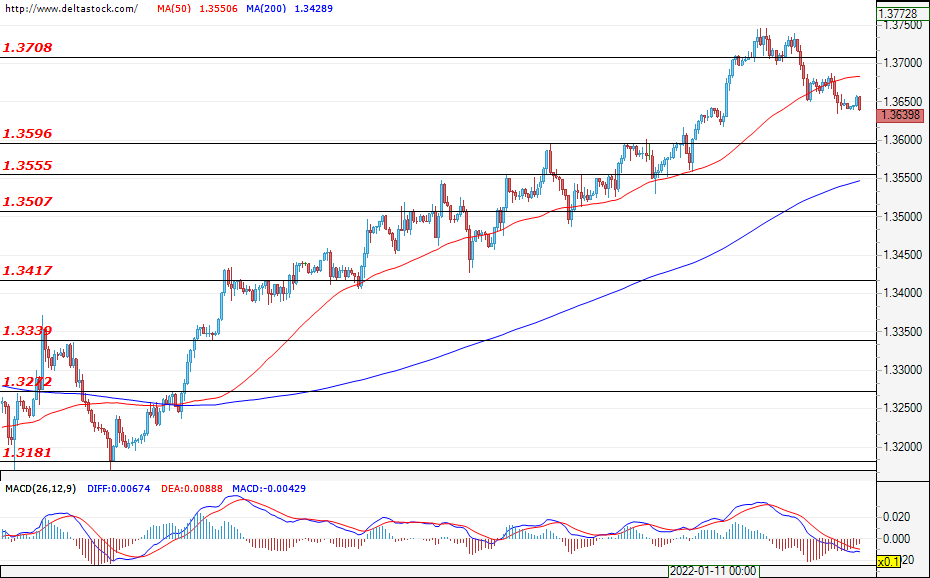
The depreciation of the British pound against the U.S. dollar began in the last trading session of the past week and it seems that the bears are rushing for a test of the first important support at around 1.3590. A successful breach of the mentioned zone could deepen the sell-off, while a breach of the support level at around 1.3200 that is coming from the higher time frames could lead to the continuation of the downward trend.
EUGERMANY40
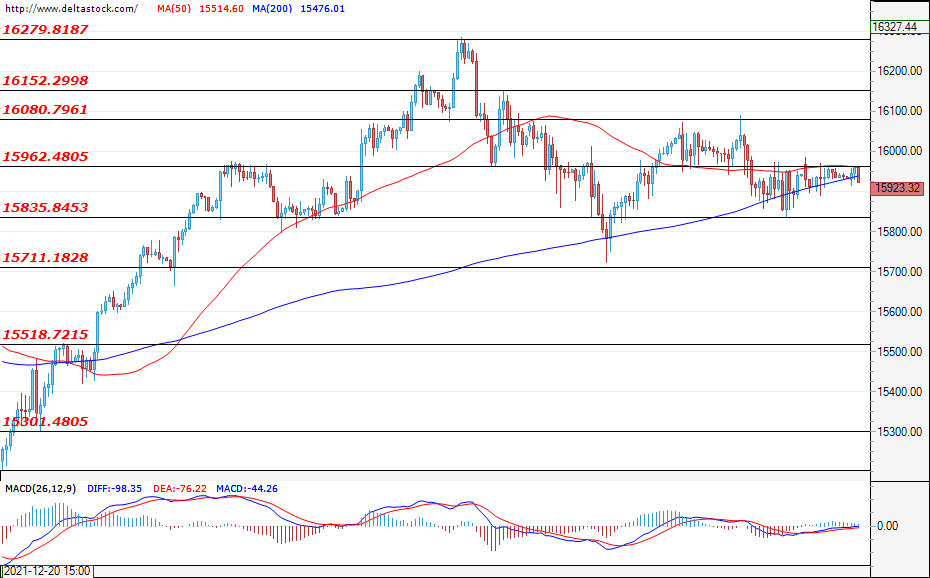
The situation with the German index remains unchanged for the time being, as neither the bulls nor the bears have so far managed to prevail. The most probable scenario is for a formation of a range movement within 15700 - 16152. A breach of any of the mentioned boundaries could predetermine the future movement of the index. From the higher time frames it is clear that the index is again finding itself stuck in a range between the not-so-close-levels of 15000 and 16300. In the long run, a breach of the lower level may be a prerequisite for a trend reversal.
US30
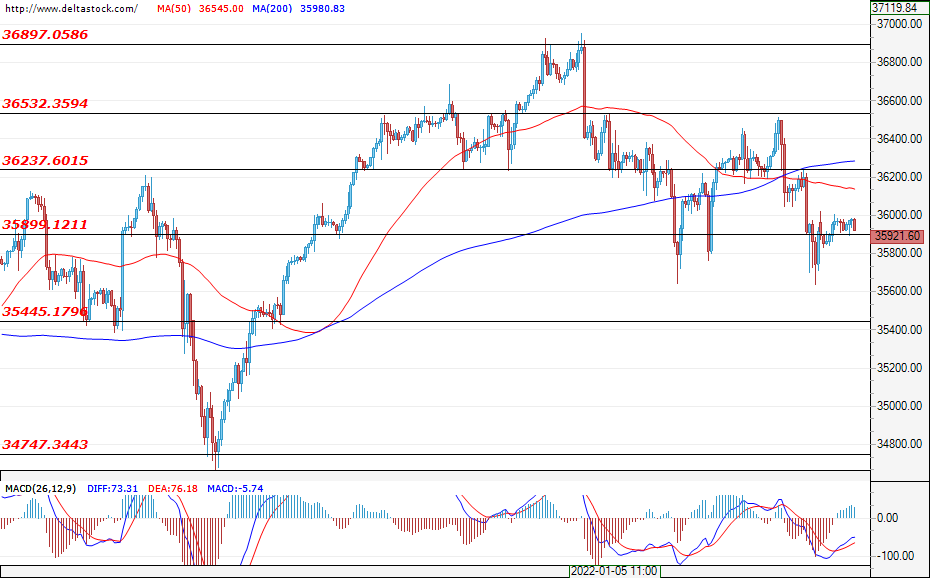
At the time of writing, the U.S. blue-chip stock index is consolidating around the support level at 35900 after the bears failed to overcome the support level at around 35600. Sentiments remain neutral for the time being, and only a breach of 35445 in a downward direction, or a breach of 36532 in the upward direction, could prevent the formation of a range and would define a clearer path for the index.
BoJ Kuroda: We are not debating an interest rate hike
In the post meeting press conference, BoJ Governor Haruhiko Kuroda said, "consumer inflation is likely to stay around 1% through the end of the BoJ's projection period. As such, there is no need to modify the BoJ's monetary easing."
"We are not debating an interest rate hike ... As shown in the report, we're not yet in a situation where inflation is steadily accelerating toward the BoJ's goal. The median forecast of board members is for inflation around 1%. Under such conditions, we are absolutely not thinking about raising rates or modifying our easy monetary policy," he said.
"If achievement of 2% inflation comes into sight, the BoJ's board will likely debate an exit strategy and communicate its intention to markets. That in itself won't be that difficult. The problem is that unfortunately, we haven't see inflation hit 2%. It's premature to debate an exit strategy," he added.
Bank of Japan Didn’t Alter Policy Parameters
Markets
Markets took a slow start to the trading week yesterday as US investors were absent due to the Martin Luther King holiday. On other major developed markets, the news flow was thin. European equities drew some comfort from China easing policy. European indices closed with gains of about 0.50-%0.75%. The by default trend on European interest rate markets also remains north even without guidance from the other side of the Atlantic. German yields rose between 2.2 bps (2y) and 1.3 bps (30-y). The 10y German yields again came with reach of the 0.02% top/the psychological barrier of 0.0%. The dollar gained modestly with the DXY closing at 95.26 and EUR/USD at 1.1408.
This morning the Bank of Japan left its policy unchanged, but changed its assessment on inflation (cf infra). Still any speculation on a policy change is probably premature. Japanese yields are little changed. USD/JPY immediately after the decision jumped from the 114.50 area to the 115 area, suggesting that markets were positioned for a more hawkish guidance. Outside Japan, a sharp rise in US yields as trading resumes after the MLK holiday is catching the eye. Fed-governors are no longer allowed to give guidance on policy as they are in the blackout period ahead of next week’s policy meeting. It doesn’t prevent markets from anticipating bolder Fed action. The US 2-y yield jumps north of 1.0% (currently 1.05%), the highest since end February 2020. The 10-y yield surpasses the 1.80% cycle top (currently 1.84%). The rise in yields is causing some, albeit mostly modest losses on Asian equity markets. China is the exception to the rule (CSI 300 + 0.7%) as markets ponder chances for further PBOC stimulus. Even so, the yuan (USDNCY 6.3425) is holding strong after touching a new cycle top overnight.
Later today, German ZEW economic sentiment is expected to improve slightly from 29.9 to 32.0. In the US, the Empire Manufacturing is expected to ease from 31.9 to 25, but this is still a lofty level. We don’t expect today’s data to change the debate on policy normalization. Key question is whether US investors will join bond sell-off in Asia. Markets now discount four 25 bps hikes starting in March and some investors are debating chances of a 50 bps hike at the start. The broader trend might propel the German 10-y yield in positive territory. Other question is whether the dollar will profit from markets further frontloading policy normalization. At least this morning, USD gains are again modest even as equities indices point to losses at the European open. In the UK, labour market data this morning were close to expectations (3M November employment softer than expected at 60k; unemployment rate dropped to 4.2% and wages rising 4.2% as expected). In a first reaction EUR/GBP is holding in the 0.8355 area.
New Headlines
The Bank of Japan didn’t alter policy parameters that include bond buying, a -0.10% main rate and a 0% 10y yield target. It did, however, for the first time since 2014 change the balance of inflation risks from mainly to the downside to balanced, meaning the BoJ sees equal risks for prices to overshoot target. The move came after Reuters, citing sources, reported last week that the BoJ is debating how to start communicating on a possible rate hike, even if inflation remains sub-target. The latter is still the case in the updated forecasts, which, although lifted, show inflation well below 2% (1.1% in FY 2022 and 2023). Growth in FY21 (to April) was revised downwardly from 3.4% to 2.8% but is seen at 3.8% in FY2022 (from 2.9%) on Omicron delaying the recovery. The Japanese yen lost ground with some investors perhaps expecting more having the Reuters article in mind. USD/JPY trades at 114.82.
During yesterday’s Eurogroup meeting, a number of euro area finance ministers raised the issue of inflation (5% in December). They warned that it is affecting purchasing power and thus economic growth. The Eurogroup President Donohoe in a press conference later said high inflation will indeed last longer than initially expected but added he was convinced that price pressures will begin to moderate later in the year as supply chains continue to improve and effects from forced accumulation of savings due to the lockdowns start moderating. The Eurogroup also discussed corporate vulnerability and structural developments after the pandemic, the draft recommendation on economic policy for 2022 and the banking union.
UK payroll rose 184k in Dec, unemployment rate dropped to 4.1% in Nov
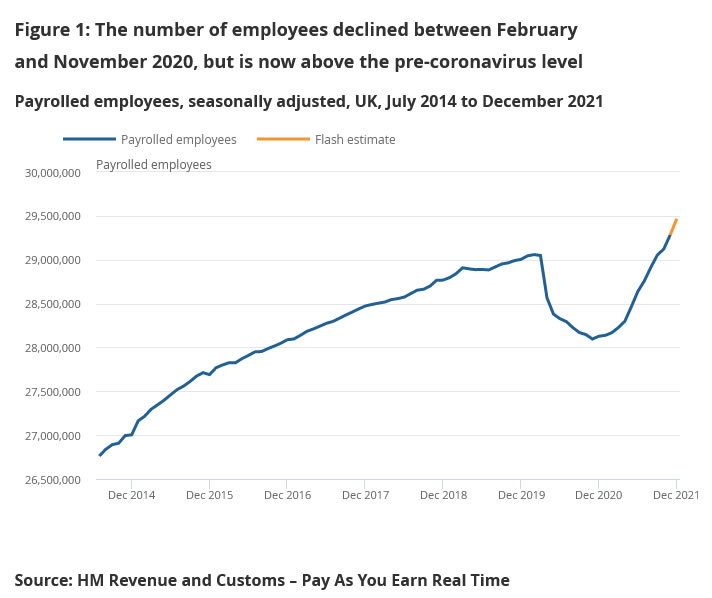
UK payrolled employees rose 184k to 29.5m in December. The number was up 409k on pre-pandemic level back in February 2020. All region are now above pre-coronavirus levels.
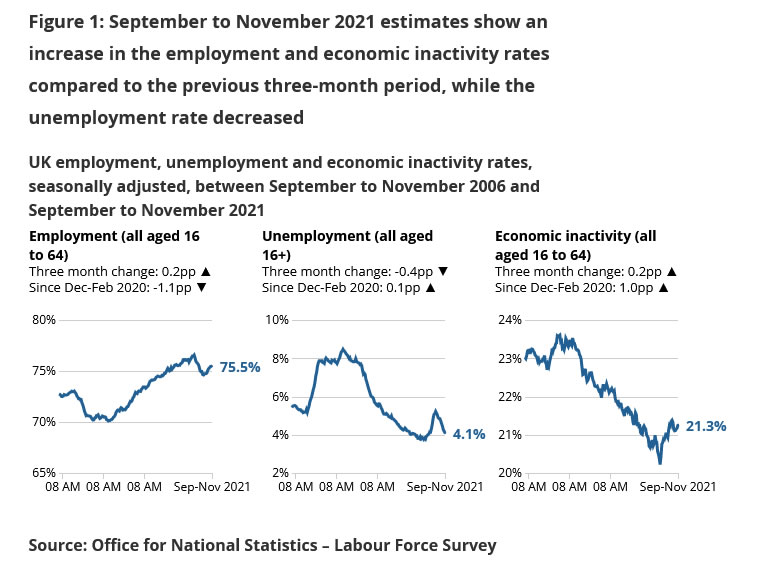
For September to November period, comparing to the prior quarter, employment rate rose 0.2% to 75.5%. Unemployment rate dropped -0.4% to 4.1%. Economic inactivity rate rose 0.2% to 21.3%.
Average earnings including bonus rose 4.2% 3moy while average earnings excluding bonuses rose 3.8% 3moy.