

Sample Category Title
USDJPY Wave Analysis
- USDJPY reversed from support level 113.50
- Likely to rise to resistance level 115.00
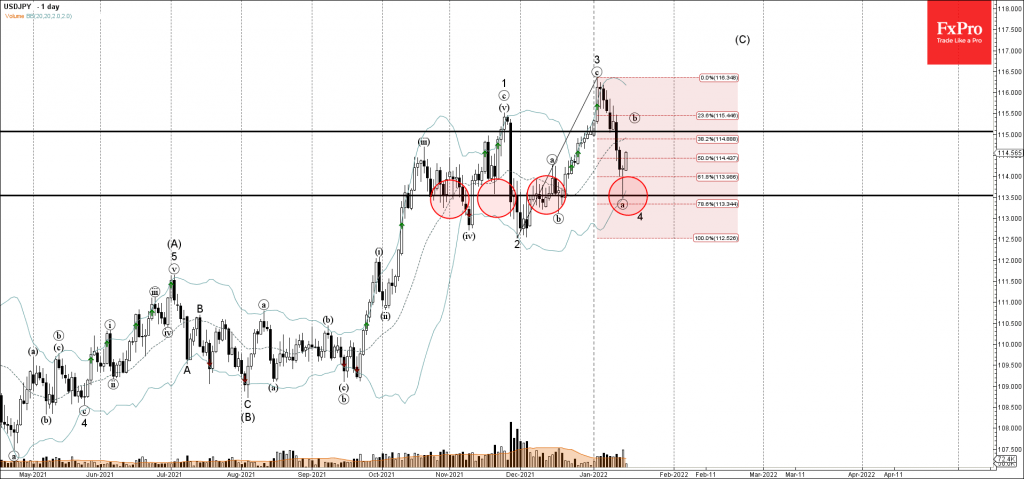
USDJPY currency pair recently reversed up with the clearly formed daily Hammer from the support level 113.50 (which has been reversing the price from October), intersecting with the lower daily Bollinger Band.
The upward reversal from the support level 113.50 started the active short-term correction (b).
USDJPY currency pair can be expected to rise further toward the next resistance level 115.00 (target price for the completion of the active short-term correction (b).).
AUDNZD Wave Analysis
- AUDNZD reversed from support level 1.0575
- Likely to rise to resistance level 1.0640
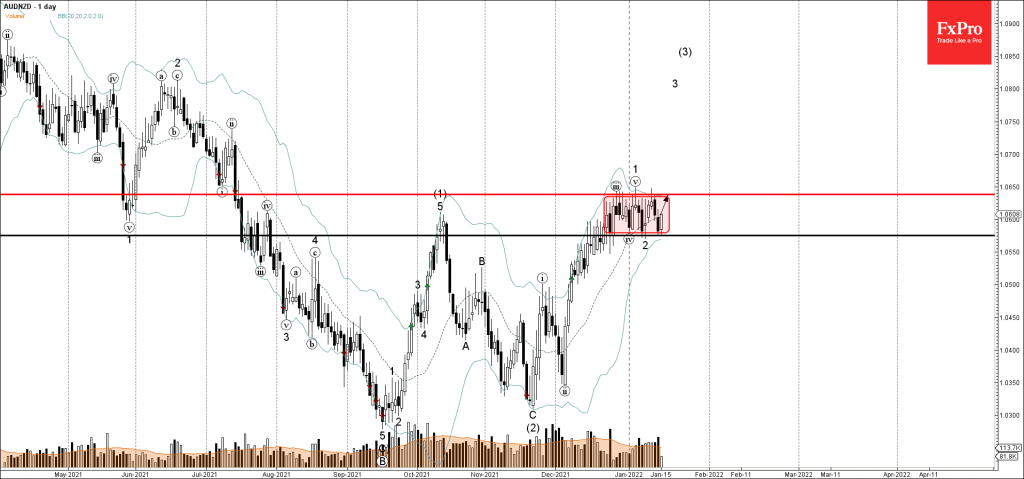
AUDNZD currency pair recently reversed up from the key support level 1.0575 (low of the sideways price range, which has been reversing the price from the start of December), intersecting with the lower daily Bollinger Band.
The upward reversal from the support level 1.0575 continues the active impulse waves 3 and (3).
AUDNZD currency pair can be expected to rise further toward the next resistance level 1.0640 (top of this sideways price range).
Cryptomarket Changing Landscape
The Cryptocurrency Fear and Greed Index has been cruising between 21-23 for the past seven days – in the extreme fear territory, finding itself in the middle of that range on Monday.
Meanwhile, the value of all coins tracked by CoinMarketCap fell 0.5% in the last 24 hours to $2.05 trillion. By and large, a sideways range, $2.0-$2.1 trillion, has also been prevalent here for the past seven days, marking a lull in bull and bear fighting. It remains to be seen whether this signifies fatigue from the past months’ turbulent moves or preparations for a new strong momentum.
The local victory is on the bears’ side, dominating the top coins now, where losses range from -0.8% for Bitcoin to -5.7% for Polkadot over the last 24 hours.
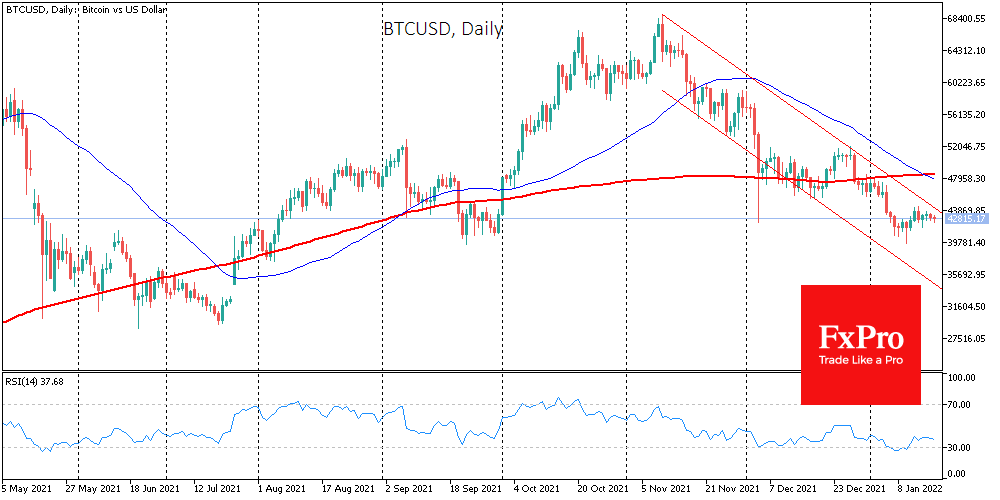
Bitcoin failed to build on last week’s upside momentum and is back in the $41-42K consolidation area, approaching it from above. A decline from these levels in the coming days will be a development of the downtrend since November, reversing the BTCUSD from the upper boundary of the downtrend channel.
A bearish scenario suggests a dip towards $31K by the end of this week to close the July gap. But the door for such a decline will only open after the bulls surrender the $40K level they managed to hold in September and earlier in January.
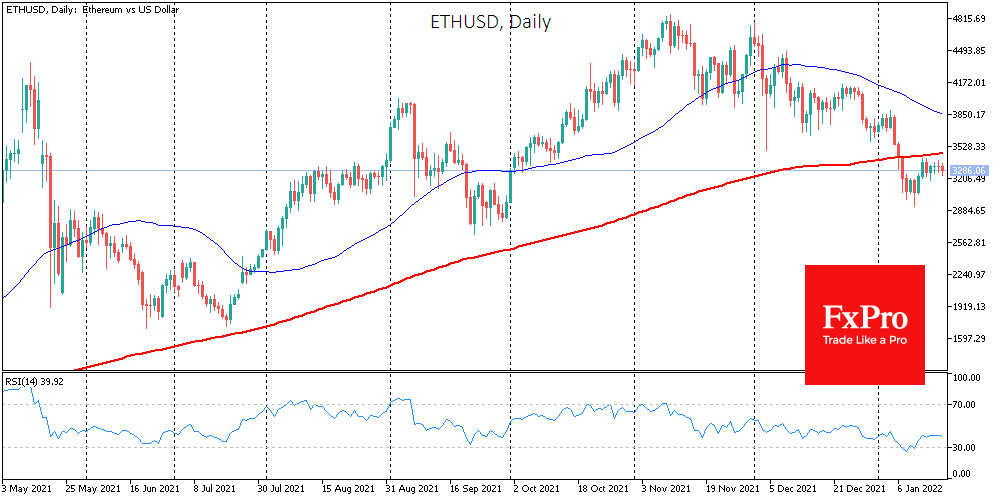
Ether has also encountered a sell-off in its attempts to rise above $3.3K. The 200-day moving average level is now acting as significant resistance.
Bitcoin and Ether, which have a combined capitalisation of almost 60% of all cryptocurrencies, show worryingly negative dynamics. At the same time, their share has been declining since late last year. We are seeing either a shift in investor attitudes towards the sector leaders or certain inertia of altcoins compared to the flagships.
Right now, it seems that crypto enthusiasts are not at all opposed to the changing landscape. However, as is often the case in nature, such changes rarely go smoothly.
Could Canadian Inflation Power Loonie’s Rally?
The Canadian dollar could face fresh volatility when December’s CPI inflation data come out on Tuesday at 12:30 GMT. Forecasts point to another pickup and investors are highly confident that the central bank could raise interest rates as soon as this month, though such a policy decision may not be straight-forward.
CPI inflation estimates
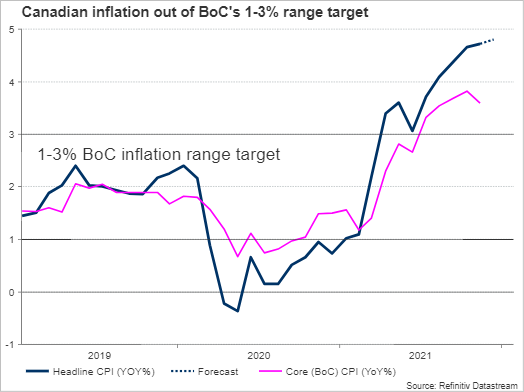
Canadian inflation is expected to have declined by 0.1% on a monthly basis in December, and while a deceleration would be somewhat a relief to the central bank at a time when pandemic risks continue to weigh on economic growth, a decline during the Christmas month has been a common phenomenon at least the past four years, making the headline and core CPI measures more meaningful to watch.
The headline CPI is expected to inch up to 4.8% year-on-year, marking a fresh two-decade high, after stabilizing around 4.7% in the preceding month. Investors will also closely look for similar upturns in the core measures, which exclude volatile energy and food prices, to figure out whether price pressures could become broadly irreversible without the central bank’s intervention.
A January rate hike?
Notably, investors have set aside omicron fears, shrugging off the renewed round of mild restrictions in Ontario and Quebec during the past week, with the 10-year government bond yield surging closer to November’s peak on Monday. On top of that, analysts are strongly pricing in a 25-basis points rate hike with a probability of 75% during next week’s policy meeting. Four more could be delivered according to rate futures by the end of the year to drive the benchmark interest rate up to 1.75%. But despite the rate optimism, the central bank has been out of the spotlight since its previous policy meeting, providing little direction about whether it could hike its borrowing costs as soon as this week.
Having ended quantitative easing, policymakers acknowledged the inflation risk during their previous gathering in December, messaging that if the omicron variant “proves to be less of a health concern than initially feared” and should the labor market remain on solid footing, “there might be some room to reduce monetary support”.
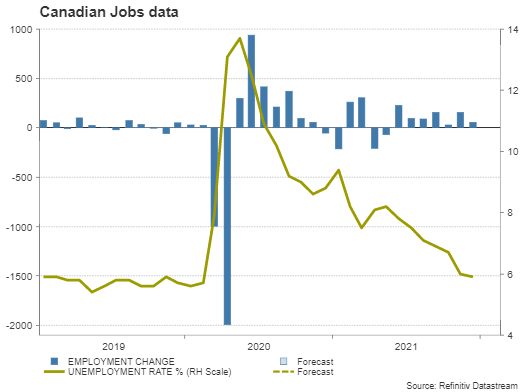
The unemployment rate registered another decline since then, almost approaching its pre-pandemic levels, while business surveys reflected resilience in demand. Hence, perhaps another uptick in inflation would be enough to put the rate campaign into action next week, taking into consideration that the CPI inflation rate would be even larger if it included rising house prices. It is also noteworthy that the government has enabled applications for subsidies to businesses and workers recently, potentially minimising any downturns in business operations and consumer spending.
A rate increase next week would put the BoC ahead of the Fed in the tightening cycle, but the pandemic and inflation risks could still hang around. Therefore, the central bank would probably require more data evidence before hiking rates, making a spring decision a safer choice. Besides, it’s the BoC which tends to follow the Fed and not the opposite, making a negative surprise likely next week.
USD/CAD
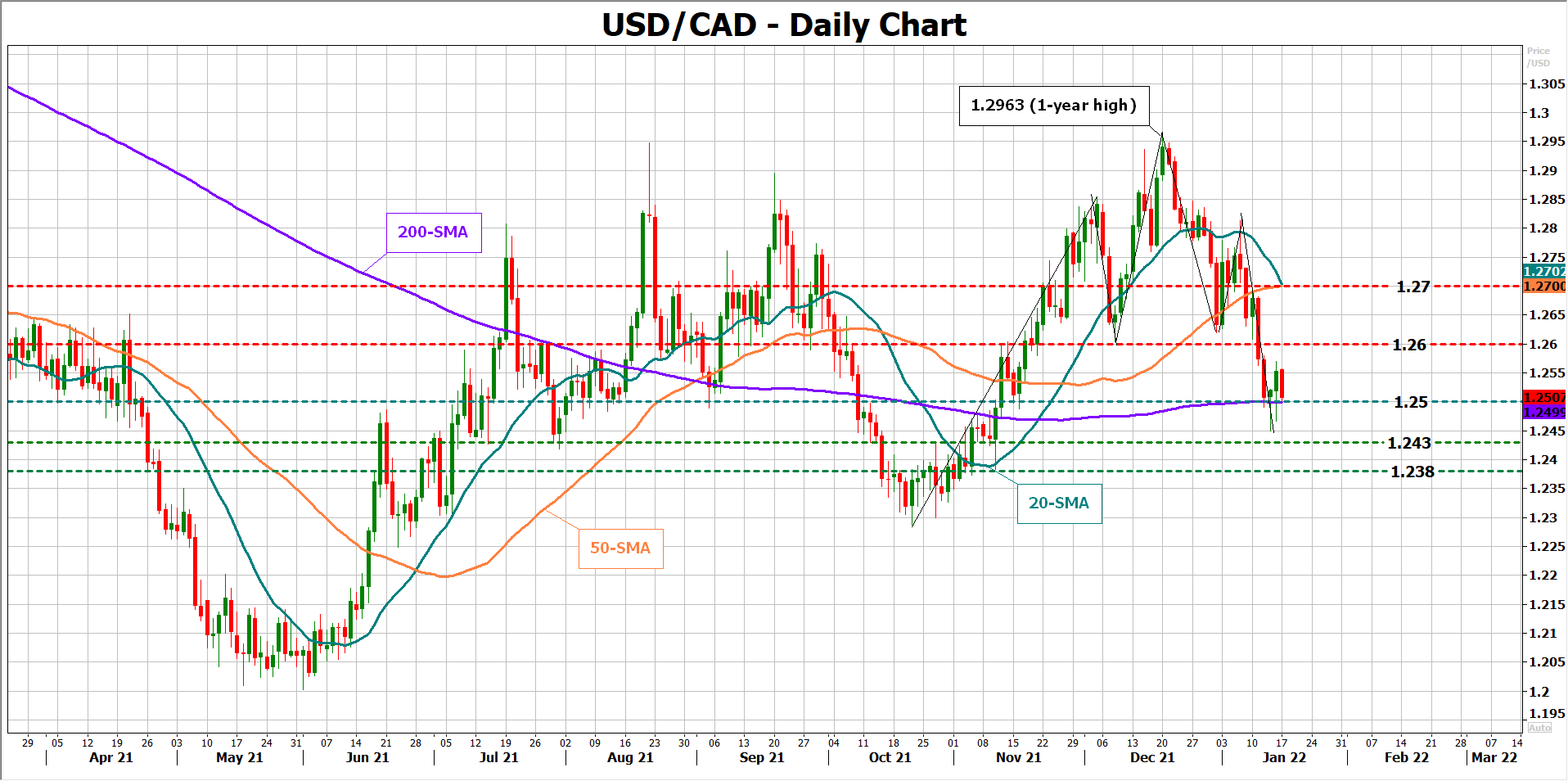
Nevertheless, stronger-than-expected CPI figures could bode well for the Canadian dollar amid the high rate hike expectations, likely putting dollar/loonie back in a downtrend below the 1.2500 level, with the 1.2430 – 1.2380 territory coming next into view.
Alternatively, weaker-than-expected inflation prints could play down a January rate hike scenario, sending the pair closer to 1.2600, where the neckline of the head and shoulder bearish pattern is positioned. Any close higher would snap the negative trend pattern, bringing the key 1.2700 mark under examination.
BoC’s Q4 Business Outlook Survey Showed Intensifying Inflation Pressure
- Business capacity pressures intensified in Q4.
- Wage and inflation pressures continued to build.
- Businesses plan to hire more, and to pay higher wages to do so
- Survey conducted pre-Omicron, but pressure growing on Bank of Canada to hike rates soon
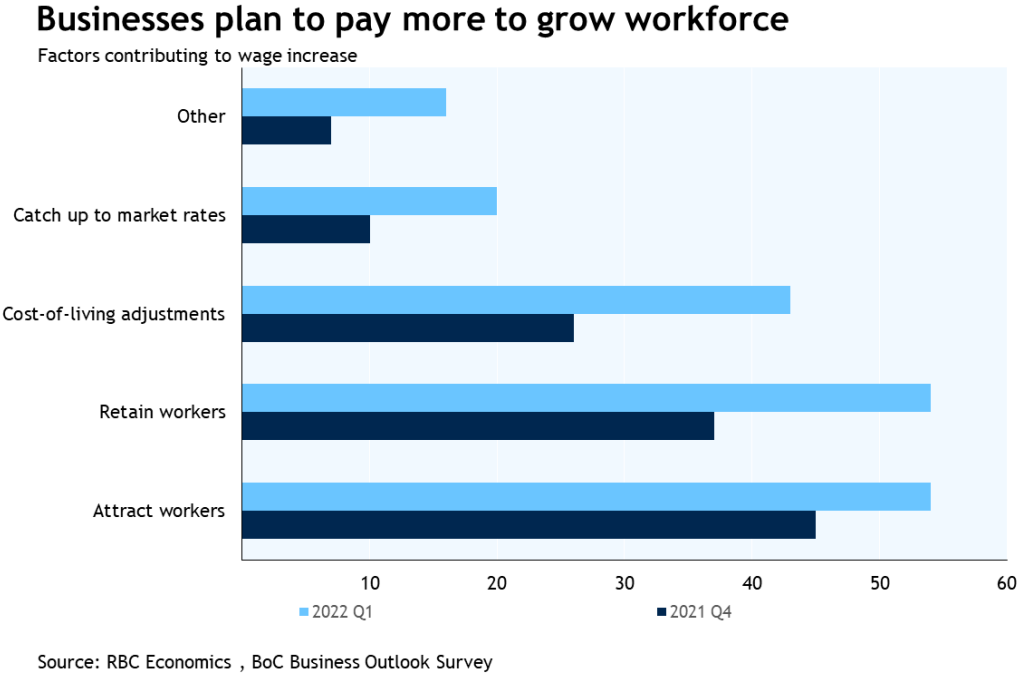
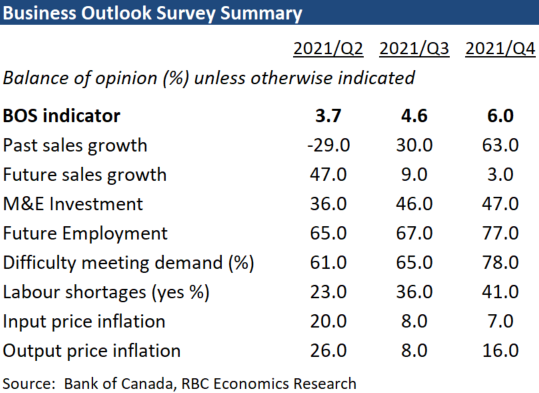
The Bank of Canada's Q4 Business Outlook Survey was conducted largely before the spread of the new Omicron variant accelerated sharply in December. But business capacity pressures were also rapidly accelerating late last year. The pace of expected future sales growth remained high, although the pace was little changed versus a quarter earlier. But ability-to-produce to fill incoming orders looks clearly to have been a larger problem than any shortfall in orders. Almost 80% of businesses reported they would have difficulty meeting an unexpected increase in Demand. Plans to invest are widespread, with the net share of firms planning to buy more machinery and equipment over the next 12 months hitting a record high. The net balance of firms planning to hire workers hit a record 77%, and businesses expect that very tight labour markets (the unemployment rate was back below 6% in December) means they will have to pay more to accomplish that goal. A net 71% of businesses expect to have to pay higher wages - mostly to retain and attract new workers. Two-thirds of businesses expect the annual rate of inflation to be above the top-end of the Bank of Canada's 1%-3% target range over the next two year, up from 45% in the Q3 survey.
The rapid spread of the Omicron variant and large numbers of workers required to self-isolate are likely only adding to labour shortages in the near-term. The economic impact of the latest virus wave will very likely push unemployment back up in January, but disruptions will also likely be short-lived given the exceptionally rapid initial virus spread and accelerated roll-out of booster shots. Government supports will once again help to keep a floor under household and business incomes. As a result, we don't expect the Omicron variant to delay Bank of Canada rate hikes. Our forecast assumes the first increase in the overnight rate will come in April, although capacity/inflation/wage pressures in today's BOS data would argue that the first increase could come at any time, including in the next policy decision later this month.
Bank of Canada Business Outlook Survey: Businesses Upbeat ahead of Omicron
The Bank of Canada Business Outlook Survey (BOS) reported elevated optimism among Canadian businesses in the fourth quarter of 2021. The BOS indicator, a statistical summary of survey results, was 5.99 in 2021Q4, up from 4.56 in the third quarter. Businesses expected foreign and domestic demand to strengthen, boosting future sales. That said, the survey was taken before the impact of Omicron was fully felt across the country, suggesting an upside bias in survey responses.
- Interestingly, today's report noted that capacity pressures are lifting the overall BOS indicator. In fact, since the beginning of 2021, they have explained most of the increase in the indicator. In the past, capacity constraints were reflective of strong demand, but in the current context, it represents both strong demand and supply disruptions.
Indeed, prior to the Omicron shock, strong demand and growing capacity constraints were leading firms to signal increased investment intentions. According to the BOS, "positive investment intentions are broad-based across sectors and regions". Some firms were planning on proceeding with plans that were delayed by the pandemic. In addition, "intense labour shortages and difficulties attracting and retaining workers" were leading to some businesses to increase expenditure on digital technologies and automation.
On the topic of labour shortages, the BOS reported that four in 10 firms see labour shortages as holding back sales. As a result, some companies said it may take longer than previously anticipated to fully recover. According to firms, there were three main factors contributing to labour market tightness: strong labour demand, structural impediments such as aging population and technological changes requiring new skills, and increased worker preference for remote work and flexible working hours.
In terms of labour demand, intentions to hire in the next 12 months rose and remain widespread across industries. Three-quarters of businesses reported that employment levels were back to pre-pandemic norms, and many are hiring to meet higher domestic and foreign demand. This has put upward pressure on wages, with 57% of respondents stating they intend to raise wages at a faster rate over the next year.
Firms expect to pass on higher wages, as well as higher input prices stemming from supply constraints, to Canadians, with many expecting to do so over the next six months. Given that, two-thirds of businesses anticipate consumer price inflation will be above 3% for next two years. In a special question included in this BOS, most companies said they expected inflationary pressures to "dissipate over time, with inflation returning close to target in one to three years."
Key Implications
Today's BOS results were a bit outdated as the survey was taken before Omicron burst onto the scene. Indeed, from October to early-December, businesses were fairly upbeat as COVID cases were relatively low and the economy continued to make solid gains. This boosted investment intentions and left some firms ready to restart investment plans that were shelved due to the pandemic.
Omicron, however, has upended the economic landscape captured in the Business Outlook Survey. With cases skyrocketing and provinces renewing public health restrictions, spending plans could again be shifted to the backburner as businesses wait out this wave of the pandemic, repeating their behaviour during previous waves. As a result, advances in non-residential could be muted in the near-term, keeping expenditure below pre-pandemic levels in the fourth quarter of last year and the first quarter of 2021.
BOS results are likely to be a key input in the Bank's next monetary policy announcement later this month. Last quarter's survey reported that businesses see price pressures receding over the medium term. This will alleviate some of the Bank's concerns around an upward shift in inflation expectations. However, the BOS also reported a tight labour market and rising wage pressures, which could keep inflation elevated for longer. The Bank will have to weigh these risks alongside the Omicron impact as it charts the next steps for monetary policy.
Eco Data 1/18/22
[php_everywhere instance="1"]
AUDUSD’s Bearing in Question as Gradual Ascent Struggles
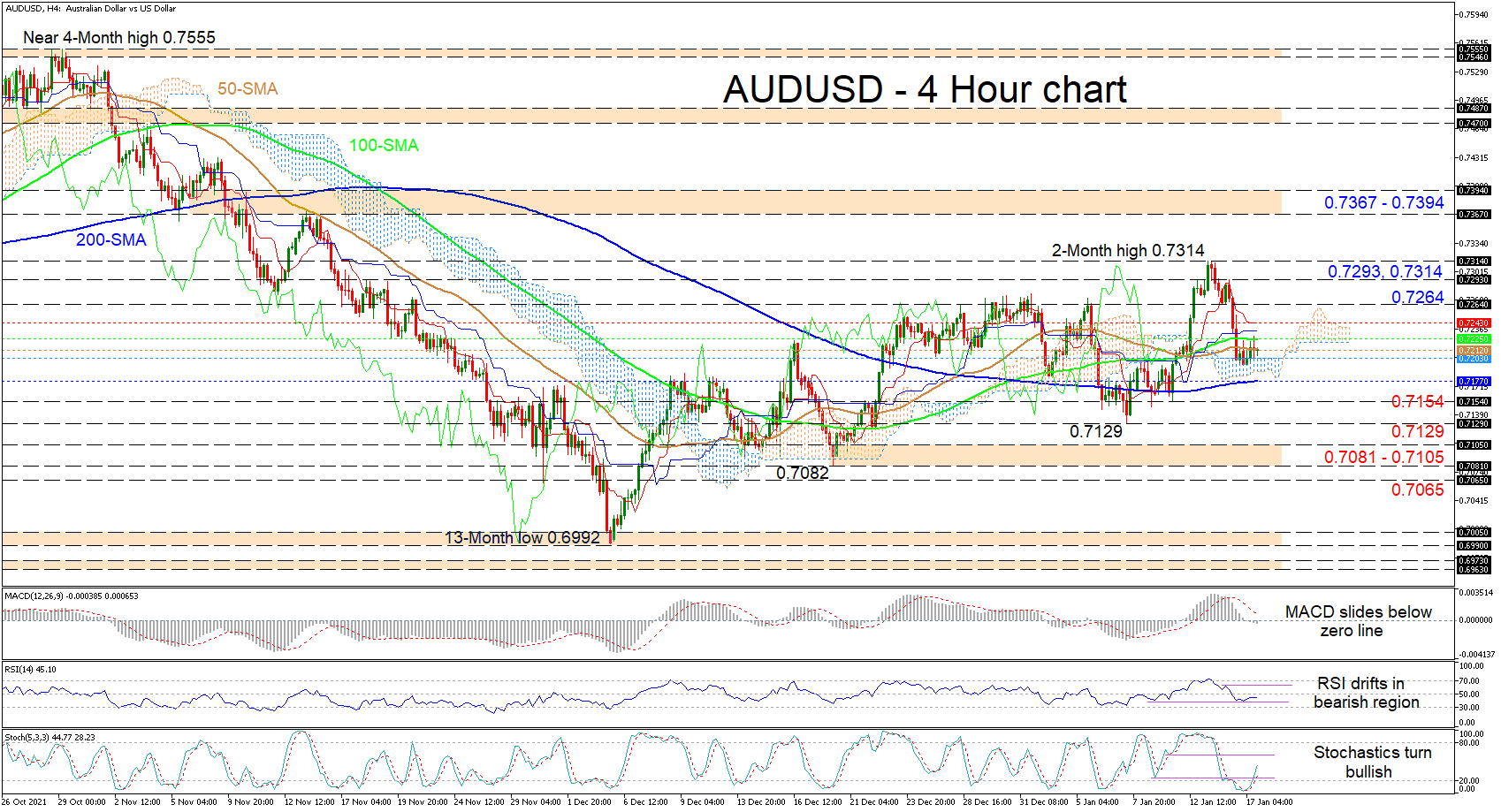
AUDUSD turns somewhat neutral as the pair’s improvements have failed to take flight for around one-and-a-half-months now. Currently, the simple moving averages (SMAs) are not implying a specific trend is in place, while the Ichimoku lines are also indicating weak and unclear directional forces in the pair.
The short-term oscillators are reflecting conflicting signals in momentum, indicating the indecision in the pair to develop a decisive trend. The MACD is below its red trigger line and has glided beneath the zero mark, while the stochastic lines are powering above the 20 level, promoting positive price action. That said, the RSI is hovering in the bearish territory, sponsoring no real change in momentum.
To the upside, an immediate zone of resistance from the 50-period SMA at 0.7212 until the red Tenkan-sen line at 0.7243 could impede the pair from recouping its latest losses. However, should buyers manage to overstep this congested obstacle zone, they may then meet the nearby 0.7264 barrier before jumping toward the neighbouring highs of 0.7293 and 0.7314. Should the bulls revive the hike north, they may eye the 0.7367-0.7394 resistance border extending back to November 2021.
Alternatively, downward forces face an instant support zone existing between the Ichimoku cloud’s lower band at 0.7203 and the 200-period SMA at 0.7177. In the event the 200-period SMA fails to provide buyers with traction, the price could slip towards the 0.7154 and 0.7129 recent troughs. Retreating further, the bears could then tackle the 0.7081-0.7105 support band ahead of the 0.7065 barrier, the last two defences before a clear drop toward the 13-month low of 0.6992.
Summarizing, AUDUSD is just about sustaining its neutral-to-bullish tone above the 200-period SMA and the 0.7129 trough. A price decline stretching beneath the 0.7082 low could trigger negative concerns in the pair.
Sunset Market Commentary
Markets
The absence of US traders in observance of Martin Luther King Day took the sting out of today’s EMU trading action. Especially since the main dish was served during Asian trading hours with monthly Chinese activity data and quarterly GDP figures. Data pointed in the direction of further waning growth momentum. The PBOC anticipated the numbers by unexpectedly cutting key policy rates for the first time since April 2020 (7d reverse repo and 1y lending facility) by 10 bps to respectively 2.1% and 2.85%. It prompted an outperformance of main Chinese equity indices (+1-1.5%). Main European benchmarks enjoyed the risk rally and currently gain 0.5% to 0.7%. EUR/USD fluctuates in low 1.14 area. German Bunds continue to trade near Friday’s sell-off lows. Daily changes range between +0.5 bps and +1.1 bp across the curve. The German 10y yield thus remains near the recovery high of -0.02%. The technical picture in the EU 10y swap rate looks even better. It broke the 2021 recovery high (0.33%) early January to bump into 0.40% resistance (50% retracement on 2018-2019) decline. A correction lower didn’t go below resistance-turned-support at 0.33% with the key swap gauge back at 0.40%. A break higher paves the way to 62% retracement on that 2018-2019 decline at 0.59%. This week’s key event from a European point of view could for once be the normally dull Minutes of the ECB meeting, published on Thursday. Recall US markets’ reaction after the release of the December Minutes. The ECB back then decided to put PEPP to bed after March 2022 and to temporarily bump APP in Q2 (€40bn/month) and Q3 (€30bn/month). We assume Lagarde used her finest negotiations skills to craft this deal and markets will be interested in more hawkish floated alternatives in line of rapidly evolving market developments.
The Kingdom of Belgium intends to launch a new 10y benchmark (OLO 94 June2032). The Belgian debt agency for this year projects a €48.28bn gross financing requirement. This covers a €18.34bn deficit (net financing), €27.59bn maturing debt and €1.84bn of planned buy-backs. Gross borrowing is up 10% compared to last year. The substantially higher debt redemptions compensate for a 25% lower cash deficit. In 2023, these redemptions should decline to €21.6bn. The bulk of the funding will be raised through OLO’s for an amount of €41.20bn (up to 3 planned syndications). EMTN & Schuldscheine programmes (€3bn) and an increase in short-term debt fill the remaining gap. Belgium will no longer fund via (SURE) EU loans.
News Headlines
Norwegian Exports in 2021 hit a record high value of NOK 1377.8 bn, raising the amount of total exports by about 77% compared to 2020. This strong export performance resulted in a record trade surplus of NOK 531bn for the year. The rise was mainly driven by higher energy prices. The value of natural gas exports more than quadrupled to NOK 478.8 bn. Revenues of oil exports reached the highest level since 2008 (NOK 349.6 bn). However, the strong Norwegian export performance was visible as well in mainland exports which also hit an all-time record (+22% from 2020). This was due to strong exports in oil related products, metals and energy, but fish exports also hit an all-time high. The Norwegian krone remains well bid with EUR/NOK returning below 10. The Norwegian central bank raised its policy rate from 0.25% to 0.50% in December. It meets again on Thursday but a next hike is only expected at the March 24 policy meeting when a new monetary policy report will be available.
December Polish inflation earlier this month printed at 0.9% m/m and 8.6% y/y. Today, the National Bank of Poland published its monthly analysis of the drivers for (core) inflation. Core inflation net of food and energy prices rose further by 0.4% M/M and 5.3% Y/Y (from 4.7% in November). The core number excluding the most volatile items still accelerated 0.7% M/M and 6.7% Y/Y. Last week, the Polish government announced a series of measures including VAT cuts on selected products for six months starting February 1 to cap price rises for Polish citizens. The zloty today extended gains. EUR/PLN is trading near 4.52, the strongest level for the zloty since September last year.
Canada’s Manufacturing Sector Recovery Continued in November
Canada's manufacturing sales increased 2.6% (month/month) in November, following a 4.6% increase in October. The outturn was still solid after accounting for price effects, with manufacturing shipment volumes up 1.9% on the month.
The increase in nominal sales spanned 18 of the 21 industries. The transportation equipment industry (+4.9%) led the overall increase. Despite the improvement, sales levels in the motor vehicle sub-industry remained relatively depressed. Sales of primary metals (+5.8%), petroleum and coal products (+3.7%), non-metallic mineral products (+10.4%), chemicals (+2.5%), wood products (+3.2%), and food (+1.3%) were also strong.
Inventories increased 1.2% on the month, and the inventory-sales ratio edged down to 1.60 (from 1.62 in October). Forward looking indicators were positive, with new orders up 3% and unfilled orders up 0.4%.
The B.C. floods were reported to have impacted 28.1% of manufacturers (through transportation delays and raw material shortages). Statistics Canada estimated an impact of $372.1 million on sales in November.
Key Implications
Canada's manufacturing sector recovery continued into November, despite severe flooding in B.C. November saw a second consecutive monthly increase in sales and broad-based strength across most of the sub-industries. Combined with other economic indicators, this release corroborates the view that the Canadian economy enjoyed a solid fourth quarter.
The outlook for Canada's manufacturing sector in the coming months is mixed. Forward looking indicators (new orders) were positive, and Canada's PMI reading alongside the ISM manufacturing index point to continued resilience in sentiment and demand. However, this strength comes against lingering global supply chain disruptions. Responses from today's Business Outlook Survey from the Bank of Canada should help shed more light on the outlook for overall business investment and the manufacturing sector.