

Sample Category Title
CAD Firm after Manufacturing Sales, Trading Generally Subdued
Canadian Dollar is trading as the strongest one for today, and remains firm after stronger than expected manufacturing sales data. Dollar is currently following, with help by rebound against Yen. Sterling is also slightly weaker, following Yen. Other currencies are mixed for now. Overall, trading is rather subdued with US on holiday.
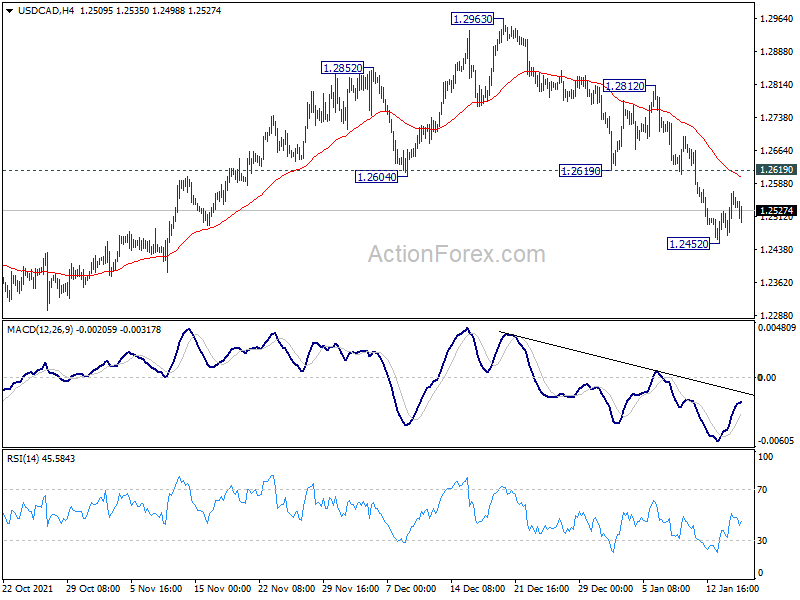
Technically, while Canadian Dollar is firm, it's currently still engaging in consolidation against Dollar. Further decline is expected with 1.2619 resistance intact. Break of 1.2452 will resume the fall from 1.2963 to 1.2286 and even further to 1.2005. However, if WTI oil reverses recent rally after being rejected by 85.92 high, a setback in Canadian Dollar could be triggered. That, if happens, could push USD/CAD through 1.2619 for a stronger rebound.
In Europe at the time of writing, FTSE is up 0.77%. DAX is up 0.39%. CAC is up 0.66%. Germany is up 0.0153 at -0.030. Earlier in Asia, Nikkei rose 0.74%. Hong Kong HSI dropped -0.68%. China Shanghai SSE rose 0.58%. Singapore Strait Times rose 0.18%. Japan 10-year JGB yield dropped -0.0046 to 0.146.
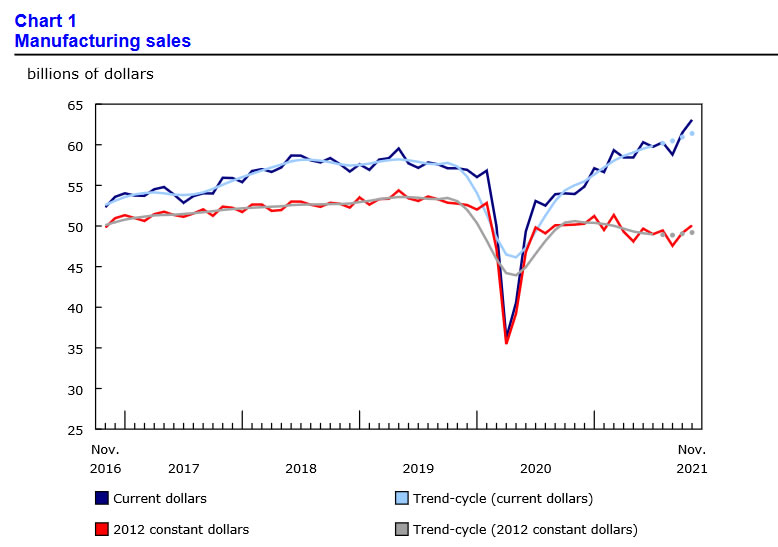
Canada manufacturing sales rose 2.6% mom in Nov, supply chains impacts continued
Canada manufacturing sales rose 2.6% mom to CAD 63.1B in November, above expectation of 1.7% mom. Sales increased in 18 of 21 industries, led by the primary metal, petroleum and coal product, non-metallic mineral, and food product industries.
Statistics Canada said, "despite the gains observed for November, supply chain issues continued to impact manufacturing production in many industries including transportation, chemical, and food. Moreover, floods in British Columbia further exacerbated the situation."
China GDP grew 4.0% yoy in Q4, weak retail sales
China GDP grew 4.0% yoy in Q4, much faster than expectation of 3.3% yoy. On a quarterly basis, GDP grew 1.6% qoq, above expectation of 1.1% qoq. For 2021 as a whole, GDP grew 8.1%, slightly above expectation of 8.1%.
In December, industrial production rose 4.3% yoy, above expectation of 3.6%. Retail sales rose 1.7% yoy, below expectation of 3.7% yoy. Fixed asset investment rose 4.9% ytd yoy, slightly above expectation of 4.8%.
The National Bureau of Statistics said, "we must be aware that the external environment is more complicated and uncertain, and the domestic economy is under the triple pressure of demand contraction, supply shock and weakening expectations."
Also from China, steel production dropped for the first time in six years in 2021, down -3% from 1.065B tonnes to 1.03B tonnes. Birth rate dropped to a record low of 7.52 births per 1000 people in 2021, down from 2020's 8.52 births per 1000 people.
China's rate cut failed to lift HSI
China's rate cuts were not enough to lift investor sentiment in the region. PBoC lowered its one-year medium-term lending facility rate by 10bps to 2.85%. The seven-day reverse repurchase rate was also cut by 10bps to 2.1%. They're the first rate cut since April 2020.
Also, the PBoC injected more liquidity by offering 700 billion yuan of MLF loans, exceeding the 500 billion yuan maturing, and added 100 billion yuan with seven-day reverse repurchase agreements, more than the 10 billion yuan due.
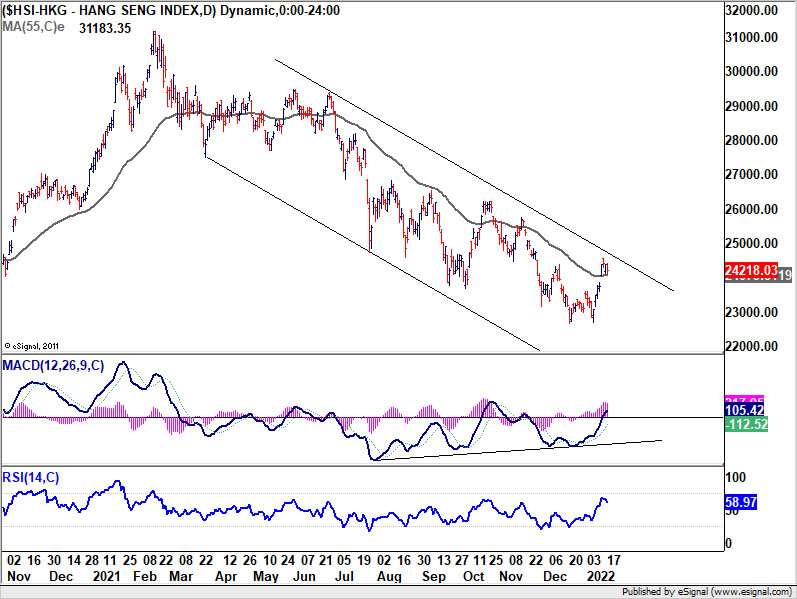
Hong Kong HSI closed down -165 pts or -0.68% at 24218.03. Downside momentum has been diminishing since mid December. Yet there is no clear sign of bullish reversal. HSI is still inside medium term falling channel. Another fall remains in favor to extend the down trend from 31183.35 through 22665.25 low.
GBP/USD Daily Outlook
Daily Pivots: (S1) 1.3642; (P) 1.3692; (R1) 1.3732; More...
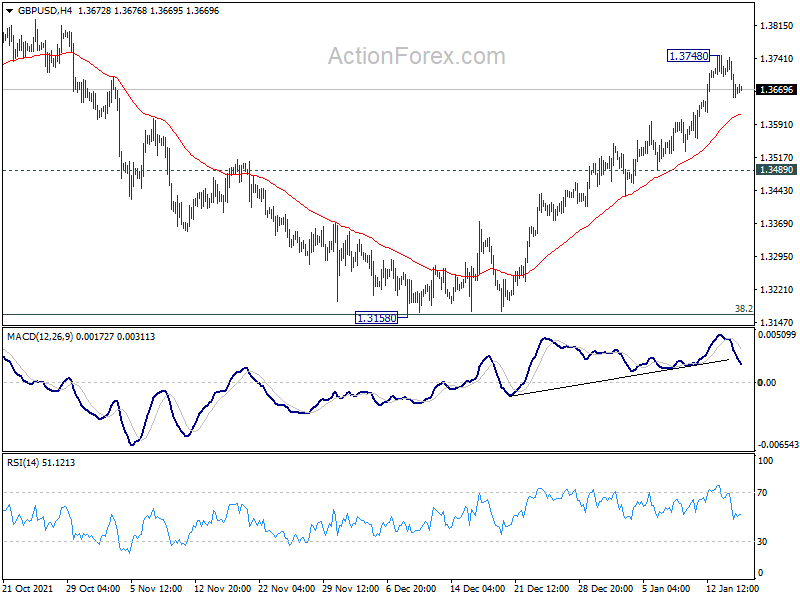
Intraday bias in GBP/USD remains neutral for consolidation below 1.3748 temporary top. Downside of retreat should be contained by 1.3489 support to bring another rally. As noted before, corrective fall from 1.4282 should have completed with three waves down to 1.3158, after hitting 1.3164 medium term fibonacci level. Above 1.3748 will target 1.3833 first. Sustained break of 1.3833 will pave the way back to retest 1.4248 high.
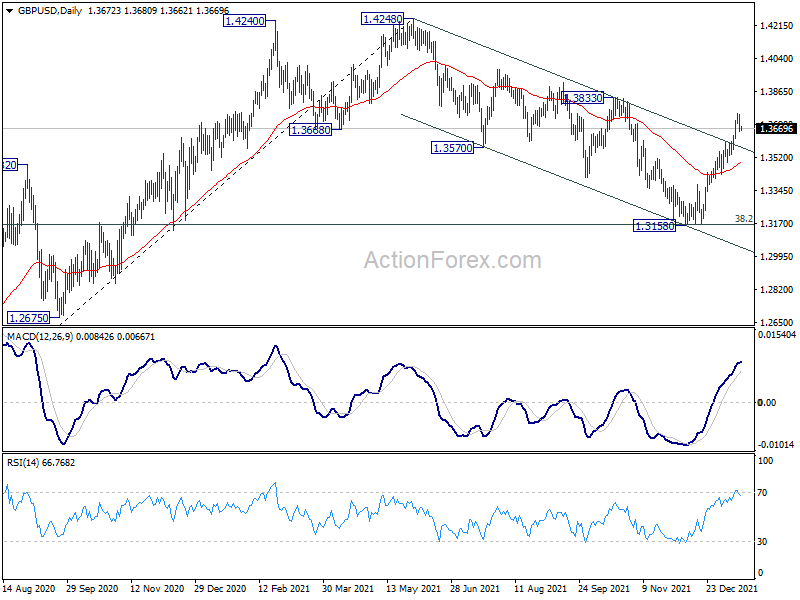
In the bigger picture, strong support was seen from 38.2% retracement of 1.1409 to 1.4248 at 1.3164. The development suggests that up trend from 1.1409 (2020 low) is still in progress. On resumption, next target will be 38.2% retracement of 2.1161 to 1.1409 at 1.5134. Nevertheless sustained break of 1.3164 will argue that whole rise from 1.1409 has completed and bring deeper fall to 61.8% retracement at 1.2493.
Economic Indicators Update
| GMT | Ccy | Events | Actual | Forecast | Previous | Revised |
|---|---|---|---|---|---|---|
| 23:50 | JPY | Machinery Orders M/M Nov | 3.40% | 1.40% | 3.80% | |
| 00:01 | GBP | Rightmove House Price Index M/M Jan | 0.30% | -0.70% | ||
| 02:00 | CNY | GDP Y/Y Q4 | 4.00% | 3.30% | 4.90% | |
| 02:00 | CNY | Retail Sales Y/Y Dec | 1.70% | 3.70% | 3.90% | |
| 02:00 | CNY | Industrial Production Y/Y Dec | 4.30% | 3.60% | 3.80% | |
| 02:00 | CNY | Fixed Asset Investment YTD Y/Y Dec | 4.90% | 4.80% | 5.20% | |
| 04:30 | JPY | Tertiary Industry Index M/M Nov | 0.40% | 1.10% | 1.50% | 1.90% |
| 13:30 | CAD | Manufacturing Sales M/M Nov | 2.60% | 1.70% | 4.30% | |
| 15:30 | CAD | BoC Business Outlook Survey |
Canada manufacturing sales rose 2.6% mom in Nov, supply chains impacts continued
Canada manufacturing sales rose 2.6% mom to CAD 63.1B in November, above expectation of 1.7% mom. Sales increased in 18 of 21 industries, led by the primary metal, petroleum and coal product, non-metallic mineral, and food product industries.
Statistics Canada said, "despite the gains observed for November, supply chain issues continued to impact manufacturing production in many industries including transportation, chemical, and food. Moreover, floods in British Columbia further exacerbated the situation."
CAD Edges Higher ahead of BoC Survey
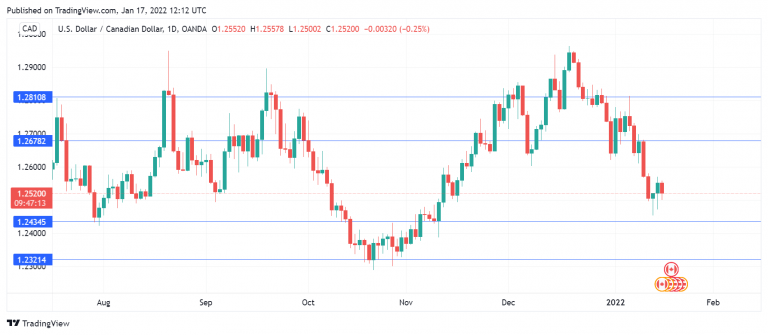
The Canadian dollar has started the week with gains and could break below the symbolic 1.25 level during the day. US markets are closed for Martin Luther King Day, so I expect a quiet North American session. Later in the day, Canada releases Manufacturing Sales and the BoC Business Outlook Survey.
Just four weeks ago, the US dollar was sizzling and USD/CAD was pressing close to the 1.30 level. The greenback has faltered since then, and USD/CAD dipped below the 1.25 line last week and seems poised to test this level again. Investors remain in a risk-on mood, which has buoyed the risk-sensitive Canadian dollar. The markets have shrugged off releases which could have dampened risk sentiment, such as weak US nonfarm payrolls and retail sales reports, CPI release of 7% and a more hawkish Federal Reserve. Risk appetite can quickly change directions, but in the meantime the mood is bullish, and that should translate into further gains for the Canadian dollar.
Markets yawn after US retail sales slide
Last week wrapped up with US Retail Sales for December and the numbers were dismal. The headline release came in at -2.3% and Core Retail Sales wasn’t much better, with a decline of -1.9%. The weak numbers supported the argument for delaying tightening, so the US dollar may have escaped a bullet as investor reaction was muted.
Why did the markets shrug off such a poor consumer spending report? One reason could be that due to chronic delivery bottlenecks, consumers opted to do their Christmas shopping in November, so the December numbers should not be construed as indicative of weaker consumer spending. The markets also ignored the UoM Consumer Sentiment index for December, which was weaker than expected. The headline print of 68.8 missed the estimate of 70 and was below the 70.6 recorded in December. Still, with inflation continuing to surge, the Fed will stay in a hawkish mood even with some weak consumer readings.
USD/CAD Technical
-
- USD/CAD is testing support at 1.2513. Below, there is support at 1.2396
- There is resistance at 1.2762 and 1.2879
EUR/USD Seems Under Pressure Below 1.1359: Elliott Wave Analysis
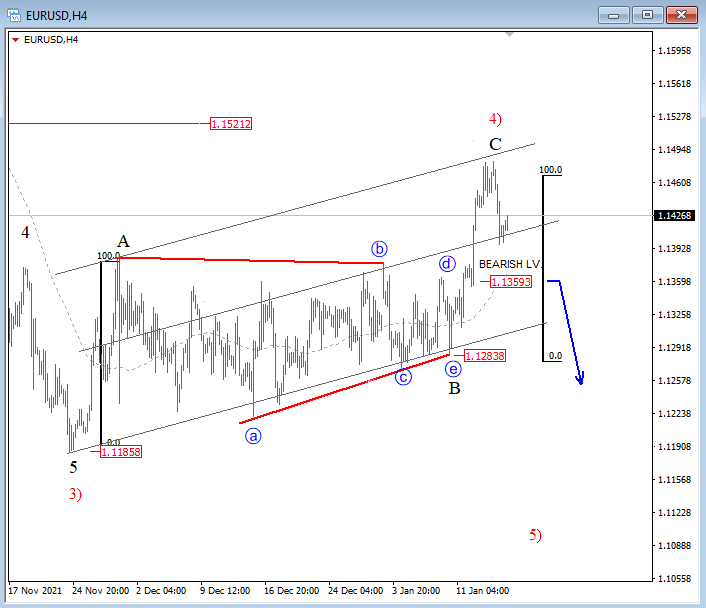
EURUSD came higher last week after US CPI figure. Pair moved to the upper side of a corrective channel line, to around 1.1490 where bulls slowed down, so it can be an interesting reversal coming this week, back to bearish mode, especially if 1.1359 is broken on a 4h chart. We think this breakdown would likely make a room for a fifth wave down.
EUR/USD 4h Elliott Wave analysis
China’s rate cut failed to lift HSI
China's rate cuts were not enough to lift investor sentiment in the region. PBoC lowered its one-year medium-term lending facility rate by 10bps to 2.85%. The seven-day reverse repurchase rate was also cut by 10bps to 2.1%. They're the first rate cut since April 2020.
Also, the PBoC injected more liquidity by offering 700 billion yuan of MLF loans, exceeding the 500 billion yuan maturing, and added 100 billion yuan with seven-day reverse repurchase agreements, more than the 10 billion yuan due.
Hong Kong HSI closed down -165 pts or -0.68% at 24218.03. Downside momentum has been diminishing since mid December. Yet there is no clear sign of bullish reversal. HSI is still inside medium term falling channel. Another fall remains in favor to extend the down trend from 31183.35 through 22665.25 low.
Gold Sluggish Below 1,830 But Bullish Pressures Still Alive
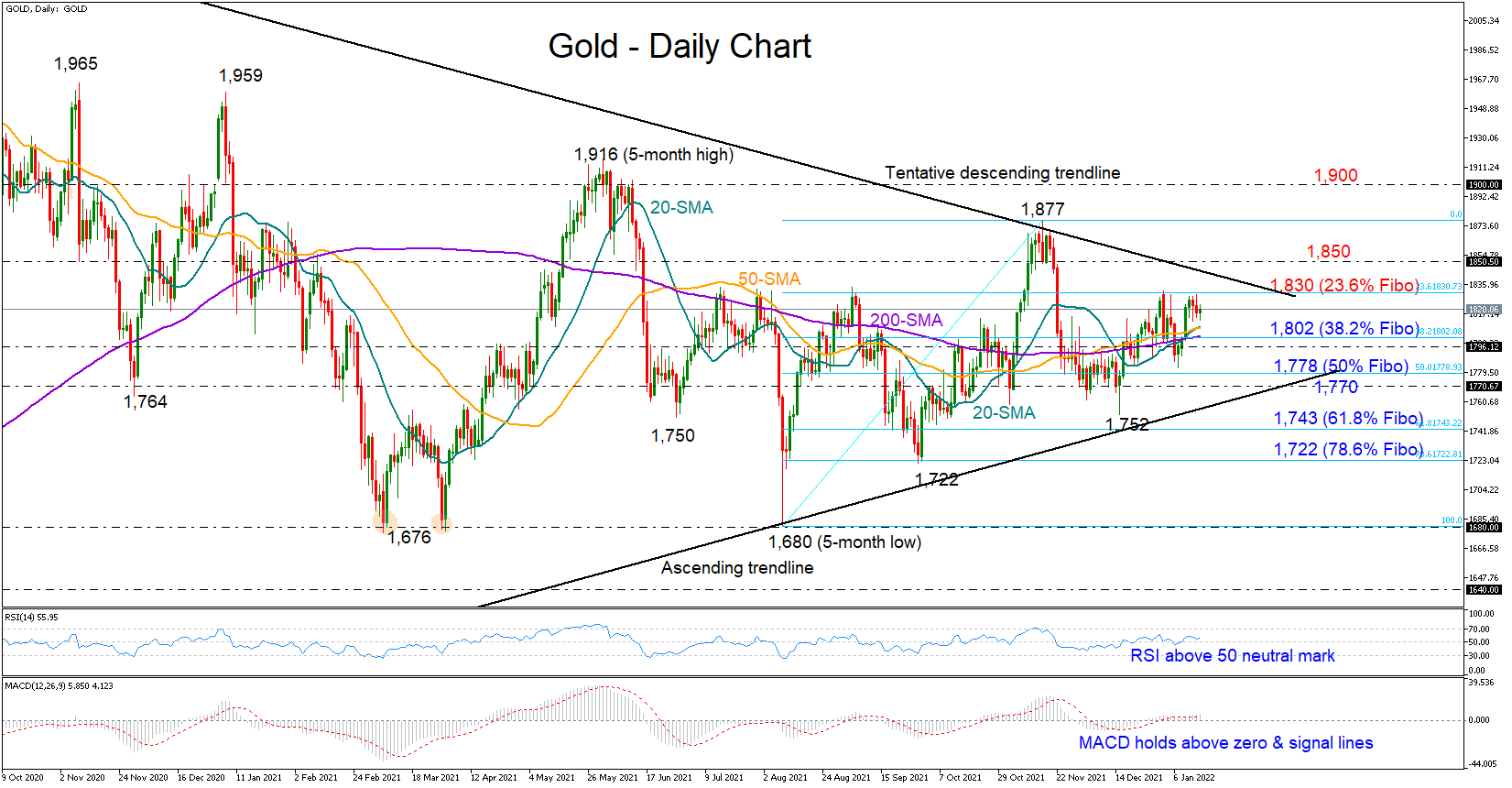
Gold has been trading at a sluggish pace below the tough 1,830 resistance zone for the past three weeks, but the latest upturn in the price could show more resilience according to the technical picture.
With the RSI fluctuating within the bullish territory and the MACD standing above its signal and zero lines, the bias is skewed more to the upside than to the downside. Also, the progressing bullish cross between the shorter and longer-term simple moving averages (SMAs) is raising hopes for trend improvement in the market. But a confirmation signal could only come above the 1,830 bar, where the tentative descending trendline drawn from the record top of 2,079 is currently intersecting the 23.6% Fibonacci retracement of the latest upleg (1,680 – 1,877).
A sustainable move above 1,830 could clear the way towards November’s high of 1,870, unless the 1,850 barrier cools buying pressures. Further up, all eyes would shift to the 1,900 – 1,916 region, a break of which is required to upgrade the neutral medium-term picture, and hence bring the 2021 top of 1,959 under the spotlight.
On the downside, a close below the 1,800 round-level could confirm another decline towards the 50% Fibonacci of 1,778 and the 1,770 support area. Note that an ascending trendline stretched from the 2020 lows is around this neighborhood. Hence, any significant violation here could sharpen selling interest, likely pressing the price immediately within the 1,743 -1,722 territory. Should the sell-off gain extra legs, the door would open for the five-month low of 1,680.
In brief, gold's short-term bias is still within the positive territory despite the soft pullback from 1,830 last week, suggesting that the bulls have not abandoned the game yet.
USDJPY Finds Foothold on 200-MA, But Bearish Risks Linger
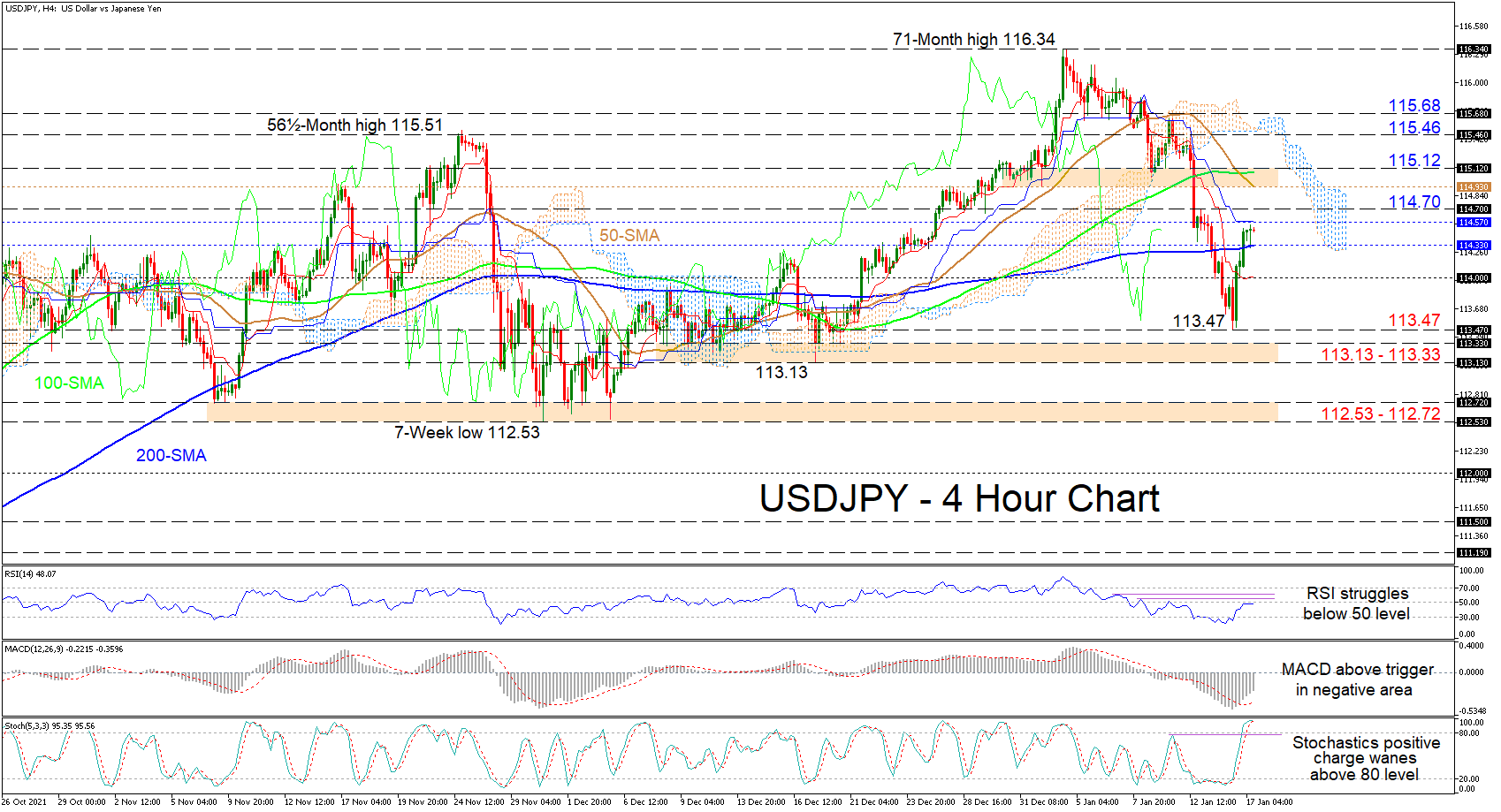
USDJPY buyers are trying to extend the bounce from the 113.47 level far beyond the recently conquered 200-period simple moving average (SMA) at 114.33. The longer-term SMAs are implying that the positive trend is feeble, while the fresh bearish crossover of the 100-period SMA by the 50-period one is endorsing the latest decline in the pair, from the near six-year high of 116.34.
The Ichimoku lines are indicating a pause in negative forces, while the short-term oscillators are demonstrating conflicting signals in directional momentum. The MACD, in the negative region, continues to climb above its red trigger line, showing that downside momentum is diminishing. However, the RSI is faltering beneath the 50 level, reflecting weakness in upside impetus, while the positively charged stochastic oscillator is hinting of waning in the bullish drive.
In the positive scenario, upside limitations could originate in the area between the blue Kijun-sen line at 114.57 and the nearby 114.70 obstacle. That said, if the bulls drive the price higher, they may then face a zone of resistance, which has taken shape from the 50-period SMA at 114.93 until the 115.12 barrier. Overcoming this boundary and the Ichimoku cloud, the pair could then seek out the 115.46 and 115.68 neighbouring highs.
Otherwise, if upside momentum fades around the blue Kijun-sen line at 114.57, initial support could emanate from the 200-period SMA at 114.33. If the pair slides back beneath the 200-period SMA, sellers may target the red Tenkan-sen line - residing around the 114.00 mark - before the price sinks toward the January 14 trough of 113.47. Slightly lower, the 113.13-113.33 support border could try to impede the bears from challenging the 112.53-112.72 foundation, which has defended the broader uptrend from the early parts of November 2021.
Summarizing, USDJPY is exhibiting a minor bullish tone slightly north of the 200-period SMA. Nonetheless, a negative tilt still grips the pair, while the price continues to trade beneath the 114.70 high and 114.93-115.12 resistance zone.
Crude Oil is Heading Towards Highs
On Monday, 17 January, the Brent price remains “in the black”; investors are clearly intending to update 7-year highs in the instrument. Brent is trading at $86.40 and may continue improving.
So, the oil is trading close to its 7-year highs and market players are focused on nothing but positive news. On one hand, the oil price is supported by the fact that investors are absolutely sure of the stable and strong demand for energies. Some OPEC+ members are really behind the previously approved oil extraction plans – this is another reason for buying oil right now. on the other hand, Libya is back to its normal pace of oil production after repairing the pipelines. In addition to that, the rumour has it that China will sell oil from its strategic resources closer to the Lunar New Year. This news is rather negative for the commodity market.
Last Friday’s report from Baker Hughes showed that the Oil Rig Count in the US added 11 units, up to 492. The same happened in Canada, with +43 units.
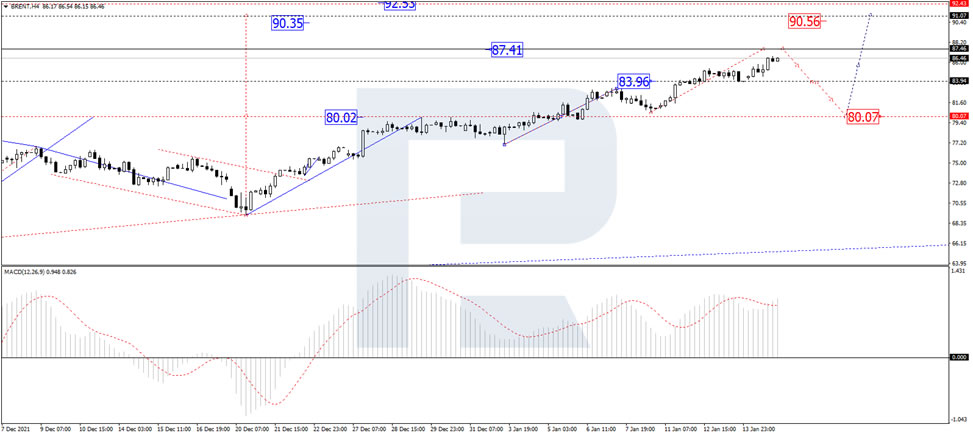
In the H4 chart, having completed the ascending structure at 83.96 and broken this level, Brent continues trading upwards. Today, the asset may reach 87.55 and then start a new correction towards 80.00. Later, the market may form another ascending structure with the target at 91.00. From the technical point of view, this scenario is confirmed by MACD Oscillator: its signal line is moving above 0 inside the histogram area, thus indicating a further uptrend in the price chart.
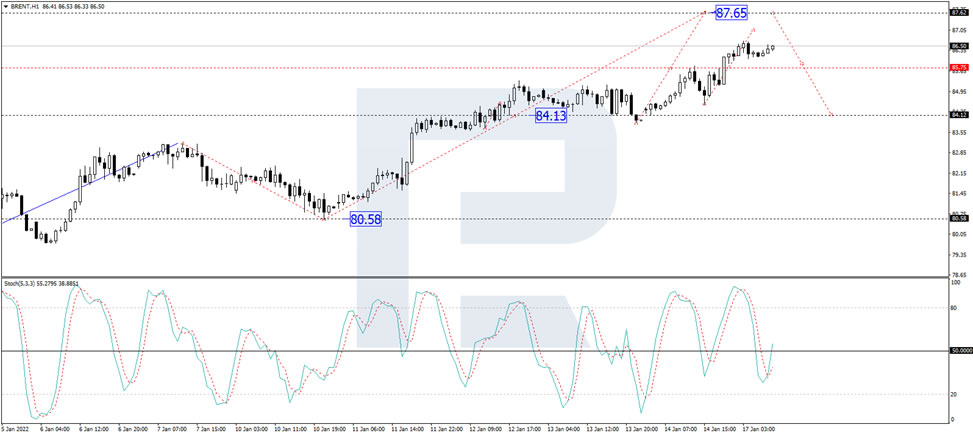
As we can see in the H1 chart, after forming a new consolidation range around 84.12 and breaking it to the upside, Brent continues growing with the short-term target at 87.65. After that, the instrument may correct to return to 84.12 and then resume growing with the target at 91.00. From the technical point of view, this idea is confirmed by the Stochastic Oscillator: its signal line is moving upwards to break 50 and may later continue growing to reach 80.
January Flashlight for the FOMC Blackout Period
Summary
- The FOMC's first meeting of the year is likely be a quieter affair than its December meeting, when the Committee accelerated its taper plans and outlined a more aggressive policy path for 2022. There will not be a fresh Summary of Economic Projections, and we expect the FOMC to reaffirm its current pace of tapering, leaving asset purchases on track to end in mid-March.
- Although we do not expect any policy changes, there will still be plenty to unpack. Since the FOMC's December meeting, inflation has gotten further offsides. December's CPI report showed prices rising 7.0% over the past year, the largest increase in nearly four decades. The labor market also continues to barrel toward "maximum employment", with the unemployment rate tumbling to 3.9%.
- With the FOMC growing increasingly concerned about inflation, we look for January's post-meeting statement to signal the fed funds rate could be lifted at its next meeting on March 15-16. Such a hint could come by indicating that the labor market is close to maximum employment, the remaining criteria the Committee has laid out for liftoff. We expect the statement and Chair Powell in his press conference to downplay the temporary slowdown in growth due to the most recent wave of the virus and highlight the overall strength of the labor market.
- Ahead of the blackout period, many FOMC members expressed that they would be comfortable with a raising rates in March. Markets are primed for a hike, pricing in a probability of roughly 90%.
- To stave off a March rate hike, we believe the FOMC would need to see an abrupt slowdown in inflation. Although hiring is likely to stumble in January under the weight of Omicron, the current wave of cases is likely to worsen the existing supply challenges for labor and goods. If inflation continues to surprise to the upside, a March increase will be all but assured. The optics of standing idle with consumer inflation still at 7% will be difficult.
- The January meeting will bring the usual rotation of voting members. On net, this year's voters lean more hawkish.
- A bigger re-shaping of the Committee this year, however, could come if the three empty Board seats are filled. While it is reasonable to assume the Biden administration's picks would lean dovish, the highest inflation in a generation may make everyone find their inner-hawk.
- Following a rate increase in March, we look for the FOMC to raise rates 25 bps per quarter through the third quarter of 2023, bringing the fed funds rate to 1.75-2.00%. We also look for the FOMC to announce a reduction in its balance sheet at its September meeting, with runoff beginning in October.
After a Fast Turn, How Quickly Can the Fed Get Policy Up to Speed?
The December FOMC meeting offered yet another illustration of conditions changing at light speed in the pandemic-era economy. After underplaying the risks around inflation for most of the year, the FOMC took a decidedly hawkish turn at its past meeting. The Committee doubled the pace of asset purchase tapering just six weeks after first announcing purchases would start winding down. In addition, it projected that increasing the fed funds rate by 75 bps would be appropriate in 2022 after being evenly split on whether liftoff would be warranted at all this year as recently as September (Figure 1). The pivot went down fairly smoothly with markets, with the accelerated timeline for policy tightening generally perceived as necessary to tackle inflation and avoid an even sharper adjustment later on.
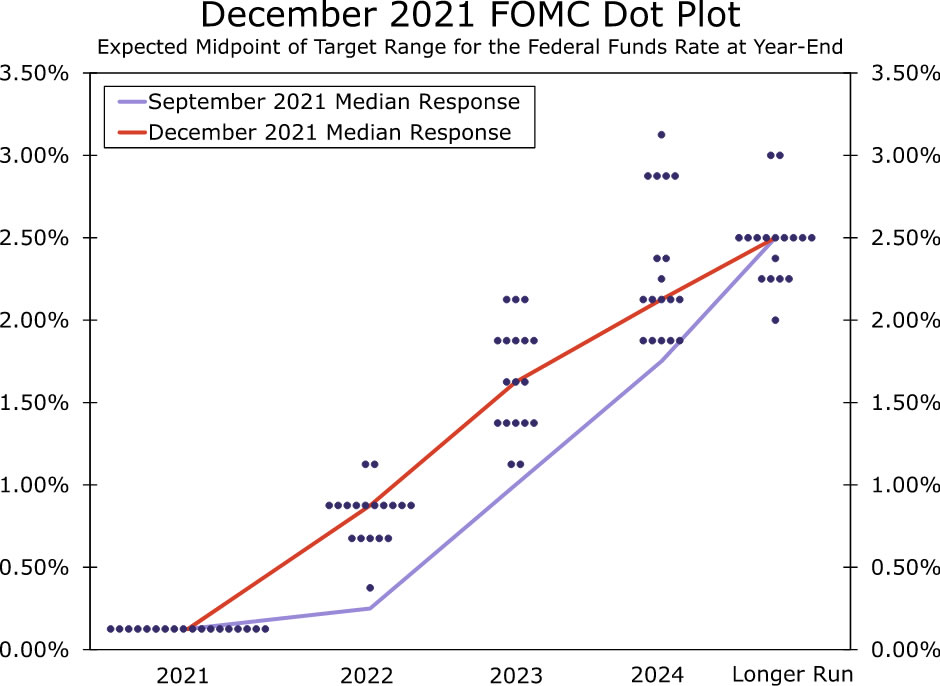
January's meeting should be more straightforward for Chair Powell, but no less important. The FOMC has made the initial turn onto the road of policy normalization, so now the question becomes its speed. Our expectations for the January meeting is that the FOMC will maintain its current pace of tapering, leaving asset purchases on track to conclude in mid-March, and that it will tee up the fed funds rate to increase as soon as its next meeting on March 15-16.
The Paradox of Omicron: Slower Growth, but Inflation Further Offsides and a Tighter Labor Market
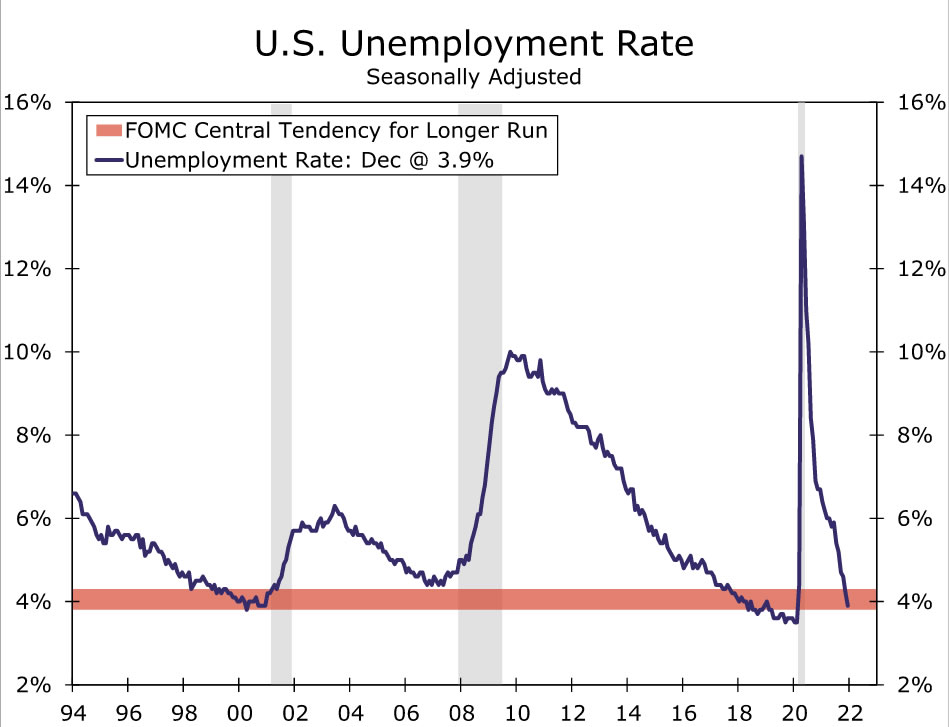
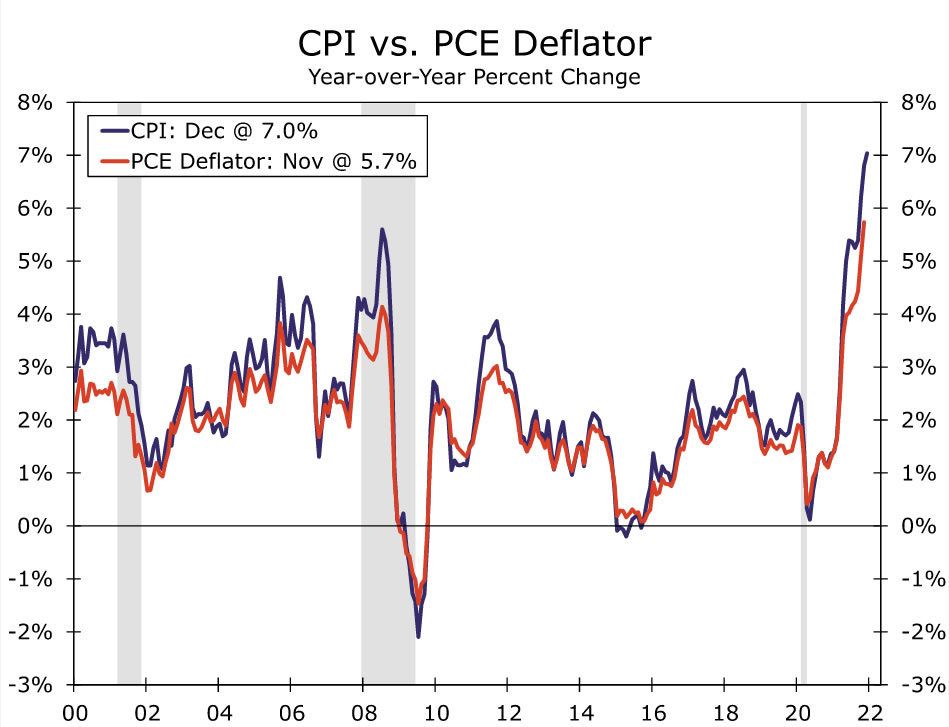
Since the FOMC's December meeting, COVID cases have once again surged and put GDP growth on weaker footing to start the year. But the Omicron wave also risks inflation getting even further away from the Fed's goal by exacerbating labor shortages that are already pushing up wages at a rapid clip, and by causing further disruptions to supply chains still struggling to meet exceptionally high demand for goods. December's data put the FOMC closer to conditions that would warrant tighter policy even before the full impact from Omicron was felt. Despite nonfarm payrolls falling short of expectations, the December employment report showed an ever-tightening labor market. The unemployment rate tumbled to 3.9%, while average hourly earnings surprised to the upside with a 0.6% increase (Figure 2). Inflation also continued to come in strong, with the CPI rising to a 39-year high of 7.0% and the monthly increase in both the headline and core indices coming slightly ahead of consensus expectations (Figure 3).
Gearing Up for March Liftoff
Some analysts have speculated that based on recent data and the FOMC's increased eagerness to address inflation the Committee will announce an immediate end to bond buying at its January meeting in order to facilitate liftoff at the March 15-16 meeting. Although we expect the FOMC's increased determination to rein in inflation will lead to a fed funds rate increase at the March meeting, we do not believe the Committee will make any changes to the pace at which it reduces asset purchases at the upcoming meeting. We expect the FOMC to reaffirm it will pare back purchases at a pace of $20 billion per month for Treasury securities and $10 billion per month for mortgage-backed securities (MBS). Accelerating the wrap-up of bond buying again at the January meeting would lead to purchases ending only one month earlier than at the current pace of tapering. It is not something that has been floated among Fed officials in recent comments and therefore would come as a surprise to markets. Moreover, we see no issue with the Fed raising rates the same month asset purchases end, considering the decision to stop purchases would have been communicated prior.
In the minutes to the December meeting, most members judged conditions to begin raising rates "could be met relatively soon." Since the release of the minutes, a number of FOMC members have indicated they would be open to raising rates as early as March. The list includes more hawkish members like Loretta Mester, Raphael Bostic and James Bullard, but also more neutral members like Thomas Barkin, Patrick Harker and even the dovish Mary Daly. Markets are more or less giving the FOMC the green light to raise rates at the March meeting by currently pricing in a probability of roughly 90% for a 25 bp hike.
Statement Changes Likely to Foreshadow March Rate Increase
There will not be an update to the Summary of Economic Projections at this meeting, so any hints that liftoff is likely to come as early as the March meeting will come down to the statement and Chair Powell's post-meeting press conference. The statement is likely to address the slowdown in activity amid rising COVID cases, but emphasize the overall strength of the labor market. The December meeting confirmed that the inflation criteria for increasing the fed funds rate—inflation at 2% and on track to stay or moderately exceed 2%—had been met, and that the Committee expected to maintain the current fed funds rate "until labor market conditions reached levels consistent with the Committee's assessments of maximum employment."
With the unemployment rate having since fallen to 3.9% and other indicators such as wage growth, quits and layoffs pointing to an even tighter jobs market, we would not be surprised if this line is scrapped. In its place, the Committee could say something similar to October 2015 when it last foreshadowed an increase in the fed funds rate from the zero lower bound was imminent, such as "In determining whether it will be appropriate to raise the target range at its next meeting, the Committee will assess labor market conditions in light of its maximum employment objective and the deviation in inflation from its price stability goal."
What Could Give the Fed Pause Between Now and March?
While FOMC members are clearly leaning toward an earlier removal of policy accommodation than was sketched out only a few months ago, conditions continue to change quickly and the outlook continues to be clouded by an unusual degree of uncertainty in this environment. Therefore, an increase in the fed funds rate in March is not a forgone conclusion, even if policymakers appear to be leaning heavily that way. The FOMC will receive two more months of data for both the labor market and inflation, which may swing the FOMC's decision to either take off in March, or take a breath.
With hawkish momentum firmly underway, we expect it would take a sharp slowdown in inflation over the next two months for the FOMC to feel it could wait slightly longer to start hiking rates without putting its price stability goal in further jeopardy. At the very least, we believe the CPI through February would need to fall back below 7%, which would entail monthly gains slowing sharply to around 15 bps (PCE data will only be available through January by the March meeting). Signs of easing would also likely need to be widespread, and not due to areas such as energy or travel services where prices could easily pick up again when COVID cases subside. Data suggesting more slack in the labor market, such as a faster pickup in labor force participation, a stalling of the unemployment rate and slowdown in wage growth, would also likely need to emerge in conjunction with an abrupt softening in inflation.
Further upside surprises to inflation would likely make a March rate hike essentially a done deal. Our own forecast is for the CPI to tick up to 7.1% in January and remain at that rate in February. The optics of standing pat at the March meeting will be tough enough if the CPI still has a 7-handle, but further upside to surprises to inflation before then could make the FOMC feel like it has no choice but to start lifting interest rates. Both Powell and incoming Vice Chair Lael Brainard made clear at their confirmation hearings last week that tackling current inflation is not only imperative to their price stability goal but also to achieving maximum employment.
Everyone Is a Hawk When Inflation is 7%
The first FOMC meeting of the year brings with it the usual rotation of regional Fed presidents voting on the Committee and speculation about how that might tip the FOMC's policy decisions. The regional Fed presidents voting this year on net lean more hawkish, in our view. Whereas in 2021 we considered one voting regional president to be a "hawk" and one a "dove", this year we would classify the rotating voters as three hawks and one centrist (Figure 4). That said, with all regional presidents having a seat at the table and influencing discussions, it is hard to see the rotation of voters tipping the balance of any single policy decision. In other words, as in years past, we do not see the rotation of voters being a difference-maker in the path of policy this year.
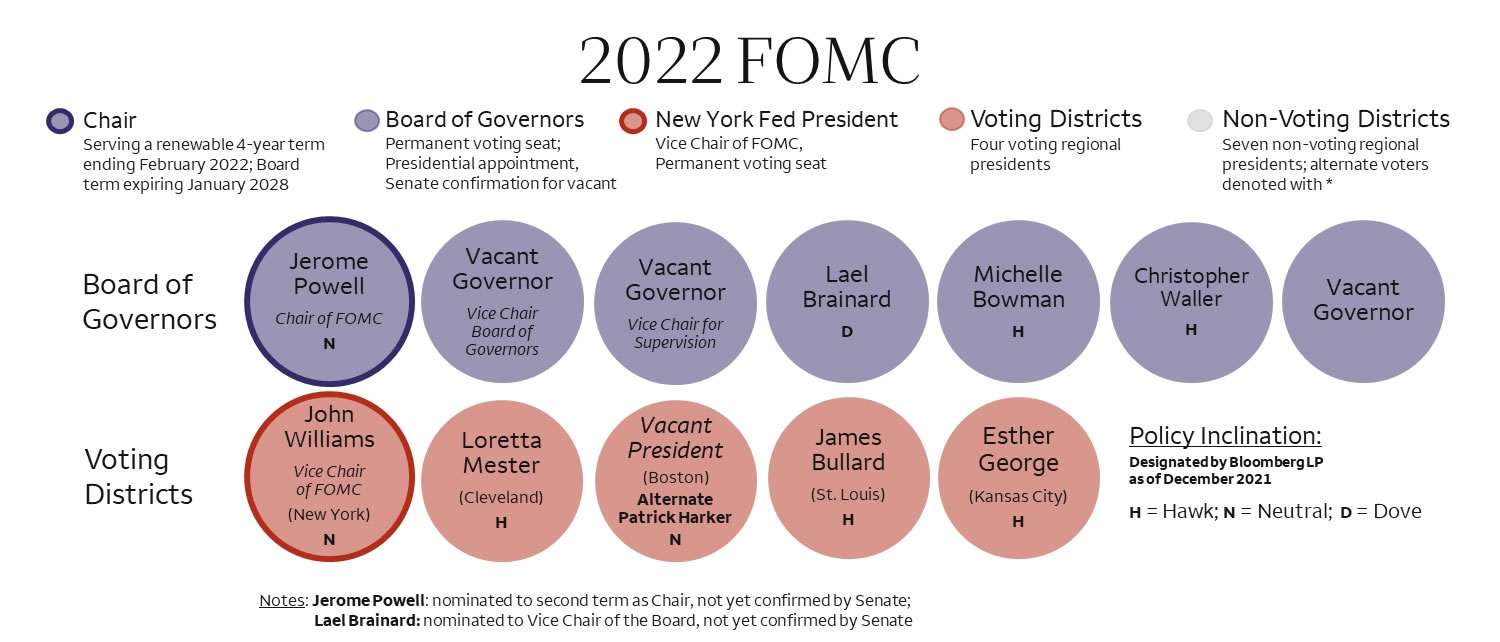
Source: Bloomberg Finance L.P. and Wells Fargo Economics
The nominations for three open Board seats could have a more impactful change on the Committee's thinking. The White House has nominated Sarah Bloom Raskin for the Vice Chair of Supervision role. She served on the Board from 2010 to 2014, and her speeches as a Governor tended to focus on regulatory issues. During that time she never dissented, signaling she is not likely to stray from the center of the Committee on monetary policy.
It is reasonable to expect that other picks for the Board would lean dovish given the administration's emphasis on diversity and inequality and the Fed's own emphasis on employment as a "broad an inclusive" goal. Economists Lisa Cook and Philip Jefferson have received nominations for the two other Board positions. Cook's research has focused on inequality, and Jefferson's has focused on labor markets and poverty, including the benefits of running a "high pressure" economy to support the labor market.
But the benefits of maintaining accommodative monetary policy are harder to justify when inflation is running more than double the Fed's target and the labor market is by nearly all measures tight. The labor market and inflation dynamics are much different in this expansion compared with the 2010s. We expect the highest inflation in a generation to make hawks of all Committee members this year.
Following an increase in March, we anticipate the FOMC will raise the fed funds rate 25 bps per quarter through Q3-2023, bringing the target range to 1.75-2.00%. We also look for the FOMC to announce a reduction in its balance sheet at its September meeting this year, with runoff beginning the following month.
Fed Bets Boost dollar, China Cuts Rates
- Dollar stabilizes as markets price in faster Fed rate hikes
- In contrast, China cuts interest rates to power up growth
- US markets will stay closed today, focus turns to BoJ meeting
Dollar unscathed by retail sales miss
Markets are growing increasingly confident that the Fed will raise interest rates four times this year to bring inflation under control. Even though the latest edition of US retail sales on Friday disappointed in a massive way, taking an axe to GDP growth estimates for the last quarter, that wasn’t enough to sink the dollar.
The silver lining was that consumption has been booming for so long that some reversion back to the pre-pandemic trend is only natural, especially when holiday spending might have skewed the picture. Instead, the dollar recovered, empowered by rising Treasury yields as traders placed more emphasis on some remarks by Fed officials that Omicron will be inflationary and that rate hikes are imminent.
A spike in survey-based measures of inflation expectations likely added fuel to the moves, along with the CEO of JPMorgan Chase, who warned during the bank’s quarterly earnings call that there could be six or seven Fed rate hikes this year.
This seems like a stretch since the Fed doesn’t want to shock financial markets swimming in leverage, but it underscores that there’s still some room for market pricing to grow more hawkish, fueling the next leg of dollar strength. After all, the US labor market has arguably crossed the full employment rubicon already.
China cuts rates, markets yawn
In contrast, China has embarked on an easing cycle. The People’s Bank of China cut its key policy rate by 10 basis points today to juice up economic growth, which has taken a sharp hit thanks to the property crisis and draconian lockdown measures in some regions.
But the market impact was negligible, with only local stock markets reacting positively. The Australian dollar didn’t even notice, despite its status as a liquid proxy for China plays given the close trading relationship between the two nations. Perhaps that’s a signal that the rate cut wasn’t big enough to move the needle for growth.
Beyond growth risks, another crucial question is whether the recent lockdown measures across China will deal another blow to distressed supply chains, keeping global inflationary pressures elevated for longer.
Yen softens ahead of BoJ meeting
The next big event for markets will be the Bank of Japan’s policy decision early on Tuesday. No policy changes are expected, although the Bank could strike a slightly more optimistic tone, drawing confidence from improving economic data and the enormous spending package the government is about to unleash.
But don’t expect the BoJ to signal rate hikes are coming anytime soon. Consumption remains weak, wage growth is anemic, and Omicron is sweeping through the country. The inflation rate speaks for itself. It is barely positive despite the mayhem in supply chains and soaring energy prices, so there is no ‘organic’ inflation.
With the BoJ likely to be the last major central bank to raise interest rates this cycle, the outlook for the yen remains negative from a relative monetary policy perspective. That said, any losses might be smaller than last year if volatility episodes in the markets become more frequent, allowing defensive assets like the yen to enjoy brief periods of strength.
As for today, US markets will remain closed for the Martin Luther King holiday. This means that liquidity will be thinner than usual, so any news could have an outsized impact.