

Sample Category Title
EUR/CHF Daily Outlook
Daily Pivots: (S1) 1.0383; (P) 1.0398; (R1) 1.0424; More....
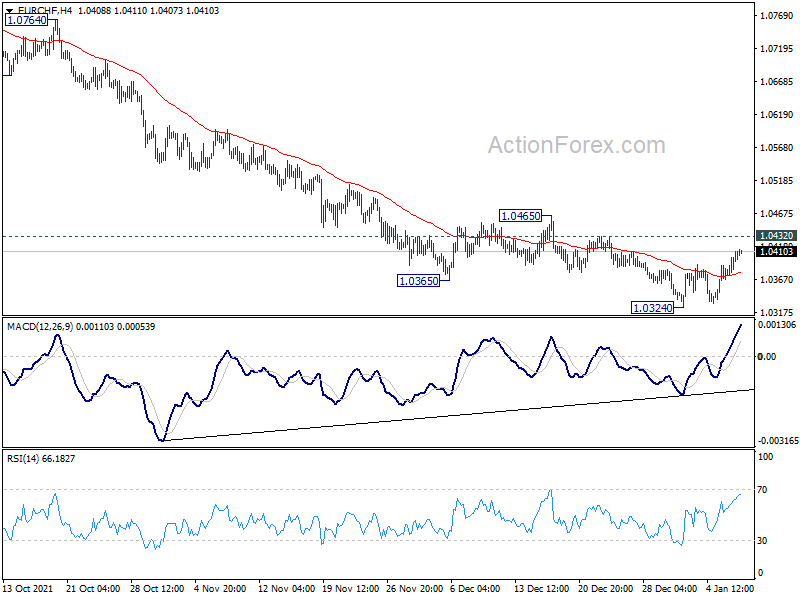
Intraday bias in EUR/CHF remains neutral for the moment. Outlook stays bearish as long as 1.0432 resistance holds. Break of 1.0324 will resume larger down trend from 1.1149 to 161.8% projection of 1.1149 to 1.0694 from 1.0936 at 1.0200 next. On the upside, however, break of 1.0432 minor resistance will indicate short term bottoming, and turn bias back to the upside for 1.0465 resistance and above.
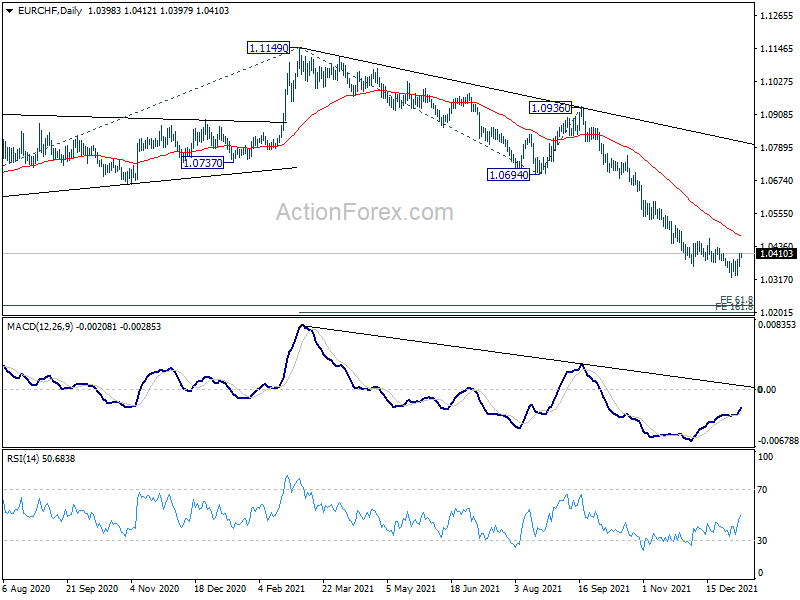
In the bigger picture, long term down trend from 1.2004 (2018 high) is now extending. Next target is 61.8% projection of 1.2004 to 1.0505 to 1.1149 at 1.0223. On the upside, break of 1.0505 support turned resistance is needed to be the first sign of medium term bottoming. Otherwise, outlook will remain bearish even in case of rebound.
USD/CAD Daily Outlook
Daily Pivots: (S1) 1.2685; (P) 1.2749; (R1) 1.2792; More...
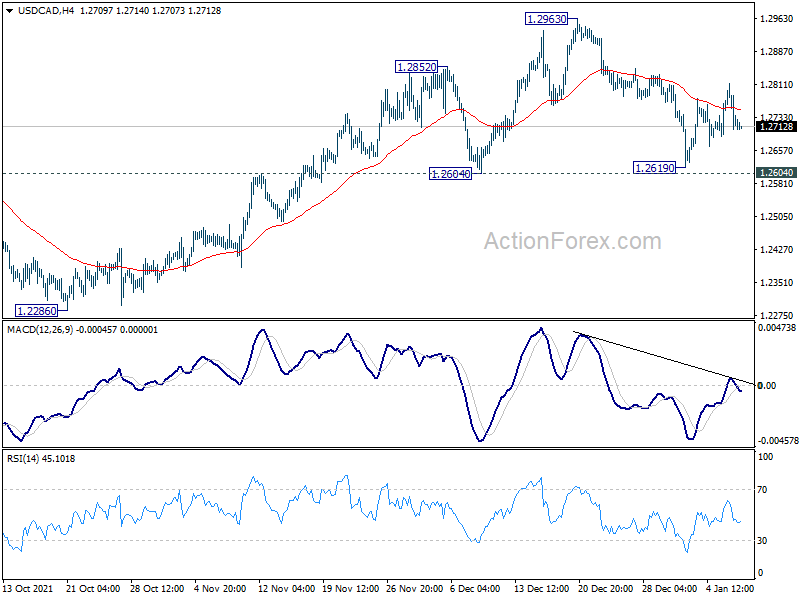
Intraday bias in USD/CAD remains neutral and outlook is unchanged. As long as 1.2604 support holds, we'd still slightly favor another rally. Break of 1.2963 will target 1.3022 key medium term fibonacci level. Sustained break of 1.3022 will carry larger bullish implications. However, firm break of 1.2604 will bring deeper fall back to 1.2286 support instead.
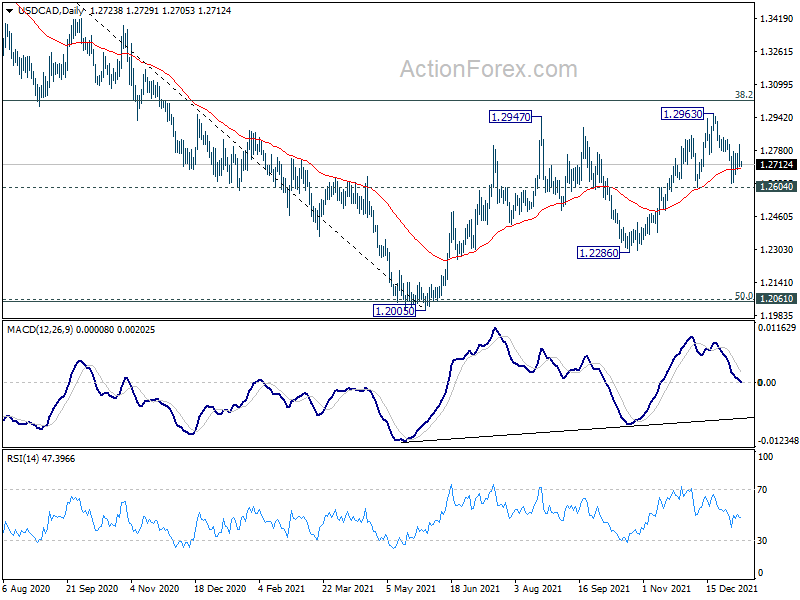
In the bigger picture, focus will be on 38.2% retracement of 1.4667 (2020 high) to 1.2005 (2021 low) at 1.3022. Sustained break there should confirm that the down trend from 1.4667 has completed after defending 1.2061 long term cluster support. Further rise would then be seen towards 61.8% retracement at 1.3650. On the downside, however, break of 1.2286 will turn focus back to 1.2005 low again.
AUD/USD Daily Report
Daily Pivots: (S1) 0.7132; (P) 0.7177; (R1) 0.7209; More...
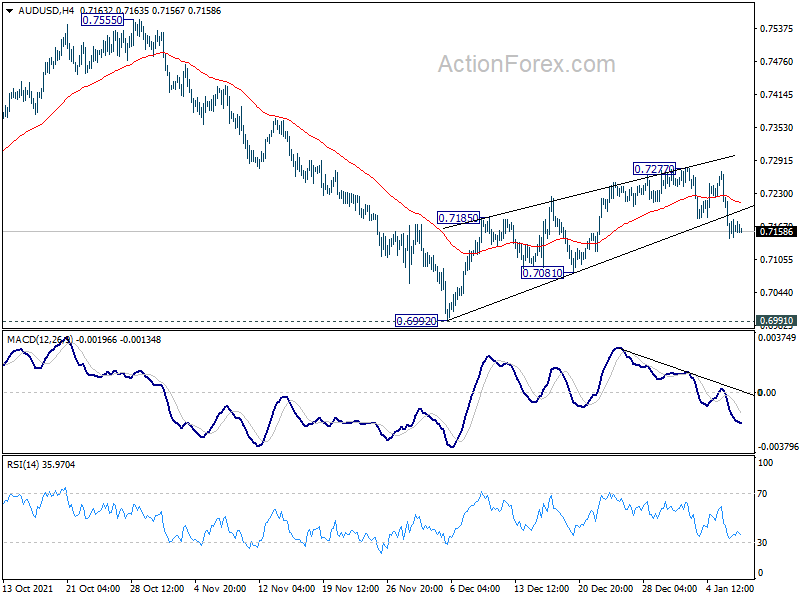
Intraday bias in AUD/USD remains neutral for the moment. On the downside, break of 0.7081 support will indicate that corrective rebound from 0.6992 has completed with three waves up to 0.7277, after hitting 55 day EMA. Intraday bias will be back on the downside for retesting 0.6991/2 support zone. Firm break there will resume larger down trend from 0.8006. On the upside, though, break of 0.7277 will turn bias to the upside to resume the rebound.
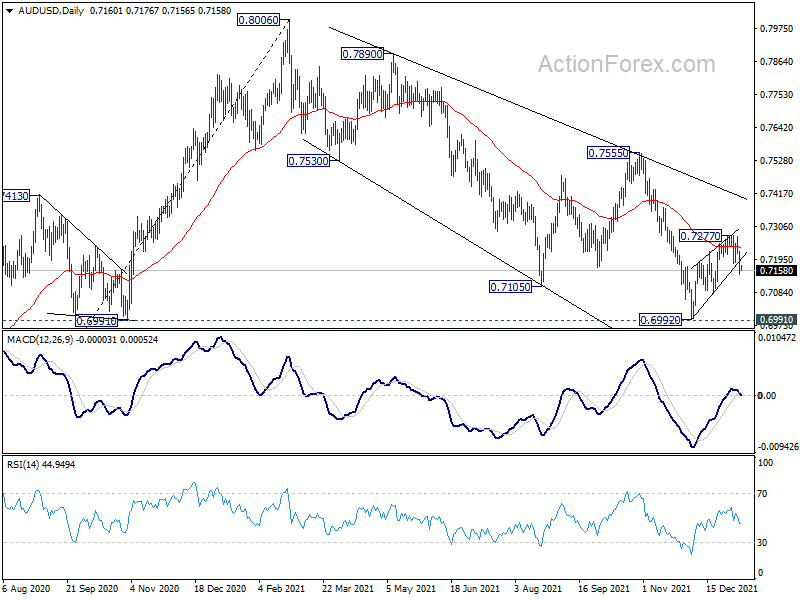
In the bigger picture, strong rebound from 0.6991 key structural support will retain medium term bullishness. That is, whole up trend from 0.5506 is still in progress. Firm break of 0.7555 resistance will target 0.8006 high and above. However, sustained break of 0.6991 will argue that the whole up trend from 0.5506 might be finished at 0.8006, after rejection by 0.8135 long term resistance. Deeper decline would then be seen back to 61.8% retracement of 0.5506 to 0.8006 at 0.6461.
USD/JPY Daily Outlook
Daily Pivots: (S1) 115.60; (P) 115.89; (R1) 116.16; More...
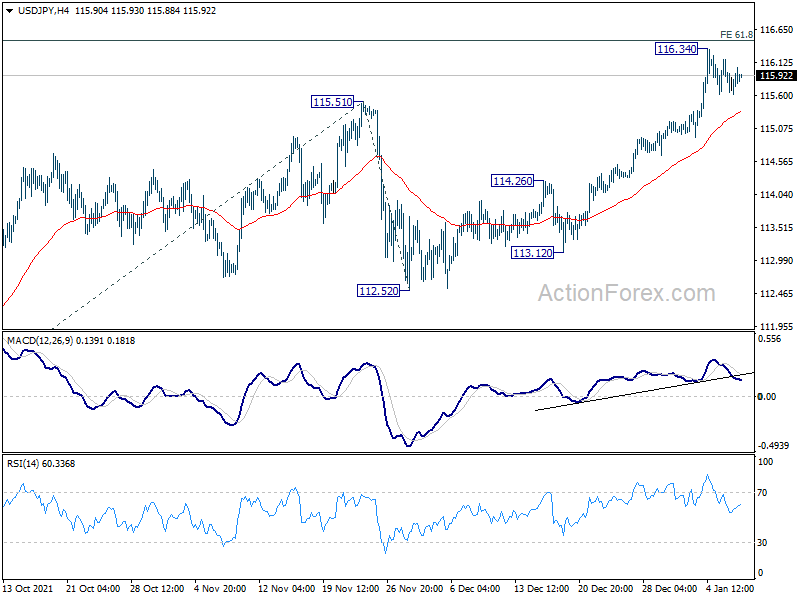
Intraday bias in USD/JPY remains neutral for consolidation below 116.34 temporary top. Downside of retreat should be contained well above 114.26 support turned resistance to bring another rally. On the upside, sustained break of 61.8% projection of 109.11 to 115.51 from 112.52 at 116.47 will pave the way to 100% projection at 118.90, which is close to 118.65 long term resistance.
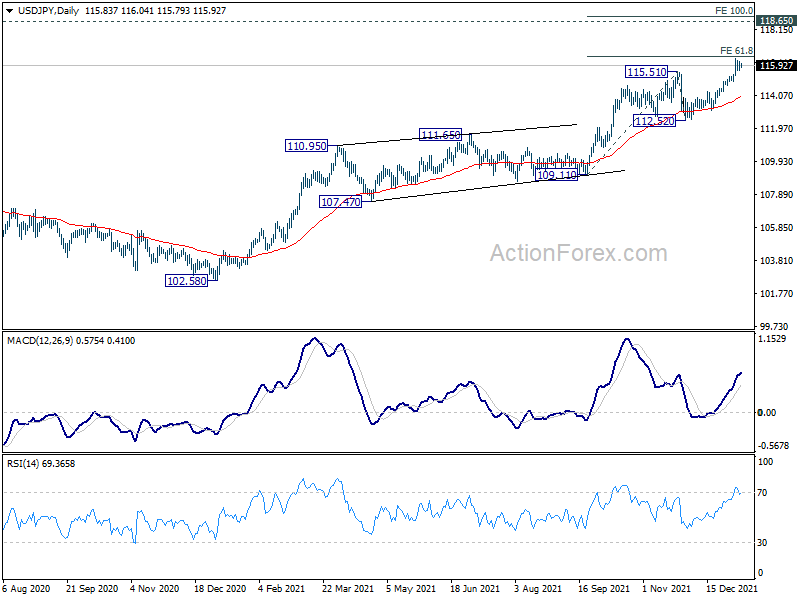
In the bigger picture, no change in the view that rise from 102.58 is the third leg of the up trend from 101.18 (2020 low). Such rally should target a test on 118.65 (2016 high). Sustained break there will pave the way to 120.85 (2015 high) and raise the chance of long term up trend resumption. For now, this will remain the favored case as long as 112.52 support holds, in case of deep pull back.
USD/CHF Daily Outlook
Daily Pivots: (S1) 0.9179; (P) 0.9202; (R1) 0.9235; More....
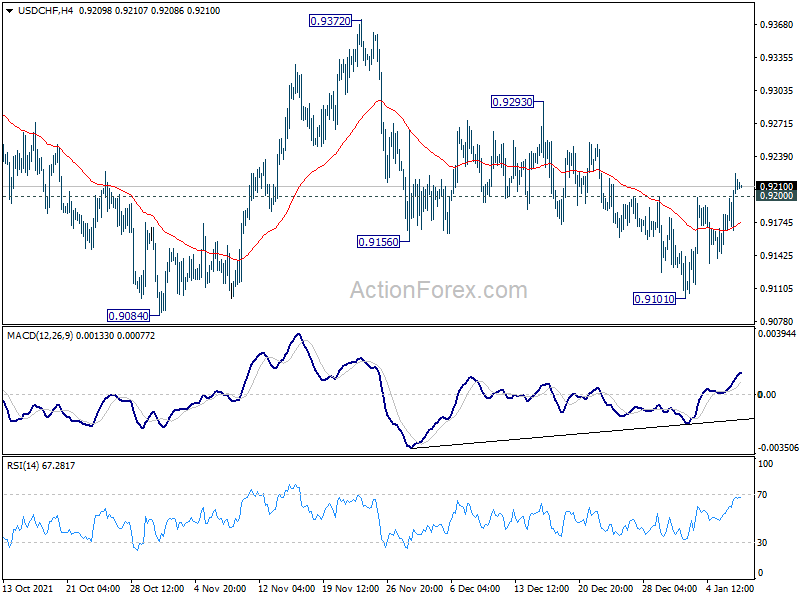
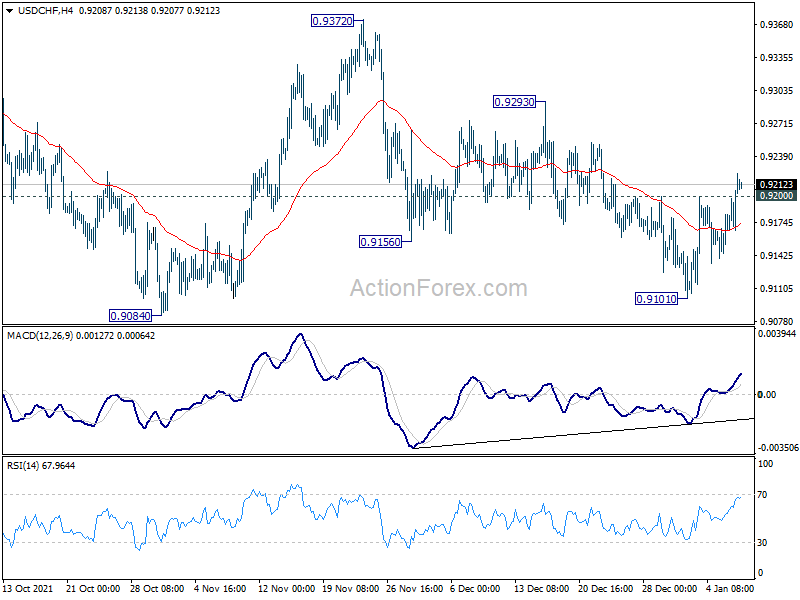
USD/CHF's break of 0.9200 resistance suggests that fall from 0.9372 has completed with three waves down to 0.9101. Intraday bias is back on the upside for 0.9293 resistance first. Break will likely resume the choppy rise from 0.8925 through 0.9372 resistance. On the downside, break of 0.9101 will resume the fall from 0.9372 instead.
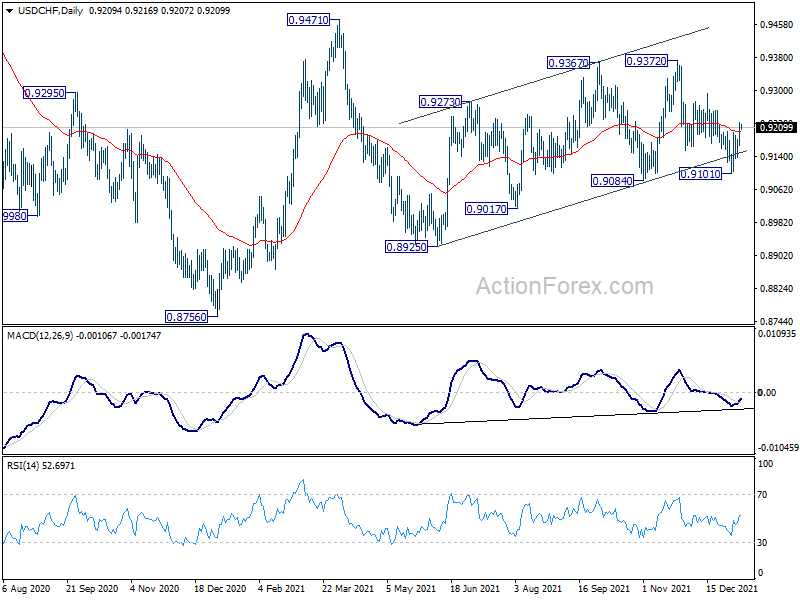
In the bigger picture, the corrective structure of the rebound from 0.8925 argues that fall from 0.9471 is not complete yet. It could either be the second leg of pattern from 0.8756 (2021 low), or resuming larger down trend from 1.0237 (2018 high). We'd pay attention to the downside momentum and assess the odds later. But for now, medium term outlook will be neutral at best as long as 0.9471 resistance holds.
GBP/USD Daily Outlook
Daily Pivots: (S1) 1.3498; (P) 1.3528; (R1) 1.3567; More...
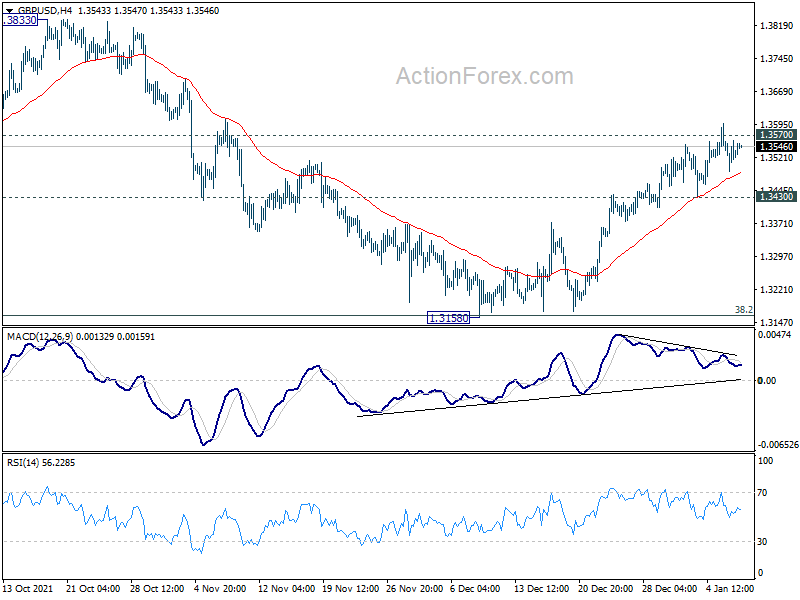
Intraday bias in GBP/USD remains neutral and outlook is unchanged. Further rally is still expected as long as 1.3430 support holds. We're seeing corrective fall from 1.4248 as complete with three waves down to 1.3158, after hitting 1.3164 medium term fibonacci level. . Sustained break of 1.3570 resistance will further affirm this bullish case and target 1.3833 resistance next. However, break of 1.3375 will turn bias back to the downside for 1.3158 low again.
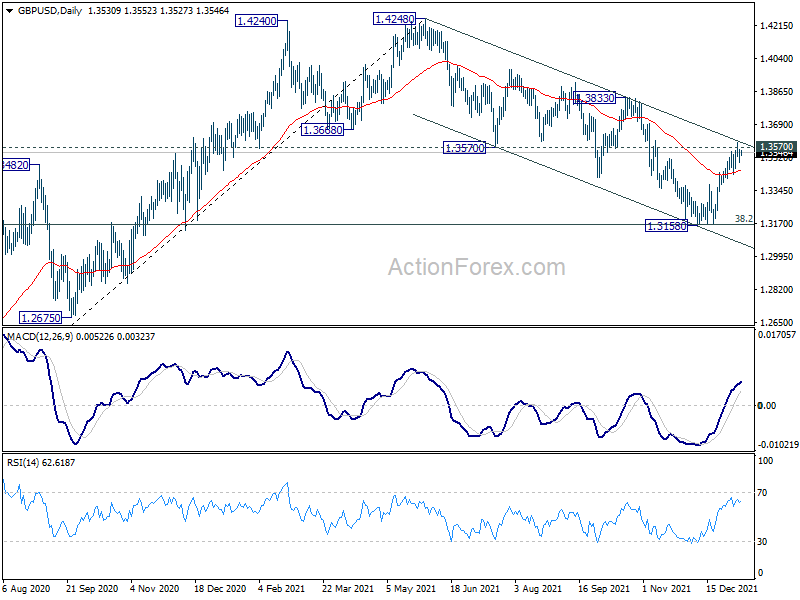
In the bigger picture, focus remains on 38.2% retracement of 1.1409 to 1.4248 at 1.3164. Sustained break there will argue that whole rise from 1.1409 has completed at 1.4248, after rejection by 1.4376 long term resistance. That will revive some medium term bearishness and and target 61.8% retracement at 1.2493. However, strong rebound from current level will revive argue that up trend from 1.1409 is still in progress, and probably ready to resume.
Buying the Dip
Lots of noise, but little substance probably describes the last 24 hours in global markets. US equities moved sideways overnight, the US Dollar was steady versus major currencies, US yields edged a little higher, while oil, a consistent outperformer, received a Libyan and Kazakhstan boost.
The US data dump overnight held no real surprises. ISM Non-Manufacturing PMI fell, as did Non-Manufacturing New Orders, Employment, Activity and Prices indexes. Like the soggy UK and European PMIs earlier, all of this can be laid at the door of omicron’s arrival. Notably, US Factory Order and Weekly Jobless Claims held steady, hinting that despite the omicron hit to services, underlying strength continues in the economy.
None of the data was enough to materially move the needle, especially when we have US Non-Farm Payrolls this evening. With a median forecast of around 400,000 jobs, we are likely to need a number lower than 250k, or higher than 550k, to drive a Fed risk-on, or risk-off, move to finish the week.
US equity index futures have put in a strong performance this morning, and it appears that the lack of new news is finally flushing out the buy-the-dip gnomes. That has been reflected by higher equity markets in Asia as well, especially those of Japan and Australia, which track Wall Street like a wide-eyed pu8ppy these days. Buying the dip has been a wonderful strategy over the past 21 months and I’m not about to diss it now. Central banks are still qualitatively easing, and the cost of capital from them is still far too close to zero, and with omicron a minor storm in a test-tube in the markets’ minds, the recovery could easily extend into the end of the week and potentially for much of January.
Japan’s Household Spending and Tokyo CPI also showed signs of an omicron discount today. That hasn’t impacted Tokyo markets or the Yen though. Notably, Japan, Australia (on a state basis), and the Philippines are all looking at bringing back virus restrictions to a greater or lesser degree. China also imposed testing restrictions on those trying to leave Shenzhen, which is adjacent to Hong Kong. Indonesia has tightened border measures to 10 days quarantine to keep the bug out, while Jakarta has raised alert levels. All this points to an Asian market that is nervously waiting for omicron and explains their reluctance to buy fully into the post-omicron rally sweeping US markets these last few weeks.
Next week’s data calendar in Asia is fairly thin still. China and India release inflation data with India being of more interest, given its risks to the upside. The Bank of Korea announces its next policy rate decision. I am expecting rates to remain on hold at 1.0% with an upside bias. That allows them to keep an eye on omicron and the economy while signalling their overall hawkish bias. Signalling a hawkish bias is important as USD/KRW has risen above 1200.00, a previous BoK redline. We are likely to see more stories like this in Asian currencies this year as the Federal Reserve gets busy with monetary policy normalisation.
Asian equities rise with US futures
Equities traded sideways overnight as US data balanced itself out and with bulls nervously on the sidelines after the rout of the past few days, and ahead of tonight’s US Non-Farm Payrolls. However, the buy-the-dip couldn’t contain its addiction anymore, especially with the news tickers remaining quiet. Overnight, the S&P 500 and Nasdaq finished just 0.10% lower, with the Dow Jones easing by 0.47%. Asia has seen futures on all three rise strongly initially, before easing back slightly. Nasdaq futures are 0.55% higher, with S&P 500 0.25% higher, and the Dow futures 0.15% higher.
The futures rally sparked an initial flurry higher in Japan Australia and South Korea, before retreating slightly. Asian markets are mostly higher to finish the week though, thanks to playing follow the leader(Wall Street). The Nikkei 225 is now in negative territory, down 0.40%, after the Japanese Finance Minister commented that FX stability is important. Markets are interpreting the comments as implying the government is displeased with the pace of the Yen fall. South Korea’s Kospi, meanwhile, is 0.70% higher.
In China, markets are trading positively with a story circulating from REDD that policymakers will exclude debt accrued by property developers from buying up distressed assets from weaker developers, from their overall debt compliance ratios. That’s a mouthful but basically, it looks like State-Owned Enterprise (SOE) developers are going to get a juicy carrot in return for taking on the assets of weaker private developers. The Shanghai Composite and CSI 300 are 0.35% higher, while Hong Kong, home to the troubled listings of many developers, is up by 1.20%.
Across the region, Singapore and Jakarta have rallied by 0.60%, with Kuala Lumpur and Bangkok rising by 0.25%. Taipei and Manila are bucking the trend, down 1.0% and 1.20% respectively. Semiconductors are leading Taipei lower for some reason while soaring omicron positivity rates are weighing on Manila. Australian markets are in a buoyant mood, with the US futures rally greenlighting the buy-the-dip gnomes of Sydney to rush out of hiding. The ASX 200 and All Ordinaries have leapt an impressive 1.40% today.
I did mention yesterday that the bearish sentiment might only last until the New York session. I was off by about eight hours, but with a thin calendar ahead, European markets should open higher today as will New York. Only a very high Non-Farm Payroll print will spoil what should be a positive finish to the week tonight.
The US Dollar holds steady
The US Dollar contented itself with range-trading once again overnight, the index closing almost unchanged once again at 96.24, before slipping to 96.22 in a moribund Asian session. EUR/USD is steady at 1.1300, GBP/USD 1.3545, and USD/JPY at 115.85 in Asia today, barely changed from the New York close and with USD/JPY ignoring “watching FX closely” noise from the Japanese Ministry of Finance. Slightly firmer yields continue to limit the US Dollar downside versus the major currencies, which appear to be in a holding pattern into the Non-Farm Payrolls. I await a dollar index break of either 95.50 or 96.50 for the next directional signal.
The AUD/USD and NZD/USD risk sentiment indicators both remained under pressure overnight, hinting that despite the calm seen elsewhere, nerves abound about the Fed tightening story and higher US yields. AUD/USD and NZD/USD finished around 0.805 lower at 0.7160 and 0.6750 where they remain in Asia. The risk is still skewed to the downside. USD/CAD bucked the trend overnight, CAD strengthening as USD/CAD fell to 1.2715, most likely dues to the 2.0%+ rally in oil overnight. It remains to be seen whether a sell-off under 1.2700 can be sustained.
Asian currencies are quiet today, edging slightly higher, but overnight weakened through some significant levels versus the US Dollar. USD/KRW has climbed through 1200.00 to 1202.00. USD/PHP has risen 51.20 and USD/IDR to 14,400.00 approaching 14.500.00. USD/MYR ignored the rise in oil, climbing to 4.2100 before retreating to 4.2000. The Thai Baht also joined them, weakening by over 1.0% as USD/THB trades at 33.578 today. The Yuan and Indian Rupee continue to outperform. For the rest, it will be interesting to see if their respective central banks step out of the shadows and start offering US Dollars again. Their hands will be stayed ahead of the US Data tonight, but next week could be a different story. Slowly but surely, the normalisation story by the Fed is seeping into weaker Asian FX, leaving regional central banks with a policy dilemma.
Oil rallies impressively
As mentioned yesterday, oil’s price action is bullish, as it shrugged off a series of seemingly bearish news inputs over the last 48 hours. That news swung the other way overnight, with domestic protests disrupting local production, and with the arrival of Russian paratroopers to restore order. Libya is also struggling to maintain production due to maintenance issues.
That saw oil prices soar overnight, with Brent crude climbing 2.40% to $82.00 a barrel, and WTI rocketing 3.20% higher to $79.65 a barrel. Additionally, the backwardation of the oil futures curve has started widening once again, implying that prompt demand is robust. In Asia, the rally has continued, driven by Kazakhstan nerves (1.6 million bpd), Brent crude climbing 0.60% to $82.50, and WTI rising 0.50% to $80.00 a barrel.
Brent crude has support at $79.60 and the 100-day moving average (DMA) at $78.00 a barrel. It has resistance nearby at $83.00 a barrel and could retest $86.00 next week. WTI has support at $78.50 and $77.50 a barrel. Having captured $80.00, a weekly close above here this evening signals more gains targeting $82.00 and potentially $85.00 a barrel.
Gold continues to fade
With US yields and the US Dollar holding their gains but trading sideways, gold gave way overnight, slumping 1.07% to $1790.85 an ounce as the bulls, once again, threw in the towel. Given the price action overnight, it appears that gold is still vulnerable to higher US yields and a higher US Dollar. Any rallies should be approached with a great deal of caution and scepticism.
Gold has recovered slightly to $1792.50 an ounce in Asia, but it looks very much like a dead cat bounce. It is relying on a weak US Non-Farm Payroll print tonight to salvage the situation. $1790.00 to $1820.00 remain my calls for the weekly range, but clearly, the downside has become the weaker side. Gold has resistance at $1810.00 and $1830.00 an ounce, although it would be a huge surprise if we saw those levels today. Support lies at $1785.00, followed by $1780.00 and $1760.00 an ounce.
Kazakhstan bites Bitcoin
Bitcoin and other digital Dutch tulips have endured a torrid week thus far, with Bitcoin falling 4.0% to $41.400.00 in Asian trading. Kazakhstan is the world’s second-biggest Bitcoin mining hub and while Russian troops are shooting protestors there to restore order, Bitcoin mining and the internet have been taken offline. I am struggling with a couple of crypto concepts at this point.
If there is less Bitcoin mining being done, surely the prospect of lower supply is bullish, and not bearish for Bitcoin. Certainly, the limited supply is what “institutional experts” have been saying is a major reason Bitcoin’s price is going to the mood, or at least $100,000.00? Maybe it's something to do with distributed ledger monitoring going offline as well, but that would involve blockchain, and I haven’t heard that mentioned in the same sentence as crypto for over a year.
Secondly, how can cryptos become replacements for fiat currencies around the world when mining and ledgers are located in Kazakhstan? We don’t call it the Norway or Switzerland of Central Asia do we? For that reason, having the world of crypto’s reliant on any country ending in "‘stan" or "‘ia" seems risky. Only the European’s have been that stupid in recent times, tying their gaseous energy security to Russia; and look where that’s got them?
Anyway, a weekly close this evening below $42,400.00 would be a negative technical signal. But I believe $40.500.00 and $39,500.00 are the real levels to watch. Before the haters come out and throw dirty tee-shirts and empty pizza boxes at me while singing Bella Ciao, I believe the sell-off has come too far, too fast. Also, note my supply comments above re Bitcoin mining disruption. The relative strength index (RSI) indicator has moved into very oversold territory, suggesting Bitcoin could rally from here. I see no reason why it could not recapture $45.000.00 in the shorter term.
Either way you look at it, this weekend Saturday and Sunday trading sessions could be emotional whether you are long or short. V for volatility, not direction.
EUR/USD Daily Outlook
Daily Pivots: (S1) 1.1279; (P) 1.1305; (R1) 1.1326; More...
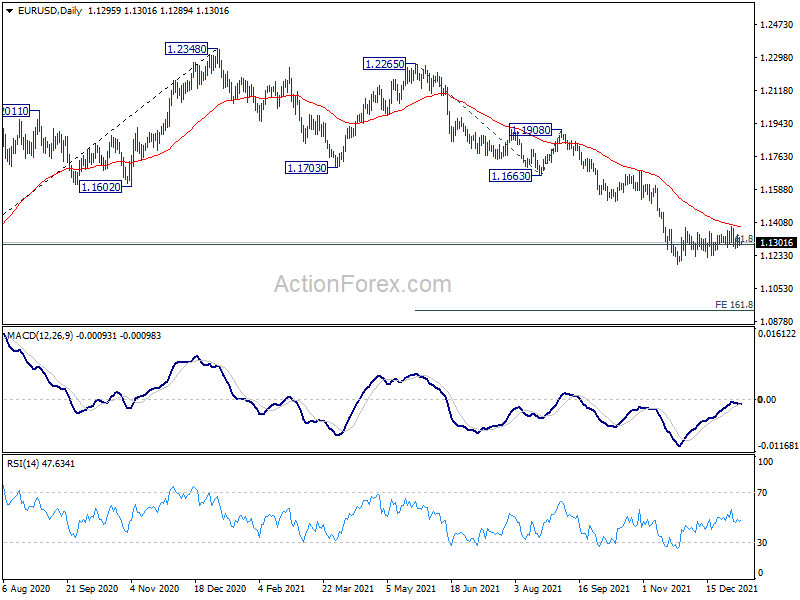
EUR/USD is still staying in sideway consolidation form 1.1185 and intraday bias remains neutral. On the downside, break of 1.1185 will resume larger decline from 1.2348. Next target is 161.8% projection of 1.2265 to 1.1663 from 1.1908 at 1.0934. On the upside, firm break of 1.1385 resistance will resume the rebound from 1.1186. Sustained trading above 55 day EMA (now at 1.1382) will bring stronger rise back to 1.1663 support turned resistance.
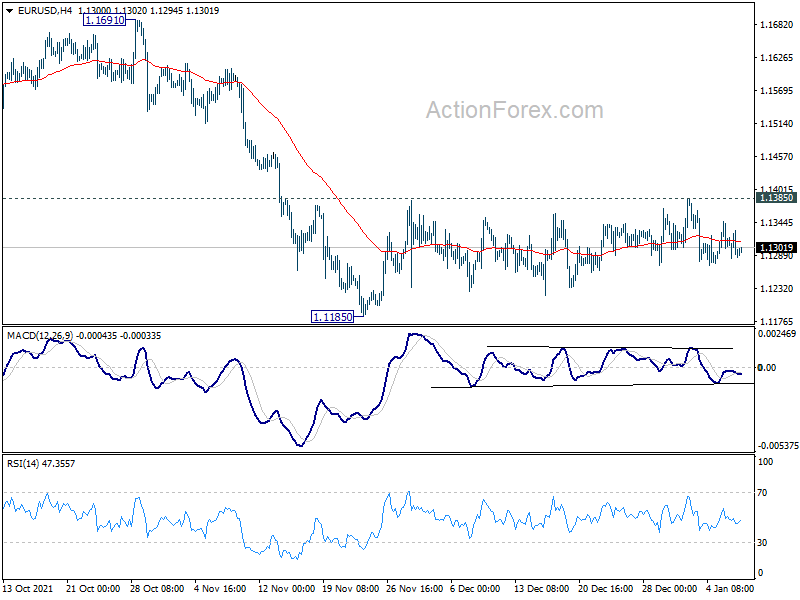
In the bigger picture, there are various ways of interpreting the fall from 1.2348 (2021 high). It could be a correction to rise from 1.0635 (2020 low), the fourth leg of a sideway pattern from 1.0339 (2017 low), or resuming long term down trend. In any case, outlook will now stay bearish as long as 1.1703 support turned resistance holds. Sustained break of 61.8% retracement of 1.0635 to 1.2348 at 1.1289 would pave the way back to 1.0635.
Markets Steady as NFP Awaited, EUR/USD Still in Range
Markets are generally steady as focus turns to non-farm payroll from US today. For the week so far, Sterling and Dollar are still the strongest ones, as supported by strong rally in benchmark yields and expectation of hawkish central bank actions. Euro is mixed, pressured by the Pound but steady against Dollar. Yen's weakest place was overtaken by Aussie and Kiwi, as risk sentiment turned sour.
Technically, USD/CHF's break of 0.9200 resistance suggests that fall from 0.9372 has completed with three waves down to 0.9101. Stronger rally is now in favor towards 0.9293 resistance, and possibly further to 0.9372. We'll now see if EUR/USD would follow with more decline back towards 1.1185 low, and possibly a break there on Dollar strength.
In Asia, at the time of writing, Nikkei is down -0.13%. Hong Kong HSI is up 1.15%. China Shanghai SSE is up 0.35%. Singapore Strait Times is up 0.50%. Japan 10-year JGB yield is up 0.0043 at 0.123. Overnight, DOW dropped -0.47%. S&P 500 dropped -0.10%. NASDAQ dropped -0.13%. 10-year yield rose 0.028 to 1.733.
Fed Bullard: FOMC could hike as early as in March
St. Louis Fed James Bullard said yesterday, "the FOMC could begin increasing the policy rate as early as the March meeting in order to be in a better position to control inflation. Subsequent rate increases during 2022 could be pulled forward or pushed back depending on inflation developments."
"There was a significant unanticipated inflation shock in the U.S. during 2021," he said. "With the real economy strong but inflation well above target, U.S. monetary policy has shifted to more directly combat inflation pressure."
"We could go ahead with balance sheet run off shortly after lifting off the policy rate," Bullard said, and start reducing support for the economy "sooner rather than later."
Fed Daly: We might need to, likely will need to, raise interest rates
San Francisco Fed President Mary Daly said yesterday that "I'm of the mind that we might need to, likely will need to, raise interest rates ... in order to keep the economy in balance." She clarified that "raising them a little bit is not the same as constraining the economy."
But she also urged a data driven, measured approach. "If we act too aggressively to offset the high inflation that's caused by the supply and demand imbalances, we won't actually do very much to solve the supply chain problems, but we will absolutely bridal the economy in a way that will mean less job creation down the road," she said.
10-year yield eyeing key resistance as NFP awaited
US non-farm payroll report is the major focus for today. Markets are expecting 400k job growth in December. Unemployment rate is expected to tick down from 4.2% to 4.1%. Wage growth is expected to continue to be strong, with average hourly earnings up 0.4% mom.
Looking at related data, ADP private employment grew strongly by 807k. ISM manufacturing component rose from 53.3 to 54.2. But ISM services employment dropped from 56.5 to 54.9. Four-week moving average of initial jobless claims dropped notably from 239k to 204.5. The NFP report is more likely a solid one than not.
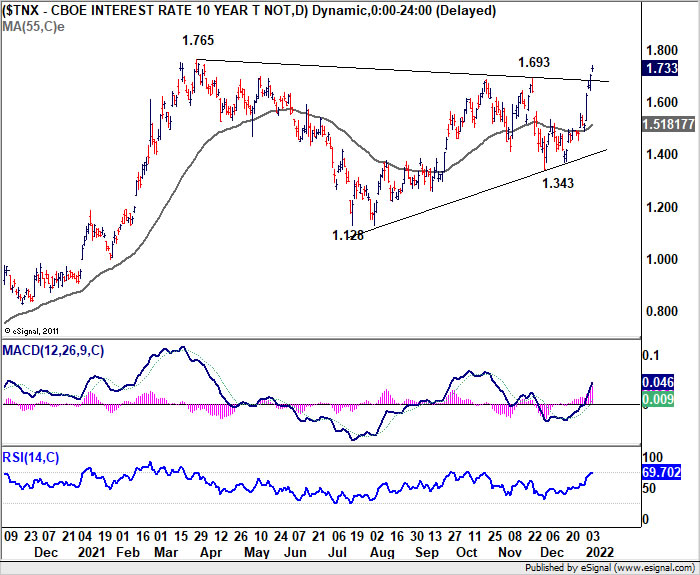
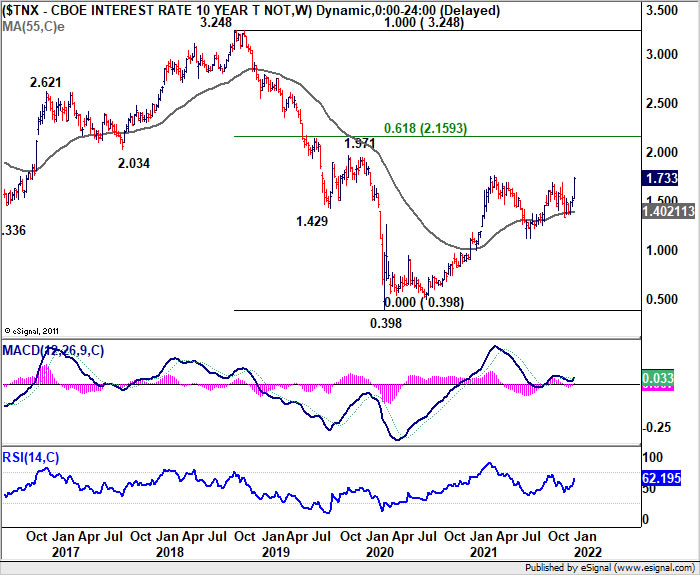
Reactions from treasury yields to the data is worth a watch. 10-year yield is now close to 1.765 key near term resistance. A set of solid job data, in particular wage growth, could push TNX through this 1.765 resistance to resume larger up trend from 0.398. In this case, we could see TNX quickly accelerate through 2.0 handle to 61.8% retracement of 3.248 to 0.398 at 2.159 down the road, even within Q1. Such development would give USD/JPY and push upwards.
On the data front
Japan Tokyo CPI core accelerated to 0.5% yoy in December, up from 0.3% yoy, above expectation of 0.4% yoy. Labor cash earnings rose 0.0% yoy in November, below expectation of 0.5% yoy. Household spending dropped -1.3% yoy, much worse than expectation of 1.6% yoy.
In European session, Swiss will release unemployment rate and retail sales. Germany will release industrial production and trade balance. France will release trade balance, consumer spending and industrial output. UK will release PMI construction. Eurozone will release CPI flash, retail sales and economic sentiment indicator.
Later in the day, US will release non-farm payroll employment. Canada will also release job data and Ivey PMI.
EUR/USD Daily Outlook
Daily Pivots: (S1) 1.1279; (P) 1.1305; (R1) 1.1326; More...
EUR/USD is still staying in sideway consolidation form 1.1185 and intraday bias remains neutral. On the downside, break of 1.1185 will resume larger decline from 1.2348. Next target is 161.8% projection of 1.2265 to 1.1663 from 1.1908 at 1.0934. On the upside, firm break of 1.1385 resistance will resume the rebound from 1.1186. Sustained trading above 55 day EMA (now at 1.1382) will bring stronger rise back to 1.1663 support turned resistance.
In the bigger picture, there are various ways of interpreting the fall from 1.2348 (2021 high). It could be a correction to rise from 1.0635 (2020 low), the fourth leg of a sideway pattern from 1.0339 (2017 low), or resuming long term down trend. In any case, outlook will now stay bearish as long as 1.1703 support turned resistance holds. Sustained break of 61.8% retracement of 1.0635 to 1.2348 at 1.1289 would pave the way back to 1.0635.
Economic Indicators Update
| GMT | Ccy | Events | Actual | Forecast | Previous | Revised |
|---|---|---|---|---|---|---|
| 23:30 | JPY | Tokyo CPI Core Y/Y Dec | 0.50% | 0.40% | 0.30% | |
| 23:30 | JPY | Labor Cash Earnings Y/Y Nov | 0.00% | 0.50% | 0.20% | |
| 23:30 | JPY | Household Spending Y/Y Nov | -1.30% | 1.60% | -0.60% | |
| 06:45 | CHF | Unemployment Rate Dec | 2.50% | 2.50% | ||
| 07:00 | EUR | Germany Industrial Production M/M Nov | 1.00% | 2.80% | ||
| 07:00 | EUR | Germany Trade Balance (EUR) Nov | 12.7B | 12.5B | ||
| 07:30 | CHF | Real Retail Sales Y/Y Nov | 0.80% | 1.20% | ||
| 07:45 | EUR | France Trade Balance (EUR) Nov | -7.2B | -7.5B | ||
| 07:45 | EUR | France Consumer Spending M/M Nov | 0.50% | -0.40% | ||
| 07:45 | EUR | France Industrial Output M/M Nov | 0.90% | |||
| 09:30 | GBP | Construction PMI Dec | 53.9 | 55.5 | ||
| 10:00 | EUR | Eurozone CPI Y/Y Dec P | 4.70% | 4.90% | ||
| 10:00 | EUR | Eurozone CPI Core Y/Y Dec P | 2.30% | 2.60% | ||
| 10:00 | EUR | Eurozone Economic Sentiment Indicator Dec | 116 | 117.5 | ||
| 10:00 | EUR | Eurozone Services Sentiment Dec | 16.1 | 18.4 | ||
| 10:00 | EUR | Eurozone Industrial Confidence Dec | 14 | 14.1 | ||
| 10:00 | EUR | Eurozone Consumer Confidence Dec F | -8.3 | -8.3 | ||
| 10:00 | EUR | Eurozone Retail Sales M/M Nov | -0.50% | 0.20% | ||
| 13:30 | USD | Nonfarm Payrolls Dec | 400K | 210K | ||
| 13:30 | USD | Unemployment Rate Dec | 4.10% | 4.20% | ||
| 13:30 | USD | Average Hourly Earnings M/M Dec | 0.40% | 0.30% | ||
| 13:30 | CAD | Net Change in Employment Dec | 24.5K | 153.7K | ||
| 13:30 | CAD | Unemployment Rate Dec | 6.00% | 6.00% | ||
| 15:00 | CAD | Ivey Purchasing Managers Index Dec | 64.3 | 61.2 |
10-year yield eyeing key resistance as NFP awaited
US non-farm payroll report is the major focus for today. Markets are expecting 400k job growth in December. Unemployment rate is expected to tick down from 4.2% to 4.1%. Wage growth is expected to continue to be strong, with average hourly earnings up 0.4% mom.
Looking at related data, ADP private employment grew strongly by 807k. ISM manufacturing component rose from 53.3 to 54.2. But ISM services employment dropped from 56.5 to 54.9. Four-week moving average of initial jobless claims dropped notably from 239k to 204.5. The NFP report is more likely a solid one than not.
Reactions from treasury yields to the data is worth a watch. 10-year yield is now close to 1.765 key near term resistance. A set of solid job data, in particular wage growth, could push TNX through this 1.765 resistance to resume larger up trend from 0.398. In this case, we could see TNX quickly accelerate through 2.0 handle to 61.8% retracement of 3.248 to 0.398 at 2.159 down the road, even within Q1. Such development would give USD/JPY and push upwards.