Sample Category Title
Euro Yawns as German Factory Orders Jump
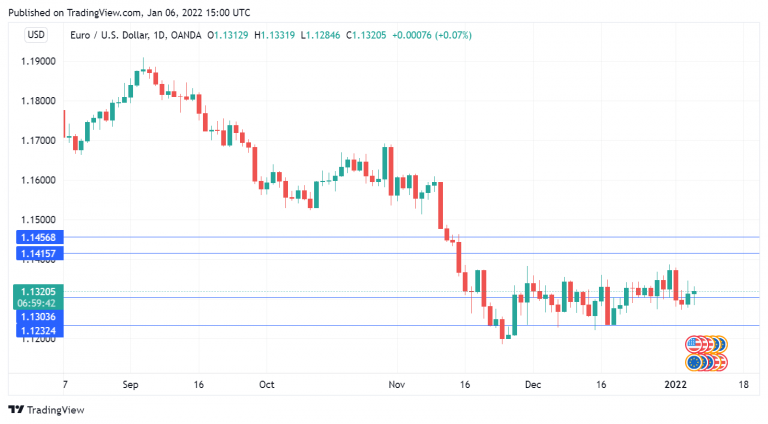
The euro is showing little movement, as it trades just above the 1.13 line.
German Factory Orders recovered in November, with a robust gain of 3.7% m/m. This follows a sharp decline of -5.8% m/m in October. Although factory orders are up, the manufacturing sector continues to grapple with supply bottlenecks which are hampering growth. Earlier this week, German Manufacturing PMI for December came in at 57.4, unchanged from November and at its lowest level since January 2021. The PMI indicates expansion but is significantly lower than the mid-60s readings we saw in Q2 and Q3.
The FOMC minutes indicated that committee members viewed inflation risks to the upside, and agreed that tapering should be accelerated due to inflationary pressures and the strong recovery. Members did not provide a lift-off date for a rate hike, but the minutes stated that they were open to raising rates “sooner or at a faster pace” than previously anticipated. The markets have priced in a March hike at around 60%, with three rate hikes expected in 2022.
In the US, the markets are awaiting Friday’s nonfarm payroll report. The ADP employment report surprised to the upside, with a December reading of 807 thousand new jobs, double the consensus of 400 thousand. The huge gain caused Goldman Sachs to upwardly revise its forecast by 50 thousand to 500 thousand and some analysts are projecting a print north of the 1-million mark. Still, it should be remembered that the ADP report is not all that reliable an indicator for nonfarm payrolls. The consensus for the NFP stands at 424 thousand, and if the read comes in below expectations, we could see the US dollar falter, as a weak NFP could push delay lift-off for a Fed rate hike.
EUR/USD Technical
- EUR/USD has support at 1.1303. Below, there is support at 1.1232
- There is resistance at 1.1456 and 1.1415
Canada’s Trade Surplus Widens in November
Canada recorded an increase in its merchandise trade surplus to $3.1 billion in November, up from a $2.3 billion surplus in October. Merchandise exports increased at a solid, 3.8% pace (month/month), and imports were up by a lesser 2.4%. In real terms, the picture was still strong, with export volumes up 3.5%, and import volumes up 0.8%.
The increase in exports was broad-based, spanning 8 of the 11 industries. Exports of consumer goods (+9%) contributed the most to the headline increase, driven by a surge in exports of pharmaceutical products. Statistics Canada highlighted that COVID-19-related medications were imported for packing/labelling in Canada, then exported during the same month. Exports of basic and industrial chemical, plastic, and rubber products (+14.7%), energy products (+2.8%), motor vehicles and parts (+4%), and forestry products and building and packaging materials (+6.7%) were also strong.
Imports were up in 6 of the 11 industries. Similar to exports, a 5.2% increase in imports of consumer goods (led by pharmaceutical products) drove the headline increase. Imports of metal and non-metallic mineral products (+7.3%) and basic and industrial, chemical, plastic and rubber products (+7.3%) were also strong.
The B.C. floods were cited in November's international trade report. The impacts were centered in B.C. Exports in the province (on a non-seasonally adjusted basis) declined 7.8%, but the decline was more than offset by an 11% increase in exports in other provinces.
In a separate release, Statistics Canada revealed that services exports were up 2.9% (month/month), whereas imports were up a more modest 0.3%.
Key Implications
Canada's exports and overall trade flows remained resilient in November, despite the disruptions stemming from the devastating floods in British Columbia. Even after controlling for the atypical spike in pharmaceutical products, nominal exports would have remained on a solid footing during the month (+2.8%).
Looking ahead, we are likely to see some volatility in international trade in the coming months. Continued strength in manufacturing sentiment south of the border, alongside robust commodity prices and demand, bode well for exports. However, the global omicron wave may prolong supply chain pressures during the first quarter this year as consumers reorient spending back towards goods. In addition, concerns relating to labour shortages (partly due to a potential increase in employees requiring isolation) may present another bottleneck in the near-term for international trade.
US ISM services dropped sharply to 62.0, much worse than expectation
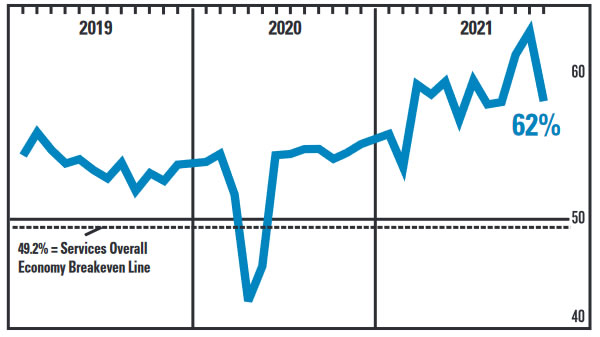
US ISM Services dropped sharply from 69.1 to 62.0 in December, much worse than expectation of 67.2. Looking at some details, business activity/production dropped from 74.6 to 67.7. New orders dropped from 69.7 to 61.5. employment dropped from 56.5 to 54.9. Supplier deliveries dropped from 75.7 to 63.9. Prices rose slightly from 82.3 to 82.5.
ISM said: "The past relationship between the Services PMI® and the overall economy indicates that the Services PMI® for December (62 percent) corresponds to a 4.5-percent increase in real gross domestic product (GDP) on an annualized basis."
EUR/USD Mid-Day Outlook
Daily Pivots: (S1) 1.1278; (P) 1.1312; (R1) 1.1348; More...
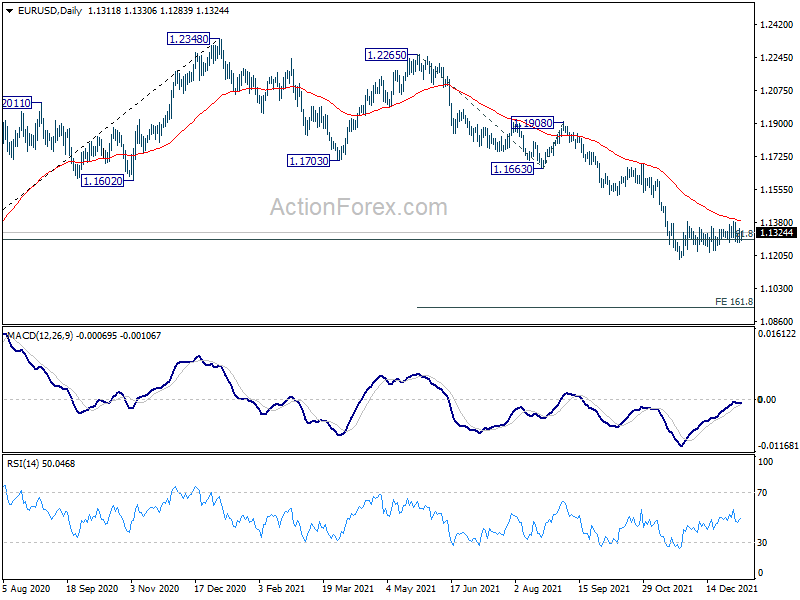
Intraday bias in EUR/USD remains neutral as range trading continues. On the upside, firm break of 1.1385 resistance will resume the rebound from 1.1186. Sustained trading above 55 day EMA (now at 1.1392) will bring stronger rise back to 1.1663 support turned resistance. On the downside, break of 1.1185 will resume larger decline from 1.2348. Next target is 161.8% projection of 1.2265 to 1.1663 from 1.1908 at 1.0934.
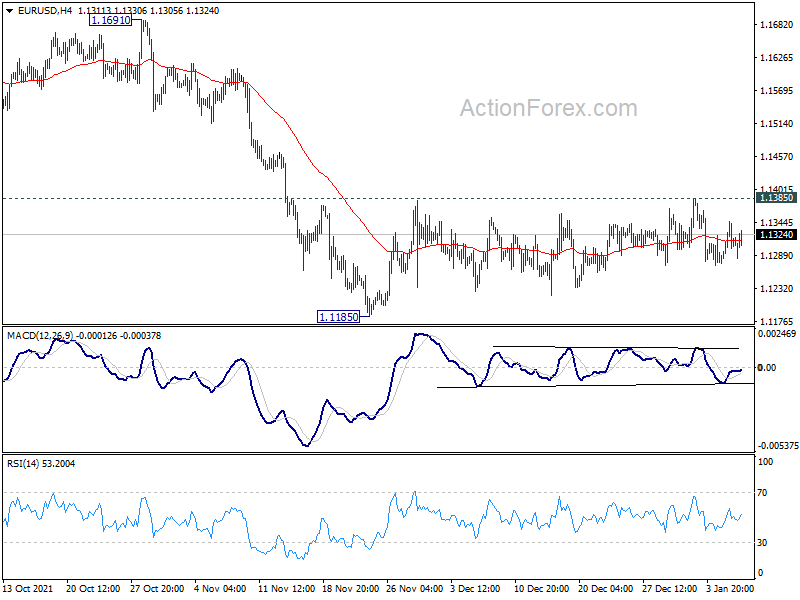
In the bigger picture, there are various ways of interpreting the fall from 1.2348 (2021 high). It could be a correction to rise from 1.0635 (2020 low), the fourth leg of a sideway pattern from 1.0339 (2017 low), or resuming long term down trend. In any case, outlook will now stay bearish as long as 1.1703 support turned resistance holds. Sustained break of 61.8% retracement of 1.0635 to 1.2348 at 1.1289 would pave the way back to 1.0635.
GBP/USD Mid-Day Outlook
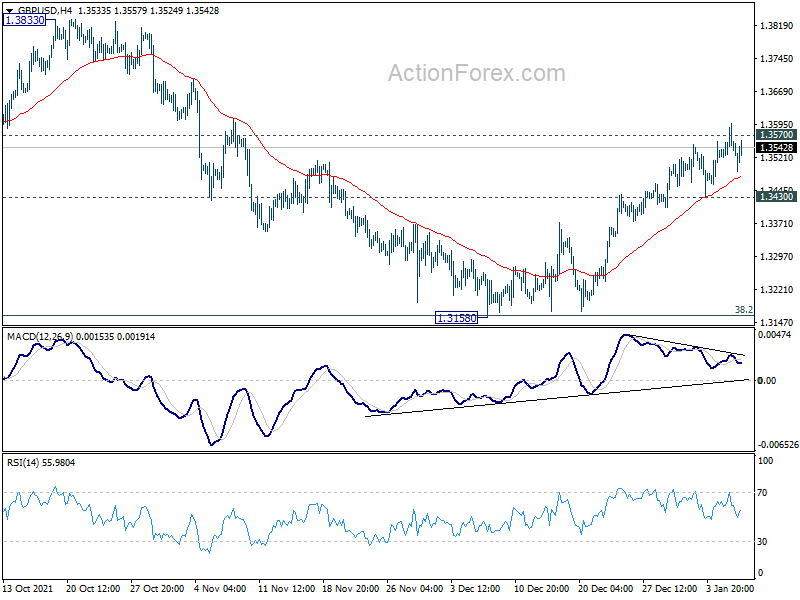
Daily Pivots: (S1) 1.3520; (P) 1.3559; (R1) 1.3596; More...
Intraday bias in GBP/USD remains neutral for the moment. Further rally is still expected as long as 1.3430 support holds. We're seeing corrective fall from 1.4248 as complete with three waves down to 1.3158, after hitting 1.3164 medium term fibonacci level. . Sustained break of 1.3570 resistance will further affirm this bullish case and target 1.3833 resistance next. However, break of 1.3375 will turn bias back to the downside for 1.3158 low again.
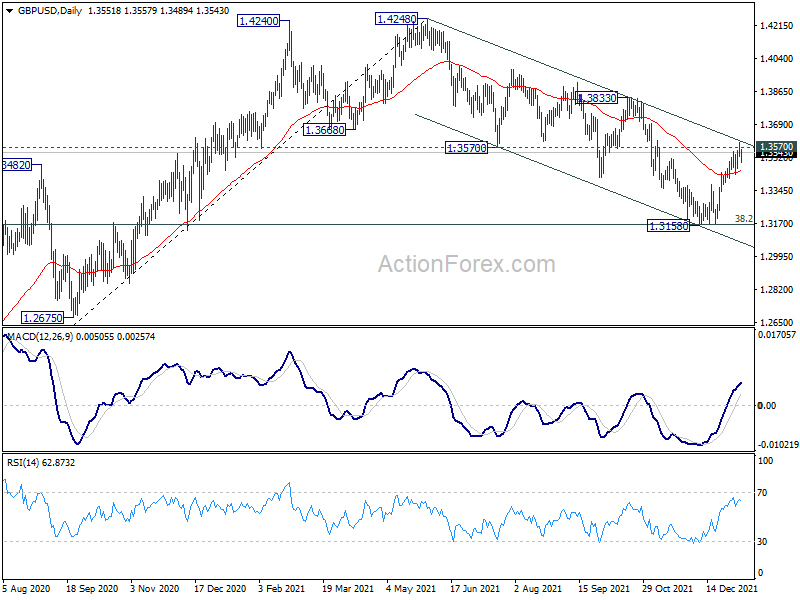
In the bigger picture, focus remains on 38.2% retracement of 1.1409 to 1.4248 at 1.3164. Sustained break there will argue that whole rise from 1.1409 has completed at 1.4248, after rejection by 1.4376 long term resistance. That will revive some medium term bearishness and and target 61.8% retracement at 1.2493. However, strong rebound from current level will revive argue that up trend from 1.1409 is still in progress, and probably ready to resume.
USD/CHF Mid-Day Outlook
Daily Pivots: (S1) 0.9149; (P) 0.9166; (R1) 0.9192; More....
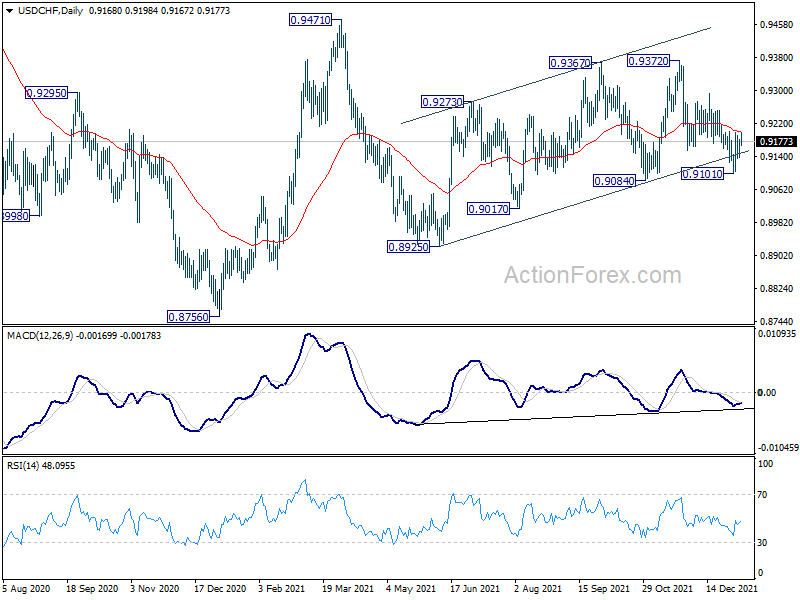
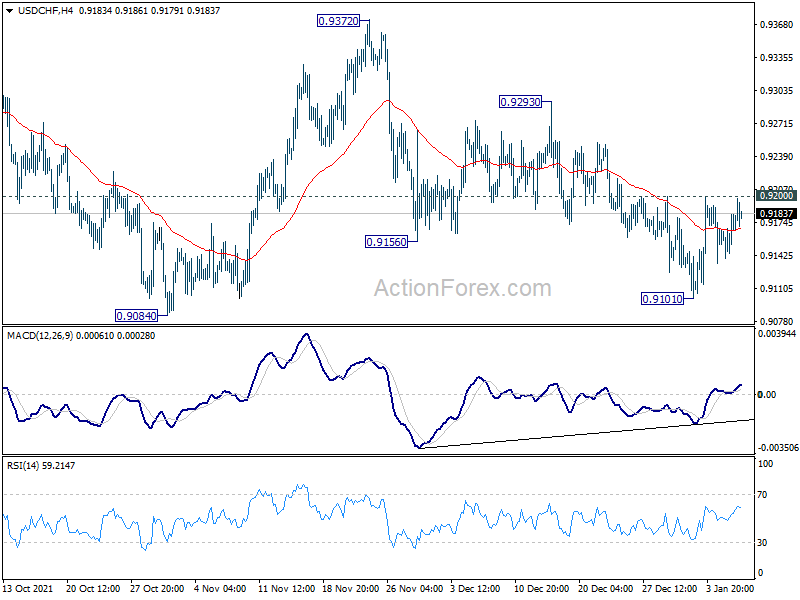
Intraday bias in USD/CHF remains neutral for the moment. On the upside, break of 0.9200 resistance will argue that fall from 0.9372 has completed with three waves down to 0.9101. Intraday bias will be back on the upside for 0.9372 resistance. On the downside, sustained break of 0.9084 support should confirm that choppy rise from 0.8925 has completed, and suggests that fall from 0.9471 is resuming. Deeper decline would be seen through 0.8925.
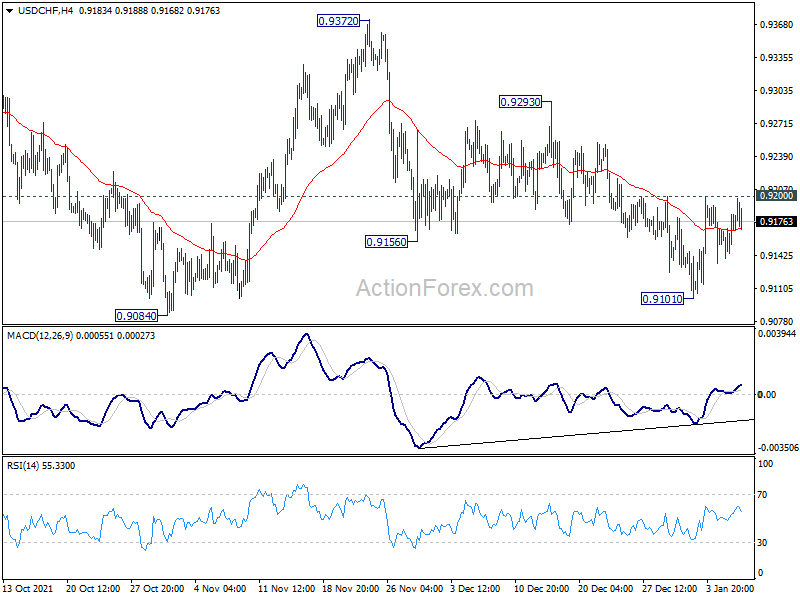
In the bigger picture, the corrective structure of the rebound from 0.8925 argues that fall from 0.9471 is not complete yet. It could either be the second leg of pattern from 0.8756 (2021 low), or resuming larger down trend from 1.0237 (2018 high). We'd pay attention to the downside momentum and assess the odds later. But for now, medium term outlook will be neutral at best as long as 0.9471 resistance holds.
USD/JPY Mid-Day Outlook
Daily Pivots: (S1) 115.74; (P) 115.99; (R1) 116.36; More...
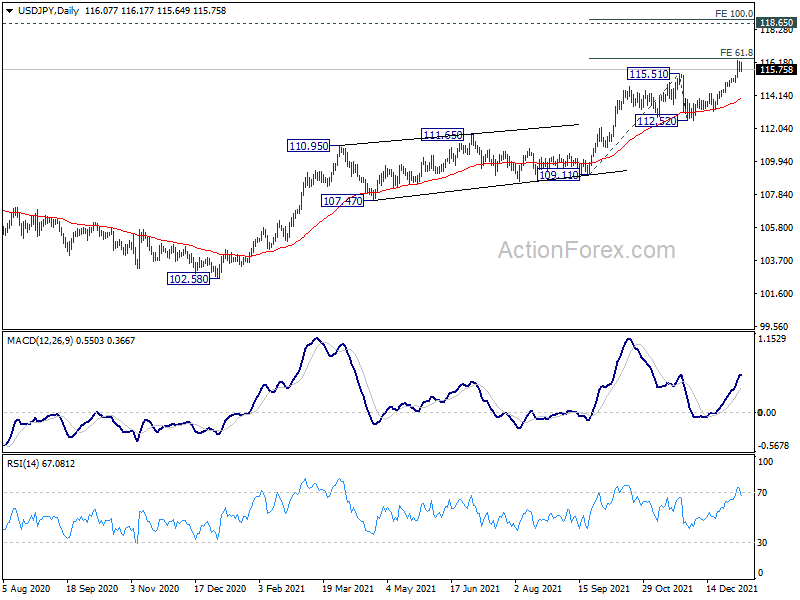
USD/JPY is staying in consolidation below 116.34 temporary top and intraday bias remains neutral. Some consolidations could be seen but downside should be contained well above 114.26 support turned resistance to bring another rally. On the upside, sustained break of 61.8% projection of 109.11 to 115.51 from 112.52 at 116.47 will pave the way to 100% projection at 118.90, which is close to 118.65 long term resistance.
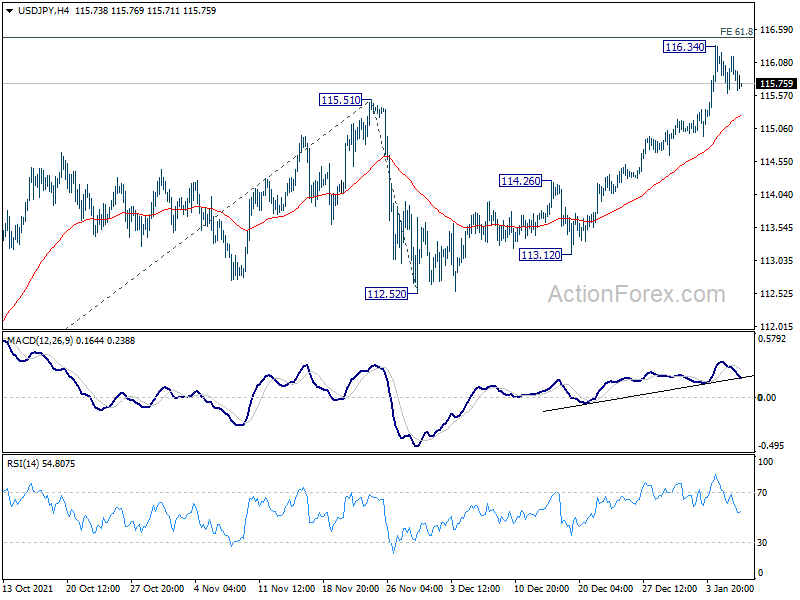
In the bigger picture, no change in the view that rise from 102.58 is the third leg of the up trend from 101.18 (2020 low). Such rally should target a test on 118.65 (2016 high). Sustained break there will pave the way to 120.85 (2015 high) and raise the chance of long term up trend resumption. For now, this will remain the favored case as long as 112.52 support holds, in case of deep pull back.
Yen in Weak Recovery, Dollar and Sterling Still Firm
Yen is trying to recover on weaker risk sentiment today. But momentum is relatively soft against Dollar and Europeans. Aussie and Kiwi follow broader risk markets lower. Sterling and Dollar remain the strongest ones for the week, on expectation of hawkish BoE and Fed. Euro and Swiss Franc are mixed, with Euro having a slight upper handle. Traders could not turn more cautious until tomorrow's non-farm payrolls report.
Technically, we'd now pay some attention to USD/CHF. Break of 0.9200 resistance will argue that fall from 0.9372 has completed with three waves down to 0.9101. Stronger rally would be seen to 0.9293 resistance and above. If that happens, it could be a prelude to EUR/USD's downside range breakout.
In Europe, at time of writing, FTSE is down -0.76%. DAX is down -1.14%. CAC is down -1.39%. Germany 10-year yield is up 0.0236 at -0.099. Earlier in Asia, Nikkei dropped -2.88%. Hong Kong HSI rose 0.72%. China Shanghai SSE dropped -0.25%. Singapore Strait Times rose 0.66%. Japan 10-year JGB yield rose 0.0323 to 0.119.
US initial claims rose to 207k, above expectation
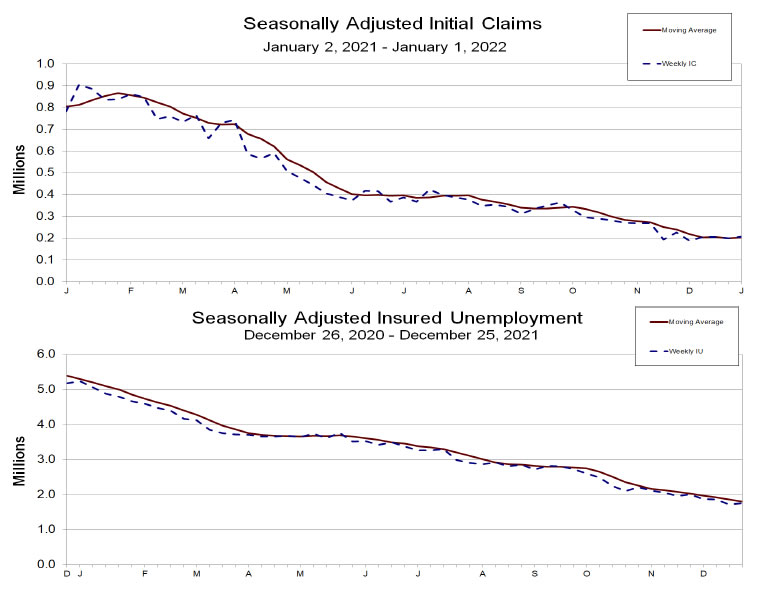
US initial jobless claims rose 7k to 207k in the week ending January 1, above expectation of 199k. Four-week moving average of initial claims rose 5k to 205k. Continuing claims rose 36k to 1754k in the week ending December 25. Four-week moving average of continuing claims dropped -61k to 1799k, lowest since March 14, 2020.
Also, released, US trade deficit widened to USD -80.2B in November, versus expectation of USD -73.5B. Canada trade surplus widened to CAD 3.1B, above expectation of CAD 1.4B.
Eurozone PPI at 1.8% mom, 23.7% in Nov
Eurozone PPI rose 1.8% mom, 23.7% yoy in November, versus expectation of 1.2% mom, 22.9% yoy. For the month, industrial increased by 3.5% in the energy sector, by 1.5% for intermediate goods, by 0.6% for non-durable consumer goods, by 0.5% for durable consumer goods and by 0.4% for capital goods. Prices in total industry excluding energy increased by 0.9%.
EU PPI came in at 2.0% mom, 23.7% yoy. The highest monthly increases in industrial producer prices were recorded in Denmark (+10.3%), Bulgaria (+8.5%) and Romania (+7.3%), while the only decrease was observed in Ireland (-2.5%).
Germany factor orders rose 3.7% mom in Nov, strong foreign orders
Germany factory orders rose 3.7% mom in November, better than expectation of 2.5% mom. Comparing with October, Largest increase in new orders (32.0%) was recorded in the manufacture of other transport equipment (aircraft, ships, trains etc.) for which extensive major orders were reported. New orders in the manufacture of motor vehicles, trailers and semi-trailers were up by 7.0%. Not including major orders, an 3.8% increase in new orders in manufacturing was recorded.
The strong growth in new orders was attributable to foreign orders which increased by 8.0%. New orders from the euro area rose by 13.1%. New orders from other countries amounted to 5.0% in the current month. Domestic orders went up 2.5% in November 2021 on the previous month.
UK PMI services finalized at 53.6, severe loss of momentum
UK PMI Services was finalized at 53.6 in December, down from November's 58.5, lowest level since February. Markit said export sales were hard-hit by renewed pandemic. Service provides remained upbeat about year ahead prospects. PMI Composite was finalized at 53.6, down from prior month's 57.6.
Tim Moore, Economics Director at IHS Markit: "December data revealed a severe loss of momentum for the UK economy as many customer-facing businesses experienced a drop in demand due to escalating COVID-19 cases. Total new orders in the service sector increased at the weakest pace for 10 months. Mass cancellations of bookings in response to the Omicron variant led to a slump in consumer spending on travel, leisure and entertainment. Survey respondents also noted that renewed pandemic restrictions had slowed the recovery in business services.
China PMI services rose to 53.1, composite rose to 53.0
China Caixin PMI Services rose from 52.1 to 53.1 in December, above expectation of 51.9. PMI Composite rose from 51.2 to 53.0.
Wang Zhe, Senior Economist at Caixin Insight Group said: "To sum up, the economy recovered in December with improvements in demand and supply of manufacturing and services. Inflationary pressure eased. But the job market was still under pressure and businesses were less optimistic, raising questions about the stability of the economic recovery. The repeated Covid-19 flare-ups and sluggish overseas demand were challenges to stability."
Bitcoin breaking down, 40k might only offer temporary support
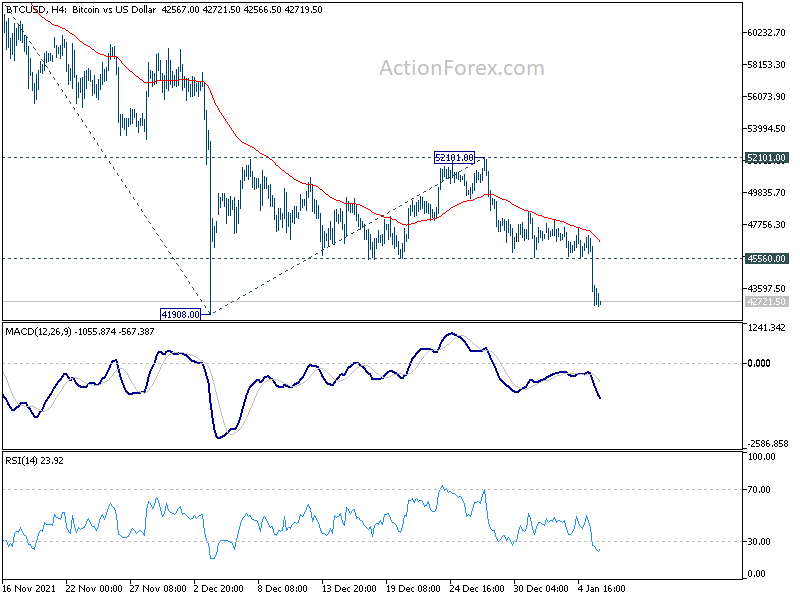
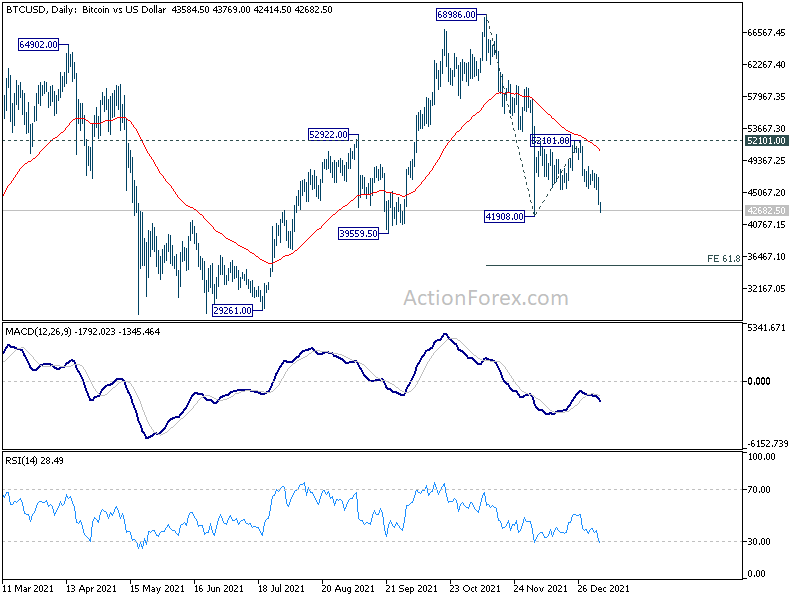
Bitcoin finally breaks down and it's now heading back to 41908 spike low. Prior rejection by 55 day EMA maintains near term bearishness and fall from 68986 is likely resuming. There might be some initial support between 39559/41908, around 40k handle. But outlook will stay bearish as long as 52101 resistance holds.
We'd expect fall form 68986 to hit 61.8% projection of 68986 to 41908 from 52101 at 35366 before finding a bottom.
USD/JPY Mid-Day Outlook
Daily Pivots: (S1) 115.74; (P) 115.99; (R1) 116.36; More...
USD/JPY is staying in consolidation below 116.34 temporary top and intraday bias remains neutral. Some consolidations could be seen but downside should be contained well above 114.26 support turned resistance to bring another rally. On the upside, sustained break of 61.8% projection of 109.11 to 115.51 from 112.52 at 116.47 will pave the way to 100% projection at 118.90, which is close to 118.65 long term resistance.
In the bigger picture, no change in the view that rise from 102.58 is the third leg of the up trend from 101.18 (2020 low). Such rally should target a test on 118.65 (2016 high). Sustained break there will pave the way to 120.85 (2015 high) and raise the chance of long term up trend resumption. For now, this will remain the favored case as long as 112.52 support holds, in case of deep pull back.
Economic Indicators Update
| GMT | Ccy | Events | Actual | Forecast | Previous | Revised |
|---|---|---|---|---|---|---|
| 01:45 | CNY | Caixin Services PMI Dec | 53.1 | 51.9 | 52.1 | |
| 07:00 | EUR | Germany Factory Orders M/M Nov | 3.70% | 2.50% | -6.90% | -5.80% |
| 09:30 | GBP | Services PMI Dec F | 53.6 | 53.2 | 53.2 | |
| 10:00 | EUR | Eurozone PPI M/M Nov | 1.80% | 1.20% | 5.40% | |
| 10:00 | EUR | Eurozone PPI Y/Y Nov | 23.70% | 22.90% | 21.90% | |
| 13:00 | EUR | Germany CPI M/M Dec P | 0.50% | 0.40% | -0.20% | |
| 13:00 | EUR | Germany CPI Y/Y Dec P | 5.30% | 5.10% | 5.20% | |
| 13:30 | CAD | Trade Balance (CAD) Nov | 3.1B | 1.4B | 2.1B | 2.3B |
| 13:30 | USD | Initial Jobless Claims (Dec 31) | 207K | 199K | 198K | 200K |
| 13:30 | USD | Trade Balance (USD) Nov | -80.2B | -73.5B | -67.1B | -67.2B |
| 15:00 | USD | ISM Services PMI Dec | 67.2 | 69.1 | ||
| 15:00 | USD | ISM Services Prices Paid Dec | 82.3 | |||
| 15:00 | USD | ISM Services Employment Index Dec | 56.5 | |||
| 15:00 | USD | Factory Orders M/M Nov | 1.50% | 1.00% | ||
| 15:30 | USD | Natural Gas Storage | -55B | -136B |
Canadian Dollar Extends Losses
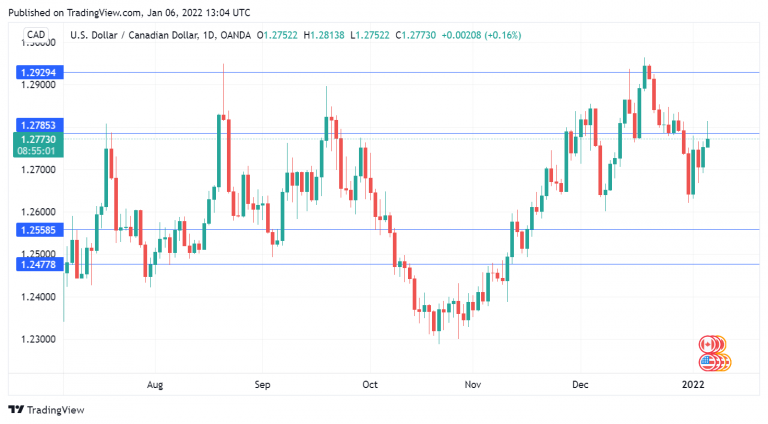
The Canadian dollar has extended its losses on Thursday as USD/CAD briefly punched above the 1.28 line earlier today. It has been a rough start to 2022 for the Canadian dollar, which has fallen over 1.0% against its US counterpart.
Canada’s Building Permits for November were much stronger than expected. The gain of 6.8% crushed the consensus of 2.3% and was sharply higher than the 2.4% reading in October. This robust release is reflective of the hot housing market, but we may be in for a cooling-off period, as new health restrictions could hamper economic growth. Quebec has announced a curfew and Ontario is restricting indoor events in response to the surge in Omicron infections.
The job market gets a report card on Friday, with the release of key employment reports. While the US is expected to show strong job growth December, the forecast for Canada is a negligible 27 thousand new jobs, after 153 thousand were added in November. If the forecasts prove accurate, the Canadian dollar could pile up more losses before the week is done.
The US dollar is getting a boost for US bond yields, which continue to head higher. This points to elevated risk sentiment, as market participants feel that although Omicron is causing a massive number of infections, it is less severe than other Covid variants and will not derail economic activity to the extent seen in previous Covid waves.
FOMC says inflation risk to upside
The FOMC minutes indicated that committee members viewed inflation risks to the upside, and agreed that tapering should be accelerated due to inflationary pressures and the strong recovery. Members did not provide a lift-off date for a rate hike, but the minutes stated that they were open to raising rates “sooner or at a faster pace” than previously anticipated. The markets have priced in a March hike at around 60%, with three rate hikes expected in 2022.
USD/CAD Technical
- USD/CAD is testing resistance at 1.2784. Above, there is resistance at 1.2929
- There are support levels at 1.2558 and 1.2477
US initial claims rose to 207k, above expectation
US initial jobless claims rose 7k to 207k in the week ending January 1, above expectation of 199k. Four-week moving average of initial claims rose 5k to 205k.
Continuing claims rose 36k to 1754k in the week ending December 25. Four-week moving average of continuing claims dropped -61k to 1799k, lowest since March 14, 2020.