

Sample Category Title
USD/CAD Daily Outlook
Daily Pivots: (S1) 1.2712; (P) 1.2740; (R1) 1.2787; More...
USD/CAD's rebound from 1.2619 extends higher but stays in range below 1.2963. Intraday bias remains neutral first. As long as 1.2604 support holds, we'd still slightly favor another rally. Break of 1.2963 will target 1.3022 key medium term fibonacci level. Sustained break of 1.3022 will carry larger bullish implications. However, firm break of 1.2604 will bring deeper fall back to 1.2286 support instead.
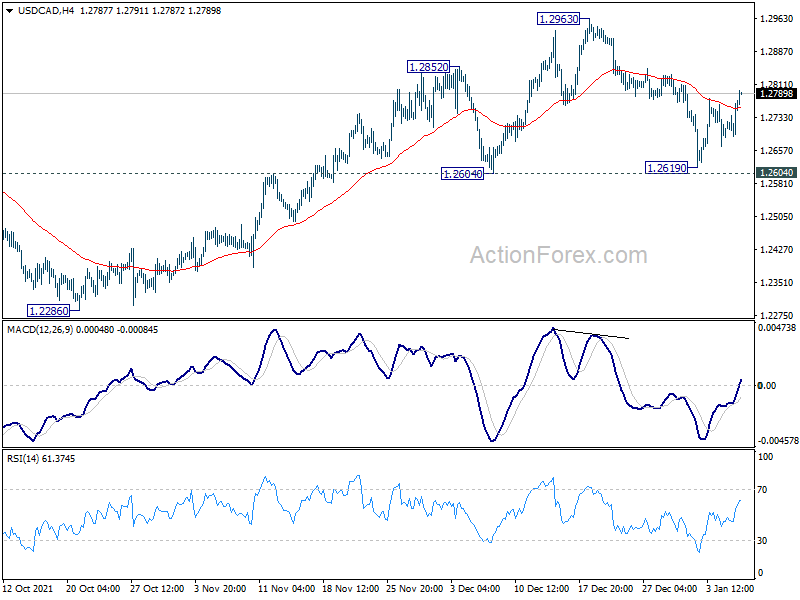
In the bigger picture, focus will be on 38.2% retracement of 1.4667 (2020 high) to 1.2005 (2021 low) at 1.3022. Sustained break there should confirm that the down trend from 1.4667 has completed after defending 1.2061 long term cluster support. Further rise would then be seen towards 61.8% retracement at 1.3650. On the downside, however, break of 1.2286 will turn focus back to 1.2005 low again.

The Street Was Clearly long Omi-gone
Greetings from day four of managed isolation in New Zealand, and no, I’m not a tennis player. All the chatter overnight was about the implosion on tech stocks in New York after a seemingly hawkish FOMC Minutes from the December meeting. The US Dollar reversed intraday losses and US yields firmed once again, but it was tech stocks and Bitcoin that fared worst, the Nasdaq falling by 3.34%, and Bitcoin slumping by 5.50%.
The minutes revealed that committee members felt inflation risks were more persistent and to the upside, and there was general agreement that the taper should be accelerated with three tentative rate hikes pencilled in. So far that’s exactly what we were told in the post-FOMC meeting by Chairman Powell. Nothing to see here. The only surprise, if you can call it that, is that some members felt that the Fed should commence running down its balance sheet soon after its first hike. I.e., selling some of those $8.50 trillion of bonds etc. Nothing else was said in the minutes and the meeting moved on.
Normally the FOMC Minutes is a big yawn-ster, and not market moving. The fact that is spurred a massive rush for the exit in the most QE-driven pimp-up-my-asset classes at a casual mention of possibly thinking about reducing the balance sheet earlier says one thing really. That thing is that markets right through the holiday period had been blissfully pricing in omicron as omi-gone. Given it hasn’t really reached Asia yet, which is mostly vaccinated with traditional vaccines that don’t appear to work against omicron, I hope they are right. Such is the Western RNA-centric flat earth universe the markets live in.
Anyway, the meltdown overnight is more about positioning than anything, because when you look at what the Fed members said in the FOMC Minutes, it wasn’t really anything different than what we already knew. I wouldn’t write off the irresistible power of the buy-the-dippers turning things around once again before the end of the week, especially if the US Non-Farm Payrolls comes in under 400k tomorrow night. Markets have been inflation nervous all week as the reality of the Fed taper peeps over the horizon.
What the price action this week tells us all is what I’ve been saying for a while, the start of monetary normalisation will make price movements a lot more “honest” than the past 18 months. The “buy everything” trade powered by “buy the dip; any dip” is on its last legs. Those most pimped up asset classes valuation wise are the most vulnerable to meaningful downside corrections. And yet another generation of young pups, (and some older ones), nurtured at the central bank pool of eternal QE-driven asset price appreciation life, will have to learn the meaning of the term “two-way price volatility.” It’s about time.
In other developments, both US and European PMIs took a hit last night, mostly down to omicron nerves and restrictions. If all goes to plan with omi-gone, they should rebound quickly. Other evidence of that was the explosion higher of official US Gasoline Inventories to 10.1 million barrels overnight. Still, December US ADP Employment exploded higher, adding 807k jobs versus 400k expected. That should see the US Non-Farm Payrolls revised higher for tomorrow, but the ADP data has been a shocking indicator for the headline number. A sub-400k number should ease the Fed taper nerves of this week, with a 500K plus number having the opposite result.
This morning, both Australian and Japan PMIs eased slightly but remained expansionary, suffering some omicron nerves, but certainly not enough to say the recoveries are in jeopardy. China’s Caixin Service PMI outperformed in fact, rising to 53.1, some good news in a week where good news is thin on the ground with China. The start of debt restructuring talks tomorrow to avoid Evergrande’s bond put-a-geddon this weekend will likely continue to weigh on China markets. https://www.reuters.com/business/china-evergrande-hold-meeting-with-bondholders-jan-7-10-2022-01-05/ The tech sell-off in the US won’t help matters either, especially in Hong Kong.
European Construction PMIs and the UK Services PMIs this afternoon, are likely to have taken a hot from omicron and Christmas holidays. The US releases Initial Jobless Claims, Factory Orders, and the ISM Non-Manufacturing sub-indexes. But I think the most interesting data today will be from our friends in Turkey, thanks to my colleague in New York, Ed Moya, for pointing it out.
At 1930 SGT, Turkey releases Foreign Exchange Reserves for the week ending December 31st. Having engineered a temporary Ponzi scheme to support the currency by backstopping the value of retail savers Lira deposits as long as savers don’t lose nerves and convert to hard currency, Turkey has been intervening heavily in FX markets as well. Reserves have fallen from $89 billion in mid-November to around $72.50 billion as of the 24th. By my reckoning, the Lira has already given back around 35% of its engineered gains in the past week or so, if reserves show a big drop this evening, the Turkish Lira vigilantes will be back out in force me thinks.
Asia follows Wall Street south
Wall Street had a torrid session as a hawk FOMC Minutes highlighted the amount of post-omicron speculative longs positions that were out there. Technology came in for particular attention, the Nasdaq suffering its biggest one day drop in nearly a year. The S&P 500 tumbled 1.94% lower, with the Nasdaq in full retreat, falling by 3.34%. By comparison, the value-centric Dow Jones fell by only 1.05%. US yields ground higher once again overnight, pressuring highly valued technology stocks. In Asia, the story is repeating in the futures market. Nasdaq futures are 0.70% lower, the S&P 500 futures are down 0.40$, and the Dow Jones futures are 0.25% lower.
Asian markets initially held their nerve this morning, but with no short-covering in the US futures, the opposite happening, in fact, Asia’s sell-off quickly accelerated leaving the region sea of red. The Nikkei 225, highly correlated to the Nasdaq these days, have tumbled 2.86% lower. The Kospi has fallen 0.75% with neither Tokyo nor Seoul showing any additional reaction to a hypersonic missile test by North Korea today.
Mainland China sees more virus restrictions being put in place including flights, but the Shanghai Composite is only 0.15% lower. I suspect China’s “national team,” is in “smoothing. The CSI 300, however, home to a much more diverse set of companies than giant SOE’s, has fallen by 0.85%, while the Hang Seng is holding up quite well, down only 0.35%, led by gains by Alibaba and JD.com.
Singapore is also bucking the trend, the Straits Times rising by 0.50%, led by its three mega-banks and consumer discretionary. Taipei has retreated 1.20%, with Jakarta down 0.80% and Kuala Lumpur down by 0.90%. Bangkok is 1.40% lower with Manila falling 0.65%.
Australian markets, facing tighter restrictions once again under a crushing omicron caseload, and with a high beta to US markets, have suffered heavily today. Both the ASX 200 and All Ordinaries have fallen by 3.0% today.
Europe is unlikely to shrug off the negativity that has swept the US and flowed so pointedly into Asia today. Europe will open lower as will London, but I won’t rule out the buy-the-dip gnomes of Wall Street seizing their chance and turning things around on Wall Street this afternoon.
The US Dollar holds steady
The US Dollar spent most of last night under pressure from the omi-gone rally, until the release of the hawkish FOMC Minutes. With US yields rising following that, the US Dollar reversed most of its losses intra-day, leaving it only slightly lower and marking the day as a range trade versus DM and EM FX.
The dollar index eased0.10% overnight to 96.18, where it remains in Asian trading. A break of 95.50 or 96.50 will signal the index’s next directional move, although if US yields stay firm, the greenback looks set to continue to outperform in the major currency space. EUR/USD is steady at 1.1310, USD/JPY at 115.90, and GBP/USD at 1.3530. Euro and Yen look most vulnerable to US Dollar strength, especially if the yield differential widens. Sterling’s fate remains tied to how its omicron wave plays out.
Risk sentiment indicators, the AUD, NZD, and CAD eased post-FOMC-Minutes. That sell-off has accelerated this morning as Asian stock markets and US index futures headed south. AUD/USD and NZD/USD have fallen by 0.55%, testing support at 0.7180 and 0.6750 respectively, while USD/CAD tests resistance at 1.2800. If the buy-the-dip rally does not appear on Wall Street this afternoon, the three amigos could easily move another 100 points lower overnight.
Asian currencies are trading sideways today, but several pairs remain close to line-in-the-sand levels with their respective central banks. USD/KRW is at 1199.00 approaching 1200.00. USD/PHP has risen above 51.00 to 51.20, USD/IDR is at 14,400 approaching 14.500.00 and USD/MYR is testing 4.2000. The Yuan, Baht and Indian Rupee continue to outperform. For the rest, it will be interesting to see if their respective central banks step out of the shadows and start offering US Dollars again.
Oil is bid despite its fall today
Oil prices were almost unchanged overnight, despite a massive 10 million barrel increase in US Gasoline Inventories, distillates rising by 4.4 million barrels and Crude Inventories falling only 2.5 million barrels, with Cushing Stocks climbing by about the same. That should all have been bad news for oil prices, implying that omicron is weighing on mobility and consumption. Even more especially, as US yields rose, and the US Dollar reclaimed intra-day losses. Instead, oil prices hardly budged and this, despite higher OPEC+ production, suggests that oil demand remains very robust indeed.
With the stock market selloff deepening in US futures, sweeping over Asia, and with some new virus restrictions in China, oil has finally moved lower. Brent crude and WTI fell by 0.45% to $79.70 and $78.80 a barrel. Given the sell-off in equity markets though, the move lower in oil is minuscule in comparison and oil prices are constructive.
Brent crude has support at $78.60 and $77.85 barrel, its 100-day moving average (DMA). It has resistance here at $80.00, and then $82.00 a barrel. WTI has support at $75.75 and then $74.90, it's 100-DMA. It has stout resistance at $77.50, and then $78.50 a barrel.
Gold’s range trade continues
With US yields and the US Dollar holding their gains but trading sideways, gold eased 0.25% overnight to $1810.30 an ounce, edging another 0.25% lower to $1805.75 an ounce in Asia. Given the price action overnight, it appears that gold is still vulnerable to higher US yields and a higher US Dollar. Any rallies should be approached with a great deal of caution and scepticism.
$1790.00 to $1820.00 remains my call for the range this week. Gold has resistance at $1830.00 and $1840.00 an ounce, although it would be a huge surprise if we saw those levels. Support lies at $1798.00, followed by $1790.00 and $1780.00 an ounce.
AUD/USD Daily Report
Daily Pivots: (S1) 0.7201; (P) 0.7237; (R1) 0.7257; More...
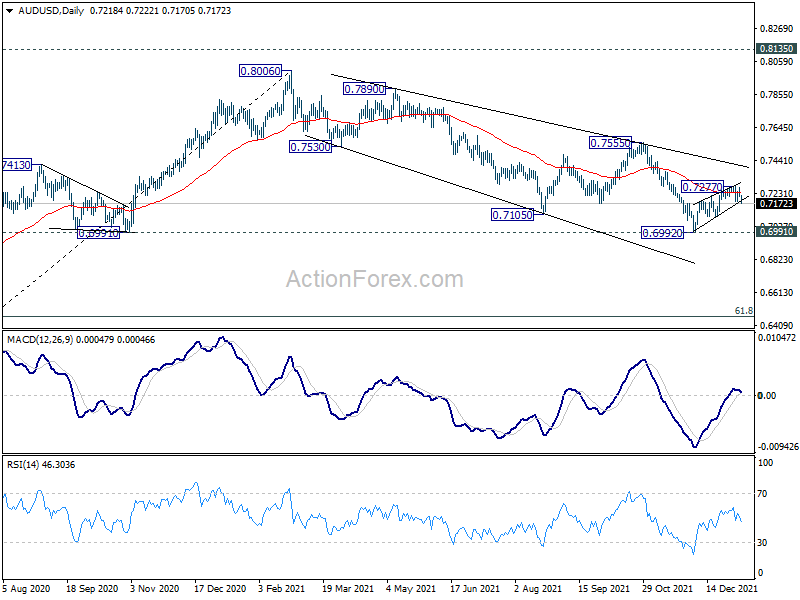
AUD/USD drops sharply today but stays above 0.7081. Intraday bias remains neutral first. On the downside, break of 0.7081 support will indicate that corrective rebound from 0.6992 has completed with three waves up to 0.7277, after hitting 55 day EMA. Intraday bias will be back on the downside for retesting 0.6991/2 support zone. Firm break there will resume larger down trend from 0.8006. ON the upside, through, break of 0.7277 will turn bias to the upside to resume the rebound.
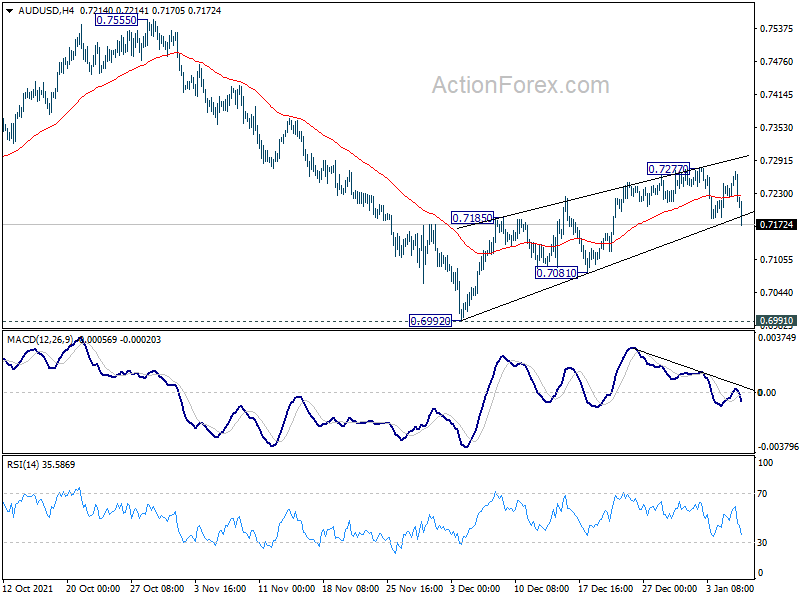
In the bigger picture, strong rebound from 0.6991 key structural support will retain medium term bullishness. That is, whole up trend from 0.5506 is still in progress. Firm break of 0.7555 resistance will target 0.8006 high and above. However, sustained break of 0.6991 will argue that the whole up trend from 0.5506 might be finished at 0.8006, after rejection by 0.8135 long term resistance. Deeper decline would then be seen back to 61.8% retracement of 0.5506 to 0.8006 at 0.6461.
Risk Sentiment Turned Sour after Hawkish FOMC Minutes
More hawkish than expected FOMC minutes sent US stocks lower overnight, and the negative sentiment carries on in Asian session. Australian Dollar leads commodity currencies sharply lower. Yen recovers but buying is weak on strong treasury yields. Dollar is also mildly firmer together with Euro.
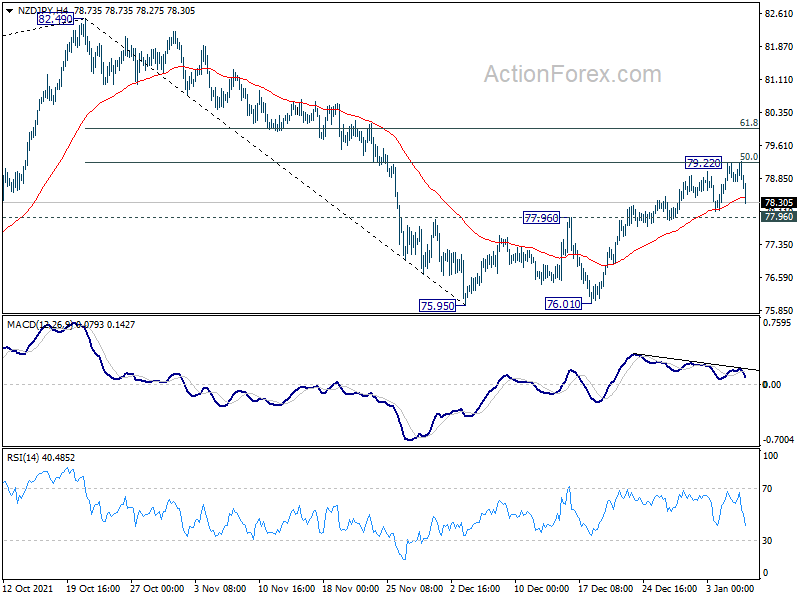
Technically, we'll look at some Yen crosses to gauge if the overall risk sentiment is really turning. As long as 82.42 resistance turned support in AUD/JPY holds, we'd still expect rebound from 78.77 to resume through 84.27 at a later stage. Similarly, as long as 77.96 resistance turned support in NZD/JPY holds, we'd expect rise form 75.96 to continue through 79.22. However, firm break of 77.96 will argue that NZD/JPY has completed the rebound and bring retest of 75.95.
In Asia, at the time of writing, Nikkei is down -2.67%. Hong Kong HSI is down -0.49%. China Shanghai SSE is down -0.18%. Singapore Strait Times is up 0.53%. Japan 10-year JGB yield is up 0.0321 at 0.119. Overnight, DOW dropped -1.07%. S&P 500 dropped -1.94%. NASDAQ dropped -3.34%. 10-year yield rose 0.037 to 1.705.
10-year yield broke 1.7 after hawkish Fed minutes, DOW dropped
US stocks tumbled overnight and treasury yields surged after surprisingly hawkish minutes of December FOMC meeting. Firstly, "participants generally noted that, given their individual outlooks for the economy, the labor market, and inflation, it may become warranted to increase the federal funds rate sooner or at a faster pace than participants had earlier anticipated.
More importantly, "almost all participants agreed that it would likely be appropriate to initiate balance sheet runoff at some point after the first increase in the target range for the federal funds rate". Also, once Fed starts to shrink its balance sheet, "the appropriate pace of balance sheet runoff would likely be faster than it was during the previous normalization episode" in October 2017.
More on FOMC minutes:
- FOMC Minutes Extremely Hawkish, Pushing Stocks Lower and USD/JPY higher
- FOMC Minutes Reveal Greater Urgency to End Emergency-Level Monetary Policy
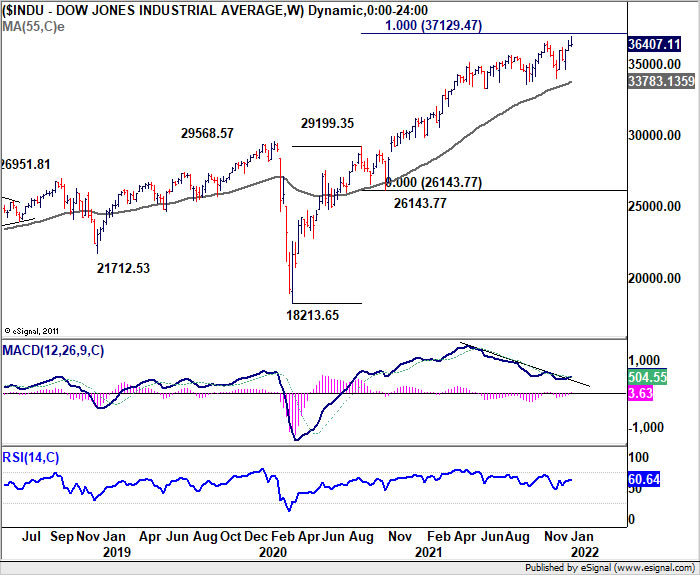
DOW closed down -1.07% or -392.54 pts at 36407.11. Despite the pull back, there is no threat to the up trend yet. However, it should not noted that DOW is close to an important fibonacci level of 100% projection of 18213.65 to 29199.35 from 26143.77 at 37129.47. Rejection by this level could trigger deep medium term correction through 55 week EMA (now at 33783.13).
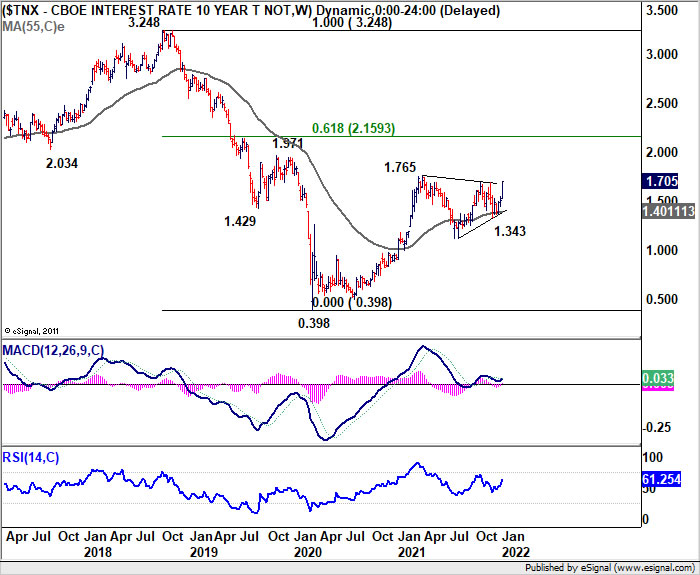
Meanwhile, 10-year yield rose strongly by 0.037 to close at 1.705, breaking 1.693 near term resistance. The development is inline with the view that consolidation from 1.765 has completed after testing 55 week EMA. Up trend from 0.398 should be ready to resume. Break of 1.765 would send TNX through 2% handle to 61.8% retracement of 3.248 to 0.398 at 2.159.
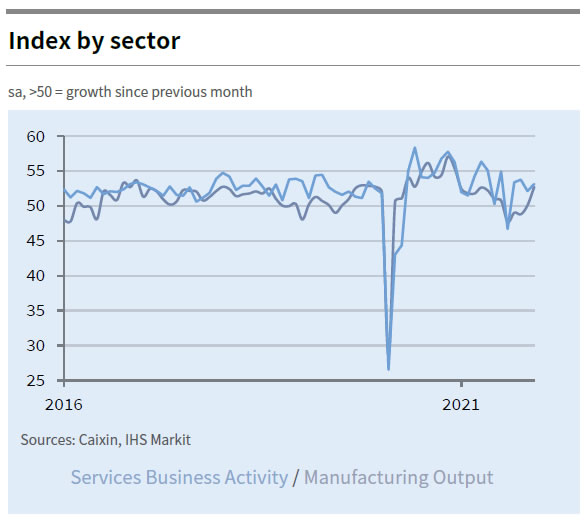
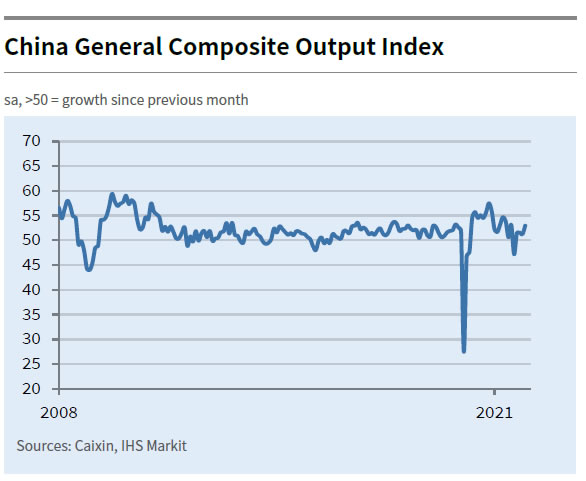
China PMI services rose to 53.1, composite rose to 53.0
China Caixin PMI Services rose from 52.1 to 53.1 in December, above expectation of 51.9. PMI Composite rose from 51.2 to 53.0.
Wang Zhe, Senior Economist at Caixin Insight Group said: "To sum up, the economy recovered in December with improvements in demand and supply of manufacturing and services. Inflationary pressure eased. But the job market was still under pressure and businesses were less optimistic, raising questions about the stability of the economic recovery. The repeated Covid-19 flare-ups and sluggish overseas demand were challenges to stability."
Looking ahead
Germany will release factory orders and CPI flash. UK will release PMI services final. Later in the day, US will release ISM services, jobless claims, trade balance and factory orders.
AUD/USD Daily Report
Daily Pivots: (S1) 0.7201; (P) 0.7237; (R1) 0.7257; More...
AUD/USD drops sharply today but stays above 0.7081. Intraday bias remains neutral first. On the downside, break of 0.7081 support will indicate that corrective rebound from 0.6992 has completed with three waves up to 0.7277, after hitting 55 day EMA. Intraday bias will be back on the downside for retesting 0.6991/2 support zone. Firm break there will resume larger down trend from 0.8006. On the upside, through, break of 0.7277 will turn bias to the upside to resume the rebound.
In the bigger picture, strong rebound from 0.6991 key structural support will retain medium term bullishness. That is, whole up trend from 0.5506 is still in progress. Firm break of 0.7555 resistance will target 0.8006 high and above. However, sustained break of 0.6991 will argue that the whole up trend from 0.5506 might be finished at 0.8006, after rejection by 0.8135 long term resistance. Deeper decline would then be seen back to 61.8% retracement of 0.5506 to 0.8006 at 0.6461.
Economic Indicators Update
| GMT | Ccy | Events | Actual | Forecast | Previous | Revised |
|---|---|---|---|---|---|---|
| 01:45 | CNY | Caixin Services PMI Dec | 53.1 | 51.9 | 52.1 | |
| 07:00 | EUR | Germany Factory Orders M/M Nov | 2.50% | -6.90% | ||
| 09:30 | GBP | Services PMI Dec F | 53.2 | 53.2 | ||
| 13:00 | EUR | Germany CPI M/M Dec P | 0.40% | -0.20% | ||
| 13:00 | EUR | Germany CPI Y/Y Dec P | 5.10% | 5.20% | ||
| 13:30 | CAD | Trade Balance (CAD) Nov | 1.4B | 2.1B | ||
| 13:30 | USD | Initial Jobless Claims (Dec 31) | 199K | 198K | ||
| 13:30 | USD | Trade Balance (USD) Nov | -73.5B | -67.1B | ||
| 15:00 | USD | ISM Services PMI Dec | 67.2 | 69.1 | ||
| 15:00 | USD | ISM Services Prices Paid Dec | 82.3 | |||
| 15:00 | USD | ISM Services Employment Index Dec | 56.5 | |||
| 15:00 | USD | Factory Orders M/M Nov | 1.50% | 1.00% | ||
| 15:30 | USD | Natural Gas Storage | -55B | -136B |
China PMI services rose to 53.1, composite rose to 53.0
China Caixin PMI Services rose from 52.1 to 53.1 in December, above expectation of 51.9. PMI Composite rose from 51.2 to 53.0.
Wang Zhe, Senior Economist at Caixin Insight Group said: "To sum up, the economy recovered in December with improvements in demand and supply of manufacturing and services. Inflationary pressure eased. But the job market was still under pressure and businesses were less optimistic, raising questions about the stability of the economic recovery. The repeated Covid-19 flare-ups and sluggish overseas demand were challenges to stability."
10-year yield broke 1.7 after hawkish Fed minutes, DOW dropped
US stocks tumbled overnight and treasury yields surged after surprisingly hawkish minutes of December FOMC meeting. Firstly, "participants generally noted that, given their individual outlooks for the economy, the labor market, and inflation, it may become warranted to increase the federal funds rate sooner or at a faster pace than participants had earlier anticipated.
More importantly, "almost all participants agreed that it would likely be appropriate to initiate balance sheet runoff at some point after the first increase in the target range for the federal funds rate". Also, once Fed starts to shrink its balance sheet, "the appropriate pace of balance sheet runoff would likely be faster than it was during the previous normalization episode" in October 2017.
More on FOMC minutes:
- FOMC Minutes Extremely Hawkish, Pushing Stocks Lower and USD/JPY higher
- FOMC Minutes Reveal Greater Urgency to End Emergency-Level Monetary Policy
DOW closed down -1.07% or -392.54 pts at 36407.11. Despite the pull back, there is no threat to the up trend yet. However, it should not noted that DOW is close to an important fibonacci level of 100% projection of 18213.65 to 29199.35 from 26143.77 at 37129.47. Rejection by this level could trigger deep medium term correction through 55 week EMA (now at 33783.13).
Meanwhile, 10-year yield rose strongly by 0.037 to close at 1.705, breaking 1.693 near term resistance. The development is inline with the view that consolidation from 1.765 has completed after testing 55 week EMA. Up trend from 0.398 should be ready to resume. Break of 1.765 would send TNX through 2% handle to 61.8% retracement of 3.248 to 0.398 at 2.159.
(FED) Minutes of the Federal Open Market Committee
December 14-15, 2021
A joint meeting of the Federal Open Market Committee and the Board of Governors of the Federal Reserve System was held by videoconference on Tuesday, December 14, 2021, at 9:00 a.m. and continued on Wednesday, December 15, 2021, at 9:00 a.m.1
Attendance
Jerome H. Powell, Chair
John C. Williams, Vice Chair
Thomas I. Barkin
Raphael W. Bostic
Michelle W. Bowman
Lael Brainard
Richard H. Clarida
Mary C. Daly
Charles L. Evans
Randal K. Quarles
Christopher J. Waller
James Bullard, Esther L. George, Naureen Hassan, Loretta J. Mester, and Kenneth C. Montgomery, Alternate Members of the Committee
Patrick Harker and Neel Kashkari, Presidents of the Federal Reserve Banks of Philadelphia and Minneapolis, respectively
Meredith Black, Interim President of the Federal Reserve Bank of Dallas
James A. Clouse, Secretary
Matthew M. Luecke, Deputy Secretary
Michelle A. Smith, Assistant Secretary
Mark E. Van Der Weide, General Counsel
Michael Held, Deputy General Counsel
Trevor A. Reeve, Economist
Stacey Tevlin, Economist
Beth Anne Wilson, Economist
Shaghil Ahmed, David Altig, Kartik B. Athreya, Brian M. Doyle,2 Rochelle M. Edge, Sylvain Leduc, Anna Paulson, and William Wascher, Associate Economists
Lorie K. Logan, Manager, System Open Market Account
Patricia Zobel, Deputy Manager, System Open Market Account
Ann E. Misback, Secretary, Office of the Secretary, Board
Matthew J. Eichner,3 Director, Division of Reserve Bank Operations and Payment Systems, Board; Michael S. Gibson, Director, Division of Supervision and Regulation, Board; Andreas Lehnert, Director, Division of Financial Stability, Board
Sally Davies, Deputy Director, Division of International Finance, Board; Michael T. Kiley, Deputy Director, Division of Financial Stability, Board
Jon Faust and Joshua Gallin, Senior Special Advisers to the Chair, Division of Board Members, Board
William F. Bassett, Antulio N. Bomfim, Burcu Duygan-Bump, Jane E. Ihrig, Kurt F. Lewis, Chiara Scotti, and Nitish R. Sinha, Special Advisers to the Board, Division of Board Members, Board
Linda Robertson, Assistant to the Board, Division of Board Members, Board
David López-Salido and Min Wei, Senior Associate Directors, Division of Monetary Affairs, Board; John J. Stevens, Senior Associate Director, Division of Research and Statistics, Board; Paul R. Wood,4 Senior Associate Director, Division of International Finance, Board
Edward Nelson and Annette Vissing-Jørgensen, Senior Advisers, Division of Monetary Affairs, Board; Jeremy B. Rudd, Senior Adviser, Division of Research and Statistics, Board
Eric C. Engstrom and Elizabeth K. Kiser, Associate Directors, Division of Research and Statistics, Board; Christopher J. Gust, Associate Director, Division of Monetary Affairs, Board; Jeffrey D. Walker,3 Associate Director, Division of Reserve Bank Operations and Payment Systems, Board
Norman J. Morin, Deputy Associate Director, Division of Research and Statistics, Board; Zeynep Senyuz3 and Rebecca Zarutskie, Deputy Associate Directors, Division of Monetary Affairs, Board
Brian J. Bonis, Etienne Gagnon,3 and Dan Li, Assistant Directors, Division of Monetary Affairs, Board; Paul Lengermann, Assistant Director, Division of Research and Statistics, Board
Alyssa G. Anderson, Section Chief, Division of Monetary Affairs, Board; Penelope A. Beattie,2 Section Chief, Office of the Secretary, Board
Camille Bryan, Senior Project Manager, Division of Monetary Affairs, Board
David H. Small, Project Manager, Division of Monetary Affairs, Board
Randall A. Williams, Group Manager, Division of Monetary Affairs, Board
Jonathan E. Goldberg,3 Sebastian Infante, and Francisco Vazquez-Grande, Principal Economists, Division of Monetary Affairs, Board
James Hebden3 and James M. Trevino,3 Lead Technology Analysts, Division of Monetary Affairs, Board
Zina Bushra Saijid,3 Senior Financial Analyst, Division of International Finance, Board
Isaiah C. Ahn, Information Management Analyst, Division of Monetary Affairs, Board
Becky C. Bareford, First Vice President, Federal Reserve Bank of Richmond
Joseph W. Gruber and Geoffrey Tootell, Executive Vice Presidents, Federal Reserve Banks of Kansas City and Boston, respectively
David Andolfatto, Anne Baum, Todd E. Clark, Marc Giannoni, Mark L.J. Wright, and, Nathaniel Wuerffel,3 Senior Vice Presidents, Federal Reserve Banks of St. Louis, New York, Cleveland, Dallas, Minneapolis, and New York, respectively
Roc Armenter, Kathryn B. Chen,3 Jonathan P. McCarthy, and Matthew D. Raskin,3 Vice Presidents, Federal Reserve Banks of Philadelphia, New York, New York, and New York, respectively
Robert Lerman3 and Jamie Pfeifer,3 Assistant Vice Presidents, Federal Reserve Bank of New York
Linsey Molloy3 Quantitative Policy and Analysis Manager, Federal Reserve Bank of New York
Developments in Financial Markets and Open Market Operations
The manager turned first to a discussion of financial market developments over the period. Financial markets responded to significant new information about the economy and monetary policy, as well as the emergence of the Omicron variant. Overall, domestic financial conditions tightened modestly but remained near historically accommodative levels. Expectations for an earlier reduction in Federal Reserve policy accommodation lifted short-term interest rates and supported the dollar. While prices of equities that are sensitive to COVID-19 risks declined significantly, the S&P 500 index was little changed.
Over the period, market participants considered potential drivers of the notable decline in far-forward sovereign yields in the United States and other advanced economies. News of the Omicron variant reportedly drove safe-haven flows into sovereign bonds, pushing term premiums lower. The significant co-movement between far-forward yields and the share prices of firms most affected by social distancing was consistent with this interpretation. In addition to the effects of the pandemic on risk sentiment, some discussed the potential for COVID to become endemic, possibly resulting in modestly lower potential growth over time and a lower long-run neutral level of the federal funds rate.
Regarding the outlook for U.S. monetary policy, expectations for a reduction in policy accommodation shifted forward notably. Respondents to the Open Market Desk's surveys of primary dealers and market participants broadly projected that the Committee would quicken the pace of reduction in the Federal Reserve's net purchases of Treasury securities and agency mortgage-backed securities (MBS), and the median respondent projected net asset purchases to end in March 2022. The median respondent's projected timing for the first increase in the target range for the federal funds rate also moved earlier from the first quarter of 2023 to June 2022.
Although the Desk surveys and interest rate futures indicated expectations for earlier increases in the target range than at the time of the November meeting, expectations for the federal funds rate at longer horizons did not appear to have risen. In addition, the average of probability distributions for the federal funds rate reported in the Desk surveys suggested considerable uncertainty about the path of the federal funds rate, as survey respondents placed significant odds on a range of outcomes. With the likely timing of the beginning of the removal of policy accommodation considered closer, market participants began to discuss how balance sheet policy might feature in the Committee's plan for reducing accommodation when warranted, although expectations for the timing of the first decline in the balance sheet were diffuse.
The manager turned next to a discussion of foreign developments. Foreign policy-sensitive rates were relatively steady over the intermeeting period, as several central banks in advanced foreign economies (AFEs) signaled somewhat cautious approaches to the removal of policy accommodation. Market participants continued to focus on risks related to economic and financial developments in China, though near-term concerns had moderated some following steps by Chinese authorities to ease policy.
Turning to Desk operations and money markets, the manager noted that the Desk had reduced net purchases of Treasury securities and agency MBS in accordance with the directive issued at the November meeting. Overall, the transition to a slower pace of purchases had gone smoothly. In money markets, news that a path had emerged to a resolution of the debt ceiling impasse led yields on Treasury bills maturing in December and January to decline. Following the resolution, the Treasury was expected to increase bill issuance to restore the Treasury General Account to more normal levels. Market participants generally were not anticipating significant strains in money market conditions over year end.
In discussing recently established backstop facilities, the manager noted continued progress towards expanding access to the standing repurchase agreement (repo) facility (SRF) to depository institutions; a number of institutions were currently in the process of becoming SRF counterparties. The Federal Reserve also continued to onboard new counterparties for the Foreign and International Monetary Authorities Repo Facility, and customers to the facility now represented the majority of foreign and international monetary authorities' custody holdings of Treasury securities at the Federal Reserve Bank of New York. The temporary dollar liquidity swap lines established in March 2020 were set to expire on December 31; the Committee's foreign currency directive would be updated at the January meeting to reflect the expiration of those lines.
Finally, the manager provided an update on the transition away from LIBOR (London interbank offered rate). Overall, considerable progress had been made in the transition away from LIBOR to the Secured Overnight Financing Rate (SOFR) in cash and derivatives markets. However, a few key areas of work remained.
By unanimous vote, the Committee ratified the Desk's domestic transactions over the intermeeting period. There were no intervention operations in foreign currencies for the System's account during the intermeeting period.
Discussion of Policy Normalization Considerations
Participants began a discussion of a range of topics associated with the eventual normalization of the stance of monetary policy. The topics included the lessons learned from the Committee's previous experience with policy normalization, alternative approaches for removing policy accommodation, the timing and sequencing of policy normalization actions, and the appropriate size and composition of the Federal Reserve's balance sheet in the longer run. They agreed that their discussion at this meeting would be helpful background for the Committee's future decisions regarding policy normalization. No decisions regarding the Committee's approach were made at the meeting.
The participants' discussion was preceded by staff presentations. The staff reviewed the previous normalization episode, including how the Committee commenced normalization by raising the target range for the federal funds rate and then reducing the Federal Reserve's asset holdings in a gradual and predictable manner, as well as the timing of these steps. The staff then discussed some of the channels through which policy rate and balance sheet actions affect financial conditions and alternative ways these tools could be deployed to reduce policy accommodation in support of the Committee's macroeconomic goals. The staff presentation included assessments of the implications for the yield curve of alternative settings of the two tools, the relative uncertainty of the effects of each tool, and the challenges associated with conducting and communicating policy with multiple tools. Finally, the staff reviewed the experience of foreign central banks with policy normalization.
Participants judged that several aspects of the previous approach remained applicable in the current environment. In particular, they noted that the principles and plans underlying policy normalization were communicated in advance of any decisions or actions, which enhanced the public's understanding and thus the effectiveness of monetary policy during that period. At the same time, participants remarked that the previous experience highlighted the benefits of maintaining the flexibility to adjust the details of the approach to normalization in response to economic and financial developments. Participants generally emphasized that, as in the previous normalization episode and as expressed in the Committee's Statement on Longer-Run Goals and Monetary Policy Strategy, changes in the target range for the federal funds rate should be the Committee's primary means for adjusting the stance of monetary policy in support of its maximum-employment and price-stability objectives. This preference reflected the view that there is less uncertainty about the effects of changes in the federal funds rate on the economy than about the effects of changes in the Federal Reserve's balance sheet. Moreover, participants stated that the federal funds rate is a more familiar tool to the general public and therefore is advantageous for communication purposes. A few participants also noted that when the federal funds rate is away from the effective lower bound (ELB), the Committee could more nimbly change interest rate policy than balance sheet policy in response to economic conditions.
Participants also discussed some key differences between current economic conditions and those that prevailed during the previous episode and remarked that the Committee would have to take these differences into account in removing policy accommodation. Most notably, participants remarked that the current economic outlook was much stronger, with higher inflation and a tighter labor market than at the beginning of the previous normalization episode. They also observed that the Federal Reserve's balance sheet was much larger, both in dollar terms and relative to nominal gross domestic product (GDP), than it was at the end of the third large-scale asset purchase program in late 2014. Participants noted that the current weighted average maturity of the Federal Reserve's Treasury holdings was shorter than at the beginning of the previous normalization episode. Some observed that, as a result, depending on the size of any caps put on the pace of runoff, the balance sheet could potentially shrink faster than last time if the Committee followed its previous approach in phasing out the reinvestment of maturing Treasury securities and principal payments on agency MBS. However, several participants raised concerns about vulnerabilities in the Treasury market and how those vulnerabilities could affect the appropriate pace of balance sheet normalization. A couple of participants noted that the SRF could help to mitigate such concerns. Participants also judged the Federal Reserve to be better positioned for normalization than in the past, as the ample-reserves framework and the Federal Reserve's current interest rate control tools, including interest on reserve balances and the overnight reverse repurchase agreement (ON RRP) facility, are in place and working well. Some participants judged that a significant amount of balance sheet shrinkage could be appropriate over the normalization process, especially in light of abundant liquidity in money markets and elevated usage of the ON RRP facility.
Participants had an initial discussion about the appropriate conditions and timing for starting balance sheet runoff relative to raising the federal funds rate from the ELB. They also discussed how this relative timing might differ from the previous experience, in which balance sheet runoff commenced almost two years after policy rate liftoff when the normalization of the federal funds rate was judged to be well under way. Almost all participants agreed that it would likely be appropriate to initiate balance sheet runoff at some point after the first increase in the target range for the federal funds rate. However, participants judged that the appropriate timing of balance sheet runoff would likely be closer to that of policy rate liftoff than in the Committee's previous experience. They noted that current conditions included a stronger economic outlook, higher inflation, and a larger balance sheet and thus could warrant a potentially faster pace of policy rate normalization. They emphasized that the decision to initiate runoff would be data dependent.
Some participants commented that removing policy accommodation by relying more on balance sheet reduction and less on increases in the policy rate could help limit yield curve flattening during policy normalization. A few of these participants raised concerns that a relatively flat yield curve could adversely affect interest margins for some financial intermediaries, which may raise financial stability risks. However, a couple of other participants referenced staff analysis and previous experience in noting that many factors can affect longer-dated yields, making it difficult to judge how a different policy mix would affect the shape of the yield curve.
Many participants judged that the appropriate pace of balance sheet runoff would likely be faster than it was during the previous normalization episode. Many participants also judged that monthly caps on the runoff of securities could help ensure that the pace of runoff would be measured and predictable, particularly given the shorter weighted average maturity of the Federal Reserve's Treasury security holdings.
Participants discussed considerations regarding the longer-run size of the balance sheet consistent with the efficient and effective implementation of monetary policy in an ample-reserves regime. Participants noted that the current size of the balance sheet is elevated and would likely remain so for some time after the process of normalizing the balance sheet was under way. Several participants noted that the level of reserves that would ultimately be needed to implement monetary policy effectively is uncertain, because the underlying demand for reserves by banks is time varying. In light of this uncertainty and the Committee's previous experience, a couple of participants expressed a preference to allow for a substantial buffer level of reserves to support interest rate control. Participants noted that it would be important to carefully monitor developments in money markets as the level of reserves fell to help inform the Committee's eventual assessment of the appropriate level for the balance sheet in the longer run. Some participants expressed the view that the SRF would help ensure interest rate control as the size of the balance sheet approached its longer-run level; several participants noted that the SRF could facilitate a faster runoff of the balance sheet than might otherwise be the case; several participants raised the possibility that the establishment of the SRF could reduce the demand for reserves in the longer run, suggesting that the longer-run balance sheet could be smaller than otherwise.
Participants also discussed the composition of the Federal Reserve's asset holdings. Consistent with the previous normalization principles, some participants expressed a preference for the Federal Reserve's asset holdings to consist primarily of Treasury securities in the longer run. To achieve such a composition, some participants favored reinvesting principal from agency MBS into Treasury securities relatively soon or letting agency MBS run off the balance sheet faster than Treasury securities.
Participants welcomed additional analysis from the staff on issues related to normalization and agreed that continuing their deliberations at upcoming meetings would be useful.
Staff Review of the Economic Situation
The information available at the time of the December 14–15 meeting suggested that U.S. real GDP growth was picking up in the fourth quarter after having slowed in the third quarter. Labor market conditions continued to improve in October and November, and measures of compensation had risen sharply so far this year. Consumer price inflation through October—as measured by the 12-month percentage change in the price index for personal consumption expenditures (PCE)—remained elevated.
Total nonfarm payroll employment rose solidly, on average, in October and November, but the average gain was below that seen in recent quarters. The unemployment rate declined from 4.8 percent in September to 4.2 percent in November; the unemployment rates for African Americans and Hispanics also declined substantially over this period, but both rates remained well above the national average. The labor force participation rate and the employment-to-population ratio both moved up in November. Private-sector job openings, as measured by the Job Openings and Labor Turnover Survey, remained well above pre-pandemic levels; quits rates also stayed elevated despite edging down in October. The four-week moving average of initial claims for regular state unemployment insurance moved lower through early December and was at a level similar to that seen before the pandemic. Recent weekly estimates of private-sector payrolls constructed by the Board's staff using data provided by the payroll processor ADP pointed to a further increase in private employment through early December. Average hourly earnings rose 4.8 percent over the 12 months ending in November, with sizable wage gains observed across most sectors.
Inflation readings remained high, and various indicators suggested that inflationary pressures had broadened in recent months. Total PCE price inflation was 5.0 percent over the 12 months ending in October, and core PCE price inflation, which excludes changes in consumer energy prices and many consumer food prices, was 4.1 percent over the same period. The trimmed mean measure of 12-month PCE inflation constructed by the Federal Reserve Bank of Dallas was 2.6 percent in October, an increase of 0.6 percentage point relative to two months earlier. In November, the 12-month change in the consumer price index (CPI) was 6.8 percent, while core CPI inflation was 4.9 percent over the same period. Survey-based measures of medium- and longer-run inflation expectations—including those from the University of Michigan Surveys of Consumers, the Federal Reserve Bank of New York's Survey of Consumer Expectations, and the Survey of Professional Forecasters—leveled off after having risen over the past year.
Real PCE growth appeared to be picking up in the fourth quarter despite an upturn in COVID-19 cases, the waning effect of previous fiscal stimulus measures, lingering supply bottlenecks, and recent increases in consumer prices. In particular, real expenditures on retail goods rose solidly again in October, and outlays for services strengthened. In November, however, the components of the nominal retail sales data used to estimate PCE stepped down, possibly reflecting some holiday sales having been pulled forward to October. Light motor vehicle sales in October and November were below their third-quarter average (though they were up, on net, relative to September), as extremely low dealer inventories continued to constrain sales. Housing demand remained strong, but indicators of housing-sector activity, including housing starts and home sales, were generally little changed in October. Shortages of construction materials appeared to have hampered building completions, and there was limited availability of lots ready for construction.
Growth in business fixed investment appeared to be rising at a slow pace again in the fourth quarter, as supply bottlenecks continued to weigh on business equipment spending, and the limited availability of construction materials was still holding back spending on nonresidential structures.
Manufacturing output increased in October, and available indicators of production were consistent with another gain in November. Motor vehicle output moved up in October from its low level in September, as most assembly plants previously shuttered by semiconductor chip shortages had reopened. Outside of motor vehicles, manufacturing production also rose in October, partly reflecting the continued recovery from the effects of Hurricane Ida on the output of the petrochemical, refining, and plastic resins industries.
Total real government purchases appeared to be rising moderately again in the fourth quarter. Federal defense spending rose, on net, in October and November relative to the third quarter. However, growth in state and local government purchases appeared to be moderating, as payrolls decreased in October and November, and nominal state and local construction expenditures in October were only a little above their third-quarter level.
After reaching a record level in September, the U.S. international trade deficit narrowed in October, reflecting a large rebound in exports. The export rebound was broad based, with sizable increases in real exports of industrial supplies, capital goods, agricultural products, and consumer goods. Exports of automotive products also picked up after having been low in recent months. Real imports were little changed in October, with increases in imports of automotive products and consumer goods offset by a decline in industrial supplies. Shipping congestion and other bottlenecks continued to restrain overall trade in goods. Exports and imports of services edged up in October but remained low relative to pre-pandemic levels, largely because international travel was still depressed.
Incoming data were consistent with a pickup in foreign economic growth in the current quarter, driven mainly by the reopening of Asian economies following lockdowns earlier in the year to contain a resurgence of COVID-19 cases. Strong gains in intra-Asian trade and solid readings of purchasing managers indexes also provided some early signs that production bottlenecks in the region were easing. In contrast, the introduction of new public health restrictions in Europe in response to a new wave of COVID-19 infections appeared to have restrained economic activity in some European economies. More recently, the detection and rapid spread of the Omicron variant prompted new international travel restrictions in many foreign economies. Inflation abroad continued to rise, mostly driven by further increases in retail energy and food prices. In addition, cost pressures from persistent bottlenecks in supply and transportation were reflected in record-high input and output price components of the purchasing managers indexes.
Staff Review of the Financial Situation
Over the intermeeting period, rising inflation and FOMC communications appeared to have put substantial upward pressure on shorter-dated Treasury yields. Even so, longer-dated Treasury yields declined, on net, in part reflecting renewed concerns among market participants about the course of the pandemic and associated safe-haven flows. Pandemic-related fears as well as concerns about inflation and tighter monetary policy apparently weighed on risky asset prices despite continued robust economic data. In domestic markets, broad equity price indexes were little changed, equity market volatility increased markedly, and spreads on corporate bonds widened moderately. In AFEs, sovereign yields declined, and major equity indexes edged down. Short-term funding markets were stable, while participation in the ON RRP facility increased further. Overall, financing conditions for businesses and households remained accommodative except for small businesses and nonprime borrowers.
Market participants' views on the expected path for the federal funds rate—as implied by a straight read of overnight index swap quotes—suggested that they had pulled forward expected rate increases more into 2022 and 2023 compared with the timing they anticipated at the time of the previous FOMC meeting. The potential for a less accommodative policy stance over the next few years contributed to a notable rise in two- and five-year Treasury yields.
On net, inflation compensation had declined moderately since the November FOMC meeting, as heightened concerns about the inflation outlook appeared to be outweighed by increases in the perceived prospects for tighter monetary policy and by fears about the course of the pandemic. Renewed concerns about the course of the pandemic also contributed to a decline in the 10-year Treasury yield, on net, over the intermeeting period despite stronger-than-anticipated data on economic activity and surprisingly high inflation.
Broad equity indexes were little changed, on net, since the previous FOMC meeting, as strong economic data appeared to offset concerns regarding monetary policy, inflation, and the pandemic. Spreads of both investment- and speculative-grade corporate bonds widened moderately, and spreads of municipal bonds were little changed.
Short-term funding markets were stable over the intermeeting period. Throughout the period, the effective federal funds rate remained at 8 basis points apart from a brief decrease on the November month-end, and the SOFR remained at 5 basis points. Participation in ON RRP operations increased slightly to an average of $1.5 trillion.
Foreign asset prices fluctuated over the intermeeting period in response to central bank communications, headlines regarding COVID-related restrictions in some countries, and the spread of the Omicron variant. On net, AFE sovereign yields declined, major foreign equity indexes generally edged down, and the broad dollar index increased modestly. Emerging market economy (EME) sovereign spreads widened, and capital flows into EME-dedicated funds turned slightly negative in the second half of November, partly in response to concerns about the Omicron variant. A credit agency declared two heavily indebted Chinese property developers to be in "restricted default," hurting asset prices in China's real estate sector, but spillovers to broader financial markets were limited.
In domestic credit markets, financing conditions for nonfinancial corporations remained accommodative. Gross corporate bond issuance by both investment- and speculative-grade borrowers was solid, and gross leveraged loan issuance was robust. Equity raised through traditional initial public offerings also was strong, but equity issuance through special purpose acquisition companies remained much weaker than earlier this year. In November, commercial and industrial (C&I) loans on banks' books grew for the first time since the beginning of the year. The share of Paycheck Protection Program loans in C&I loan balances at banks continued to fall in the third quarter amid ongoing forgiveness of those loans.
The credit quality of large nonfinancial corporations remained solid amid strong earnings growth. S&P 500 firms' earnings reports for the third quarter again exceeded analyst expectations. In November, the volume of upgrades outpaced that of downgrades for both investment- and speculative-grade nonfinancial corporate bonds. Trailing default rates on corporate bonds and leveraged loans declined to close to historical lows in October and November, and market indicators of future default expectations remained benign.
In the municipal bond market, issuance was robust in October and November, and financing conditions remained accommodative, supported by low yields. The credit quality of municipal debt continued to be stable, as the number of bond upgrades outpaced downgrades, and defaults were relatively low.
Survey-based indicators suggested that credit supply conditions for small firms remained stable but tighter than before the pandemic. Small business loan originations ticked down in October, likely reflecting weak loan demand as suggested by survey-based and market indicators. Broad measures of small businesses' financial health improved slightly. Short- and long-term delinquency rates on loans to small businesses remained roughly in line with their pre-pandemic levels.
Financing conditions in commercial real estate (CRE) markets remained accommodative. CRE loan balances on banks' books continued to expand at a solid pace in October and November. Issuance of commercial mortgage-backed securities (CMBS) continued to be strong, supported by spreads of agency and non-agency CMBS that were generally at or below pre-pandemic levels. Delinquency rates on mortgages in CMBS pools continued to fall but remained elevated for loans backed by hotel and retail properties.
In the residential mortgage market, financing conditions stayed accommodative, particularly for borrowers who met standard conforming loan criteria. Conditions continued to ease for lower-score borrowers but remained somewhat tighter than before the pandemic. Mortgage originations for home purchases and refinances were robust through November amid historically low mortgage rates. The fraction of mortgage borrowers missing payments continued to decline through October.
Financing conditions for consumer credit remained accommodative for most borrowers, especially those with higher credit scores. Conditions for nonprime consumers in the credit card market continued to ease from the tight levels seen earlier in the pandemic. Growth of credit card balances picked up in September and October, and bank credit data indicated a further increase in November. Growth of auto loans outstanding slowed through October because of tepid auto sales. Use of forbearance programs for credit card and auto loans remained at low levels in September and October.
Staff Economic Outlook
The projection for U.S. consumer price inflation prepared by the staff for the December FOMC meeting was higher than in the November projection. The near-term outlook was revised up, reflecting faster-than-expected increases both for a broad array of consumer prices and for wages. Supply chain bottlenecks were seen as continuing to put upward pressure on prices. As a result, the 12-month change in PCE prices was projected to move up further relative to October's pace and to end the year around 5 percent. Over the following two years, the boost to consumer prices caused by supply issues was expected to partly reverse, and energy prices were projected to decline. PCE price inflation was therefore expected to step down to 2.1 percent in 2022 and to remain there in 2023 and 2024. Projected inflation over this period was a little higher than in the previous projection, as supply bottlenecks were assumed to resolve more gradually and as the salience of this year's higher inflation readings was assumed to raise the underlying trend in inflation relative to the previous forecast. Longer-run inflation was still assumed to remain anchored at 2 percent.
The staff's forecast for economic activity remained strong but was weaker, on net, than in the November projection. Although aggregate demand appeared to be rising sharply in the fourth quarter, the emerging surge in COVID-19 caseloads and hospitalizations was expected to weigh on economic activity in the winter months. In addition, supply bottlenecks were expected to resolve more gradually than previously assumed. All told, real GDP was expected to post a sizable gain over 2021 as a whole and to rise a bit less rapidly in 2022, with the pace of growth supported by the continued reopening of the economy and the resolution of supply constraints in most sectors. With the boost from these factors fading, real GDP growth was projected to step down noticeably in 2023. Given the higher forecast for inflation, the staff assumed monetary policy would be less accommodative in coming years and therefore revised down the medium-term forecast for GDP somewhat. Even so, the level of real GDP was expected to remain well above potential throughout the projection period, and labor market conditions were projected to remain very tight.
The staff continued to judge that the risks to the baseline projection for economic activity were skewed to the downside and that the risks around the inflation projection were skewed to the upside. In particular, the possibility that COVID-19 cases could continue to rise steeply, especially if the Omicron variant proves to be vaccine resistant, was seen as an important source of downside risk to activity, while the possibility of more severe and persistent supply issues was viewed as an additional downside risk to activity and as an upside risk to inflation.
Participants' Views on Current Economic Conditions and the Economic Outlook
In conjunction with this FOMC meeting, participants submitted their projections of the most likely outcomes for real GDP growth, the unemployment rate, and inflation for each year from 2021 through 2024 and over the longer run based on their individual assessments of appropriate monetary policy, including the path of the federal funds rate. The longer-run projections represented each participant's assessment of the rate to which each variable would be expected to converge, over time, under appropriate monetary policy and in the absence of further shocks to the economy. A Summary of Economic Projections was released to the public following the conclusion of the meeting.
In their discussion of current economic conditions, participants noted that, with progress on vaccinations and strong policy support, indicators of economic activity and employment had continued to strengthen. The sectors most adversely affected by the pandemic had improved in recent months but continued to be affected by COVID-19. Job gains had been solid in recent months, and the unemployment rate had declined substantially. Supply and demand imbalances related to the pandemic and the reopening of the economy had continued to contribute to elevated levels of inflation. Overall financial conditions remained accommodative, in part reflecting policy measures to support the economy and the flow of credit to U.S. households and businesses. Participants commented that the path of the economy continued to depend on the course of the virus. An easing of supply constraints was expected to support continued gains in economic activity and employment as well as a reduction in inflation. Risks to the economic outlook remained, including from new variants of the virus.
Participants observed that growth of economic activity appeared to have been strong in the fourth quarter after having slowed in the third quarter, and they generally expected robust growth to continue in 2022. A few participants cited healthy household balance sheets, the need for businesses to rebuild inventory, and accommodative financial conditions as factors supporting continued robust growth. A couple of participants commented that business conditions appeared to be improving broadly, including in sectors providing in-person services, such as the retail, restaurant, and hotel sectors. Many participants noted that the emergence of the Omicron variant made the economic outlook more uncertain; several remarked that they did not yet see the new variant as fundamentally altering the path of economic recovery in the United States.
In their discussion of the household sector, participants generally noted that demand for consumer goods had remained strong, likely supported by accommodative fiscal and monetary policies, increased household income as more people found jobs, increasing net worth of the household sector, and the high level of savings accumulated through the course of the pandemic.
Participants noted that supply chain bottlenecks and labor shortages continued to limit businesses' ability to meet strong demand. They judged that these challenges would likely last longer and be more widespread than previously thought. Participants generally expected global supply chain bottlenecks to persist well into next year at least. While several participants pointed to signs of incremental improvement in supply chains, a few others remarked that business contacts were experiencing deteriorating supply conditions that could be exacerbated by the emergence of new variants of the virus. A couple of participants reported that some contacts were implementing permanent changes in their business models to help weather current and future disruptions, including holding larger inventories or building domestic manufacturing capacity. Many business contacts continued to experience difficulty hiring workers across all skill levels, noting the lack of qualified candidates as well. Some participants noted that businesses were offering higher wages, larger bonuses, or more flexible work arrangements to compete for workers.
Participants judged that labor markets continued to strengthen, with the unemployment rate falling rapidly and payrolls growing at a solid pace. A few participants noted the recent decline in the unemployment rates of African Americans and Hispanics and the narrowing of the racial and ethnic gap in the prime-age employment-to-population ratio as suggesting a more inclusive labor market recovery. Some participants discussed the modest increase in the labor force participation rate in November. A number of participants judged that a substantial improvement in labor force participation would take longer than previously expected. A few others assessed that any further improvement in labor force participation would be quite modest. Participants cited a number of pandemic and economic factors likely depressing labor force participation, such as increased caregiving needs amid a shortage of workers in the caregiving industry, remaining concerns about the virus, and healthy balance sheets for households, including for those who retired early. A couple of participants cited factors that could support higher labor force participation over the next few years, including waning fiscal stimulus; depleted savings, particularly for lower-income households; and the historical tendency for labor force participation to lag improvement in the labor market.
Participants pointed to a number of signs that the U.S. labor market was very tight, including near-record rates of quits and job vacancies, as well as a notable pickup in wage growth. In line with the recent data showing a rise in the employment cost index, many participants reported District business contacts either planning or having implemented larger wage increases to retain current employees or attract new workers. Participants generally noted that they were monitoring the incoming data for signs of inflationary pressures associated with the increasingly tight labor market. Acknowledging that the maximum level of employment consistent with price stability may evolve over time, many participants saw the U.S. economy making rapid progress toward the Committee's maximum-employment goal. Several participants viewed labor market conditions as already largely consistent with maximum employment.
Participants remarked that inflation readings had been higher and were more persistent and widespread than previously anticipated. Some participants noted that trimmed mean measures of inflation had reached decade-high levels and that the percentage of product categories with substantial price increases continued to climb. While participants generally continued to anticipate that inflation would decline significantly over the course of 2022 as supply constraints eased, almost all stated that they had revised up their forecasts of inflation for 2022 notably, and many did so for 2023 as well. In discussing their revisions to the inflation outlook, participants pointed to rising housing costs and rents, more widespread wage growth driven by labor shortages, and more prolonged global supply-side frictions, which could be exacerbated by the emergence of the Omicron variant. Moreover, participants widely cited business contacts feeling confident that they would be able to pass on higher costs of labor and material to customers. Participants noted their continuing attention to the public's concern about the sizable increase in the cost of living that had taken place this year and the associated burden on U.S. households, particularly those who had limited scope to pay higher prices for essential goods and services.
In their comments on inflation expectations, some participants discussed the risk that recent elevated levels of inflation could increase the public's longer-term expectations for inflation to a level above that consistent with the Committee's longer-run inflation objective. They noted that the realization of such a development could make it harder for the Committee to achieve 2 percent inflation over the longer run. A couple of participants pointed to reports of higher inflation expectations of businesses and of increased use of cost-of-living adjustments in wage negotiations as early developments that could potentially affect the anchoring of inflation expectations. A few participants, however, noted that long-term inflation expectations remained well anchored, citing stable readings of market-based inflation compensation measures or the generally low level of longer-term bond yields.
Participants observed that uncertainty about the economic outlook remained high. Most agreed that risks to inflation were weighted to the upside. Several participants pointed to the possibility that structural factors that kept inflation low in the previous decade, such as technological changes, demographics, and the proximity of the ELB in an environment of low equilibrium interest rates, may reemerge when the effects of the pandemic abate. A couple of others noted the risk that persistent real wage growth in excess of productivity growth could trigger inflationary wage–price dynamics. Participants generally continued to stress uncertainties associated with the labor market—in particular, the evolution of labor force participation—and with the length of time required to resolve the supply chain situation. Many participants noted that the pandemic, particularly new variants of the virus, continued to pose downside risks to economic activity and upside risks to inflation.
In their consideration of the stance of monetary policy, participants reaffirmed the Federal Reserve's commitment to using its full range of tools to support the U.S. economy during this challenging time, thereby promoting the Committee's statutory goals of maximum employment and price stability. Participants discussed the progress the economy had made toward the criteria the Committee had specified in its forward guidance for the federal funds rate. Participants agreed that the Committee's criteria of inflation rising to 2 percent and moderately exceeding 2 percent for some time had been more than met. All participants remarked that inflation had continued to run notably above 2 percent, reflecting supply and demand imbalances related to the pandemic and the reopening of the economy. With respect to the maximum-employment criterion, participants noted that the labor market had been making rapid progress as measured by a variety of indicators, including solid job gains reported in recent months, a substantial further decline in a range of unemployment rates to levels well below those prevailing a year ago, and a labor force participation rate that had recently edged up. Many participants judged that, if the current pace of improvement continued, labor markets would fast approach maximum employment. Several participants remarked that they viewed labor market conditions as already largely consistent with maximum employment.
In support of the Committee's goals of maximum employment and inflation at the rate of 2 percent over the longer run, participants judged that it would be appropriate for the Committee to keep the target range for the federal funds rate at 0 to 1/4 percent until labor market conditions had reached levels consistent with the Committee's assessments of maximum employment, a condition most participants judged could be met relatively soon if the recent pace of labor market improvements continued. A few participants remarked that maximum employment consistent with price stability evolves over time and that further improvements in labor markets were likely over subsequent years as the economy continued to expand. Some participants also remarked that there could be circumstances in which it would be appropriate for the Committee to raise the target range for the federal funds rate before maximum employment had been fully achieved—for example, if the Committee judged that its employment and price-stability goals were not complementary in light of economic developments and that inflation pressures and inflation expectations were moving materially and persistently higher in a way that could impede the attainment of the Committee's longer-run goals.
In light of elevated inflation pressures and the strengthening labor market, participants judged that the increase in policy accommodation provided by the ongoing pace of net asset purchases was no longer necessary. They remarked that a quicker conclusion of net asset purchases would better position the Committee to set policy to address the full range of plausible economic outcomes. Participants judged that it would be appropriate to double the pace of the ongoing reduction in net asset purchases. Such a change would result in reducing the monthly pace of net purchases of Treasury securities by $20 billion and of agency MBS by $10 billion starting in January. Participants also expected that economic conditions would evolve in a manner such that similar reductions in the pace of net asset purchases would be appropriate each subsequent month, resulting in an end to net asset purchases in mid-March, a few months sooner than participants had anticipated at the November FOMC meeting. In addition, participants remarked that the Committee should continue to be prepared to adjust the pace of purchases if warranted by changes in the economic outlook.
Participants continued to stress that maintaining flexibility to implement appropriate policy adjustments on the basis of risk-management considerations should be a guiding principle in conducting policy in the current highly uncertain environment. Participants generally noted that, given their individual outlooks for the economy, the labor market, and inflation, it may become warranted to increase the federal funds rate sooner or at a faster pace than participants had earlier anticipated. Some participants also noted that it could be appropriate to begin to reduce the size of the Federal Reserve's balance sheet relatively soon after beginning to raise the federal funds rate. Some participants judged that a less accommodative future stance of policy would likely be warranted and that the Committee should convey a strong commitment to address elevated inflation pressures. These participants noted, however, that a measured approach to tightening policy would help enable the Committee to assess incoming data and be in position to react to the full range of plausible economic outcomes.
Committee Policy Action
In their discussion of monetary policy for this meeting, members agreed that with progress on vaccinations and strong policy support, indicators of economic activity and employment had continued to strengthen. They noted that the sectors most adversely affected by the pandemic had improved in recent months but continued to be affected by COVID-19. Job gains had been solid in recent months, and the unemployment rate had declined substantially. They remarked that supply and demand imbalances related to the pandemic and the reopening of the economy had continued to contribute to elevated levels of inflation. Overall financial conditions remained accommodative, in part reflecting policy measures to support the economy and the flow of credit to U.S. households and businesses. Members also acknowledged that the path of the economy continued to depend on the course of the virus. Progress on vaccinations and an easing of supply constraints were expected to support continued gains in economic activity and employment as well as a reduction in inflation, but risks to the economic outlook remained, including from new variants of the virus.
As elevated inflation had persisted for longer than they had previously anticipated, members agreed that it was appropriate to remove the reference to "transitory" factors affecting inflation in the postmeeting statement and instead note that supply and demand imbalances have continued to contribute to elevated inflation. Members also agreed that, with the emergence of the Omicron variant, it was appropriate to note the risk of new variants of the virus in their assessment of risks to the economic outlook.
Members agreed that the Federal Reserve was committed to using its full range of tools to support the U.S. economy in this challenging time, thereby promoting its maximum employment and price stability goals. All members reaffirmed their commitment to seek to achieve maximum employment and inflation at the rate of 2 percent over the longer run.
Members agreed that the postmeeting statement should be updated to reflect the Committee's assessment of the progress the economy had made toward the criteria specified in its forward guidance for the target range for the federal funds rate. They agreed that the inflation criteria in the guidance had been met and that the postmeeting statement should note that with inflation having exceeded 2 percent for some time, the Committee expected that it would be appropriate to maintain the current target range of 0 to 1/4 percent until labor market conditions had reached levels consistent with the Committee's assessments of maximum employment.
In light of inflation developments and the further improvement in the labor market, members decided to reduce the monthly pace of the Federal Reserve's net asset purchases by $20 billion for Treasury securities and $10 billion for agency MBS. Specifically, beginning in January, the Committee would increase its holdings of Treasury securities by at least $40 billion per month and of agency MBS by at least $20 billion per month. Members also agreed that similar reductions in the pace of net asset purchases would likely be appropriate in subsequent months, implying that increases in the Federal Reserve's securities holdings would cease by mid-March under the Committee's outlook, a few months sooner than had been anticipated at the previous meeting. Members noted that the Committee was prepared to adjust the pace of purchases if warranted by changes in the economic outlook and that it was important to maintain the flexibility to adjust the stance of policy as appropriate in response to changes in the Committee's outlook for the labor market and inflation. Members also noted that the Federal Reserve's ongoing asset purchases and holdings of securities would continue to foster smooth market functioning and accommodative financial conditions, thereby supporting the flow of credit.
Members agreed that, in assessing the appropriate stance of monetary policy, they would continue to monitor the implications of incoming information for the economic outlook and that they would be prepared to adjust the stance of monetary policy as appropriate in the event that risks emerged that could impede the attainment of the Committee's goals. They also concurred that, in assessing the appropriate stance of monetary policy, they would take into account a wide range of information, including readings on public health, labor market conditions, inflation pressures and inflation expectations, and financial and international developments.
At the conclusion of the discussion, the Committee voted to authorize and direct the Federal Reserve Bank of New York, until instructed otherwise, to execute transactions in the System Open Market Account in accordance with the following domestic policy directive, for release at 2:00 p.m.:
"Effective December 16, 2021, the Federal Open Market Committee directs the Desk to:
- Undertake open market operations as necessary to maintain the federal funds rate in a target range of 0 to 1/4 percent.
- Complete the increase in System Open Market Account (SOMA) holdings of Treasury securities by $60 billion and of agency mortgage-backed securities (MBS) by $30 billion, as indicated in the monthly purchase plans released in mid-December.
- Increase the SOMA holdings of Treasury securities by $40 billion and of agency MBS by $20 billion, during the monthly purchase period beginning in mid-January.
- Increase holdings of Treasury securities and agency MBS by additional amounts as needed to sustain smooth functioning of markets for these securities.
- Conduct overnight repurchase agreement operations with a minimum bid rate of 0.25 percent and with an aggregate operation limit of $500 billion; the aggregate operation limit can be temporarily increased at the discretion of the Chair.
- Conduct overnight reverse repurchase agreement operations at an offering rate of 0.05 percent and with a per-counterparty limit of $160 billion per day; the per-counterparty limit can be temporarily increased at the discretion of the Chair.
- Roll over at auction all principal payments from the Federal Reserve's holdings of Treasury securities and reinvest all principal payments from the Federal Reserve's holdings of agency debt and agency MBS in agency MBS.
- Allow modest deviations from stated amounts for purchases and reinvestments, if needed for operational reasons.
- Engage in dollar roll and coupon swap transactions as necessary to facilitate settlement of the Federal Reserve's agency MBS transactions."
The vote also encompassed approval of the statement below for release at 2:00 p.m.:
"The Federal Reserve is committed to using its full range of tools to support the U.S. economy in this challenging time, thereby promoting its maximum employment and price stability goals.
With progress on vaccinations and strong policy support, indicators of economic activity and employment have continued to strengthen. The sectors most adversely affected by the pandemic have improved in recent months but continue to be affected by COVID-19. Job gains have been solid in recent months, and the unemployment rate has declined substantially. Supply and demand imbalances related to the pandemic and the reopening of the economy have continued to contribute to elevated levels of inflation. Overall financial conditions remain accommodative, in part reflecting policy measures to support the economy and the flow of credit to U.S. households and businesses.
The path of the economy continues to depend on the course of the virus. Progress on vaccinations and an easing of supply constraints are expected to support continued gains in economic activity and employment as well as a reduction in inflation. Risks to the economic outlook remain, including from new variants of the virus.
The Committee seeks to achieve maximum employment and inflation at the rate of 2 percent over the longer run. In support of these goals, the Committee decided to keep the target range for the federal funds rate at 0 to 1/4 percent. With inflation having exceeded 2 percent for some time, the Committee expects it will be appropriate to maintain this target range until labor market conditions have reached levels consistent with the Committee's assessments of maximum employment. In light of inflation developments and the further improvement in the labor market, the Committee decided to reduce the monthly pace of its net asset purchases by $20 billion for Treasury securities and $10 billion for agency mortgage-backed securities. Beginning in January, the Committee will increase its holdings of Treasury securities by at least $40 billion per month and of agency mortgage‑backed securities by at least $20 billion per month. The Committee judges that similar reductions in the pace of net asset purchases will likely be appropriate each month, but it is prepared to adjust the pace of purchases if warranted by changes in the economic outlook. The Federal Reserve's ongoing purchases and holdings of securities will continue to foster smooth market functioning and accommodative financial conditions, thereby supporting the flow of credit to households and businesses.
In assessing the appropriate stance of monetary policy, the Committee will continue to monitor the implications of incoming information for the economic outlook. The Committee would be prepared to adjust the stance of monetary policy as appropriate if risks emerge that could impede the attainment of the Committee's goals. The Committee's assessments will take into account a wide range of information, including readings on public health, labor market conditions, inflation pressures and inflation expectations, and financial and international developments."
Voting for this action: Jerome H. Powell, John C. Williams, Thomas I. Barkin, Raphael W. Bostic, Michelle W. Bowman, Lael Brainard, Richard H. Clarida, Mary C. Daly, Charles L. Evans, Randal K. Quarles, and Christopher J. Waller.
Voting against this action: None.
Consistent with the Committee's decision to leave the target range for the federal funds rate unchanged, the Board voted unanimously to maintain the interest rate paid on reserve balances at 0.15 percent, effective December 16, 2021. The Board also voted unanimously to approve establishment of the primary credit rate at the existing level of 0.25 percent, effective December 16, 2021.
At the end of the meeting, the Chair noted that the Board's staff had made substantial progress in developing formal polices to implement the tough and comprehensive ethics rules for senior officials that were announced in October.
It was agreed that the next meeting of the Committee would be held on Tuesday–Wednesday, January 25–26, 2022. The meeting adjourned at 11:00 a.m. on December 15, 2021.
Notation Vote
By notation vote completed on November 23, 2021, the Committee unanimously approved the minutes of the Committee meeting held on November 2–3, 2021.
_______________________
James A. Clouse
Secretary
1. The Federal Open Market Committee is referenced as the "FOMC" and the "Committee" in these minutes; the Board of Governors of the Federal Reserve System is referenced as the "Board" in these minutes. Return to text
2. Attended Tuesday's session only. Return to text
3. Attended through the discussion of policy normalization considerations. Return to text
4. Attended through the discussion of policy normalization considerations and all of Wednesday's session. Return to text
Elliott Wave View: AUDJPY Turning Lower
Short Term Elliott Wave View in AUDJPY suggests cycle from December 4, 2021 low has ended with wave ((B)) at 84.3. Internal of wave ((B)) unfolded as a double three Elliott Wave structure. Up from December 4 low, wave (W) ended at 82.43 and pullback in wave (X) ended at 80.25 Pair then extends higher in wave (Y) which ended at 84.32. Double three is a 3-3-3 structure where wave (W) and wave (Y) subdivided in 3 waves. In the 30 minutes chart below, we could see the subdivision of (Y) is in ABC zigzag. The chart shows wave B ended at 82.804 and wave C ended at 84.32.
The pair has now turned lower in wave ((C)). For confirmation of this view, pair still needs to break below wave ((A)) low on December 4, 2021 at 78.77. At minimum, we can expect a 3 waves down in the pair to correct cycle from December 4, 2021 low. Near term, down from January 6, 2022 wave ((B)) high, wave ((i)) ended at 83.705 and rally in wave ((ii)) ended at 83.88. As far as pivot at 84.32 high stays intact, expect pair to continue lower in 5 waves to complete wave 1. Pair should then rally in wave B to correct the decline from wave ((B)) peak before it resumes lower.
AUDJPY 30 Minutes Elliott Wave Chart
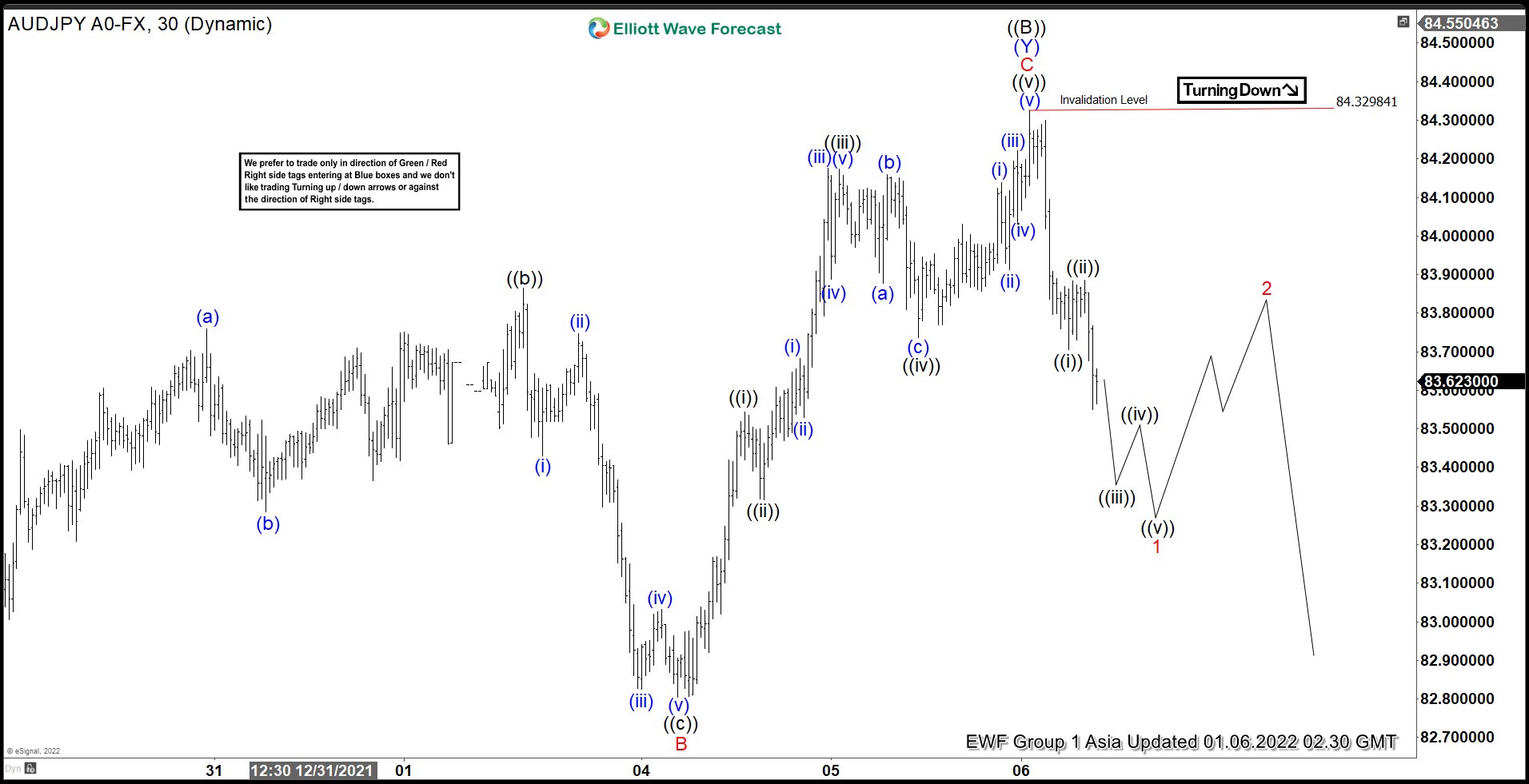
Technical Outlook and Review
DXY:
On the H4, prices are on bearish momentum and abiding to our bearish channel. We see the potential for a dip from our 1st resistance at 96.367 in line with 100% Fibonacci extension and 61.8% Fibonacci retracement towards our 1st support in line 95.88 with 61.8% Fibonacci retracement. Our bearish bias is further supported by MACD, which is showing bullish momentum.
Areas of consideration:
- H4 time frame, 1st resistance at 96.467
- H4 time frame, 1st support at 95.88
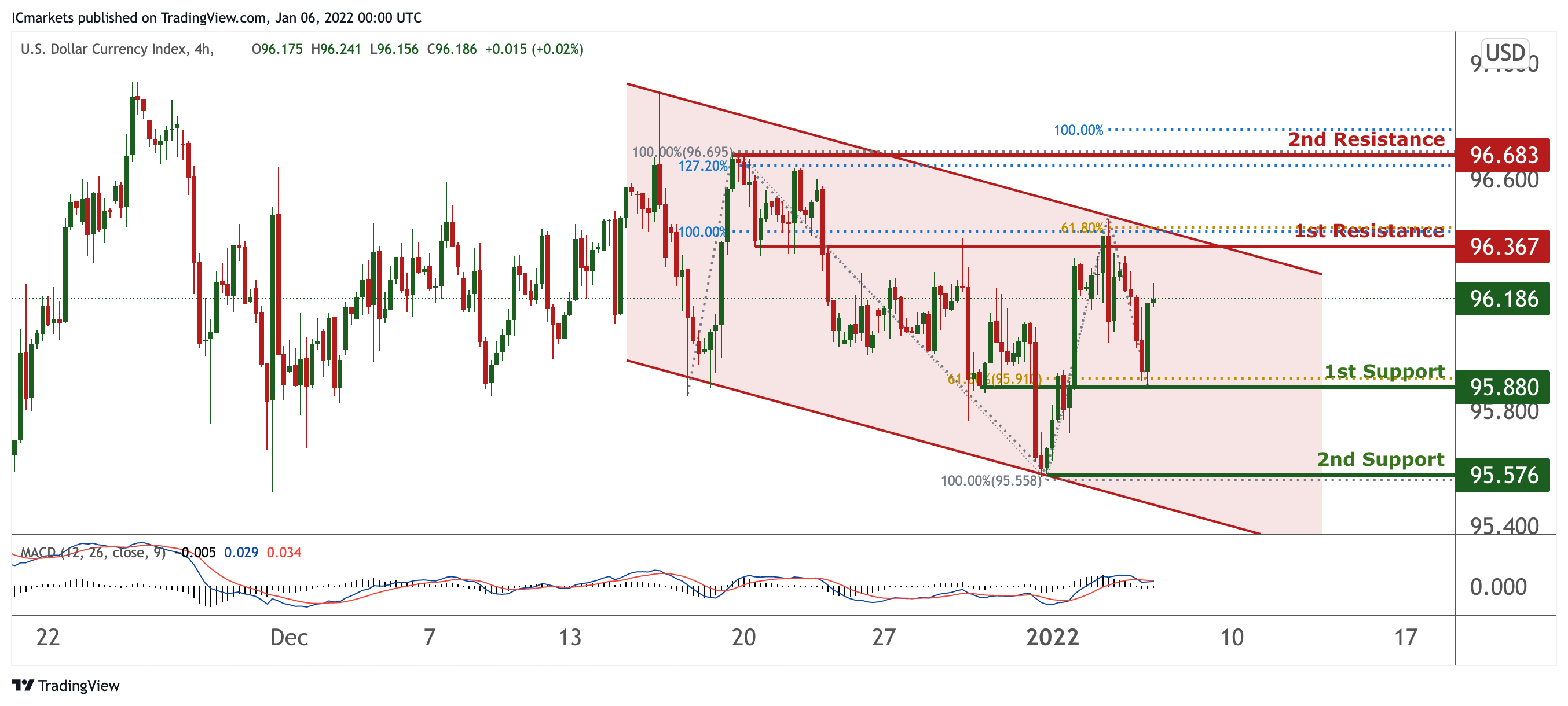
XAU/USD (GOLD):
On the H4, prices are on bullish momentum and consolidating in a triangle pattern. We see the potential for further upside from our 1st support at 1807.653 in line with 61.8% Fibonacci extension towards our 1st resistance at 1824.710 in line with 78.6% Fibonacci extension. Prices are trading our MA and also ichimoku clouds, and RSI are showing bullish momentum, further supporting our bullish bias. Alternatively, our stop loss will be placed at 2nd support at 1906.510 in line with 61.8% Fibonacci retracement.
Areas of consideration:
- H4 1st support at 1807.653
- H4 1st resistance at 1824.710
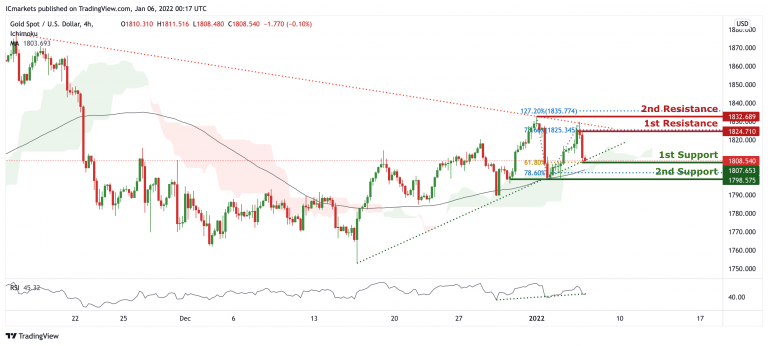
GBP/USD
On the H4 chart, price is currently heading towards the first resistance level of 1.36029 which is also 100% Fibonacci projection and 61.8% Fibonacci retracement. Price can potentially dip to the 1st support level of 1.34588 which is also 23.6% Fibonacci retracement and 100% Fibonacci projection. Our bearish bias is supported by the stochastic indicator as it is near resistance level.
Areas of consideration:
- H4 1st resistance at 1.36029
- H4 1st support 1.34588
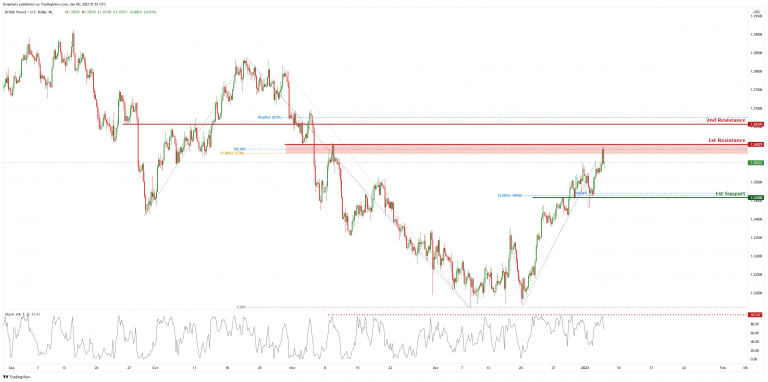
USD/CHF
In reference to yesterday’s analysis, prices are on bearish momentum and abiding to our descending trendline. We see the potential for a sell entry at 0.91855 in line with 78.6% Fibonacci retracement and 61.8% Fibonacci extension towards our 1st support at 0.91448 in line with 78.6% Fibonacci extension. Prices are trading below our MA and also facing resistance crossing the Ichimoku clouds, further supporting our bearish bias.
Areas of consideration:
- Watch 1st Support at 0.91448
- Watch 1st Resistance at 0.91855
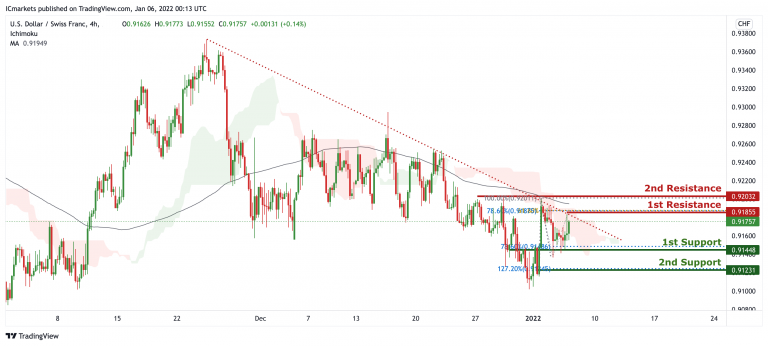
EUR/USD :
On the H4 chart, price is abiding by an ascending trendline and is near 1st support level of 1.12783 which is also 50% Fibonacci retracement and 78.6% Fibonacci projection. Price can potentially go to the 1st resistance of 1.13854 which is also 100% Fibonacci projection and 38.2% Fibonacci retracement. Our bullish bias is supported by the ichimoku cloud indicator
Areas of consideration :
- H4 1st support at 1.12783
- H4 1st resistance at 1.13854
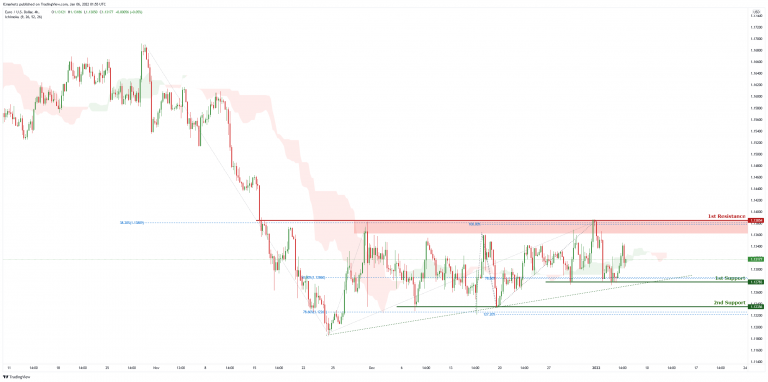
USD/JPY
On the H4 timeframe, price is abiding to an ascending trendline and showing bullish momentum. We can expect further bullish continuation from our 1st support at 115.838 in line with 38.2% Fibonacci retracement towards our 1st resistance at 116.369 in line with 100% Fibonacci retracement and 127.2% Fibonacci extension. Our bullish bias is further supported by prices trading above our MA and also Ichimoku clouds.
Areas of consideration:
- H4 1st resistance level 116.369
- H4 1st support level 115.838
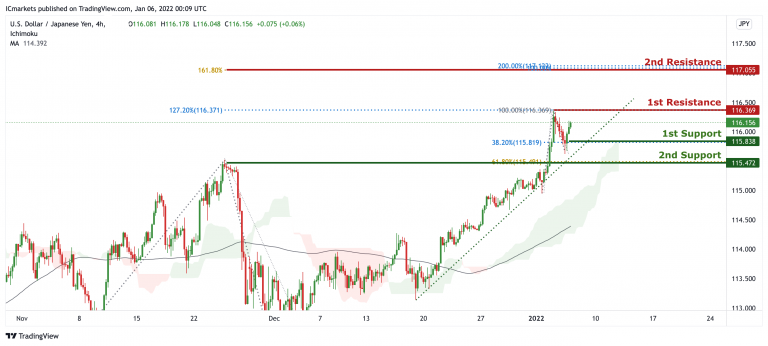
AUD/USD:
On the H4, with price approaching the support of the ichimoku cloud, we have a bullish bias that price will rise to our 1st resistance at 0.72765 which is in line with horizontal swing high resistance, 50% Fibonacci retracement and 127.2% Fibonacci extension from 1st support at 0.71844, which is in line with horizontal overlap support. Alternatively, price may break 1st support structure and head for 2nd support at 0.71162, which coincides with horizontal overlap support and 78.6% Fibonacci retracement level .
Areas of consideration:
- H4 1st Support level 0.71844
- H4 1st resistance level 0.72765
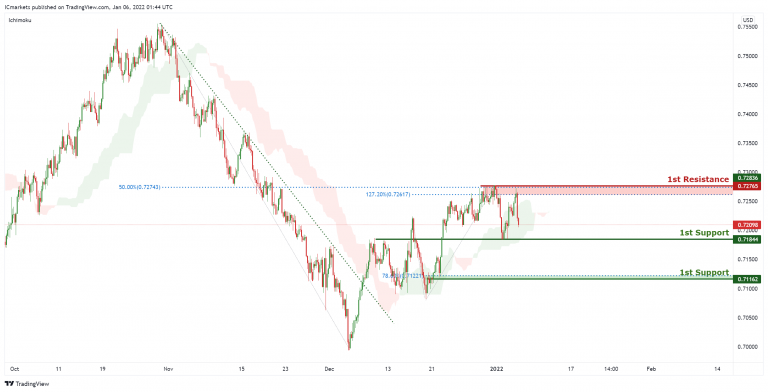
NZD/USD:
On the H4, prices are on bullish momentum and consolidating in a wedge pattern. We see the potential for further bullish movement from our 1st support at 0.67892 in line with 61.8% Fibonacci extension and 61.8% Fibonacci retracement towards our 1st resistance at 0.68569 in line with 127.2% Fibonacci extension and 100% Fibonacci extension. Prices are trading above our MA and also within the area of ichimoku clouds support, further supporting our bullish bias. Alternatively, our stop loss will be placed at 2nd support at 0.67395 in line with 100% Fibonacci extension.
Areas of consideration:
- H4 time frame, 1st resistance at 0.68569
- H4 time frame, 1st support at 0.67892
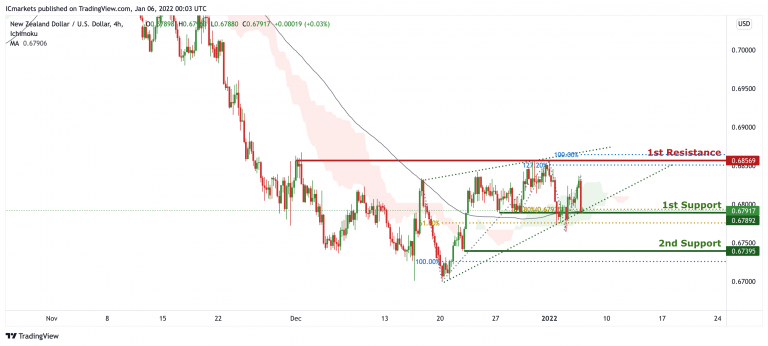
USD/CAD:
On the H1, with price moving above the ichimoku cloud, we have a bullish bias that price will rise to our 1st resistance at 1.28111 which is in line with horizontal swing high resistance and 127.2% Fibonacci extension from 1st support at 1.27331, which is in line with horizontal overlap support and 38.2% Fibonacci retracement level. Alternatively, price may break 1st support structure and head for 2nd support at 1.26735, which coincides with horizontal swing low support.
Areas of consideration:
- H4 time frame, 1st support at 1.27331
- H4 time frame, 1st resistance at 1.28111
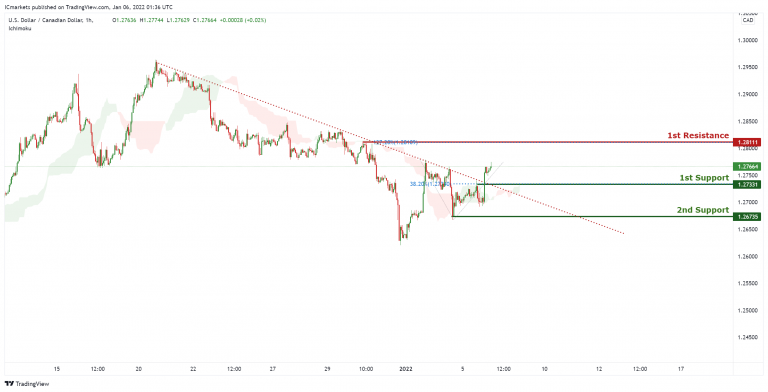
OIL:
On the H4, with price moving above the ichimoku cloud, we have a bullish bias that price will rise to our 1st resistance at 82.83 which is in line with horizontal swing high resistance and 127.2% Fibonacci extension from 1st support at 79.51, which is in line with horizontal overlap support and 23.6% Fibonacci retracement level. Alternatively, price may break 1st support structure and head for 2nd support at 76.76, which coincides with horizontal overlap support and 38.2% Fibonacci retracement level .
Areas of consideration:
- H4 time frame, 1st resistance of 82.83
- H4 time frame, 1st support of 79.51
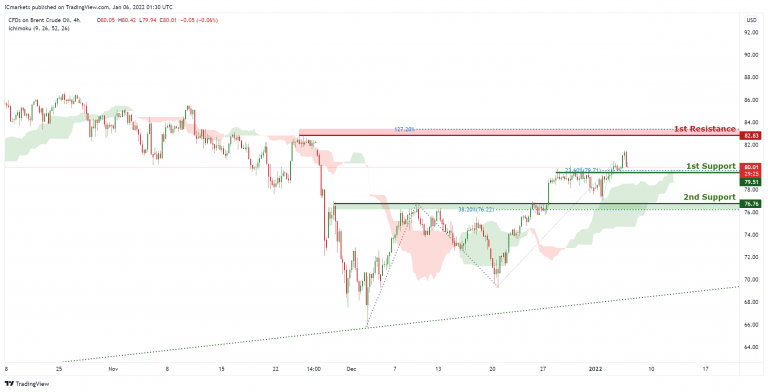
Dow Jones Industrial Average:
On the H4, with price moving above the ichimoku cloud, we have a bullish bias that price will rise to our 1st resistance at 36861 which is in line with horizontal swing high resistance from 1st support at 36189, which is in line with horizontal overlap support and 32.8% Fibonacci retracement level. Alternatively, price may break 1st support structure and head for 2nd support at 35415, which coincides with horizontal overlap support and 61.8% Fibonacci retracement level .
Area of consideration:
- 4H resistance at 36861
- 4H support at 36189
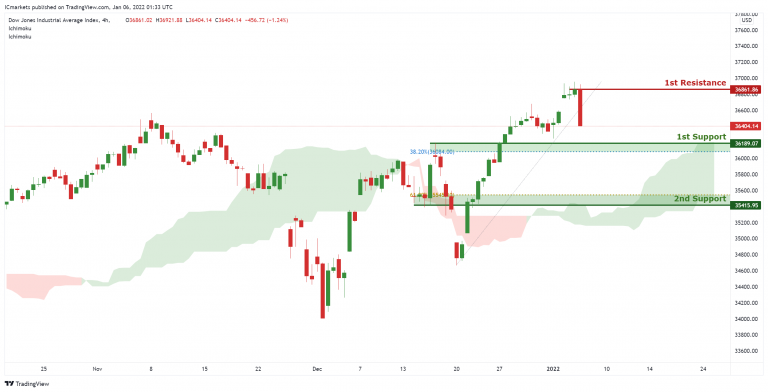
Crude Oil Price Surges, Next Hurdle At $80
Key Highlights
- Crude oil price started a fresh increase from the $72.00 support zone.
- It broke a couple of bearish trend lines near $76.00 and $77.00 on the 4-hours chart of XTI/USD.
- EUR/USD is still struggling near the 1.1380 resistance zone.
- The US ISM Services Index could decline from 69.1 to 66.9 in Dec 2021.
Crude Oil Price Technical Analysis
This week, crude oil price started a major increase from the $68.00 zone against the US Dollar. It broke many hurdles near $70.00 and $72.00 to move into a positive zone.
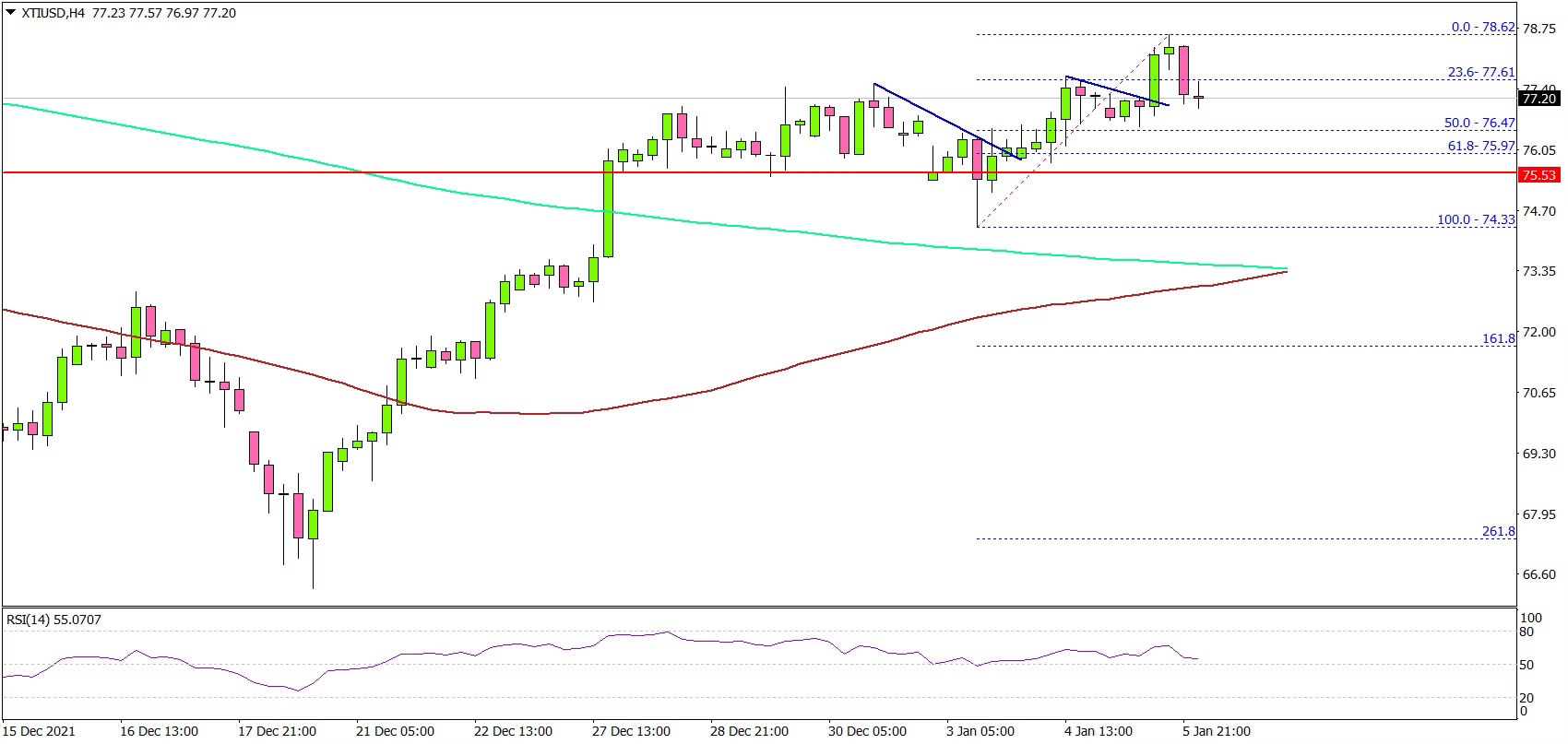
Looking at the 4-hours chart of XTI/USD, the price gained pace above the $74.00 level, the 100 simple moving average (4-hours, red) and the 200 simple moving average (4-hours, green).
There was also a break above a couple of bearish trend lines near $76.00 and $77.00. The price is now showing positive signs above the $76.50 level. It even spiked above the $78.00 level. If the bulls remain in action, there are chances of a move towards the $80.00 level.
The next major resistance is near the $82.00 level. An immediate support on the downside is near the $76.50 level. The first major support is near $75.50. Any more losses could open the doors for a move towards the $73.20 support.
Looking at EUR/USD, the pair is still struggling to gain momentum for a clear move above the 1.1380 and 1.1400 levels.
Economic Releases to Watch Today
- German Consumer Price Index for Dec 2021 (YoY) (Prelim) – Forecast +5.1%, versus +5.2% previous.
- German Consumer Price Index for Dec 2021 (MoM) (Prelim) – Forecast +0.4%, versus -0.2% previous.
- US Initial Jobless Claims - Forecast 197K, versus 198K previous.
- US ISM Services Index for Feb 2021 – Forecast 66.9, versus 69.1 previous.