Sample Category Title
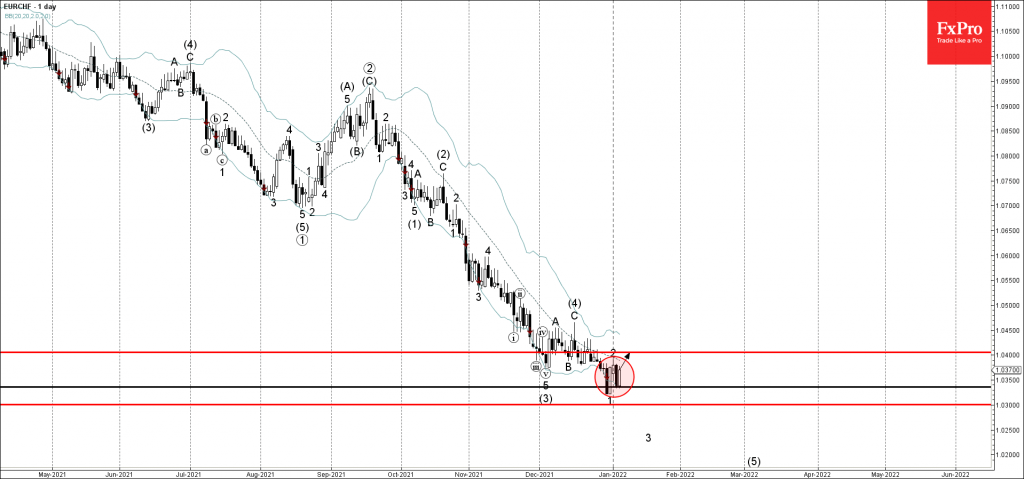
EURCHF Wave Analysis
- EURCHF reversed from support zone
- Likely to rise to resistance level 1.040
EURCHF currency pair recently reversed up from the support zone lying at the intersection of the key support level 1.0335 (which stopped the previous minor impulse wave 1) and the lower daily Bollinger Band.
The upward reversal from this support zone stopped the earlier short-term impulse waves 3 and (3).
Given the strength of the aforementioned support zone – EURCHF currency pair can be expected to rise further toward the next resistance level 1.040.
FOMC Minutes Reveal Greater Urgency to End Emergency-Level Monetary Policy
The minutes from the December 14-15, 2021 Federal Open Market Committee (FOMC) meeting showed that members are feeling the push to end pandemic-induced support.
On the overall economic outlook, members felt more confident in the recovery, highlighting continued strength in the labor market. The members noted "a number of signs that the U.S. labor market was very tight, including near-record rates of quits and job vacancies, as well as a notable pickup in wage growth."
On the persistence of high inflation caused by supply-side factors, FOMC members "noted that supply chain bottlenecks and labor shortages continued to limit businesses' ability to meet strong demand. They judged that these challenges would likely last longer and be more widespread than previously thought. Participants generally expected global supply chain bottlenecks to persist well into next year at least."
During the December meeting, FOMC members voted to speed up the taper of the Fed's Quantitative Easing (QE) program. In the minutes, they stated that the "ongoing pace of net asset purchases was no longer necessary…[given]…elevated inflation pressures and the strengthening labor market".
Key Implications
It is clear that the U.S. economy no longer needs emergency levels of monetary policy support. Economic output continues to accelerate and the labor market is heating up. This economic strength alone should maintain inflation at elevated levels. Layer on the disruption to global supply chains caused by the Omicron variant and we have the necessary ingredients to further stoke inflation. This is why the Fed announced that it will hasten the taper of its QE program. It is also why the members have significantly pulled forward the start of rate hikes this year.
Treasury yields have continued to rise since the Fed's December meeting. The 2-year yield is now at 0.82% (up 22 basis points) and the 10-year yield is at 1.70% (up nearly 35 basis points from the December low). At the same time, equity markets continue to surge higher, with the Dow and S&P 500 riding the Santa Claus rally to new all-time highs. The threat of tighter financial conditions caused by higher policy rates clearly isn't enough to dent investor optimism on risk assets.
Eco Data 1/6/22
[php_everywhere instance="1"]
US oil inventories dropped -2.1m barrels, WTI accelerating as rally resumes
US commercial crude oil inventories dropped -2.1m barrels in the week ending December 31. At 417.9m barrels, oil inventories are about -8% below the give year average for this time of year. Gasoline inventories rose 10.1m barrels. Distillate rose 4.4m barrels. Propane/propylene dropped -0.7, barrels. Total commercial petroleum inventories rose 10.2m barrels.
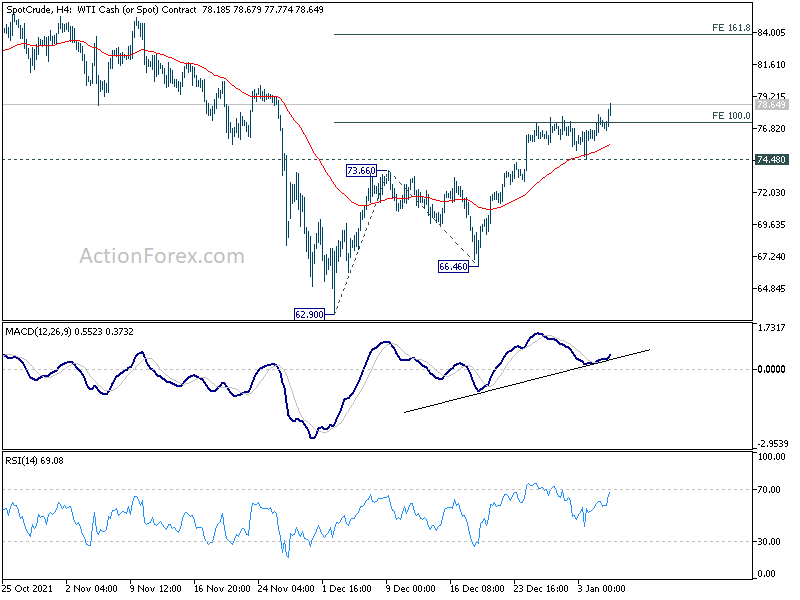
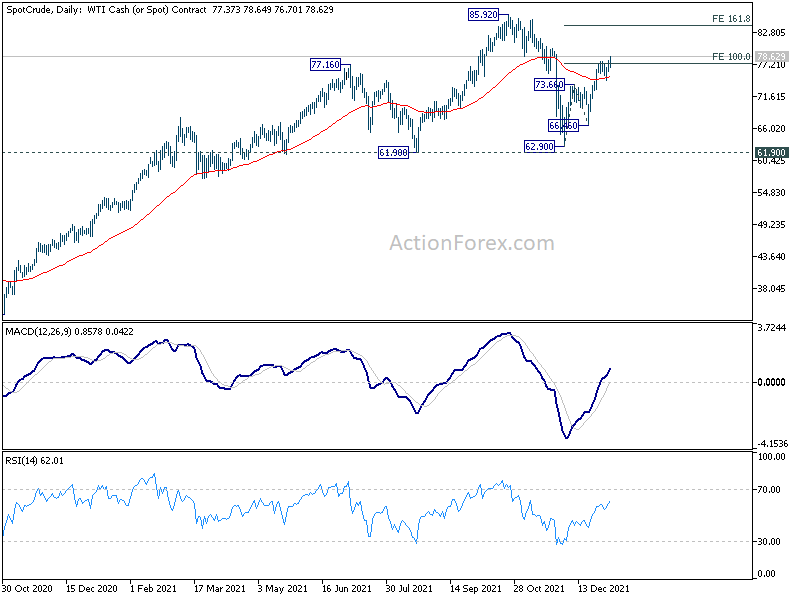
WTI crude oil rises further after the release, as rally from 62.90 resumed. 100% projection of 62.90 to 73.66 from 66.46 at 77.22 is considered firmly taken out. Further rise is expected as long as 74.48 support holds. WTI is likely in another round of upside acceleration to 161.8% projection at 83.86, which is close to 85.92 high.
For now, we're not expecting a break of 85.92 yet. We'd expect at least one more down leg before the corrective pattern from there completes. Hence, we'd look for topping between 83.86/85.92. But we'll see.
Pound Edges Higher on Johnson Covid Remarks
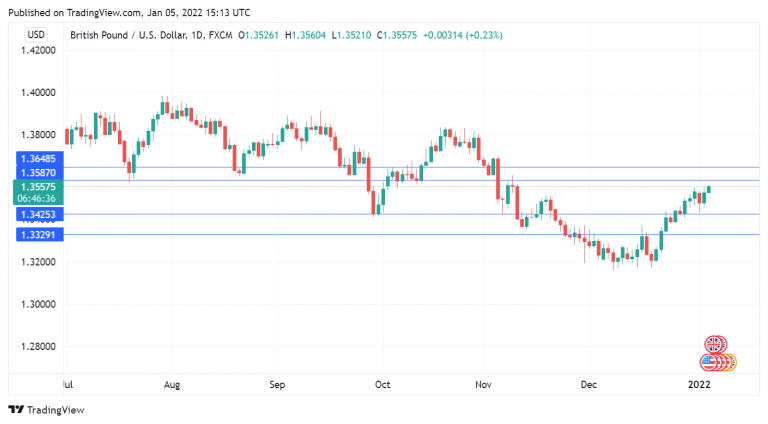
The British pound has posted slight gains on Wednesday. GBP/USD rose to 1.3557 on Tuesday, marking a 7-week high.
Johnson says no to further restrictions
The British pound ended 2021 on a strong note, gaining more than 2% in the last two weeks of the year. Higher risk sentiment led to a rotation out of US dollars and the risk-sensitive pound made strong inroads against the safe-haven US dollar. This week has seen US treasury yields rise, also a result of confidence in the markets. This has given the US dollar some strength, although the pound is holding its own after positive comments from UK Prime Minister Boris Johnson that the government plans to ‘ride out’ the Omicron wave without further restrictions.
The UK has recorded more than 200 thousand news cases of Omicron on Tuesday, but Johnson has argued that Omicron is less severe than previous variants, and with the rollout of booster vaccines, the country could keep schools and businesses open and live alongside Omicron. The markets are watching with fingers crossed, hoping that Johnson’s stance will prove successful in the face of skyrocketing Omicron cases.
Fed to double taper, raise rates
The Federal Reserve is poised to shift in a hawkish direction, after finally admitting that high inflation is not going away anytime soon. The Fed plans to double the tapering of its USD 120 billion bond purchase programme from 15 billion dollars to 30 billion dollars at the January meeting. This will be followed by a rate hike lift-off, perhaps as early as March. Higher rates have become imperative due to red-hot inflation, which is currently running at a clip of 6.8%, its highest level in 40 years. The Fed dot plot at the December meeting indicated that policymakers plan on two rate hikes of 0.25% in 2022, but the markets, which are more hawkish, have priced in three rate hikes. With the US economy performing well, both the Fed and the markets are confident that the economy is resilient enough to withstand a series of rate hikes in 2022.
GBP/USD Technical Analysis
- GBP/USD has support at 1.3426 and 1.3329
- There is resistance at 1.3585. Above, there is resistance at 1.3647
Sunset Market Commentary
Markets
Yesterday’s dynamic trading session, especially on US bond markets, was in stark contrast with today’s. The US yield curve bear flattens marginally with changes ranging from +1.4 bps (2y) to +0.3 bps (10y) with most of the “move” occurring following a strong ADP jobs report. Employment rose with 807k in December vs the 410k consensus. It’s the second strongest increase of 2021. The bulk was situated in the services sector (+669k) with all sectors posting job gains. Leisure & hospitality doesn’t feel the impact of Omicron and (voluntary) social distancing (yet?) and add 246k more jobs. Trade, transportation & utilities and professional and business services come in at a second (138k) and third (130k) place. German yields rose in sympathy but only temporarily. The curve flattens with yields down 1.4 bps at the ultralong end, unaffected by ECB Governing Council Kazaks saying no one should doubt that the central will raise rates or cut support if the inflation outlook strengthens further. The hawkish camp within the ECB is still a minority but becomes ever more vocal. Previously, Dutch member Knot said net bond-buying could be wound down by year-end to raise rates early in 2023. Belgian board member Wunsch earlier said the inflation projections show the ECB is “essentially at target”. Peripheral 10y bond yield spreads vs Germany show resilience. Spain and Portugal outperform (-3 bps), Greece lags (+3 bps) peers. Italy (-2bps) successfully launched a new benchmark 30y bond, selling €7bn at BTPS+6 vs guidance of BTPS+8. Books amounted above €55bn.
In FX space, the dollar inches lower vs most majors though moves remain contained. The trade-weighted DXY is testing the 96 big figure, down from 96.3 at the open. EUR/USD is headed north, going from 1.128 to 1.1335 at the time of writing. USD/JPY eases sub 116 after closing north of that level for the first time since 2017. The Norwegian krone is one of the better performers, attacking EUR/NOK 10 again. Rising oil prices (see headline below) are a boon to the commodity currency. Sterling retreats somewhat after steaming through to a new recovery high at EUR/GBP 0.834. The currency pair is filling bids in the 0.836 area. The zloty underperforms peers in the CE area during NBP’s Glapinski press conference on yesterday’s rate hike. He said the central bank still has room to raise rates but won’t “quell CPI at any price”. He also said some members didn’t want more hikes. EUR/PLN advances a tad to 4.57.
News Headlines
The Turkish central bank is ‘guiding’ banks and investors not to park money in dollars in order to avoid further pressure on the lira, Bloomberg reported. According to ‘sources’ the CBRT asked lenders to report big amounts of USD purchases that might impact the lira negatively. The CBRT is also said to prefer corporates to hedge against lira losses via the futures markets or via the CB’s non-delivered forward market. The report wasn’t confirmed by the CBRT. It comes after recent central bank data showed that Turkish investors still keep a record amount of foreign currency deposits late December despite measures put in place to protect local TRY deposit holders from a potential further decline of the lira. The lira today weakens slightly to trade at EUR/TRY 15.31
According to the Central Statistics Office of Hungary (KSH), the employment rate in November declined from 3.9% to 3.7%. Markets expected a more modest decline. In this respect, the unemployment rate declined back toward the levels that were in place at the onset of the corona crisis early 2020. On a monthly basis, 9400 fewer people were unemployed compared to October and 10.200 less than in November 2020. The further decline in the employment rate indicates a further tightening of labour market conditions and also suggests that domestic factors might become a more important factor for Hungarian inflation as the MNB takes a more aggressive anti-inflationary approach. The forint continues to perform well at the start of 2022. EUR/HUF currently trades near 361.75.
Eurozone Inflation to Ease Slightly; Bad News for Euro?
The flash inflation estimates for December will hit the market on Friday at 10:00 GMT. The headline rate is anticipated to edge lower, but remain extremely elevated. Upcoming data are not expected to offer the much needed positive relief for the euro, which had its worst year against the US dollar since 2015, as the European Central Bank (ECB) is unlikely to speed up its normalization plans.
Eurozone inflation is running hot
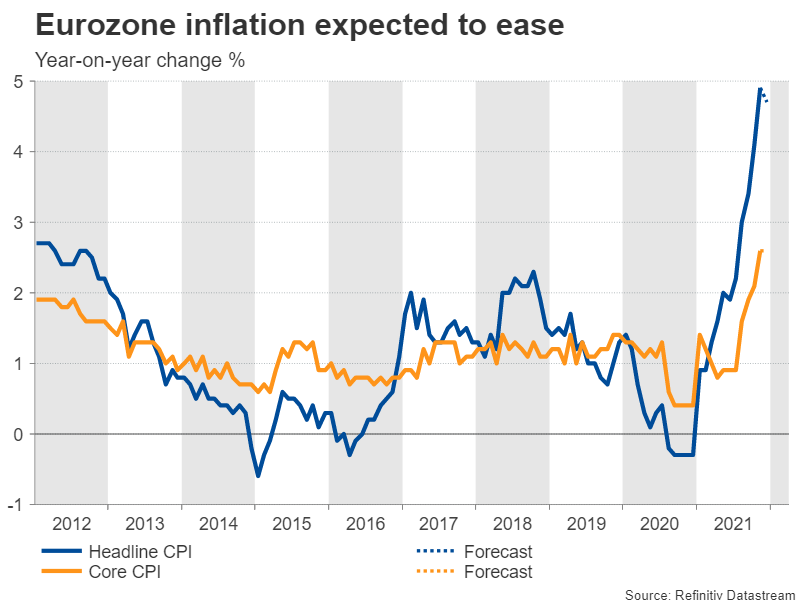
Inflationary pressures in the Eurozone have been spiraling, reaching in November their highest growth rate since 1991. This was mainly driven by supply bottlenecks and soaring energy prices, forcing businesses to pass the increasing costs to consumers. However, despite inflation being well above the symmetric target of 2%, the ECB looks reluctant to press hard on the tapering button.
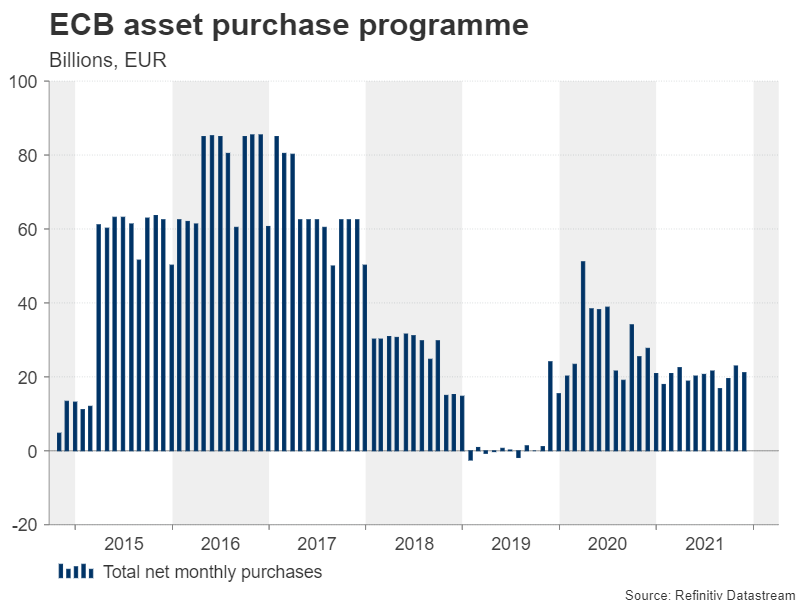
In its December meeting, the ECB vowed to hold down borrowing costs through 2022 and set out a plan to gradually wind down its asset purchases, while leaving the door open for reversing this decision. This has reaffirmed the interest rate path divergence with the BoE and the Fed, weighing on the euro’s future outlook.
Will the ECB remain patient?
The Eurozone’s economy has hit a speed bump as the Omicron variant, lockdowns and supply bottlenecks have reignited slowdown fears. This uncertain outlook and the risk of unraveling years of effort to revive the once anemic inflation in the euro area have made the ECB reluctant to commit to a normalization plan.
The central bank forecasted inflation to ease at 3.2% in 2022 before retreating below the price mandate in the subsequent years, backing the transitory inflation story. However, given the persistent global supply headwinds and the easing of current restrictions which could drive demand, those projections could prove too modest.
Has inflation peaked already?
Looking at the consensus estimates for Friday’s release, year-over-year inflation for December is expected to drop to 4.7% from 4.9%, while core inflation (excluding food and energy) is anticipated to remain steady at 2.6%. Therefore, inflation is expected to remain elevated despite its minor drop, which is attributed to lower energy prices.
The latest PMI report showed a modest alleviation in supply pressures, which was followed by a record increase in inventory purchases. This signals an easing in input costs and output prices, which could indicate that inflation may have passed its peak. In that case, traders may price out any possibility for a rate hike by the ECB for at least the next 12 months, pressuring the euro further.
Currently, the biggest risk for the Eurozone lies in the likelihood of further deterioration in supply chain from the rampaging Covid-19 cases. Therefore, future inflation spikes, which could force the ECB to turn significantly more hawkish, should not be ruled out.
Euro outlook not bright
Euro/dollar is currently consolidating at around 1.13, with not much potential for a significant upside in the coming months. Should the upcoming CPI figures disappoint, the pair could move towards its 1.118 support.
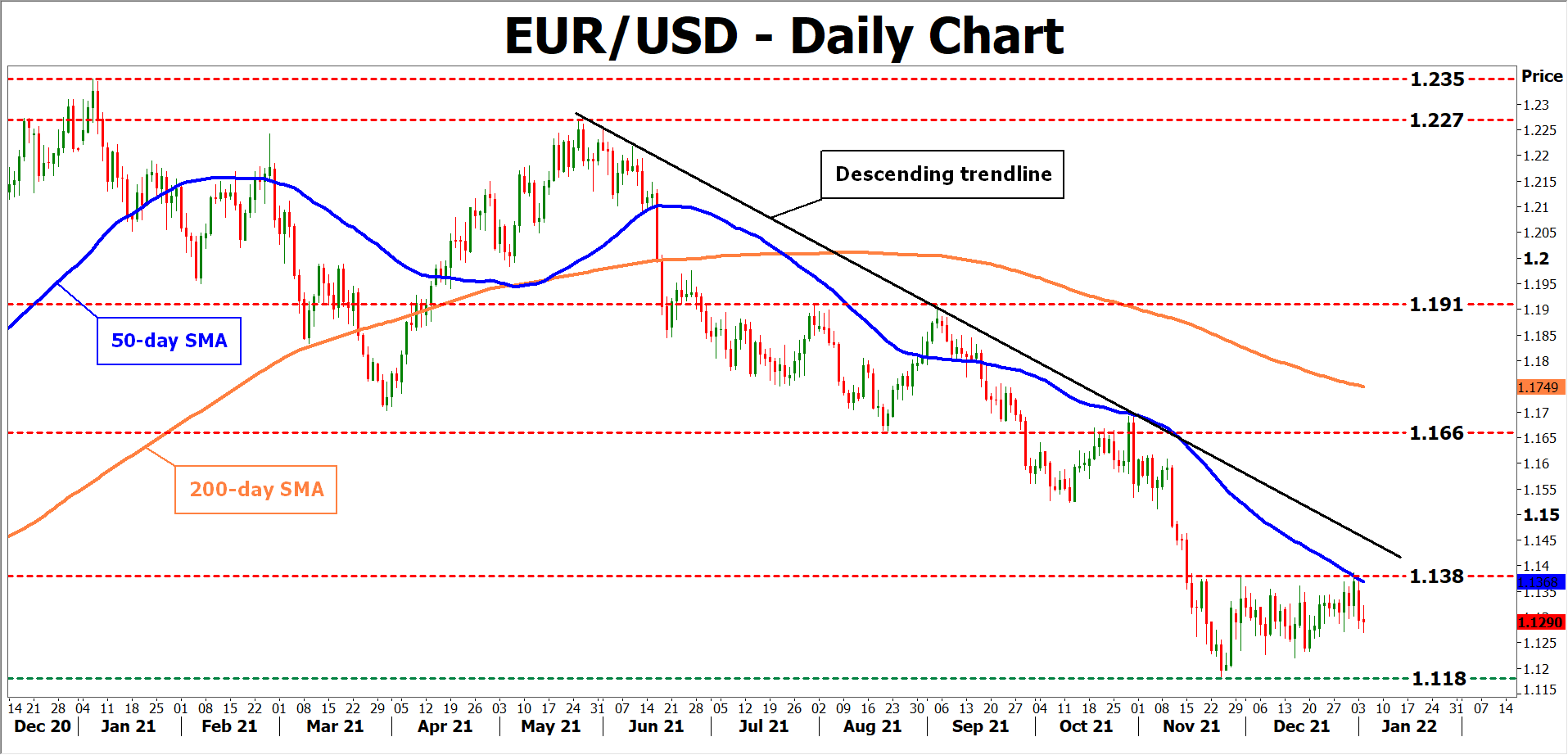
However, an unexpected pickup in the CPI reading, accompanied by hawkish comments from ECB policymakers, could provide the much needed appreciation for the euro. This could send the pair to test the nearest resistance region, which includes the 50-day simple moving average (SMA) and the 1.138 hurdle.
USD/CAD Analysis: Reveals New Support Zone
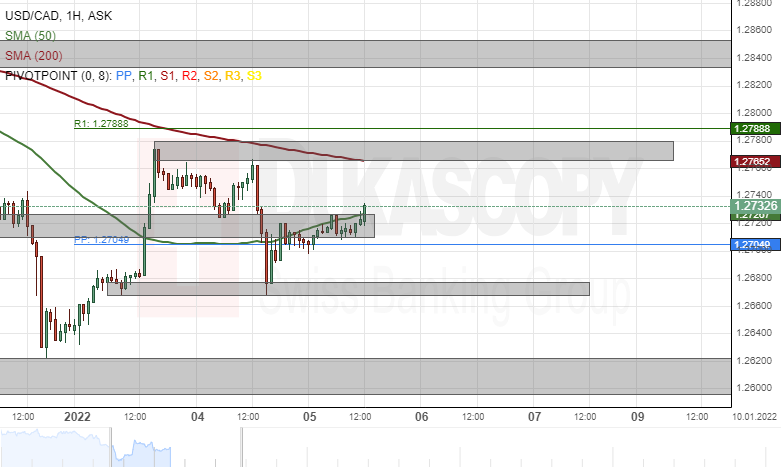
At mid-day on Tuesday, the USD/CAD declined and confirmed the existence of a support zone at 1.2668/1.2677. Meanwhile, the pair appeared to be almost ignoring the 50-hour simple moving average, the weekly simple pivot point and the previous low and high-level zone at 1.2710/1.2730.
A surge of the pair might find resistance in this week's high levels near 0.7265/0.7280. In addition, note the 200-hour simple moving average near 1.2770. Above the zone, the weekly R1 simple pivot point could act as resistance at 1.2789.
On the other hand, a decline would have to pass the 1.2668/1.2677 zone, before aiming at 1.2595/1.2620.
GBP/JPY Analysis: Surge Stops before 157.50
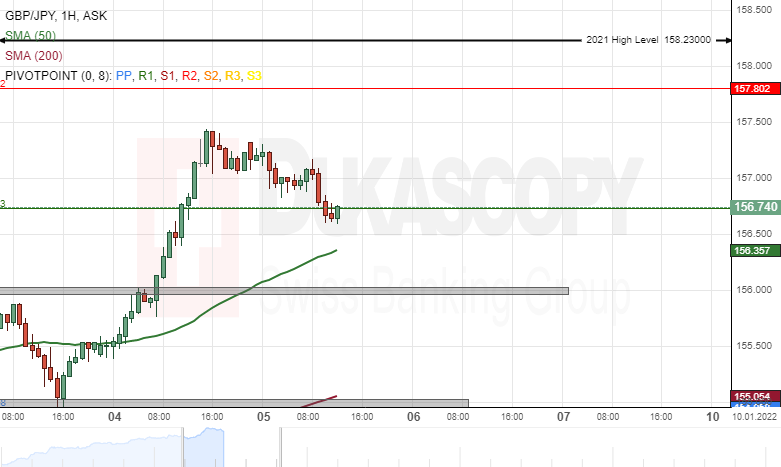
The surge of the GBP/JPY stopped at the 157.43 level, during late Tuesday's trading. By the start of Wednesday's European trading, the rate had retreated to trade below the 157.00 mark.
A continuation of the decline of the Pound against the Japanese Yen might look for support in the weekly R1 simple pivot point at 156.73. Below the pivot point, the combination of the 156.50 mark and the 50-hour SMA might stop a decline.
Meanwhile, a resumption of the surge would need to pass the 157.50 mark, before aiming at the weekly R2 simple pivot point at 157.80 and the 2021 high level at 158.23.
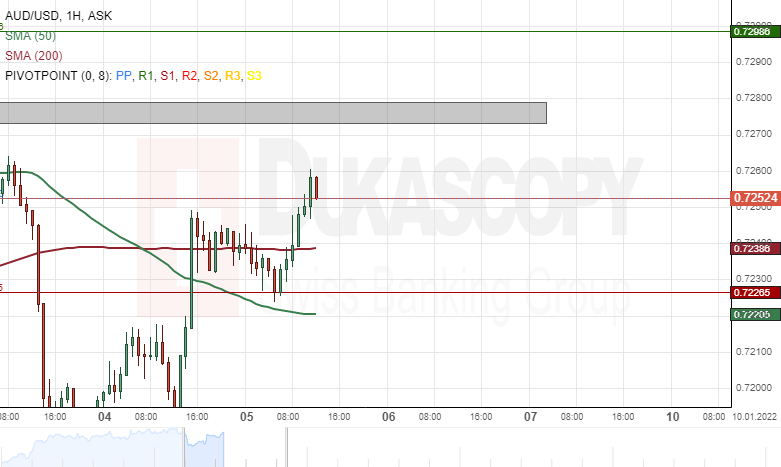
AUD/USD Analysis: Recovery Touches 0.7250 Level
On Tuesday, the rate conducted another decline to the September low and December high-level zone at 0.7170/0.7185, before starting a sharp recovery. By 16:00 GMT, the rate had already touched the 0.7250 level. The 0.7250 mark caused a minor decline, which found support in the weekly S1 simple pivot point at 0.7266.
If the rate passes the support of the weekly S1 simple pivot point at 0.7266, the 50-hour SMA near 0.7210 might stop a decline. Meanwhile, a move below these levels would have no support as low as the 0.7170/0.7185 zone.
However, a recovery of the Australian Dollar against the USD might find resistance in the 0.7250 mark and the weekly simple pivot point at 0.7252. Above these levels, the last week's high-level zone could be capable of stopping the Australian Dollar at 0.7273/0.7279.