

Sample Category Title
EUR/USD and GBP/USD Look Lower: Elliott Wave Analysis
Hawkish FED is causing a sharp reversal in the markets, with stocks coming down as US yields rise which makes USD very strong across the board. So we think that volatility is likely going to stay here because of Central banks policy divergences.
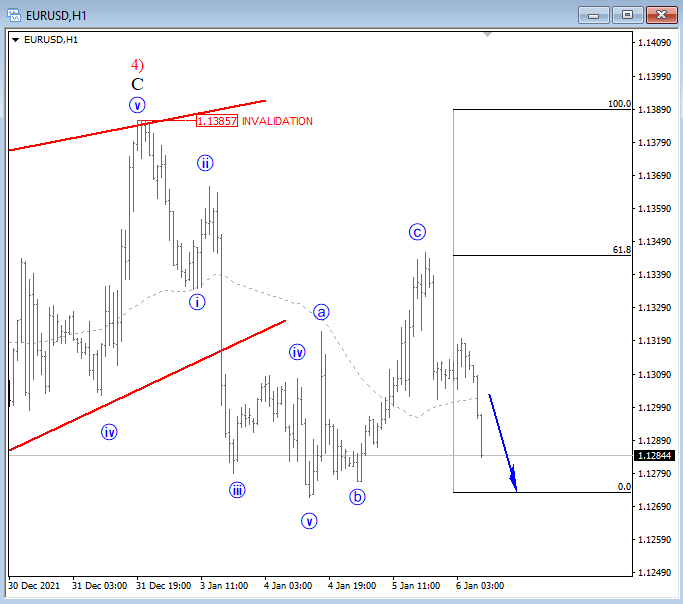
So one pair that we track closely is EURUSD for more weakness as ECB seems to be on the different side compared to FED. In fact, we see nice five wave drop from 1.1380 followed by only three-wave rally into 61.8% Fib so we assume that trend will stay bearish.
EUR/USD intraday Elliott Wave analysis
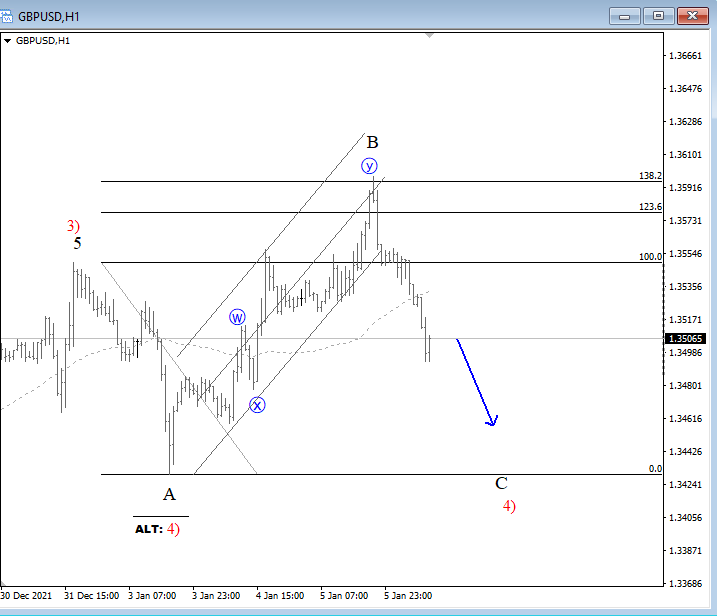
GBPUSD, Cable found a top yesterday, exactly at our Fib projected resistance area for wave B. We see sharp reversal and broken trendline which puts more weakness in play now for subwave C which can retrace even back to wave A levels for a flat formation.
GBP/USD intraday Elliott Wave analysis
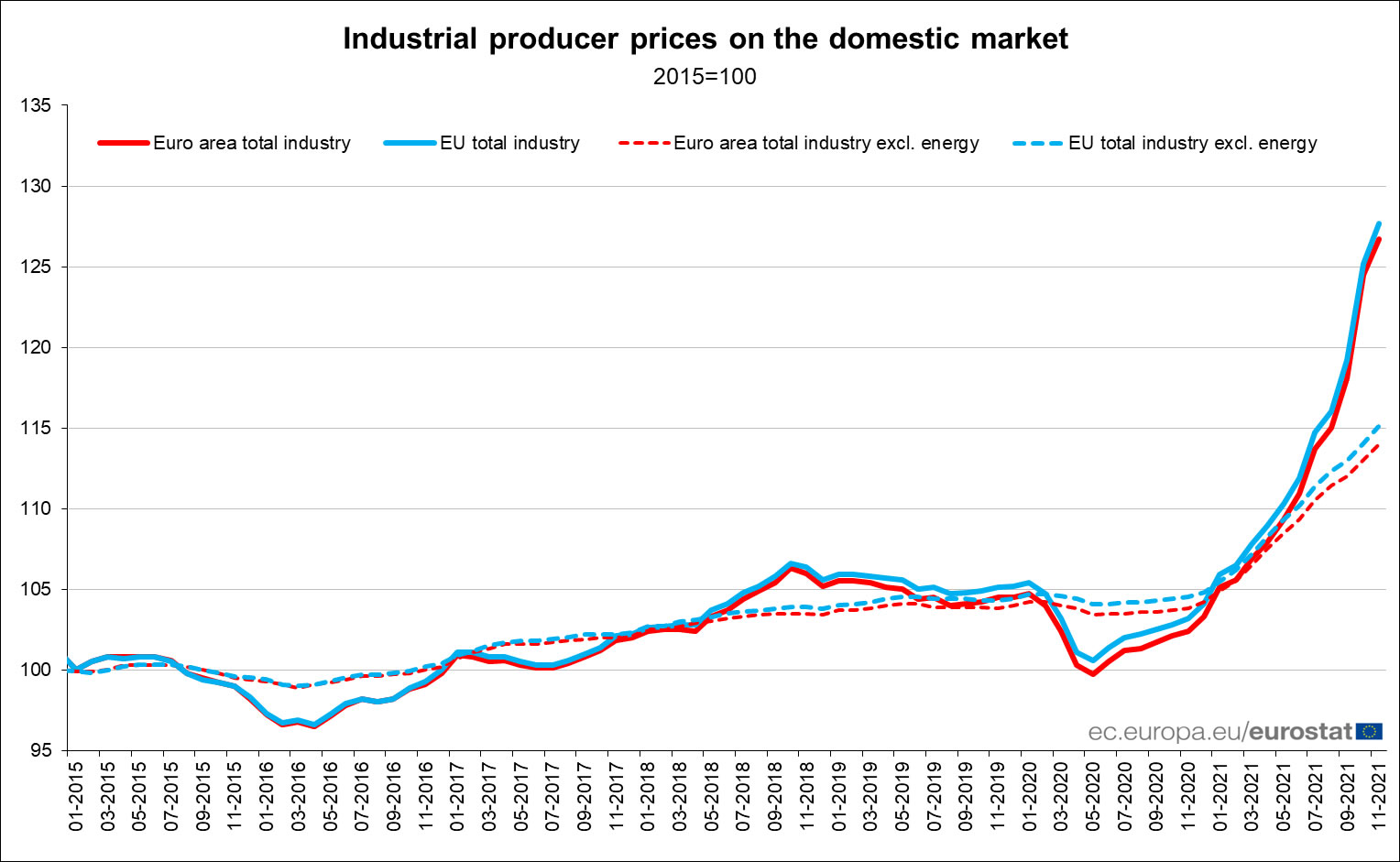
Eurozone PPI at 1.8% mom, 23.7% in Nov
Eurozone PPI rose 1.8% mom, 23.7% yoy in November, versus expectation of 1.2% mom, 22.9% yoy. For the month, industrial increased by 3.5% in the energy sector, by 1.5% for intermediate goods, by 0.6% for non-durable consumer goods, by 0.5% for durable consumer goods and by 0.4% for capital goods. Prices in total industry excluding energy increased by 0.9%.
EU PPI came in at 2.0% mom, 23.7% yoy. The highest monthly increases in industrial producer prices were recorded in Denmark (+10.3%), Bulgaria (+8.5%) and Romania (+7.3%), while the only decrease was observed in Ireland (-2.5%).
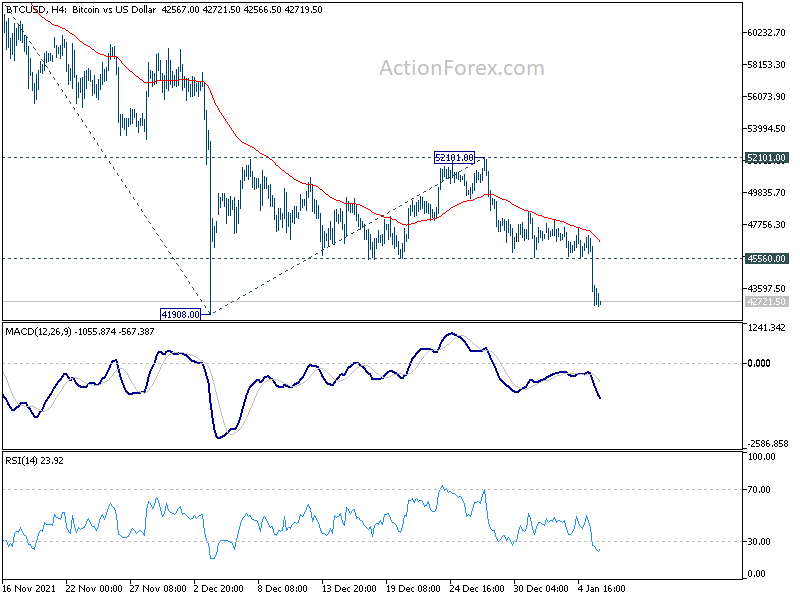
Bitcoin breaking down, 40k might only offer temporary support
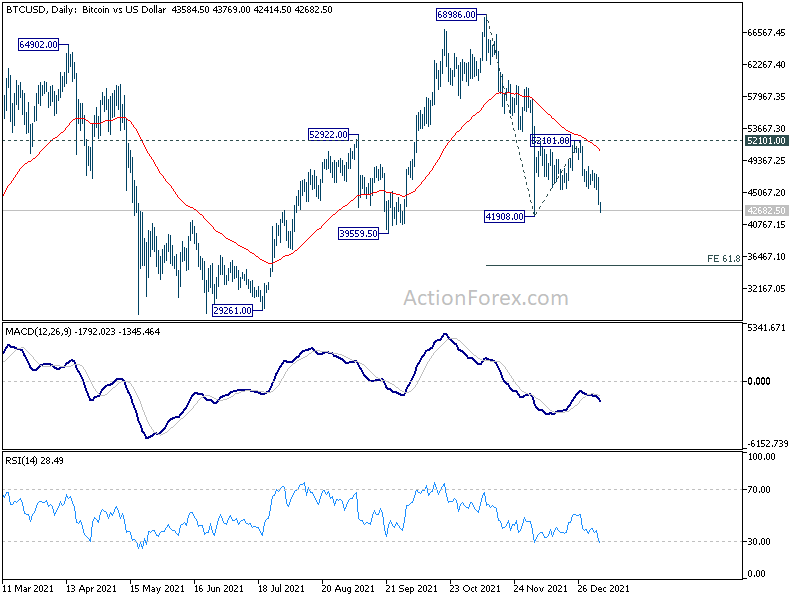
Bitcoin finally breaks down and it's now heading back to 41908 spike low. Prior rejection by 55 day EMA maintains near term bearishness and fall from 68986 is likely resuming. There might be some temporary support between 39559/41908, around 40k handle. But outlook will stay bearish as long as 52101 resistance holds.
We'd expect fall form 68986 to hit 61.8% projection of 68986 to 41908 from 52101 at 35366 before finding a bottom.
Equity Bulls Deflated by Hawkish Fed
Stock markets are limping into Thursday’s session in a frightened state after the minutes from the December Federal Reserve meeting pointed to a faster than expected hike in interest rates.
Asian stocks flashed red this morning following the heavy selloff on Wall Street overnight as hawkish signals from the FOMC minutes and spread of the Omicron variant sapped investor confidence. Gold has also found itself under pressure with prices struggling to keep above the psychological $1800 support level. In the FX space, the dollar appreciated as US Treasury yields jumped after the meeting minutes were released.
Given the market reaction to a more hawkish Fed, global equities certainly remain highly sensitive to increased rate hike expectations. With the US December jobs report around the corner, the atmosphere across the board could become tense and nervy as investors adopt a cautious stance. Whatever the outcome on Friday, the first trading week of 2022 has already kicked off with a bang.
It’s all about the US non-farm payrolls
All eyes are now firmly focused on December’s US jobs report which will be released on Friday. The pending data will be heavily scrutinised by investors for key insight into the health of the US labour market and wage growth.
Yesterday, the ADP Employment Report revealed that private sector employment surged by 807,000 in December. This figure smashed market forecasts and was a big jump from the 505,000 witnessed in November. Even though the ADP data is a poor predictor of the key non-farm payrolls report on Friday, markets may be readying themselves for a potential upbeat number. Consensus expects 425,000 jobs to have been created by the US economy last month, with the unemployment rate falling to 4.1% from 4.2%.
One thing to keep in mind is that the US jobs report is being released at a time when the Fed has signaled interest rate hikes may be more aggressive than expected, amid concerns over soaring inflation. The March Fed meeting is now very much “live” with an 80% chance of an interest rate hike. The general consensus at the Fed also appears to be emerging that the maximum employment goal is now within reach, so NFP may play a big part in validating this thinking.
Should the jobs report exceed market expectations, this is likely to boost confidence in the US economy and reinforce expectations that the Fed will raise interest rates in the Spring. Such a development may result in a stronger dollar while pressuring equity bulls and gold further. Alternatively, a massive payroll miss similar to November may raise questions over the health of the US economy and the Fed’s ability to aggressively raise rates.
Commodity spotlight – Gold
A stronger dollar, hawkish Federal Reserve, and rising treasury yields make a poisonous cocktail for gold. The precious metal is under pressure on the daily charts with prices struggling to keep above $1800 as of writing.
Where the precious metal closes the week is likely to be heavily influenced by the key US jobs data on Friday. A strong report could cripple gold bugs, opening a path lower towards $1786 and $1770. Should $1800 prove to be reliable support, prices may rebound back towards the $1810 and $1831.
UK PMI services finalized at 53.6, severe loss of momentum
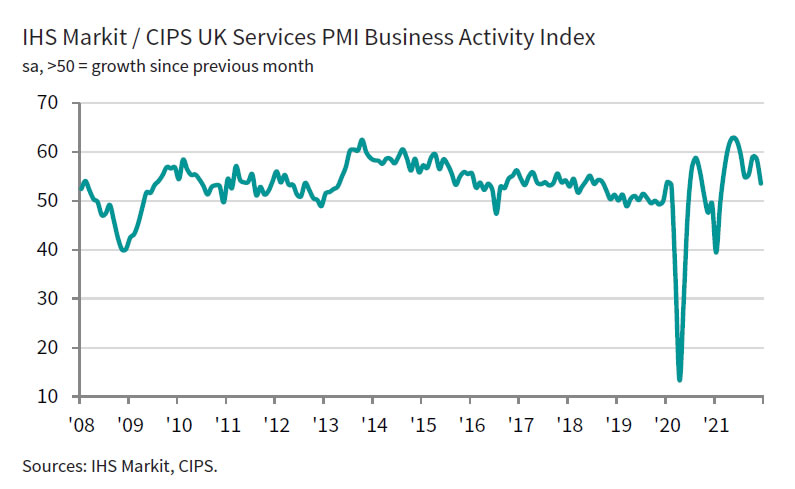
UK PMI Services was finalized at 53.6 in December, down from November's 58.5, lowest level since February. Markit said export sales were hard-hit by renewed pandemic. Service provides remained upbeat about year ahead prospects. PMI Composite was finalized at 53.6, down from prior month's 57.6.
Tim Moore, Economics Director at IHS Markit: "December data revealed a severe loss of momentum for the UK economy as many customer-facing businesses experienced a drop in demand due to escalating COVID-19 cases. Total new orders in the service sector increased at the weakest pace for 10 months. Mass cancellations of bookings in response to the Omicron variant led to a slump in consumer spending on travel, leisure and entertainment. Survey respondents also noted that renewed pandemic restrictions had slowed the recovery in business services.
Germany factor orders rose 3.7% mom in Nov, strong foreign orders
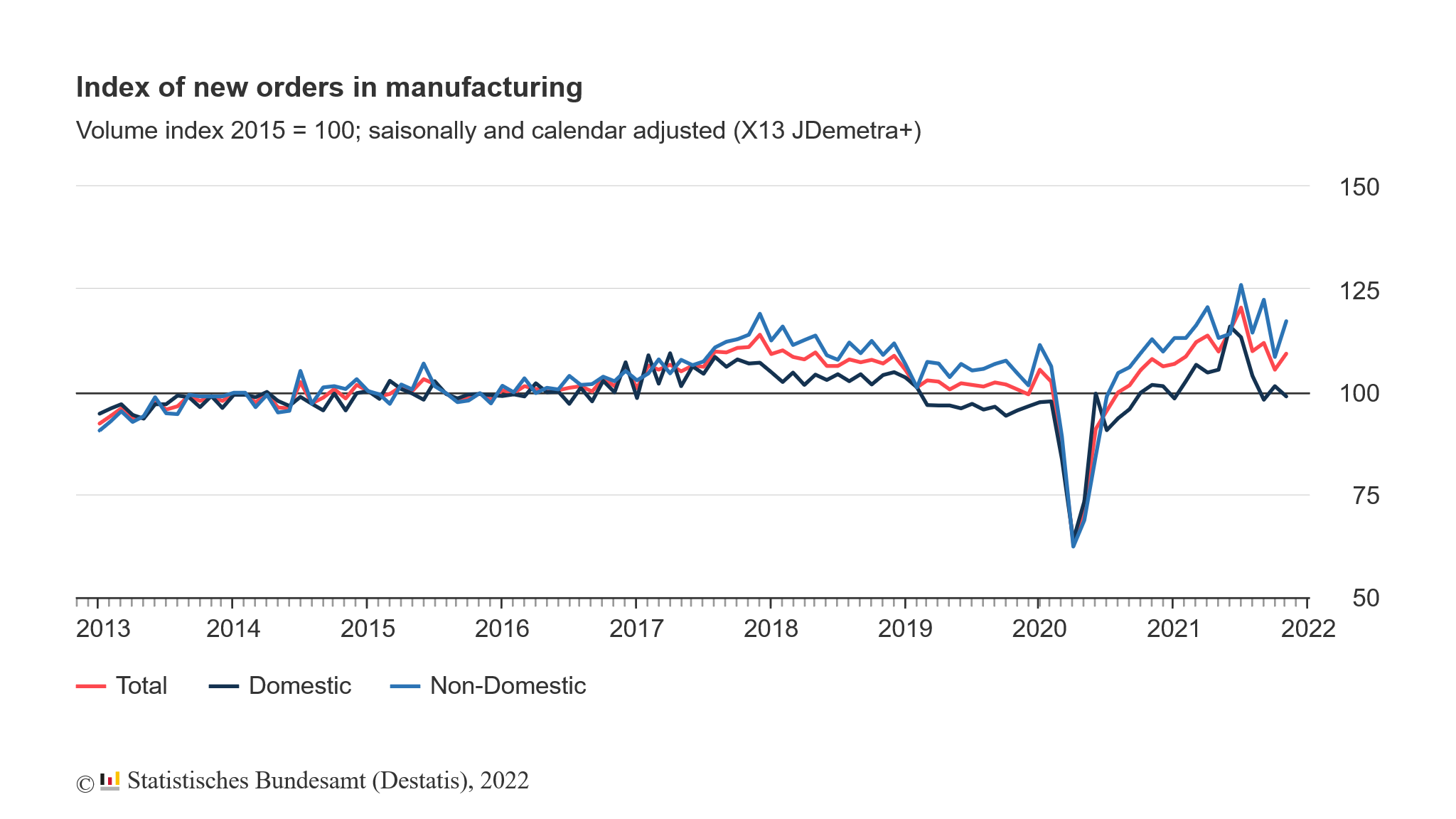
Germany factory orders rose 3.7% mom in November, better than expectation of 2.5% mom. Comparing with October, Largest increase in new orders (32.0%) was recorded in the manufacture of other transport equipment (aircraft, ships, trains etc.) for which extensive major orders were reported. New orders in the manufacture of motor vehicles, trailers and semi-trailers were up by 7.0%. Not including major orders, an 3.8% increase in new orders in manufacturing was recorded.
The strong growth in new orders was attributable to foreign orders which increased by 8.0%. New orders from the euro area rose by 13.1%. New orders from other countries amounted to 5.0% in the current month. Domestic orders went up 2.5% in November 2021 on the previous month.
Daily Technical Analysis
EUR/USD
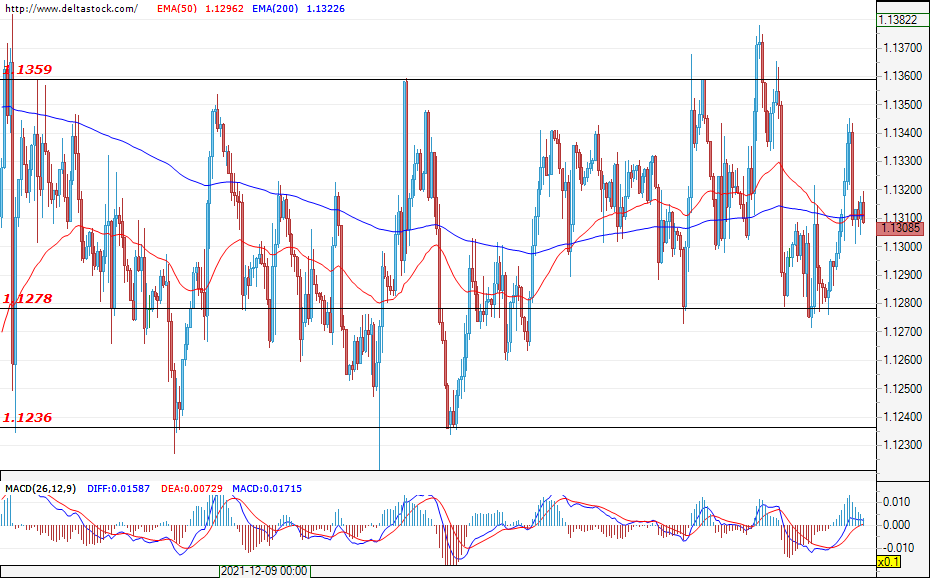
Current level - 1.1308
The situation with the single European currency remained unchanged at the beginning of today's session as the range move currently stays locked between 1.1278 and 1.1359. The forecast remains neutral, but today's announcement of the initial jobless claims data for the U.S. at 13:30 GMT could affect the volatility of the currency pair. Only a successful breach of one of the mentioned boundaries of the narrow range, however, could determine the future mood of investors. Of course, the non-farm payrolls change data for the U.S. (Friday; 13:30 GMT) will also be followed just as attentively.
USD/JPY
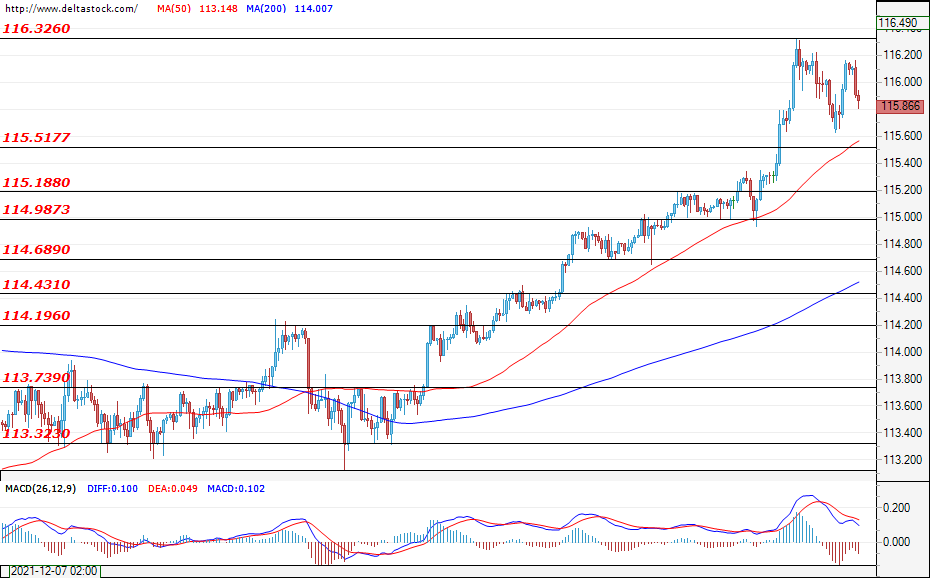
Current level - 115.86
At the time of writing, the currency pair is consolidating in the range between 115.51 - 116.32 as the inertia of the bulls was thwarted at the beginning of this year's trading. The current depreciation of the greenback against the yen could be seen as a corrective move unless the bears fail to overcome the support at 115.51. In the event of such a pessimistic scenario, we could witness a further deepening of the sell-off towards the support area at 115.18.
GBP/USD
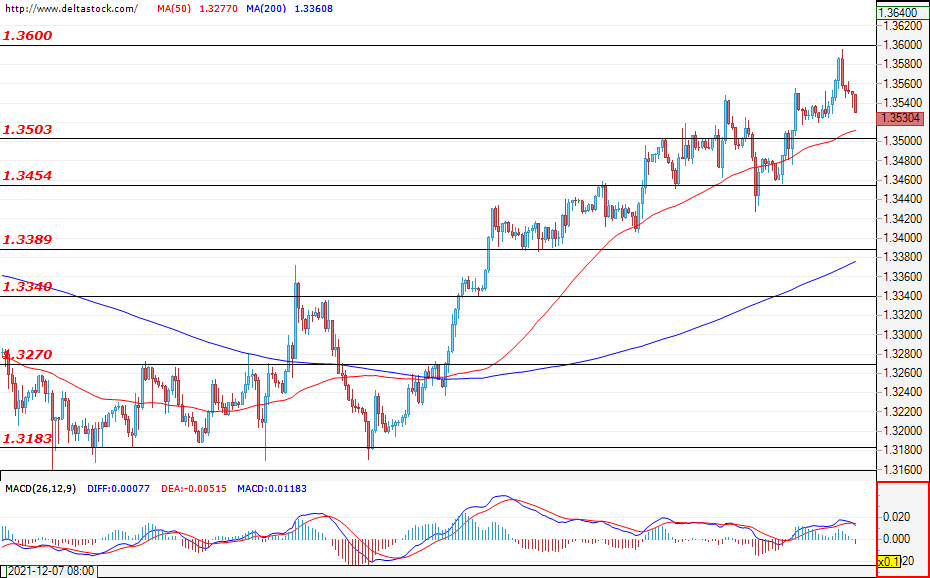
Current level - 1.3530
The test of the resistance zone at 1.3600 became a fact during the past session, but the bulls still failed to gather enough momentum to make the breakthrough happen. The subsequent decline towards the support zone at 1.3503 could be exacerbated if the bears take control. Such a pessimistic scenario is not ruled out as the next significant support area would be the level of 1.3389.
EUGERMANY40
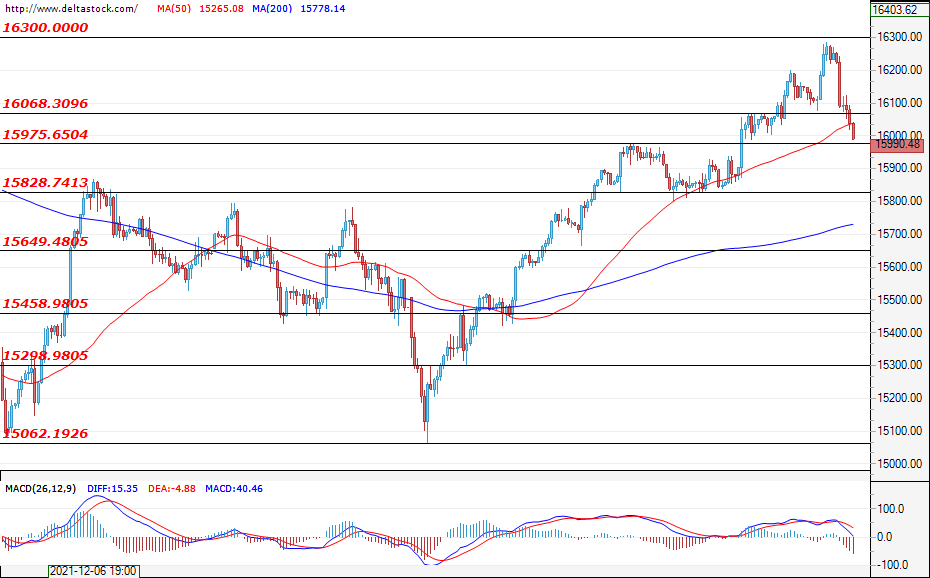
Current level - 15990
During the last trading session, the German index almost reached the record highs that it had previously scored at the middle of last year’s final quarter. However, the subsequent drop might turn out to be more than just a correction. At the time of writing, the index is just about to test the 15975 support zone. The coronavirus, with its various strains, is still causing fear and uncertainty among investors and it is possible for the sell-off to deepen towards the next significant support level at 15828.
US30
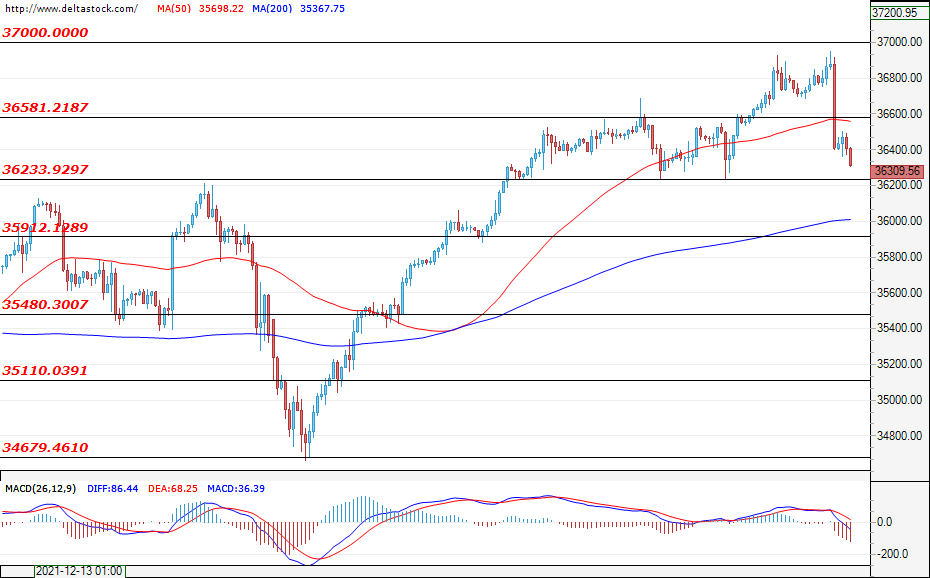
Current level - 36309
The bulls failed to hold their ground after the U.S. blue-chip stock index reached fresh record highs during the last trading session of just below 37000, followed by a decline that was just under 2% at the time of writing. Sentiments may remain negative and investors may continue the sell-off, which could lead the market towards a test of the support area at around 35900. The announcement of the initial jobless claims data today at 13:30 could lead to a change in the market participants' sentiment.
GBPUSD Soars on Hopes of a More Hawkish BOE
US equities wavered on Wednesday as concerns about the Omicron variant rose. The Dow Jones index rose by 57 points while the S&P 500 and Nasdaq 100 declined by 8 and 135 points, respectively. The mixed performance happened as the US reported more than 885k new Covid-19 cases on Wednesday. Boeing was among the best performing stocks after the company received a large order from Allegiant Air.
Crude oil continued its bullish trend on Wednesday after mixed inventories data from the Energy Information Administration (EIA) and American Petroleum Institute (API). Data published by the API showed that the number of US inventories fell by more than 6.4 million barrels last week. In its part, the EIA said that inventories declined by 2.4 million barrels. Analysts were expecting the data to show that inventories fell by 3.2 million barrels. Oil prices also rose as investors reacted to this week’s OPEC+ meeting. The members decided to extend their gradual supply increase plan.
The US dollar rose slightly after the strong jobs numbers from the US. According to ADP, US private companies added 807k jobs in December after adding another 505k in the previous month. The data came a day after the Labor Department showed that the US had over 10 million job vacancies. Later today, the US will release the latest initial jobless claims numbers. And on Friday, the US will release the official non-farm payrolls data. The US dollar will also react to the latest ISM non-manufacturing PMI data.
XBRUSD
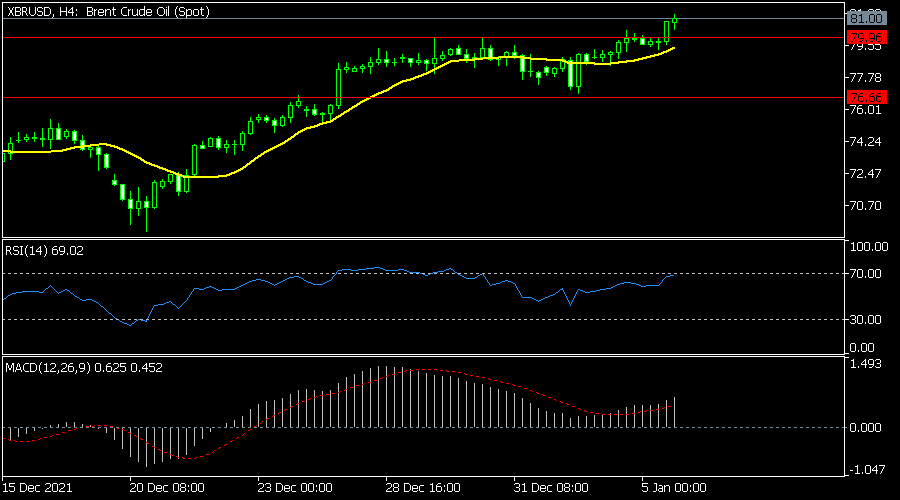
The XBRUSD pair rose to a high of 80.98 in the overnight session. This was the highest price since November. It was also slightly above the important support at 70.95, which it struggled moving above several times since December. It has moved above the 25-day and 50-day moving averages while the Relative Strength Index (RSI) tilted higher. Therefore, the pair will likely keep rising as bulls target the key resistance at 82.
EURUSD
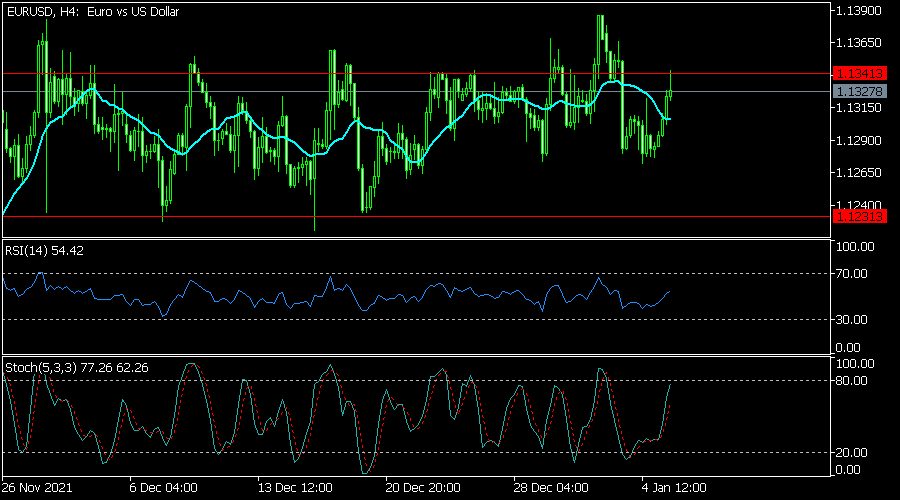
The EURUSD pair rose slightly after the FOMC minutes. It rose to the key resistance level at 1.1341, which was along the upper side of the horizontal channel. It is also slightly above the 25-day moving average while the Stochastic Oscillator and the Relative Strength Index (RSI) have tilted higher. Therefore, the pair will likely remain in this range ahead of the US NFP data.
GBPUSD
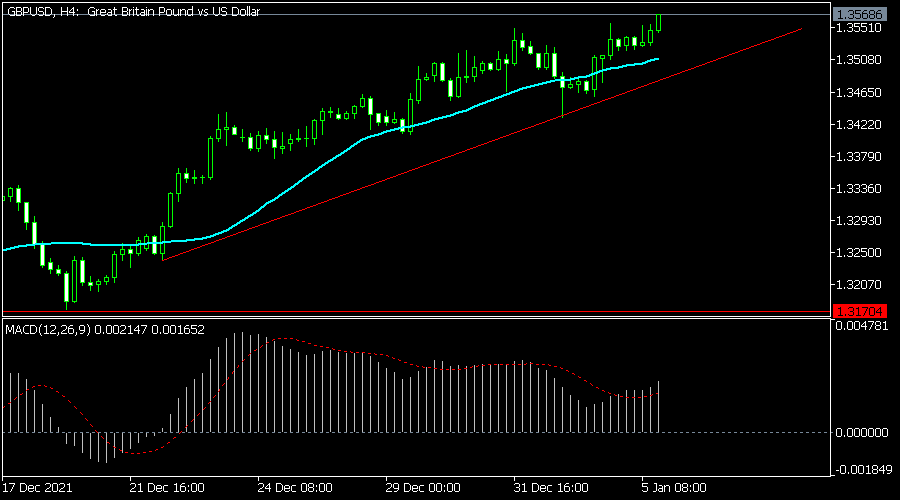
The GBPUSD pair continued its bullish breakout as demand for the sterling continued rising. It is trading at a multi-month high of 1.3570, which is above the 25-day moving average. It is also above the ascending trendline shown in red. Also, its oscillators have continued rising. Therefore, the pair will likely keep rising as investors target the key resistance at 1.3600.
US Dollar Gained Intraday after FOMC Minutes
Markets
Minutes of the December FOMC meeting were yesterday’s defining moment for trading, taking the shine off a stellar December ADP employment report (+807k vs +410k expected). The Fed at the end of last year lifted rate projections to three rate hikes this year, three hikes in 2023 and another two in 2024. This more aggressive stance is now accompanied by even more aggressive guidance that the rate lift-off could arrive “sooner or at a faster pace than participants had earlier anticipated.” This would imply that the start of the tightening cycle could match the projected end of net asset purchases in March. There is a strong conviction within the Fed that the inflation bar for raising rates has been met, with Minutes indicating that almost all participants had revised up their forecasts for inflation for 2022 notably and many did so for 2023 as well. Rising housing costs and rents, more widespread wage growth and more prolonged global supply bottlenecks “which could be exacerbated by the emergence of the Omicron variant”, prompted the changes. On top, general consensus is emerging that also the maximum employment goal is within reach. “Acknowledging that the maximum level of employment consistent with price stability may evolve over time, many participants saw the US economy making rapid progress toward the committee’s maximum-employment goal.” Several participants viewed labor market conditions even as already largely consistent with maximum employment. Apart from the hawkish interest rate guidance, Minutes also revealed that “participants judged that the appropriate timing of the balance sheet runoff would likely be closer to that of the policy rate lift off than in the committee’s previous experience.” Last time around, the Fed ended net asset purchases in October 2014 and kept the balance sheet stable for three years (almost two years after rate lift-off). Some participants now noted that it could be appropriate to begin to reduce the size of the balance sheet ($8.8tn) relatively soon after beginning to raise interest rates and that a significant amount of shrinkage could be appropriate over the normalization process. This formulation also suggest that balance sheet reduction serves as return to pre-pandemic settings and should be decoupled from an interest-rate tightening cycle to combat inflation.
US yields added 3.1 bps (30-yr) to 7.3 bps (5-yr) in a daily perspective, with the move continuing this morning. The US 2-yr yield set a new cycle high at 0.85% with a 25 bps March rate hike now largely discounted and becomes our preferred scenario. The US 10-yr yield took out the October top at 1.7% with the 2021 high of 1.77% being the next target. A significant surge in real rates (to -0.85%; highest since June) drives the move. We believe that a 2022 start of the balance sheet run-off is the most likely way to go. The jump in real yields scared equity investors with main US indices losing 1% (Dow) to 3.3% (Nasdaq). The US dollar gained intraday after the Minutes, but moves are very disappointing given the real yield pick-up. EUR/USD even closed at 1.1314 compared with an 1.1287 open.
News headlines
NBP governor Glapinski indicated that there is room for additional Polish rate hikes after this week’s 50 bps increase to 2.25%. The majority of the MPC sees few negative effects from raising the policy rate to 3%. However, if economic conditions continue to improve further there might be room to raise the policy rate to 4%. Glapinski also indicated to prefer a next step again to be 50 bps, but additional rate hikes might become less frequently. The zloty gained slightly before revering most intraday gains after the publication of hawkish Fed Minutes. EUR/PLN closed at 4.575.
The China December Services PMI recovered at a faster than expected pace, raising from 52.1 to 53.1. The composite PMI rose from 51.2 to 53.0, the highest reading since July 2021 and the fourth consecutive monthly rise. Output growth and total new orders both rose in December. Employment stabilized as a better performance in services was counterbalanced by a weaker performance in manufacturing. Gauges for prices eased. Given the soft development in the labour market, Caixin Senior economist Wang advocated policy makers to focus on shoring up employment and developing targeted support for small and midsize companies.
US Yields Edge Higher and Wall Street Nose Dives on Hawkish FOMC Minutes
Market movers today
Danmarks Nationalbank (DN) sold DKK in FX intervention for DKK47bn in December amid downwards pressure on EUR/DKK. It was the second highest monthly FX intervention selling of DKK on record. It has created speculation about whether DN would respond with a rate cut and possibly already today - a rate decision would come at 17:00CET. We do not expect a rate cut as we attribute the developments in December to temporary factors.
German HICP inflation in December is due out at 14:00 CET (regional inflation prints are due out during the morning). We are also looking forward to the German factory orders in November after the sharp decline in October.
In the US, ISM services and jobless claims data are due out in the afternoon.
Fed's Daly and Bullard are speaking tomorrow but we do not expect them to move markets significantly taking the Fed's hawkish shift in December into account. Fed's own signals are now very much aligned with market pricing and consensus.
The 60 second overview
Hawkish tilt in FOMC minutes: There was definitely a hawkish tilt in the FOMC minutes from the December meeting released yesterday. The minutes suggested that March is a live meeting (and investors started pricing in a ~75% probability of a rate hike in March), as the economy is in good shape and inflation is high. This also opens the window for not just three rate hikes this year (which is our base case and what Fed signalled in the December dots) but four if the Fed hikes once per quarter as was the case when the hiking cycle started for real after the financial crisis. The Fed also discussed when to start reducing the balance sheet, which is quite large compared to previous rounds of QE. FOMC members indicated that they would like to start "quantitative tightening" earlier and run off holdings faster than last time. That said, the Fed funds target range remains the primary policy tool, according to the minutes. The Fed also said that it prefers holding Treasuries over mortgage-backed securities.
US labour market: According to the ADP rapport, private payrolls jumped by 807,000 in December. ADP is, unfortunately, not a very good indicator of the official jobs report due out on Friday. But if true it is a good sign supporting the case for tighter monetary policy further.
Energy: Energy prices have bounced back again over the last couple of days. Natural gas prices are back at early December levels after a plunge around new years and Brent crude oil has traded back close to USD80 per barrel even after OPEC+ producers stuck to an agreed output target rise for February. Energy prices look set to keep headline inflation at elevated levels through the winter.
Equities: Equities lower yesterday as the US session turned from neutral to very bad and hence Asia and Europe have to do some catching up today. If we focus on the US session, FOMC minutes fuelled the fire and suddenly yield moves went from an acceptable pace to too fast and rotation in equities shifted to sell-off. Please note the level of yields is not yet a challenge for equities, it is the speed of change currently challenging the risk sentiment. With the central bank fear increasing we saw the classic defensive value rotation where large cap and low vol stocks also outperformed. The flip side of this, tech, long duration, small cap getting hammered. With uncertainty increasing the VIX rose 3 points to north of 19. In US Dow -1.1%, S&P 500 -1.9%, Nasdaq -3.3% and Russell 2000 -3.3%. The negative sentiment is feeding through to the Asian session this morning with all markets lower, led by Japan and Australia. Futures in Europe not surprisingly sharply lower while US futures have turned negative as well after being in green in the early Asia trade.
FI: Yesterday was a very low volatile day in the fixed income markets with broadly unchanged yields in Germany and France, but 2.5bp rise in Italian 10Y government yields on a day with the syndicated sale of the 30Y Italian bond.
FX: EUR/USD rose during the day but some of the gains were erased after the hawkish tilt in the FOMC minutes and the cross was still trading above 1.13 at the time of writing. EUR/NOK rose back above 10.00. EUR/DKK was largely unchanged yesterday, as the rates market started speculating in an imminent rate cut following the fast pace of FX intervention in December.
Credit: CDS indices sold slightly off yesterday where iTraxx Xover closed 3bp wider and Main 0.7bp. HY bonds managed to tighten 1bp while IG was unchanged.