

Sample Category Title
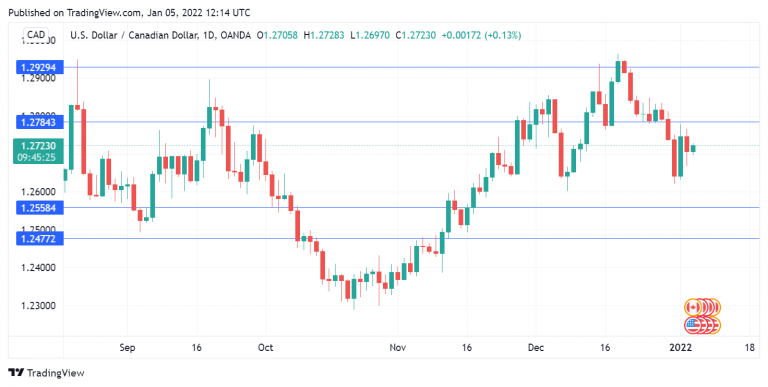
USD/CAD – Building Permits, FOMC Minutes Next
The Canadian dollar is trading slightly above the 1.27 line in the European session. Looking at today’s schedule, Canada Building Permits for November is expected to accelerate to 2.3%, up from 1.3% a month earlier. In the US, a flurry of job reports kicks off with the ADP Employment report, which is forecast to slow to 400 thousand in December, down from 534 thousand in November. Interestingly, the highlight of the week, nonfarm payrolls, has an identical estimate. Investors will also be all ears as the FOMC releases the minutes of the December policy meeting.
Busy times ahead for Fed
The Federal Reserve will be busy, as it is expected to double the tapering of its USD 120 billion bond purchase programme from 15 billion dollars to 30 billion dollars. The Fed may raise interest rates as early as March, which has become imperative due to red-hot inflation, which is currently running at a clip of 6.8%, its highest level in 40 years. The Fed dot plot at the December meeting indicated that policymakers plan on two rate hikes of 0.25% in 2022, but the markets, which are more hawkish, have priced in three rate hikes. With the US economy performing well, it appears that the economy is strong enough to withstand a series of rate hikes this year.
Treasury yields have been rising this week, as investors continue to sell Treasury bills on improved sentiment that the latest wave of the Omicron variant, although extremely contagious, will be less severe than originally feared. In the US, Omicron cases are exploding, with the average number of new cases breaking above 400 thousand, a 200% increase in the past 14 days. However, hospitalisation rates have not jumped higher and Covid-related deaths have actually declined slightly during this period. With no indications that Omicron will have a devastating effect on the global economy, investors remain in a risk-on mood.
USD/CAD Technical
- USD/CAD has support at 1.2558 and 1.2477
- There is resistance at 1.2784. Above, there is resistance at 1.2929
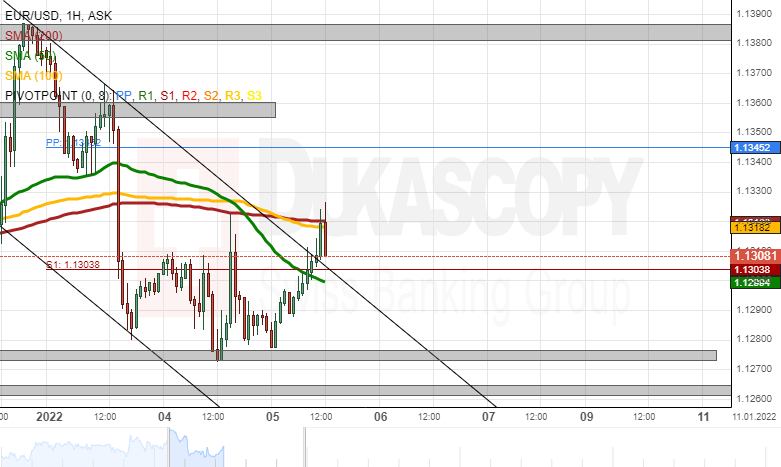
EUR/USD Analysis: Breaks Pattern
On Tuesday, the EUR/USD found support in the December 29 low level at 1.1275 and the 1.1280 mark. The following surge passed the resistance of the channel down pattern, which recently guided the pair down.
In addition, the technical resistance of the 50, 100 and 200-hour simple moving averages and the weekly S1 simple pivot point were passed. By the middle of Wednesday's European trading hours, the currency exchange rate had no technical resistance as high as the weekly simple pivot point at 1.1345.
A surge above the simple weekly pivot point at 1.1345 might test the resistance of the 1.1360 level and the zone below it. Higher above, take into account the December high levels at 1.1381/1.1386.
On the other hand, a potential decline could find support in the 100 and 200-hour simple moving averages near 1.1320. Afterward, the weekly S1 might stop a decline near 1.1304. In addition, the 1.1300 mark and the 50-hour simple moving average might act as support.
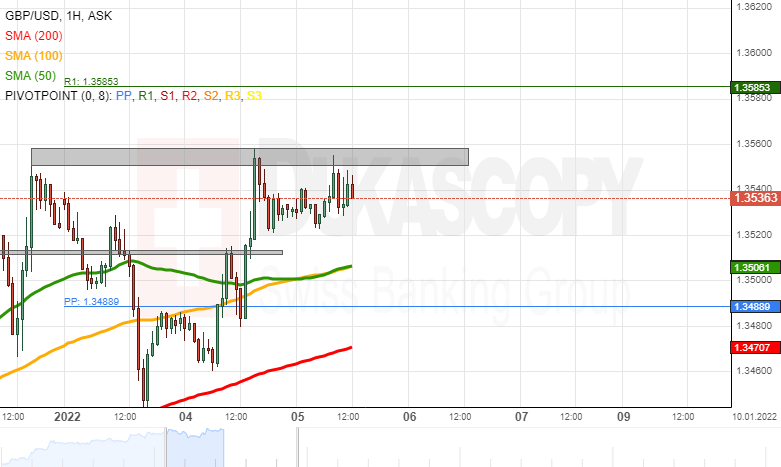
GBP/USD Analysis: Remains Below December High
Starting from Tuesday up to the middle of Wednesday's trading, the resistance zone at 1.3550/1.3557 continued to hold, as the GBP/USD was making its third attempt at breaking it. Previous forecast scenarios remained unchanged.
In the near term future, a move above the 1.3550 mark might aim at the weekly R1 simple pivot point at 1.3585. Afterward, the 1.3600 mark could provide resistance, before the GBP/USD reaches the weekly R2 simple pivot point at 1.3647.
Meanwhile, a potential decline is highly likely set to look for support in the 50 and 100-hour simple moving averages near 1.3500. Below the 1.3500 mark, the weekly simple pivot point at 1.3489 could stop a decline.
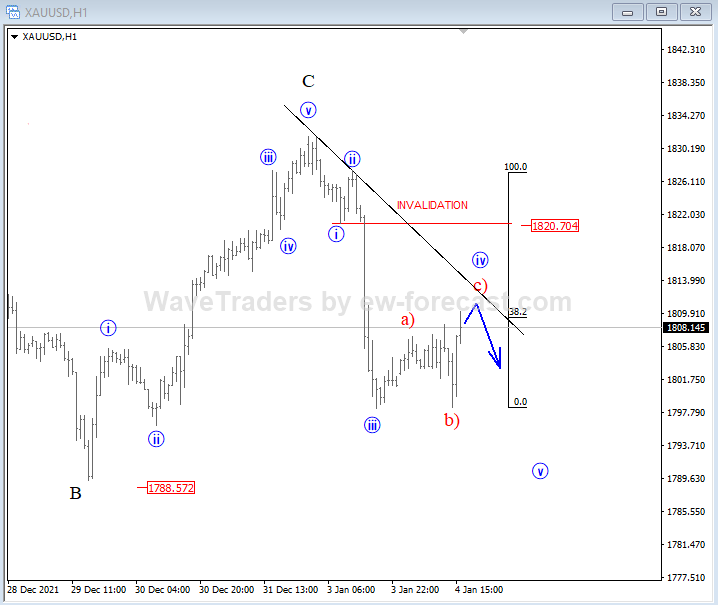
Gold Eyes Down: Elliott Wave Analysis
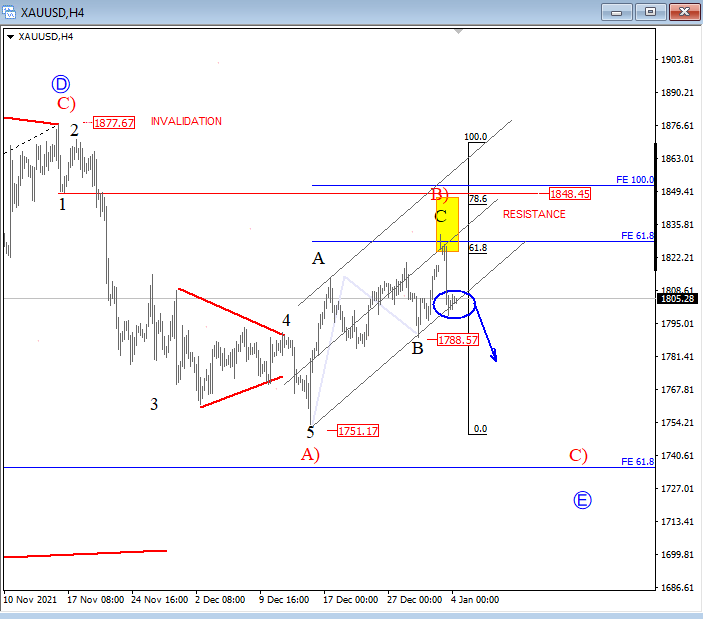
GOLD is making bigger intraday recovery, but still in three waves a)-b)-c) and into ideal 38,2% Fibo. retracement for wave »iv«. So, still watch out for further weakness within wave »v«, but only if the price manages to stay below 1820 invalidation level, otherwise gold can see bigger and more complex corrective rally.
Gold 1h Elliott Wave analysis
Gold is in a recovery mode on 4h chart, away from 1751, but only in three waves that we see as wave B) moving towards 1820-1848 resistance. Therefore, we should be aware of another leg down, into wave C) of E to complete a higher degree triangle. Break below trendline support near 1808 will put weakness in play.
Gold 4h Elliott Wave analysis
Gold Persists above 1800 Mark at Start of 2022
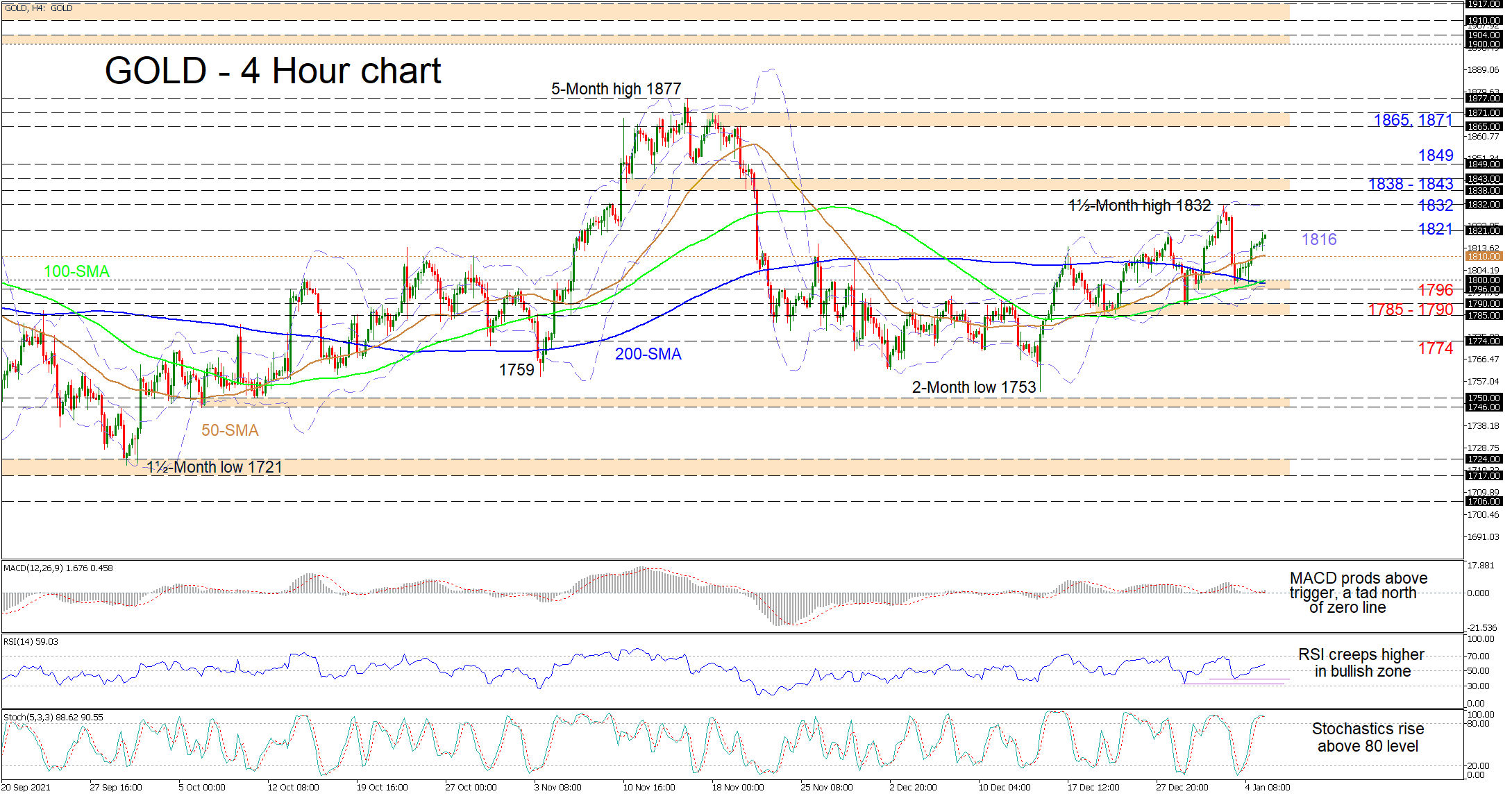
Gold is currently trading around 1816, tracing the mid-Bollinger band higher, trying to keep intact the gradual climb in the commodity from the December 15 trough of 1,753. The bullish 50- and 100-period simple moving averages (SMAs) are endorsing the last three weeks of gains in the precious metal.
The short-term oscillators are indicating a phase where positive momentum has yet to show any decisive signs of weakness. The MACD has overstepped the red trigger line again slightly above the zero threshold, while the RSI is improving in the positive region. The stochastic lines are in overbought territory, hinting that upside impetus may start to abate but have yet to confirm this. Nonetheless, it would be wise for traders to keep a watchful eye on bullish pressures as congested upside obstacles are ahead, which could pose a threat to additional progress.
Maintaining the current trajectory, the 1,821 immediate barrier could delay the test of the latest high of 1,821, where the upper Bollinger band also resides. Successfully steering higher and reinforcing the recent uptrend, the bulls could then face the 1,838-1,843 resistance band ahead of the 1,849 border. Conquering these obstacles may encourage buyers to propel the price towards the 1,865 and 1,871 highs, near the 5-month high level of 1,877.
If the price fades from the 1,821 barrier, initial downside hindrance could occur at the 50-period SMA at 1,810 ahead of the key 1,796-1,800 support section. Retracing beneath this fortified zone, the bears may then target the 1,785-1,790 support base. If a deeper retracement unfolds, the 1,774 level could be pursued by sellers before the 1,753 trough even starts to draw traders’ focus.
Summarizing, gold is currently exhibiting a bullish tone above the 1,800 mark and the SMAs, implying only minor hints that bullish backing is lacking strong upside force.
Sterling Shines as Yields Rally, Stocks Mixed
- Global spike in yields boosts sterling and US dollar, crushes yen
- Stock markets mixed as traders rotate towards ‘cheaper’ sectors
- Fed minutes and ADP jobs report coming up today
Sterling leads the pack
Every asset class has been dancing to the tune of rising bond yields this week. The bond market is essentially saying that some central banks will raise interest rates with force to combat inflation and that the Omicron outbreak is not enough to derail those plans, or even slow them down.
This has been a blessing for the British pound and the US dollar as traders have started to entertain the idea that the Bank of England could raise rates again next month and that the Fed could get the ball rolling in March.
Money markets are currently pricing in a 70% probability for a BoE rate hike in February, which helped push euro/sterling to a new post-pandemic low yesterday, along with some signals from Prime Minister Johnson that further covid restrictions are unlikely.
In contrast, the yield rally has been a curse for the yen since the Bank of Japan is not expected to join the global rate hike party in the coming years, with the economy having just escaped deflation. Dollar/yen met resistance around the 116.30 region yesterday, but if it pierces through, there isn’t much standing in the way until the 2016 peak of 118.66.
‘Expensive’ stocks under fire
In the stock market, it has been a classic rotation towards ‘cheap’ sectors and away from ‘expensive’ ones. Tech and growth names got smoked yesterday as higher yields make it more difficult to justify the exorbitant valuations of many companies, driving investors towards value plays with solid profits that are less sensitive to rising rates.
Reflecting as much, the tech-heavy Nasdaq lost 1.3%, the S&P 500 closed virtually unchanged, while the Dow Jones rose by 0.6%. European markets have done better though, thanks to their concentration of value names. The British FTSE 100 reached a new post-pandemic high yesterday despite the stronger pound, which typically holds the index back.
US releases in the limelight
There’s a heavy barrage of US economic releases over the next week that could be crucial for the dollar as markets currently assign a 65% chance for the Fed to raise rates in March. The show will get going with the ADP jobs data and the minutes of the December FOMC meeting today, ahead of Friday’s employment report and next week’s inflation stats.
Several Fed officials have been on the wires since the December meeting explaining the rationale behind their aggressive shift, so the minutes are unlikely to make waves in the markets. Instead, the ADP numbers could attract more attention as traders calibrate their expectations for Friday’s official jobs report.
Staying in America, the ISM manufacturing survey that was released yesterday suggested inflationary pressures are finally cooling. Of course, this is just one data point, but if there are more signs that ‘peak inflation’ is around the corner in the coming months, there could be a drastic rethink about central banks. This is the key risk to the rally in bond yields.
A Mixed US Dollar Performance
US dollar gets lift from rising US bond yields
The US dollar had a mixed night, rising versus the major currencies and the Asian currency grouping, as firm US bond yields sparked yield differential nerves. Conversely, the same post-omicron sentiment propelling stock markets and bond yields higher had a positive effect on the usual sentiment barometers. Sterling and the Canadian, Australian and New Zealand dollars all having a good night.
The dollar index rose 0.06% overnight, only to give it all back in Asia, where it is trading net-unchanged for the last 24 hours at 96.24. A break of 95.50 or 96.50 will signal the index’s next directional move, although if US yields stay firm, the greenback looks set to continue to outperform in the major currency space. EUR/USD remained steady at 1.1295, as did USD/JPY at 116.00, while positive comments from the UK Prime Minister that Britain could weather the omicron storm without shutting down lifted GBP/USD to 1.3530, where it remains in Asia. A close above 1.3560 potentially signals a rally to 1.3800.
Although the AUD, NZD and CAD retraced some of their losses overnight, they are almost unchanged at 0.7235, 0.6805 and 1.2715, leaving all three roughly mid-range for the week. 0.7180 and 0.7280, 0.6750 and 0.6850, and 1.2600 and 1.2800 are the breakout levels to watch for. Sentiment swings continue to rule the direction of the three amigos.
In Asia, the rise in US yields seems to be spooking some Asian currencies, with the US dollar rally pushing a number of pairs towards line-in-the-sand levels with their respective central banks. USD/KRW is at 1198.00 approaching 1200.00. USD/PHP has risen up through 51.00 to 51.10, USD/IDR is at 14,350 approaching 14,500.00 and USD/MYR looks set to test 4.2000. The yuan, baht and Indian rupee continue to outperform. For the rest, it will be interesting to see if their respective central banks step out of the shadows and start offering US dollars again. In a rising US interest rate environment, this will be a quandary they will be asked numerous times in 2022. If the Asian central banks stay side-lined, USD/Asia could be about to move sharply higher, assuming US yields hold their gains.
Asia Follows New York’s Value Versus Growth
Asia markets mixed
Overnight, Wall Street went looking for the winners in an inflationary environment and as a result, loaded up on the Dow Jones at the expense of the Nasdaq, mostly on the premise the Fed inflation hunting will resume as the global recovery bids omicron goodbye. The S&P 500 was almost unchanged at -0.06%, but the Nasdaq tumbled by 1.33%, while the Dow Jones added 0.58%. In Asia, all three indexes have retreated, down around 0.25%. A fire at the world’s most critical semiconductor machine manufacturer, Dutch company ASML, could be weighing on sentiment.
Extreme ultra-violet lithography systems aside, Asian markets have split in roughly the same direction as New York today. The Nikkei 225 is unchanged, having reversed earlier losses, but the South Korean Kospi is 1.30% lower and Taipei is down by 0.35%. The ASML fire potentially weighs more on the latter two.
China markets are also in retreat on pre-Chinese-New-Year funding fears, China property developers, US-listed technology groups and Huarong with no signs from the PBOC that it intends to ease the funding crunch as it keeps money tight via the daily repo. The Shanghai Composite is down 0.85% with the CSI 300 easing 0.65% lower. Hong Kong is down 0.75% today.
In ASEAN though, Singapore has eased 0.25%, but Kuala Lumpur is 0.20% higher and Bangkok is up 0.30%, with Jakarta and Manila unchanged. Most exchanges having given back intra-day gains. Australian markets are lower after jumping the gun on the value trade earlier this week with some stellar gains so far. The easing of the S&P 500 and Nasdaq overnight and today has prompted some profit-taking down under. The ASX 200 and All Ordinaries are 0.35% lower.
Europe is likely to find gains hard to find initially with Asia’s mixed momentum subsiding and turning to a more generally cautious note. If the fire damage at ASML’s Berlin factory is minimal, that could be enough to encourage the bulls back again as none likes the thought of a drawn-out semiconductor shortage.
Markets Flirt with the Inflation Trade
US treasury yields head higher
Seemingly, the sharp rise in US yields this week has sparked a move from growth to value, or as I put it, from the Nasdaq to the Dow Jones. Whether it lasts is another thing altogether, with such rotations running out of steam over the past 18 months, without really ever gathering momentum. Still, a couple of things are “different this time,” namely the omicron variant is rapidly being repriced as omi-gone. Secondly, the Federal Reserve has commenced tapering its QE and will likely start hiking soon after the mid-year.
US yields should keep rising, not a certainty and the world has been led to water many a time over the past 18 months on this front. The reason? You can buy a 10-year Japan JGB and earn 0.0%, or a 10-year Bund and earn maybe -0.40% but buy a US 10-year note and you’ll earn 1.60% right now. What’s not to like if you are a pension fund manager in Europe or Japan with ageing populations who will all require a pension? Slap in USD 120 billion a month of buying from the Fed alongside them, it’s hardly a surprise that being a US bond vigilante has become a tough job.
The overnight data from the US didn’t really support the premise either. The Jolts Job Openings dropped by around 0.50 million to 10.562 mio, while quits jumped to 4.50 mio. The ISM Manufacturing PMI fell to 58.7, while the Manufacturing Employment, New Orders and Manufacturing Prices sub-indexes all eased. None of that data was inflationary, more people were working, even as labour market turnover increased, but mostly in jobs people hate, restaurants/food service, delivery and warehouses. PMIs, prices and orders eased but that can be accounted for by holiday seasonality and omicron’s incredible spread, forcing many workers to self-isolate.
The overnight US data is likely to be an outlier, but don’t count out the growth versus value trade just yet, and a US Non-Farm Payrolls number on Friday under 400,000 jobs added could give the Fed Funds hike-a-nistas pause for thought. I do believe that higher US rates, a higher US dollar, and tighter monetary policy will be the bride to make an honest man of big tech, but full confirmation will only come later in Q1. And even then, I am expecting technology to experience more two-way price action, not beat a full retreat, although if you are a pimped up SPAC, this year may not be your year. Inverting SPAC and inserting an R after the C would sum it up best in my mind. Always beware of investment bankers bearing gifts; I’ve been saying this for 20 years, and still, no one listens.
A similar pattern is emerging in Asia today as well, with the North-East Asian heavyweights of China, Japan and South Korea struggling for friends today, while the more value-stock-heavy markets of South-East Asia are generally doing better. Keep a cautious and risk-averse eye on China over the next couple of days. Shares of Huarong Asset Management, a poster child of China corporate governance, returned to the market today after a 9-month suspension. Wearing a fresh USD 6.6 bio government bailout, they promptly fell by 50% in Hong Kong. Another champion of corporate governance, Evergrande, faces potential redemptions of a CNY 4.50 bio bond from investors this weekend.
The China property sector remains a slow-moving lava flow, burning everything, it touches. That pain now switches to domestic investors and unsurprisingly, Evergrande is meeting investors from the 7th-10th to try and extend the put option. As I’ve said before, beware investment bankers bearing gifts, or in this case telling you to buy the dip; and remember, there’s never just one cockroach.
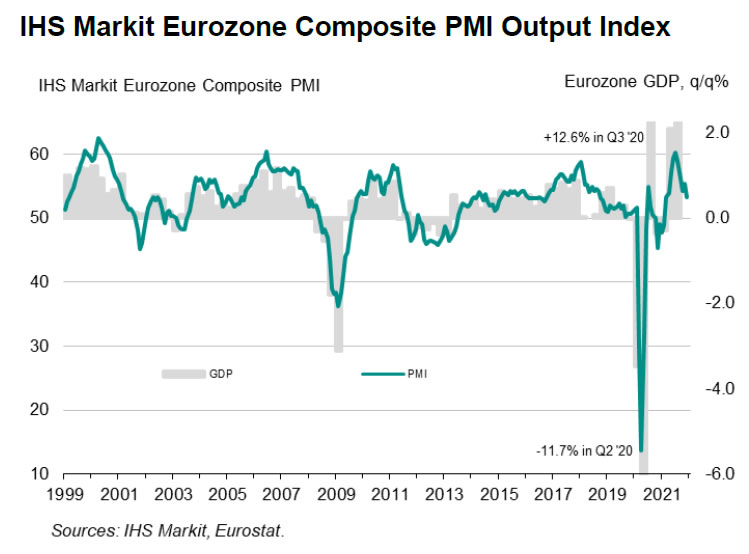
Eurozone PMI composite finalized at 53.3, weakest growth since Mar
Eurozone PMI Services was finalized at 53.1 in December, down from November's 55.9. PMI Composite was finalized at 53.3, down from November's 55.4, lowest since March.
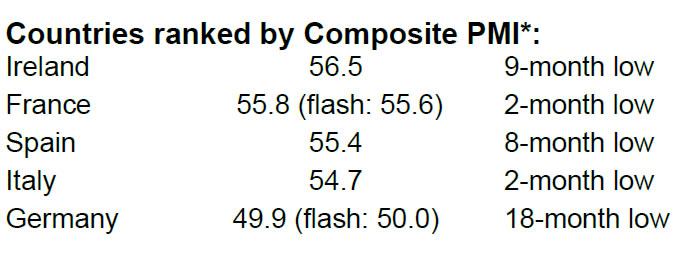
Looking at some member states, Ireland PMI composite dropped to 9-month low at 56.5. France dropped to 55.8. Spain dropped to 55.4, an 8-month low. Italy dropped to 54.7. Germany dropped to 49.9, an 18-month low.
Joe Hayes, Senior Economist at IHS Markit said:
"The accelerated expansion in output we saw in November unfortunately turned out to be brief. Amid a resurgence of COVID-19 infections across the euro area, growth slowed to the weakest since March in December. In Germany, where measures to combat COVID-19 have been more stringent than other monitored euro area countries, levels of economic activity broadly stagnated in December. Nonetheless, slower growth was seen across the board.
"There was also little to cheer with regards to inflation. Although there was a marginal easing of price pressures, we're still in excessively hot territory – increases in both input and output costs were the second-quickest on record... As euro area nations deal with the latest developments in the pandemic, it's clear that risks to the economy are now greater as tighter restrictions to curb the spread of COVID-19 are more likely than they have been recently."