Sample Category Title
Cliff Notes: A Strong End to 2021
Key insights from the week that was.
For Australia and New Zealand, it has been a very busy week ahead of the Christmas/ new year holiday period. Elsewhere, a run of central bank meetings reset expectations heading into 2022.
The first key release for Australia was NAB’s business survey. In November, business conditions lifted another 2pts to 12 to remain well above average, albeit still materially below the peak level of 30 seen back in the June quarter, before the delta lockdowns. Underlying this result, employment conditions rose 5pts to +11 as trading conditions edged higher to +16. New orders also remained strong at +14, and profitability supportive, +8. Although it fell back 8pts in the month, confidence also remained above average at +12. Focusing in on manufacturing, our ACCI-Westpac Survey of Industrial Trends pointed to positive expectations for the outlook despite flat output in the December quarter.
Our Westpac-MI consumer sentiment survey was also constructive on the outlook in December, remaining above average. The underperformance of NSW and Victoria in the month points to an omicron effect in the headline index’s 1% fall. Also at play are expectations around inflation, with 21% of respondents recalling news on the topic in December, up from 5% a year ago.
Views on the economy overall remain well above average. However, perspectives on family finances are, more-or-less, in line with average levels, while ‘time to buy’ a major household item and dwelling both weakened materially in the month from already sub-par levels. Chief Economist Bill Evans discussed these outcomes and other key themes from December’s consumer sentiment report in this week’s video update, the last for the year.
Although we saw Westpac-MI unemployment expectations rise in December, confidence in the labour market is very strong. This is unsurprising given the recovery in employment following the delta lockdowns. In November, a startling 366k/2.9% increase in employment was seen, the largest monthly gain in the survey’s history back to 1978. Total employment is now higher than in June 2021 prior to the delta lockdown. Even with participation recovering to be just 0.2ppts below its June 2021 peak, the unemployment rate fell to 4.6%, a low back to late-2008, the peak of the mining boom. Underemployment is also the lowest it has been since early-2014 at 7.5%. Along with persistent strength in consumer sentiment and a high level of savings, this momentum sets the scene for strong gains in activity in 2022.
For both Australia and New Zealand, this week also saw the release of mid-year fiscal updates. For Australia, there was little net change in the Budget’s bottom line as higher revenues were offset by greater-than-expected expenditure related to the delta outbreak and new policy. New Zealand’s Government meanwhile reported a sizeable improvement in their Budget position because of a structurally higher tax take.
Also in New Zealand this week, Q3 GDP printed weaker than we had anticipated at -3.7%. However, this was the result of COVID-19 restrictions instead of weakness in underlying demand. A strong recovery is expected from Q4 as pent-up demand is released, albeit at a more measured pace than in 2020 given some restrictions have remained in place through Q4. For the full detail on GDP, see Westpac New Zealand Economics’ bulletin.
Moving further afield, the US FOMC held centre stage this week as they met for their December meeting. As we anticipated, they doubled the pace of the taper, to conclude purchases in mid-March 2022, and guided that three rate hikes were now likely in 2022. The Committee subsequently sees two more rate hikes over 2023 and 2024 than we are forecasting, taking the fed funds rate to 2.1% end-2024 (Westpac 1.675%). While we have a lower endpoint for the fed funds rate, we anticipate that the economy’s persistent momentum and lingering inflation risks will support the 10-year yield, seeing it peak at 2.30% in late-2022 and remain materially higher than the fed funds rate to the end of the forecast horizon. An in-depth look at the FOMC’s December decision and the outlook for the US economy is available on Westpac IQ.
The Bank of England’s approach to policy also took a turn at their December meeting as they increased the Bank rate by 15bps to 0.25%. This decision comes as their asset purchase program formally ends, and despite the clear and present threat of delta and omicron to the health of the UK economy. The decision was justified by the strength of inflation, the latest print coming in ahead of expectations and above 5%yr, as well as a tight labour market which is expected to support robust wage gains in the period ahead. From here, a modest tightening should be expected to help achieve the Bank’s medium-term 2.0%yr inflation target. This is unlikely to be of the same scale or pace as the US FOMC, though the next move will likely occur before the FOMC hikes for the first time in June 2022 – on our view.
Finally, to the ECB. In stark contrast to both the US FOMC and UK’s BoE, the ECB increased policy accommodation at their December meeting, announcing their open-ended Asset Purchase Program (APP) will be expanded to EUR40bn for Q2 2022 and EUR30bn in Q3 2022 before returning to the pre-pandemic pace of EUR20bn per month in Q4 2022. This decision has been made to allow a staged withdrawal of stimulus once the pandemic purchase envelope (PEPP) is exhausted in March.
This decision is required to maintain accommodative financial conditions to support the recovery in activity and as core inflation is expected to remain below the 2.0%yr target throughout the forecast period to end-2024. On the forecasts of the ECB, it is difficult to see the ECB ending asset purchases and beginning to raise interest rates until 2023, at the very least. Indeed, with inflation still below target in 2024 on current policy settings, there is good justification to believe the current stance will remain in place beyond 2023. This is not to say that the Euro Area economy will be weak over this period. Growth is expected to remain above trend to end-2024 by both the ECB and Westpac, tightening the labour market and strengthening income growth. Into the medium-term, the health of the Euro Area economy will therefore remain robust.
This is our final edition until the end of January. We would like to wish all our readers a Merry Christmas and happy new year.
USD/JPY Starts Fresh Increase Above 113.50
Key Highlights
- USD/JPY started a fresh increase above the 113.50 and 114.00 levels.
- A key rising channel is forming with support near 113.60 on the 4-hours chart.
- EUR/USD is still trading well below the 1.1350 resistance zone.
- Gold price spiked towards the $1,750 support before correcting higher.
USD/JPY Technical Analysis
The US Dollar formed a base above the 112.65 level against the Japanese Yen. USD/JPY started a fresh increase above the 113.50 resistance level.
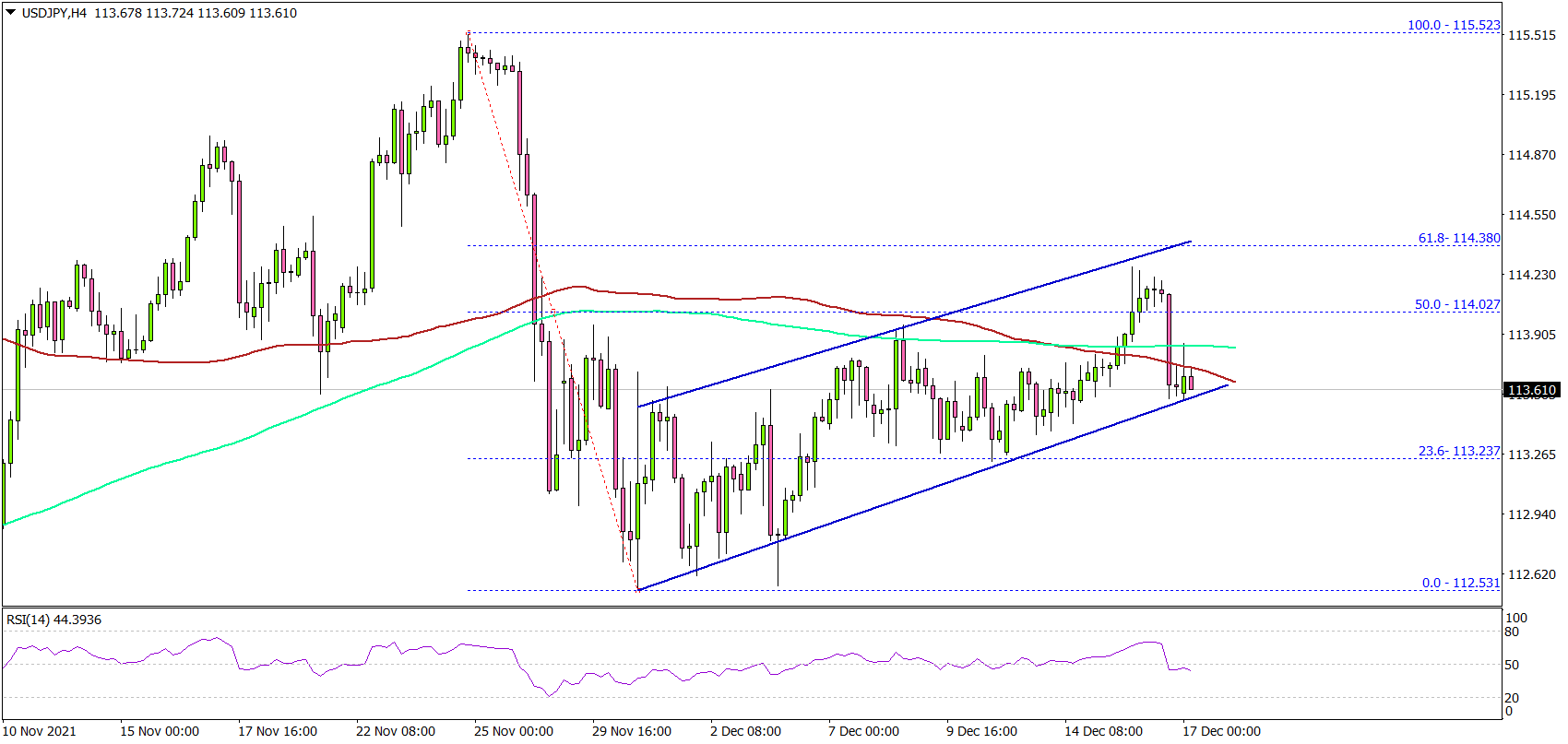
Looking at the 4-hours chart, the pair gained pace after there was a close above the 113.50 level, the 100 simple moving average (red, 4-hours), and the 200 simple moving average (green, 4-hours).
The pair even surpassed the 50% Fib retracement level of the key decline from the 115.52 swing high to 112.53 swing low. Besides, there is a key rising channel forming with support near 113.60 on the same chart.
An immediate resistance is near the 114.80 level. It is near the 76.4% Fib retracement level of the key decline from the 115.52 swing high to 112.53 swing low.
The next key resistance is near the 115.00 level. A clear break above the 114.80 and 115.00 resistance levels could open the doors for more gains. If there is a downside correction, the pair might find support near the 113.60 level.
If there is a downside break below the trend line, the pair could decline towards the 113.50 level. The next major support is near the 113.00 level, below which the pair could decline heavily.
Looking at EUR/USD, the pair is still well below the 1.1350 level, but it is showing a few positive signs of a recovery wave.
Economic Releases
- German IFO Business Climate Index for Dec 2021 – Forecast 95.4, versus 96.5 previous.
- Euro Zone CPI for Nov 2021 (YoY) - Forecast +4.9%, versus +4.9% previous.
- Euro Zone CPI for Nov 2021 (MoM) - Forecast +0.5%, versus +0.8% previous.
Eco Data 12/17/21
[php_everywhere instance="1"]
Euro Gains Ground after ECB
ECB to wind up PEPP, increase APP
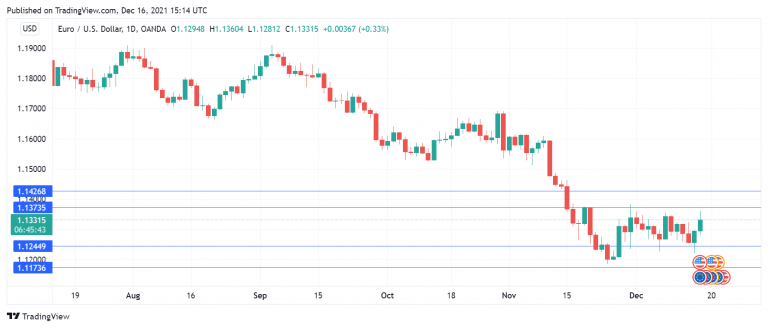
The euro has extended its gains and touched 1.1360 earlier, its highest level in December. This follows the ECB policy meeting earlier today. In the North American session, EUR/USD is trading at 1.1332, up 0.34% on the day.
With the major economies showing decent growth and inflation running at high levels, major central banks find themselves under pressure to tighten policy. This week we saw the Fed double its taper, while the Bank of England surprised the markets by raising rates from -0.15% to 0.25%. The ECB has opted not to follow suit and will continue its accommodative policy.
As expected, the ECB announced that it would scale back its bond purchases under the EUR 1.85 trillion Pandemic Emergency Purchase Programme (PEPP) and would wind up the scheme in March 2022. Once PEPP ends, however, the ECB will increase QE through its Asset Purchase Programme (APP), which currently runs at a clip of EUR 20 billion/month. The bank will double bond purchases to EUR 40 billion in Q2 and reduce this to EUR 30 billion in Q3. In October 2022, purchases will be kept at EUR 20 billion for “as long as necessary”.
There had been dissension within the ECB on what to do with APP after PEPP ended. Doves had called for a doubling of APP, while the hawks wanted to maintain it at current levels. The move devised by the ECB represents a compromise between the two positions, with APP to double to 40 billion but then gradually decrease back to 20 billion.
What is significant is that the ECB continues to move in an opposite direction to the Federal Reserve. At its policy meeting on Wednesday, the Fed accelerated its taper and the dot plot indicated that rates could be raised up to three times in 2022. After the Fed meeting, Chair Jerome Powell circled inflation as a threat that has to be contained. Inflation has not surged to the same extent in the eurozone as in the US, and the ECB, unlike the Fed, is yet to ditch its script that inflation is transitory.
EUR/USD Technical
- EUR/USD is putting pressure on support at 1.1245. Below, there is support at 1.1173
- There is resistance are 1.1372 and 1.1427
Sunset Market Commentary
Markets
It doesn’t happen that much that European (November) PMIs have close to no impact on the euro or bond yields. The fact that they were mixed both in terms of sector (services fell from 55.9 to 53.3, manufacturing stabilized around 58) and across countries (Germany disappointed vs a stronger France) didn’t help. More importantly, it was the looming ECB meeting that kept investors to the sidelines. We retain that strains on supply chains eased somewhat, helping to revive factory production while also alleviating some of the upward pressures on inflation. Optimism about the year ahead in the European region nevertheless worsened with Omicron, rising cases and the reintroduction of restrictive measures hurting sentiment as well as posing the most important downside risks to growth going into 2022. Turning to the ECB meeting, the central bank officially announced the end of PEPP in March 2022 but keeps the programme dormant rather than remove it from the toolkit. It did extend the reinvestment horizon to the end of 2024. These reinvestments will be done in a much more flexible manner in terms of time, asset classes and jurisdictions to ensure easy finance conditions across the eurozone. Net buying under PEPP in 2022Q1 will be conducted under a lower pace than in the current quarter. From Q2 onwards, APP takes over at double the pace today (from €20bn/m to €40bn) before slowing down in Q3 (€30bn) and returning to the original €20 in Q4. This still-supportive monetary stance comes even as the ECB projects 5.1% growth for this year, 4.2% for 2022, 2.9% in 2023 and 1.6% for 2024. Inflation is seen (much) higher again, with forecasts of 2.6% (vs 2.2%) for 2021, 3.2% (vs 1.7%) next year and a convenient 1.8% for 2023 and 2024. Asked why the ECB is still committed for such a long time given the high uncertainty surrounding the forecasts, Lagarde said the path of bond purchases is actually the expression of that: still high to avoid a “brutal transition” but declining over time. She repeated that under current circumstances, it’s very unlikely that interest rates will be raised before 2023, referring to inflation expected below 2% further out the horizon. Lagarde did say the ECB will assess its stance on a quarterly basis in function of the economic developments and projections. Combined with high inflation forecasts and related upside risks, markets interpreted it as a first step towards normalization. EUR/USD rebounded north of 1.13(4) though still has some ground to recover before the first meaningful resistance around 1.15. German yields eased from their intraday highs during the press conference. The curve steepens with changes ranging from -1.6 bps (2y) to +5.2 bps (30y). The initial yield jump interestingly did not happen on the ECB statement, but on the BoE decision that took place a bit earlier. The central bank kicked off its tightening cycle with a 15 bps rate hike. The latest labour market and especially CPI (>5%) release this week were crucial ingredients. The central bank in its statement even suggested to increase the weight given to inflation in its assessment. A next rate hike as early as February (when new forecasts are available) is possible. EUR/GBP hit an intraday low of 0.846 on sterling strength but reversed part of the move after some euro appreciation following the ECB. UK gilt yields jump 4 to 6 bps across the curve.
News Headlines
The Swiss National Bank (SNB) today as expected maintained an accommodative monetary policy. The policy rate was kept unchanged at -0.75%. The Bank also reiterated that it can intervene in the FX market order to counter upward pressure on the Swiss franc if necessary. The Swiss economy will probably grow 3.5% this year and 3.0% next year and returned to a pre-corona level in Q3 of this year. Inflation in Switzerland also rose (1.5%), but remains below the 2.0% reference level. Inflation is also expected to remain below the target over the policy horizon (expected 0.6% in 2021, 1.0% for 2022 and 0.6% for 2023). The SNB maintains the view that the Swiss franc is highly valued. However, in remarks for the news conference, the SNB indicated that the real effective weighted exchange rate of the franc has little changed since the start of the pandemic due to the differences in inflation with other countries. The rise in the nominal exchange rate also helped to contain inflation. This analysis suggests that the SNB will keep a guarded approach on FX interventions, especially as long as it develops in a gradual manner.
EURCHF Raises Bullish Odds above 20-SMA
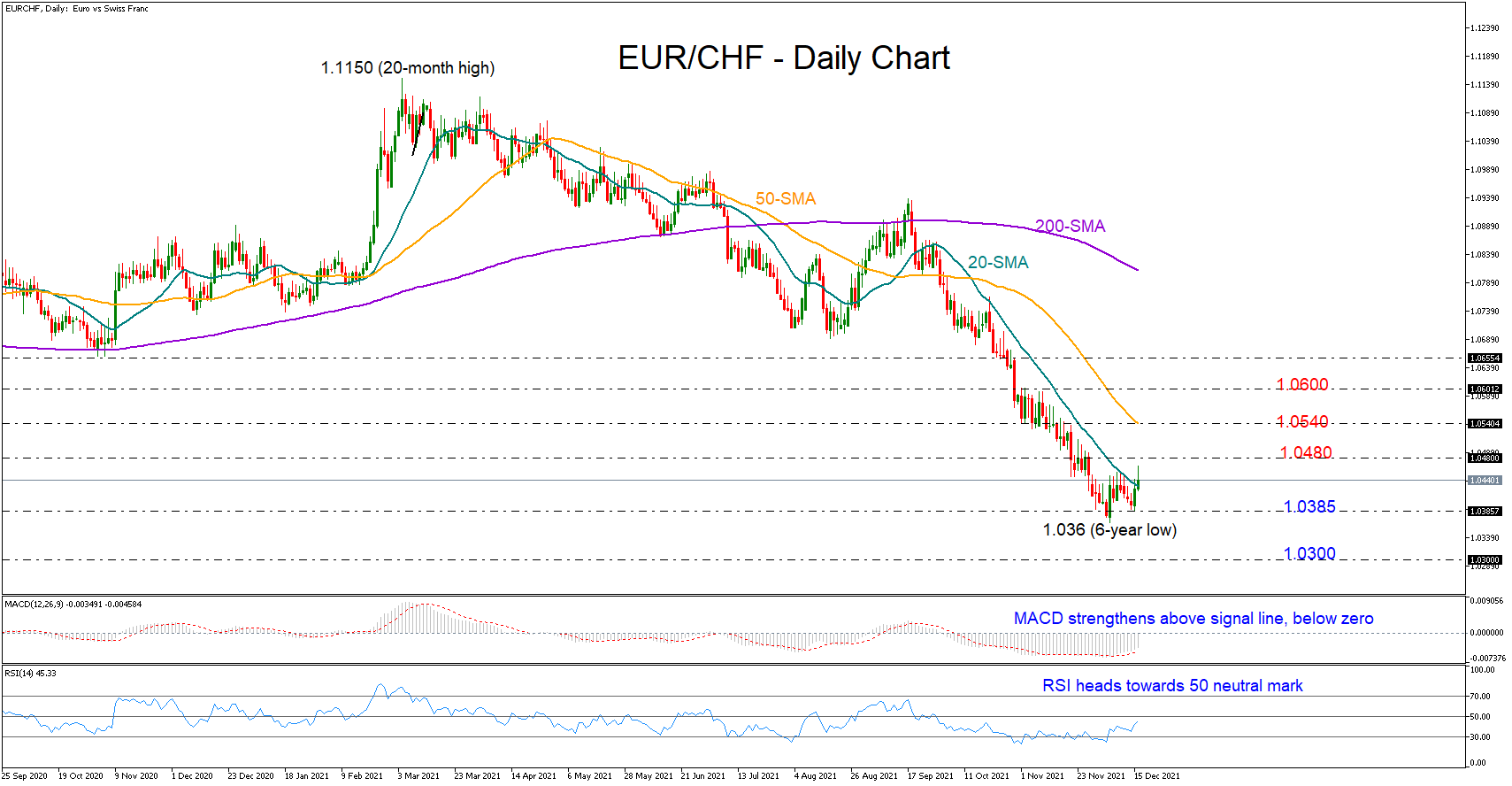
EURCHF is determined to improve its fortunes above the 20-day simple moving average (SMA) for the first time since mid-September, with the price crawling as high as 1.0465 in mid-European trading hours on Thursday following the plunge to a six-year low of 1.0360 at the start of the month.
Although the 1.0480 bar is still laying overhead, the positive momentum in the RSI and its prolonged presence around the 30 oversold level suggests the bulls could keep the upper hand in the near term. The ongoing recovery in the MACD is backing this view as well, adding to hopes that a break above 1.0480 is possible. If true, the price could advance towards the 50-day SMA at 1.0540, while higher it could test the 1.0600 psychological mark before heading for the key 1.0650 handle.
Below the 20-day SMA, the 1.0380-1.0360 zone may attempt to block the way towards the 1.0300 psychological number, and hence prevent an outlook deterioration in the broad picture. In the event selling pressures persist below the latter, the spotlight will fall on the 1.0232 support area taken from April 2015.
Summarizing, the recent pickup in EURCHF might gain extra legs in the near-term, but buyers would probably wait for a clear break above 1.0480 before raising exposure to the market.
ECB Reduces PEPP Purchases, Upgrades Inflation forecasts
The ECB meeting came largely in line with expectations. While leaving the policy rates unchanged, the members confirmed that the PEPP program would end in March 2022. Meanwhile, they have extended the reinvestment process and topped up the APP program, as means to continuously provide liquidity to the market. The staff economic projections saw sharp upgrades in inflation outlook over the years ahead.
On the monetary policy, policymakers announced to lower the pace of asset purchases via the PEPP over coming months so that it would end in March 2022, as scheduled. As noted in the statement, the Council “judges that the progress on economic recovery and towards its medium-term inflation target permits a step-by-step reduction in the pace of its asset purchases over the coming quarters”. Despite the reduction, it assured that “monetary accommodation is still needed for inflation to stabilise at the 2% inflation target over the medium term”. Besides extending the reinvestment horizon for the PEPP to at least the end of 2024, the ECB will also increase the pace of monthly purchases under APP to 40B euro in 2Q22 and 30B euro in 3Q21, from 20B euro currently. Purchases from 4Q22 onwards would then return to 20B euro for as long as necessary to reinforce the accommodative impact of its policy rates.
On economic projection, ECB upgraded its inflaton forecasts for the entire projection horizon. Headline CPI is expected to reach +3.2% y/y in 2022, before accelerating further to +4.8% in 2023. These are revised higher from +1.7% and +1.5%, respectively in September's projectors. GDP growth forecasts are upgraded slightly higher to +5.1% y/y this year (Sep: +5%) but downgraded to +4.2% in 2022 (Sep: +4.6%). The economy is expected to slow further to +2.9% and +1.6% in 2023 and 2024 respectively.
Fed Struck a More Hawkish Tone; BoE Raises Interest Rates
Fed catches up with inflation; BoE raises interest rates
On Wednesday, the Fed struck a more hawkish tone, doubling its tapering pace and signaling three rate hikes for 2022. However, the US dollar quickly erased early gains closing the day in red and only managing to outperform the Japanese yen. On Thursday, the 10-year US treasury yield ticked higher, while the US dollar fell against a basket of currencies, mirroring traders' shift to riskier assets.
Meanwhile, the BoE announced on Thursday its decision to increase interest rates by 15 basis points to 25bps, despite consensus expectations of maintaining constant rates. The rising Omicron infections, which weighed on the British economy as reflected by December’s deteriorating flash PMI numbers, was not enough to keep the BoE on the sidelines. The decision rattled the markets, skyrocketing the pound against the euro and the US dollar.
ECB leaves key rates unchanged
In Europe, the ECB’s Governing Council announced its plan to cut down its asset purchase program to 40 billion during the first quarter and to 30 billion in the third quarter of 2022. This was interpreted as a relatively hawkish shift by traders, sending the euro higher against the dollar. However, it's unlikely that those gains will be long-lived as the latest flash PMI numbers for December illustrate a dampening economic recovery as covid-19 restrictions rampage across the continent.
Elsewhere, the Swiss National Bank press conference was uneventful, with the Swiss franc witnessing minor losses today against the euro. The Turkish Central Bank announced another 100bps cut despite surging inflation, pushing the lira into a record-low against the US dollar.
Stocks set to extend gains
On Wednesday, investors witnessed a roller-coaster session with all three major US indices reversing early losses, closing firmly higher in the aftermath of Fed’s announcement. The rally was led by technology and healthcare, while the energy sector was the lone decliner despite WTI adding 1.2%. Investors were not discouraged by the prospect of reduced market stimulus and instead focused on the message that the central bank will prevent inflation from getting out of control.
Major US indices futures are pointing to further gains on Thursday, with technology stocks tied to the Nasdaq 100 leading the race. The increasing optimism arises from speculation that the policy tightening will help fight elevated inflation without dampening economic growth. Moreover, fixed income and cash holdings are still ‘pain trades’ for investors, prompting them to maintain their stock allocations.
The European Stoxx 600 index followed Wall Street on Thursday, with technology, energy and travel stocks leading the rally. In Asia, Hong Kong’s Hang Sheng index closed 0.23% lower after yesterday’s selloff. Oil prices witnessed minor losses at the time of writing, while gold prices extended yesterday's gains as risk appetite increased.
EUR/USD Mid-Day Outlook
Daily Pivots: (S1) 1.1244; (P) 1.1272; (R1) 1.1321; More...
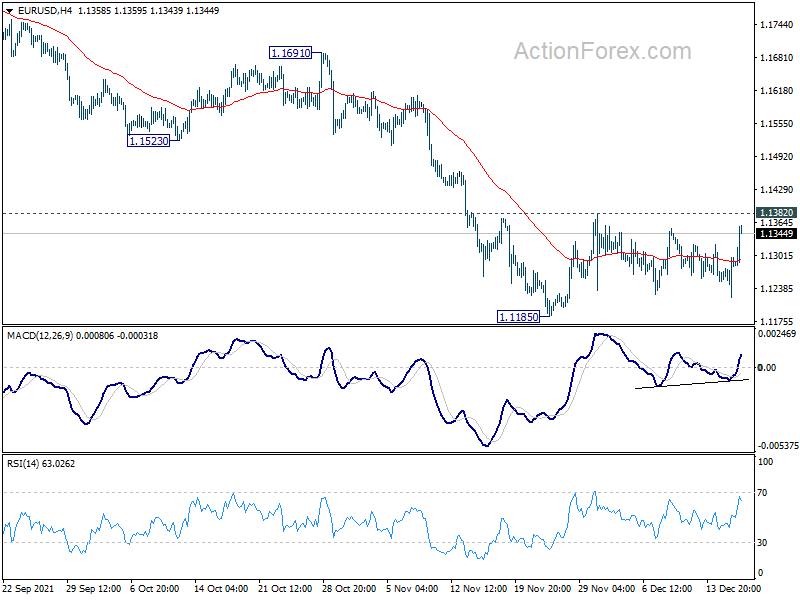
EUR/USD recovers notably today but stays in range of 1.1185/1382. On the upside, firm break of 1.1382 resistance should confirm short term bottoming at 1.1186. Intraday bias will be turned back to the upside for 55 day EMA (now at 1.1438). Sustained break there will be a sign of larger bullish reversal. On the downside, break of 1.1185 will resume larger fall from 1.2348. Next target is 161.8% projection of 1.2265 to 1.1663 from 1.1908 at 1.0934.
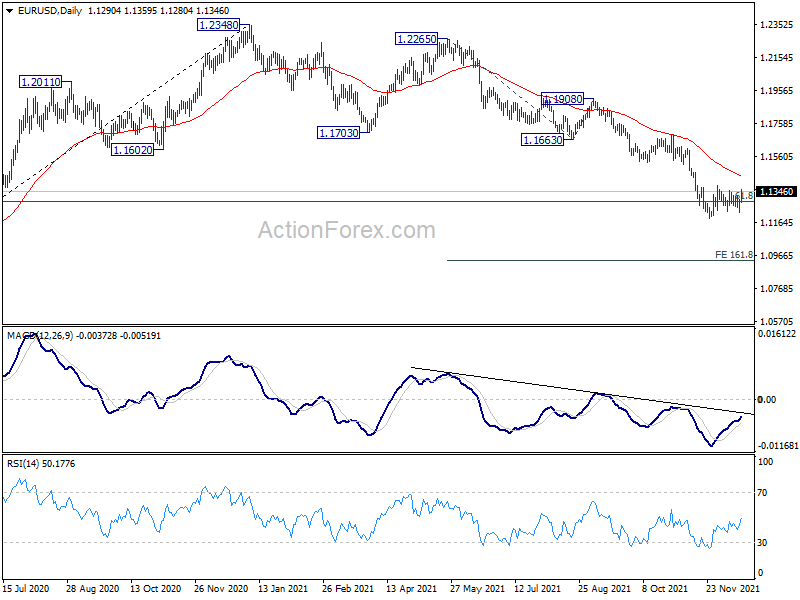
In the bigger picture, there are various ways of interpreting the fall from 1.2348 (2021 high). It could be a correction to rise from 1.0635 (2020 low), the fourth leg of a sideway pattern from 1.0339 (2017 low), or resuming long term down trend. In any case, outlook will now stay bearish as long as 1.1703 support turned resistance holds. Sustained break of 61.8% retracement of 1.0635 to 1.2348 at 1.1289 would pave the way back to 1.0635.
USD/CHF Mid-Day Outlook
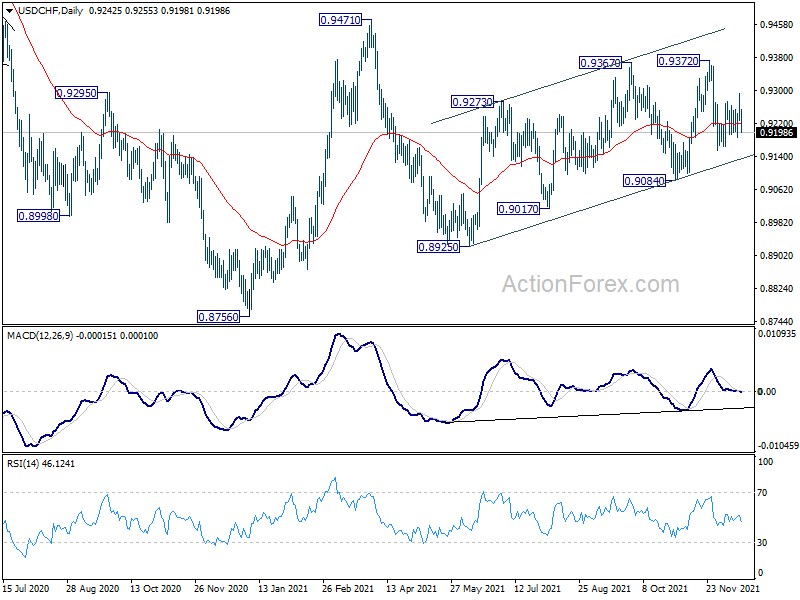
Daily Pivots: (S1) 0.9221; (P) 0.9258; (R1) 0.9282; More....
Intraday bias in USD/CHF remains neutral first. On the downside, below 0.9156 will target 0.9084 support. Firm break there should confirm that choppy rise from 0.8925 has completed, and suggests that fall from 0.9471 is resuming. Deeper decline would be seen through 0.8925. On the upside, break of 0.9293 will suggest that the pull back from 0.9372 is finished. Intraday bias will be turned back to the upside for 0.9372.
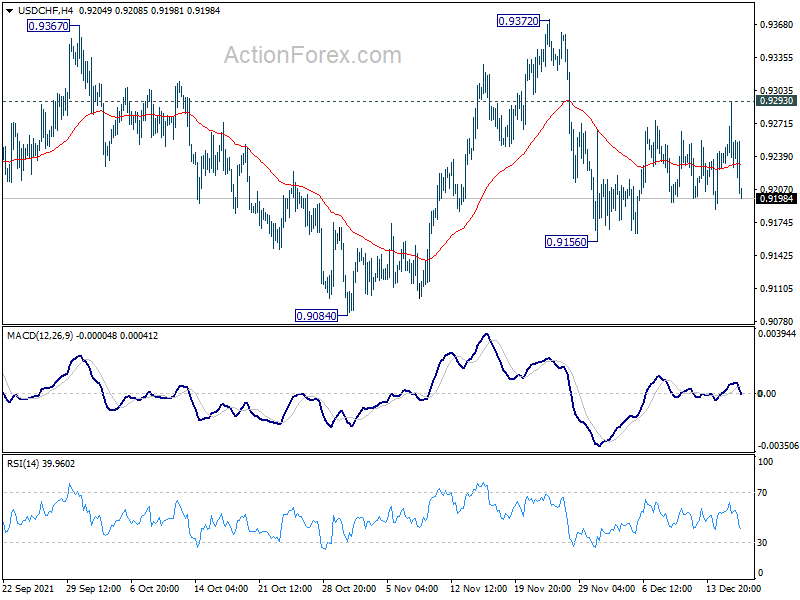
In the bigger picture, the corrective structure of the rebound from 0.8925 argues that fall from 0.9471 is not complete yet. It could either be the second leg of pattern from 0.8756 (2021 low), or resuming larger down trend from 1.0237 (2018 high). We'd pay attention to the downside momentum and assess the odds later. But for now, medium term outlook will be neutral at best as long as 0.9471 resistance holds.