Sample Category Title
GBP/USD Daily Outlook
Daily Pivots: (S1) 1.3252; (P) 1.3313; (R1) 1.3384; More...
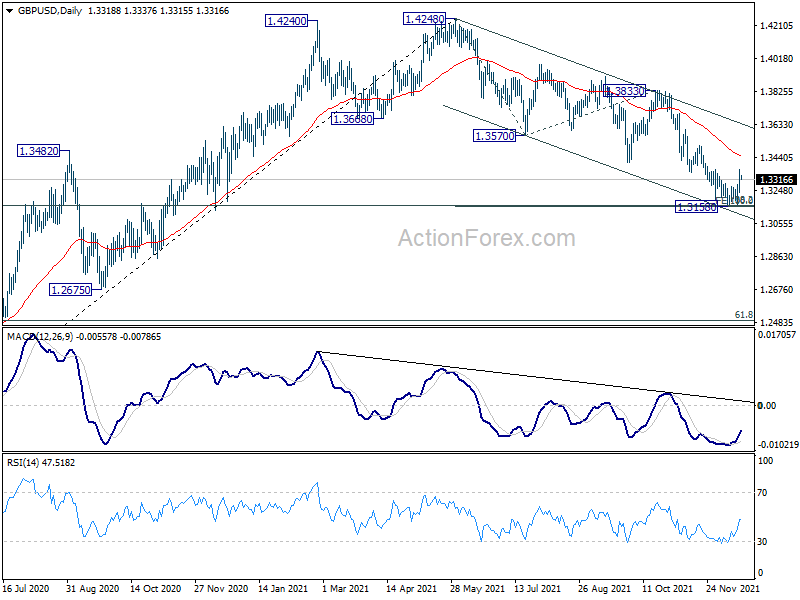
Intraday bias in GBP/USD remains mildly on the upside at this point. A short term bottom should be formed after defending 1.3164 key medium term fibonacci level. Further rise would be seen to 1.3570 support turned resistance first. Firm break there will affirm the case that whole correction from 1.4248 has completed. On the downside, however, sustained break of 1.3164 will carry larger bearish implications.
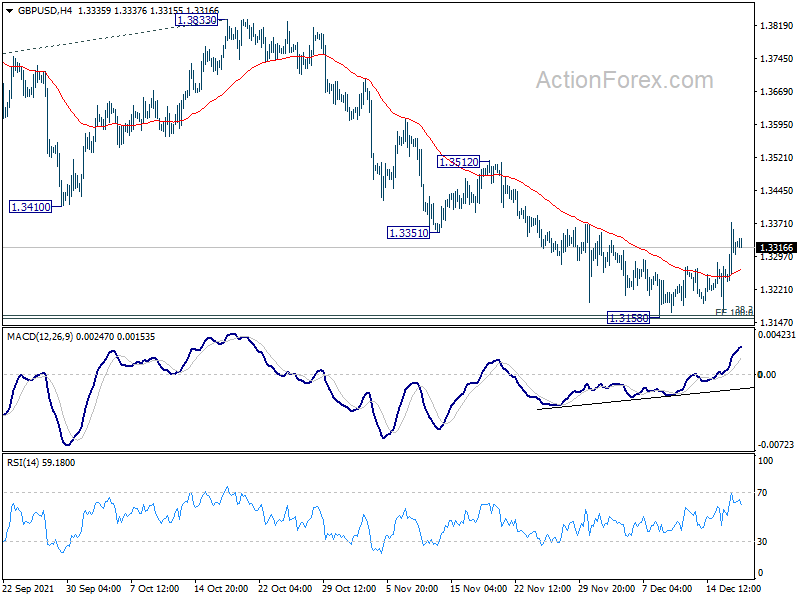
In the bigger picture, immediate focus is now on 38.2% retracement of 1.1409 to 1.4248 at 1.3164. Sustained break there will argue that whole rise from 1.1409 has completed at 1.4248, after rejection by 1.4376 long term resistance. That will revive some medium term bearishness and and target 61.8% retracement at 1.2493. However, strong rebound from current level will revive that case and up trend from 1.1409 is still in progress, and probably ready to resume.
The Dust Settles
The dust is settling on central bank week, with the Bank of Japan leaving policy rates and its 10-year JGB yield target of 0.0% unchanged. It has announced it will scale back its pandemic bond and commercial buying programs in 2022 while extending the SME relief program. USD/JPY is sharply unchanged, unsurprising given that the US/Japan yield differential is its key driver.
The BOJ's announcement follows in a similar vein to the ECB's “the lady is not for tapering” tapering not tapering announcement yesterday. Policy rates remained unchanged, but tapering of the PEPP was announced, although it replaced that by that with, you guessed it, more QE under the old APP scheme, as well as continuing with the TLTRO's. A very European compromise overall with the ECB acknowledging inflationary pressures, but well and truly hedging its bets. Overall, the QE forever family of the BOJ and ECB made plenty of noise but did very little tinkering under the bonnet. Both the Yen and the Euro are likely to have a tough Q1 versus the US Dollar.
Elsewhere, it was a mixed result. Norway and Britain have hiked modestly, while Australia and Southeast Asia remain cemented to unchanged, inflation be damned. Latin America, Eastern Europe and Russia have seen a series of hikes continuing and this will spare them the worst of the ravages of a stronger US Dollar in H1 2022. Turkey, meanwhile, cut rates under Erdoganomics. President Erdogan also fired a couple of people, and the Turkish Lira looks to have lost another 12% while I have been away this week. I might have to pencil in USD/TRY at 20.000 by early January at this rate. It would be comical if it wasn't so sad for the people of Turkey.
The FOMC has swung to hawkish, as per the hints from Jerome Powell pre-FOMC. A faster taper and three rate hikes “dot-plotted” into 2022 are the new reality now. I wasn't the least surprised at the equity and bond market reaction. The “buy everything” story rules the roost and annoying things like reality won't get in the way of it. The FOMC flip was interpreted by the perpetual mega-bulls as proactively anchoring future inflation expectations, something long-dated bond markets have been pricing in forever, so buy big-tech, I mean growth. How bonds and equities will weather the Fed not buying billions of bonds each month remains to be seen. The story looks to be running out of steam already looking at equity markets overnight. The US yield curve will maintain a healthy attraction if you are a fund manager in QE-forever Europe or Japan, so I am not expecting long-dated yields to explode higher. It does, however, reinforce my thoughts that the US Dollar will be the winner in H1 2022.
I will reiterate once again, however, that V for Volatility, and not directional trends, will continue to be the winner in December. I am also quietly hoping that the US Dollar falls, and equities rise in January as well. The new budget year usually brings a group-think kitchen-sink rush in a particular thematic trade. Unfortunately, bitter experience tells me that the first big move of the year in January is usually the wrong one. So, keep going on the “buy-everything” trade, it's all part of my cunning plan, and I love it when a plan comes together.
In Asia today, Singapore posted robust non-oil exports. Overall, omicron has not caused the global economy to blink yet it seems, but that appears to be because the world is fed up with lockdowns and restrictions, rather than the virus itself. The news from China continues to concern, however. The bottom-pickers buy recommendations are flowing thick and fast on China property companies. As I said last week, there's never just one cockroach.
Having vaccinated its population with Sinovac, which doesn't appear to work against omicron, we can safely assume China won't be opening borders in 2022. That, along with the still-developing property sector woes will crimp growth. Additionally, the US has added another 34 Chinese entities to its blacklist, so US/China relations are going nowhere in a hurry. Hopefully, the rest of the world can pick up some of the slack in 2022.
I note that the YouTuber's tool of choice, drone maker DJI, is one of those entities. Are YouTubers about to suffer a Christmas Black Swan? Hit the like and subscribe buttons to see.
A mixed day for Asian equities
The post-FOMC “inflation expectations are now anchored” rally has petered out. Technology, or growth, took a bath overnight as the Nasdaq plummeted by 2.47%, while the S&P 500 fell 0.87%, with the “value-heavy” Dow Jones easing just 0.09%. In Asia, futures on all three indexes continue to ease, shedding around 0.30%. With multiple expires on equity instruments occurring this evening in the US, some distortion because of that could be in play, as could end of yearbook squaring etc. I expect the choppy price action to continue to spoof fast-money players into the year-end, both in the US and elsewhere.
The Wall Street tech retreat overnight has had a similar effect on Asian markets with similar weightings, with the US addition of another swath of Chinese companies to their entity lists also weighing on sentiment. The Nikkei 225 is 1.55% lower, with markets completely ignoring the Bank of Japan. South Korea's Kospi has eased by 0.25%. Mainland China is also lower, the Shanghai Composite falling by 0.95%, and the CSI 300 has retreated by 0.70%. Meanwhile, the Hang Seng is 1.25% in the red.
Regionally, Singapore has eased 0.30% lower while Kuala Lumpur has climbed 0.30%. Jakarta has retreated 0.40%, with Taipei easing just 0.15%. Bangkok and Manila have fallen by 0.40%. Australia is bucking the trend with local markets rising. The All Ordinaries has risen 0.25%, while the ASX has rallied by 0.35%.
Softer post-FOMC US Dollar continues
The US Dollar fell after the FOMC meeting as investors priced in lower longer-term inflation expectations thanks to a pro-active FOMC. Longer-dated yields continue to trade on the softer side, although volatility remains at the shorter end of the curve. There is also likely to be some end of year book-squaring flows that will weigh on the greenback over the next two weeks. It will be interesting to see if we get the usual squeeze on overnight offshore dollar funding rates over the New Year turn this year, which should be greenback supportive next week.
Also weighing on sentiment is the failure of the Biden Build Back Better Bill to make it through the US Congress this year; if it ever does. Technically, that should mean less government borrowing, and less upward pressure on US bond yields and thus, less upward pressure on the US Dollar. Risk sentiment is also steadier in currency versus equity markets right now, particularly6 regarding omicron. Currency markets are pricing in no virus dip from the new variant, most notable in strength in Asian EM and the commonwealths.
The dollar index fell sharply again overnight by 0.34% to 96.00, easing to 95.92 in Asia. Support at 95.50 could well be tested into the year-end, and I would not be surprised to see that continue into January before the FOMC monetary reality hits markets. EUR/USD rose sharply overnight to 1.1340 after a taper, not taper, announcement from the ECB. The rally remains asthmatic though, unable to reclaim 1.1350, and the Euro, along with the Yen, remain highly vulnerable to US Dollar strength and rate differentials going forward.
A 10 basis point hike from the Bank of England overnight has lifted GBP/USD to 1.3330 today with the street pricing in future hikes after yesterday's surprise. However, until we close above 1.3500, Sterling remains in a technical downtrend and the UK could yet suffer an omicron upset. AUD, CAD and NZD all outperformed overnight thanks to steady risk sentiment, much like Asian FX.
Asian currencies have had a mixed performance. The Yuan continues to strengthen despite weaker fixes from the PBOC. With China borders likely closed for all of 2022, the trade surplus flows will continue underpinning Yuan strength. The SGD, THB, PHP, and IDR have all performed well post-FOMC, most likely because omicron has been discounted as a risk factor by investors. Although the INR and KRW have failed to rally, they are still holding steady. Both currencies are likely to feel the heat of fast-money outflows into the year-end, limiting gains.
Oil searches for equilibrium
Oil prices have endured another choppy range-trading week, although, by the standards of early December, the volatility remains modest. A continuing recovery ex-China and the threat of OPEC+ moving suddenly, is offset by an easing energy crunch in China and omicron growth fears. That has left oil markets looking for a more settled equilibrium price until the narrative convincingly changes one way or the other.
Brent crude rose 0.40% to $74.60 overnight, easing to $74.30 in Asia. It looks set to trade between its 100 and 200-day moving averages (DMAs) at $76.80 and $73.20 into the year-end. WTI climbed by 0.70% to $71.95 overnight, easing to $71.60 in Asia. It has clearly denoted resistance above $73.00 a barrel, followed by its 100-DMA at $74.00. Its 200-DMA at $70.50, and technical support at $69.50 a barrel, should contain any sell-offs.
Gold's recovery continues
Gold spiked higher overnight, continues its post-FOMC recovery. Gold finished 1.25% higher at $1799.00 an ounce, an impressive rally in two days from its post-FOMC lows around $1753.00 an ounce. In Asia, the rally has continued, with gold rising 0.30% to $1805.00 an ounce as local investors put on risk insurance for the weekend.
Gold has now cleared and closed above its 50, 100 and 200-DMAs at $1789.00, $1795.00 and $1786.50, an ostensibly bullish technical move. As ever, though, the rally overnight has more than a small hint of desperate fast-money to it. Gold bulls have been led to water before, only to find a massive Nile crocodile awaiting them in the watering hole.
The jury is still out on whether the rally is sustainable, although is US Dollar weakness continues, combined with year-end risk hedging, there may still be juice left in it. Gold has resistance at $1810.00 and $1820.00 an ounce and that could possibly extend to $1840.00 an ounce. Readers should tread with extreme caution if we see that level before the month-end.
Equity Markets Generally Track The Earlier Losses On Wall Street
General trend
- Reminder: China loan prime rates (LPRs) may be lowered during Dec, cited analysts - Chinese press [from Dec 16th].
- Australia New South Wales (highest population state) reported another record for virus cases.
- Australia debt agency cut FY21/22 bond issuance plan.
- Risk-sensitive commodity currencies trade lower, Crude Oil FUTs also drop.
- Quiet Asian session seen for GBP/USD amid BOE rate hike.
- USD/JPY trades slightly lower.
- US equity FUTs extended declines in Asia, Nasdaq FUTs continued to lag; Some are focusing on Friday’s option expiration.
- FedEx rose during afterhours trading amid earnings/guidance and buyback.
- Cerner [CERN] rose on renewed M&A talk.
- Nikkei 225 has extended declines.
- Hang Seng ended the morning session near the lows (-1.3%).
- Shanghai Composite also continued to decline during morning trading.
- S&P ASX 200 has pared gain.
- BOJ Gov Kuroda to hold post rate decision press conference at 06:30 GMT [will he comment on the recent rise in repo rates?].
- Companies due to report during the NY morning include Darden Restaurants, Winnebago.
Headlines/Economic Data
Australia/New Zealand
- ASX 200 opened flat.
- (AU) Australia Treasurer Frydenberg: China is unable to replace Australia Iron Ore very easily.
- (AU) NSW recorded 2,213 new COVID cases [record high]; South Australia has also reported a record high for new virus cases - Australian press.
- (AU) Australia AOFM Issuance Program/MYEFO 2021-22: Cuts planned gross issuance of Treasury Bonds for 2021-22 to ~A$105B (of which A$44.3B has been completed) v ~A$130B prior.
Japan
- Nikkei 225 opened -0.7%.
- (JP) Bank of Japan (BOJ) leaves interest rate on excess reserves (IOER) unchanged at -0.10%; as expected; Announces partial extension of the Special Program to Support Financing in Response to COVID-19 to Sept 2022 (prior Mar 2022), but reduced the scale of the program.
- (JP) Japan PM Kishida's visit to the US has been postponed to 2022 - Nikkei.
- (JP) Japan Govt said to be looking at maintaining new JGB issuance in the ~¥30T range for FY22/23 [~¥43.6T was initially planned]; notes economic recovery may support tax revenues - Press.
- (JP) Japan Govt to convene diet session on Jan 17th (Mon) - Press.
- (JP) Japan considers extending border controls past Jan - Press.
Korea
- Kospi opened -0.7%.
- (KR) South Korea to spend ~KRW3.2T on small business owners during coronavirus restrictions.
China/Hong Kong
- Hang Seng opened -0.1%; Shanghai Composite opened -0.1%.
- (CN) China PBOC Deputy Gov Chen: Calls for creation of financial risks alert system.
- (CN) China PBOC sets Yuan reference rate: 6.3651 v 6.3637 prior.
- (CN) China PBOC Open Market Operation (OMO): Sells CNY10B in 7-day reverse repos v CNY10B prior; Net CNY0B v Net CNY0B prior.
- (US) Senate passes bill unanimously to ban all imports from Xinjiang, China unless US govt determines that they were not made with forced labor; Bill now moves to Pres Biden who has indicated he will sign it.
- (CN) China Stats Bureau (NBS) Revises 2020 GDP growth to 2.2% v 2.3% prior (>40 year low).
- CN) China Finance Ministry (MOF) said debt risks related to local governments are 'generally' under control - Chinese press.
- (HK) Hong Kong Government: To sell land site in Tsing Yi by public tender, the move will support the development of logistics.
- (CN) China Ministry of Finance (MOF) Sells 3-month bills and 50-year bonds.
North America
- (US) President Biden: Has productive call with Schumer and Pelosi; Believes Build back better will receive support to pass in Senate.
- (US) Nov Housing Starts: 1.679M V 1.567ME; Building permits: 1.712M V 1.661ME.
- (US) Price-fixing case related to Chicken industry prices said to end in mistrial - US financial press.
- (US) Initial Jobless Claims: 206K V 200KE; Continuing claims: 1.85M V 1.94ME.
- (US) Dec Preliminary Markit PMI Manufacturing : 57.8 V 58.5E.
- (US) Dec Philadelphia Fed Business Outlook Survey: 15.4 V 29.6E.
- (US) Nov industrial Production M/M: 0.5% V 0.6%E; Capacity Utilization: 76.8% V 76.8%E.
Europe
- (DE) German Chancellor Scholz: Will continue to closely watch energy price situation; Do not plan an obligation for coronavirus tests for travel in the EU.
- (FR) France President Macron: No plans to introduce obligatory coronavirus tests for travel in the EU.
- (UK) Liberal Democrats said to win the North Shropshire seat by defeating the UK Conservatives in special election - UK media.
Others
- (PE) Peru Congress to debate giving tax law powers to Govt on Dec 17.
Levels as of 00:20 ET
- Nikkei 225, -1.9%, ASX 200 +0.1% , Hang Seng -1.2%; Shanghai Composite -0.9% ; Kospi flat.
- Equity S&P500 Futures: -0.2%; Nasdaq100 -0.3%, Dax -0.3%; FTSE100 -0.5%.
- EUR 1.1340-1.1320 ; JPY 113.85-113.44 ; AUD 0.7187-0.7151 ;NZD 0.6829-0.6774.
- Gold +0.3% at $1,803/oz; Crude Oil -1.2% at $71.53/brl; Copper flat at $4.2977/lb.
EUR/USD Daily Outlook
Daily Pivots: (S1) 1.1289; (P) 1.1324; (R1) 1.1368; More...
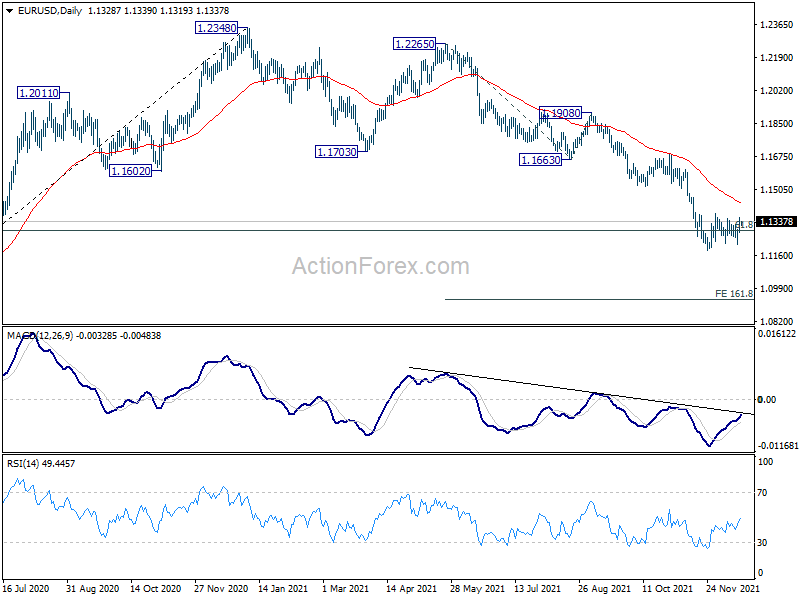
EUR/USD is still bounded in sideway trading in range of 1.1185/1382. Intraday bias remains neutral first. On the upside, firm break of 1.1382 resistance should confirm short term bottoming at 1.1186. Intraday bias will be turned back to the upside for 55 day EMA (now at 1.1436). Sustained break there will be a sign of larger bullish reversal. On the downside, break of 1.1185 will resume larger fall from 1.2348. Next target is 161.8% projection of 1.2265 to 1.1663 from 1.1908 at 1.0934.
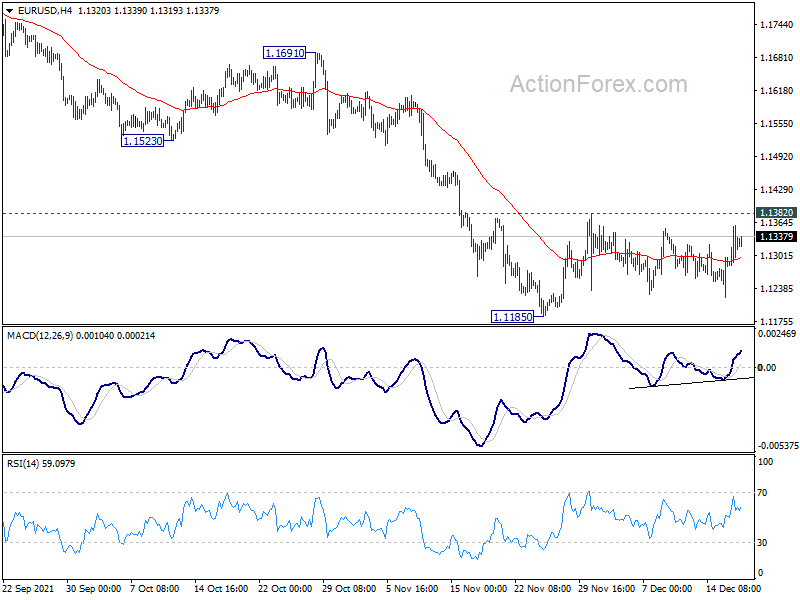
In the bigger picture, there are various ways of interpreting the fall from 1.2348 (2021 high). It could be a correction to rise from 1.0635 (2020 low), the fourth leg of a sideway pattern from 1.0339 (2017 low), or resuming long term down trend. In any case, outlook will now stay bearish as long as 1.1703 support turned resistance holds. Sustained break of 61.8% retracement of 1.0635 to 1.2348 at 1.1289 would pave the way back to 1.0635.
Gold Back above 1800, EUR/USD Still Ranging in Mixed Markets
Overall markets are rather mixed so far, as guided by the volatile risk sentiment. There is no clear follow through moves in the markets. Sterling is the strongest one for the week so far, after the surprised BoE rate hike. But Swiss Franc is the second strongest, as helped by some safe haven flow. Canadian Dollar is the worst performing, while even the strong Aussie is losing much momentum. Dollar and Euro are mixed and they're still bounded in range against each other.
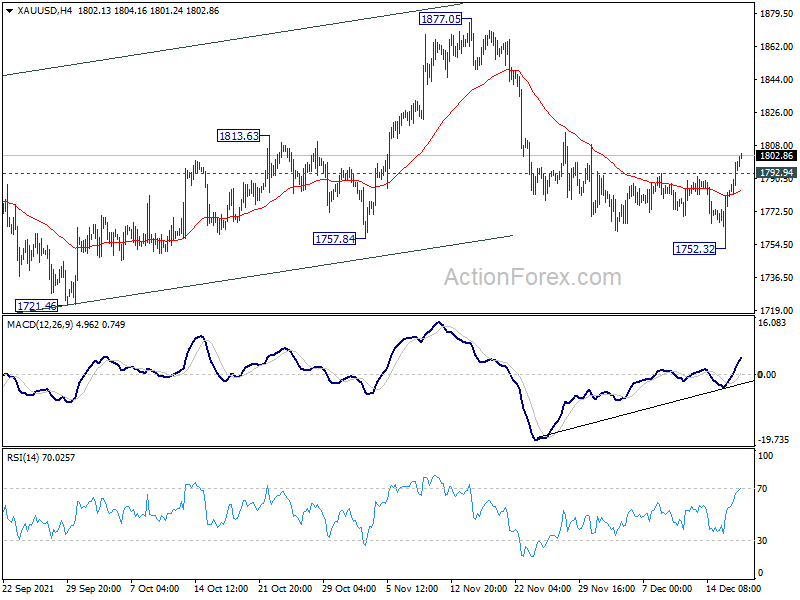
Technically, Gold is probably displaying the clearest picture. A short term bottom is formed at 1752.32 with break of 1792.94 resistance. It's supported by bullish convergence condition in 4 hour MACD too. Fall from 1877.05 should be finished. If Gold could grab firm hold above 1800 handle, there is prospect of further rise back to 1877.05 resistance. That, if happens, would be a sign of Dollar weakness.
In Asia, at the time of writing, Nikkei is down -1.63%. Hong Kong HSI is down -1.28%. China Shanghai SSE is down -0.90%. Singapore Strait Times is down -0.28%. Japan 10-year JGB yield is up 0.0016 at 0.046. Overnight, DOW dropped -0.08%. S&P 500 dropped -0.87%. NASDAQ dropped -2.47%. 10-year yield dropped -0.041 to 1.422.
BoJ keeps interest rates unchanged, scales back emergency funding
Under the yield curve control, BoJ kept short-term policy interest rate unchanged at -0.10%, and 10-year JGB target at around 0% without upper limit to purchases. It will continue to buy ETFs and J-REITs with upper limits of JPY 12T and JPY 180B respectively on annual paces.
The Special Program to Support Financing in Response to the Novel Coronavirus is extended in part by six months until the end of September 2022. The additional purchases of commercial paper and corporate bonds will be complete at the end of March 2022 as scheduled with outstanding amounts gradually drop back to pre-pandemic levels.
BoJ said, "Japan's economy is projected to continue growing at a pace, albeit slower, above its potential growth rate." Core CPI is "likely to increase moderately in positive territory in the short run," and "projected to increase gradually as a trend".
The course of COVID-19 continues to warrant attention". There are "high uncertainties over whether the resumption of economic activity can progress smoothly". Attentions should also be paid to risk that "effects of supply-side constraints seen in some areas will be amplified or prolonged."
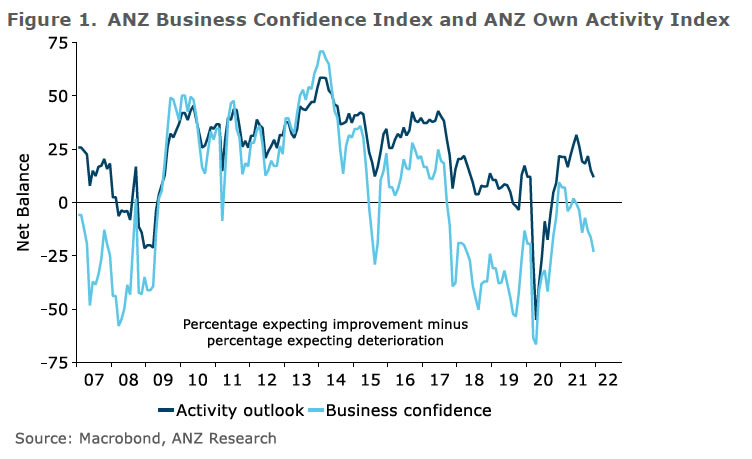
New Zealand ANZ business confidence dropped to -23.2, inflation expectations rose further
New Zealand ANZ business confidence dropped further to -23.2 in December, down from November's -16.4. Own activity outlook dropped from 15.0 to 11.8. Export intentions dropped from 9.5 to 8.8. Investment intentions dropped from 16.3 to 11.4. Employment intentions dropped from 15.8 to 10.5. Pricing intentions dropped from 66.5 to 63.6. Inflation expectations rose further from 4.24% to 4.42%.
ANZ said: "Unfortunately the cloud of uncertainty that hangs over 2022 is not a great deal smaller, nor fluffier... Labour shortages and cost pressures rank high in firms' list of concerns, and freight disruptions are getting worse... But having trouble meeting demand is probably a better problem to have than not having enough demand.
UK Gfk consumer confidence dropped to -14, slightly depressed end of year
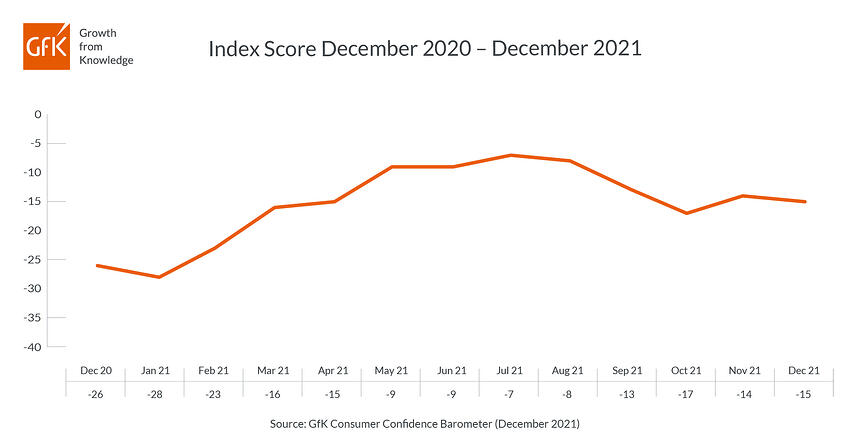
UK Gfk consumer confidence dropped from -14 to -15 in December. Personal financial situation over the next 12 months dropped from 2 to 1. General economic situation over the next 12 months dropped from -23 to -24. Major purchase index also dropped from -3 to -6.
Joe Staton, Client Strategy Director, GfK says: "News about the Omicron variant could not have arrived at a worse time for festive celebrations... We end 2021 on a slightly depressed note and it looks like it will be a bleak midwinter for UK consumer confidence possibly with new COVID curbs and little likelihood of any real uplift in the first months of 2022."
Looking ahead
Germany Ifo business climate, PPI and Eurozone CPI final will be released in European session. Canada will release foreign securities purchases.
EUR/USD Daily Outlook
Daily Pivots: (S1) 1.1289; (P) 1.1324; (R1) 1.1368; More...
EUR/USD is still bounded in sideway trading in range of 1.1185/1382. Intraday bias remains neutral first. On the upside, firm break of 1.1382 resistance should confirm short term bottoming at 1.1186. Intraday bias will be turned back to the upside for 55 day EMA (now at 1.1436). Sustained break there will be a sign of larger bullish reversal. On the downside, break of 1.1185 will resume larger fall from 1.2348. Next target is 161.8% projection of 1.2265 to 1.1663 from 1.1908 at 1.0934.
In the bigger picture, there are various ways of interpreting the fall from 1.2348 (2021 high). It could be a correction to rise from 1.0635 (2020 low), the fourth leg of a sideway pattern from 1.0339 (2017 low), or resuming long term down trend. In any case, outlook will now stay bearish as long as 1.1703 support turned resistance holds. Sustained break of 61.8% retracement of 1.0635 to 1.2348 at 1.1289 would pave the way back to 1.0635.
Economic Indicators Update
| GMT | Ccy | Events | Actual | Forecast | Previous | Revised |
|---|---|---|---|---|---|---|
| 0:01 | GBP | GfK Consumer Confidence Dec | -15 | -14 | ||
| 3:00 | JPY | BoJ Interest Rate Decision | -0.10% | -0.10% | -0.10% | |
| 7:00 | EUR | Germany PPI M/M Nov | 1.40% | 3.80% | ||
| 7:00 | EUR | Germany PPI Y/Y Nov | 19.80% | 18.40% | ||
| 9:00 | EUR | Germany IFO Business Climate Dec | 95.4 | 96.5 | ||
| 9:00 | EUR | Germany IFO Current Assessment Dec | 97.5 | 99 | ||
| 9:00 | EUR | Germany IFO Expectations Dec | 93.3 | 94.2 | ||
| 10:00 | EUR | Eurozone CPI Y/Y Nov F | 4.90% | 4.90% | ||
| 10:00 | EUR | Eurozone CPI Core Y/Y Nov F | 2.60% | 2.60% | ||
| 13:30 | CAD | Foreign Securities Purchases (CAD) Oct | 20.02B |
BoJ keeps interest rates unchanged, scales back emergency funding
Under the yield curve control, BoJ kept short-term policy interest rate unchanged at -0.10%, and 10-year JGB target at around 0% without upper limit to purchases. It will continue to buy ETFs and J-REITs with upper limits of JPY 12T and JPY 180B respectively on annual paces.
The Special Program to Support Financing in Response to the Novel Coronavirus is extended in part by six months until the end of September 2022. The additional purchases of commercial paper and corporate bonds will be complete at the end of March 2022 as scheduled with outstanding amounts gradually drop back to pre-pandemic levels.
BoJ said, "Japan's economy is projected to continue growing at a pace, albeit slower, above its potential growth rate." Core CPI is "likely to increase moderately in positive territory in the short run," and "projected to increase gradually as a trend".
The course of COVID-19 continues to warrant attention". There are "high uncertainties over whether the resumption of economic activity can progress smoothly". Attentions should also be paid to risk that "effects of supply-side constraints seen in some areas will be amplified or prolonged."
Elliott Wave View: Nasdaq (NQ) Turning Lower
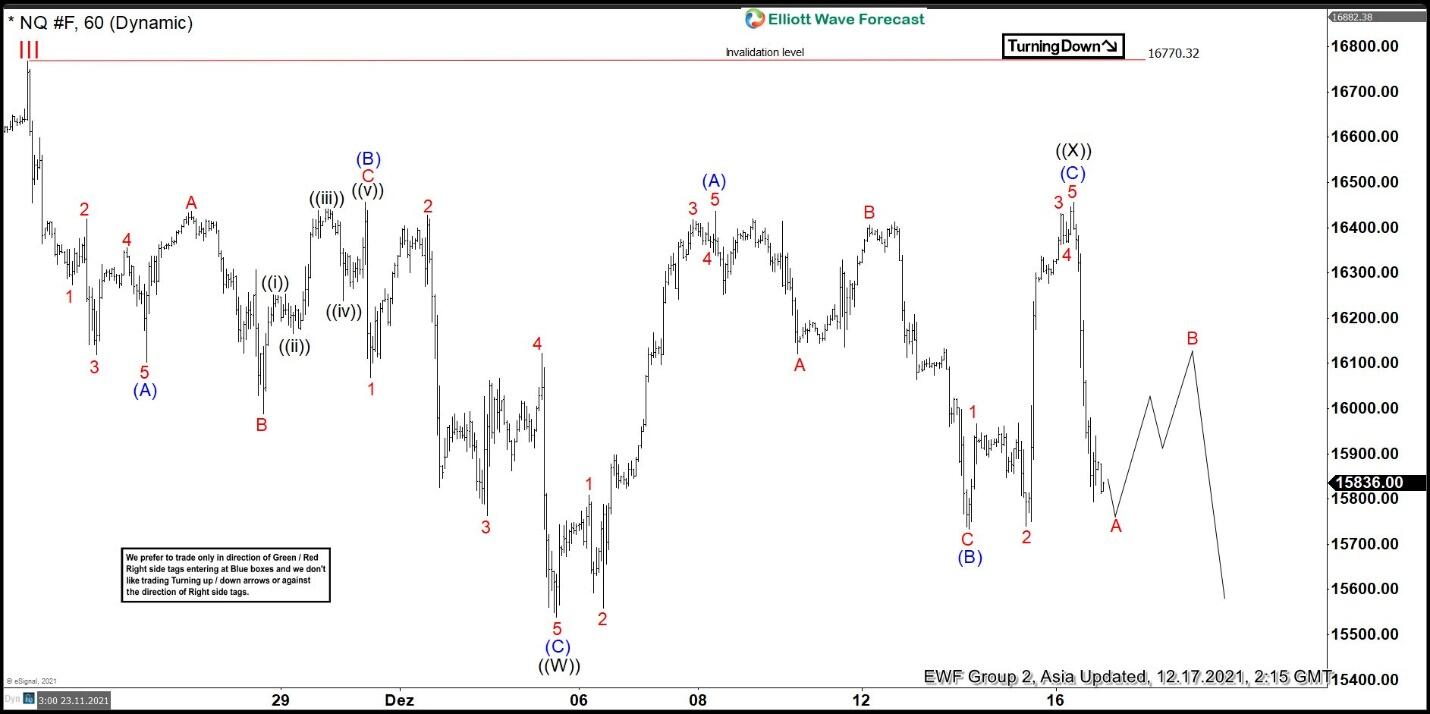
Short-term Elliott wave view in Nasdaq (NQ) suggests rally to 16770.32 ended wave III. Pullback in wave IV is currently in progress with subdivision as a double three Elliott Wave structure. Down from November 22, 2021 peak, wave (A) ended at 16102, and rally in wave (B) ended at 16456.25. Index then extends lower in wave (C) towards 15538. This completed wave ((W)) in larger degree. Index then rallied in wave ((X)) with subdivision as a zigzag. Up from wave ((W)), wave (A) ended at 16436.75 and pullback in wave (B) ended at 15734. Index then extends higher in wave (C) towards 16457 which completed wave ((X)).
The Index has turned lower again in wave ((Y)). It however still needs to break below wave ((W)) at 15538 to validate the view. Near term, it’s expected to rally in wave B to correct cycle from December 16, 2021 peak before the next leg lower. As far as pivot at 16770.32 high stays intact, expect wave B rally to fail in the sequence of 3, 7, or 11 swing for more downside. Potential target to the downside is the 100% – 161.8% Fibonacci extension of wave ((W)) towards 14467 – 15227 area.
Nasdaq 60 Minutes Elliott Wave Chart
Market Morning Briefing: Dollar-Yen Fell Back To Levels Below 114 As The Dollar Index Weakened
STOCKS
Dow has risen slightly today but chances of a fall towards 35250-35000 is still possible. Dax has room to rise towards 15800-15900. The view in Nikkei is bearish to see a fall towards 28500/28250. Shanghai has room to fall towards 3625 , if the index falls further the a test of 3550 is possible, else if we see a bounce from 3625 then a rise towards 3700 can be seen. Nifty can rise towards 17400/600, while above 17200. If seen a break below 17200 is seen ,the fall can be limited to 17000/16800. Sensex has scope of falling towards 57500-57000.
Dow (35897.64, -29.79, -0.083%) has chances to see a fall to 35250-35000 in the near term. A broad range between 35000-36000 can be seen in the near term. A sustained break above 36000 will reinforce bullishness.
DAX (15636.40, +160.05, +1.03%) has come down after testing a high of 15780.90. While above 15500, a rise towards 15800-900 is possible.
Nikkei (28799.60, -266.72, -0.92%) has come down sharply today in line with our expectations to see a fall. The view is bearish to see a fall towards 28500/28250 on the downside. Further break below 28250 can take the index down towards 27000.
Shanghai (3646.83, -28.19, -0.78%) has come down after testing the high of 3673.53 as we has expected. A break below 3625 if seen can take the index down towards 3600 and 3550 eventually. Else, if the index manages to bounce from 3625 then a rise to 3700 is possible.
Nifty (17248.40, +27, +0.16%) closed above 17200 yesterday keeping a rise towards 17400/600 possible in the near term. A fall, if seen can be limited to 17000/16800. We expect a broad range of 16800/17000-17800 to hold for the next 1-2 weeks.
Sensex (57901.14, +113.11, +0.20%) rose slightly yesterday. The view is still bearish to see a test of 57500-57000 before we see a bounce back. Only a sustained rise above 58000 will negate the downside.
COMMODITIES
Crude prices remain in a sideways consolidation and need to break on either side to start a fresh trending movement. Till then we may look at Brent and WTI to trade within 78-72 and 74-69 respectively. Gold and Silver have both risen after seeing a sideways range for almost 2-weeks. A rise to 1820 on Gold and towards 23 or higher on Silver is possible by the coming week. Copper is bullish while above 4.00/10. Interim resistances seen at 4.35 and 4.40.
Brent (74.85) can fall towards 72-70 while below immediate resistance zone of 77/78. WTI (71.95) on the other hand looks likel it can be raged within 74-69 region for sometime before a break on either side is seen.
Gold (1804.00) and Silver (22.55) have risen well. Gold has moved up above 1800 as support near 1750/60 seems to be holding well for now. After a long sideways range of 2-weeks Gold has moved up and if the rise sustains, it can target 1820 on the upside. Thereafter it needs to break above 1820 to move up further else a fall back to 1750 cannot be negated. Silver has risen well and a break above 23 if seen can take it higher towards 24.50 eventually. Watch price action while above 22.
Copper (4.3080) broke below the immediate support at 4.25/20 and fell to almost test 4.10 on the downside before bouncing back sharply to current levels. Broad range of 4.00-4.35 may hold for now. A break above 4.35 if seen can take it higher to 4.40/50 on the upside. In the longer run, view is bullish while above 4.00-4.10.
FOREX
Dollar Index fell to show some near term weakness, remaining within the 95.50-97 range while Euro has scope to trade within 1.1355/60-1.1250 for the very near term. EURJPY rose sharply yesterday but has come off and could hold within 129.50-127.50 for at least the next couple of weeks. Aussie and Pound could slowly inch up in the near term. USDCNY can trade within 6.38-6.36 while USDJPY has come off sharply and hold within 114.50-112.50 region for the near term. USDINR came off sharply yesterday to close near 76.09. We need to see the weekly close today to decide if the upside possibilities of 76.80-77 is still intact for the near term.
Dollar Index (96.03) fell sharply from 96.45 seen yesterday. We continue to look for a fall in Dollar Index towards 95.50 before rising back towards 97. A range of 97-95.50 may continue to hold for the next week as well.
Euro (1.1324) tested 1.1360 before the ECB meeting yesterday but close at lower levels. Today a slight dip is seen butt there is scope for a rise to1.1355/60 on the upside which is also an immediate resistance. A range of 1.1355/60-1.1250 may hold for now and can trigger bullishness on a break above 1.1355/60.
EURJPY (128.67) tested 129.637 overnight but came off to levels below 129 just now. A broad range of 129.50-127.50 is likely to hold unless a sustained break on either side is seen in the near term.
Aussie (0.7175) rose sharply to test 0.7223 yesterday but could not sustain higher and instead came down to trade below 0.72 currently. A further fall from here can take the Aussie down towards 0.71 or even lower. Immediate range of 0.7250-0.71 may hold for now.
Pound (1.3324) tested 1.3374 on the upside before coming off sharply from there but the view is bullish for Pound while above 1.3250. There is scope for an eventual rise to 1.34-1.3450.
Dollar-Yen (113.60) fell back to levels below 114 as the Dollar Index weakened. While below 114.50, view is likely to be bearish for a fall towards 113-112.50 on the downside. A break above 114.50 needs to be seen again and sustained in order for Dollar Yen to move up again.
USDCNY (6.3687) is inching up slowly but within a narrow range. While below 6.38, there is scope for USDCNY to fall towards 6.36 and lower again. Immediate range of 6.38-6.36 may hold for now.
{USDINR (76.09) fell sharply yesterday from 76.125 to come back to our expected and earlier range of 76.20-75.80/75. Movement today would be crucial to see if the week closes at levels above 76.20 or lower. While below 76.20-76.00, we may look for a fall to 75.80-75.60 but any break above 76.20 if seen again could bring back bullish possibility of a rise to 76.80-77 or higher on the upside. Watch weekly close today.
INTEREST RATES
Following the US Federal Reserve Bank, the European Central Bank (ECB) yesterday announced that it will cut down its Pandemic Emergency Purchase Programme from next month and will end it by March 2022. The Bank of England has hiked the interest rate to 0.25% yesterday. The US Treasury yields have fallen-back across tenors. We retain our view of seeing a broad sideways range movement in the yields for some time. The German yields have inched up slightly but have resistances ahead that can cap the upside and keep the broader bearish view intact. The 10Yr and 5Yr GoI can move up to test the upper end of their respective range of 6.3%-6.4% (10Yr) and 5.62%-5.73% (5Yr) and then can come down again.
The US 2Yr (0.62%), 5Yr (1.18%) and the 10Yr (1.42%) yields have dipped sharply while the 30Yr (1.86%) remains stable. We reiterate that the yields can oscillate in a broad range of 1.3%-1.65% (10Yr) and 1.7%-2% (30Yr) for some time. Within this if the 10Yr falls below 1.4%, it can dip to 1.3%. The 30Yr on the other hand can test 1.7% if it falls below 1.8% from here. But broadly we see high chances of the yields moving towards the upper end of their range in the coming weeks.
The German 2Yr (-0.71%) and 5Yr (-0.59%) yields remain stable while the 10Yr (-0.36%) and 30Yr (-0.01%) have inched up slightly. With resistances at -0.25% (10Yr) and 0.05% (30Yr) the view remains bearish to see -0.45% / -0.5% (10Yr) and -0.1% / -0.2% (30Yr) in the coming weeks.
The Indian 10Yr (6.3749%) and 5Yr (5.6937%) GoI can move up towards the upper end of their respective range as mentioned yesterday. 6.3%-6.4% (10Yr) and 5.62%-5.73% (5Yr) is the expected range of trade. Within this the 10Yr can test 6.4% and the 5Yr can rise to 5.72%-5.73% and then can come down again.
UK Gfk consumer confidence dropped to -14, slightly depressed end of year
UK Gfk consumer confidence dropped from -14 to -15 in December. Personal financial situation over the next 12 months dropped from 2 to 1. General economic situation over the next 12 months dropped from -23 to -24. Major purchase index also dropped from -3 to -6.
Joe Staton, Client Strategy Director, GfK says: "News about the Omicron variant could not have arrived at a worse time for festive celebrations... We end 2021 on a slightly depressed note and it looks like it will be a bleak midwinter for UK consumer confidence possibly with new COVID curbs and little likelihood of any real uplift in the first months of 2022."
New Zealand ANZ business confidence dropped to -23.2, inflation expectations rose further
New Zealand ANZ business confidence dropped further to -23.2 in December, down from November's -16.4. Own activity outlook dropped from 15.0 to 11.8. Export intentions dropped from 9.5 to 8.8. Investment intentions dropped from 16.3 to 11.4. Employment intentions dropped from 15.8 to 10.5. Pricing intentions dropped from 66.5 to 63.6. Inflation expectations rose further from 4.24% to 4.42%.
ANZ said: "Unfortunately the cloud of uncertainty that hangs over 2022 is not a great deal smaller, nor fluffier... Labour shortages and cost pressures rank high in firms' list of concerns, and freight disruptions are getting worse... But having trouble meeting demand is probably a better problem to have than not having enough demand.