

Sample Category Title
(ECB) Monetary policy decisions
The Governing Council judges that the progress on economic recovery and towards its medium-term inflation target permits a step-by-step reduction in the pace of its asset purchases over the coming quarters. But monetary accommodation is still needed for inflation to stabilise at the 2% inflation target over the medium term. In view of the current uncertainty, the Governing Council needs to maintain flexibility and optionality in the conduct of monetary policy. With this is mind, the Governing Council took the following decisions:
Pandemic emergency purchase programme (PEPP)
In the first quarter of 2022, the Governing Council expects to conduct net asset purchases under the pandemic emergency purchase programme (PEPP) at a lower pace than in the previous quarter.It will discontinue net asset purchases under the PEPP at the end of March 2022.
The Governing Council decided to extend the reinvestment horizon for the PEPP. It now intends to reinvest the principal payments from maturing securities purchased under the PEPP until at least the end of 2024. In any case, the future roll-off of the PEPP portfolio will be managed to avoid interference with the appropriate monetary policy stance.
The pandemic has shown that, under stressed conditions, flexibility in the design and conduct of asset purchases has helped to counter the impaired transmission of monetary policy and made efforts to achieve the Governing Council's goal more effective. Within our mandate, under stressed conditions, flexibility will remain an element of monetary policy whenever threats to monetary policy transmission jeopardise the attainment of price stability. In particular, in the event of renewed market fragmentation related to the pandemic, PEPP reinvestments can be adjusted flexibly across time, asset classes and jurisdictions at any time. This could include purchasing bonds issued by the Hellenic Republic over and above rollovers of redemptions in order to avoid an interruption of purchases in that jurisdiction, which could impair the transmission of monetary policy to the Greek economy while it is still recovering from the fallout of the pandemic. Net purchases under the PEPP could also be resumed, if necessary, to counter negative shocks related to the pandemic.
Asset purchase programme (APP)
In line with a step-by-step reduction in asset purchases and to ensure that the monetary policy stance remains consistent with inflation stabilising at its target over the medium term, the Governing Council decided on a monthly net purchase pace of €40 billion in the second quarter and €30 billion in the third quarter under the asset purchase programme (APP). From October 2022 onwards, the Governing Council will maintain net asset purchases under the APP at a monthly pace of €20 billion for as long as necessary to reinforce the accommodative impact of its policy rates. The Governing Council expects net purchases to end shortly before it starts raising the key ECB interest rates.
The Governing Council also intends to continue reinvesting, in full, the principal payments from maturing securities purchased under the APP for an extended period of time past the date when it starts raising the key ECB interest rates and, in any case, for as long as necessary to maintain favourable liquidity conditions and an ample degree of monetary accommodation.
Key ECB interest rates
The interest rate on the main refinancing operations and the interest rates on the marginal lending facility and the deposit facility will remain unchanged at 0.00%, 0.25% and -0.50% respectively.
In support of its symmetric 2% inflation target and in line with its monetary policy strategy, the Governing Council expects the key ECB interest rates to remain at their present or lower levels until it sees inflation reaching 2% well ahead of the end of its projection horizon and durably for the rest of the projection horizon, and it judges that realised progress in underlying inflation is sufficiently advanced to be consistent with inflation stabilising at 2% over the medium term. This may also imply a transitory period in which inflation is moderately above target.
Refinancing operations
The Governing Council will continue to monitor bank funding conditions and ensure that the maturing of TLTRO III operations does not hamper the smooth transmission of its monetary policy. The Governing Council will also regularly assess how targeted lending operations are contributing to its monetary policy stance. As announced, it expects the special conditions applicable under TLTRO III to end in June next year. The Governing Council will also assess the appropriate calibration of its two-tier system for reserve remuneration so that the negative interest rate policy does not limit banks' intermediation capacity in an environment of ample excess liquidity.
***
The Governing Council stands ready to adjust all of its instruments, as appropriate and in either direction, to ensure that inflation stabilises at its 2% target over the medium term.
The President of the ECB will comment on the considerations underlying these decisions at a press conference starting at 14:30 CET today.
GBP/USD and GBP/JPY solidifying near term reversal after BoE hike
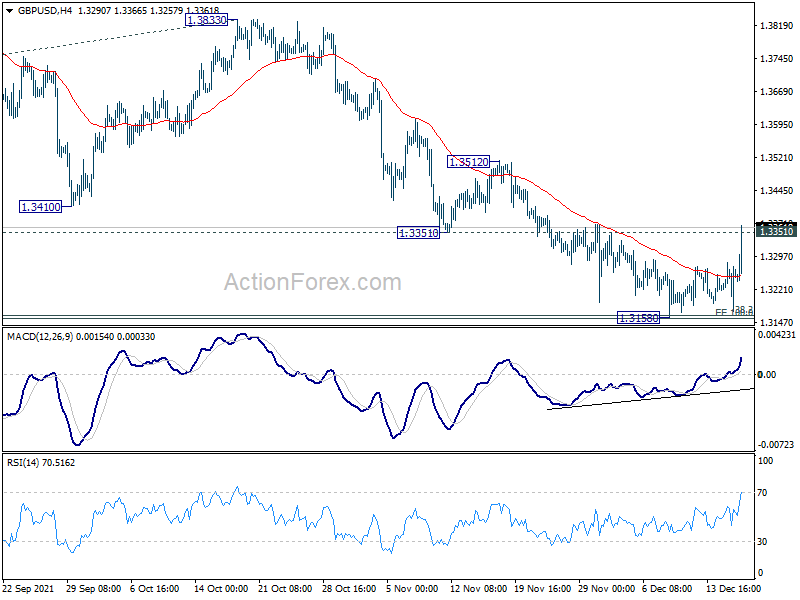
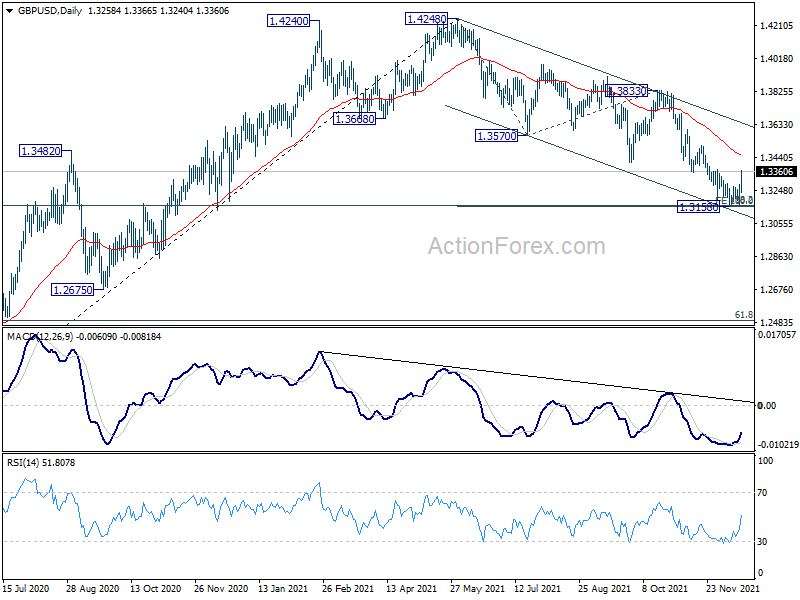
Sterling rises sharply after surprised BoE rate hike. GBP/USD's break of 1.3351 support turned resistance confirms short term bottoming at 1.3158. More importantly, it's the first sign that corrective fall from 1.4248 has completed at 1.3158 after hitting 38.2% retracement of 1.1409 to 1.4248 at 1.3164. Sustained trading above 55 day EMA (1.3453) will affirm this bullish case.
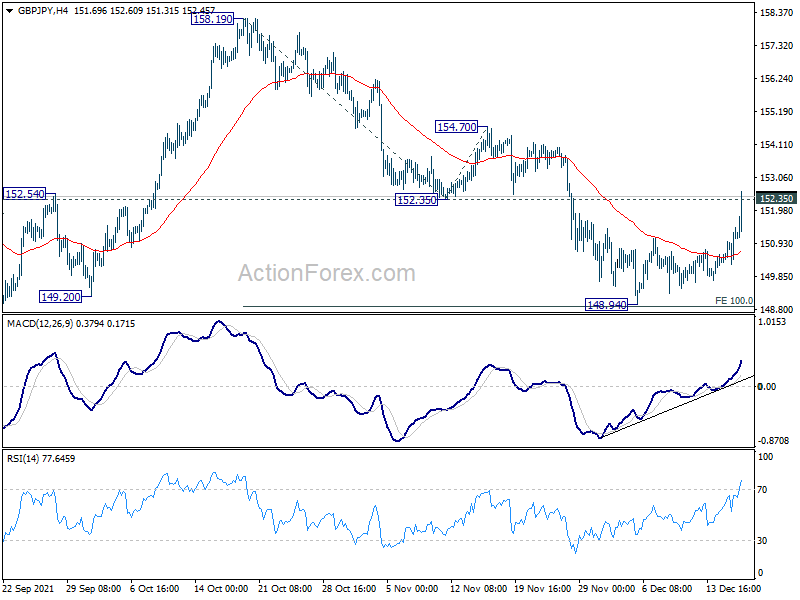
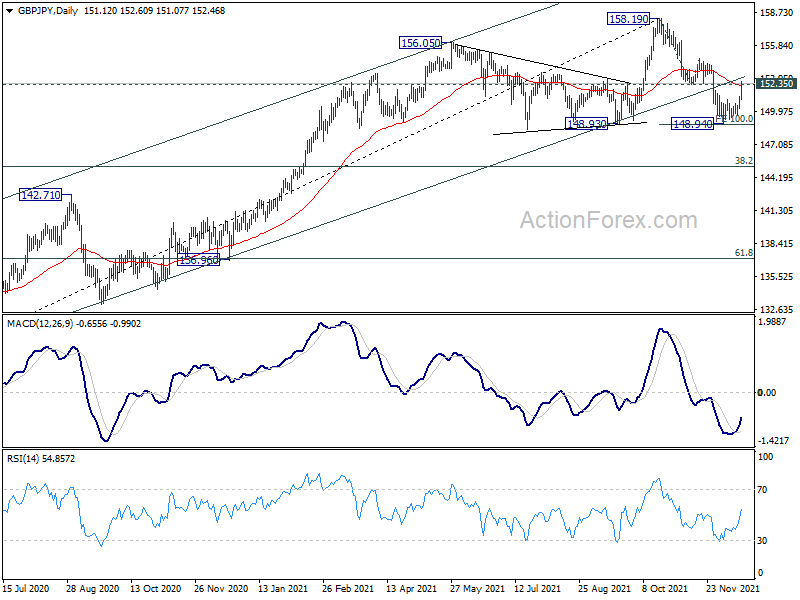
Similarly, GBP/JPY's break of 152.35 support turned resistance argues that correction from 158.19 has completed at 148.94, after defending 148.93 support. Further rise would be seen to 154.70 resistance. Break there will pave the way to retest 158.19 high.
BoE hikes to 0.25%, some modest tightening still needed
BoE decided to raise the Bank Rate by 0.15 bps to 0.25%, with 8-1 vote. Silvana Tenreyro was the only MPC member voted for no change. The MPC also voted unanimously to maintain the stock of government bond purchases at GBP 875B, and corporate bond purchases at GBP 20B.
The central bank said it will review developments, including the impact of Omicron, in the February Monetary Policy Report, with focus on medium term prospects for inflation. There are "two-sided risks around inflation outlook in the medium term". But, "some modest tightening of monetary policy over the forecast period is likely to be necessary to meet the 2% inflation target sustainably".
(BOE) Bank Rate increased to 0.25%
Monetary Policy Summary, December 2021
The Bank of England's Monetary Policy Committee (MPC) sets monetary policy to meet the 2% inflation target, and in a way that helps to sustain growth and employment. At its meeting ending on 15 December 2021, the MPC voted by a majority of 8-1 to increase Bank Rate by 0.15 percentage points, to 0.25%. The Committee voted unanimously for the Bank of England to maintain the stock of sterling non-financial investment-grade corporate bond purchases, financed by the issuance of central bank reserves, at £20 billion. The Committee also voted unanimously to maintain the stock of UK government bond purchases, financed by the issuance of central bank reserves, at £875 billion, and so the total target stock of asset purchases at £895 billion.
In the MPC's central projections in the November Monetary Policy Report, global and UK GDP were expected to recover further from the effects of Covid-19 (Covid) in the near term. Conditioned on the rising path for Bank Rate expected by financial markets at that time, upward pressure on CPI inflation was expected to dissipate over time, as supply disruption eased, global demand rebalanced from goods to services, and energy prices stopped rising. Earnings growth was also expected to fall back from its current rate. As a result, inflation was projected to fall back materially from the second half of next year.
Since the November MPC meeting, the Omicron Covid variant has emerged. It appears to be spreading rapidly within the United Kingdom and around the world. The new variant appears to be much more transmissible than the Delta variant and, on the basis of current knowledge, poses new risks to public health. Global risky asset prices fell in response to this news but have since largely recovered. Longer-term advanced-economy government bond yields have declined.
The level of global GDP in 2021 Q4 is likely to be broadly in line with the November Report projection, but consumer price inflation in advanced economies has risen by more than expected. The Omicron variant poses downside risks to activity in early 2022, although the balance of its effects on demand and supply, and hence on medium-term global inflationary pressures, is unclear. Global cost pressures have remained strong.
Bank staff have revised down their expectations for the level of UK GDP in 2021 Q4 by around ½% since the November Report, leaving GDP around 1½% below its pre-Covid level. Growth in many sectors has continued to be restrained by disruption in supply chains and shortages of labour. The impact of the Omicron variant, associated additional measures introduced by the UK Government and Devolved Administrations, and voluntary social distancing will push down on GDP in December and in 2022 Q1. The experience since March 2020 suggests that successive waves of Covid appear to have had less impact on GDP, although there is uncertainty around the extent to which that will prove to be the case on this occasion.
The Labour Force Survey unemployment rate fell to 4.2% in the three months to October, while the number of payrolled employees continued to rise strongly in November. There is little sign in the available data that the closure of the Coronavirus Job Retention Scheme at the end of September has led to a weakening in the labour market. The LFS unemployment rate is now expected to fall to around 4% in 2021 Q4, compared with the 4½% projection in the November Report. Bank staff continue to estimate that underlying earnings growth has remained above pre-pandemic rates, and the Committee continues to see upside risks around the projection for pay in the November Report.
Twelve-month CPI inflation rose from 3.1% in September to 5.1% in November, triggering the exchange of open letters between the Governor and the Chancellor of the Exchequer that is being published alongside this monetary policy announcement. Relative to the November Report projection, there has been significant upside news in core goods and, to a lesser extent, services price inflation. Bank staff expect inflation to remain around 5% through the majority of the winter period, and to peak at around 6% in April 2022, with that further increase accounted for predominantly by the lagged impact on utility bills of developments in wholesale gas prices. Indicators of cost and price pressures have remained at historically elevated levels recently, and contacts of the Bank's Agents expect further price increases next year driven in large part by pay and energy costs. CPI inflation is still expected to fall back in the second half of next year.
The MPC's remit is clear that the inflation target applies at all times, reflecting the primacy of price stability in the UK monetary policy framework. The framework also recognises that there will be occasions when inflation will depart from the target as a result of shocks and disturbances. In the recent unprecedented circumstances, the economy has been subject to very large and repeated shocks. Given the lag between changes in monetary policy and their effects on inflation, the Committee, in judging the appropriate policy stance, will as always focus on the medium-term prospects for inflation, including medium-term inflation expectations, rather than factors that are likely to be transient.
At its November meeting, the Committee judged that, provided the incoming data, particularly on the labour market, were broadly in line with the central projections in the November Monetary Policy Report, it would be necessary over coming months to increase Bank Rate in order to return CPI inflation sustainably to the 2% target. Recent economic developments suggest that these conditions have been met. The labour market is tight and has continued to tighten, and there are some signs of greater persistence in domestic cost and price pressures. Although the Omicron variant is likely to weigh on near-term activity, its impact on medium-term inflationary pressures is unclear at this stage.
The Committee judges that an increase in Bank Rate of 0.15 percentage points is warranted at this meeting.
The MPC will review developments, including emerging evidence on the implications for the economy of the Omicron variant, as part of its forthcoming forecast round ahead of the February 2022 Monetary Policy Report. The Committee will, as always, continue to focus on the medium-term prospects for inflation. The Committee continues to judge that there are two-sided risks around the inflation outlook in the medium term, but that some modest tightening of monetary policy over the forecast period is likely to be necessary to meet the 2% inflation target sustainably. The Committee will reach its assessment on the balance of the risks to medium-term inflation in light of the relevant data as they emerge.
GOLD Surges After Fed Statement
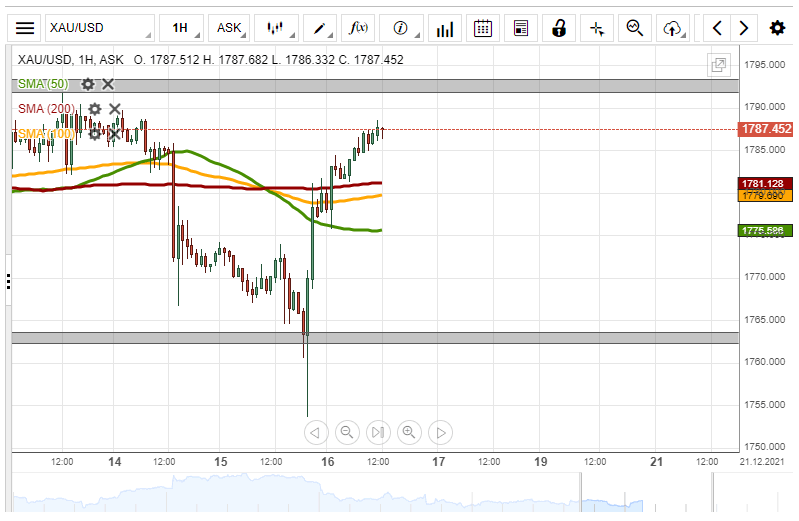
The price for gold has fluctuated due to changes in market demand for the US Dollar not due to changes in the perceived value of gold as a commodity. Namely, at 19:00 GMT on Wednesday, the price dipped as the USD initially gained value due to the reveal that monetary stimulus would be reduced. However, as the markets realized that the remaining stimulus would still dilute the value of the USD, a surge began.
By the middle of Thursday's European trading hours, the price had reached above the 1,785.00 level.
A continuation of the would most likely test the resistance of the December high levels at 1,791.80/1,793.40. Higher above, the 1,800.00 mark was expected to act as resistance.
Meanwhile, a decline of the commodity might find support in the 100 and 200-hour simple moving averages at 1,780.00. Below the 1,780.00 level, note the 50-hour SMA near 1,775.00.
‘Super Thursday’ Of Rate Decisons
Notes/Observations
- Plethora of rate decisions that highlight the divergence of central bank policies (Norges hikes by 25bps; SNB, Taiwan, Philippines, Indonesia hold); Turkey expected to cut despite continues record lows of the Lira currency.
- Focus on upcoming BOE, ECB and BOJ decisions and the potential impact of the Omicron virus variant on decisions.
- Major European Manufacturing PMI readings mixed (Beats: Germany, Euro Zone; Misses: France; In-line: UK).
- German PMI Services suggest the domestic economic recovery came to a halt due to the resurgence of the pandemic.
Asia
- New Zealand Q3 GDP Q/Q: -3.7% v -4.1%e; Y/Y: -0.3% v -1.4%e.
- Australia Dec Preliminary Manufacturing PMI: 57.4 v 59.2 prior.
- (19th month of expansion)
- Australia Dec Consumer Inflation Expectation Survey: 4.8% v 4.6% prior.
- Australia Nov Net Employment Change: +366.1K v +200.0Ke; Unemployment Rate: 4.6% v 5.0%e.
- Japan Dec Preliminary PMI Manufacturing: 54.2 v 54.5 prior (11th month of expansion).
- Japan Nov Trade Balance: -¥954.8B v -¥600.3B; Exports Y/Y: 20.5% v 21.0%e; Imports Y/Y: 43.8% v 40.0%.
- RBA Gov Lowe reiterates stance that still a ways from a rate hike, Board prepared to be patient. Separates RBA’s decision on Bond Buying from rate hikes.
- Australia Treasurer Frydenberg issued the Mid-Year Economic and Fiscal Outlook (MYEFO) which cut its GDP outlook while raising the CPI forecasts.
- BOK Gov Lee bi-annual inflation review reiterated view that CPI to stay above 2% for quite some time amid a solid economic recovery and increasing price pressures from global supply bottlenecks. Rate hikes since August would help ease inflation eventually.
Europe
- UK Chief Medical Officer Whitty: COVID case records will be broken a lot over next few weeks.
- UK Business leaders said to be calling on the UK govt to come up with a plan and assistance amid the rapid spread of Omicron virus variant. Concerns that that a workers would have to self-isolate furthering disruptions to supply chains.
- UK Tory party 1922 committee leaders said to join the Covid-19 passport rebellion. MP’s said to have been told they can email a letter of no confidence in the PM over Christmas.
- Turkey President Erdogan replaced Deputy Treasury and Finance Ministers Sakir Ercan Gul and Mehmet Hamdi Yildirim; TRY currency hit a fresh record low vs. USD above the 15 handle.
Americas
- FOMC left interest rates unchanged (as expected) and to reduce bond purchases by $30B/ month (doubles pace of tapering),. Fed opened the door to raising rates in spring. Dot plots show 3 rate hikes in 2022, 3 in 2023, and 2 more in 2024.
- Fed Chair Powell post rate decision press conference noted that the economic developments and outlook warranted a faster bond taper; Elevated inflation was reason for accelerating taper. Quicker taper would allow Fed to adapt to the economic outlook. On track to end taper by mid-March. Bottlenecks and supply constraints had been larger and longer lasting than anticipated. Inflation to run above 2% goal well into next year; Did expect inflation to decline closer to 2% by end of 2022.
Speakers/Fixed income/FX/Commodities/Erratum
Equities
- Indices [Stoxx600 +1.20% at 476.42, FTSE +0.92% at 7,236.53, DAX +1.58% at 15,719.95, CAC-40 +1.07% at 7,002.03, IBEX-35 +1.08% at 8,364.50, FTSE MIB +0.67% at 26,845.00, SMI +1.55% at 12,724.65, S&P 500 Futures +0.53%].
- Market Focal Points/Key Themes: European indices open higher across the board and stayed amply positive as the session progressed; improved risk appetite seen following FOMC meeting within expectations; sectors among those leading to the upside are technology and materials; while laggard sectors include utilities and telecom; UK retail sector under pressure following outlook cut at Boohoo; Schroders confirms Greencoat Capital looking to take stake; Ascential sells MediaLink; focus on series of central bank decisions through rest of the day; earnings expected during the upcoming US session include Accenture, FedEx and Adobe.
Equities
- Consumer discretionary: Domino's Pizza UK & IRL [DOM.UK] +29% (resolution; trading update), boohoo.com [BOO.UK] -13% (trading update).
- Energy: Electricite de France [EDF.FR] -12% (narrows outlook).
- Healthcare: Novartis [NOVN.CH] +4% (buyback), Valneva [VLA.FR] +10% (vaccine data).
- Industrials: Airbus [AIR.FR] +3% (large order), METRO [B4B.DE] -3% (earnings).
Speakers
- SNB Policy Statement reiterated its language on FX; that the CHF currency remained highly valued and was willing to intervene more strongly in the FX market. It noted that vulnerabilities of the mortgage and real estate markets increased.
- SNB Quarterly SNB forecasts raised its 2021 GDP growth outlook from 3.0% to 3.5% and set the 2022 GDP growth at 3.0%. It raised the 2021 CPI from 0.5% to 0.6% and 2022 CPI from 0.7% to 1.0% but remained well below the 2% target.
- SNB President Jordan post rate decision press conference noted that the real trade-weighted exchange rate for CHF currency (Franc) had hardly changed since the start of the pandemic. Believed that Swiss inflation had peaked and will decline in 2022.
- Norway Central Bank (Norges) Policy Statement noted that the decision to hike by 25bps was unanimous and saw a gradual rise in policy rate in the coming years. It forward guidance saw another rate hike as likely being in March.
- Norway Central Bank (Norges) Gov Olsen post rate decision press conference noted that the outlook had little changed since Sept.
- German Chancellor Scholz stated that the EU Leader Summit to stress that Ukraine's border must not be violated.
- Germany Debt Agency on 2022 issuance: To sell approx €410B in debt in year (2nd highest on record).
- Swiss KOF Institute Winter Economic Forecast raised its 2021 GDP growth from 3.2% to 3.9% while cutting the 2022 GDP growth from 3.6% to 3.0%. KOF Raised 2021 CPI from 0.5% to 0.6% and 2022 CPI from 0.6% to 0.8%.
- German VCI (Chemical Industry Association): Maintains 2021 Production +4.5% y/y, prices +8.5% y/y, Rev +15.5% y/y.
- Russia govt spokesperson Peskov stated that was prepared to begin Security talks and provided the US with two drafts for discussion. Inflation was high and remained a concern.
- Philippines Central Bank (BSP) Policy Statement noted that it saws higher baseline CPI forecast for both 2021 and 2022 with risks being balanced for 2023. Maintained its support for the economy but mindful of inflation risks; prepared for any potential 2nd round effects on supply and CPI. Saw economic growth on former footing.
- Indonesia Central bank (BI) Policy Statement noted that the decision to keep policy steady was consistent with need to keep IDR currency (Rupiah) stable amid global uncertainty and low inflation outlook. To optimize policy mix to maintain stability and support the economic recovery. The 2022 monetary policy would focus on pro-stability and other tools would be pro-growth.
- Indonesia Central Bank (BI) Gov Warjiyo pre-rate decision press conference noted that Q4 GDP growth was seen improving with 2022 growth seen accelerating. CPI seen remaining low and supporting stability. Reiterated to keep IDR currency (Rupiah) to be in-line with fundamentals. Liquidity remains very loose.
- Taiwan Central Bank (CBC) Policy Statement noted that the decision to keep policy steady was unanimous. To appropriately adjust policy when necessary and watch rate decisions from other major economies. Saw 2022 economic growth as mild.
Currencies/Fixed Income
- USD was softer despite the Fed signaling three potential rate increases in 2022 and accelerated bond-purchase tapering as the outcome appeared to be already baked in. Overall risk-on appetite providing some unwinding of safe=haven flows.
- EUR/USD back above the 1.13 handle ahead of the ECB rate decision despite an expected dovish ECB later today. ECB seen continuing pushing back against any hawkish tilt in market expectations on rates and emphasize that rates would not increase in 2022. Focus to be on its new macroeconomic (Staff) forecasts with markets believing ECB would continue to fall short of meeting its inflation objective in 2023 and 2024 period.
- GBP/USD higher and approaching the 1.33 area ahead of the BOE. Decision whether to hike or hold the Bank Rate was on a knife edge among analysts. The question among the MPC is whether there is was value in waiting at this time. Uncertainty about the omicron virus variant on the public health and the economy. likely to keep policy on hold for now.
- USD/JPY at 114.15 ahead of Friday’s BOJ policy meeting.
- TRY currency (Lira) continued to weaken to fresh record lows as tested above 15.00 in trade after Turkey President Erdogan again replaced some govt officials in the Treasury Dept. Turkey Central Bank (CBRT) was again expected to cut One-Week Repo Rate by 100bps to 14.00% later todat despite the continued surge in Turkish inflation data (Nov CPI accelerated for a sixth straight month with YoY at 21.3%).
Economic data
- (NL) Netherlands Nov Unemployment Rate: 2.7% v 2.9% prior.
- (PH) Philippines Central Bank (BSP) left Overnight Borrowing Rate unchanged at 2.00% (as expected).
- (ID) Indonesia Central Bank (BI) left the 7-Day Reverse Repo unchanged at 3.50% (as expected).
- (FR) France Dec Business Confidence: 110 v 113e; Manufacturing Confidence: 111 v 109e; Production Outlook Indicator: 21 v 15e; Own-Company Production Outlook: 29 v 16e.
- (CZ) Czech Nov PPI Industrial M/M: 1.2% v 0.9%e; Y/Y: 13.5% v 13.2%e.
- (FR) France Dec Preliminary PMI Manufacturing: 54.9 v 55.4e (13th month of expansion); PMI Services: 57.1 v 56.0e; PMI Composite: 55.6 v 55.0e.
- (DE) Germany Dec Preliminary PMI Manufacturing: 57.9 v 57.0e (18th month of expansion); PMI Services: 48.4 v 51.0e; PMI Composite: 50.0 v 51.2e.
- (CH) SNB left both Policy Rates unchanged at -0.75% (as expected).
- (HK) Hong Kong Nov Unemployment Rate: 4.1 v 4.2%e.
- (SE) Sweden Nov Unemployment Rate: 7.5% v 7.6% prior; Unemployment Rate (seasonally adj): 8.3% v 8.4%; Trend Unemployment Rate: 8.5% v 8.6% prior.
- (TW) Taiwan Central Bank (CBC) left its Benchmark Interest Rate unchanged at 1.125%(as expected).
- (EU) Euro Zone Dec Preliminary PMI Manufacturing: 58.0 v 57.8e (17th month of expansion); PMI Services: 53.3 v 54.3e; PMI Composite: 53.4 v 54.2e.
- (NO) Norway Central Bank (Norges) raised the Deposit Rates by 25bps to 0.50% (as expected).
- (IT) Italy Oct Total Trade Balance: €3.9B v €2.4B prior; Trade Balance EU: €0.3B v €0.8B prior.
- (UK) Dec Preliminary PMI Manufacturing: 57.6 v 57.6e (19th straight expansion); PMI Services: 53.3 v 57.0e; PMI Composite: 53.3 v 56.3e.
- (EU) Euro Zone Oct Trade Balance (seasonally adj): €2.4B v €5.8Be; Trade Balance NSA (unadj): €3.6B v €7.3B prior.
- (EU) Euro Zone Q3 Labour Costs Y/Y: +2.5% v -0.1% prior.
Fixed income Issuance
- None seen.
Looking ahead
- (EG) Egypt Central Bank Interest Rate Decision (no set time): Lending Rate current at 9.25%; Deposit Rate currently at 8.25%.
- 05:25 (EU) Daily ECB Liquidity Stats.
- 05:30 (HU) Hungary Debt Agency (AKK) to sell bonds.
- 05:30 (EU) ECB allotment in 3-year TLTRO III tender (10th round) (prior €97.6B with 152 bids recd).
- 06:00 (TR) Turkey Central Bank (CBRT) Interest Rate Decision: expected to cut One-Week Repo Rate by 100bps to 14.00%.
- 06:00 (IL) Israel Q3 Preliminary GDP (2nd reading): No est v 2.4% advance.
- 06:00 (BR) Brazil Central Bank (BCB) Quarterly Inflation Report (QIR).
- 06:45 (US) Daily Libor Fixing.
- 07:00 (UK) Bank of England (BOE) Interest Rate Decision: Expected to leave Bank Rate unchanged at 0.10%; Expected to maintain Total Asset Purchases at £895B (Gilt Purchase Target unchanged at £875B and Corporate Bond Target unchanged at £20B).
- 07:45 (EU) ECB Interest Rate Decision: Expected to leave Key Rates unchanged; Expected to leave Main 7-Day Refinancing Rate unchanged at 0.00%; Expected to leave Marginal Lending Facility unchanged at 0.25%; Expected to leave Deposit Facility Rate unchanged at -0.50%.
- 08:00 (RU) Russia Gold and Forex Reserve w/e Dec 10th: No est v $622.8B prior.
- 08:00 (PL) Poland Nov CPI Core M/M: 0.4%e v 0.7% prior; Y/Y: 4.7%e v 4.5% prior.
- 08:00 (UK) Daily Baltic Dry Bulk Index.
- 08:30 (US) Nov Housing Starts: 1.567Me v 1.52M prior; Building Permits: 1.663Me v 1.653M prior (revised from 1.650M).
- 08:30 (US) Initial Jobless Claims: 200Ke v 184K prior; Continuing Claims: 1.94Me v 1.992M prior.
- 08:30 (US) Dec Philadelphia Fed Business Outlook Survey: 29.1e v 39.0 prior.
- 08:30 (CA) Canada Oct Wholesale Trade Sales M/M: 1.5%e v 1.0% prior.
- 08:30 (US) Weekly USDA Net Export Sales.
- 08:30 (EU) ECB chief Lagarde post rate decision press conference.
- 09:15 (US) Nov Industrial Production M/M: 0.6%e v 1.6% prior; Capacity Utilization: 76.8%e v 76.4% prior; Manufacturing Production: 0.7%e v 1.2% prior.
- 09:45 (US) Dec Preliminary Markit PMI Manufacturing: 58.5e v 58.3 prior; Services PMI: 58.8e v 58.0 prior; Composite PMI: No est v 57.2 prior.
- 10:30 (US) Weekly EIA Natural Gas Inventories.
- 11:00 (US) Dec Kansas City Fed Manufacturing Activity Index: 25e v 24 prior.
- 14:00 (MX) Mexico Central Bank (Banxico) Interest Rate Decision: Expected to raise Overnight Rate by 25bps to 5.25%.
- (EG) Egypt Central Bank Interest Rate Decision.
- 14:00 (AR) Argentina Q3 GDP Q/Q: No est v -1.4% prior; Y/Y: 12.0%e v 17.9% prior.
- 14:00 (AR) Argentina Oct Capacity Utilization: No est v 64.4% prior.
- 16:00 (NZ) New Zealand Dec Consumer Confidence Index: No est v 96.6 prior.
- 19:00 (NZ) New Zealand Dec Business Confidence: No est v -16.4 prior; Activity Outlook: No est v 15.0 prior.
- 19:01 (UK) Dec GFK Consumer Confidence: -17e v -14 prior.
- 19:30 (SG) Singapore Nov Non-oil Domestic Exports M/M: No est v 4.2% prior; Y/Y: 15.3%e v 17.9% prior; Electronic Exports Y/Y: No est v 14.9%.
- 22:00 (CN) China to sell 50-yaer Upsize Bond.
- (JP) Bank of Japan (BOJ ) Interest Rate and Policy Decision: expected to leave Interest Rate on Excess Reserves (IOER) unchanged at -0.10% and maintain 10-year Yield Target (YCC): at 0.00%.
USD/JPY Jumps On Fed Announcemnet
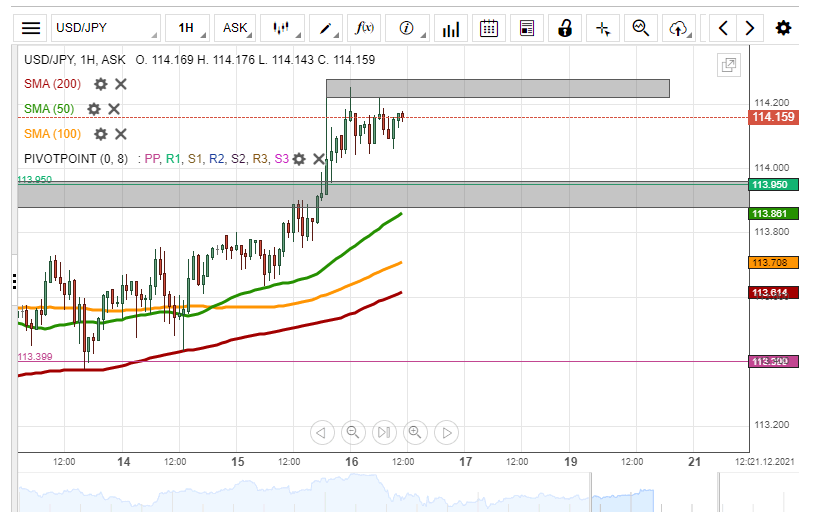
The USD/JPY currency exchange rate pierced the resistance zone of 113.88/113.96, as the US Federal Reserve revealed that it would decrease stimulus. Although, the surge stopped at the 114.28 level. Take into account that the USD/JPY is the only of the top pairs, where the initial surge of the USD caused by the Fed was not followed up by a decline of the Dollar. That is explained, as follows.
The announcement of a decrease of stimulus initially caused a jump of the USD. Afterwards, as the markets realized that the supply of the USD would still grow, the value of the currency started to decline. However, on the USD/JPY charts the initial jump was not reversed, as the certainty of the future caused a broader risk on sentiment, as risk assets surged and the JPY declined due to its safe haven status.
In the near term future, if the pair passes the resistance of the post-Fed-spike-high levels at 114.22/114.28, the USD/JPY might reach the weekly R2 simple pivot point at 114.51 and the 114.50 mark. Higher above, the weekly R3 and the 115.00 level could stop a surge.
On the other hand, a decline of the US Dollar against the Japanese Yen would most likely look for support in the combination of the 114.00 mark, the weekly R1 simple pivot point at 113.95, the 50-hour simple moving average and the previous December high level zone at 113.88/113.96. Below these levels, the 100 and 200-hour SMAs are located near 113.70 and 113.60.
GBP/USD Reaches 1.3300 Mark
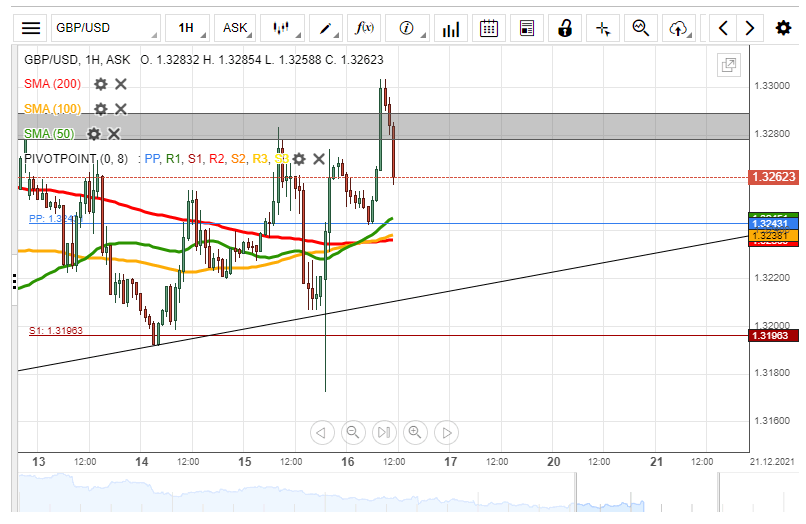
The GBP/USD bounced off the resistance of the high level zone near 1.3280 on Thursday. Afterwards, at 19:00 GMT on the same day, the pair reacted to the US Fed Statement by piercing the recent low level connecting trend line and shortly trading below 1.3180.
However, as it was clear that despite a decrease monetary USD stimulus would remain intact, the pair started a surge. By the middle of Thursday's trading, the GBP/USD had pierced the recent high level zone and reached the 1.3300 mark.
If the Pound continues to gain against the US Dollar, the rate might reach the resistance of the weekly R1 simple pivot point at 1.3324. Higher above, the weekly R2 simple pivot point could stop a surge at 1.3371.
On the other hand, a bounce off from the resistance of the 1.1300 mark might look for support in the previous high level zone at 1.3277/1.3289. Below the zone, a cluster of technical levels is capable of reversing the rate's direction. Namely, the combination of the 50, 100 and 200-hour simple moving averages and the weekly simple pivot point at 1.3235/1.3245.
EUR/USD Returns Above 1.1300 After Fed Dip
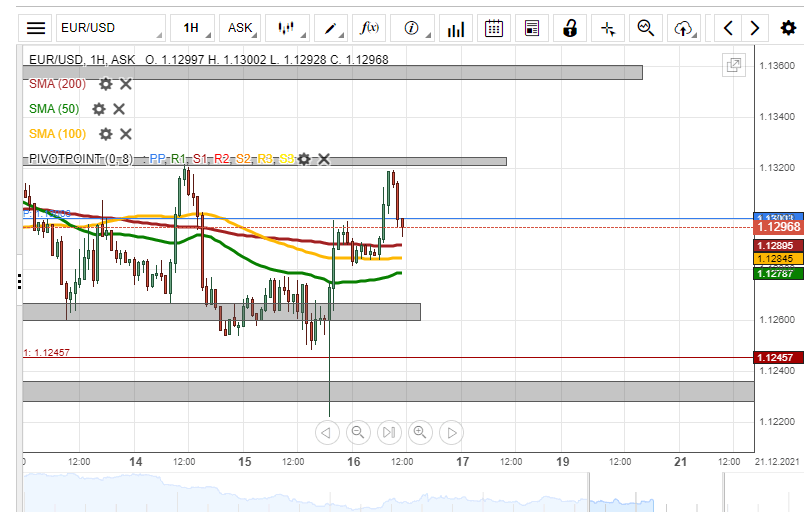
The EUR/USD dipped 35 base points on Wednesday at 19:00 GMT, as the US Federal Reserve announced that it would reduce stimulus. However, the dip was followed by a surge, as the markets realized that despite the decrease the Fed is still set to increase USD supply.
By the middle of Thursday's trading, the pair had returned to the 1.1320 level. In the near term future, the pair could test the resistance of the 1.1320/1.1325 zone, which represents the recent high levels.
If the EUR/USD breaks the resistance of the 1.1320/1.1325 zone, the rate could reach the December high level zone at 1.1355/1.1360. Above the December high, the pair might be stopped by the weekly R1 simple pivot point at 1.1373.
Meanwhile, a decline of the rate is most likely going to look for support in the weekly simple pivot point at 1.1300. Below the pivot point, take into account the 50, 100 and 200-hour simple moving averages spread out from 1.1280 up to 1.1290.
Pound Steady As BoE Rate Decision Looms
The British pound has posted slight gains in the European session, as GBP/USD trades just shy of the 1.33 line ahead of today’s key BoE meeting.
Will BoE hit the rate trigger?
All eyes are on the Bank of England, which must decide whether to raise interest rates. This week’s inflation and employment data certainly pull in favor of a rate hike. Inflation jumped to 5.1% y/y in November, the highest level in 10 years. The labour market continues to tighten, as unemployment rolls fell for a seventh straight month.
The elephant in the room is the Omicron variant, which although milder than Delta, is some 70 times more contagious and has sent infection rates skyrocketing in the UK. The markets are betting that the BoE will refrain from a hike today, and revisit a rate move at its next meeting in February. By then, the bank will be in a better position to evaluate the damage to the economy from Omicron. The bank shocked the markets in November when it didn’t raise rates, after signalling that it would due to the threat from inflation. The pound took a tumble as a result, but I don’t expect a repeat performance since the markets have priced in the likelihood that the BoE won’t raise rates. If the BoE surprises with a rate hike, the pound should record significant gains.
The markets were anticipating a hawkish turn from the FOMC, and policy makers did not disappoint. As expected, the Fed announced that starting next month it would scale back bond purchases at double the pace, to USD 30 billion/month. This means that the bond purchases will end in March rather than July, putting the Fed in a position to raise rates earlier. The dot plot showed that 18 FOMC members are projecting at least one rate hike in 2022. This is a major shift from the September meeting, when members were evenly split. As well, 12 of the 18 members expect three rate hikes next year.
In its statement after the meeting, the Fed explained that the sharp increase in the taper was due to inflation developments and the further improvement in the labor market”. This is significant because it states in black and white that the Fed has taken off the gloves in order to fight inflation. Just a few weeks ago, Fed Chair Powell was insisting that inflation was transitory, before abandoning this stance and admitting that high inflation would remain for longer than previously expected.
GBP/USD Technical Analysis
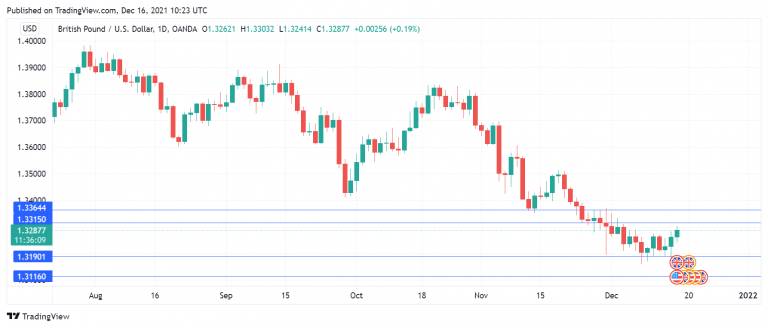
- GBP/USD has support at 1.3190 and 1.3116
- There is resistance at 1.3314 and 1.3364