Sample Category Title
GBP/JPY Reaches Resistance Line
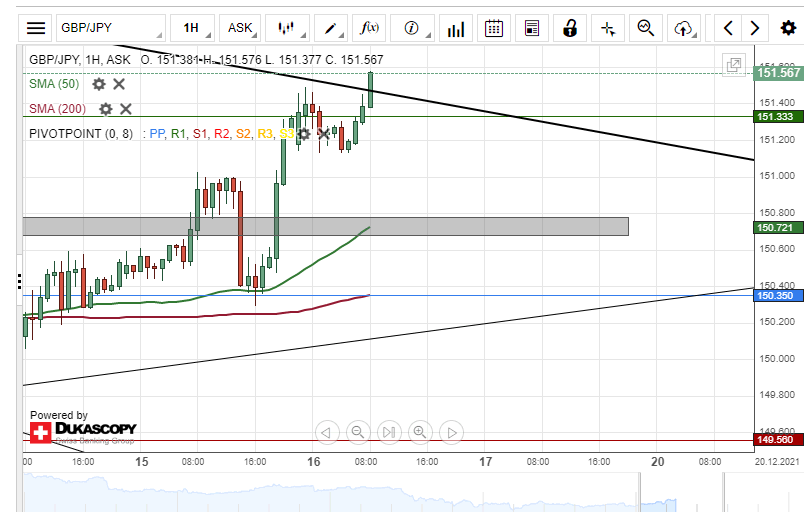
The GBP/JPY has surged to the resistance line, which connects the rate's high levels since late October. The surge was caused by risk on sentiment in the markets, which caused a drop of the Japanese Yen. The sentiment was created by the US Federal Reserve Monetary Policy Statement. The central bank decreased stimulus, as it observed a recovery of the global economy.
In the case that the rate passes the resistance line, it could find resistance in the 152.00 mark, before reaching the weekly R2 simple pivot point at 152.12.
On the other hand, a decline of the Pound against the Japanese Yen might find support in the 151.00 level. Further below, the previous high level zone and the 50-hour simple moving average are expected to provide support at 150.67/150.78.
AUD/USD Reaches December High Zone
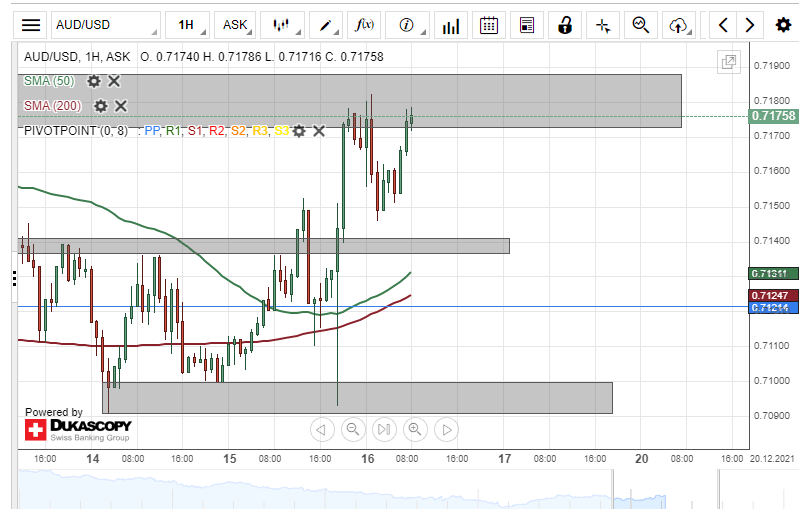
The AUD/USD pair reacted to the US Federal Reserve policy statement on Wednesday evening by dropping to the support zone below the 0.7100 and immediately recovering from it. The surge was stopped by the December high level zone at 0.7171/0.7188. Up to the start of Thursday's European trading hours, the zone continue to keep the rate down.
If the rate starts a decline, the pair might look for support in the recent high level zone below the 0.7140 mark. Note that the 50 and 200-hour simple moving averages might reach the zone. Further below, the weekly simple pivot point could act as support at 0.7121.
On the other hand, a surge above the 0.7171/0.7188 zone might immediately find resistance at the 0.7200 mark. Higher above, the weekly R1 simple pivot point could provide resistance at 0.7242.
EUR/JPY Approaches 129.00
The EUR/JPY currency exchange rate jumped on Wednesday at 19:00 GMT. Strangely enough, the surge was fueled by the US Federal Reserve cutting stimulus. However, the pair does not include the US Dollar. More likely, the investment heading to the USD caused a run from the safety of the Japanese Yen. Namely, the Japanese Yen lost value due to the markets shifting to the USD. The eventual spillover of the loss of value impacted the EUR/JPY.
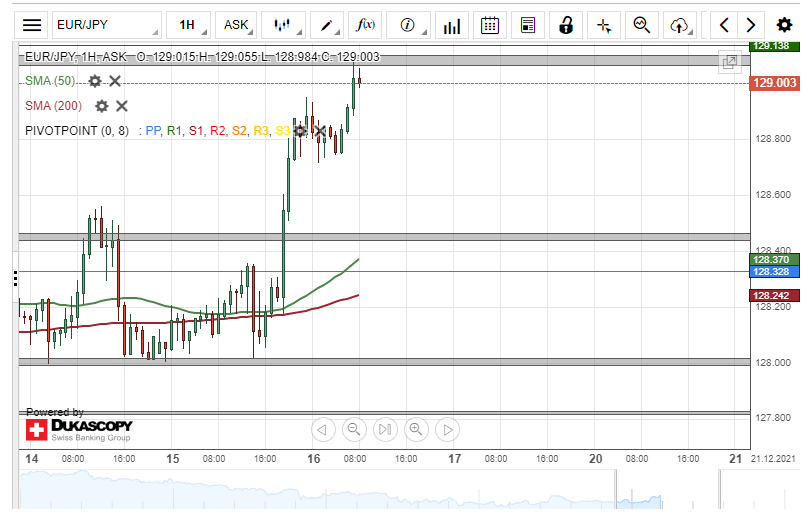
On Thursday morning, the pair approached the 129.00 mark. Above the 129.00 level's resistance, the December 8 high levels were expected to provide resistance at 129.07/129.10. In addition, note the weekly R1 simple pivot poin at 129.14.
If the rate passes the resistance levels at 129.00/129.14, the pair might aim at the late November high levels in the 129.53/129.60 zone. Higher above, the weekly R2 simple pivot point might provide resistance at 129.92. Moreover, take into account the 130.00 level and the mid-November high levels above it.
On the other hand, a potential decline might look for support in previously passed high level zone at 128.43/128.46. Below this zone, the weekly simple pivot point and the 50 and 200-hour simple moving averages might act as support in the 128.35/128.25 range.
Fed Is Looking At A Broad Range Of Labour Market Indicators
Markets
The Fed as expected delivered ‘a hawkish shift’. Inflation officially is no longer considered transitory. It currently settles at elevated levels. The Fed left the target rate unchanged at 0-0.25%, but with inflation exceeding the 2% target for some time and the labour market improving further, it was appropriate to reduce asset purchases at double current pace even as Omicron and other variants remain a risk. From January on the Fed will buy Treasury holdings by at least $40 bln p/m and mortgage back securities at $20 bln p/m. Net purchases will end in March. Inflation becoming the priority also caused a significant recalibration in the December projections. The median PCE inflation for this and next year is upwardly revised to 5.3% (from 4.2%) and 2.6% (from 2.2%) respectively. The unemployment rate for 2022-2024 is seen at 3.5%, below the long term equilibrium. Powell at the press conference reiterated that the Fed is looking at a broad range of labour market indicators. Even so, current and projected improvement made governors conclude that 3 rate hikes next year and in 2023 and 2 additional hikes in 2024 are feasible. According to Powell, the lift-off might start soon after the end of net asset purchases. The Fed discussed the balance sheet, but no decisions have been made. In a first reaction US yields rose about 5 bps, but the move was reversed during the press conference. At the end of the day, US yields rose between 0.63bps (2-y) and 3.2bps (30-y). The rise in inflation expectations outpaced the setback in real yields. So, markets apparently don’t see the Fed’s shift as overly hawkish at this stage. This was also the conclusion in FX and for equity investors. US equities rose between 1.08% (Dow) and 2.15% (Nasdaq). The DXY index reversed intraday gains to close modestly lower at 96.51. EUR/USD intraday tested the 1.1225 area, but close in neutral territory just below 1.129.
In the slipstream of yesterday’s Fed meeting, multiple central banks including the ECB, the BoE, the Swiss National Bank, the Norges and Turkish central bank (CBRT) all will decide on monetary policy. The CBRT is expected (feared) to cut interest rates further. For the SNB markets look out for the SNB’s assessment on recent CHF strength. The Norges bank will likely continue its gradual normalization (+0.25%). The main dish will be served by the Bank of England and the ECB. The BoE in November abstained from a lift-off as it wanted to be sure on a smooth functioning of the labour market after the end of the furlough scheme. Labour reports were strong and inflation sooner than expected crossed 5.0%. If the BoE wants to preserve its aura of credibility and consistency, it is time to at least take the symbolic step and raise the policy rate to 0.25%. The mission of the ECB is much more difficult and complicated by internal political debate. Even the heart of the matter, the inflation forecast, is subject to debate. The 2022 forecast will be raised well above 2.0%, but a return to/just below target in 2023 and 2024 might leave the debate open on (the pace of) normalization. The ECB in any case hasn’t much time left to set the framework for post PEPP asset purchases. A flexible, degressive APP with a short-term evaluation (e.g. quarterly) looks preferable to cope with rising inflation risk. However, the ECB continues facing claims to keep conditions equally easy across the EMU. Lagarde has some work to do in convincing markets that inflation is becoming its priority. This will also be a key factor to halt the ongoing erosion of the single currency’s value.
News headlines
The Australian labour market had a bumper November. Employment grew a record-breaking 366.1k after declining 56k in October. Consensus estimates were more modest around 200k. However, the surge was not driven by the creation of new jobs. Instead many employees who had been counted as not employed during extended lockdowns returned to work after covid restrictions eased. This caused the participation rate to jump from 64.6% to 66.1%. Still the employment rise was big enough to trigger a steep decline in the unemployment rate from 5.2% to 4.6%. AUD/USD knee-jerk rise died out quickly as markets took the nuances into consideration. It’s currently trading at 0.715. RBA governor Lowe before the data release outlined three options for its bond buying programme (currently A$ 4bn per week). Two of them included tapering and then either end QE in May or hold a review. A third, and with the latest labour market report the more likely option, is to cease purchases already in February. On rate hikes, Lowe repeated that conditions probably won’t be met in 2022.
GBP/JPY Daily Outlook
Daily Pivots: (S1) 150.59; (P) 150.95; (R1) 151.62; More...
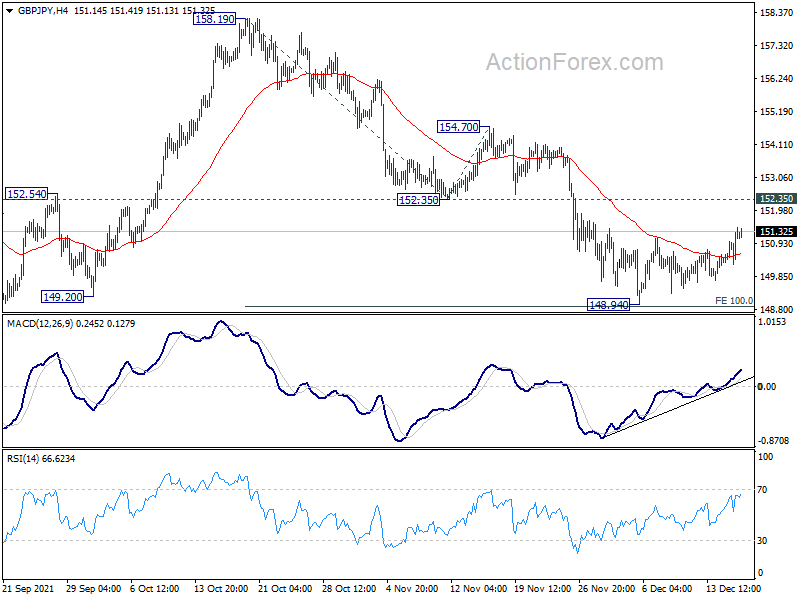
Intraday bias in GBP/JPY remains neutral for the moment. On the downside, firm break of 148.93 key structural support will carry larger bearish implications. Next target is 161.8% projection of 158.19 to 152.35 from 154.70 at 145.25. On the upside, however, break of 152.35 support turned resistance will argue that the pull back from 158.19 is complete. Intraday bias will be turned back to the upside for retesting 158.19 high.
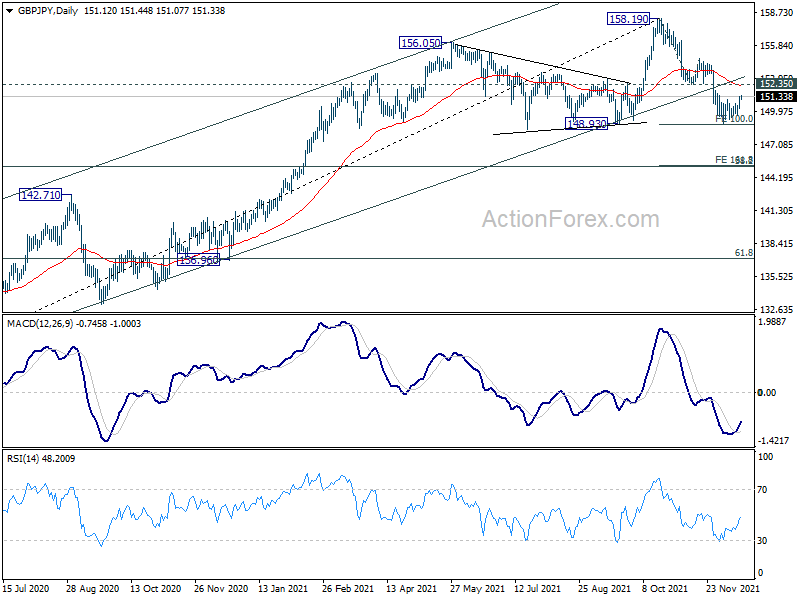
In the bigger picture, the break of medium term channel support, and bearish divergence condition in week MACD are raising the chance of medium term topping at 158.19. Firm break of 148.93 support will argue that GBP/JPY is at least correcting the whole rise from 123.94 (2020 low). In this case, deeper fall would be seen to 38.2% retracement of 123.94 to 158.19 at 145.10. Nevertheless, strong rebound from 148.93 will retain medium term bullishness for another rise through 158.19 at a later stage.
EUR/JPY Daily Outlook
Daily Pivots: (S1) 128.27; (P) 128.54; (R1) 129.09; More....
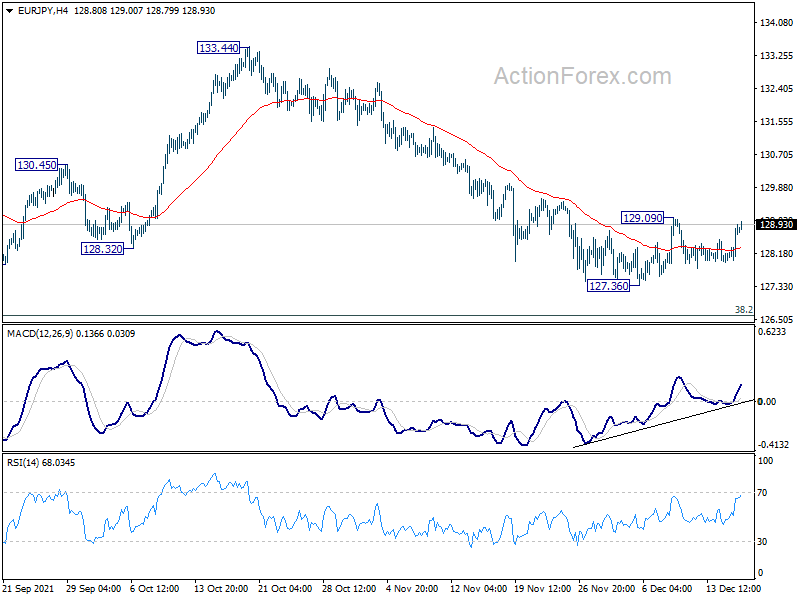
Intraday bias in EUR/JPY stays neutral for the moment. On the upside, break of 129.09 minor resistance will argue that fall from 133.44 has completed. Intraday bias will be back to the upside for 55 day EMA (now at 129.49) and above. On the downside, break of 127.36 will resume larger pattern from 134.11 to 126.58 medium term fibonacci level. We'd look for some support from there to bring rebound.
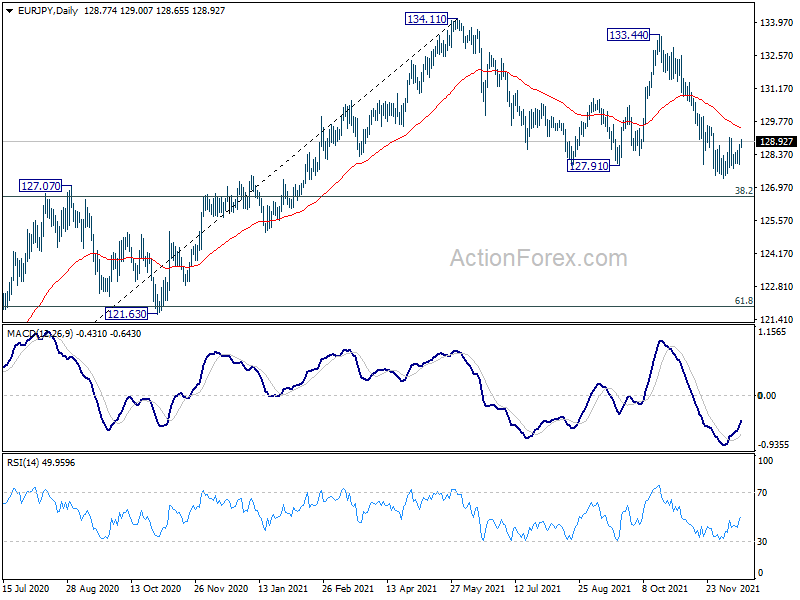
In the bigger picture, as long as 38.2% retracement of 114.42 (2020 low) to 134.11 at 126.58 holds, up trend from 114.42 is still in favor to continue. Break of 134.11 will target long term resistance at 137.49 (2018 high). However, sustained break of 126.58 will raise the chance of medium term bearish reversal. In this case, deeper decline would be seen to 61.8% retracement at 121.94, and possibly below.
EUR/GBP Daily Outlook
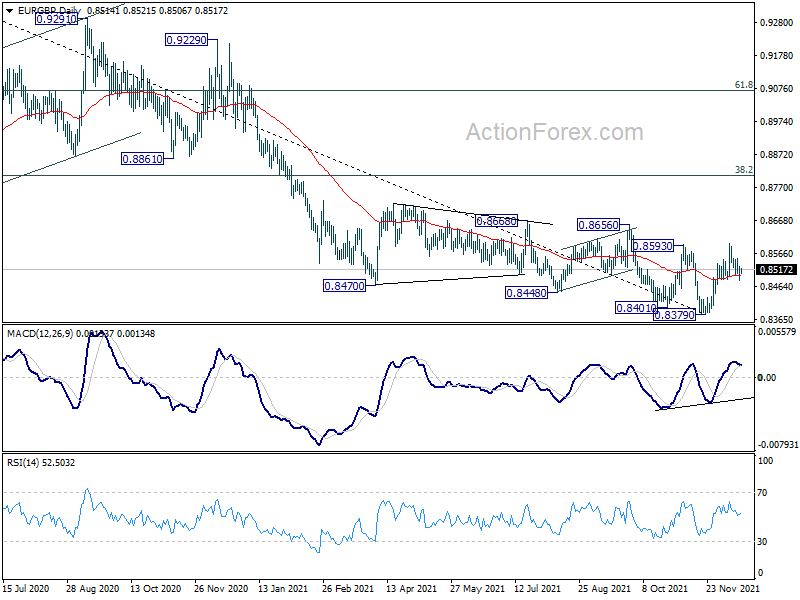
Daily Pivots: (S1) 0.8492; (P) 0.8510; (R1) 0.8534; More...
Outlook in EUR/GBP remains unchanged. Intraday bias stays neutral and further rally is mildly in favor with 0.8387 minor support intact. On the upside, firm break of 0.8593 resistance will be the first sign of larger bullish reversal and target 0.8656 resistance next. On the downside, however, break of 0.8487 will turn bias back to the downside to retest 0.8379 low instead.

In the bigger picture, price actions from 0.9499 (2020 high) are still seen as developing into a corrective pattern. Deeper fall could be seen as long as 0.8593 resistance holds, towards long term support at 0.8276. We'd look for bottoming signal around there to bring reversal. Meanwhile, firm break of 0.8593 will now be an early sign of medium term bottoming. Further break of 0.8656 will pave the way to 38.2% retracement of 0.9499 to 0.8379 at 0.8807.
EUR/AUD Daily Outlook
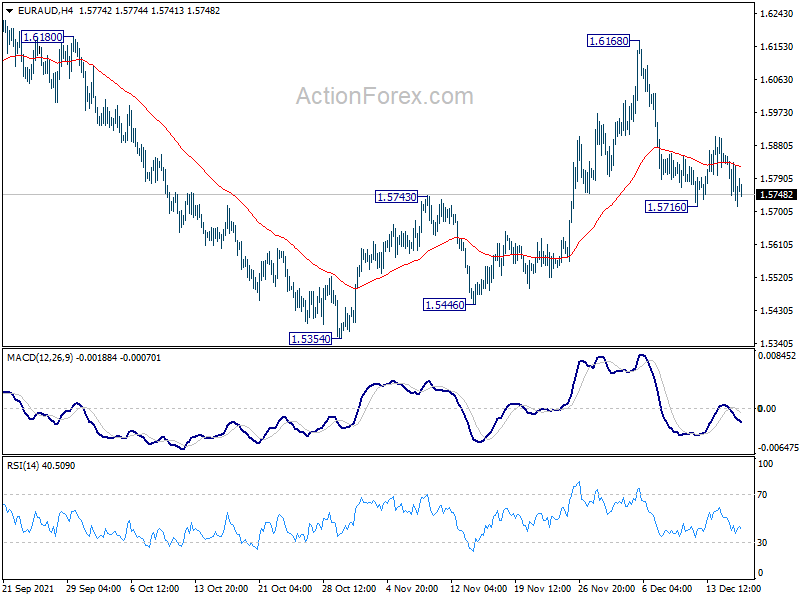
Daily Pivots: (S1) 1.5699; (P) 1.5779; (R1) 1.5823; More...
Intraday bias in EUR/AUD remains neutral at this point. On the downside, break of 1.5716 will revive the case that rebound from 1.5354 has completed, and bring retest of this support. On the upside, break of 1.6168will resume the rise from 1.5354 to 1.6434 resistance.
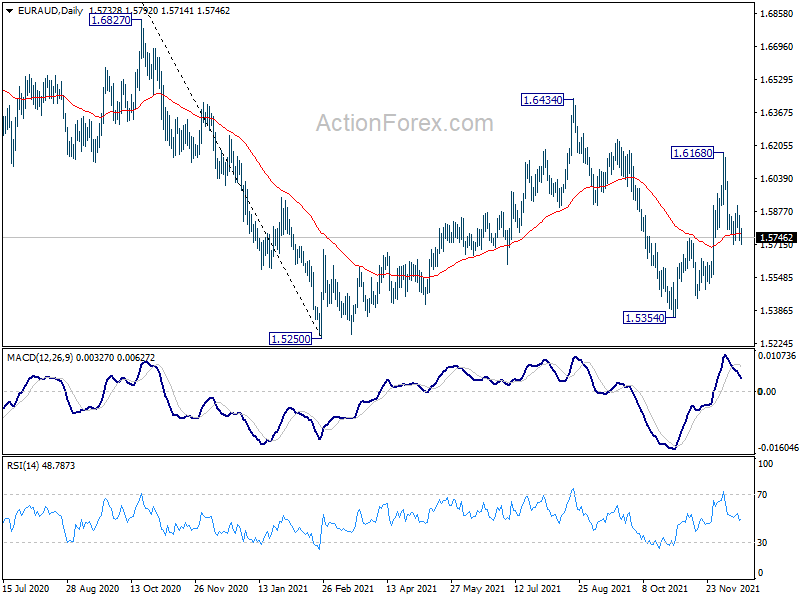
In the bigger picture, medium term outlook is neutral for the moment. Rise from 1.5354 is seen as the third leg of the corrective pattern from 1.5250 low. Further rise cannot be ruled out, but even in that case, strong resistance should be seen at 38.2% retracement of 1.9799 to 1.5250 at 1.6988. Larger down trend from 1.9799 is in favor to extend through 1.5250 at a later stage.
EUR/CHF Daily Outlook
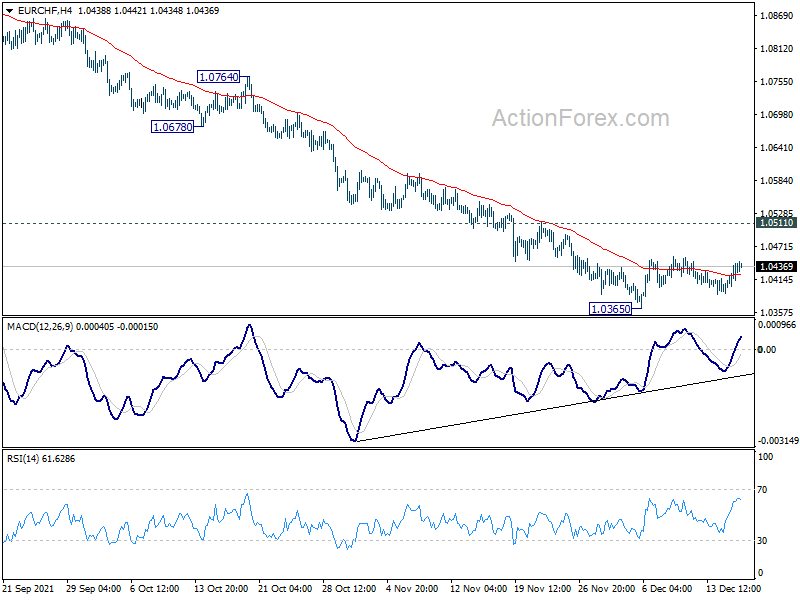
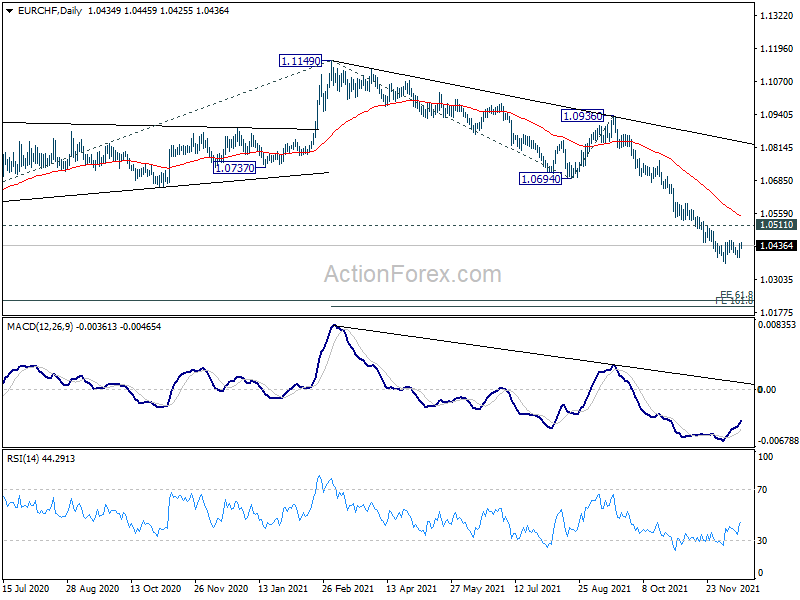
Daily Pivots: (S1) 1.0412; (P) 1.0428; (R1) 1.0456; More....
EUR/CHF is staying in consolidation from 1.0365 and intraday bias remains neutral for the moment. Further decline is expected as long as 1.0511 resistance holds. On the downside, break of 1.0365 will resume larger down trend from 1.1149 to 161.8% projection of 1.1149 to 1.0694 from 1.0936 at 1.0200 next.
In the bigger picture, long term down trend from 1.2004 (2018 high) is now extending. Next target is 61.8% projection of 1.2004 to 1.0505 to 1.1149 at 1.0223. On the upside, break of 1.0694 support turned resistance is needed to be the first sign of medium term bottoming. Otherwise, outlook will remain bearish even in case of rebound.
USD/CAD Daily Outlook
Daily Pivots: (S1) 1.2820; (P) 1.2842; (R1) 1.2887; More...
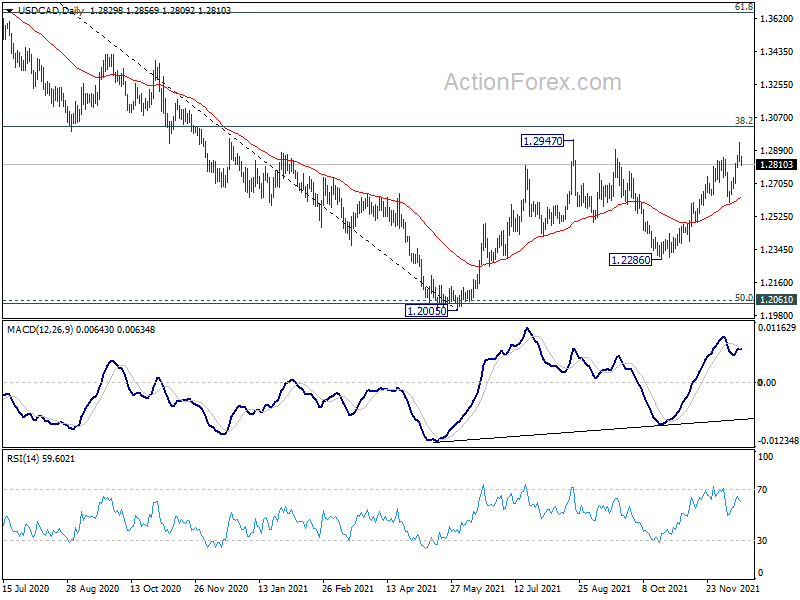
Intraday bias in USD/CAD is turned neutral again as it retreated after hitting 1.2935. Some consolidations could be seen, but near term outlook will stay mildly bullish as long as 1.2604 support holds. On the upside, above 1.2935 will target 1.2947 resistance next. Firm break there will target 1.3022 key medium term fibonacci level.
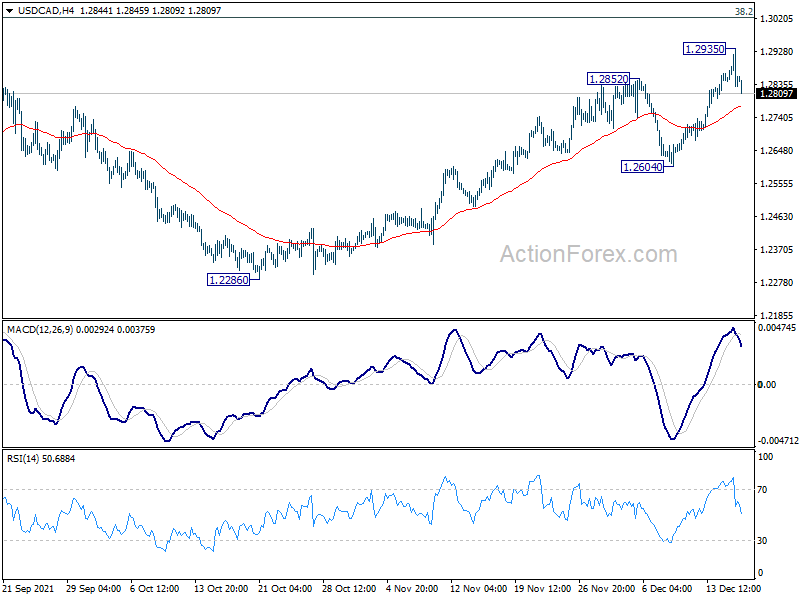
In the bigger picture, focus will be on 38.2% retracement of 1.4667 (2020 high) to 1.2005 (2021 low) at 1.3022. Sustained break there should confirm that the down trend from 1.4667 has completed after defending 1.2061 long term cluster support. Further rise would then be seen towards 61.8% retracement at 1.3650. On the downside, however, break of 1.2286 will turn focus back to 1.2005 low again.