

Sample Category Title
New Zealand GDP contracted -3.7% qoq in Q3, better than expectation
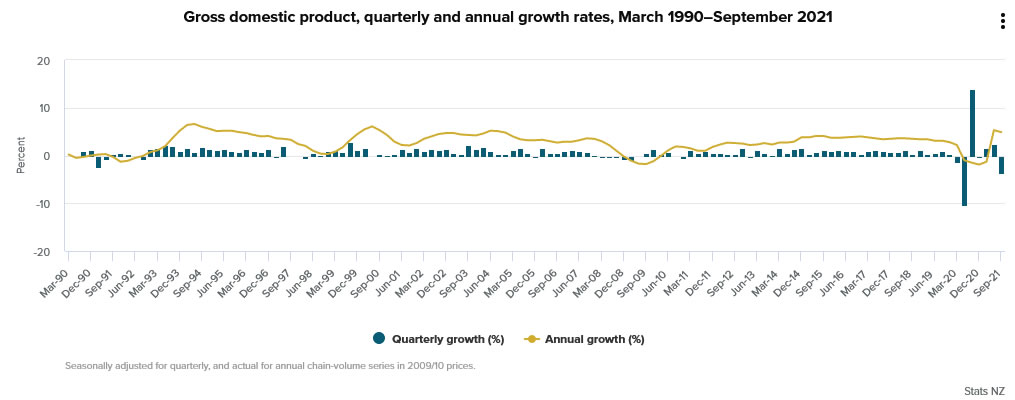
New Zealand GDP dropped -3.7% qoq in Q3, better than expectation of -4.3% qoq. For the year, GDP contracted -0.3% yoy, versus expectation of -1.6% yoy. Services industries dropped -2.7% qoq. Goods-producing industries dropped -7.3% qoq. Primary industries dropped -3.1% qoq.
The contraction reflects a widespread drop in economic activity due to the COVID-19 alert level restrictions and nationwide-lockdown implemented in the second half of the quarter. But the contraction in Q3 was "less pronounced" when compared with Q2 2020.
"The September 2021 quarter had fewer days in higher alert levels, and border restrictions were already in place. Also, some businesses may have adapted to and been better prepared for higher alert levels, compared with the first lockdown," national accounts industry and production senior manager Ruvani Ratnayake said.
Australia November Labour Force – Employment Goes Boom!
A very solid update with a labour market significantly outperforming all expectations.
There is no doubt this is a very solid update highlighting a labour market significantly outperforming all expectations.
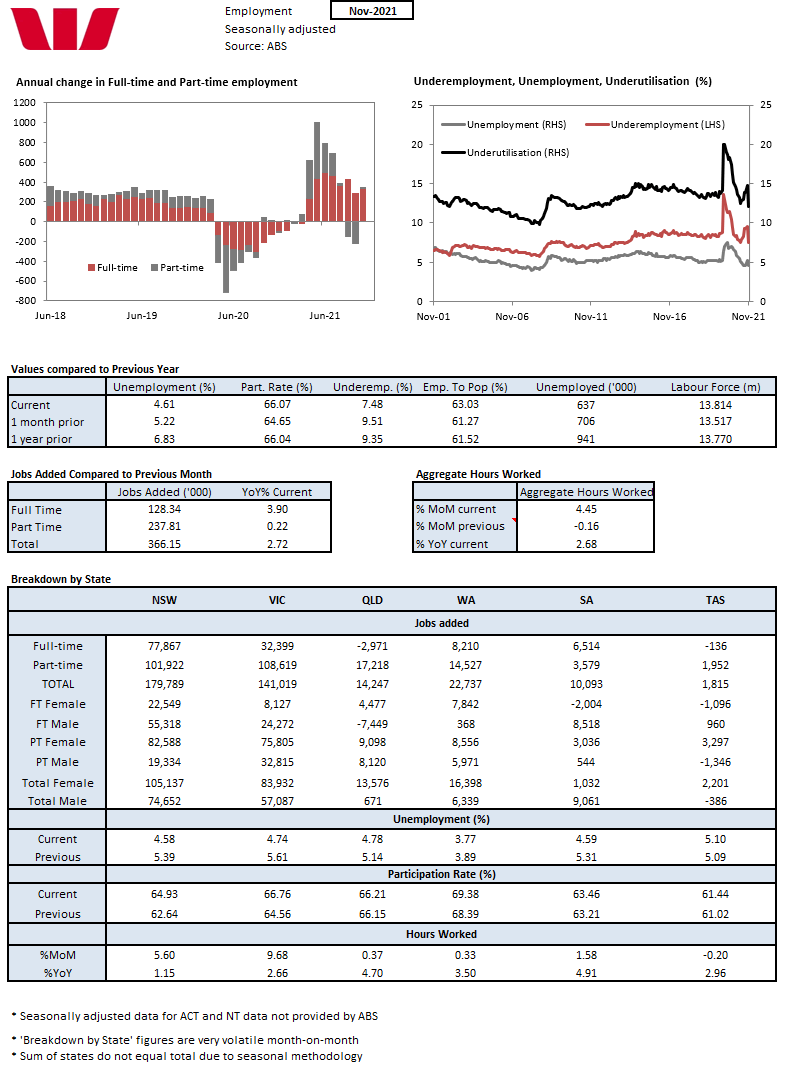
The November Labour Force Survey reported a spectacular 366.1k/2.9% gain in employment much stronger that Westpac’s and the market’s expectations (220k and 200k respectively) even pipping the top of the range forecast of 310k. It is also the largest single monthly gain on record going back to 1978.
Total employment is now higher than it was back in June 2021, pre the latest round of lockdowns.
Interestingly, most of the gains were in part-time employment, +237.8k, while full-time employment lifted a still very solid 128.3k.
Hours worked surged 4.5%, we had expected that hours worked would outperform the gains in employment but given the magnitude of the gains in employment this is a very solid update on economic activity.
Given the surge in hours worked it should be no surprise that underemployment also had a meaningful correction falling 2ppt to 7.5%, the lowest level of underemployment since January 2014.
As expected, there was as surge in workers returning to the labour force, +296.8k, which saw the participation rate lift to 66.1%, just shy of the June 2021 peak of 66.3%. However, this was not enough to counter the gains in employment and the unemployment rate fell to 4.6%, the lowest unemployment rate since December 2008, the peak of the mining boom.
Underutilisation, that is unemployment plus underemployment, fell from 14.7% to 12.1% the lowest level since August 2012. This is significant as we have found underutilisation to be a much better indicator of potential wages growth than unemployment on its own. This suggests meaningful upside risk to the outlook for wage inflation in 2022.
It is worth noting that for the last two months, the ABS estimate of the working age population contracted slightly again. The closure of the international borders is still biting and it will be interesting see where this goes in 2022 as the borders reopen.
The ABS noted that the easing of restrictions in NSW and Vic had a large influence on the national figures, with employment in the two states increasing by 180k and 141k. Employment in those states is only 52k and 4k (respectively) below May, having fallen by 250k and 145k during the lockdowns.
While the focus is on NSW and Vic it would be remiss not to note the strength of the labour market in the other states. Employment gained 14.2k in Qld, 22.7k in WA and 10.0k in SA. In terms of unemployment, it fell from 5.4% to 4.6% in NSW, 5.6% to 4.7% in Vic, 5.1% to 4.8% in Qld and from 5.3% to 4.6% in SA.
Fed Research Review: Catching Up to Reality – First Rate Hike Likely in May
Key takeaways
- The Fed doubles the tapering pace to USD30bn per month (up from USD15bn per month), implying an end to QE bond buying in March (from June). This opens the window for a rate hike as early as in spring (March or May).
- The Fed now signals three rate hikes in 2022 (up from 50% probability of one single rate hike in 2022 in the September projections).
- The reason for the hawkish shift is a combination of still high inflation (the Fed removed "transitory" from the statement) and a tighter labour market (expects maximum employment to be reached next year).
- Basically, the Fed catches up to reality and market pricing (and consensus among economists).
- We continue to expect three rate hikes in 2022. We now, however, expect the first rate hike will arrive in May (June previously). We still expect the next two rate hikes to arrive in September and December. We expect the hiking cycle will continue in 2023 with four rate hikes.
- FX: We continue to forecast EUR/USD at 1.10 in 12M and continue to see downside risk to this.
- Fixed Income: We continue to expect a further flattening of the US curve, as Fed hikes roll into the curve in 2022, and target 2% for the 10% US Treasury yield in 2022.
EUR/JPY Eyes Upside Break, ECB Next
Key Highlights
- EUR/JPY is forming a base above the 127.50 support zone.
- A major bearish trend line is forming with resistance near 128.60 on the 4-hours chart.
- EUR/USD is struggling to recover above the 1.1320 resistance zone.
- Gold price is slowly moving lower, and it could break the $1,750 support.
EUR/JPY Technical Analysis
The Euro tumbled from well above the 130.00 level against the Japanese Yen. EUR/JPY traded below 128.80 and even tested the 127.50 support zone.
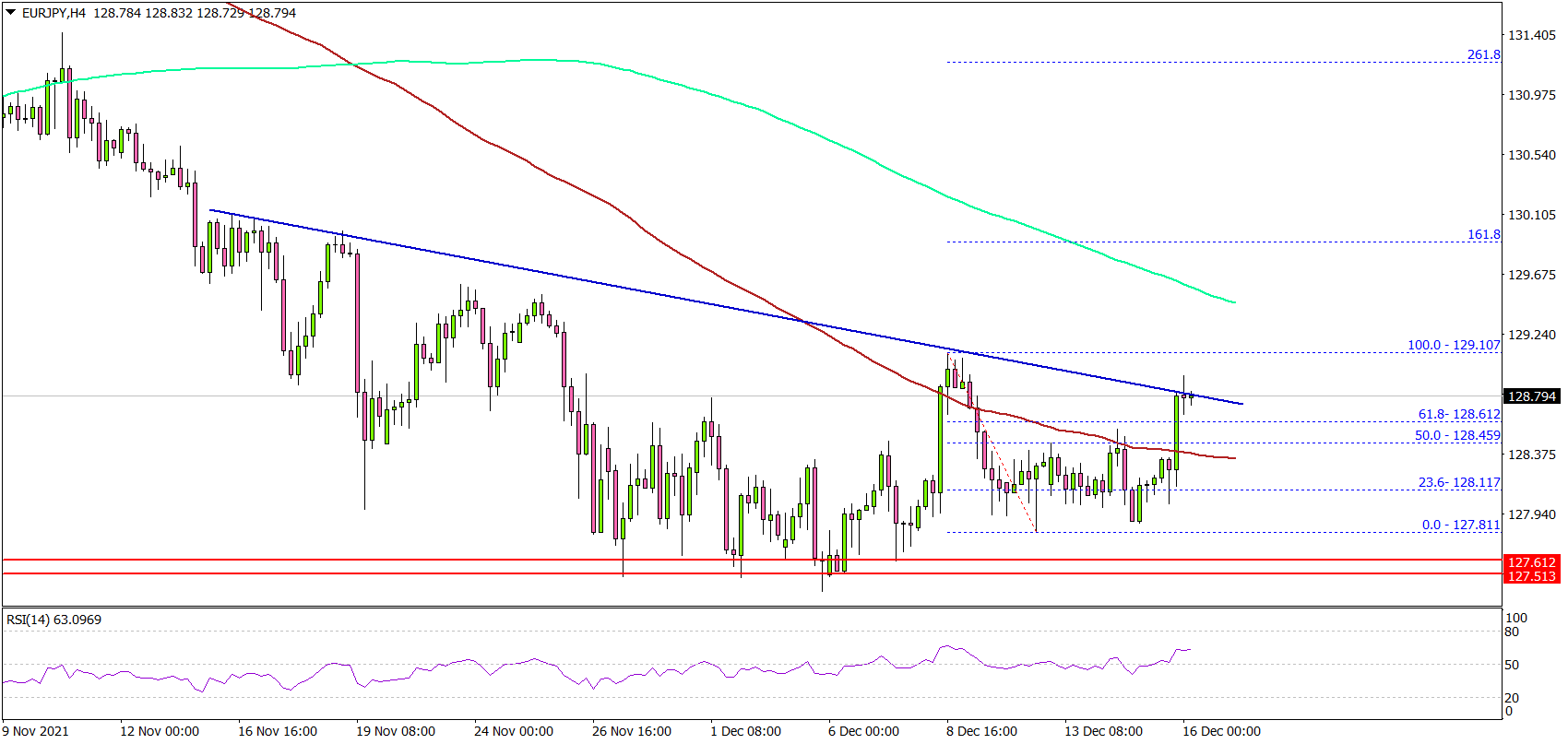
Looking at the 4-hours chart, the pair seems to be forming a base above the 127.50 level. Recently, there was an upside correction above the 128.00 level. There was also a move above the 128.50 level and the 100 simple moving average (red, 4-hours).
However, the pair struggled to clear the 129.10 level. There was a fresh decline below the 128.50 and a low is formed near 127.81. The pair is consolidating and facing resistance near 128.50.
There is also a major bearish trend line forming with resistance near 128.60 on the same chart. The next key resistance is near the 129.00 level. A clear break above the 128.80 and 129.00 resistance levels could open the doors for a steady upward move.
If not, there could be a fresh decline below the 127.80 support. The next major support is near the 127.50 level, below which the pair could decline heavily.
Looking at EUR/USD, the pair is still well below the 1.1350 level and there is a risk of more losses below the 1.1200 support zone in the near term.
Economic Releases
- Germany’s Manufacturing PMI for Dec 2021 (Preliminary) - Forecast 56.8, versus 57.4 previous.
- Germany’s Services PMI for Dec 2021 (Preliminary) - Forecast 51.0, versus 52.7 previous.
- Euro Zone Manufacturing PMI for Dec 2021 (Preliminary) – Forecast 57.8, versus 58.4 previous.
- Euro Zone Services PMI for Dec 2021 (Preliminary) – Forecast 54.1, versus 55.9 previous.
- UK Manufacturing PMI for Dec 2021 (Preliminary) – Forecast 57.6, versus 58.5 previous.
- UK Services PMI for Dec 2021 (Preliminary) – Forecast 57.0, versus 58.5 previous.
- BoE Interest Rate Decision – Forecast 0.1%, versus 0.1% previous.
- ECB Interest Rate Decision – Forecast 0%, versus 0% previous.
- US Manufacturing PMI for Dec 2021 (Preliminary) – Forecast 58.5, versus 58.3 previous.
- US Services PMI for Dec 2021 (Preliminary) – Forecast 58.7, versus 58.0 previous.
- US Initial Jobless Claims - Forecast 195K, versus 184K previous.
Market Morning Briefing: Dollar-Yen Has Risen Well Breaking Above 114 Today
STOCKS
Dow has risen fairly after the FOMC and needs to break above 36000 to turn bullish else can fall back to 35250-35000. Dax can hold above 15400 and rise eventually towards 15700/800. Nikkei and shanghai can test 28500/250 and 3625 respectively before rising back from there in the medium term. Nifty can rise to 17400 or higher if it holds above immediate support at 17200. Sensex too needs to sustain above 58000 to head higher towards 59000 else a fall back to 57500-57000 cannot be negated. Dow (35927.43, +383.25, +1.08%) has risen after the FOMC yesterday. But while below 36000, we may not fully negate chances of a fall to 35250-35000 before again reversing higher. Watch a range of 36000-35000 for now.
DAX (15476.35, +22.79, +0.15%) has risen slightly but trades below 15500 mentioned yesterday. If 15400 holds, we may expect a bounce to 15700/800 else a fall to 15200/100 cannot be negated on the downside in the next 1-2 weeks.
Nikkei (28904.25, +444.53, +1.56%) rose with a gap up but fell from an intra-day high of 29044. If the rise does not sustain above 29000, we may expect a fall back towards 28500-28250 on the downside. Maximum upside is seen at 29500 within the current move.
Shanghai (3658.61, +10.98, +0.30%) is heading towards 3625 from where a bounce towards 3675 or higher can again be possible in the medium term.
Nifty (17221.40, -103.50, -0.60%) has chances of bouncing back from current levels as it has support at 17200. If Nifty breaks below 17200 then next level to watch will be 17000/16800. However, if we see a bounce from 17200 then we can a test of 17400 on the upside.
Sensex (57788.03, -329.06, -0.57%) has dipped below 58000 yesterday. The range of 58000-59000 mentioned previously has been broken. The view is now bearish to see a fall towards 57500/57000.
COMMODITIES
Crude prices have risen but are likely to remain within 77-72 (Brent) and 74-69 (WTI) for the near term. Gold has risen on Dollar weakness and while above 1770/60, it can rise to 1790-1800 soon. Silver can rise back to 22.50-23 while above 22. Copper has bounced wll from 4.22 and while above 4.25, it can head towards 4.45/50.
Brent (74.66) has risen after briefly falling below 73 over the past 2-days. We may expect a range of 77-72 to hold for the very near term before a break on either side is seen in the longer run.
WTI (71.52) is likely to trade within 74-69 region for the near term.
Gold (1782.80) and Silver (22.16) have risen from levels seen yesterday. While above 1770 and 22, both Gold and Silver can rise slowly towards 1790-1800 and 22.50-23 on the upside.
Copper (4.2405) fell to 4.2210 before bouncing back sharply from there. While above 4.20, we may expect a slow rise towards 4.45/50 in the near term.
FOREX
The FED announced it would double the pace of tapering to $30bln per month (from earlier $15bln) to end the program by early 2022 rather than the earlier intended mid-2022. Three rate hikes are suggested in 2022 against two rate hikes as expected by most economists. Dollar Index has fallen sharply and can range within 95.50-97 while Euro has risen and could be restricted to 1.1350 on the upside. EURJPY has to break above 129 to turn bullish else could remain within 129-12750 region. Aussie and Pound look stable just now. USDCNY is bearish while below 6.38/37. USDINR is bullish while above 76.20.
Dollar Index (96.40) has fallen sharply from 96.90 yesterday. While 97 is holding well, we continue to look at the 95.50-97 range to hold for the near term unless a break on either side is seen.
Euro (1.1289) has risen well from 1.12219 yesterday and is headed higher just now. It can test 1.1321-1.1325 initially followed by a further rise to 1.1350 before again falling off from there.
EURJPY (128.83) has risen well and needs to break above 129 in order to move up further towards 130. Failure to break above 129 can drag the cross lower towards 128-127.50 again in the near term.
Aussie (0.7152) is likely to trade within 0.72-0.70 in the next few sessions as mentioned yesterday.
Pound (1.3250) has moved up a bit. While above 1.3150-1.32, there is scope for a rise to 1.33-1.3350. Broad range of 1.3350-1.3150 may hold for now.
Dollar-Yen (114.09) has risen well breaking above 114 today. While above 114, there is scope for a rise to 114.50-115 in the near term before a pause is seen.
USDCNY (6.3665) is ranged within the narrow 6.37-6.36 region and may hold that for a few more sessions before falling lower towards 6.35. On the upside immediate limit would be 6.38-6.3850, below that the pair continues to remain bearish.
{USDINR (76.2350) closed above 76.20 yesterday, surging in the last hour of trade. The sharp rise has proved our view wrong of seeing a reversal from 75.80-76.20 region we have been mentioning for quite some time. While above 76.20, there is scope for a rise to 76.75/80-77 on the upside or even 78 over the coming weeks. Watch price action while above 76.20 as that would be bullish for the medium term. Unless an immediate fall is seen by end of this week to close below 76.20, the chances of a pull-back seems less likely.
INTEREST RATES
The US Treasury yields have inched up slightly after the US Federal Reserve meeting yesterday. The Fed as expected had announced to increase the stimulus taper from $15 billion to $30 billion per month from January. As per the projections there will be three rate hikes in 2022. The yields broadly remain well within our preferred range and are likely to move up within it in the near-term. The German yields remain lower and stable. The view is bearish to see a further fall from here. It will have to be seen as what the European Central Bank has on its plate for the markets today after the Fed meeting yesterday. The Indian 10Yr and 5Yr GoI continues to trade mixed within their sideways range. The bias is inclined to see a rise within their respective range in the coming sessions.
The US 2Yr (0.68%), 5Yr (1.25%), 10Yr (1.47%) and the 30Yr (1.86%) yields have moved up across tenors. Our view of seeing a broad sideways range remains intact. 1.3%-1.65% (revised from 1.35%-1.65% mentioned so far) on the 10Yr and 1.7%-2% on the 30Yr is the expected range. Within this range we can expect the yield to move up in the coming weeks.
The German 2Yr (-0.70%), 5Yr (-0.59%), 10Yr (-0.37%) and 30Yr (-0.05%) yields remain stable. The view remains bearish to see a fall to -0.45% / -0.5% (10Yr) and -0.1% / -0.2% (30Yr) from here in the coming days.
The Indian 10Yr (6.3644%) and 5Yr (5.6937%) GoI have inched up slightly yesterday thereby reducing the chances of seeing a further dip as was expected yesterday. A further rise today can take them to their upper end of the range. Overall, 6.3%-6.4% (10Yr) and 5.62%-5.73% (5Yr) is the expected range of trade.
Eco Data 12/16/21
[php_everywhere instance="1"]
Hawkish Fed Anticipates Three or More Rate Hikes Next Year
FOMC delivered a hawkish outlook at the December meeting. Besides doubling the size of tapering as we had anticipated, more than two-third of the members have projected at least 3 rate hikes next year. The latest economic projections suggest that inflation could rise to +5.3% this year before easing. Both headline and core CPI are expected to stay above +2% through to 2024.
The central bank acknowledged that the improvement in the job market had been “solid” and the unemployment rate “declined substantially” in recent months. They, however, warned of the risks “from new variants of the virus”. The Fed dropped the term “transitory factors” in its characterization of inflation. It suggested that supply and demand imbalances “continued to contribute to elevated levels of inflation”. Moreover, the reference that inflation had “run persistently below” 2% was dropped and replaced by the acknowledgement that inflation has “exceeded 2% for some time”.
Against the backdrop the staff economic projections saw some changes. The forecasts of unemployment rate for this year and next year have been revised lower to 4.3% and 3.5%, from 4.8% and 3.5% respectively. Both headline and core inflation rates have been upgraded sharply. Inflation is expected to rise to +5.3% this year, before easing to +2.6% and +2.3% in 2022 and 2023, respectively. Core CPI is expected to rise to +4.2% this year. On the economic growth, GDP is projected to reach +5.5% y/y in 2021, compared with +5.9% in September’s projection.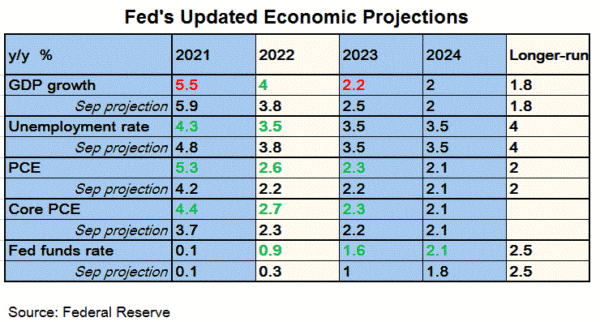
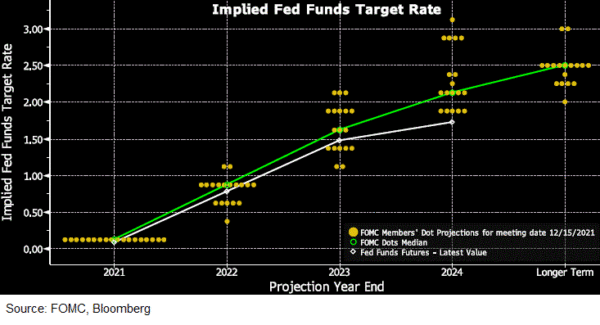
On the monetary policy, the Fed would double the pace of tapering to US$30B/ month in January, in light of elevated inflation pressure and the resilient job market. The Fed funds rate was kept unchanged at 0–0.25% at the December meeting. The members have upgraded their rate hike projections. The median dot plots indicate that there would be three rate hikes in both 2022 and 2023, followed by two more in 2024. It’s striking to see that two-thirds of the members projected 3 or more hikes next year.
Fed press conference live stream
https://www.youtube.com/watch?v=QI5yMHXin2o
Fed doubles tapering speech, 12 members project 3 hikes or more in 2022
Fed kept federal funds rate target unchanged at 0-0.25%. And, "in light of inflation developments and the further improvement in the labor market", Fed will now reduce monthly purchases of of treasury securities and MBS at a faster rate of USD 20B and USD 10B respectively. That is, the tapering speed is doubled.
In the new median economic projections for 2022:
- GDP growth forecast was raised from 3.8% to 4.0%.
- Unemployment forecast was lowered from 3.8% to 3.5%.
- PCE inflation forecast was raised from 2.2% to 2.6%.
- Core PCE inflation forecast was raised from 2.3% to 2.7%
- Federal funds rate forecast was raised from 0.3% to 0.9%.
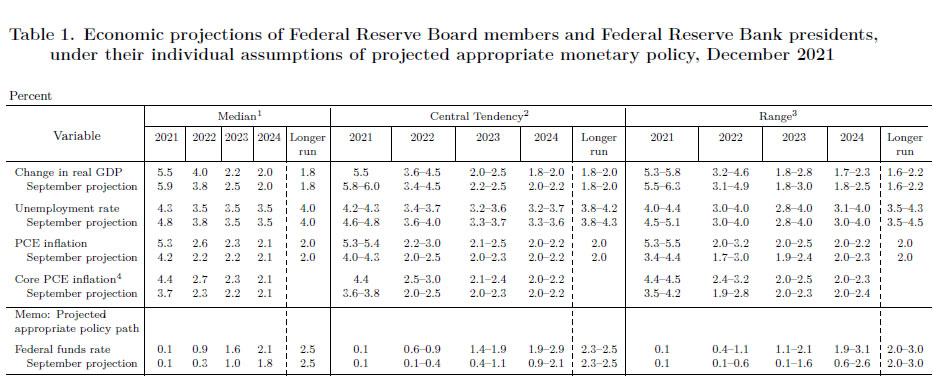
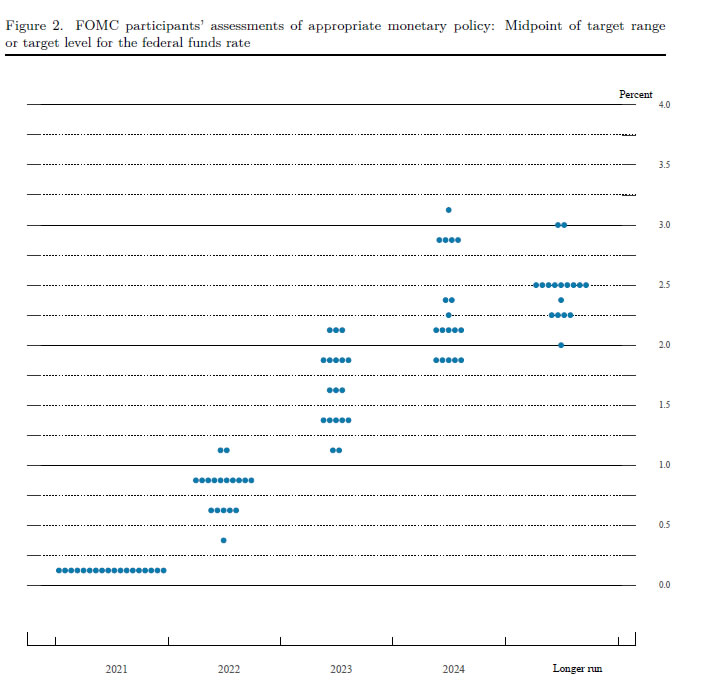
In the new dot plot:
- All members project one rate hike or more in 2022.
- 5 members project two rate hikes in 2022.
- 12 members project three hikes or more in 2022.
US Crude Oil and Petroleum Inventory Unexpectedly Dropped
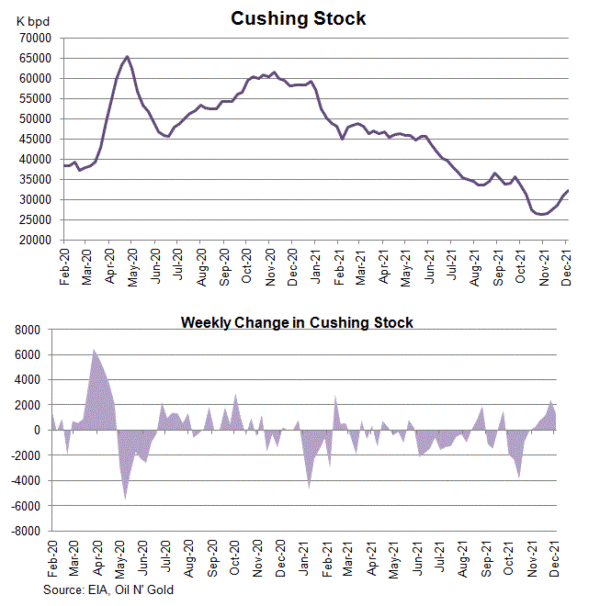
The report from the US Energy Information Administration (EIA) shows that total crude oil and petroleum products (ex. SPR) stocks slumped -15.87 mmb to 1210.49 mmb in the week ended December 10. Crude oil inventory dropped -4.58 mmb to 428.29 mmb, compared with consensus of a +0.82 mmb increase. Inventory increased in 3 out of 5 PADDs. PADD 3 (Gulf Coast) alone saw inventory draw of -3.8 mmb. Cushing stock added +1.29 mmb to 32.21. Utilization rate stayed unchanged at 89.8% while crude production steadied at 11.7M bpd for the week. Crude oil imports decreased -0.03M bpd to 6.47M bpd in the week.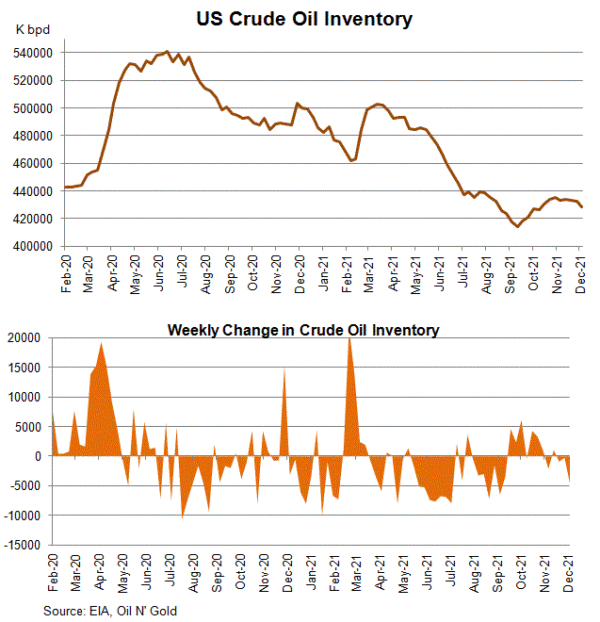
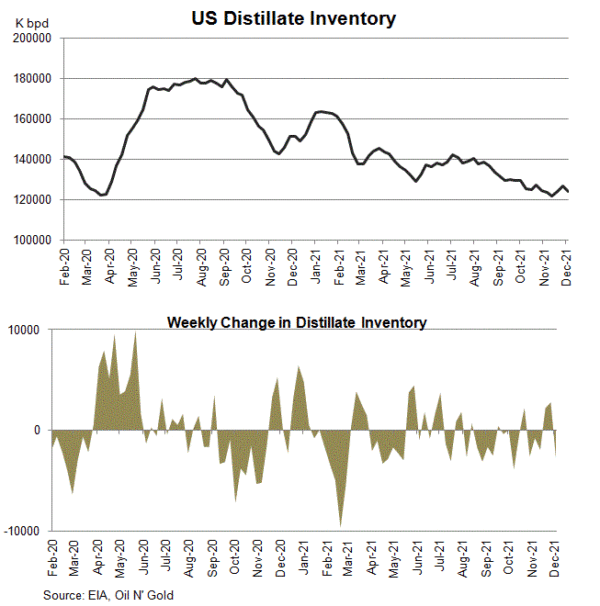
 Concerning refined oil product inventories, gasoline inventory dropped -0.72 mmb to 218.89 mmb while demand jumped +5.68% to 9.47M bpd. The market had anticipated a +1.6 mmb growth in stockpile. Production rose +8.96% to 10.42M bpd while imports plunged -10.57 % to 0.5M bpd during the week. Distillate stockpile fell -2.85 mmb to 123.76 mmb. The market had anticipated a +0.69 mmb increase. Demand soared +36.84% to 4.9M bpd. Imports rose +66.7% to 0.45 mmb while production slipped -2.14% to 4.81M bpd during the week.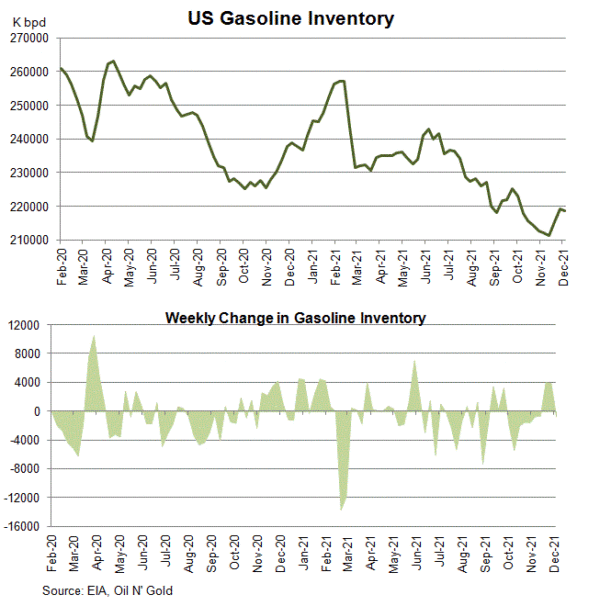
A day earlier, the industry-sponsored API estimated that crude oil inventory added +0.82 mmb. Gasoline stockpile gained +0.43 mmb, while that for distillate was down -1.02 mmb.