Sample Category Title
(FED) Federal Reserve Issues FOMC Statement
The Federal Reserve is committed to using its full range of tools to support the U.S. economy in this challenging time, thereby promoting its maximum employment and price stability goals.
With progress on vaccinations and strong policy support, indicators of economic activity and employment have continued to strengthen. The sectors most adversely affected by the pandemic have improved in recent months but continue to be affected by COVID-19. Job gains have been solid in recent months, and the unemployment rate has declined substantially. Supply and demand imbalances related to the pandemic and the reopening of the economy have continued to contribute to elevated levels of inflation. Overall financial conditions remain accommodative, in part reflecting policy measures to support the economy and the flow of credit to U.S. households and businesses.
The path of the economy continues to depend on the course of the virus. Progress on vaccinations and an easing of supply constraints are expected to support continued gains in economic activity and employment as well as a reduction in inflation. Risks to the economic outlook remain, including from new variants of the virus.
The Committee seeks to achieve maximum employment and inflation at the rate of 2 percent over the longer run. In support of these goals, the Committee decided to keep the target range for the federal funds rate at 0 to 1/4 percent. With inflation having exceeded 2 percent for some time, the Committee expects it will be appropriate to maintain this target range until labor market conditions have reached levels consistent with the Committee's assessments of maximum employment. In light of inflation developments and the further improvement in the labor market, the Committee decided to reduce the monthly pace of its net asset purchases by $20 billion for Treasury securities and $10 billion for agency mortgage-backed securities. Beginning in January, the Committee will increase its holdings of Treasury securities by at least $40 billion per month and of agency mortgage‑backed securities by at least $20 billion per month. The Committee judges that similar reductions in the pace of net asset purchases will likely be appropriate each month, but it is prepared to adjust the pace of purchases if warranted by changes in the economic outlook. The Federal Reserve's ongoing purchases and holdings of securities will continue to foster smooth market functioning and accommodative financial conditions, thereby supporting the flow of credit to households and businesses.
In assessing the appropriate stance of monetary policy, the Committee will continue to monitor the implications of incoming information for the economic outlook. The Committee would be prepared to adjust the stance of monetary policy as appropriate if risks emerge that could impede the attainment of the Committee's goals. The Committee's assessments will take into account a wide range of information, including readings on public health, labor market conditions, inflation pressures and inflation expectations, and financial and international developments.
Voting for the monetary policy action were Jerome H. Powell, Chair; John C. Williams, Vice Chair; Thomas I. Barkin; Raphael W. Bostic; Michelle W. Bowman; Lael Brainard; Richard H. Clarida; Mary C. Daly; Charles L. Evans; Randal K. Quarles; and Christopher J. Waller.
An Action-Packed Few Days
Caution is once again evident in equity markets on Wednesday as we await the final Fed rate decision of the year.
Once again we find ourselves in an environment in which investors have perhaps got carried away with some early promising reports on the severity of the omicron variant and have not fully appreciated the downside economic risks facing the global economy.
Central banks have little choice but to start tightening monetary policy in the majority of cases, as inflation continues to rise to uncomfortable levels, become more widespread, and show signs of becoming more permanent. Omicron posing a greater threat and forcing restrictions may delay the inevitable but not for long as policymakers can't afford to be complacent.
The Fed is not likely to hesitate following its meeting today and is widely expected to accelerate the tapering of its asset purchases, allowing for rate hikes to start in the second quarter. It could be argued that it's taken longer than it should have but policymakers are finally coming around to the markets way of thinking and rate hikes are not far away.
The retail sales data for November won't deter the Fed, with consumer spending more broadly remaining strong and the data perhaps signalling that purchases were brought forward as a result of supply concerns. The consumer remains in a strong position going into the new year and today's report won't be a cause for concern.
UK inflation hits decade high ahead of BoE meeting
The UK data this week highlights exactly why policymakers are being forced to withdraw stimulus earlier than they'd like and at a time of significant uncertainty around the variant. Not only are inflationary pressures accelerating faster than they anticipated and becoming more widespread, but an ever-tightening labour market is chipping away at the argument that it's only temporary.
Odds on the Bank of England to raise rates tomorrow have increased following the data this week, although the consensus view remains that it will refrain due to the significant amount of uncertainty that omicron is creating as restrictions are reimposed. By February, the MPC will have much more data to hand and the booster program will have had time to improve the nation's resistance to the virus. It certainly won't be easy, but it may be sensible for policymakers to turn a blind eye to decade-high inflation this week.
Oil eases but OPEC+ could strike at any point
Oil prices are continuing to pare post-OPEC+ gains ahead of the Fed meeting. Ongoing reports of omicron-driven restrictions, combined with disappointing data from China which casts doubt over its growth potential are weighing on crude prices as we head into a highly uncertain period for the global economy.
The IEA also reported that the oil market has returned to surplus and that inventories will swell early next year, with first-quarter demand seen dropping by 600,000 barrels per day. It's hard not to see this as a political victory for Joe Biden and the Democrats ahead of the midterms, given the timing of their coordinated SPR release. He'll end up getting a lot of credit, despite the bulk of the price decline being omicron-related.
That said, it just takes OPEC+ to follow through on the immediate adjustment threat for prices to rise once again which will keep oil sellers on edge. This may limit the downside for now, although markets do like to eventually test the resolve of these warnings eventually.
Gold vulnerable to hawkish Fed
Gold is relatively flat on the day ahead of the all-important Fed decision. The yellow metal has been range-bound for weeks as every other asset class has whipsawed all over the place, while traders get to grips with the new variant. The Fed will have a huge role to play in how gold trades into year-end, starting today.
The central bank can't afford to be complacent and isn't expected to be. A policy mistake on that front could be bullish for gold as investors will be forced to factor in higher inflation which certainly improves to appeal of the yellow metal. If policymakers accelerate tapering, as expected, and price in two or three hikes for next year, we could see gold really test the lows of the last couple of months.
Santa rally for Bitcoin?
Bitcoin has also been relatively steady recently, albeit with a slight bearish bias as it struggles to generate any momentum above $50,000. It slipped below $47,000 earlier this week but quickly found its feet again and, despite being above here once more, is off a little today. Perhaps there is an eye on the Fed meeting here as well, with the crypto-crowd hoping for a continuation of inflationary loose policy, which they've long believed is bullish for the cryptocurrency. I guess we'll soon see if bitcoin can look forward to a Santa rally of its own.
Canadian Dollar Dips after CPI
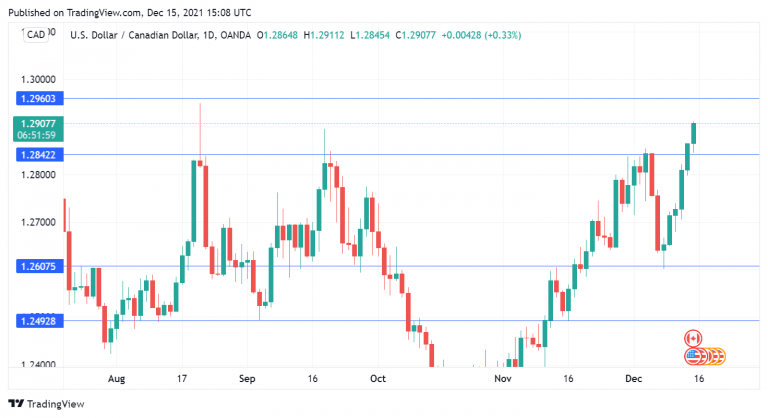
The Canadian dollar continues to struggle. In the North American session, USD/CAD has broken above the 1.29 level for the first time since August. The Canadian dollar has not recorded a winning day since December 7th.
Canada’s inflation within expectations
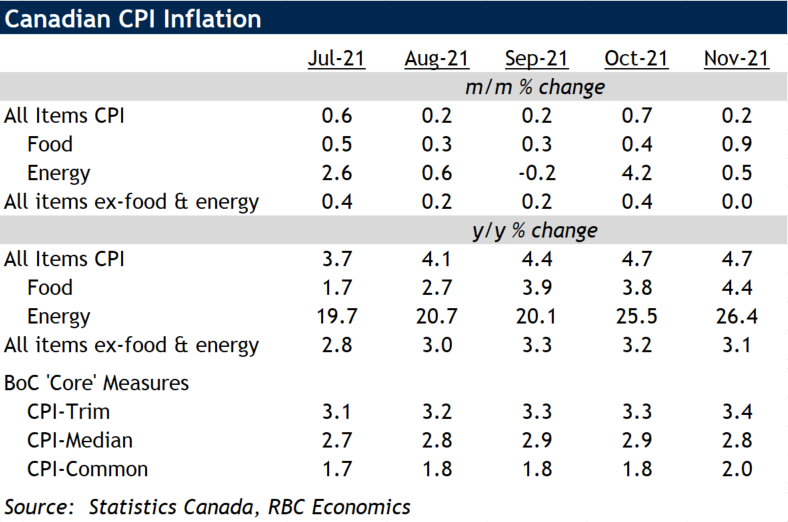
The Canadian dollar had a muted reaction to Canada’s inflation report for November. Annual CPI climbed 4.7% y/y, unchanged from the October release and matching the consensus. The BoC Core CPI measure, the central bank’s preferred inflation indicator, slowed to 3.6% y/y as expected, down from 3.8% in October.
The inflation data didn’t help the struggling Canadian dollar. USD/CAD is up 1.34% this week and could gain more ground if the FOMC takes a hawkish pivot at today’s policy meeting. The markets are expecting some drama at the meeting, with the Fed widely expected to double the pace of its monthly taper from USD 15 billion to 30 billion. This means that the Fed’s bond purchase scheme would end in March instead of July, setting the stage for a Fed rate hike in mid-2022.
The dot plot at today’s meeting will be closely watched and could be a market-mover. The US dollar could gain ground if the dot plot indicates that three hikes are projected for 2022. On the other hand, if the dot plot indicates only two hikes, sentiment towards the US dollar will fall. The FOMC is also expected to bury the term ‘transitory inflation’ after Fed Chair Jerome Powell acknowledged last month that high inflation would last longer than previously anticipated.
Overshadowed by the FOMC meeting was the release of US Retail Sales for November. The data was soft, with the headline release rising by just o.3% m/m, shy of the 0.8% consensus and well below the 1.8% gain in October. It was a similar story for Core Retail Sales, which was also up 0.3% and missed expectations.
USD/CAD Technical
- USD/CAD has support at 1.2618. Below, there is a monthly support line at 1.2477
- The pair is testing resistance at 1.2666. Above, there is resistance at 1.2898
Sunset Market Commentary
Markets
This week’s UK developments enlarge the Bank of England’s dilemma tomorrow. On the one hand, the country is going in overdrive to shield the economy/population against the Omicron tidal wave. On the other hand, UK eco data show that the labour market didn’t face the feared setback as furlough schemes ended while inflation is running away. Headline CPI accelerated to the highest level since 2012 (5.1% Y/Y) while core CPI surged to the fastest pace since 1992 (4% Y/Y). Both significantly exceed the Bank of England’s forecasts and 2% inflation target. The British central bank in November misguided markets by not pulling the trigger on a first rate hike despite strong verbal commitments by governor Bailey and chief economist Pill. Recent eco data and guidance since August (“normalization is necessary over the policy horizon to pull (too high) inflation back to target”) suggest a lift-off tomorrow. Omicron uncertainty could be an excuse to delay the call to the February meeting when a new monetary policy report is available. The market is split, but we slightly favour a rate hike tomorrow. Sterling and short term UK yields went somewhat higher over the past two days. EUR/GBP traded below the 0.85 big figure. The UK 2-yr yield bounced off 0.4% support yesterday and currently test the short term downward trend line just north of 0.5%. A rate hike would lift the UK 2-yr yield out of this closing triangle pattern (see graph).
Global investors remain in wait-and-see mode ahead of Fed (tonight) and ECB (tomorrow) policy meetings. Mixed US eco data had no influence. December Empire Manufacturing business survey unexpectedly strengthened from 30.9 to 31.9. Details were less bullish than the headline reading suggested though with new orders and employment for example falling. Headline retail sales rose a smaller than forecast 0.3% M/M following a bumper 1.8% M/M in October. The retail sales control group – proxy for consumption in calculating GDP – even registered a small monthly decline (-0.1% M/M). Finally, import (0.7% M/M & 11.7% Y/Y) and export prices (1% M/M & 18.2% Y/Y) accelerated further in November. EUR/USD trades on the weak side near 1.1250, but intraday dynamics lack real strength. Core bonds lose some ground for a second session straight. US yields add 2 bps (2-yr) to 3.2 bps (20-yr) across the curve. The German yield curve bear steepens with yields rising by 0.9 bps (2-yr) to 3.3 bps (30-yr). 10-yr yield spread changes vs Germany narrow by up to 2 bps with Greece outperforming (-10 bps). Most European stock markets recover around 0.5%.
News Headlines
Canadian inflation in November rose the expected 0.2% m/m to be up 4.7% y/y, stabilizing at the two-decade high it hit in October. Food, shelter and clothing were the biggest drivers. The average of core measures came in at 2.73% y/y, up from to October’s 2.67%. With inflation now for an eight month straight above the BoC’s 1-3% control range, pressure to kick off a tightening cycle continues to build. Markets currently discount about five rate hikes in 2022. The Bank of Canada’s next meeting is due in January. The Canadian dollar trades little changed in the wake of the inflation release. USD/CAD ekes out a small gain to 1.288 currently with most (FX) markets trading stoic ahead of the Fed later today.
The surge in European gas futures eased today after soaring from €90/MWh from the beginning of this month to €128 yesterday. The almost 40% jump was a combination of high demand (ahead of the winter and low European inventories) and geopolitical tensions with key gas supplier over Ukraine building. Prices marginally fall to €128 after gas flows to the Mallnow point in Germany via Russia’s Yamal-Europe pipeline rose to the highest level since November 21. Flows were effectively reduced to zero at the beginning of November before rebounding somewhat. Compared to previous years, flows are still low though.
Euro Drifting ahead of FOMC
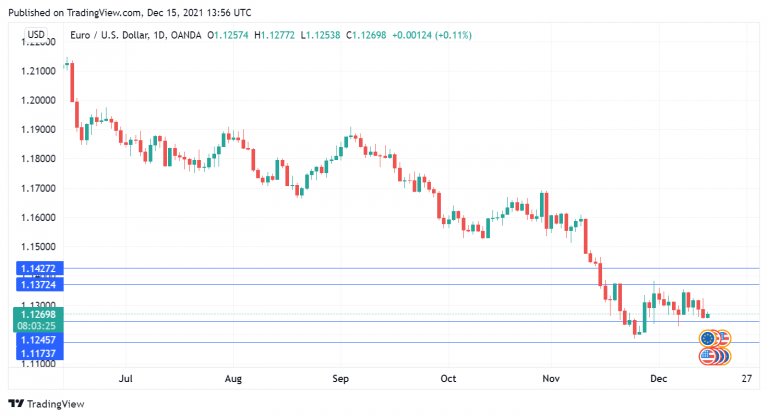
The euro is showing limited movement on Wednesday. In the European session, EUR/USD is trading at 1.1274, up 0.14% on the day. It could be a busy couple of days for the euro, with the Federal Reserve and the ECB holding key policy meetings.
FOMC expected to accelerate taper
All eyes are on the FOMC policy meeting later today. We could see some dramatic announcements, the primary one being that starting in January, the Fed will double the pace of its monthly taper from USD 15 billion to 30 billion. This means that the Fed’s bond purchase scheme would end in March instead of July, setting the stage for a Fed rate hike soon afterwards. The dot plot at today’s meeting will be closely watched and could well be a market-mover. If the dot plot shows that two hikes are planned for 2022, the dollar could sag, while three hikes would likely provide a boost to the greenback.
The ECB holds its policy meeting on Thursday, and high on the agenda is the bank’s monetary support for the eurozone economy. The ECB’s 1.85 trillion euro emergency pandemic programme (PEPP), has been in place since March 2020, and policymakers are expected to confirm that PEPP will be terminated in March 2020. The loss of PEPP’s stimulus will be significant, and the ECB will have to decide what to do with the Asset Purchase Programme (APP), which is running at EUR 20 billion/month, once PEPP is done.
Here, however, there is dissension within the ECB, with hawks staunchly against increasing QE at a time that inflation is moving upwards in the eurozone. The dovish ECB members want to double APP and maintain the bank’s ultra-accommodative policy. There could be a compromise in the works, such as keeping APP at current levels, while providing a mechanism to increase bond purchases if needed. The heavily indebted members of the bloc, such as Greece, have voiced concern that the removal of the PEPP could result in a ‘cliff effect’ which would hurt poorer bloc members.
EUR/USD Technical
- EUR/USD is putting pressure on support at 1.1245. Below, there is support at 1.1173
- There is resistance are 1.1372 and 1.1427
US: Soft Retail Sales Report Signals Higher Prices Factoring into Spending
Summary
Retail sales increased just 0.3% in November; less than half of the expected gain. Holiday sales are still on track to post a record for the year, but with spending slowing in the final months, it is not the finish retailers were hoping for. Consumers are no longer the price-takers they were when they were flush with cash from stimulus checks; higher prices for gas and food is taking away wallet share from other spending categories.
Inflation's Greetings!
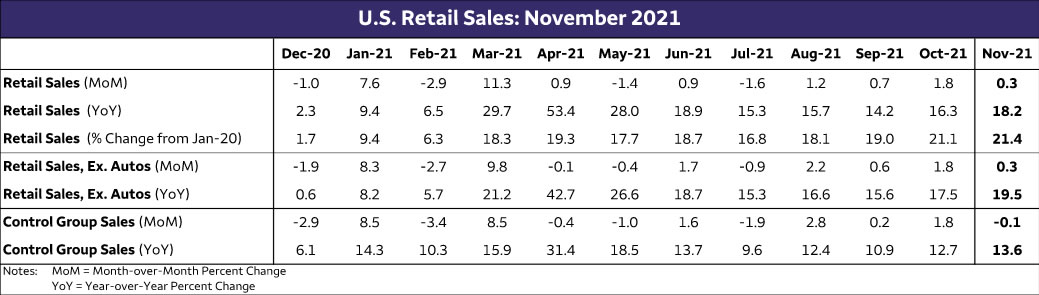
Retail sales rose just 0.3% in November, which was less than half the consensus estimate that was calling for a 0.8% gain. The main story in the November is that higher prices for non-discretionary items, like food and gas, are forcing hard choices for consumers in other areas this holiday season. There is also reason to believe holiday sales were pulled forward to get ahead of supply chain snarls that left retailers worried and consumers frantic to secure their gifts in time for the holidays.
The underlying details of November sales were mixed among retailers. The largest declines came from holiday-sensitive categories, like electronics & appliances (-4.6%) and department store sales (-5.4%), which both saw the fastest decline in sales in nine months. Other categories eked out modest gains during the month. But control group sales, which excludes autos, building materials, gasoline and restaurant sales and is a reliable gauge for goods spending in the GDP accounts, declined 0.1%.
Record Gain in Holiday Sales, but Limping Across the Finish Line
In our September forecast for Holiday sales this year we established a range of 10-13%, a figure which would have handily exceeded any year since at least 1992. While we took some heat for such an optimistic forecast at the time, holiday sales are now on track to handily exceed the top end of our range. Factoring in today's sales numbers through November, even if sales were flat in December, holiday sales would come in at 14.6% for 2021.
That said, we would not rule out some giveback in December. With well-publicized supply-chain issues and aggressive messaging from retailers, shoppers have largely heeded the advice to shop early. The risk is that all that early shopping pulled forward trips that in other years would have happened in December, setting us up for a decline. It is not just pulled-forward demand either. If stores are out of key merchandise, holiday gift cards might take the place of gifts; since those get counted for retail sales when they are redeemed, that could push some spending into January.
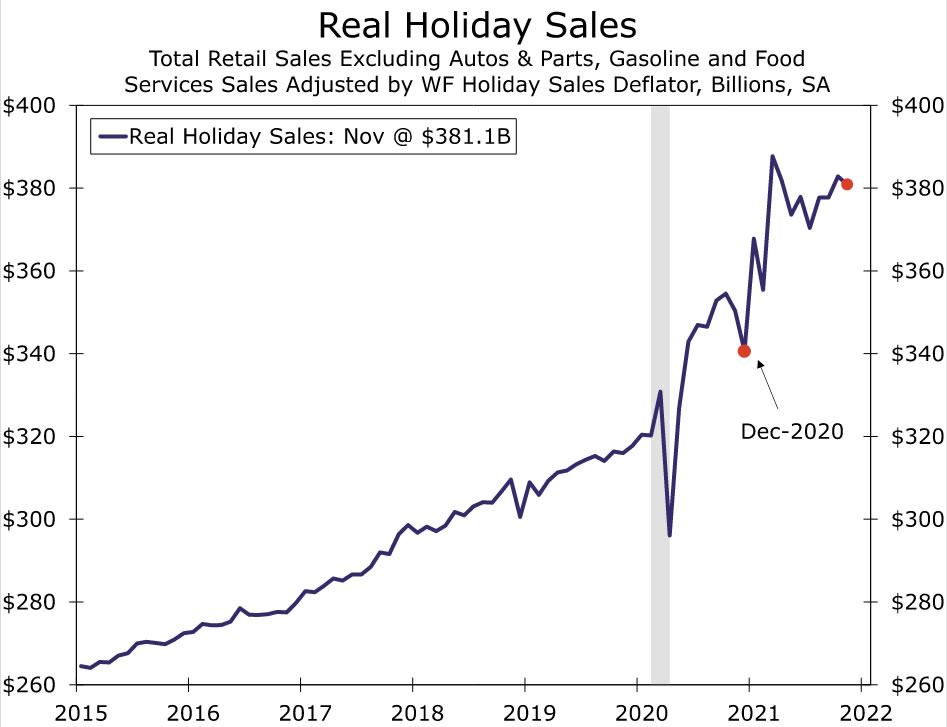
The one thing everyone is getting this holiday season is inflation, our measure of real holiday sales showed a decline of 0.5% in November—which puts real holiday sales on track to rise roughly 10%. However once things shake out, the nominal year-over-year gain will likely be four to five percentage points higher thanks to inflation.
Consumers Faced With Higher Prices & Omicron Variant
As we've cautioned in recent months, prices are certainly a factor boosting the retail sales estimates. Since sales are reported in nominal dollars they are not adjusted for inflation. This is perhaps most evident in the 1.7% jump in gasoline station sales for November, which was the largest gain of any retailer. Last week we learned consumer prices for gasoline surged another 6.1% during the month, which suggests consumers aren't purchasing more gasoline but simply paying more at the pump. Grocery sales is another example of a price-related boost. Sales rose a solid 1.3% during the month, but that's in the context of another 0.8% gain in consumer prices of food at home. Price gains in these non-discretionary goods are forcing hard choices in other areas.
Consumers are not just facing higher prices of goods, but services prices have also started to pick up in recent months creating an inflation challenge for consumers as they try to normalize spending. On top of higher prices, the Omicron variant presents some risk to spending, particularly in services where consumer sensitivity around COVID has largely been concentrated.
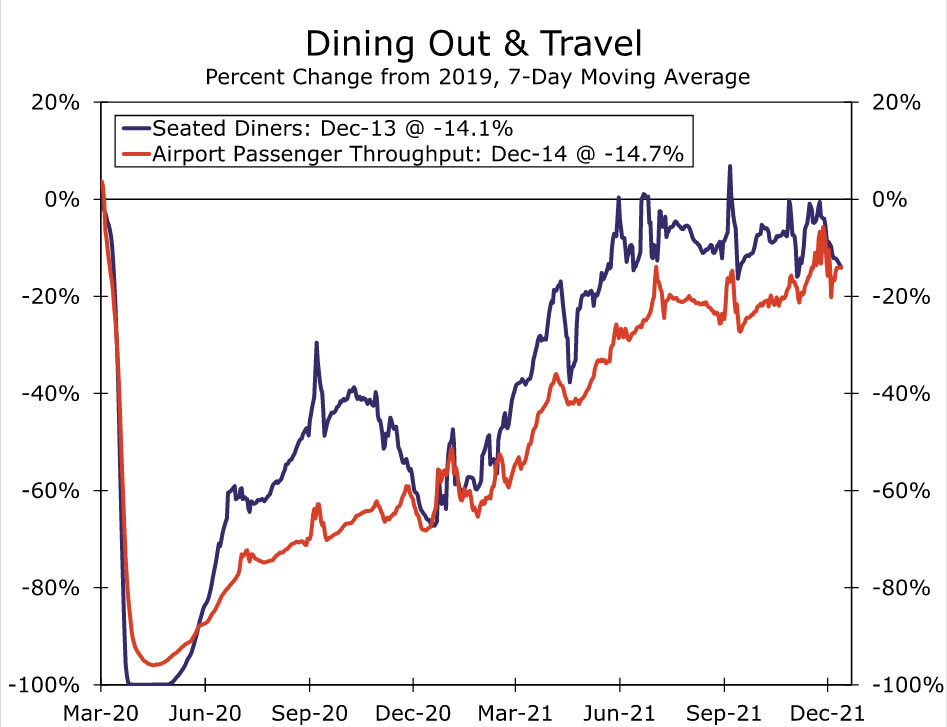
At this point, health officials are only beginning to understand the threat from the Omicron variant. Since retail sales tends to be more goods-related, it does not present a clear read on how consumers are adjusting spending patterns. We've seen a slight pullback in some high-frequency measures of services activity like diner reservations via OpenTable, the amount of people passing through TSA checkpoints and hotel occupancy. But since these data are not seasonally adjusted, some of this weakness can be attributed to payback after the Thanksgiving rush. We'll get a cleaner read on services consumption when the personal income & spending data for November are released next week.
Canada’s Inflation Rate Held at 4.7% in November
- Headline CPI held at 4.7%, matching consensus expectations
- Growth in prices ex-food & energy ticked lower to 3.1%, offsetting strength in food and energy prices
- Inflation pressure continues to broaden; stronger labour markets to prompt rate hike in Q2/22
Canada’s headline inflation rate was unchanged in November, at 4.7% year over year. Energy price growth inched higher again, backed by still elevated gasoline prices, which were 43.6% above levels in November 2020 and accounted for just under a quarter of the headline inflation rate. Growth in food prices also strengthened, to 4.4% or the highest since 2015. Meat costs remained elevated (9%) and price growth in bakery and cereal products also accelerated more significantly (4.1%). We expect that to start moderating in coming months however, given slower pace of price growth for wholesale meat, fish and dairy products from September to November. Gasoline prices are also expected to track lower in December with Omicron worries rattling energy demand.
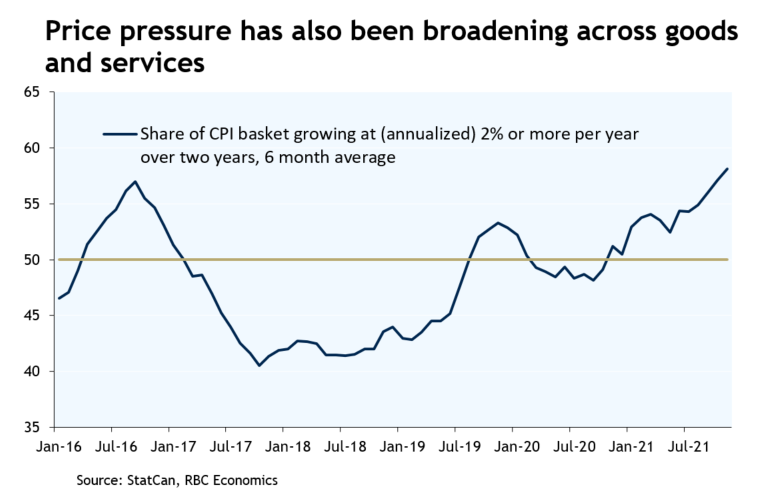
Excluding food and energy products, CPI ticked slightly lower to 3.1% from year ago in November, or 2.7% on an annualized seasonally adjusted basis relative to the pre-shock February 2020 level. Roughly half of that 2.7% can be still attributed to rising expenses related to home-owning and car purchase or leasing. But the breadth of inflation pressure has also widened, with 58% of the consumer basket seeing faster-than-2% annualized growth in November from pre-pandemic (2019) levels on average over the last 3 months. That compares to 47% in February 2020. The broadening is expected to carry on in 2022 as rising input, transport and labour expenses continue to flow through supply chains for a wider swath of goods and services. Further disruptions to supply chains and energy markets from Omicron and the BC flood later in November are expected to add to price uncertainties in the near-term. But very firm demand growth means inflation rates will likely remain above pre-pandemic levels over the next year. And with labour markets also growing increasingly tight, we expect the bank of Canada to start hiking rates around the second quarter of 2022.
Will the Fed’s Policy Decision Rattle the Markets?
FOMC decision in the spotlight
Markets are on edge as the Federal Reserve’s final policy decision for 2021 will hit the markets today at 19:00 GMT. The 10-year US treasury yield ticked higher ahead of the event, while the US dollar remains relatively unchanged. The central bank is widely expected to announce its plan to dial back its bond-purchases program at a faster pace and signal at least two rate hikes for next year, which could boost Treasury yields and the greenback.
On the data front, producer prices for November witnessed a monthly increase of 0.8% versus the consensus estimate of 0.5%, reinforcing expectations for a faster tapering announcement. However, today’s retail sales figures disappointed slightly, as they rose by 0.3% m/m in November compared to forecasts of 0.9%, suggesting that consumers’ purchasing power may have started to cool off due to the current elevated prices.
Will the pound hold onto today's gains?
The British pound rallied on Wednesday after data showed that UK inflation topped 5% in November. This prompted traders to increase their bets for a BoE rate hike announcement on Thursday. However, the overall consensus remains that the BoE will delay an increase in interest rates due to the new Covid-19 restrictions announced in England that could weigh on the economy, pressuring sterling.
In Europe, ECB sources hinted that the central bank’s new projections to be published tomorrow will show inflation falling back below the 2% target in 2023 and 2024, boosting the case against a future rate hike. The loonie slipped on Wednesday against the euro and the dollar after Canadian inflation data came in line with expectations.
US stocks headed for a muted open
On Tuesday, major US indices finished firmly lower after another hotter-than-expected inflation reading weighed on stocks. Technology shares led the decline, with financials being the only S&P 500 sector closing the day in green. US stocks are headed for a muted open on Wednesday, as investors await the FOMC statement later today.
Europe’s Stoxx 600 index rose on Wednesday after five consecutive days of losses. In Asia, Hong Kong’s Hang Sheng index closed 0.91% lower today, as a range of Chinese data suggested slowing growth due to the ongoing property crisis.
Oil dips; gold steady ahead of FOMC announcement
Oil prices declined for a third consecutive day amid fears over tougher Covid-19 restrictions and comments from the International Energy Agency stating that the global oil market has already returned into surplus. Gold prices remained relatively unchanged on Wednesday ahead of the Fed's announcement. If the bank signals faster rate hikes for 2022, gold prices might face more negative pressures, while a more dovish stance could prove to be the much needed catalyst for the precious metal to gain.
EUR/USD Mid-Day Outlook
Daily Pivots: (S1) 1.1233; (P) 1.1278; (R1) 1.1303; More...
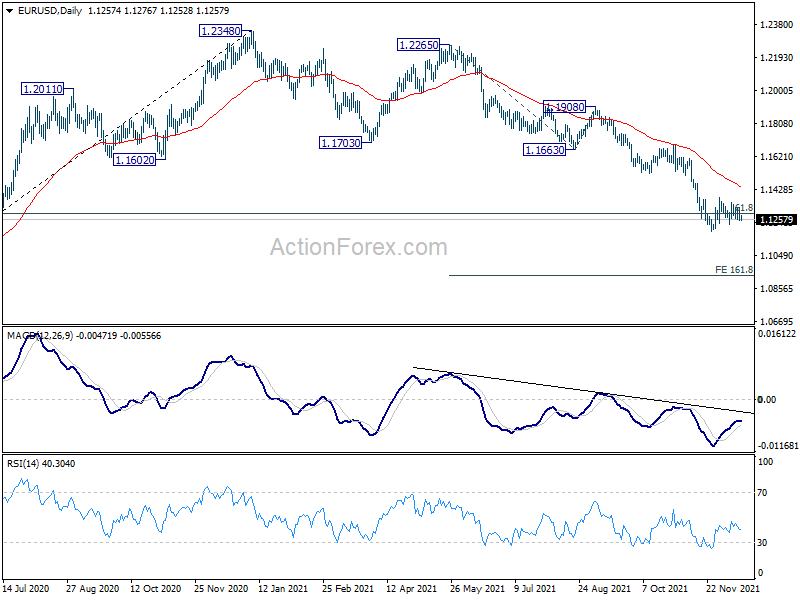
Intraday bias in EUR/USD remains neutral as range trading continues. Downside breakout is mildly in favor with 1.1382 minor resistance intact. On the downside, break of 1.1185 will resume larger fall from 1.2348. Next target is 161.8% projection of 1.2265 to 1.1663 from 1.1908 at 1.0934. On the upside, however, firm break of 1.1382 resistance should confirm short term bottoming at 1.1186. Intraday bias will be turned back to the upside for 55 day EMA (now at 1.1443).
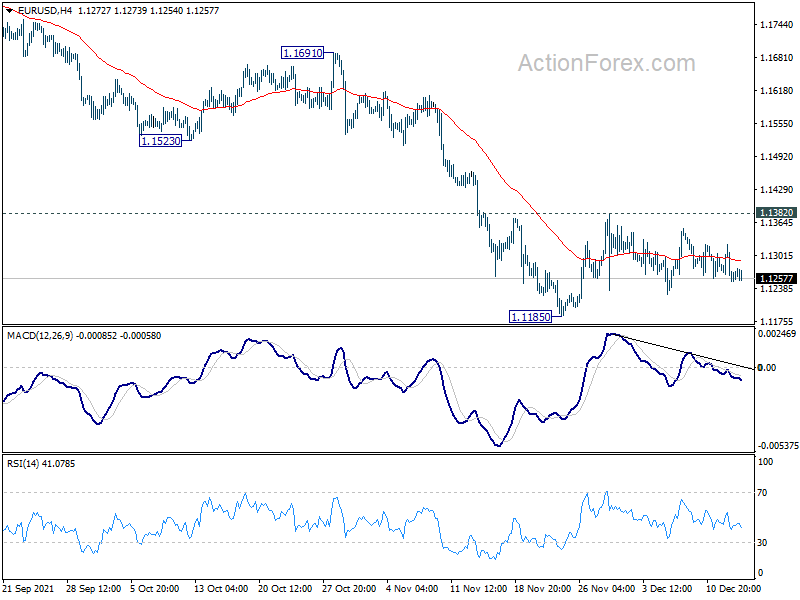
In the bigger picture, there are various ways of interpreting the fall from 1.2348 (2021 high). It could be a correction to rise from 1.0635 (2020 low), the fourth leg of a sideway pattern from 1.0339 (2017 low), or resuming long term down trend. In any case, outlook will now stay bearish as long as 1.1703 support turned resistance holds. Sustained break of 61.8% retracement of 1.0635 to 1.2348 at 1.1289 would pave the way back to 1.0635.
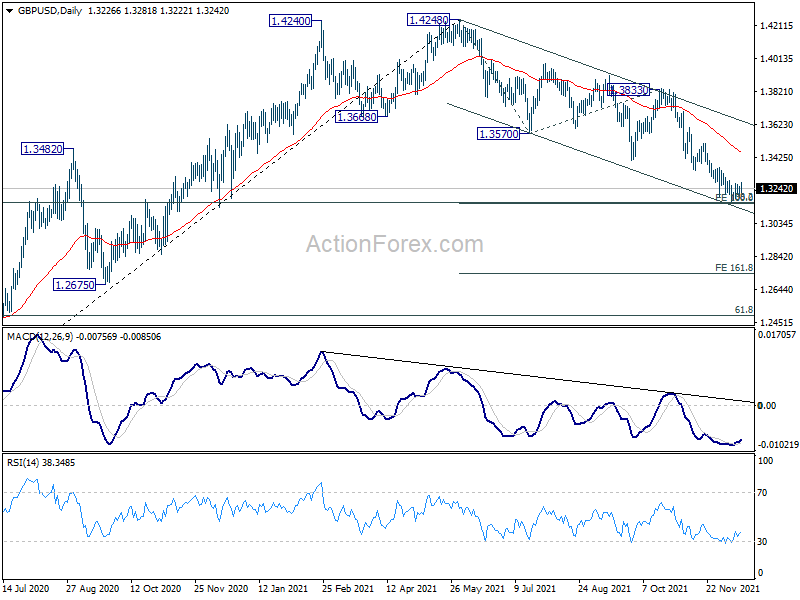
GBP/USD Mid-Day Outlook
Daily Pivots: (S1) 1.3193; (P) 1.3225; (R1) 1.3259; More...
Intraday bias in GBP/USD remains neutral for the moment. Focus stays on 1.3164 medium term fibonacci level. Sustained break there will carry larger bearish implication, and target 161.8% projection of 1.4248 to 1.3570 from 1.3833 at 1.2736. On the upside, though, break of 1.3351 support turned resistance will indicate short term bottoming, and turn bias back to the upside for 1.3512 resistance next.
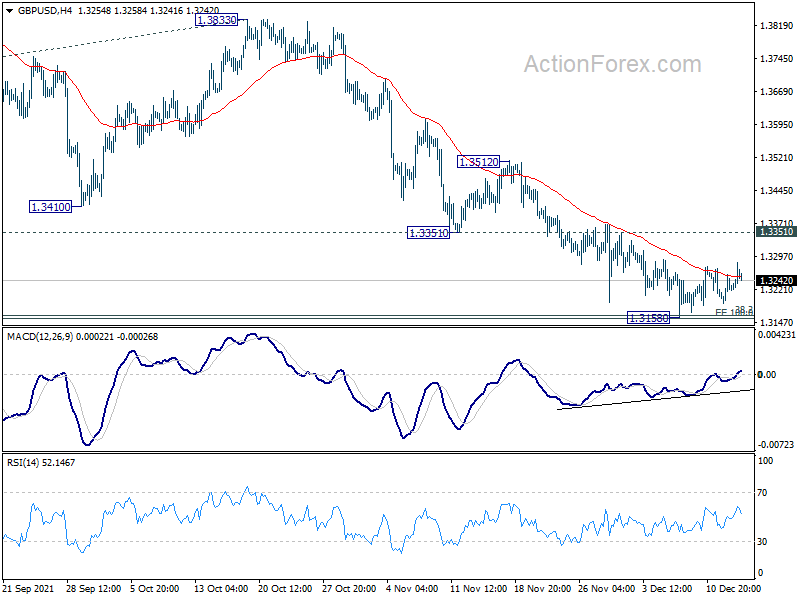
In the bigger picture, immediate focus is now on 38.2% retracement of 1.1409 to 1.4248 at 1.3164. Sustained break there will argue that whole rise from 1.1409 has completed at 1.4248, after rejection by 1.4376 long term resistance. That will revive some medium term bearishness and and target 61.8% retracement at 1.2493. However, strong rebound from current level will revive that case and up trend from 1.1409 is still in progress, and probably ready to resume.