Sample Category Title
NAS100 – The Rally Continues
Can it thrive in a tightening environment
It goes without saying that US tech stocks have gone from strength to strength the last two years and while there have been small setbacks along the way, the trend remains very strong.
While they suffered along with the rest early in the pandemic, it soon became clear that those companies that were most future-proof and better placed to thrive in an environment that massively accelerated pre-pandemic trends were going to do well. Whether that be online shopping, working from home, gaming, etc, these companies were ahead of the pack and are reaping the rewards.
And while there have been wobbles along the way and a lot of concern about how many of these firms will adjust to a monetary tightening environment, it’s clear investors are in no rush to abandon ship. As we saw after the Fed on Wednesday, investors (tech included) fear inflation far more than modestly higher rates.
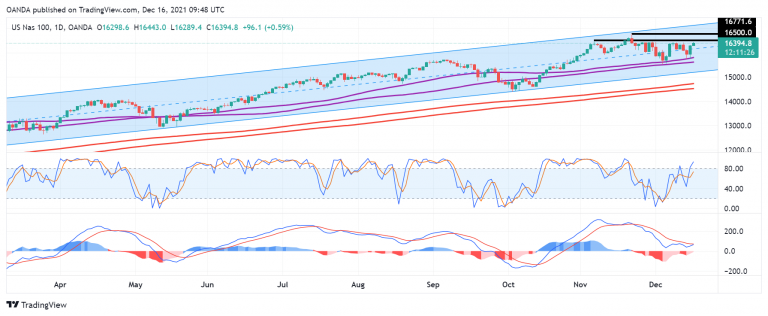
The recent pullback saw the index find support once again around the 55/89-day SMA band before getting a post-Fed lift. While a break below here would have been a setback, as long as the channel holds, the trend continues to look healthy.
The next test to the upside is 16,500 where the index has repeatedly run into resistance followed by the all-time high around 16,771.
We may not see price soar from here given the uncertain interest rate environment which has hindered tech firms more than others. That said, they have performed best in restriction/lockdown environments and that appears to be where we’re heading once again. That may be supportive depending on how severe restrictions become and how long they last.
Federal Reserve Accelerates QE Program Cuts And Forecasts 6 Interest Rate Hikes In Next Two Years
According to the results of the FOMC meeting, the US Federal Reserve kept the interest rate at 0-0.25%. The US Fed is doubling the reduction rate in its quantitative easing program to $30 billion a month. Fed officials forecast 3 interest rate hikes in 2022 and 3 interest rate hikes in 2023. The median forecast assumes an interest rate of 0.9% by the end of 2022, 1.6% by the end of 2023, 2.1% by the end of 2024, and 2.5% in the long term. The Fed raised its US inflation forecast for 2021 to 5.3% from 4.2% and expects inflation of 2.6% in 2022 and 2.3% in 2023.
The negativity of the last few days has been precisely related to these expectations, so this scenario has already been"in price." On Wednesday, American stock indexes demonstrated the most significant growth in the last week following the meeting of the Federal Reserve. By market close, the Dow Jones Industrial Average (US30) added 1.1%, the S&P 500 (US500) increased by 1.63%, and the Nasdaq Composite (US100) jumped by 2.15%.
Main from the Fed Chief Jerome Powell's press conference:
- "I decided to accelerate the QE cuts because of higher inflation and much faster progress in employment."
- "We plan to complete the cuts by mid-March."
- "Don't expect a rate hike before the cuts are completed."
- "We have not yet taken a position on whether we should pause between the completion of the cuts and the first rate hike."
- "We believe the labor market will continue to strengthen."
- "If the economy is not as strong as expected, we will adjust policy accordingly."
- "If the economy slows, rate hikes will also slow down."
- "The Fed may raise interest rates before full employment is reached."
- "Omicron's impact on the economy will be determined by its impact on supply and demand."
- "Even with Omicron, the economy is resilient enough to reduce bond issuance."
- "We will use all of our tools to support the labor market and prevent higher inflation from taking root."
- In November, the US retail sales increased by 0.3% for the previous month (0.8% growth was expected).
European stock indices finished the trading without a single dynamics. German DAX (DE30) added 0.2%, French CAC 40 (FR40) increased by 0.5%, British FTSE 100 (UK100) decreased by 0.6%, and Spanish IBEX35 (ES35) lost 1.1%. Today, the Bank of England, the ECB, and the Swiss National Bank will report on monetary policy. Analysts believe the Swiss National Bank will keep the lowest rate globally at -0.75% since inflation in the region is not high, and the Swiss franc looks stable. The Bank of England is likely to postpone an interest rate hike for next year due to restrictions imposed across the country due to a sharp rise in the incidence, particularly Omicron. The European Central Bank, as usual, will try to get out of the emergency stimulus regime without tightening monetary policy.
Most analysts expect that the ECB will not cut monetary stimulus to the economy until at least 2023. Meanwhile, in France, consumer prices increased to 3.4% in annual terms in November, the highest level in 13 years. In Spain, inflation accelerated to 5.5% in annual terms (5.4% in October), the highest level since 1992. Norway's central bank is considering raising the interest rate. Faced with the highest inflation rate since 2007, Hungary's central bank also plans to raise its prime rate by 30 basis points to 3.6%.
According to a weekly report from the US Energy Department, the US crude oil inventories fell by 4,584,000 barrels last week. This sharp decline in inventories led to a jump in oil prices. WTI crude oil increased by 0.23%, and Brent crude oil increased by 0.22%.
Gold prices were unpredictable at the US Federal Reserve meeting. Initially, gold prices started to decline sharply, but within 30 minutes, they came back and now are showing strong growth. However, analysts are confident that this growth is temporary because with the reduction of the QE program, the dollar index and government bond yields will have growth dynamics in the medium term, which will undoubtedly lead to a decline in gold prices.
Asian stock indices are trading flat today. Japan's Nikkei 225 Index (JP225) added 2.13%, Hong Kong's Hang Seng Index (HK50) increased by 0.22%, and Australia's ASX 200 Index (AU200) decreased by 0.43%. Reserve Bank of Australia Governor Philip Lowe said the central bank would not raise interest rates until inflation will steadily be in the 2-3% range, which is unlikely to be expected next year.
Main market quotes:
- S&P 500 (F) (US500) 4,709.85 +75.76 (+1.63%)
- Dow Jones (US30) 35,927.43 +383.25 (+1.08%)
- DAX (DE40) 15,476.35 +22.79 (+0.15%)
- FTSE 100 (UK100) 7,170.75 −47.89 (−0.66%)
- USD Index 96.35 −0.23 (−0.23%)
Important events for today:
- Australia Manufacturing PMI (m/m) at 00:00 (GMT+2);
- Australia RBA Gov Lowe’s Speech at 01:30 (GMT+2);
- Australia Unemployment Rate (m/m) at 02:30 (GMT+2);
- Japan Manufacturing PMI (m/m) at 02:30 (GMT+2);
- Switzerland SNB Interest Rate Decision at 10:30 (GMT+2);
- Switzerland SNB Monetary Policy Assessment at 10:30 (GMT+2);
- Germany Manufacturing PMI (m/m) at 10:30 (GMT+2);
- Eurozone Manufacturing PMI (m/m) at 11:00 (GMT+2);
- Eurozone Services PMI (m/m) at 11:00 (GMT+2);
- UK Manufacturing PMI (m/m) at 11:30 (GMT+2);
- UK Services PMI (m/m) at 11:30 (GMT+2);
- UK BoE Interest Rate Decision at 14:00 (GMT+2);
- UK BoE Monetary Policy Statement at 14:00 (GMT+2);
- Eurozone ECB Interest Rate Decision at 14:45 (GMT+2);
- Eurozone ECB Monetary Policy Statement at 14:45 (GMT+2);
- Eurozone ECB Press Conference at 15:30 (GMT+2);
- US Building Permits (m/m) at 15:30 (GMT+2);
- US Initial Jobless Claims (w/w) at 15:30 (GMT+2);
- US Philadelphia Fed Manufacturing Index (m/m) at 15:30 (GMT+2);
- US Industrial Production (m/m) at 16:15 (GMT+2);
- US Manufacturing PMI (m/m) at 16:45 (GMT+2);
- US Services PMI (m/m) at 16:45 (GMT+2);
- US Natural Gas Storage (w/w) at 17:30 (GMT+2).
The Analytical Overview Of The Main Currency Pairs
The EUR/USD currency pair
Technical indicators of the currency pair:
Prev Open: 1.1258
Prev Close: 1.1294
% chg. over the last day: +0.32%
Analysts polling shows Eurozone inflation at 3.5% in Q1 2022, 3.1% in Q2, and 2.4% in Q3 2022. At the same time, inflation in the Eurozone may be higher than expected next year, and long-term forecasts may be revised to increase. Today, the ECB will report on further monetary policy plans. Given that the ECB expects a decline in inflation, the tightening of monetary policy in the region should not be expected.
Trading recommendations
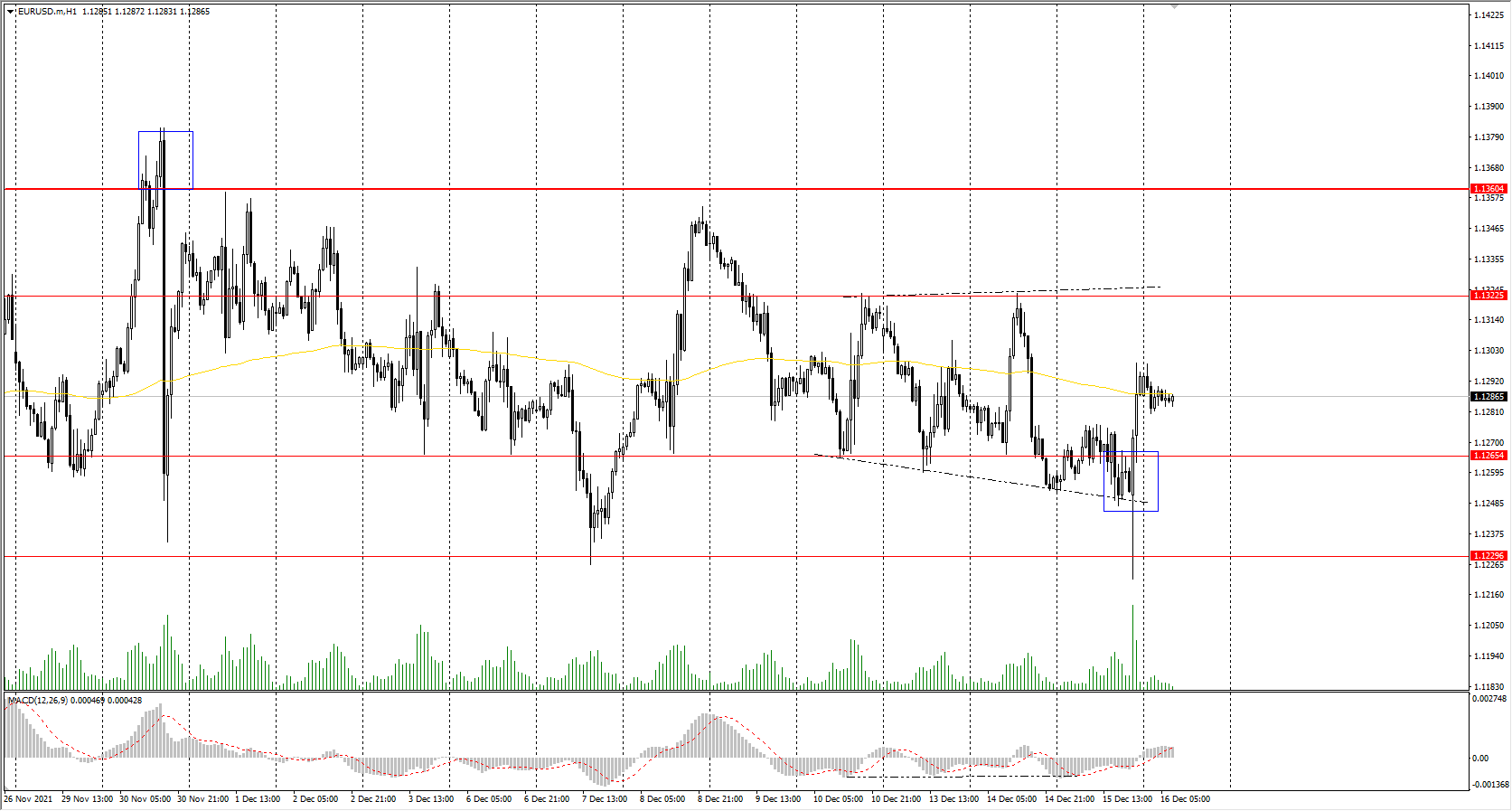
Support levels: 1.1265, 1.1230, 1.1168
Resistance levels: 1.1323, 1.1360, 1.1436, 1.1535, 1.1613, 1.1667, 1.1717
From a technical point of view, the EUR/USD on the hour time frame is still bearish. The price is trading in the corridor, while there is an expansion of borders in the form of false breaks. The MACD indicator has become inactive. Under such market conditions, traders should consider sell positions from the resistance level of 1.1323. Buy trades can be considered from the false breakdown zone, but only with additional confirmation.
Alternative scenario: if the price breaks out through the 1.1360 resistance level and fixes above, the mid-term uptrend will likely resume.
News feed for 2021.12.16:
- Germany Manufacturing PMI (m/m) at 10:30 (GMT+2);
- Eurozone Manufacturing PMI (m/m) at 11:00 (GMT+2);
- Eurozone Services PMI (m/m) at 11:00 (GMT+2);
- Eurozone ECB Interest Rate Decision at 14:45 (GMT+2);
- Eurozone ECB Monetary Policy Statement at 14:45 (GMT+2);
- Eurozone ECB Press Conference at 15:30 (GMT+2);
- US Building Permits (m/m) at 15:30 (GMT+2);
- US Initial Jobless Claims (w/w) at 15:30 (GMT+2);
- US Philadelphia Fed Manufacturing Index (m/m) at 15:30 (GMT+2);
- US Industrial Production (m/m) at 16:15 (GMT+2);
- US Manufacturing PMI (m/m) at 16:45 (GMT+2);
- US Services PMI (m/m) at 16:45 (GMT+2).
The GBP/USD currency pair
Technical indicators of the currency pair:
Prev Open: 1.3228
Prev Close: 1.3257
% chg. over the last day: +0.22%
The UK consumer price level for November was 5.1% in annual terms (4.8% was expected). Analysts believe that the Bank of England should take advantage of the nearest opportunity to tighten the program of quantitative easing and strive to increase interest rates, as the US Fed made. The United Kingdom announces a record number of daily cases of COVID-19. For Wednesday, 78,610 new COVID-19 cases were registered compared with 59,610 during the day earlier.
Trading recommendations
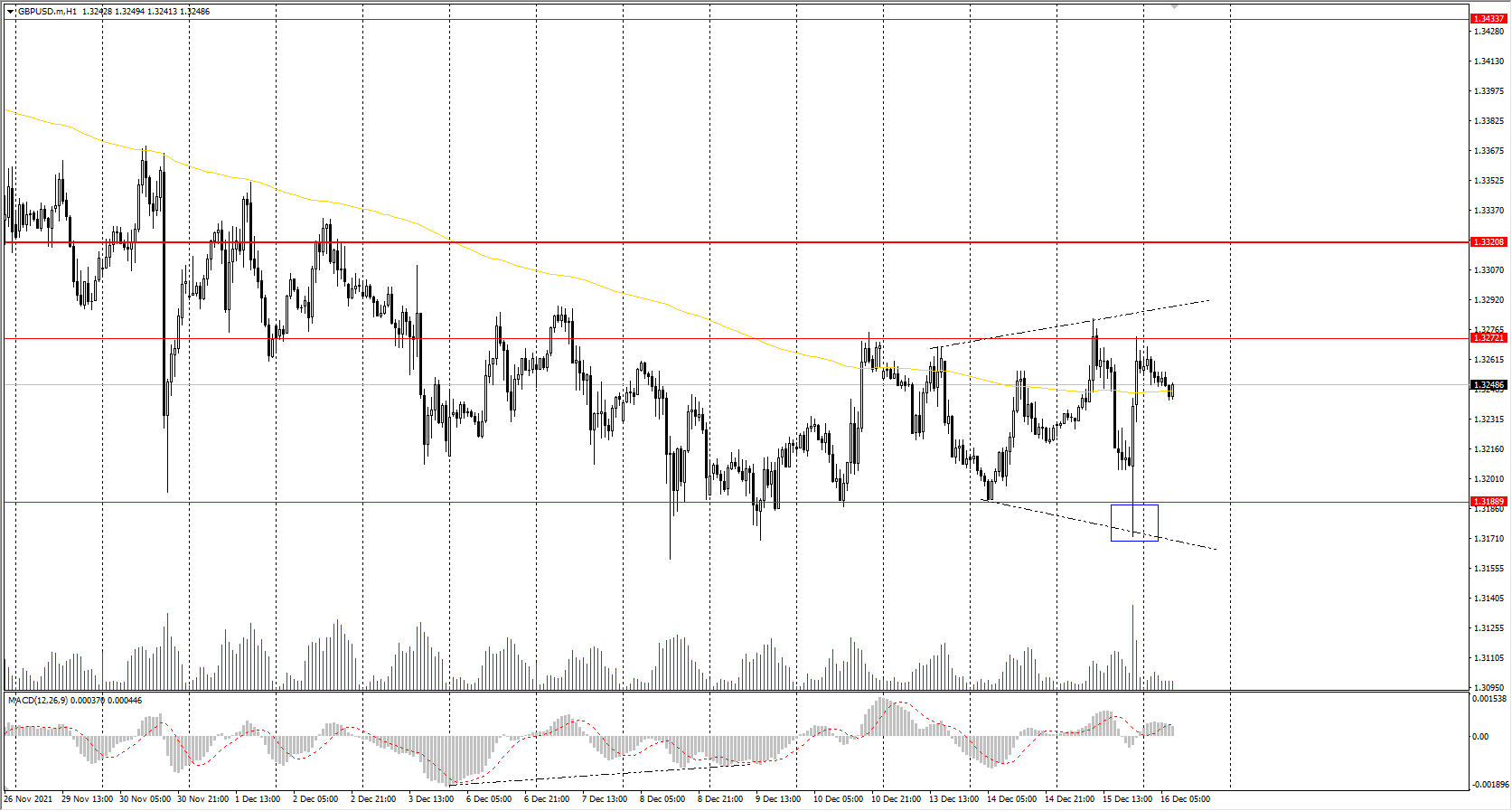
Support levels: 1.3188
Resistance levels: 1.3252, 1.3321, 1.3434, 1.3507, 1.3575, 1.3685
On the hourly time frame, the trend on GBP/USD is bearish. The price is trading in the corridor, while there is an expansion of borders in the form of false breaks. The MACD indicator has become positive. Under such market conditions, traders should consider sell positions from the resistance levels around the moving average. Buy trades can be considered from the false breakdown zone, but only with additional confirmation.
Alternative scenario: if the price breaks out through the 1.3321 resistance level and consolidates above, the bullish scenario will likely resume.
News feed for 2021.12.16:
- UK Manufacturing PMI (m/m) at 11:30 (GMT+2);
- UK Services PMI (m/m) at 11:30 (GMT+2);
- UK BoE Interest Rate Decision at 14:00 (GMT+2);
- UK BoE Monetary Policy Statement at 14:00 (GMT+2).
The USD/JPY currency pair
Technical indicators of the currency pair:
Prev Open: 113.65
Prev Close: 114.05
% chg. over the last day: +0.35%
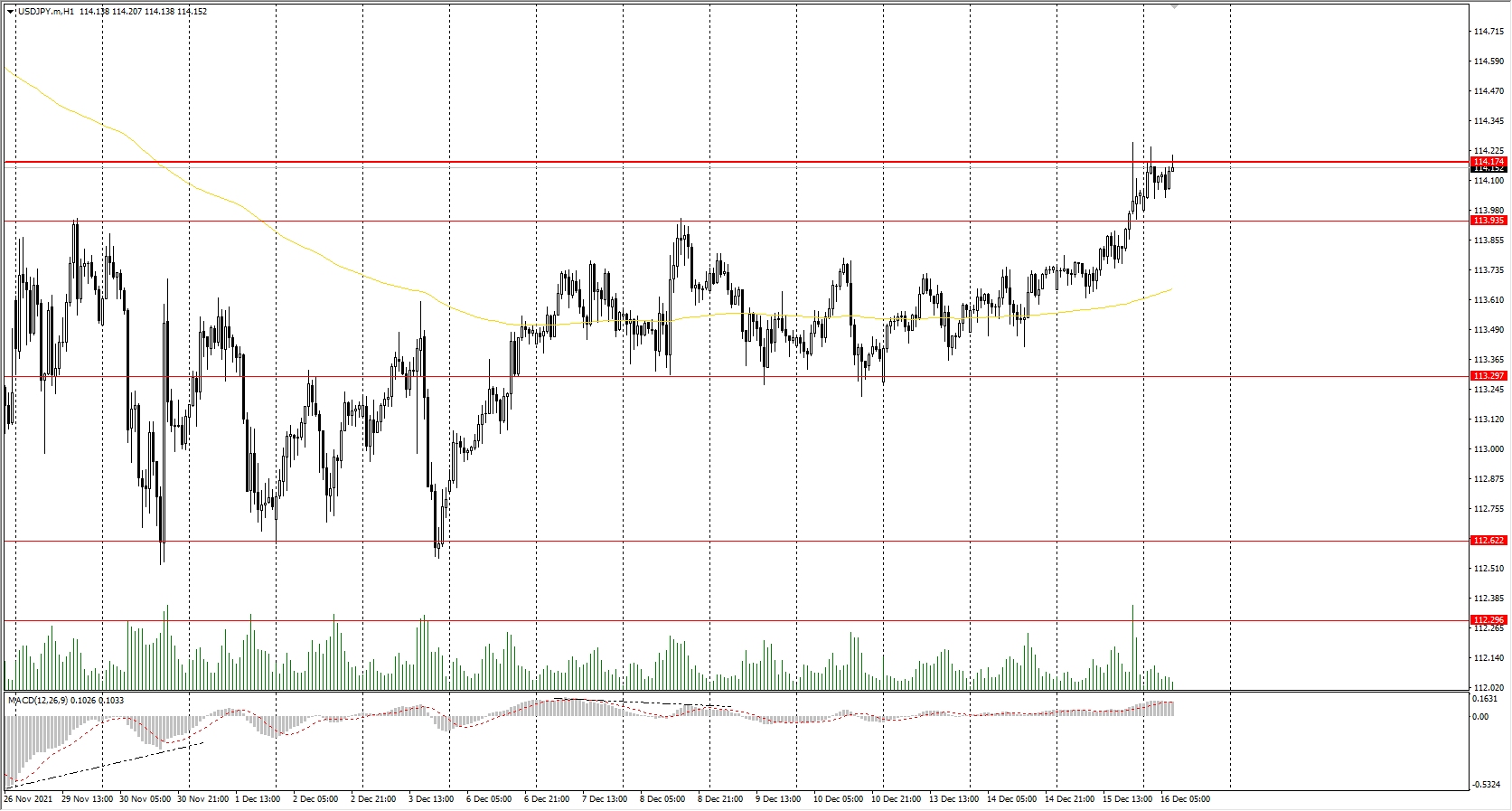
Japan's manufacturing PMI index showed a decline in November (54.2 vs. 54.5 in the previous month). The situation with the Japanese Yen remains the same. Against the background of a large-scale economic stimulation by the central bank of Japan, the fundamental outlook for the yen looks gloomy. Yesterday, the US Federal Reserve announced that it would accelerate the reduction of the QE program, which will result in the dollar index strengthening and the growth of the USD/JPY quotes in the mid-term.
Trading recommendations
Support levels: 113.94, 113.30, 112.62, 112.30
Resistance levels: 114.17, 115.15, 115.50
The global trend on the USD/JPY currency pair is bearish. However, the pressure of buyers is slowly increasing, and the price is approaching the priority change level. Under such market conditions, traders are better to look for sell positions from the priority change level, but with additional confirmation. Buy positions should be considered from the lower border of the corridor, but with additional confirmation in the form of a buyers' initiative or after the price breakout of the priority change level.
Alternative scenario: if the price rises above 114.17, the uptrend will likely resume.
News feed for 2021.12.16:
- Japan Manufacturing PMI (m/m) at 02:30 (GMT+2).
The USD/CAD currency pair
Technical indicators of the currency pair:
Prev Open: 1.2860
Prev Close: 1.2831
% chg. over the last day: -0.22%
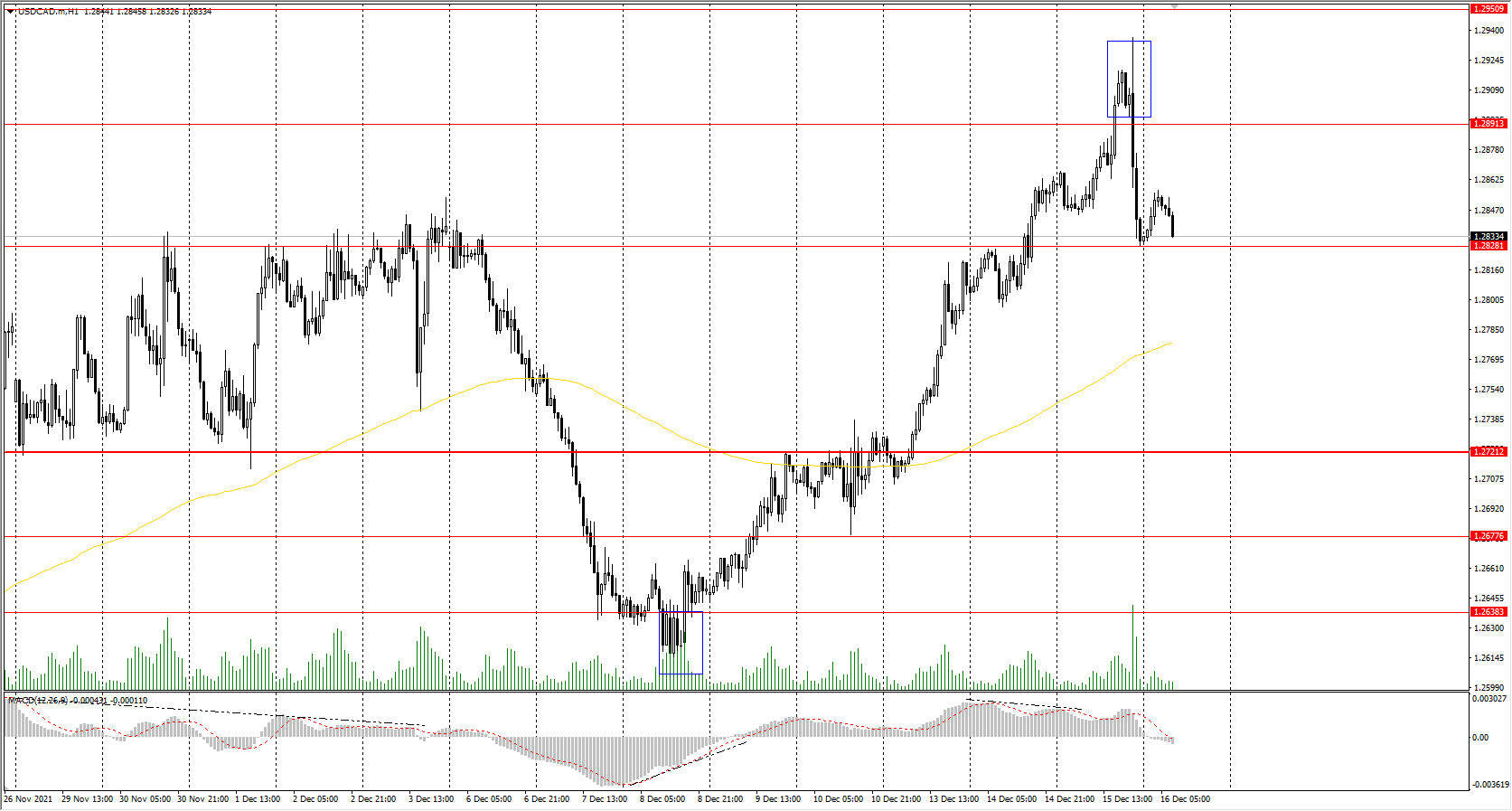
In November, Canada's annual inflation rate was unchanged at 4.7%, remaining at an 18-year high. The key driver of inflation was again gasoline prices, which increased by 43.6% compared to the same month a year earlier. Core inflation (which excludes food and gasoline prices) was 2.7% in annual terms; it’s a 30-year record high. Bank of Canada Governor Tiff Macklem said yesterday that the Bank of Canada might move to a more "patient" state about raising interest rates under certain circumstances. Macklem gave more detail on the new central bank orders, which include some freedom of action, allowing inflation to exceed the target indicator of the Central Bank at 2%.
Trading recommendations
Support levels: 1.2828, 1.2776, 1.2721, 1.2677, 1.2638
Resistance levels: 1.2891, 1.2951
From a technical point of view, the USD/CAD currency pair trend is bullish. The MACD indicator is positive, but there are signs of divergence. Under such market conditions, it is better to look for buy deals from the support levels near the moving average. It is best to look for sell deals from the false breakout area, but with additional confirmation.
Alternative scenario: if the price breaks down through the 1.2721 support level and fixes below, the downtrend will likely resume.
Hawkish Fed Doesn’t Intimidate Markets, ECB And BoE Next
- Fed doubles tapering speed, signals three rate hikes in 2022
- Yet the dollar moves lower, stocks approach record highs
- SNB doesn't do anything, ECB and BoE meetings coming up
No stimulus? No problem
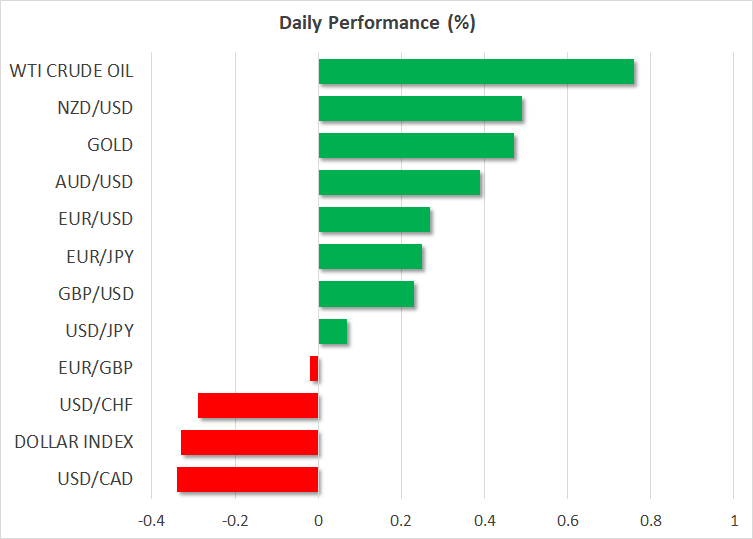
What a crazy market. The Federal Reserve was as hawkish as possible yesterday, doubling the pace at which it reduces asset purchases and signaling three rate increases for next year. But despite the central bank hitting the brakes with full force, stock markets rallied furiously and the dollar retreated with its tail between its legs once the dust settled.
Several arguments have been floated to explain this puzzling reaction, from equity traders heading into the event loaded with defensive hedges and hence unwinding them afterwards to diminishing fears around inflation now that the Fed is reacting to it. Ultimately the simplest answer is that another dip was bought relentlessly, as there's still so much excess liquidity sloshing around the system.
The dollar mirrored the shift in risk appetite, falling as stock markets powered higher and only managing to outperform the defensive Japanese yen. Still, the bigger picture hasn't changed. The US economy has staged one of the most impressive comebacks ever, and with the Fed gearing up for rapid rate increases, carry trades that favor the dollar over the euro and yen could become a dominant force moving forward.
ECB meeting - Shadow tapering
The European Central Bank will have some tough decisions to make when it concludes its own meeting today. Inflation has accelerated dramatically thanks to surging energy prices and the storm in supply chains, yet the outlook for growth remains gloomy. The latest PMIs from Germany are a testament to this slowdown, with the services sector slipping into contraction as covid restrictions hamper activity.
Against this backdrop, the ECB will have to decide by how much to slash its asset purchases. Admittedly, it's a tough spot. Do nothing and you risk pouring more fuel on the inflationary fire. Cut back too much and you might shock the bond market, risking a spike in yields that cripples highly-indebted economies like Italy.
Hence, the most likely compromise is the ECB reducing the pace of its asset purchases by about half, from EUR 80 billion per month currently to around 40 billion in total. The reaction in the euro will depend mostly on how deeply QE purchases are cut and any signals around future rate increases.
Even if the market decides the ECB was relatively hawkish and the euro spikes even higher, it's difficult to envision any rally being sustained for long. The European recovery is rocky and money markets will likely have to price out the minor rate increase that is still baked in for next year.
BoE - No rate hike for Christmas
The Bank of England decision will also be tricky as markets are pricing in about even chances for a 15 basis points rate increase today. Yet that seems highly unlikely. The economic conditions for a rate hike have arguably been met already, but the chilling covid wave that's currently sweeping the country doesn't allow the BoE much room for maneuvering.
As such, there might be a negative knee-jerk reaction in the pound today if rates are indeed kept unchanged, especially if that's done by a unanimous vote. Beyond the initial reaction though, sterling's fortunes will depend on what the BoE signals about future hikes as investors expect almost four of them next year.
Finally, the Swiss National Bank did not announce anything new today. Early on Friday, the spotlight will turn to the Bank of Japan, which is unlikely to rock the boat either. Elsewhere, the carnage in the Turkish lira continues ahead of an expected rate cut today.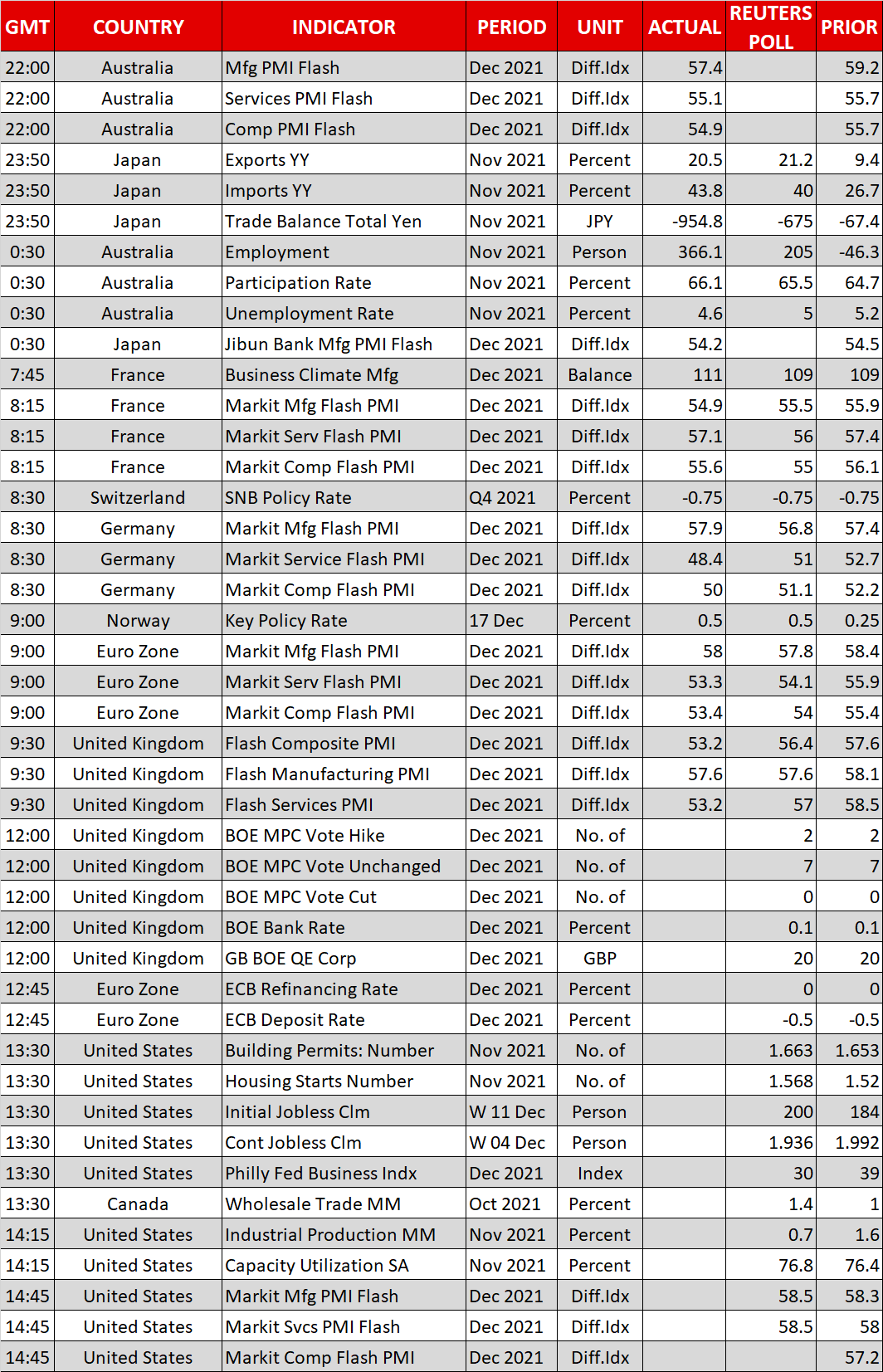
EURJPY Overcomes 129 Mark As Bullish Forces Grow
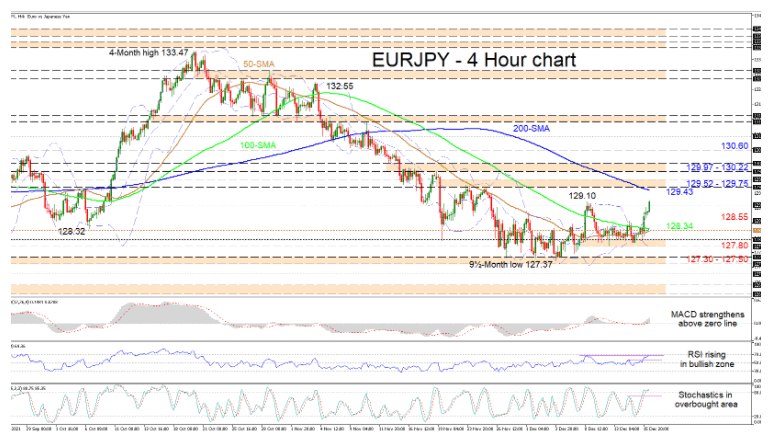
EURJPY is extending beyond the 129.00 handle after a surge of bullish price action from the 128.00 level propelled the pair back above the 50- and 100-period simple moving averages (SMAs). The slight upturn in the 50-period SMA, is suggesting that the pair’s bullish trajectory is beginning to strengthen, while the softened decline in the 100-period SMA is promoting a more neutral price phase.
The short-term oscillators are reflecting an increase in positive momentum. The MACD, in the bullish region, is advancing above the zero threshold and its red trigger line. The climbing RSI is toying with the 70 overbought level, while the stochastic lines are sponsoring additional positive price action in the pair.
Sustaining the current trajectory, resistance could commence at the approaching 200-period SMA at 129.43 that is safeguarding the bearish bias, ahead of the 129.52-129.75 obstruction. Overstepping these barriers, the bulls may then confront the 129.97-130.22 resistance border. In the event buyers recapture the area north of this boundary, upside momentum could power up, sending the price towards the 130.60 high prior to testing the 131.00 handle.
If buying interest starts to diminish and the price retreats beneath the 129.00 level, initial support could stem from the 128.55 barrier ahead of the converging 100- and 50-period SMAs at 128.34 and 128.27 respectively. Continuing to move southwards, a week-long of lows residing between the 128.00 hurdle and the 127.80 level could provide footing. However, if sellers dive beneath this section, which encompasses the lower Bollinger band, the price could seek out the 127.30-127.50 support band before traders’ attention shifts towards the 127.00 mark.
Summarizing, EURJPY is developing a neutral-to-bullish tone as it steers past the 129.00 psychological number. That said, the claws of a neutral picture may still cling to the newfound upside surge in the pair.
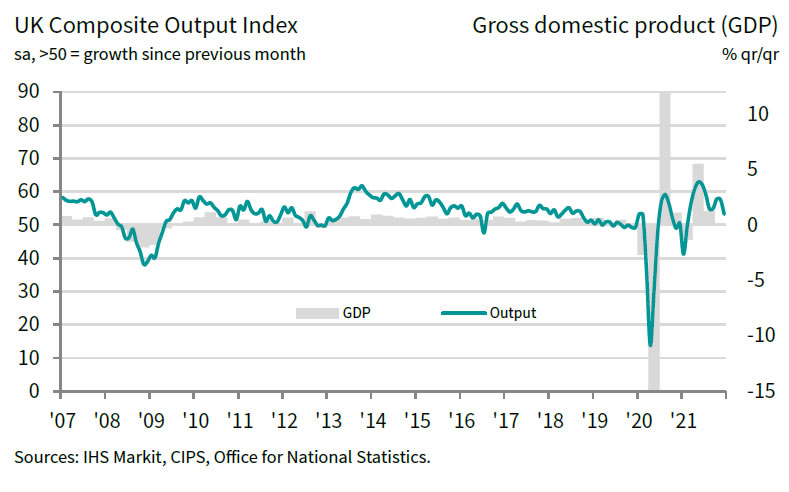
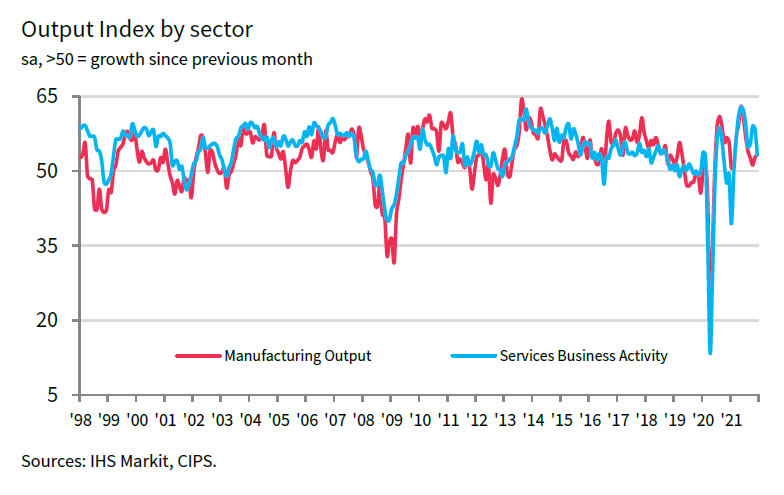
UK PMI composite dropped to 53.2, hit once again by COVID-19
UK PMI Manufacturing dropped from 58.1 to 57.6 in December, matched expectations. PMI Services dropped sharply from 58.5 to 53.2, well below expectation of 57.5, a 10-month low. PMI Composite dropped from 57.6 to 53.2, also a 10-month low.
Chris Williamson, Chief Business Economist at IHS Markit, said: "The flash PMI data show the UK economy being hit once again by COVID-19, with growth slowing sharply at the end of the year led by a steep drop in spending on services by households. Some brighter news came through from manufacturing, where an easing of supply chain delays helped lift production growth, but more importantly also helped take some upward pressure off prices to hint at a peaking of inflation."
EURGBP Consolidates Gains
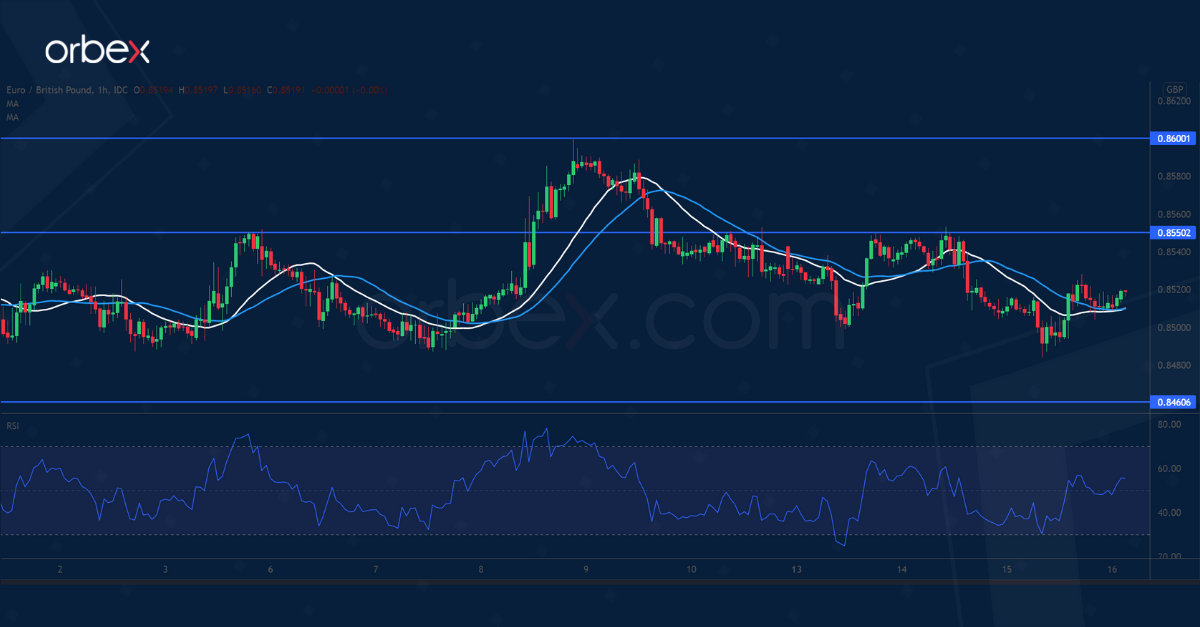
The euro recovers as traders wait for the ECB’s policy meeting later today. A rally above November’s high at 0.8590 has put the bulls back in the game. However, the RSI’s repeated venture into the overbought area has refrained buyers from chasing the momentum.
A drop below 0.8490 shows some weakness in the euro. A lack of support and a bearish MA cross may lead to an acceleration to the downside. 0.8460 would be the next target. The euro will need to reclaim 0.8550 to consolidate the rebound.
USDCAD To Test 4-Month High
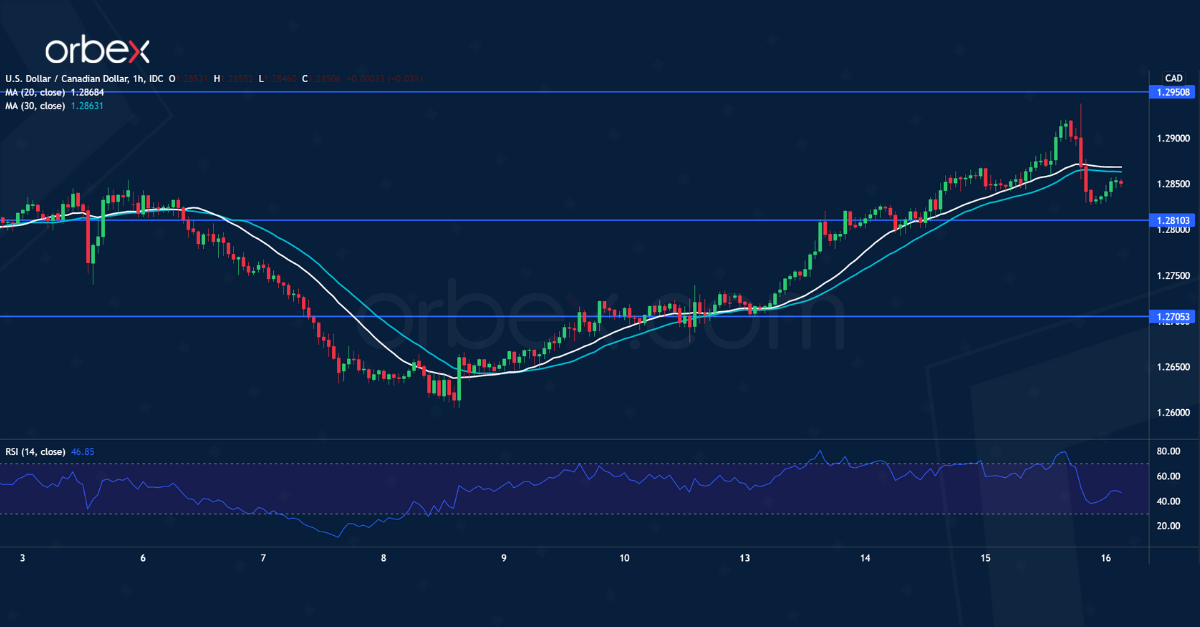
The Canadian dollar recouped some losses after November’s BOC CPI met expectations. Medium-term price action saw strong buying interest near the 30-day moving average (1.2610).
A break above the recent peak at 1.2850 indicates that the bulls have retained control. The RSI’s overbought situation has caused a brief pullback to let the bulls catch their breath.
The August high at 1.2950 is the last resistance before an extended rally would unfold. 1.2810 is the immediate support for the current pullback.
AUDUSD Bounces Higher
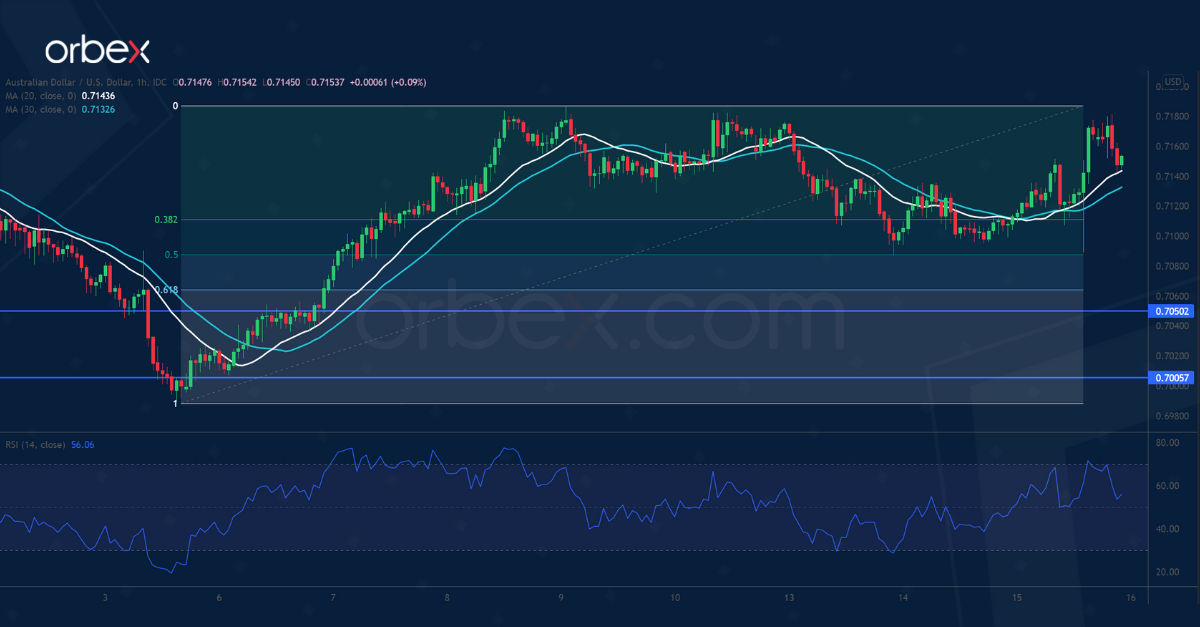
The US dollar softened over profit-taking after the Fed sped up tapering as expected. The pair has found support over the psychological level of 0.7000.
A break above the supply zone at 0.7170 is a show of strength from the buy-side, forcing the shorts to cover. An overbought RSI has limited the upward extension.
The 50% (0.7090) Fibonacci retracement level attracted some buying interest. Further down, the 61.8% (0.7060) level is the second line of defense. A rally above 0.7180 may send the pair to 0.7270.
US Dollar Index Outlook: Dollar Eases In Post-Fed ‘Buy The Rumor – Sell The Fact’ Action
The dollar extends weakness in early Thursday’s trading, following a posted's drop in a typical ‘buy the rumor, sell the fact’ action.
The US central bank was more hawkish than expected with decision to accelerate tapering its bond purchases and end the program by March 2022 being, but surprised by indicating three 25 basis-point rate hikes next year, compared to widely expected two increases.
The Fed’s Chair Powell was upbeat on economic activity and recovery in the labor sector, supporting the FOMC decision, although many analysts see the Fed’s decision as a panic action in attempt to chase surging inflation.
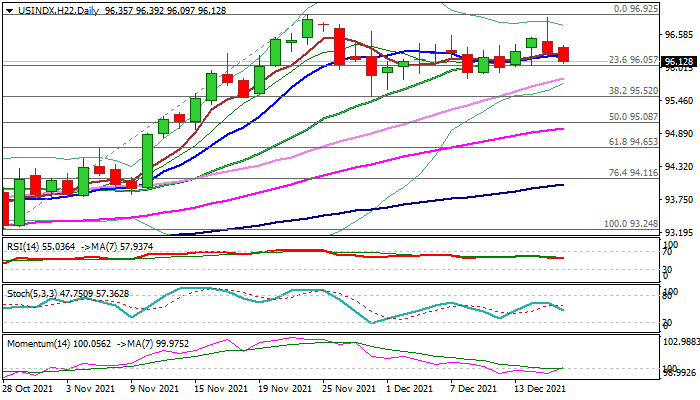
Daily chart shows a negative signal from Thursday’s bearish candle with long upper shadow, formed after bulls stalled on approach to 2021 high at 96.92, posted on Nov 24.
This mainly reflects on hourly and 4-hr charts, where technical studies weakened significantly, keeping near-term focus shifted to the downside.
But daily techs remain in bullish setup, as rising momentum is about to break into positive territory and the action underpinned by 10/200WMA golden-cross, seeing current easing as extended consolidation of a larger uptrend.
Bulls may have another chance to accelerate after the ECB policy meeting, due later today, as market has been pricing in a divergence between the Fed and the European central bank.
Today’s close below converged 10/20DMA’s (96.24) would signal near-term top and keep the downside vulnerable, but dips towards 95.50 support (consolidation range floor / Fibo 38.2% of 93.24/96.92 upleg) would offer better buying opportunities as overall picture is bullish.
Res: 96.24, 96.57, 96.92, 97.78.
Sup: 96.05, 95.82, 95.52, 95.08.