Sample Category Title
GBP/USD Continues To Struggle, UK’s Jobs Report Next
Key Highlights
- GBP/USD is consolidating losses above the 1.3200 support.
- A crucial bearish trend line is forming with resistance near 1.3240 on the 4-hours chart.
- EUR/USD is stuck below the 1.1400 resistance zone.
- Gold price could attempt a fresh increase above $1,800.
GBP/USD Technical Analysis
The British Pound remained in a bearish zone below 1.3300 against the US Dollar. GBP/USD is now consolidating losses above the 1.3200 support zone.
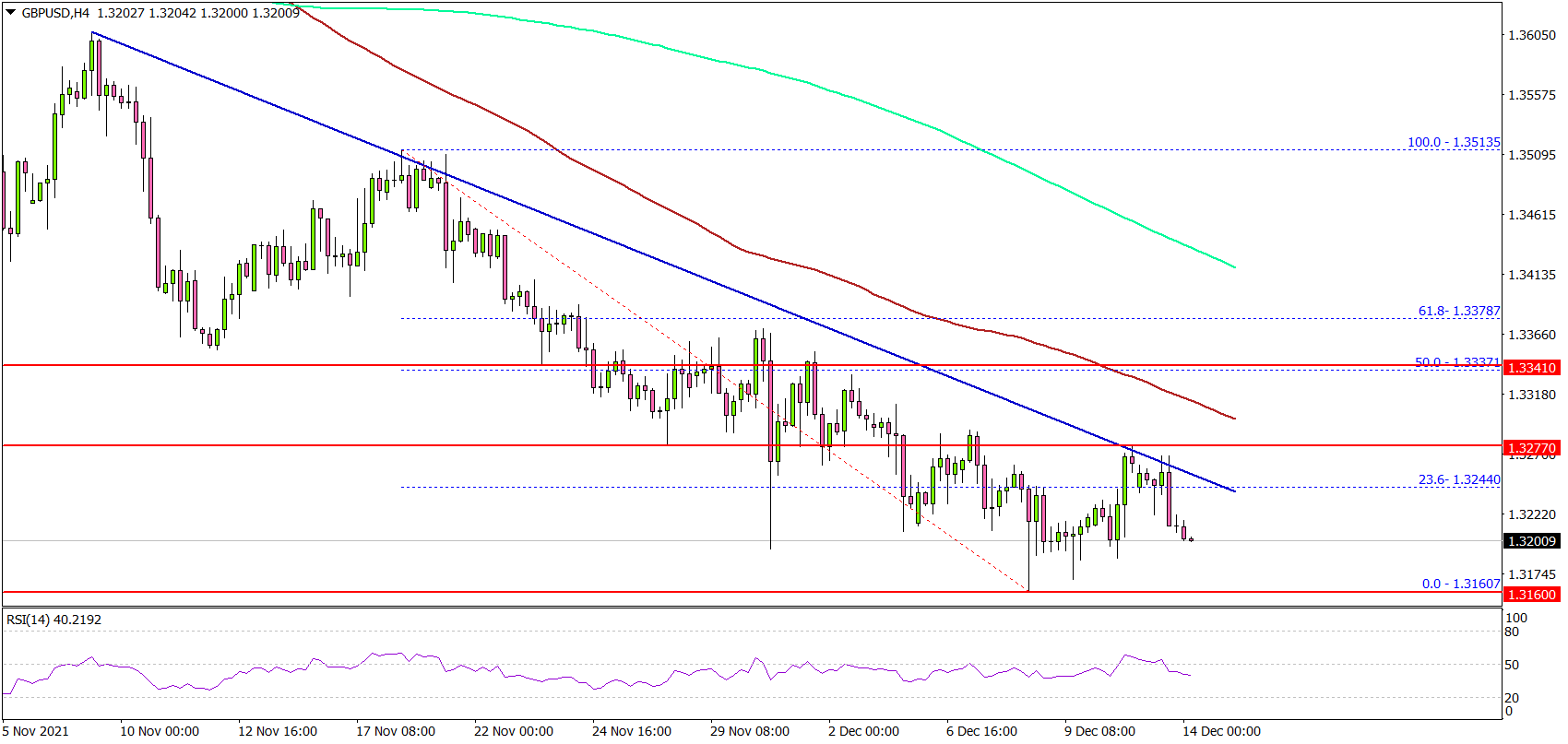
Looking at the 4-hours chart, the pair settled below the 1.3300 resistance zone. There was also a break below the 1.3200 level, and a close below the 100 simple moving average (red, 4-hours) and the 200 simple moving average (green, 4-hours).
A low was formed near 1.3160 and the pair is now consolidating losses. There was a minor recovery wave above the 23.6% Fib retracement level of the downward move from the 1.3513 swing high to 1.3160 low.
On the upside, the bulls are now facing resistance near the 1.3240 level. There is also a crucial bearish trend line forming with resistance near 1.3240 on the same chart.
The next key resistance is near the 50% Fib retracement level of the downward move from the 1.1608 swing high to 1.1186 low at 1.3335. A clear break above the 1.3300 and 1.3335 resistance levels could open the doors for a steady upward move.
If not, there could be a fresh decline below the 1.3200 support. The next major support is near the 1.3150 level, below which the pair could decline heavily.
Looking at EUR/USD, the pair is consolidating losses and it could gain pace if there is a clear move above the 1.1400 resistance.
Economic Releases
- UK Claimant Count Change for Nov 2021 – Forecast -13.0K, versus -14.9K previous.
- UK ILO Unemployment Rate Feb 2021 (3M) – Forecast 5.2%, versus 5.1% previous.
Eco Data 12/14/21
[php_everywhere instance="1"]
EUR/USD – Consolidation ahead of Fed and ECB
Which will break first?
It would seem EURUSD is in consolidation ahead of the Fed and ECB events this week.
It appeared to be flirting with a breakout higher but it wasn’t long until bulls abandoned ship, ahead of the recent highs in fact, in a sign that they had little confidence of achieving a substantial breakout ahead of the rate decisions.
Given the amount of uncertainty around both, not to mention omicron, it’s perhaps not too surprising that we aren’t seeing a more significant breakout at this stage.
The Fed could accelerate its tapering but in the absence of concrete data on the new variant, it may be hesitant to offer too much on interest rate guidance. Of course, the dot plot means we will get a much better grasp and I expect forecasts will be much more hawkish, but we could see a strong sprinkling of dovish caveats.
The ECB is in a similar, albeit less pressured, situation. They don’t quite seem prepared to retire transitory yet but there’s one big question on everyone’s lips. What will replace PEPP in March? Can it be extended now that there’s a new variant running wild?
With so many questions to be answered, we could be in for a couple more days of consolidation, after which, a breakout may follow.
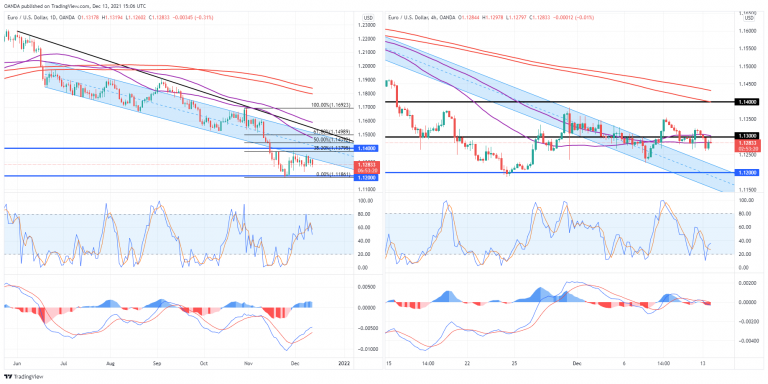
The notable levels above and below remain largely the same, with 1.12 below the major support level and 1.14 above key resistance. There may be a giveaway prior to this, with a break of the recent highs (1.1320) or lows (1.1260) perhaps signalling a shift, but a break of the earlier levels will be more significant.
Sunset Market Commentary
Markets
20. That’s the amount, more or less, of central banks that will hold their final policy meeting of 2021. Major events this week include the likes of the Fed (Wednesday), the Bank of England and the ECB (both on Thursday). Turkey, Norway, Switzerland, Japan, Russia, Hungary and many others together with important economic data (EMU PMIs, US retail sales, UK labour market and CPI) fill the gaps here and there, except for today. Monday’s session thus was much like the weather: dull and grey as investors stuck to the sidelines. Core bonds traded with an upward “better safe than sorry” bias, causing a gentle flattening of the German yield curve. Changes stay limited to -1.2/1.4 bps (10y/30y). Peripheral spreads narrow 1 bp. Italy again outperforms (-3 bps). Both Italy and Greece, Europe’s two most indebted countries, showed some nervousness last week against the background of the ECB exploring PEPP options for when the crisis tool comes to an end in March 2022. The US curve flattens too with the 2y (+1.3 bps) recouping some of last Friday’s small CPI-driven correction. The long end outperforms with gains building as we go into early US dealings (10y: -3.8 bps, 30y: -5.1bps) even as the Fed is widely anticipated to double the pace of tapering. Stock markets initially kicked off in good spirits. The EuroStoxx50 rose about 0.5% but a more fragile US sentiment reduces current gains to about 0.2%. Equities on WS open 0.3-0.4% lower.
The US dollar held an edge over most majors. The trade-weighted dollar (DXY) ekes out a gain from 96.1 to 96.3 though is off intraday highs. EUR/USD came under additional selling pressure at the beginning of European dealings but found a bottom around 1.126. The pair is currently filling bids in the 1.129 support/resistance area. Sterling is doing not too bad. EUR/GBP hit the 0.85 big figure after trading as high as 0.855 in Asian dealings. A break lower was never really explored. Things were a lot spicier more east though. The Turkish lira gets knocked out once again after S&P lowered the country’s rating outlook to negative and the fresh Turkish finance minister Nebati told Haberturk newspaper that “we [speaking in name of the government, really] will not raise rates”. The central bank convenes later this week and is expected to cut rates further from 15% to 14%. EUR/TRY in volatile early dealings spiked at 16.6 before easing to 15.9 currently, another new all-time low despite new FX interventions (selling foreign currency reserves to support the lira) by the CBRT. In Central-Europe, the Hungarian forint lags the CZK and PLN today. EUR/HUF edges higher from 365.5 to 367.13, near last week’s lows. Perhaps some nervousness kicks in ahead of tomorrow’s MNB meeting. Consensus expects the base rate to be lifted from 2.1% to 2.5% but markets are probably hoping for more. The one-week deposit rate, the de facto policy rate, is seen hiked to 3.5% two days later.
News Headlines
The Organization of the Petroleum Exporting Countries published its monthly oil market report. OPEC raised its oil demand forecasts for Q1 2022, but keeps it steady at 4.2 mb/d for the full year amid a more steady recovery in H2 2022. The impact of the new Omicron variant is expected to be mild and short-lived, as the world becomes better equipped to manage COVID-19 and its related challenges. 2022 world oil supply forecasts were kept stable as well. Brent crude continues to hover around the $75/barrel mark.
Czech National Bank vice-governor Mora joined this weekend’s call by MPC member Holub in arguing for a >25 bps rate hike at the December meeting. Personally, he’s considering 50 bps or 75 bps. Mora pins the aggressive attitude to the further increase in inflation in November (to 6% Y/Y) which requires more significant action. On top, wage pressure shows no signs of easing while Q4 GDP is expected to beat the central bank’s forecasts despite the virus resurgence and despite weaker production in the car sector. Mora added that the tightening cycle “theoretically” could end in February next year based on the prognosis that inflation will return back to target over 2022 into early 2023. The Czech koruna traded near the strongest levels against the euro this month at EUR/CZK 25.35.
EUR/USD Doesn’t Care About Statistics
On Monday, 13 December, the major currency pair is trading at 1.1300.
Last Friday’s statistics on the US Consumer Price Index were not surprising, although a bit unusual. The indicator skyrocketed to 6.8% y/y in November. On MoM, inflation was 0.8% against the expected reading of 0.7%.
Based on the latest inflation reports, among other things, the US Fed may announce its decision to speed up the closure of its QE programme by at least fifty per cent. In this case, the programme may be щук as early as March 2022 and the Fed may start discussing the rate hike in May.
Investors believe that the regulator may raise the rate by 50 basis points next year.
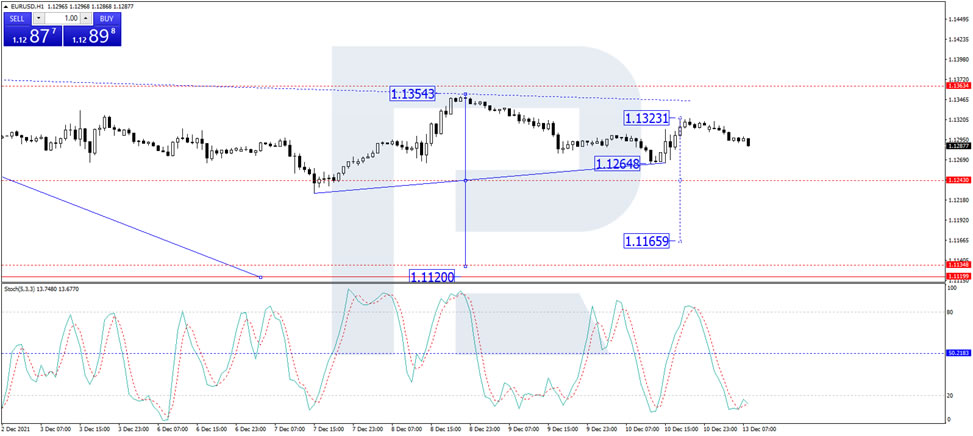
In the H4 chart, EUR/USD is trading downwards to reach 1.1120 and may later consolidate there. If the price breaks the range to the upside, the market may start a new correction with the target at 1.1363. From the technical point of view, this scenario is confirmed by MACD Oscillator: its signal line is moving below 0 and may later continue falling towards new lows.
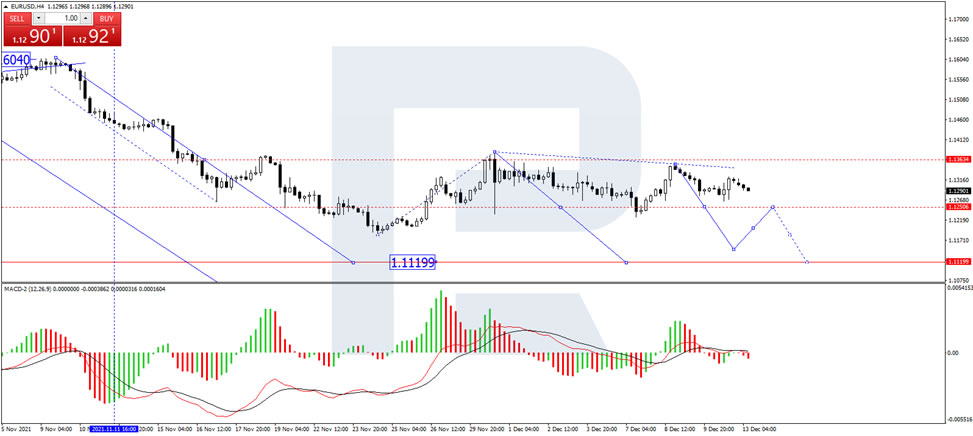
As we can see in the H1 chart, EUR/USD is forming another descending structure to break 1.1243 and may later continue falling with the short-term target at 1.1166. After that, the instrument may correct to return to 1.1243 and then resume falling towards 1.1100. From the technical point of view, this idea is confirmed by the Stochastic Oscillator: its signal line is moving below 20, thus implying further decline towards new lows.
Quiet Day ahead of Raft of Central Bank Meetings
It’s a relatively quiet start to the week before the expected onslaught of central bank meetings that will take place this week. On Monday, US futures gained along with European stocks as traders braced for a week of central bank decisions amid fears about inflation and the omicron virus.
Fed, ECB and BoE meetings in the spotlight this week
The Federal Reserve is anticipated to accelerate its stimulus withdrawal on Wednesday and could pave the way for quicker interest rate hikes in 2022 if price pressures remain around a four-decade high. The US dollar index today is moving up above 96.72, while dollar/yen is struggling to surpass the 20-day simple moving average (SMA).
The euro has remained around $1.1300 since mid-November, ahead of this week's meeting of major central banks, including the ECB. Eurozone policymakers are expected to decide on the future of the bond-buying program. Elsewhere, fears over Europe's faltering economic recovery have grown as the area grapples with rising energy prices and new Covid regulations.
These restrictions are causing traders to reduce their wagers for an increase in interest rates by the Bank of England next year. A "tidal wave" of omicron infections in the UK has prompted Prime Minister Boris Johnson to set an end-of-year deadline for the country's booster immunization campaign. Pound/dollar today is ticking slightly higher, reaching 1.3250 and pound/yen is flirting with 150.60.
Turkish lira plunges; gold and oil struggle around 200-SMA
In other markets, the Turkish lira fell to an all-time low of 14.6180 per dollar today, as the country's central bank was expected to lower interest rates further. Pressured by Turkish President Tayyip Erdogan, the TCMB is expected at Thursday's policy meeting to decrease the policy rate by 100 basis points to 14%, in order to promote a new economic plan that prioritizes growth, output, exports, and credit.
Elsewhere, WTI oil prices eased around the 200-day SMA near $71.00/per barrel as concerns about the omicron variant and its impact on global growth are affecting the commodity. Gold is trying to hit the $1,800/per ounce again, but the 200-day SMA acts as a strong resistance level near $1,792/per ounce.
Blockbuster Week Ahead
What a week we have in store and equity markets are off to another strong start as investors brush aside downside economic risks this winter.
Once again we're seeing the resilience of investors in action. This week we have a plethora of central bank decisions, the highlight of which will obviously be the Fed on Wednesday, as well as a wide array of economic data and, let's not forget, more information on the Omicron variant and the risks it poses in the coming months.
The bulk of this week's event risk is loaded into the second half of the week but there'll clearly be no shortage of action before then as we're already seeing. It may just be that there's heightened focus on Omicron and the measures leaders are taking to get to grips with it and prevent a more severe crisis in the coming weeks.
UK getting nervous about Omicron as over 30s encouraged to get booster
We're already seeing the effect the new variant is having here in the UK, with more restrictions being imposed and the government urging people 30 and over to get the booster. Suddenly it's a scramble to get boosted, so much so that we're seeing long queues outside vaccinations centers and, as I've experienced the last 24 hours, a booking website completely incapable of handling the surge in numbers.
The economy was already facing numerous headwinds this winter and the clear concern coming from the top is only going to filter down and be a drag at an important time for many businesses. With the Prime Minister refusing to rule out further curbs before Christmas and his credibility at a low following recent leaks, who knows what the coming weeks will hold. The hope is that the late dash for the booster will be enough to save Christmas this year.
All considered it's hardly surprising that market pricing for a rate hike from the BoE this week has plunged. The MPC was slaughtered last month for overwhelmingly voting against raising rates after misleading investors in the weeks leading up to the meeting. This time investors are clearly focused more on the rational argument for hiking, which in the current environment, there isn't much of. February makes much more sense.
Lira plunges against ahead of CBRT on Thursday
I obviously understand why the Fed is the headline event this week but it's the CBRT I'm most looking forward to. The central bank and government are signing from the same hymn sheet but living on a different planet from the rest of us. Inflation is above 21% and yet interest rates are expected to fall by another 100 basis points on Thursday to 14%, totaling a cut of 500 basis points since September.
A fourth intervention in the currency markets after the dollar rallied above 14 against the lira at the start of the week on the back of the S&P outlook downgrade will prove to be about as successful as the rest. The lines aren't even blurred between government and central bank anymore, as evident in remarks by Finance Minister Nureddin Nebati on Sunday, when he claimed: "we won't raise the interest rate". That makes for an interesting rate decision on Thursday, but unfortunately further pain for Turkish businesses and households for many months to come.
Apple ticking all the boxes
Apple is closing in on a $3 trillion market cap in what would be another landmark moment for the company, coming a little over a year after hitting $2 trillion and three years after $1 trillion. It really is an incredible achievement and just begs the question, how long until it hits $4 trillion? They have a fantastic product lineup and so much to offer in the coming years. It's had its doubters at times over the years, particularly on the innovation side, but it appears to be ticking all the boxes at the moment.
Oil stabilizes as we await more Omicron data
Oil prices appear to have stabilized over the last week after roaring back from their Omicron-induced losses. OPEC+ put a floor under the price for now as the group warned of sudden adjustments in output but ultimately, the price will only hold up as long as investors continue to believe Omicron poses no substantial threat. Leaders appear more concerned than investors at the moment which is always a worry, but with oil prices 15% off their October highs, there does appear to be some caution priced in at these levels.
Gold range-bound ahead of the Fed
Gold is seeing some support for a second day but remains below $1,800 and within the range, it's traded broadly within over the last few weeks. If it can break above $1,810 it may pick up some momentum to the upside but I struggle to see that ahead of the Fed decision on Wednesday. Then it's a question of what gold bulls will want to see from the meeting. No taper acceleration? Pushback against rate hikes? Transitory being brought out of retirement? I'm not sure we'll see any of these.
Bitcoin struggling once more
Bitcoin is back below $50,000 and really struggling to find any bullish momentum when the price does rebound. An improvement in risk appetite hasn't even helped the cryptocurrency which could be facing a move back towards the levels seen during the flash crash earlier this month if $47,000 falls. Perhaps central banks collectively paring back tightening expectations will get the crypto community excited again this week.
EUR/USD Mid-Day Outlook
Daily Pivots: (S1) 1.1280; (P) 1.1302; (R1) 1.1339; More...
Intraday bias in EUR/USD remains neutral for the moment. Downside breakout is mildly in favor with 1.1382 minor resistance intact. On the downside, break of 1.1185 will resume larger fall from 1.2348. Next target is 161.8% projection of 1.2265 to 1.1663 from 1.1908 at 1.0934. On the upside, however, firm break of 1.1382 resistance should confirm short term bottoming at 1.1186. Intraday bias will be turned back to the upside for 55 day EMA (now at 1.1456).
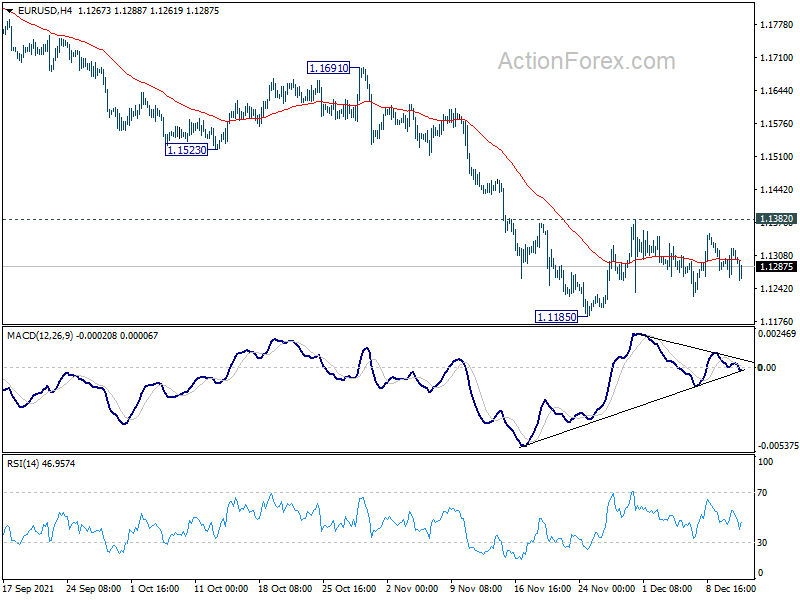
In the bigger picture, there are various ways of interpreting the fall from 1.2348 (2021 high). It could be a correction to rise from 1.0635 (2020 low), the fourth leg of a sideway pattern from 1.0339 (2017 low), or resuming long term down trend. In any case, outlook will now stay bearish as long as 1.1703 support turned resistance holds. Sustained break of 61.8% retracement of 1.0635 to 1.2348 at 1.1289 would pave the way back to 1.0635.
GBP/USD Mid-Day Outlook
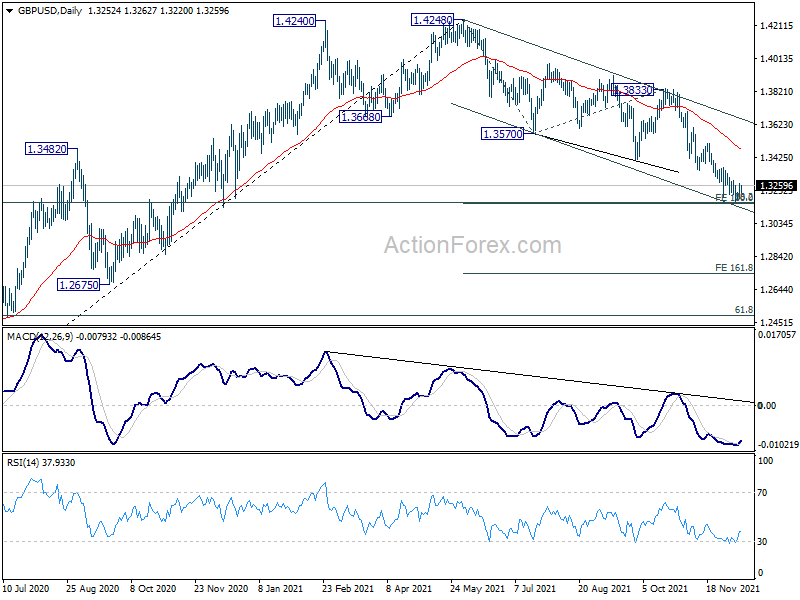
Daily Pivots: (S1) 1.3209; (P) 1.3242; (R1) 1.3298; More...
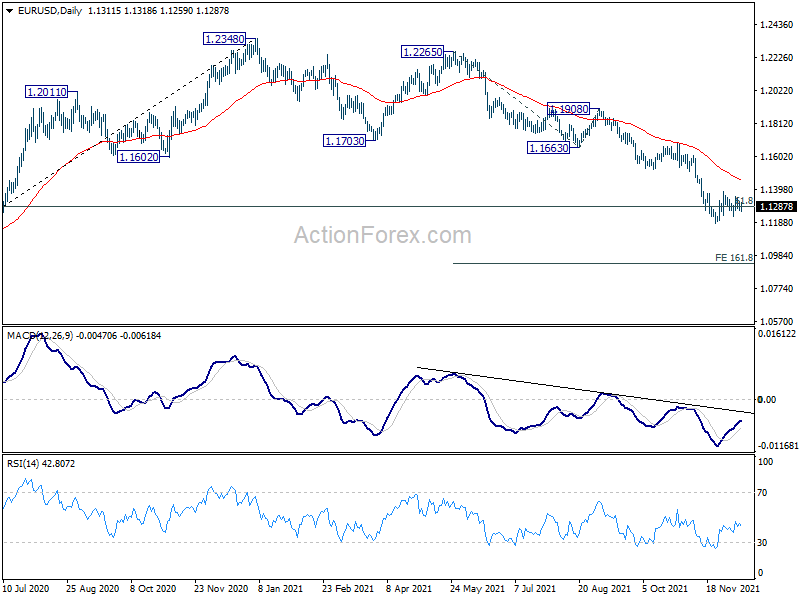
Intraday bias in GBP/USD remains neutral at this point. Focus stays on 1.3164 medium term fibonacci level. Sustained break there will carry larger bearish implication, and target 161.8% projection of 1.4248 to 1.3570 from 1.3833 at 1.2736. On the upside, though, break of 1.3351 support turned resistance will indicate short term bottoming, and turn bias back to the upside for 1.3512 resistance next.
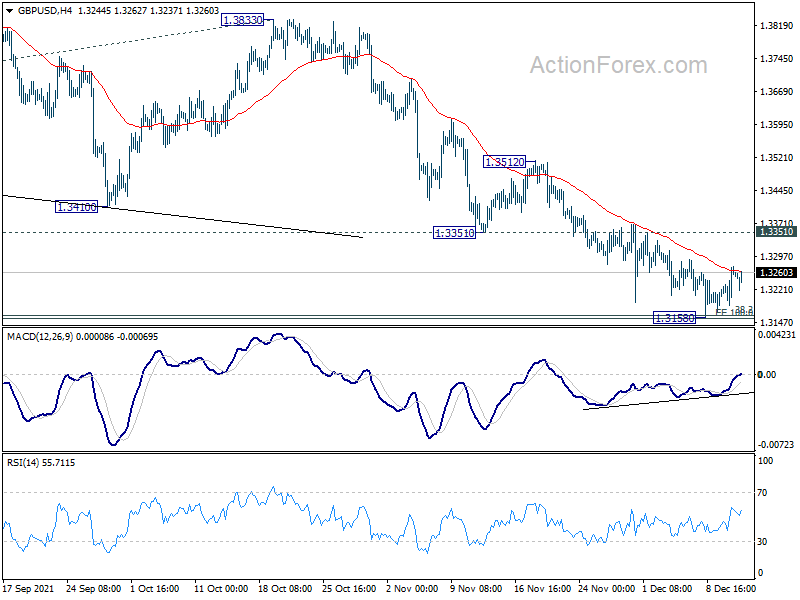
In the bigger picture, immediate focus is now on 38.2% retracement of 1.1409 to 1.4248 at 1.3164. Sustained break there will argue that whole rise from 1.1409 has completed at 1.4248, after rejection by 1.4376 long term resistance. That will revive some medium term bearishness and and target 61.8% retracement at 1.2493. However, strong rebound from current level will revive that case and up trend from 1.1409 is still in progress, and probably ready to resume.
USD/CHF Mid-Day Outlook
Daily Pivots: (S1) 0.9186; (P) 0.9220; (R1) 0.9241; More....
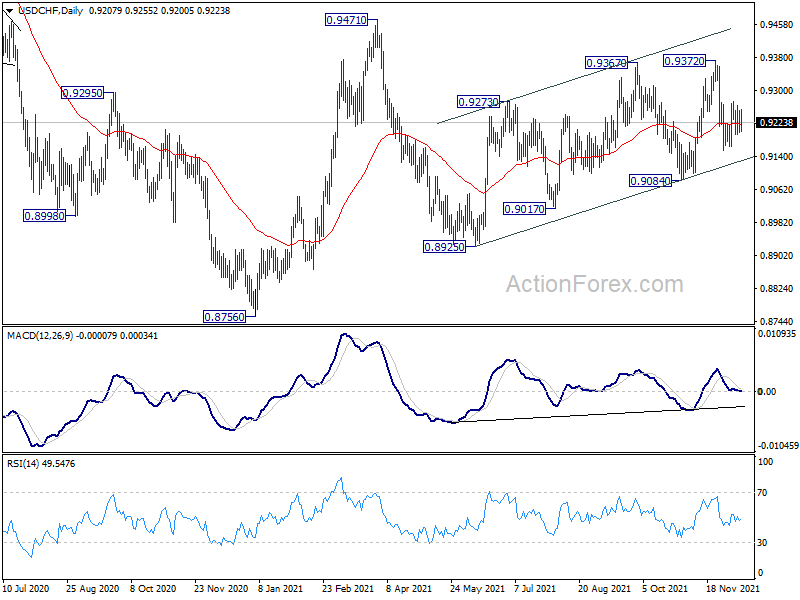
Range trading continues in USD/CHF and intraday bias remains neutral first. On the upside, break of 0.9274 will suggest that the pull back from 0.9372 is finished. Intraday bias will be turned back to the upside for 0.9372. On the downside, below 0.9156 will target 0.9084 support. Firm break there should confirm that choppy rise from 0.8925 has completed, and suggests that fall from 0.9471 is resuming. Deeper decline would be seen through 0.8925.
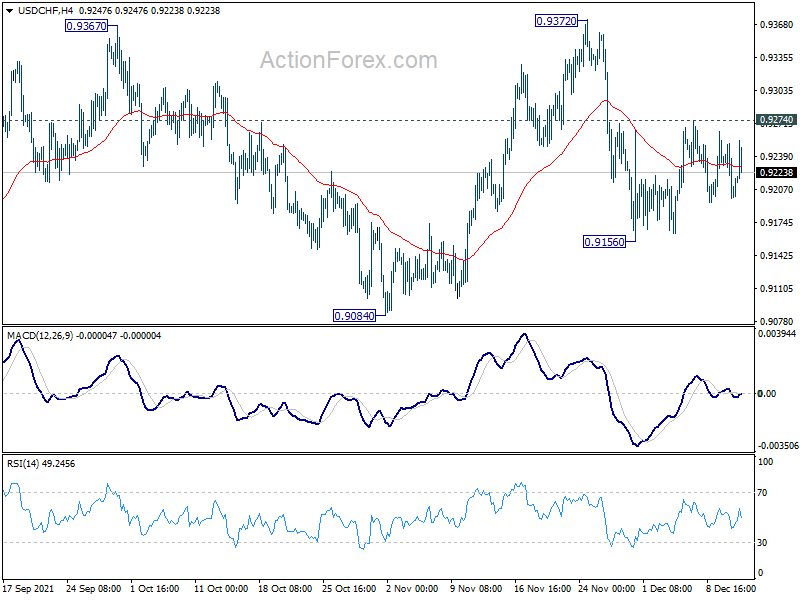
In the bigger picture, the corrective structure of the rebound from 0.8925 argues that fall from 0.9471 is not complete yet. It could either be the second leg of pattern from 0.8756 (2021 low), or resuming larger down trend from 1.0237 (2018 high). We'd pay attention to the downside momentum and assess the odds later. But for now, medium term outlook will be neutral at best as long as 0.9471 resistance holds.