

Sample Category Title
USD/JPY Mid-Day Outlook
Daily Pivots: (S1) 113.15; (P) 113.47; (R1) 113.71; More...
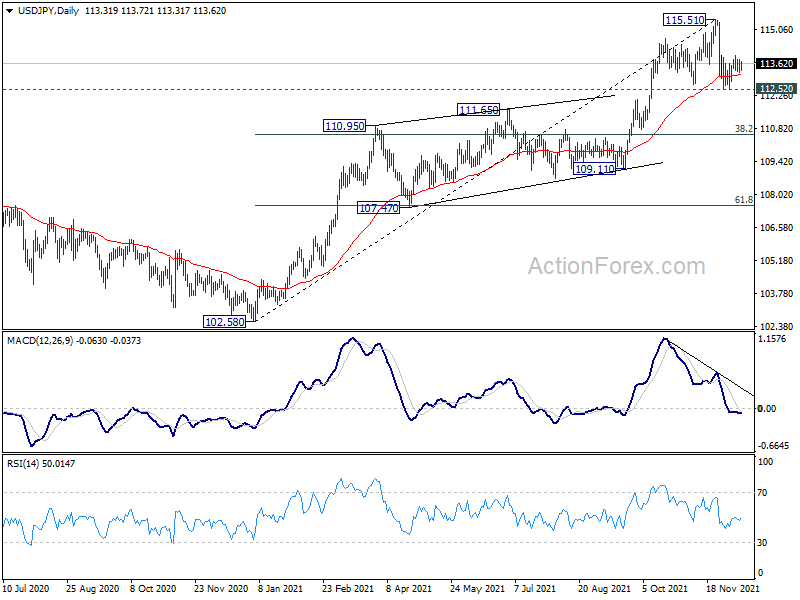
Range trading continues in USD/JPY and intraday bias remains neutral first. On the downside, sustained break of 112.71 will argue that it's already correcting whole rise from 102.58. Deeper fall would be seen to 38.2% retracement of 102.58 to 115.51 at 110.57. On the upside, break of 113.94 minor resistance will turn bias back to the upside for retesting 115.51 high instead.
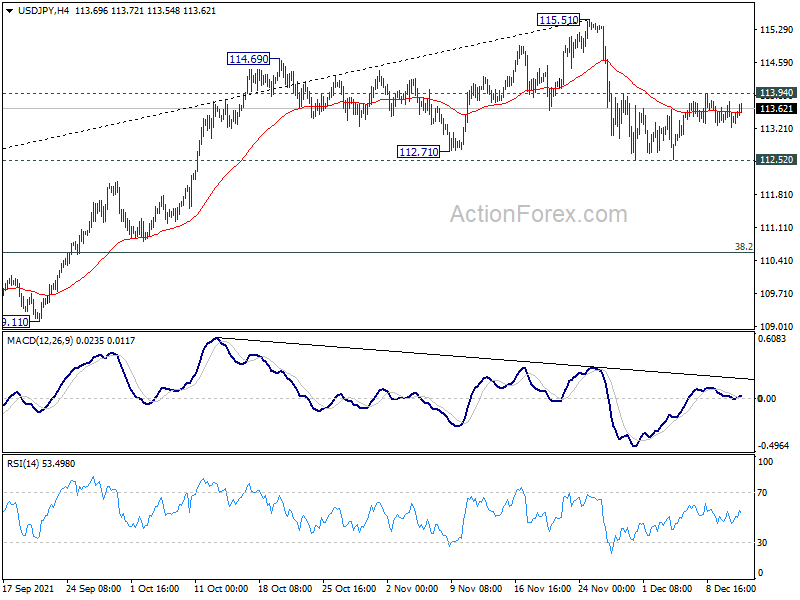
In the bigger picture, no change in the view that rise from 102.58 is the third leg of the up trend from 101.18 (2020 low). Such rally should target a test on 118.65 (2016 high) on resumption. However, firm break of 109.11 structural support will argue that the trend might have reversed and bring deeper fall to 107.47 support and possibly below.
USD/CAD Mid-Day Outlook
Daily Pivots: (S1) 1.2691; (P) 1.2714; (R1) 1.2749; More...
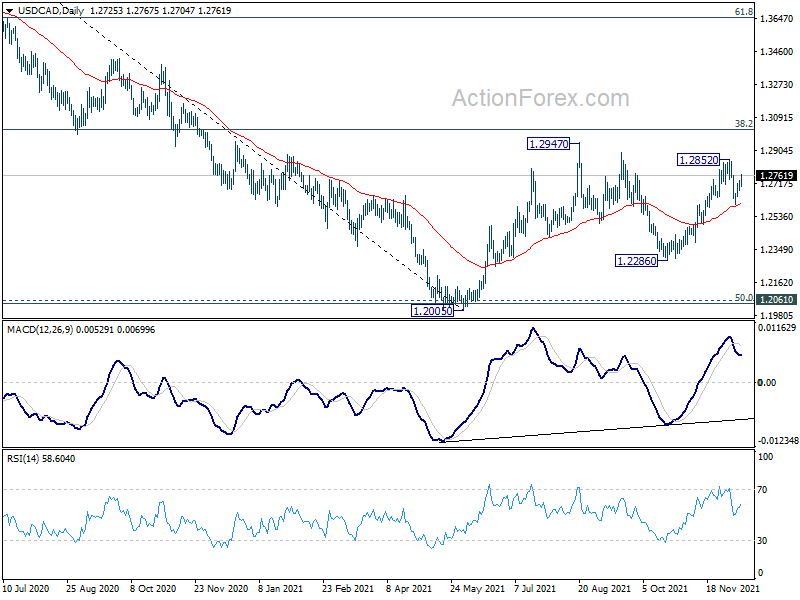
USD/CAD's break of 1.2742 minor resistance suggests that pull back from 1.2852 has completed at 1.2604 already. Rise from 1.2286 might be ready to resume. Intraday bias is turned back to the upside for 1.2852 first. Break will confirm this case and target 1.2947 resistance. On the downside, however, firm break of 1.2604 will argue that rise from 1.2286 has completed. Deeper fall would be seen back to 1.2286 support.
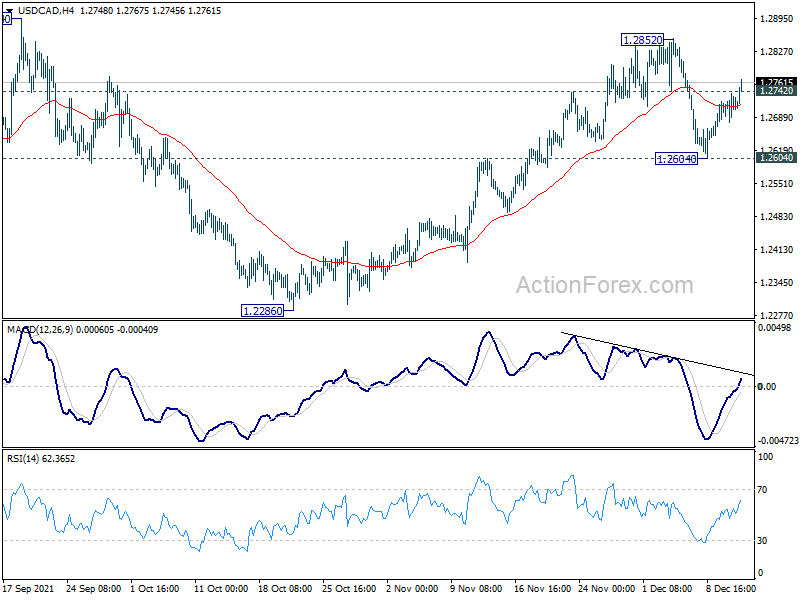
In the bigger picture, medium term outlook remains neutral for now. The pair drew support from 1.2061 cluster and rebounded. Yet, upside was limited below 38.2% retracement of 1.4667 to 1.2005 at 1.3022. On the upside, firm break of 1.3022 should affirm the case of medium term bullish reversal. However, break of 1.2286 will turn focus back to 1.2005 low again.
Dollar Mildly Higher as Traders Turn Cautious, CAD Dips
Dollar and Sterling firm up mildly in overall quiet markets today. Commodity currencies are, on the other hand, trading lower. Investors are turning cautious ahead of the wave of central bank meetings later this week, in particular on Fed's decision to faster the tapering pace. Oil prices also dip mildly even though OPEC upgraded demand forecasts and maintained an upbeat tone. Gold is mildly higher together with Silver.
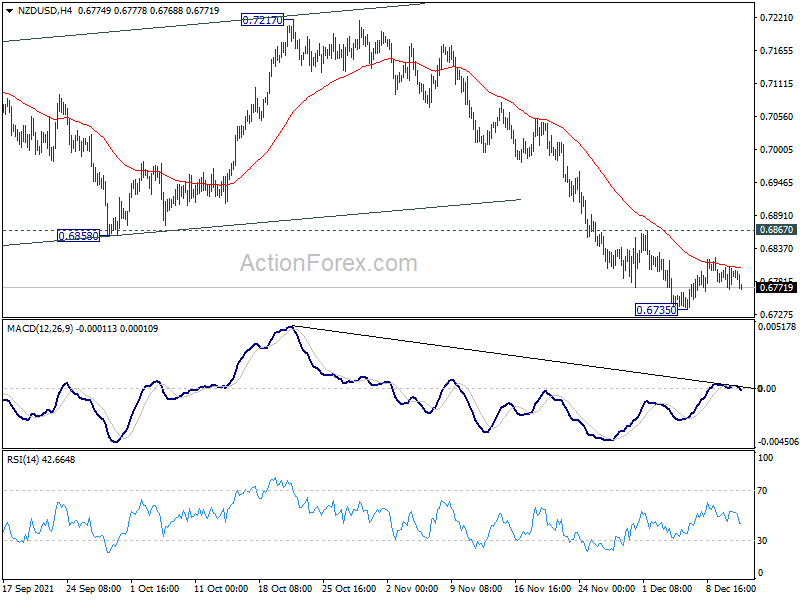
Technically, USD/CAD's break of 1.2742 minor resistance suggests that pull back from 1.2852 has completed and rise from 1.2286 is ready to resume. We'll also pay attention to NZD/USD and break of 0.6735 temporary low will resume the fall from 0.7217, as part of the larger pattern from 0.7463.
In Europe, at the time of writing, FTSE is down -0.18%. DAX is up 0.87%. CAC is up 0.10%. Germany 10-year yield is down -0.0089 at -0.354. Earlier in Asia, Nikkei rose 0.71%. Hong Kong HSI dropped -0.17%. China Shanghai SSE rose 0.40%. Singapore Strait Times dropped -0.50%. Japan 10-year JGB yield dropped -0.0061 to 0.050.
OPEC: Impact of Omicron to be mild and short-lived
In the December Monthly Oil Market Report, OPEC said the impact of Omicron is projected to be ":mild and short-lived, as the world becomes better equipped to manage COVID-19 and its related challenges."
"Some of the recovery previously expected in the fourth quarter of 2021 has been shifted to the first quarter of 2022, followed by a more steady recovery throughout the second half of 2022," OPEC said.
OPEC expects oil demand to average 99.13m bpd in Q2 of 2022, up 1.11m bpd from its forecast last month.
Germany wholesale price rose at record 16.6% yoy in Nov
Germany wholesale price index rose 1.3% mom, 16.6% yoy in November. The annual rate was the highest since record began back in 1962.
Destatis said: "The high rates of change for wholesale prices in annual comparison derive from increased prices for raw materials and intermediate products. The largest impact on the year-on-year price rate in wholesale trade had the increased prices for mineral oil products (+62.4%)."
Japan Tankan large manufacturing index unchanged a 18, outlook ticked down
According to the BoJ's Tankan survey in Q4, large manufacturing index was unchanged at 18, below expectation of 19. Large manufacturing outlook dropped from 14 to 13, below expectation of 19.
Non-manufacturing index rose sharply from 2 to 9, well above expectation of 6. That's the highest reading since December 2019. Non-manufacturing outlook also rose from 3 to 8, but missed expectation of 10.
Output price index for large enterprises jumped from 10 to 16, highest since the 1980s. Input prices index also rose from .37 to 49, highest since 2008.
Large firms are expecting to increased capital spending by 9.3% in the year ending in March 2022, lower than expectation of 9.8%.
Also released, machine orders rose 3.8% mom in October, above expectation of 2.1% mom. That's the first rise in three months.
NZIER: NZ inflation to stay above RBNZ target mid-point through to 2025
NZIER lowered near-term economic outlook of New Zealand, reflecting the impact of pandemic restrictions, "which turned out to persist for longer than initially expected". For the year to March 2022, GDP growth was revised down from 4.5% to 4.3%. But growth for 2023 was revised up from 4.5% to 4.6%.
Growing capacity pressures are contributing to a sharp rise in inflation. CPI is expected to 5.1% in 2022 (up from prior estimate of 3.0%), and remain elevated above RBNZ's inflation target mid-point of 2% "through to 2025".
NZD trade-weighted index forecast was revised lower "partly reflecting market disappointment at smaller than expected interest rate increased from the Reserve Bank in its November meeting." NZD TWI is expected to peak at 74.5 for the year to March 2023 (revised down from 74.8), then ease to 72.7 in 2025.
USD/CAD Mid-Day Outlook
Daily Pivots: (S1) 1.2691; (P) 1.2714; (R1) 1.2749; More...
USD/CAD's break of 1.2742 minor resistance suggests that pull back from 1.2852 has completed at 1.2604 already. Rise from 1.2286 might be ready to resume. Intraday bias is turned back to the upside for 1.2852 first. Break will confirm this case and target 1.2947 resistance. On the downside, however, firm break of 1.2604 will argue that rise from 1.2286 has completed. Deeper fall would be seen back to 1.2286 support.
In the bigger picture, medium term outlook remains neutral for now. The pair drew support from 1.2061 cluster and rebounded. Yet, upside was limited below 38.2% retracement of 1.4667 to 1.2005 at 1.3022. On the upside, firm break of 1.3022 should affirm the case of medium term bullish reversal. However, break of 1.2286 will turn focus back to 1.2005 low again.
Economic Indicators Update
| GMT | Ccy | Events | Actual | Forecast | Previous | Revised |
|---|---|---|---|---|---|---|
| 23:50 | JPY | Tankan Large Manufacturing Index Q4 | 18 | 19 | 18 | |
| 23:50 | JPY | Tankan Non-Manufacturing Index Q4 | 9 | 6 | 2 | |
| 23:50 | JPY | Tankan Large Manufacturing Outlook Q4 | 13 | 19 | 14 | |
| 23:50 | JPY | Tankan Non - Manufacturing Outlook Q4 | 8 | 10 | 3 | |
| 23:50 | JPY | Tankan Large All Industry Capex Q4 | 9.30% | 9.80% | 10.10% | |
| 23:50 | JPY | Machinery Orders M/M Oct | 3.80% | 2.10% | 0.00% | |
| 17:00 | GBP | Financial Stability Report |
EURUSD Fragile but Bullish Hopes Still Exist
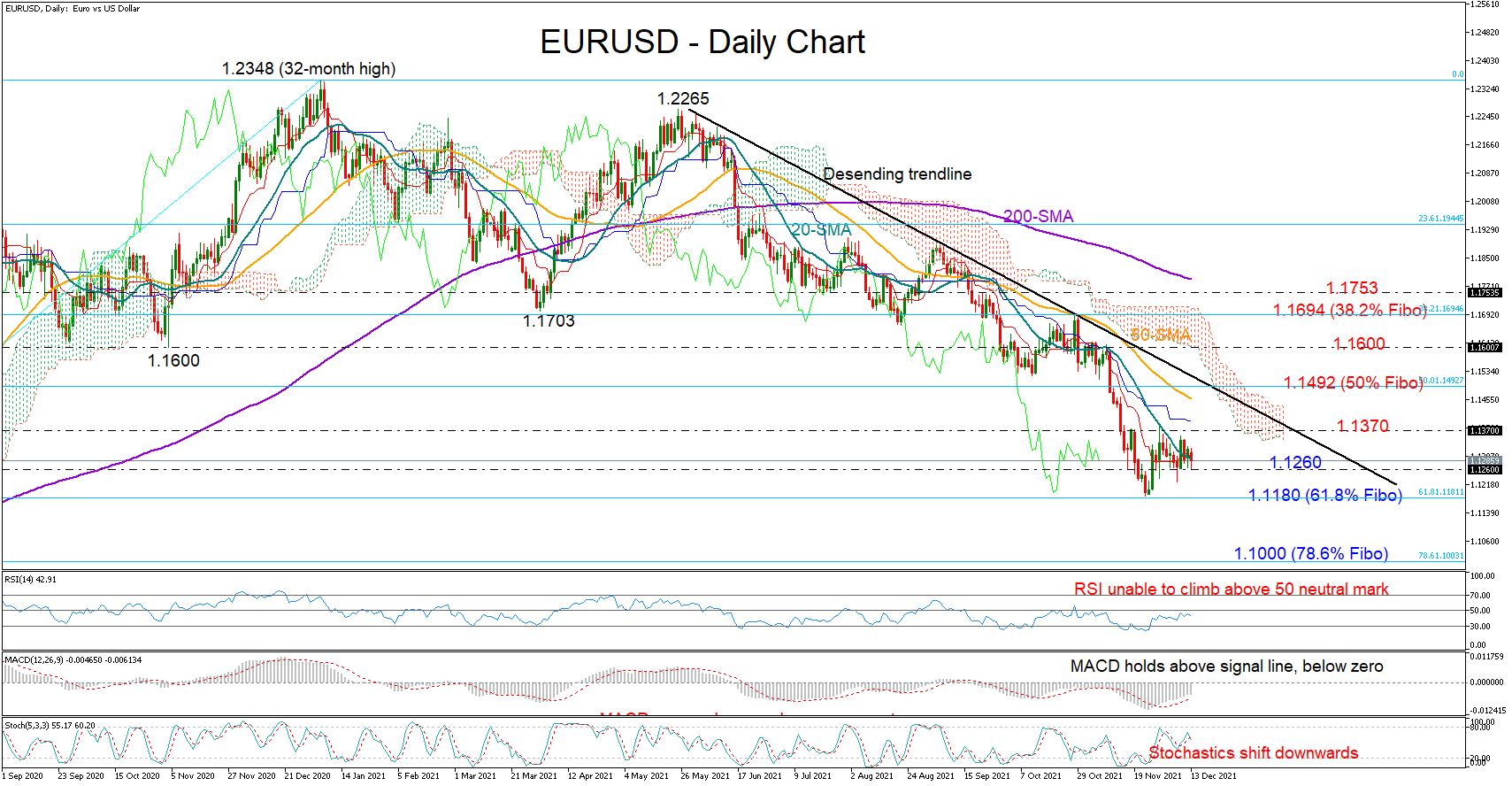
EURUSD could not sustain last week’s bullish breakout above the restrictive 20-day simple moving average (SMA), pulling back into the 1.1200 area on Monday.
Downside risks are now on the table again as the RSI is drifting lower in the bearish zone, and the Stochastics are pointing downwards. Yet, the increasing positive momentum in the MACD signals that the bulls may not abandon the battle unless the price closes clearly below the 20-day SMA and the 1.1260 level.
Should the bears pierce the 1.1260 boundary instead, all eyes will turn back to the 1.1180 floor. This is where the 61.8% Fibonacci retracement of the 2020 upleg (1.0636 – 1.2348) happens to be. Therefore, any extension lower could press the price aggressively towards the 1.1000 psychological mark and the 78.6% Fibonacci, strengthening the bearish outlook in the medium-term picture.
Alternatively, if the pair manages to return above the 20-day SMA, the bulls may attempt to pierce the 1.1370 barrier and crawl up to the 50-day SMA at 1.1460. Slightly higher, the descending trendline and the 50% Fibonacci of 1.492 could prove to be a tougher obstacle. Should buying forces knock down that wall, raising the odds for further recovery in the market, the next stop could be around the 1.1600 number.
Summarizing, although the short-term outlook for EURUSD is still looking fragile, hopes for an upside reversal remain alive as long as the price keeps some foothold around the 20-day SMA.
OPEC: Impact of Omicron to be mild and short-lived
In the December Monthly Oil Market Report, OPEC said the impact of Omicron is projected to be "mild and short-lived, as the world becomes better equipped to manage COVID-19 and its related challenges."
"Some of the recovery previously expected in the fourth quarter of 2021 has been shifted to the first quarter of 2022, followed by a more steady recovery throughout the second half of 2022," OPEC said.
OPEC expects oil demand to average 99.13m bpd in Q2 of 2022, up 1.11m bpd from its forecast last month.
Japanese Yen Dips as Manufacturing Outlook
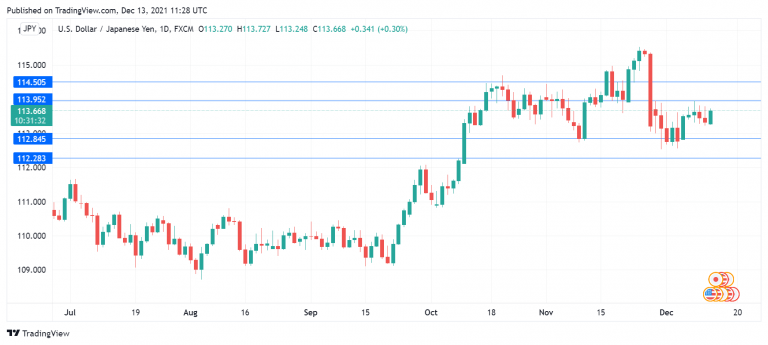
The Japanese yen has started the trading week with losses, as the dollar has pushed closer to the 114 level. In the European session, USD/JPY is trading at 113.69, up 0.32% on the day.
Manufacturing outlook is grim
Japan’s economy received a mixed report on Monday from the well-respected Tankan indices for Q3. The Manufacturing Index stalled at 18, shy of the consensus of 19 points. Large firms are pessimistic about the outlook for manufacturing. There are expectations that raw material costs will rise due to higher energy costs and the weak Japanese yen. Add to this an already difficult situation with supply shortages, and the outlook for the manufacturing sector does not look good.
The situation looks brighter for the non-manufacturing sector, which accelerated for a sixth straight quarter. The Q3 reading of 9 was up sharply from 2 in Q2 and beat the forecast of 6 points. This was the highest level since December 2019, the last release before the Covid pandemic.
It should be noted that the Tankan readings are based on surveys which may not have included the recent spread of Omicron, which means that the readings would have been weaker. As we head into the New Year, the outlook for Japan’s economy is not all that promising, especially with the uncertainty over Omicron. The Kishida government is expected to maintain, and possibly increase, its huge fiscal and monetary support programmes, but it’s questionable, based on past performance, if these measures will be effective at kick-starting the weak economy.
This week’s highlight is the FOMC policy meeting on Wednesday. There is a strong chance that the Fed will announce it is doubling the pace of its taper, to US 30 billion dollars/mth. This could provide a boost for the dollar, as the Fed’s bond purchase scheme would wind up in March and enable the Fed to begin raising interest rates soon after.
USD/JPY Technical
- 113.95 is under pressure in resistance. The next resistance line is 114.50
- USD/JPY has support at 112.84 and 111.28
EUR/USD Outlook Firmer Dollar And Fed/ECB Divergence Keep The Euro Under Pressure
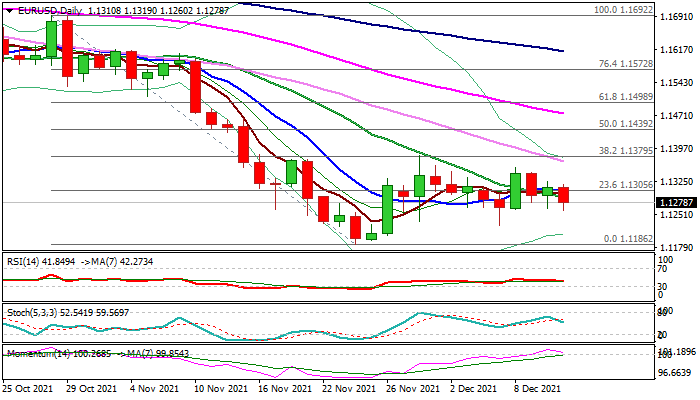
The EURUSD pair starts the week in red, as the dollar keeps traction ahead of highly anticipated Fed policy meeting this week, while fast spread of new Omicron variant continues to sour the sentiment.
It seems that the single currency may take a fresh direction after two consecutive weekly Doji candles signaled strong indecision.
Continuation of a larger downtrend after multi-day pause is seen as more likely scenario, as daily technical studies are weakening after a brief improvement, while weekly techs remain in full bearish setup.
High expectations that the US central bank would eventually turn hawkish and announce acceleration in winding down its massive stimulus that would boost hopes for earlier than expected rate cut and widen the divergence between the ECB and the Fed, would add pressure on Euro.
Bears look for final clear break of pivotal Fibo support t 1.1290 (61.8% of 1.0635/1.2349) after multiple failure to do so in past four weeks that would open way for fresh bearish acceleration and expose targets at 1.1040/00 (Fibo 76.4% / psychological).
Res: 1.1324, 1.1364, 1.1379, 1.1400
Sup: 1.1260, 1.1227, 1.1186, 1.1100
XAUUSD Is Possibly Bullish
Technical analysis
The RSI is below level 50 and headed upwards.
The Stochastics is above level 50 and headed upwards to overbought zone.
Most likely scenario – BUY
Target prices: 1,790.54 1,793.10
Alternative scenario – SELL
Target prices: 1,783.40 1,779.89
Key levels
Support 1,783.40 1,779.89
Resistance 1,790.54 1,793.10

Fed Meeting: Faster Taper Looms But What Will The Dot Plot Reveal?
The Federal Reserve will conclude its final meeting of the year on Wednesday, announcing its decision at 19:00 GMT. Chair Jerome Powell has already dropped some hints as to what to expect after his hawkish pivot last week when he testified before Congress. Most FOMC members seem to be on board with accelerating the pace at which bond purchases are tapered given the relentless rise in inflation. The question is, will they be equally as hawkish when it comes to raising interest rates, or has the Omicron variant upset the rosy outlook for the US economy? Ahead of the meeting, dollar bulls are feeling reinvigorated.
A booming economy, with high inflation to show for it
Throughout the pandemic, the American economy has been the most impervious to the numerous Covid waves that have come and gone. GDP has expanded in every quarter since emerging from the collapse in output induced by the shutdowns of the first wave and now exceeds its pre-pandemic peak. But more importantly, the labour market is getting closer to a full recovery, worker and component shortages are worsening, and commodity prices remain too high, all of which mean inflationary pressures won’t be abating anytime soon.
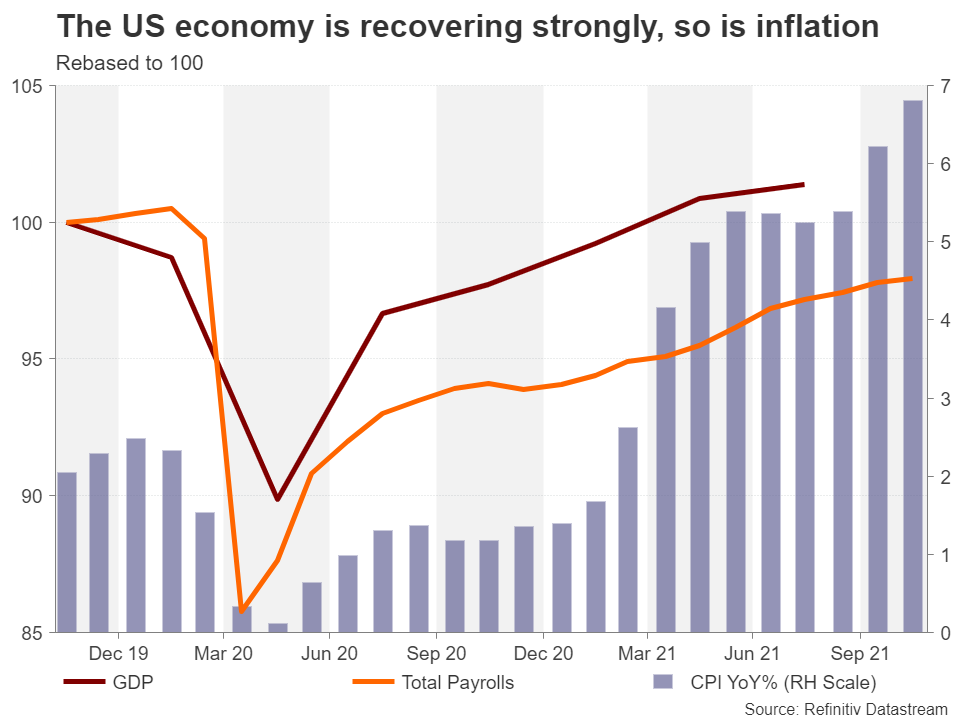
The US consumer price index hit 6.8 in November – a 39-year high. Judging from their latest remarks, inflation appears to have crossed the threshold that is within policymakers’ comfort zone. Up until recently, Powell and most of his colleagues were willing to remain patient on the inflation front to give more time for the labour market to heal. But the jobs data has been steadily improving, and besides that, all the evidence suggests that the surge in inflation won’t be temporary.
Time to retire ‘transitory’
It was a game-changing moment when Powell and his predecessor, Janet Yellen, both admitted in their hearing before lawmakers last week that it may be time to retire the word ‘transitory’. This climbdown has paved the way for the Fed to speed up the winding down of its emergency asset purchases – something the more hawkish FOMC members had been strongly calling for prior to Powell’s change in tone.
Policymakers will probably opt to double the pace of tapering from $15 billion a month to $30 billion, ending the program in mid-March instead of in mid-June as per November’s decision. But markets had been sensing this shift coming from the Fed and there was no tantrum to Powell’s signal.
Will Omicron spur some caution?
However, it’s possible that following the discovery of the Omicron variant, should the Fed still go ahead with faster tapering, the market response might not be so tamed. Yet, investors do not seem particularly worried about the Omicron variant and even less concerned that US growth would suffer because of it. Nonetheless, there are still far too many unknowns about this latest mutation. Moreover, the growth outlook in some of America’s trading partners has dimmed lately. Hence, a too aggressive rate hike path might just spook the markets.
It’s all about the dot plot
The Fed publishes its quarterly economic projections in December and so the updated dot plot will likely be the centre of investors’ attention. Back in September, policymakers had pencilled in even odds for one rate increase in 2022 and three in 2023. Money markets are currently pricing in three hikes in 2022. If the new dot plot becomes more closely aligned with fed funds futures, it might deal a reality check for Wall Street where stocks continue to prove to have the remarkable ability to always bounce back from negative headlines.
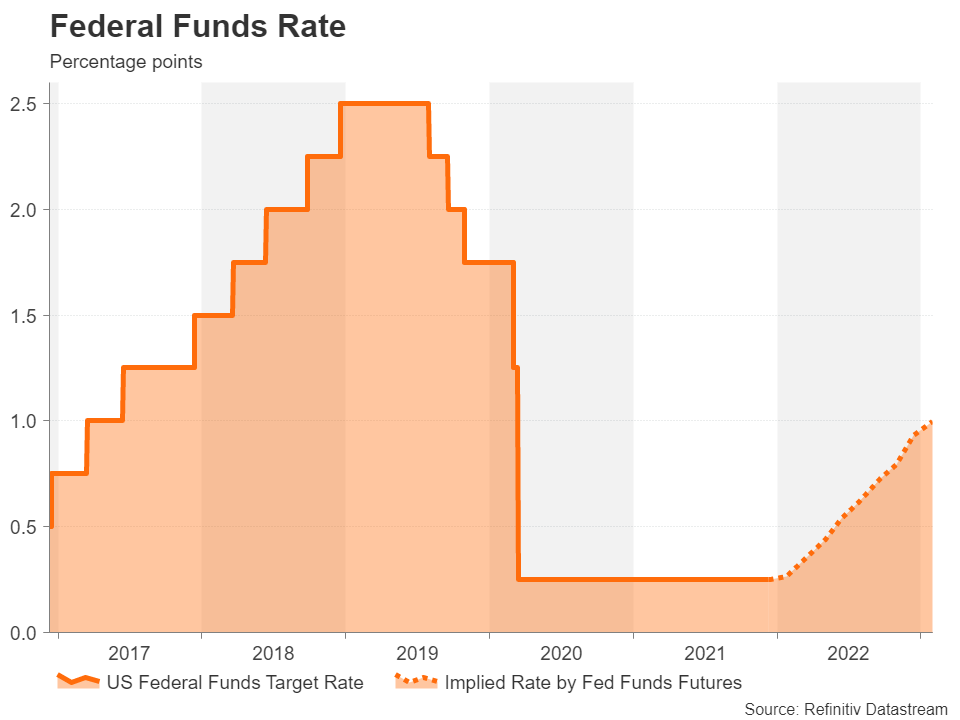
But what about in the currency markets? The US dollar has been caught between rising short-dated Treasury yields and downward trending long-term ones. If the dot plot cements expectations of at least two rate rises in 2022, starting soon after QE has ended, yields could post some fresh gains, bolstering the dollar. Currencies like the euro are the most vulnerable to a boost in the greenback, especially if the European Central Bank, also due to meet this week, is contrastingly dovish.
Dollar may pull back in absence of hawkish surprises Euro/dollar is currently fluctuating around the $1.1290 mark, which is the 61.8% Fibonacci retracement of the March 2020 – January 2021 uptrend. A hawkish FOMC outcome could pull the pair back down to November’s 17-month low of $1.1184. A drop below this trough would clear the path towards the $1.10 level – the 78.6% Fibonacci.
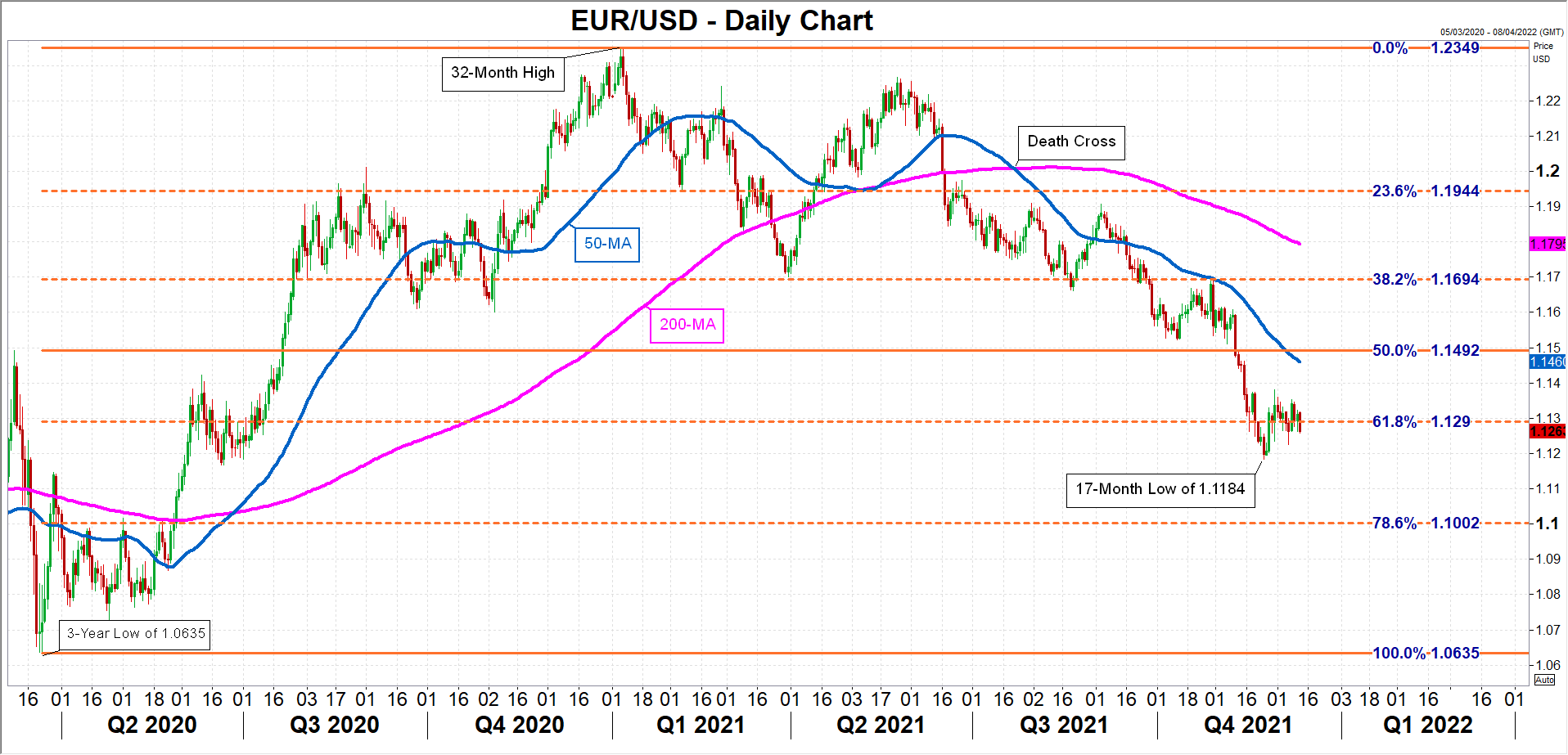
However, should the Fed disappoint the hawkish expectations, the euro could climb towards its 50-day moving average, which lies slightly beneath the 50% Fibonacci of $1.1492.
Nevertheless, although there is a risk that the Omicron outbreak will spur some caution, the Fed will probably want to get an early start on rate hikes and traders should brace themselves for some volatility in the coming days.
What To Expect From The Fed’s Final 2021 Meeting?
The highest inflation in 39 years, volatile equity markets, a flattening bond yield curve, and a spreading new Covid-19 variant have all hit the markets in the last two weeks. And the question on every investor's and trader's mind is what is the US Federal Reserve going to do about it?
The November FOMC meeting saw Fed officials make the first call on tapering their bond purchases in their quantitative easing program. The plan was to reduce asset purchases by $15 billion a month and continue at this pace until the entire $120 billion a month bond-buying program ends in May 2022. Meanwhile economists were still seeing more price spikes due to transitory pressures with consumer prices hovering near 7%. More recently, Chair Powell had finally admitted that inflation is more than a passing side effect of the pandemic, suggesting that the debate over “transitory” price rises is over.
Many believe the Fed might already be behind the curve when it comes to controlling inflation and needs to act fast to prevent severe future shocks to the economy. Given the statements we have heard from several officials, including Powell himself, expect the Fed to announce an acceleration of tapering by $30 billion a month, starting in January 2022 so that the program ends by March, allowing the Fed to begin rate hikes earlier than previously anticipated.
While US consumer confidence remains near a decade low, spending on debit and credit cards has surged significantly. Bank of America saw spending increase 20% compared with last year and 28% compared with November 2019. So, Americans are saying one thing while behaving in a totally different manner, indicating that the economic recovery remains robust.
The Fed will likely acknowledge that economic activity remains strong, labor markets have improved further, and financial conditions are still accommodative. This would further encourage a faster ending of emergency measures. It will be interesting to see if the statement keeps the line “longer-term inflation expectations remain well anchored at 2%.”
Most of the expected amendments by the Fed are already priced into markets, but how the bank will respond to the Omicron variant remains unclear. The September FOMC dot plot showed expectations for a one rate hike in 2022, followed by three in 2023 and another three by 2024. These dots are now expected to shift upwards with at least two rate hikes occurring in 2022.
The pace of interest rate hikes is now concerning bond investors with the spread between 30-year and 2-year Treasury yields the flattest since March 2020. Bond markets are signaling that economic growth will be heavily impacted by a faster rate hike cycle, but stock markets do not seem to agree with the S&P 500 hovering near its record highs. So, the Fed has a tough job to address both bond and stock investors' concerns.
The dollar is likely to remain elevated against a basket of currencies, especially against low yielding currencies. Given the divergence in monetary policies, expect to see new yearly lows for the euro and yen. Traders will be watching to see if EURUSD breaks below 1.10 and USDJPY moves above 115 before year end.