

Sample Category Title
USD/CHF Mid-Day Outlook
Daily Pivots: (S1) 0.7955; (P) 0.7967; (R1) 0.7990; More….
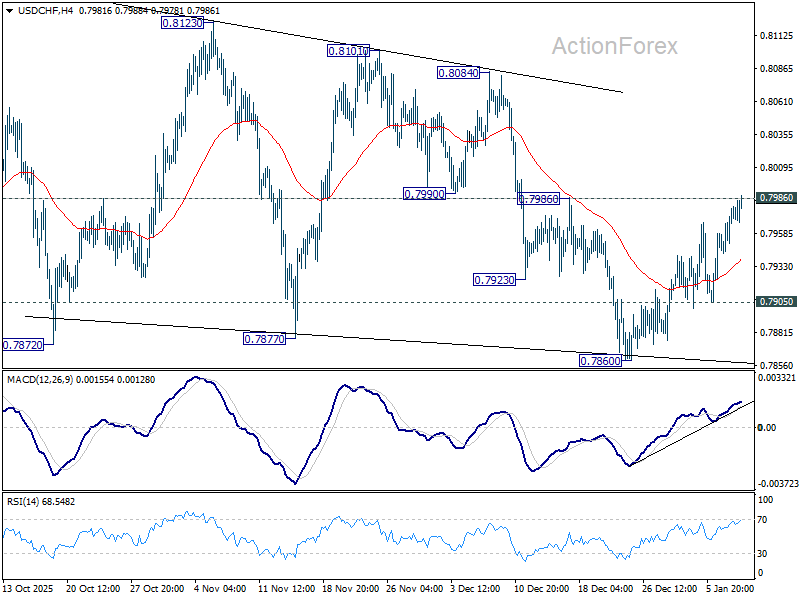
Focus remains on 0.7986 resistance in USD/CHF. Firm break there will argue that corrective pattern from 0.7828 is still extending with another rising leg already in progress. Bias will be turned back to the upside for 0.8123 resistance. Nevertheless, on the downside, below 0.7905 support will turn bias to the downside. Break of 0.7860 will target a retest on 0.7828 low.
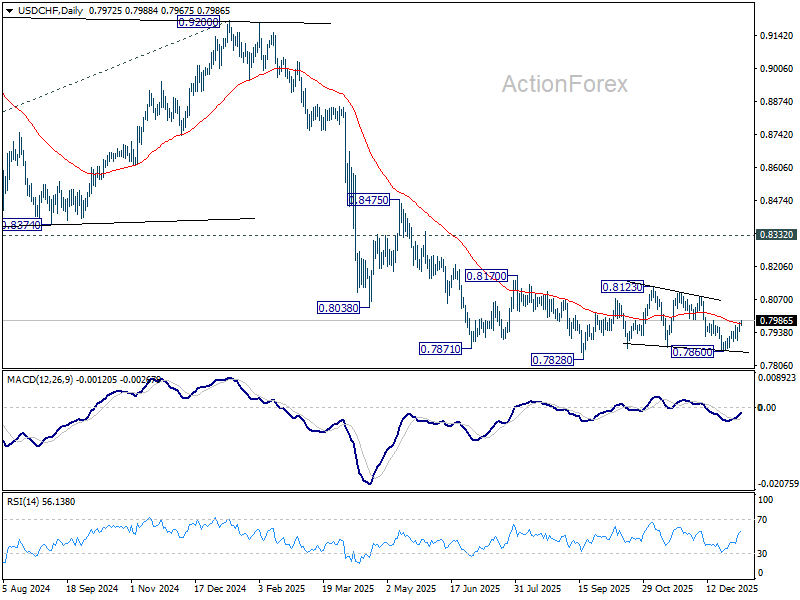
In the bigger picture, outlook will stay bearish as long as 0.8332 support turned resistance holds (2023 low). Long term down trend from 1.0342 (2017 high) is still in progress. Next target is 100% projection of 1.0146 (2022 high) to 0.8332 from 0.9200 at 0.7382.
USD/JPY Mid-Day Outlook
Daily Pivots: (S1) 156.44; (P) 156.62; (R1) 156.95; More...
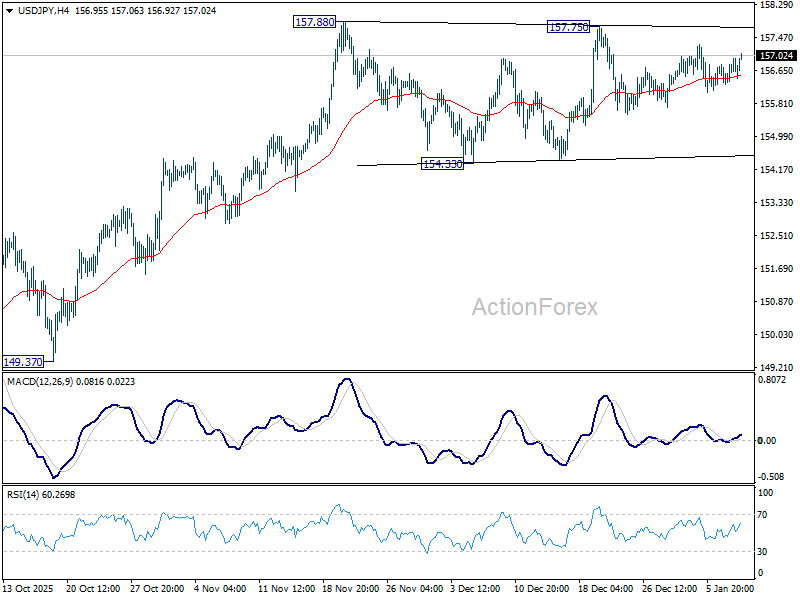
USD/JPY is still extending sideway consolidations below 157.88 and intraday bias stays neutral at this point. Further rally is expected with 154.33 support intact. On the upside, firm break of 158.85 key structural resistance will be an important medium term bullish sign. Next target will be 161.94 high. However, decisive break of 154.33 will turn bias to the downside for deeper correction.
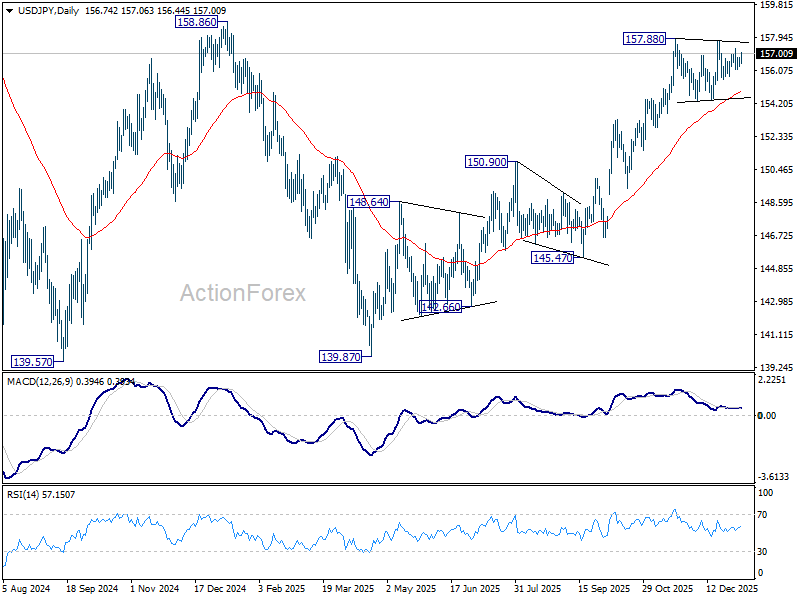
In the bigger picture, corrective pattern from 161.94 (2024 high) could have completed with three waves at 139.87. Larger up trend from 102.58 (2021 low) could be ready to resume through 161.94 high. Decisive break of 158.85 structural resistance will solidify this bullish case and target 161.94 for confirmation. On the downside, break of 150.90 resistance turned support will dampen this bullish view and extend the corrective range pattern with another falling leg.
GBP/USD Mid-Day Outlook
Daily Pivots: (S1) 1.3436; (P) 1.3477; (R1) 1.3497; More...
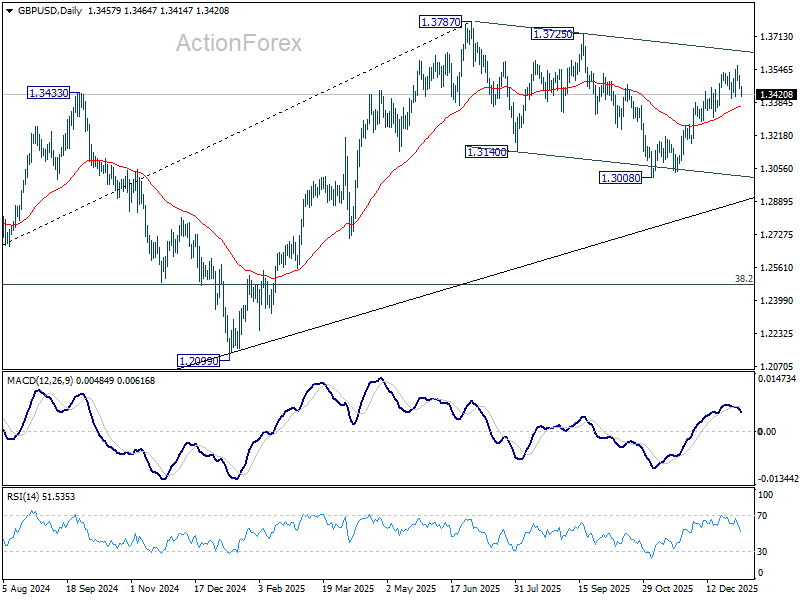
Intraday bias in GBP/USD remains neutral for the moment. Further rally is in favor with 1.3401 support intact. On the upside, break of 1.3567 will resume the rise from 1.3008 to retest 1.3787 high. However, firm break of 1.3401 will confirm short term topping, and bring deeper fall back to 55 D EMA (now at 1.3365) and possibly below. Sustained break of 55 D EMA will argue that corrective pattern from 1.3787 is already extending with another falling leg, and target 1.3008.
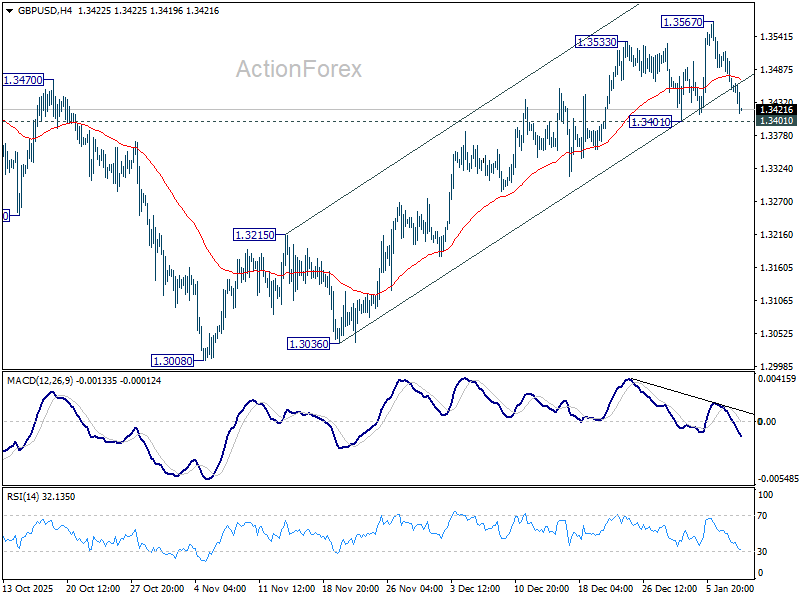
In the bigger picture, current development suggests that fall from 1.3787 is merely a corrective move, and larger rise from 1.0351 (2022 low) is still in progress. Firm break of 1.3787 will target 1.4248 (2021 high) key structural resistance. This will remain the favored case as long as target 38.2% retracement of 1.0351 to 1.3787 at 1.2474 holds, in case of another fall.
Dollar Drifts Higher as Risk Tone Softens Amid Geopolitics, Tariff Ruling Looms
Market sentiment has tilted mildly risk-off, though there is no sign of aggressive follow-through selling. Price action suggests caution rather than panic, with investors trimming exposure while waiting for clearer signals from both geopolitics and economic data.
Geopolitical developments continue to dominate headlines this week and look unlikely to fade quickly. The key question is whether there will be meaningful follow-up after the Venezuela episode. Attention has increasingly shifted toward Greenland, even if direct US military action there remains highly unlikely. Markets are watching diplomatic signals closely, particularly ahead of next week’s meeting between U.S. Secretary of State Marco Rubio and Denmark’s leadership to discuss Greenland.
For now, geopolitical risk is proving persistent but not disruptive enough to trigger classic safe-haven flows. Precious metals have failed to attract sustained demand, with Gold continuing to drift lower after briefly testing the 4500 level earlier in the week. Instead, defensive positioning has favored Dollar. Funds appear to be rotating back into USD, particularly from risk-sensitive currencies such as Aussie, Kiwi and Loonie.
That positioning, however, remains tentative ahead of Friday’s US non-farm payrolls report. Employment data so far have been solid in the sense that there is no evidence of a labor market breakdown. Weekly jobless claims released today and the rebound in ISM services employment both point to underlying resilience. Hiring momentum may be uneven, but the labor market is clearly not collapsing. The reaction function to NFP, however, is a key uncertainty. An upside surprise may not be uniformly negative for risk assets, especially if markets interpret strength as confirmation of a soft-landing scenario rather than renewed inflation risk.
Another looming catalyst is a forthcoming ruling by the US Supreme Court on President Donald Trump’s use of emergency tariff powers. A decision could come as early as Friday, with betting markets assigning roughly a 30% chance that the tariffs are upheld. Striking them down could dent government revenue expectations, lift Treasury yields and inject fresh volatility into the stock markets.
In FX performance today, Kiwi lags, followed by Aussie and Sterling. Swiss Franc Leads, ahead of Loonie and Yen. Dollar and Euro trade in the middle.
In Europe, at the time of writing, FTSE is down -0.22%. DAX is down -0.20%. CAC is down -0.17%. UK 10-year yield is up 0.005 at 4.422. Germany 10-year yield is up 0.027 at 2.842. Earlier in Asia, Nikkei fell -1.63%. Hong Kong HSI fell -1.17%. China Shanghai SSE fell -0.07%. Singapore Strait Times fell -0.18%. Japan 10-year JGB yield fell -0.041 to 2.080.
US initial jobless claims rise to 208k vs exp 213k
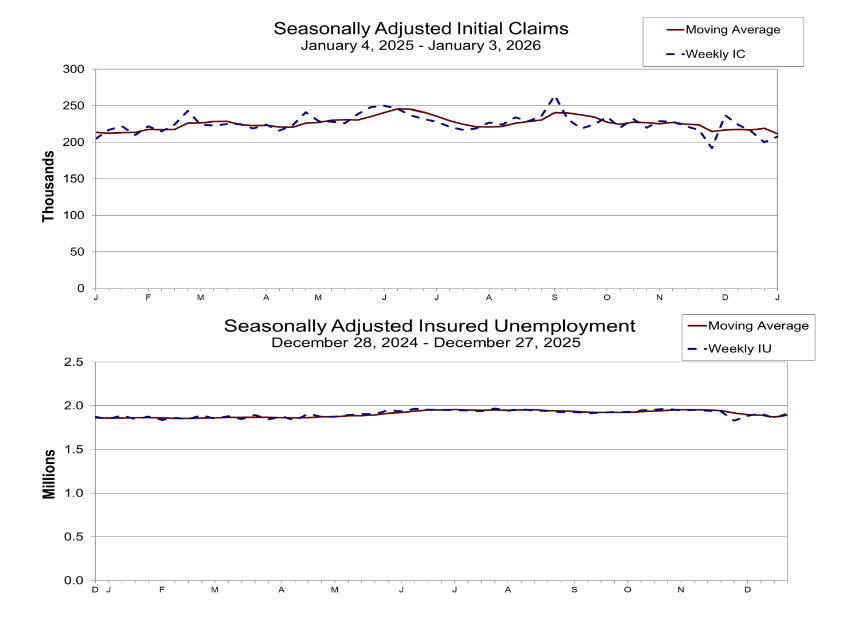
US initial jobless claims rose 8k to 208k in the week ending January 3, below expectation of 213k. Four-week moving average of initial claims fell -7k to 212k, lowest since April 27, 2024. Continuing claims rose 56k to 1914k in the week ending December 27. Four-week moving average of continuing claims rose 21k to 1893k.
Eurozone PPI rises 0.5% mom in November, annual pressures stay weak at -1.7% yoy
Eurozone producer prices rose more than expected in November, with PPI increasing 0.5% mom, above forecasts of 0.2%. Despite the rebound, annual producer price inflation remained firmly negative at -1.7% yoy, versus expectation of -1.9% yoy.
The monthly increase was led by energy prices, which jumped 1.8% mom, while intermediate goods rose 0.3% and capital goods edged up 0.1%. Prices for durable consumer goods also increased 0.3%, partially offset by a -0.2% decline in non-durable consumer goods.
Across the EU, producer prices rose 0.6% mom and fell 1.3% yoy, with sharp divergence among member states. Ireland posted the strongest monthly gain at 4.4%, followed by (+4.4%), Sweden (+1.9%), Bulgaria and Greece (both +1.6%). Slovakia (-0.9%), Cyprus (-0.8%) and Spain (-0.5%).
Swiss CPI stays subdued at 0.1% as imported prices drag
Swiss inflation remained subdued in December, with headline CPI unchanged at 0.1% yoy, in line with expectations. Core inflation edged slightly higher, ticking up from 0.4% to 0.5%, pointing to mild underlying price pressures even as overall inflation stayed close to zero.
The divergence between domestic and imported prices remained a defining feature. Prices of domestic products rose from 0.4% to 0.5% yoy, while imported goods prices fell further into negative territory, slipping from -1.3% to -1.6% yoy.
On a monthly basis, headline and core CPI were flat mom, with domestic prices up 0.2% mom and imported prices down sharply by -0.8% mom. According to the State Secretariat for Economic Affairs, offsetting price movements kept the index stable. Lower prices for international package holidays, medicines and certain vegetables were balanced by higher costs for hotels, supplementary accommodation and private transport hire.
BoJ regional report sees small firms face constraints on wage hikes
Japan’s economy continues to recover gradually across the country, according to the latest Regional Economic Report from the BoJ. The central bank maintained its assessment for all nine regions, noting that activity is either picking up or recovering at a modest pace.
The report highlighted continued wage pressure, with many firms indicating the need to raise wages in fiscal 2026 at roughly the same pace as in 2025. Strong corporate profits and a tight labour market were cited as key drivers. That said, the BoJ flagged emerging divergence beneath the surface. Some regions warned that smaller firms may struggle to match last year’s wage hikes.
Some export-oriented areas reported softness linked to "the impact of U.S. tariffs and intensifying competition from Asian companies". Others, however, pointed to "increasing global demand mainly for artificial intelligence-related goods."
Japan real wages fall -2.8% in November, sharpest in nearly a year
Japan’s real wages fell sharply in November, dropping -2.8% yoy, marking the 11th consecutive month of decline and the steepest fall since last January. Inflation-adjusted earnings were hit as a 3.3% rise in consumer prices more than offset a modest increase in nominal pay.
Nominal wages rose just 0.5% yoy, far below expectations of 2.3% and a sharp slowdown from October’s 2.5% pace. While nominal pay has now risen for 47 straight months, the latest reading marks the weakest growth since December 2021.
The softness was driven largely by a -17.0% drop in special earnings, mainly volatile one-off bonuses outside the usual summer and winter payment periods. More concerning for the underlying trend, regular pay growth eased from 2.4% yoy to 2.0%. Overtime pay slowed from 2.1% to 1.2%, pointing to waning momentum in private-sector income growth and continued pressure on household purchasing power.
RBA’s Hauser shrugs off CPI miss, says rate cuts still unlikely
The RBA remains biased against further near-term rate cuts, despite the softer-than-expected inflation data, according to comments from Deputy Governor Andrew Hauser. Speaking in an interview with Australian Broadcasting Corporation, Hauser said the likelihood of additional easing in the near term remains "probably very low".
Hauser stressed that the November CPI downside surprise has not altered the central bank’s thinking. He described the data as “helpful” but said it was “largely as we expected,” adding that there was “not a lot of news” in the release from a policy perspective. Inflation remains above the RBA’s 2–3% target range, reinforcing the case for caution.
He also noted that part of the moderation in inflation reflected temporary factors such as Black Friday discounting, while cost pressures in housing-related components actually picked up. As a result, policymakers are placing greater emphasis on the upcoming quarterly inflation report due later this month.
Hauser said the RBA will assess that quarterly data in the context of the broader economy rather than reacting mechanically to a single number. While an extreme outcome would prompt deeper scrutiny, he made clear there is no simple rule linking specific inflation prints to policy move.
"We don't have a rule that says if it's 0.9 we hold, and if it's 1 we raise and if it's 0.7 we cut — we take a view of the whole economy," Hauser emphasized.
GBP/USD Mid-Day Outlook
Daily Pivots: (S1) 1.3436; (P) 1.3477; (R1) 1.3497; More...
Intraday bias in GBP/USD remains neutral for the moment. Further rally is in favor with 1.3401 support intact. On the upside, break of 1.3567 will resume the rise from 1.3008 to retest 1.3787 high. However, firm break of 1.3401 will confirm short term topping, and bring deeper fall back to 55 D EMA (now at 1.3365) and possibly below. Sustained break of 55 D EMA will argue that corrective pattern from 1.3787 is already extending with another falling leg, and target 1.3008.
In the bigger picture, current development suggests that fall from 1.3787 is merely a corrective move, and larger rise from 1.0351 (2022 low) is still in progress. Firm break of 1.3787 will target 1.4248 (2021 high) key structural resistance. This will remain the favored case as long as target 38.2% retracement of 1.0351 to 1.3787 at 1.2474 holds, in case of another fall.
US initial jobless claims rise to 208k vs exp 213k
US initial jobless claims rose 8k to 208k in the week ending January 3, below expectation of 213k. Four-week moving average of initial claims fell -7k to 212k, lowest since April 27, 2024.
Continuing claims rose 56k to 1914k in the week ending December 27. Four-week moving average of continuing claims rose 21k to 1893k.
Full US jobless claims release here.
Do Not Underestimate Dollar
- Positive macro statistics for the US are helping the greenback.
- Gold could rise to $4,610 per ounce in 2026.
The US dollar has been rising for seven of the last nine days, thanks to geopolitics and investors’ growing confidence in a prolonged pause in the Fed’s monetary expansion cycle. After a series of strong US economic data, the chances of a federal funds rate cut in January fell to 13% and in March to 44%. On the contrary, disappointing statistics for the eurozone may bring back the idea of a cut in the ECB’s deposit rate. Should we be surprised by the fall in EURUSD?
The ISM Non-Manufacturing Purchasing Managers’ Index jumped to a 14-month high. The indicator’s dynamics contrast with business activity indicators in the manufacturing sector. However, given the significantly larger share of the service sector in the economy, investors can expect positive dynamics in US GDP. This is especially true as the labour market begins to gradually recover. ADP reported a 41,000 increase in private sector employment in December.
In contrast, clouds are gathering over the European economy. A decline in retail sales in Germany and a slowdown in inflation to 2% in the eurozone have led to a fall in the economic surprises index to a monthly low and an increased likelihood of the ECB resuming its cycle of monetary expansion in the second half of the year. This is not what investors were hoping for.
At the end of 2025, there were many bets on divergence in monetary policy and a narrowing of the economic growth differential between the US and the eurozone. So far, these ideas have not been effective. The Fed intends to keep rates unchanged, while the ECB may cut them. The result is a fall in EURUSD to its lowest level since early December.
The US dollar is supported by expectations of positive US labour market statistics for December from the BLS, as well as hopes that the Supreme Court will recognise the legality of the White House tariffs. Its verdict may be delivered as early as 9 January.
The strengthening of the US dollar is causing gold to retreat. Nevertheless, Financial Times experts remain optimistic. According to their consensus estimate, the precious metal will trade at $4,610 per ounce by the end of 2026, which is 4% higher than current levels. Central banks will continue to support XAUUSD. For example, the PBoC has been increasing its gold reserves for the 14th month in a row. During this period, they have grown by 1.35 million ounces.
Crypto Fails to Find Support for a Breakout
Market Overview
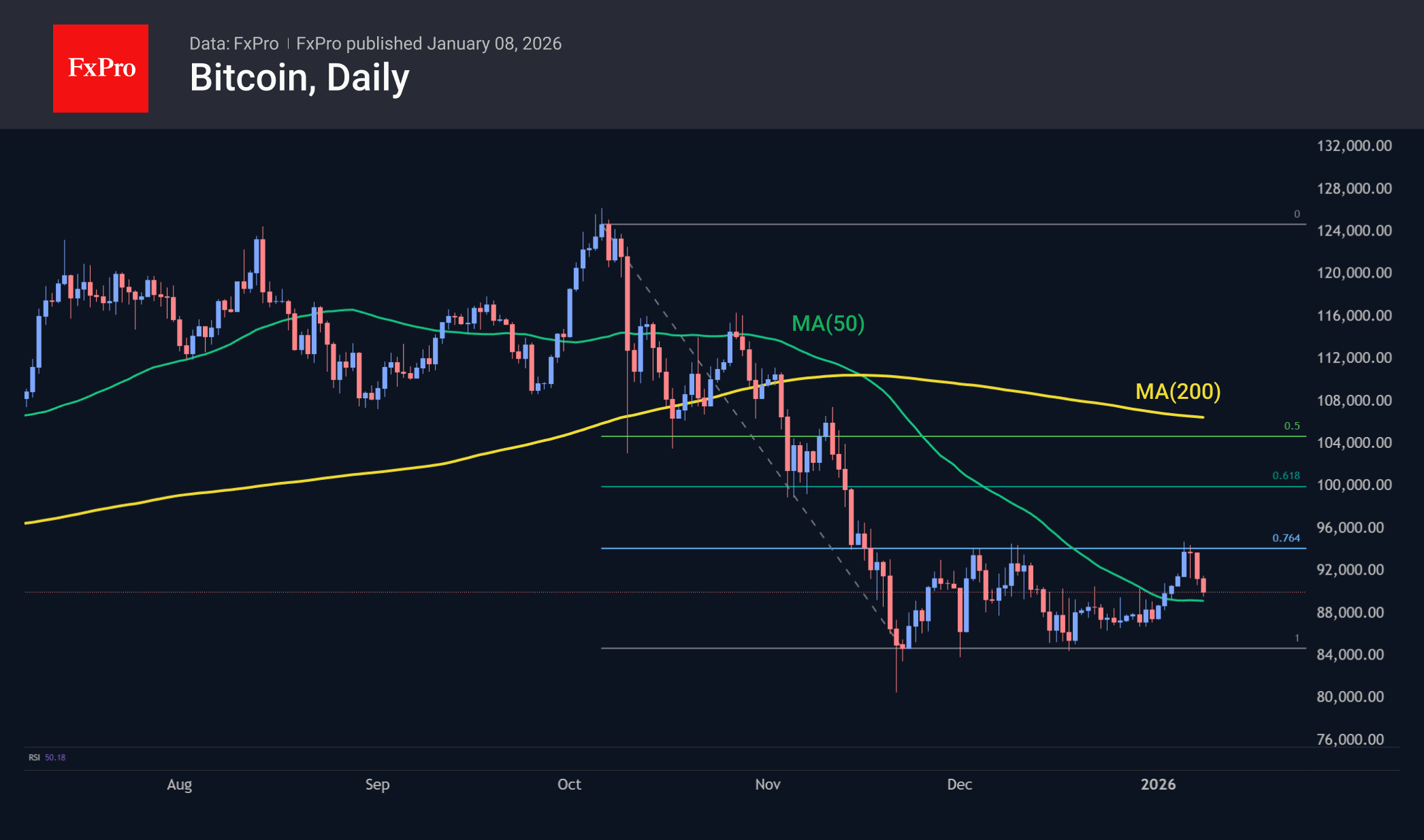
The crypto market remained under pressure throughout Wednesday and early trading on Thursday, losing about 4% of its capitalisation to $3.08 trillion over the day. The market once again confirmed its cautious sentiment, retreating from the upper boundary of the consolidation range of the last eight weeks. The retreat of the stock markets created an unfavourable backdrop, and cryptocurrencies were unable to move from a rebound mode after the decline to a full-fledged recovery.
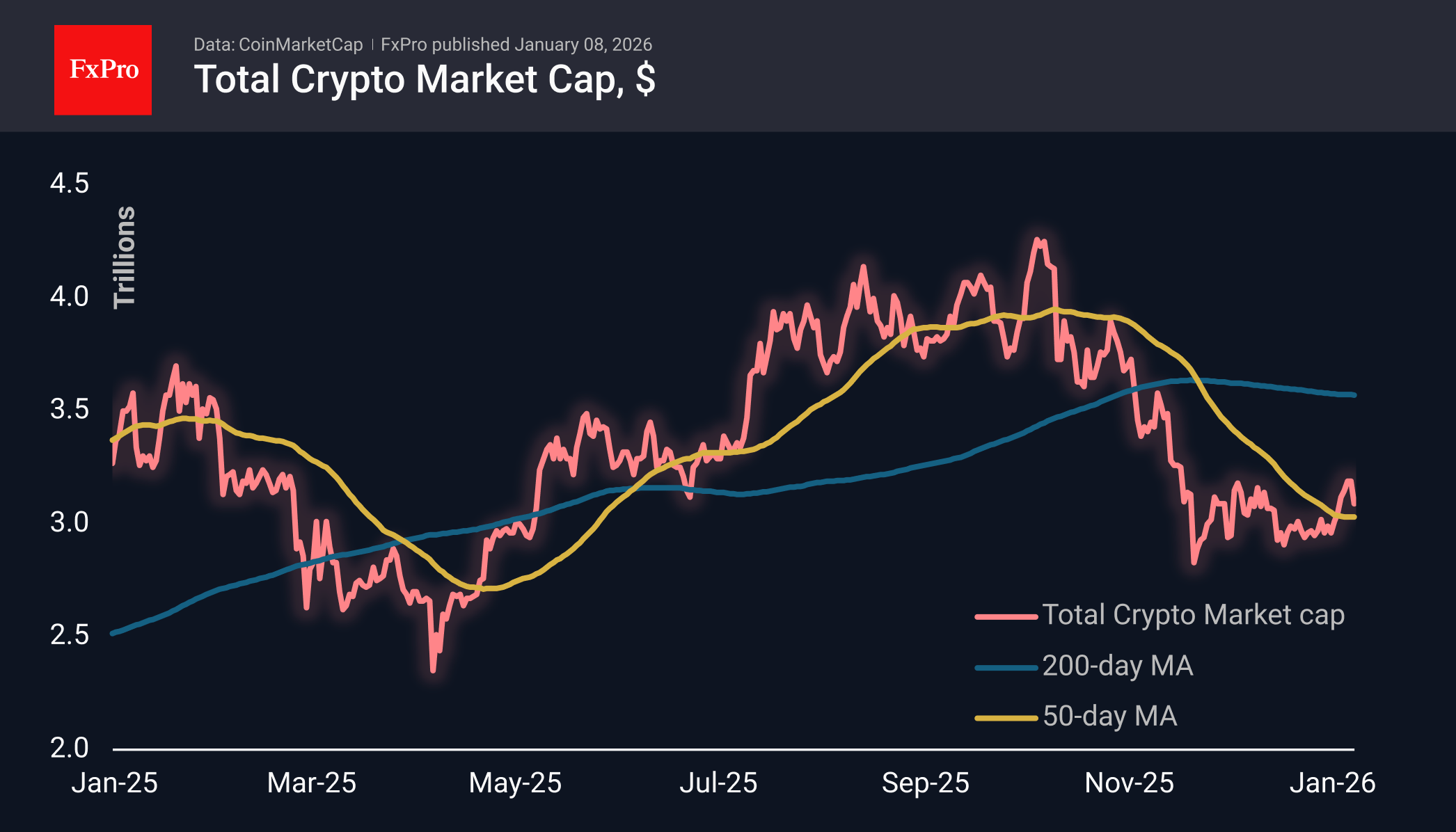
Bitcoin plunged below $90K on Thursday morning after bears seized the initiative at the end of the day on 5 January. At its lowest point, BTC approached the 50-day moving average, above which it climbed at the start of the year. The end of the week will bring an answer to the question of whether this curve has become a support level or whether we saw a false breakout at the start of the year.
News Background
Bitcoin could reach a new all-time high this year, said Bill Miller, investment director at Miller Value Partners. According to him, major Wall Street players are once again showing interest in the asset.
Institutional investors are again buying more Bitcoin through ETFs than miners are mining per day, notes analyst Charles Edwards. On-chain demand is still weak, but there are signs of a return of liquidity on Binance.
The main catalyst for Ethereum’s growth in the new year will be crypto neobanks, not speculative traders, according to Ether.fi. Such platforms are capable of attracting many more crypto users than spot ETFs.
On 7 January, Ethereum developers implemented the Blob Parameter-Only (BPO) fork on the main network, which increases the BLOB object limit from 15 to 21. This will allow more transactions to be processed simultaneously, increasing the efficiency of the blockchain without the direct risk of overload.
Ripple has announced that it has no plans to go public, despite Wall Street’s $40 billion valuation. Ripple’s strong institutional support and overall treasury size have virtually eliminated the need for additional funding.
Privacy is a critical feature necessary for the development of global finance on the blockchain, which is why it will become a major focus in the crypto industry in 2026, according to a16z crypto.
Eurozone PPI rises 0.5% mom in November, annual pressures stay weak at -1.7% yoy
Eurozone producer prices rose more than expected in November, with PPI increasing 0.5% mom, above forecasts of 0.2%. Despite the rebound, annual producer price inflation remained firmly negative at -1.7% yoy, versus expectation of -1.9% yoy.
The monthly increase was led by energy prices, which jumped 1.8% mom, while intermediate goods rose 0.3% and capital goods edged up 0.1%. Prices for durable consumer goods also increased 0.3%, partially offset by a -0.2% decline in non-durable consumer goods.
Across the EU, producer prices rose 0.6% mom and fell 1.3% yoy, with sharp divergence among member states. Ireland posted the strongest monthly gain at 4.4%, followed by (+4.4%), Sweden (+1.9%), Bulgaria and Greece (both +1.6%). Slovakia (-0.9%), Cyprus (-0.8%) and Spain (-0.5%).
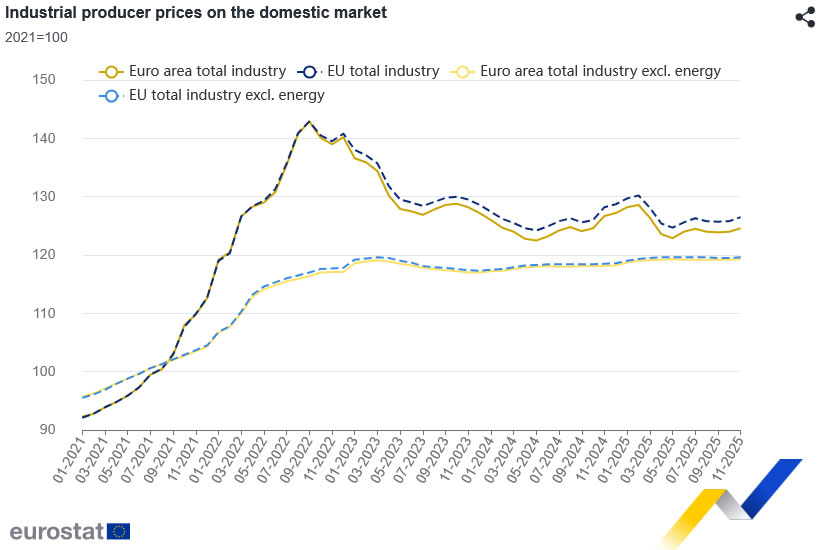
Chart Alert: Nasdaq 100 Bullish Momentum Building Up
Key takeaways
Nasdaq 100 lagging but constructive: Recent underperformance reflects sector rotation rather than trend damage, with the index still within 2% of its all-time high and showing signs of bullish consolidation.
Bullish breakout setup forming: Holding above 25,350 support keeps the near-term bias positive, while a break above 25,760/25,830 would open upside toward 26,107 and the record high.
Momentum turning supportive: Higher lows, a rebound above key moving averages, and improving RSI dynamics reinforce the case for a fresh impulsive up move.
The technology-heavy Nasdaq 100 has been the laggard in the past five trading sessions among the major US stock indices due to sector rotation towards the laggards (Dow Jones Industrial Average and small-caps Russell 2000) due to overvaluation fears in Artificial Intelligence (AI) related mega-cap technology stocks that are heavily weighted in the Nasdaq 100
The Nasdaq 100 is still trailing around 2% below from its current all-time high printed in late October 2025, whereas the Dow Jones Industrial Average and S&P 500 have rallied to fresh all-time highs on Tuesday, 6 January 2025, with the Russell 2000 just a whisker of 0.6% away from its record high reached on 11 December 2025.
Interestingly, technical analysis suggests that the Nasdaq 100 is now forming a potential bullish consolidation to kickstart a fresh impulsive up move sequence.
Short-term trend bias (1 to 3 days): Bullish breakout from 8/12 December 2025 range top
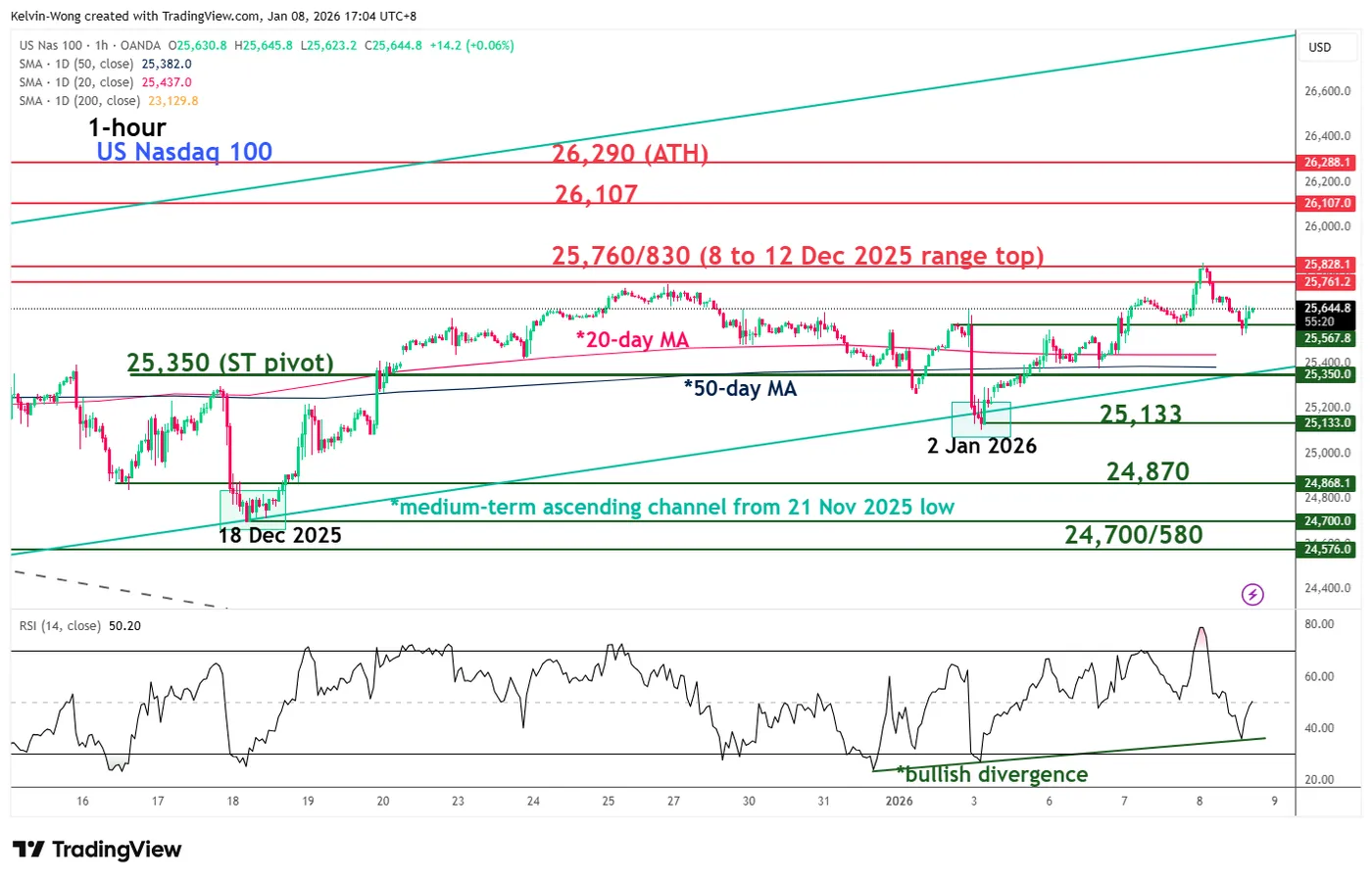
Fig. 1: US Nasdaq 100 CFD index minor trend as of 8 Jan 2026 (Source: TradingView)
25,350 key short-term pivotal support to watch on the US Nasdaq 100 CFD index (a proxy of the Nasdaq 100 E-mini futures) to maintain the potential bullish bias.
A clearance above 25,760/25,830 triggers a minor bullish breakout towards the next intermediate resistances at 26,107 and 26,290 (current all-time high area of 30 October 2025) in the first step.
Key elements to support the bullish bias
- Recent price actions of the US Nasdaq 100 CFD index have retested the lower boundary of the medium-term ascending channel twice (18 December 2025 and 2 January 2026) and formed a higher low with a reintegration back above its 20-day and 50-day moving averages.
- The hourly RSI momentum indicator has managed to stage a rebound today after a retest of a key ascending trendline support that formed an earlier bullish divergence condition at its oversold region on 2 January 2026.
Alternative trend bias (1 to days)
A break with an hourly close below 25,350 key short-term support invalidates the bullish tone for another round of choppy corrective decline to expose the next intermediate supports of 25,133, 24,870, and 24,700/24,580.
BTC/USD Chart Analysis: Bitcoin Price Falls Below $90k
As the BTC/USD chart shows, the price of the leading cryptocurrency briefly dipped below the psychological $90k level this morning, despite trading above $94k earlier in the week.
Why is Bitcoin falling today?
Among the key drivers, the following stand out:
→ Decline in the geopolitical risk premium. Bitcoin’s rise earlier this week was supported by news of Maduro’s detention and US actions in Venezuela. However, this factor is now losing relevance.
→ Ahead of key macroeconomic data. On Friday, the US Nonfarm Payrolls report is due to be released. Recent ADP Employment Change data suggest that Friday’s figures could point to a recession in the US. In such an environment, traders may seek to reduce exposure to risk assets.
Technical analysis of the BTC/USD chart
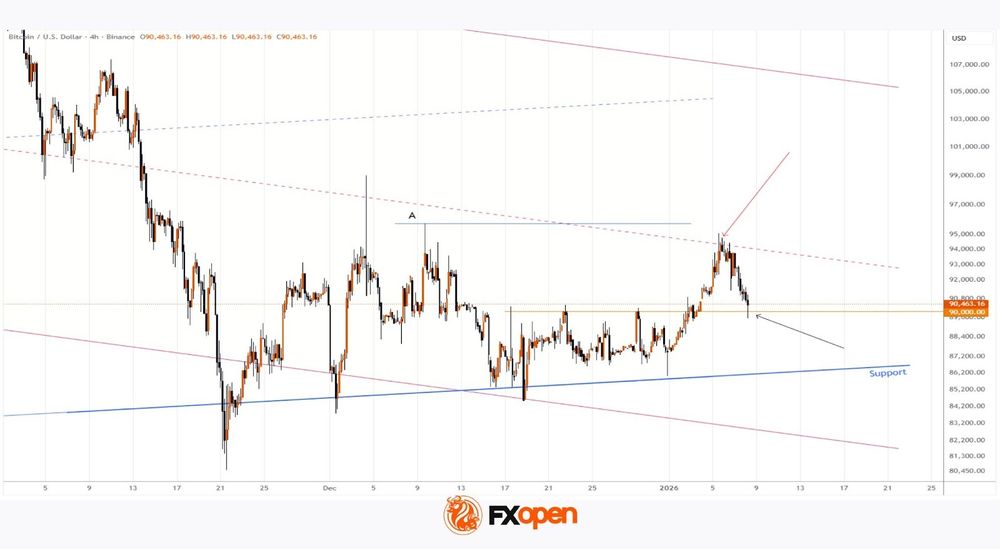
On 18 December, we discussed Bitcoin’s price action within a system of two channels, which remain relevant. This week, as indicated by the red arrow:
→ the channel median acted as resistance;
→ on the CME exchange, futures prices posted a false bullish breakout above the December high (A).
These observations suggest that bears retain strength in the medium term. However, a sharp rebound from the $90k level (marked by the black arrow) points to renewed bullish activity. Therefore, if bears are indeed targeting a break below the lower boundary of the ascending channel, they will need to exert considerable pressure to push BTC/USD below this key psychological level.
FXOpen offers the world's most popular cryptocurrency CFDs*, including Bitcoin and Ethereum. Floating spreads, 1:2 leverage — at your service (additional fees may apply). Open your trading account now or learn more about crypto CFD trading with FXOpen.
*Important: At FXOpen UK, Cryptocurrency trading via CFDs is only available to our Professional clients. They are not available for trading by Retail clients. To find out more information about how this may affect you, please get in touch with our team.
This article represents the opinion of the Companies operating under the FXOpen brand only. It is not to be construed as an offer, solicitation, or recommendation with respect to products and services provided by the Companies operating under the FXOpen brand, nor is it to be considered financial advice.