Sample Category Title
Crypto Market Has Hit Upper Limit of Rebound
Market Overview
This week’s strengthening of the crypto market has hit local resistance near the $3.2 trillion total capitalisation level. The market recovery in early December also stalled at around these levels, which is why the current level is attracting some cautious sellers. For now, the recovery is being stifled by intense selling pressure, which allows us to remain cautious about the near-term outlook.
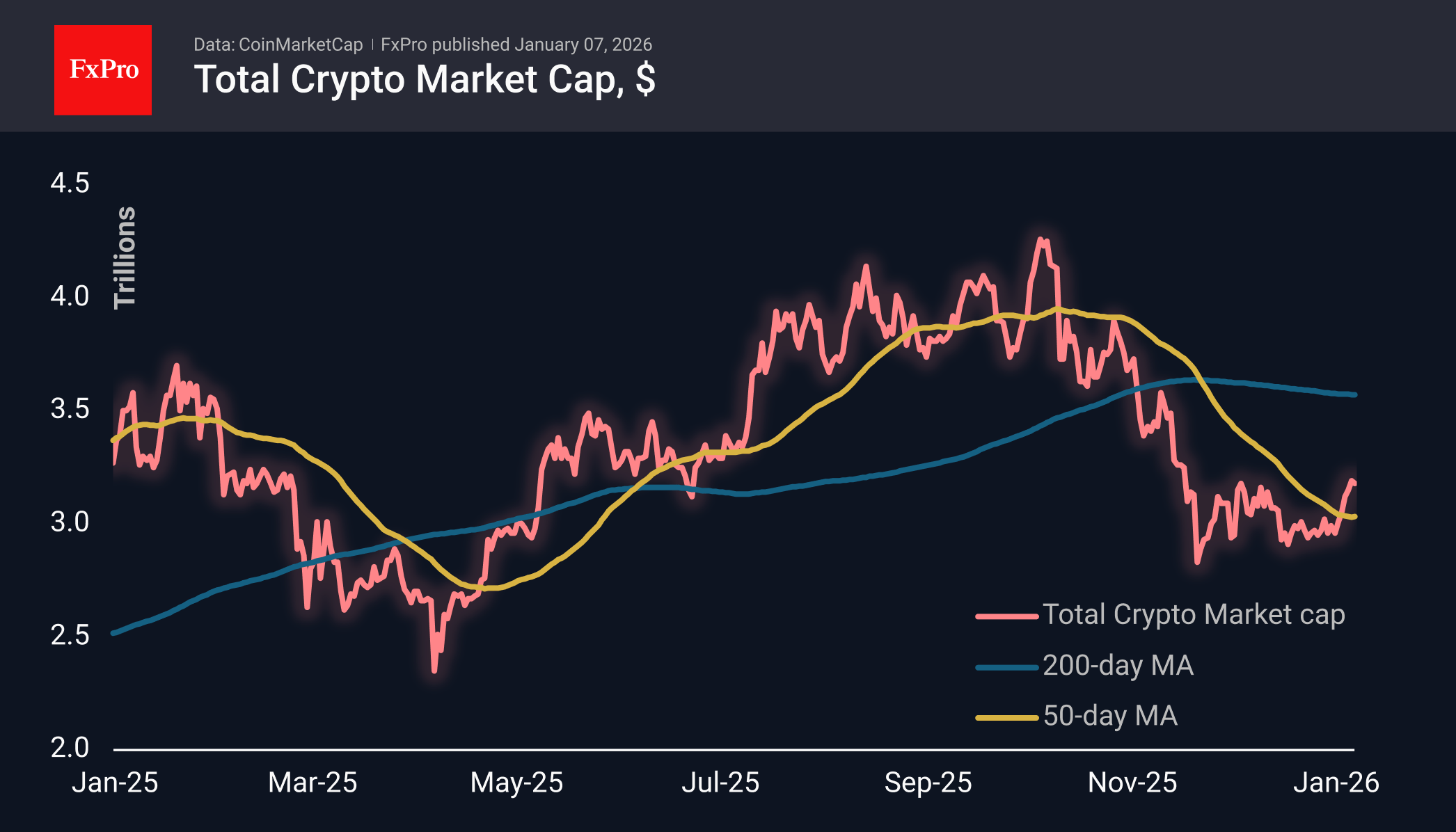
The sentiment index has risen sharply over the last two days, buoyed by rising prices, and has returned to neutral territory from the fear zone. Notably, this shift in sentiment has been reflected in altcoins, which have experienced significant price increases since the start of the year.
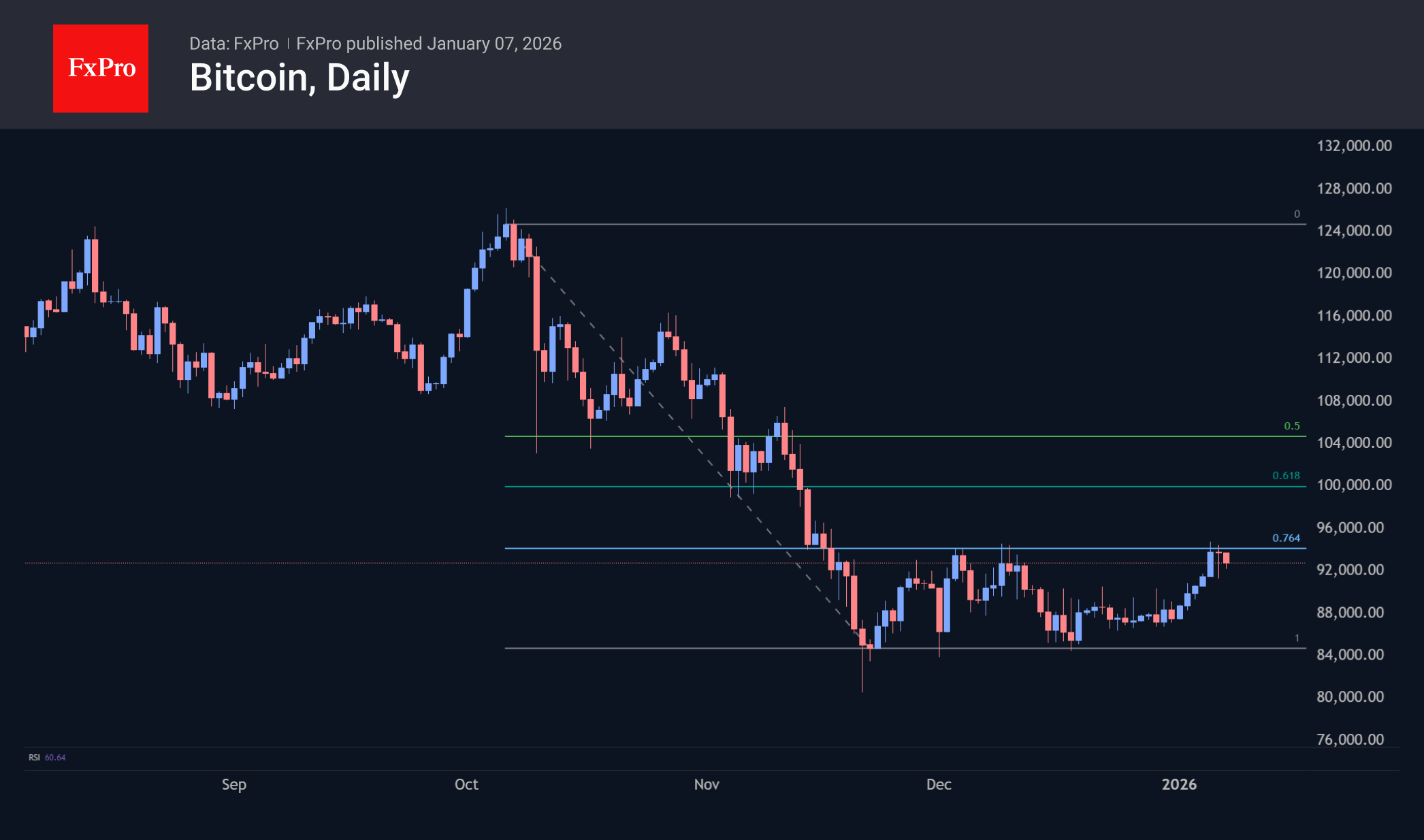
On Monday and Tuesday, Bitcoin rose to the upper limit of its trading range since mid-November, at $95K, followed by a drop to $91K and a further recovery to $92.6K, where the quotes stand at the time of writing. Clearly, the easy part of the BTC rebound is behind us, and further growth can be seen as a signal of a prolonged recovery, which bears are still strongly resisting.
News Background
The risks of a deep fall in Bitcoin in the current market cycle remain limited, as do the chances of a significant rally. Bitcoin’s four-year cycle remains in place, and 2026 is likely to be a period of consolidation and sideways movement, according to VanEck.
Over the past week, the Binance exchange has recorded the most significant inflow of Bitcoin and Ethereum in a month, amounting to nearly $2.4 billion. The inflow of cryptocurrency may be linked to holders’ desire to sell their assets, according to CryptoOnchain.
The myth that crypto whales are aggressively buying up Bitcoin is not true. Their activity is overestimated due to distortions associated with the work of crypto exchanges, according to CryptoQuant. Exchanges consolidate funds from many small wallets into a few large ones for regulatory reasons, which leads to the misclassification of such activity.
A rare buy signal has appeared on the weekly Bitcoin chart according to the McMillan Volatility Band indicator, said analyst Lawrence McMillan. In the entire history of BTC, such a signal has appeared only three times, and each time it coincided with successful buying points.
According to Token Terminal, the Ethereum network has set a new record for the volume of stablecoin transfers. The figure in the fourth quarter of last year exceeded $8 trillion — in six months, the volume has almost doubled.
Starting this year, crypto services in 48 countries are required to begin collecting information on cryptocurrency transactions. Member states of the Organisation for Economic Co-operation and Development (OECD) intend to exchange this data to increase tax revenues.
AUD/CAD medium-term parity case builds, on metal boom and RBA outlook
Australian Dollar has taken a clear leadership role among commodity currencies as the new year starts, outperforming peers as powerful tailwinds from metals markets combine with resilient domestic rate expectations.
Iron ore prices surged to their highest level since February, driven by optimism over Chinese macro support and seasonal restocking ahead of the Lunar New Year. That confidence was underlined by fresh guidance from the PBoC which said it will deploy interest-rate cuts, reserve-requirement reductions and other tools in a flexible and efficient manner to maintain ample liquidity and support credit growth.
Policymakers also pledged to step up counter-cyclical and cross-cyclical adjustments, boost domestic demand and manage financial risks, signaling a determination to stabilize growth early in the new five-year planning cycle. For commodity exporters, the message has been unambiguously supportive.
Also, Copper has delivered an additional boost, pushing to a fresh series of record highs. The rally has been driven by supply-side disruptions and deepening concerns over medium-term availability rather than short-term speculative flows.
Production setbacks at several major mines, including FreeportMcMoRan’s Grasberg operation, have tightened global supply. At the same time, demand expectations continue to rise due to Copper’s critical role in construction, energy transition, artificial intelligence data centers and defense industries.
Back home, November CPI data in Australia surprised to the downside, reducing pressure for an immediate February rate hike by the RBA. Even so, the broader policy outlook remains tilted toward tightening rather than easing.
Underlying inflation pressures are easing only slowly, particularly in services, keeping policymakers cautious. Markets still expect rates to remain on hold in February but see a high likelihood of a hike by June and another before the end of the year.
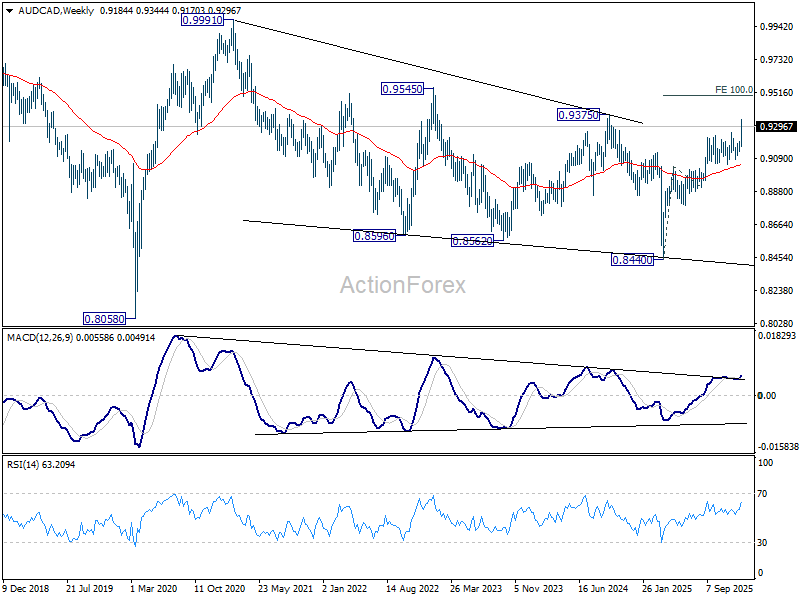
That policy-commodity mix has translated directly into Aussie strength. Technically, AUD/CAD has broken decisively above 0.9256 resistance, confirming resumption of the uptrend from 0.8440 (2025 low). Next upside target stands at 100% projection of 0.8440 to 0.9041 from 0.8902 at 0.9503.
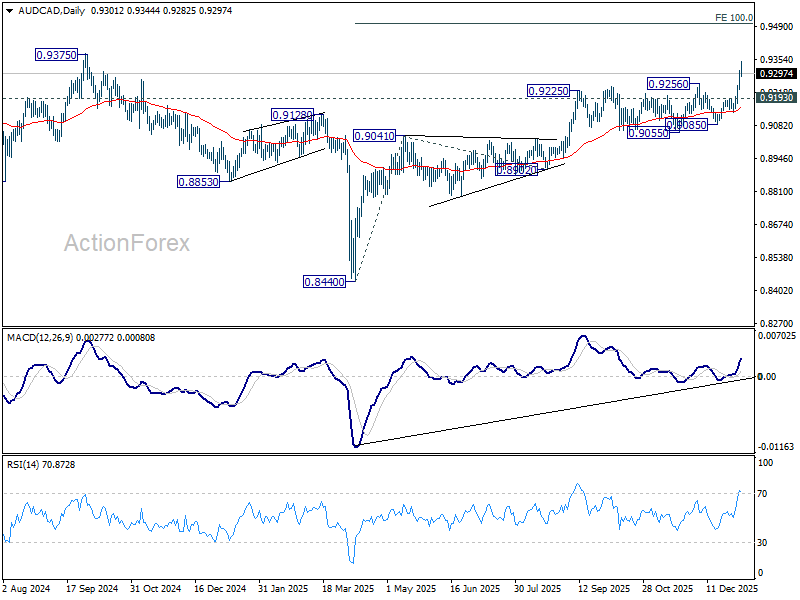
More importantly, the upside breakout strengthens the case that the entire corrective decline from the 0.9991 (2021 high) ended at 0.8440. Medium-term focus now shifts to 0.9545, where decisive break would argue that the longer-term rise from the 2020 low at 0.8058 is ready to resume toward parity.
Old Fears About Euro Have Returned
- The resurgence of the political crisis in France is weighing on EUR/USD.
- The US Dollar is rising on expectations of strong labour market statistics.
Buy the rumour, sell the fact. The strengthening of the US dollar is due to expectations of positive labour market statistics, a chance of another easing from the Fed in March fell to 45%, and demand for safe-haven assets in a changing world. Donald Trump does not rule out the seizure of Greenland by force, while Denmark and the rest of Europe are talking about the collapse of NATO, and the US may take control of about 30% of world oil reserves. This allows them to dictate rules to the market.
One way or another, Donald Trump wants to lower rates to 1%, which, given the rapid growth of GDP, contradicts economic theory. However, if the composition of the FOMC changes, everything would be possible. In this regard, the court's verdict in the Lisa Cook case is of fundamental importance. A precedent may be set that gives the president the power to dismiss members of the Federal Reserve.
Donald Trump intends to achieve a further slowdown in inflation. Why not capture the president of Venezuela to accomplish this? Washington is now demanding that Caracas sell it 50 million barrels of oil and cut all ties with Beijing, Moscow, Tehran and Havana. Deglobalisation is intensifying, and the world is becoming increasingly bipolar. In the short term, the greenback can benefit from growing demand for safe-haven assets.
The fall in EUR/USD is also due to the vulnerability of the European economy. Following Italian and French inflation, consumer prices in Germany slowed in December from 2.6% to 2%. If the disinflation process gains momentum, the ECB may start to consider resuming its easing cycle, which is bearish for the euro.
According to Chancellor Friedrich Merz, some sectors of the German economy are in critical condition, and the government has not done enough in the eight months since he took office. The French Ministry of Finance announced that the budget deficit would rise to 5.4% if parliament did not compromise. As a result, the risks of a credit rating downgrade increased, and EURUSD moved south.
The strengthening of the US Dollar caused gold to retreat. Nevertheless, the precious metal remains in a strong position. This is partly due to the likely increase in central bank activity in the bullion market in a bipolar world.
XAU/USD: Gold Cracks $4,500, Eyes Further Upside
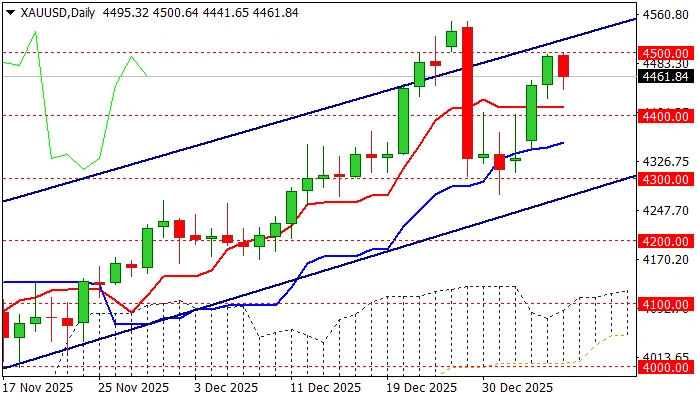
Gold price eased in early Wednesday trading, on partial profit-taking, after three-day advance cracked psychological $4500.
Bounce from $4300 zone, where pullback from new record high ($4550) has been contained, closed above Fibo 76.4% of $4550/$4274 bear-leg on Tuesday, generating strong signal that corrective phase is likely over.
Renewed safe-haven demand on the latest shockwaves that Trump’s attacks on Venezuela sent through markets, lifted metal’s price, with the latest very hawkish comments from administration about further action, particularly in Greenland and some South American states, raised uncertainty and fear that is likely going to further fuel migration into safety.
Technically, gold remains in strong uptrend (since late 2022) which accelerated and steepened in 2025 (gold was up 66% last year) and still shows no significant signs of fatigue, as key price drivers continue to underpin the action and offset signals from strongly overbought monthly studies.
In the near-term, correction from $4500 is likely to be mild and provide space for consolidation and better buying levels, before bulls regain full control.
Solid supports at $4422/00 (10DMA / psychological) to ideally contain dips and keep fresh bulls intact.
Sustained break of 4500 to expose key barrier at $4550 (new record high) violation of which to generate initial signal of bullish continuation and expose projected targets at $4615 (Fibo 123.6%); $4656 (138.2%) and $4721 (161.8%) but would also unmask a magic $5000 barrier (scenario that I predicted a couple of months ago).
Res: 4500; 4550; 4615; 4656.
Sup: 4422; 4400; 4381; 4300.
Eurozone inflation cools to 2.0% in December, services still main driver
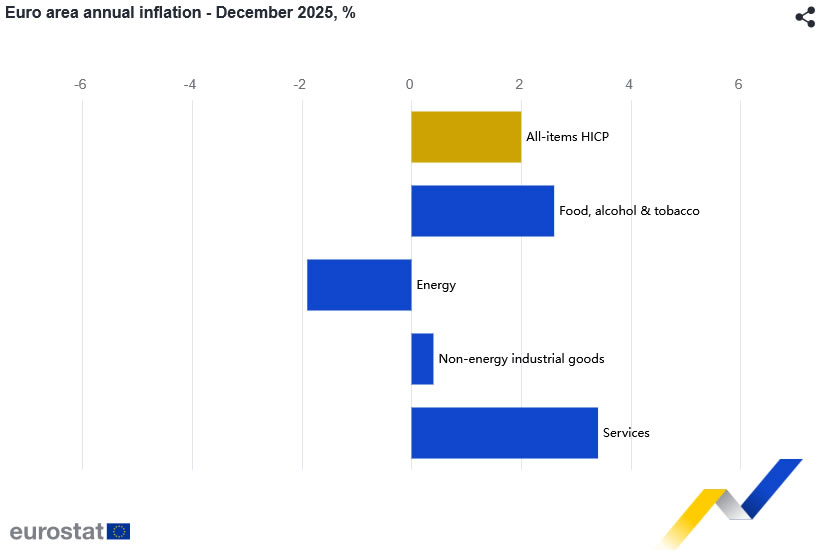
Eurozone inflation edged lower in December, with flash data showing headline CPI slowing from 2.1% to 2.0% yoy, undershooting expectations of 2.1%. Core inflation also eased, with CPI excluding energy, food, alcohol and tobacco falling from 2.4% to 2.3%, below the 2.4% consensus forecast.
Services remained the dominant source of price pressure, posting an annual rate of 3.4%, down slightly from 3.5% in November. Food, alcohol and tobacco inflation ticked higher to 2.6%.
Non-energy industrial goods inflation eased further to 0.4%. Energy prices remained a strong disinflationary force, with prices falling -1.9% yoy after a smaller decline in November.
EUR/USD Daily Outlook
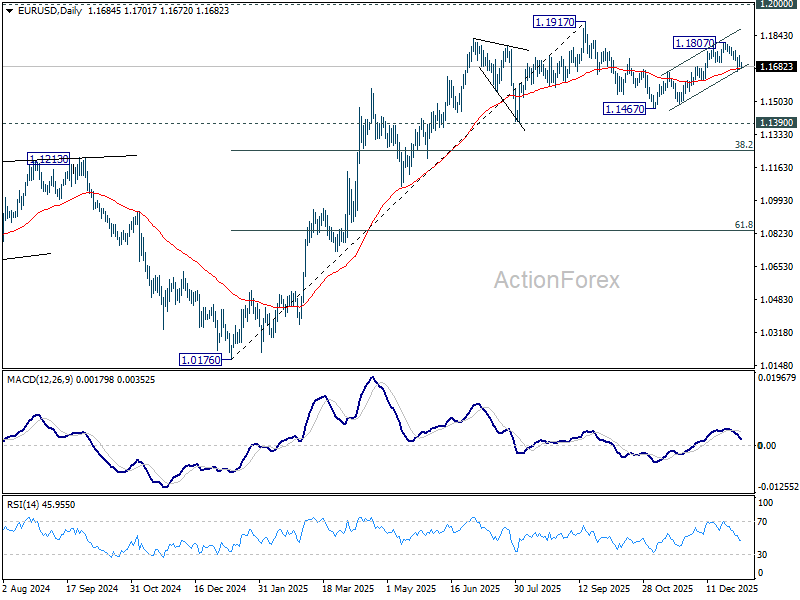
Daily Pivots: (S1) 1.1667; (P) 1.1705; (R1) 1.1726; More….
Intraday bias in EUR/USD remains neutral at this point. Rise from 1.1467 could still be in progress. Firm break of 1.1807 resistance will resume the rally to retest 1.1917 high. However, break of 1.1658 support will target 1.1467, as corrective pattern from 1.1917 has started the third leg.
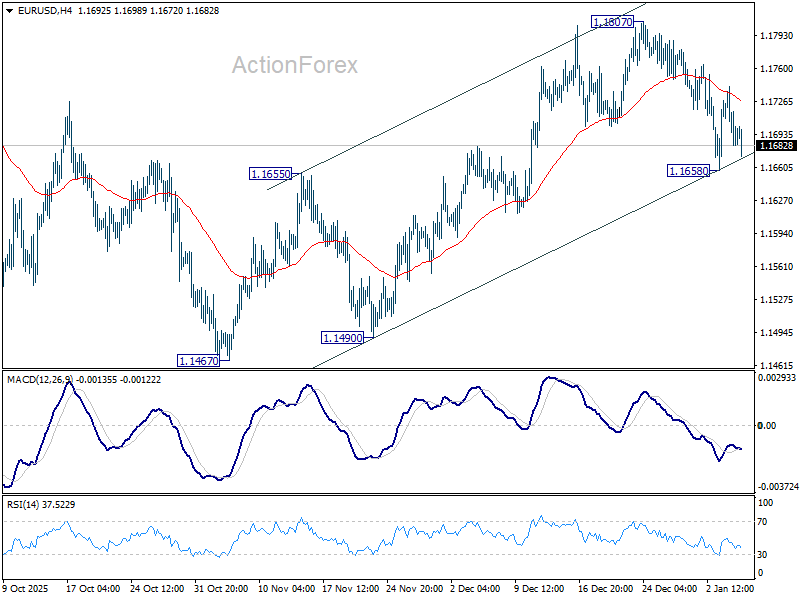
In the bigger picture, as long as 55 W EMA (now at 1.1408) holds, up trend from 0.9534 (2022 low) is still in favor to continue. Decisive break of 1.2 key psychological level will carry larger bullish implication. However, sustained trading below 55 W EMA will argue that rise from 0.9534 has completed as a three wave corrective bounce, and keep long term outlook bearish.
USD/JPY Daily Outlook
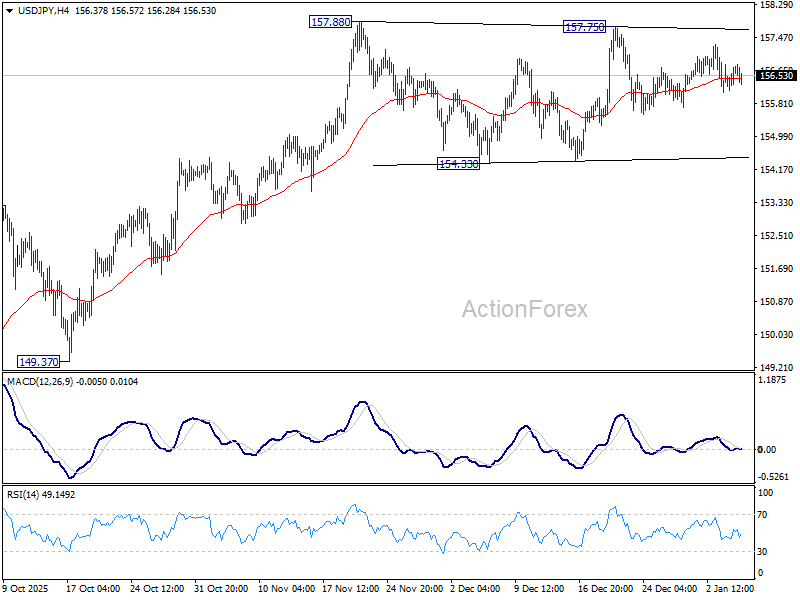
Daily Pivots: (S1) 156.29; (P) 156.54; (R1) 156.93; More...
USD/JPY is still bounded in sideway consolidations from 157.88 and intraday bias stays neutral for the moment. Outlook will stay bullish as long as 154.33 support holds. On the upside, firm break of 158.85 key structural resistance will be an important medium term bullish sign. Next target will be 161.94 high. However, decisive break of 154.38 will turn bias to the downside for deeper correction.
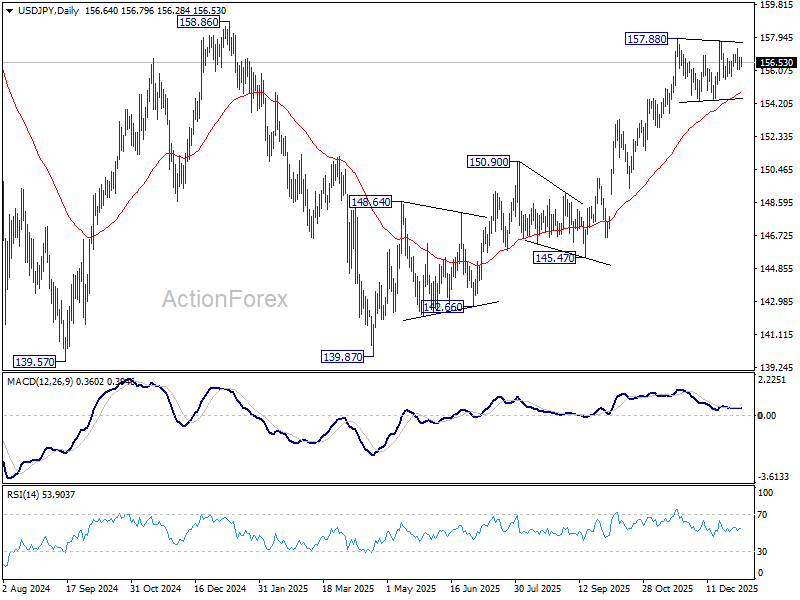
In the bigger picture, corrective pattern from 161.94 (2024 high) could have completed with three waves at 139.87. Larger up trend from 102.58 (2021 low) could be ready to resume through 161.94 high. Decisive break of 158.85 structural resistance will solidify this bullish case and target 161.94 for confirmation. On the downside, break of 150.90 resistance turned support will dampen this bullish view and extend the corrective range pattern with another falling leg.
GBP/USD Daily Outlook
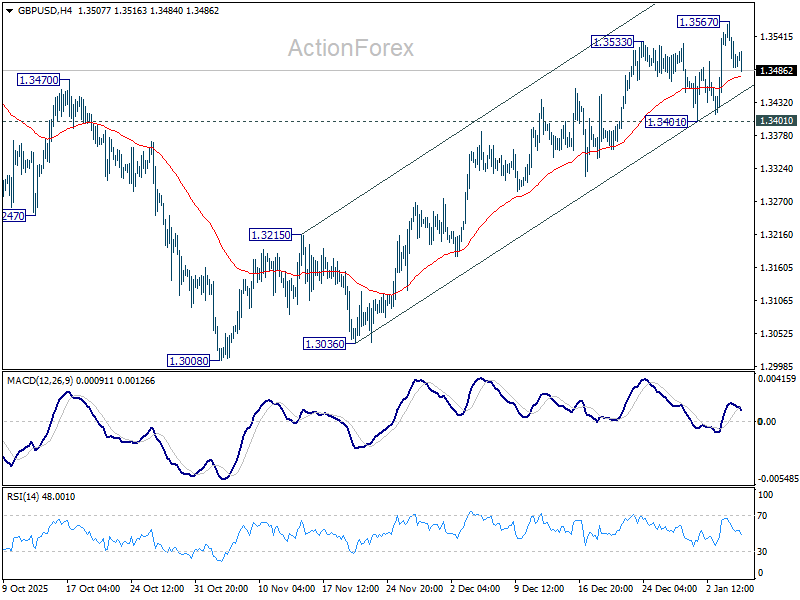
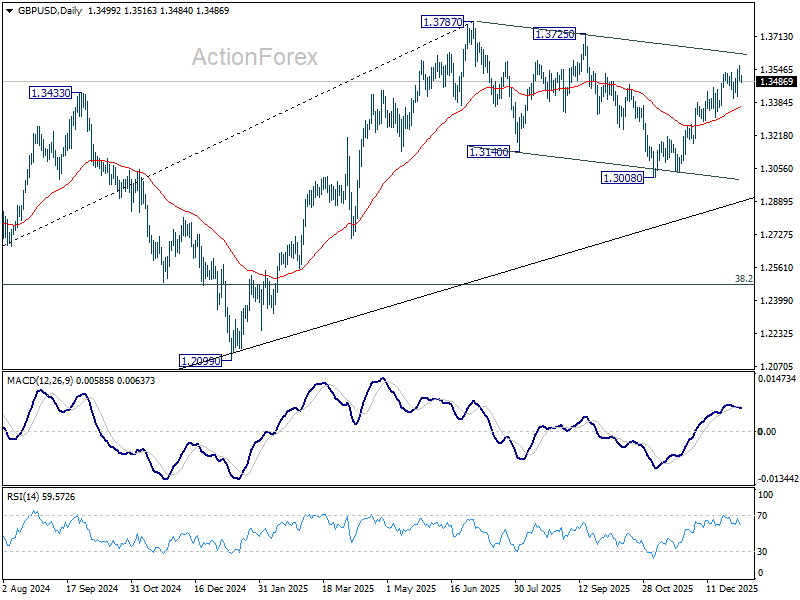
Daily Pivots: (S1) 1.3473; (P) 1.3521; (R1) 1.3549; More...
Intraday bias in GBP/USD is turned neutral with current retreat, and some consolidations would be seen below 1.3567 temporary top. But further rally is expected as long as 1.3401 support holds. ON the upside, break of 1.3567 will resume the rise from 1.3008 to retest 1.3787 high.
In the bigger picture, current development suggests that fall from 1.3787 is merely a corrective move, and larger rise from 1.0351 (2022 low) is still in progress. Firm break of 1.3787 will target 1.4248 (2021 high) key structural resistance. This will remain the favored case as long as target 38.2% retracement of 1.0351 to 1.3787 at 1.2474 holds, in case of another fall.
USD/CHF Daily Outlook
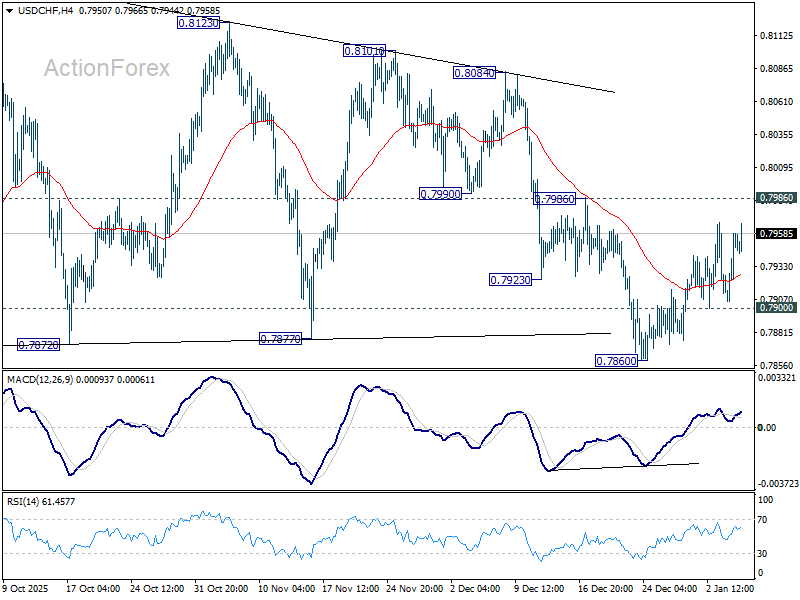
Daily Pivots: (S1) 0.7923; (P) 0.7942; (R1) 0.7977; More….
Intraday bias in USD/CHF stays neutral and further decline is mildly in favor with 0.7986 resistance intact. On the downside, below 0.7900 minor support will turn bias to the downside. Break of 0.7860 will target a retest on 0.7828 low. However, break of 0.7986 will argue that corrective pattern from 0.7828 is still extending with another rising leg already in progress.
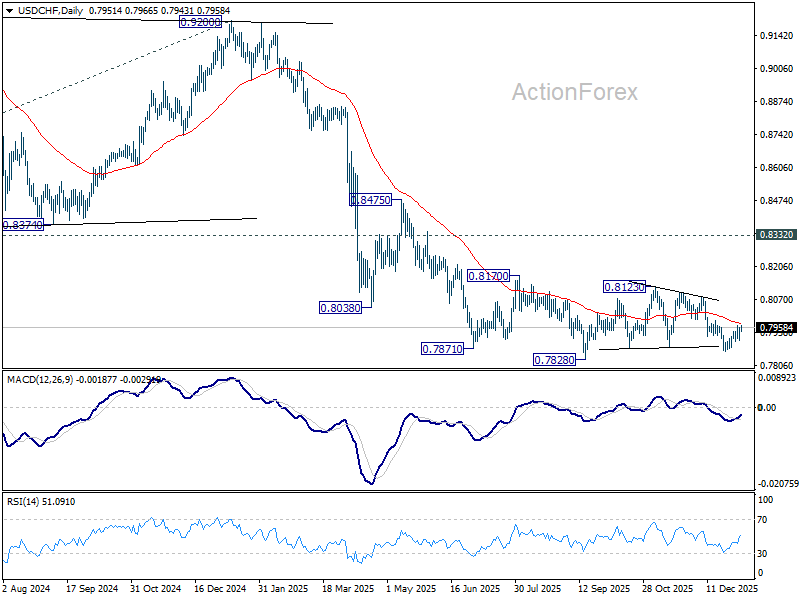
In the bigger picture, outlook will stay bearish as long as 0.8332 support turned resistance holds (2023 low). Long term down trend from 1.0342 (2017 high) is still in progress. Next target is 100% projection of 1.0146 (2022 high) to 0.8332 from 0.9200 at 0.7382.
AUD/USD Daily Report
Daily Pivots: (S1) 0.6713; (P) 0.6728; (R1) 0.6752; More...
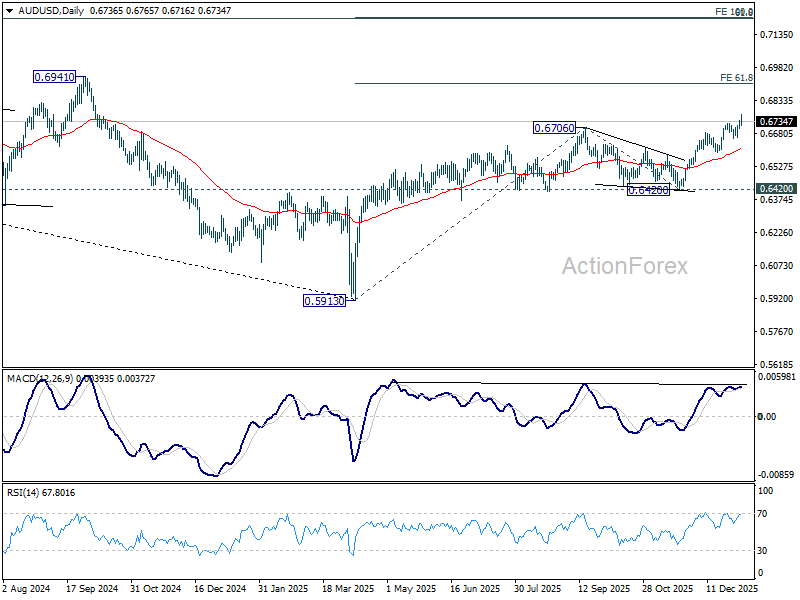
Intraday bias in AUD/USD's remains on the upside at this point. Current rise from 0.6420 is part of thew hole rally from 0.5913. Next target is 61.8% projection of 0.5913 to 0.6706 from 0.6420 at 0.6910. For now, risk will stay on the upside as long as 0.6659 support holds, in case of retreat.
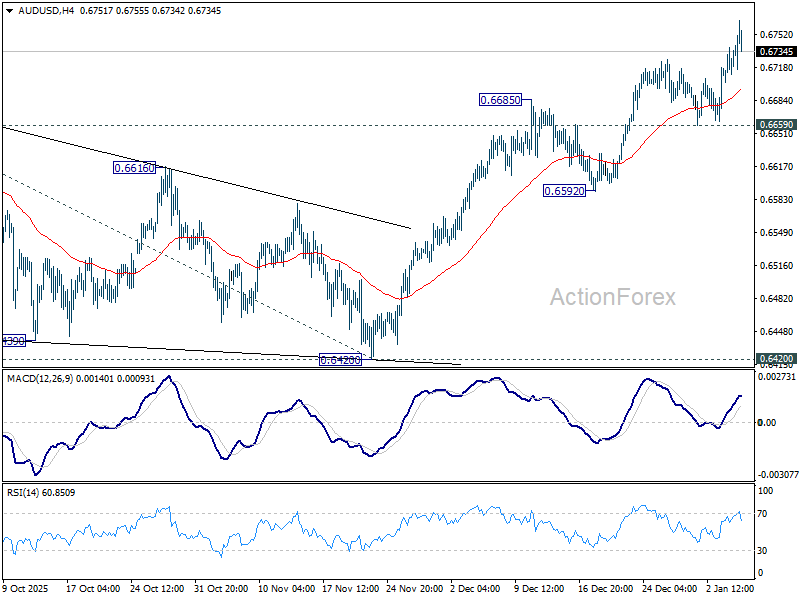
In the bigger picture, current development argues that rise form 0.5913 (2024 low) is reversing whole down trend from 0.8006 (2021 high). Further rally should be seen to 61.8% retracement of 0.8006 to 0.5913 at 0.7206. This will remain the favored case as long as 0.6420 support holds.