Sample Category Title
The US Federal Reserve Can Fully Complete The QE Program At The Next Meeting
Fed chief Jerome Powell indicated in his speech to the US Senate that the US central bank could fully reduce large-scale bond purchases in two weeks, referring to a strong economy. This will be a necessary first step toward raising rates next year to prevent inflationary problems by the end of 2022. The chairman of the US Federal Reserve said that the economy was likely to pass the target the Fed has set for raising interest rates on inflation in the coming months. On the other hand, it will still need complete employment before it starts the rise. Mr. Powell also pointed out that inflation in the United States could no longer be called "temporary".
Powell's statement was received negatively by traders, leading to a sharp strengthening of the dollar index and a decline in major stock indices worldwide. By the end of the trading session on Tuesday, Dow Jones Industrial Average (US30) decreased by 1.86% (-3.98% for the month), S&P 500 (US500) lost 1.90% (-1.01% for the month), and the tech index Nasdaq (US100) decreased by 1.55% (-0.37% for the month).
The US consumer sentiment index continued its decline in November, falling 4.3 points to 109.5, according to the Conference Board. This is the third consecutive decline.
Ray Dalio, a famous hedge-fund manager, said that there was no need to "go to the cash" right now despite the heightened market volatility due to a new strain of the virus. Dalio said that cash would burn because of high inflation, and reliable and balanced portfolios would save investors. At the same time, the billionaire is worried about a lot of liquidity in the economy: "It won’t raise living standards in an important way. As inflation then begins to bite, it has political consequences".
European stock indices also closed in the red area yesterday. French index CAC 40 (FR40) decreased by 0.81% (-2.5% for the month), British FTSE 100 (UK100) decreased by 0.44% (-3.14% for the month), German DAX (DE40) lost 1.18% (-4.47% for the month), Spanish IBEX (ES35) lost 1.78% (-9.56% for the month). Eurozone annual inflation accelerated to 4.9% in November from 4.1%; it’s well above the 4.5% forecast and above the ECB's target. Pressure is now building on the ECB on future monetary stimulus, as the ECB initially did not plan to cut the PEPP program until spring 2022.
Rating agency MOODY pointed out that the emergence of the Omicron strain creates new risks to global economic growth and inflation expectations. MERCK expects the Covid-19 drug to be effective against the Omicron strain.
The White House is disappointed that oil prices fell, but gasoline prices remained at the same level. Yesterday, WTI crude oil fell below $65 a barrel for the first time since August, and the Vix oil volatility index reached 2008 levels. Oil prices increased more than 3% this morning ahead of an OPEC+ meeting, where major producers will discuss how to respond to the threat of falling fuel demand due to the Omicron strain. Algeria's Energy Minister said yesterday that OPEC+ would deliver enough oil to the world market and take all necessary measures to maintain market balance amid fears of a new strain.
Asian markets, on the other hand, are showing a recovery today. Japan's Nikkei index (JP225) increased by 0.41% (-6.16% for the month), Hong Kong's Hang Seng (HK50) added 0.75% (-6.68% for the month), Australia's ASX 200 (AU200) decreased by 0.28% (-1.21% for the month).
Evergrande's price fell by 4.8% yesterday after Chairman Hui Ka Yan had sold part of his stake in the company, raising about $344 million. He sold 1.2 billion shares on Friday, reducing his stake from 77% to 67.9% to solve the problem of more than $300 billion debt.
Main market quotes:
- S&P 500 (F) (US500) 4,567.00 −88.27 (−1.90%)
- Dow Jones (US30) 34,483.72 −652.22 (−1.86%)
- DAX (DE40) 15,100.13 −180.73 (−1.18%)
- FTSE 100 (UK100) 7,059.45 −50.50 (−0.71%)
- USD Index 96.27 +0.18 (+0.19%)
Important events for today:
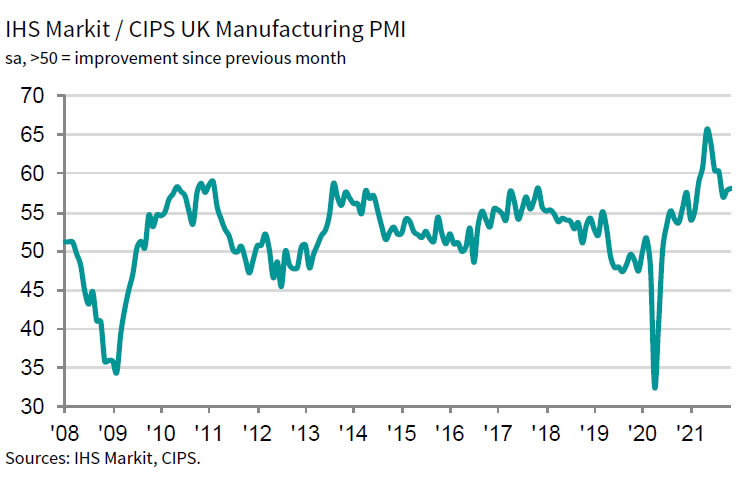
- Australia GDP (q/q) at 02:30 (GMT+2);
- Japan Manufacturing PMI (m/m) at 02:30 (GMT+2);
- German Retail Sales (m/m) at 09:00 (GMT+2);
- German Manufacturing PMI (m/m) at 10:55 (GMT+2);
- Eurozone Manufacturing PMI (m/m) at 11:00 (GMT+2);
- UK Manufacturing PMI (m/m) at 11:30 (GMT+2);
- US ADP Nonfarm Employment Change (m/m) at 15:15 (GMT+2);
- Canada Building Permits (m/m) at 15:30 (GMT+2);
- UK BoE Gov Bailey’s Speech at 16:00 (GMT+2);
- US ISM Manufacturing PMI (m/m) at 17:00 (GMT+2);
- US Fed Chair Powell Testifies at 17:00 (GMT+2);
- US Treasury Secretary Yellen Speaks at 17:00 (GMT+2);
- US Crude Oil Reserves (w/w) at 17:30 (GMT+2).
Bond Yield Inching Higher Following Fed’s Transitory U-Turn
Notes/Observations
- Transitory u-turn on inflation by Powell; increased concerns over inflation risks going forward; appeared to dismiss concerns about the new omicron Covid-19 variant.
- Major European PMI Manufacturing readings remain former in expansion territory (Beats: France, Italy; Misses: Euro Zone, Germany, Spain, UK).
- Turkish Lira currency appreciated over 7% after CBRT intervened in FX market.
Asia
- China Nov Caixin PMI Manufacturing registered its 1st contraction in 3 months (49.9 v 50.5e).
- Japan Nov Final PMI Manufacturing: 54.5 v 54.2 prelim (confirms10th consecutive expansion and highest since Jan 2018).
- Australia Q3 GDP beat expectation and shrugs of Delta lockdown (Q/Q: -1.9% v -2.5%e; Y/Y: 3.9% v 3.0%e).
- BOJ Board Member Adachi noted that now that the COVID-19 situation had started to calm down, firms were gradually beginning to raise the prices of their goods and services. BOJ to scrutinize COVID developments and impact on corporate finance in deciding fate of pandemic relief loan programs.
Coronavirus
- NIH's Fauci: Preliminary information from South Africa suggested no unusual symptoms associated with Omicron.
- Biden administration said to be preparing stricter testing requirements for all travelers entering the US. Everyone entering the country to be tested one day before boarding flights and considering travelers get retested within 3 to 5 days after arrival.
Europe
- Incoming German Chancellor Scholz stated that should not aim for inflation as high as we have now, if inflation did not ease, action must be taken. Would not tolerate high inflation rates over the long run, price developments must be very closely monitored.
Americas
- Fed Chair Powell testimony in House noted it was appropriate to consider wrapping up taper a few months sooner, To talk about speeding up taper at next FOMC meeting. Stated that now was a good time to retire the 'transitory' term regarding inflation.
- Fed Vice Chair Clarida: Fed pandemic actions are aimed at stemming financial panic. Getting actual inflation down close to 2% will be important part of keeping inflation expectations anchored.
Energy
- Weekly API Crude Oil Inventories: -0.7M v +2.3M prior.
Speakers/Fixed income/FX/Commodities/Erratum
Equities
- Indices [Stoxx600 +1.03% at 467.74, FTSE +1.30% at 7,151.10, DAX +1.47% at 15,321.79, CAC-40 +1.23% at 6,804.13, IBEX-35 +1.51% at 8,430.43, FTSE MIB +1.50% at 26,202.00, SMI +0.39% at 12,207.42, S&P 500 Futures +1.23%].
Market Focal Points/Key Themes:
Equities
- European indices open sharply higher across the board amid partial easing of concerns regarding new Omicron variant; better performing sectors include consumer discretionary, energy and technology; while utilities is among underperforming sectors; on corporate front, German real estate firm Adler announced disposal of its €800M property portfolio and trades higher over 20% in Frankfurt; elsewhere, Drax Group also trading higher on LSE following trading and CMD updates; on M&A front, SS&C Technologies raises offer for UK-based Blue Prism Group, while CVC Capital announced it is no longer in talks to acquire Intertrust; earnings expected during the upcoming US session include G-III Apparel, Royal Bank of Canada before market opens and CrowdStrike, Snowflake after US close.
- Consumer discretionary: Intertrust [INTER.NL] -5% (no longer in discussions with CVC).
- Energy: Drax Group [DRX.UK] +6% (trading update; CMD), Royal Dutch Shell [RDSA.NL] +3% (oil price bounce).
- Technology: Blue Prism Group [PRSM.UK] +2% (SS&C raises offer).
- Real Estate: Adler [ADJ.DE] +22% (divestment).
Speakers
- Spain Econ Min Calvino stated that the inflation situation in EU was different compared to US; reiterated that price rise in Europe was seen as transitory.
- Poland Central Bank (NBP) Gov Glapinski stated that it had room for interest rates hikes but space was not unlimited.
- Turkey Central Bank (CBRT) intervened in the FX market citing unhealthy price formations in the exchange rate.
- Turkey President Erdogan reiterated stance that could never be in favor of high interest rates. Understood public concerns over the volatility in exchange rates. Had abandoned monetary policy based upon high rates but conceded that the new path could be risky but correct. Exchange rates were expected to stabilize soon.
- Israel Health Min Horowitz stated that the were first indications that individuals fully vaccinated against COVID-19 within 6 months or with the booster were protected against the Omicron variant.
- Belarus President Lukashenko reiterated threat to suspend Russian energy transport if Poland closed the migrant border.
Currencies/Fixed Income
- USD remained on firm footing following hawkish comments by Fed Chair Powell on Tuesday which spurred expectations of faster policy tightening and renewed focus on yield differentials. The Fed Chair noted that elevated inflation pressures and rapid improvements in the labor market would justify wrapping up the taper by perhaps a few months sooner. Dealers noted that the overall USD trend based on rate differentials would be dependent on how the Omicron variant of coronavirus developed
- EUR/USD drifted lower in the session to reapproach the 1.1300 level before consolidating.
- USD/JPY back above 113.50 aided by the yield differentials.
- TRY currency (Lira) hit fresh record lows near the 14 handle before the Turkey Central Bank (CBRT) intervened in the FX market citing unhealthy price formations in the exchange rate. Lira gained over 7.5% afterwards to retest below the 12.45 level. Lira retarced its gains after President Erdogan reiterated his stance that could never be in favor of high interest rates.
Economic data
- (RU) Russia Nov PMI Manufacturing: 51.7 v 51.6 prior (2nd straight expansion).
- (DE) Germany Oct Retail Sales M/M: -0.3% v +0.9%e; Y/Y: -4.1% v -1.7%e.
- (UK) Nov Nationwide House Price M/M: 0.9% v 0.4%e; Y/Y: 10.0% v 9.3%e.
- (TR) Turkey Nov PMI Manufacturing: 52.0 v 51.2 prior (6th month of expansion).
- (NO) Norway Q3 Current Account Balance (NOK): 157.9B v 114.7B prior.
- (CH) Swiss Nov CPI M/M: 0.0% v -0.1%e; Y/Y: 1.5% v 1.4%e; CPI Core Y/Y: 0.7% v 0.7%e.
- (CH) Swiss Nov CPI EU Harmonized M/M: -0.1% v +0.4% prior; Y/Y: 1.5% v 1.3% prior.
- (SE) Sweden Nov PMI Manufacturing: 63.3 v 64.2 prior (18th month of expansion).
- (TH) Thailand Nov Business Sentiment Index: 48.4 v 47.0 prior.
- (NL) Netherlands Nov Manufacturing PMI: 60.7 v 61.3e (16th straight expansion).
- (PL) Poland Nov PMI Manufacturing: 54.4 v 53.9e (17th straight expansion).
- (HU) Hungary Nov Manufacturing PMI: 52.2 v 53.4e (8th straight expansion).
- (HU) Hungary Q3 Final GDP Q/Q: 0.7% v 0.7% prelim; Y/Y: 6.1% v 6.1% prelim.
- (HU) Hungary PPI M/M: 4.5% v 2.4% prior; Y/Y: 18.5% v 14.0% prior.
- (ES) Spain Nov Manufacturing PMI: 57.1 v 57.9e (10th month of expansion).
- (CH) Swiss Nov PMI Manufacturing: 62.5 v 64.2e (16th straight expansion).
- (CZ) Czech Republic Nov PMI Manufacturing: 57.1 v 55.5e (15th straight expansion).
- (IT) Italy Nov Manufacturing PMI: 62.8 v 61.1e (17th month of expansion and record high).
- (NG) Nigeria Nov PMI Manufacturing: 55.0 v 54.1 prior.
- (FR) France Nov Final Manufacturing PMI: 55.9 v 54.6 prelim (confirmed 12th month of expansion).
- (DE) Germany Nov Final Manufacturing PMI: 57.4 v 57.6 prelim (confirmed 17th month of expansion but lowest since Jan).
- (EU) Euro Zone Nov Final Manufacturing PMI: 58.4 v 58.6 prelim (confirmed 17th month of expansion).
- (GR) Greece Nov Manufacturing PMI: 58.8 v 58.9 prior (9th month of expansion).
- (NO) Norway Nov PMI Manufacturing: 63.7 v 58.0e (15th month of expansion).
- (ZA) South Africa Nov Manufacturing PMI: 57.2 v 53.3e (4th month of expansion).
- (IS) Iceland Q3 Current Account Balance (ISK): +13.1B v -36.9B prior.
- (UK) Nov Final Manufacturing PMI: 58.1 v 58.2e(confirmed 18th month of expansion).
- (DK) Denmark Nov PMI Survey: 68.2 v 72.2 prior (9th straight expansion).
Fixed income Issuance
- (IN) India sold total INR200B vs. INR200B indicated in 3-month, 6-month and 12-month bills.
- (SE) Sweden sold total SEK2.5B vs. SEK2.5B indicated in 2029 and 2032 bonds.
- (UK) DMO sold £2.25B in new 1.0% Jan 2032 Gilts; Avg Yield: 0.918% v 1.144% prior; bid-to-cover“ 2.23x (lowest since Mar 2020) v 2.65x prior; Tail: 1.9bps v 0.2bps prior.
Looking Ahead
- OPEC JMMC meeting.
- (AR) Argentina Nov Government Tax Revenue (ARS): No est v 1.019T prior.
- (ZA) South Africa Nov Naamsa Vehicle Sales Y/Y: No est v 6.1% prior.
- (IT) Italy Nov Budget Balance: No est v -€7.5B prior.
- (US) Nov Total Vehicle Sales data.
- 05:25 (EU) Daily ECB Liquidity Stats.
- 05:30 (DE) Germany to sell €3.0B in 0% Oct 2026 BOBL.
- 05:30 (GR) Greece Debt Agency (PDMA) to sell €625M in 26-week Bills; Avg Yield: % v -0.41% prior; Bid to cover: x v 1.83x prior (Oct 26th 2021).
- 06:00 (IE) Ireland Nov Unemployment Rate: No est v 5.2% prior.
- 06:00 (EU) EU Commission to sell combined €3.0B in 3-month and 6-month Bills.
- 06:30 (CL) Chile Oct Economic Activity Index (Monthly GDP) Y/Y: 15.0%e v 15.6% prior.
- 06:45 (US) Daily Libor Fixing.
- 07:00 (RU) Russia to sell combined RUB30.1B in 2031 and 2032 OFZ Bonds.
- 07:00 (US) MBA Mortgage Applications w/e Nov 26th: No est v 1.8% prior.
- 07:00 (UK) Weekly PM Question time in House.
- 08:00 (HU) Hungary Central Bank Nov Minutes.
- 08:00 (CZ) Czech Nov Budget Balance (CZK): No est v -335.0B prior.
- 08:00 (BR) Brazil Nov PMI Manufacturing: No est v 51.7 prior.
- 08:00 (UK) Daily Baltic Dry Bulk Index.
- 08:15 (US) Nov ADP Employment Change: +525Ke v +571K prior.
- 08:30 (CA) Canada Oct MLI Leading Indicator M/M: No est v 0.7% prior.
- 08:30 (CA) Canada Oct Building Permits M/M: -1.0%e v +4.3% prior.
- 09:00 (UK) BOE Gov Bailey.
- 09:00 (SE) Sweden Central Bank (Riksbank) Breman.
- 09:30 (CA) Canada Nov Manufacturing PMI: No est v 57.7 prior.
- 09:45 (US) Nov Final Markit Manufacturing PMI: 59.1e v 59.1 prelim.
- 09:45 (UK) BOE to buy £1.47B in APF Gilt purchase operation (7-20 years).
- 10:00 (US) Nov ISM Manufacturing: 61.2e v 60.8 prior; Prices Paid: 85.5e v 85.7 prior.
- 10:00 (US) Oct Construction Spending M/M: +0.4%e v -0.5% prior.
- 10:00 (MX) Mexico Oct Total Remittances: $4.6Be v $4.4B prior.
- 10:00 (MX) Mexico Central Bank Economist Survey.
- 10:00 (CO) Colombia Nov PMI Manufacturing: No est v 54.0 prior.
- 10:00 (PE) Peru Nov CPI M/M: 0.3%e v 0.6% prior; Y/Y: 5.6%e v 5.8% prior.
- 10:00 (US) Fed chief Powell and Treasury Sec Yellen testify in House.
- 10:30 (MX) Mexico Nov PMI Manufacturing: No est v 49.3 prior.
- 10:30 (US) Weekly DOE Oil Inventories.
- 12:00 (IT) Italy Nov New Car Registrations Y/Y: No ext v -35.7% prior.
- 13:00 (BR) Brazil Nov Trade Balance: -$1.3Be v $2.0B prior; Total Exports: $21.8Be v $22.5B prior; Total Imports: $23.3Be v $20.5B prior.
- 13:00 (MX) Mexico Nov IMEF Manufacturing Index: 51.0e v 50.7 prior; Non-Manufacturing Index: 52.5e v 52.1 prior.
- 13:00 (MX) Mexico Central Bank (Banxico) Quarterly Inflation Report (QIR).
- 14:00 (US) Federal Reserve Beige Book.
- 16:45 (NZ) New Zealand Q3 Terms of Trade Index Q/Q: 2.0%e v 3.3% prior.
- 18:00 (KR) South Korea Q3 Final GDP Q/Q: 0.3%e v 0.3% prelim; Y/Y: 4.0%e v 4.0% prelim.
- 18:00 (KR) South Korea Nov CPI M/M: -0.2%e v +0.1% prior; Y/Y: 3.1%e v 3.2% prior; CPI Core Y/Y: 2.2%e v 2.8% prior.
- 18:50 (JP) Japan end-Nov Monetary Base: No est v ¥664.0T prior.
- 19:30 (AU) Australia Oct Trade Balance: A$11.2Be v A$12.2B prior; Exports M/M: -1%e v -6% prior; Imports M/M: +2%e v -2% prior.
- 19:30 (AU) Australia Oct Home Loans Value M/M: +1.5%e v -1.4% prior.
AUD/USD Bullish Attack M H3 Is The Next Target
AUD/USD technical analysis
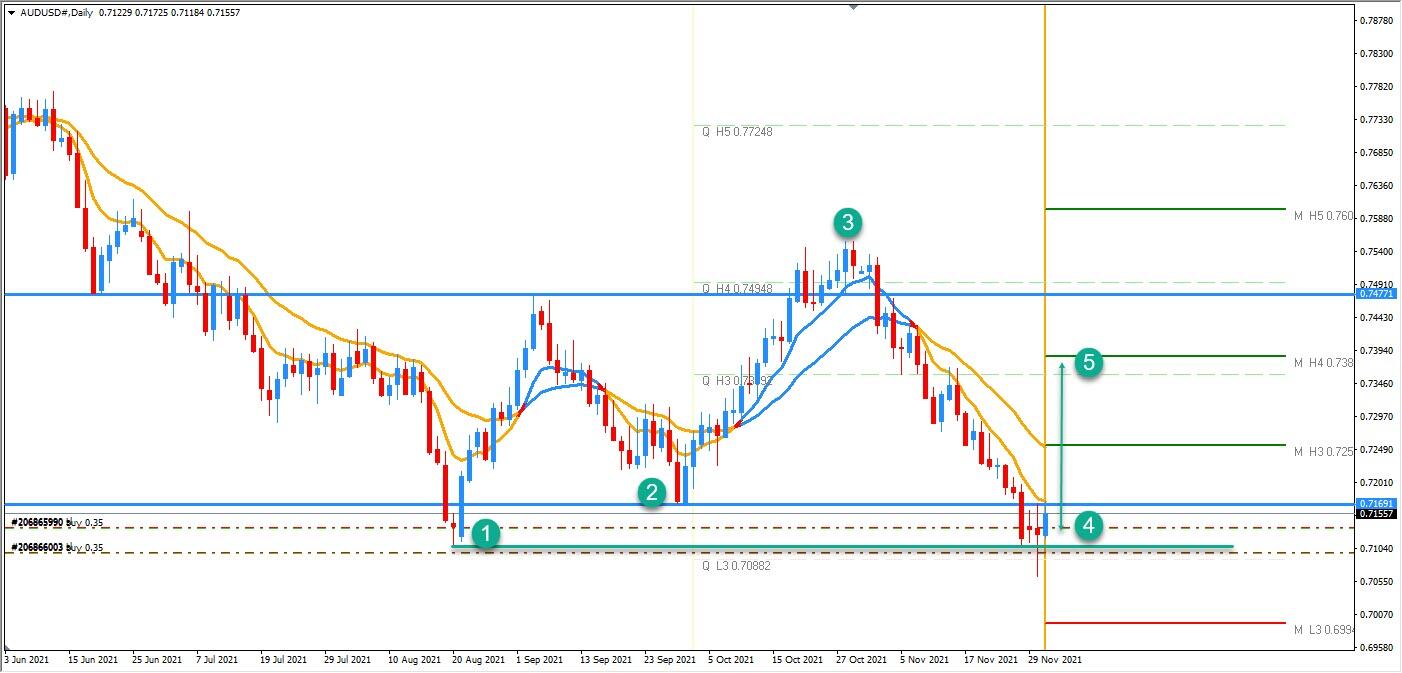
- Bullish pinbars at support.
- Move up is expected.
- Higher lows and higher highs.
- M H3 is the target.
- Low.
- Higher Low.
- Higher High.
- Entry.
- Target.
The AUD/USD made a bounce from the lows. This is a technical bounce and it was expected. It was sped up by a positive GDP report. Gross Domestic Product (GDP) gauges the inflation-adjusted value of all goods and services produced within the economy. It is the most comprehensive measure of economic activity and an important indicator of economic health. 0.7100 zone was the entry zone with one more trade added at the retracement. Targets are 0.7170 followed by 0.7205 and 0.7250. if the market makes a close above 0.7250 in the upcoming days, it will open the way to 0.7385.
Fed Chief Signals Faster Taper, Dollar Not Impressed
- Fed Chair Powell says appropriate to consider accelerating taper process
- Dollar spikes higher but cannot sustain gains, stocks close lower
- Heavy dose of economic data releases today, OPEC begins meeting
Powell turns hawkish
The Chairman of the Federal Reserve dropped a bombshell on global markets yesterday by signaling his central bank will consider accelerating the pace at which it withdraws liquidity from the financial system. Testifying before the US Senate, Powell stressed that inflation risks have intensified and that incoming data since the last FOMC meeting point to a rapid improvement in the economy.
He also downplayed the Omicron variant as being a mere risk at this stage and explicitly said it could be appropriate to end asset purchases “a few months” earlier than planned. Several other Fed officials have expressed similar views about faster tapering recently, including Vice Chairman Clarida, Board Governor Waller, and regional presidents Daly, Bostic, and Bullard.
Barring some catastrophe in Friday’s jobs numbers or next week’s inflation report, it seems like an acceleration of tapering could be announced at the next FOMC meeting in mid-December. The question that will keep traders guessing until then is exactly how much faster the Fed might dial back its bond purchases.
Dollar not impressed
Markets reacted quickly. Fed futures contracts are currently pricing in two rate increases for next year and even odds for a third one, starting in June. Short-term Treasury yields soared to reflect this hawkish shift, although longer-dated yields fell as investors priced some inflation risk out of bonds now that the Fed is getting the normalization ball rolling properly.
Yet the dollar was not impressed. The reserve currency spiked higher initially but soon surrendered all its Powell-related gains to close the session in the red overall. It’s difficult to say whether this was because of a relief rally in the euro as oil prices plunged or whether month-end flows simply eclipsed everything else.
Either way, the bigger picture for euro/dollar remains grim. A barrage of economic growth downgrades is likely imminent with restrictions returning across the Eurozone, while in contrast, the American economy is booming and there’s still room for markets to fully price in a third Fed rate increase for next year.
There’s also an element of political risk in Europe ahead of next year’s presidential election in France after far-right journalist Eric Zemmour announced his candidacy yesterday. President Macron is leading in opinion polls but if the polls narrow heading into the election, a risk premium could be added to the euro as hopes of continued European integration are challenged.
Stocks volatile, key data coming up
Between Omicron worries, the Fed potentially speeding up tapering, and fund managers trying to protect their yearly performance before closing their books later this month, there has been no shortage of volatility in stocks lately. But for all the headlines, the S&P 500 is only 3% away from its record highs. Not exactly panic territory.
The market is essentially being held up by its generals - a handful of tech heavyweights. There has been a clear rotation to quality lately, with unprofitable ‘growth’ companies and small caps getting blasted while titans like Apple continue to forge ahead, carrying entire indices on their shoulders.
As for today, there are several events that could reignite volatility. The ISM manufacturing survey and the ADP jobs report from America will top the economic calendar, while Powell will appear before the House of Representatives for his second round of testimony.
In energy markets, OPEC will begin its two-day meeting. With concerns that Omicron will hurt demand and several nations releasing strategic reserves, the cartel has the perfect excuse to hit pause on its plans to steadily raise production. If so, that could bring some much-needed relief to oil prices.
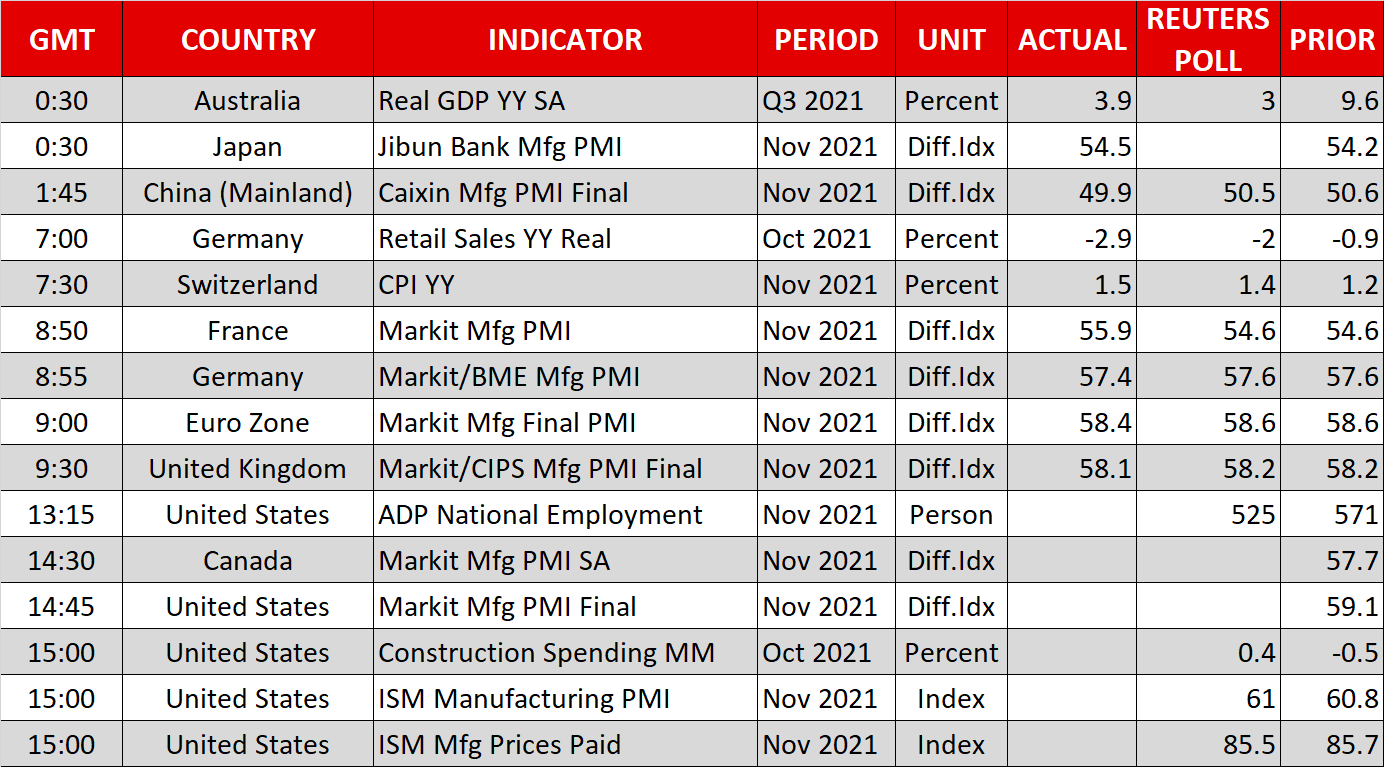
USDJPY Plunges To 113 Mark But Bullish Structure Intact
USDJPY has formed a foothold around the 113.00 handle after a selloff in the pair from a near five-year high, which was linked to concerns around the new omicron variant. The aggressive pullback in the pair has failed to cause any significant damage towards the broader uptrend. Furthermore, the rising simple moving averages (SMAs) are also suggesting that the ascent in the pair remains sturdy.
The picture painted by the short-term oscillators is somewhat unclear, as the indicators are conveying mixed messages in directional momentum. The MACD is falling far below its red trigger line and is approaching the zero line. On the other hand, the RSI is improving in the bearish region and looks set to test the 50 level, while the stochastic %K line has pushed back above the 20 level, both signalling that negative pressures are somewhat fading.
If buyers manage to create additional traction and with certainty clearing the 50-day SMA at 113.40, resistance could show its claws around the 114.00 hurdle, where the mid-Bollinger also currently lies. Moving past this obstacle, the price may then tackle the 115.07-115.62 resistance section, which also encapsulates the multi-year high and the upper Bollinger band. Conquering this blockade, the bulls could then meet the 116.00 psychological number before propelling for the 116.87 high, achieved in January 2017.
Otherwise, steering lower involves congested regions of support, starting from the 113.00 border and the 112.40-112.72 barrier, which is reinforced by the lower Bollinger band. Not far below, the 112.00-112.22 boundary could try to impede the drop from gaining pace. However, if a deeper retracement unfolds, the 100-day SMA at 111.64 and the 110.80-111.19 border could act as upside defences. From here, for the pair to surrender more ground, the price would need to pierce below the 200-day SMA and slip past the 110.07 obstacle.
Summarizing, USDJPY’s broader bullish bearing should endure if the price holds above the 112.40-112.72 support zone. Yet, for negative forces to gain an upper hand, the price would need to break beneath the 110.80-111.19 section, once sellers conquer the crammed support obstacles above.
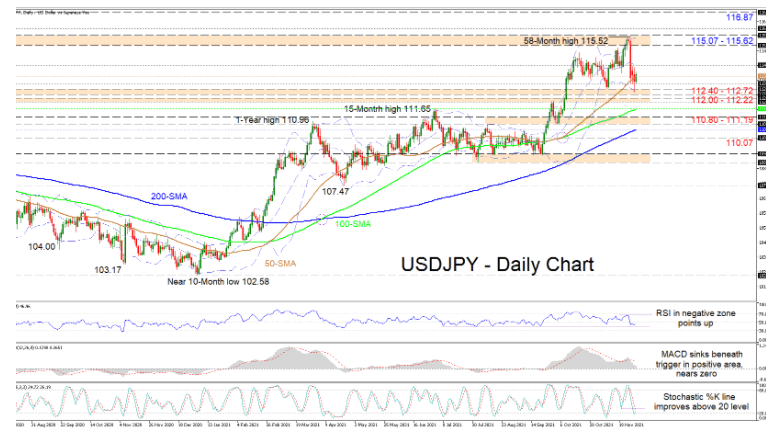
UK PMI manufacturing finalized at 58.1 in Nov, but industry in a vulnerable position
UK PMI Manufacturing was finalized at 58.1 in November, up from October's 57.8, hitting a 3-month high. Markit said output growth edged higher as domestic order intakes rose. New export business fell for the third straight month.
Rob Dobson, Director at IHS Markit, said: "The current mix of supply-side constraints, cost increases, skill shortages and rising demand for labour will add to the expectations of an imminent rate increase by the central bank, but the survey highlights how the subdued rate of manufacturing growth and export decline leaves industry in a vulnerable position to any new headwinds, not least the Omicron variant."
Oil Slides, Gold Under Pressure
Oil has another virus slump
In a high-volatility week, oil markets are in a league of their own. The Moderna CEO’s vaccine efficacy comments yesterday triggered another massive slump in oil prices. Brent crude finished 4.50% lower at USD 70.15 a barrel, having traded below USD 68.00 intraday. WTI slumped 4.40% to USD 66.95 a barrel, having tested USD 64.50 intraday.
With risk sentiment improving slightly, and the fall in prices irresistible to physical bargain hunters, Brent and WTI have rallied by 0.85% to USD 70.8 and USD 65.65 in Asia. It must be noted, however, that the gains this morning are only a slight dent in the scale of the falls seen in the past four sessions. While positive virus headlines provide an excuse for fast-money buying, the weaker side still seems to be lower.
With panicked tail-chasing blowing out volatility this week, the full OPEC+ meeting tomorrow cannot come soon enough, with the grouping cancelling the JMMC meeting earlier this week to evaluate omicron. With oil’s slump overnight, it is almost certain that OPEC+ will pause its scheduled production hikes for December to allow it to assess the impact of omicron more fully on the world economy. President Biden won’t be happy, but it does seem to be the more sensible move right now. If OPEC+ postpones hikes tomorrow, oil prices may stabilise around present levels.
Technical levels and indicators are fairly useless in markets such as this, driven by panicked swings in investor sentiment and low liquidity. However, for what it is worth, the relative strength indexes (RSIs) on both Brent and WTI are now heavily oversold, indicating markets are vulnerable to a short squeeze. The overnight lows should provide some support ahead of OPEC+. Until OPEC+ announces its decisions though, we can expect more blood-bath range trading.
Gold is in trouble
Gold’s price action continues to underwhelm, as it finished the overnight session down 0.55% at USD 1775.00 an ounce, before eking out a 0.20% gain to USD 1778.70 an ounce in Asia, almost a rerun of the price action yesterday. There are zero signs of any safe-haven bids emerging to shelter from virus volatility, and it is falling despite both US yields and the US dollar also falling. Gold has now recorded its 3rd successive daily close below its 50,100 and 200 DMAs clustered between USD 1791.00 and USD 1792.20 an ounce, yet another bearish signal.
Gold will have resistance at $1800.00 and $1815.00, while yesterday’s low at $1770.00 an ounce, has traced out a double bottom support level. Failure of $1770.00 now signals a retest of $1760.00 and $1740.00 an ounce. I do not rule out a move lower to $1720.00 this week, especially if the Non-Farms puts the Fed taper front and centre after yesterday’s hawkish tone to the Powell testimony.
A Confusing Night On Currency Markets
Powell turns hawkish but US dollar weakens
It is difficult to unpick the overnight movements in currency markets. The Moderna omicron headlines sent haven currencies such as the Japanese yen and Swiss franc soaring, but the US dollar also faded badly versus the euro and the emerging market space. Inflows into the German Bund market will have assisted the euro, but heightened concerns over omicron should have weakened EM currencies, not strengthened them. Additionally, a hawkish Powell narrative in overnight testimony should have been US dollar positive, although the US yield curve flattened afterwards.
I can only surmise that in the confused menagerie of overnight trading, month-end institutional flows played their part in the US dollar’s demise. Notably, the sterling and Australian and New Zealand dollars barely moved on a closing basis, despite the EM FX rally. That suggests the risk sentiment remains fragile and that the EM rally overnight should be taken with a huge grain of salt. The prospect of a faster Fed taper and earlier hikes in 2022 should start to reassert themselves.
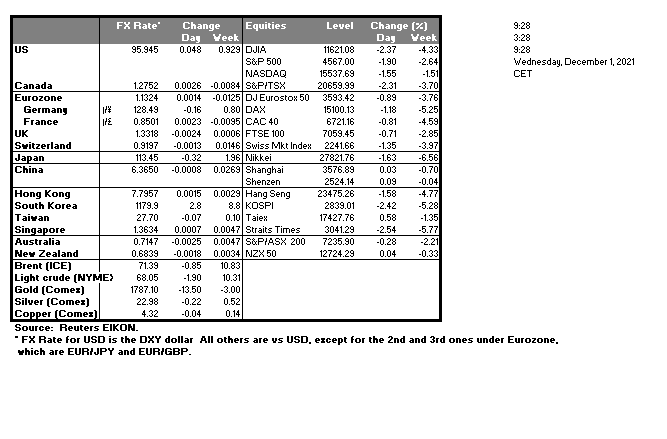
The dollar index traded in a frenzied 100 point range overnight between 95.50 and 96.50, before closing 0.31% lower at 95.89, rising slightly to 95.95 in Asia. 95.50 to 96.50 will probably cover the rest of the week, at least until the next omicron headline. EUR/USD rose 0.40% to 1.1330, but its rally looks fragile. USD/JPY and USD/CHF plummeted on haven buying, with USD/JPY testing 112.50 intra-day before closing at 113.20. The cross looks very overdone at 112.50 and I will stick my neck out and say that will be the week’s low.
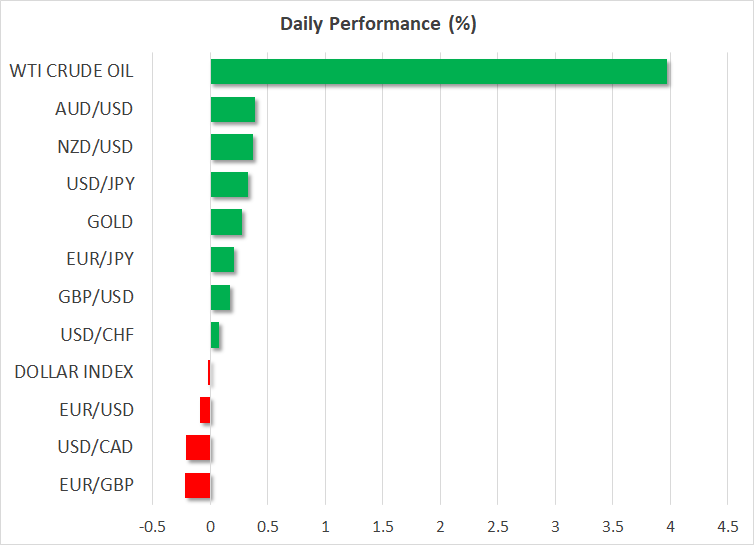
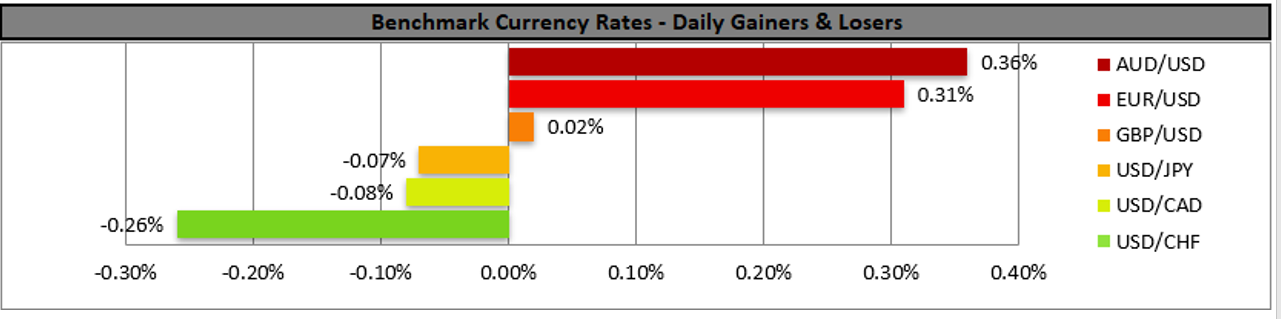
The US dollar has strengthened this morning, notably against the majors, perhaps as risk sentiment has recovered. That is evidenced by the 0.40% rise by AUD/USD and NZD/USD today, which are key barometers of market risk sentiment. Both currencies remain vulnerable to headline risk though and a move below their 2021 lows at 0.7100 and 0.6800 remains the path of least resistance.
Asian currencies rallied sharply overnight with USD/CNY falling 0.405 to 6.3940, USD/MYR falling 0.90% to 4.2000 despite oil plummeting, and USD/KRW falling 0.70% to 1182.70, a pattern repeated across the Asia FX space. I believe month-end flows, as well as the fall of the USD/JPY, helped drive the EM outperformance. Asian currencies have continued to book more gains today in Asia, driven by improved risk sentiment after the vaccine efficacy story from Israel gained wider circulation. With Asia FX rallying on positive virus news, its stands to reason that the next negative headline will see them about-face. With Jerome Powell setting a hawkish tone overnight, I would urge caution about the longevity of the Asian FX rally.
USD Gets Support From Hawkish Powell
The USD got some support yesterday yet during today’s Asian session traded at lower levels against some of its counterparts. In his testimony before the Senate yesterday, Fed Chairman Powell stated that the bank would discuss expediting the tapering of its QE program in the bank’s December meeting, providing support for the greenback as the hawkish tone seemed to take the markets by surprise. Also Chairman Powell tended to imply a strong economy, a slow growth in the US employment market and stated that high inflation is expected to continue until mid-next year, once again implying a rather transitory nature of the inflationary pressures in the US economy. Its characteristic that the Fed Chairman sounded confident that the impact of the Omicron variant of the pandemic could be lighter. Today we note the release from the US of the ADP national employment figure for November, yet the main release could prove to be the ISM manufacturing PMI figure for the same month.
The USD Index jumped on Powell’s testimony, reaching as high as the 96.65 (R2) resistance line, yet corrected lower and remained below the 96.15 (R1) resistance level. Temporarily we tend to maintain bias for a sideways motion between the 96.15 (R1) resistance line and the 95.60 (S1) support line, yet some bearish tendencies seem to exist. The RSI indicator below our 4-hour chart is between the readings of 30 and 50 also implying an advantage for the bears. Should there actually be a selling interest for the greenback we may see the index breaking the 95.60 (S1) support line and aim for the 94.95 (S2) support level. Should the index on the other hand actually find fresh buying orders along its path, we may see it breaking the 96.15 (R1) resistance line and aim for the 96.65 (R2) resistance level.
Oil’s drop seems to be extended
WTI prices extended their losses yesterday and closed their worst monthly drop since the pandemic started in March 2020. Fundamentals for oil traders cannot exclude OPEC’s meeting which is about to start along with its allies, which is to decide the oil production levels in the coming months. It should be noted that OPEC last week had noted that the release of strategic oil reserves by the US, China, Japan and India could create a surplus in the oil market and we note that the Omicron variant added more uncertainty on the demand side of oil. Should OPEC decide to curtail its production levels we may see oil prices jumping higher, while today oil traders may be keeping an eye out for the weekly US EIA crude oil inventories figure.
WTI prices dropped yesterday testing the 65.00 (S2) support level yet corrected higher and floated above the 67.35 (S1) support line in today’s Asian session. We maintain a bearish outlook for the commodity currently and for it to change we would require a clear breaking of the downward trendline guiding the commodity’s prices since the 26th of the November. Please note that the RSI indicator below our 4-hour chart is near the reading of 30 and despite the slight upward slope, seems to confirm the bearish sentiment of the market. Should the bears continue to guide WTI’s price, we may see it breaking the 67.35 (S1) support line and aim for 65.00 (S2) support level. On the other hand, should the bulls take over, we may see WTI’s price breaking the prementioned downward trendline and the 70.00 (R1) resistance line in search of higher grounds.
Other highlights today and during tomorrow’s Asian session
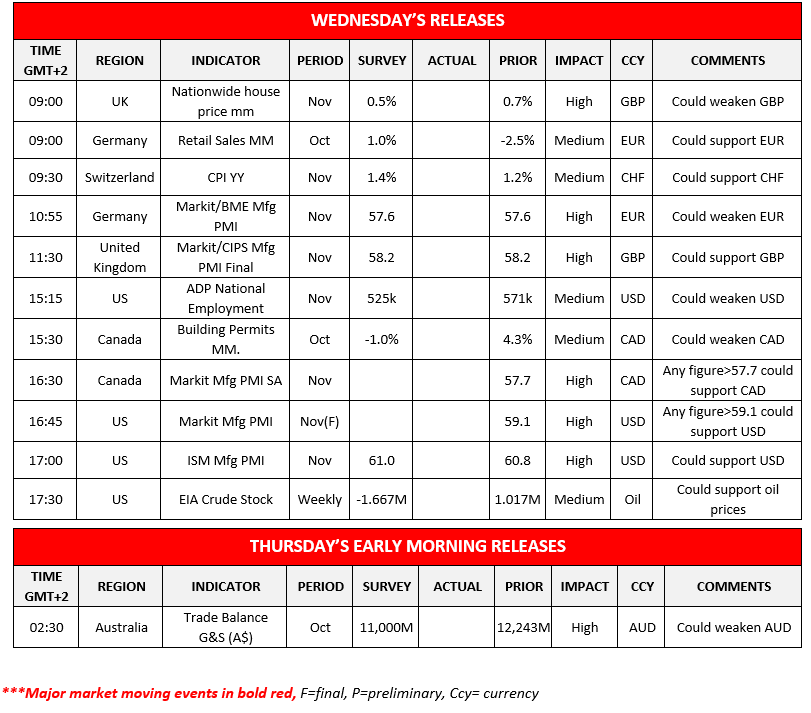
Besides the financial releases allready mentioned we would also like to note in the European session UK’s Nationwide House prices for November, Germany’s retail sales for October, Switzerland’s CPI rates for November and Germany’s as well as UK’s final manufacturing PMI figures for November. In the American session, we get from Canada the building permits growth rate for October and the manufacturing PMI figure for November. During tomorrow’s Asian session we note the release of Australia’s trade data for October
USD Index H4 Chart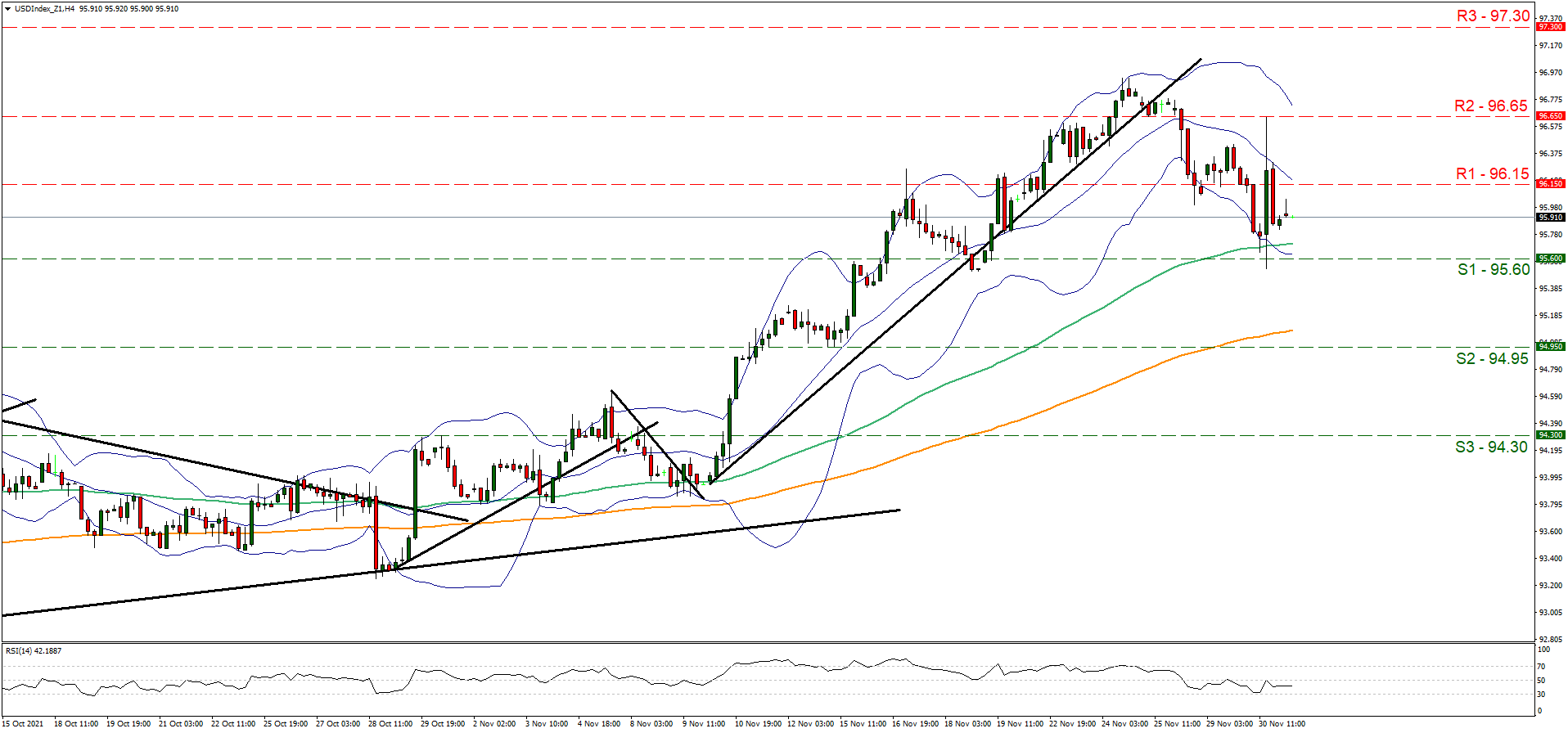
Support: 95.60 (S1), 94.95 (S2), 94.30 (S3)
Resistance: 96.15 (R1), 96.65 (R2), 97.30 (R3)
WTI H4 Chart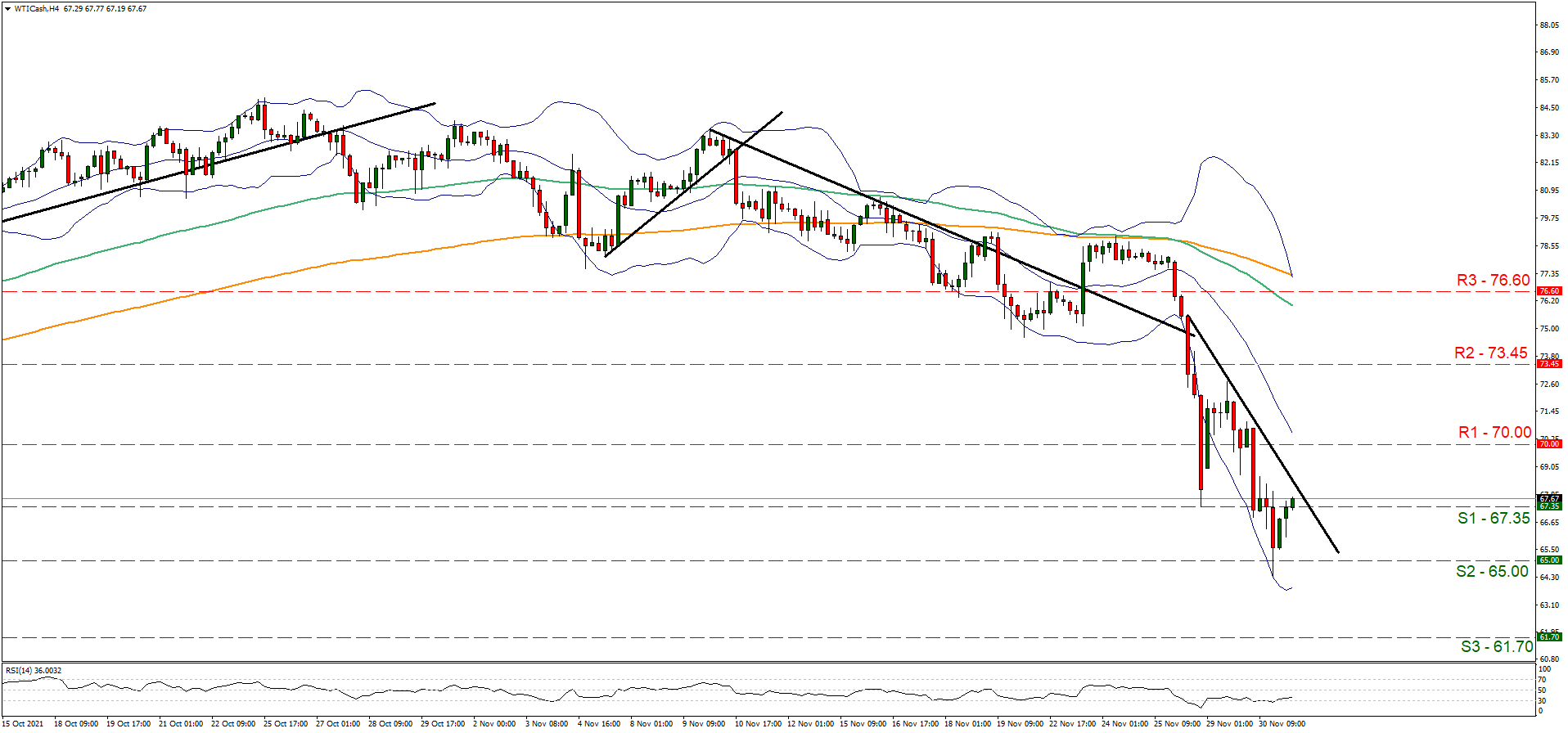
Support:67.35 (S1), 65.00 (S2), 61.70 (S3)
Resistance: 70.00 (R1), 73.45 (R2), 76.60 (R3)
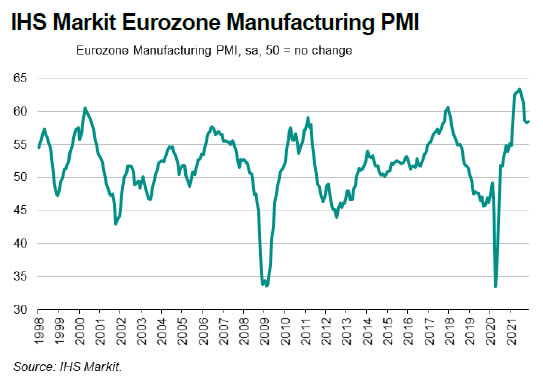
Eurozone PMI manufacturing finalized at 58.4 in Nov, strong headline reading masks tough business conditions
Eurozone PMI Manufacturing was finalized at 58.4 in November, slightly up from October's 58.3. Markit said stocks of purchases rose at strongest rate on record as firmed built safety buffers. Output price inflation hit fresh record while supplier performance deteriorated rapidly once again.
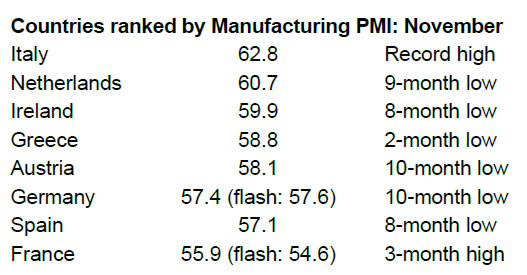
Looking as some member states, Italy PMI manufacturing rose to record high at 62.8. Others, except France at 55.9 (3-month high), dropped, but readings remained high, including the Netherlands at 60.7 (9-month low), Ireland at 59.9 (8-month low), Greece at 58.8 (2-month low), Austria at 58.1 (10-month low), Germany at 57.4 (10-month low), and Spain at 57.1 (8-month low).
Chris Williamson, Chief Business Economist at IHS Markit said:
"A strong headline PMI reading masks just how tough business conditions are for manufacturers at the moment. Although demand remains strong, as witnessed by a further solid improvement in new order inflows, supply chains continue to deteriorate at a worrying rate. Shortages of inputs have restricted production growth so far in the fourth quarter to the weakest seen over the past year and a half...
"... Looking ahead, rising COVID-19 infection rates cast a darkening cloud over the near-term outlook, threatening to further disrupt supply chains while at the same time diverting spending from consumer services to consumer goods again, therefore worsening the imbalance of supply and demand."