

Sample Category Title
Franc and Yen Softer in Consolidations, Gold Presses Channel Support
Global stock markets are recovering slightly today, continuing to stabilize from Omicron worries for now. Major currency pairs are also bounded in consolidative trading in tight range. While Aussie is trying to lead commodity currencies higher, it's lacking clear upside momentum. Swiss Franc and Yen are the softer ones followed by Euro and Dollar.
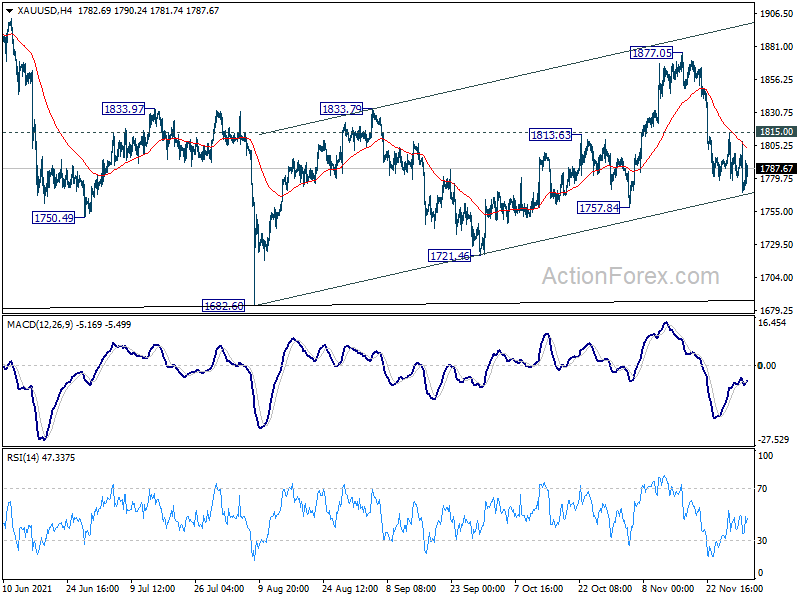
Technically, trading in Gold is also sluggish. Near term channel support appears to be providing a floor for now. Yet, there is no strength for a rebound. Gold's decline from 1877.05 could re-accelerate if the support zone between 1757.84 and the channel support is taken out decisively. In the case, we might see a test on 1700 handle quickly. But a break of 1815 resistance will bring stronger rebound back towards 1877.05 resistance instead. The next move might be accompanied by a move in Dollar in the opposite direction.
In Europe, at the time of writing, FTSE is up 1.33%. DAX is up 1.87%. CAC is up 1.76%. Germany 10-year yield is up 0.025 at -0.324. Earlier in Asia, Nikkei rose 0.41%. Hong Kong HSI rose 0.78%. China Shanghai SSE rose 0.36%. Singapore Strait Times rose 1.87%. Japan 10-year JGB yield rose 0.0081 to 0.067.
US ADP jobs grew 534k in Dec, recovery continued to power through its challenges
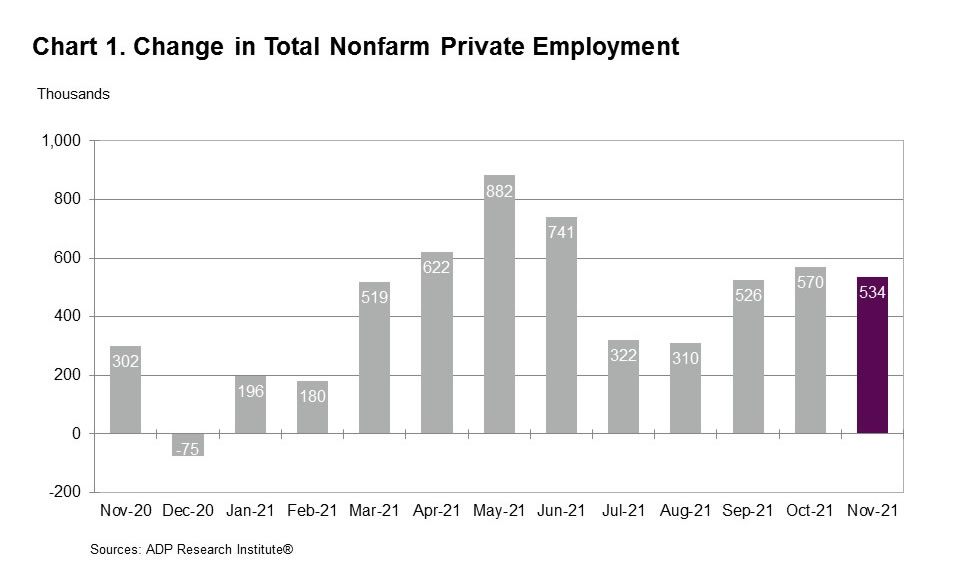
US ADP private employment grew 534k in December, slightly above expectation of 525k. By company size, small businesses job grew 115k, medium businesses grew 142k, large businesses grew 277. By sector, goods-producing jobs grew 110k, service-providing jobs grew 424k.
"The labor market recovery continued to power through its challenges last month," said Nela Richardson, chief economist, ADP. "November's job gains bring the three month average to 543,000 monthly jobs added, a modest uptick from the job pace earlier this year. Job gains have eclipsed 15 million since the recovery began, though 5 million jobs short of pre-pandemic levels. Service providers, which are more vulnerable to the pandemic, have dominated job gains this year. It's too early to tell if the Omicron variant could potentially slow the jobs recovery in coming months."
UK PMI manufacturing finalized at 58.1 in Nov, but industry in a vulnerable position
UK PMI Manufacturing was finalized at 58.1 in November, up from October's 57.8, hitting a 3-month high. Markit said output growth edged higher as domestic order intakes rose. New export business fell for the third straight month.
Rob Dobson, Director at IHS Markit, said: "The current mix of supply-side constraints, cost increases, skill shortages and rising demand for labour will add to the expectations of an imminent rate increase by the central bank, but the survey highlights how the subdued rate of manufacturing growth and export decline leaves industry in a vulnerable position to any new headwinds, not least the Omicron variant."
Eurozone PMI manufacturing finalized at 58.4 in Nov, strong headline reading masks tough business conditions
Eurozone PMI Manufacturing was finalized at 58.4 in November, slightly up from October's 58.3. Markit said stocks of purchases rose at strongest rate on record as firmed built safety buffers. Output price inflation hit fresh record while supplier performance deteriorated rapidly once again.
Looking as some member states, Italy PMI manufacturing rose to record high at 62.8. Others, except France at 55.9 (3-month high), dropped, but readings remained high, including the Netherlands at 60.7 (9-month low), Ireland at 59.9 (8-month low), Greece at 58.8 (2-month low), Austria at 58.1 (10-month low), Germany at 57.4 (10-month low), and Spain at 57.1 (8-month low).
Chris Williamson, Chief Business Economist at IHS Markit said: "A strong headline PMI reading masks just how tough business conditions are for manufacturers at the moment. Although demand remains strong, as witnessed by a further solid improvement in new order inflows, supply chains continue to deteriorate at a worrying rate. Shortages of inputs have restricted production growth so far in the fourth quarter to the weakest seen over the past year and a half...
"... Looking ahead, rising COVID-19 infection rates cast a darkening cloud over the near-term outlook, threatening to further disrupt supply chains while at the same time diverting spending from consumer services to consumer goods again, therefore worsening the imbalance of supply and demand."
Germany PMI Manufacturing was finalized at 57.4 in November, down from October's 57.8. Markit noted that input shortages held back output and, to a lesser extent, new orders. Rising energy costs helped drive new record increase in output prices. Business expectations improved for the first time in five months.
France PMI Manufacturing was finalized at 55.9 in November, up from October's 53.6. That's the first increase since May. Markit noted that output volumes were broadly unchanged during the month. Demand improved, but remained subdued amid supply-related constraints. Output price inflation reached new high.
Also released, Germany retail sales dropped -0.3% mom in October versus expectation of 1.0% mom. Swiss CPI jumped to 1.5% yoy in November, up from 1.2% yoy, above expectation of 1.4% yoy. Swiss SVME PMI dropped to 62.5, down from 65.4, below expectation of 64.5.
Australia GDP contracted -1.9% qoq in Q3, back below pre-pandemic level
Australia GDP contracted -1.9% qoq in Q3, better than expectation of -2.7% qoq. Through the year, GDP was up 3.9%.
Acting Head of National Accounts at the ABS, Sean Crick said: "Domestic demand drove the fall, with prolonged lockdowns across NSW, Victoria and the ACT resulting in a substantial decline in household spending.
"The fall in domestic demand was only partly offset by growth in net trade and public sector expenditure. GDP in the September quarter 2021 was 0.2 per cent below the December quarter 2019 pre-pandemic level."
Australia AiG manufacturing rose to 54.8, grew more decisively
Australia AiG Performance of Manufacturing Index rose 4.4 pts to 54.8 in November. Looking at some details, production rose 4.7 to 52.5. Employment rose 2.0 to 50.0. New orders rose 1.0 to 59.3. Supplier deliveries rose 12.2 to 53.4. Input prices dropped -3.5 to 78.3. Selling prices rose 4.2 to 68.1. Average wages dropped -1.3 to 62.4.
Ai Group Chief Executive Innes Willox said: "The Australian manufacturing industry grew more decisively in November after a few flat months during which the south-east corner of the country was held back by the delta outbreaks and associated activity restrictions and while the states and territories tightened barriers to the movement of people."
China Caixin PMI manufacturing dropped to 49.9, recovery not solid
China Caixin PMI Manufacturing dropped from 50.6 to 49.9 in November, below expectation of 50.5. Caixin added that output rose for the first time in four months as power supply issues unwound. But total new orders fell slightly. Inflationary pressures eased markedly.
Wang Zhe, Senior Economist at Caixin Insight Group said: "To sum up, the manufacturing sector remained stable overall in November. Increased downward pressure and easing inflationary pressure were prominent features of the economic situation.... After the shortage of power was alleviated, the supply side began to recover. But due to weak demand, the supply recovery was limited, and the foundation of the recovery was not solid."
BoJ Adachi: Concern over spread of a new variant is increasing
BoJ board member Seiji Adachi said in a speech, the number of new coronavirus case in Japan is seeing "great improvement", with weekly average decline to a "considerable extent recently". However, "the situation warrants careful attention, as concern over the spread of a new variant is increasing at the moment."
He added BoJ will "closely monitor the impact of COVID-19 and will not hesitate to take additional easing measures if necessary, with a view to supporting firms' ability to sustain their businesses",
"If the number of COVID- 19 cases resurges and it once again becomes inevitable to have public health measures in place, for example, it could become necessary to support corporate financing."
"The role of the COVID-19 Special Operations largely depends on developments relative to the pandemic, so it is necessary to assess such developments and their impact on corporate financing when deliberating on the next steps."
Japan PMI manufacturing finalized at 54.5 in Nov
Japan PMI Manufacturing was finalized at 54.5 in November, up from October's 53.2. That's the best reading since January 2018, and the 10th consecutive month of overall growth. Markit noted that output and new orders rose at faster rates. There was sharp rise in cost burdens amid sustained supply chain disruption. Businesses reported strong optimism regarding future output.
Also released, capital spending rose 1.2% in Q3 versus expectation of 2.7%.
USD/CHF Mid-Day Outlook
Daily Pivots: (S1) 0.9139; (P) 0.9203; (R1) 0.9248; More....
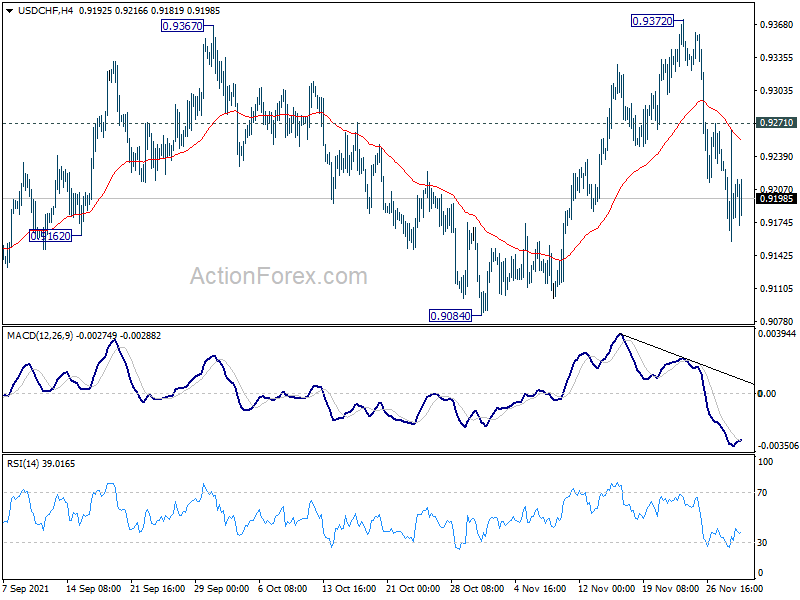
Further decline remains in favor in USD/CHF with 0.9271 minor resistance intact. Fall from 0.9372 would target 0.9084 support. Firm break there will argue that choppy rise from 0.8925 has completed, and fall from 0.9471 is resuming. Deeper decline would be seen through 0.8925. Nevertheless, break of 0.9271 will turn bias back to the upside for retesting 0.9372.
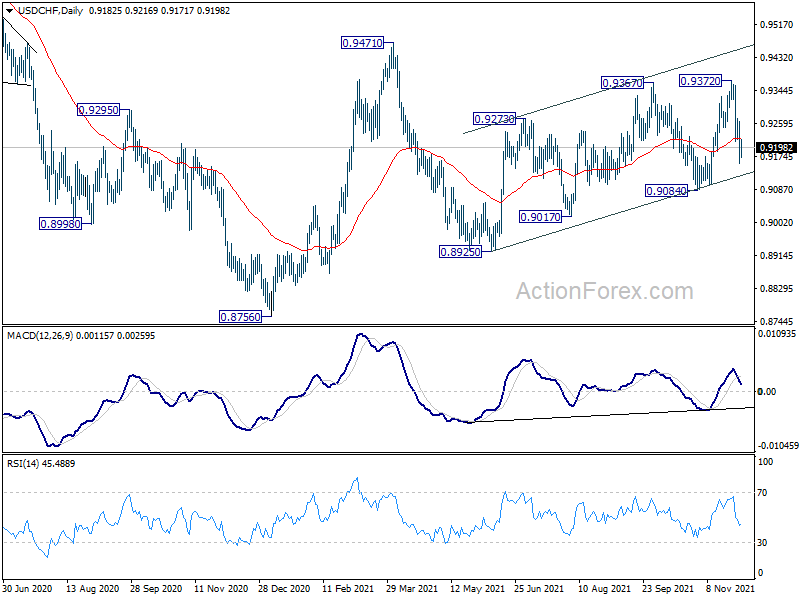
In the bigger picture, the corrective structure of the rebound from 0.8925 argues that fall from 0.9471 is not complete yet. It could either be the second leg of pattern from 0.8756 (2021 low), or resuming larger down trend from 1.0237 (2018 high). We'd pay attention to the downside momentum and assess the odds later. But for now, medium term outlook will be neutral at best as long as 0.9471 resistance holds.
Economic Indicators Update
| GMT | Ccy | Events | Actual | Forecast | Previous | Revised |
|---|---|---|---|---|---|---|
| 21:30 | AUD | AiG Performance of Manufacturing Index Nov | 54.8 | 50.4 | ||
| 21:45 | NZD | Building Permits M/M Oct | -2.00% | -1.90% | -2.00% | |
| 23:50 | JPY | Capital Spending Q3 | 1.20% | 2.70% | 5.30% | |
| 00:01 | GBP | BRC Shop Price Index Y/Y Oct | 0.30% | -0.40% | ||
| 00:30 | AUD | GDP Q/Q Q3 | -1.90% | -2.70% | 0.70% | |
| 00:30 | JPY | Manufacturing PMI Nov F | 54.5 | 54.2 | 54.2 | |
| 01:45 | CNY | Caixin Manufacturing PMI Nov | 49.9 | 50.5 | 50.6 | |
| 07:00 | EUR | Germany Retail Sales M/M Oct | -0.30% | 1.00% | -2.50% | -1.90% |
| 07:30 | CHF | CPI M/M Nov | 0.00% | -0.10% | 0.30% | |
| 07:30 | CHF | CPI Y/Y Nov | 1.50% | 1.40% | 1.20% | |
| 08:30 | CHF | SVME PMI Nov | 62.5 | 64.5 | 65.4 | |
| 08:45 | EUR | Italy Manufacturing PMI Nov | 62.8 | 61 | 61.1 | |
| 08:50 | EUR | France Manufacturing PMI Nov F | 55.9 | 54.6 | 54.6 | |
| 08:55 | EUR | Germany Manufacturing PMI Nov F | 57.4 | 57.6 | 57.6 | |
| 09:00 | EUR | Eurozone Manufacturing PMI Nov F | 58.4 | 58.6 | 58.6 | |
| 09:30 | GBP | Manufacturing PMI Nov F | 58.1 | 58.2 | 58.2 | |
| 13:15 | USD | ADP Employment Change Nov | 534K | 525K | 571K | 570K |
| 13:30 | CAD | Building Permits M/M Oct | 1.30% | 0.10% | 4.30% | |
| 14:30 | CAD | Manufacturing PMI Nov | 57.7 | |||
| 14:45 | USD | Manufacturing PMI Nov F | 59.1 | 59.1 | ||
| 15:00 | USD | ISM Manufacturing PMI Nov | 61 | 60.8 | ||
| 15:00 | USD | ISM Manufacturing Prices Paid Nov | 86 | 85.7 | ||
| 15:00 | USD | ISM Manufacturing Employment Index Nov | 52 | |||
| 15:00 | USD | Construction Spending M/M Oct | 0.40% | -0.50% | ||
| 15:30 | USD | Crude Oil Inventories | -1.5M | 1.0M | ||
| 19:00 | USD | Fed's Beige Book |
US ADP jobs grew 534k in Dec, recovery continued to power through its challenges
US ADP private employment grew 534k in December, slightly above expectation of 525k. By company size, small businesses job grew 115k, medium businesses grew 142k, large businesses grew 277. By sector, goods-producing jobs grew 110k, service-providing jobs grew 424k.
"The labor market recovery continued to power through its challenges last month," said Nela Richardson, chief economist, ADP. "November's job gains bring the three month average to 543,000 monthly jobs added, a modest uptick from the job pace earlier this year. Job gains have eclipsed 15 million since the recovery began, though 5 million jobs short of pre-pandemic levels. Service providers, which are more vulnerable to the pandemic, have dominated job gains this year. It's too early to tell if the Omicron variant could potentially slow the jobs recovery in coming months."
Australian Dollar Recovers Despite Soft GDP
Australian GDP declines in Q3
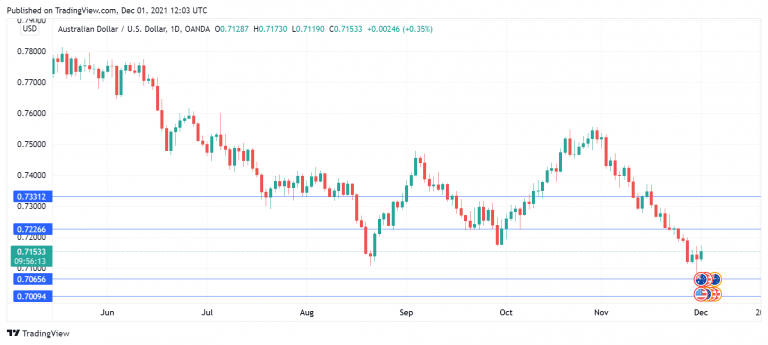
After touching a 13-month low on Tuesday, the Australian dollar has reversed directions and moved higher. In the European session, AUD/USD is trading at 0.7155, up 0.37% on the day.
The Aussie is in positive territory despite a weak GDP for the third quarter. Investors were clearly relieved that the decline of -1.90% q/q was much better than the consensus of -2.70%. This suggests that the Q3 lockdowns due to the spike in Covid cases did not cause as great a downturn as expected. There are encouraging signs that Q4 growth will rebound. House prices rose for a 14th successive month, and the Manufacturing PMI improved in November, rising from 54.8, up from 50.4 beforehand.
Fed Chair Jerome Powell showed a hawkish side in his testimony before a Senate committee. Powell retired the word “transitory” from his description of inflation, a label that the markets essentially threw in the dustbin months ago. Powell stated that FOMC members would discuss accelerating the unwinding of the taper scheme at the December meeting. The abrupt change in stance by Powell has added to the uncertainty in the markets, which have been shaken by the spread of the Omicron variant of Covid.
Powell’s remarks on the Hill appear to indicate a slight narrowing of the gap between the Fed’s view and market expectations. The markets expect an acceleration of tapering in January, with Goldman Sachs stating in a note last week that it expects a doubling of the trim, from USD 15 billion to 30 billion. The Fed is nowhere near the market pricing of three rate hikes in 2022, but if inflation remains red-hot, we can expect Powell to signal that the Fed is prepared to raise rates next year. With the Fed signalling further tightening, the dollar outlook for early 2022 is a bright one.
AUD/USD Technical
- There are resistance lines at 0.7226 and 0.7331
- AUD/USD is testing support at 0.7065. Below, there is support at 0.7009, which is protecting the symbolic 70 level
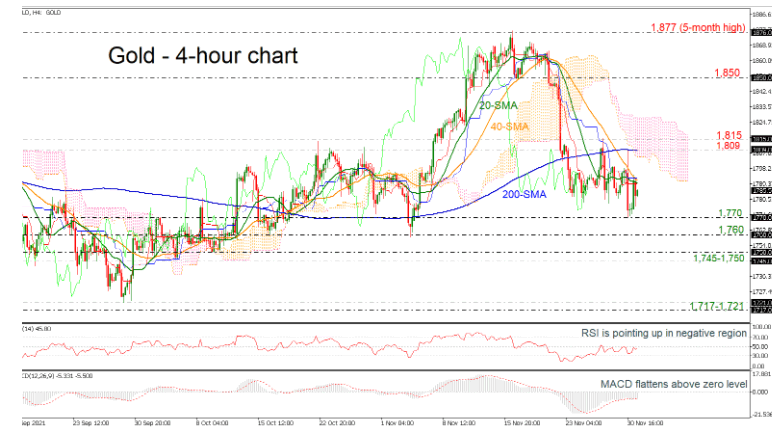
Gold Battles With 200-Period SMA Below 1,800
Gold prices could not find enough buyers to overcome the 200-period simple moving average (SMA), with the spotlight remaining on the $1,800 mark.
Encouragingly however, the RSI and the MACD continue to hold above their recent lows, while the latter has also managed to crawl back above its trigger line, providing some optimism that the bulls may not give up the battle yet.
The 1,790 level, where the 20-period SMA has converged, could challenge any bullish attempts towards the 1,809-1,815 area. Hence, any breakout at this point may gather extra interest, with the price likely speeding up to 1,850 in the aftermath. The five-month high of 1,877 could come on the radar next, though only a rally above the 1,916 top can boost buying confidence in the medium- and long-term picture.
Alternatively, an extension below 1,770 will strengthen the case for a down-trending market, likely activating a fresh bearish wave towards the 1,760 and 1,745-1,750 zone. Failure to hold above that floor could cause another negative extension towards the four-month-old 1,717 restrictive region.
In brief, although the fresh decline from 1,877 has downgraded the short-term outlook to slightly bearish, upside corrections cannot be ruled out in the near term according to the technical indicators.
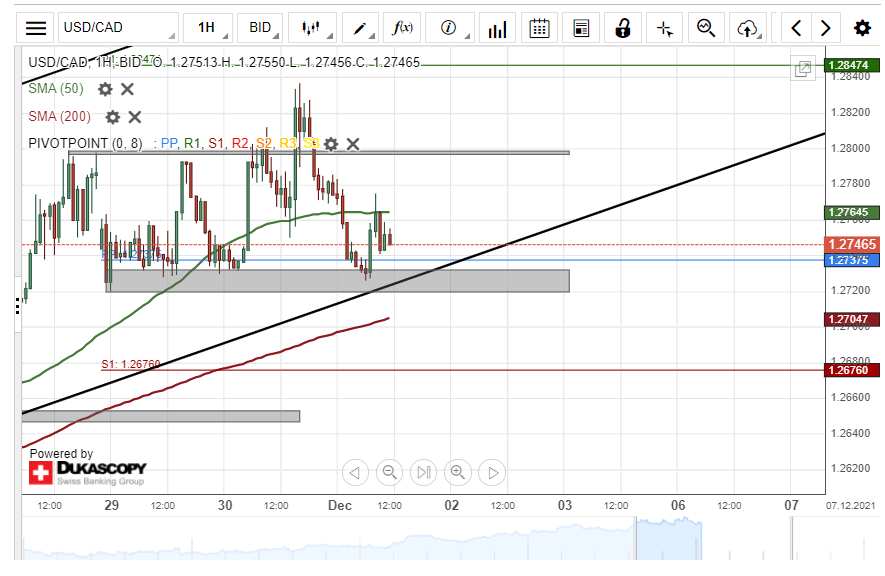
USD/CAD Returns To Support Zone
Despite almost touching the 1.2840 high level, the USD/CAD retreated and returned to the support of the 1.2720/1.2732 zone. On Wednesday, the rate was finding support in the zone, as a recovery was possible.
A potential recovery of the USD/CAD would most likely encounter resistance in the 50-hour simple moving average near 1.2765 and the 1.2800 level. Above these levels, the rate could once again find resistance in the 1.2840 mark.
Meanwhile, a decline of the rate would have to pass the combination of the 1.2720/1.2732 zone, the weekly simple pivot point at 1.2738 , the lower trend line of the channel up pattern that has guided the pair throughout November and the 200-hour simple moving average near 1.2700.
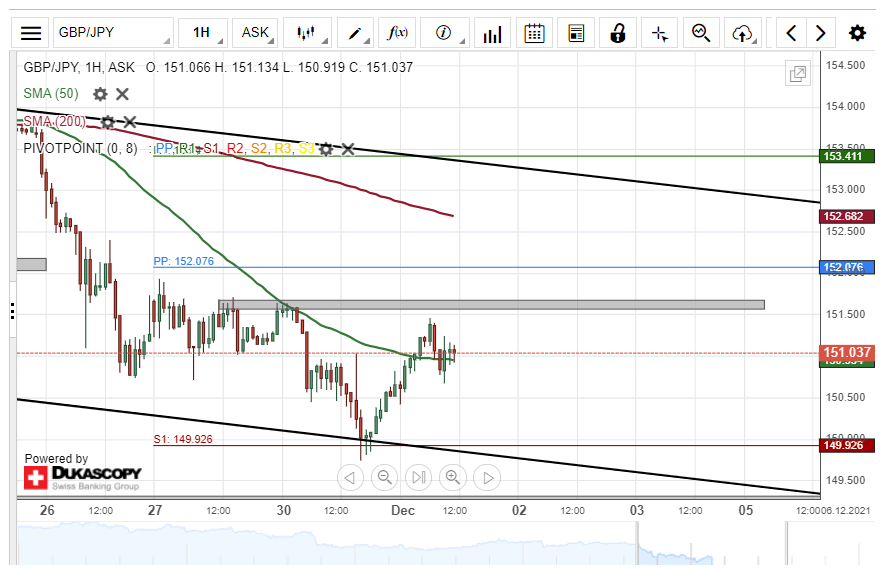
GBP/JPY Respects Dominant Pattern
The GBP/JPY has bounced off the combination of the 150.00 mark, the weekly S1 simple pivot point at 149.93 and the lower trend line of the large scale channel down pattern, which has guided the rate since the middle of October. The event was followed up by a surge, which on Wednesday almost touched the 151.50 mark.
In the case that the rate passes the resistance of the 151.50 level, the 152.00 mark could be reached. Note that the 152.00 level's resistance was being strengthened by the weekly simple pivot point at 152.08. Above the 152.00 mark, note the 200-hour simple moving average near 152.65.
However, a decline of the GBP/JPY currency exchange rate might find support at 150.50 before once again reaching the 150.00 level and the weekly S2 simple pivot point.
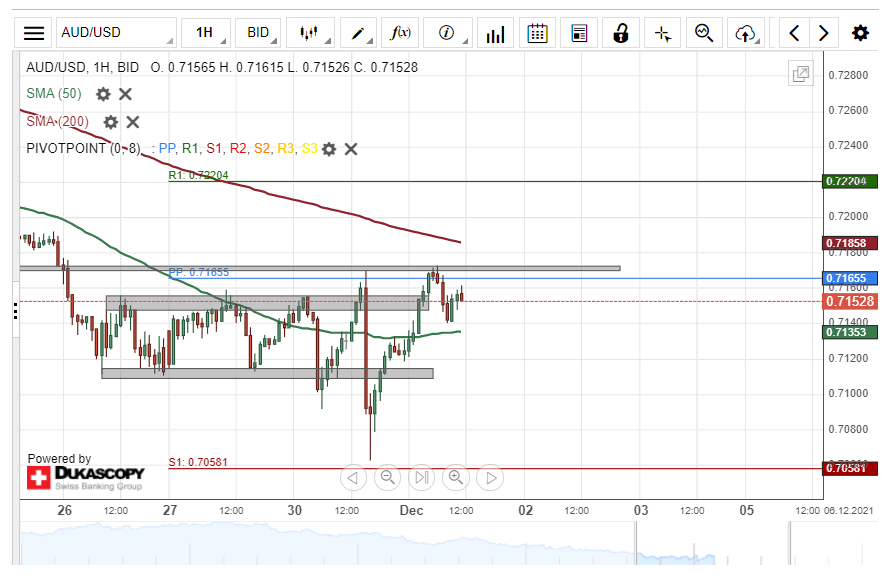
AUD/USD Tests Resistance Zone
Despite the sharp drop on Tuesday, the AUD/USD currency exchange rate recovered. By the middle of Wednesday's European trading hours, the currency exchange rate had reached the resistance zone at 0.7170/0.7173. In the meantime, it was spotted that the rate was finding support in the 0.7140 level, which was supported by the 50-hour simple moving average.
A surge above the resistance zone might almost immediately find resistance in the 200-hour simple moving average at 0.7185. Above the SMA, the 0.7200 mark and the weekly R1 simple pivot point at 0.7220 might act as resistance.
On the other hand, a decline would have to pass the 0.7140 mark and the 50-hour simple moving average. A passing of the 0.7140 mark could result in the rate reaching previous low levels at 0.7100 and 0.7060.
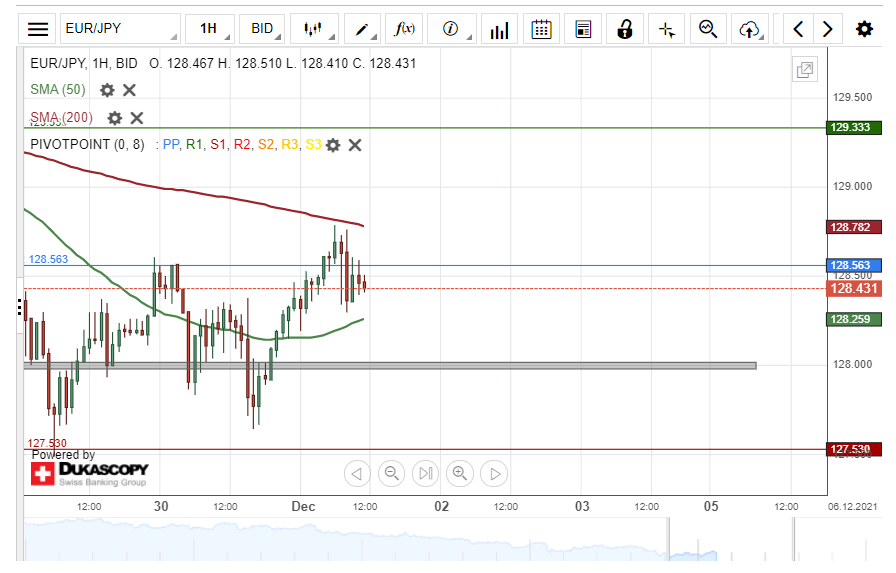
EUR/JPY Trades Between SMAS
During the second part of Tuesday's trading, the EUR/JPY currency exchange rate ignored technical levels and previously notable round exchange rates. It ended doing so on Wednesday, when the pair respected the support of the 50-hour simple moving average and the resistance of the 200-hour simple moving average.
If the rate passes the support of the 50-hour SMA, the pair could decline. Potential support could be found in the 128.00 and 127.50 levels. However, note that the 128.00 mark was ignored during Tuesday's trading.
On the other hand, a breaking of the 200-hour simple moving average might result in the rate reaching the weekly R1 simple pivot point at 129.33. Although, the 129.00 level might provide resistance to a potential surge.
Elliott Wave Analysis: EUR/USD Approaches Trendline Resistance
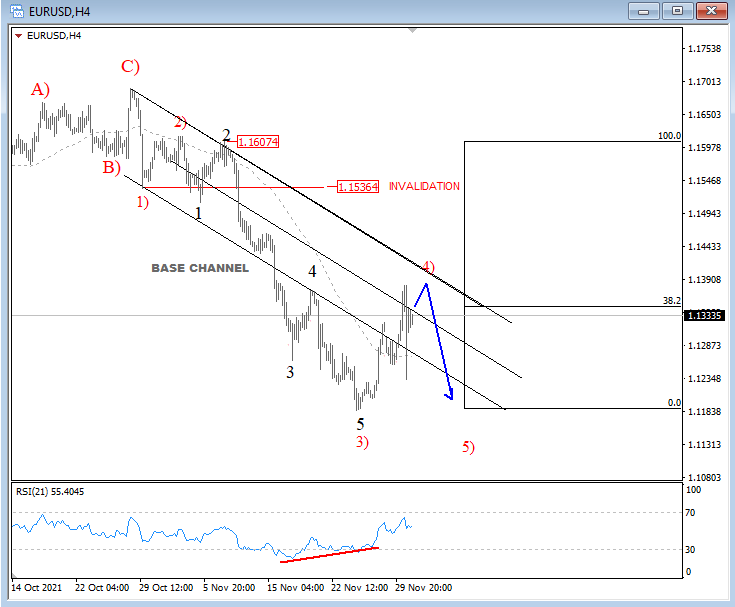
Powell speech, end-of-the-month position adjustments, and covid news have shaken the markets quite nicely this week. We have seen some sharp intraday drop yesterday on US stock market while the USD rallied before it bottomed later in the session. However, the EURUSD is still tapped in a 200 pip range so wave 4) can still in underway.
EURUSD is trying to stabilize after a recent sharp sell-off from 1.1600 that we see as an extended wave 3) that belongs to the ongoing bearish impulse which may resume after a current rally. We see that rally as wave 4) which is now at the resistance zone here around 1.1370, near 38.2%, and an upper trendline that should stay in place to keep bearish trend in play.
EUR/USD 4h Elliott Wave analysis
The Analytical Overview Of The Main Currency Pairs
The EUR/USD currency pair
Technical indicators of the currency pair:
Prev Open: 1.1287
Prev Close: 1.1338
% chg. over the last day: +0.45%
Eurozone annual inflation accelerated to 4.9% in November from 4.1%, it’s well above the 4.5% forecast and above the ECB's target. Pressure is now building on the ECB on future monetary stimulus, as the ECB initially did not plan to cut the PEPP program until spring 2022.
Trading recommendations
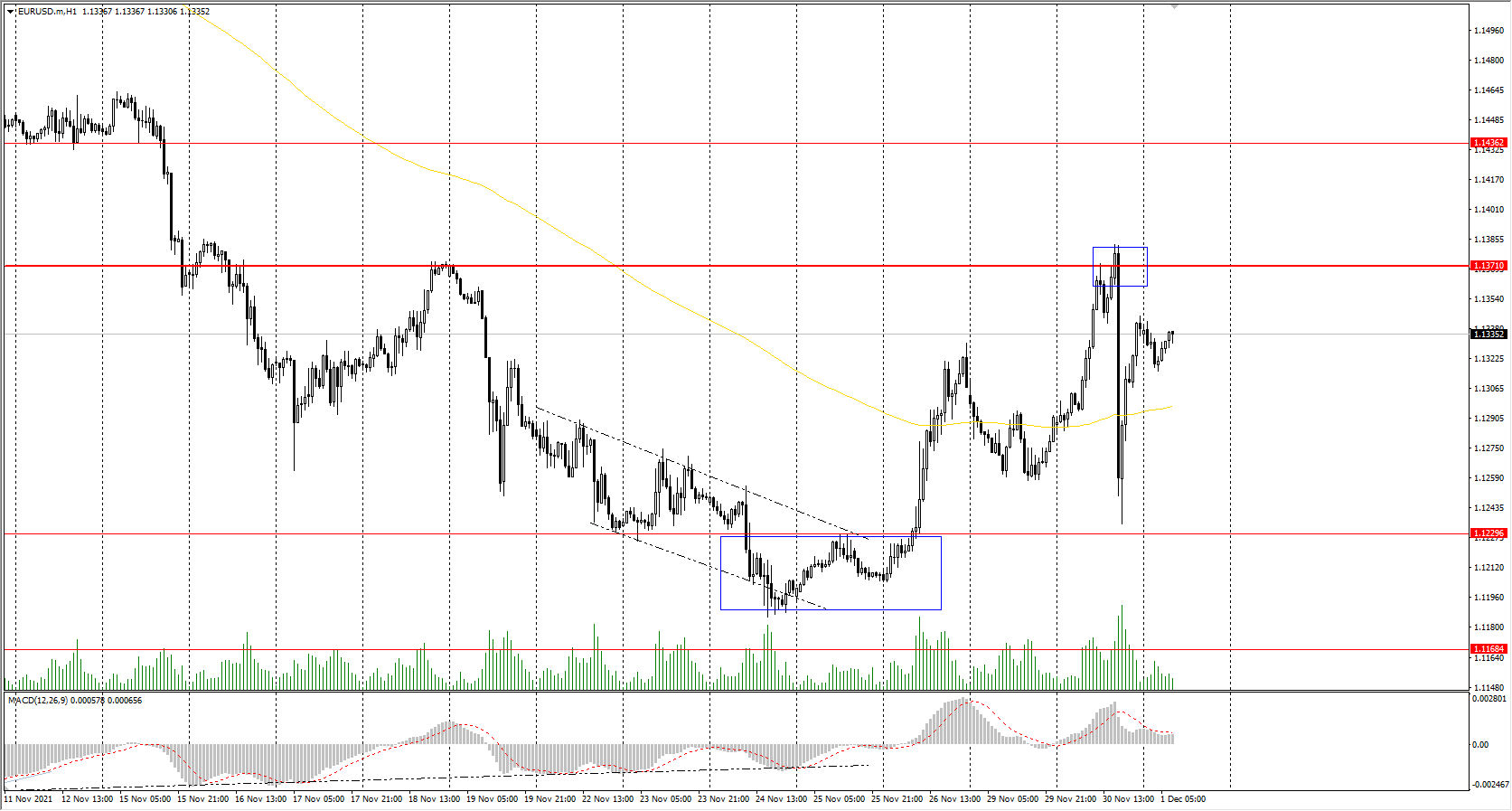
Support levels: 1.1230, 1.1168
Resistance levels: 1.1350, 1.1436, 1.1535, 1.1613, 1.1667, 1.1717
From a technical point of view, the EUR/USD on the hour time frame is still bearish, but yesterday the price made an attempt to break out of the priority change level but failed to consolidate above. The MACD indicator became inactive. Under such market conditions, traders should consider sell positions from the priority change level of 1.1371. Buy trades should be considered only from the support levels of the higher time frame, given the buyers’ initiative, but only with short targets.
Alternative scenario: if the price breaks out through the 1.1371 resistance level and fixes above, the mid-term uptrend will likely resume.
News feed for 2021.12.01:
- German Retail Sales (m/m) at 09:00 (GMT+2);
- German Manufacturing PMI (m/m) at 10:55 (GMT+2);
- Eurozone Manufacturing PMI (m/m) at 11:00 (GMT+2);
- US ADP Nonfarm Employment Change (m/m) at 15:15 (GMT+2);
- US ISM Manufacturing PMI (m/m) at 17:00 (GMT+2);
- US Fed Chair Powell Testifies at 17:00 (GMT+2);
- US Treasury Secretary Yellen Speaks at 17:00 (GMT+2).
The GBP/USD currency pair
Technical indicators of the currency pair:
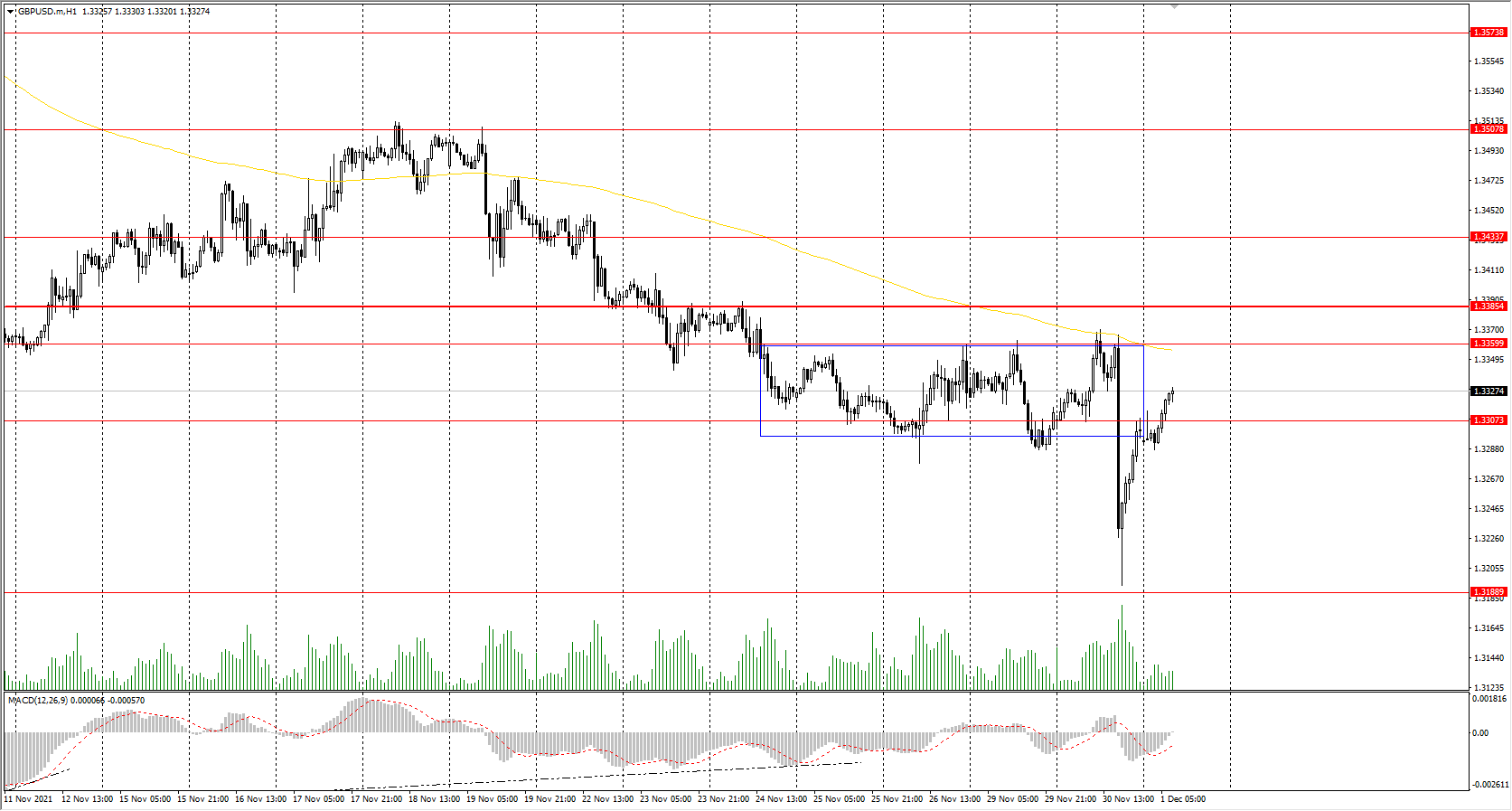
Prev Open: 1.3307
Prev Close: 1.3301
% chg. over the last day: -0.05%
After analysts reduced their forecasts on the Bank of England rate hike, the British pound lost some ground against the Euro. But unlike the ECB, the Bank of England plans to raise the rate soon, so fundamentally, the British pound can quickly strengthen.
Trading recommendations
Support levels: 1.3307
Resistance levels: 1.3360, 1.3434, 1.3507, 1.3575, 1.3685, 1.3748
On the hourly time frame, the trend on GBP/USD is bearish. The MACD indicator has become inactive but is still signaling divergence on several time frames. Under such market conditions, traders should consider sell positions from the resistance levels around the moving average. Buy trades should be considered on the support levels of higher time frames, given the buyers’ initiative.
Alternative scenario: if the price breaks out through the 1.3385 resistance level and consolidates above, the bullish scenario will likely resume.
News feed for 2021.12.01:
- UK Manufacturing PMI (m/m) at 11:30 (GMT+2);
- UK BoE Gov Bailey’s Speech at 16:00 (GMT+2).
The USD/JPY currency pair
Technical indicators of the currency pair:
Prev Open: 13.51
Prev Close: 113.18
% chg. over the last day: -0.29%
Japan's manufacturing PMI index shows growth, indicating a gradual recovery from the pandemic. The Japanese Yen at the moment does not have any fundamental factors for strengthening in the mid-term prospect, so analysts expect the growth of USD/JPY quotes at least till the spring of the next year.
Trading recommendations
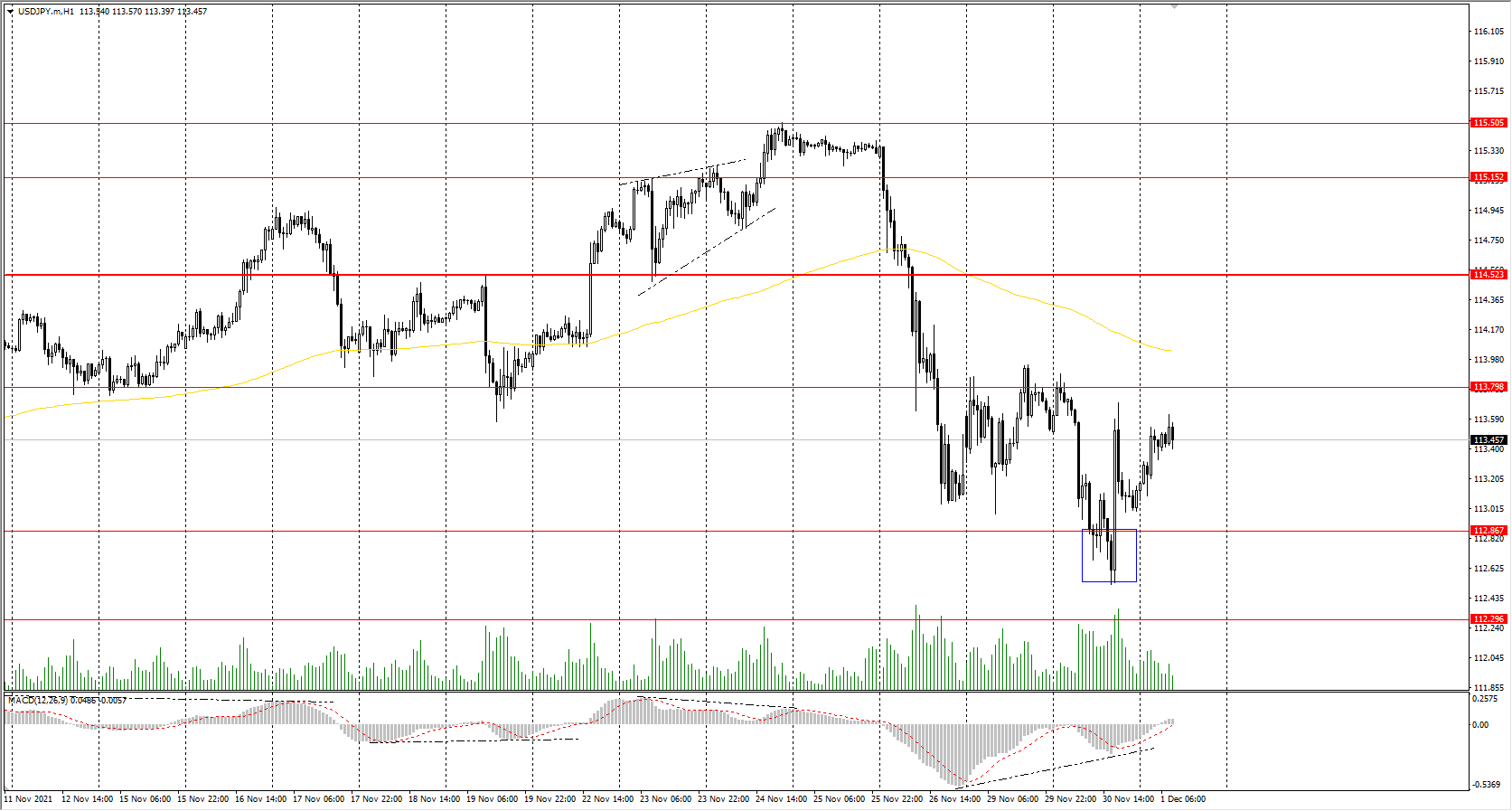
Support levels: 112.87, 112.30
Resistance levels: 113.79, 114.48, 115.15, 115.50
The global trend on the USD/JPY currency pair is bearish. At the moment, the price is trading in the corridor with the 112.87-113.79 range. Under such market conditions, it is best for traders to look for sell positions from the resistance levels around the moving average or from the upper border of the corridor. Buy positions should be considered from the false breakdown zone formed yesterday when the price tried to move down.
Alternative scenario: if the price rises above 114.52, the uptrend will likely resume.
News feed for 2021.12.01:
- Japan Manufacturing PMI (m/m) at 02:30 (GMT+2).
The USD/CAD currency pair
Technical indicators of the currency pair:
Prev Open: 1.2736
Prev Close: 1.2777
% chg. over the last day: +0.32%
Oil prices continue to decline amid news that a new variant of the Omicron virus is resistant to vaccines, adding to fears that there could be an excess of supply in the first quarter of next year. The Canadian dollar is a commodity currency, so the CAD is falling sharply against the dollar amid a drop in oil.
Trading recommendations
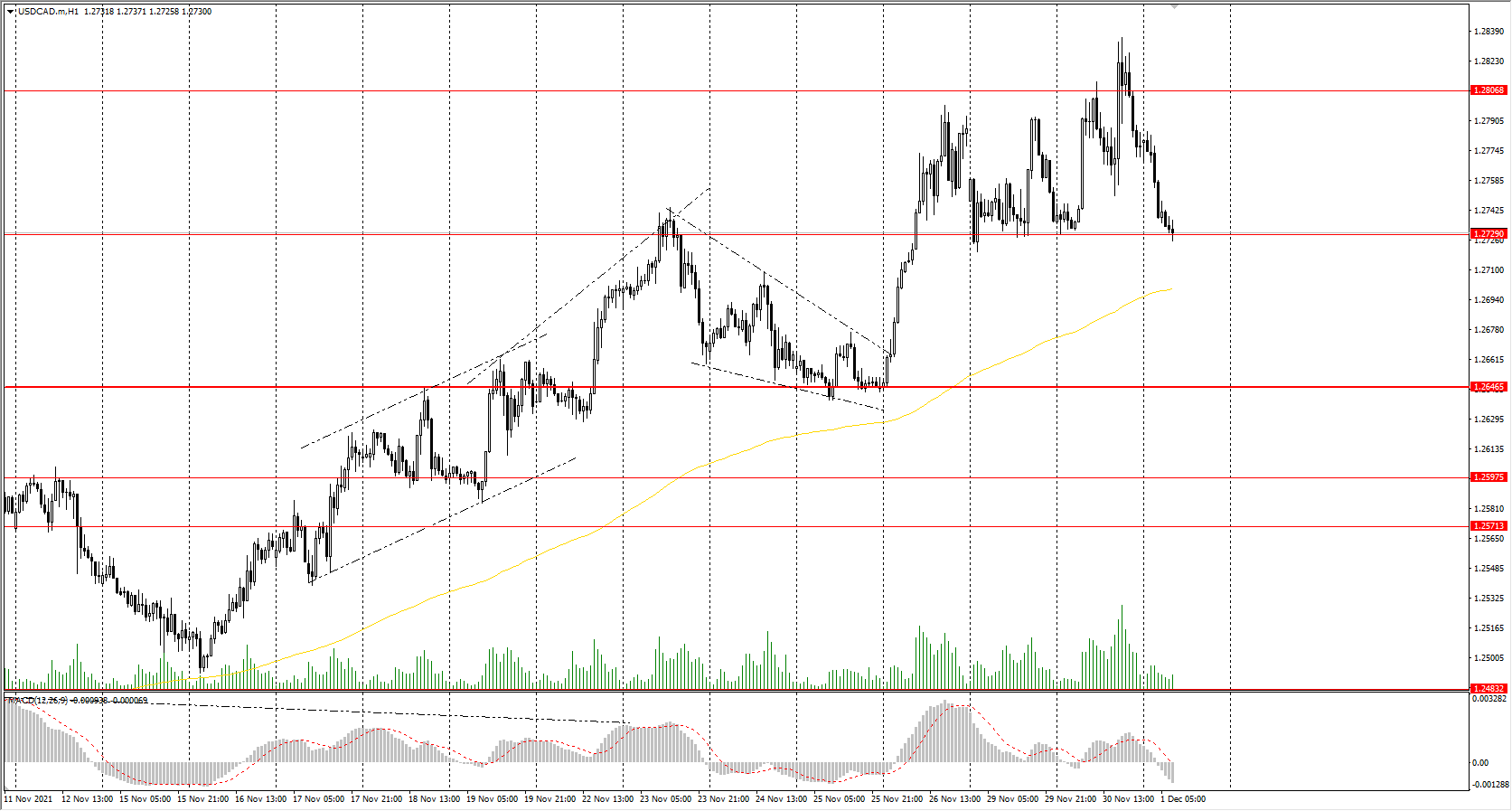
Support levels: 1.2729, 1.2646, 1.2598, 1.2571, 1.2483, 1.2416, 1.2388
Resistance levels: 1.2807
From a technical point of view, the trend of the USD/CAD currency is bullish. The MACD indicator has become inactive, but buyer pressure remains high. Under such market conditions, it is better to look for buy trades from the lower border of the flat corridor. Sell deals should be considered from the resistance levels of the higher time frames.
Alternative scenario: if the price breaks down through the 1.2646 support level and fixes below, the downtrend will likely resume.
News feed for 2021.12.01:
- Canada Building Permits (m/m) at 15:30 (GMT+2)
- US Crude Oil Reserves (w/w) at 17:30 (GMT+2).