Sample Category Title
US Crude Oil Inventory Dropped Less than Expected. Price Continued to Fall on Omicron Concerns
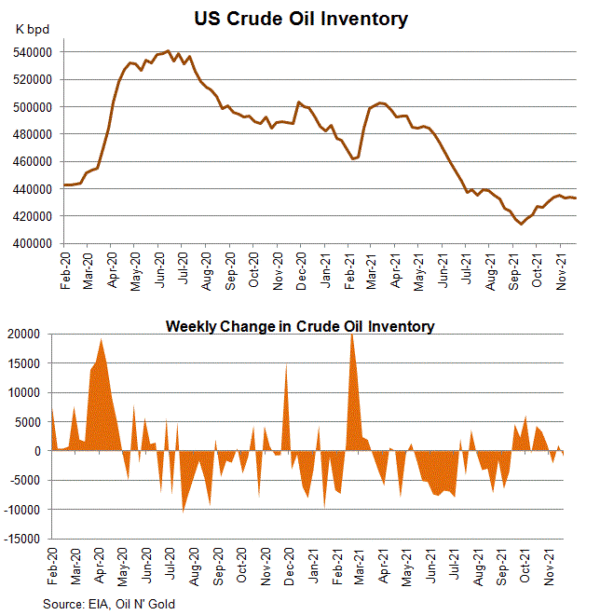
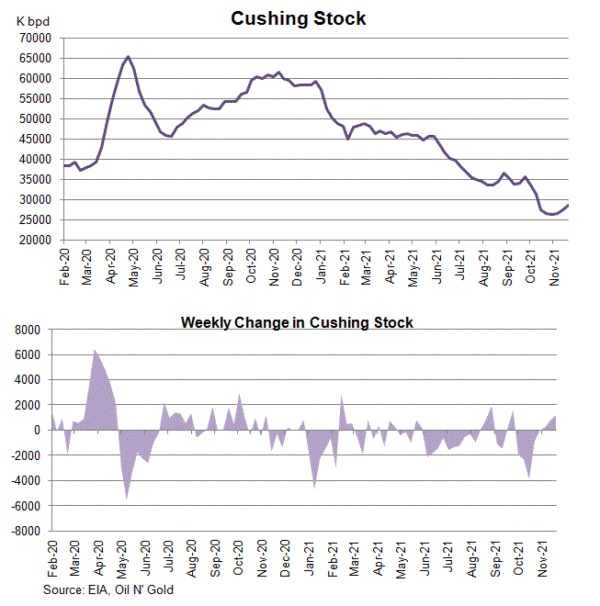
The report from the US Energy Information Administration (EIA) shows that total crude oil and petroleum products (ex. SPR) stocks rose +4.27 mmb to 1222.16 mmb in the week ended November 26. Crude oil inventory dropped -0.91 mmb to 433 mmb, compared with consensus of a -1.24 mmb decrease. Inventory increased in 3 out of 5 PADDs. For instance, PADD 3 (Gulf Coast) fell -2.81 mmb during the week. Cushing stock added +1.16 mmb to 28.54. Utilization rate added +0.2 percentage points to 88.8% while crude production added +0.1 mmb to 11.6M bpd for the week. Crude oil imports increased -0.178M bpd to 6.6M bpd in the week.
Concerning refined oil product inventories, gasoline inventory gained +4.03 mmb to 215.42 mmb while demand dropped -5.76 % to 8.8M bpd. The market had anticipated a +0.03 mmb growth in stockpile. Production slipped -4.46% to 9.65M bpd while imports soared +33.13% to 0.64M bpd during the week. Distillate stockpile gained +2.16 mmb to 123.88 mmb. The market had anticipated a +0.46 mmb increase. Demand fell -4.14% to 4.21M bpd. Imports slumped -29.52% to 0.23 mmb while production dropped -8.29% to 4.39M bpd during the week.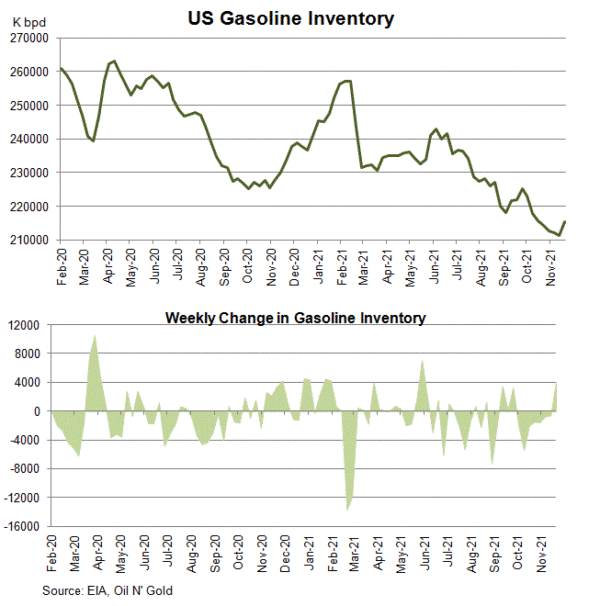
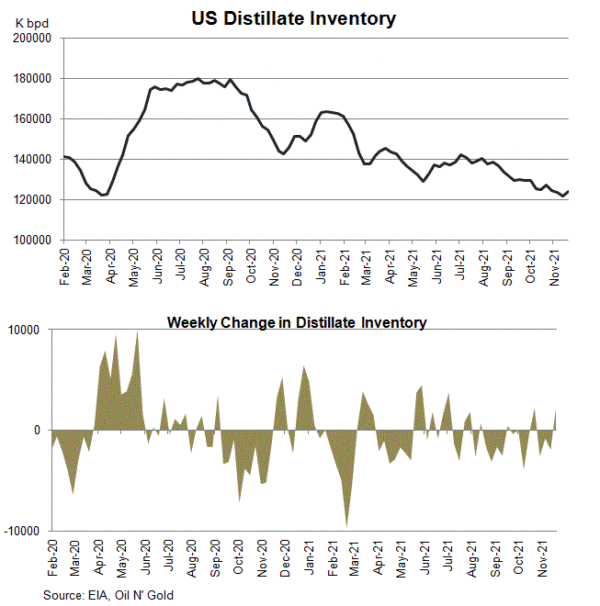
A day earlier, the industry-sponsored API estimated that crude oil inventory slipped -0.75 mmb. Gasoline stockpile rose +2.2 mmb, while that for distillate was up +0.8 mmb.
Sunset Market COmmentary
Markets
Powell’s hawkish pivot before the US Senate yesterday still rippled through markets today. By burying the long-standing “inflation is transitory” narrative, shifting policy priorities from the labour market to inflation and backing a faster taper process, the Fed chair effectively paved the way for a quicker start of the hiking cycle. This rate lift-off could well coincide with the new QE shelf date end Q1 2022. Markets do not price in such a scenario yet but moves yesterday and today are going in that direction. The US yield curve bear flattens with changes at the short end ranging from +2.2 to 4.1 bps. Yields in longer tenors recoup some of yesterday’s whammy with growth fears (Omicron, impact from Fed’s accelerated tightening cycle) at the base of the move yesterday. The US 10y rises 3.4 bps, the 30y adds 2.8 bps. Strong US data may have contributed, comforting some that the economy/labour market is resilient enough to withstand policy normalization. The unofficial ADP jobs report showed employment rose a strong 534k, the third month straight of 500k+. Services as usual accounted for the lion share of job gains (424k). Leisure & hospitality added 136k jobs, professional & business services came in second with 110k, followed by trade, transportation & utilities (78k). The ADP chief economist in a comment did leave some room for uncertainty, saying it is too early to tell if the Omicron variant could slow down the jobs recovery in coming months. European yields mainly followed US peers, lacking other drivers. The European 10y swap yield tested strong 0.1% support in early trading but is currently 1.8bps higher vs. yesterday’s close. German yield changes range from 1.7-3.3 bps across the curve. Peripheral spreads widen 1 to 3 bps with the exception of Greece (-6 bps).
The euro in recent days was in pretty good shape. Heavy risk-off even supported EUR/USD via narrowing (short-term) interest rate differentials. Today is the other way around. Risk sentiment today is considerably better (oil prices up 2.5%, stocks rise 2% and more) but the pair now has to cope with faster rising/recovering US yields. It results in a tie between the euro and the dollar at an unchanged 1.134. The Japanese yen holds up surprisingly well given gains on stock exchanges and in core bond yields. USD/JPY and EUR/JPY barely budged at 113.05 and 128.18 respectively. The same goes for the euro vs the Swiss franc: EUR/CHF is unable to leave behind recent lows just north of 1.04. Sterling trades mixed vs G10 peers but does eke out a small gain against the euro. EUR/GBP slowly drifts south towards the 0.85 big figure. Cable bounces from 1.33 to 1.334.
News Headlines
The CBRT for the first time since 2014 intervened in the FX market to address the ongoing sell-off of the lira. The CBRT justified the move as an act to fight ‘unhealthy price formations’. The amount of the interventions is made public within 2 weeks. Even so, net reserves of the CBRT are limited and it is doubtful that interventions will be big enough to address the issue of a persistent negative real (policy) yield and a lack of confidence in the CBRT’s unconventional policy approach. After a brief intraday gain of about 8 %, the lira currently trades little changed against the euro (EUR/TRY 15.10) and only marginally stronger against the dollar (USD/TRY 1.1332). At least for now, the charts show no trend reversal yet. Historic peak levels in EUR/TRY and USD/TRY are still within reach.
Reuters, referring to sources close to the ECB, reported that a number of ECB policy makers is pondering the scenario of delaying the decision on a part of the ECB stimulus plans beyond the December 16 policy meeting. By postponing the decision on what will happen after the end of the PEPP programme in March to the February 3 meeting, the ECB hopes to know more about the impact of Omicron, both on the economy and on inflation. Executive Board members are said not to be in favour of this approach as it could upset bond investors looking for a clear guidance for the ECB.
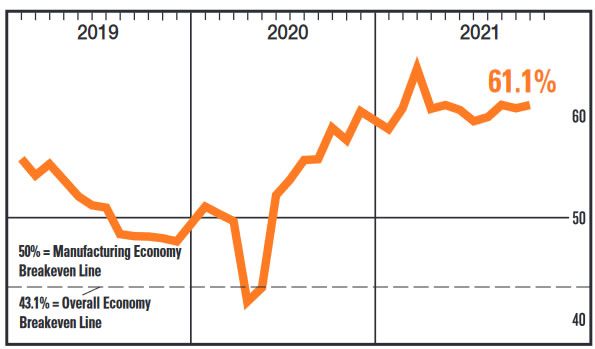
US ISM manufacturing ticked up to 61.1, corresponds to 5.1% annualized GDP growth
US ISM Manufacturing Index rose slightly from 60.8 to 61.1 in November, above expectation of 61.0. Looking at some details, new orders rose from 59.8 to 61.5. Production rose from 59.3 to 61.5. Employment rose from 52.0 to 53.3. Supplier deliveries dropped from 75.6 to 72.2. Prices dropped from 85.7 to 82.4.
ISM said: "The past relationship between the Manufacturing PMI and the overall economy indicates that the Manufacturing PMI for November (61.1 percent) corresponds to a 5.1-percent increase in real gross domestic product (GDP) on an annualized basis".
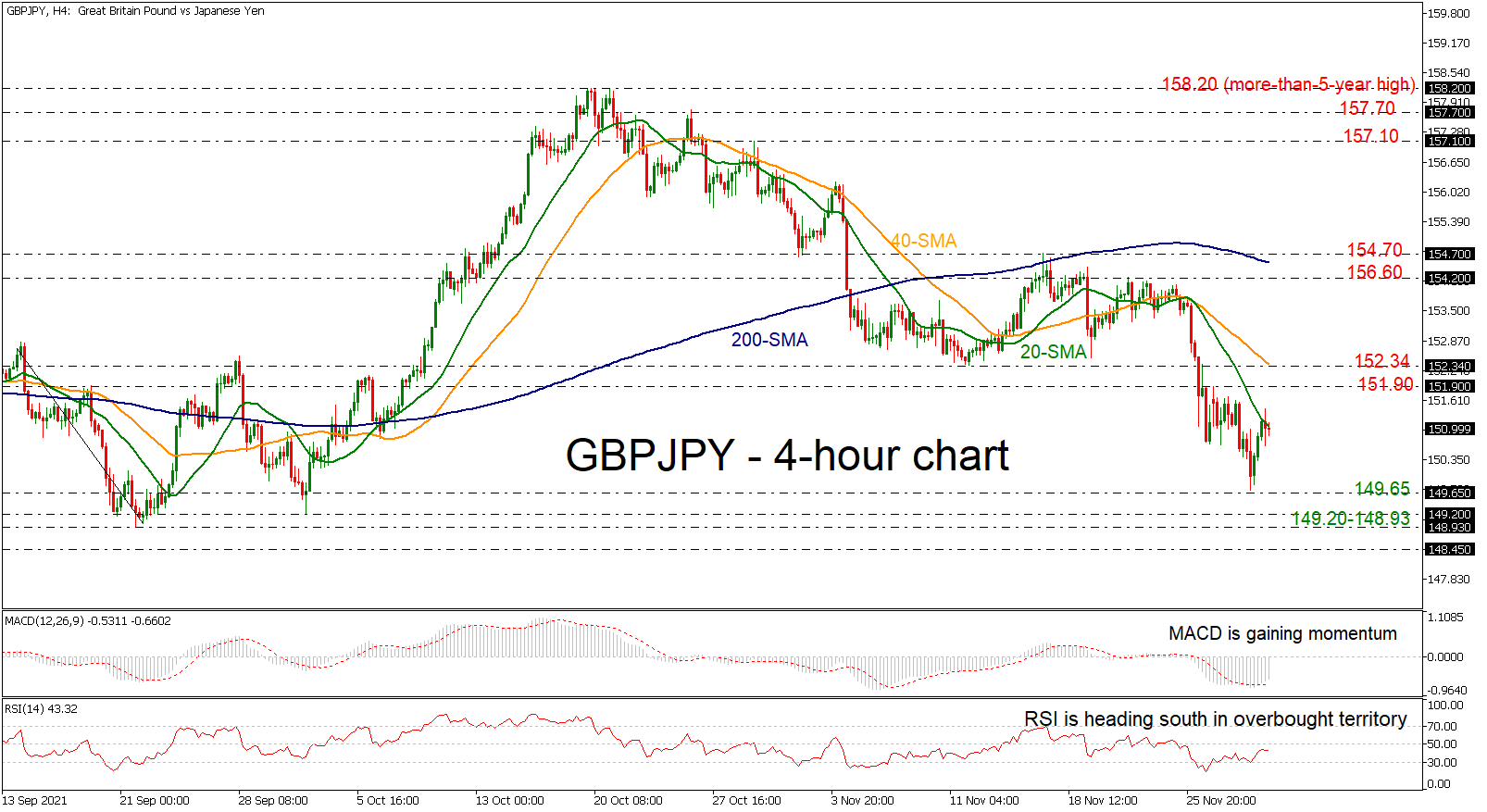
GBPJPY Tests 20-Period SMA; Tries to Turn Bullish
GBPJPY rebounded off the 149.65 support level and tested the 20-period simple moving average (SMA) around the 151.00 psychological mark. The MACD oscillator is advancing above its trigger line in the negative region, while the RSI is flattening in the bearish territory, indicating a somewhat weak momentum in the price.
If the pair successfully surpasses the 20-period SMA, immediate resistance could come at 151.90 and then at 152.34, which overlaps with the 40-period SMA. More gains could take the bulls until the 156.60 barrier before challenging the 200-period SMA at 154.50.
Alternatively, a drop lower again could endorse the medium-term bearish structure, allow the price to flirt with the 149.65 support and the 149.20-148.93 region. Underneath this line, traders could reach the low from July 2021 at 148.45.
All in all, GBPJPY has been in a descending movement over the last month and only a significant rally above the 200-period SMA may change this view.
CAD Shrugs as Building Permits Sparkles
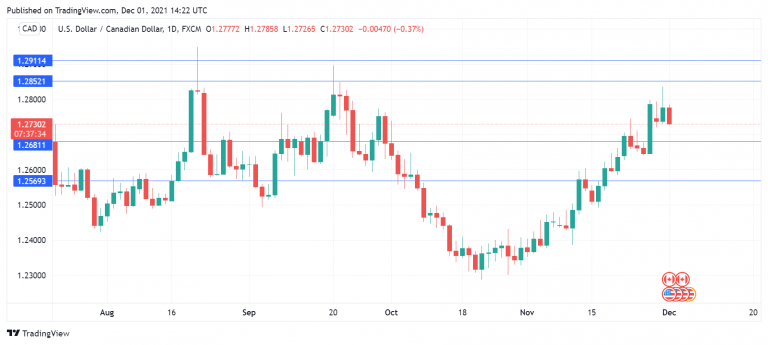
The Canadian dollar has edged lower on Wednesday. In North American trade, USD/CAD is trading at 1.2743, down 0.27% on the day.
Canada’s Building Permits beats expectations
It has been a relatively quiet week for the Canadian dollar, despite some solid releases out of Canada. Building Permits for October increased 1.3% m/m, crushing the consensus of -1.0%. The indicator gained 4.3% in September. This follows a robust GDP for Q3 of 5.4% y/y, much better than the forecast of 3.0%. A major driver for the strong gain was consumer spending, as health restrictions were eased and consumers were able to go out and spend. The economy grew by 0.8% in October m/m and has almost completely recovered to its pre-pandemic level of February 2020.
Despite this week’s strong numbers, the Canadian dollar has shown limited movement. Investors remain concerned about the Omicron variant of Covid, which has spread rapidly and could cause another wave of Covid. Preliminary reports indicate that the symptoms from Omicron have been mild. This has led to hopes that global economic activity will not be greatly affected by the variant. Still, until more information is available about Omicron, risk appetite will be subdued and this will weigh on minor currencies like the Canadian dollar.
The markets were upended by the appearance of Omicron on the global stage last week, and then Jerome Powell came along with a surprise of his own. Powell made a hawkish turn in his testimony before a Senate committee, which surprised the markets. Powell retired the word “transitory” from his description of inflation, a label that the markets essentially discarded months ago. As for the burning issue of tapering, Powell stated that a speeding up of the unwinding of the taper scheme would be discussed at the December meeting. Powell’s abrupt move has led to more uncertainty in the markets, which means investors should be prepared for further volatility.
USD/CAD Technical
- There is support at 1.2681. Below, there is support at 1.2569
- The next resistance line is at 1.2852, followed by 1.2911
Powell’s Hawkish Transition Unable to Boost the Dollar
Powell signals faster tapering
Global markets were struck by Fed Chair Jerome Powell’s hawkish tone during his testimony before the Senate Banking Committee on Tuesday. Powell stated that inflation could no longer be characterized as transitory, indicating that his central bank will consider speeding up its tapering process during the upcoming FOMC meeting in December. Terminating the Quantitative Easing programme faster than planned could be interpreted as an early rate hike signal since the Fed has made clear that it would like to end its bond buying programme before raising rates.
The 10-year US Treasury yield soared after Powell’s remarks but soon surrendered those gains, with the greenback also being unable to hold on to its early testimony-related gains. On Wednesday, the US dollar remained relatively unchanged against a basket of currencies at 96.02.
In the rest of the FX arena, the euro has suffered losses against the dollar and sterling at the time of writing, as pandemic-related risks are casting a darker shadow over the continent. The common currency ticked 0.18% lower against the greenback to $1.1322, while versus sterling, the euro fell by 0.33%. Commodity-linked currencies enjoyed a strong rebound on Wednesday, with the aussie rising by 0.32% against the dollar to 0.7151, while the greenback fell by 0.25% against the loonie.
US stocks are back in the green
On Tuesday, major US indices finished firmly lower as panic-selling gripped global markets amid perceived hawkish comments from the Fed’s Chair and elevated pandemic anxiety due to the Omicron variant. Therefore, market participants could witness further volatility over the coming month as investors will be closing their books for the year, amplifying market moves.
US stocks are headed for opening gains on Wednesday, as the latest Covid-19 variant doesn't look enough right now to derail the ongoing recovery process. The S&P 500 and Dow Jones futures rose by 1.31% and 0.95%, respectively. Likewise, the tech-heavy Nasdaq 100 is set to gain 1.44% at the opening bell.
In the commodity market, WTI crude oil surged by 3.55% as traders may have exaggerated the possible impact of the latest variant on oil demand. Meanwhile, gold inched higher by 0.80%, mirroring the improvement in risk appetite.
Salesforce share price tumbles
Salesforce’s share price is down by over 6% in pre-market trade after the software company’s guidance came short of expectations despite reporting strong earnings. GAP was the S&P 500 index’s worst performer during yesterday’s trading session, as its share price tumbled by 7.13%. The clothing retailer came under pressure after settling with the US Department of Justice, following claims that it had breached a discrimination law.
EUR/USD Mid-Day Outlook
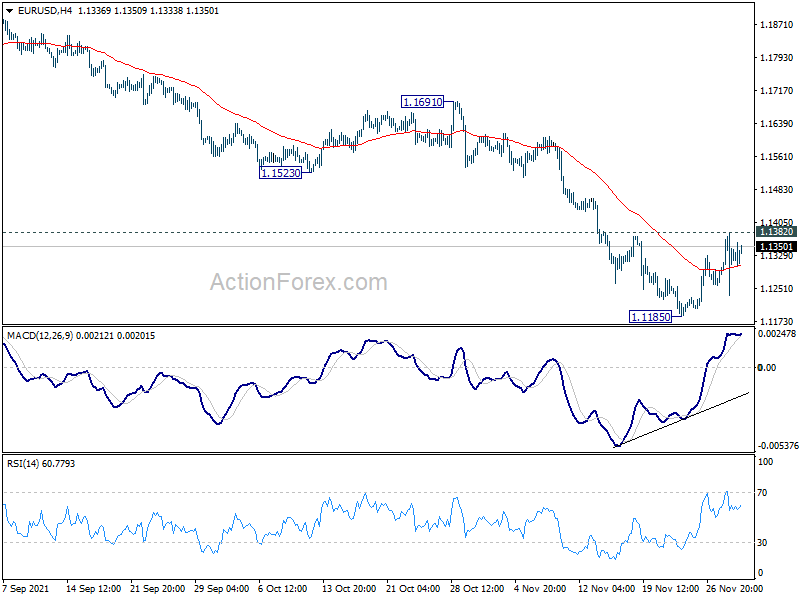
Daily Pivots: (S1) 1.1256; (P) 1.1320; (R1) 1.1403; More...
Intraday bias in EUR/USD remains neutral first. On the upside, break of 1.1382 resistance should confirm short term bottoming at 1.1186. Intraday bias will be turned back to the upside for 55 day EMA (now at 1.1510). On the downside, break of 1.1185 will resume larger fall from 1.2348.
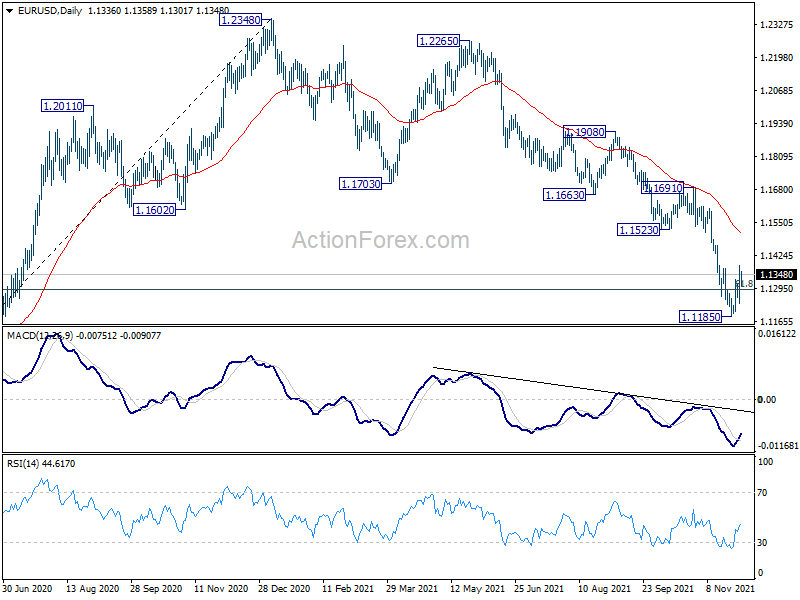
In the bigger picture, there are various ways of interpreting the fall from 1.2348 (2021 high). It could be a correction to rise from 1.0635 (2020 low), the fourth leg of a sideway pattern from 1.0339 (2017 low), or resuming long term down trend. In any case, outlook will now stay bearish as long as 1.1703 support turned resistance holds. Sustained break of 61.8% retracement of 1.0635 to 1.2348 at 1.1289 would pave the way back to 1.0635.
GBP/USD Mid-Day Outlook
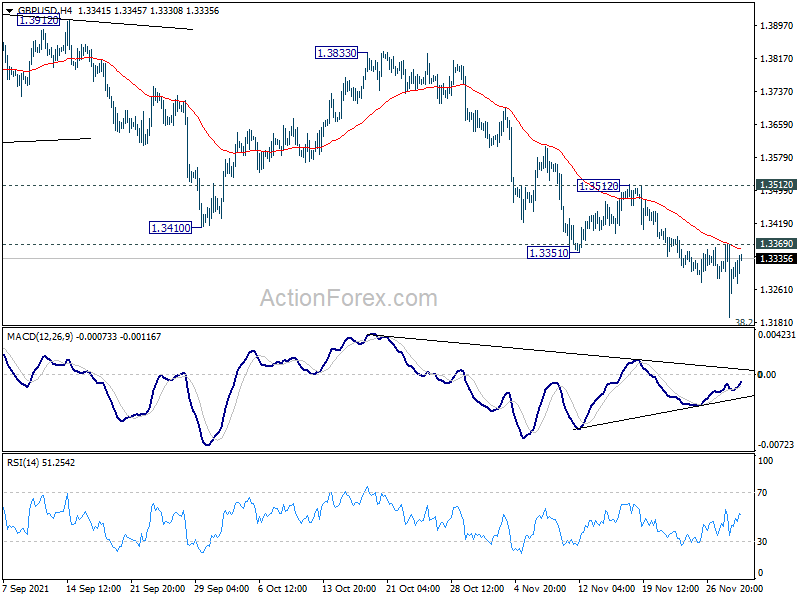
Daily Pivots: (S1) 1.3209; (P) 1.3289; (R1) 1.3384; More...
Further decline could still be seen in GBP/USD. But we'd look for some support from 1.3164 fibonacci level to bring rebound. On the upside, break of 1.3369 minor resistance will suggest short term bottoming, and turn bias back to the upside for 1.3512 resistance first. However, sustained break of 1.3164 will carry larger bearish implication.
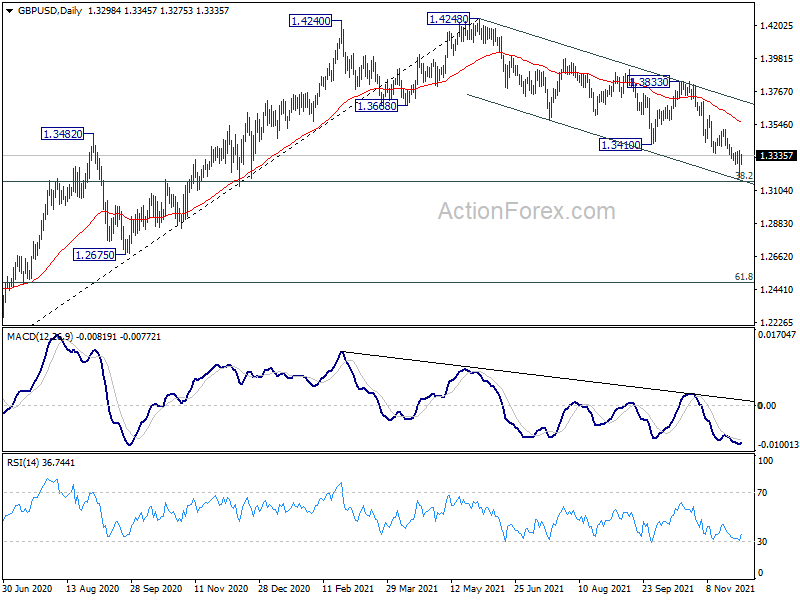
In the bigger picture, the structure of the fall from 1.4248 suggests that it's a correction to the up trend from 1.1409 (2020 low) only. While deeper fall cannot be ruled out yet, downside should be contained by 38.2% retracement of 1.1409 to 1.4248 at 1.3164, at least on first attempt, to bring rebound. On the upside, break of 1.3833 resistance will argue that the correction has completed and bring retest of 1.4248 high. However, sustained trading below 1.3164 will revive some medium term bearishness and target 61.8% retracement at 1.2493.
USD/JPY Mid-Day Outlook
Daily Pivots: (S1) 112.49; (P) 113.19; (R1) 113.84; More...
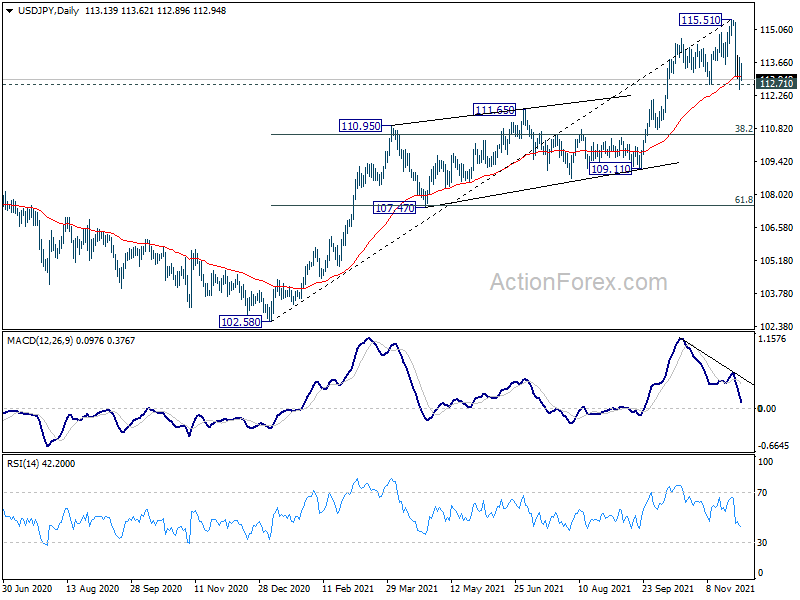
Intraday bias in USD/JPY remains neutral first. On the upside, break of 113.94 minor resistance will turn bias back to the upside for retesting 115.51 high. However, sustained break of 112.71 will argue that fall from 115.51 is already correcting whole rise from 102.58. Deeper decline would then be seen to 38.2% retracement of 102.58 to 115.51 at 110.57.
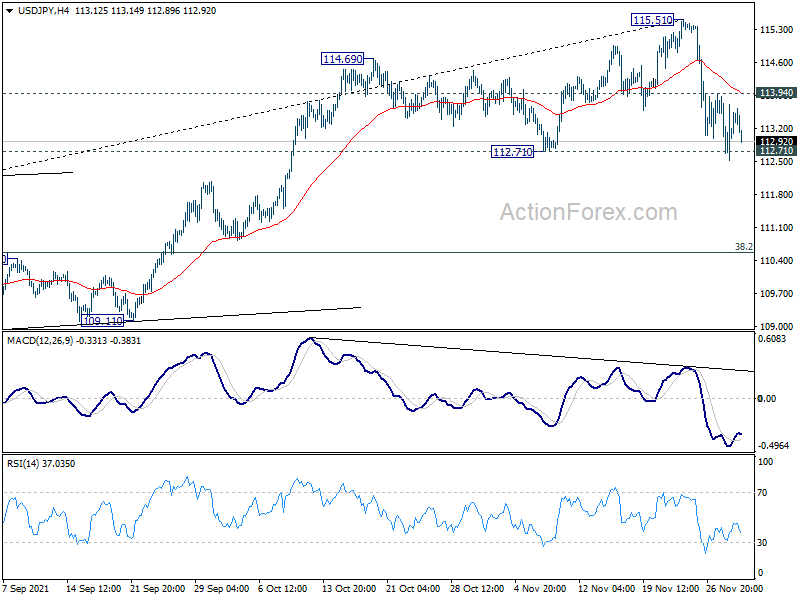
In the bigger picture, no change in the view that rise from 102.58 is the third leg of the up trend from 101.18 (2020 low). Such rally should target a test on 118.65 (2016 high) on resumption. However, firm break of 109.11 structural support will argue that the trend might have reversed and bring deeper fall to 107.47 support and possibly below.
USD/CHF Mid-Day Outlook
Daily Pivots: (S1) 0.9139; (P) 0.9203; (R1) 0.9248; More....
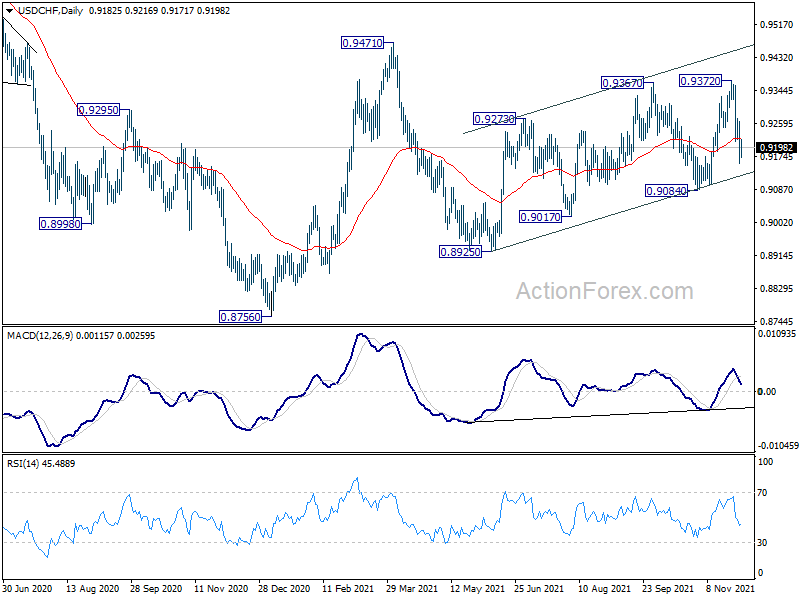
Further decline remains in favor in USD/CHF with 0.9271 minor resistance intact. Fall from 0.9372 would target 0.9084 support. Firm break there will argue that choppy rise from 0.8925 has completed, and fall from 0.9471 is resuming. Deeper decline would be seen through 0.8925. Nevertheless, break of 0.9271 will turn bias back to the upside for retesting 0.9372.
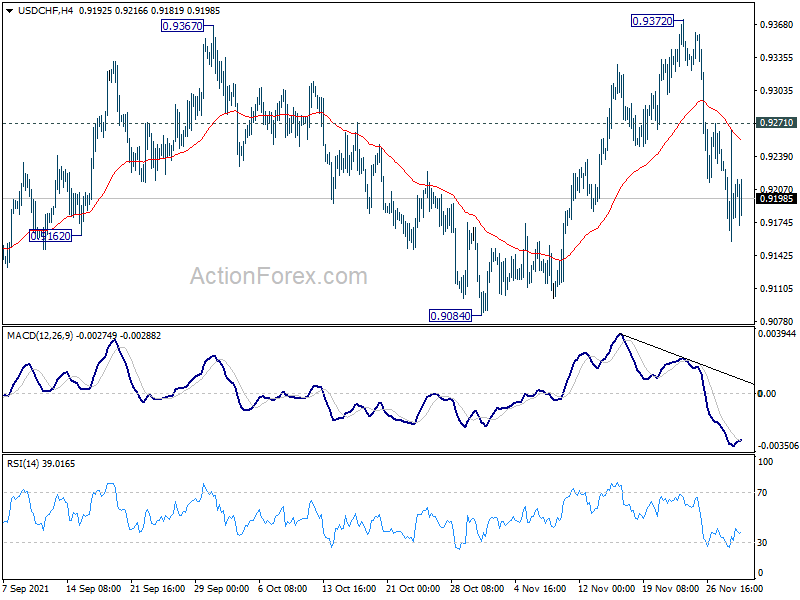
In the bigger picture, the corrective structure of the rebound from 0.8925 argues that fall from 0.9471 is not complete yet. It could either be the second leg of pattern from 0.8756 (2021 low), or resuming larger down trend from 1.0237 (2018 high). We'd pay attention to the downside momentum and assess the odds later. But for now, medium term outlook will be neutral at best as long as 0.9471 resistance holds.