

Sample Category Title
EUR/USD Daily Outlook
Daily Pivots: (S1) 1.1295; (P) 1.1327; (R1) 1.1352; More...
Intraday bias in EUR/USD remains neutral for the moment and outlook is unchanged. On the upside, firm break of 1.1382 resistance should confirm short term bottoming at 1.1186. Intraday bias will be turned back to the upside for 55 day EMA (now at 1.1509). On the downside, break of 1.1185 will resume larger fall from 1.2348.
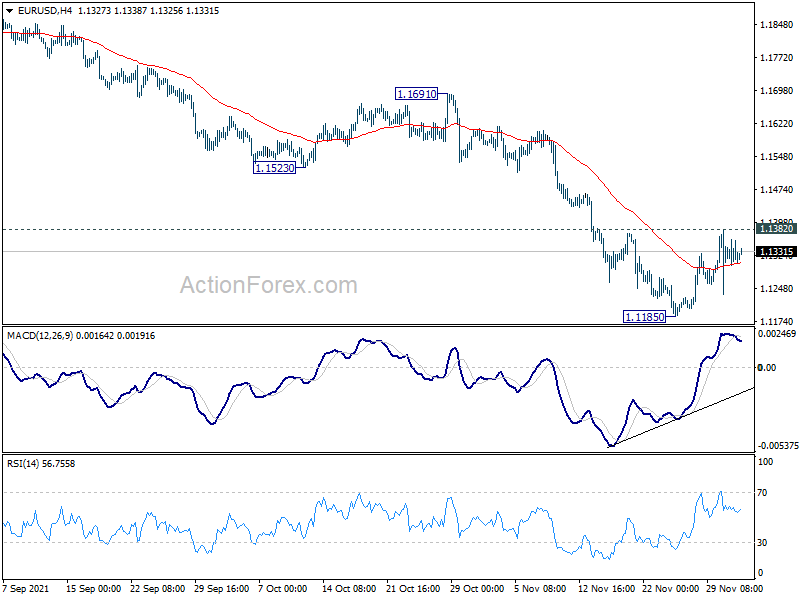
In the bigger picture, there are various ways of interpreting the fall from 1.2348 (2021 high). It could be a correction to rise from 1.0635 (2020 low), the fourth leg of a sideway pattern from 1.0339 (2017 low), or resuming long term down trend. In any case, outlook will now stay bearish as long as 1.1703 support turned resistance holds. Sustained break of 61.8% retracement of 1.0635 to 1.2348 at 1.1289 would pave the way back to 1.0635.
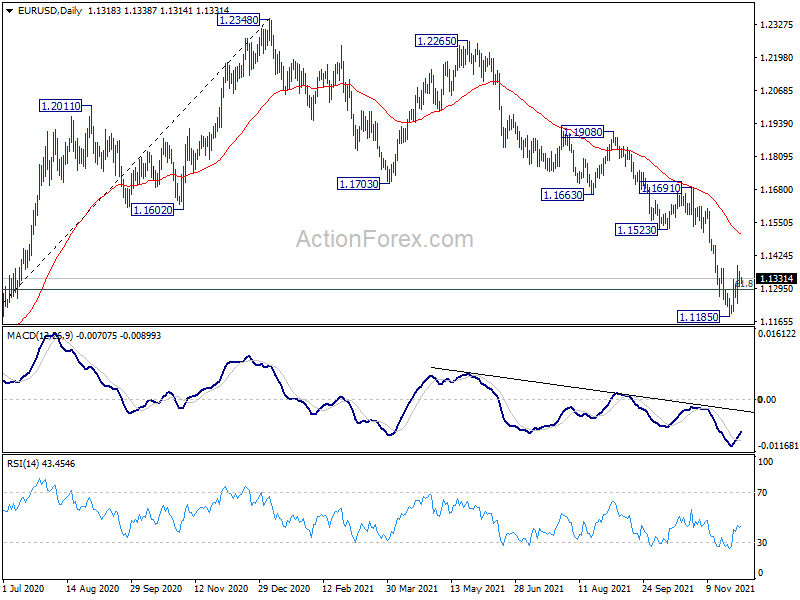
US Stocks Extended Selloff on Faster Fed Tapering, Dollar Mixed
While the US stock extended the near term steep pull back overnight, Asian markets are relatively steady and are just mixed. Major currency pairs and crosses are also stuck in tight range for consolidation. As for the week, Swiss Franc and Yen are the stronger ones on risk off sentiment, on both Omicron and talk of Fed's quicker tapering. Sterling is currently the worst performing, followed by Aussie. Dollar is mixed as it's partly weighed down by weakness in treasury yields.
Technically, we're still looking at breakthroughs in both EUR/USD and USD/JPY. Break of 1.1382 minor resistance in EUR/USD will confirm short term bottoming and bring stronger rebound. On the other hand, firm break of 112.71 support in USD/JPY will extend the correction from 115.51 to 110.57 fibonacci level. Both developments, if happen, will at least confirm near term weakness in the greenback.
In Asia, at the time of writing, Nikkei is down -0.66%. Hong Kong HSI is up 0.39%. China Shanghai SSE is down -0.02%. Singapore Strait Times is down -0.24%. Japan 10-year JGB yield is down -0.0022 at 0.064. Overnight, DOW dropped -1.34%. S&P 500 dropped -1.18%. NASDAQ dropped -1.83%. 10-year yield dropped -0.009 to 1.434.
Fed Williams: To complete tapering earlier is a decisive to grapple with
New York Fed President John Williams said in an FT interview that Omicron "adds a lot of uncertainty to the outlook". It will "will continue that excess demand in the areas that don't have capacity, and will stall the recovery in the areas where we actually have the capacity." That would mean a "somewhat slower rebound overall" and "increase those inflationary pressures, in those areas that are in high demand."
As for monetary policy, "the question is: Would it make sense to end those purchases somewhat earlier, by maybe a few months, given how strong the economy is?" he said. "That's a decision, discussion, I expect we'll have to grapple with."
Fed Mester very open to consider faster tapering
Cleveland Fed President Loretta Mester told Bloomberg TV, "making the taper faster is definitely buying insurance and optionality so that if inflation doesn't move back down significantly next year we're in a position to be able hike if we have to."
She said that recent data "have come in supportive of that case, so I'm very open to considering a faster pace of tapering."
"Right now, with the inflation data the way it is and with the job market as strong as it is, I do think that we have to be in a position that if we need to raise rates a couple of times next year we're able to do that," said Mester.
BoJ Suzuki: Effective and sustainable monetary easing to persistently continue
BoJ board member Hitoshi Suzuki said in a speech, "to achieve the price stability target of 2 percent, the Bank is expected -- even after COVID-19 subsides -- to persistently continue with further effective and sustainable monetary easing".
However, it's also necessary to "pay attention to the possibility that credit costs will increase due to a delay in economic recovery at home and abroad". Also, "downward pressure on financial institutions' core profitability is likely to persist as a trend even after COVID-19 subsides".
"My view is that the Bank should pay due attention to the fact that side effects of monetary easing will accumulate over time," he added. "The Bank will continue to conduct monetary policy in an appropriate manner so as to fulfill the two missions of achieving price stability and ensuring the stability of the financial system."
From Japan too, monetary base rose 9.3% yoy in November, below expectation of 10.3% yoy.
Australia trade surplus narrowed to AUD 11.22B in Oct
Australia exports of goods and services dropped -3% mom to AUD 43.05B in October, driven by falls in iron ore prices. Goods and services imports dropped -3% mom to AUD 31.83B, by fall in imports of capital goods. Trade surplus narrowed to AUD 11.22B, slightly higher than expectation of AUD 11.00B.
Retail sales rose 4.9% mom, 5.9% yoy to AUD 31.13B.
Looking ahead
Swiss retail sales, Eurozone unemployment rate and PPI will be released in European session. US will release jobless claims and Challenger job cuts.
EUR/USD Daily Outlook
Daily Pivots: (S1) 1.1295; (P) 1.1327; (R1) 1.1352; More...
Intraday bias in EUR/USD remains neutral for the moment and outlook is unchanged. On the upside, firm break of 1.1382 resistance should confirm short term bottoming at 1.1186. Intraday bias will be turned back to the upside for 55 day EMA (now at 1.1509). On the downside, break of 1.1185 will resume larger fall from 1.2348.
In the bigger picture, there are various ways of interpreting the fall from 1.2348 (2021 high). It could be a correction to rise from 1.0635 (2020 low), the fourth leg of a sideway pattern from 1.0339 (2017 low), or resuming long term down trend. In any case, outlook will now stay bearish as long as 1.1703 support turned resistance holds. Sustained break of 61.8% retracement of 1.0635 to 1.2348 at 1.1289 would pave the way back to 1.0635.
Economic Indicators Update
| GMT | Ccy | Events | Actual | Forecast | Previous | Revised |
|---|---|---|---|---|---|---|
| 21:45 | NZD | Terms of Trade Index Q3 | 0.70% | 2.10% | 3.30% | 3.20% |
| 23:50 | JPY | Monetary Base Y/Y Nov | 9.30% | 10.30% | 9.90% | |
| 0:30 | AUD | Trade Balance (AUD) Oct | 11.22B | 11.00B | 12.24B | 11.82B |
| 5:00 | JPY | Consumer Confidence Nov | 40.3 | 39.2 | ||
| 7:30 | CHF | Real Retail Sales Y/Y Oct | 2.20% | 2.50% | ||
| 10:00 | EUR | Eurozone Unemployment Rate Oct | 7.30% | 7.40% | ||
| 10:00 | EUR | Eurozone PPI M/M Oct | 3.20% | 2.70% | ||
| 10:00 | EUR | Eurozone PPI Y/Y Oct | 19% | 16% | ||
| 12:30 | USD | Challenger Job Cuts Nov | 22.822K | |||
| 13:30 | USD | Initial Jobless Claims (Nov 26) | 250K | 199K | ||
| 15:30 | USD | Natural Gas Storage | -21B |
Crude Oil Price Turns Red Below $70
Key Highlights
- Crude oil price started a downside correction below $75.00.
- A key bearish trend line is forming with resistance near $70.20 on the 4-hours chart of XTI/USD.
- EUR/USD is facing resistance near 1.1400, and GBP/USD could recover if it breaks 1.3400.
- The US ISM Manufacturing Index increased from 60.8 to 61.1 in Nov 2021.
Crude Oil Price Technical Analysis
After facing resistance near $80.00, crude oil price starting a fresh decline against the US Dollar. The price traded below the $75.00 support to enter a short-term bearish zone.
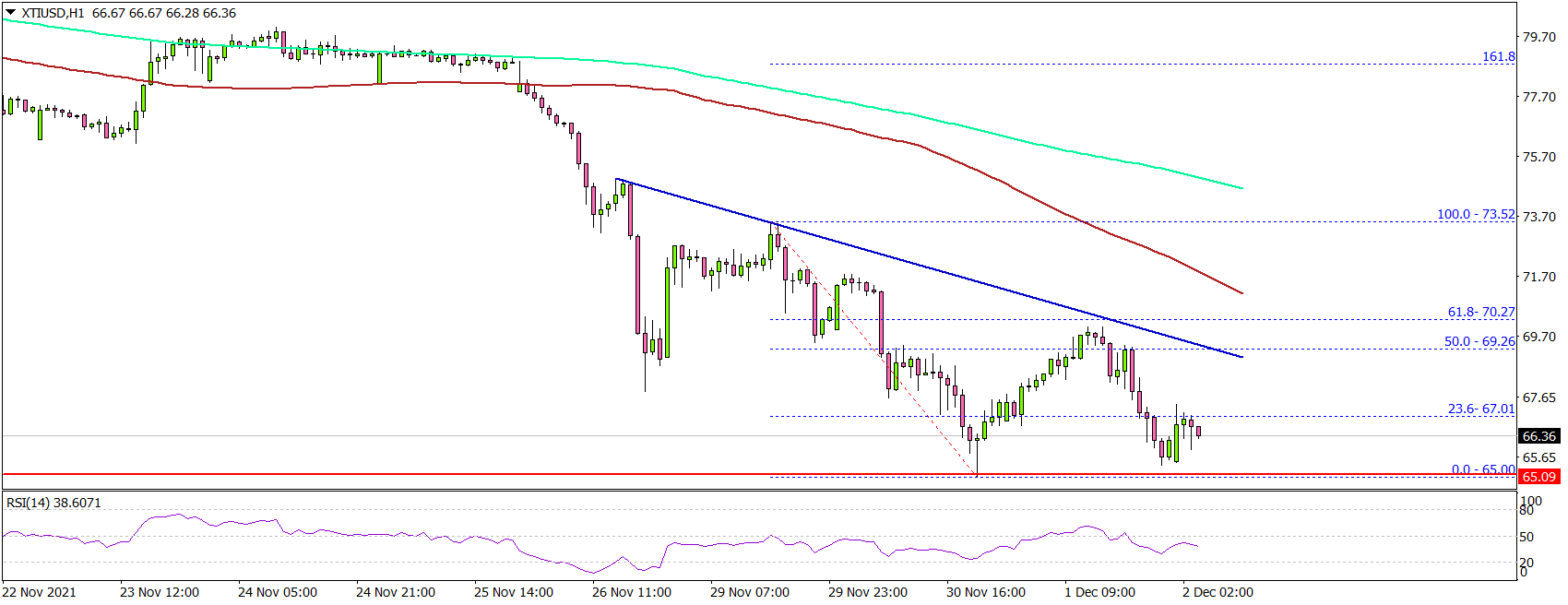
Looking at the 4-hours chart of XTI/USD, the price traded below the $72.00 support, the 100 simple moving average (4-hours, red) and the 200 simple moving average (4-hours, green).
The bears pushed the price below the $70.00 support zone. A low was formed near $65.00 before there was a recovery wave. The price recovered above the $68.00 level. However, it is facing resistance near the $69.50 and $70.00 levels.
There is also a key bearish trend line forming with resistance near $70.20 on the same chart. A close above $70.00 and $70.20 could start a steady increase towards the $73.50 level.
An immediate support on the downside is near the $67.00 level. The first major support is near $66.50. Any more losses could open the doors for a move towards the $65.00 support.
Fundamentally, the US ISM Manufacturing Index was released yesterday by the Institute for Supply Management (ISM). The market was looking for a rise from 60.8 to 61.0 in Nov 2021.
However, the actual result was positive, as the US ISM Manufacturing PMI increased from 60.8 to 61.1 in Nov 2021. Besides, the US ISM Manufacturing New Orders Index increased from 59.8 to 61.5.
Looking at EUR/USD, the pair recovered above 1.1320, but it is facing resistance near 1.1400. Besides, GBP/USD could rally if it clears 1.3400.
Economic Releases to Watch Today
- US Initial Jobless Claims - Forecast 240K, versus 199K previous.
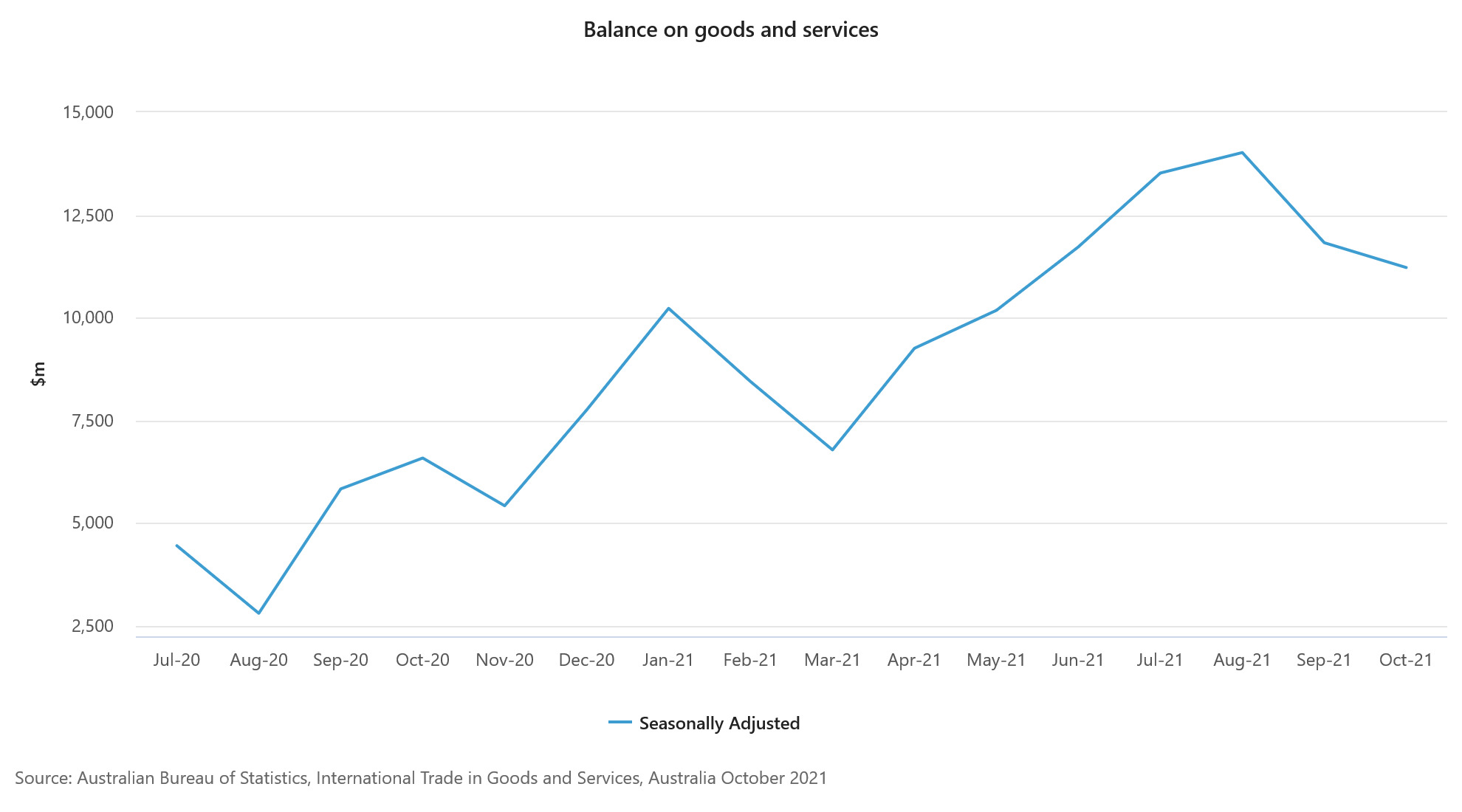
Australia trade surplus narrowed to AUD 11.22B in Oct
Australia exports of goods and services dropped -3% mom to AUD 43.05B in October, driven by falls in iron ore prices. Goods and services imports dropped -3% mom to AUD 31.83B, by fall in imports of capital goods. Trade surplus narrowed to AUD 11.22B, slightly higher than expectation of AUD 11.00B.
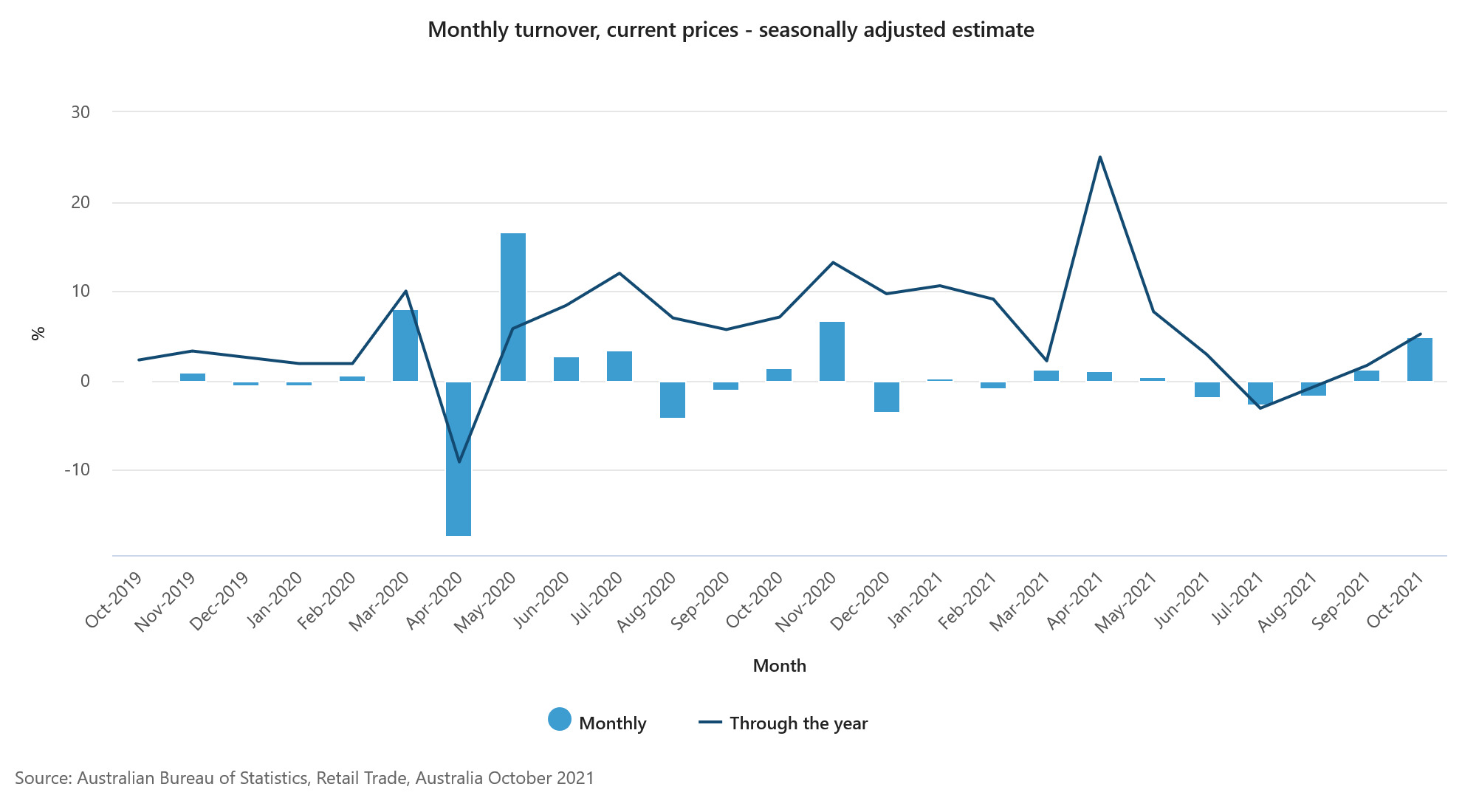
Retail sales rose 4.9% mom, 5.9% yoy to AUD 31.13B.
BoJ Suzuki: Effective and sustainable monetary easing to persistently continue
BoJ board member Hitoshi Suzuki said in a speech, "to achieve the price stability target of 2 percent, the Bank is expected -- even after COVID-19 subsides -- to persistently continue with further effective and sustainable monetary easing".
However, it's also necessary to "pay attention to the possibility that credit costs will increase due to a delay in economic recovery at home and abroad". Also, "downward pressure on financial institutions' core profitability is likely to persist as a trend even after COVID-19 subsides".
"My view is that the Bank should pay due attention to the fact that side effects of monetary easing will accumulate over time," he added. "The Bank will continue to conduct monetary policy in an appropriate manner so as to fulfill the two missions of achieving price stability and ensuring the stability of the financial system."
Fed Mester very open to consider faster tapering
Cleveland Fed President Loretta Mester told Bloomberg TV, "making the taper faster is definitely buying insurance and optionality so that if inflation doesn't move back down significantly next year we're in a position to be able hike if we have to."
She said that recent data "have come in supportive of that case, so I'm very open to considering a faster pace of tapering."
"Right now, with the inflation data the way it is and with the job market as strong as it is, I do think that we have to be in a position that if we need to raise rates a couple of times next year we're able to do that," said Mester.
Fed Williams: To complete tapering earlier is a decisive to grapple with
New York Fed President John Williams said in an FT interview that Omicron "adds a lot of uncertainty to the outlook". It will "will continue that excess demand in the areas that don't have capacity, and will stall the recovery in the areas where we actually have the capacity." That would mean a "somewhat slower rebound overall" and "increase those inflationary pressures, in those areas that are in high demand."
As for monetary policy, "the question is: Would it make sense to end those purchases somewhat earlier, by maybe a few months, given how strong the economy is?" he said. "That's a decision, discussion, I expect we'll have to grapple with."
Oil Eyes OPEC+, Gold Surprisingly Steady
Oil edges higher ahead of massive OPEC+ meeting
Oil remains extremely volatile ahead of tomorrow’s OPEC+ meeting when the group will decide if and how to respond to the Omicron news and last month’s coordinated SPR release by major consuming nations. On the latter, I don’t think there’ll be a direct retaliation – perhaps a warning – but it may feed into any decision-making on the new variant.
I still think the meeting has come too soon. That’s evident in the fact that it was pushed back by a couple of days in order to gather more data. And I’m not sure there’s enough at this stage to make an informed judgment. And if they had, by their own admission, factored in another wave this winter, then there should be no need to adjust at this stage. Although the SPR release may push some to support it anyway under the guise of an Omicron response.
With prices having fallen so far from the highs – around 20% – a one-month pause, for example, could see crude bounce back sharply and would discretely undo any benefit resulting from the SPR move.
Gold awaiting more data
Gold is really struggling for direction at the momentum, having repeatedly failed to generate any momentum above $1,800. It’s not in decline anymore but it can’t seem to make its mind up. The dollar easing in recent days and the huge amount of uncertainty in the markets should be giving it a lift but then we have seen near-term yields rising as the Fed has accepted more action may be necessary.
Perhaps like the rest of us, gold traders are simply waiting on more information before deciding where to head next. Choppy price action may be here to stay for now but the next couple of weeks will shed a light of light on what’s in store, at which point we should see gold find some direction once more.
GBP/USD – Correction On The Cards?
Or can it fall further?
The pound has been trending lower over the last month or so but the decline may finally be losing momentum.
It’s found some support around 1.32 but momentum has been slipping over the last week or two, creating divergences on both the daily and 4-hour chart, which may suggest a correction is coming.
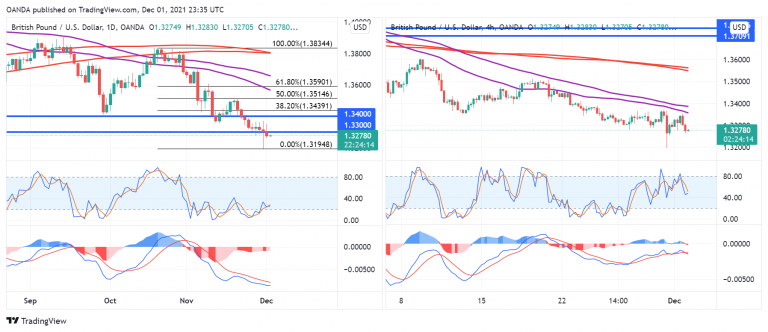
If the pair has bottomed for now, how deep a correction can we expect? The first test is 1.3360-1.3375 where recent resistance combines with past support and the 55/89-period SMA band on the 4-hour chart.
Above here, 1.34 is interesting but 1.35-1.3520 is the next big test. Here, recent resistance combines with the 50 fib level and the 200/233-period SMA on the 4-hour chart.
Finally, 1.36 sees the 61.8 fib and the top of the 55/89-day SMA band. A move above here would suggest a much deeper correction is on the cards after six months of decline.
Eco Data 12/2/21
[php_everywhere instance="1"]