Sample Category Title
EUR/AUD Weekly Outlook
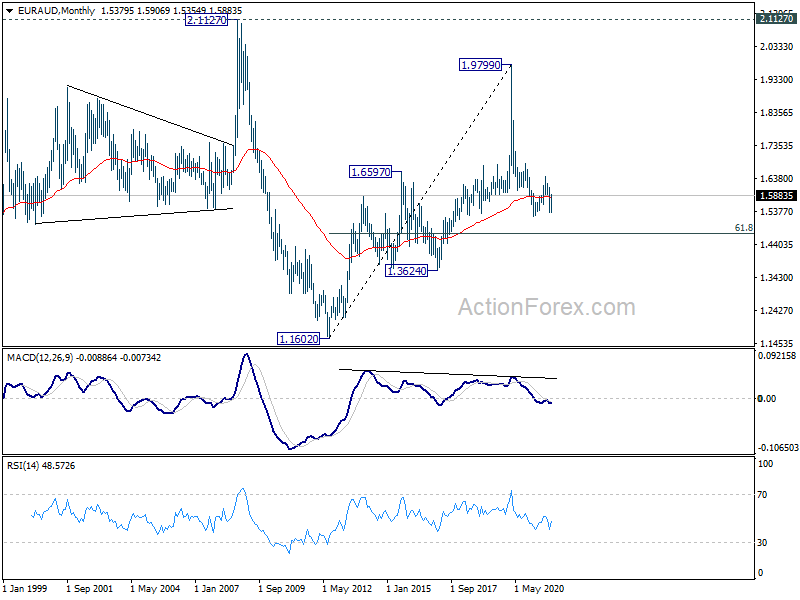
EUR/AUD's rebound from 1.5354 resumed last week and accelerated to as high as 1.5906. The development suggests that whole decline from 1.6434 has completed at 1.5354 already. Initial bias stays on the upside this week for 161.8% projection of 1.5354 to 1.5743 from 1.5446 at 1.6075 next. On the downside, break of 1.5743 resistance turned support will mix up the near term outlook and turn intraday bias neutral first.
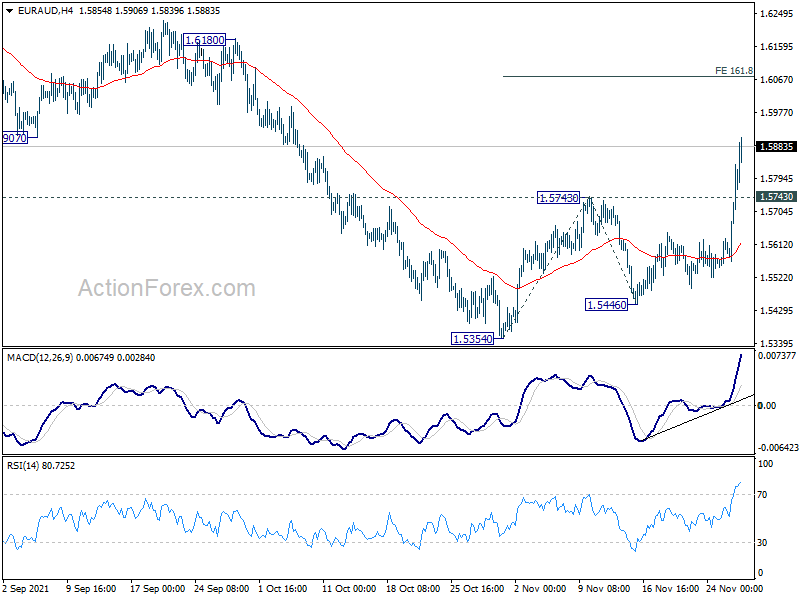
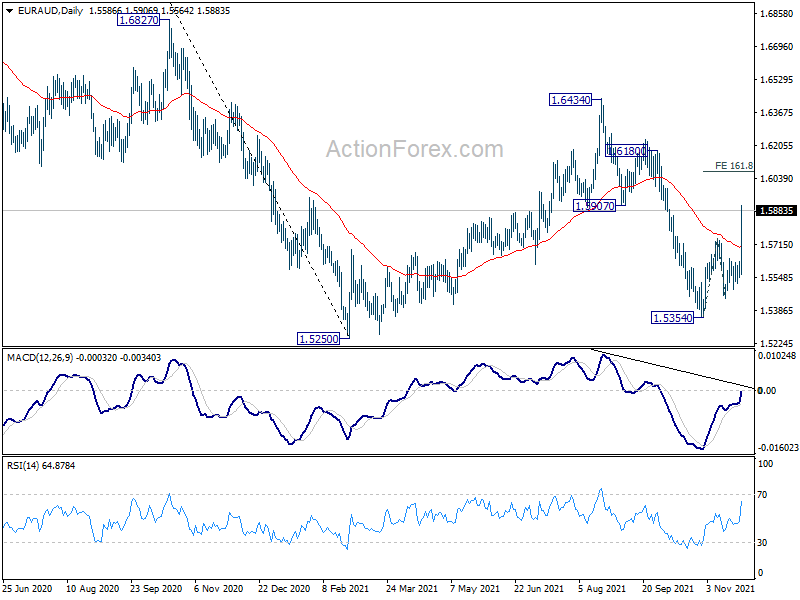
In the bigger picture, the strong rebound from 1.5354 invalidates the case of imminent downside breakout, and turn medium term outlook neutral again. Such rise is seen as the third leg of the corrective pattern from 1.5250. Further rally could be seen through 1.6434 resistance. On the downside, however, break of 1.5446 support will turn focus back to 1.5250 low.
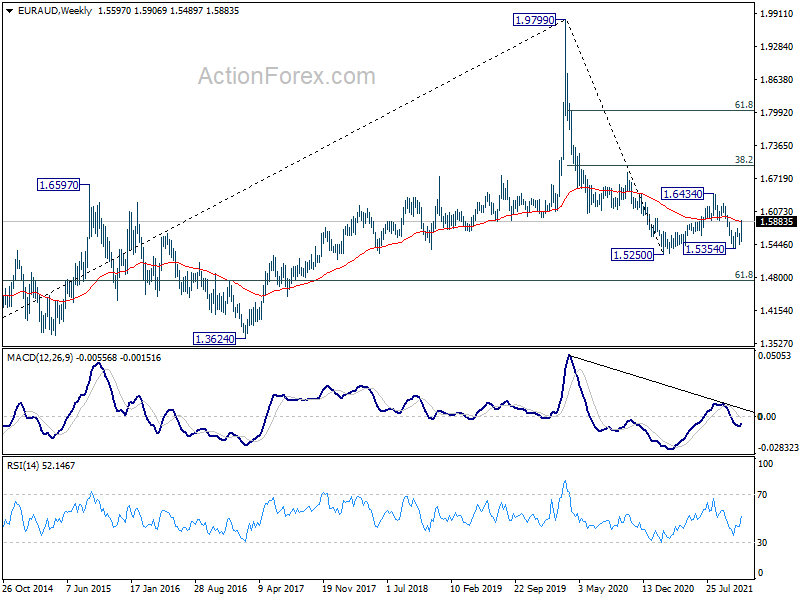
In the longer term picture, fall from 1.9799 (2020 high) is seen as a long term down trend. Further decline will remain in favor as long as 38.2% retracement of 1.9799 to 1.5250 at 1.6988 holds. Break of 1.5250 will target 61.8 retracement of 1.1602 (2012 low) to 1.9799 at 1.4733
EUR/JPY Weekly Outlook
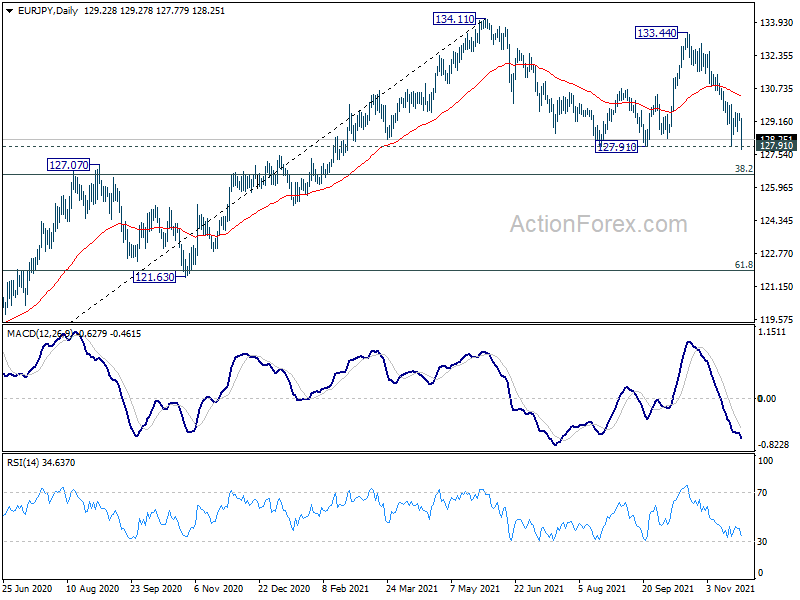
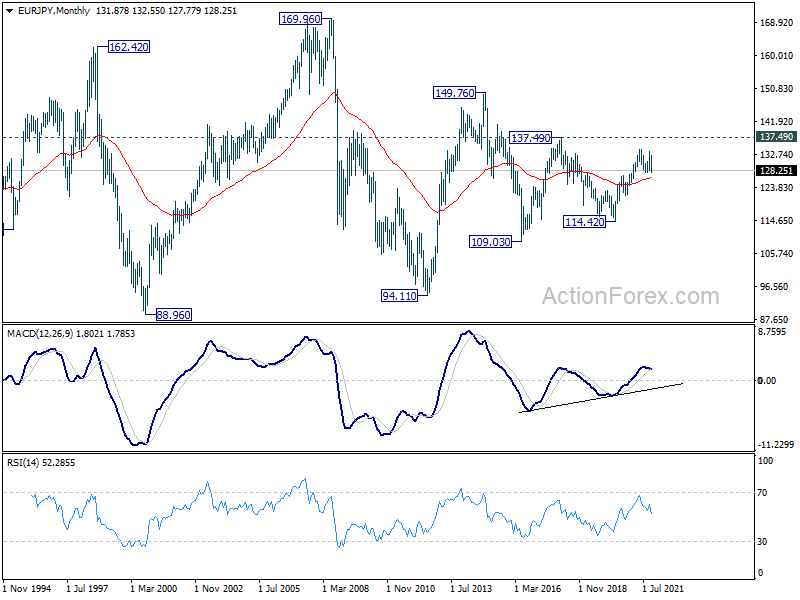
EUR/JPY's fall from 133.44 resumed last week after some recovery. Initial bias is now on the downside this week with focus on 127.91 support. Firm break there will resume whole pattern from 134.11 and target 126.58 fibonacci level. Sustained break there will carry larger bearish implications. On the upside, however, break of 129.59 resistance will indicate short term bottoming, and turn bias back to the upside for stronger rebound first.
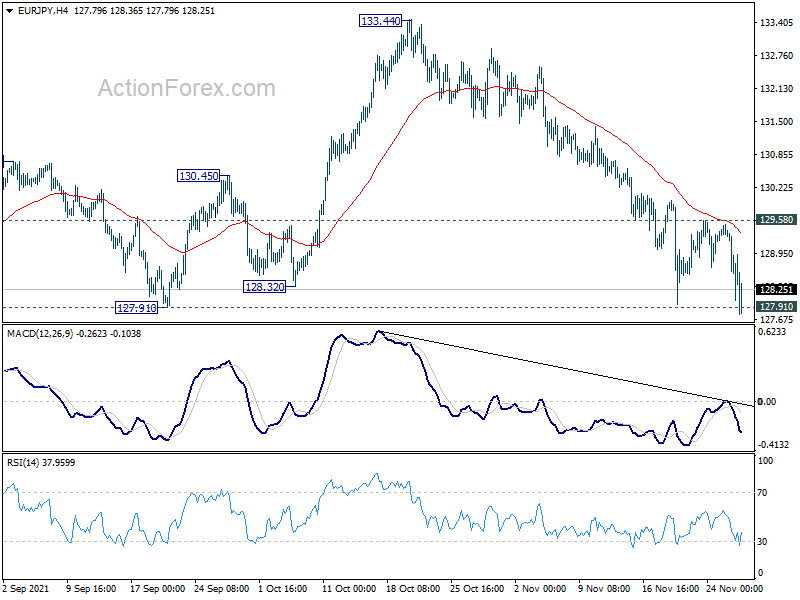
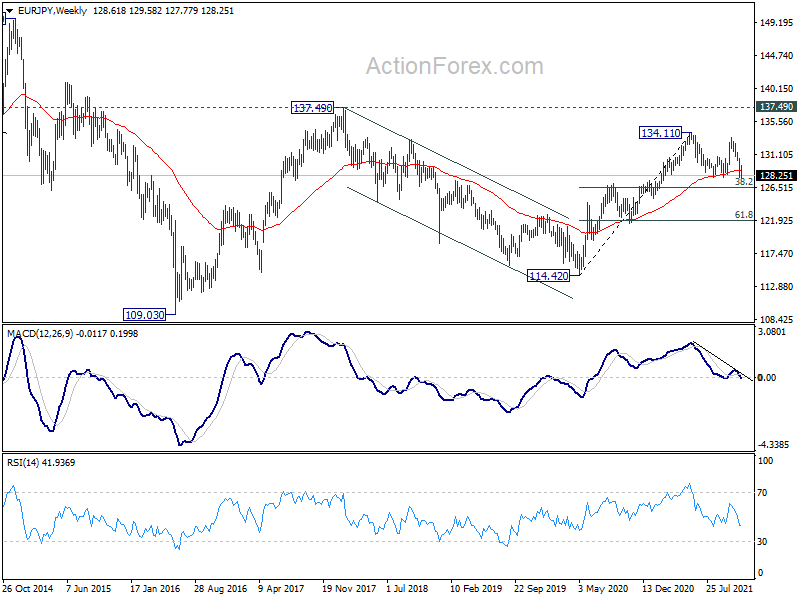
In the bigger picture, as long as 38.2% retracement of 114.42 (2020 low) to 134.11 at 126.58 holds, up trend from 114.42 is still in favor to continue. Break of 134.11 will target long term resistance at 137.49 (2018 high). However, sustained break of 126.58 will raise the chance of medium term bearish reversal. In this case, deeper decline would be seen to 61.8% retracement at 121.94, and possibly below.
In the long term picture, EUR/JPY is staying in long term sideway pattern, established since 2000. Long term outlook will remain neutral until breakout from the range of 109.03/137.49.
GBP/JPY Weekly Outlook
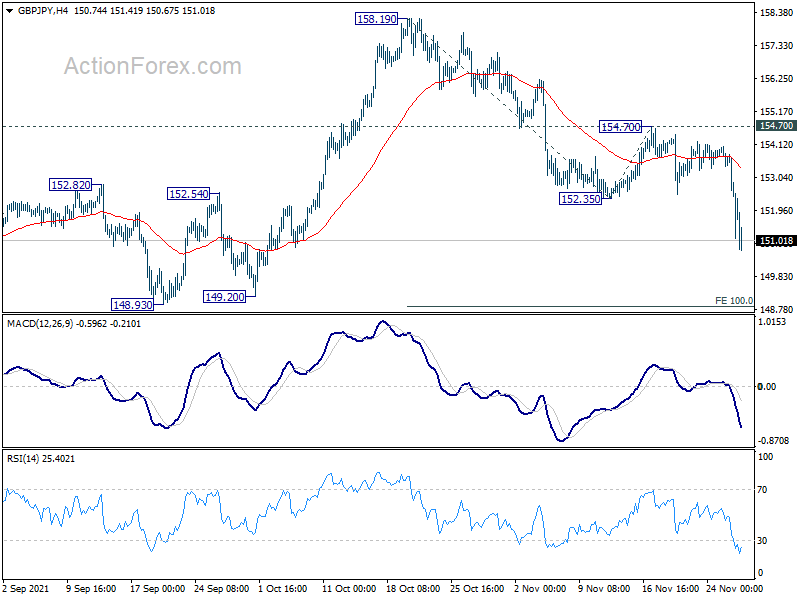
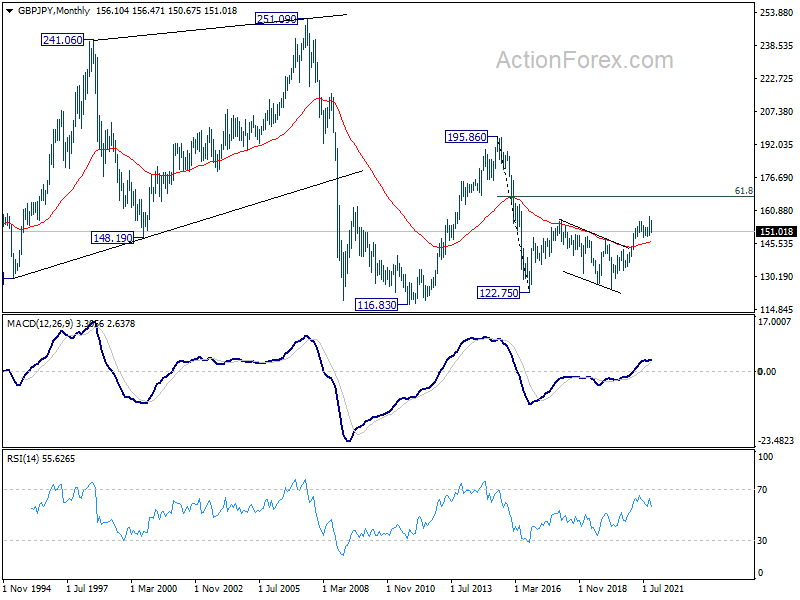
GBP/JPY's fall from 158.19 resumed last week and accelerated to as low as 150.67. Initial bias remains on the downside this week for 100% projection of 158.19 to 152.35 from 154.70 at 148.86 next, which is close to 148.93 key structural support. Decisive break there will carry larger bearish implication and target 161.8% projection at 145.25 next. For now, near term outlook will stay bearish as long as 154.70 resistance holds, in case of recovery.
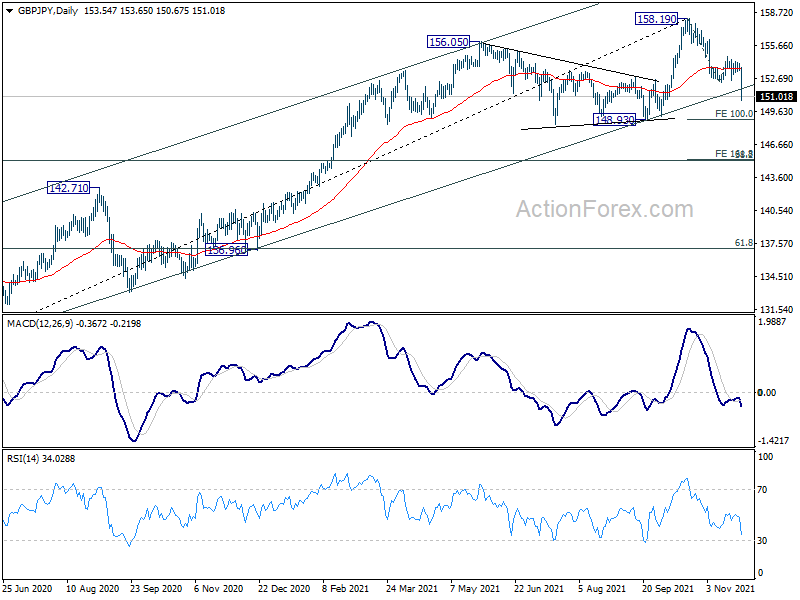
In the bigger picture, the break of medium term channel support, and bearish divergence condition in week MACD are raising the chance of medium term topping at 158.19. Firm break of 148.93 support will argue that GBP/JPY is at least correcting the whole rise from 123.94 (2020 low). In this case, deeper fall would be seen to 38.2% retracement of 123.94 to 158.19 at 145.10. Nevertheless, strong rebound from 148.93 will retain medium term bullishness for another rise through 158.19 at a later stage.
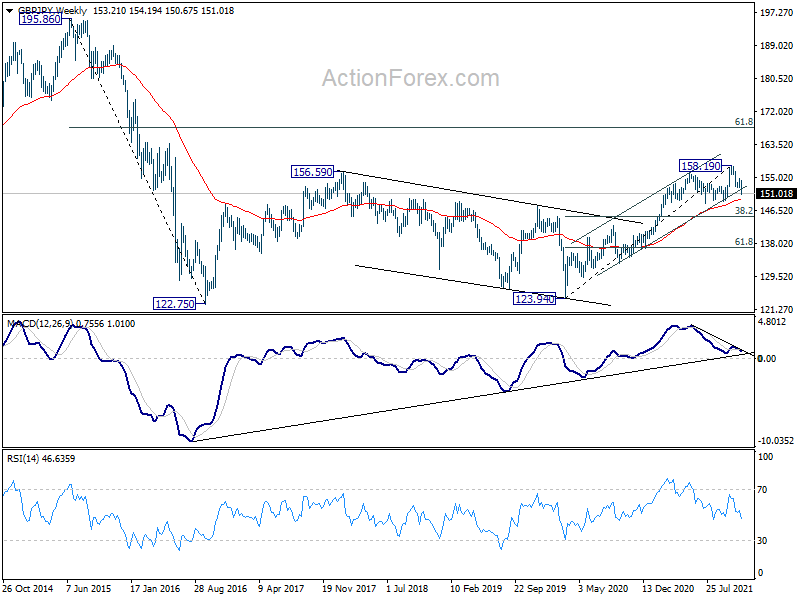
In the longer term picture, as long as 55 month EMA (now at 146.38) holds, we'd still favor more up trend to 61.8% retracement of 195.86 to 122.75 at 167.93. But sustained trading below 55 month EMA will at least neutralize medium term bullishness and re-open the chance of revisiting 122.75 low (2016 low).
EUR/CHF Weekly Outlook
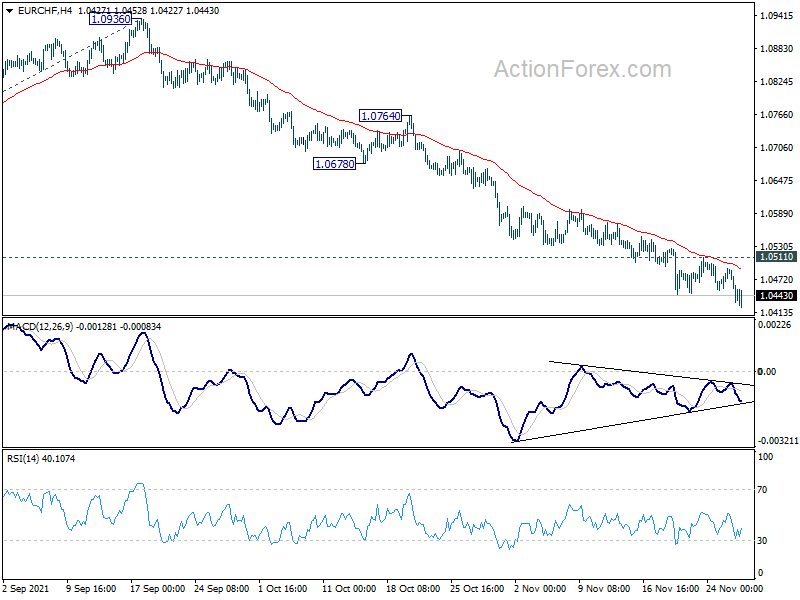
EUR/CHF's down trend continued last week and outlook is unchanged. Initial bias remains on the downside this week for 161.8% projection of 1.1149 to 1.0694 from 1.0936 at 1.0200 next. On the upside, though, break of 1.0511 resistance will now indicate short term bottoming, and turn bias back to the upside for stronger rebound.
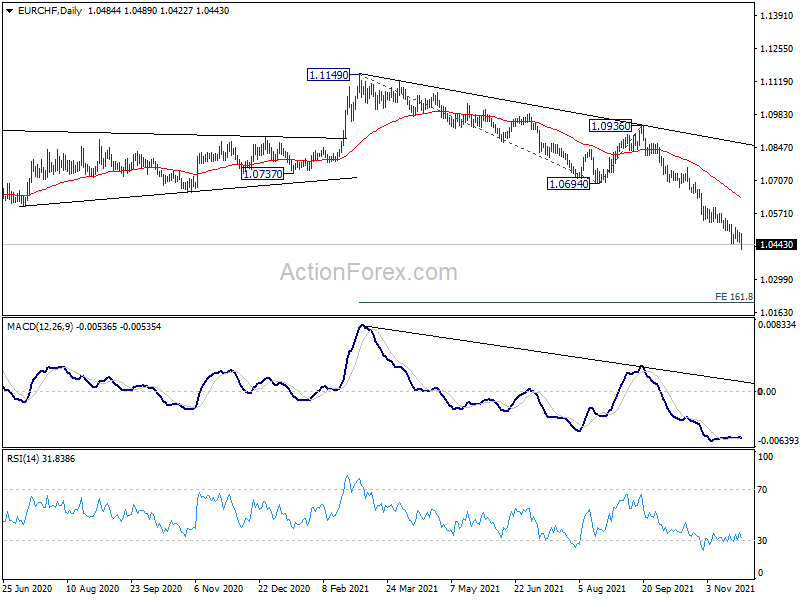
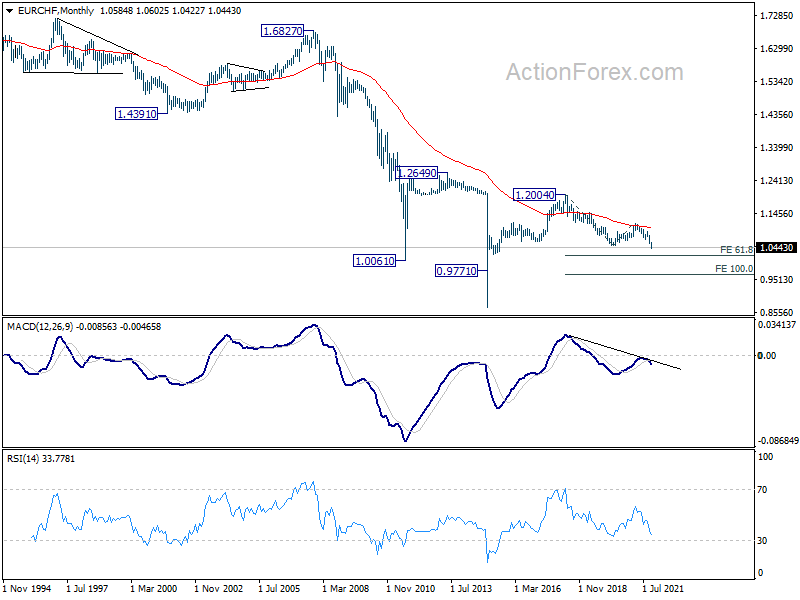
In the bigger picture, long term down trend from 1.2004 (2018 high) is now extending. Next target is 61.8% projection of 1.2004 to 1.0505 to 1.1149 at 1.0223. On the upside, break of 1.0694 support turned resistance is needed to be the first sign of medium term bottoming. Otherwise, outlook will remain bearish even in case of rebound.
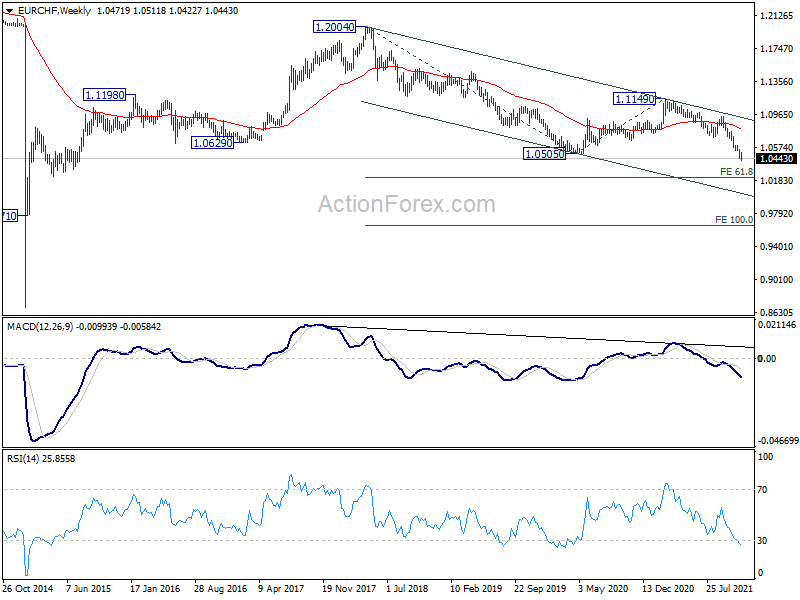
In the long term picture, rejection by 55 month EMA (now at 1.1015) maintains long term bearishness. Down trend from 1.2004 is now in progress for 61.8% projection of 1.2004 to 1.0505 to 1.1149 at 1.0223. Firm break there will target 100% projection at 0.9650.
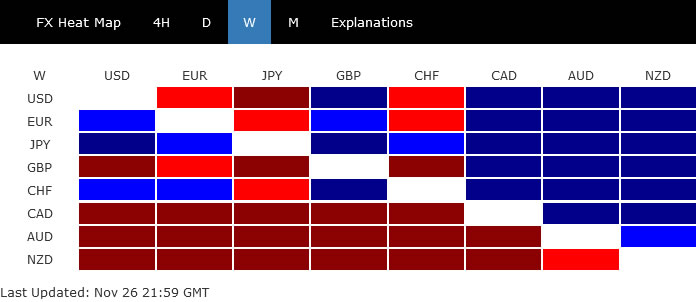
Investor Confidence Shattered by Omicron Variant, Yen and Swiss Franc Surged
Investor confidence was shattered by the news of the heavily mutated B.1.1.529 coronavirus variant, now called omicron. WHO warned that this variant has a large number of mutations, some of which are concerning. It added that preliminary evidence suggested an increased risk of reinfection with this variant. It may also have a growth advantage to other variants, with faster rate of infections. It's also still unknown if this variant is vaccine-resistant.
Yen and Swiss Franc ended the week as run-away leaders as global risk markets were in free-fall. Commodity currencies were the worst performing ones, as lead by New Zealand Dollar despite RBNZ rate hike. Meanwhile, Euro, Sterling and Dollar were mixed, with the greenback giving away much of the earlier gained grounds. While markets will likely stay risk-off for a while, the long term trends are not threatened yet. But of course, we'll have to wait-and-see how things develop.
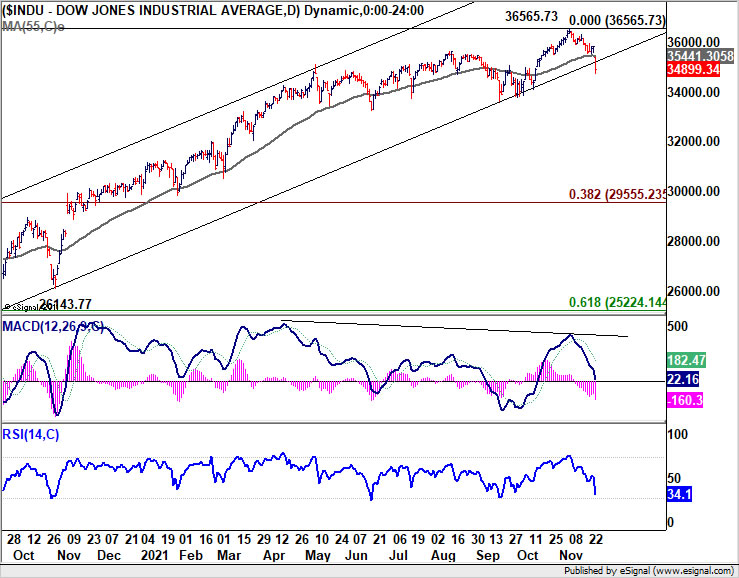
DOW starting medium term correction with break of channel support
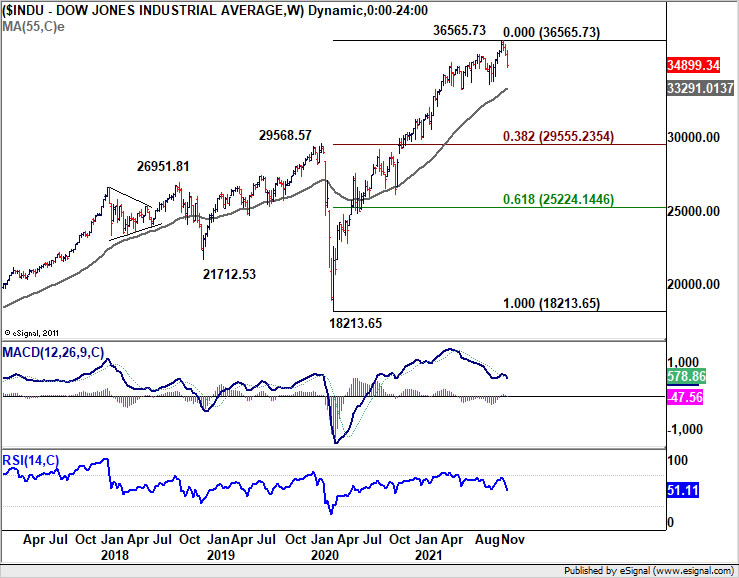
DOW took out both 55 day EMA and medium term channel support with the steep selloff late last week. The development suggests that a medium term top was formed at 36565.73, on bearish divergence condition in daily MACD too. At this point, we're treating the fall from 36565.73 as a correction to the rise from 26143.77 first. While deeper decline would be seen, the first line of defense will be at 55 week EMA (now at 33291.01). Strong support could be seen there to bring rebound and set the range of consolidations.
However, in the more bearish alternate scenario, sustained break of the 55 week EMA will argue that DOW is already correcting the whole up trend from 18213.65. In this case, deeper correction could be seen to 38.2% retracement of 18213.65 to 36565.73 at 29555.23, which is close to 29568.57 resistance turned support, and 30k round number.
10-year yield to draw support from 1.415, hopefully
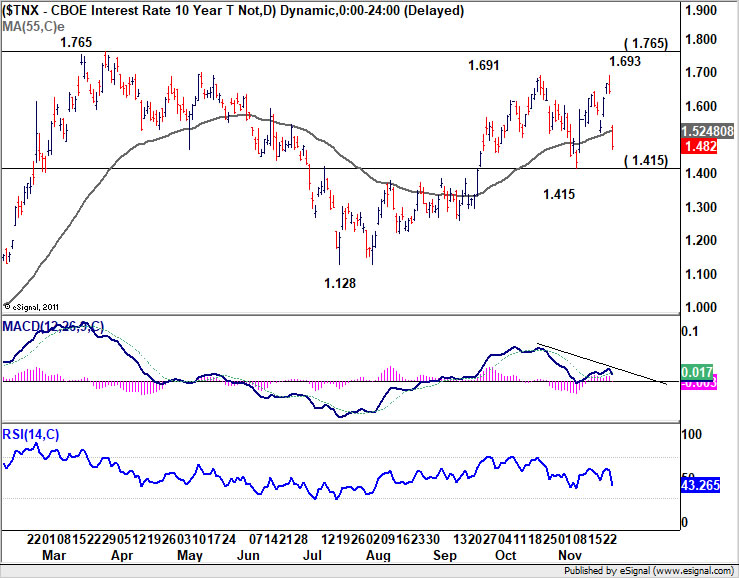
10-year yield also tumbled sharply after breaching 1.691 to 1.693 just very briefly. We'd look for strong support from 1.415 to bring rebound to set the range, even though a break of 1.765 will remain distant in terms of time. However, sustained break of 1.415 support could be accompanied some fundamental change in the global economic outlook. That is, the world might be back to a never-ending cycle of lockdowns and re-openings. In that case, TNX could head back to 1.128 before having some support to reverse.
DXY topped at 96.93, now in near term consolidations
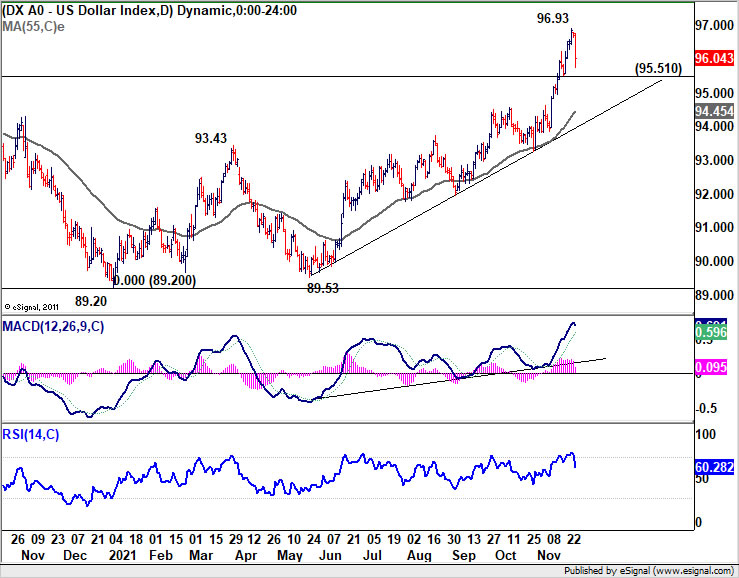
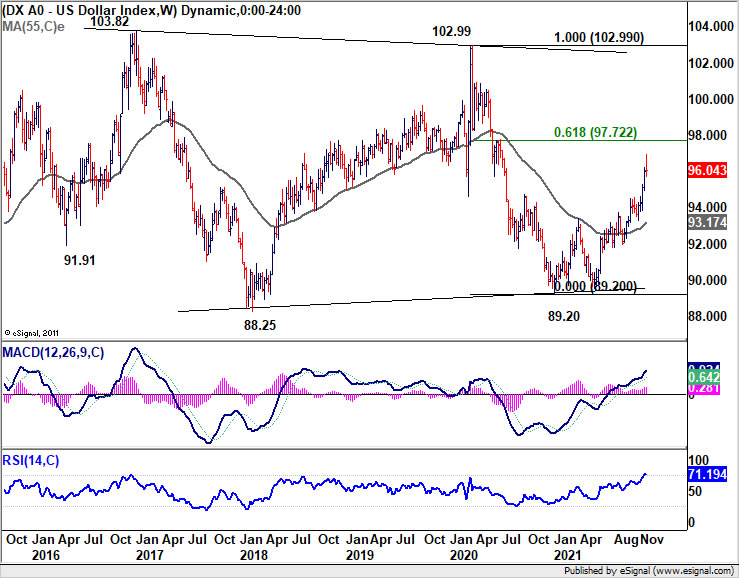
Dollar index rose to 96.93 last week but reversed from there. Considering the depth of the subsequent fall, a short term top should be formed. But for now, it's seen as engaging in a near term consolidation pattern only, as long as 95.51 support holds. We'd expect rally resumption to 61.8% retracement of 102.99 to 89.20 at 97.72 sooner rather than later. However, firm break of 95.51 will indicate that DXY is at least in a medium term correction. Deeper would be seen back to 55 day EMA (now at 94.45).
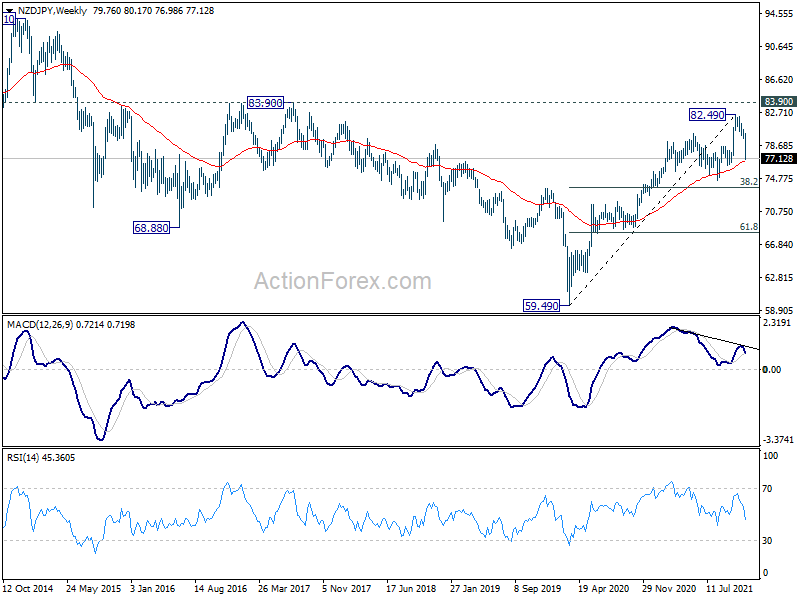
NZD/JPY could drop to 73.70 before finding a bottom
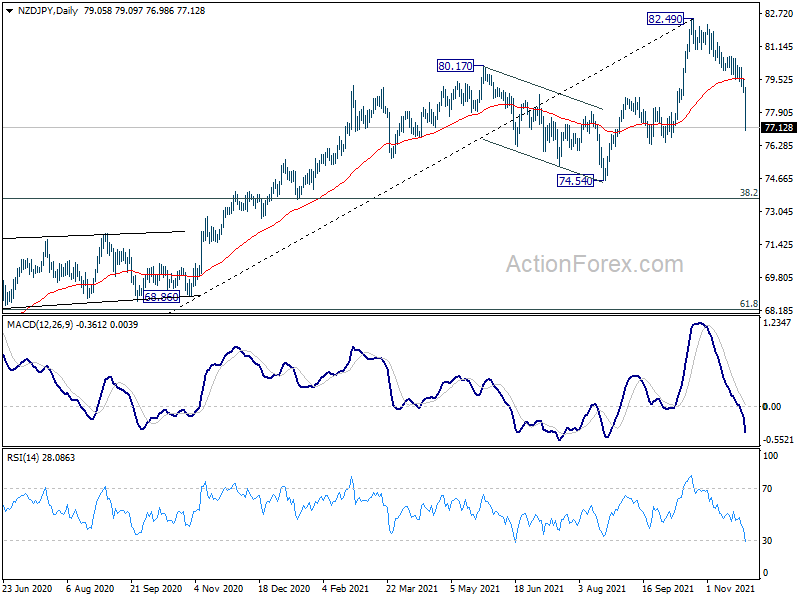
NZD/JPY ended as the biggest loser last week, despite RBNZ rate hike. Bearish divergence condition in weekly MACD, and the momentum of the fall, argues that 82.49 might be a medium term top already. NZD/JPY could now be correcting the whole up trend from 59.49 (2020 low). Immediate focus will be on 55 week EMA (now at 76.75). Sustained break there will bring deeper decline to 38.2% retracement of 59.49 to 82.49 at 73.70 before finding a bottom. Also, NZD/JPY will have to get back above 55 day EMA (now at 79.54) to revive near term bullishness, or risk will stay heavily on the downside.
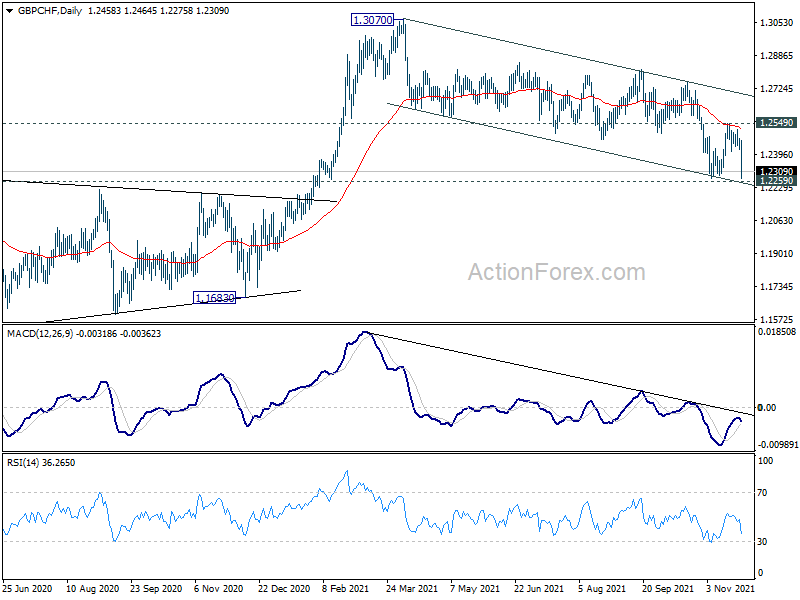
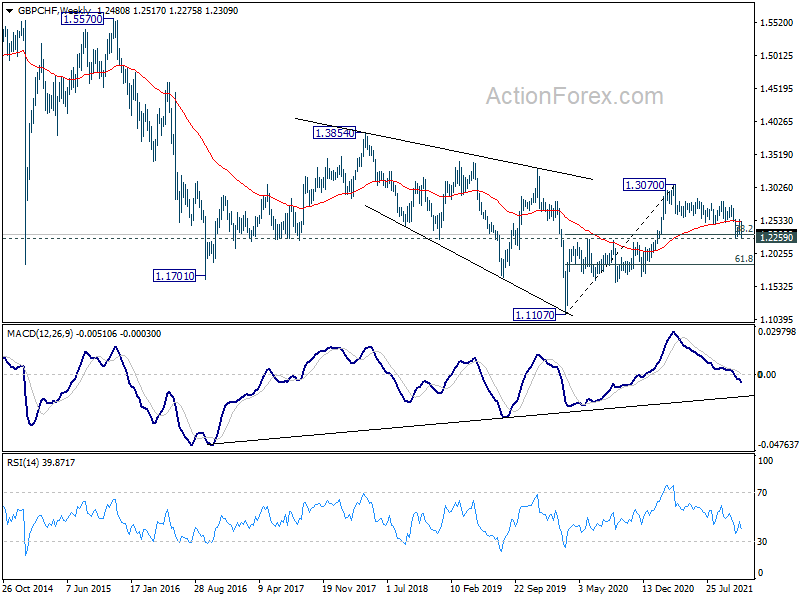
GBP/CHF eyeing 1.2259 key support with heavy downside risks
Risks are now heavily on the downside in GBP/CHF after last week's steep decline. Rejection by 55 day EMA (now at 1.2529) and 55 week EMA (now at 1.2499) are rather bearish signal. Immediate focus is back to 1.2259 key resistance turned support. Sustained break there would confirm that whole rise from 1.1107 (2020 low) has completed at 1.3070. Deeper fall would be seen back to 61.8% retracement of 1.1107 to 1.3070 at 1.1857 and below. Nevertheless, rebound from current level, followed by break of 1.2549 resistance will clear downside risks.
GBP/JPY Weekly Outlook
GBP/JPY's fall from 158.19 resumed last week and accelerated to as low as 150.67. Initial bias remains on the downside this week for 100% projection of 158.19 to 152.35 from 154.70 at 148.86 next, which is close to 148.93 key structural support. Decisive break there will carry larger bearish implication and target 161.8% projection at 145.25 next. For now, near term outlook will stay bearish as long as 154.70 resistance holds, in case of recovery.
In the bigger picture, the break of medium term channel support, and bearish divergence condition in week MACD are raising the chance of medium term topping at 158.19. Firm break of 148.93 support will argue that GBP/JPY is at least correcting the whole rise from 123.94 (2020 low). In this case, deeper fall would be seen to 38.2% retracement of 123.94 to 158.19 at 145.10. Nevertheless, strong rebound from 148.93 will retain medium term bullishness for another rise through 158.19 at a later stage.
In the longer term picture, as long as 55 month EMA (now at 146.38) holds, we'd still favor more up trend to 61.8% retracement of 195.86 to 122.75 at 167.93. But sustained trading below 55 month EMA will at least neutralize medium term bullishness and re-open the chance of revisiting 122.75 low (2016 low).
Summary 11/29 – 12/3
Monday, Nov 29, 2021
[php_everywhere instance="1"]
Tuesday, Nov 30, 2021
[php_everywhere instance="2"]
Wednesday, Dec 1, 2021
[php_everywhere instance="3"]
Thursday, Dec 2, 2021
[php_everywhere instance="4"]
Friday, Dec 3, 2021
[php_everywhere instance="5"]
The Weekly Bottom Line: Consumer Spending Powers Ahead
U.S. Highlights
- President Biden removed months of speculation by announcing his nomination of current Fed Chair Jerome Powell for a second term to head the Central Bank. He will be joined by Governor Brainard who the President nominated for Vice-Chair. The appointments eased one area of uncertainty around future monetary policy.
- U.S. personal income and outlays gave a reassuring picture of economic momentum heading into the fourth quarter. Spending on both goods and services accelerated notably.
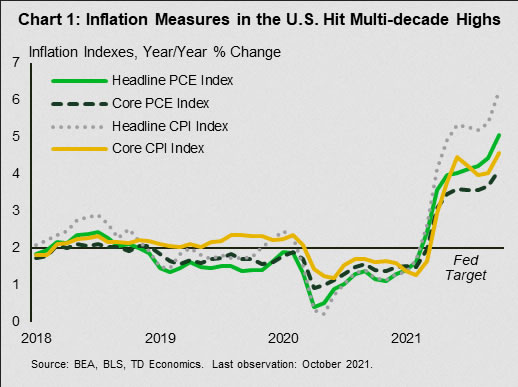
- Inflation, as measured by the personal consumption expenditure (PCE) deflator continued to accelerate in October. Core PCE – the Fed’s preferred gauge of inflation – rose to 4.1% year-on-year, adding to concerns depicted in the FOMC’s November meeting minutes that price pressures were more persistent and pervasive than previously thought.
Canadian Highlights
- This week was an eventful one. Communities in B.C. are beginning to rebuild, but new storm systems could hamper recovery efforts. The economic impact of the floods will be determined by how long severe weather lasts in the region.
- On the data front, payroll employment and job vacancy data for September were positive. Labour market conditions are tightening indicating stronger wage growth in coming months.
- Overall activity is not showing the same vibrancy as the labour market. GDP is likely to come in below the BoC’s expectation for the third quarter. The emergence of the Nu variant presents further downside risks to the outlook..
U.S. - Consumer Spending Powers Ahead
In a week shortened by the Thanksgiving holiday, the U.S. economic calendar was packed. Let’s kick things off with the BEA’s second estimate for third quarter GDP. Economic growth was revised up one tenth of a percentage point to 2.1% annualized. This represents a slowing of economic activity from 6.3% and 6.7% in Q1 and Q2 respectively. The marginal revision reflected a small upgrade to consumer spending that was partially offset by a downward revision to business investment. Given the strength of consumer spending in October (discussed below), we expect a rebound in fourth quarter GDP more in line with the numbers reported for Q1 and Q2.
Up next is October’s personal income and spending. The data showed that personal income rose by 0.5% month-on-month (m/m), with the gain primarily reflecting an increase in compensation of employees (up 0.8%) and income receipts on assets (up 0.9%). These were partly offset by a decline in current transfer receipts (down 0.5%). Unfortunately, inflation ate away those nominal gains. Real personal disposable income fell by 0.3% in October, an improvement from the 1.6% decline posted in September.
Nominal personal spending rose by 1.3% m/m in October (up 0.7% in real terms). Goods spending accelerated to 2.2% (from 0.9% in September) and spending on services rose by 0.9% (up from 0.5% in September). Spending on durable goods continued to exceed its pre-pandemic share with consumers spending about 13% of their total expenditures on durables – up from an average of 10% in 2019.
The personal consumption expenditure (PCE) price deflator rose by 0.6% m/m in October. Year-over-year (y/y) it was up 5.0%, 1.2 percentage points below the CPI inflation rate (Chart 1). Excluding food and energy, core PCE inflation rose 0.4% m/m and accelerated to 4.1% y/y (from 3.7%) – like its CPI counterpart, hitting a fresh 30-year high. The core PCE deflator has been running ahead of the Fed’s long-term 2% target since April of this year.
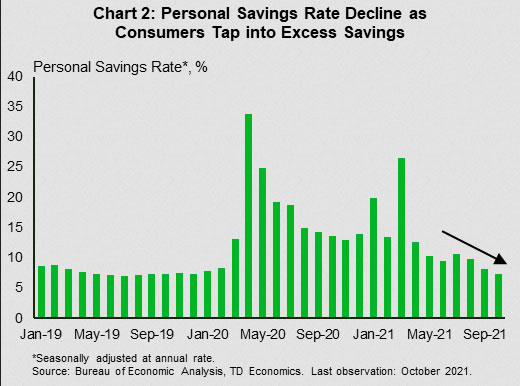
With spending outpacing income, the personal saving rate dropped to 7.3% in October from an upwardly revised 8.2% in September (Chart 2). The figure now stands below the pre-pandemic average of 7.5%, as consumers drawdown excess savings amassed during the pandemic to compensate for months of restricted economic activity.
To wrap things up we turn to activities at the Fed. President Biden announced that he will nominate Jerome Powell to retain his seat at the head of the central bank, with Lael Brainard joining him as Vice-Chair. The announcement ends months of speculation and signals continuity in U.S. monetary policy amid public concerns about inflation.
The central bank also released minutes of its November meeting. The minutes showed continued concerns about widespread price pressures. Chair Powell noted that inflation came in higher than expected and supply bottlenecks were more persistent than initially thought. ‘Uncertainty’ and ‘flexibility’ were key themes. With the potential for a new more contagious COVID-19 variant emerging, the Fed has positioned itself to respond quickly should the realized path of economic activity diverge from expectations.
Canada - Nu Variant Dulls Canada's Outlook
This week was an eventful one. Out west, communities in B.C. are slowly beginning to dig out from the powerful rainstorm that hit the province last week. Unfortunately, recovery efforts could be hampered by incoming storms. Flood warnings have been issued through much of the province and may lead to further highway closures and damage farmlands still reeling from the first storm. The economic impact of the floods will be dictated by how long the bout of severe weather lasts, as well as the time it takes to restore damaged infrastructure. November is looking like it will be a challenging month for the province. Hopefully, the recovery from it will be swift.
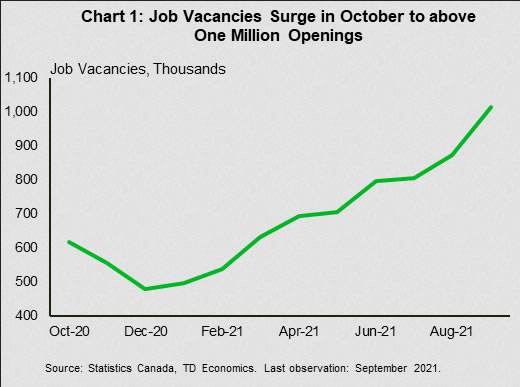
On the data front, key releases this week suggested labour market conditions tightened in September. The Survey of Employment, Payrolls and Hours reported a fourth consecutive monthly increase in employment of 91k positions. In addition, job vacancies surged, rising to above one million openings during the month (Chart 1). While these data highlight growing labour shortages in industries like accommodation and food services, it also points to rising wages and robust employment gains in the coming months. Indeed, employers may be forced to increase pay to address inadequate staffing levels.
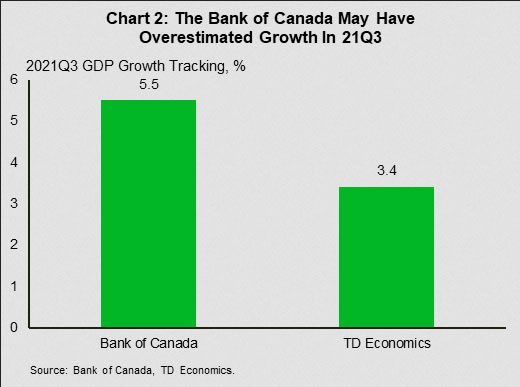
Regrettably, this vibrancy in the labour market is unlikely to be matched by third quarter GDP, which will be released next week. Supply chain constraints and plummeting agriculture production hit economic activity hard during the quarter, even as a strong rebound in services consumption fueled employment growth. We expect growth will come in a little over 3% (annualized) for the third quarter, more than two percentage points below the Bank of Canada's forecast in the October Monetary Policy Report (Chart 2).
This is likely to pose a communication challenge for the Bank. With inflation top of mind, the Bank brought forward its expectation for when economic slack will be absorbed to the middle of 2022 (from the second half of the year previously). With GDP underperforming, this could push the timeline back to the latter part of the year, requiring a reversal in their guidance for the eventual tightening of policy. If the Bank wants to maintain this date it will either have to downgrade potential growth (again) or lift its expectations for growth over the first half of 2022.
However, there are COVID-related clouds forming. Scientists sounded the alarm this week about a new strain of COVID-19, likely to be named Nu, that featured an "unusual constellation of mutations" that could render vaccines less effective and the virus more transmissible. In fact, this version of the virus is already overtaking other variants in South Africa. There is much that's not known about Nu. But if it is deemed to be a nastier variant than Delta, it would certainly be the most important downside risk to Canada's economic outlook.
Forward Guidance: Canadian GDP Edging Higher as Labour Markets Tighten
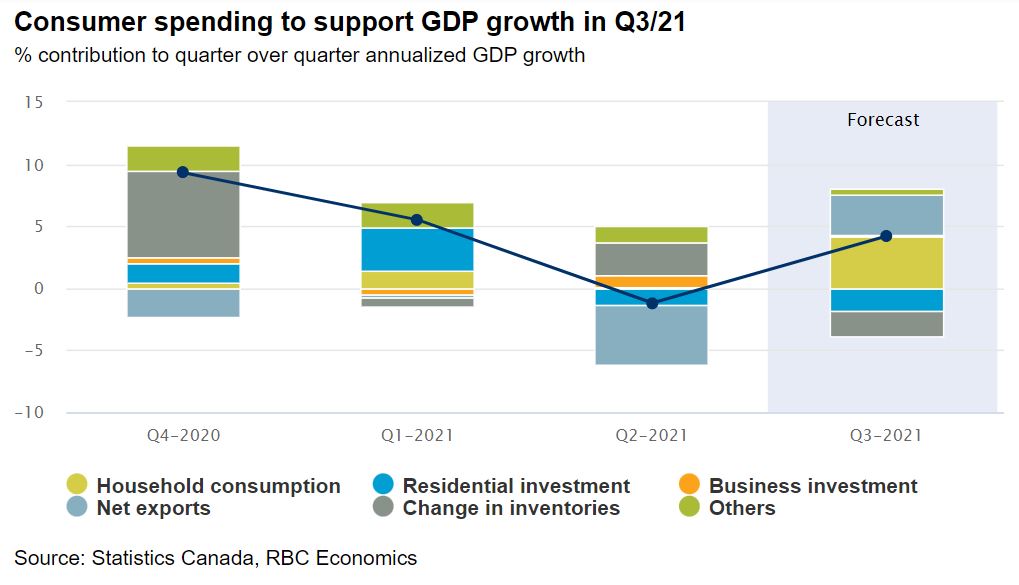
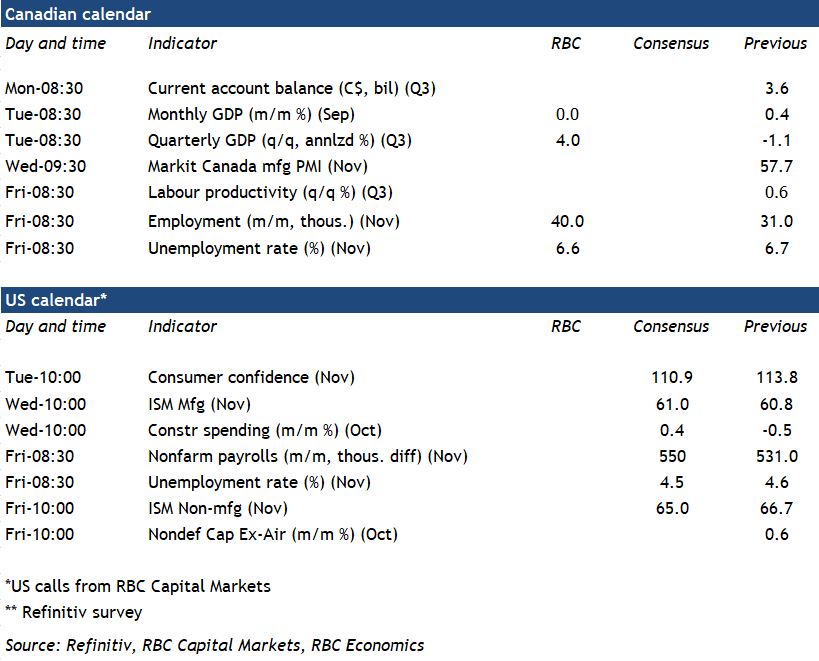
We expect GDP rose 4.0% (annualized) in the third quarter, picking up after a 1.1% decline in Q2 when COVID-19 restrictions were more stringent. That Q3 increase would be stronger than the 2% early estimate from Statistics Canada a month ago with improved labour market data leaving some upside risk—hours worked increased at an almost 7% rate in Q3. Residential investment likely pulled back for a second consecutive quarter as home resale markets cooled. But consumer spending rebounded. The volume of retail merchandise purchases increased 6.3% and spending on high-contact services is beginning to recover from pandemic-restrained levels. Exports are tracking higher too, gaining 10% after plunging 15% in Q2. On a monthly basis, the preliminary estimate from Statistics Canada was that output was unchanged in September, in part due to supply chain disruptions that drove motor vehicle manufacturing sales down more than a third from August. The early reading for October is expected to look substantially better. The advance manufacturing sales report pointed to a temporary reprieve in auto production disruptions, and early retail and wholesale trade estimates were also up.
Labour market indicators have been consistently firmer. Employment was back to pre-pandemic levels as of September— compared to a 1.5% shortfall in GDP. We estimate that employment rose by another 40,000 jobs in November, led by further improvement in high-contact services sectors where the bulk of remaining labour market weakness remains. Even in those industries though, labour shortages look set to intensify. Employment in those hardest-hit high-contact service sectors is still down almost 280,000 from pre-pandemic levels, but the number of remaining unemployed workers out there above longer-run ‘normal’ levels is smaller at under 150,000. The threat of virus spread remains and global supply chain bottlenecks will continue to disrupt goods production. But even as those start to dissipate, shortages of labour are expected to remain a significant constraint on further GDP growth into next year.
Week ahead data watch:
Canadian GDP is expected to have remained flat for September from August, with declines in manufacturing, retail and wholesale sales tied to a weaker auto sector. These were offset by ongoing recovery in hospitality and travel. Growth likely reverted back to positive in October, as suggested by more positive advance data releases.
We expect a 40,000 increase in Canadian employment in October, lowering the unemployment rate to 6.6%. The improvement was likely supported by the ongoing recovery of close-contact service sector industries, where employment is still weaker than pre-pandemic but demand continues to resume.
The US employment report next week is expected to show continuous improvement in payroll in November, with consensus currently expecting a larger than 500k gain for a second month in a row and a tick lower in the unemployment rate to 4.5%. Rising demand for workers, without adequate inflow into the labour force will likely keep market tension elevated and further add to wage pressure, which has been increasingly present in earnings data in recent reports.
Week Ahead – Pressure Mounting on Central Banks
Investors concerned about new Covid variant
For months now the main topic of conversation in the markets has been inflation. Is there too much of it, is it here to stay, and are monetary policymakers actually going to do something about it? Of all the risks facing the global economy and the markets this winter, that had risen to the top of the list. Until now.
Covid has returned with a bang, with Europe at the epicentre but the focus now switching to South Africa as the new “Omicron” variant has everyone fretting about whether another terrible wave is going to hit this winter. We’ll know a lot more about how dangerous the new variant is in the coming weeks but for now, investors are fearing the worst and risk assets are being hit hard.
As far as central banks are concerned, the timing couldn’t be worse. They’re already trying to navigate their pandemic exit strategies earlier than they’d clearly prefer as inflationary pressures continue to rise and become more widespread. If the world goes back into lockdown, what becomes the bigger priority, inflation or the economy? Thankfully there’s plenty of policymakers appearing next week who will be asked that very question. Talk about a rock and a hard place.
US
Next week is packed full of event risk from the US and news about a new Covid variant has added a whole new dimension to it. The jobs report is typically the highlight of the week and it will be one highlight, but next week is all about the Fed appearances in light of Thursday’s news. Investors had started to price in a faster pace of tightening, with an announcement maybe coming at the meeting in a couple of weeks. Should the variant prove to be a greater threat than others, it’s highly unlikely the Fed will change course. The absence of evidence on it will surely also encourage caution. The worst case isn’t worth thinking about but would make life very difficult for central banks next year.
We also get a bunch of economic data from the US next week aside from the jobs report on Friday, including PMIs, jobless claims and pending home sales, among others. Powell’s appearances in the Senate and House alongside Treasury Secretary Janet Yellen will surely be the standout event though.
EU
A lot of data to come from the EU next week including PMIs on Wednesday and Friday, inflation data on Tuesday, unemployment on Thursday, and retail sales on Friday.
But as will be the case for all countries next week, central banks will be front and centre following the new variant news. We were just starting to get an idea of how they’ll proceed in the months ahead but this throws a massive spanner in the works. ECB President Christine Lagarde bookends the week, with others making appearances in between and investors will be hanging on their every word.
UK
At the risk of sounding repetitive, next week is all about the new Covid variant and central bank speak. BoE Governor Andrew Bailey’s appearance on Wednesday is the standout with PMIs also being noteworthy, albeit irrelevant if Omicron poses a real threat to life without restrictions.
Russia
PMI and unemployment data are the notable releases next week for Russia, which will also be watching the variant situation closely.
Perhaps more significant with respect to Russia is the growing tensions with Ukraine as forces build on the border. President Volodymyr Zelenskiy has claimed Ukraine has uncovered a plot to overthrow the government next week including Russian individuals, which the Kremlin has denied involvement in. With tensions on the rise, it may not take much for this to boil over which could hit the ruble hard.
South Africa
The spotlight is very much on South Africa for the foreseeable future after discovering the new Omicron variant which could account for around 90% of new cases. With a small number appearing in Botswana, Hong Kong and Belgium, countries are rapidly applying travel restrictions on South Africa in a desperate attempt to avoid being next.
Turkey
It’s difficult to know what to add anymore. Rather than being deterred by the extraordinary declines in the lira over the last week, President Erdogan is doubling down. On Friday he declared there is no turning back from the new economy program, that interest rates will decline and the economy is in the most determined policy shift.
And in Şahap Kavcıoğlu, Erdogan appears to have finally found an ally willing to do his bidding. Challenging times lie ahead. One interesting point on Friday was the lira tumbling more than 2% on Erdogan’s comments before recouping those losses quickly. Perhaps a sign of traders becoming less influenced by the President’s rants, although sensitivity remains. I’m sure there’s plenty more volatility to come in the weeks ahead.
China
China releases official and Caixin Manufacturing and Services PMIs in the week ahead. Nerves have been increasing and China’s growth is slowing thanks to its energy crunch and property sector woes. The latter is grabbing headlines once again as Kaisa attempts a debt restructuring. Against this background will be the global sell-off in emerging markets over South African virus concerns. How this plays out next week will determine the overall direction of China equities, although a weak reading once again from the Manufacturing PMIs will deepen the negative sentiment.
The Yuan has resisted the sell-off sweeping other EM currencies and the PBOC seems to be determined to maintain its stability. Similarly, China’s “national team” may be active in equity markets if the sell-off deepens or becomes disorderly.
India
Emerging markets will suffer in the race to safety over concerns surrounding the new virus mutation and whether it is the next delta. Indian equities have been sold heavily and both they and the Rupee may be in the firing line if WHO guidance is negative over the weekend. The evolution of the virus situation will set the direction for Indian and most emerging markets next week.
Australia
The rush to safety over the Omicron Covid-variant has punished the Australian Dollar which was already wilting in the face of China concerns and a strong US Dollar. AUD/USD could remain under pressure on Monday if the virus news continues to be negative over the weekend.
Australian Q3 GDP mid-week is expected to show weakness, although it will be largely ignored as the Victoria and NSW reopenings in Q4 should see a rapid bounce in GDP.
New Zealand
Markets were disappointed that the RBNZ only hiked 0.25% this week, leaving the NZD under serious pressure as the week ended. The virus-led selloff in equities has crushed risk appetite and leaves the Kiwi vulnerable to a material move lower. If the WHO announces further concerns over the weekend, NZD/USD could move sharply lower as the week starts.
No data of note in the week ahead.
Japan
The Japanese Yen is seeing strong haven inflows as markets retreat to defensive positioning over South Africa Covid variant concerns. USD/JPY is testing key support and could see more pressure to the downside if variant concerns grow.
Japanese retail sales and the Jibun Bank PMIs feature in the week ahead, but markets will be more focused on further details of the stimulus package and whether the virus risk-off move seen on Friday continues.
Key Economic Events
Saturday, Nov. 27
- China – Industrial Profits
- Japan – Retail Sales
Monday, Nov. 29
- Fed Speakers – Jerome Powell (Chairman, Pre Record), John Williams, Michelle Bowman
- ECB Speakers – Christine Lagarde (President), Luis de Guindos (Vice Presdent), Andrea Enria (Board), Isabel Schnabel (Board), Pentti Hakkarainen (Board)
- BoC Speakers – Tiff Macklem (Governor)
- RBA Speakers – Guy Debelle (Deputy Governor)
Economic Data
- Germany – HICP Inflation
- South Korea – Retail Sales
- Japan – Unemployment
Tuesday, Nov. 30
- Jerome Powell (Fed Chairman) to appear in Senate Testimony alongside Treasury Secretary Janet Yellen
- RBA Speakers – Guy Debelle (Deputy Governor)
- Riksbank Speakers – Henry Ohlsson (Deputy Governor)
- Fed Speakers – Jerome Powell (Chairman), Richard Clarida (Vice-Chair), John Williams,
Economic Data
- US – Consumer Confidence
- China – Manufacturing PMI, Composite PMI
- Eurozone – HICP Inflation
- Turkey – GDP
- Denmark – GDP, Unemployment
- France – GDP
- Italy – GDP, CPI Inflation
- Germany – Unemployment
- India – GDP
- Canada – GDP
- API Crude Oil Stocks
Wednesday, Dec. 1
- Hungarian Central Bank Minutes
- Fed Beige Book
- BoJ Speakers – Seiji Adachi (Board)
- BoE Speakers – Andrew Bailey (Governor)
Economic Data
- US – Manufacturing PMI, ISM Manufacturing PMI
- China – Caixin Manufacturing PMI
- Eurozone – Manufacturing PMI
- Japan – Manufacturing PMI
- UK – Manufacturing PMI
- Germany – Manufacturing PMI
- France – Manufacturing PMI
- Italy – Manufacturing PMI
- Australia – GDP
- South Korea – Manufacturing PMI
- Indonesia – Manufacturing PMI
- India – Manufacturing PMI
- Russia – Manufacturing PMI
- Turkey – Manufacturing PMI, Istanbul Retail Prices
- Canada – Manufacturing PMI
- Mexico – Manufacturing PMI
- EIA Crude Inventories
Thursday, Dec. 2
- OPEC+ Ministerial Meeting
- Fed Speakers – Raphael Bostic (Atlanta President), Randal Quarles (Governor), Mary Daly (San Francisco President)
- ECB Speakers – Fabio Panetta
- BoJ Speakers – Hitoshi Suzuki (Board)
- Riksbank Speakers – Henry Ohlsson (Deputy Governor)
Economic Data
- US – Initial Jobless Claims
- Eurozone – Unemployment Rate
- Australia – Trade Balance, Services PMI, Composite PMI
- Turkey – FX Reserves
Friday, Nov. 26
- ECB Speakers – Christine Lagarde (President), Philip Lane (Board)
Economic Data
- US – Non-Farm Payrolls, Unemployment, Average Earnings, Participation, Services PMI, Composite PMI, Factory Orders, ISM Non-Manufacturing PMI
- China – Caixin Services PMI
- Eurozone – Services PMI, Composite PMI
- Germany – Services PMI, Composite PMI
- France – Services PMI, Composite PMI
- Italy – Services PMI, Composite PMI
- UK – Composite PMI
- Japan – Services PMI
- India – Services PMI
- Russia – Services PMI, Unemployment
- Turkey – CPI
- South Africa – Whole Economy PMI
- Canada – Unemployment, Employment Change
Sovereign Rating Updates
- Italy (Fitch)
- Russia (Fitch)
- Sweden (Fitch)
Eurozone’s Inflation Spiral to Continue but will Euro Capitalize?
The euro went downhill lately as Europe became the epicenter of another pandemic wave, forcing several economies to return to lockdowns ahead of the holiday season. With new business containment measures rolling in, investors are wondering whether inflation will continue to escalate. On Tuesday, CPI inflation figures for November are expected to jump again for the fifth straight month, but with Covid making a fresh round, the euro will probably receive only a modest boost.
Growth jitters resurface
The eurozone economy seems to be stuck between a rock and a hard place nowadays. On the one hand, businesses keep transferring some of their pandemic-related higher input costs to consumers, making inflation spiral higher for the fourth consecutive month to a 13-month high of 4.1% y/y in October. On the other hand, covid infection cases have recently started to ramp up dangerously again, with the Netherlands, Germany and Austria being some of the member states to reimpose new curbs to reduce traffic in the streets and promote vaccinations ahead of the winter and holiday season.
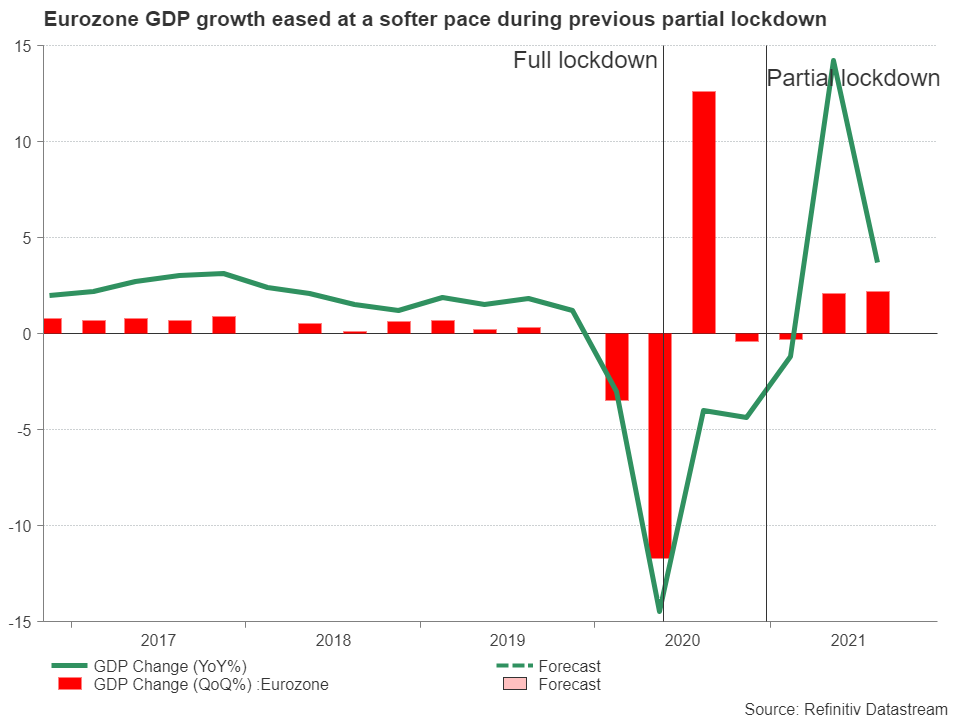
The above have already resurfaced fears of a growth slowdown in the region, but the truth is that intermittent business closures during the previous lockdown phases had not hugely affected economic growth. GDP growth had accelerated by 14.3% y/y in the second quarter following a soft contraction in the first three months of the year. Hence, assuming consumption and hiring remain buoyant, and business activity stands healthy, as recent Markit PMI figures reflected, the economy could still catch up in the coming quarters.
Eurozone inflation to run hot
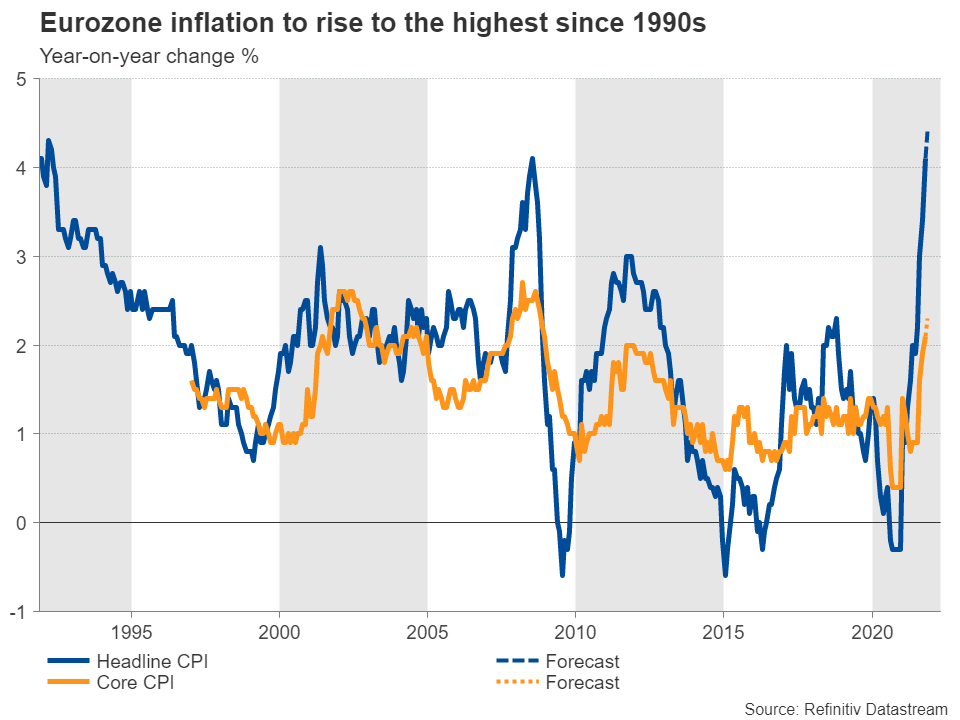
Yet, how inflation will develop, and therefore how monetary policy will respond, could be puzzling. The European Central Bank (ECB) is blindly trusting its inflation models, which suggest current price pressures are transitory, foreseeing price growth easing to 2.0% in the medium term. The headline CPI rate, however, is already double that threshold, and according to forecasts it has further stretched to 4.4% y/y in November – the highest since 1991, while the core CPI measure, which excludes volatile food and energy prices, is also projected to edge up to 2.2% y/y.
ECB may choose to play safe
Under different circumstances, another acceleration in inflation data would press for an earlier rate hike as divisions within the ECB have further widened lately, with the German Bundesbank President Jens Weidmann sounding the alarm that inflation will probably remain above the 2.0% target in the medium-term and slow at a more gradual pace than policymakers previously forecast.
The German ECB board member, however, is stepping down at the end of the year and the threat of a new ‘Nu’ covid variant, as well as, the potential of stringent lockdowns in the Eurozone during winter will probably be a good reason for the central bank to maintain its rate outlook steady for now and keep its liquidity taps open till March when it meets in mid-December.
What could be more toxic for the ECB is a cocktail of continuous inflationary pressures backed by supply constraints and a decelerating economic growth (stagflation) in the coming quarter, but that remains to be seen.
EUR/USD
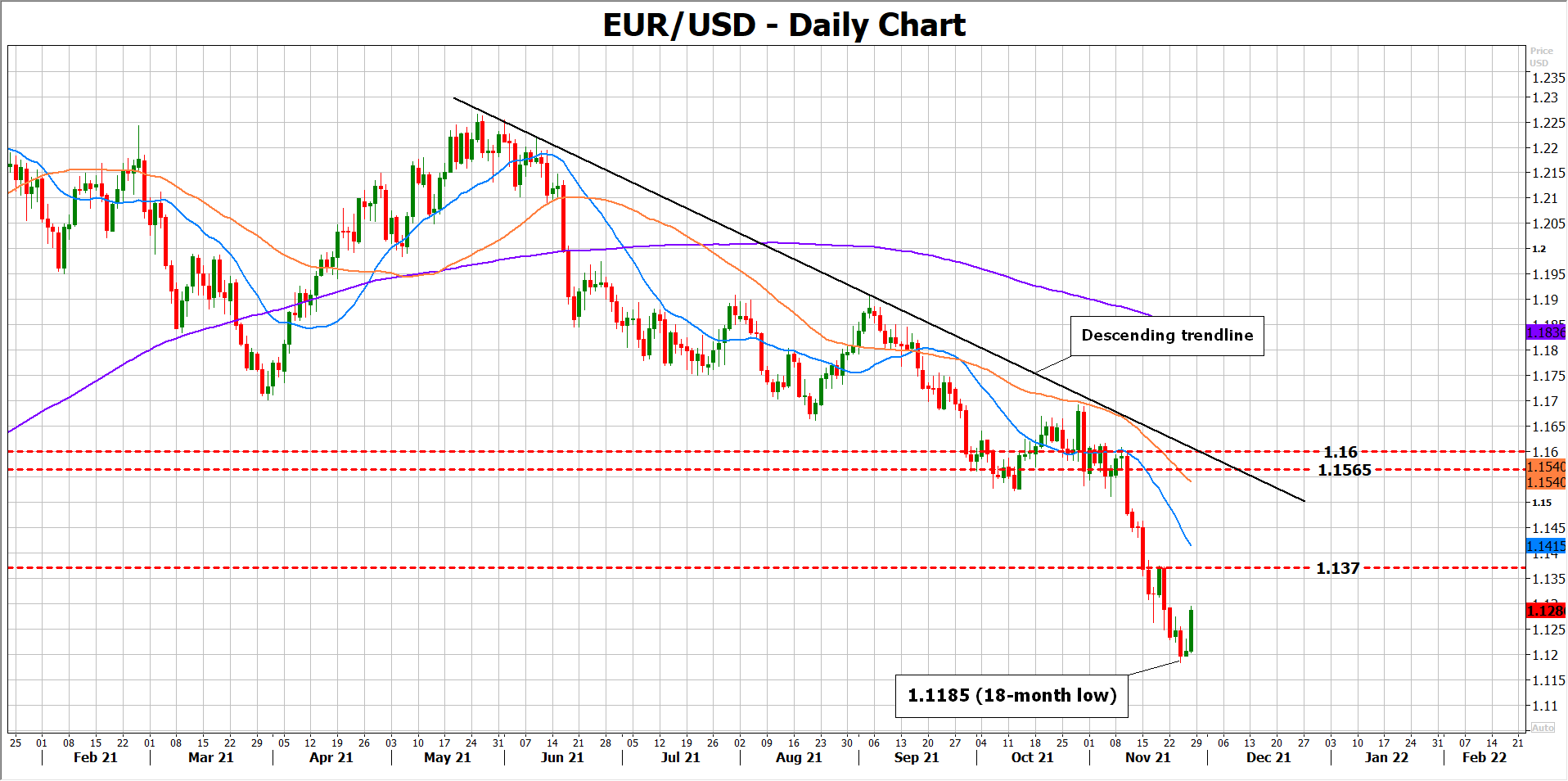
As regards the market reaction, an upside surprise in CPI readings could meet heightened pandemic concerns next week, likely causing a muted positive reaction in euro/dollar. Euro/dollar is currently in a recovery mode following the plunge to an almost 1½ -year low of 1.1185, and a clear break above the nearby 1.1370 barrier is probably required to drive the price up to 1.1450. Yet, the broader bearish outlook would remain intact unless the pair speeds above the 1.1565 – 1.1600 area.
In the event the data miss expectations, justifying the ECB’s current accommodative stance, euro/dollar could pull back to test the low of 1.1185. Failure to rebound here may activate a more aggressive sell-off towards the 1.1000 number.