Sample Category Title
Week Ahead – NFP Report Could Keep the Dollar Rally Going
It will be hard for the US dollar to escape the spotlight in the coming week as the November jobs report will likely further fuel expectations of faster Fed tapering, extending the rally. The last month of the year is expected to get off to a busy start with a slew of data on the way. Aside from the US highlights, Canada will also be reporting jobs numbers in addition to its Q3 GDP print, Australia will publish growth figures too, while the Eurozone’s flash inflation readings might give the euro a much-needed reprieve.
Australian economy likely shrunk in Q3
The weight of the recent lockdowns will be on full display in Australia’s GDP estimate for the quarter ending in October on Wednesday. The data will be preceded by quarterly business inventories and net exports contribution on Monday and Tuesday, respectively. Strong demand for Australia’s resources exports is expected to have lessened the overall hit to the economy from the Covid shutdowns, which are anticipated to have substantially dented consumption and the construction sector.
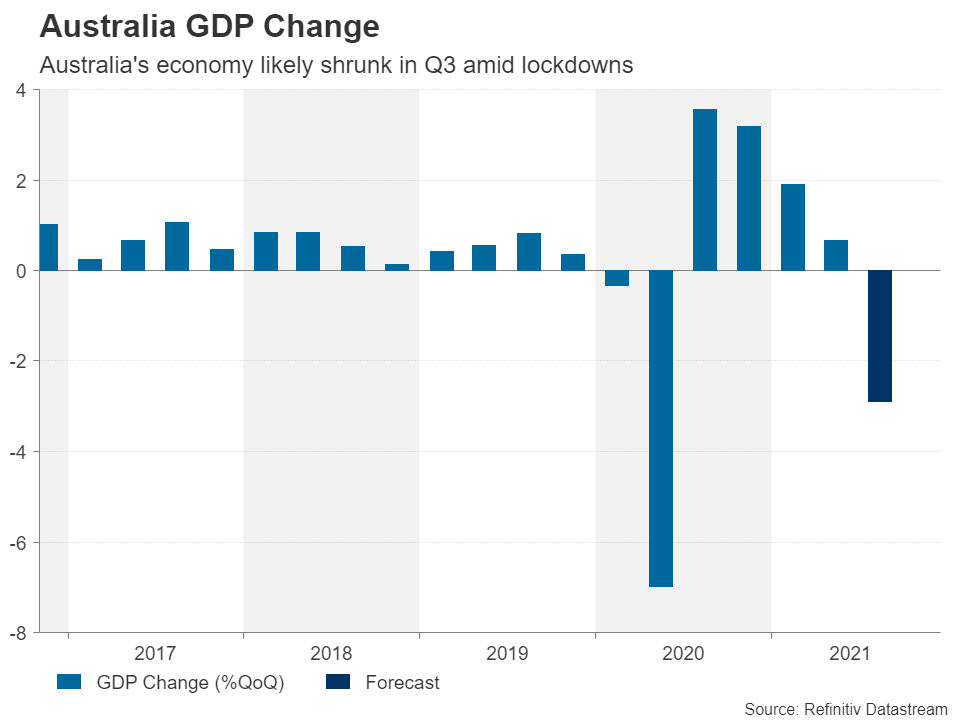
With investors pricing in almost four rate hikes in 2022, better-than-expected growth numbers would support the view that the Reserve Bank of Australia will begin raising rates before its own guidance of 2023 at the earliest.
However, although any changes to the rate outlook would probably not be very significant, it might be the perfect excuse the aussie bulls need to step in and rescue the local dollar from the multi-week lows plumbed against its US rival.
But while there is scope for an upside surprise in the GDP figure, China’s manufacturing PMIs on Tuesday and Thursday pose more of a downside risk for the aussie. China’s economy is cooling and any fresh evidence that the slowdown is accelerating could hurt risk appetite, causing more pain for the aussie.
Loonie hoping for data-led rebound
The Canadian dollar hasn’t been spared from the greenback’s ruthless assault even though the outlook for the Canadian economy remains quite rosy. Growing expectations that the Federal Reserve will not only begin to lift rates sooner but by more times are superseding investors’ similarly aggressive pricing for Bank of Canada tightening in 2022.
The raging speculation as to which central bank will raise rates the most will almost certainly not be easing next week as employment data are due in both Canada and the US.
In addition, investors will get the chance on Friday to see how strongly Canada’s economy rebounded in the third quarter, having contracted in the June quarter when much of the country was in lockdown.
Solid GDP numbers on Tuesday and a further big jump in employment in October could see the BoC making another hawkish turn at its December 8 policy meeting, potentially boosting the loonie.
But the oil-linked currency will also be keeping an eye on the upcoming gathering of major oil producers.
Will it be payback time for OPEC?
White House-led efforts to alleviate the global energy crisis ended in disaster after the coordinated move by the US and several other big nations to release some of their strategic oil reserves did little to drive oil prices lower. Oil futures are on track to finish the week lower, but only because of the fears about the new and potentially very dangerous strain of Covid-19 that could weigh on demand if it spreads.
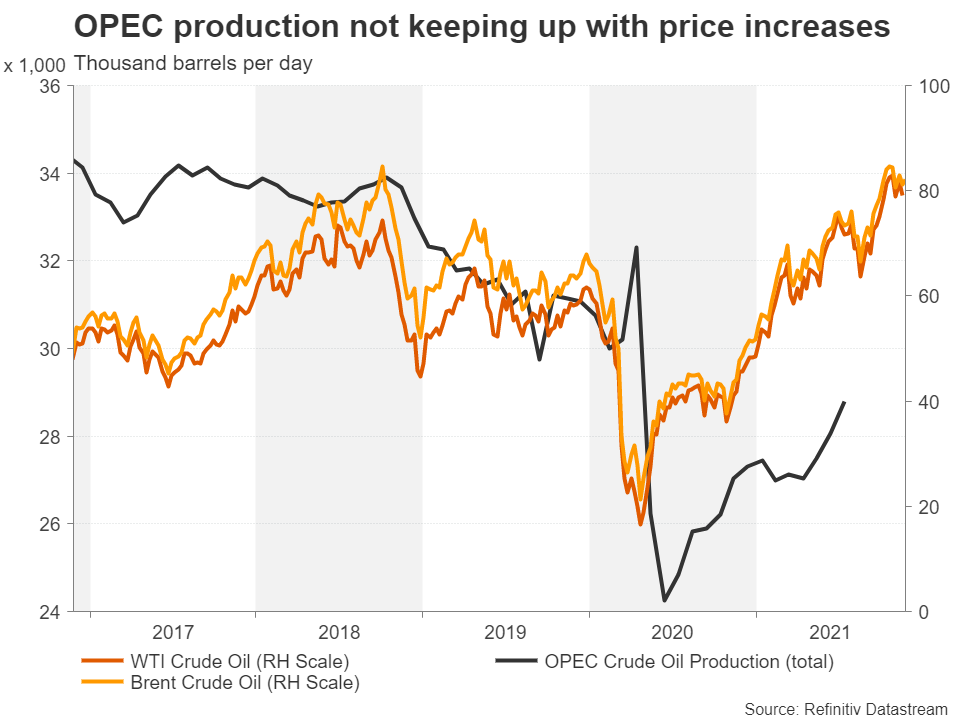
The question now is, will OPEC and its allies punish the US and its partners in crime for taking matters into their own hands? Probably not. Although, this does reduce the odds of OPEC+ countries accelerating the pace at which they undo the 2020 supply cuts in the coming months.
As for next week’s meeting (OPEC members meet on December 1 and the OPEC+ pact on December 2), the likely outcome is that they will stick with the plan of monthly increases of 400,000 barrels a day. However, there may be some clues as to which direction production might be headed in 2022, and this could be a key driver for the loonie next week.
Another NFP beat?
It’s been a bumpy year for the US labour market despite the overall positive trajectory. But last month’s robust gain of 531k in nonfarm payrolls reassured investors and the Fed that it’s only a matter of time before the jobs market fully heals from the pandemic. Analysts are anticipating that November was another good month for job creation, with forecasts currently running at 563k. This would lower the unemployment rate down a tick to 4.5%, while pushing up yearly average earnings growth to 5.0%.
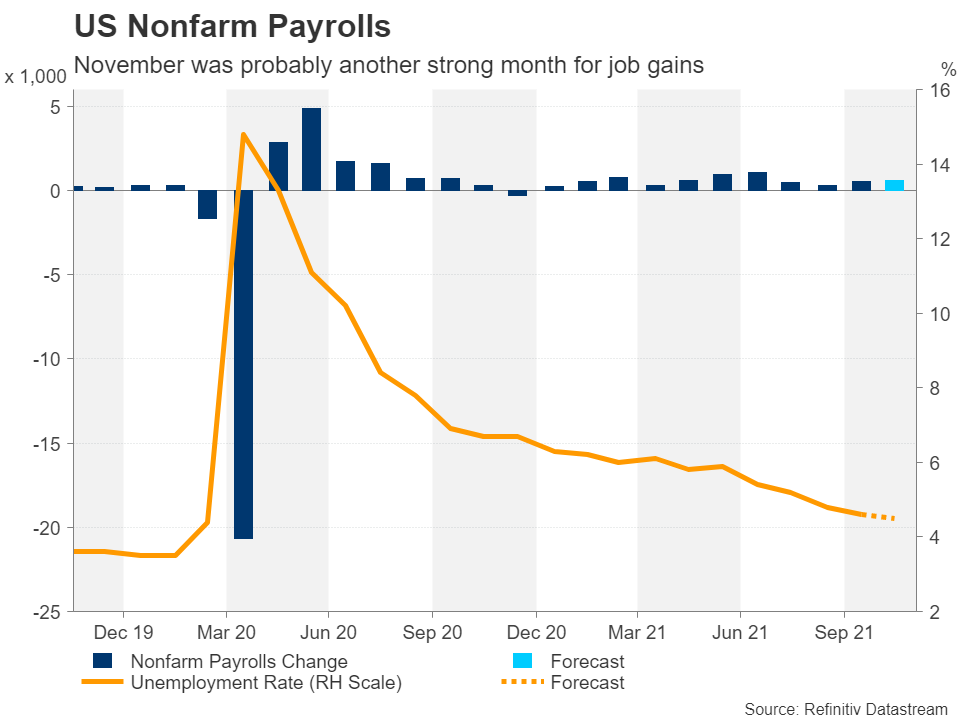
If Friday’s jobs figures are in line or better than the projections, it would strengthen expectations that the Fed will speed up tapering, perhaps as early as the December meeting. Also important will be the ISM PMI reports. The manufacturing PMI is out on Wednesday, to be followed by the non-manufacturing composite on Friday.
In other US data, pending home sales are due on Monday, the consumer confidence index and the Chicago PMI on Tuesday, and factory orders on Friday.
A broadly upbeat set of data would add fuel to the dollar’s upward charge, as currently, it is only the US where the economic outlook is as bullish as the rate hike expectations. This of course implies that other majors stand little chance of clawing back some losses.
The main risk for the greenback over the next few days is if Jerome Powell talks down speculation of a quicker exit from QE when he testifies before the Senate Banking Committee on Tuesday. The Fed chief will be answering questions from lawmakers alongside Treasury Secretary Janet Yellen and may drop some hints as to whether he is leaning towards such a policy shift like many of his colleagues are. The discovery of the new Covid mutation could prompt Powell to err on the side of caution.
Eurozone inflation to spike again
Inflation in the Eurozone could rise to the highest since 1991 in November. The flash estimates are out on Tuesday and are forecast to show the headline number picking up to 4.4% year-on-year. Before the recent worsening of the virus picture across the EU, such an increase would have bolstered the case for a rate hike. However, with Germany possibly joining Austria soon in going into a nationwide lockdown, the European Central Bank will likely wait and see whether the transitory effects on inflation will fade on their own accord.
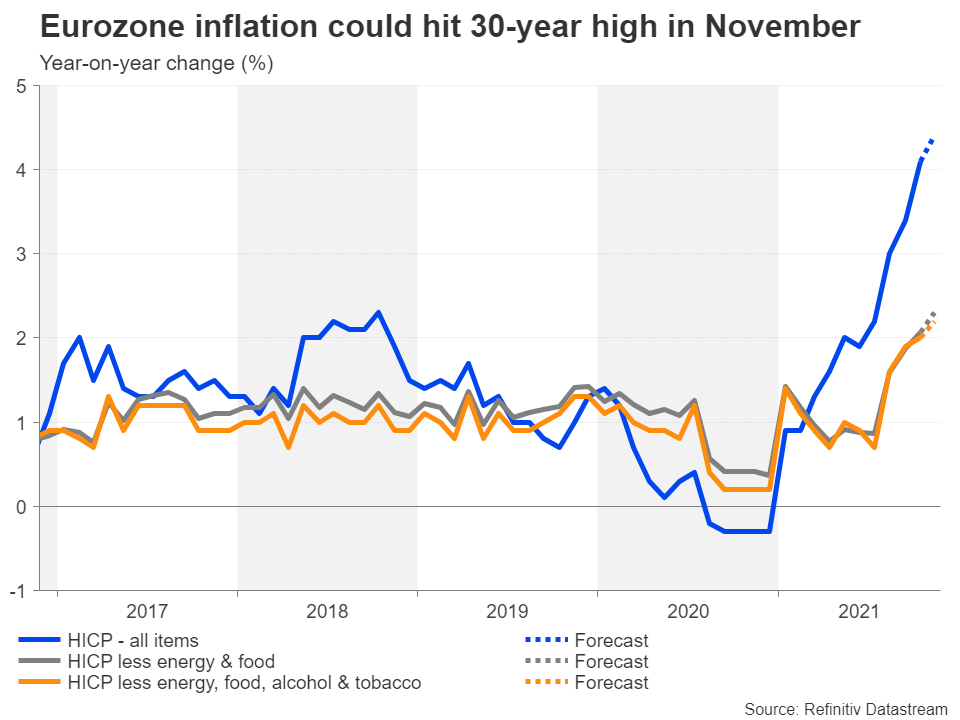
Hence, the euro’s best bet for a near-term rebound is if there is a pullback in the dollar.
Aside from the flash inflation numbers, the economic sentiment indicator for November on Monday, the final PMI readings on Thursday and retail sales on Friday might also attract some attention for the euro.
Elsewhere, the final PMIs for November will also be doing the rounds in the UK, retail sales and industrial production data will be watched in Japan on Monday and Tuesday, respectively, while in New Zealand, the NBNZ business outlook survey on Tuesday and Q3 terms of trade figures might spur some volatility in the kiwi.
Weekly Focus – Strong Activity ahead of Slowdown
Markets largely reflected strong macro news this week until the spook from a new COVID-19 variant/mutation (B1.1.529) observed in South Africa hit risk sentiment. The USD continued to strengthen amid strong US data and President Biden's re-nomination of Jerome Powell as Fed chair. At the same time, COVID-related restrictions are weighing on the euro. Yields edged higher through the week on the back of reacceleration in economic activity and hawkish comments from ECB governing council members. On the B1.1.529 news, they dropped again and Bunds hit the lows of last week. It has been somewhat of a roller coaster week for equities with global indices down across the board on COVID-fears after a week with VIX volatility at its highest since early October. There is also a flip side to strong macro news for stock markets these days as it moves us closer to monetary tightening.
In the expectation of a coordinated release of strategic oil reserves from the US, China, Japan, India and South Korea, oil prices traded lower, but in the end the release was not enough to satisfy expectations and oil increased back to levels around USD82 per barrel before plunging to 78 levels amid B1.1.529 fears.
The European economy is faring better than expected with November euro area PMIs surprising on the upside. Particularly the service sector picked up pushing composite PMI higher for the first time since the reopening fumes dozed off in July. However, German Ifo figures indicate slowdown in the coming months particularly in the service sector as further restrictions are lurking ahead and consumer confidence are heading lower in Germany, and in the euro area, as high inflation erodes purchasing power. COVID-related restrictions are spreading all over Europe as the number of cases are surging many places. This is bound to weigh on the service economy.
We have seen strong macro data outside Europe as well with US initial jobless claims below 200.000 for the first time since the pandemic. October consumer spending and capex orders were strong too. The recent recovery in Japan is also solid with increases in both manufacturing and service PMIs indicating easing supply chain issues and a strong rebound from the reopening of the economy on 1 October.
Next week markets will start by tuning in on November inflation figures from Spain and Germany on Monday and then the euro area on Tuesday. We expect a small increase from 4.1% to 4.2% in euro area headline HICP inflation. We will also keep a close eye on potential new restrictions in Europe. The Netherlands and Austria are already in lockdown and further countries could follow.
In the US, we also have several key releases next week, in particular the jobs report, but also ISM manufacturing and ISM non-manufacturing. In China, we expect another weak PMI release. On the oil market, all eyes will be on OPEC, as the group has said earlier that they consider a release from strategic reserves unjustified by market conditions and could respond by reconsidering plans to add supply to the market.
Sunset Market Commentary
Markets
It truly is a black Friday today. Overnight news of a highly contagious South African coronavirus variant that has mutated so much it may be resistant to current vaccines sparked a heavy sell-off in risky assets. The new strain already set foot in Europe, with Belgium confirming its first case. European stocks slide more than 3% with the travel industry, energy and financials leading declines. Wall Street rejoins global markets with a shortened session where losses mount to 2% (DJI). The VIX “fear” index surged beyond 25, the highest level in six months. Core bond yields get slammed. USTs are very well bid, causing the curve to bull flatten with changes ranging from -11.4 bps (2y) over -15.2 bps (5y) to -8.1 bps (30y). The emergence of this potentially vaccine-immune strain may hamper the recovery, exacerbate supply-driven inflation and thus pose an ever bigger dilemma for central banks. US money markets indeed push back bets for a second Fed rate hike. German yields shed 1.7 bps (2y) to 7.2 bps (10y). The 10y lost support at -0.24% (38.2% retracement from the Aug-Oct recovery) yesterday and is already more than halfway to the next reference around -0.347% (61.8% retracement). UK Gilt yields suffer heavy losses as well, all within a range of 10-13 bps.
FX markets follow the traditional risk-off script. The yen hugely outperforms peers. USD/JPY tanks 1.5 big figures from 115.36 to 113.87. EUR/JPY hit support at 128 before rebounding to 128.54. The Swiss franc aims for silver. EUR/CHF fell below recent multi-year lows around 1.045 in early European trading but there were no follow-up losses. Markets may be reluctant to send the Swissie much higher from current levels, having in mind the SNB that is not too shy to intervene from time to time. Third place today goes to the … euro. The ECB’s steadfast focus on growth along with the much sharper repricing in US bond yields allow for the common currency to stand up against bookie favourite n° 3 in case of risk-off, the USD. EUR/USD is testing previously lost support at 1.129. In a similar vein, EUR/GBP surpassed 0.845 intermediate resistance and tested the April low at 0.8472. You would expect that the South African rand is at the centre of attention in emerging markets. While the currency does slip against virtually all EM peers (USD/ZAR >16), its losses pale compared to those in the Turkish lira. Amidst huge risk-off, president Erdogan said interest rates will decline and said the currency’s moves have no basis while blaming “global hitmen” for standing in the way of Turkey’s economic path. Talk about timing. EUR/TRY is set to close the week north of 14.
News Headlines
Bank of England Chief Economist Huw Pill delivered his first real speech at the Confederation of British Industry. He says that, provided the jobs market continues to be strong, he thinks interest rates will need to gradually increase in the coming months, to make sure inflation comes back down from current high levels. For Pill, the burden of proof has now clearly shifted. In September, when he took up the role as chief economist, he was still seeking data to confirm his assessment of the strength of the post-pandemic recovery and accumulation of inflationary pressures. Now he scans incoming information for challenges to that view. Pill does points out that the medium term economic picture is still uncertain, so the BoE can’t give precise guarantees on what will happen to interest rates, especially further into the future than the coming months.
The Swiss economy kept its growth pace more or less stable in Q3, rising by 1.7% Q/Q vs 1.8% in Q2. The outcome was slightly stronger than expected with Y/Y growth coming in at 4.1%. Details showed that consumption was the key GDP driver at 2.7% Q/Q. Government spending (-1.5% Q/Q) and gross fixed capital investments (-0.8% Q/Q) contributed negatively. The positive contribution from net exports (+1.3% Q/Q) hides a decline in both exports (-0.1% Q/Q) and imports (-1.4% Q/Q). The State Secretariat of Economic Affairs noted that Swiss output is 1% above its pre-pandemic level. Switzerland’s relatively low vaccination rate puts the recovery at stake in case of potential future covid-waves. EUR/CHF reached its lowest level since 2015 south of 1.0450 in today’s risk-off climate.
Markets Dive as New Covid Variant Identified
FX market is bleeding due to new variant; yen shines
After the discovery of a new and possibly vaccine-resistant coronavirus variant in South Africa, Botswana, and Hong Kong, the FX market is posting strong losses and US stock futures are indicating a negative open. Flights from South Africa and other nearby countries have already been temporarily banned by Britain, which was followed by Israel and Singapore, and could lead to similar bans in other countries. The introduction of the new variant comes at a time when different European countries are coping with an increase in cases of the delta variant and have re-imposed social distancing limits in order to keep the spread under control.
The dollar index is posting minor gains, while dollar/yen is dropping sharply below the 114.00 mark after it reached a fresh high of 115.15 earlier in the week. Pound/dollar is recouping some losses but the upside momentum remains weak, while the pound/yen is hovering around the seven-week low of 151.06. Euro/dollar is surprisingly moving higher near 1.1275, following a rebound off 1.1185 on Wednesday as the US 10-year yield has fallen almost 12 bps to nearly 1.5%. The kiwi and the aussie are heading south as well, hitting $0.7110 and $0.6800 respectively. Dollar/loonie is gaining some ground, visiting a two-month high near 1.2770.
Eurozone suspends flights; US remains on the same page
The virus is spreading across the Eurozone, causing anxiety for the winter and the first measure in response to the new mutated strain was to tighten travel curbs today. Meanwhile, Austria has declared a state of emergency for the fourth time and wants to introduce mandatory vaccinations.
With rising vaccination rates and a successful booster campaign in the US, the chances of new lockdowns are slim. The Fed started normalising policy earlier this month by announcing tapering and is anticipated to accelerate the process if the data improves.
Oil tumbles and gold rises
WTI futures are diving around the $72.60/ per barrel, the lowest level in nearly two months, as investors fret about growing demand concerns following the new Covid variant. Gold prices are jumping beyond the $1,800 psychological mark, recouping some of the previous days’ losses.
EUR/USD Mid-Day Outlook
Daily Pivots: (S1) 1.1196; (P) 1.1213; (R1) 1.1226; More...
Intraday bias in EUR/USD remains neutral with today's recovery. Further fall is expected as long as 1.1373 minor resistance holds. Break of 1.1185 will resume the down trend from 1.2348 to 161.8% projection of 1.1908 to 1.1523 from 1.1691 at 1.1068 next. However, firm break of 1.1373 will indicate short term bottoming and turn bias back to the upside for stronger rebound.
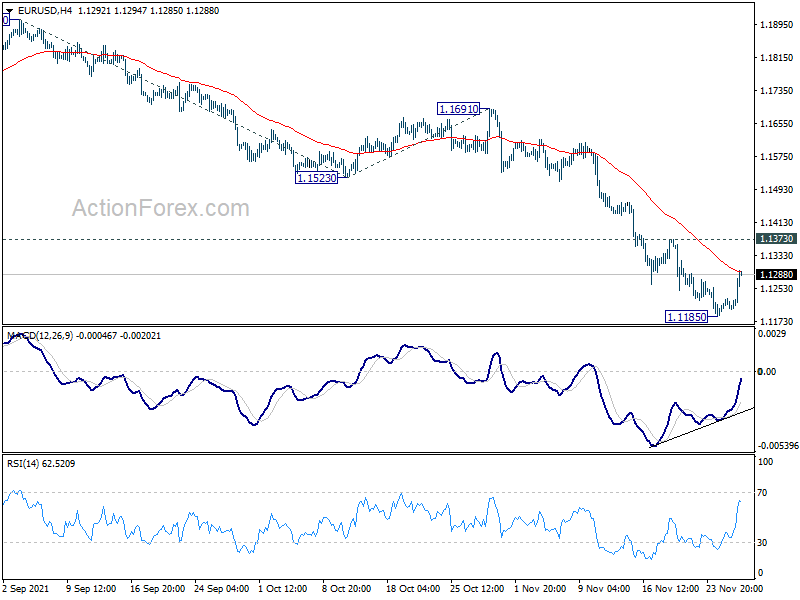
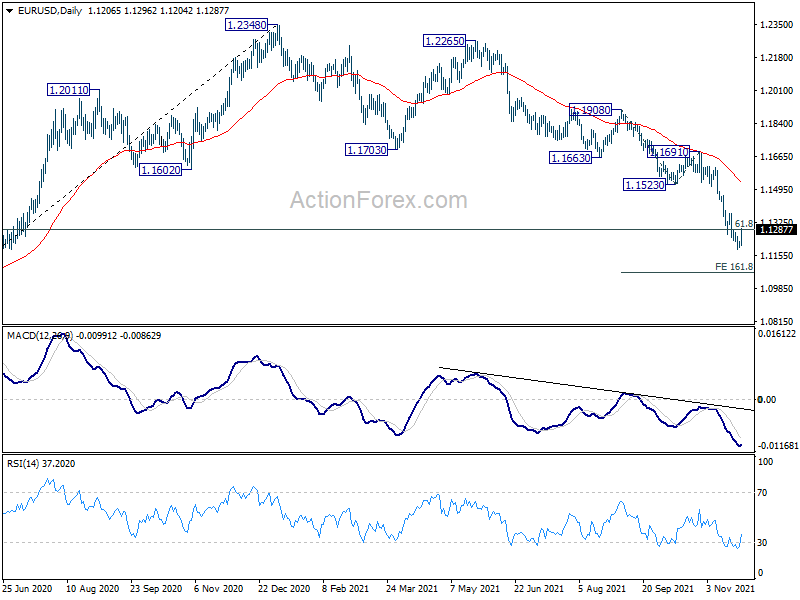
In the bigger picture, there are various ways of interpreting the fall from 1.2348 (2021 high). It could be a correction to rise from 1.0635 (2020 low), the fourth leg of a sideway pattern from 1.0339 (2017 low), or resuming long term down trend. In any case, outlook will now stay bearish as long as 1.1703 support turned resistance holds. Sustained break of 61.8% retracement of 1.0635 to 1.2348 at 1.1289 would pave the way back to 1.0635.
GBP/USD Mid-Day Outlook
Daily Pivots: (S1) 1.3299; (P) 1.3327; (R1) 1.3348; More...
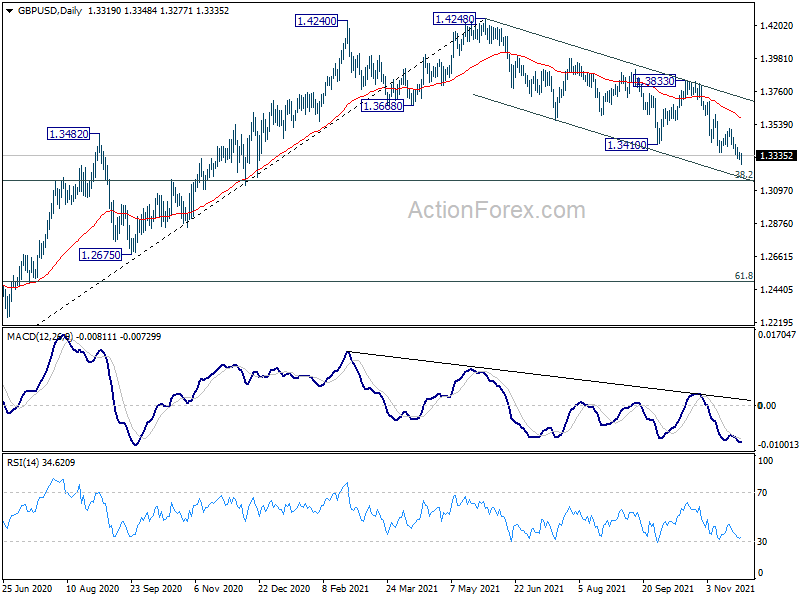
Intraday bias in GBP/USD is turned neutral with today's recovery. Further decline will remain in favor as long as 1.3512 resistance holds. Break of 1.3277 will resume the down trend from 1.4248 to 1.3164 fibonacci level next.
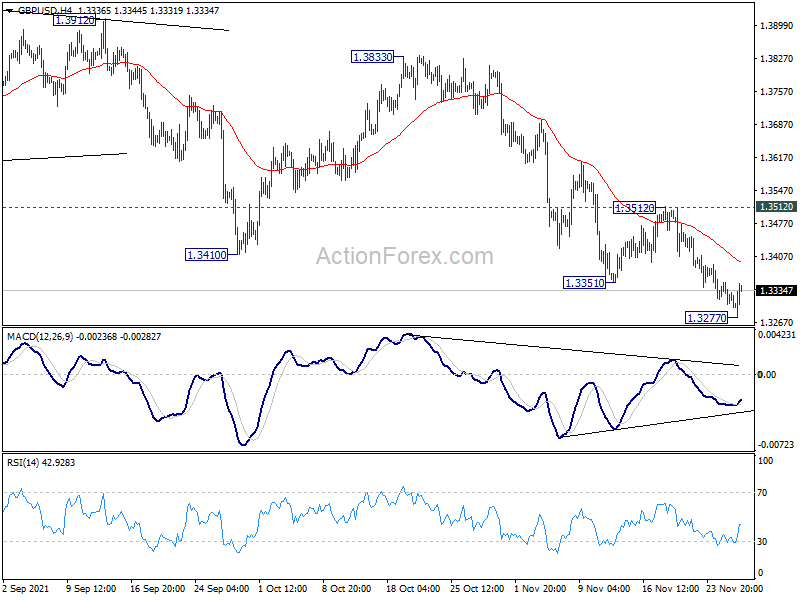
In the bigger picture, the structure of the fall from 1.4248 suggests that it's a correction to the up trend from 1.1409 (2020 low) only. While deeper fall cannot be ruled out yet, downside should be contained by 38.2% retracement of 1.1409 to 1.4248 at 1.3164, at least on first attempt, to bring rebound. On the upside, firm break of 1.4376 key resistance (2018 high) will add to the case of long term bullish reversal. However, sustained trading below 1.3164 will revive some medium term bearishness and target 61.8% retracement at 1.2493.
USD/CHF Mid-Day Outlook
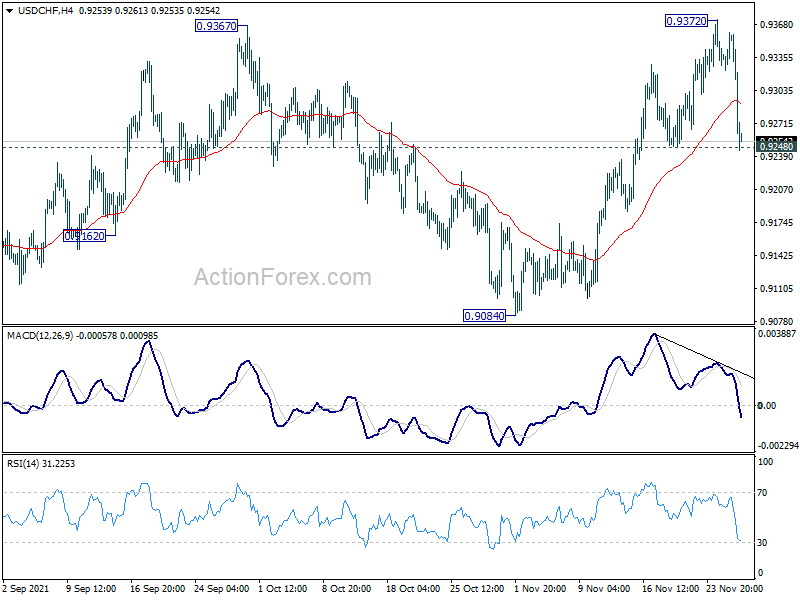
Daily Pivots: (S1) 0.9335; (P) 0.9348; (R1) 0.9372; More....
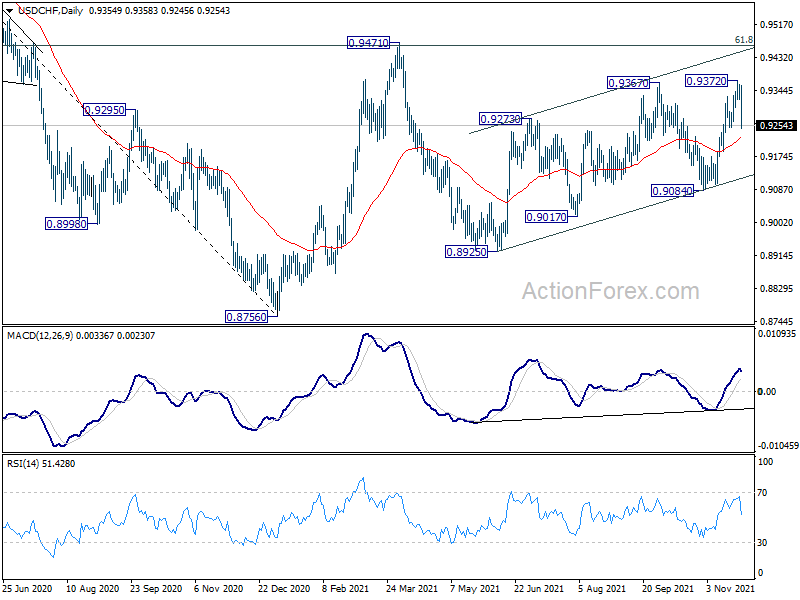
Focus is immediately on 0.9248 support with today's sharp fall. break will confirm short term topping and bring deeper fall back to 0.9084 support. Firm break there will indicate completion of whole choppy rise from 0.8925. On the upside, though, break of 0.9372 will resume the rise towards 0.9471 key resistance.
In the bigger picture, as long as 0.9471 resistance holds, larger down trend from 1.0237 (2018 high) could still extend through 0.8756 low. However, sustained break of 0.9471 will revive the case of medium term bullish reversal. In this case, we'd assess the change of retesting 1.0342 high at a later stage, by looking at the upside momentum first.
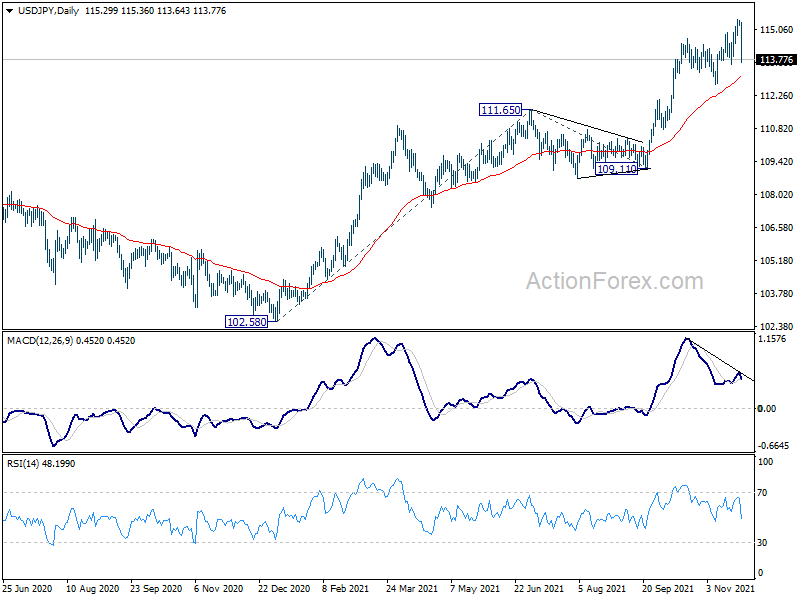
USD/JPY Mid-Day Outlook
Daily Pivots: (S1) 115.26; (P) 115.36; (R1) 115.48; More...
Focus is immediately on 113.58 support with today's sharp decline. Firm break there will suggest that fall from 115.51 is correcting the rise from 109.11 at least. Deeper fall would be seen to 112.71 support and below. On the upside, though, break of 115.51 will resume larger up trend from 102.58.
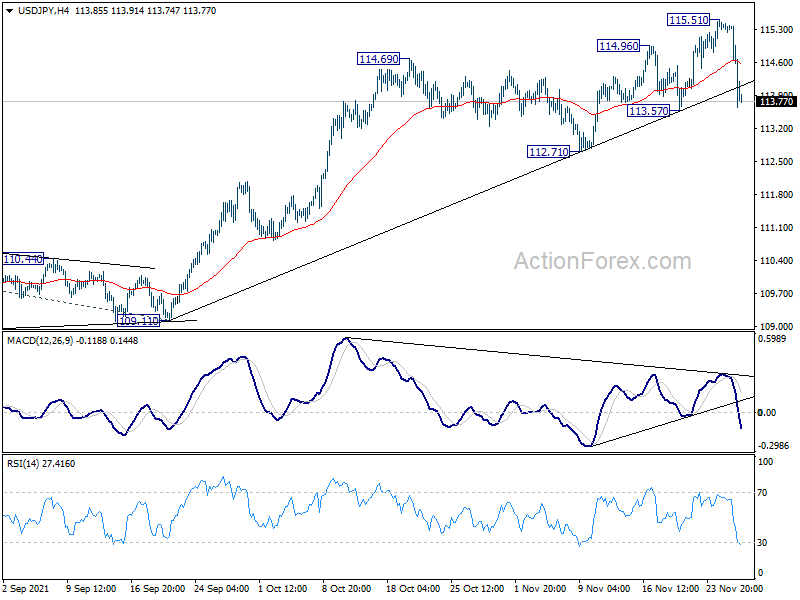
In the bigger picture, corrective decline from 118.65 (2016 high) should have completed at 101.18 already. Rise from the 102.58 is seen as the third leg of the up trend from 101.18. Next target is 118.65 high. This will now be the preferred case as long as 111.65 resistance turned support holds, even in case of deep pull back.
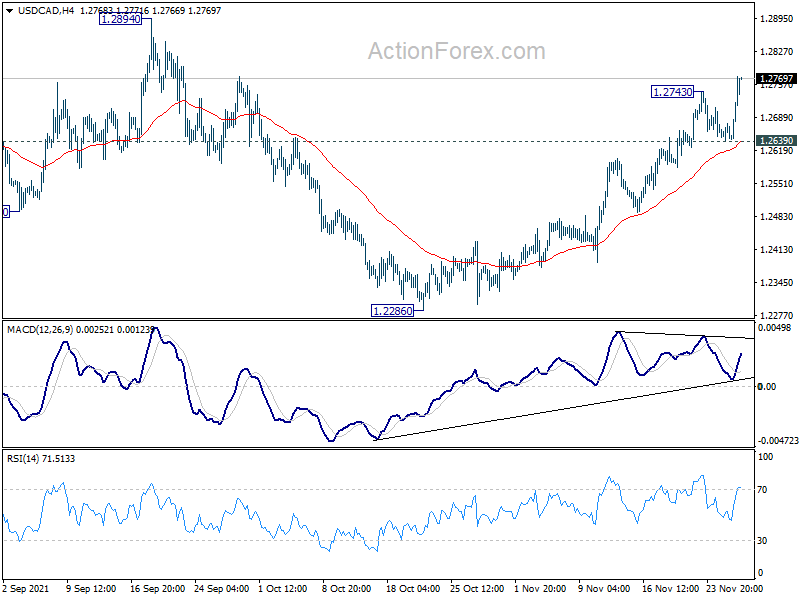
USD/CAD Mid-Day Outlook
Daily Pivots: (S1) 1.2634; (P) 1.2655; (R1) 1.2670; More...
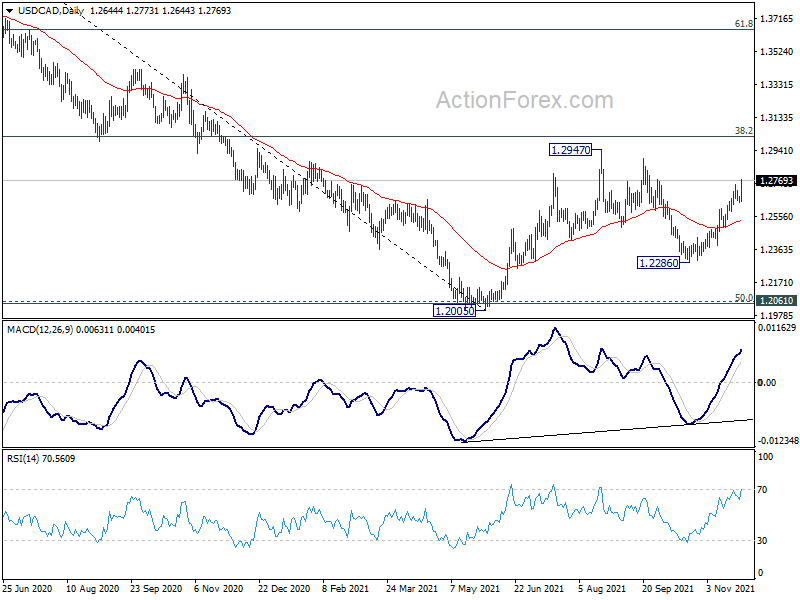
USD/CAD's rise from 1.2286 resumed by breaking through 1.2743 temporary top today. Intraday bias is back on the upside for retesting 1.2894/2947 resistance zone. On the downside, break of 1.2639 support is needed to indicate short term topping. Otherwise, outlook will remain bullish in case of retreat.
In the bigger picture, medium term outlook is neutral for now. The pair drew support from 1.2061 cluster and rebounded. Yet, upside was limited below 38.2% retracement of 1.4667 to 1.2005 at 1.3022. On the upside, firm break of 1.3022 should affirm the case of medium term bullish reversal. However, break of 1.2286 will turn focus back to 1.2005 low again.
GBP/JPY Mid-Day Outlook
Daily Pivots: (S1) 153.38; (P) 153.73; (R1) 154.03; More...
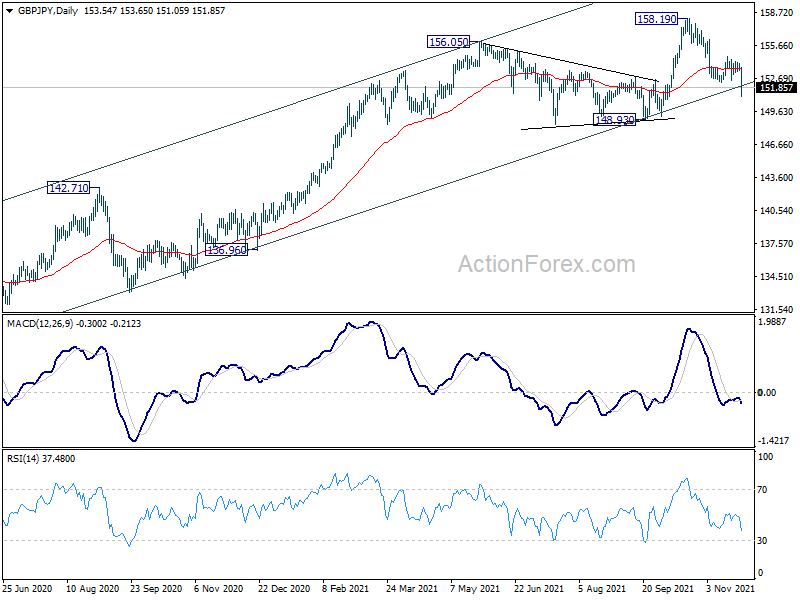
GBP/JPY's fall from 158.19 resumes by breaking 152.35 support and intraday bias is back on the downside. Deeper fall would be seen back to 148.93 key support. On the upside, break of 154.70 resistance is needed to indicate short term bottoming. Otherwise, near term outlook will stay bearish in case of recovery.
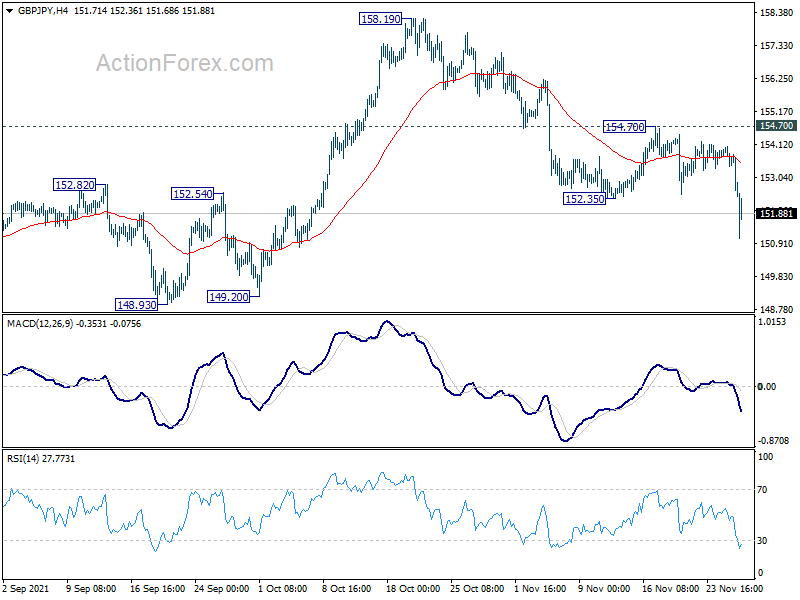
In the bigger picture, rise from 123.94 is seen as the third leg of the pattern from 122.75 (2016 low). Further rally is still expected as long as 148.93 support holds. However, firm break of 148.93 will argue that the medium term trend has reversed and bring deeper fall back to 142.71 resistance turned support first.